Day 37, Wednesday, October 4, 2023
We visit two prehistoric sites today. This morning we tour the Cap Blanc rock shelter. It is a masterpiece of prehistoric sculpture from the Cro-Magnon/Magdalenian Era. The path to the site is pretty with lots of moss covered trees.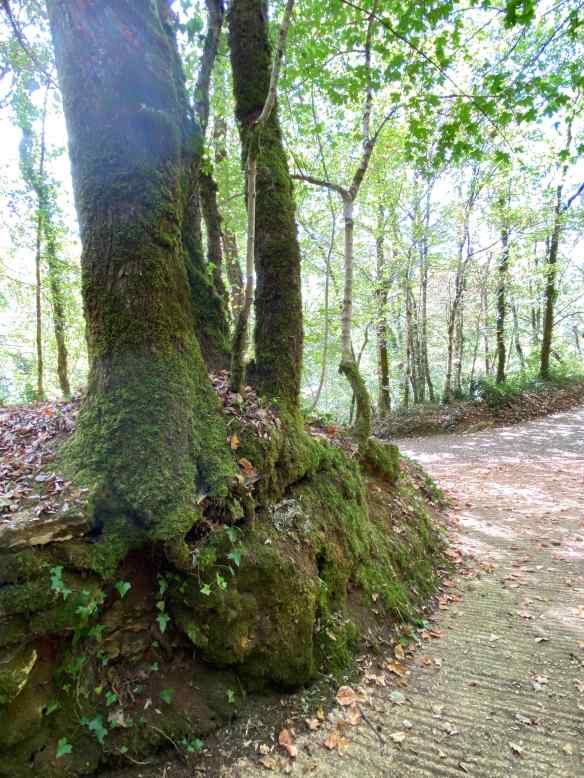
This is the building that was built to shelter the site. It goes right up to the cliff face so that the sculptures are protected inside.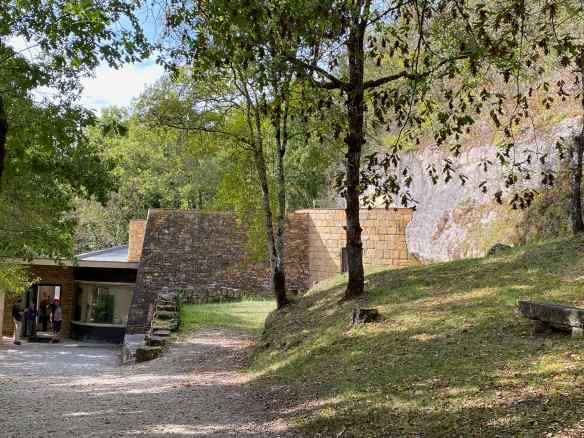
Today it is the only frieze of prehistoric sculptures in the world to be shown to the public. And we are able to visit! The red line is about where the frieze and the museum building is located. 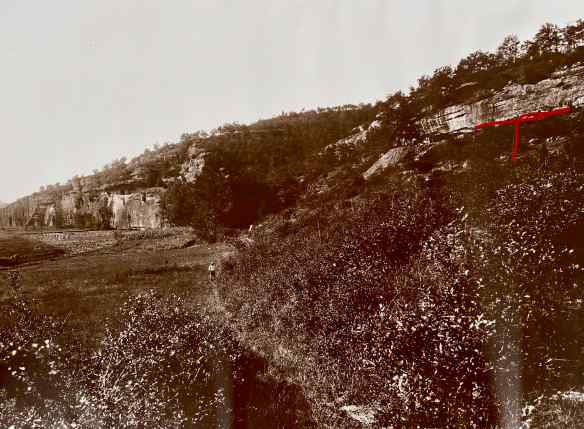
Of course, no photos are allowed. I buy a postcard so that I have a photo of the frieze, although it does not do it justice at all. There is absolutely no substitute for standing in front of this prehistoric sculpture which brings together horses, bison and deer.
The skeleton on the ground is a replica of the one that was found when the owner of the site dug down to build a wall to protect the site in the early 1900’s. It is a female, approximately 5’1″ tall and between 30 and 35 years of age. The owner of the site sold the original skeleton to a museum in Chicago where it still resides. It was first thought to be a young girl and the Chicago Museum called this skeleton Magdalenian Girl. Only later were scientists able to determine more accurate information about this skeleton, which has been carbon dated and is 30,000 years old. The frieze was made over 15,000 years ago, another 15,000 years after this woman was buried here. She was found in a fetal position with three large flat stones carefully placed over her body. A spear head was found with the body but there is no way to know if that was the cause of her death or not. The farmer who found this did not know anything about how to preserve information at an archeological site.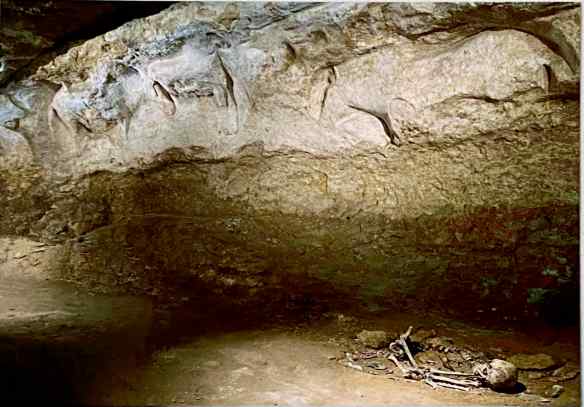
Here is a close up of one of the horses heads. I am amazed at how naturalistic they are, and the details that remain are amazing. Unfortunately the bottom half of the frieze was carved in a softer limestone and has eroded so the legs of most of the animals are no longer visible. When the original site was discovered in 1909 part of the overhang had fallen down and dirt had built up so that most of the sculptures were covered. There was quite a lot of damage done to part of the frieze when it was being uncovered. Pick axes were used to move the rock and dirt that had fallen down over the years and parts of the frieze were actually broken off by the very people who were trying to uncover it. There were also notes made about the frieze being painted red, but the people who uncovered it decided to wash all the dirt off of the frieze and in doing so they washed off the red colouring! Hard to believe, but archeology did not become systematic and disciplined in its approach to excavation until after the 1920’s.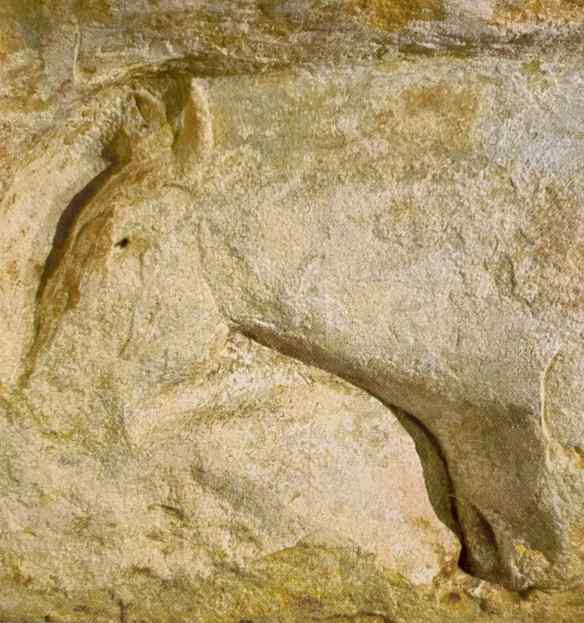 A scientist reconstructed the features of the skull that was found here. I think she is quite beautiful and yes, much like a modern woman. The jewellery is from an area near here but ti was not found with this skeleton. Magdelenian man, or Cro-Magnon man is regarded as the closest ancestor to today’s humans.
We have lunch in a little nearby village with a pretty little river and watch a heron try to catch its lunch. You can just make it out near the centre of the far river bank.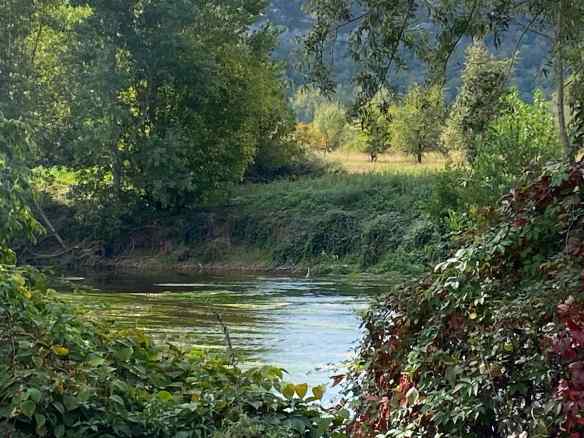
Huge limestone cliffs tower over the village…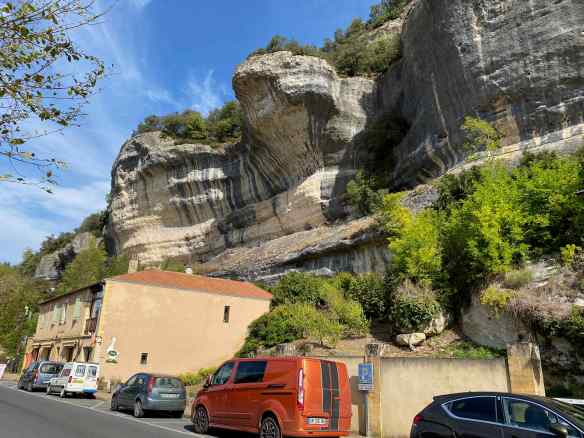
and there are houses and buildings still in use today that are built right into the cliffs. 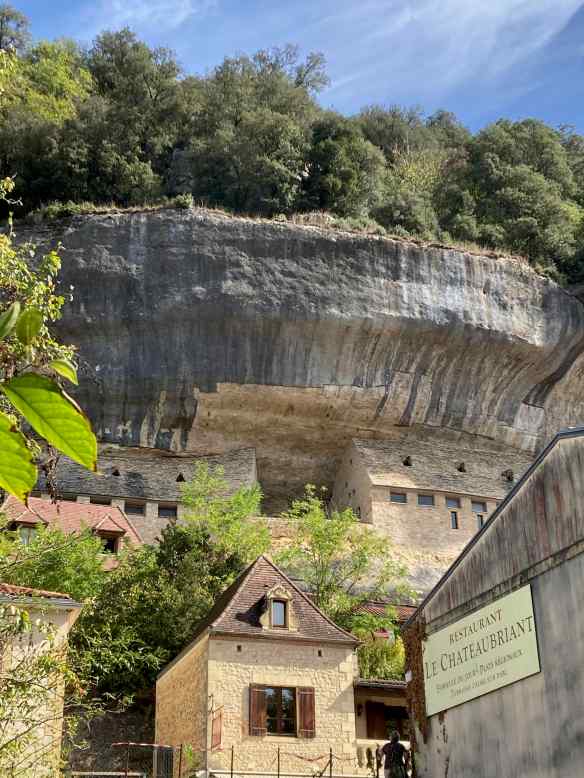
After lunch is a short drive to the Grotte des Combrelles. Grotte is cave in French.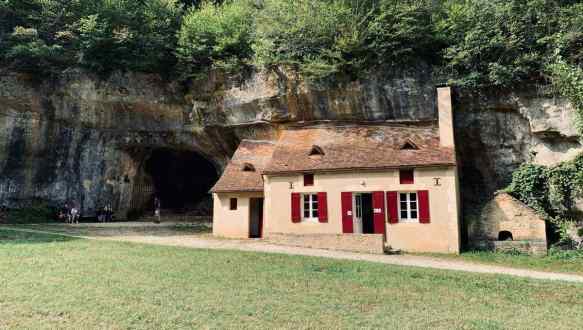 Inside the entrance building there are some drawings of the etchings in this cave. There are more than 800 rock engravings dating back to the era of Magdalenians, including 300 mammals, 52 stylized human figures, abstract signs and half a dozen sexual symbols.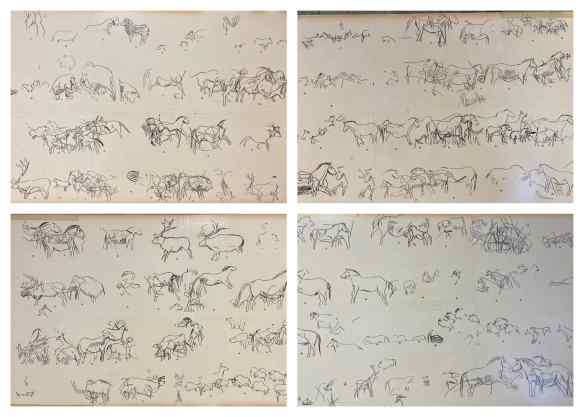
The entrance to the cave used to be used by a farmer to keep his animals before the entrance to the rest of the cave was discovered.
There are two entrances to the cave but only the one with the gate is accessible by the public. 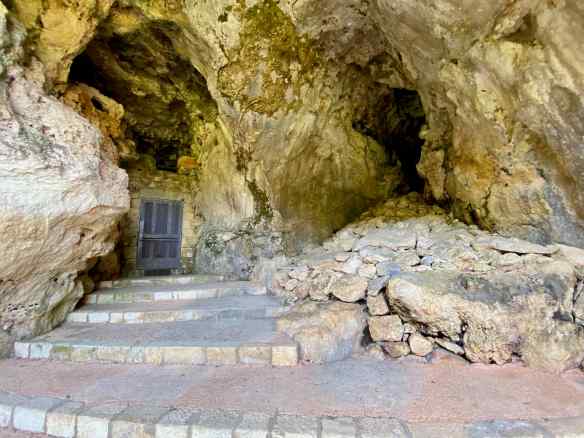
It is a long, narrow winding cave, 235 meters in length with no side channels. A maximum of seven people at a time are allowed in the cave because there just isn’t room for more than that to see the engravings in each location. As it is we have to snuggle up so that we can all see the engravings pointed out by our guide. This photo of a bison was in the office. The engravings are not always easy to see. 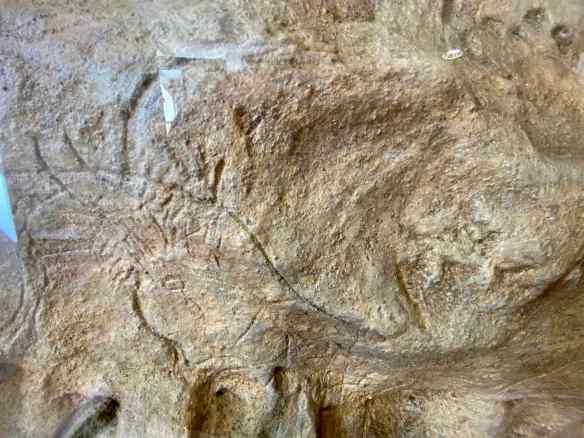
One of the best known engravings is the Drinking Reindeer. There are some abstract signs and several human representations. The humans are incomplete, they do not have heads, females are often represented by torsos or engravings of vulvas. Animals featured in the cave are horses, bison, aurochs, cattle, bears, reindeer, mammoths, ibex, antelopes, cave lions, rhinos and even the odd fox and fish. We only have time on our hour long tour to see the most prominent engravings, and part of the cave is not open to the public, but it is an amazing experience to stand just inches away from these engravings. It gives me goosebumps to think that I am standing in the same spot as the artist who made these engravings thousands of years ago.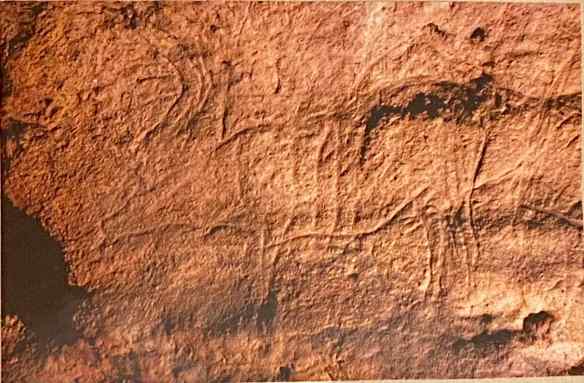
Back at our apartment Bob decides to taste the ingredients from our gift package. Unfortunately, the foie gras with walnuts just isn’t very appealing. It kind of looks like cat food and neither of us like it at all.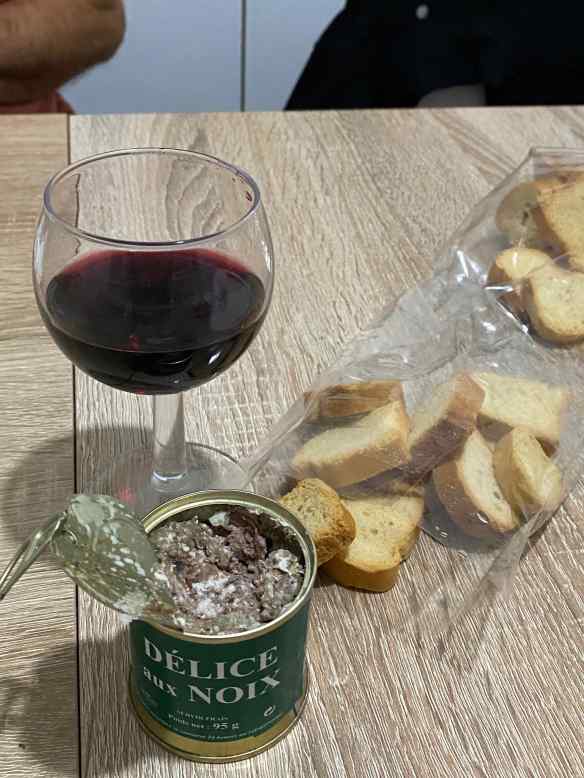
 trudymason.com
Spotted the heron. Learned a new term: auroch. Must have been absolutely astonishing to be so close to cave drawings of centuries ago!
<
div>Good thing they don’t typically have earthquakes with all th
LikeLike
It certainly was! Just amazing!
LikeLike