Day 22, Tuesday, September 19, 2023
Here we are walking out to Mont St. Michel. It is a three kilometre walk from the car park to this UNESCO World heritage site. Be warned, this is a photo heavy post.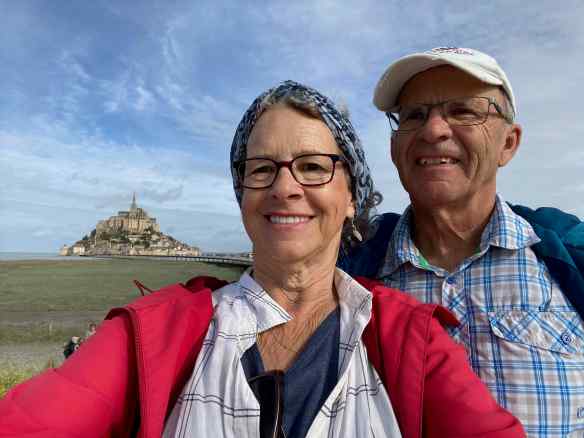
The sheep under the bridge attract a lot of attention. I wish I had time to sit and draw them, but Mont St. Michel beckons…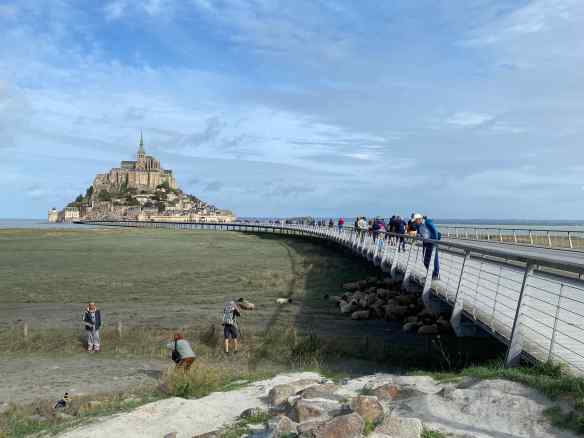
Almost there!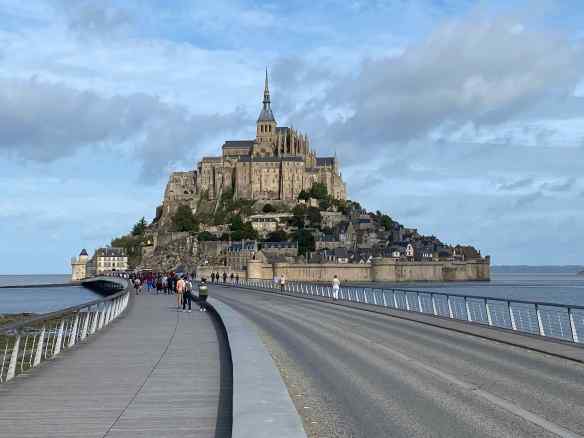
We climb the ramparts right after the entrance gates while the sun is shining. There is a chance of rain this afternoon. The Abbey church dominates the skyline.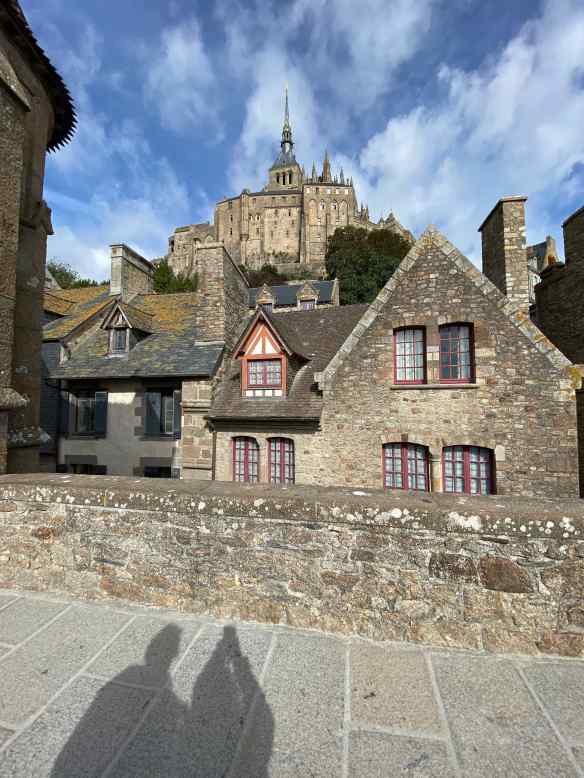
The streets below are crowded and more people are arriving by the minute. The group with the white hats are pilgrims from Southern France. I spoke to one of the ladies later in the day who sat by us while we were having lunch.
I love the little conical roof over the dormer window.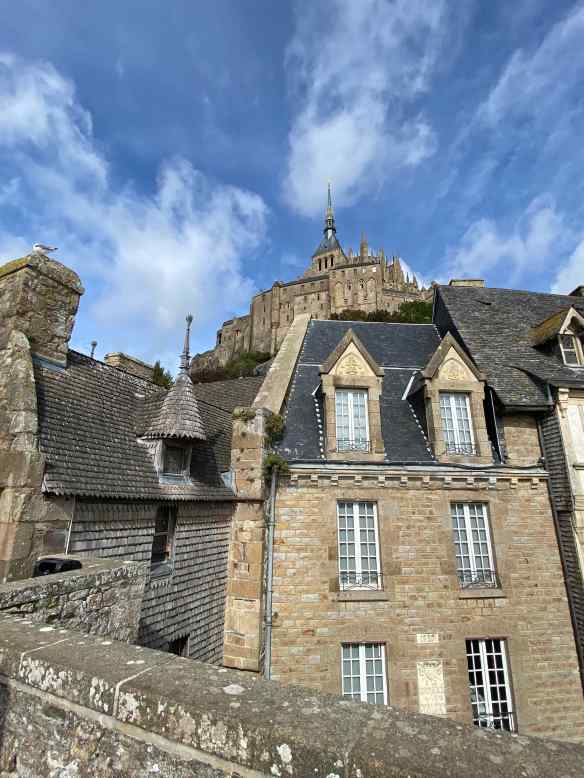
The streets are narrow and they fill up quickly. We are told that in high season you can barely walk through the streets as there are so many people.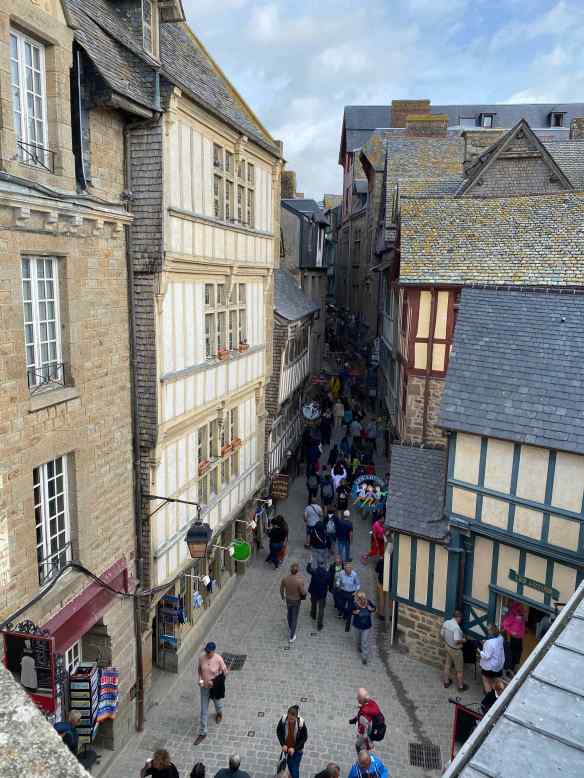
Soon we are among the hordes of people climbing the tall narrow 319 steps to the Abbey.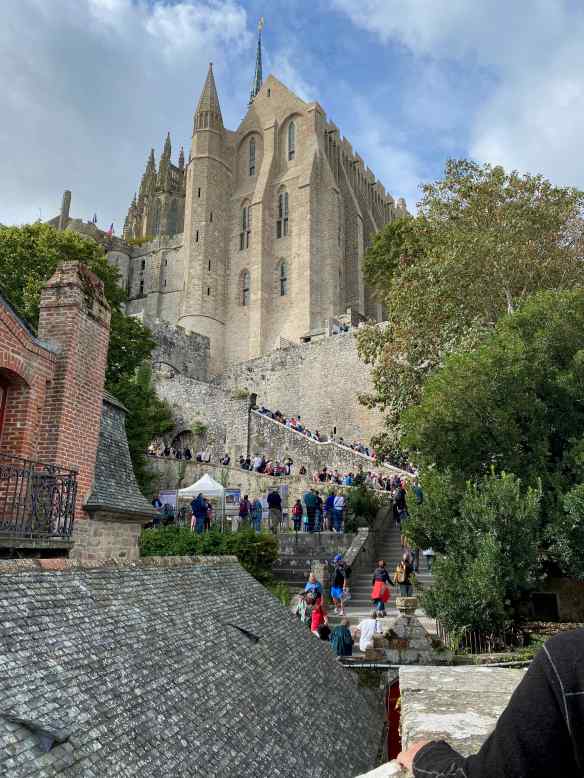
We bought our tickets online so we get to walk right past a long line of people waiting to buy tickets.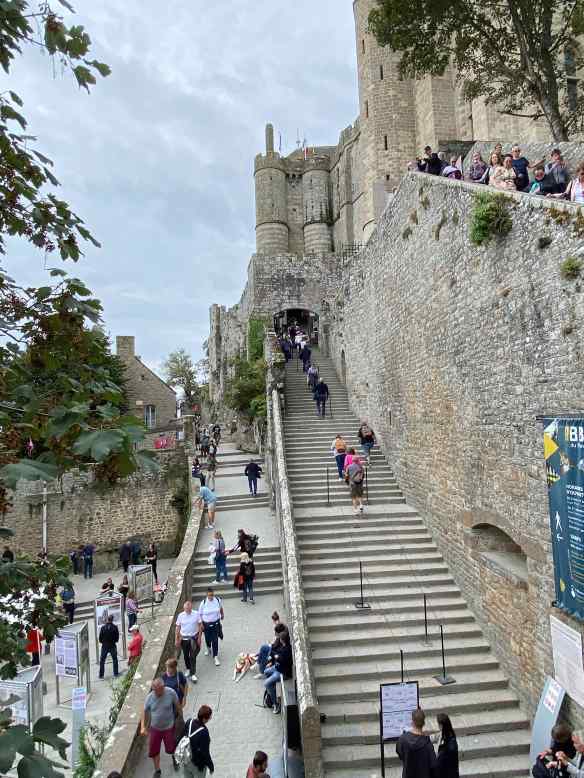
This model of the abbey shows the back side which is only visible if you walk on the sands at low tide or travel by boat.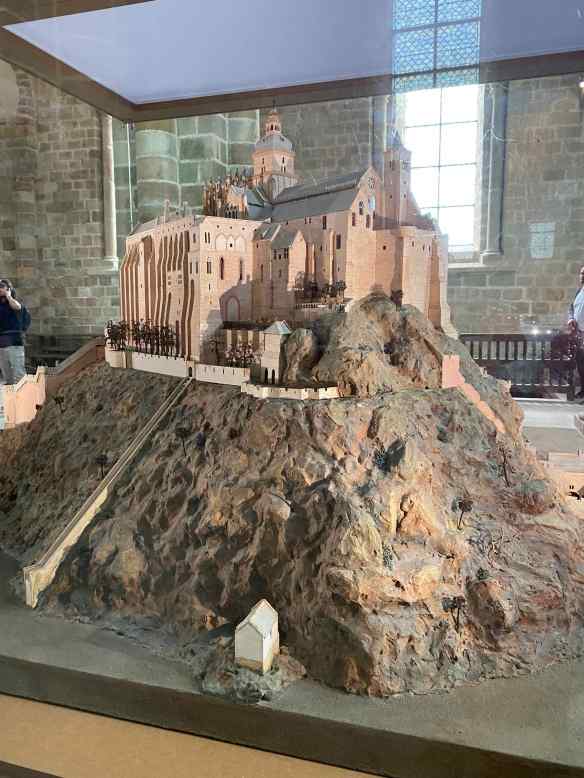 There are usually 5 monks and 7 nuns who live at the abbey and there are only 25-30 people who actually live on Mont Saint Michel. We sat and listened to part of the mass, from the side of the church. The singing was really lovely and I found it interesting that the nuns and the priest sat on the floor of the church during the service.
Next we walk through the cloister with its many narrow columns and a view of the church tower.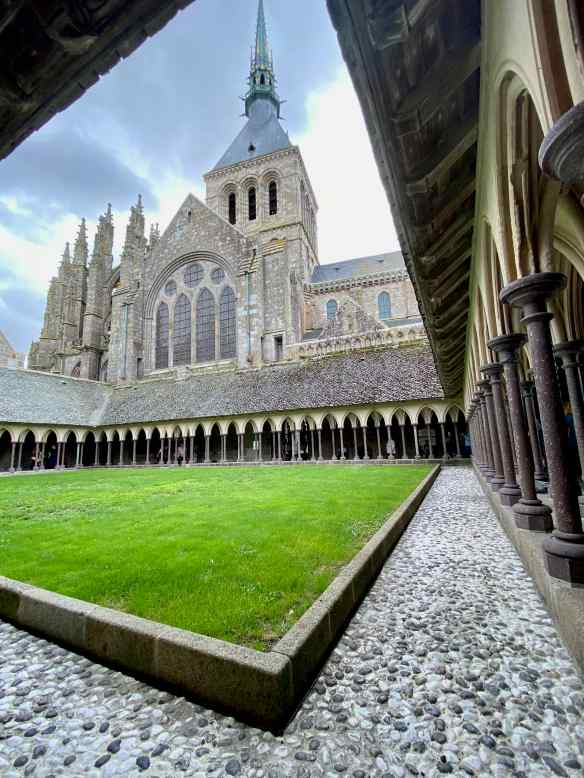
The Host’s room has two enormous fireplaces. Here I am standing in one and the little round circle is looking up the chimney towards the sky. This is where food was prepared and where the Abbot received important visitors. The bottom photo is the Refectory where the monks ate their meals.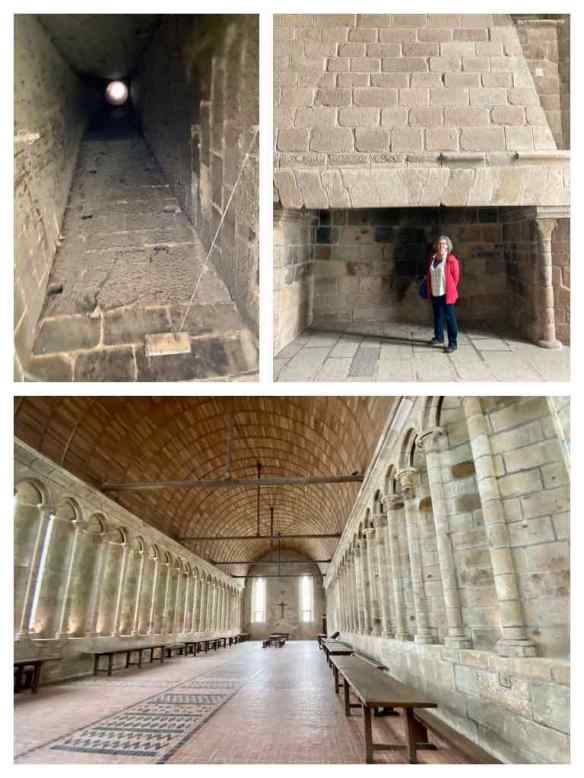
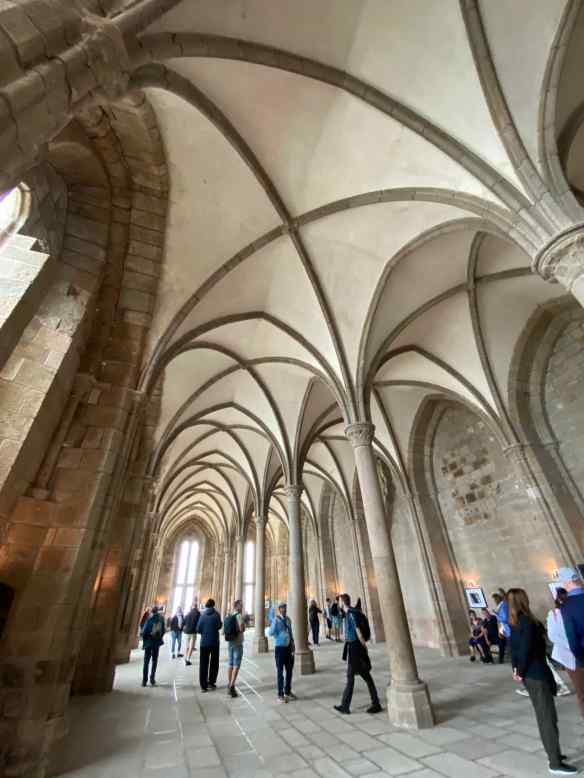
Another view of the Host’s room with its beautiful arched ceiling.
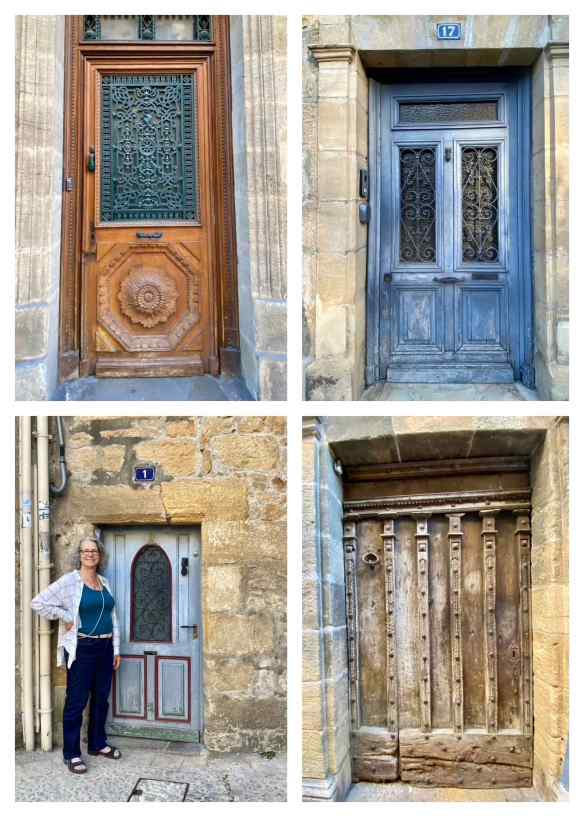
 There are so many interesting doors in this abbey.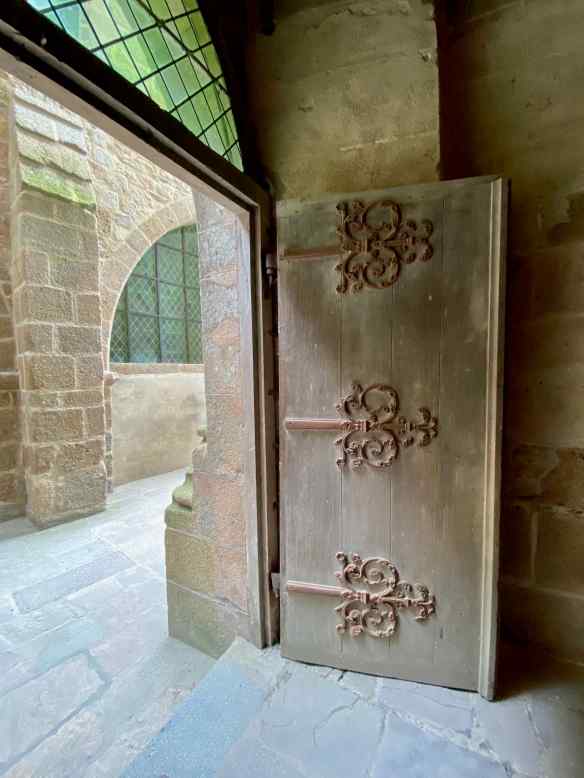
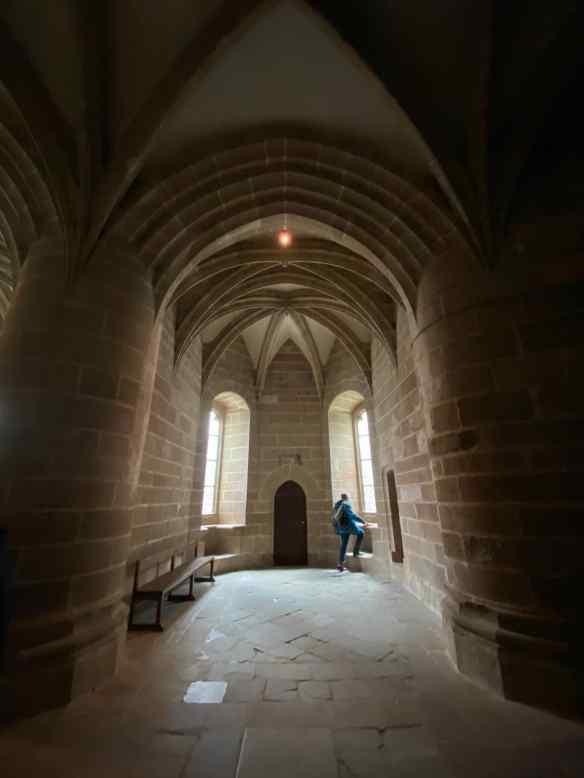
The Crypt des Gros Pillars (Big Pillars’ Crypt) with its ten huge pillars was built to support the choir in the abbey above.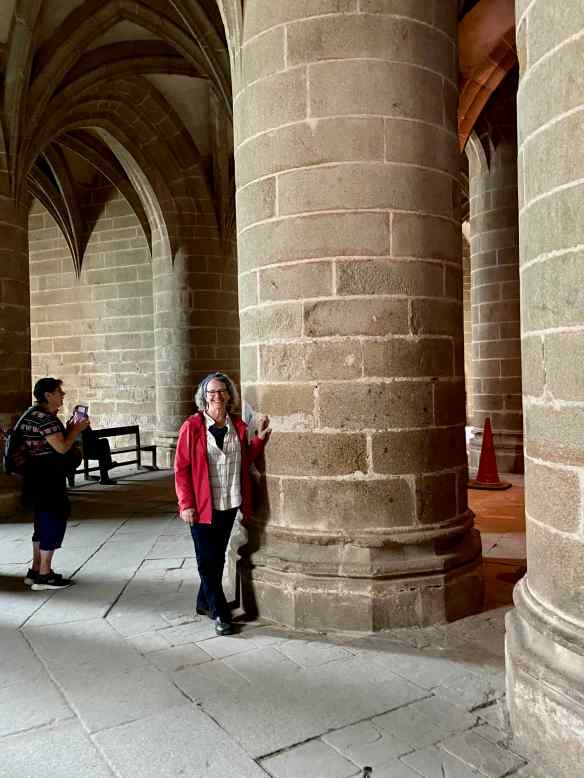 There are so many smaller rooms and interesting spaces to be explored. This one is off the side of the crypt.
 When the Abbey was used solely as a prison in the 1800’s, this huge wheel was was used to haul supplies up to the abbey. Prisoners walking inside the wheel were able to raise and lower a cart along a stone ladder inclined along the rock wall.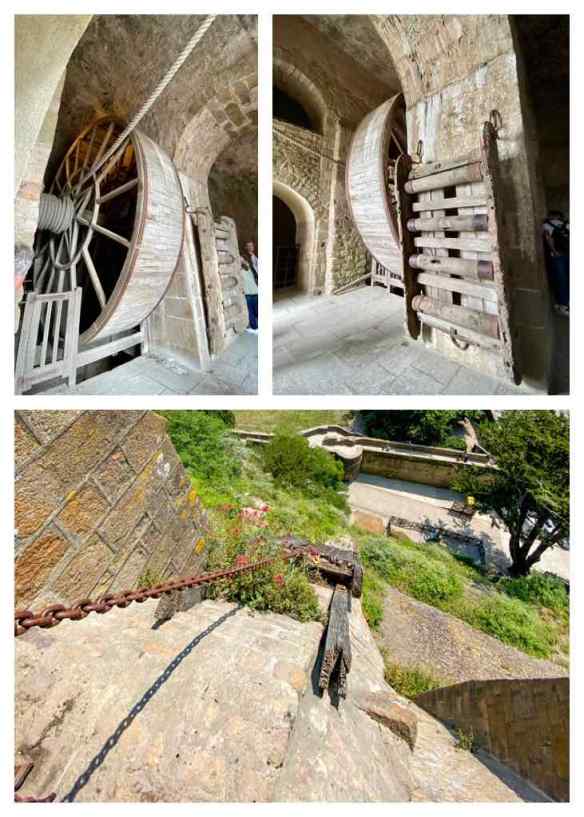
Here you can see where the cart was hauled up the side of the abbey.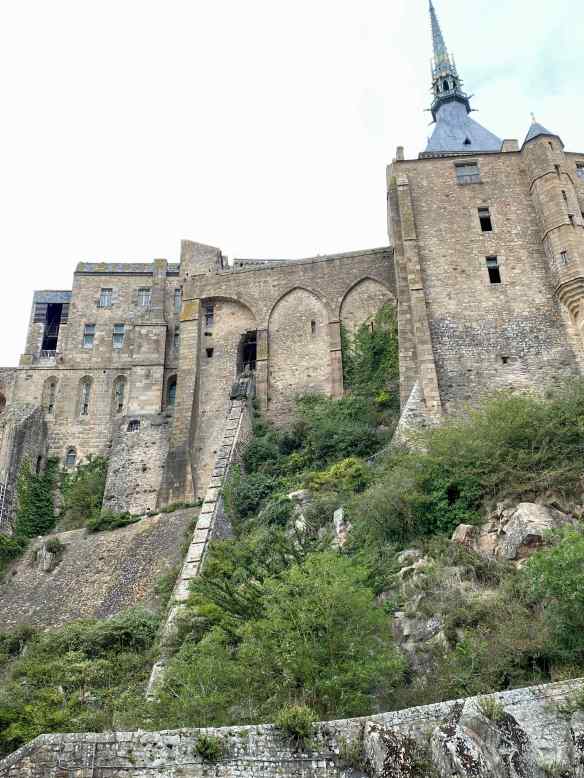
The Salle des Chevliers or Knight’s room was most likely used by the monks as a place of meditation and for copying and illustrating manuscripts. 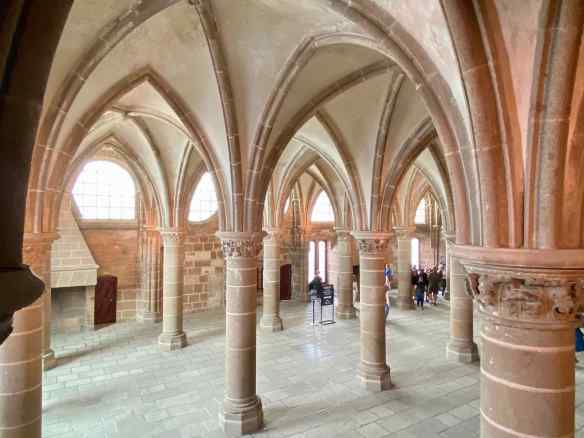
When we walk out into the gardens we see that the ocean is now at low tide and the sand bars are visible all around Mont St. Michel.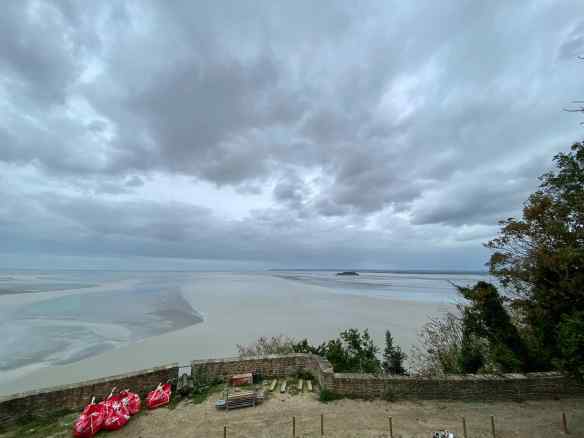 We hear shrieks and peals of laughter and realize that is is coming from the people out walking on the sands now that the tide is out. Some of them are thigh deep in the water! There are a lot of people out there, some of them way off in the distance. Thanks, but I am happy to pass walking in mud and cold water.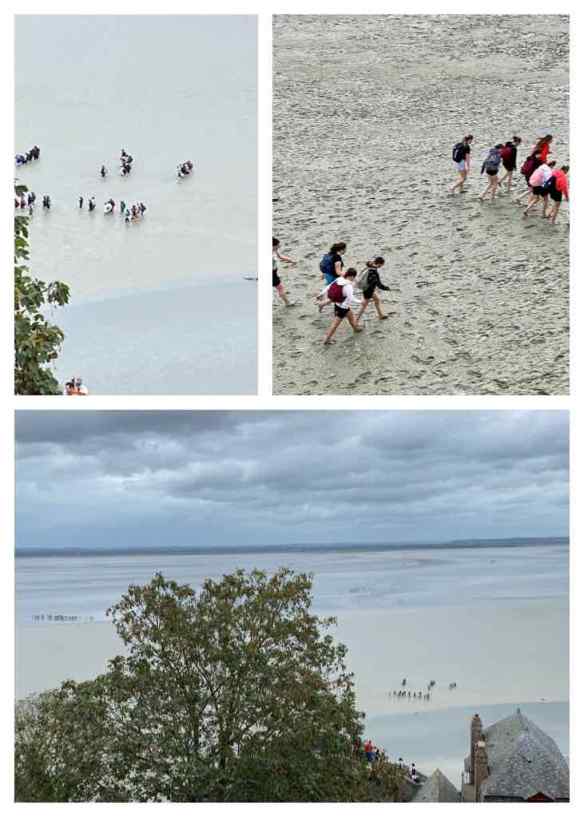
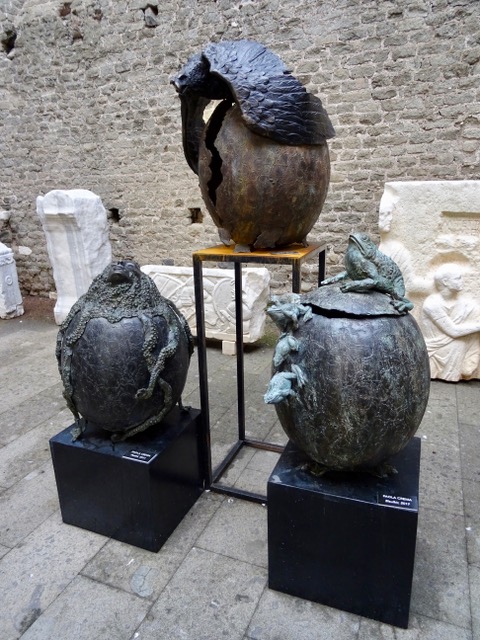
We stop at this little art gallery and I have chat with the artist. She has a variety of different styles and media, and I found her work very appealing. 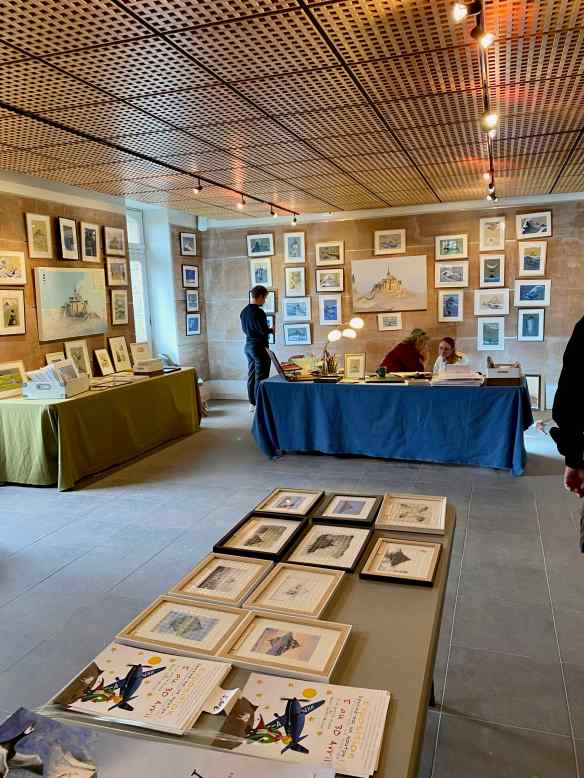
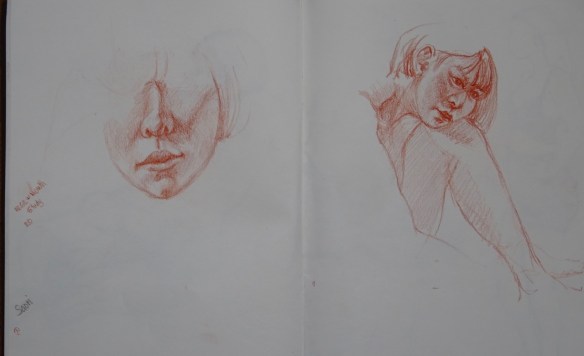
It starts to rain so we duck into the Parish Church of St. Peter for a well needed sit down. I draw the statue on the wall while Bob rests and then goes for a little walk about so that I have time finish my drawing. 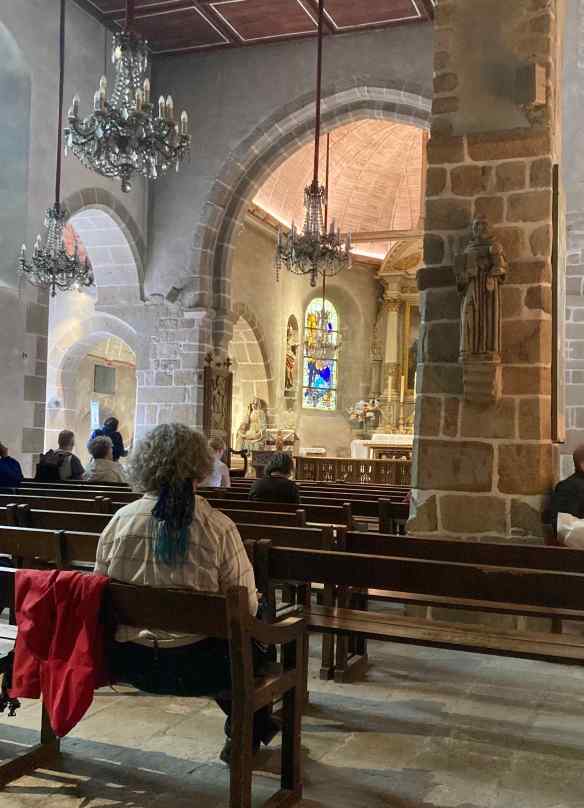
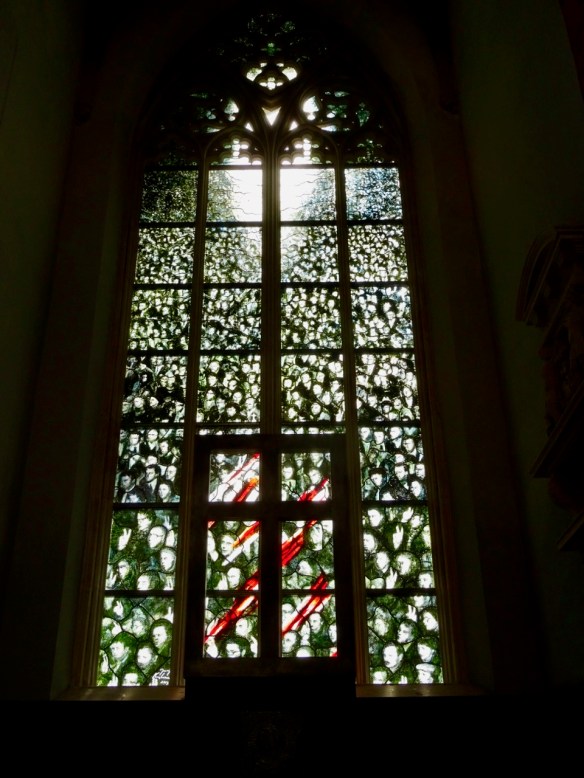
I forgot to see if there was plaque saying who the sculpture was.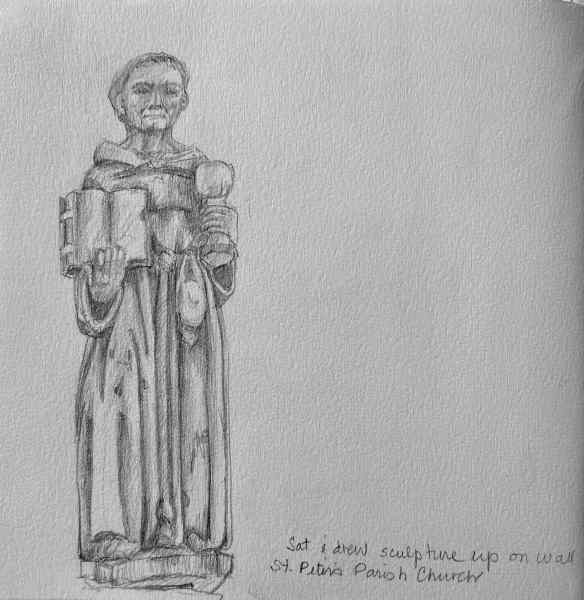 Bob took interesting photos of the inside and outside view of these two stained glass windows.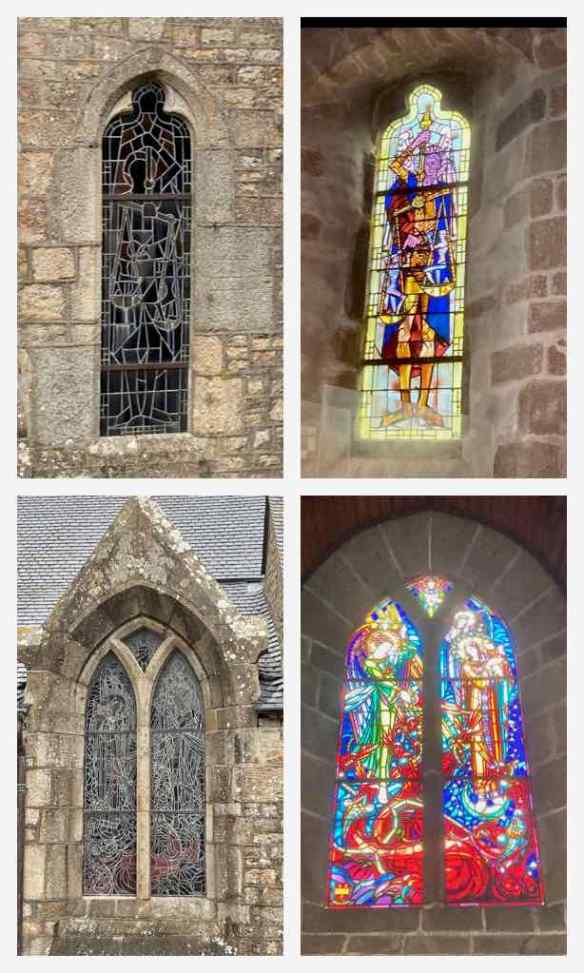
People are still coming and going…lots of people!
This photo of the bell tower just barely shows the golden statue of St. Michael threatening a dragon, who represents evil, with his sword. St. Michael is perched 156 metres high, is 4.5 metres tall and weighs 520 kg. The statue is made of gilded copper and serves as a lightning rod.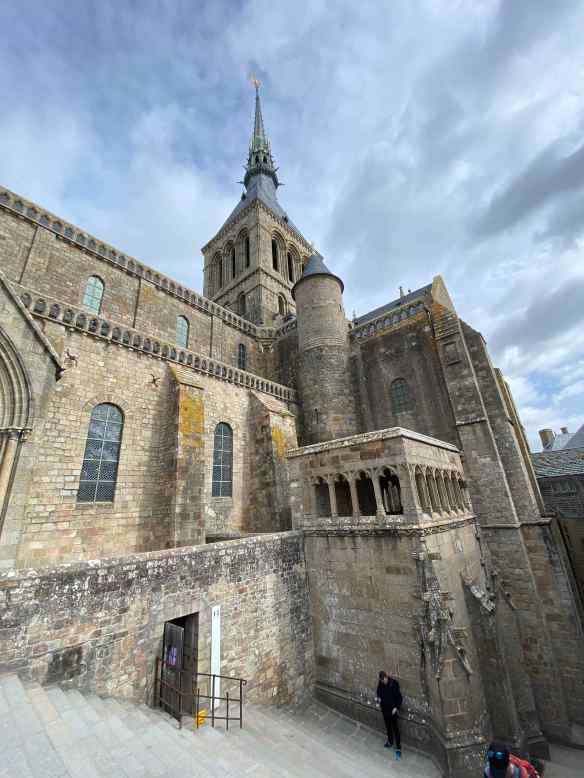
We wander the back streets which most people seem to ignore. There are lots of steps….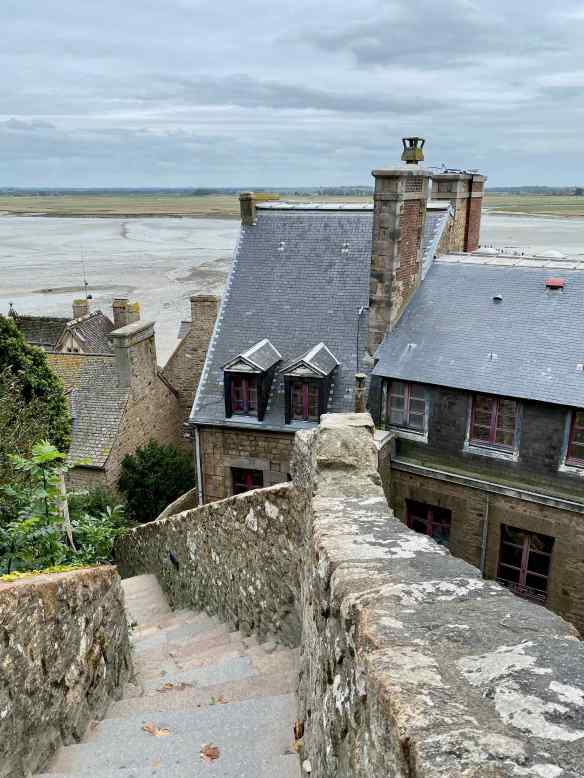 …interesting details…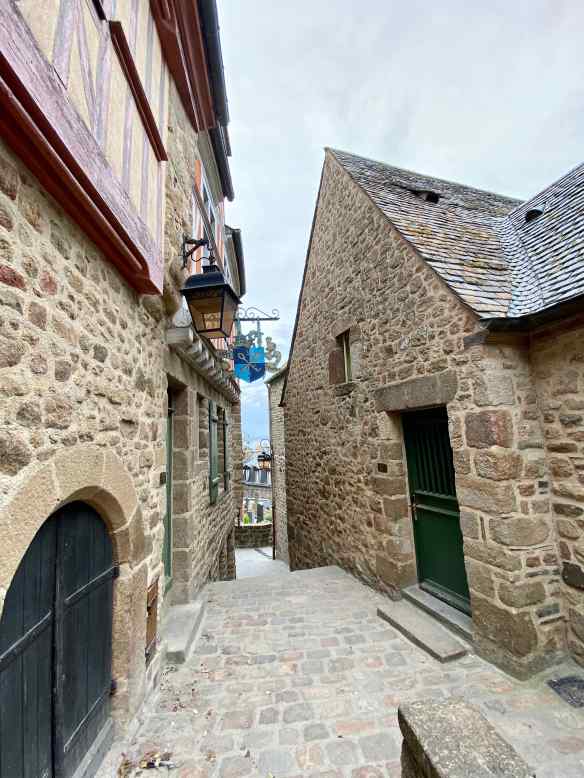
…narrow streets…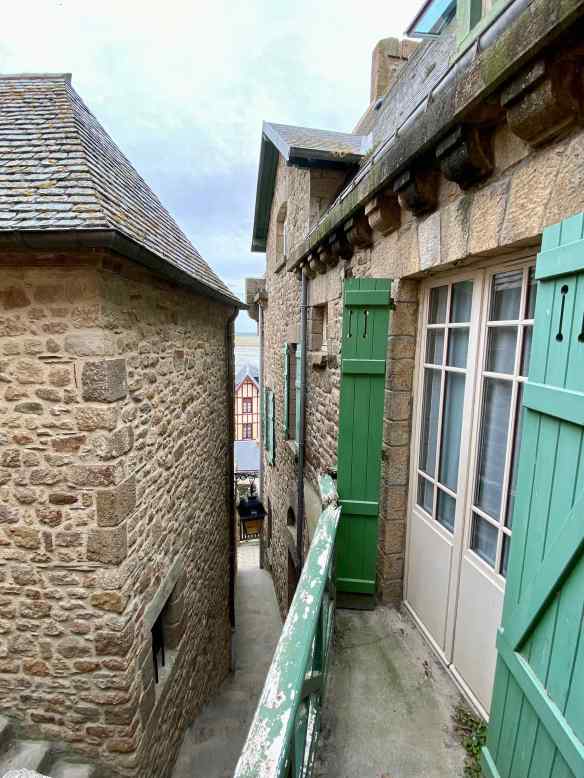 …crooked roof lines…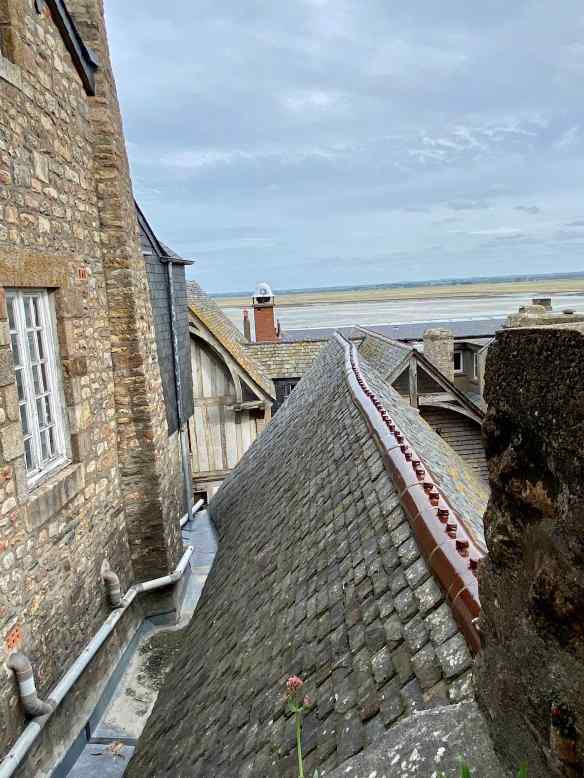
…fantastic rooftop views…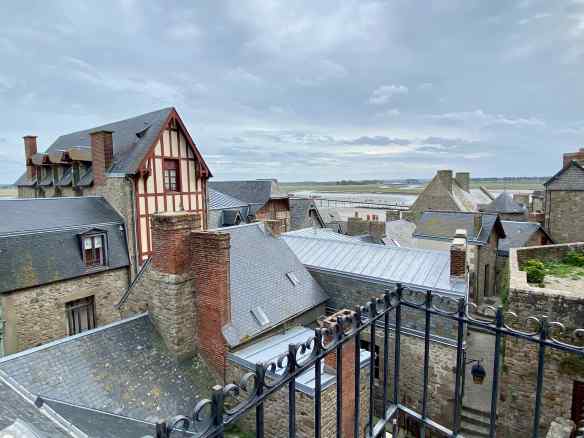
…more steps and stone walls…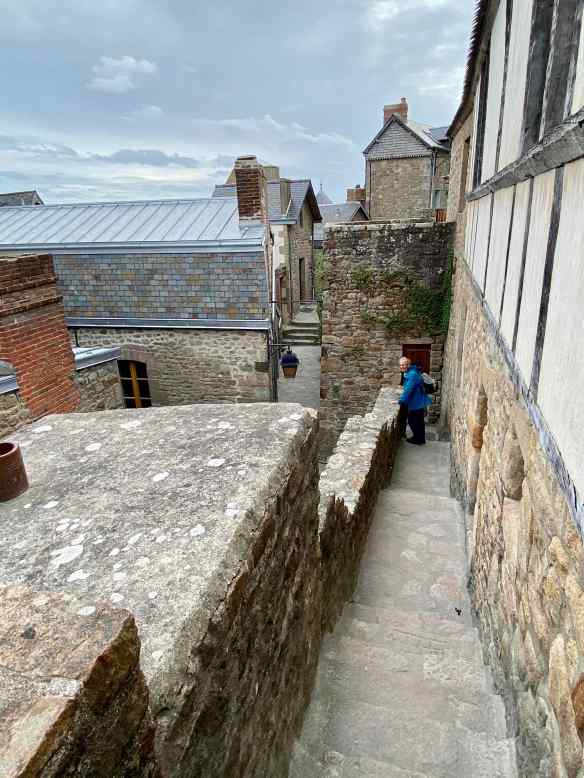
…the narrowest street ever…This is Cuckold’s Alley!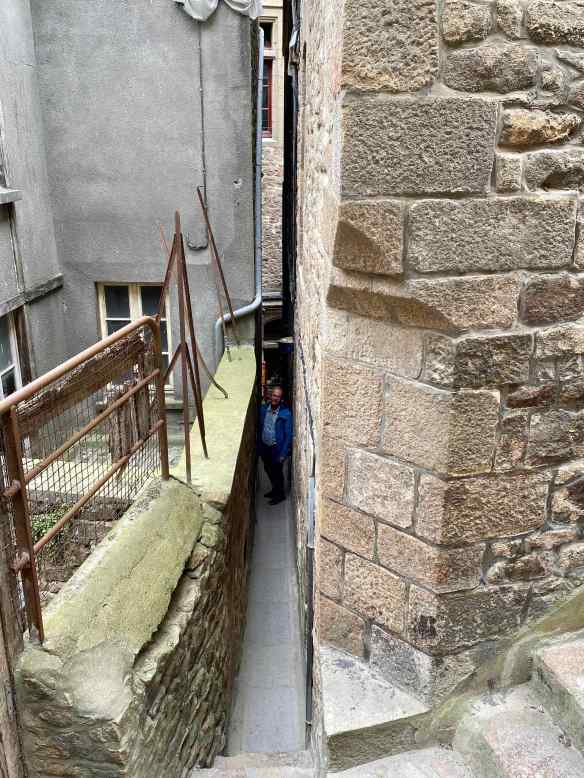
I think I may have mentioned steps…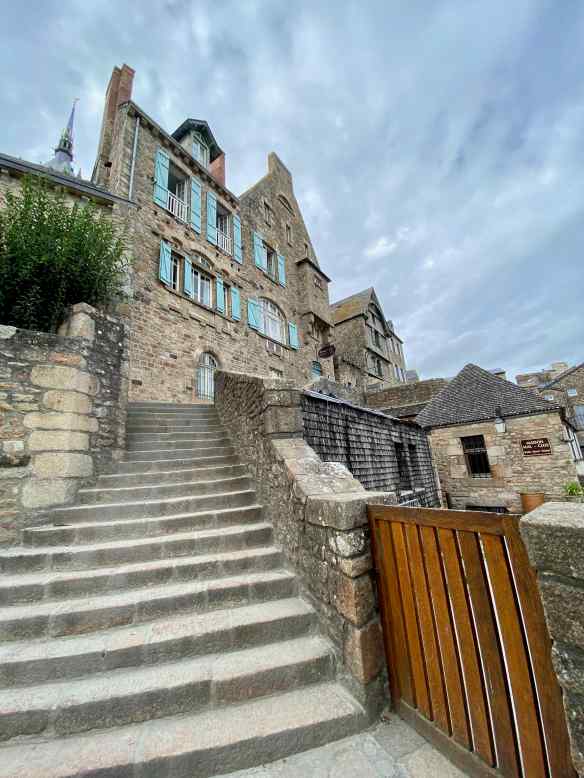
and buildings tucked into the strangest places…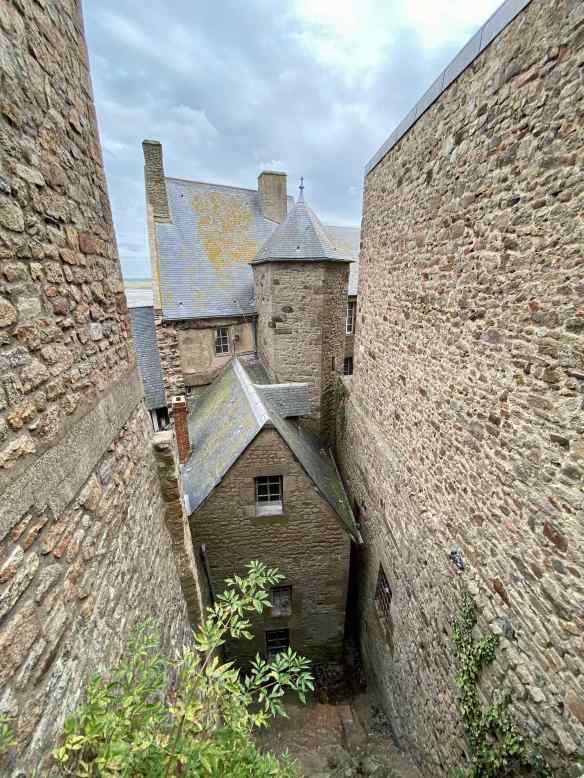
…and more steps with a tiny view of the ocean… 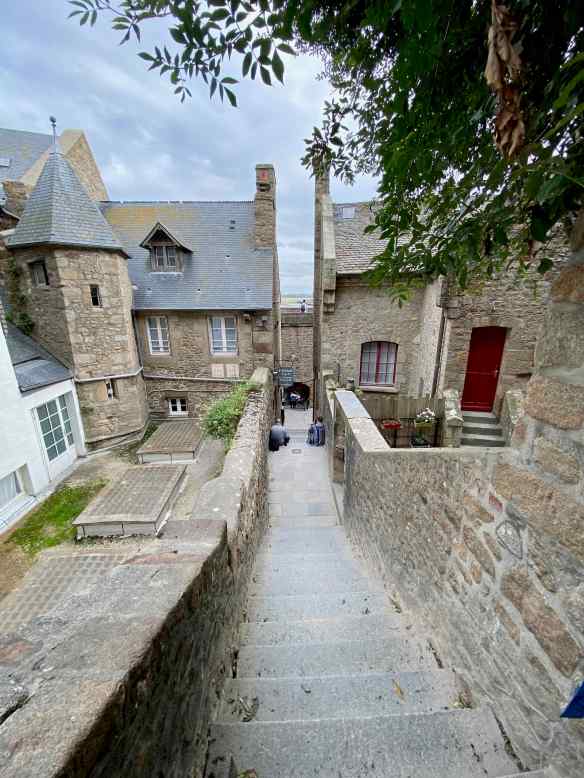
…which leads us back to the Main Street.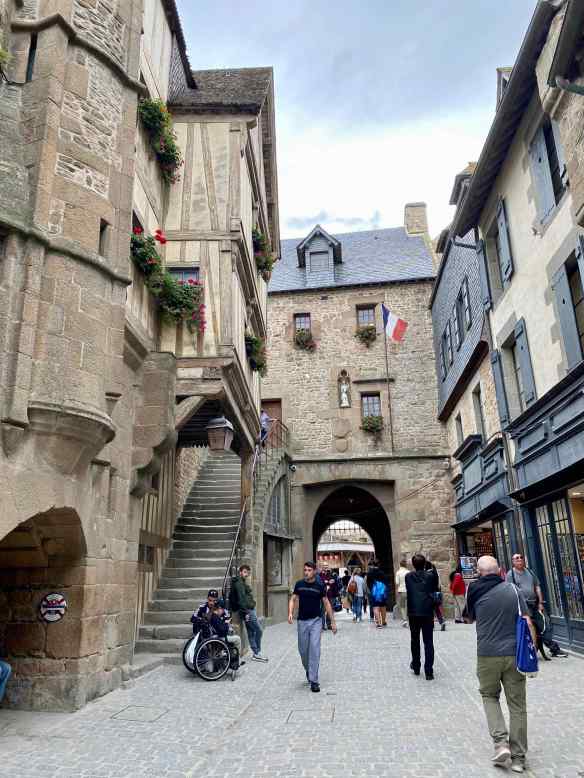
Time to cross the drawbridge and leave Mont St. Michel.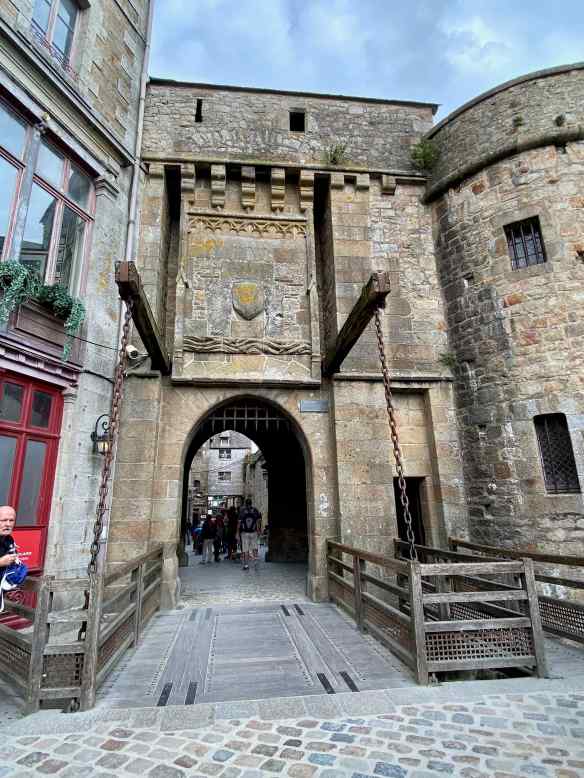
We say goodbye to Mont St. Michel after 7 hours of exploring this fabulous island. 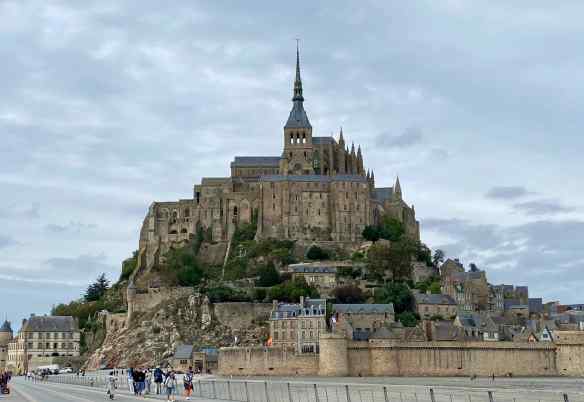
Day 21, Monday, September 18, 2023
Yesterday was a stay at home day. No photos, just relaxing and catching up on my blog and planning the next part of our trip.
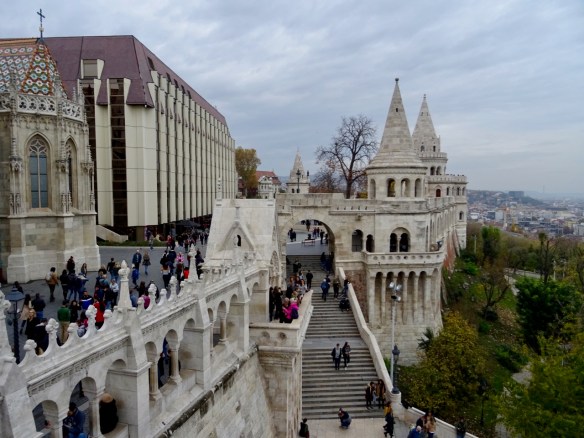
 We visit the Buda side of Budapest today. First stop is the Matthias Church, located in the Holy Trinity Square in front of the Fisherman’s Bastion. It has a beautiful tiled roof and a 60 metre tall bell tower.
 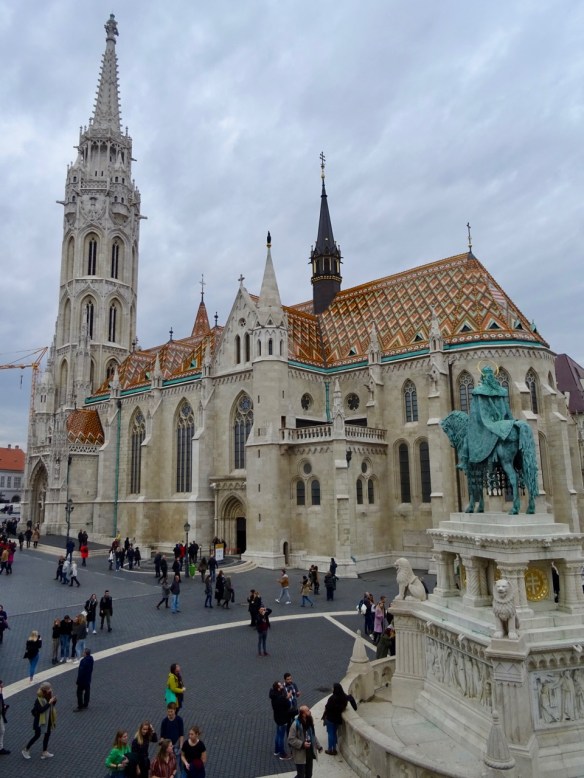 There are a lot of people here.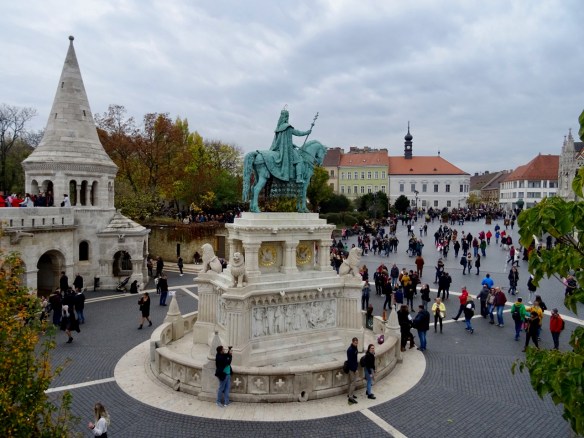
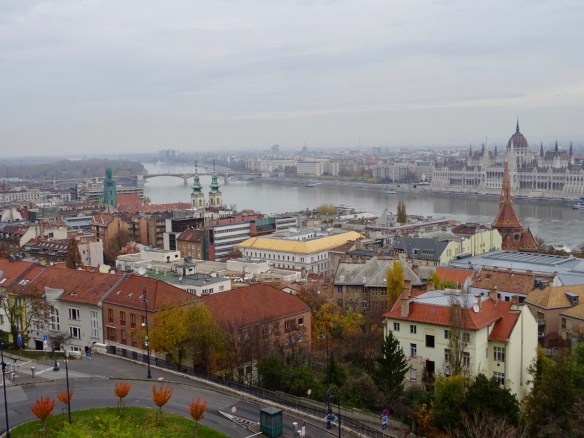
 One of the many great views from the Bastion.
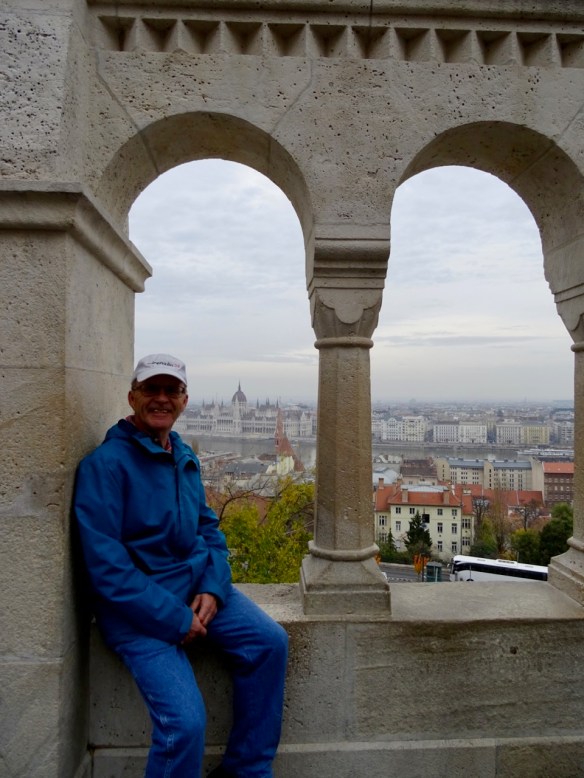
 We had to wait a bit to find an arch not filled with other tourists. It often takes a while before I can get a decent photo, which involves deciding where I can get the best view and waiting until vehicles and other people are not in my picture frame. Bob is very patient, waiting for me to take photos. I probably take at least 5 or 6 photos for every one I use in this blog.
 The Bastion was inspired by the architectural style of the early medieval times. It has many towers and was meant to feel like a fairy tale castle, as it wasn’t built for defence.
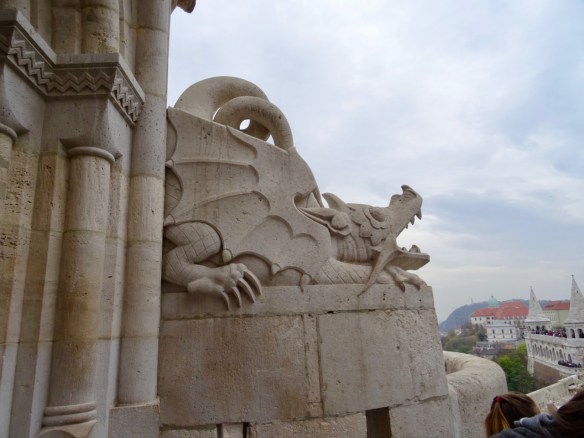
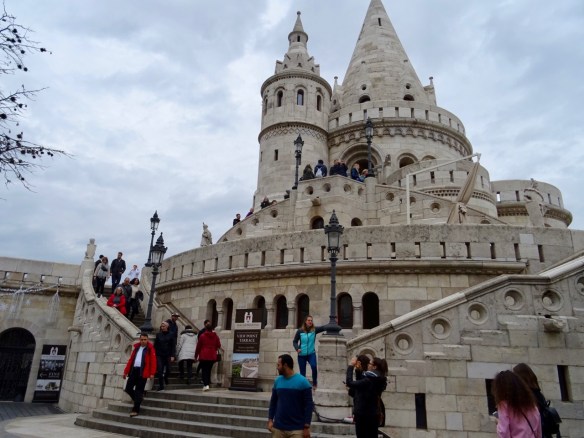 I am always happy when I find a dragon!
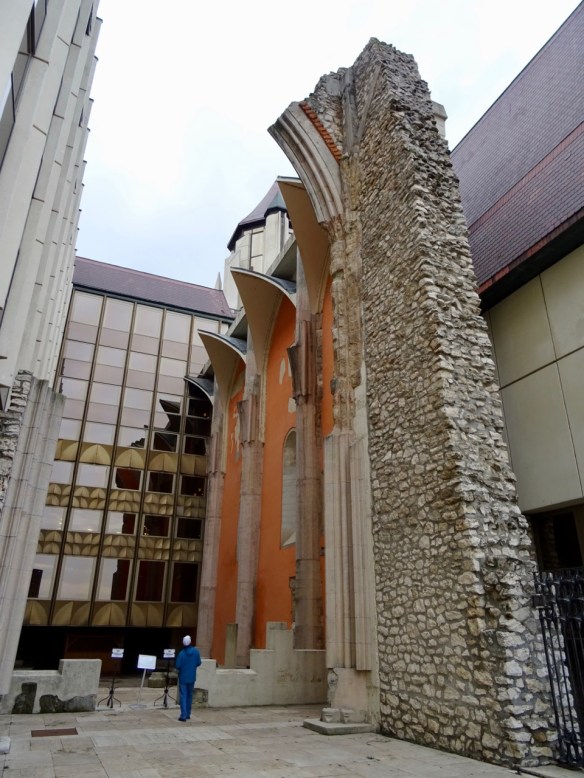
 These medieval church ruins were built into the modern Hilton Budapest Hotel.
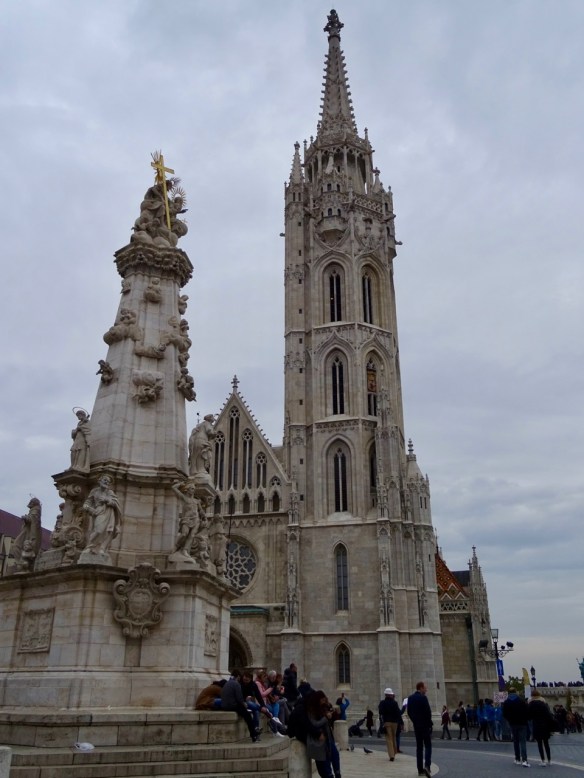
 The Black Plague caused the death of 30-60% of Europe’s total population in 1691 and 1709. People believed that erecting a column would protect them from the plague. The carving on the top of the column represents the Holy Trinity. Below this the whole column is decorated with smaller statues depicting angels, and saints. The central sculpture shows King David praying to God to let his people avoid the outbreak of a plague. Residents believed the Holy Trinity Column did its job, as the plague never returned after 1709.
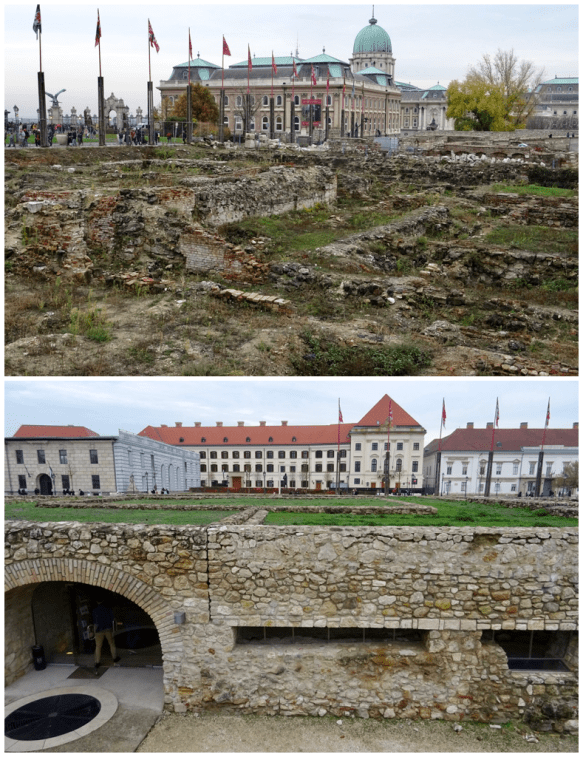
 On our walk to the nearby Buda Castle we pass these Medieval ruins. Beneath some of the ruins there is a wine cellar which offers wine tastings. It is located below the remains of a 13th century Dominican Cloister, which is part of a huge labyrinth system underneath the Castle Hill.
  King Matthias (1457-1458) adopted the crow as his heraldic emblem after catching one of them stealing a ring, and killing it to get his ring back. These gates are topped with a crow with a ring in its mouth. The gates are very bizarre, almost creepy looking.
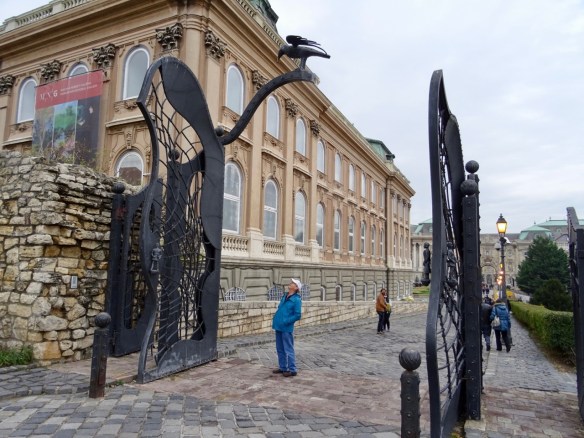 This is the back side of the Buda Castle…
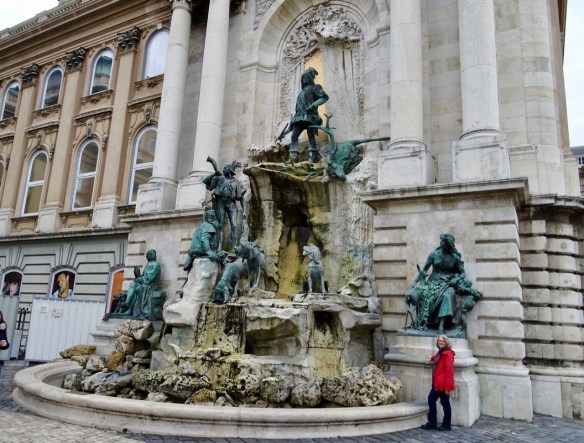
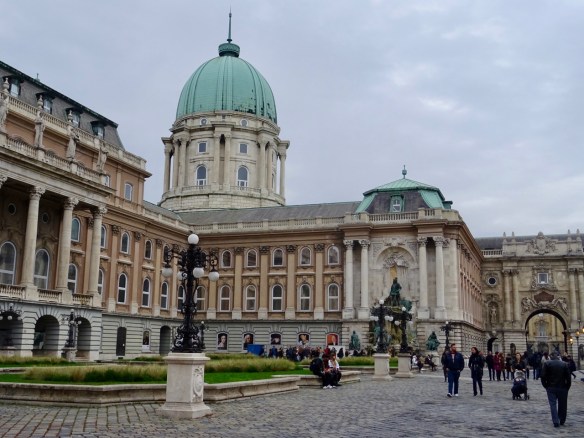 and here is a close up of its fountain. Too bad the water in all the fountains in Budapest has already been turned off for the winter.
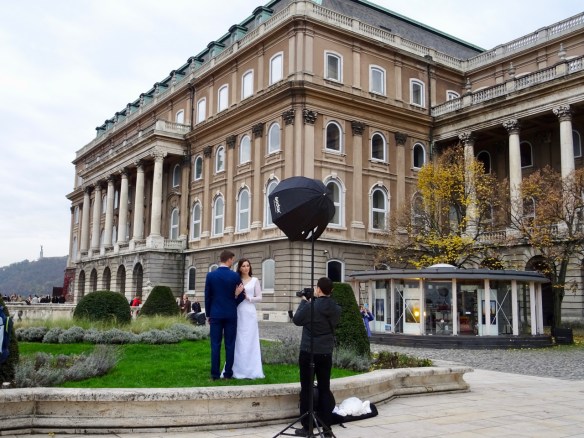
 The front of the Buda Castle with lots of tourists…
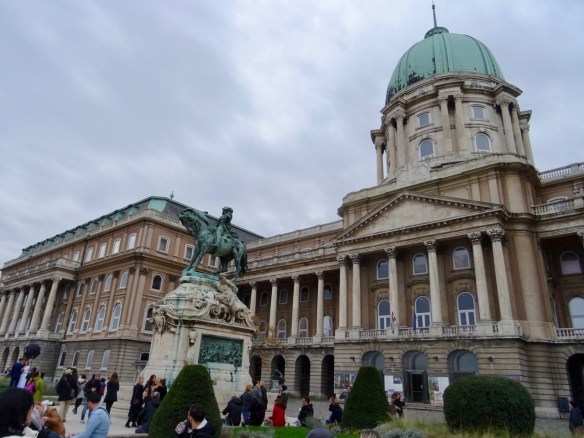 and a bride and groom taking their wedding photos. I wonder if the photographer has to photoshop out all the tourists?
 We see a large river cruise ship o the Danube.
 There are walkways high above Medieval walls.
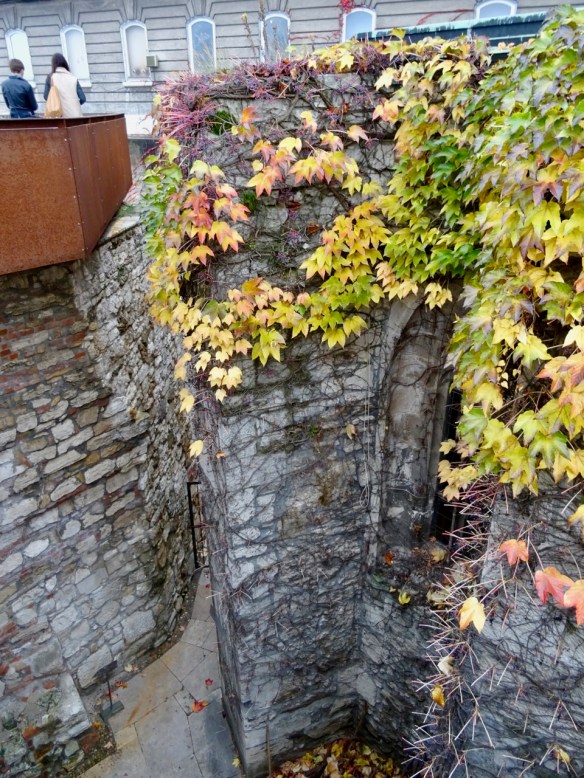 We walk down a flight of stairs below a statue of the Madonna and baby Jesus.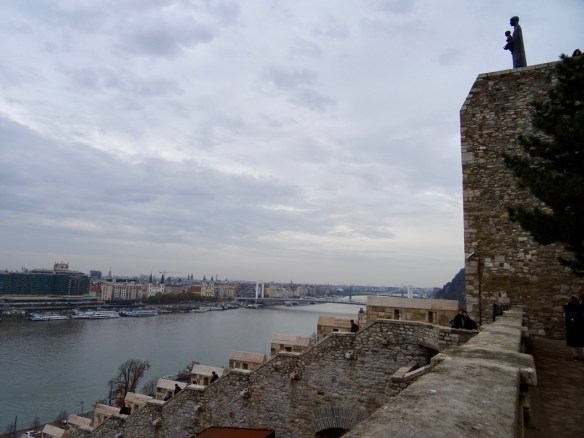
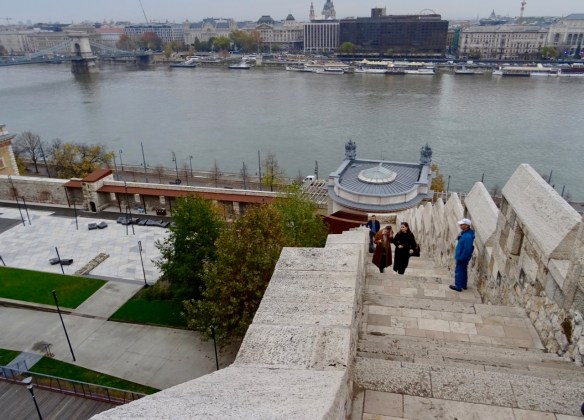 When we walk across this bridge we can see these same stairs on the far left side of this photo.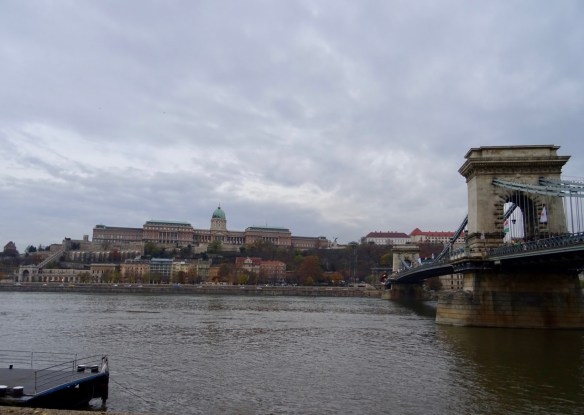
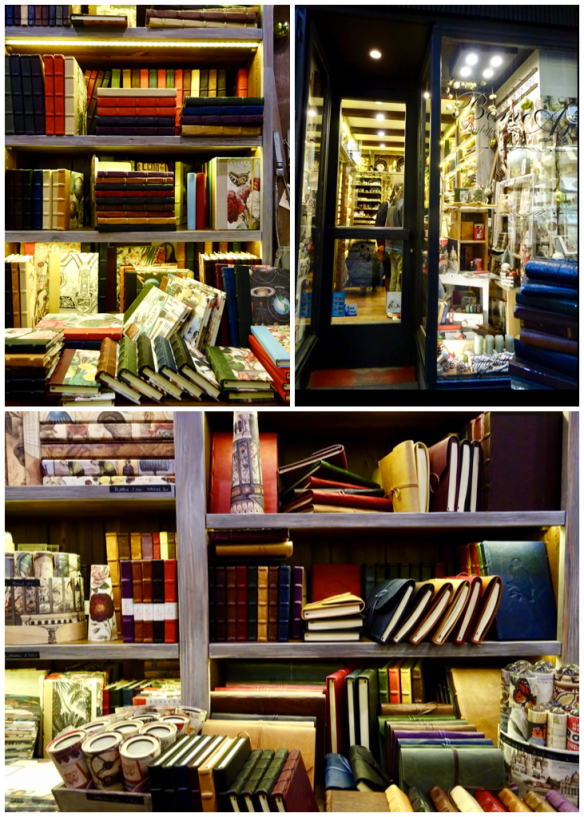
 We are walking to this little bookstore that sells handmade journals. Bomo Art is a tiny store, less than 2 metres wide! It didn’t have any larger sketchbooks with good paper for drawing. Too bad, or maybe it was good. My suitcase is already pretty heavy with the two sketchbooks I bought in Linz, and the huge Dürer book I got in Vienna.
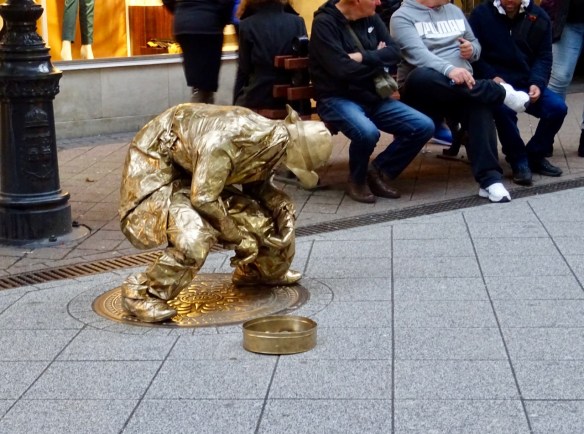
 We watched this street performer for a while and wondered how he was able to hold this difficult pose. We later saw him in a different position but when we walk by again we see a guy lean heavily on him and to our surprise he crumples! Turns out he is a mechanical man! People were putting lots of coins into his can, trying to get him to move. They had no idea they were being tricked into thinking this was a man in costume.
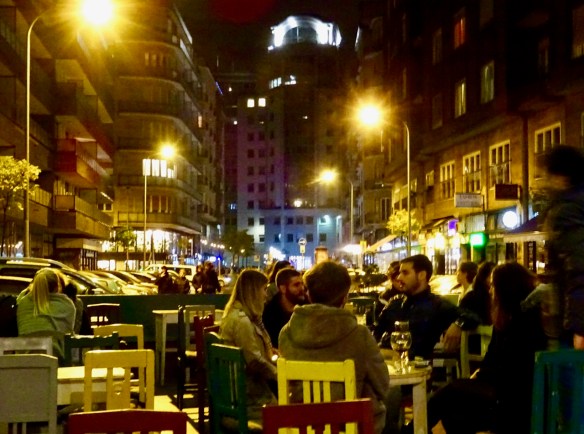
  It is quite cool at night but it doesn’t stop people from sitting outside drinking beer.
  One last walk down the decorated street towards the Christmas Market. There are so many more people out on the streets tonight.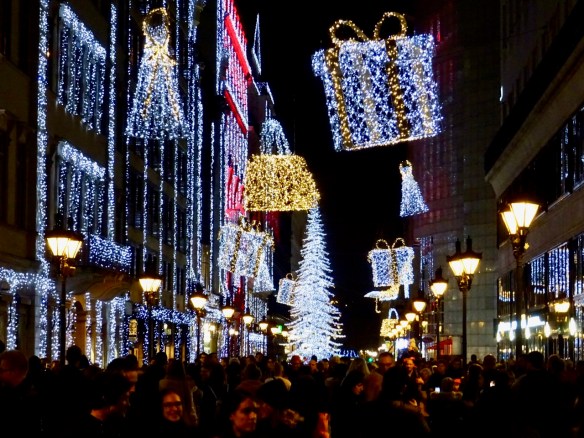
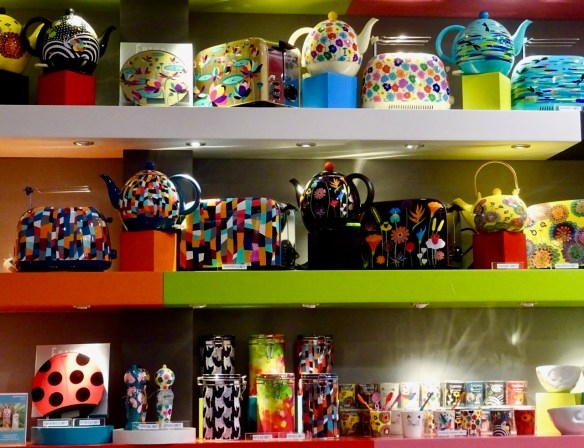 We stop at one of the stalls and I buy a couple small gifts I have been eyeing every time we walk by.
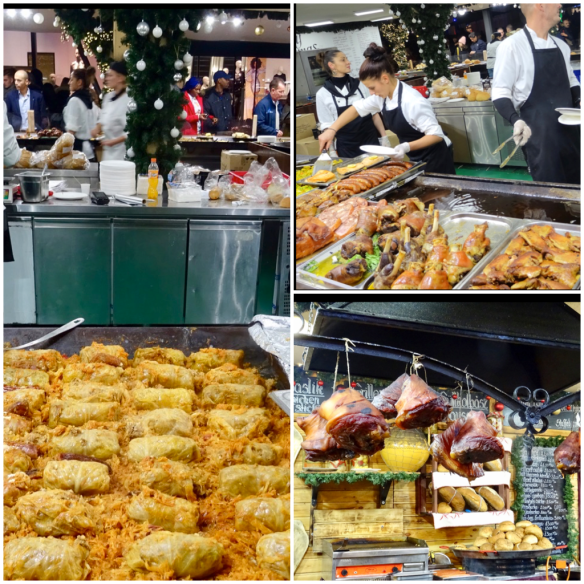
 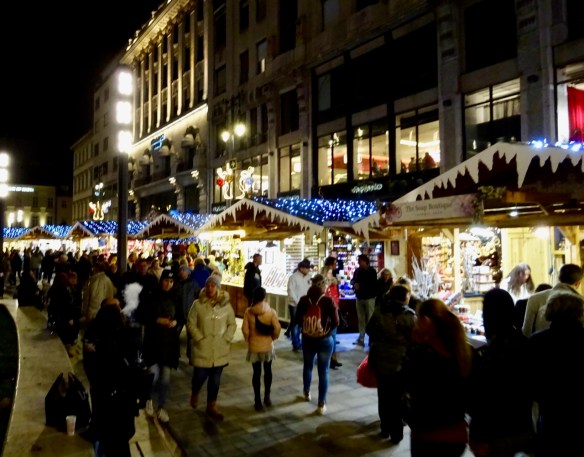 I also took photos of the food stands. Pork hocks are a big item here! We were going to buy a meal here a few days ago but quickly changed our minds when we discovered that one cabbage roll, albeit a big one, would cost us 5,000 Forints, the equivalent of $25 Canadian! A small plate with a sausage and two small helpings of side dishes was $35.00! We were rather shocked at how expensive it was. We saw other tourists change their mind and refuse to purchase what they had ordered when they realized the price.
 I saw lots of these sparkling balloons and thought they were so pretty. They were even nicer in person than in the photo. We spend the rest of the evening tidying the apartment and packing for our drive to Croatia tomorrow. Oh, and the puppet show we saw ws ‘Coraline’.
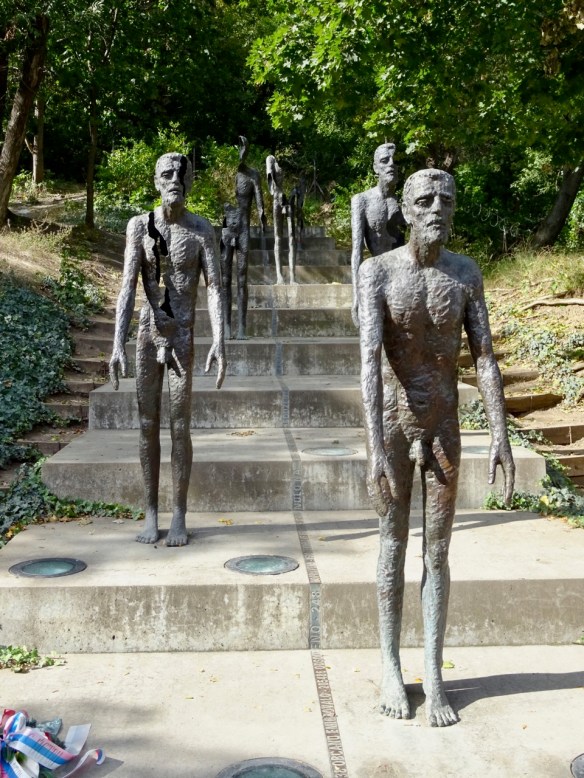 This sculpture makes us smile. It appears to have a dog drinking dish at its bottom.
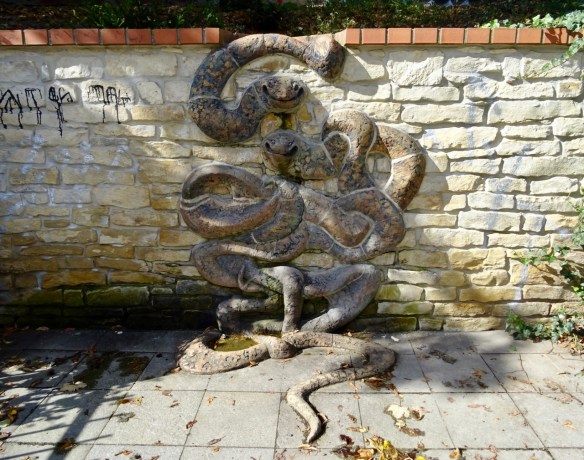 Peering into a church courtyard we see this crucifix right beside a gift shop. It seems strange to have an upscale gift shop in a church courtyard.
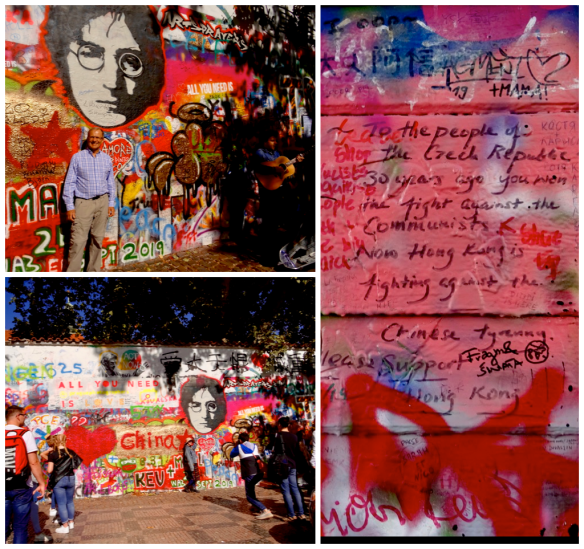
 Bob leads us down several little side streets to the John Lennon Wall. Since the 1980s it has been filled with John Lennon-inspired graffiti, pieces of lyrics from Beatles’ songs, and other designs relating to local and global causes.
 We stop for a picnic lunch in this little park beside St. Charles Bridge…
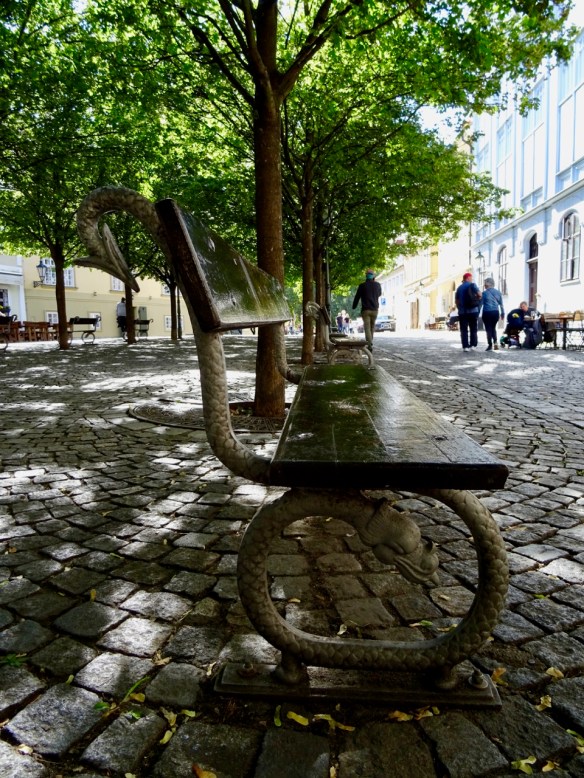
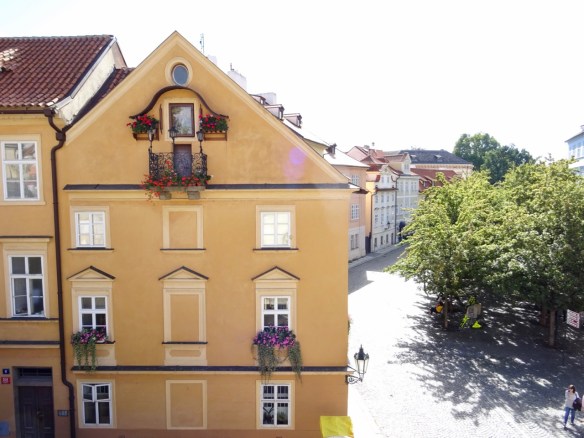 and sit on a dragon bench.
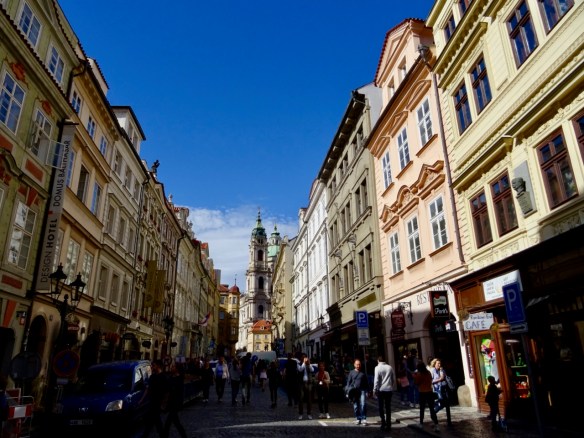
 The streets in Prague are busy no matter where we go. We wonder what they must be like during the summer months?
 It showers on and off as we arrive at the monastery. Note the cobbled road. All these uneven cobbled surfaces are quite hard on our feet and ankles.
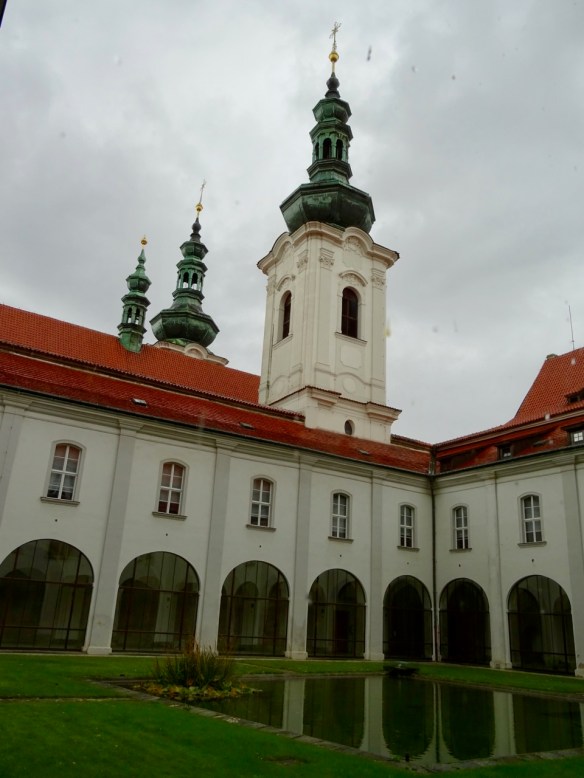
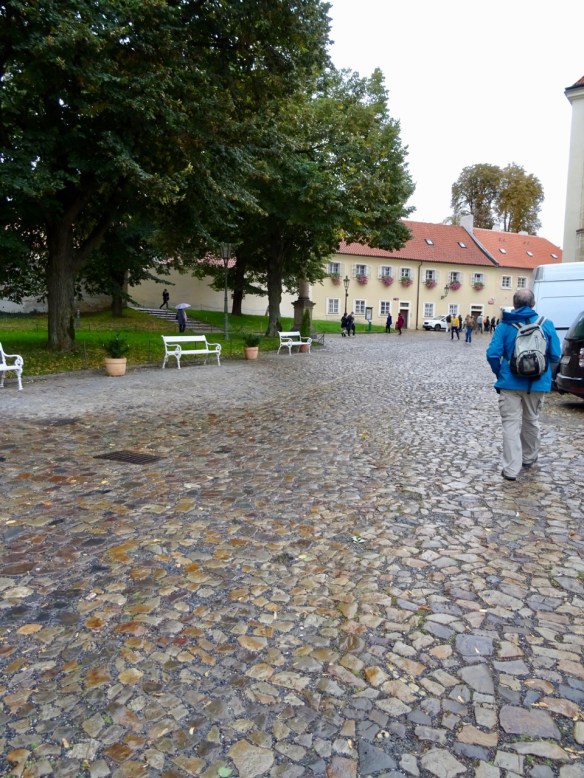 The Strahov Monastery was founded in 1143 and has many buildings and extensive gardens.
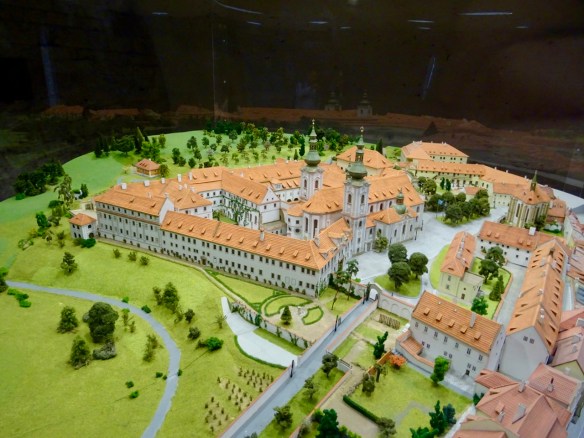 First stop is the Strahov Library and I am delighted to find that there is an exhibit of Cabinets of Curiosities!
 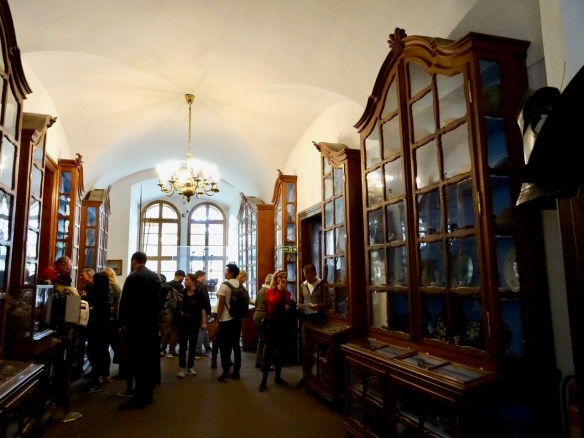 I love these cabinets and have several drawers at home with my own curiosities. Perhaps I need to make my own Cabinet of Curiosities?
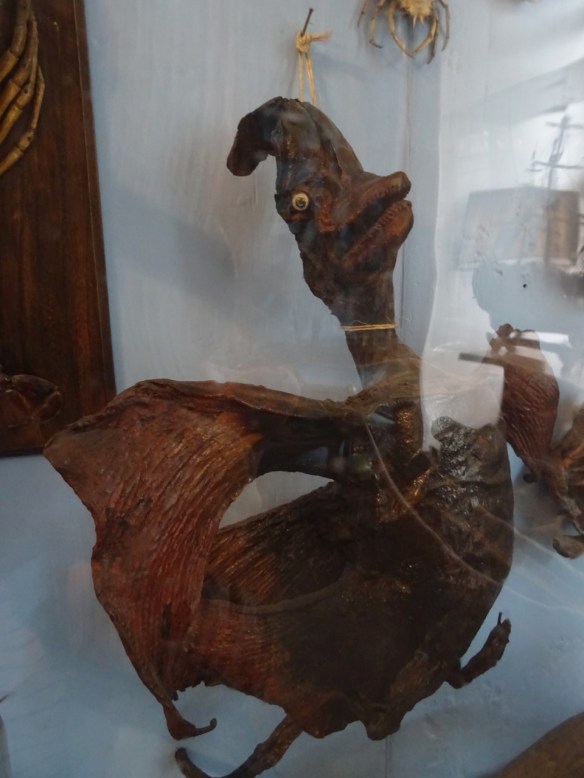
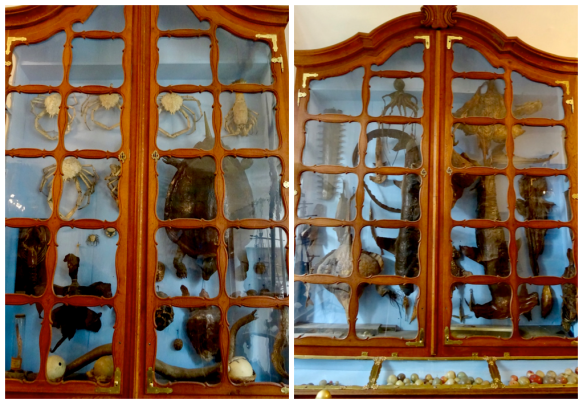 Some of the contents are rather strange.
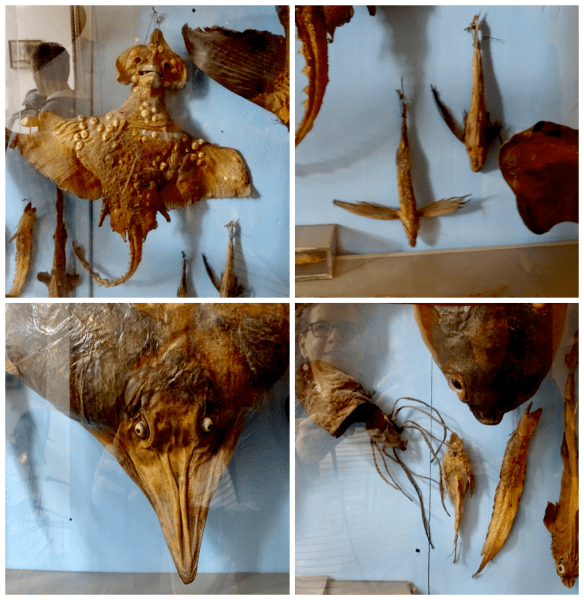 We are told that this ‘might’ be a young dodo bird!
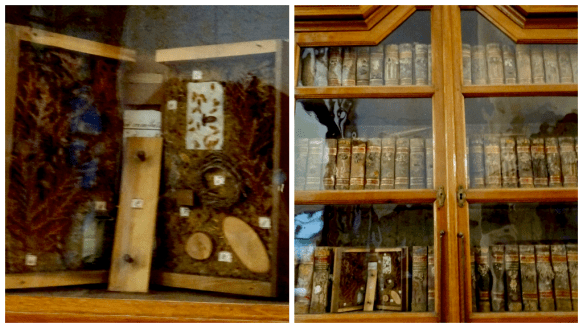
 These books are very unusual. This is a 68 volume Dendrological Library. Dendrology is the science and study of wooded plants. The covers of each volume are made of the wood of a particular tree, the spine has its name in Latin and German, and inside each volume are pieces of the roots, branches and twigs, as well as leaves, blossoms, fruit, and sometimes even insect pests. As a paper artist and bookmaker, I find these unusual volumes fascinating and inspiring.
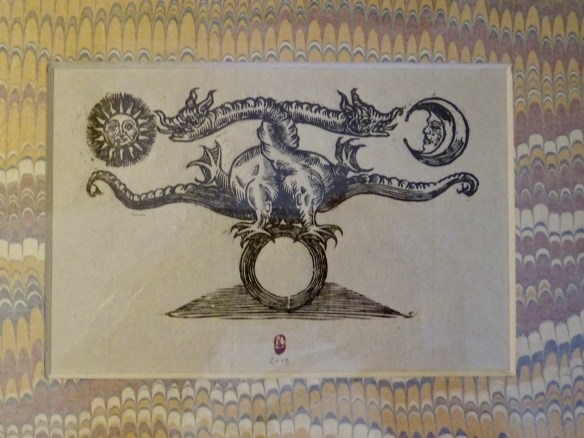
 Along the hallway between two magnificent libraries are display cases with very old volumes. This 1632 woodcut first appeared in a compilation of English Alchemical texts. This piece was printed by hand on Japanese hand made paper and the pass-partout, or mat, is covered in handmade marbled paper.
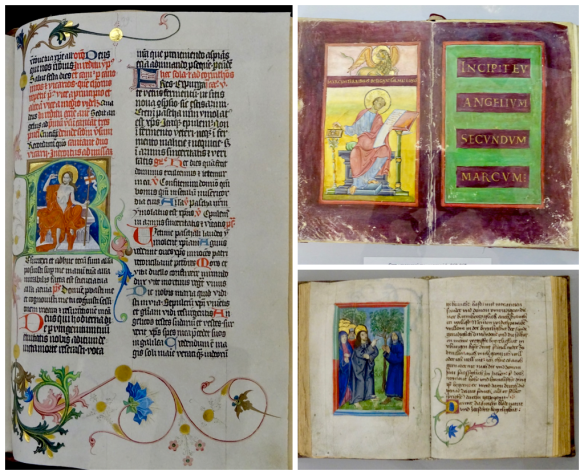
  The John of Šellmberk’s Bible preserves the oldest translation of the Bible into the Czech language and dates from the 1400’s. Notice how thick the volume is!
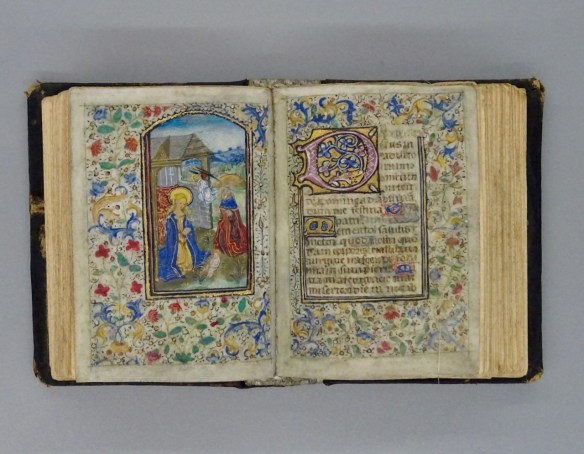
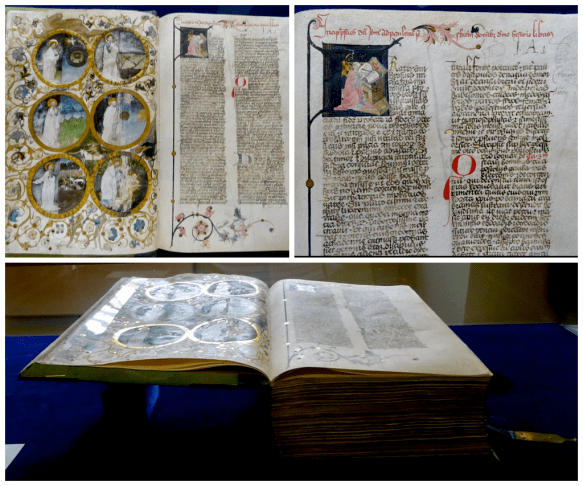 This exquisite miniature book from the 15th century is only about 3″ x 4″ and would have belonged to a private citizen.
 A page from the Missale of Louka, 1483, illuminations from the Strahov Evangeliary, 860-865 AD and on the bottom right, a book for private use from the 15th century.
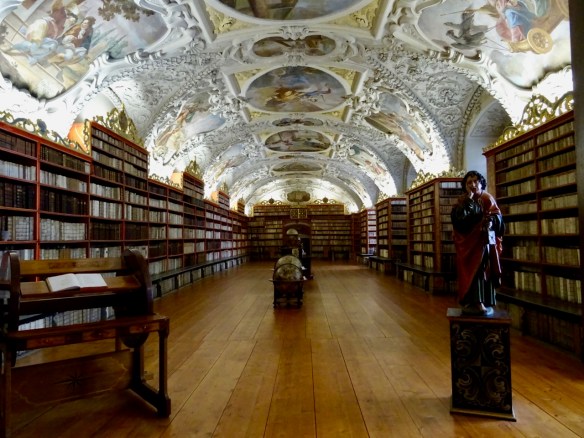
 The Theological Hall was built in the 1600’s and holds over 20,000 volumes. One whole wall is filled with various editions of the Bible, or its parts, in various languages.
 The ceiling depicts the life of the librarian.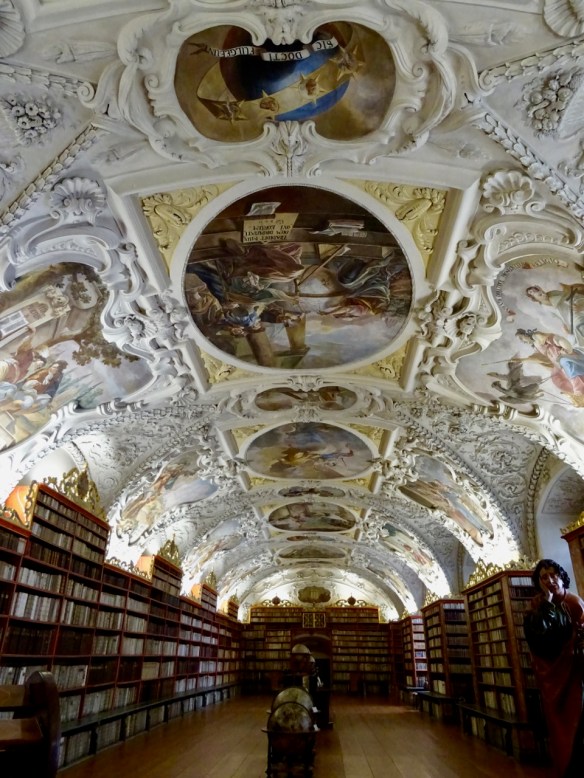
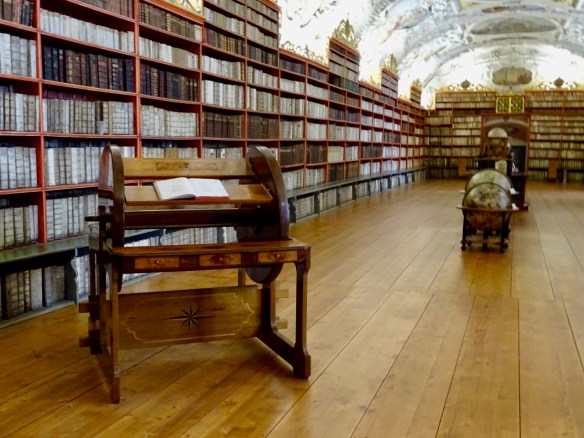
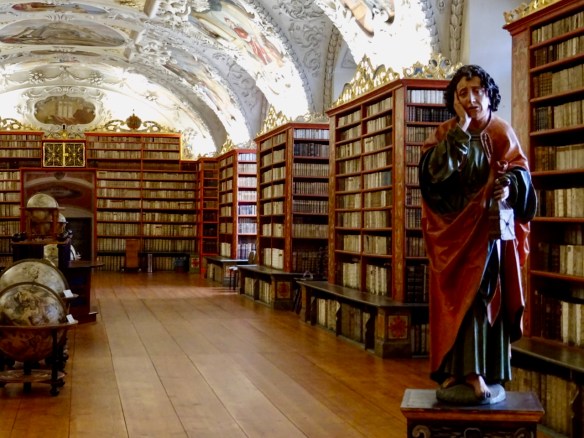 There are several globes, both terrestrial and astronomical, in the centre of the room and the interesting device on the left is a book wheel from 1678 for the study and compilation of books. The gear inside enabled the shelves to remain at the same angle when they are turned so that the books would not slide off the shelves.
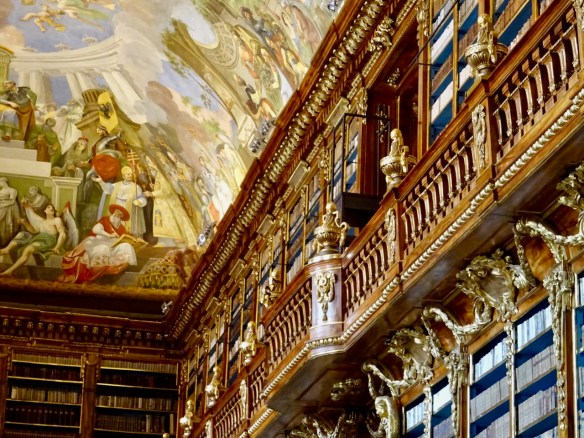
 As magnificent as the Theological Hall is I think that the Philosophical Hall is even more impressive. This library, finished in 1794, is 32 metres long, 10 metres wide and 14 metres in height. The ceiling painting, ‘The Spiritual Development of Mankind’, was created by a Viennese artist, and one assistant in just six months!
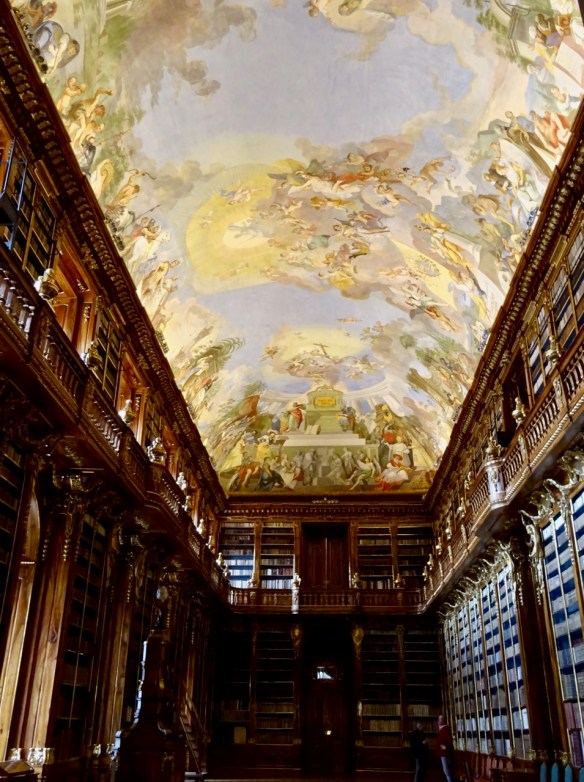 The shelves of books in the gallery are only accessible from hidden spiral staircases in both corners, masked by false book spines.
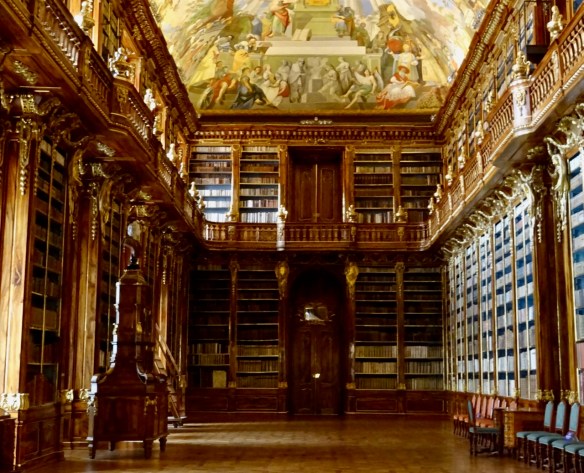 The books are shelved two deep. At one time tourists were allowed to walk through the library but this caused too much humidity and put the paintings and volumes at risk. Now we have to contend ourselves with peering in from the doorway. Too bad but it is still wonderful to see these incredible libraries.
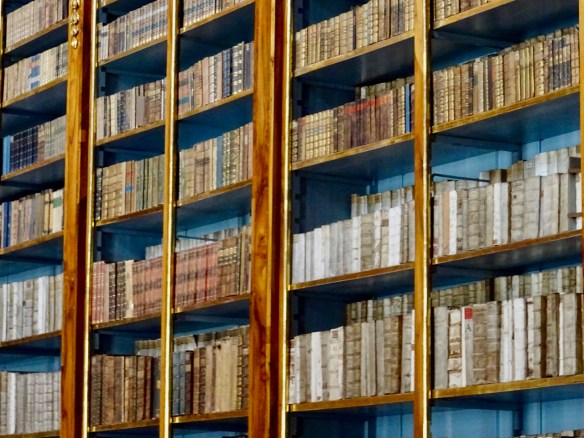 The Philosophical Hall contains more than 50,000 volumes on Philosophy, all the sciences, history, law, and natural sciences.
 Next we visit the Convent Building which has galleries on two floors around this cloister with its unusual trapezoid pool.
 There is an exhibit of large restored paintings depicting the life of St. Norbert but they were difficult to see. My neck got sore from looking up all the time.
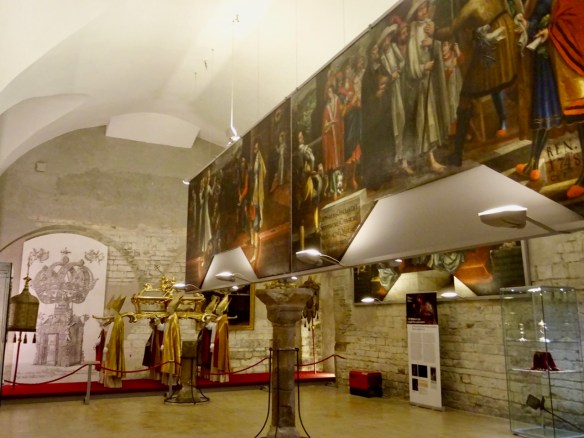 The ‘procession’ at the end of the room holds a reliquary with what appears to be part of St. Norbert’s skull.
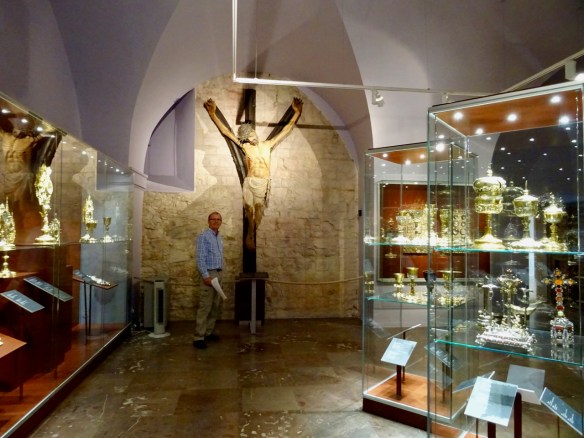
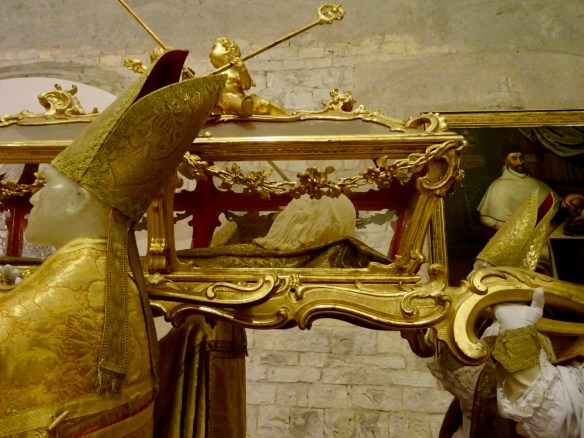 Another room has exhibits of beautifully embroidered church vestments and other liturgical objects including heavily jewelled monstrances.
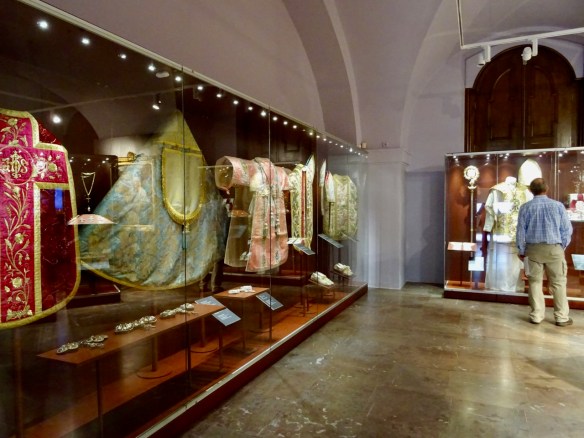 It does make me wonder just how much money the Catholic Church has?
 The second floor has a gallery around three sides of the cloister.
 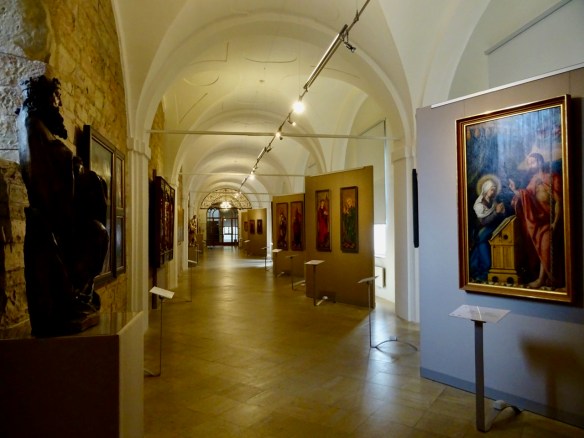 There were a few paintings I liked but most of them didn’t really impress either of us all that much.
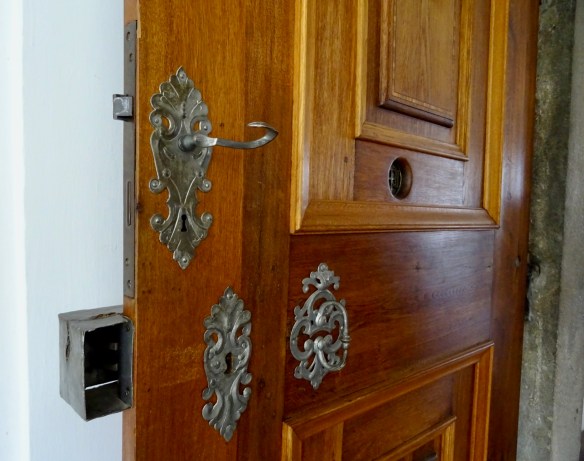
 Bob notices another ornate old lock.
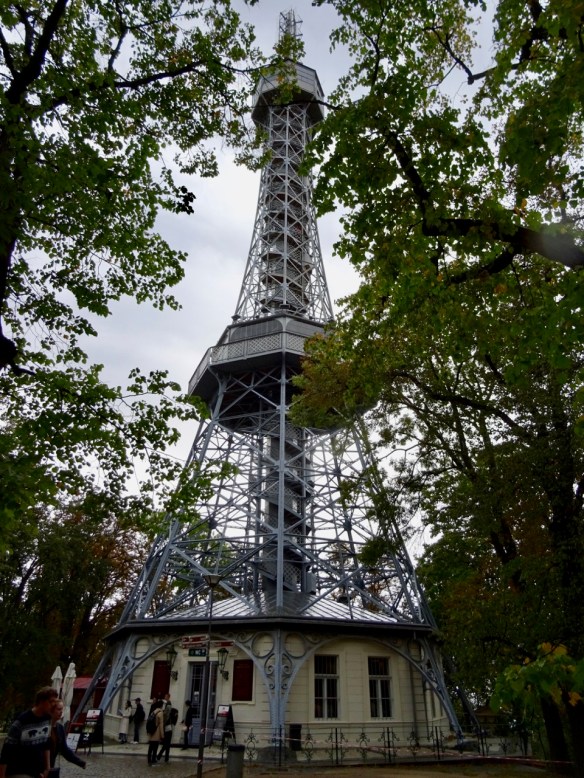
 As we leave the monastery grounds on our way to the Prague Funicular, we pass the 63.5 metre high Petrin Tower, which is reminiscent of the Eiffel Tower. This tower was built in 1891, and is used as an observation tower as well as a transmission tower.
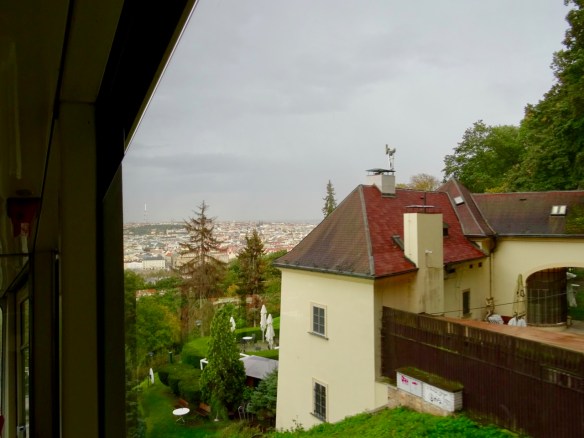
 The 383 metre long funicular takes us back down to Prague city streets. I didn’t get much of a view because some young people kindly jumped up to give me a seat, so instead of standing where I could see I sat all the way down! The hazards of having grey hair!
 It has been a full day and we are happy to be home. I had planned on going to life drawing again tonight, but we need to clean and pack for our trip to Vienna tomorrow so I decide not to go.
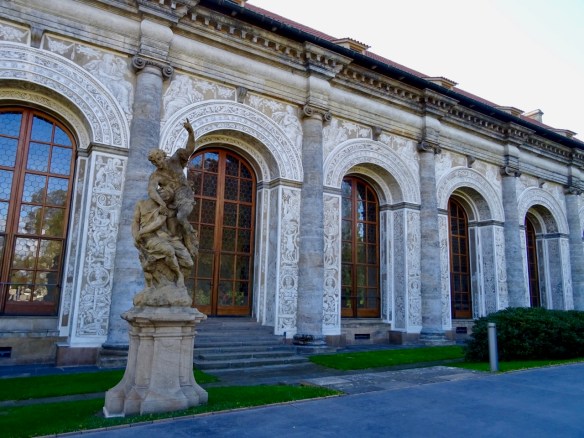 We had a good laugh. Bob thought that the two guards in the guard-boxes were wax mannequins. They were so motionless!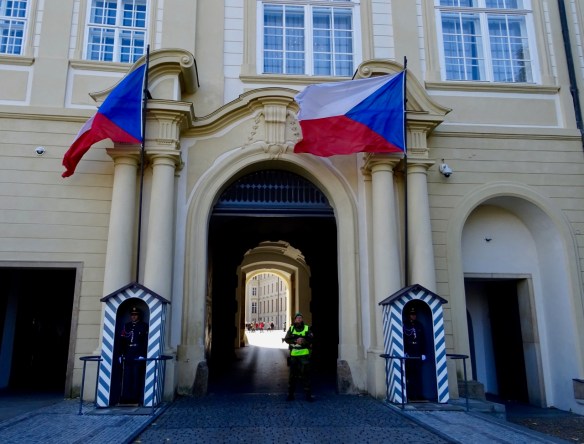
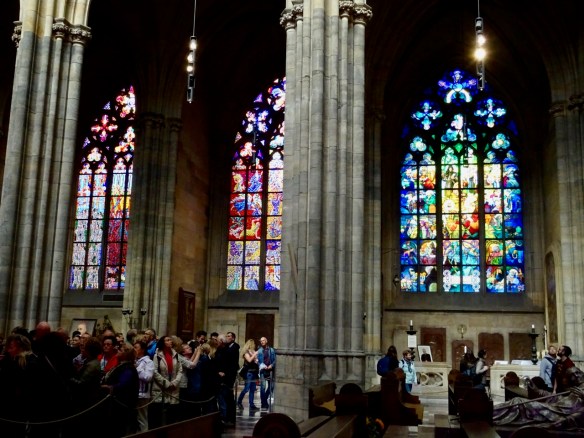
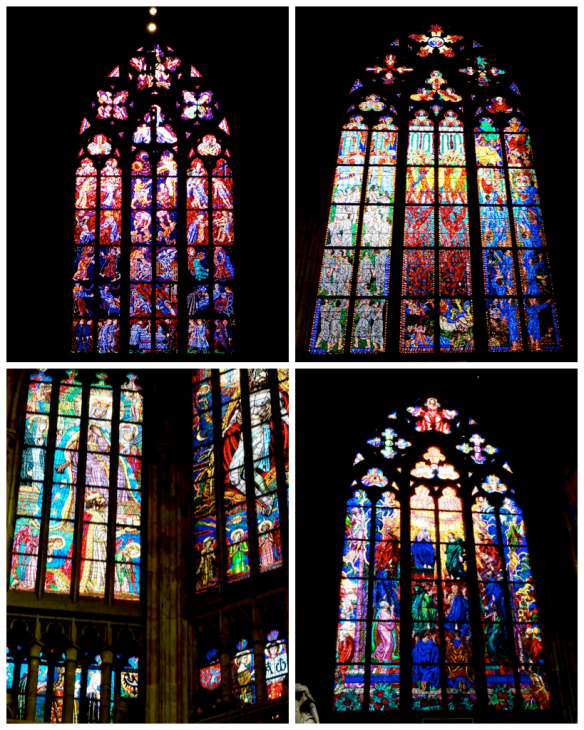
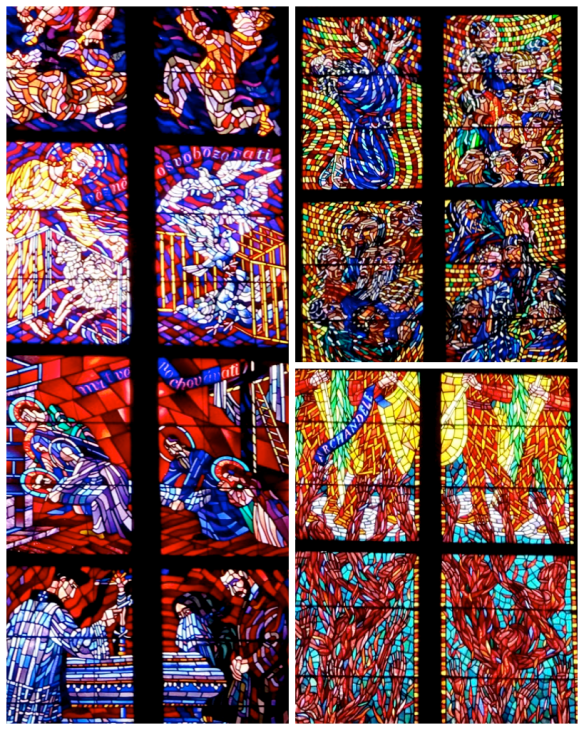 Perhaps my favourite is the window designed by Alphonse Mucha. You may remember we saw his design drawing for this window at the Mucha Museum yesterday.
 The beautiful rose window on the entrance wall of the cathedral was completed in 1925 and took two years to complete. The inscriptions on the stained glass tell the story of Creation as told in the Bible.
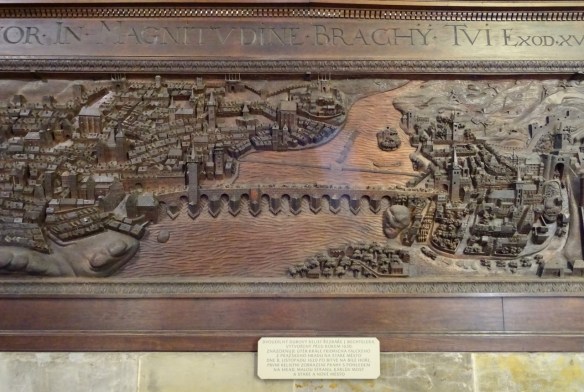
  This wooden panel from 1630 shows the St. Charles Bridge, built in 1403, that we visited on Saturday. The city doesn’t really look all that different, does it?
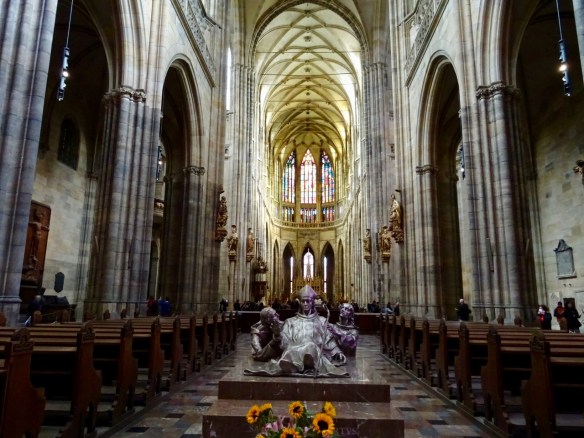
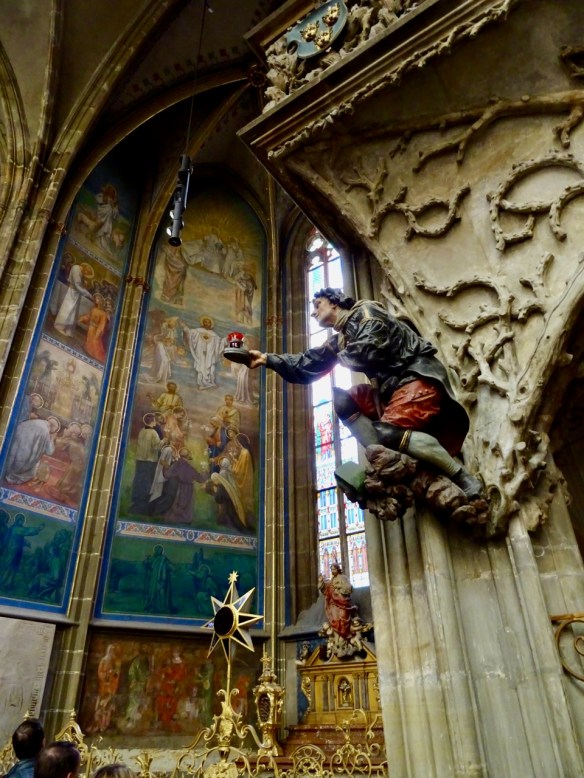
 St. Vitus is portrayed with a rooster by his side, because he was boiled to death in a pot with a rooster! These saints all seem to have had horrible tortuous deaths. St. Vitus never actually even visited this cathedral, but a relic, or pieces of his body, was brought here and the Cathedral was built to honour him.
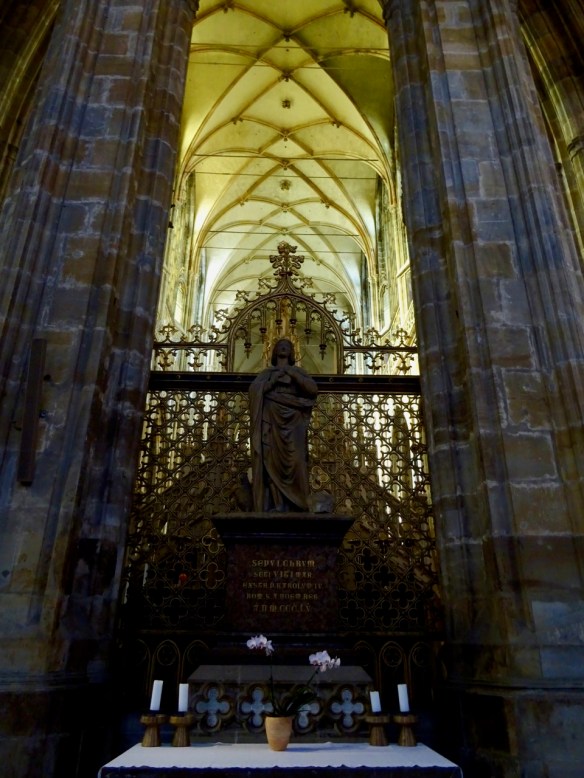 St John of Nepomuk’s tomb is an elaborate baroque silver tomb with angels supporting a draped canopy. It is said to contain two tonnes of silver. St. John is the patron saint of the Czechs. There are so many people visiting this cathedral that I had to take this photo looking back towards the tomb to get a decent shot.
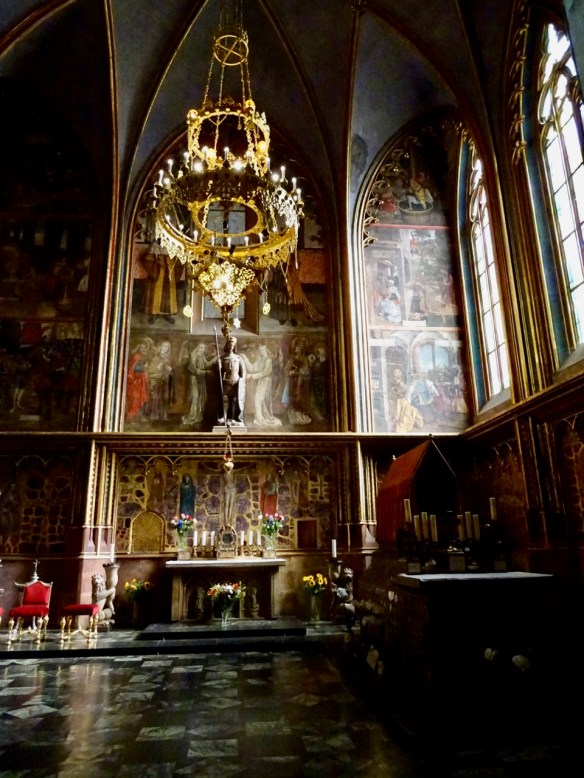
 This is the chapel dedicated to St. Wenceslas, the king and patron saint of all the Czech lands. The lower part of the walls are decorated with more than 1300 gems and the joints between them are covered with gold. The walls are covered in frescoes and the relics of St. Wenceslas are kept in the red draped case.
  As we are leaving, the sun comes out for a bit and shines through the stained glass windows casting coloured light into the cathedral. Note the lady posing behind Bob. We seem to see her everywhere we go today and she is always posing ‘just so’ for a photo. I’m not sure her and her husband are even looking at the cathedral as anything but a backdrop for her photographs.
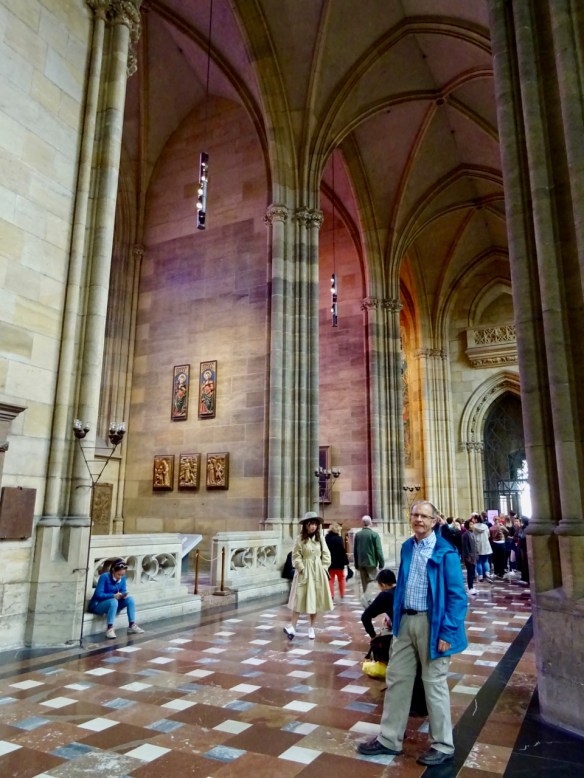 As beautiful as this cathedral is, I still love some of the simpler details that are easy to overlook with all the grandeur surrounding us.
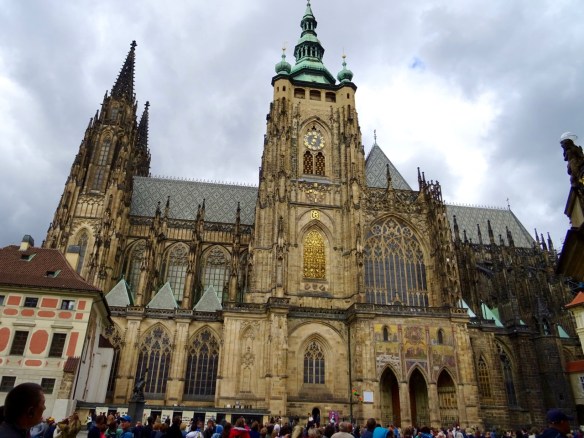
 A view of the Cathedral. This front entrance isn’t used by tourists, we entered on the end of the cathedral behind the building with orange panels.
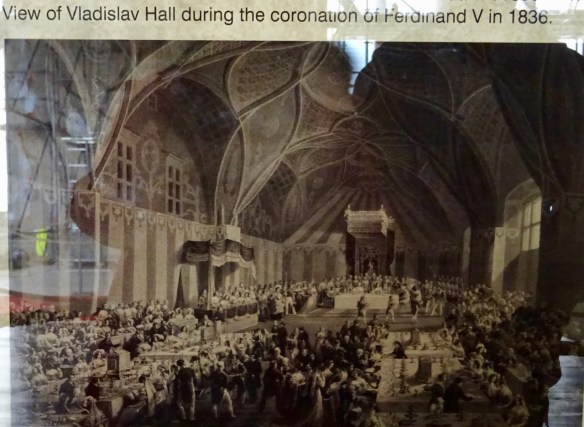
 since the 16th century, the Vladislav Hall in the Old Royal Place, was used for coronation festivities and banquets, knights’ tournaments and markets for luxurious goods. The Vladislav Hall still is used for state functions. It is an enormous room.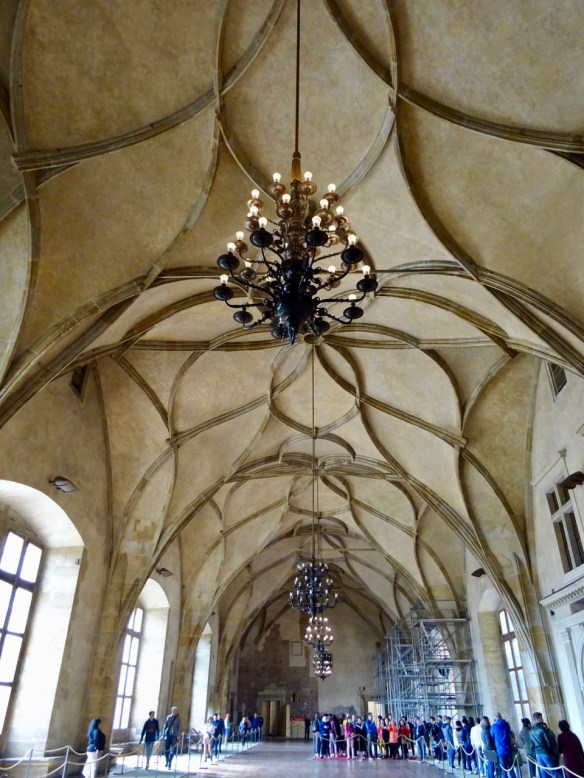
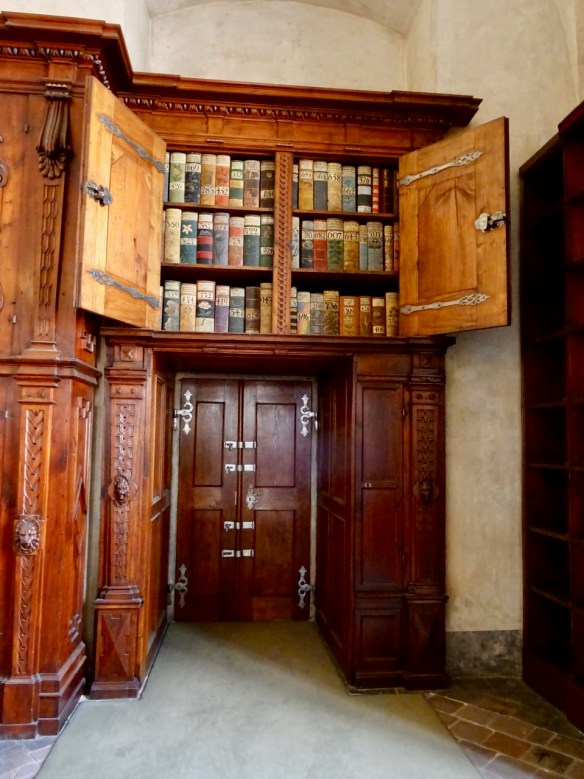
 The Old Palace contained the Land Rolls, where all matters regarding property rights and criminal law were recorded.
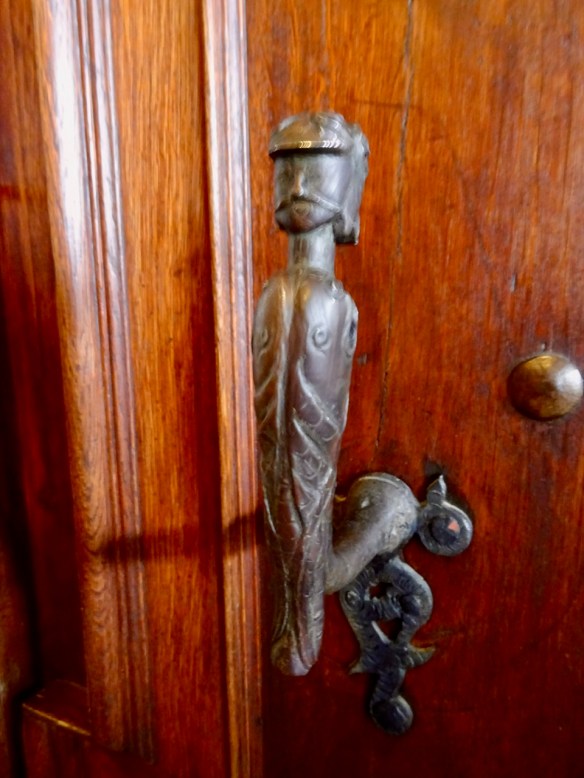
  An interesting door handle.
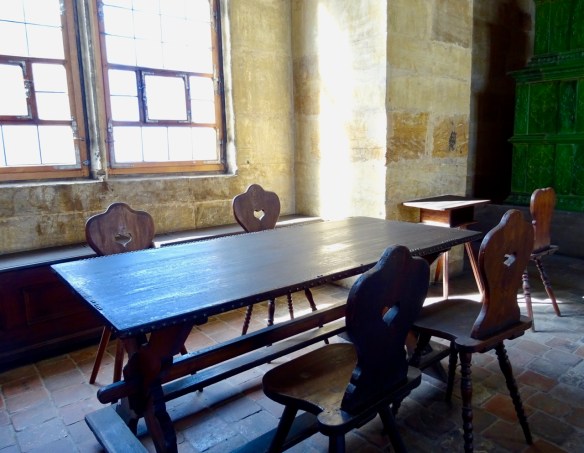
 One room had chairs which are almost the same as the ones my Swiss grandfather used to make, only he put more carving and decoration on his.
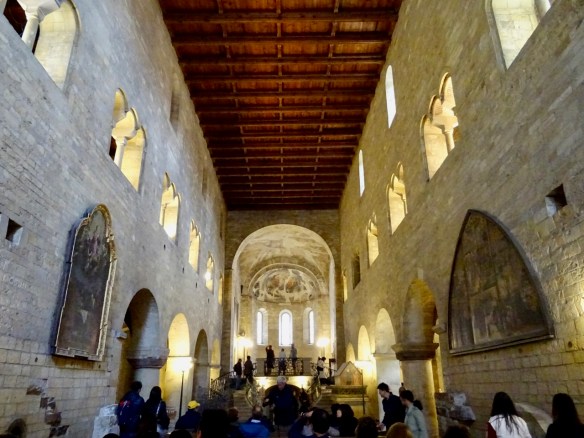
 The present day appearance of St. George’s Basilica dates to the reconstruction after a devastating fire in 1142. Now it is used for short-term art exhibitions.
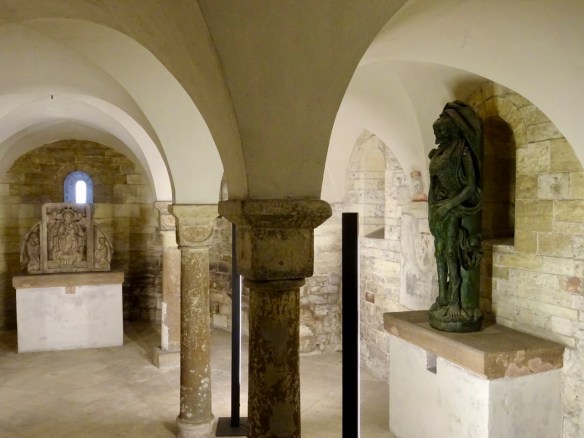
 We visit St. Georges 12th century crypt and see this rather bizarre sculpture. I did some research and discovered that it is “a Late Gothic Statue of Brigita, representing a dead and decaying girl´s body. It is a symbol of impermanence. A legend says that it was made by a sculptor, who killed his girlfriend and wanted to create her statue before he was executed. However, he was only able to make it as a dead body, because of his despair.” ~.www.prague.cz
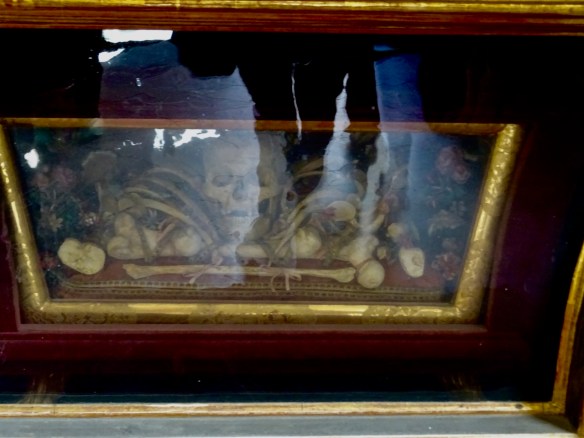
  On the way out we see this collection of relics, but have no idea who they are. These relics seem a bit bizarre. Not only was the poor person usually tortured and killed but then their bones were carted off, often to several different locations and put on display. Hmmm.
 This is the Golden Lane. This lane of tiny houses was built against the northern wall of the castle. These tiny houses were occupied until World War II and have been preserved so that the character of this lane has not changed. From 1916 to 1917 house No. 22 was inhabited by the writer Franz Kafka.
 The name of the Lane is derived from goldsmiths who used to live there. I struck up a conversation with a gentleman who told me that he and his father were both goldsmiths and that the tools have not changed at all. He also said his father died young and that he quit because some of the processes involved are very toxic.
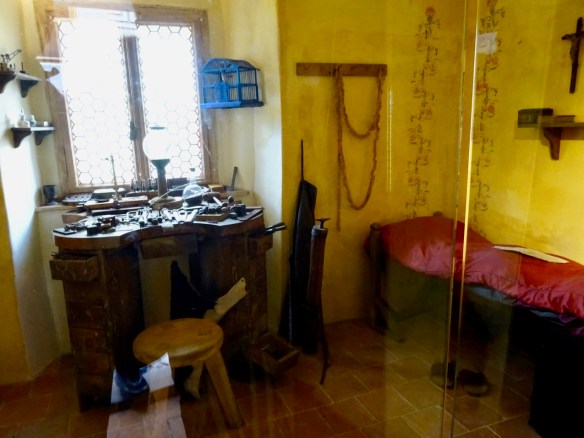 The houses are tiny and have tiny doors.
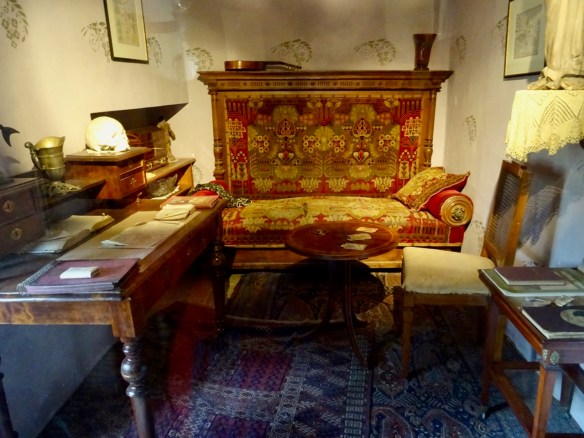
 This was a fortune teller’s house whose predictions about the early fall of the Third Reich resulted in her being arrested and tortured to death by the Gestapo.
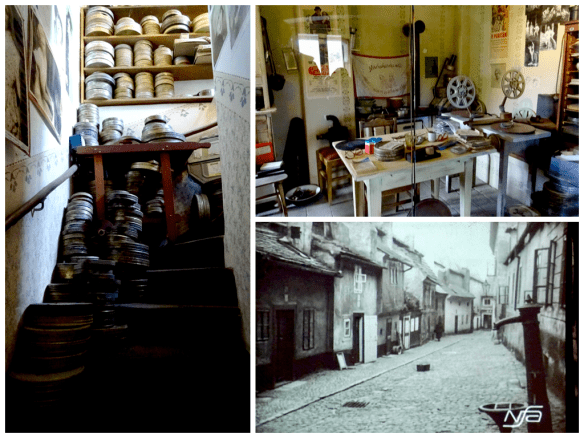
 An amateur historian who saved many copies of old films that were intended for disposal during the Second World War lived here. We watch one film that showed scenes of Prague and this Golden Lane. It looks much like it does today.
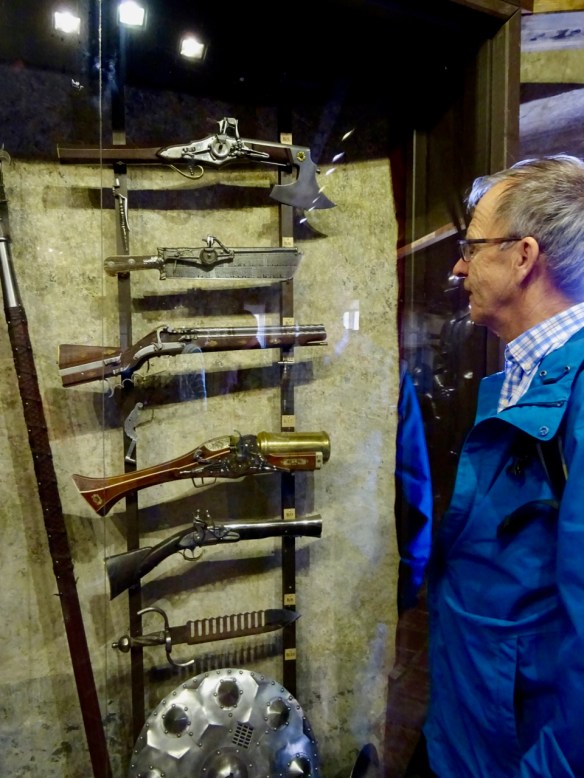
 We almost missed seeing a huge display of old armaments and armour. It was quite interesting. Some the swords have pistols built into them, or axes attached!
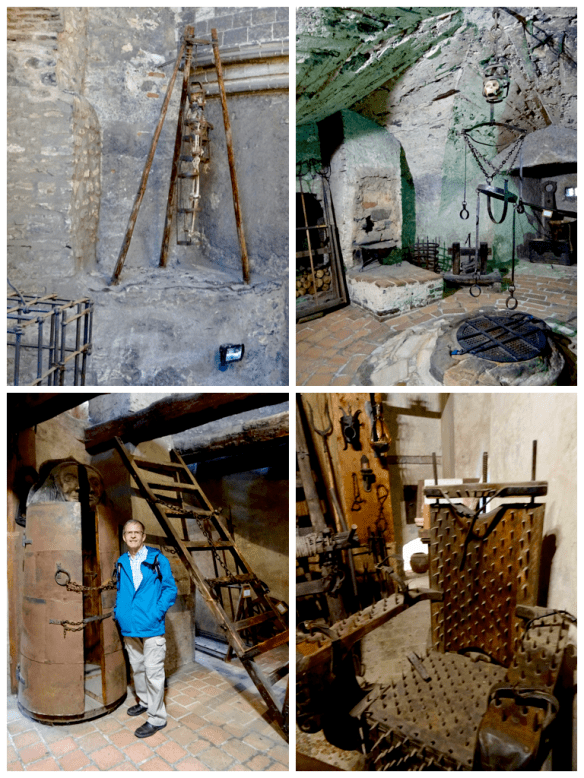
 And then there is the torture chamber. These places give me the creeps. It is just so hard ot think of people subjecting each other to such pain and terror. Bob is standing beside an Iron Maiden, which has spikes inside just long enough to pierce the body and make sure that the person inside dies a slow painful death. There are two spikes placed so that they will pierce the eyes of whoever is placed inside, and take a look at that chair! It is enough to give me nightmares.
 After the torture chamber we see some great views of Prague…
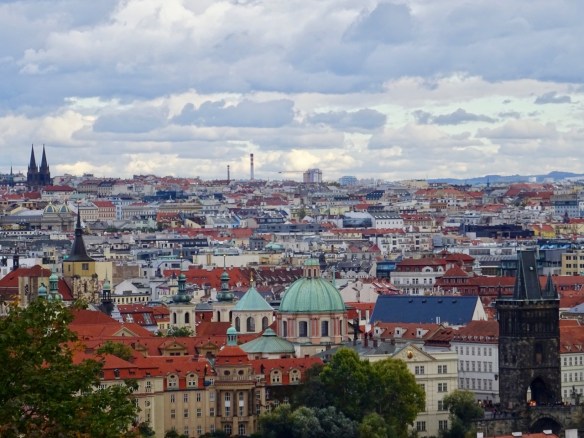 can you spot our TV Tower? It is hard to miss.
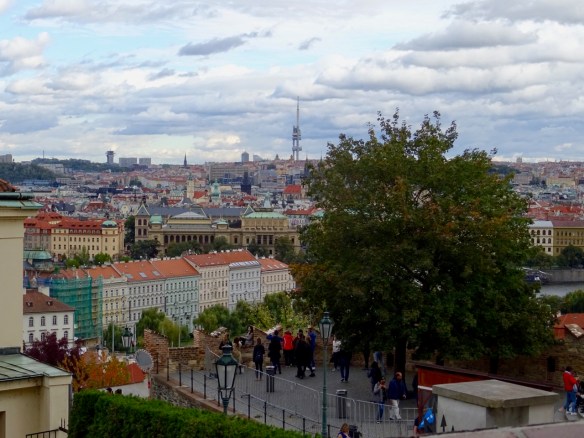 As we leave the castle the changing of the guards marches past. A couple of the guards have their hats blown off by the wind but they just keep marching, although they did smile! It was crazy windy today and a bit cold so it was a good day to be inside.
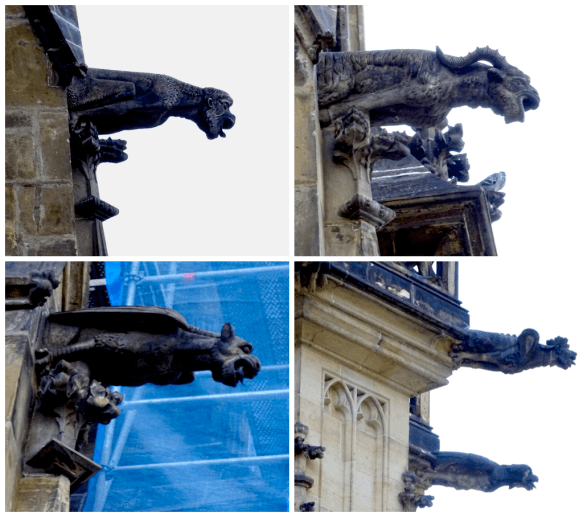
 Walking past the Cathedral towards the exit I thought to look up, and yes, there were gargoyles! I love gargoyles, in case you didn’t know.
 This shrub was near the exit. I have no idea what it is and wonder if anyone else might know?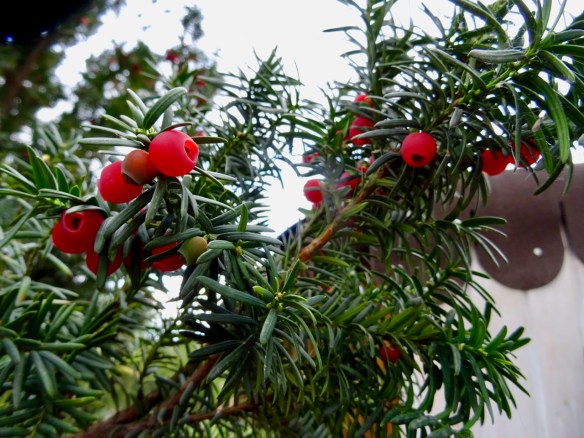
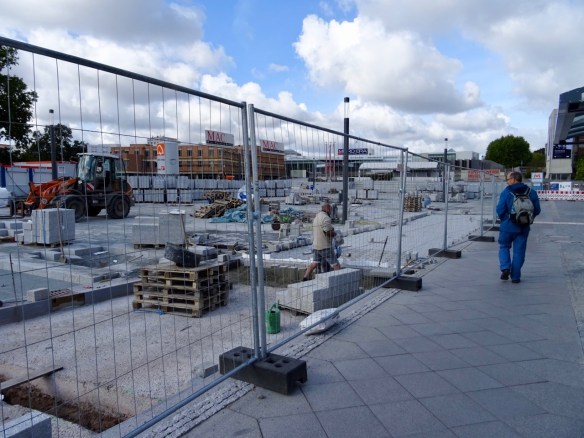
 These workers are laying paving bricks for a huge plaza. We have not seen poured cement sidewalks or plazas here, they are all made with paving stones. It seems very labour intensive.
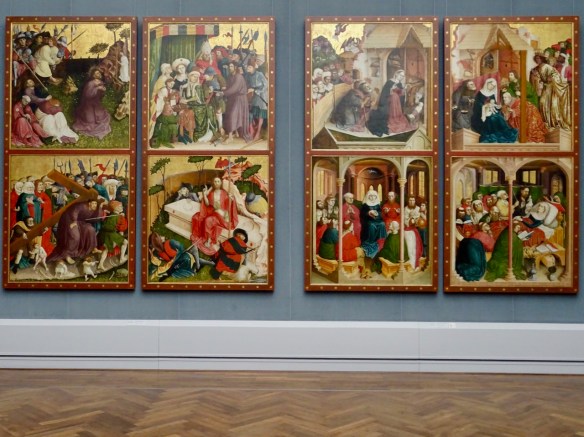
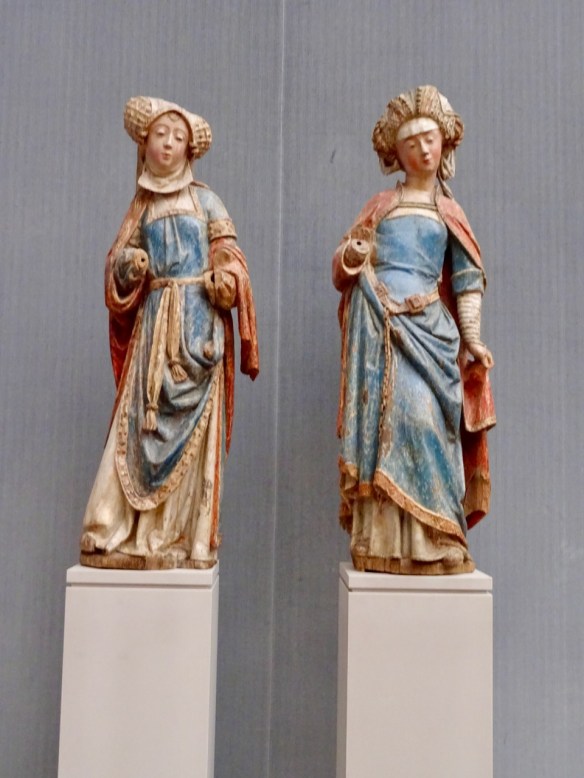
 The Gemäldegalerie is our first stop today. This museum is near the Berlin Zoo and has one of the world’s leading collections of European paintings from the 13th to the 18th century. The quality of the artwork here is amazing. This is the first painting we see, part of an altar from 1437 telling the story of Jesus on the left, and Mary on the right. The white ‘baseboard’ in the photo comes almost mid-thigh on me, to give you an idea of the scale of the works.
 The corner of one painting from 1444 shows two pregnant women, notice the babies depicted on their stomachs. I had never seen this symbolism before.
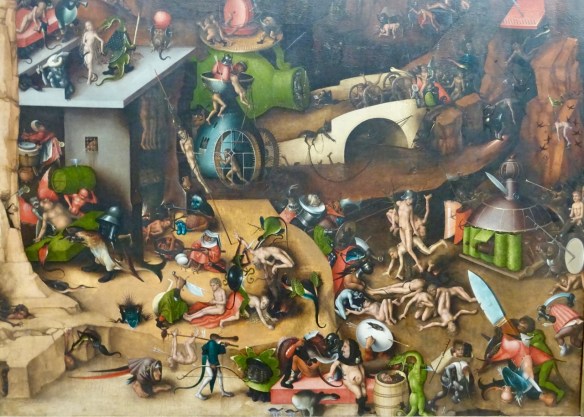
 We both liked the Fountain of Youth by Lucas Cranach, 1546. This is not the style of his work that I am familiar with…
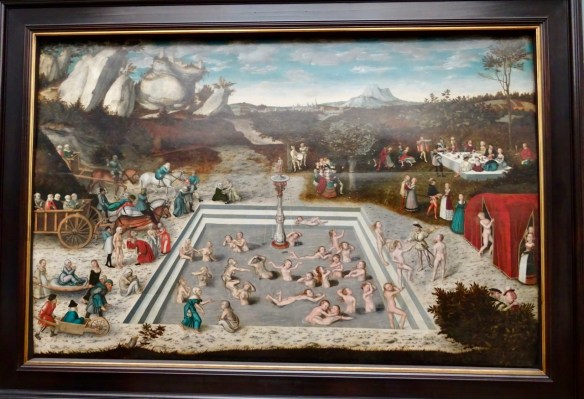 this is! I have always wondered at this artist’s creativity.
 Wow!! This painting by Rogier van Der Weyen from 1440 is my absolute favourite of everything we have seen so far this trip. I absolutely love it and wish that the photo was able to convey the impact it has in person. I would have bought a print but it was almost $100 and I worried about getting it home safely. This is a painting I could live with forever.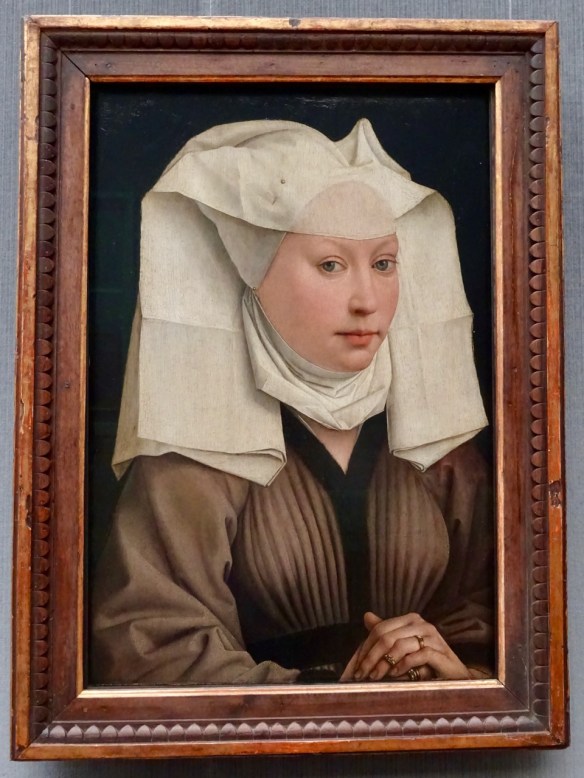

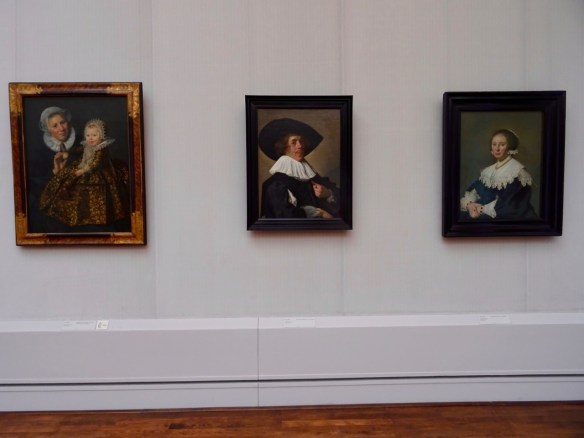
 I am fond of Frans Hals portraits and there was a whole room of them.
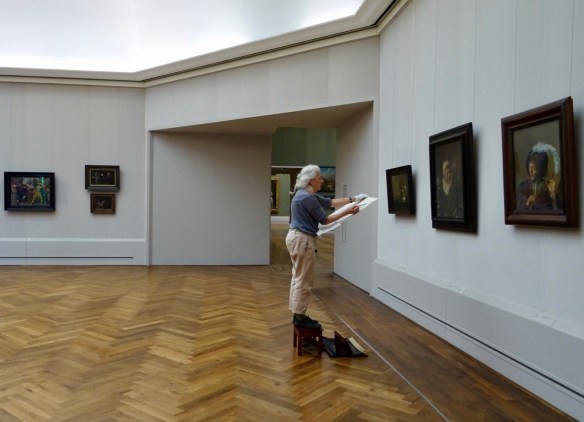
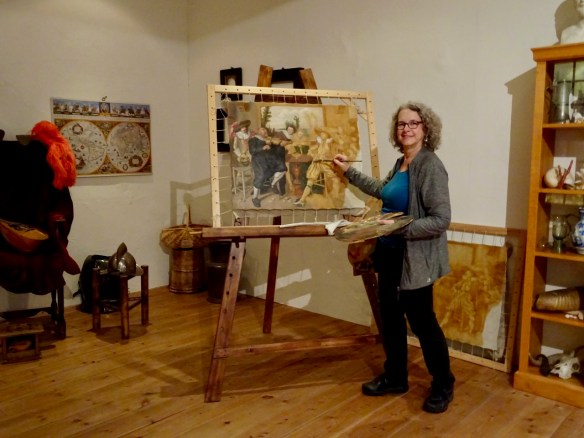
 This artist must like them too. What a tough way to work though, on a little stool, holding such a large drawing board. I assume the museum does not allow easels.
 I am excited to see this Vermeer from across the room, but then..
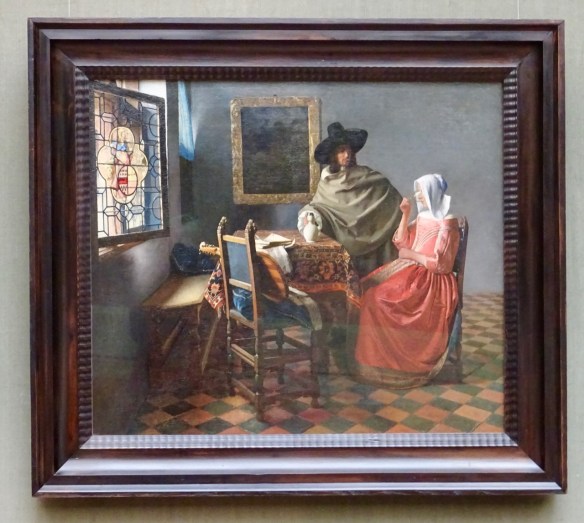 I notice The Girl with the Pearl Earring. I had no idea the this painting was in this museum. What a lovely surprise.
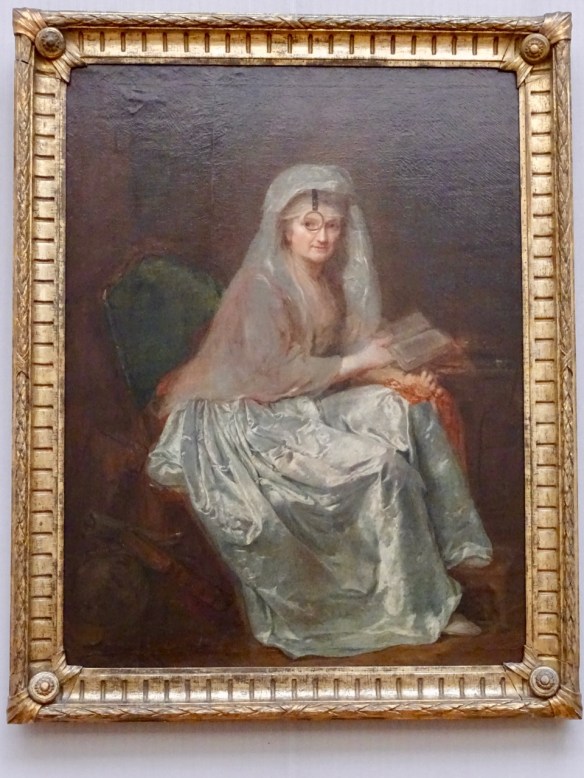
 Anna Dorothea Therbusch, 1721-1782, is one of the few women artists who actually made a living as an artist. This is a self portrait.
 There are Caravaggio’s here…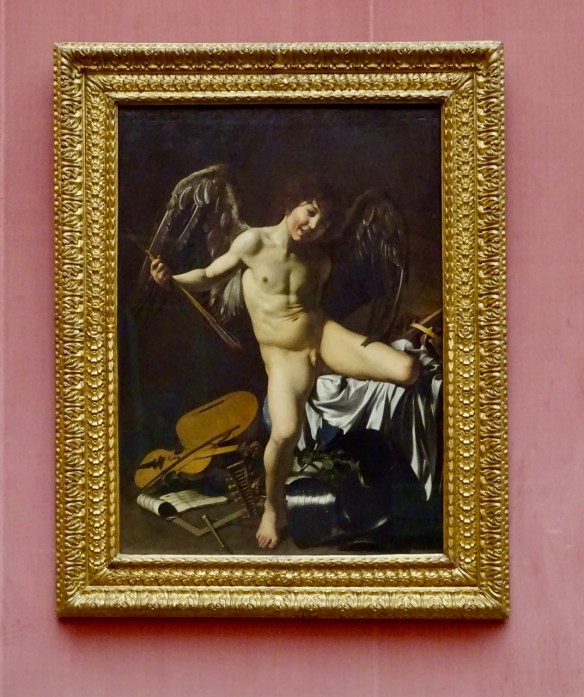
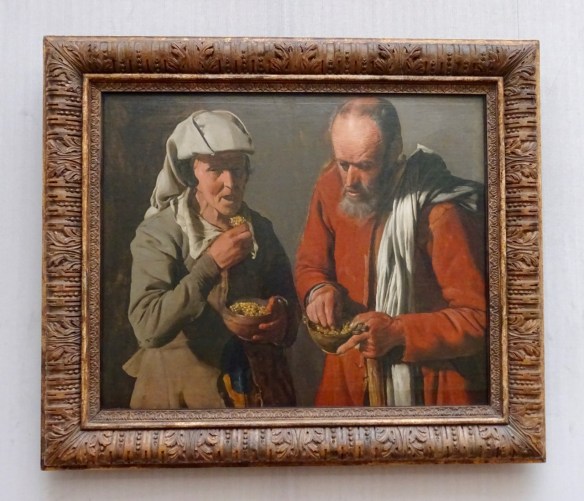
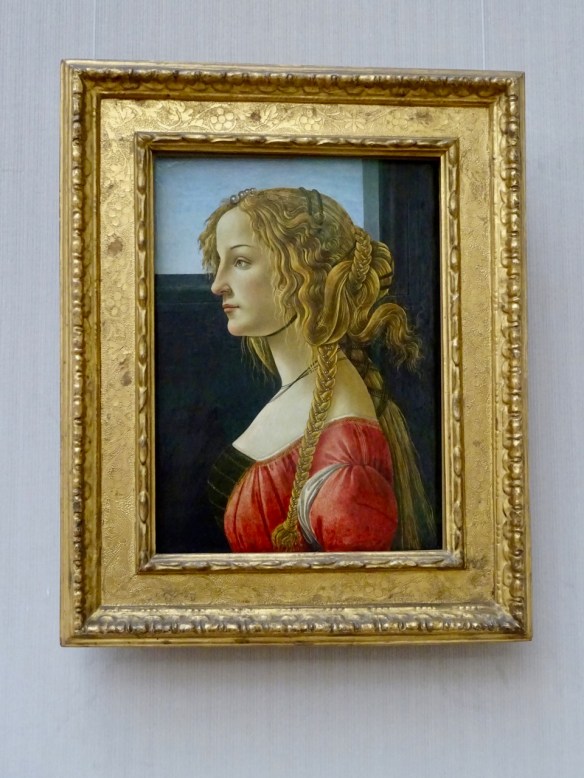 including this Botticellis Venus.
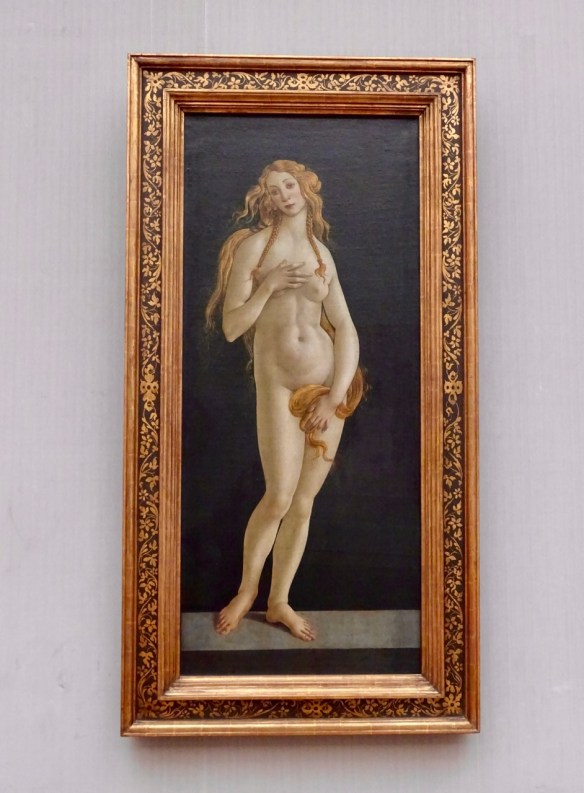 And there are Rembrandts, including these two famous self portraits.
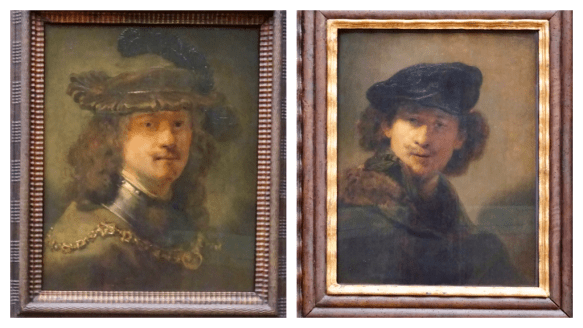 I finally get to see these two tondos in person, the one on the left by Raffael (34″ diameter) and the one on the right by Botticelli (54″ diameter). I particularly like the Botticelli, his Madonnas are always so beautiful.
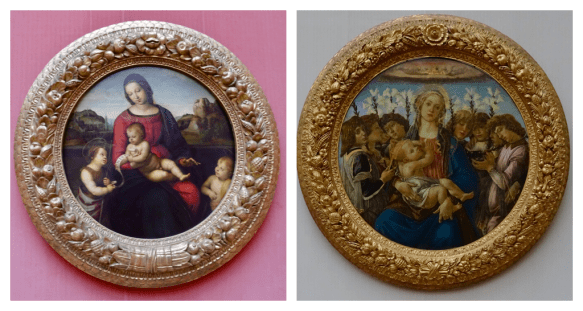 This was fun! I am so glad we visited the Gemäldegalerie, it was quite amazing.
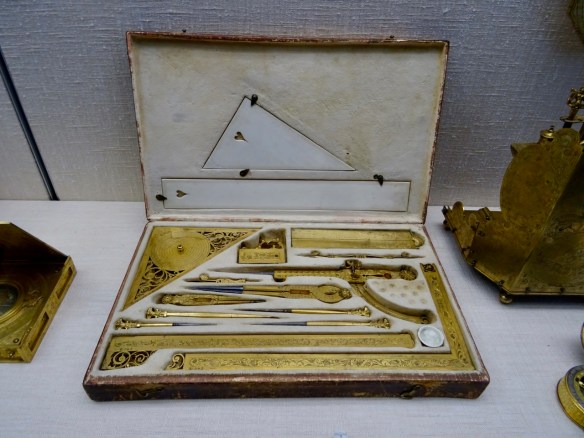
 After a picnic lunch we check out the Kunstgwerbe Museum nearby. I would love to have this beautiful geometry set from the 16th century.
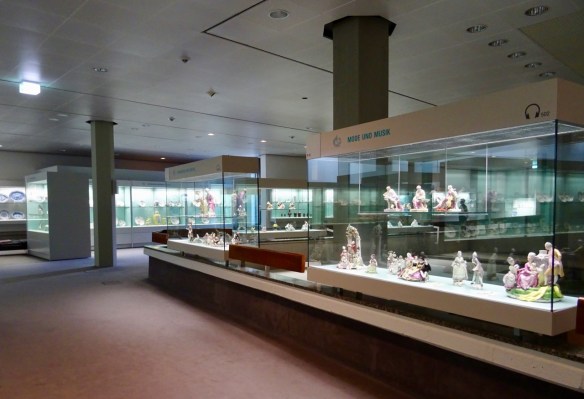
 This museum has lots of porcelain, furniture and church treasures, but we walk by all these. It is just too much to absorb.
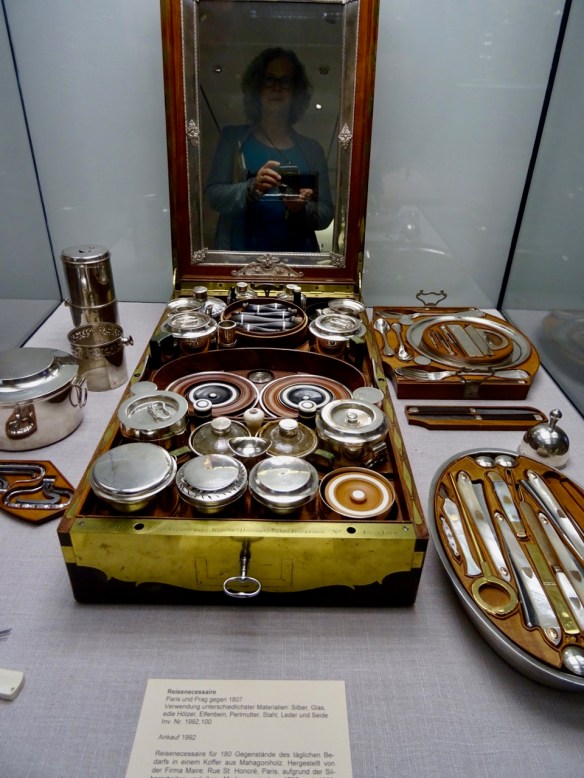
 A few items did catch our eye though. This is an elaborate portable kitchen from 1807, maybe used for camping? All the info is in German, so not sure.
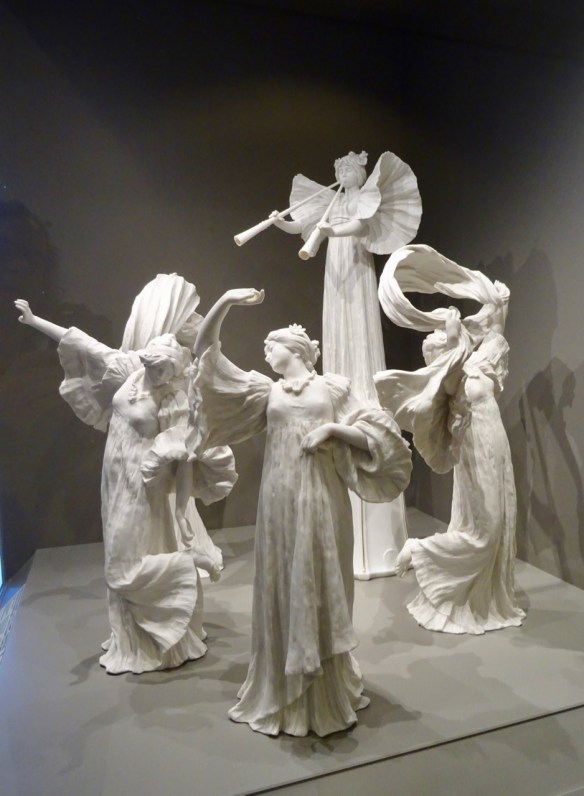
 These glazed porcelain figurines were part of a group of 15 that were awarded a gold medal at the 1900 International Exhibition in Paris.
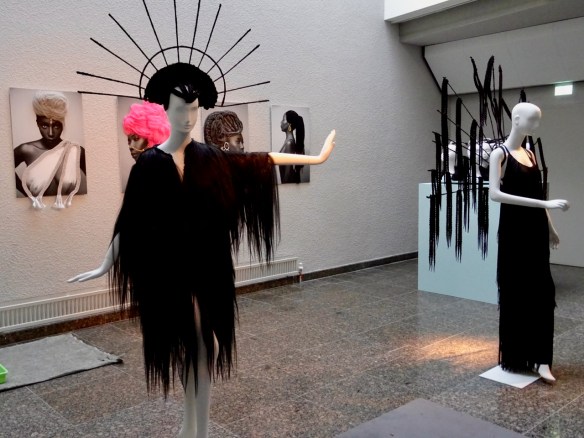
  There was also an exhibit on Afro Hair, with some very different displays.
 And finally, an interesting walk through women fashions through the ages.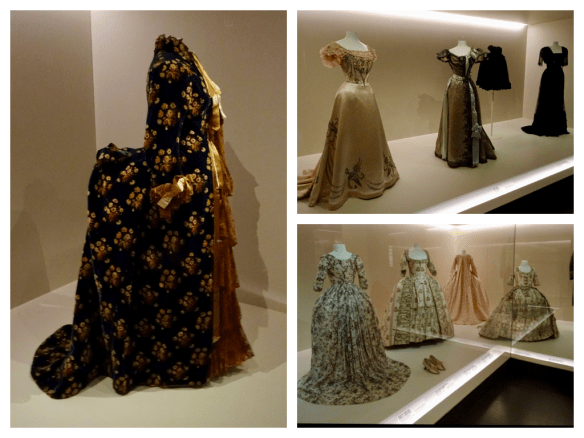
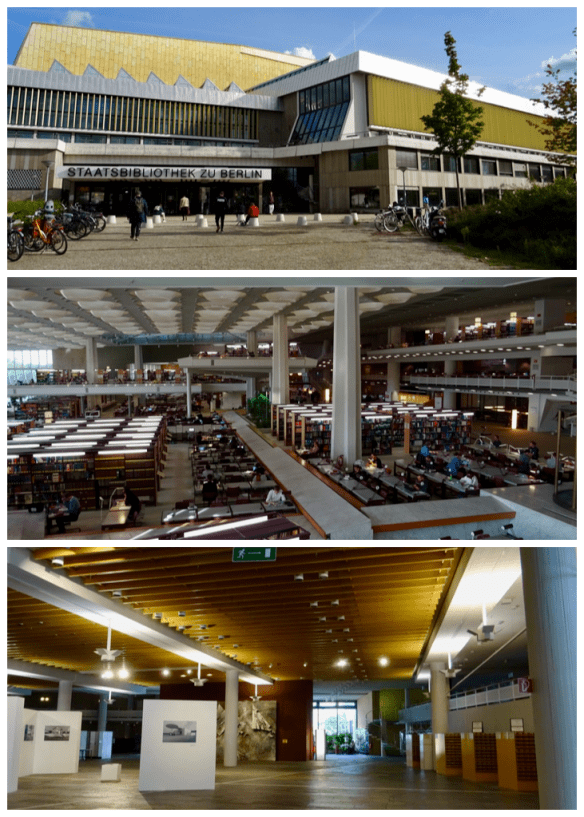 Whew! and we aren’t finished yet. We catch a bus back across town to visit the oldest church in Berlin but the interior has been updated so much. It wasn’t what we were expecting, but still interesting. For some reason there was a rooster crowing inside the church? No idea what that was about.
 We split up, Bob heads to the Bode Museum and I catch the metro to go life drawing. I pass this post with just a few posters wrapped around it on my way to drawing.
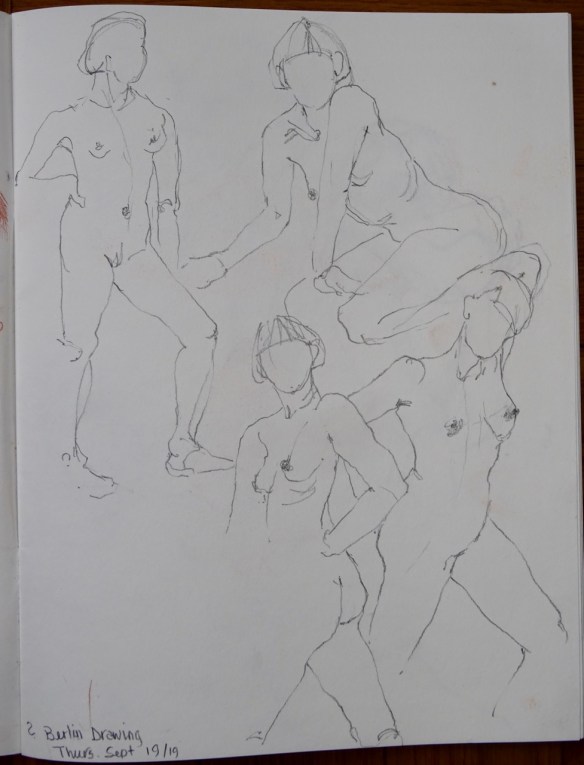
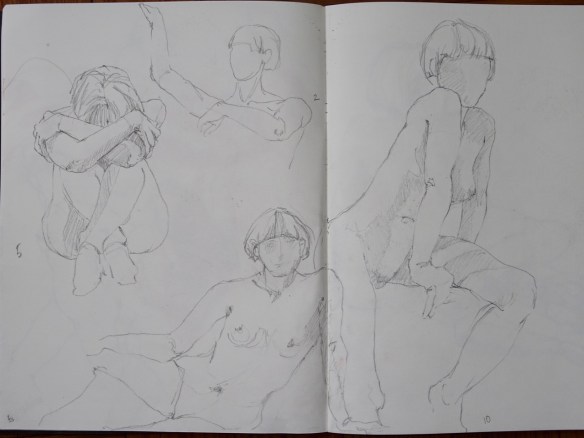
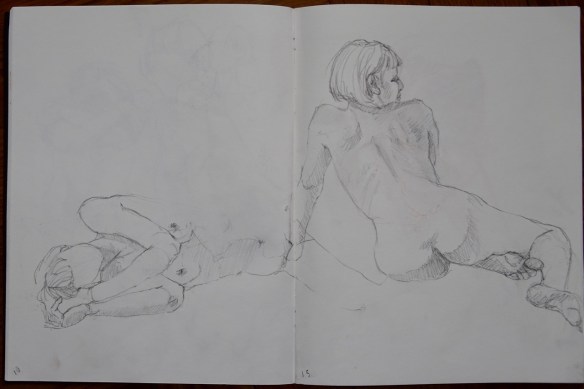
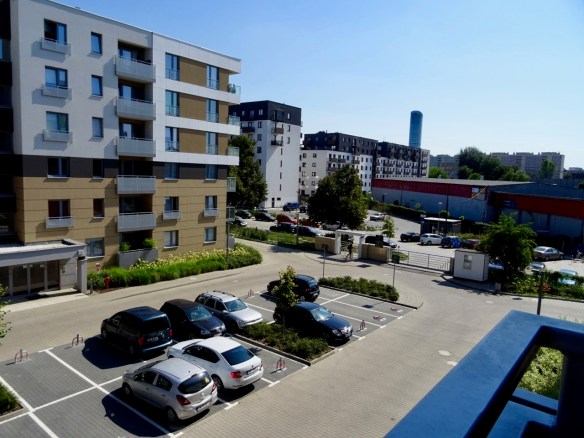
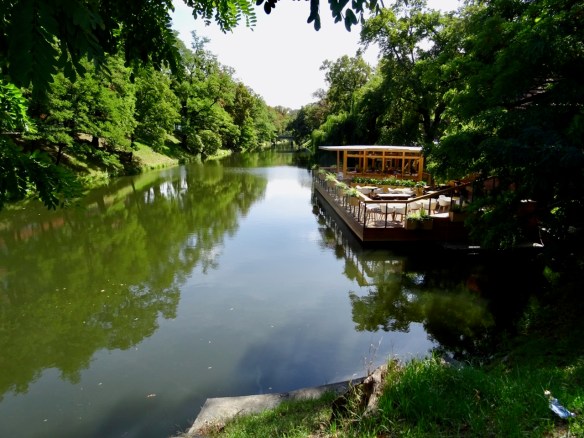
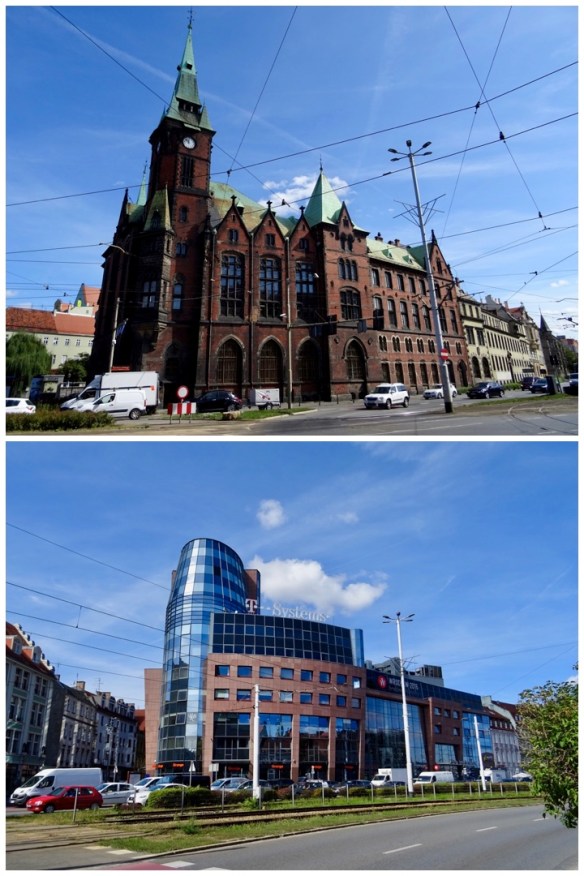 Here’s how big items get delivered!
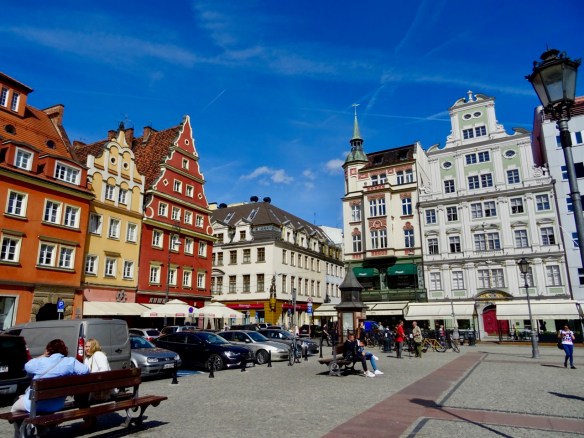
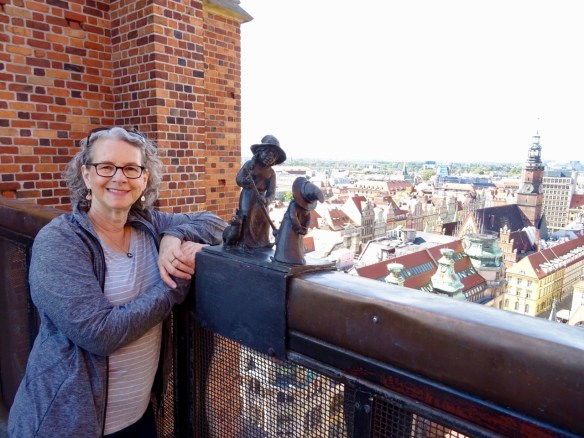
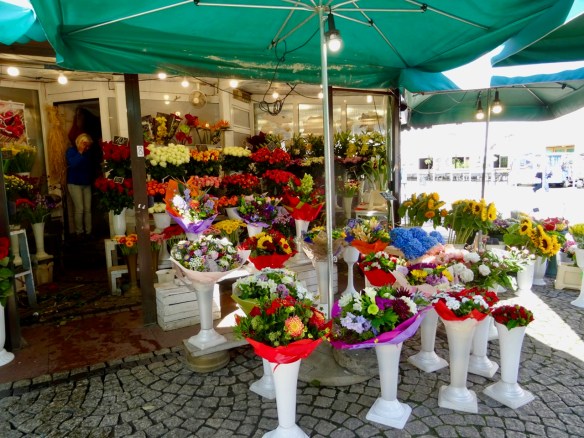 Wroclaw has an ever growing populations of gnomes. In fact, our guidebook states “the little buggers are currently rumoured to be running rampant to the score of over 300 making it literally impossible for us to try to keep track of them!” I think they are delightful and I am happy to make their acquaintance .
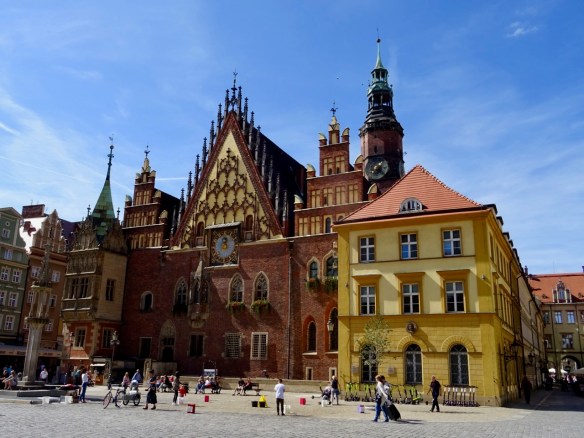
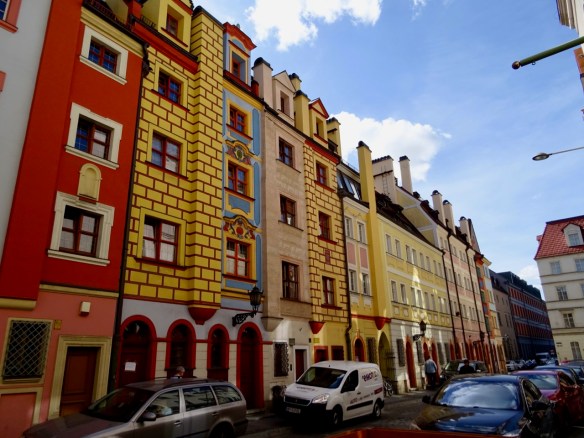
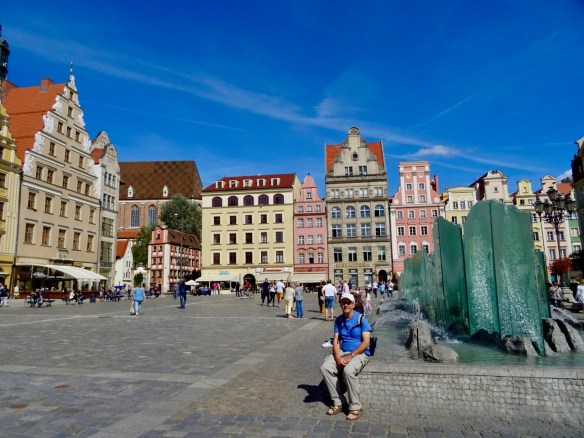 and more tenement houses in the town square.
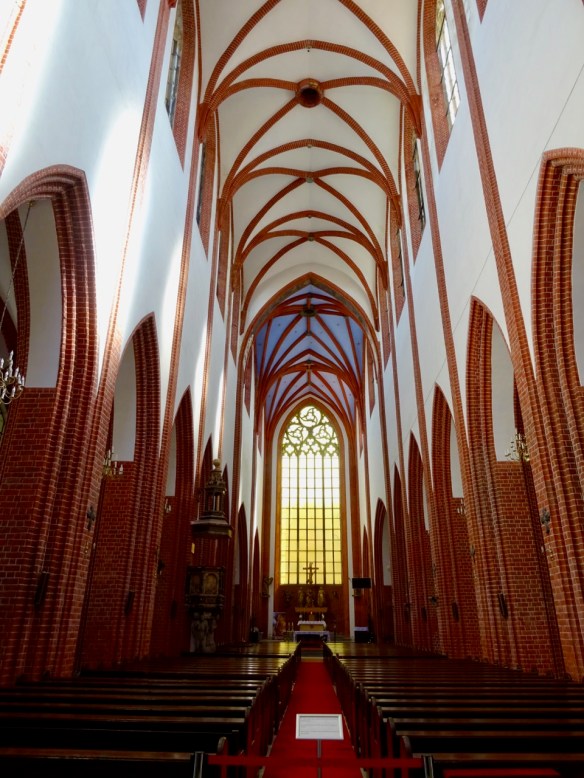
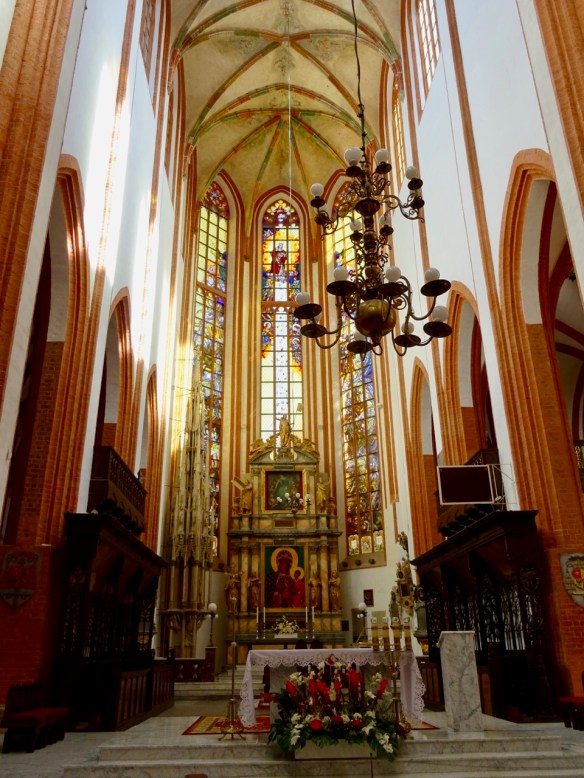
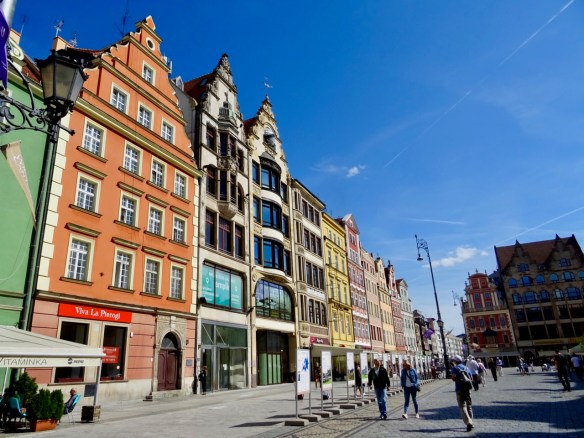 The interior of St. Mary Magdalene’s Church which dates from 1330.
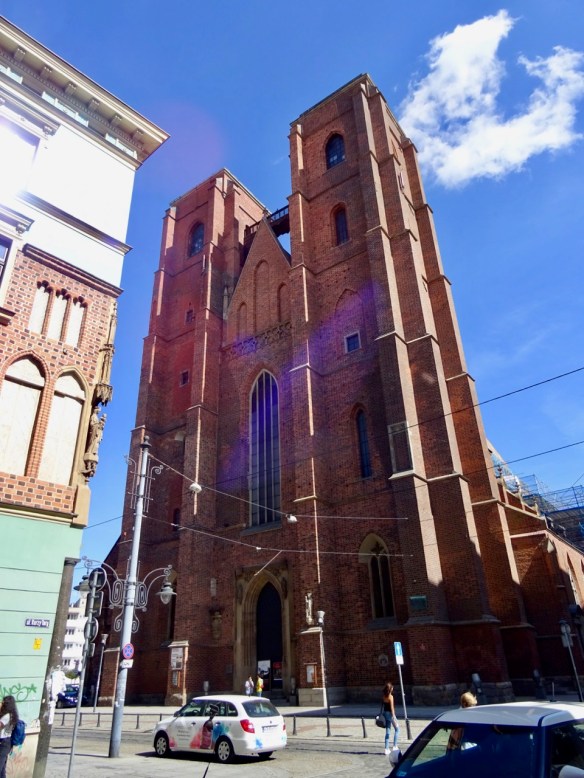
 We climb 147 steps up to the walkway between the two towers. In times past women suspected of being witches were forced to cross this walkway (there were no railings then) and if they made it across safely they were branded as a witch. If they fell to their death, then they were innocent of the crime of being a witch! You certainly didn’t want to be accused of witchcraft! I am very glad there are railings now and I meet another couple of gnomes.
 We have great views of the city from up here.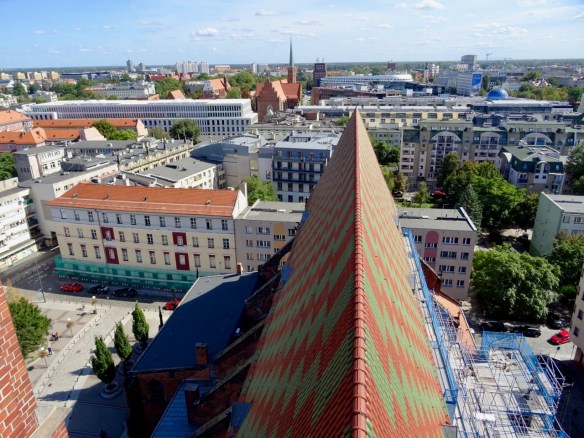
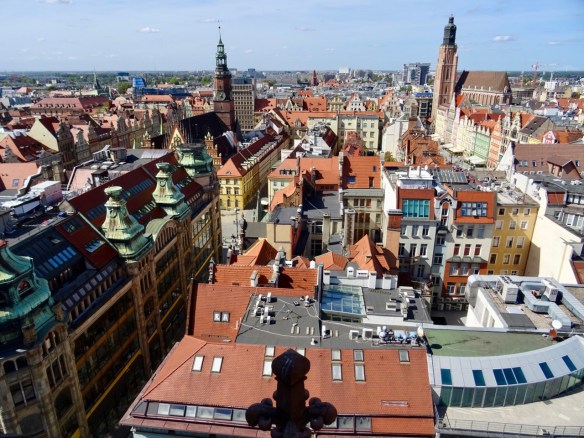 Here is a view of the walkway, way up there between the two towers.There were steeples on these at one time, not sure if they were destroyed during the war?
 More ornate colourful buildings.
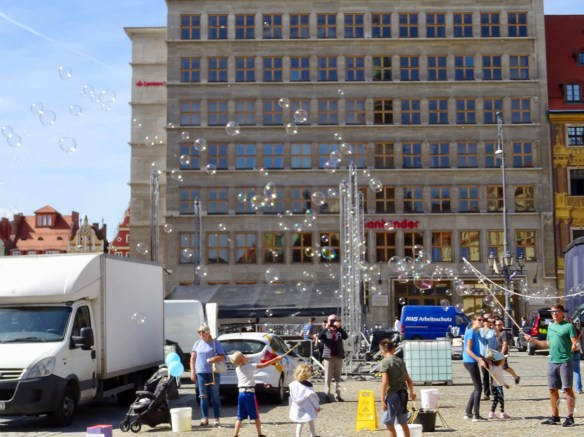
 I wish I knew the recipe for the bubble mixture this guy was using! He made hundreds of bubbles at a time with his string between two sticks. Kids had such fun chasing all the bubbles.
 We found quite a few more of these little fellows, on doorsteps, or tucked into corners.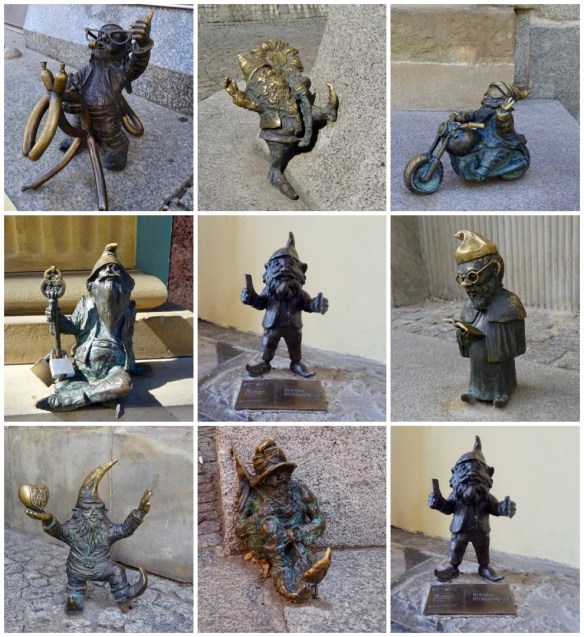
 The two little houses in the corner called Hansel and Gretel are the only two houses left of streets that used to surround a cemetery. The cemetery closed in 1773. I wonder where the graves went?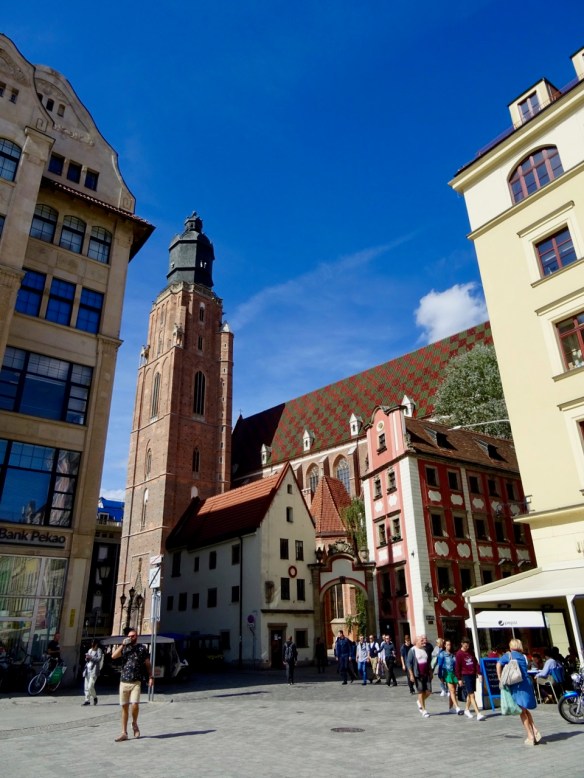
 and more busy gnomes.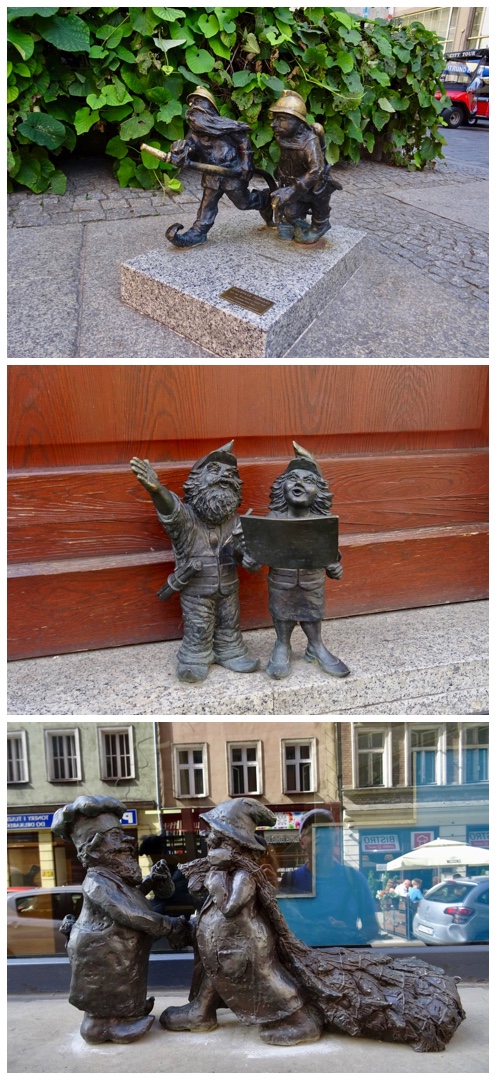
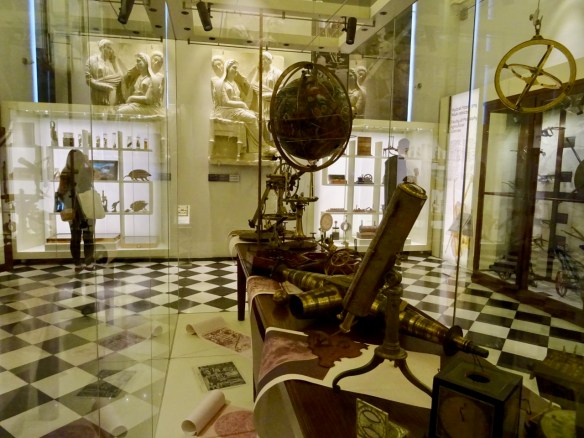
 and an interesting collection of artifacts. This is a chart for determining eye colour.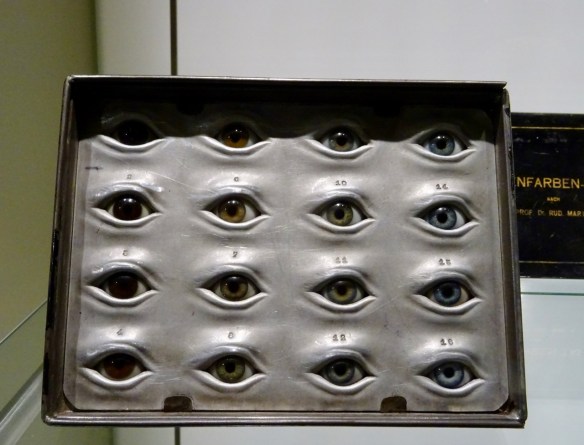
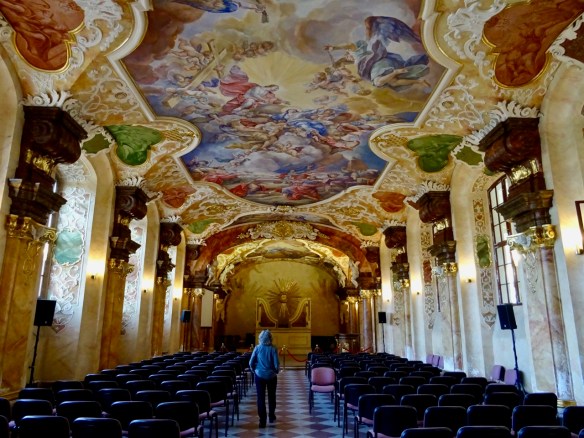
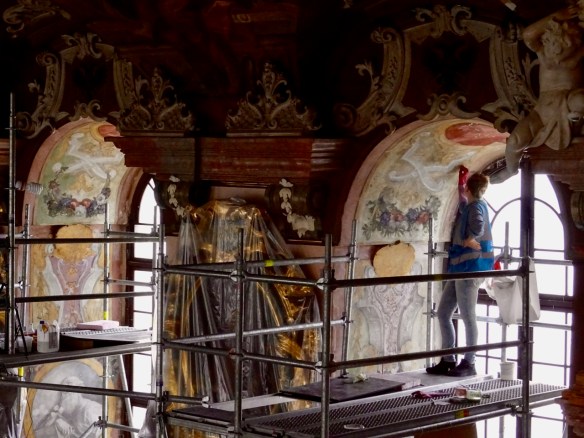
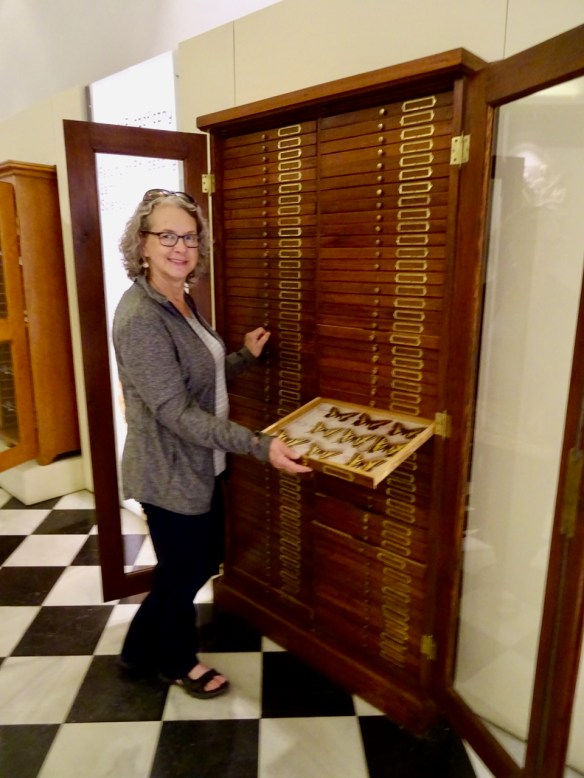 The Music Hall is under restoration but we are allowed a peak inside.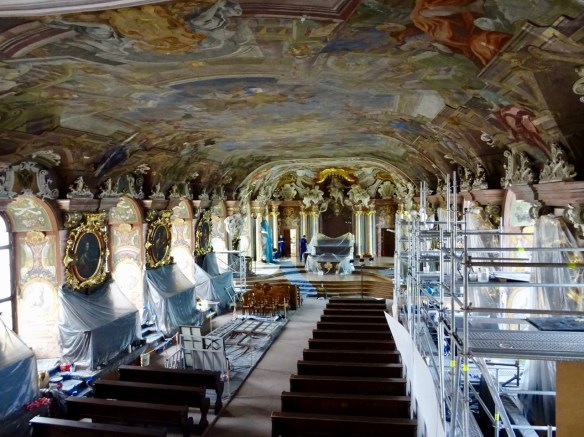
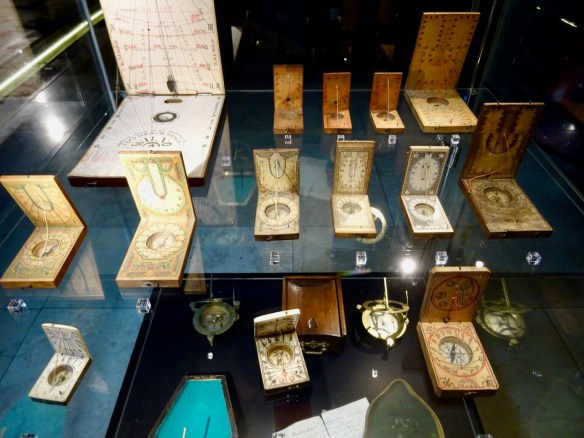
 We. climb another 203 steps up the Math tower, which has displays along the way.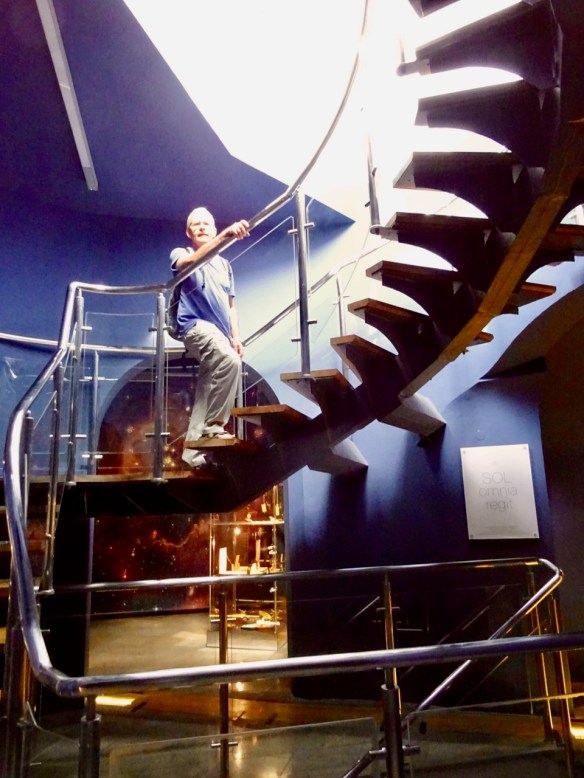
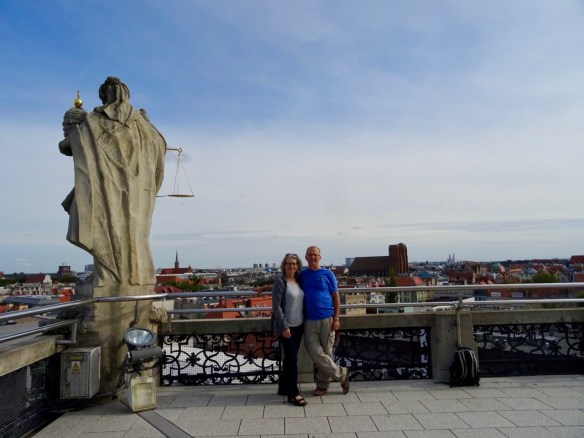 and the views. Notice the very modern looking tower among the old.
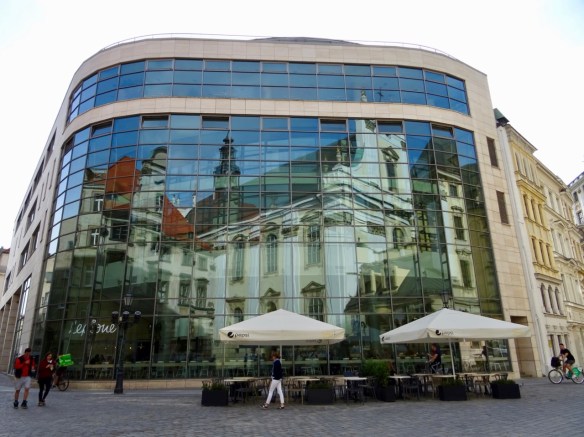
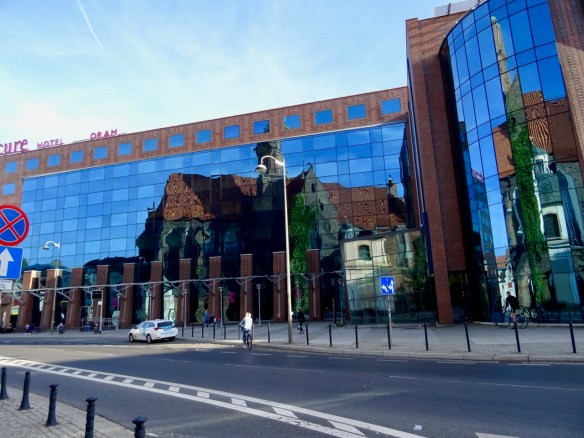
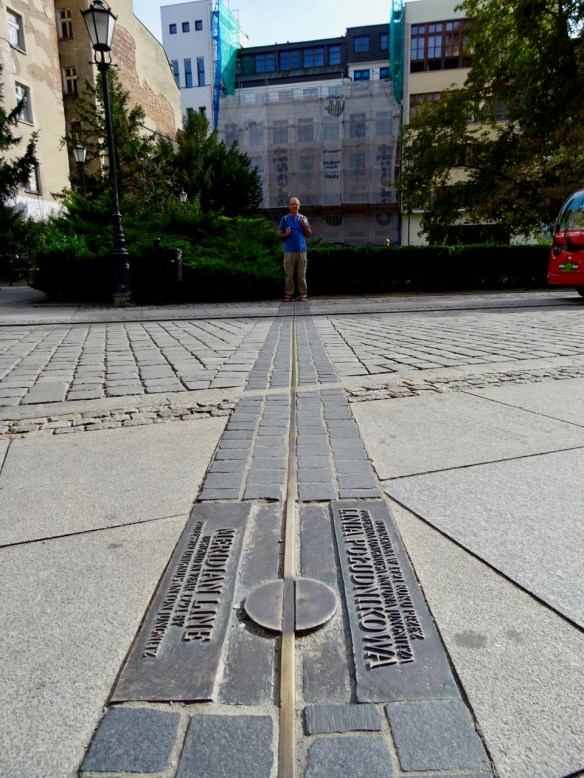 I just love all the reflections of the old buildings in the glass walls of the modern new buildings!
 Churches here are either very ornate…
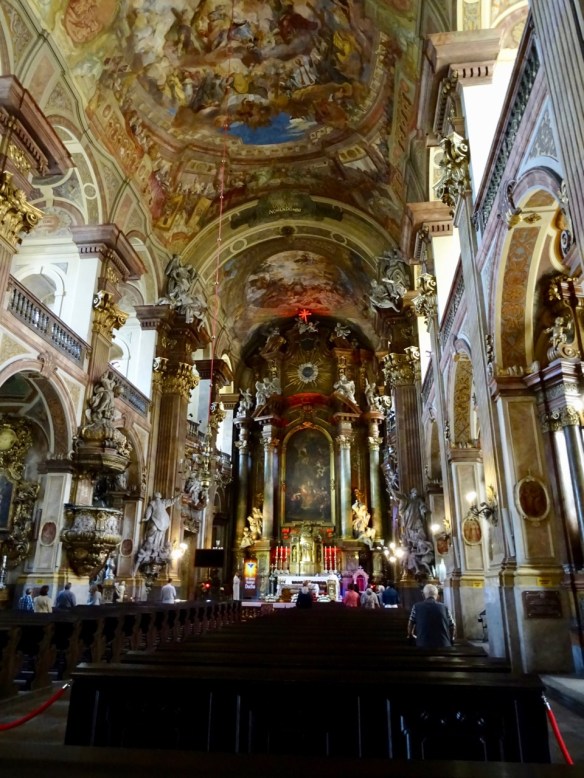 or look like this. The late afternoon sun was shining through the windows casting everything in a lovely olden glow.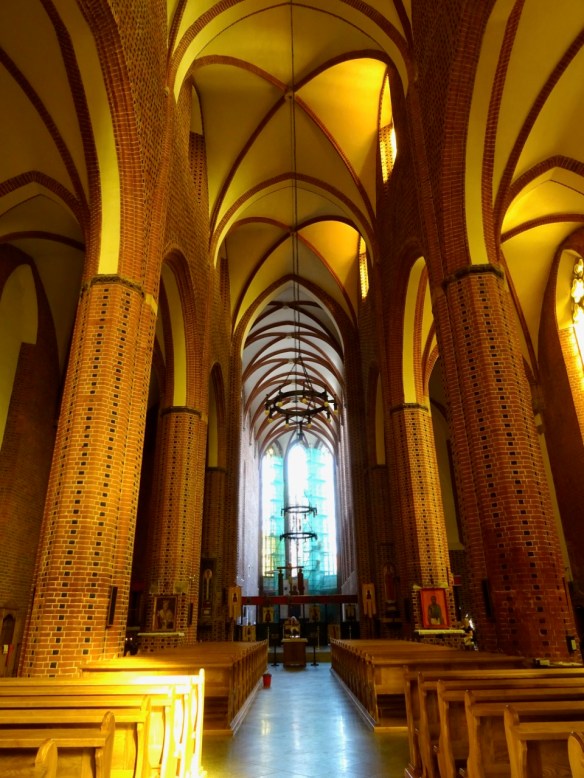
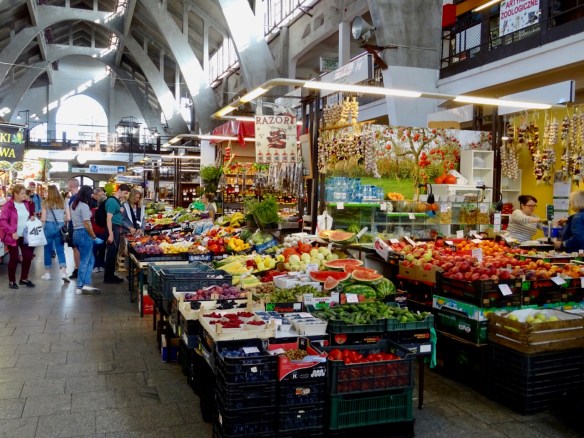
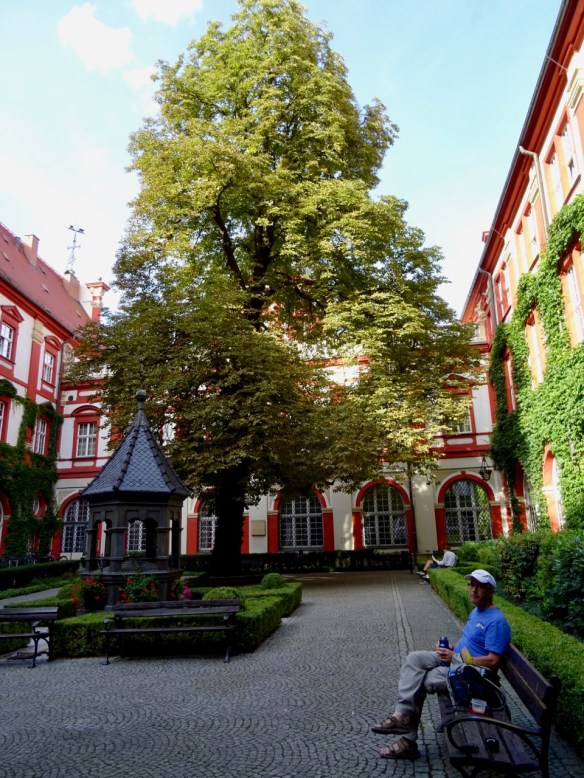 Then we visit the market and buy some fruit. Food prices are very reasonable here.
 More reflections.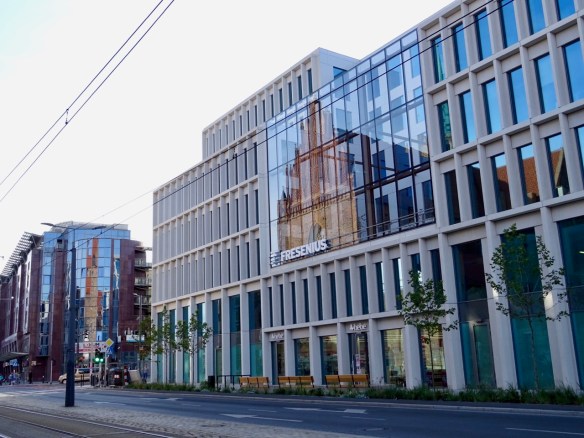
 We catch a trolley bus home. We haven’t seem many paved streets or sidewalks here. Most of the streets and sidewalks here are cobbled in one fashion or another. All the uneven footing is hard on the feet and ankles. We walked 16,700 steps today and climbed the equivalent of 31 floors!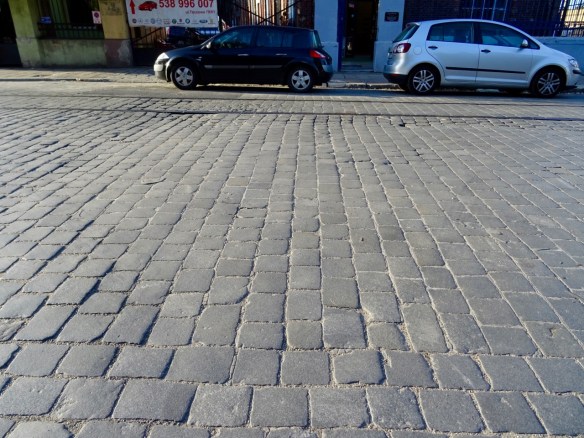








 trudymason.com
