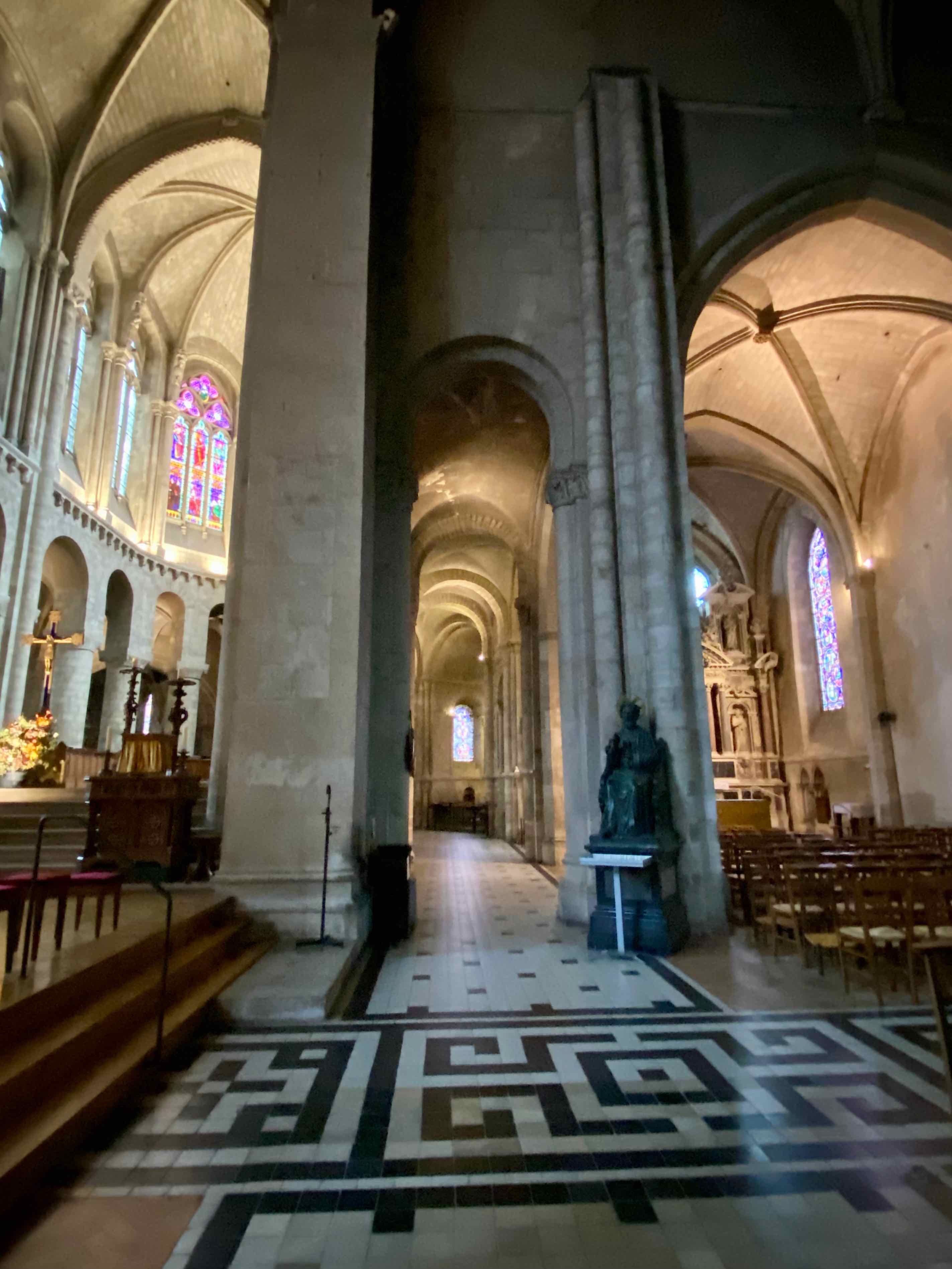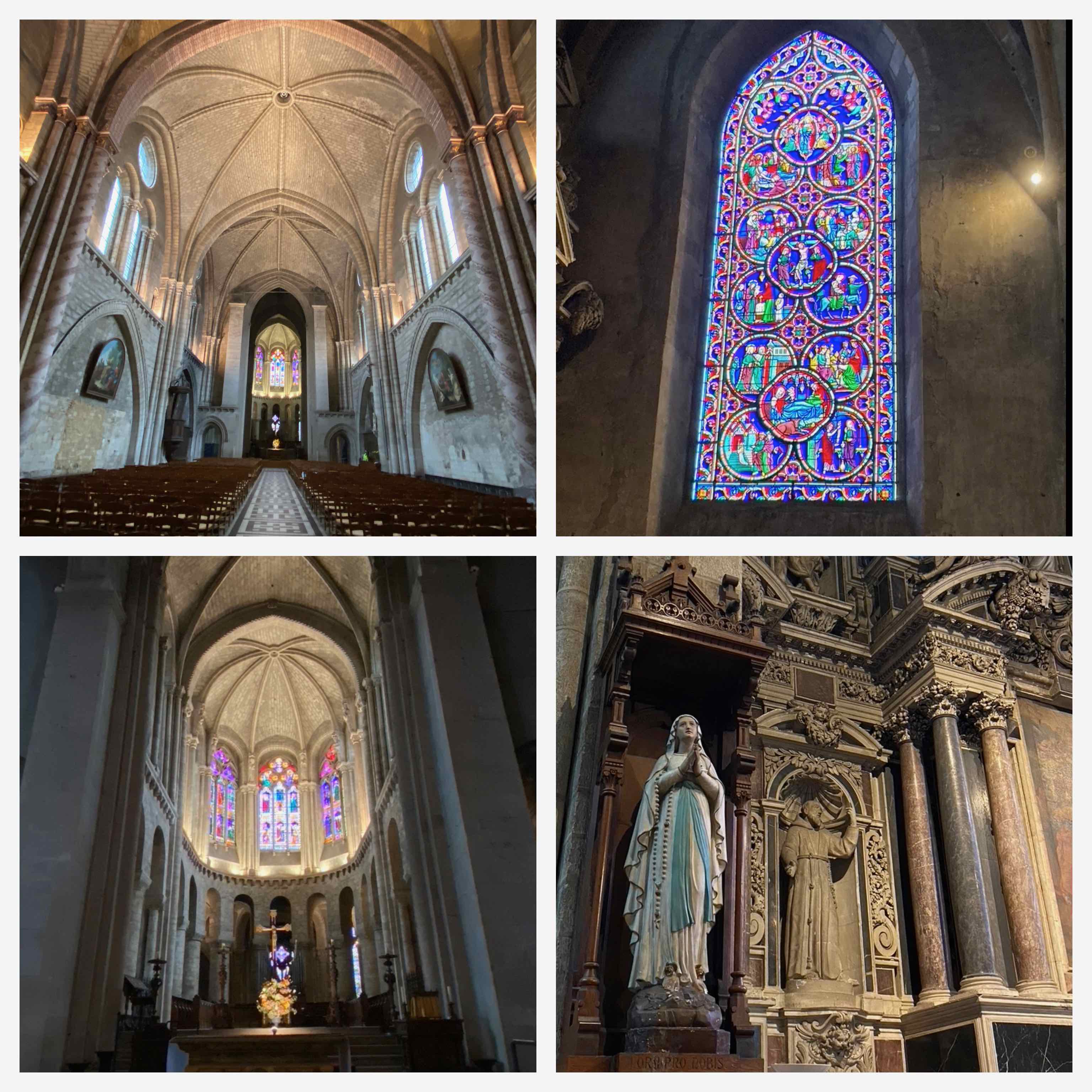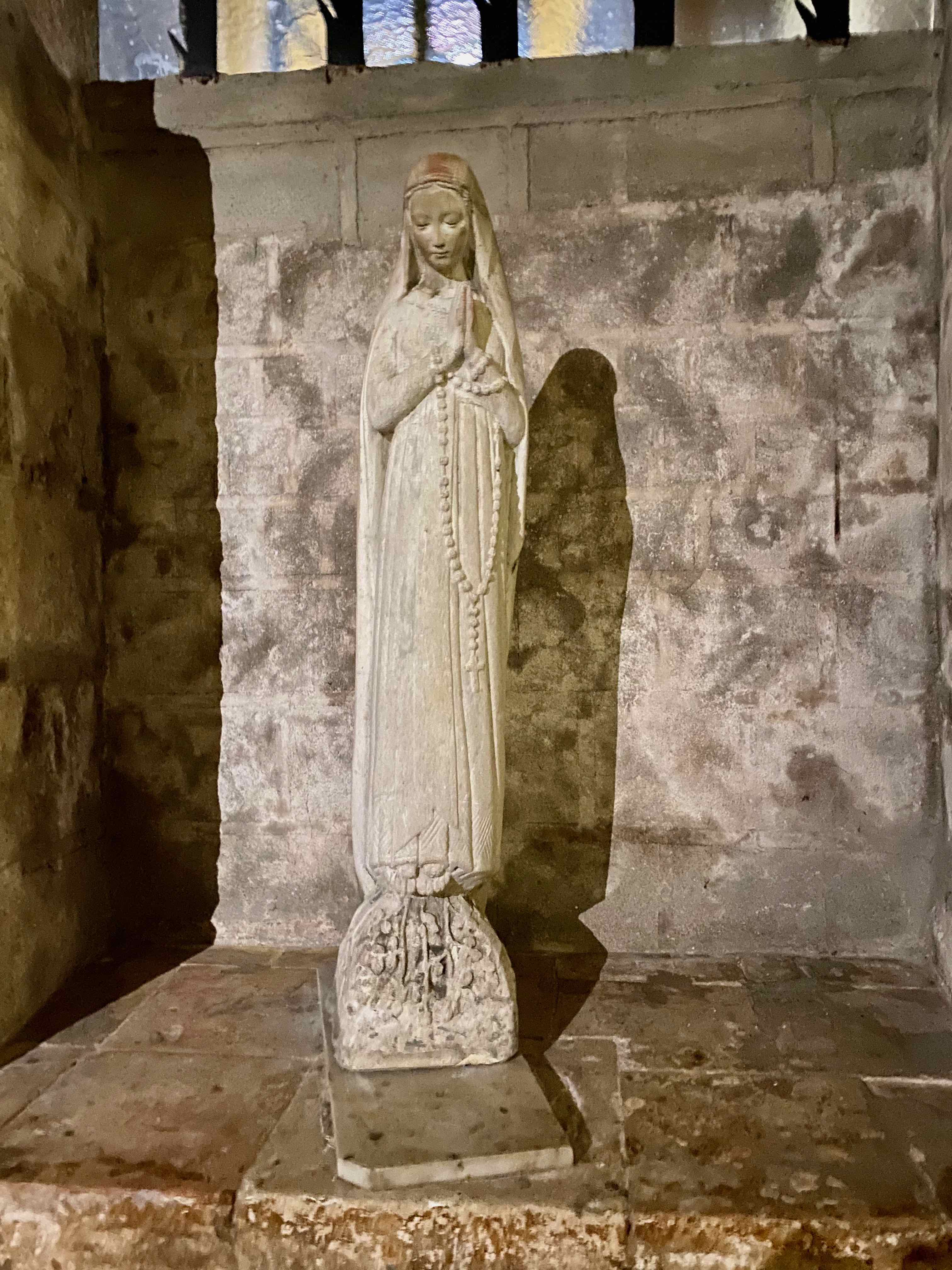
Amiens, France

Day 13.    Friday, September 12, 2025

It is an hour drive to Amiens from Arras where we will visit Jules Verne’s house, the largest cathedral in France, and take a unique boat ride.

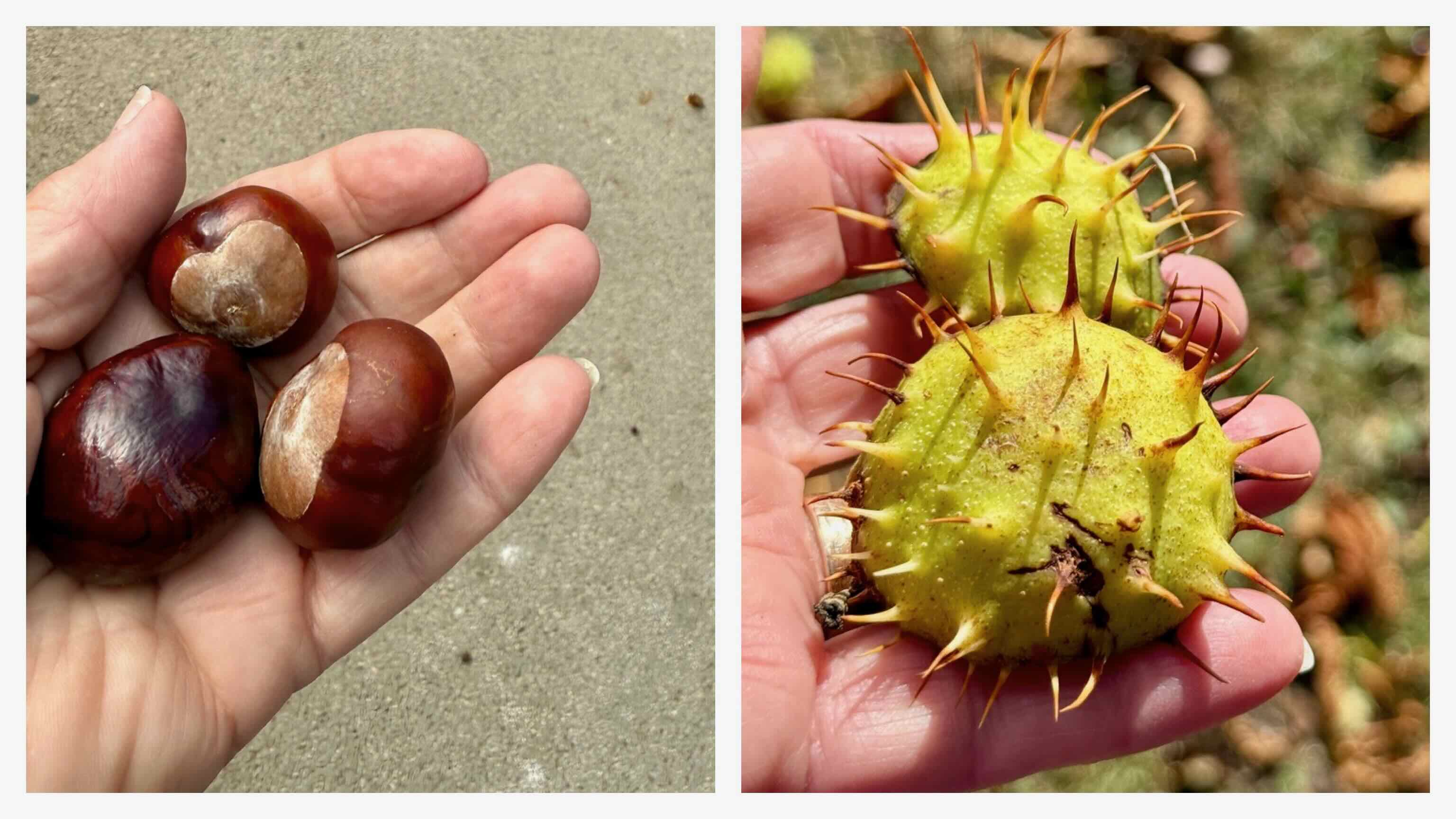
We luck out and find a parking space right beside the Jules Verne museum.  Parking downtown in French cities is very difficult, there are more cars than spaces available.  We have our picnic lunch in a little park right by the museum but these chestnuts were falling and landing with a crash around us…the spikes on the green fruit are very sharp and we decide to move to a safer bench.
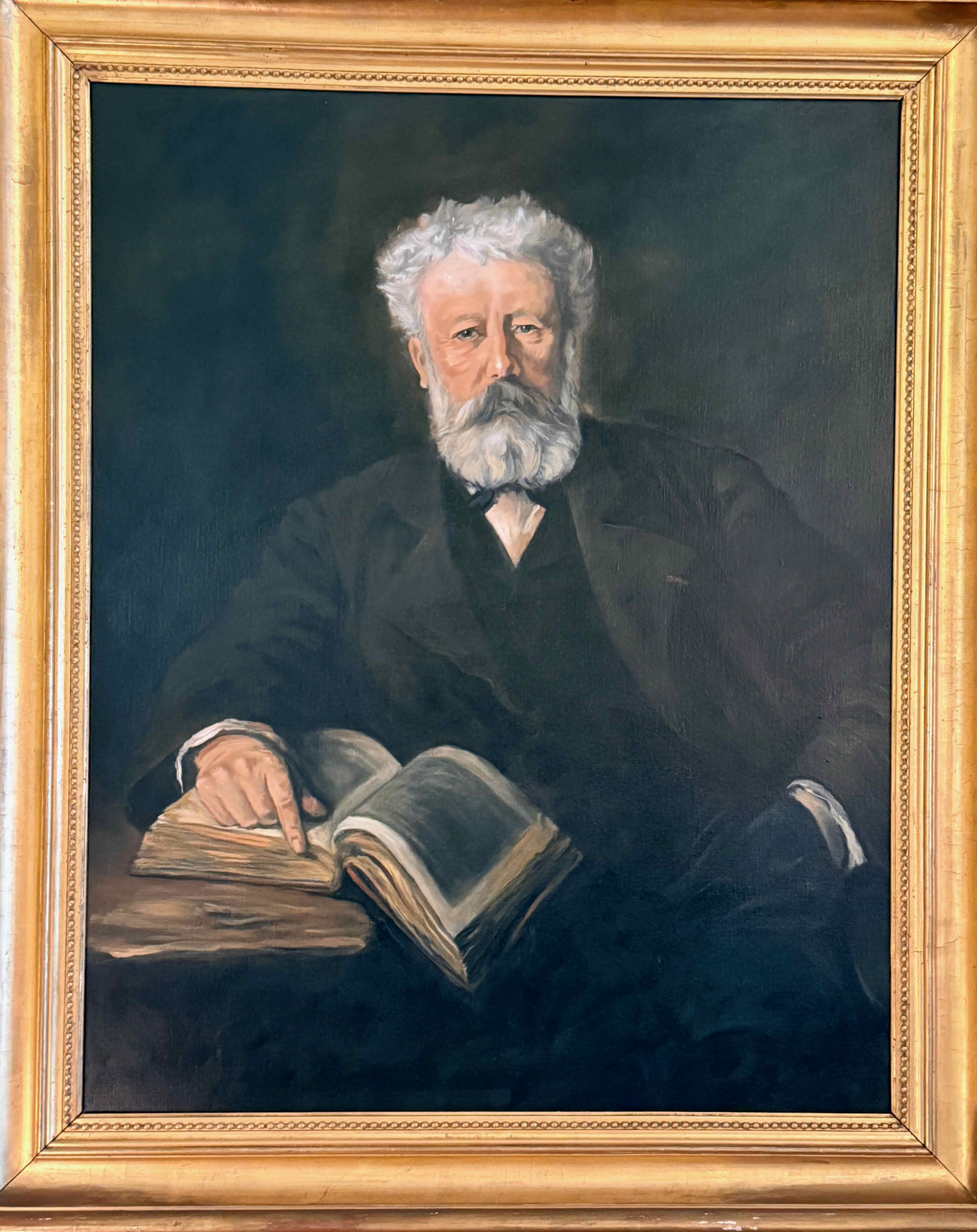
Jules Verne (1828-1905) was a French novelist, poet and playwright.  Jules Verne is the second most translated author in the world, ranking below Agatha Christie and above William Shakespeare.  His novel Around the World in 80 Days is printed in 18 languages.
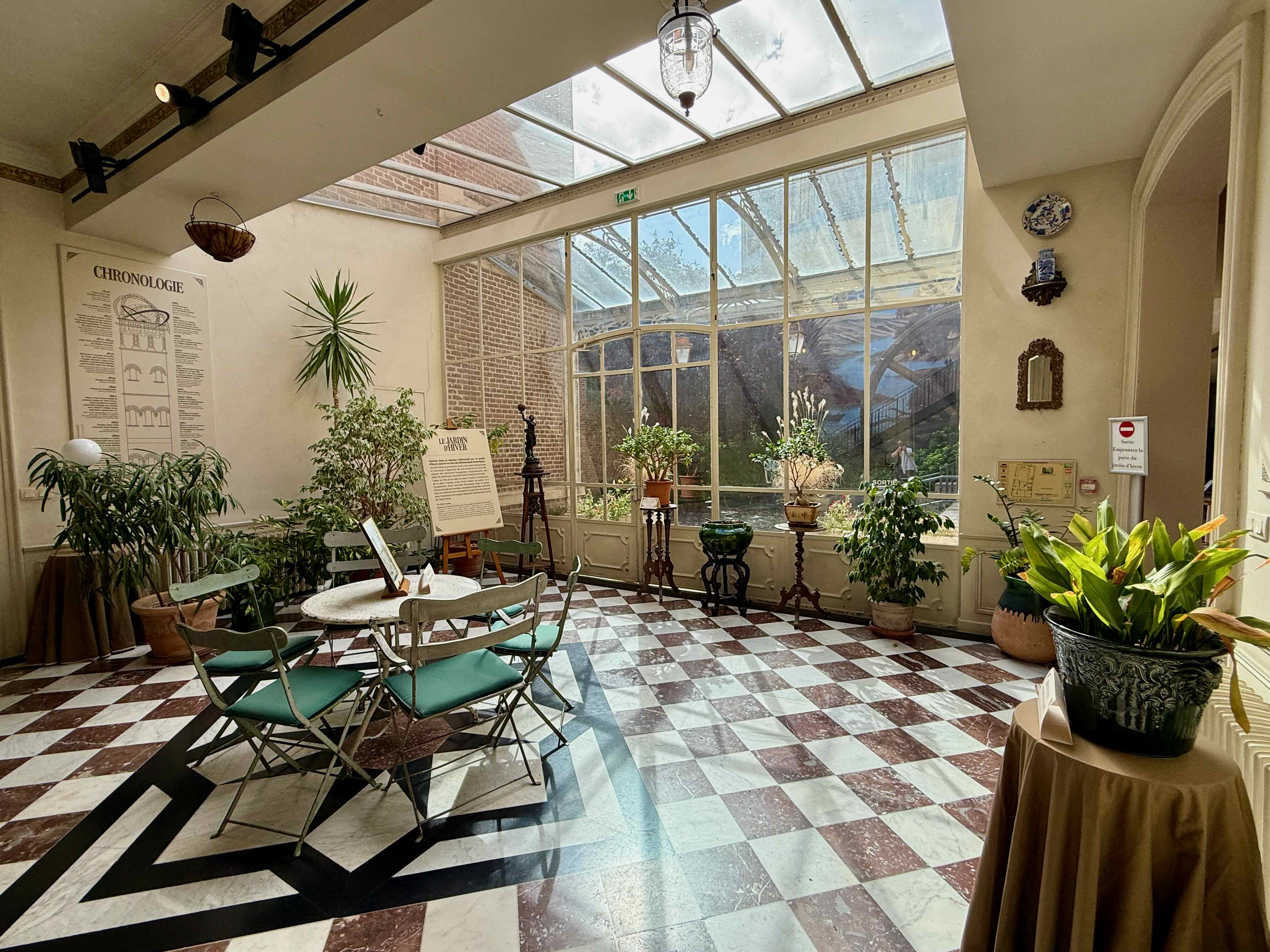
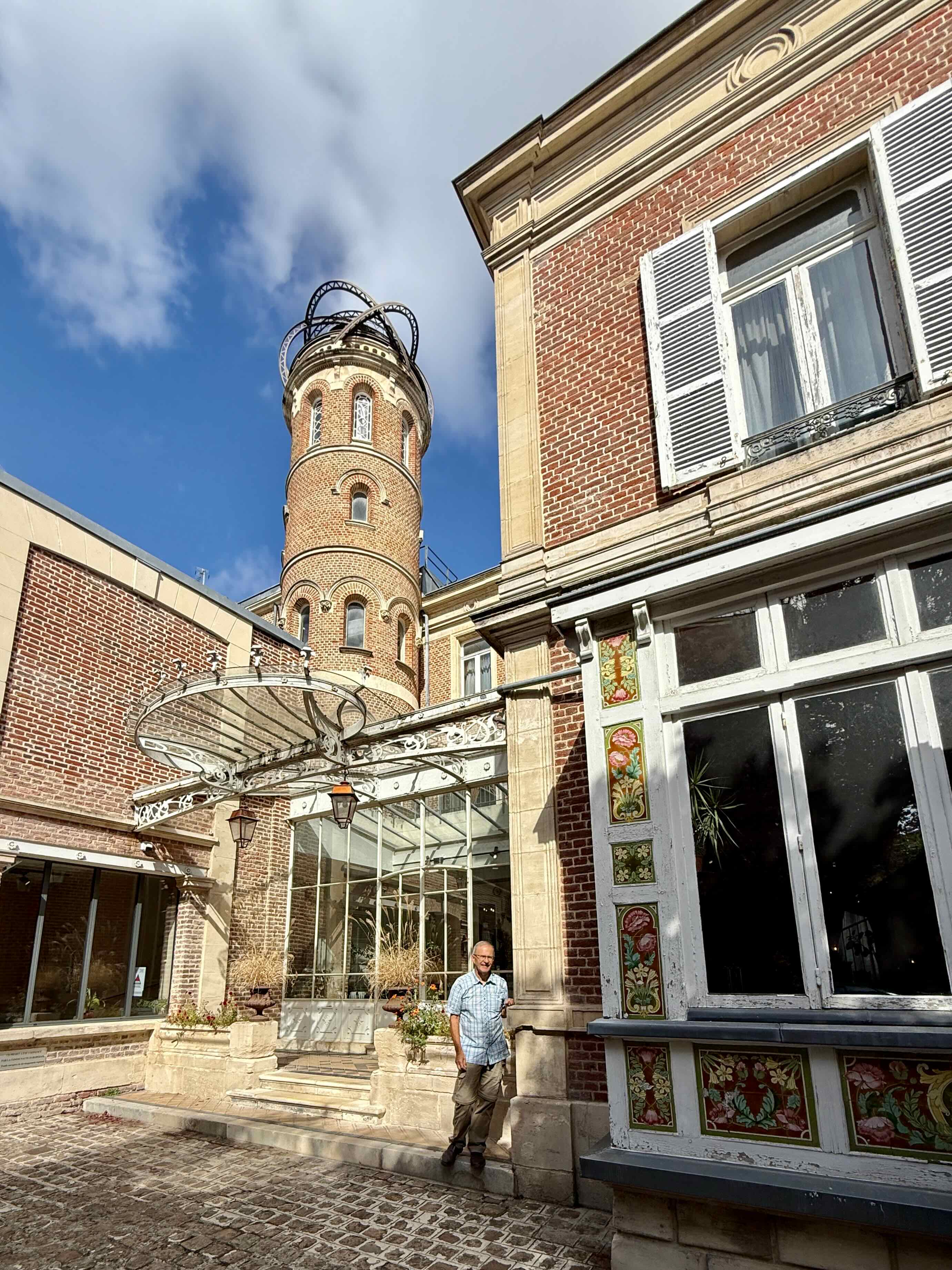
The winter garden was the original entrance to the Jules Verne house.  Tropical garden plants were moved indoors here to spend the winter.
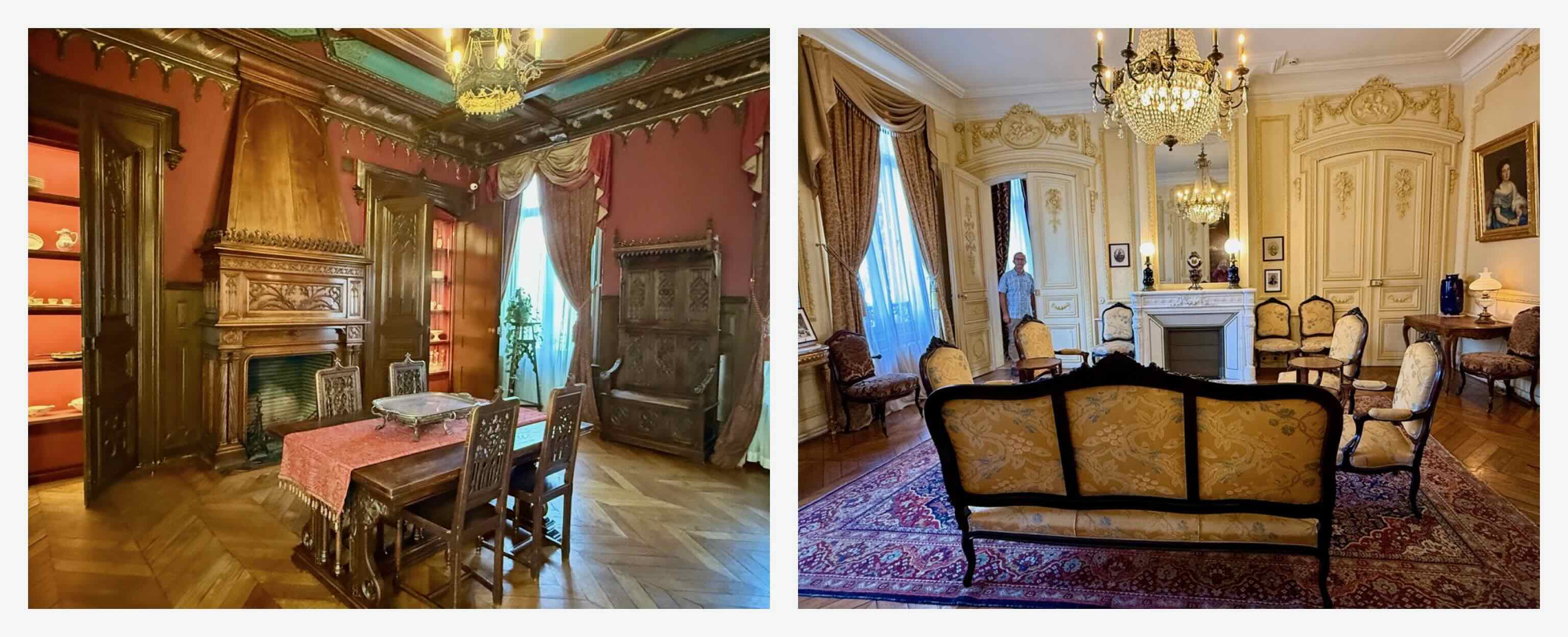
The dining room and salon on the main floor.
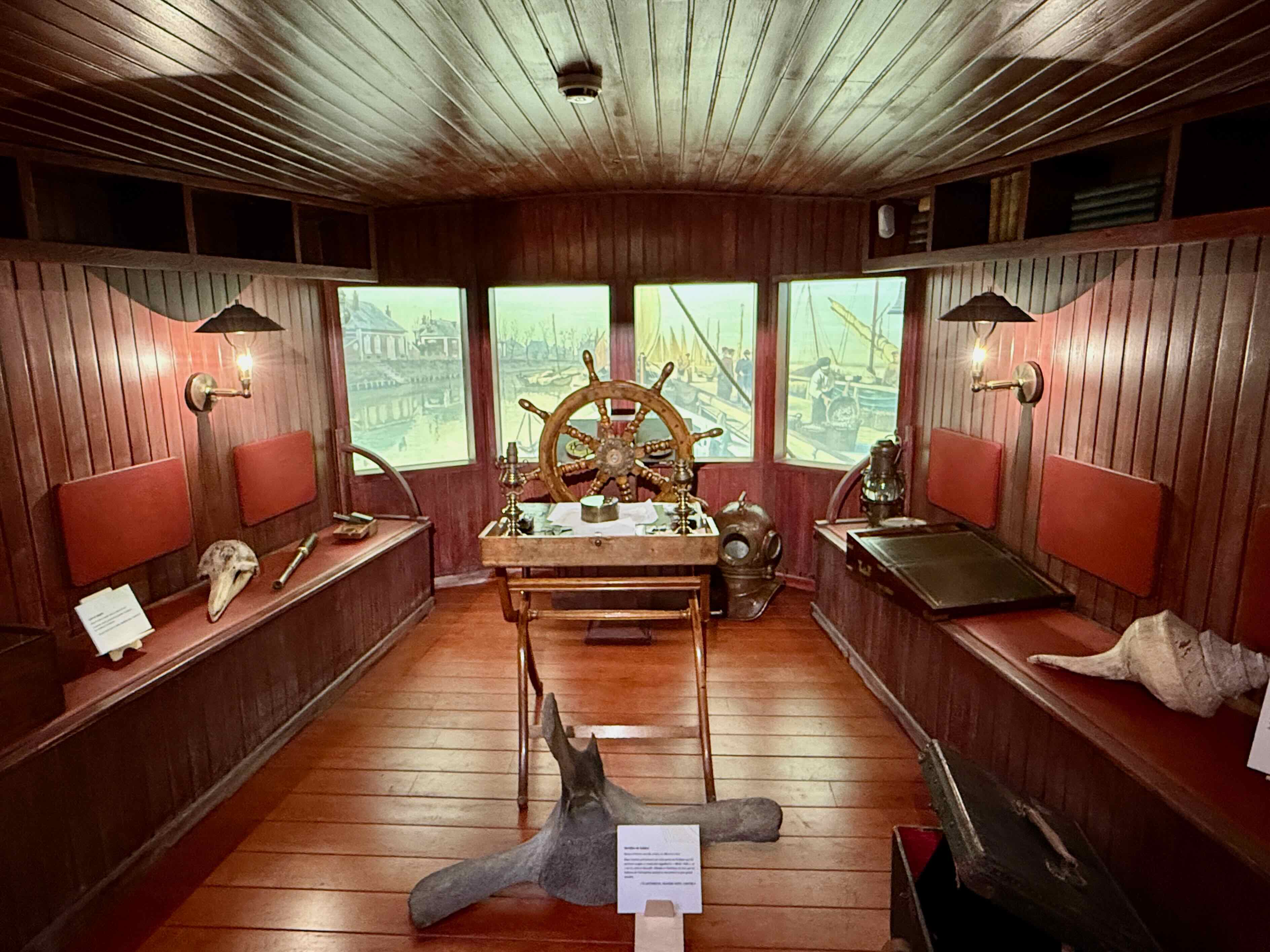
One of the second floor rooms was a reconstruction of his first boat.  Jules Verne loved to sail and his first boat was a 9 metre long.  His second boat was 20 meters in length and the third was 30 meters!  
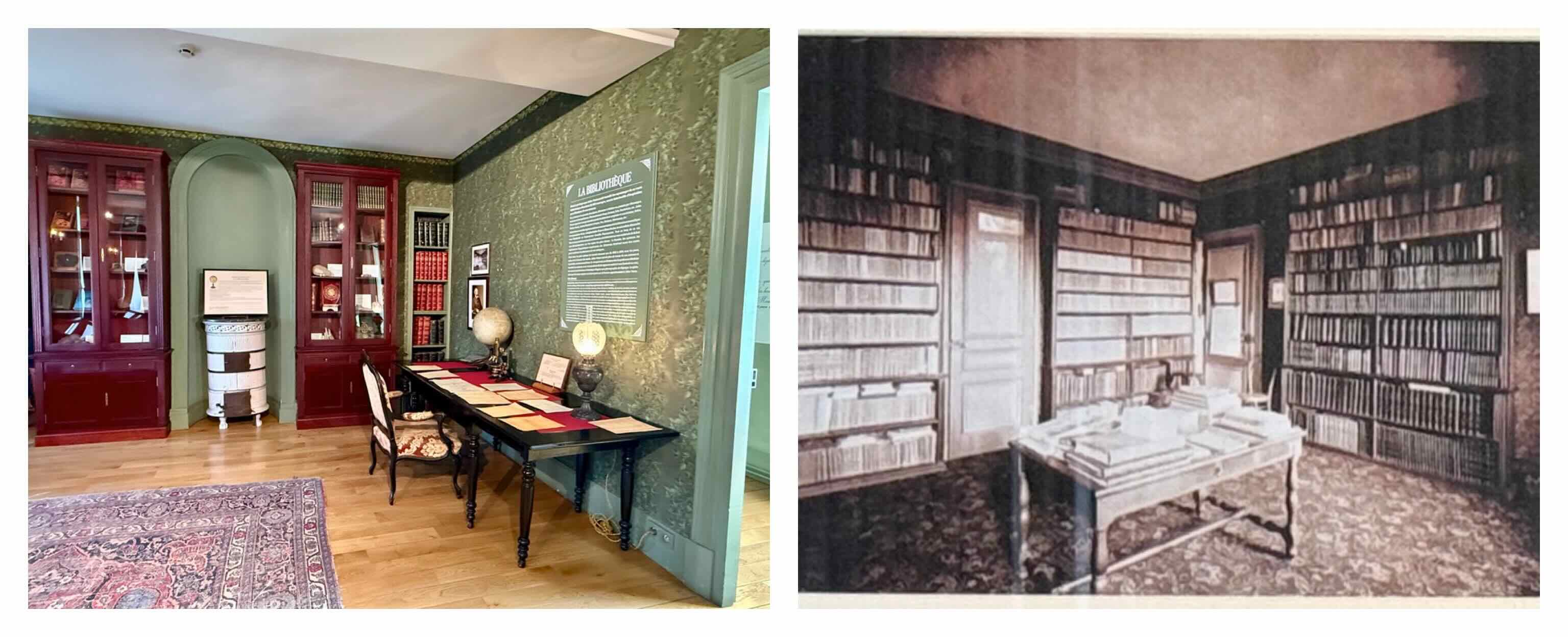
This second floor room was a library. The second photos shows the original library with over 12,000 books.  When he read these books Jules Verne wrote notes on index cards to use as reference information for his novels.
From 1882 to 1900 Jules Verne wrote every day from 5:00 am until 11:00 am in this little room.
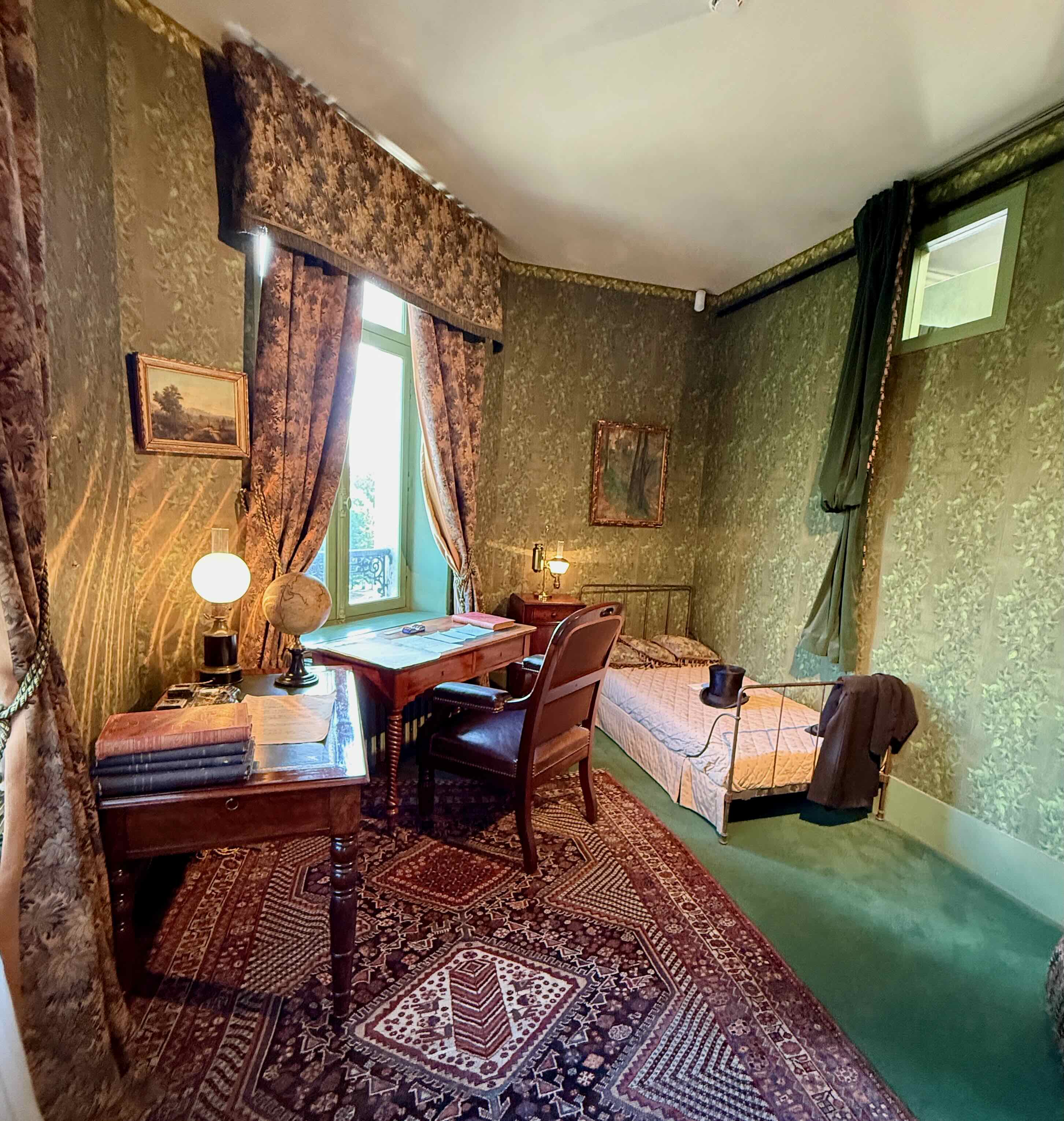
Climbing the tower which was added to the house by Jules Verne.  It allows access to all three floors of the house.
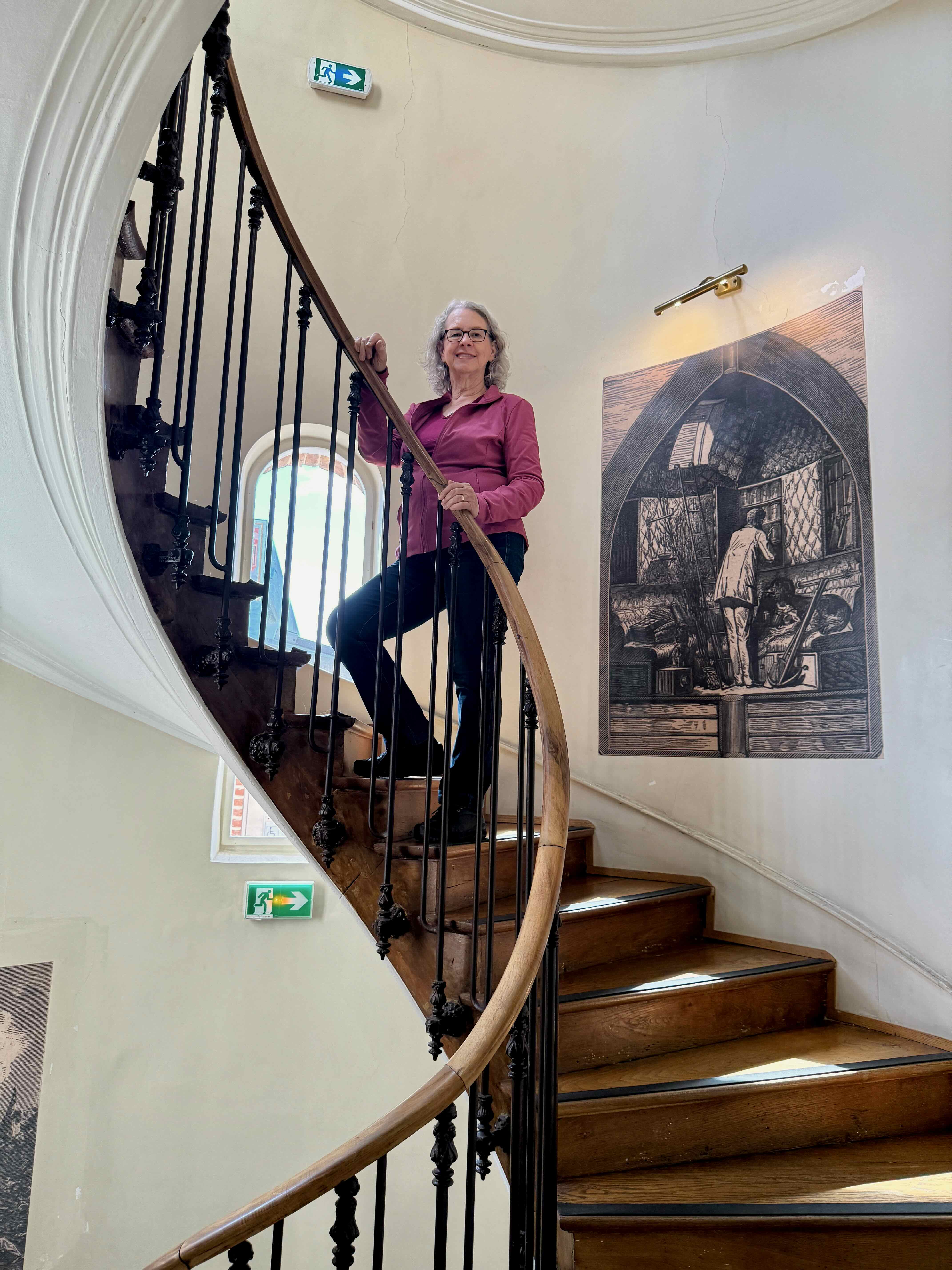
The third floor attic has a collection of original movie posters…
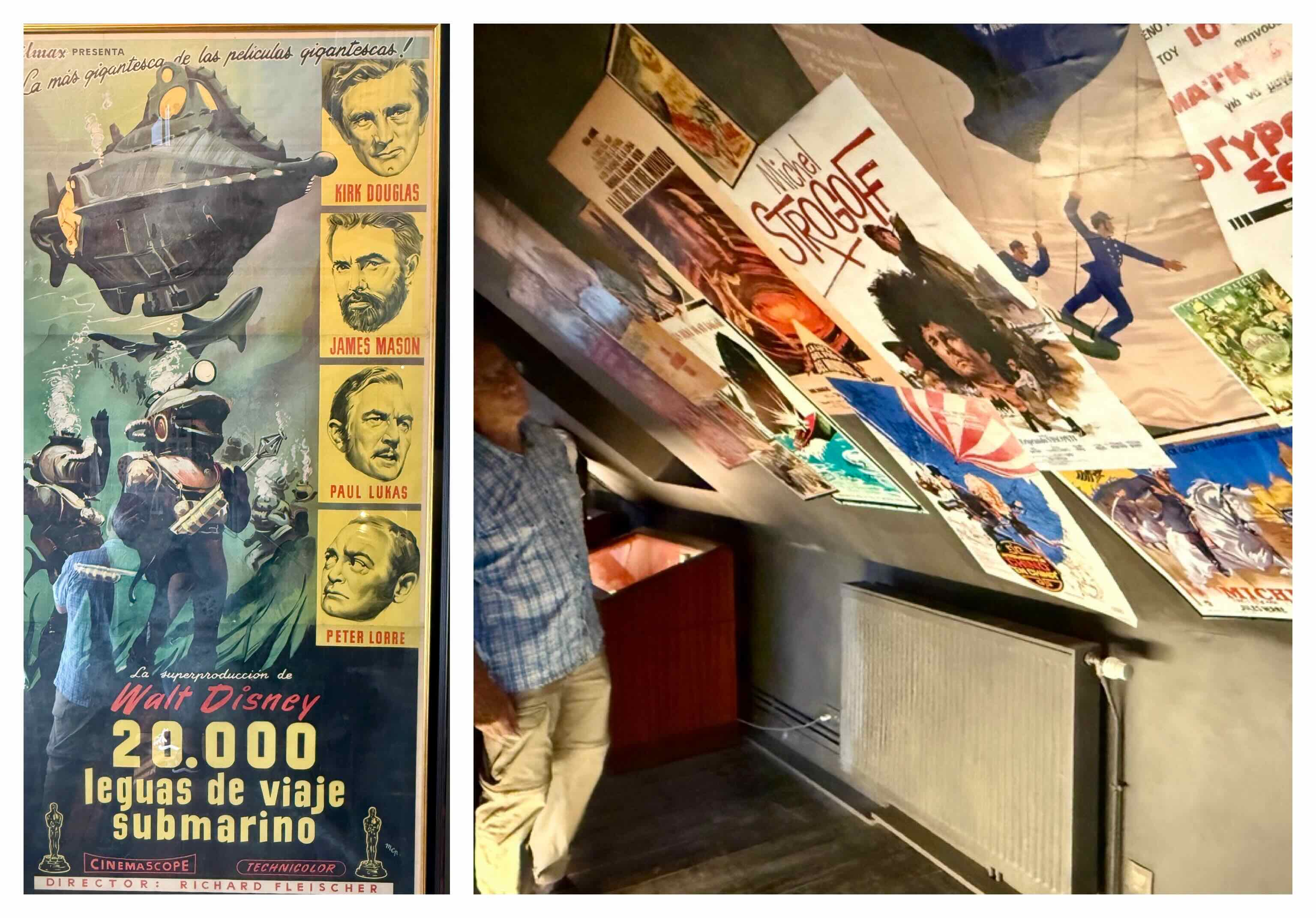
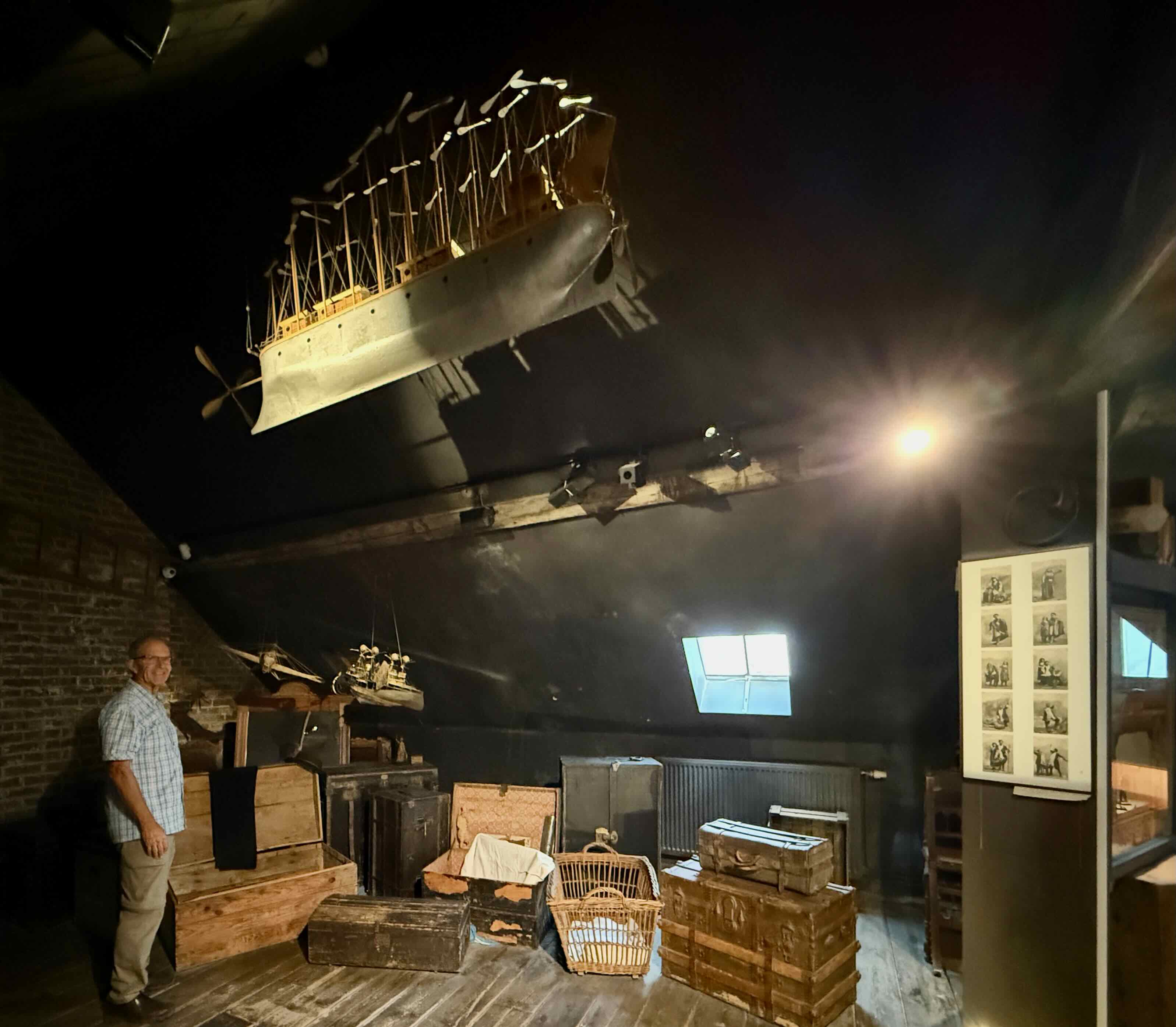
…and other memorabilia.  I look like I am one of the exhibits!
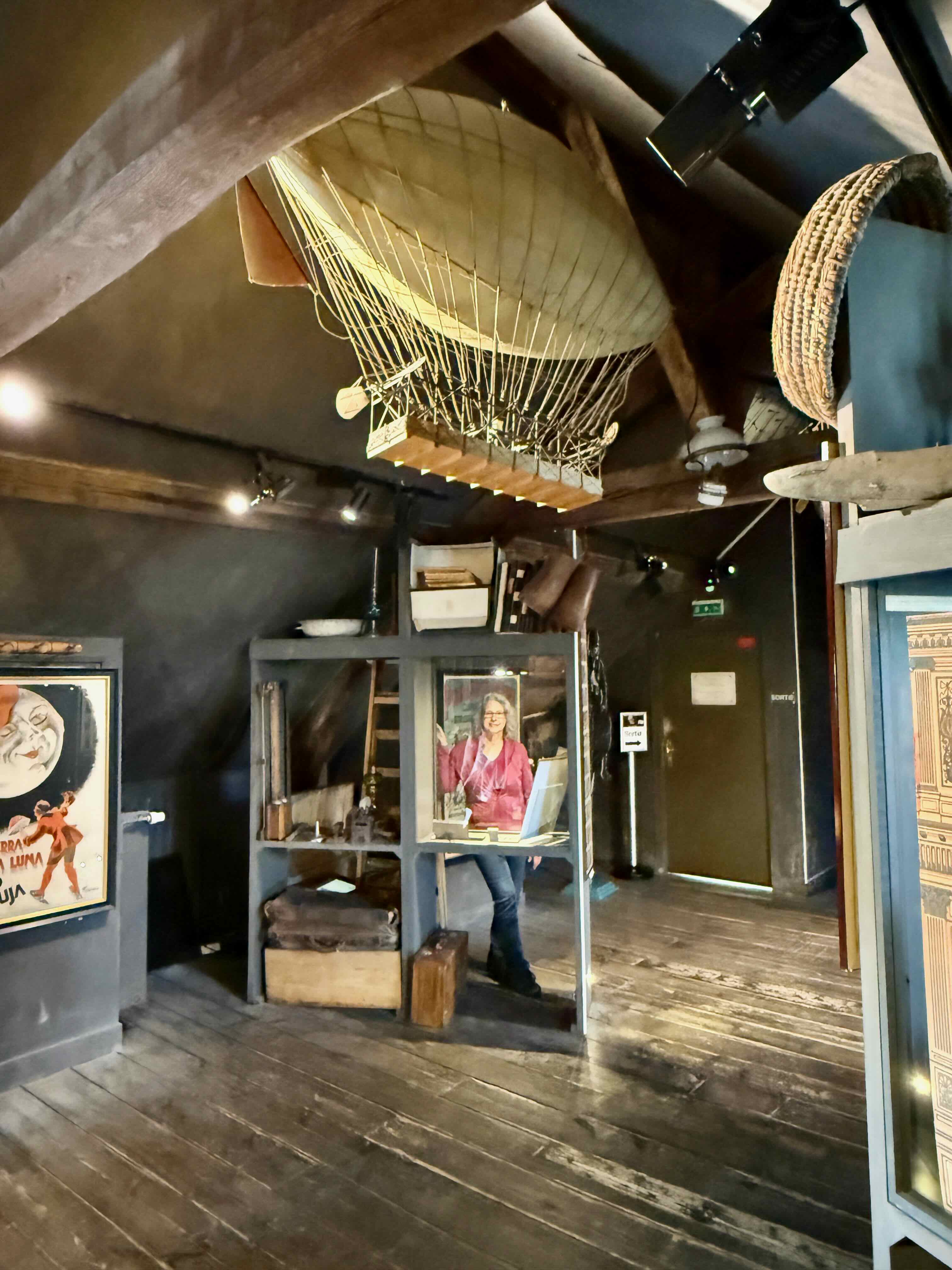
Bob and a fictional flying machine from one of Verne’s novels.  A view from the front of the house showing the winter garden.
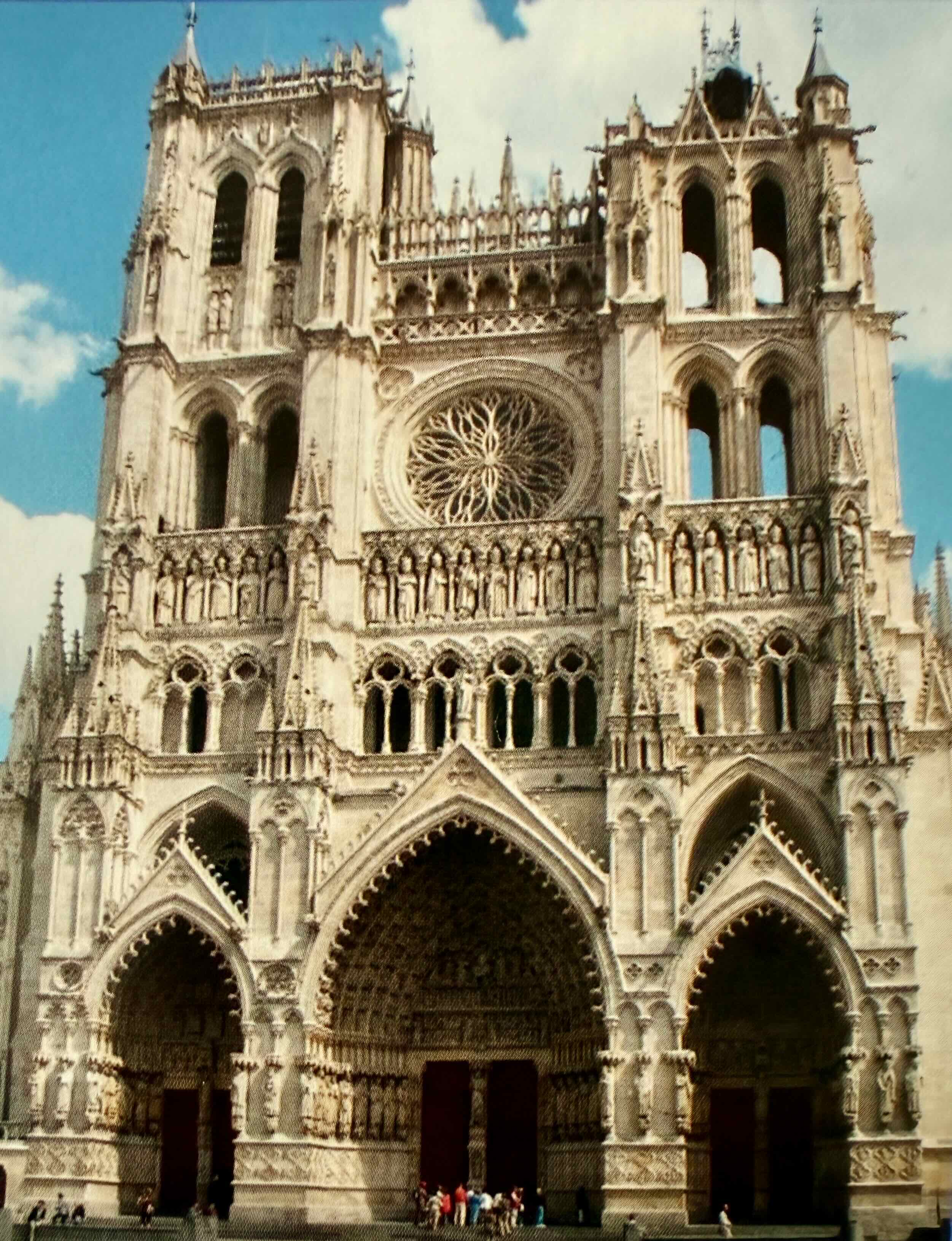
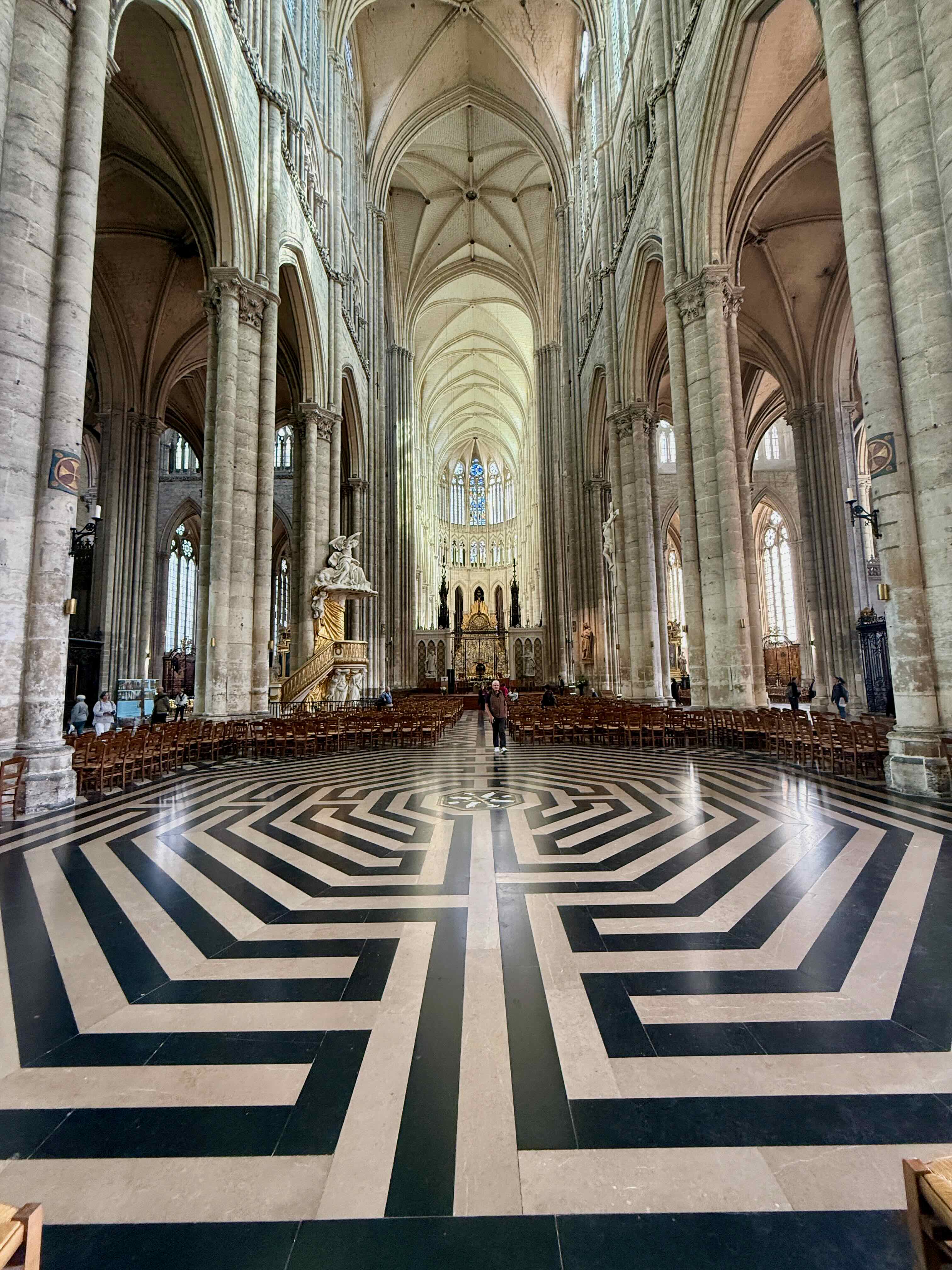
it is a short walk to the Amiens cathedral. Notre-Dame d’Amiens is the largest medieval cathedral in the world.  It was built in 1269 and is twice the size of Notre Dame in Paris.
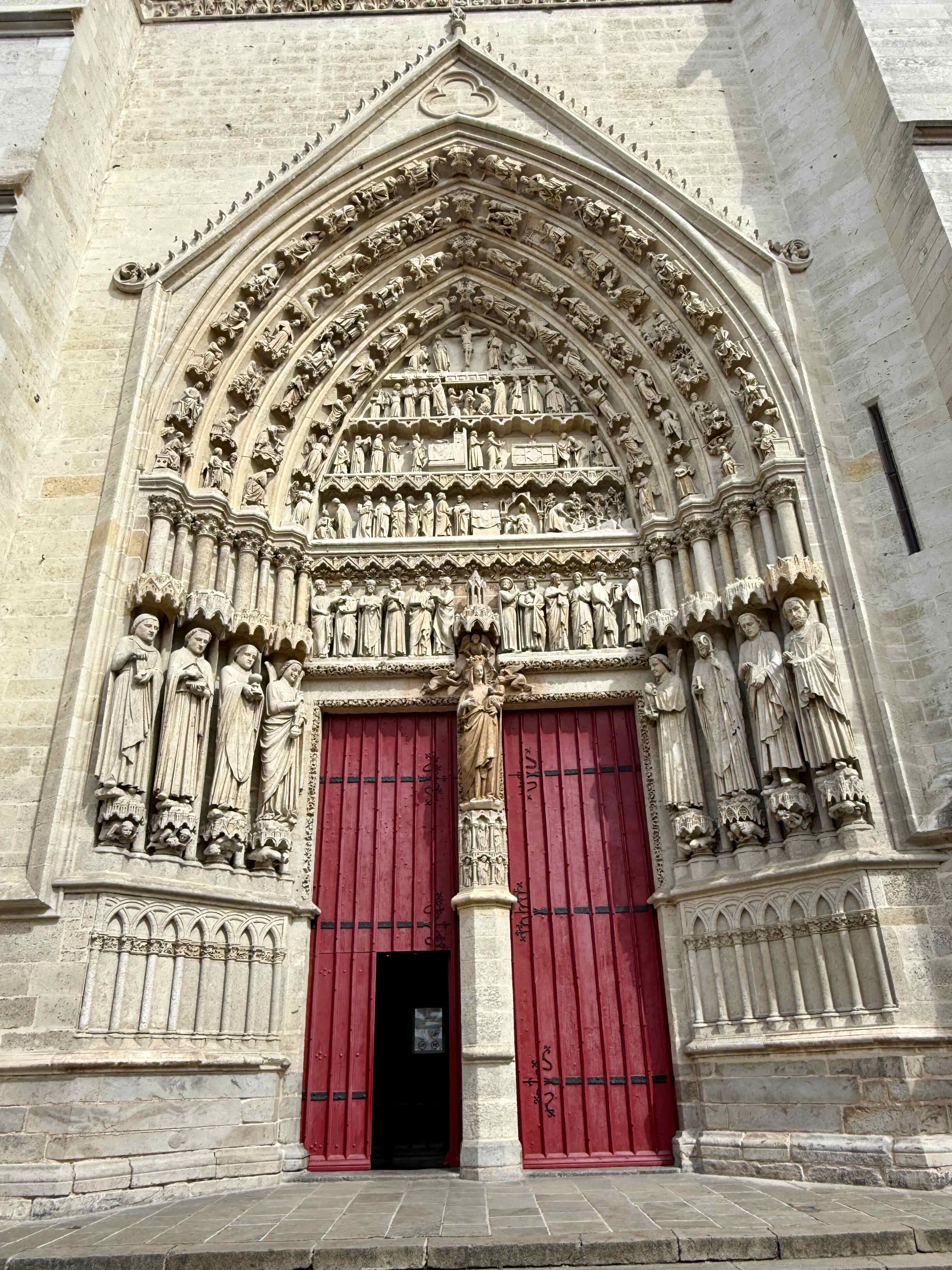
The sculpted decorations in the portals have survived in a remarkable state of preservation…
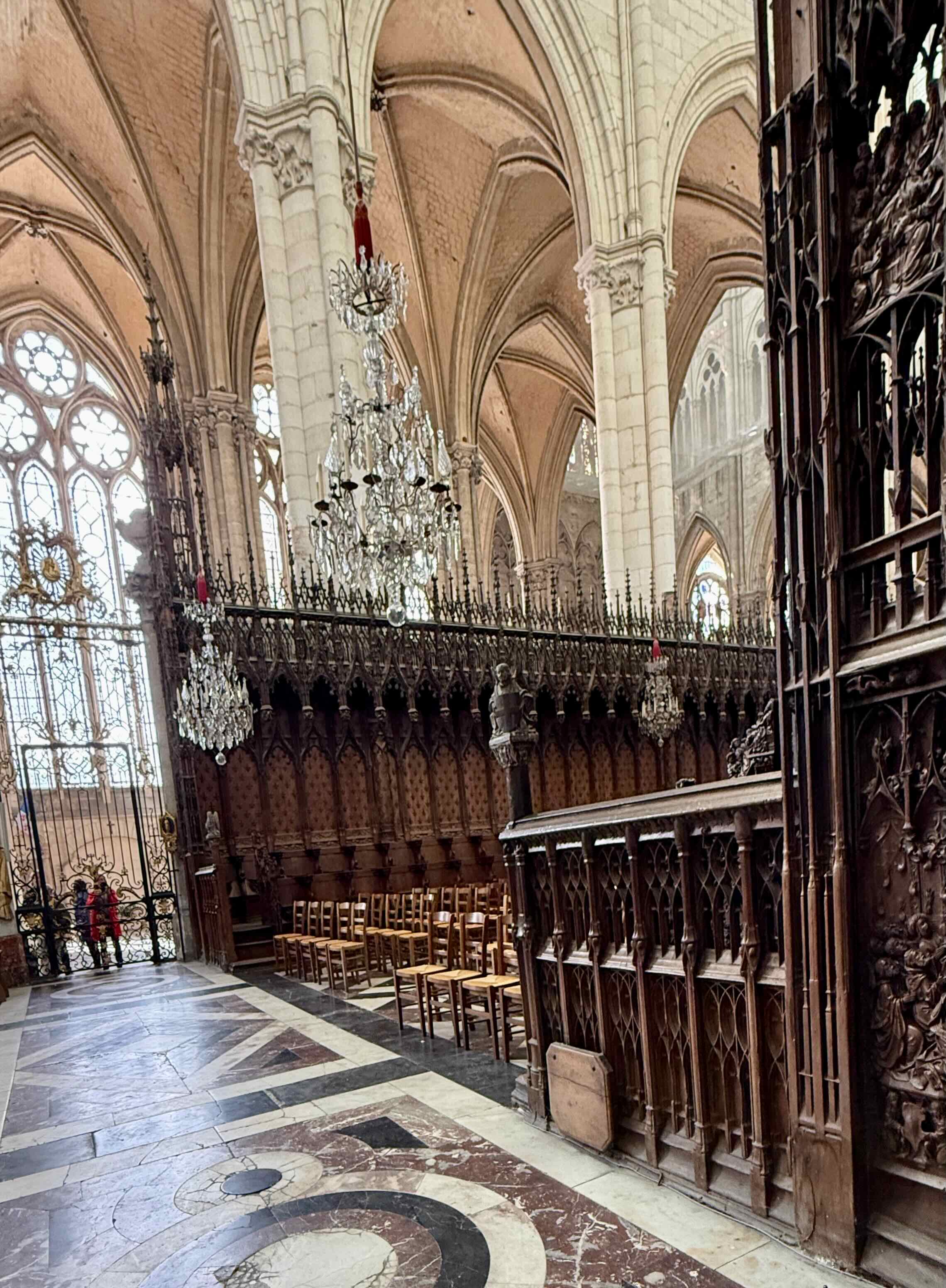
…and the 16th century wood carvings of the choir stalls are unique in the world.
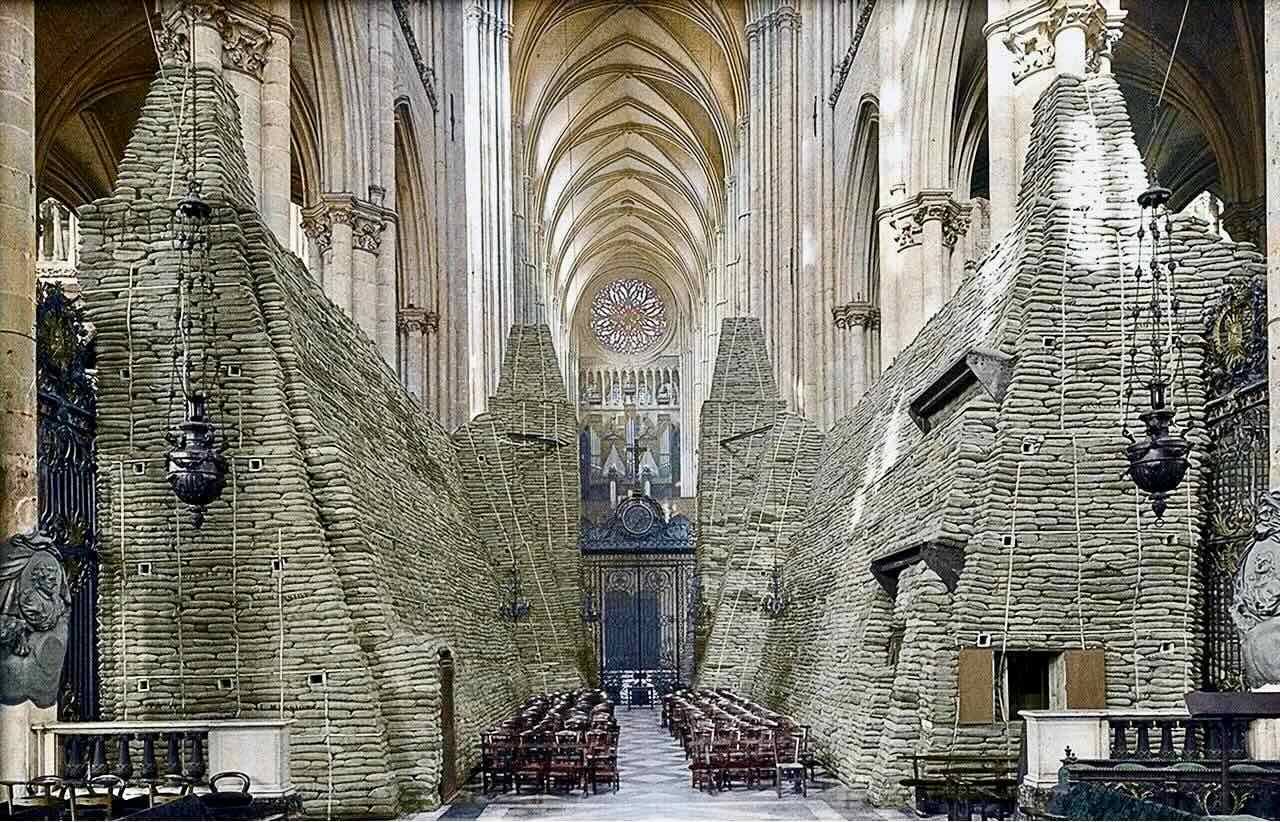
Sandbags were used to protect the exterior and interior of the church during WWI.  The stained glass windows were removed and stored elsewhere.  Unfortunately there was a fire and some of the windows were destroyed.  A bomb did fall directly on the church but it did not detonate. Whether by faulty fuse, divine intervention or sheer luck, the cathedral stood unharmed.  Info and photo~ church heritage.eu
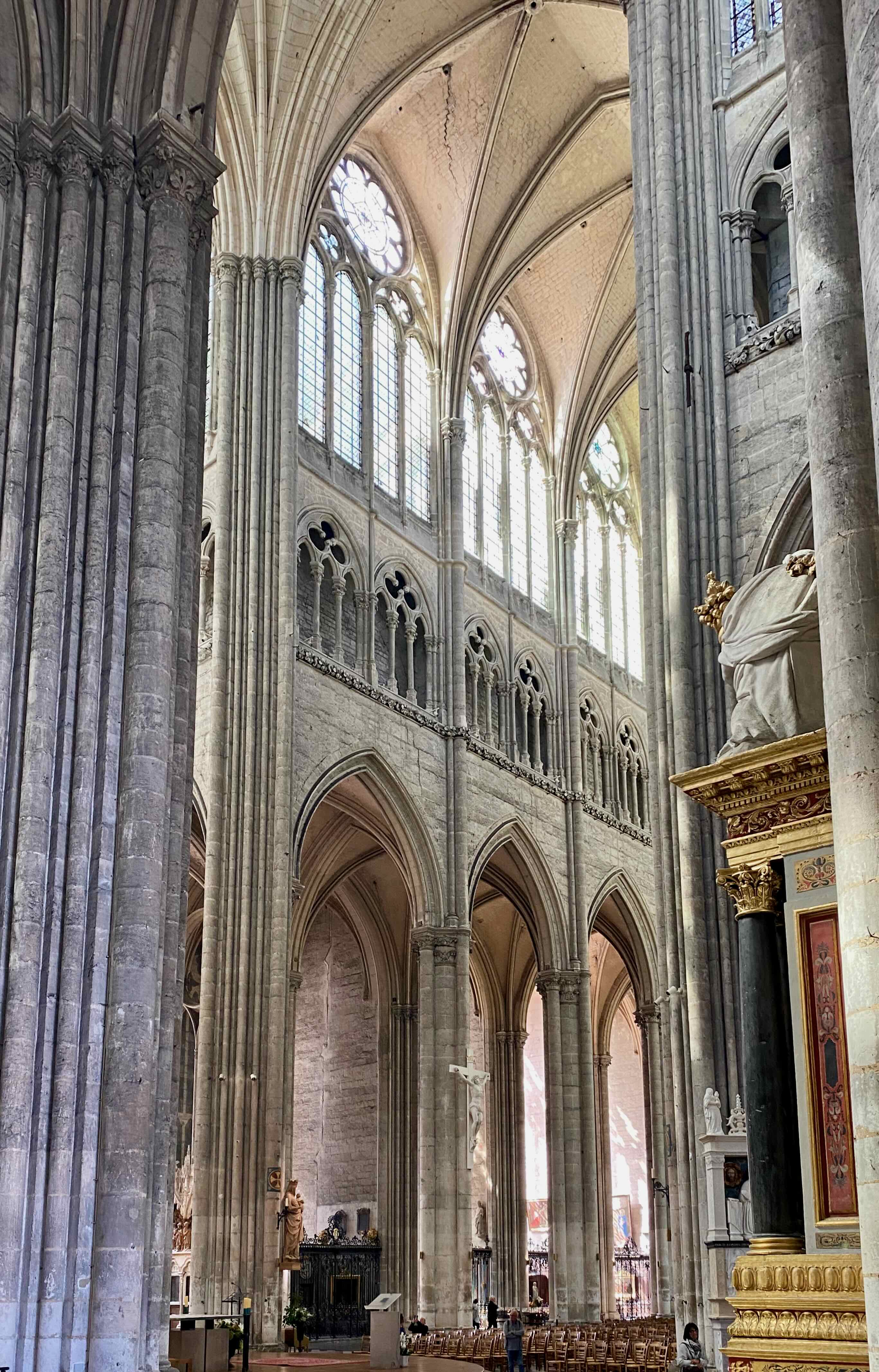
This is a massive cathedral…
…with stunning stained glass windows.
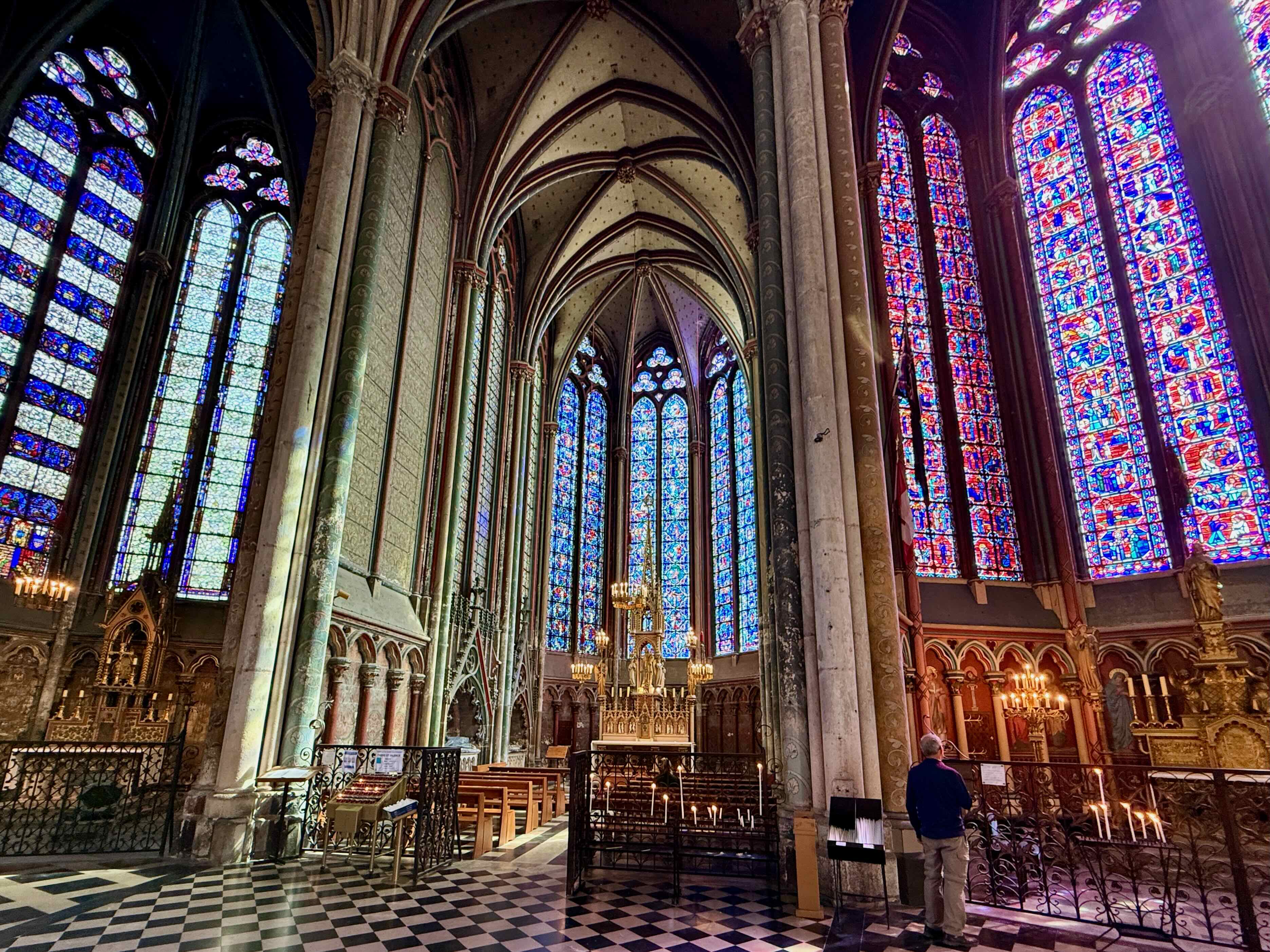
Do you see the people? They give a sense of scale.
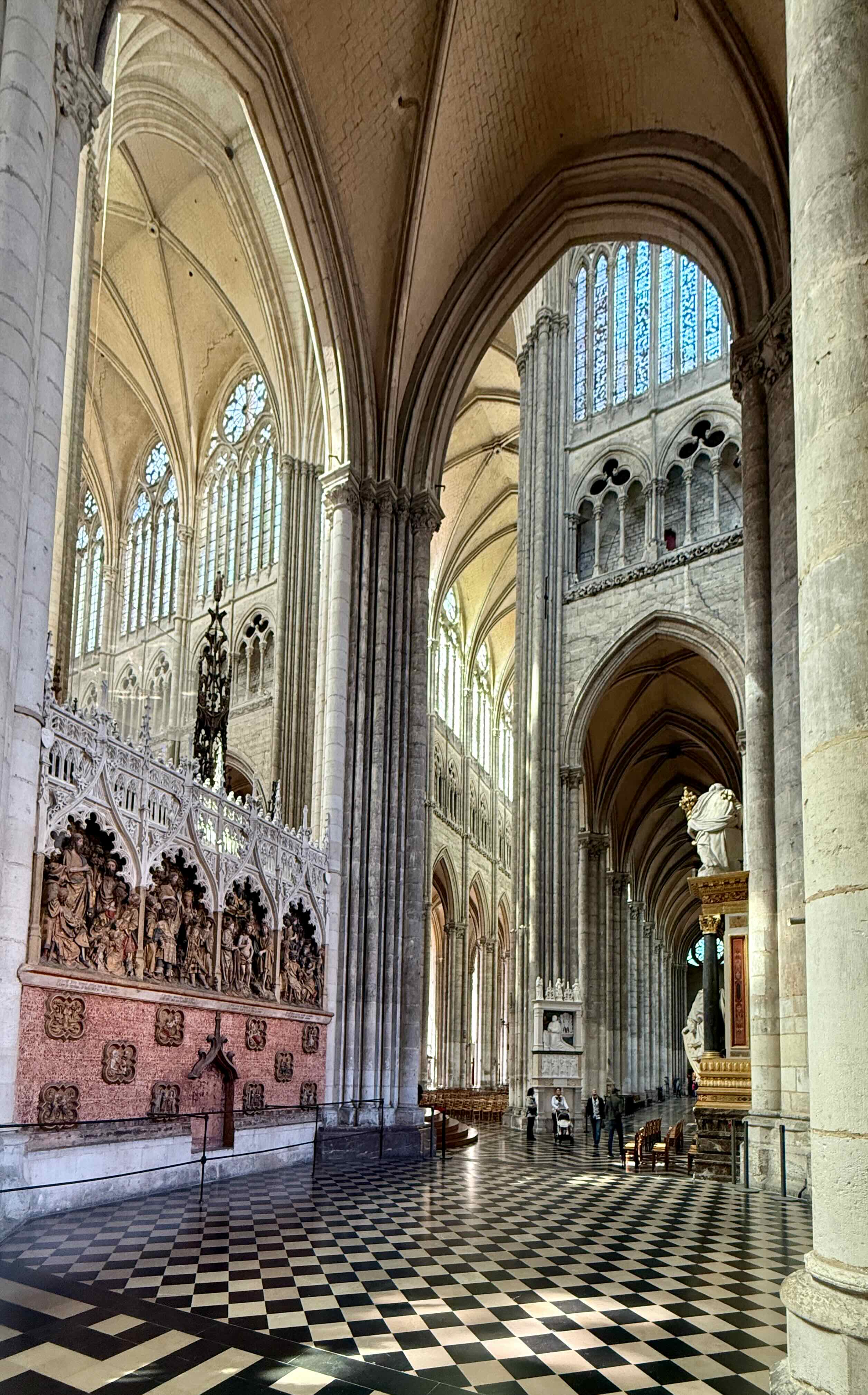
Looking towards the richly decorated altar…
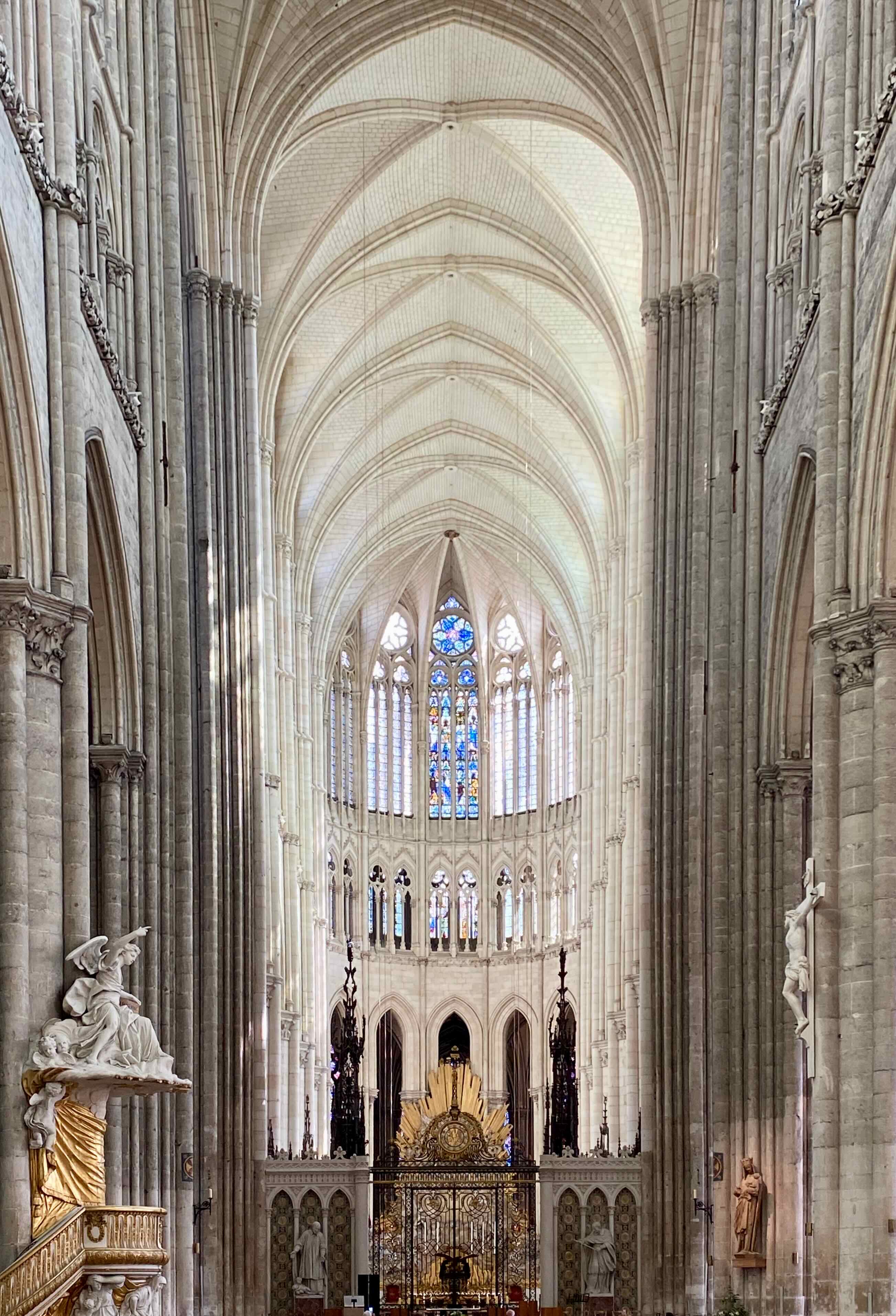
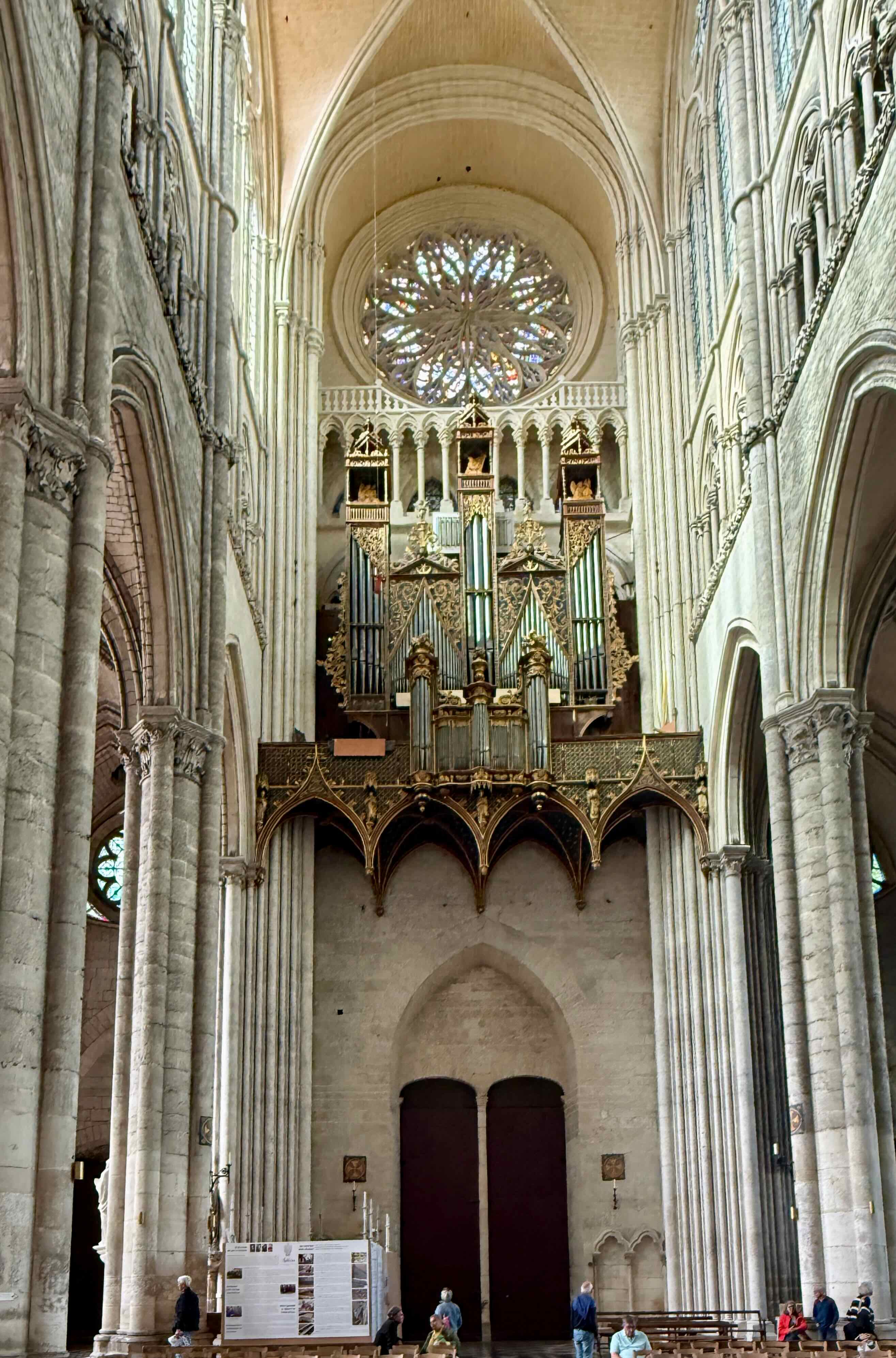
and in the opposite direction, the organ that was built in 1549…
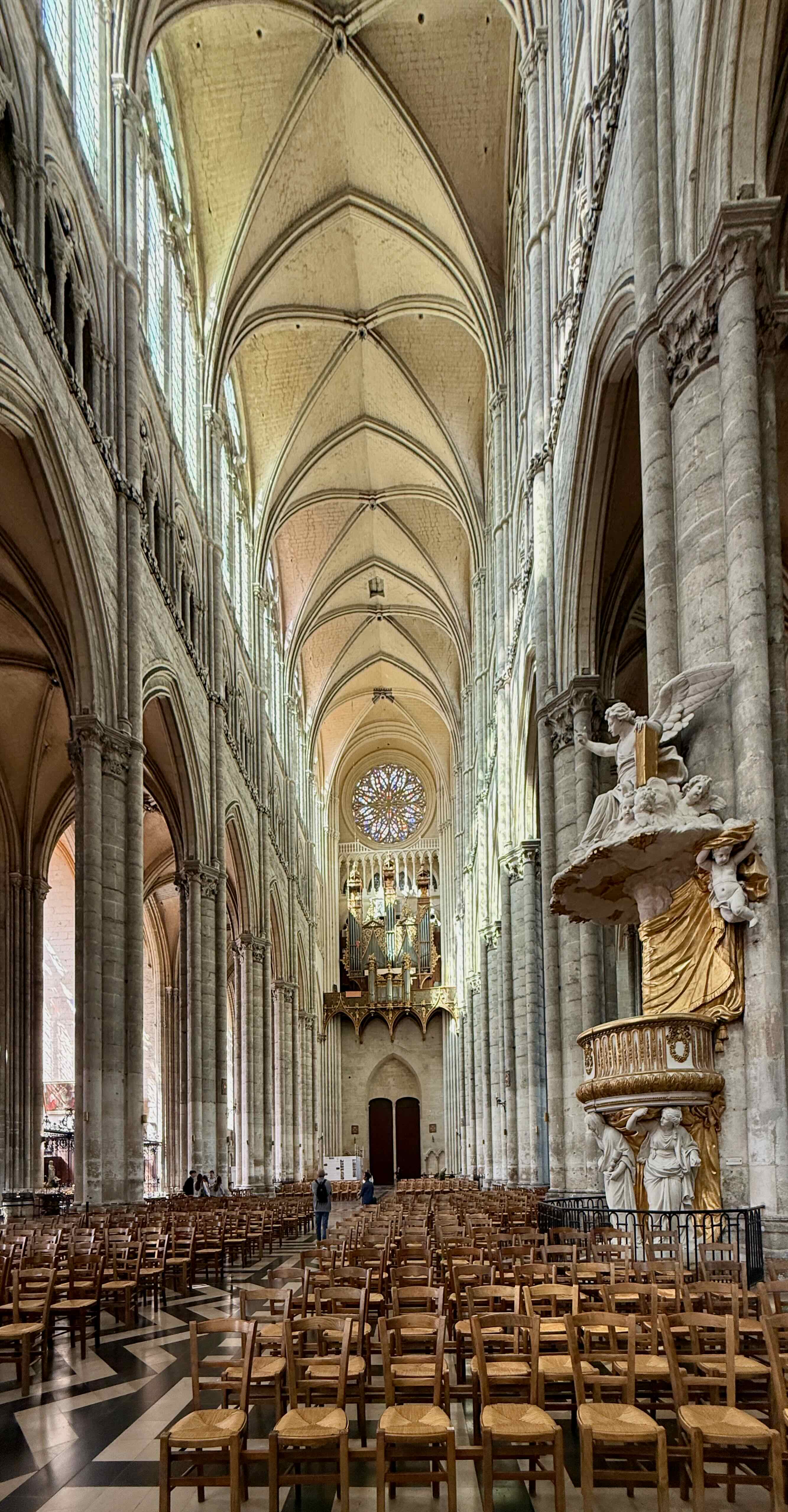
which has just been cleaned and restored.
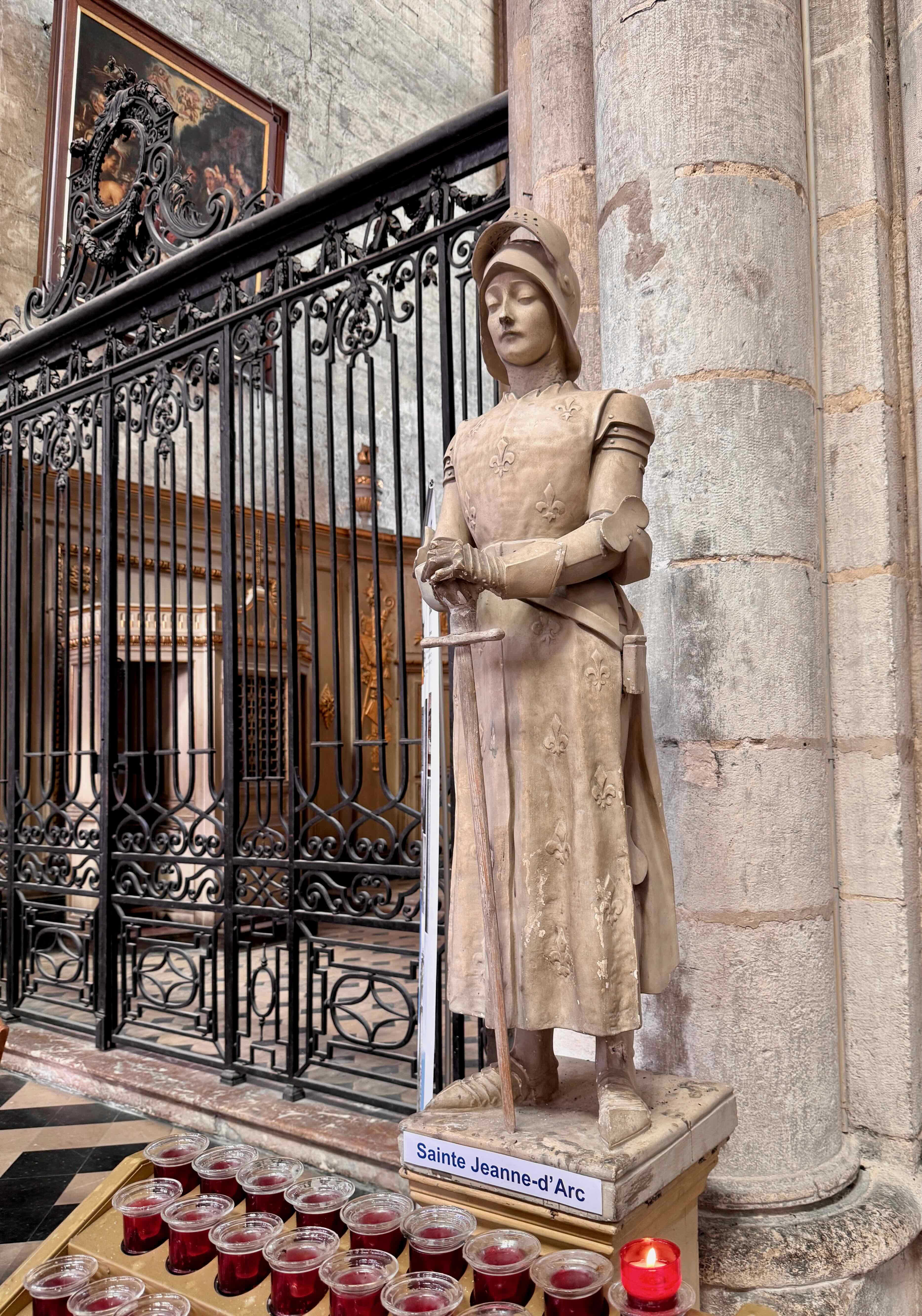
Love this statue of Joan of Arc.
There is also a labyrinth from 1288.When we leave the cathedral, I look up and there are the gargoyles!  I am very fond of gargoyles.
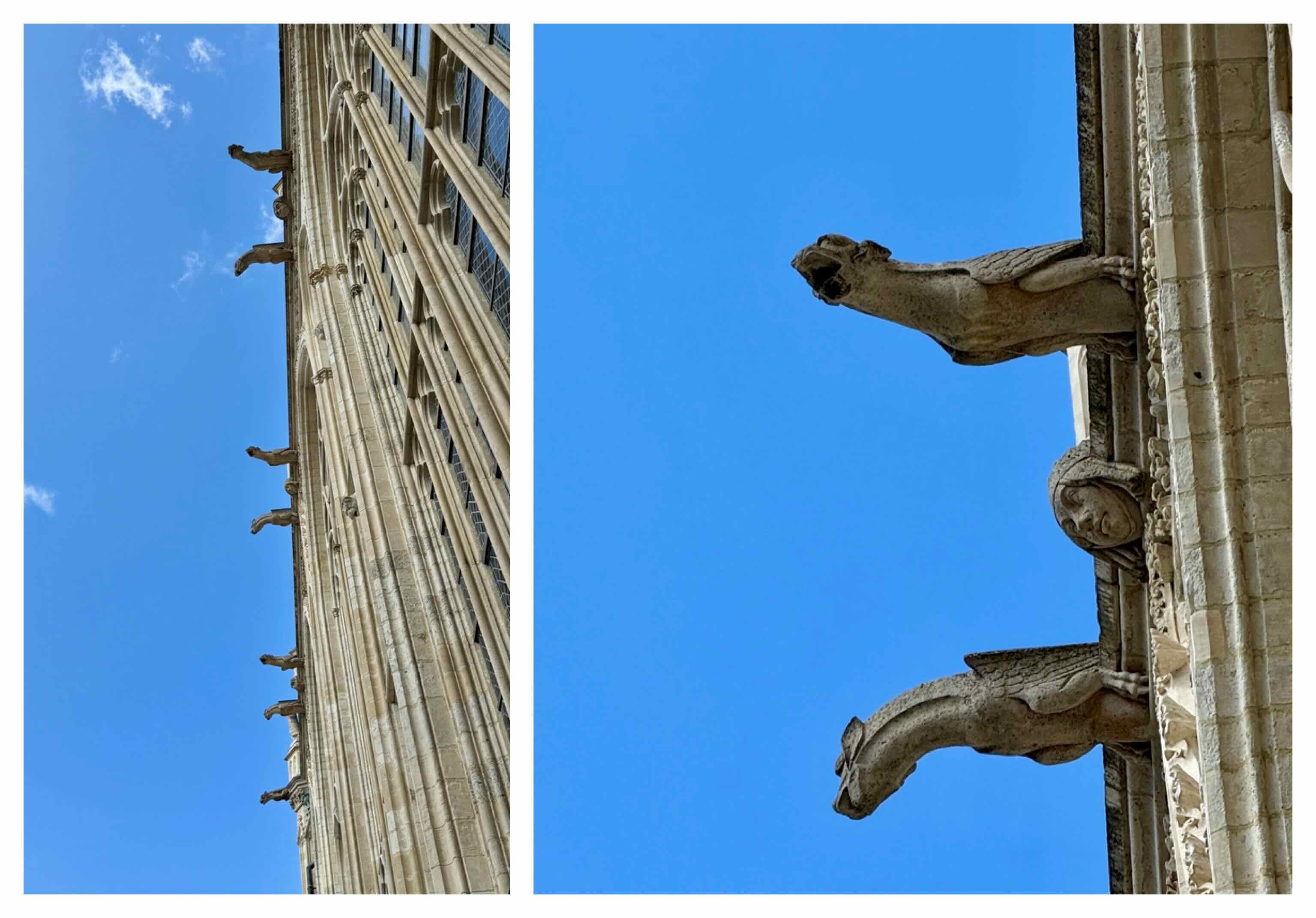
We have time to walk back to the car for tea and cookies and a little down time before we get ready for our boat ride at the Hortillonages.

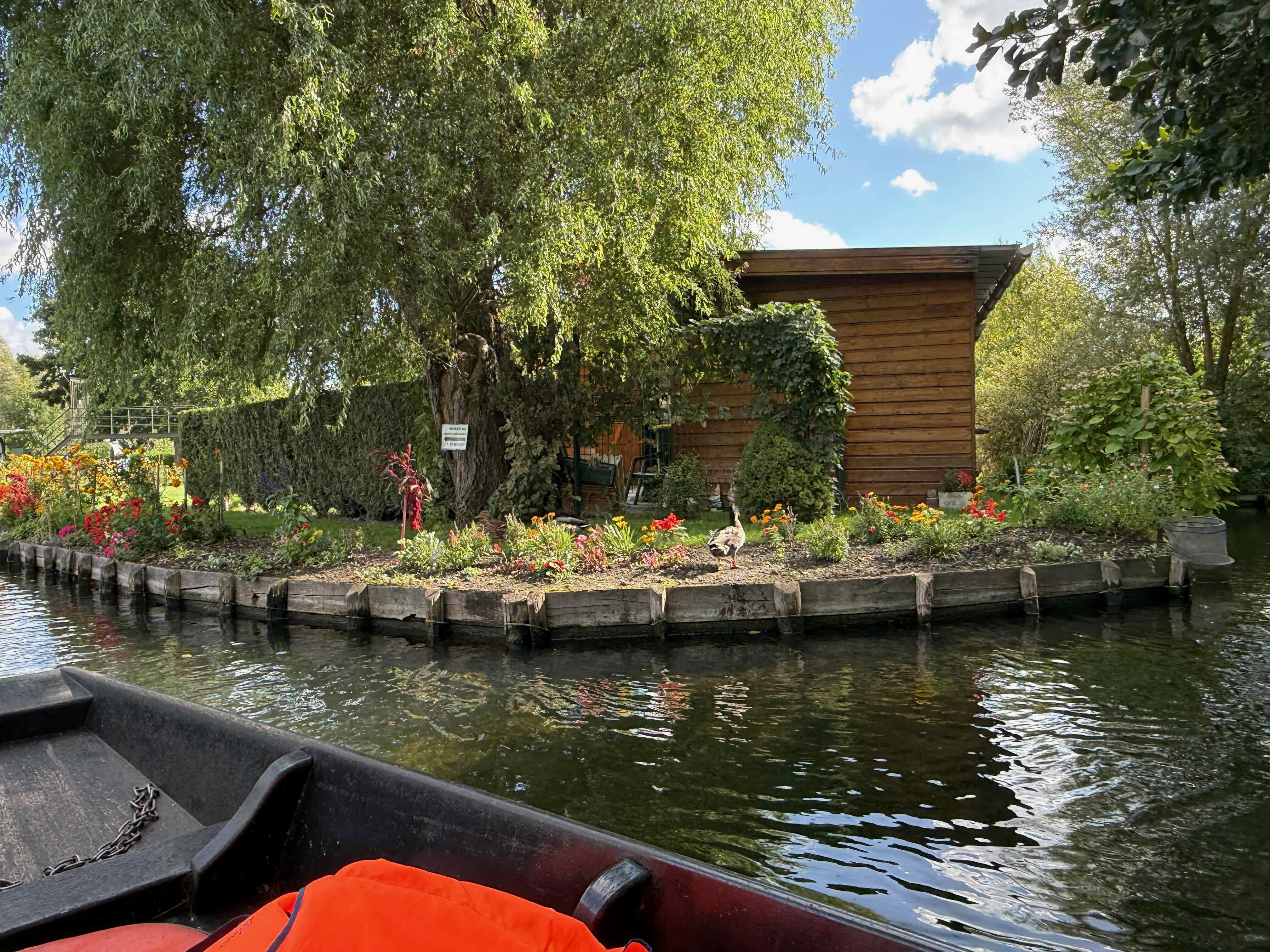
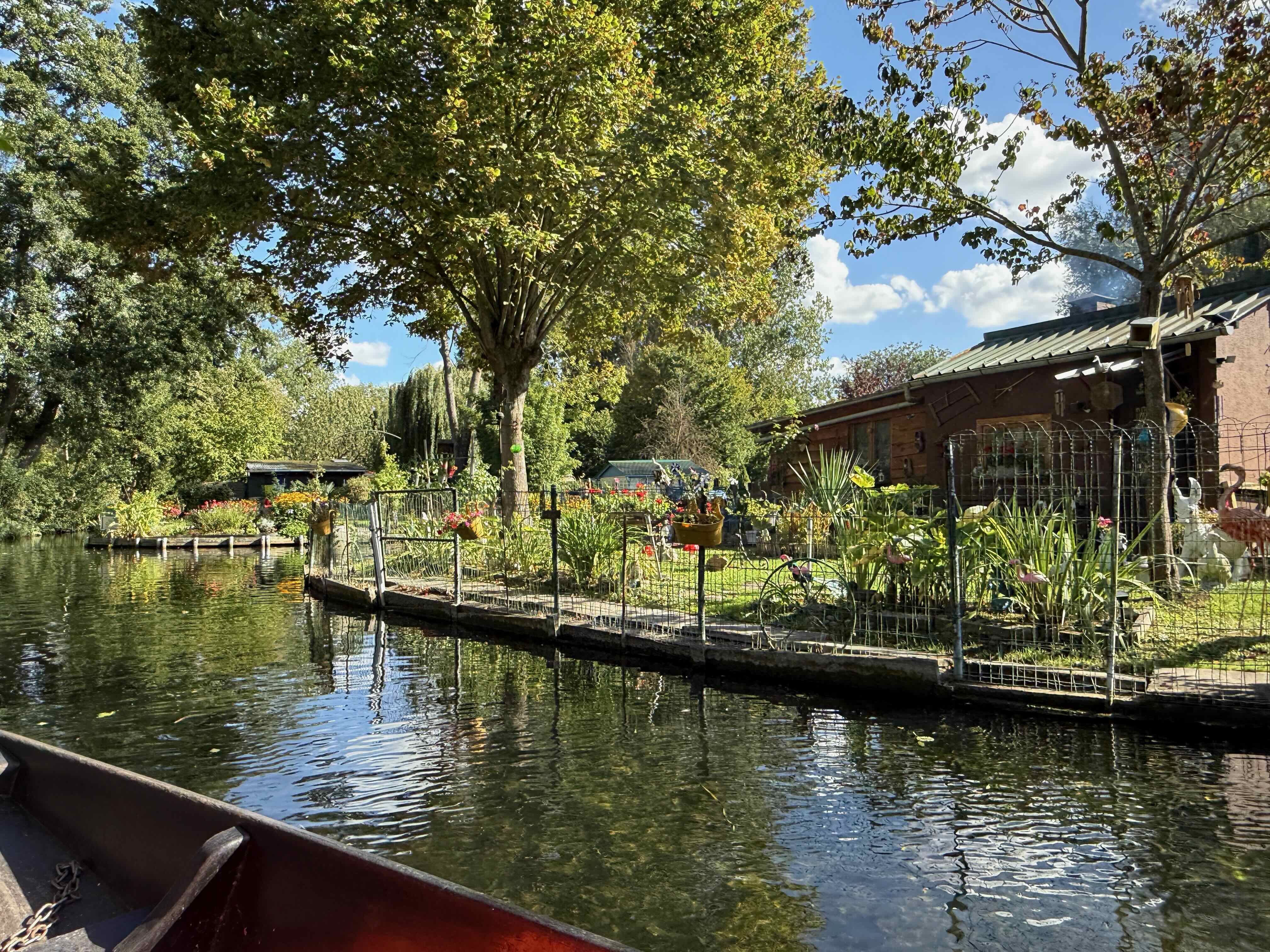
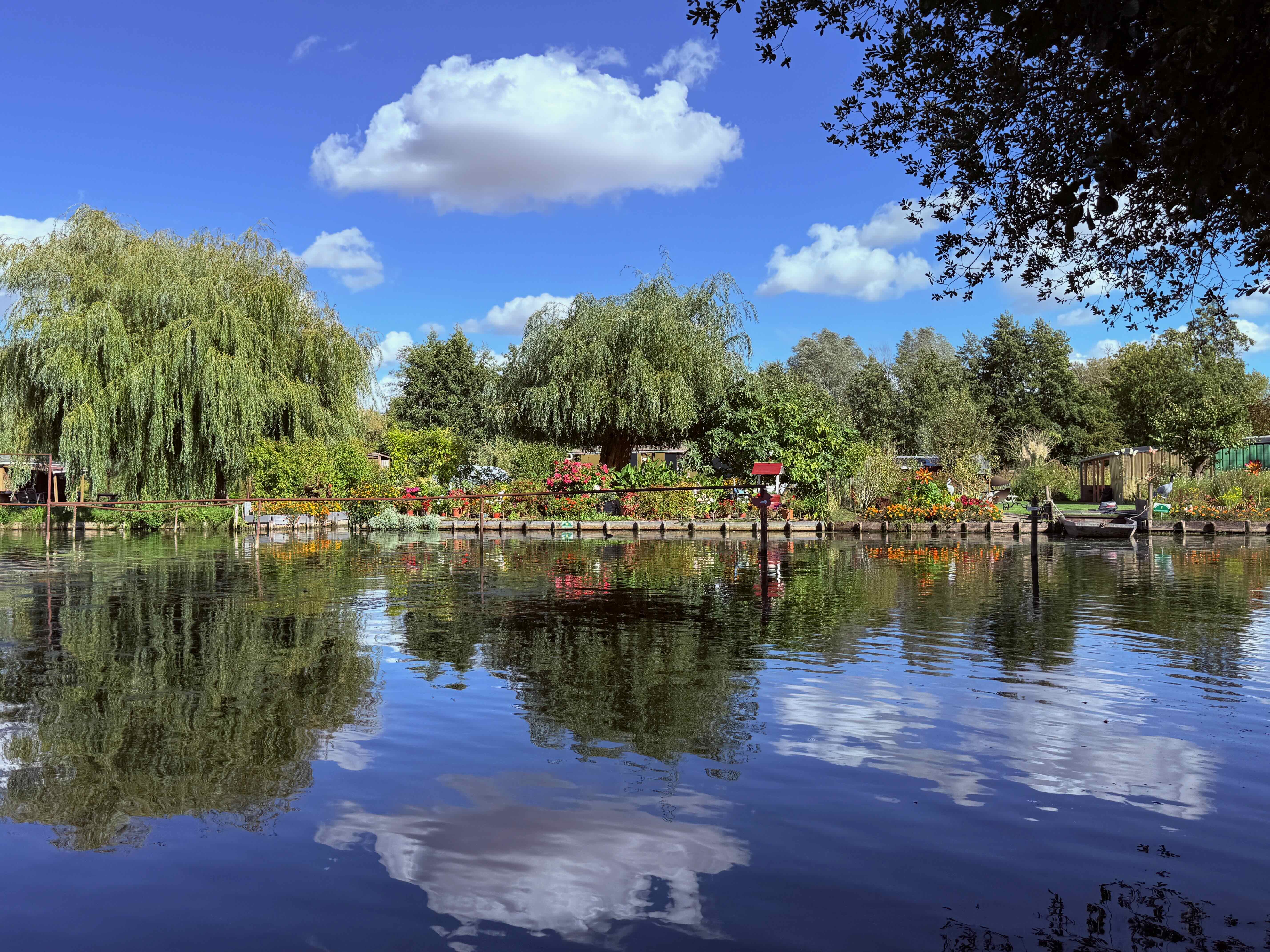
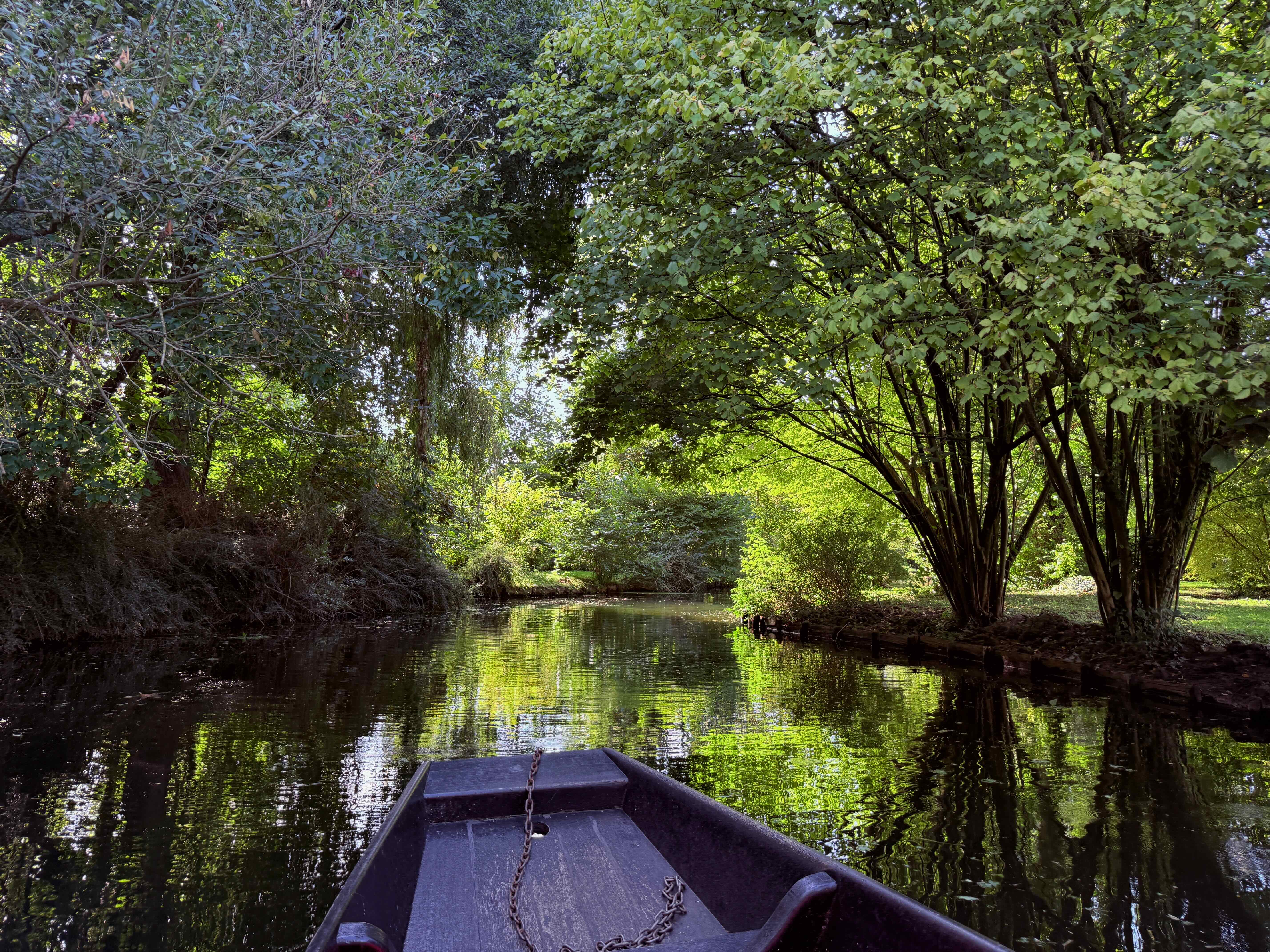
Shaped by generations of market gardeners known as ‘hortillons’, this site is the only one of its kind in France. The Hortillonnages are made up of a multitude of small cultivated islets surrounded by water, accessible only by boat on a network of waterways

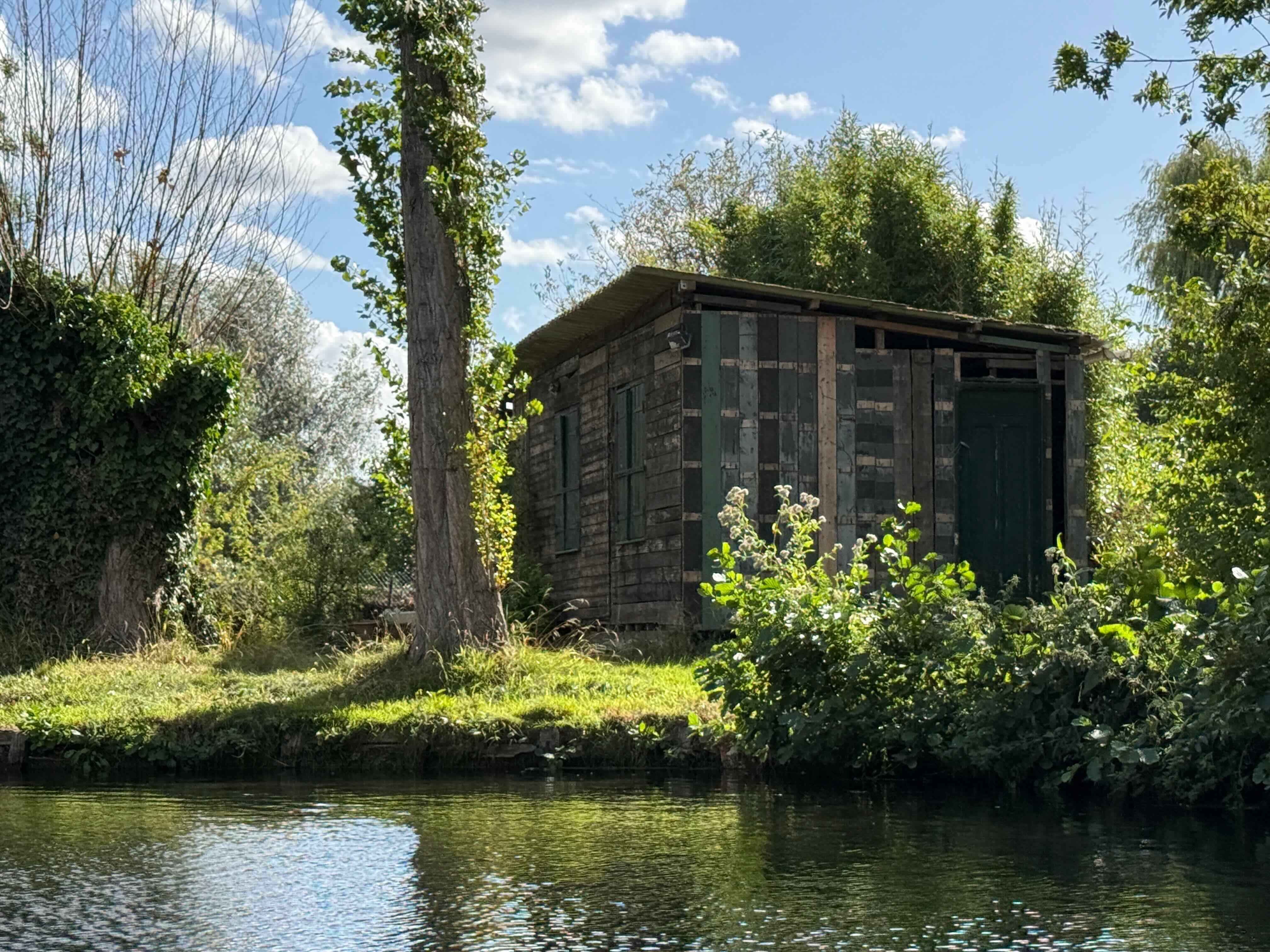
We spend a relaxing 45 minutes travelling these waterways. We see market gardens, private gardens, cottages and some islands that look very wild and unkept.
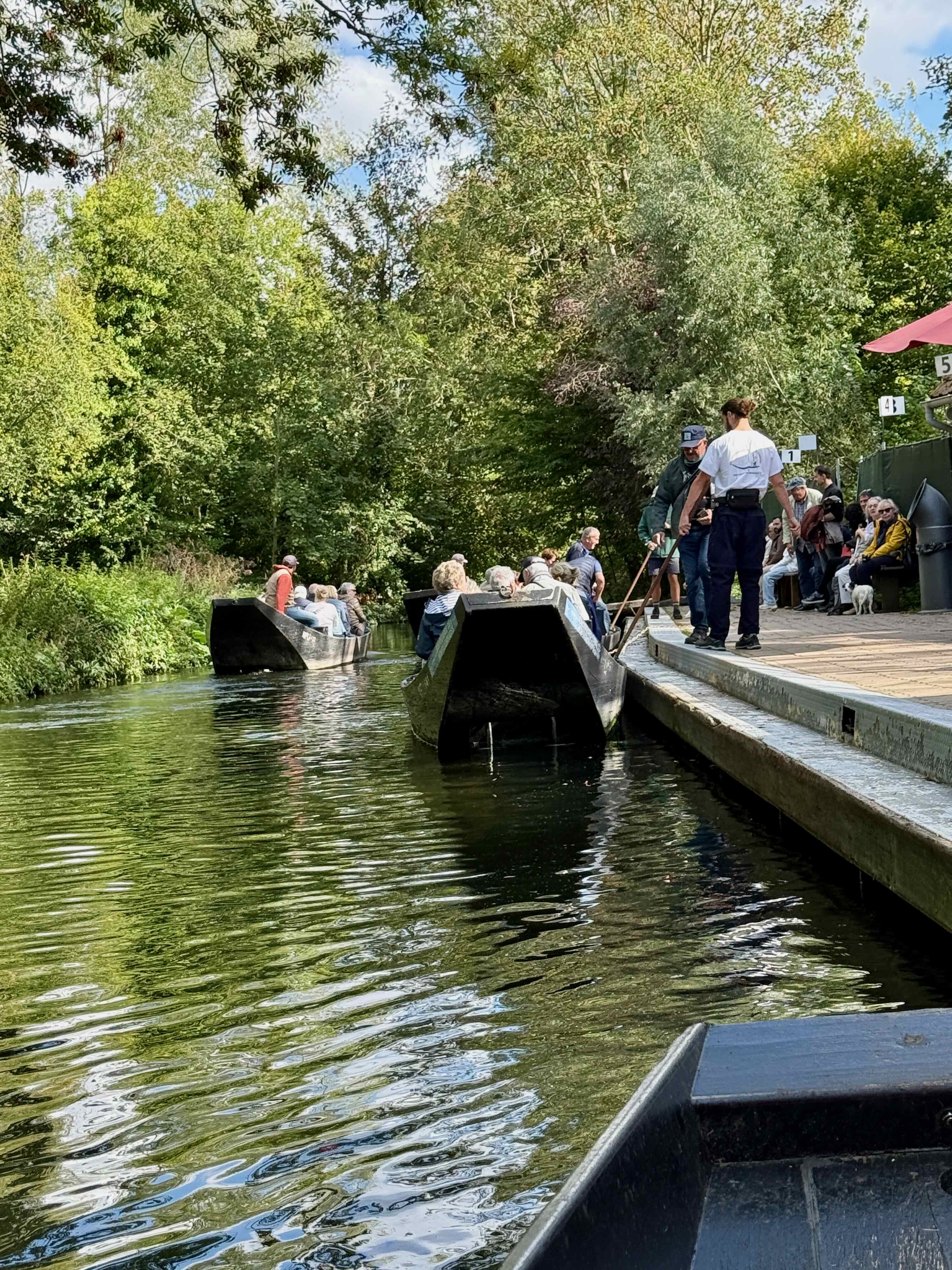
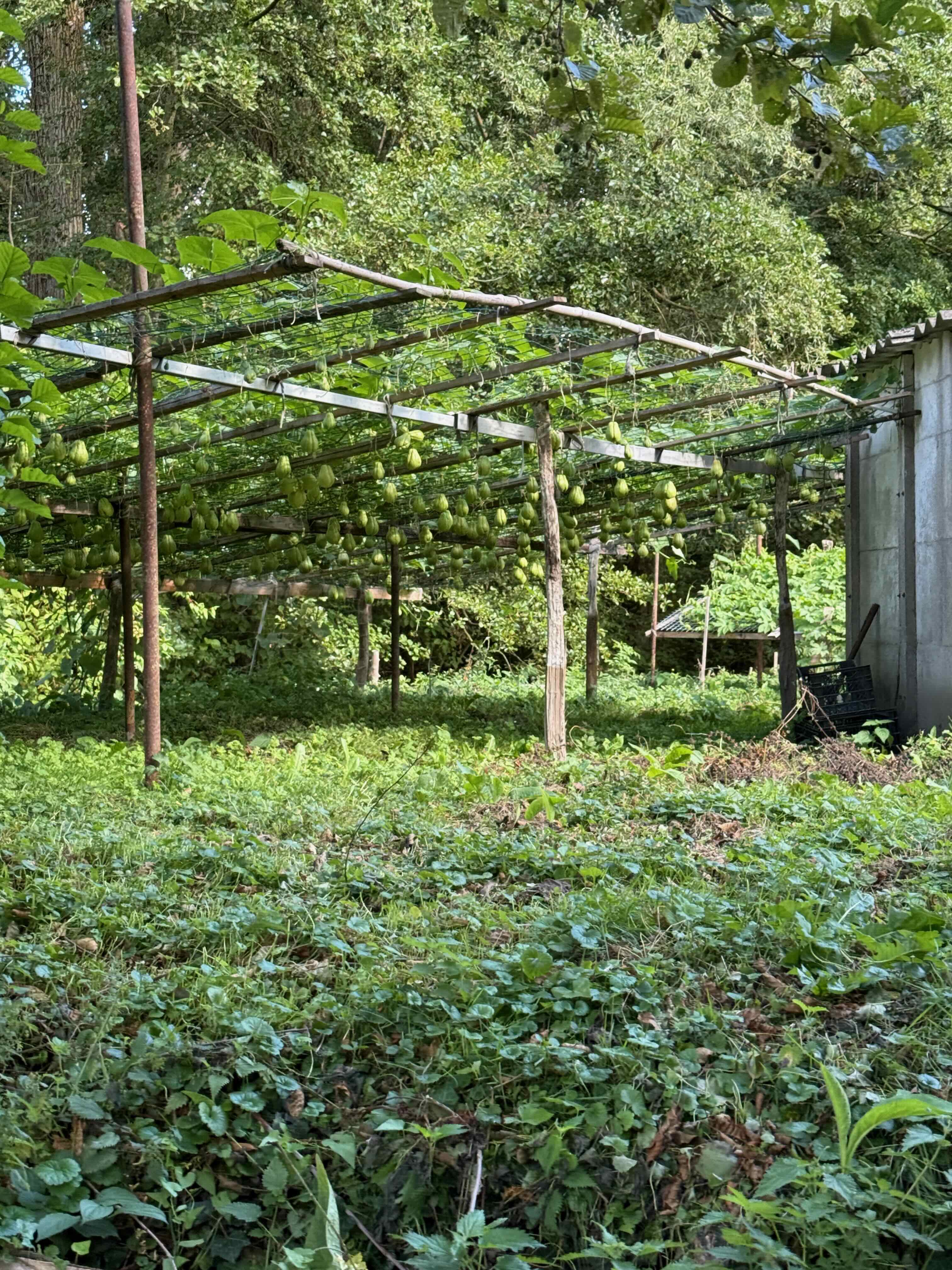
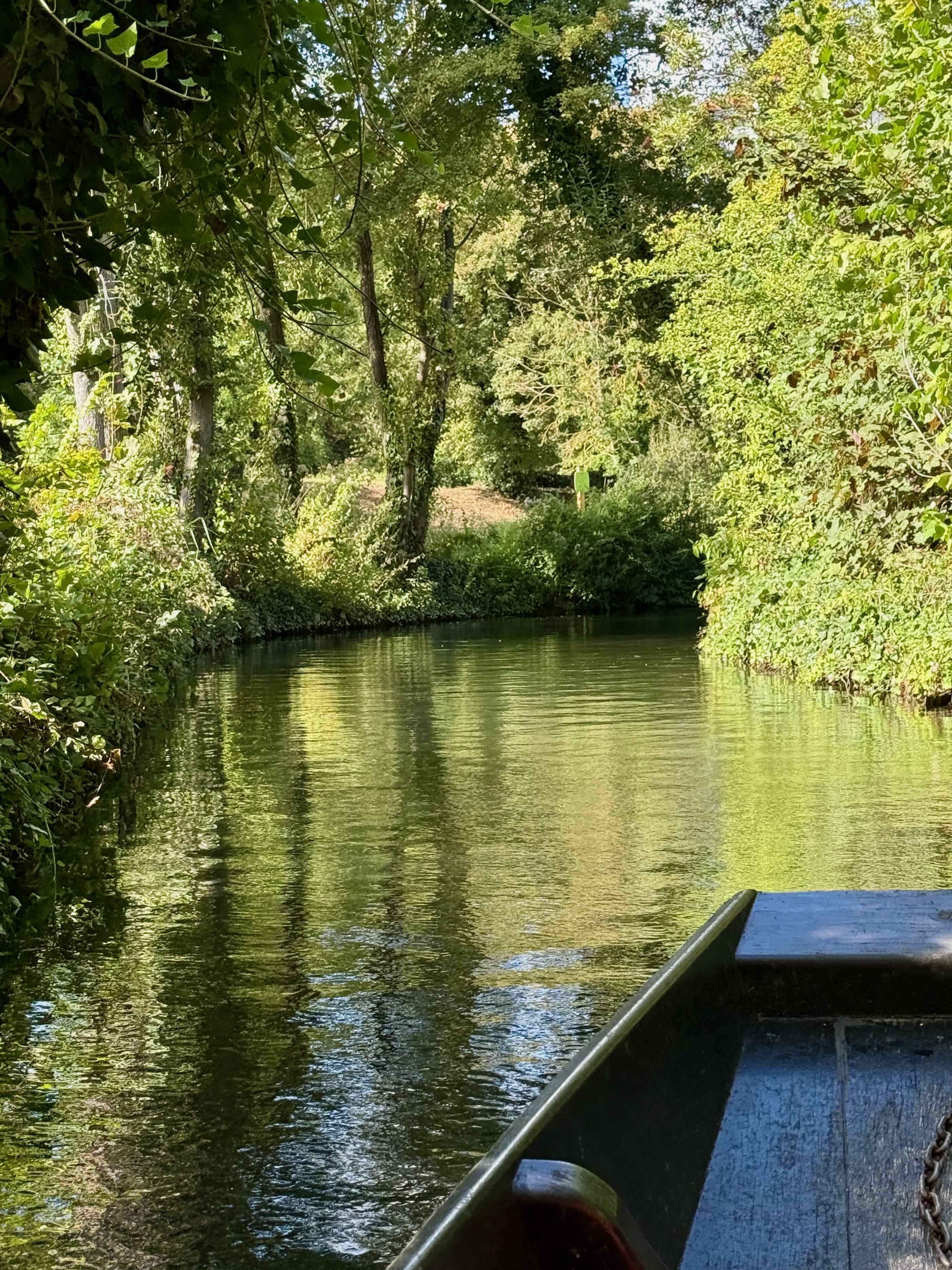
The Hortillonnages have been here since ancient times. They are located on the naturally marshy terrain of the old bed of the River Somme. The site’s name has its origins in the Latin ‘hortus’ meaning garden. Nowadays, the ownership of this 300-hectare site is shared by over 1000 individuals who use it for market gardening or leisure activities such as gardening, fishing, and observing nature.

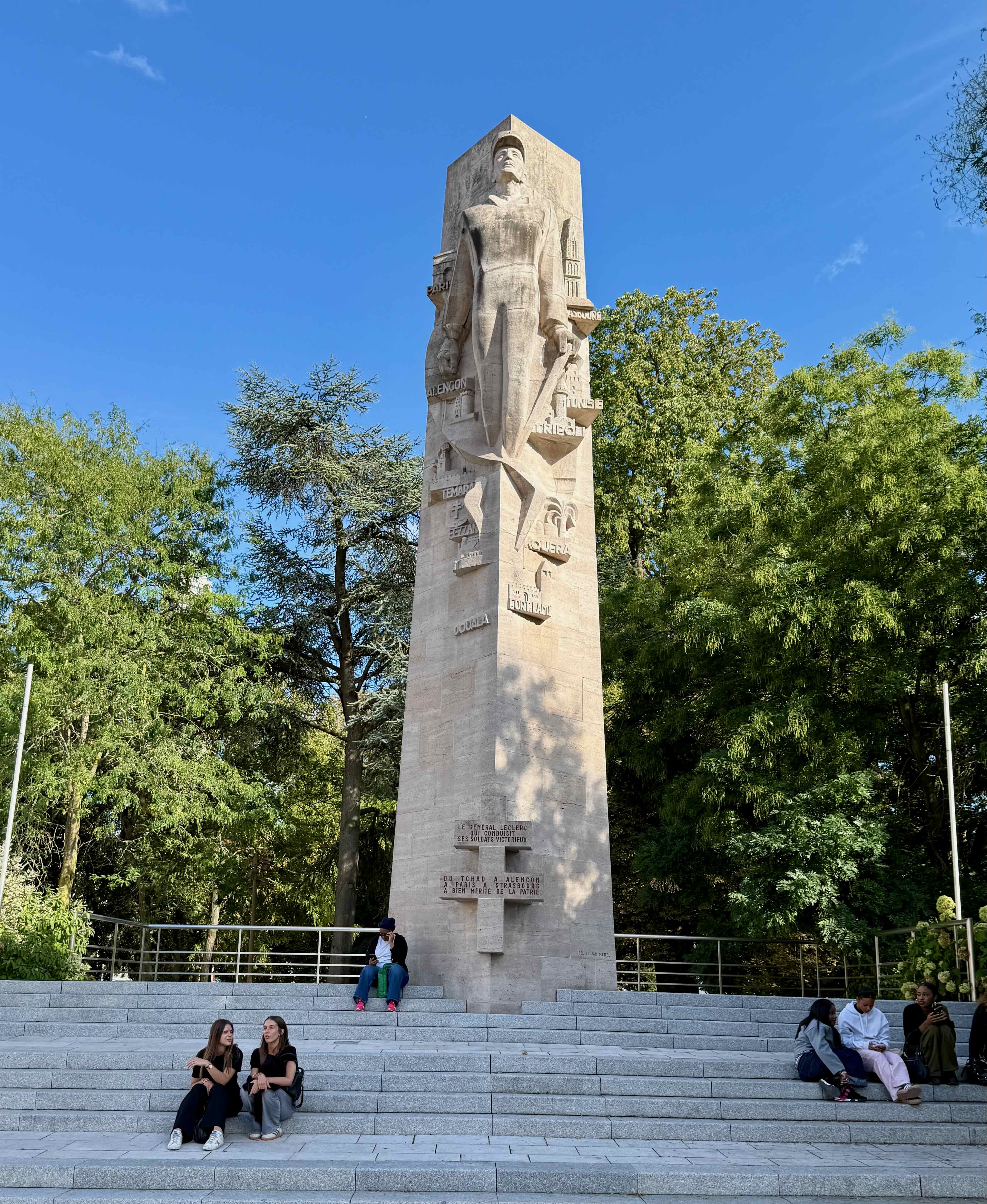
Walking back to our car we pass yet another war memorial, a reminder of the war and those who fought and died for France.
Lens Louvre

Day 12.   Thursday, November 11, 2025

I did not know that the Louvre had a satellite museum.  It is located in Lens, which is about 25 minutes from Arras.  There is free parking and the museum is free to visit.  We arrive early afternoon and walk up a tree lined lane to the entrance to the museum.

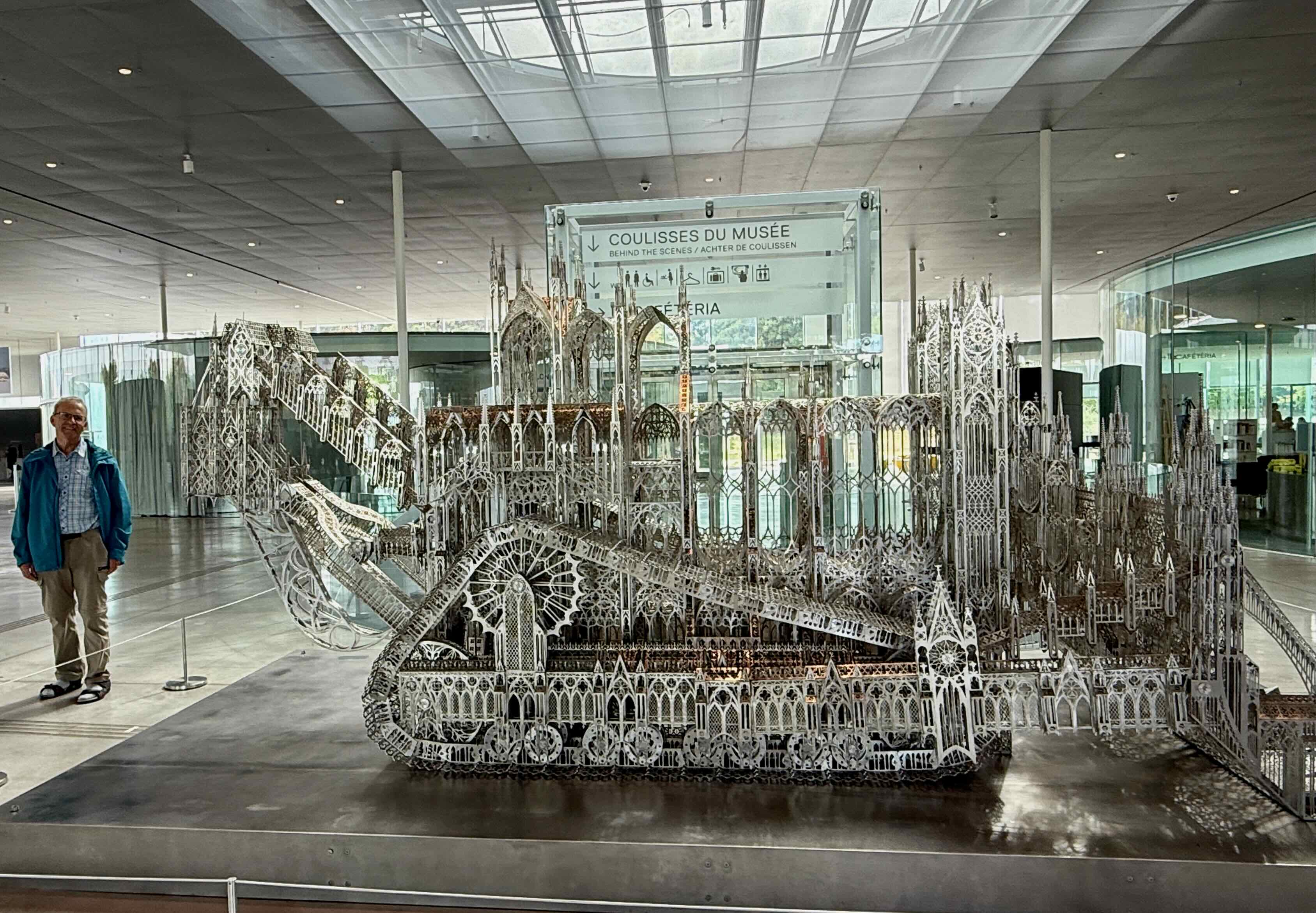
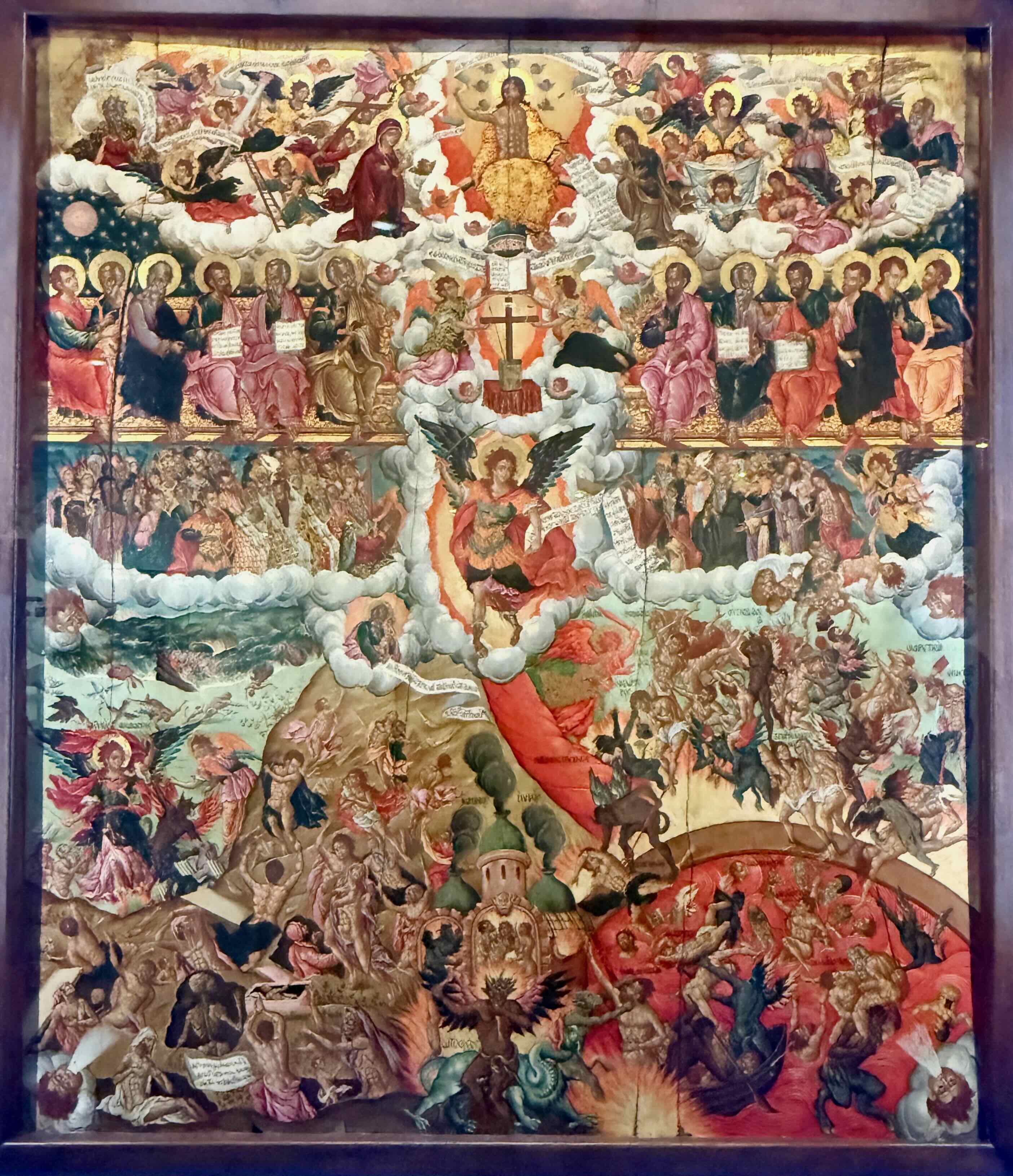
The first thing we see on entering the museum is this Gothic Bulldozer. It is very intricate and difficult to photograph.  Zoom in for a closer look.Downstairs is an exhibit of Ukrainian Icons. Today the term «icon» refers primarily to paintings made with tempera (egg-bound pigments) on a prepared wood panel. Icons are also characterised by the use of gold leaf.  Museums around the world are safekeeping artwork from the Uraine until the war ends. The Louvre-Lens has four of Ukraine’s Icon paintings on display. This is The Last Judgement by Theodore Poulakis, 1661.
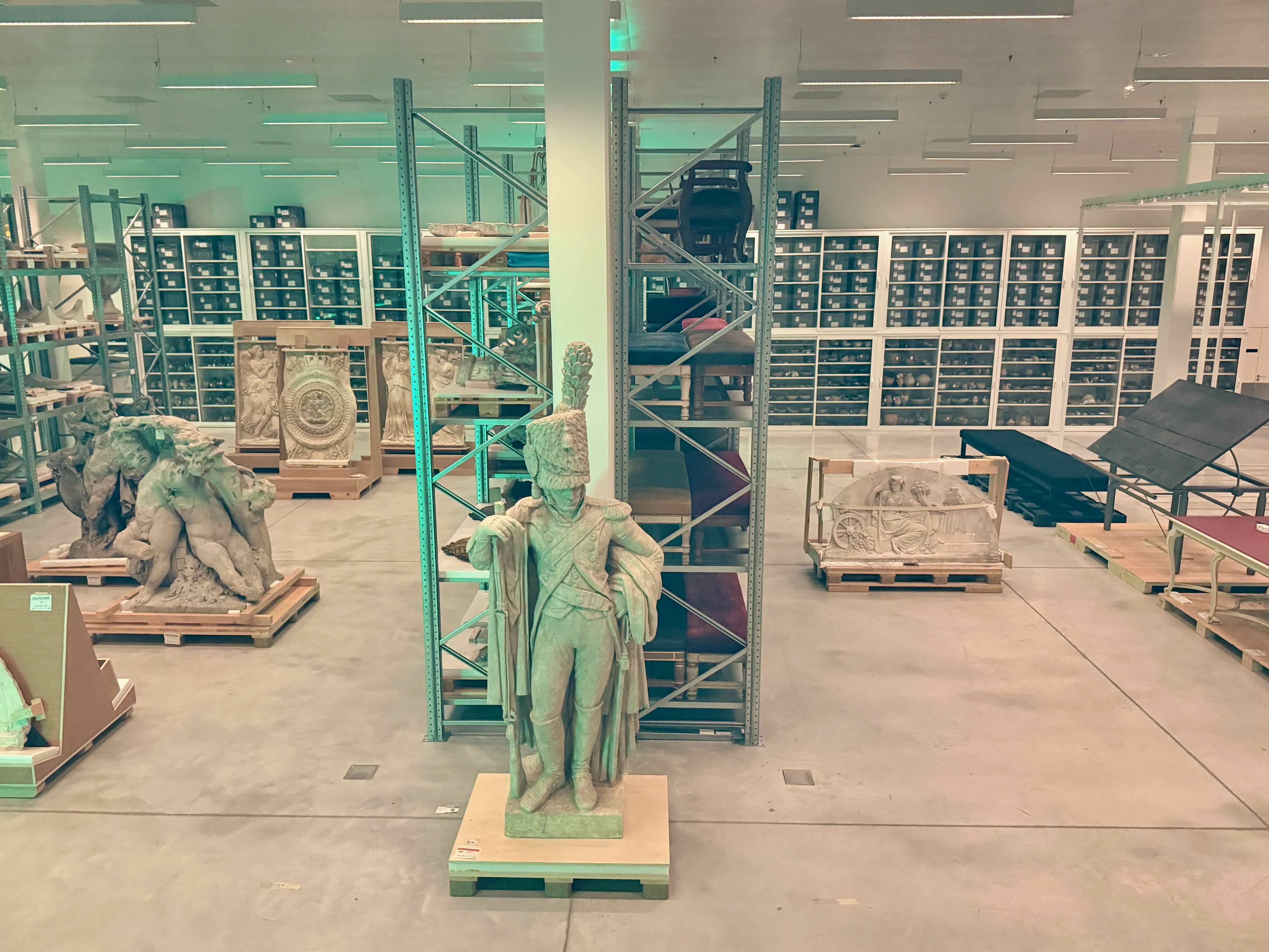
Alongside this exhibition space is a glass wall that allows visitors to view works in the restoration area of the Museum.The main exhibit at the museum is The Gallery of Time.
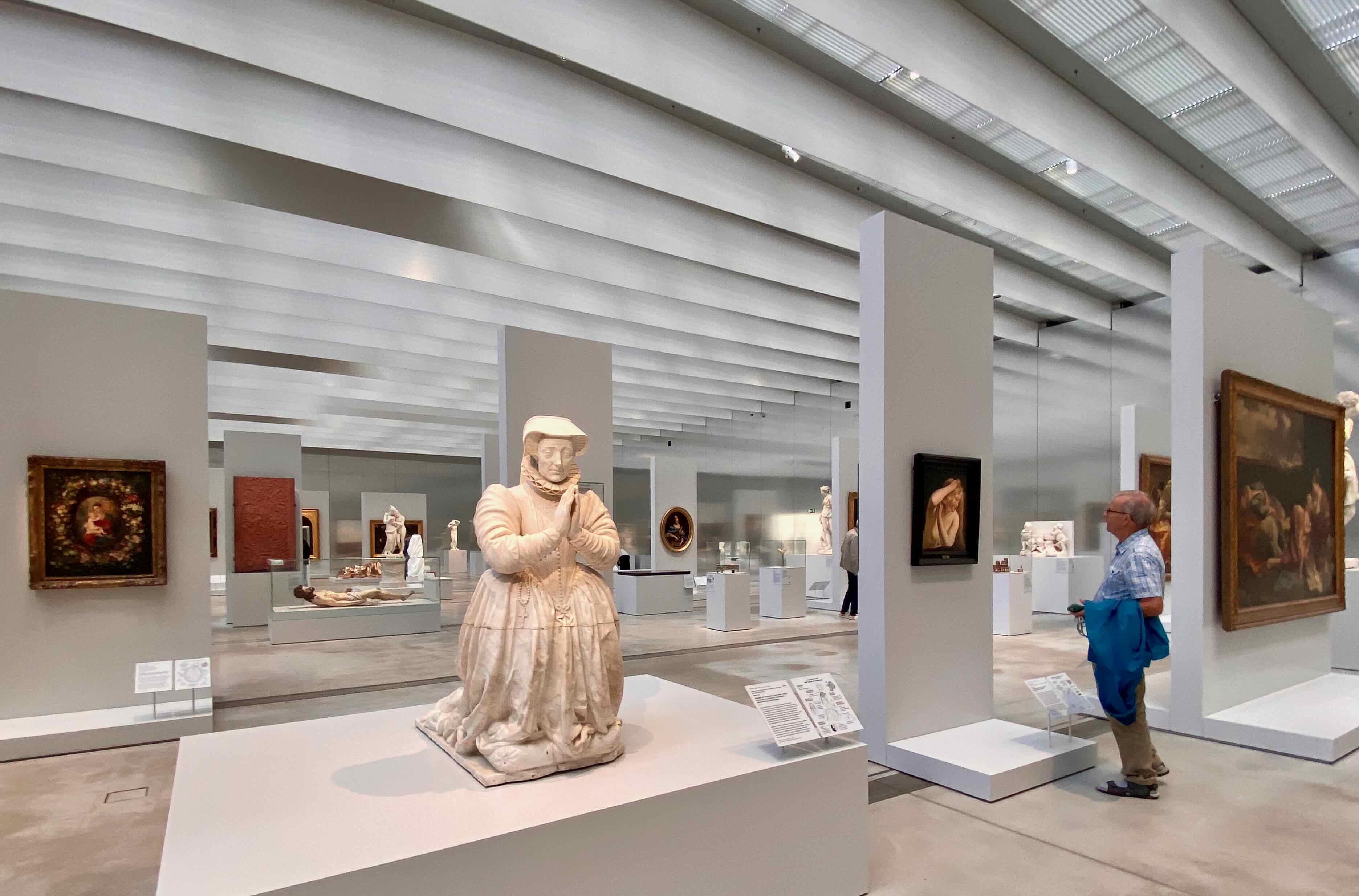
The Gallery of Time is an original showcase for a variety of art forms from different civilisations, all of which come together in an open-plan layout covering some 3,000 square metres. Visitors are invited to immerse themselves in the story of more than 5,000 years of human history and artistic creation. The Gallery of Time takes visitors on a chronological journey from the 4th millennium BCE to the 19th century, drawing on the collections of the Musée du Louvre and on other works which combine to tell a story of human creation, from the earliest recorded times to the most recent.
 

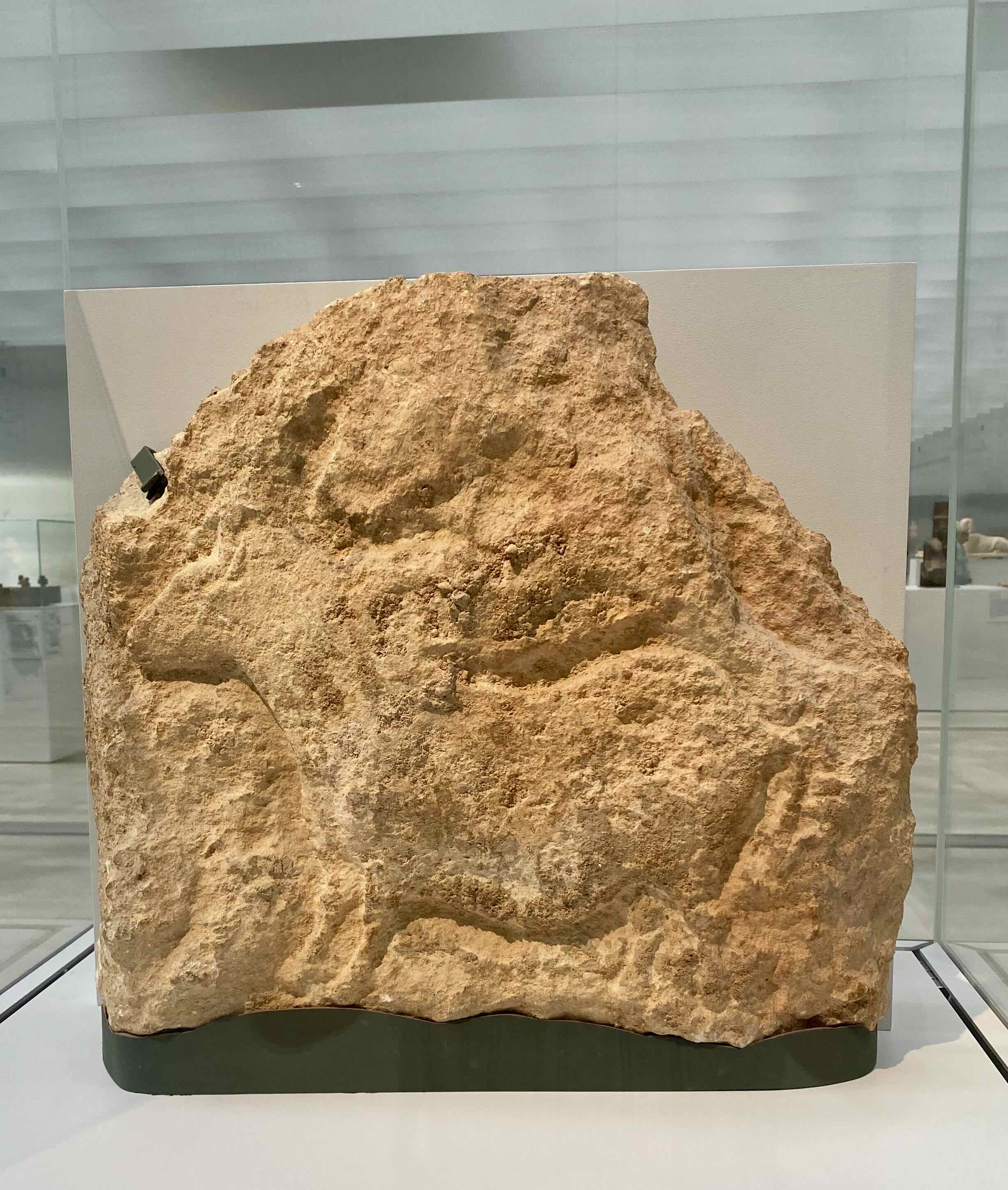
This is the beginning of The Gallery of Time. The first exhibit is the Roc-de-Sers, a stone with a carved horse that was part of a frieze found in a shallow cave in the south west of France. It is from 18,000 BC.

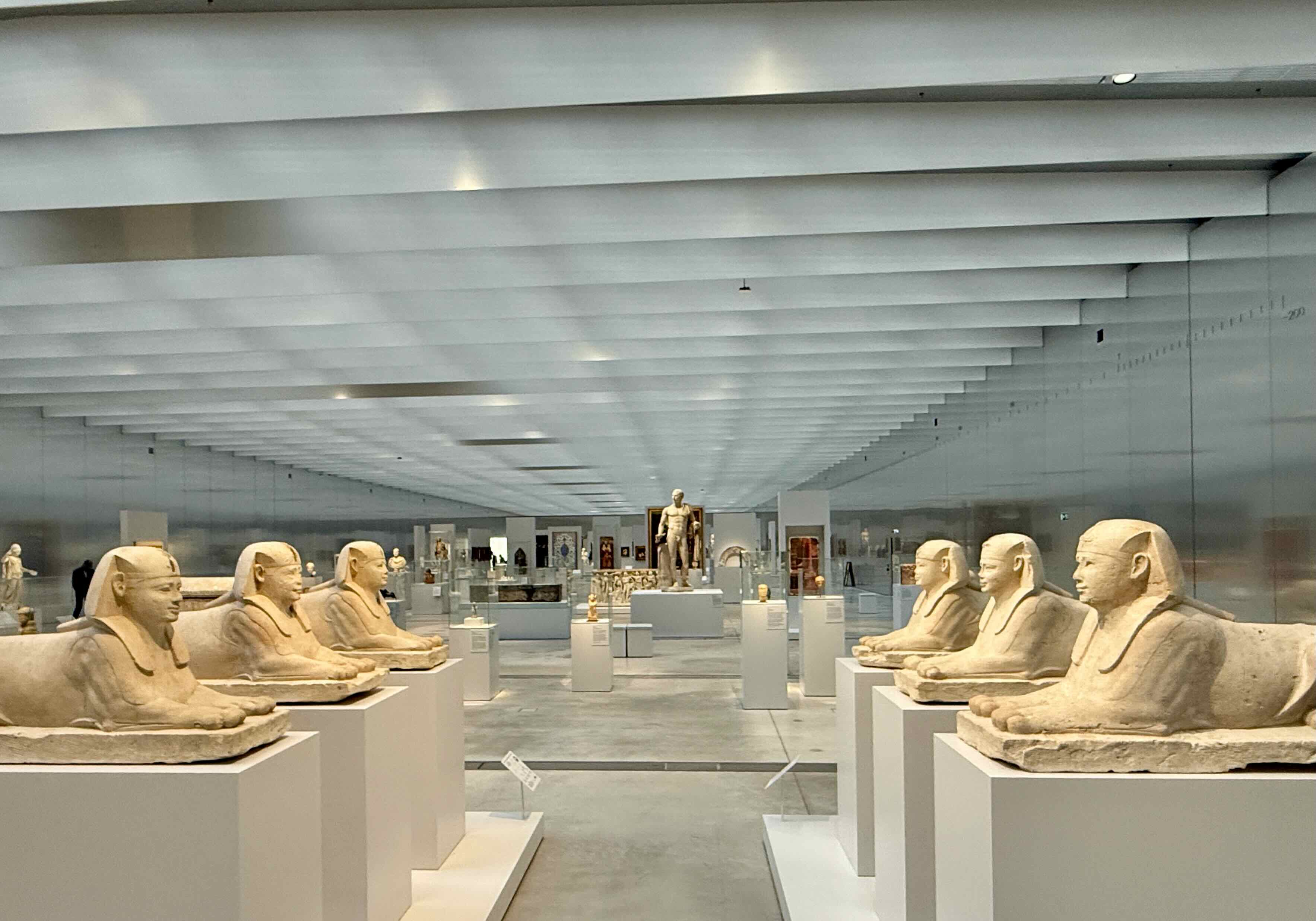
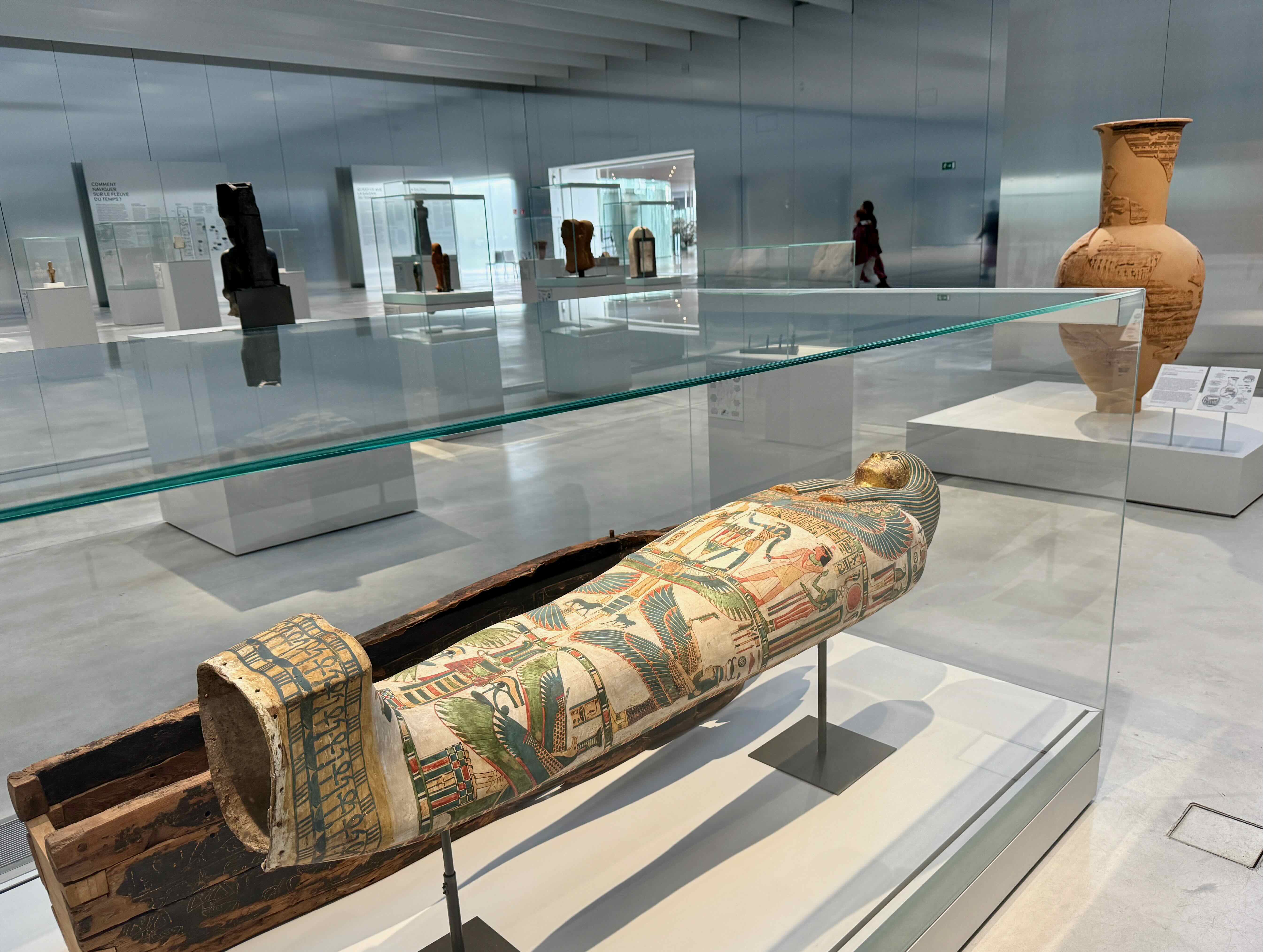
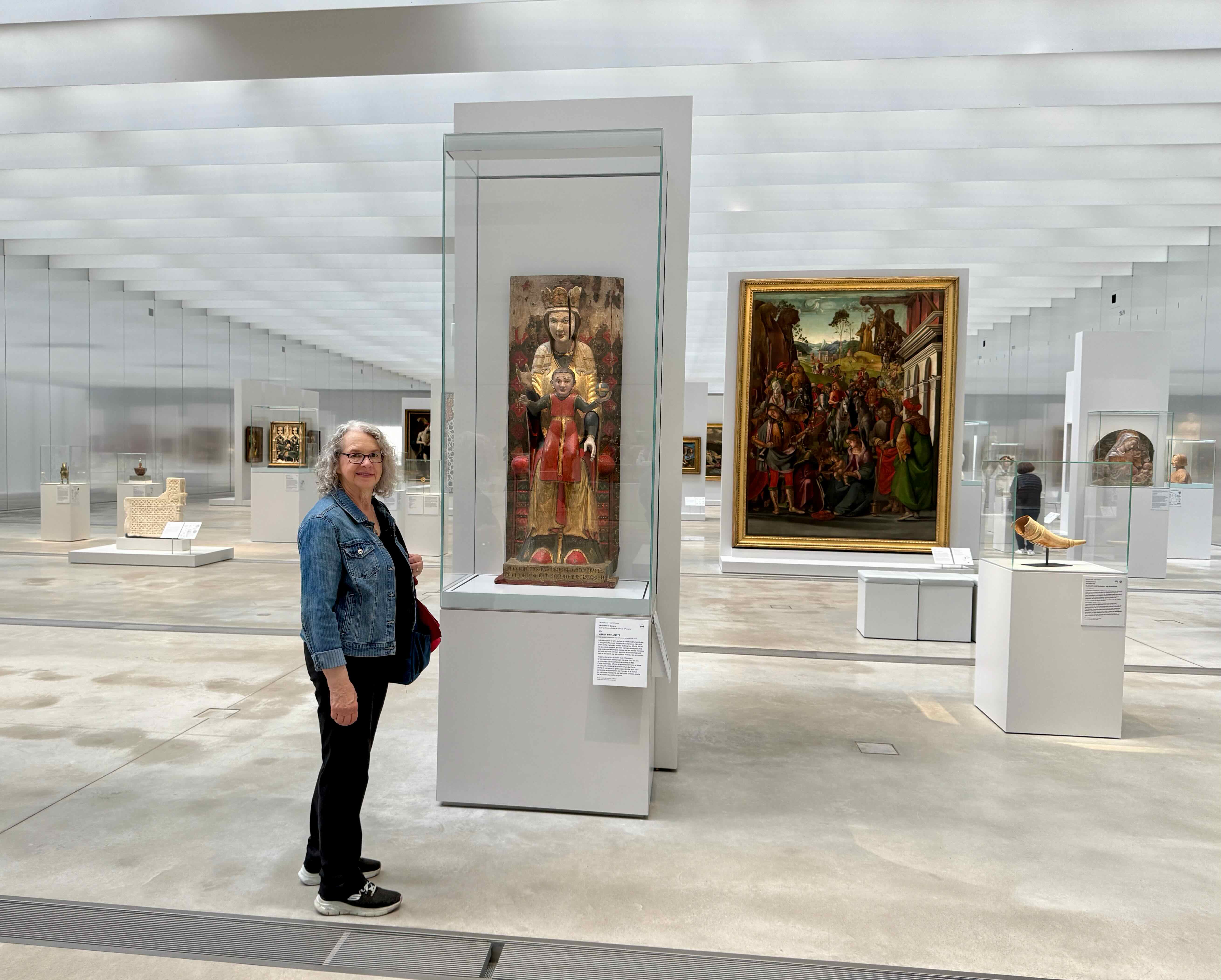
Some views of more than 250 pieces of art on display in this huge gallery.

And here, in no particular order, are a few of the pieces that we found especially interesting.
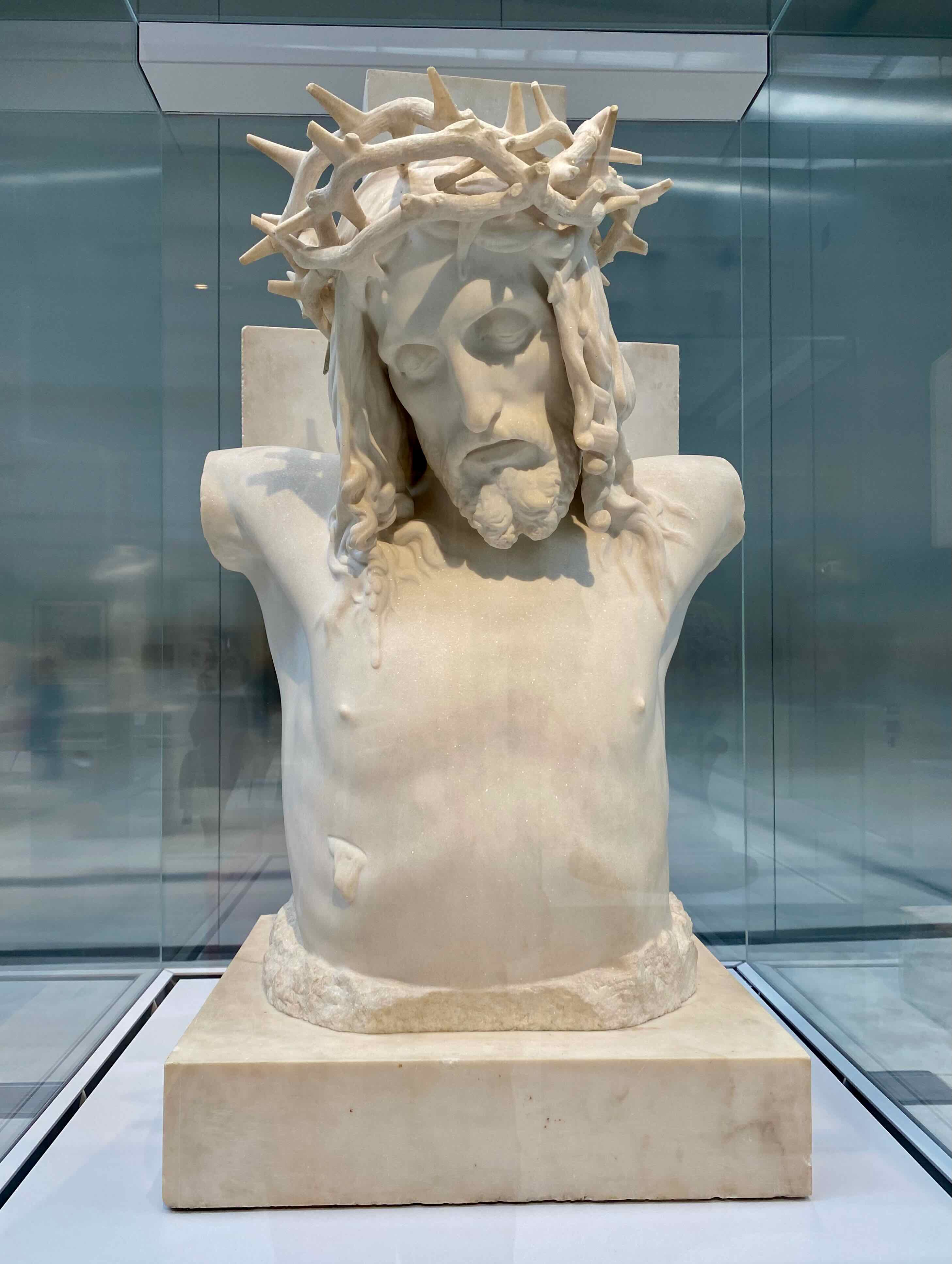
Francois Rude, Christ on the Cross.  Rude started this marble sculpture in 1885 but died before it was completed.  His student and nephew Jean Baptiste Paul Cabet completed it.  I found it very moving, and marvelled at being able to carve the crown of thorns in marble!

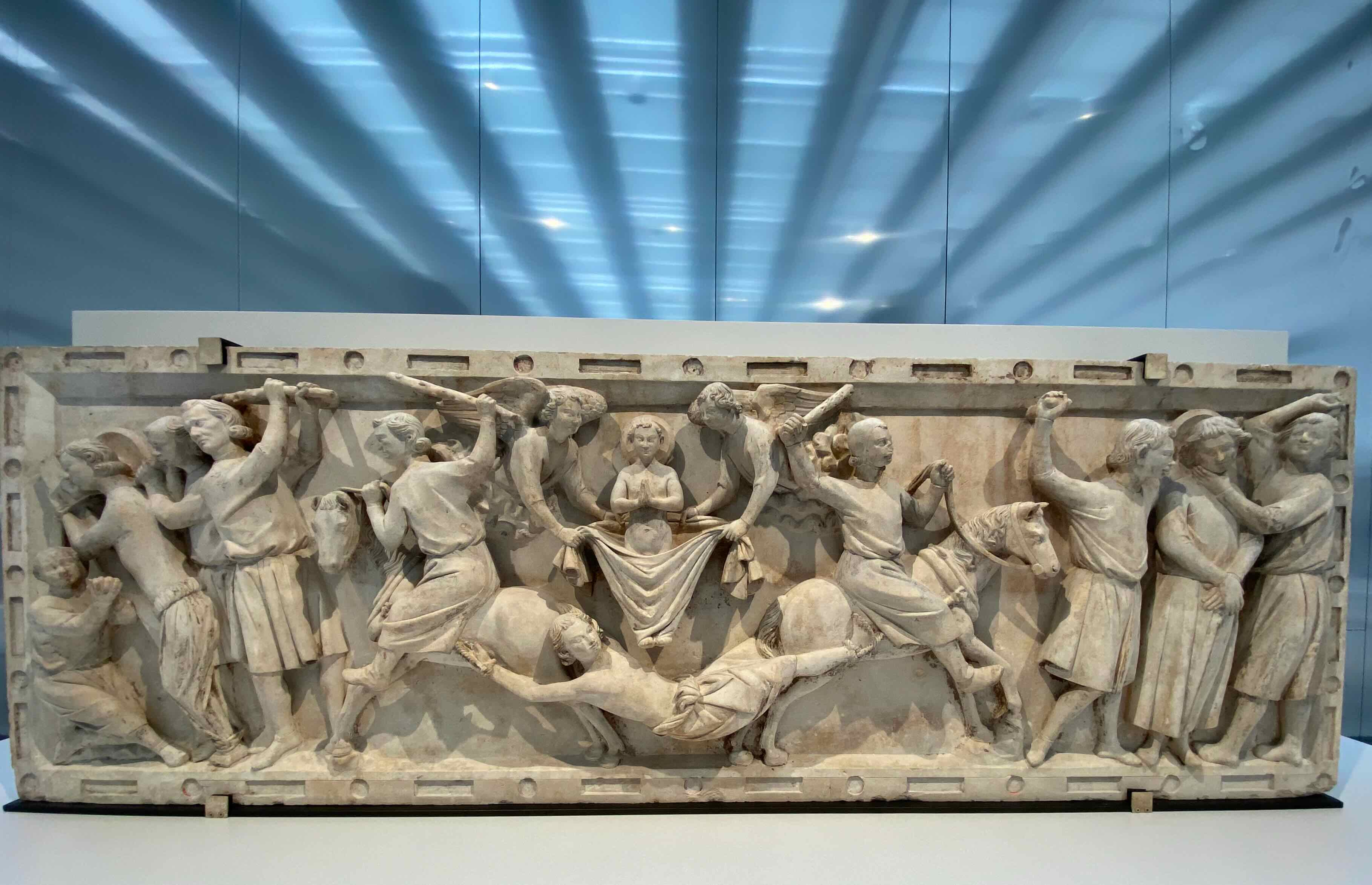
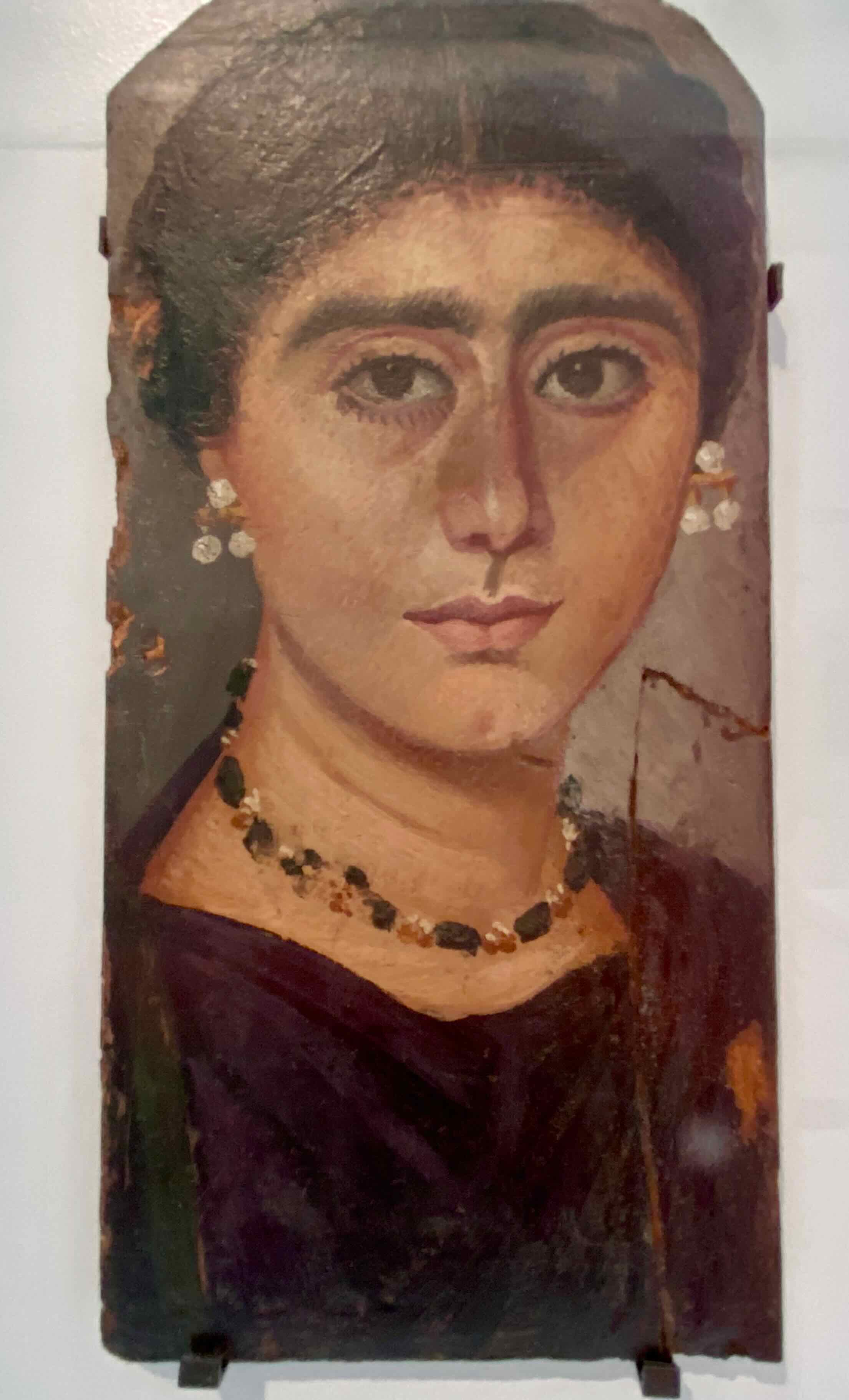
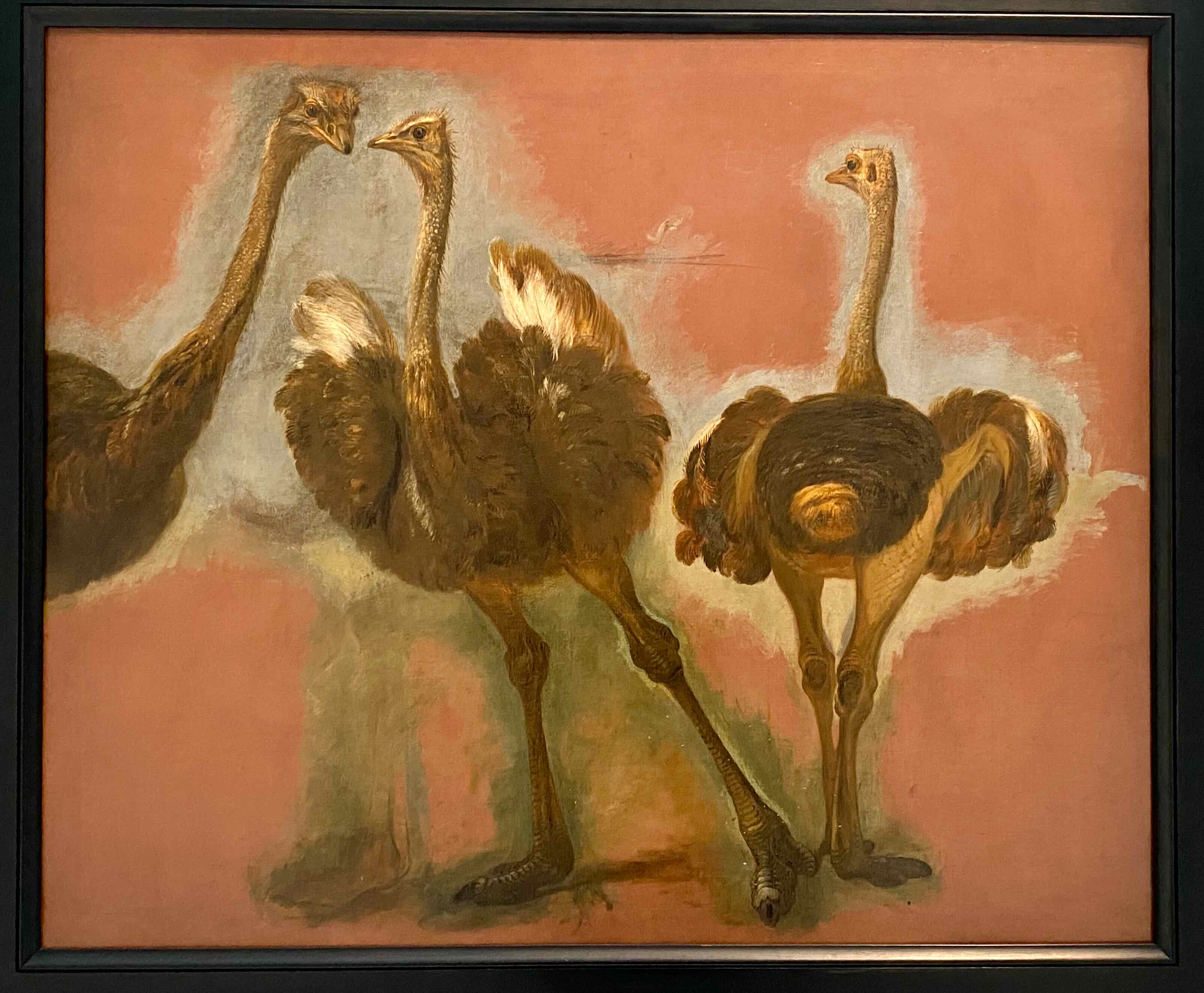
The Martyrdom of Saint Hippolyte, Cathedral of Sant-Denis, France, c. 1225-1250,  My first thought seeing this was what would it feel like to be pulled apart by horses? Egyptian Tomb Portrait of a Woman c. 150 AD.  I love these tomb paintings.  We saw several of them years ago when we visited Egypt.  Pieter Boel, c.1669-1671 Triple study of an Ostrich. 
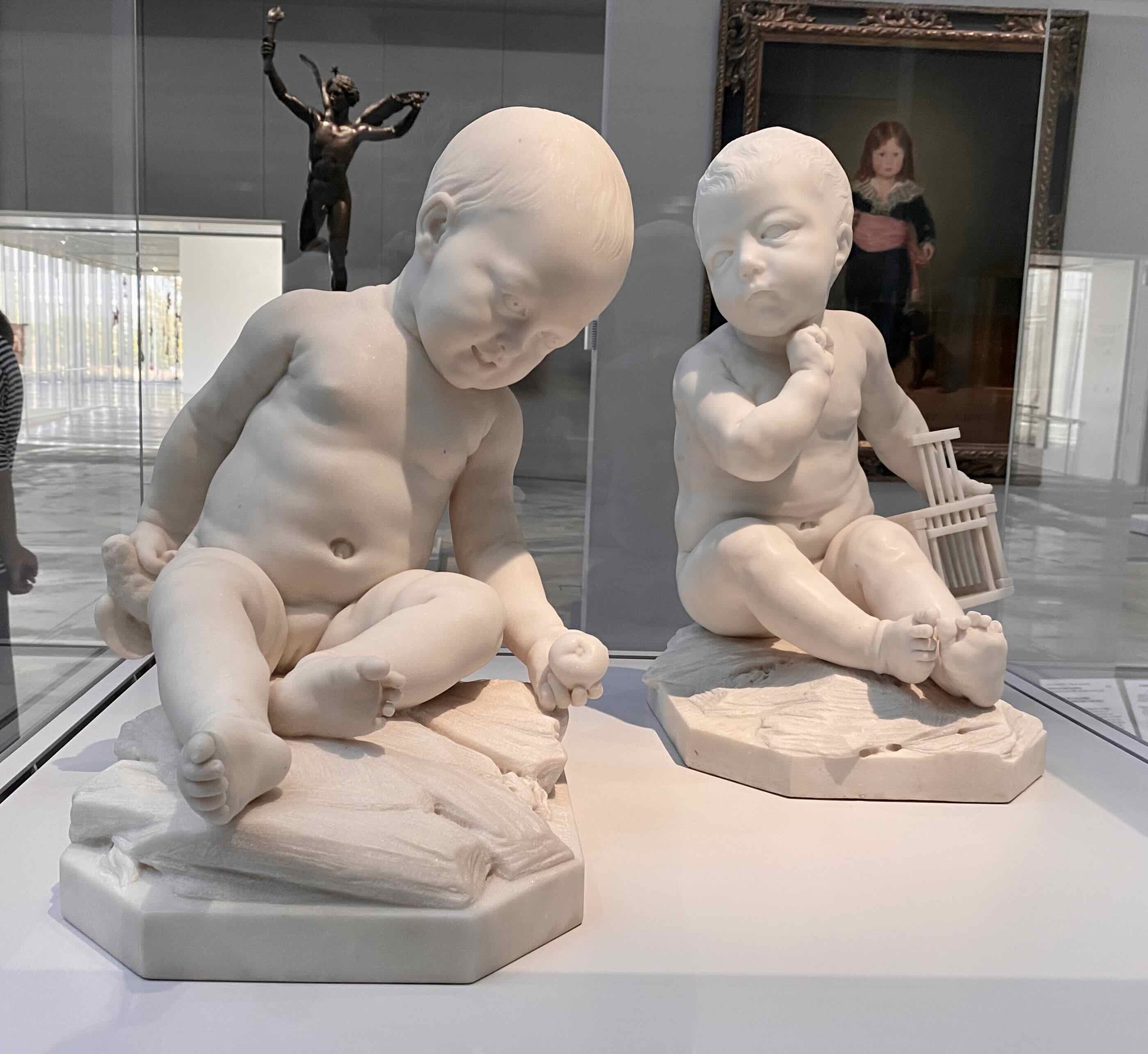
Jean-Baptiste Pigalle, Paris 1714-1785, The Child and the Cage and The Girl with a Bird and an Apple. I fell in love with this two cherubic statues.  The dimples and folds in their skin were so incredibly life-like.

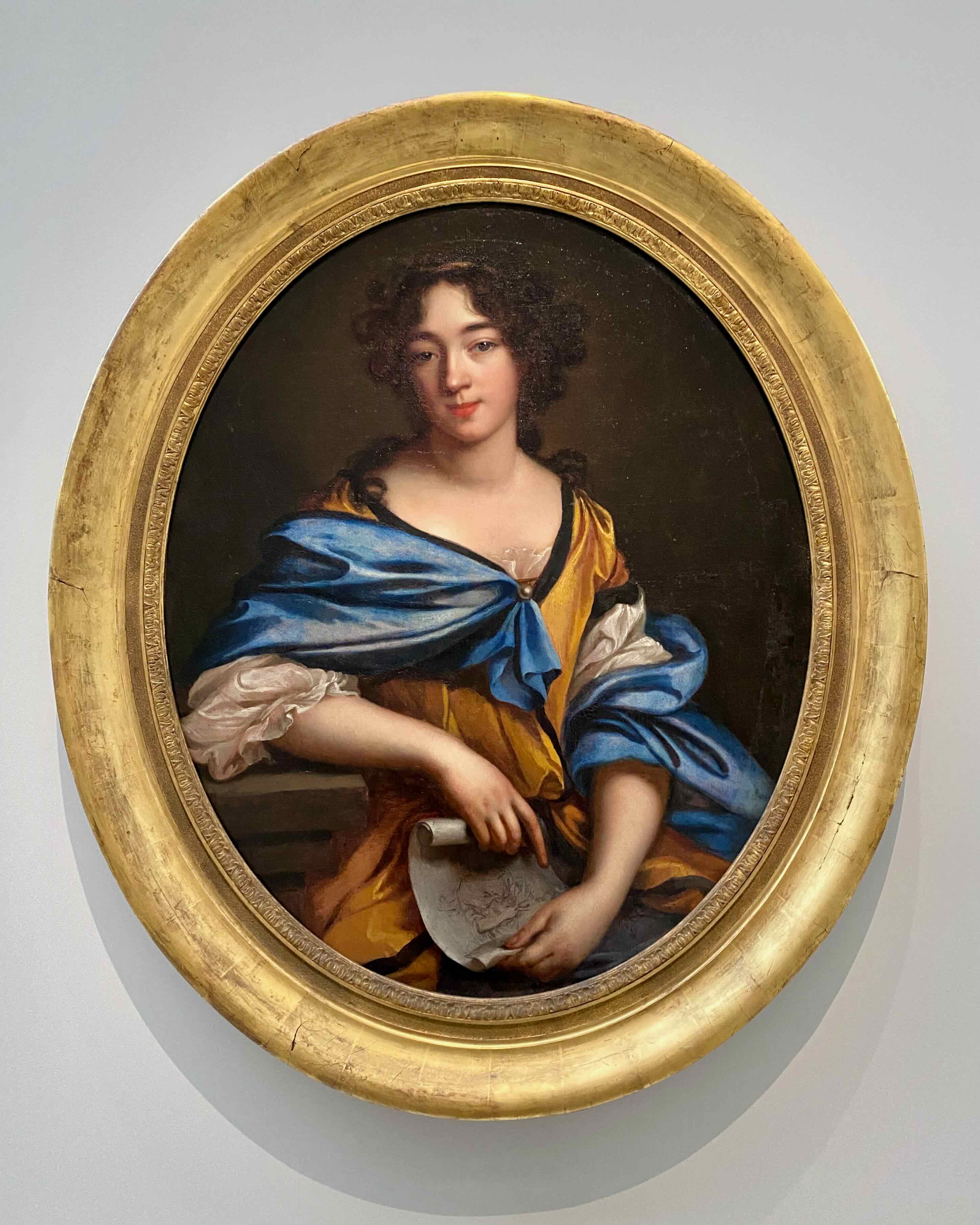
Élisabeth-Sophie Chéron, (1648-1711), 1672 Self Portrait.  This is the oldest self portrait of a French female artist in the possession of a Museum.

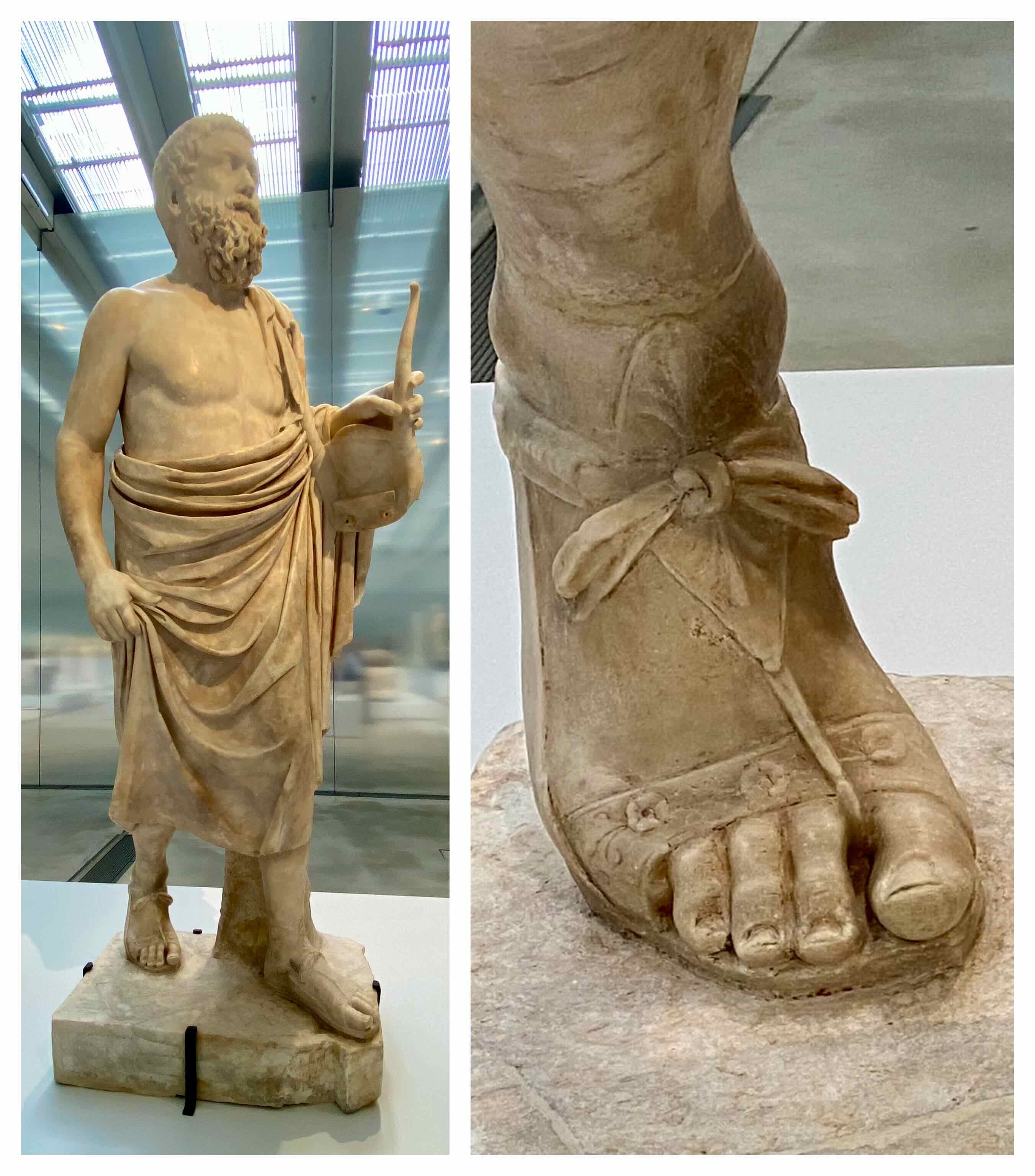
The Marching Player, 1063 AD. This statue is a replica of a Greek bronze original created around 440-400 BC.  I love the detail in his feet and toes.

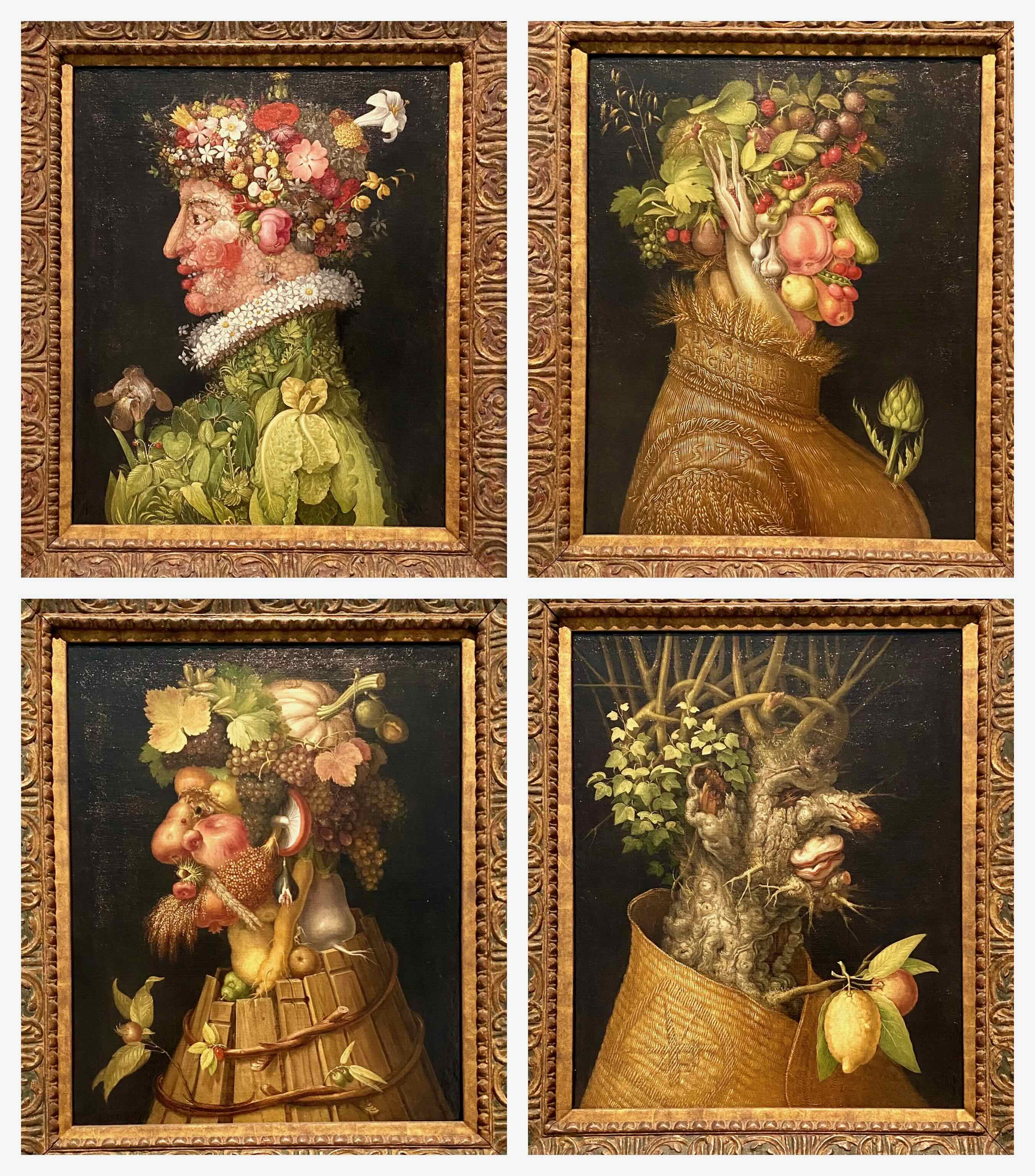
Giuseppe Arcimboldo, Milan, c. 1527-1593. We have seen other work by this artist…it is pretty distinctive. This is Spring, Summer, Autumn and Winter.

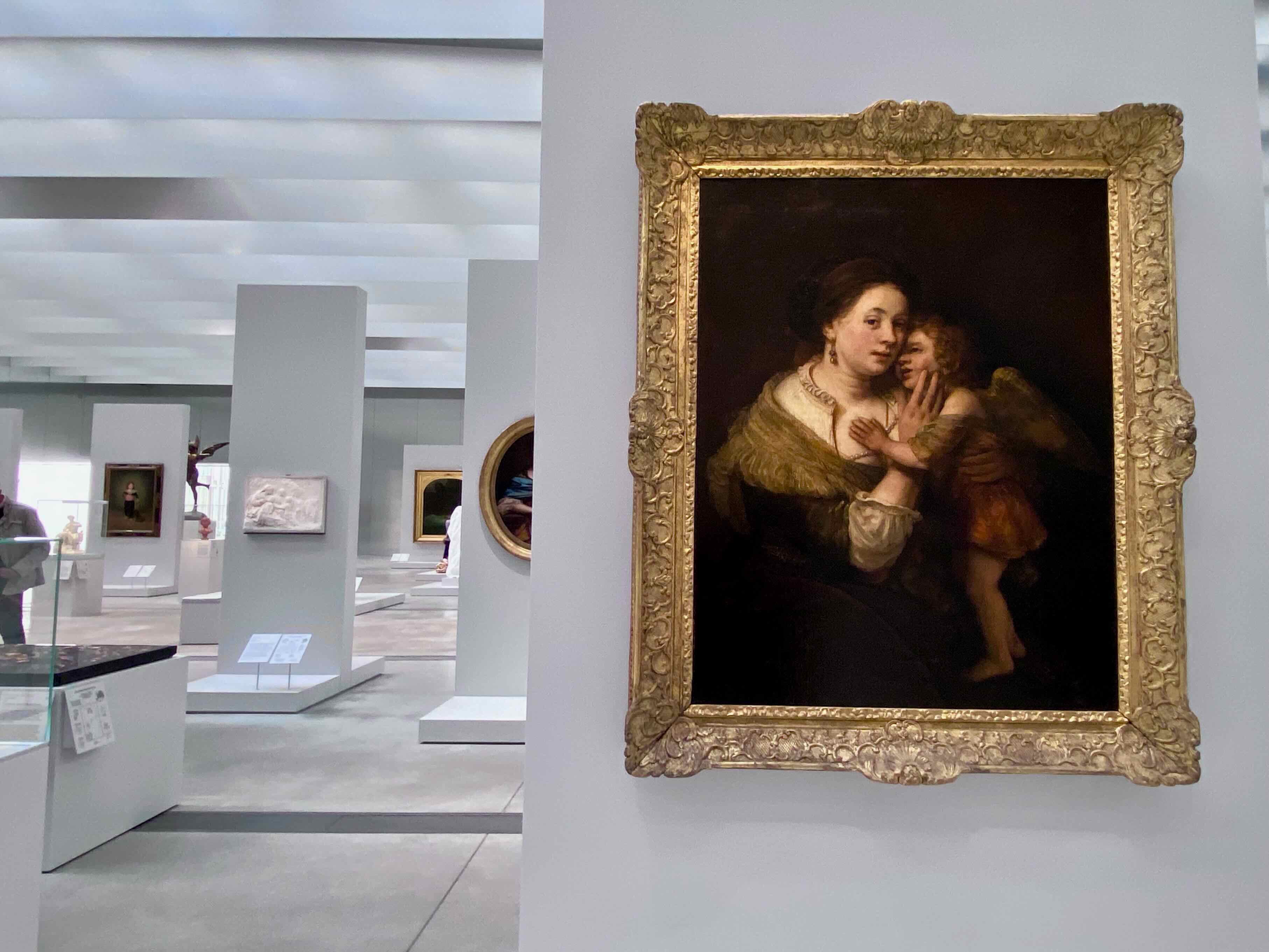
Rembrandt van Eijn, 1640-1660, Venus et L’Amour

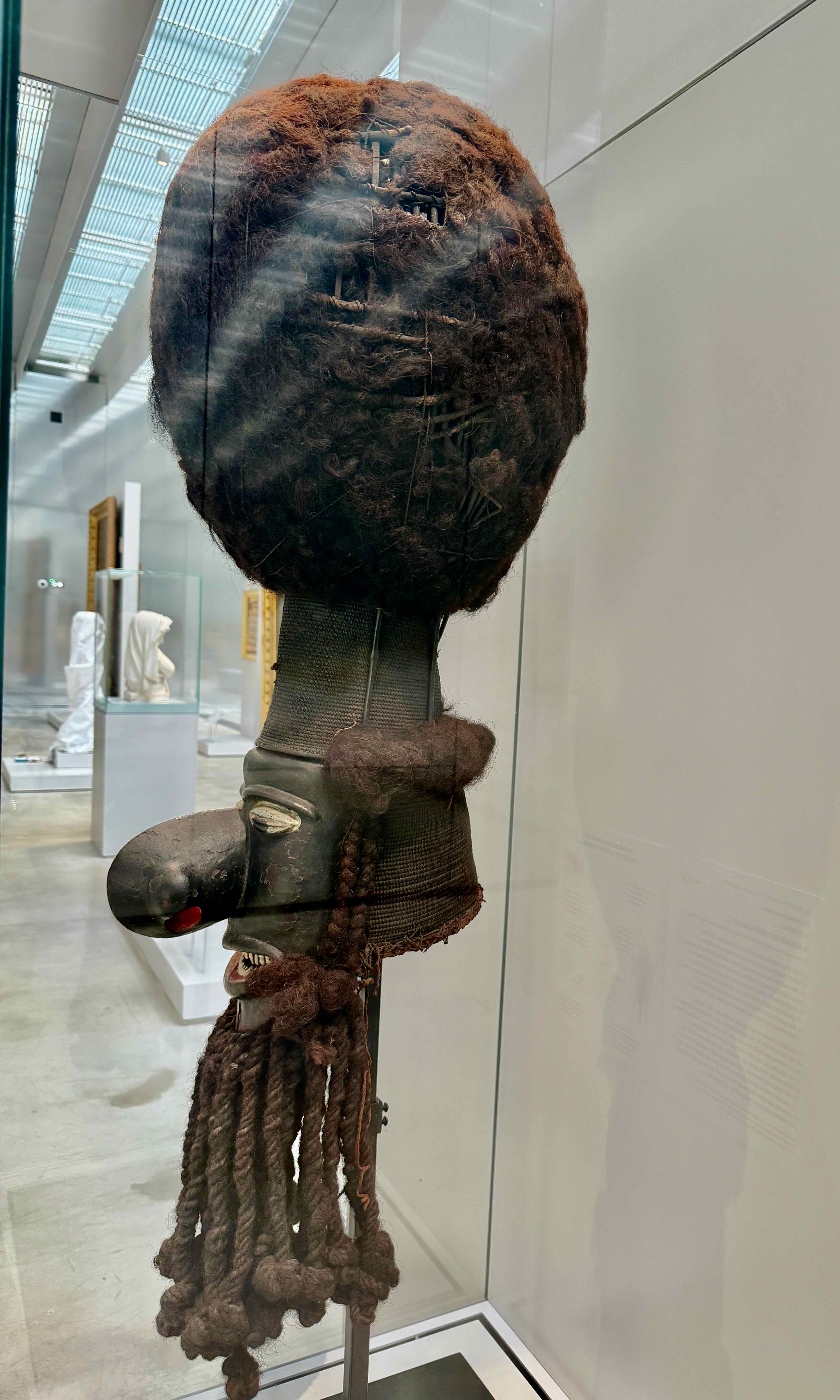
Mourner’s Mask, New Caledonia c.1850

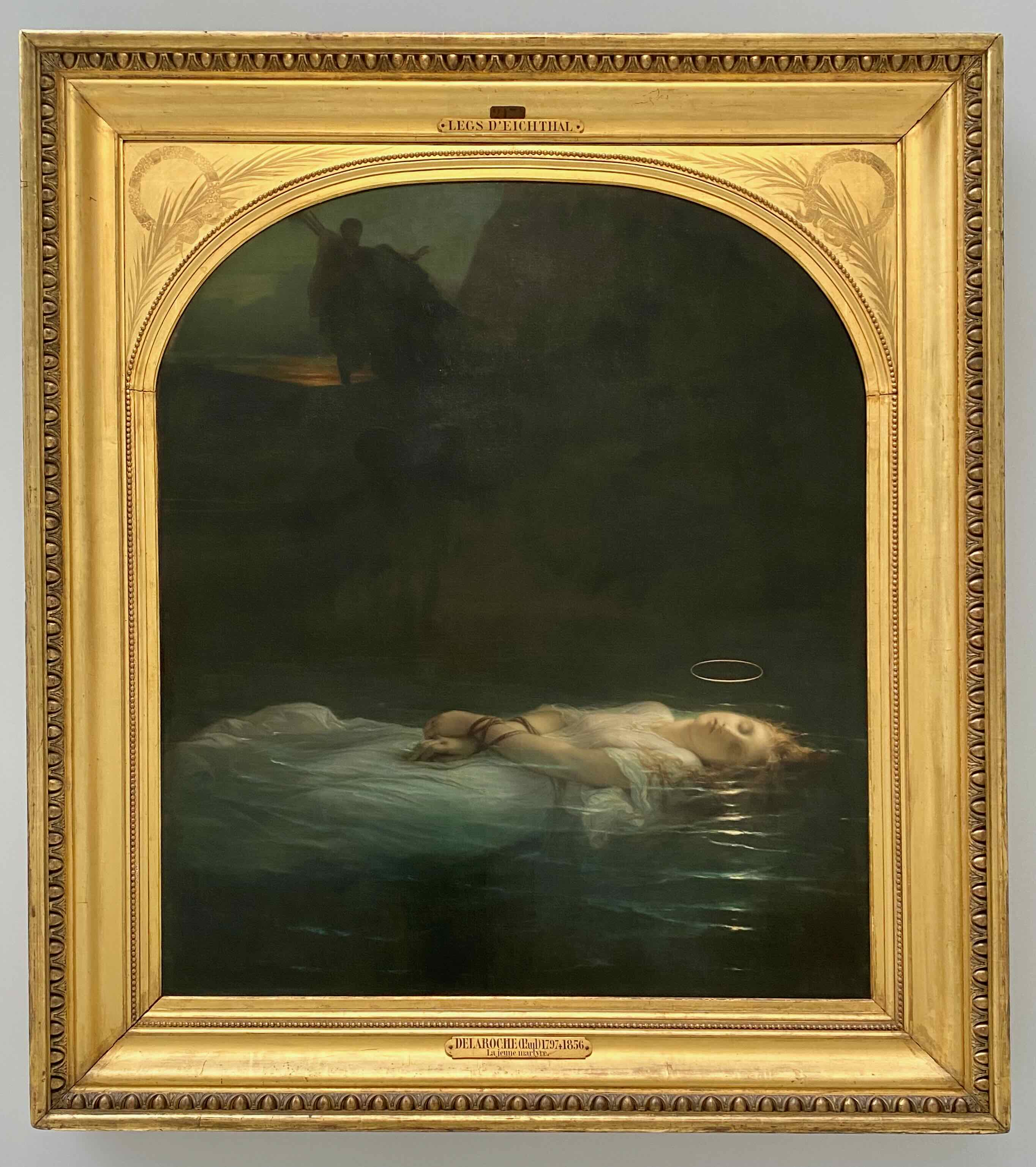
This was the last piece in the Gallery of Time.  A painting by Paul Delaroche, 1885, The Young Martyr.  A painting of a young woman who was killed for refusing to renounce her Christian faith.

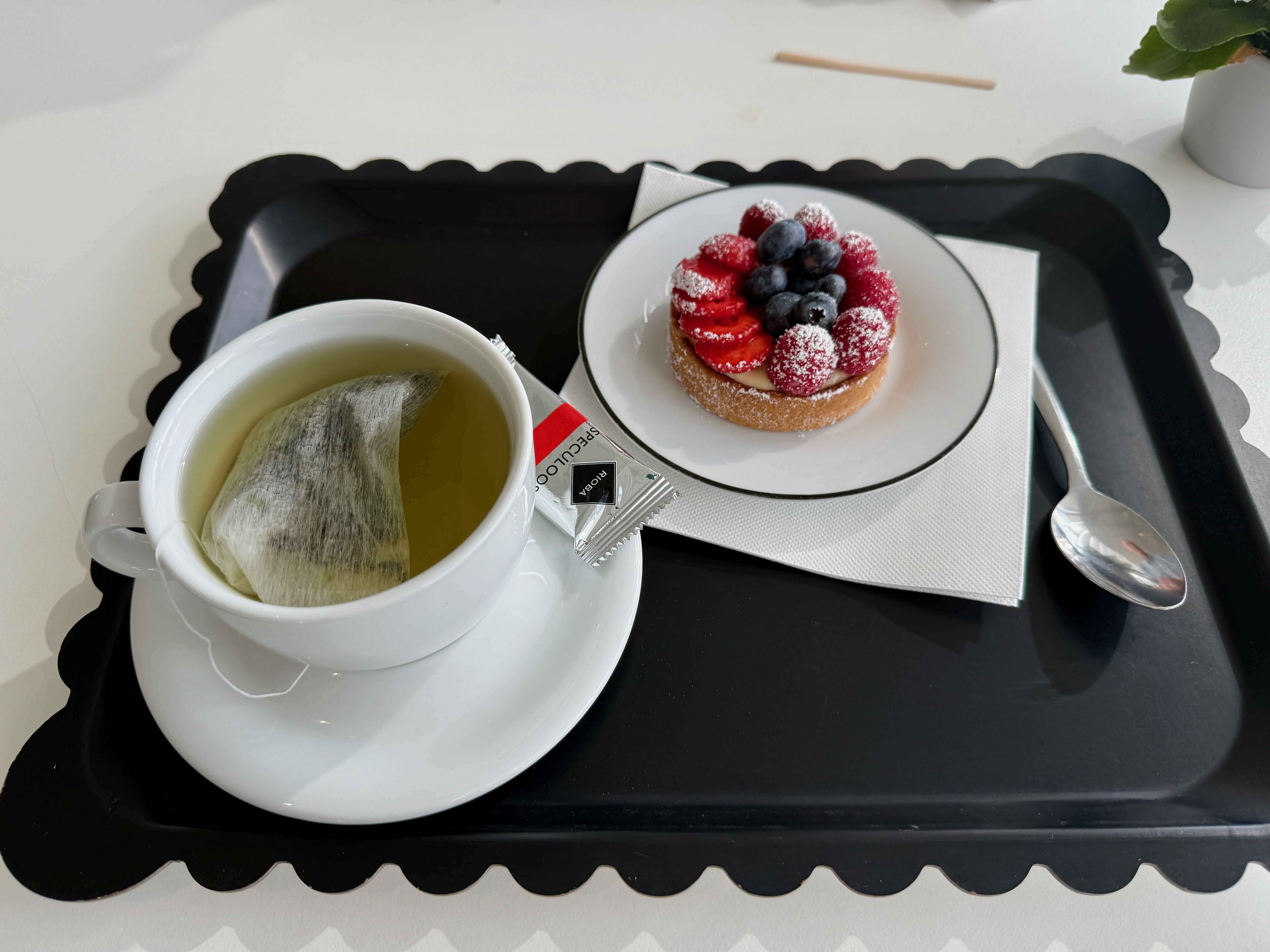
We have a much needed tea break. I asked how big the tea was and was assured that it was very big…well, this rather ‘very large” cup of tea was €5.50!  Bob finds a spot to read and I go back to the gallery to do some sketching.  They aren’t the best sketches but I had such an enjoyable time doing them.  Two people asked if they could take a photo…people are always interested in what I am drawing.
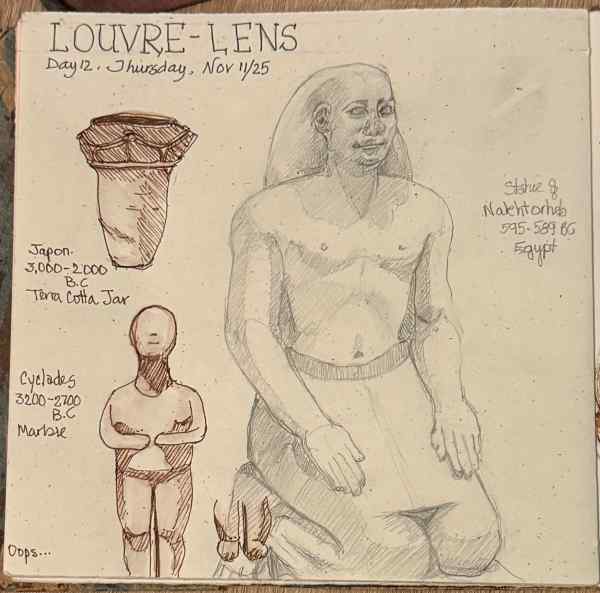
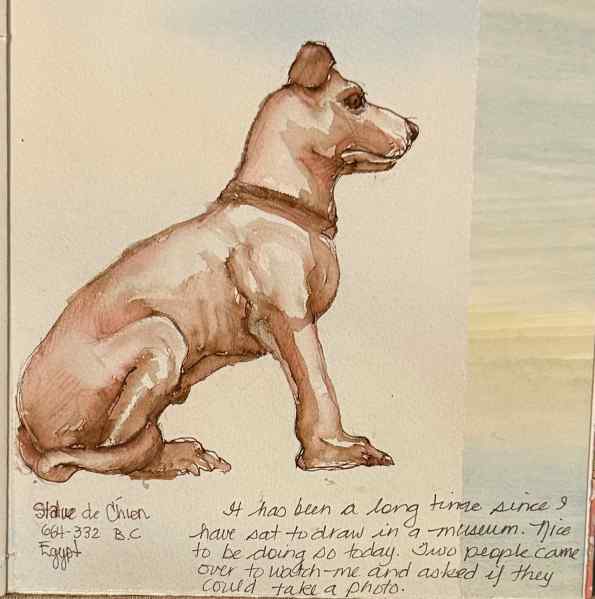
We stay until the museum closes at six and we are surprised to see it is raining outside.  The Louvre -Lens is a very modern building, so different than the Louvre in Paris.  We really enjoyed the Gallery In Time”. It was interesting, and not as overwhelming as the Louvre.

The Boves, World War I Cemeteries and Vimy Ridge Memorial

Day 11.    Wednesday, September 10, 2025

This is a bit of a long post…it was a very full day.

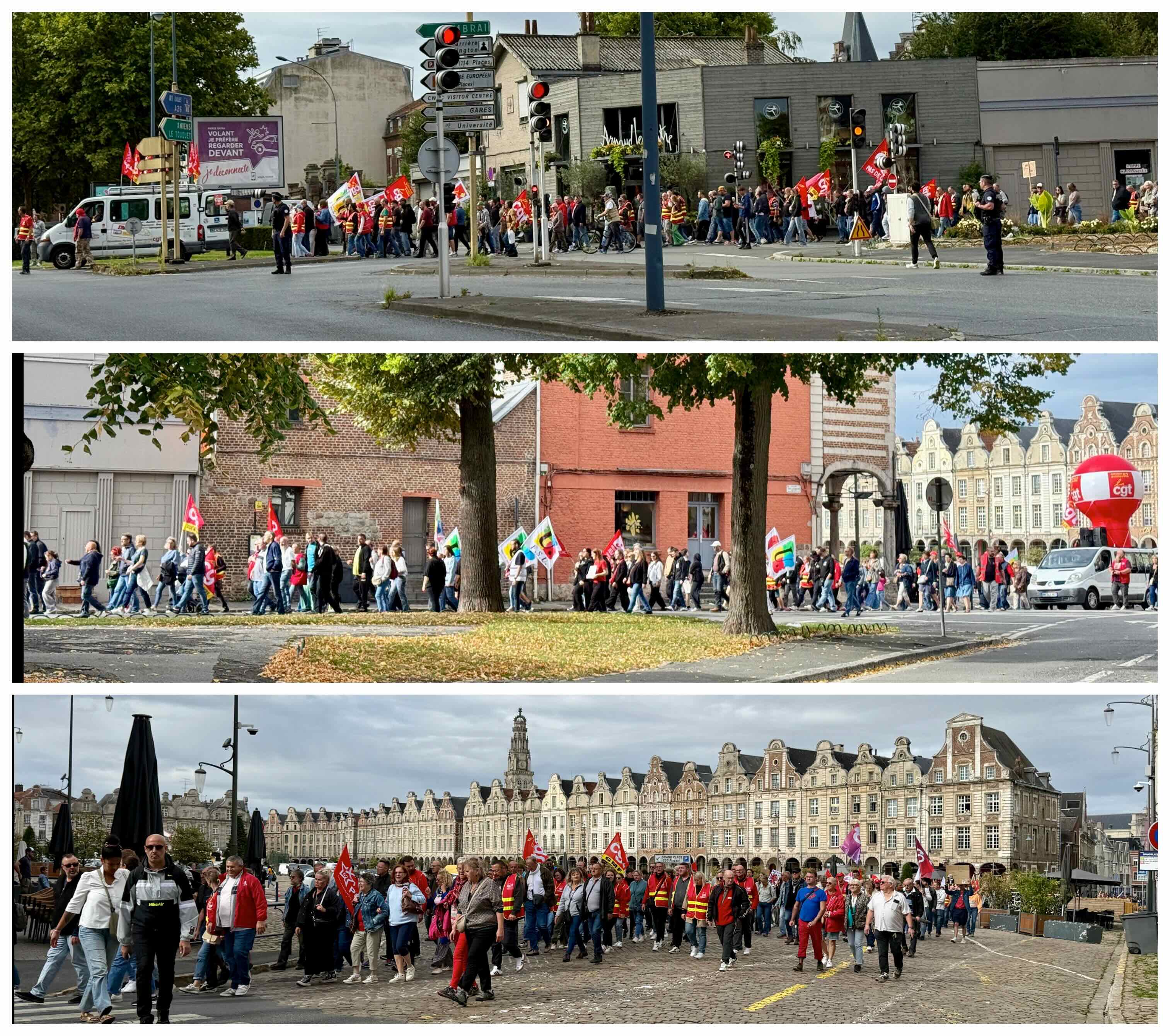
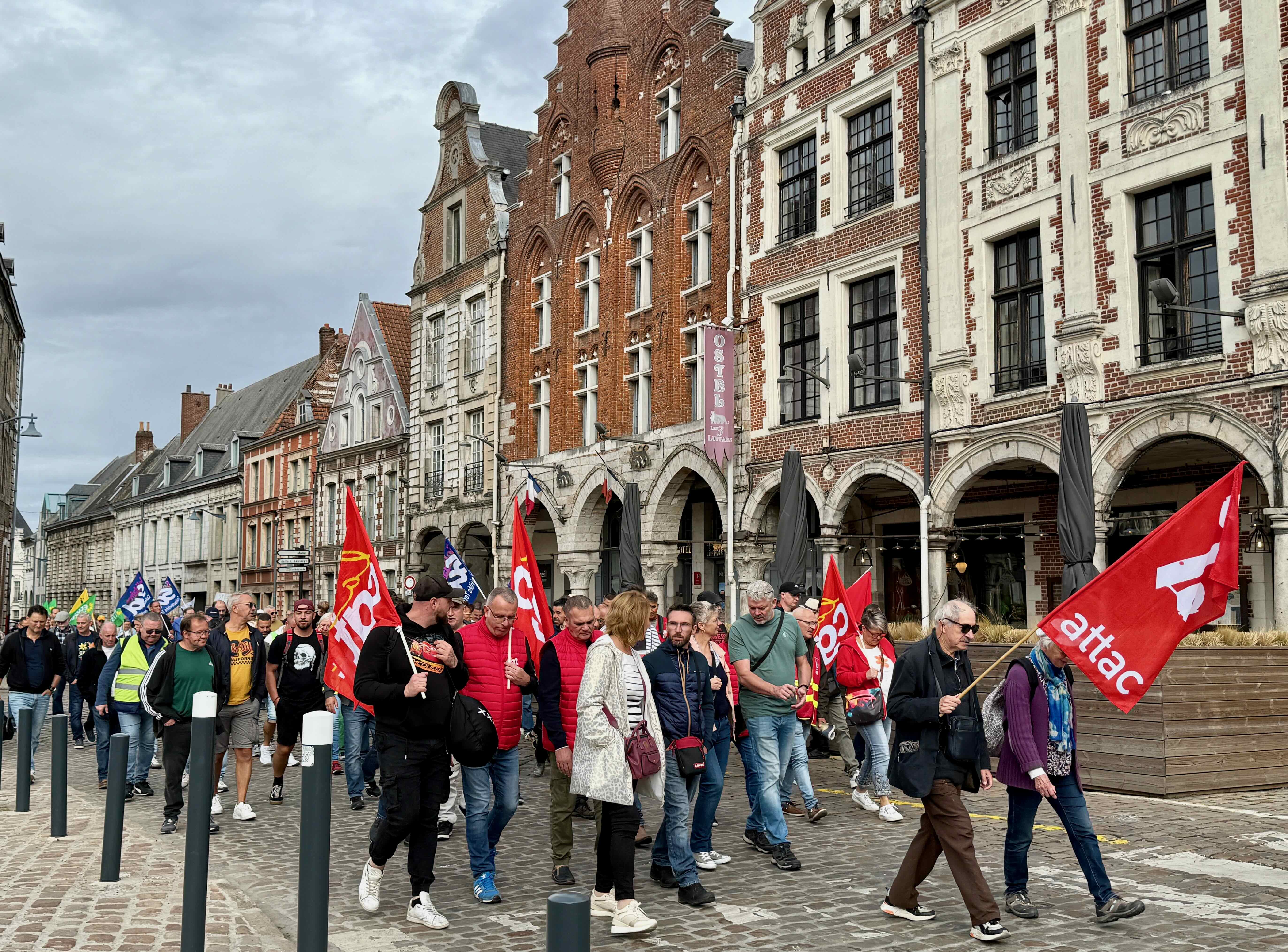
On our walk to Arras City Hall this morning we pass a ‘Bloquons Tout’ (Bock Everything) protest march.  This march is much calm, but people are very angry with the government’s austerity budget.

It is not just young people who are upset and protesting.  There are people of all ages in this protest march that is blocking the streets for more than three blocks.

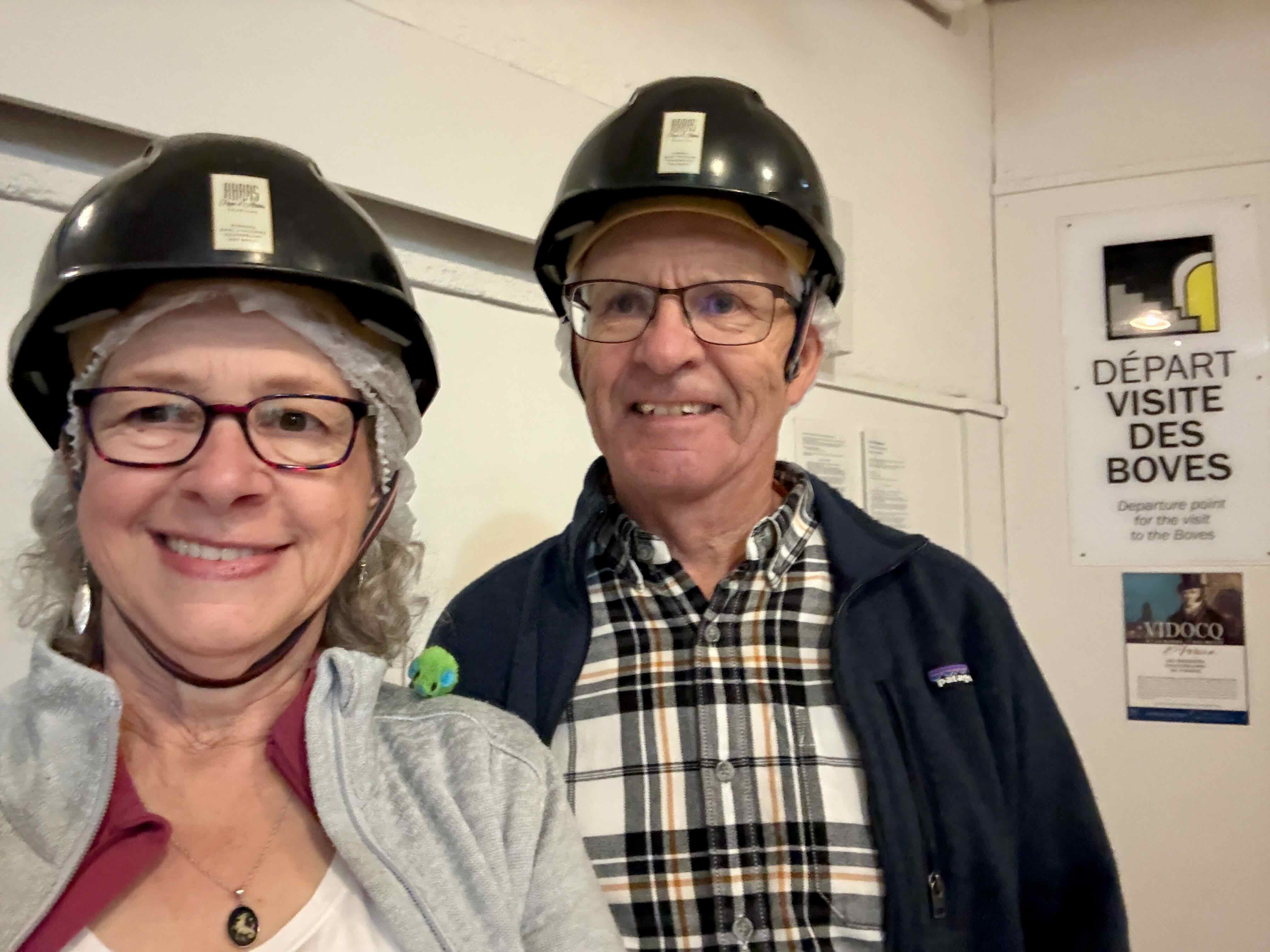
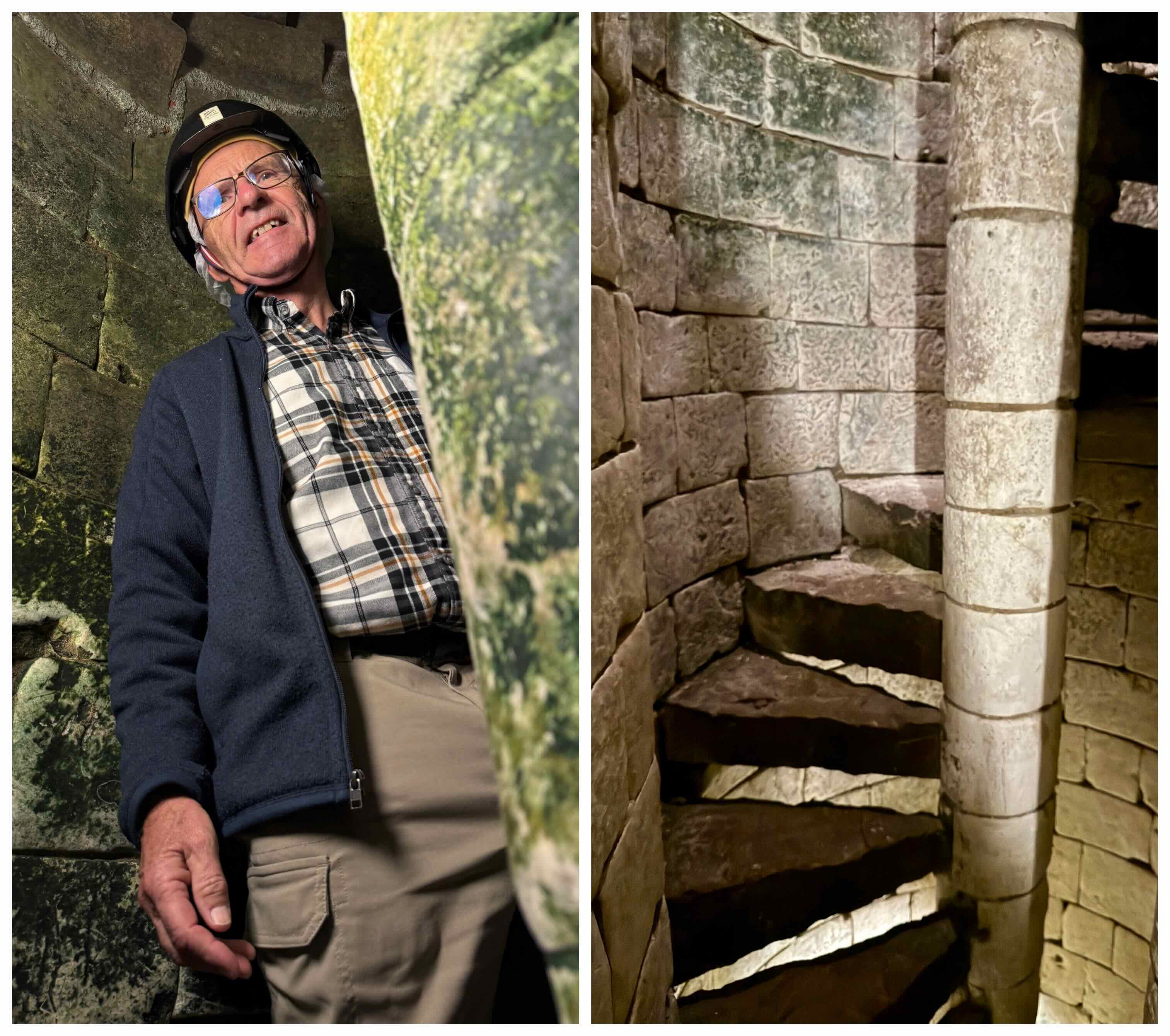
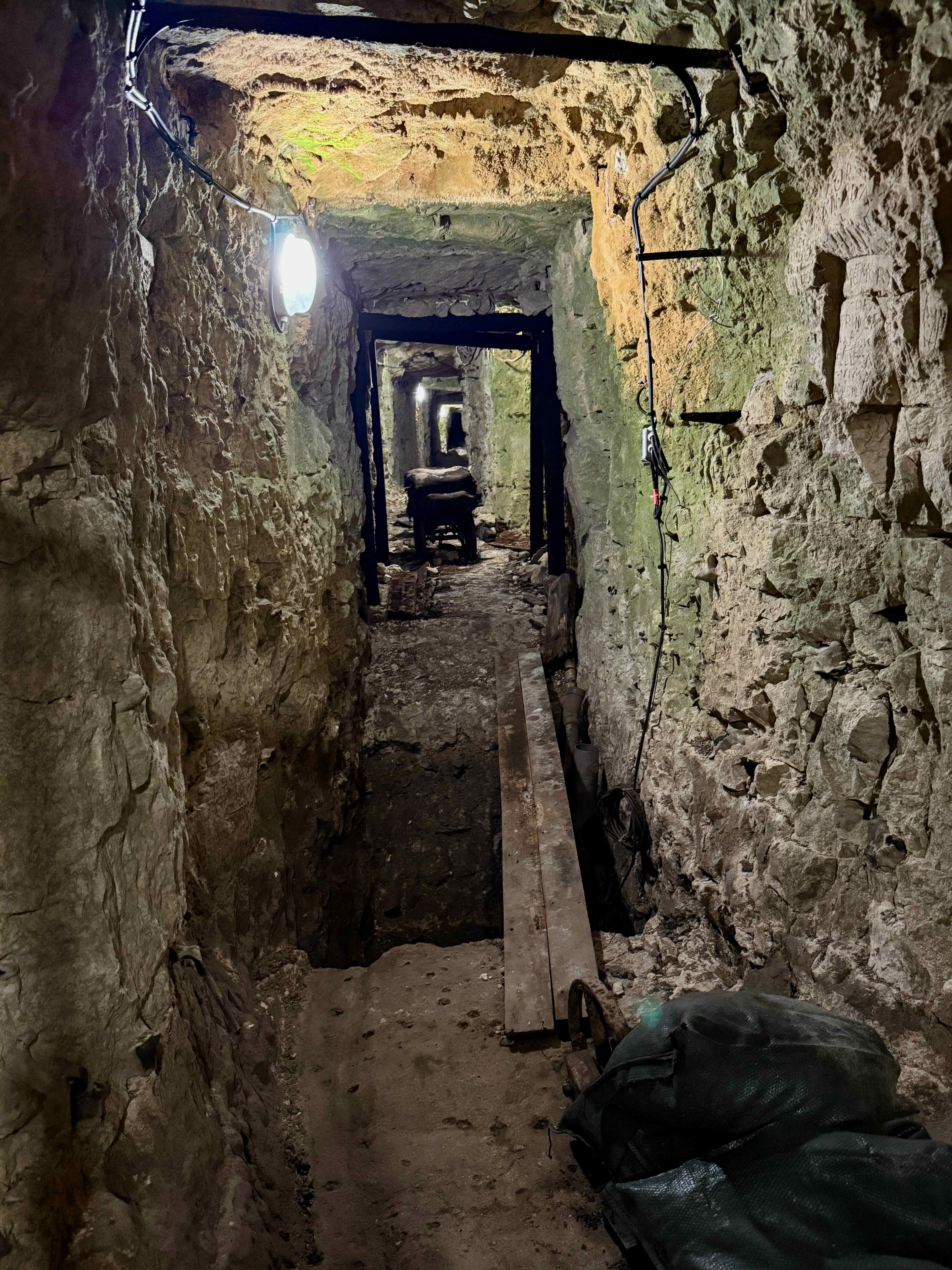
We are going on a guided tour of the Boves this morning.  The Boves are the tunnels and caves that were excavated under the city of Arras and the surrounding countryside.  The stones for building the churches, City Hall and other large buildings  were excavated from these caves and tunnels.  We are given hardhats to wear, but Sue is content to sit on my shoulder for the tour.  

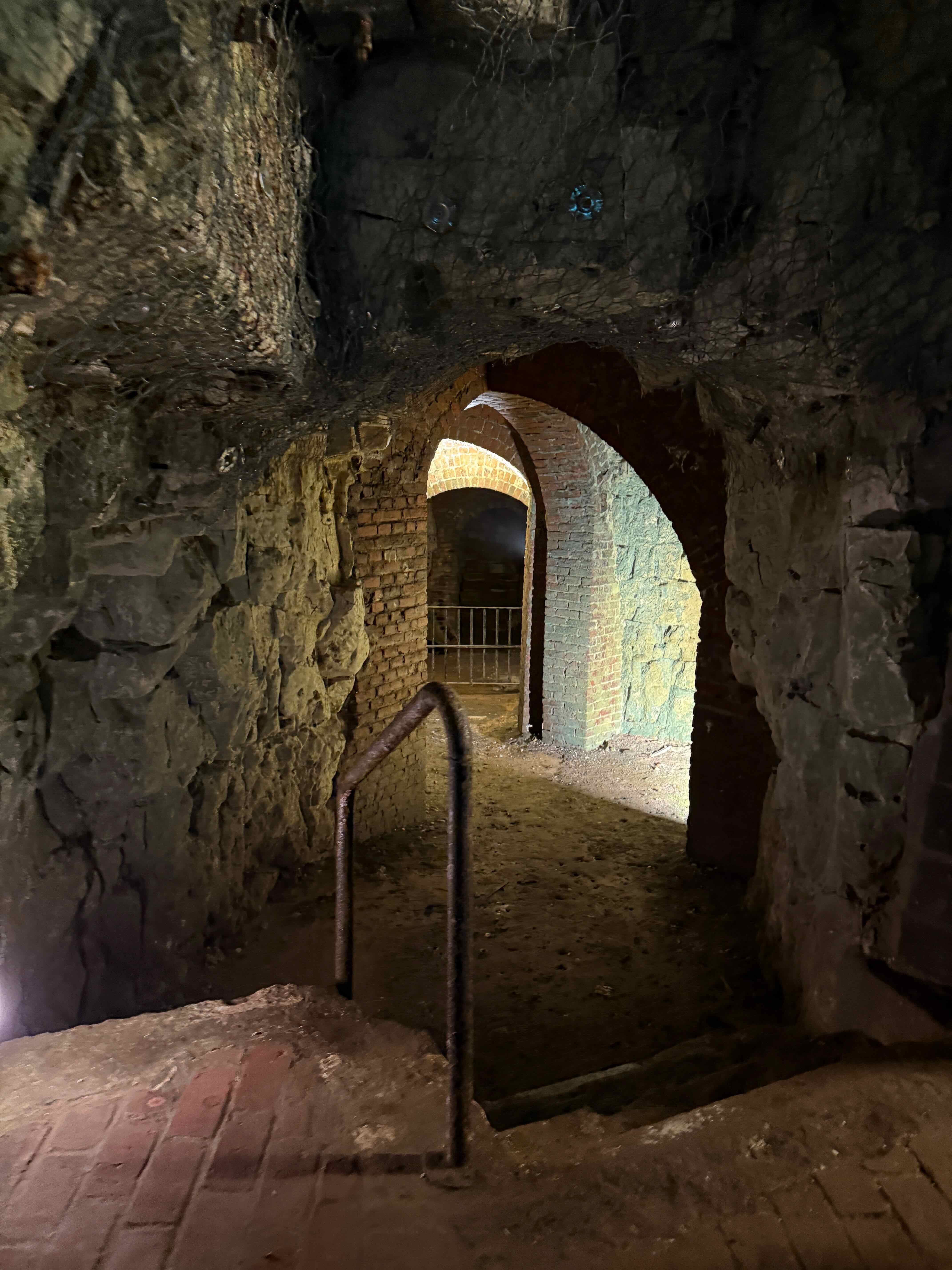
This is the entrance to the Boves.

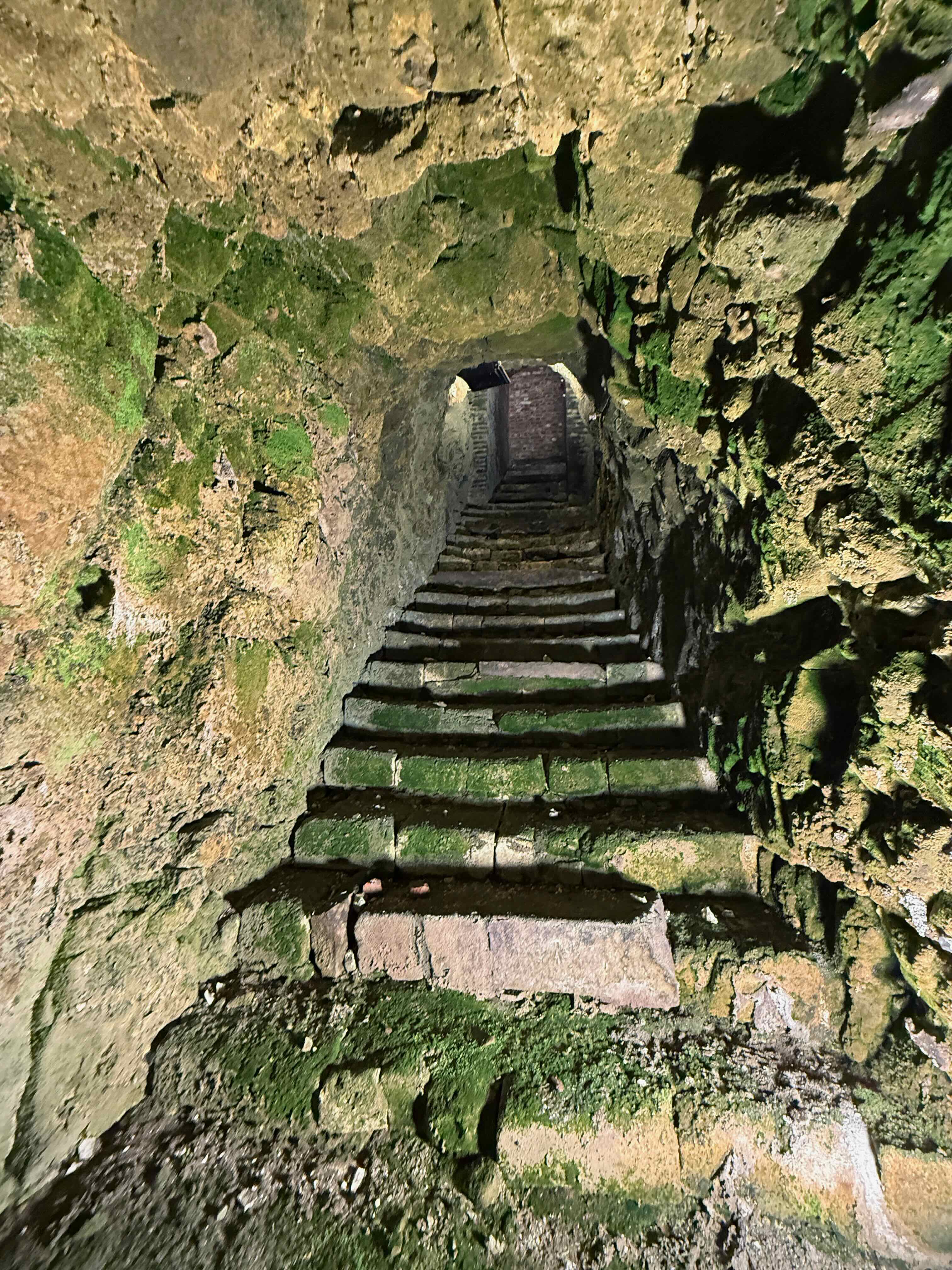
It is damp down here, 80% humidity and about 12° Celsius. Some of the tunnels have moss growing on the walls.

In places these very narrow spiral staircases are used to go between levels of tunnels.  There are three levels, one at 4 metres, one at 8 metres and one at 12 metres.

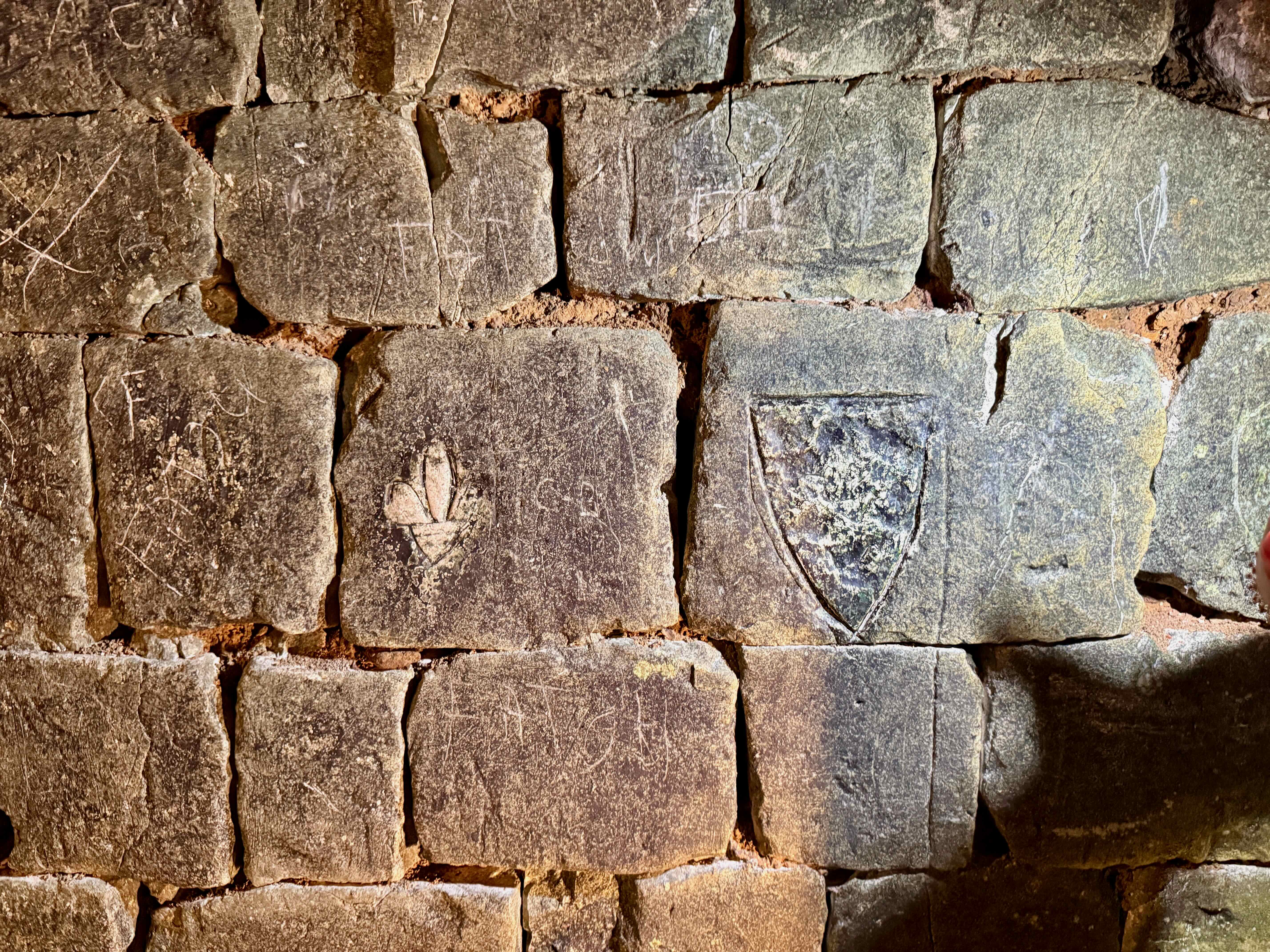
Graffiti covers many of the walls, both modern day graffiti and graffiti from the days of the First World War.  The fleur-de-lys and the French Crest, which once had 2 lions on it are very old, the rest unfortunately are from recent tourists who visit these tunnels.

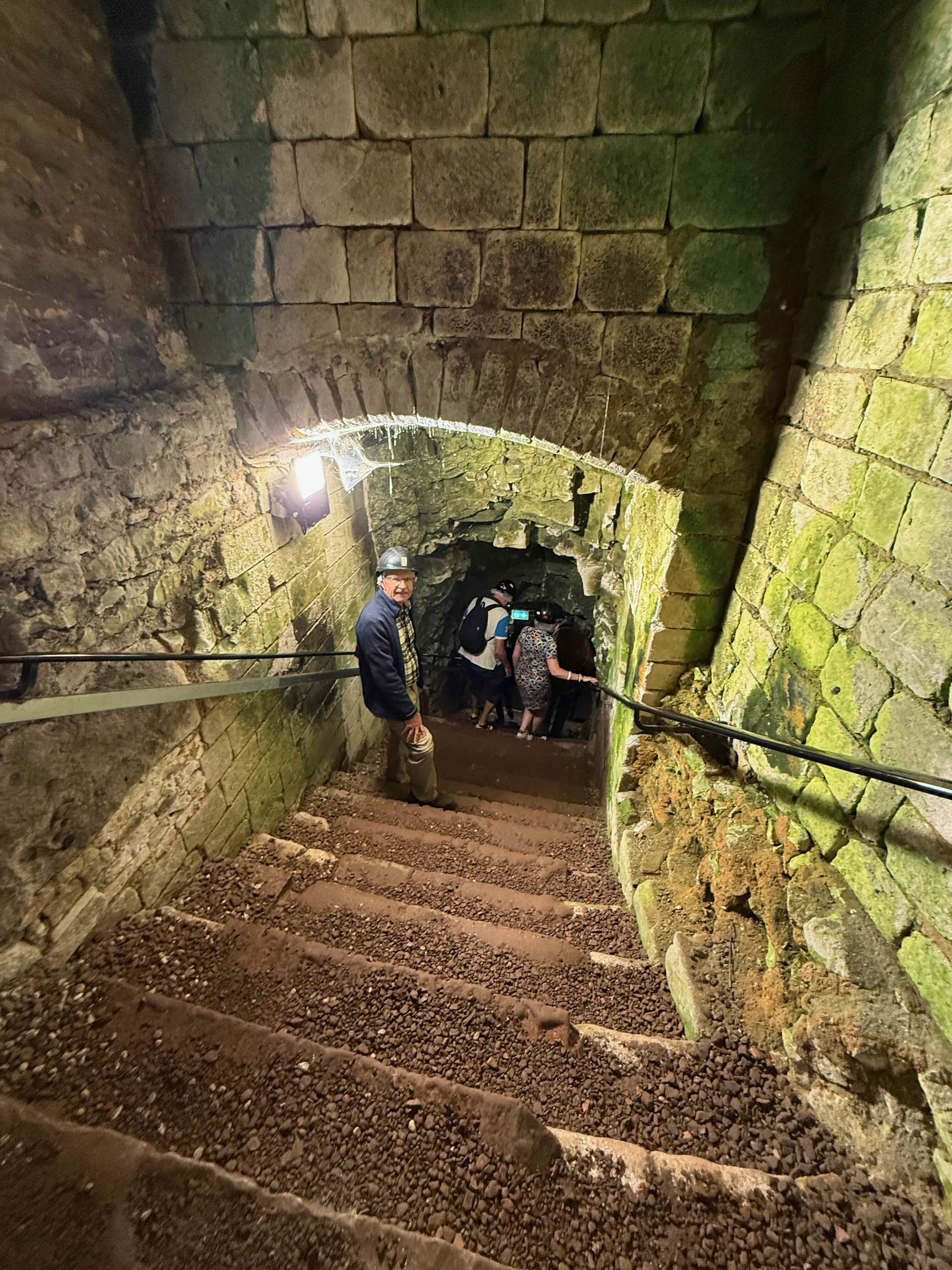
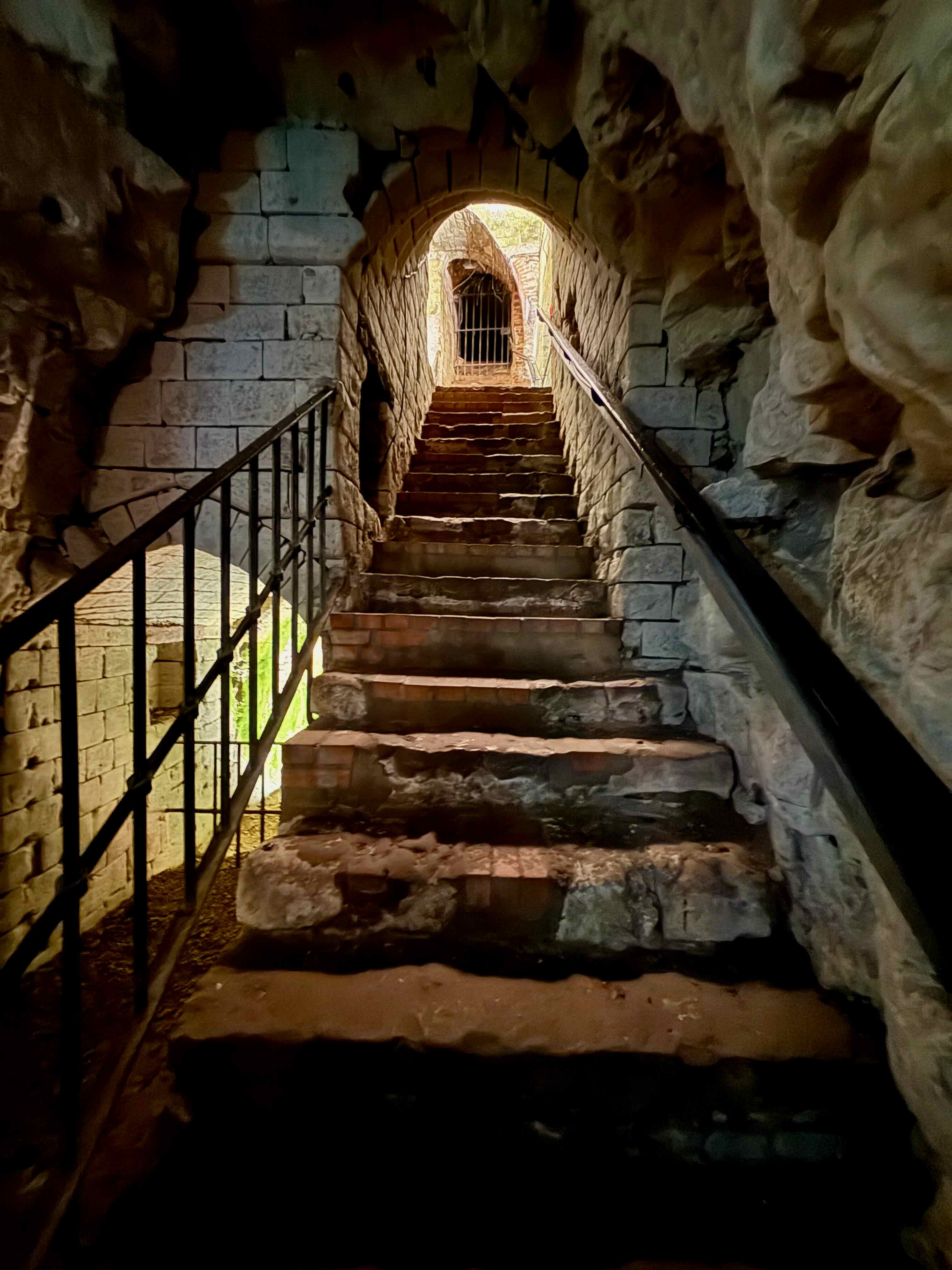
One of the many staircases on the tour.

Many of the staircases and tunnels are now blocked off for security reasons.

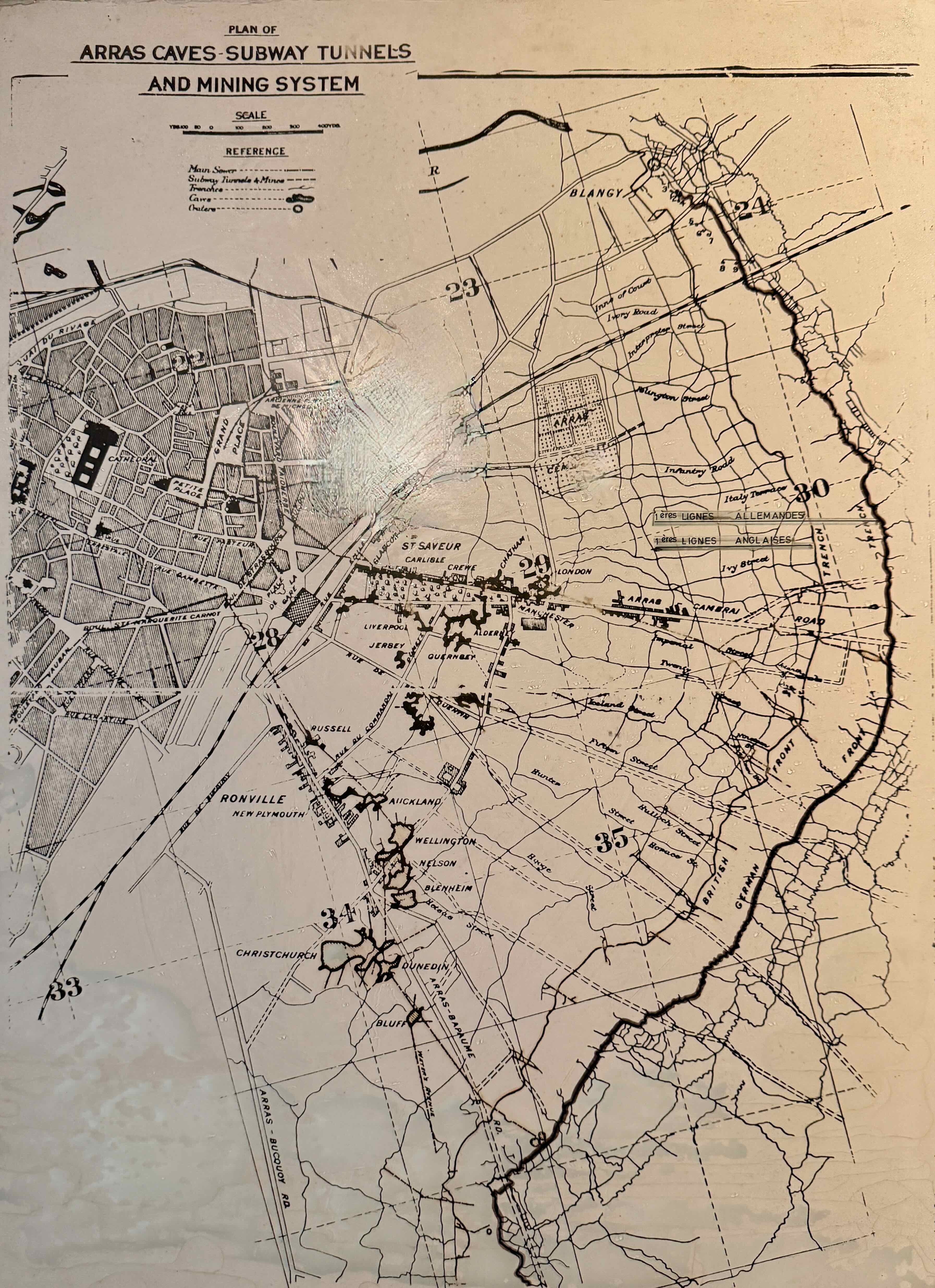
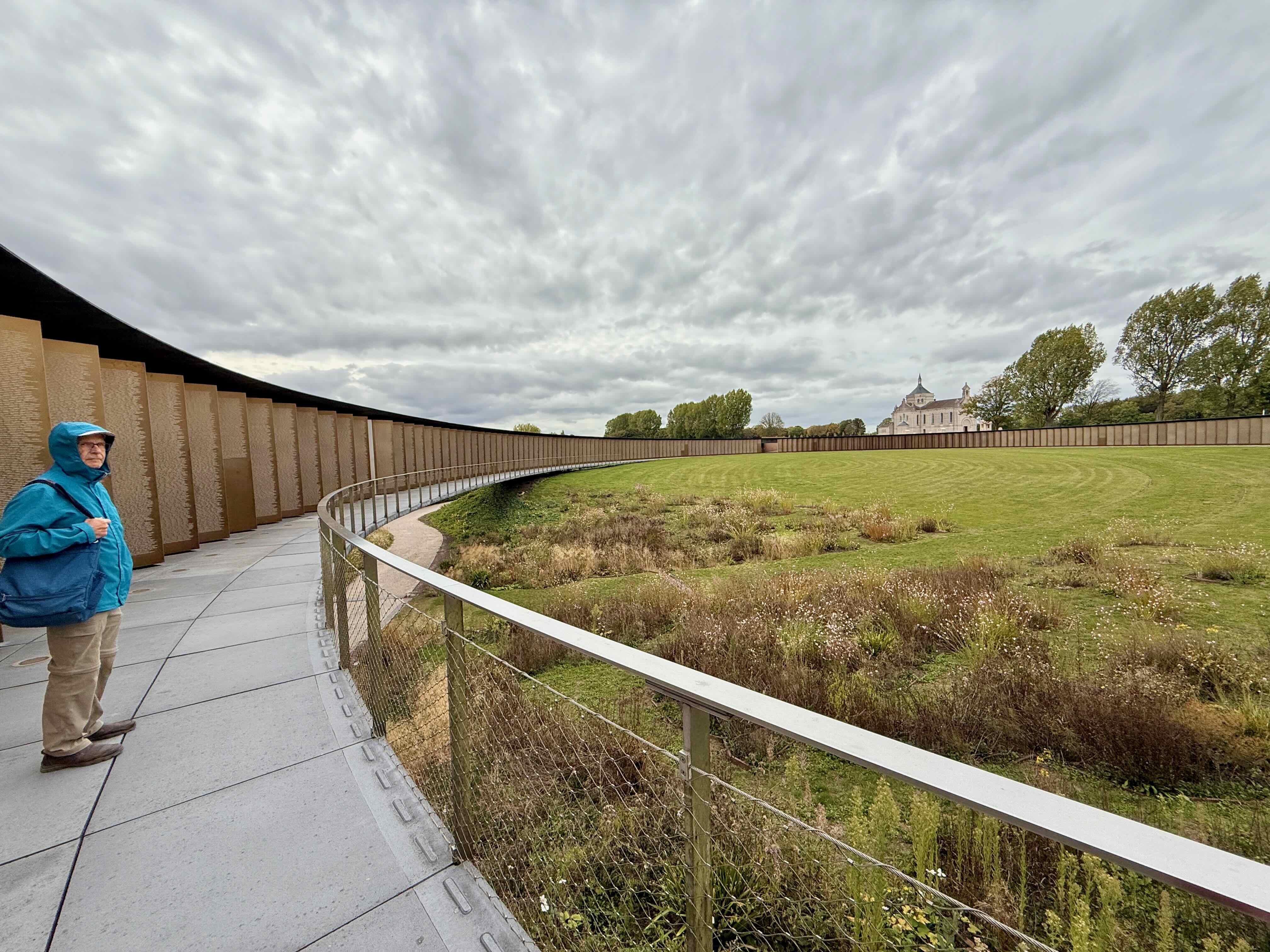
There are some informative posters in one of the caves.  During World War I more tunnels were built to connect the caves. This gave Allied troops a way to move underground very close to the German front so that a surprise attack was possible. There are over 20 km of caves and tunnels and 24,000 soldiers gathered in these tunnels and caves for a week in order to attack the Germans. The Arras Attack was a diversion tactic for the more important battle at Vimy Ridge.  This map shows the caves and tunnels used in the attack.  The dark line on the right side is the German front.  We enjoy our tour but it does feel good to be back outside in the sunshine.  I can’t imagine having to stay underground here for a week like the soldiers in WWI.After our underground tour and lunch at our bnb we drive about half an hour to La Nécropole National de Notre Dame de Lorette.  Bob says we have to visit this site first.  I have no idea what is behind this big black wall.

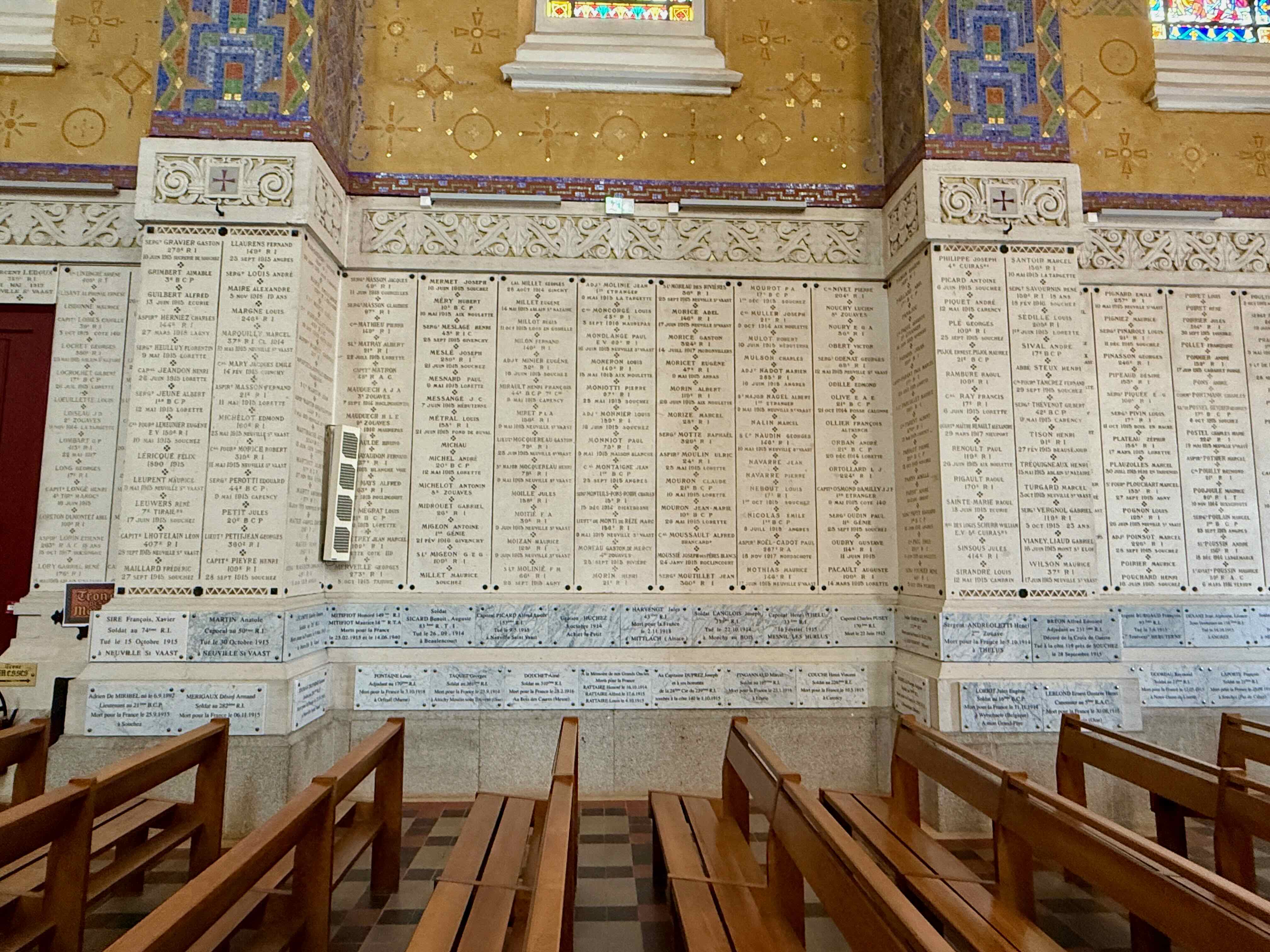
We pass through the entrance, this is what I see, and I start to cry.

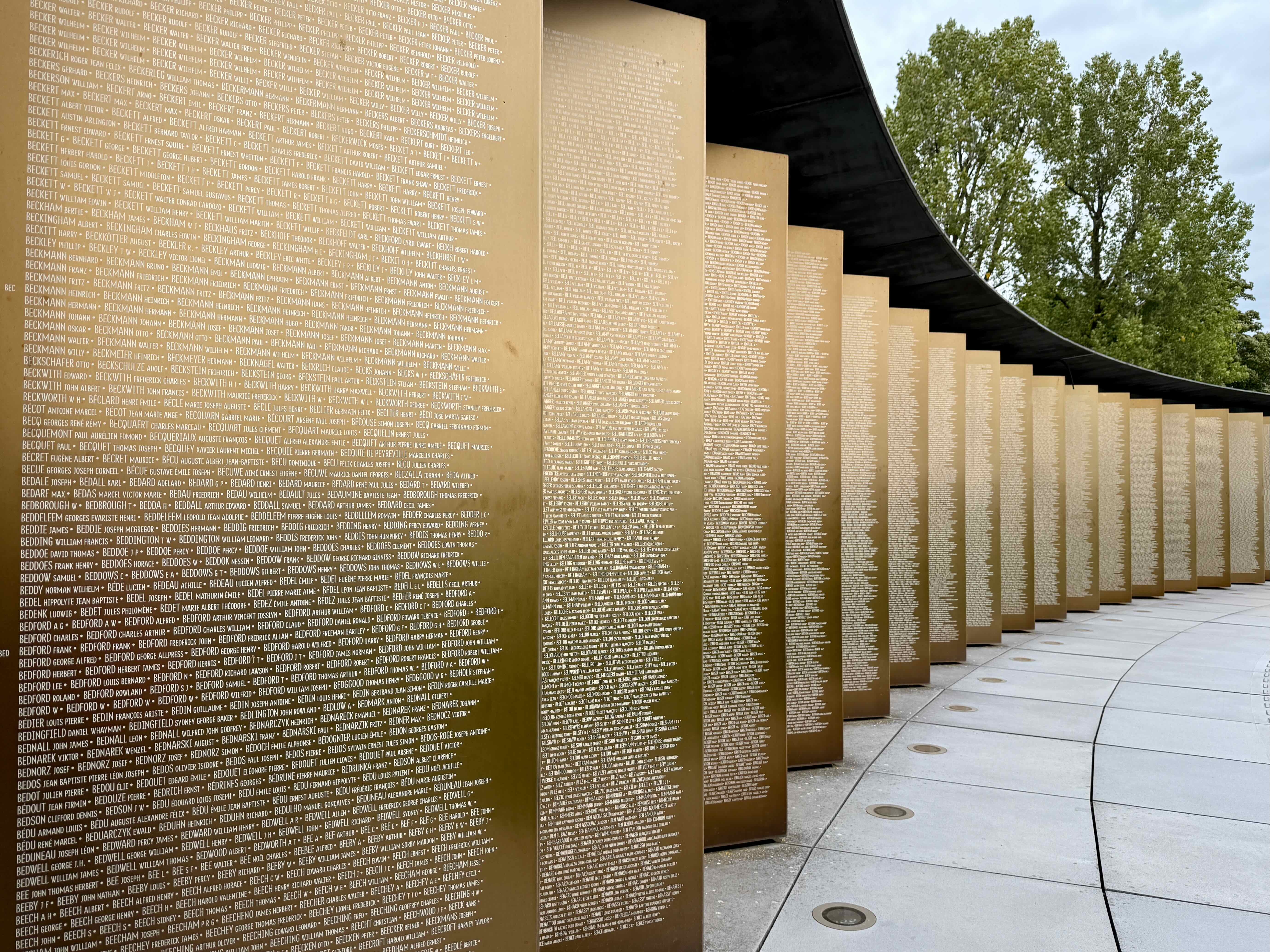
This memorial was inaugurated on November 11, 214. This World War I monument gives those who fell in battle  in this area a place of remembrance…a place where their names ( Allied and German) are preserved, commemorated and honoured.

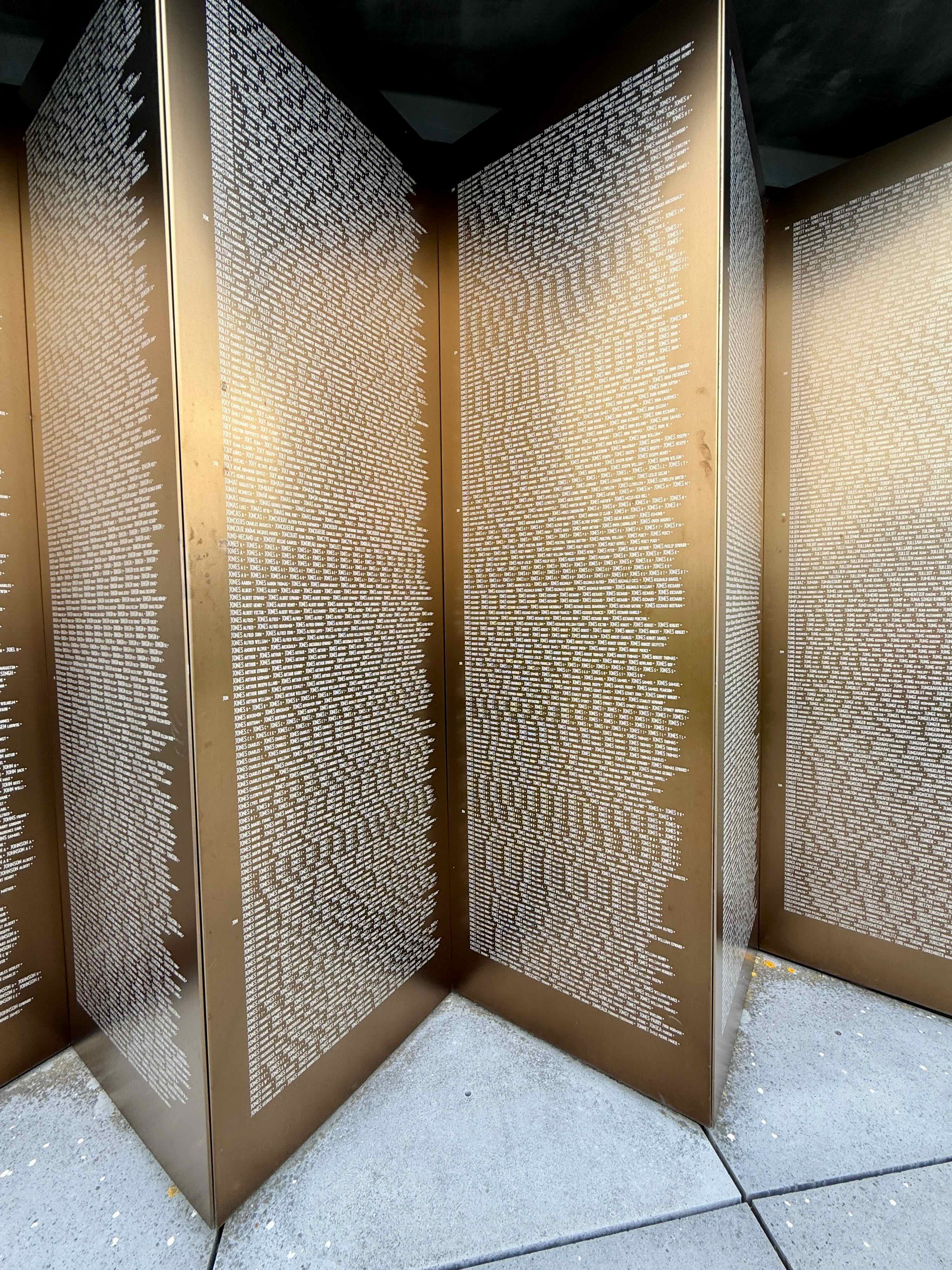
This is about 1/4 of the Ring of Remembrance…579,606 names.  It is overwhelming.  All these young men dead. Sons, brothers, husbands, fathers…a whole generation of men that were no more. It is an incredibly powerful memorial.

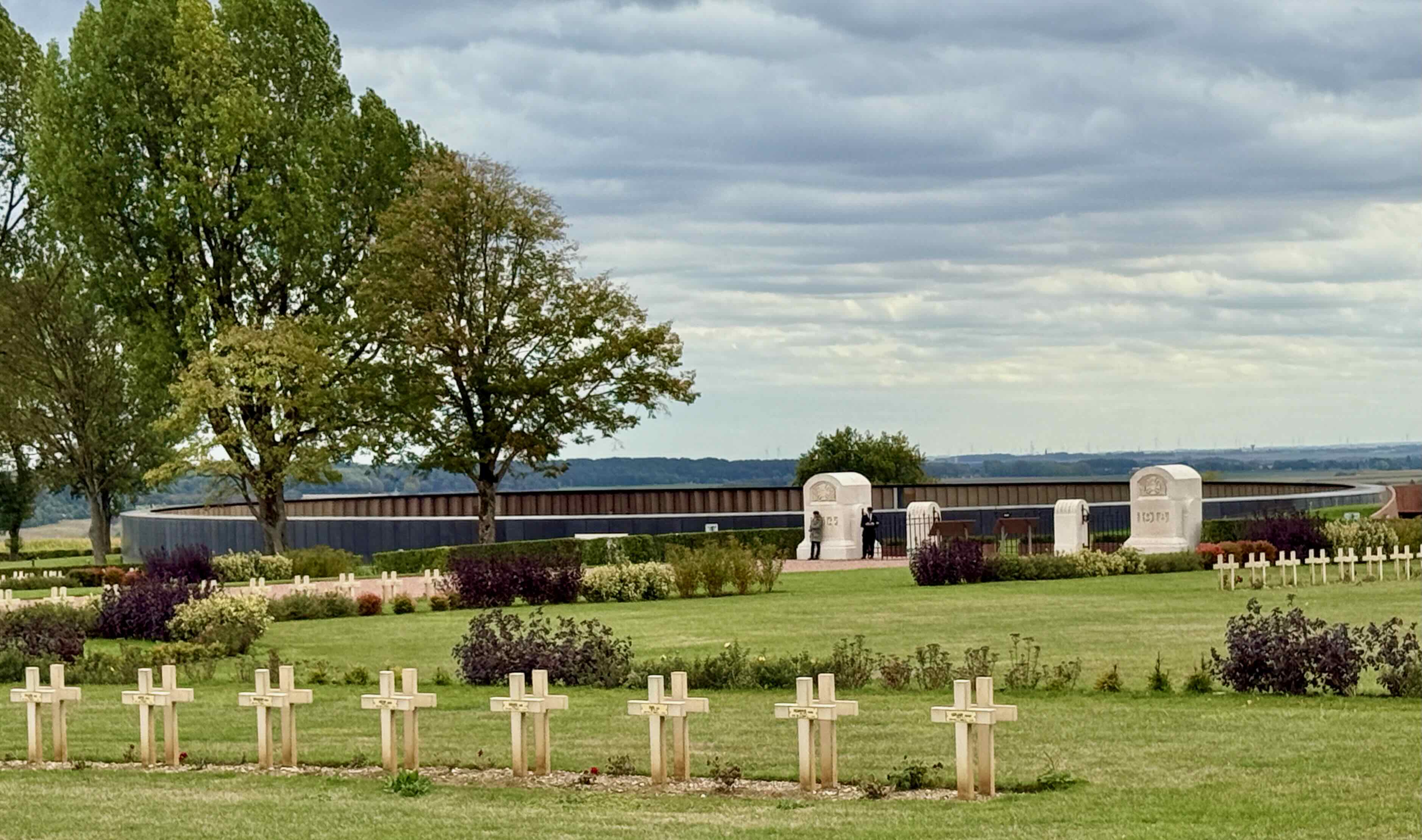
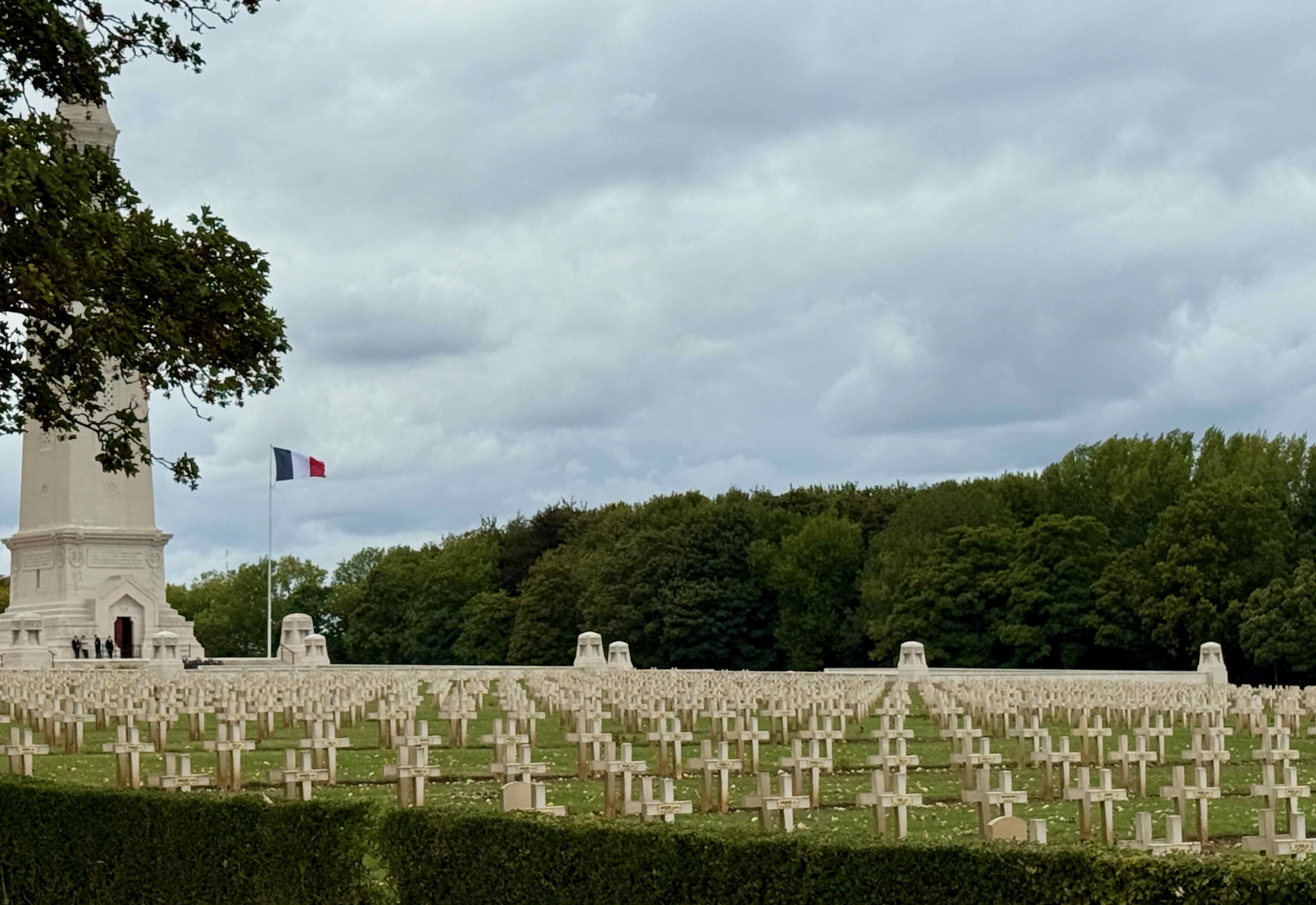
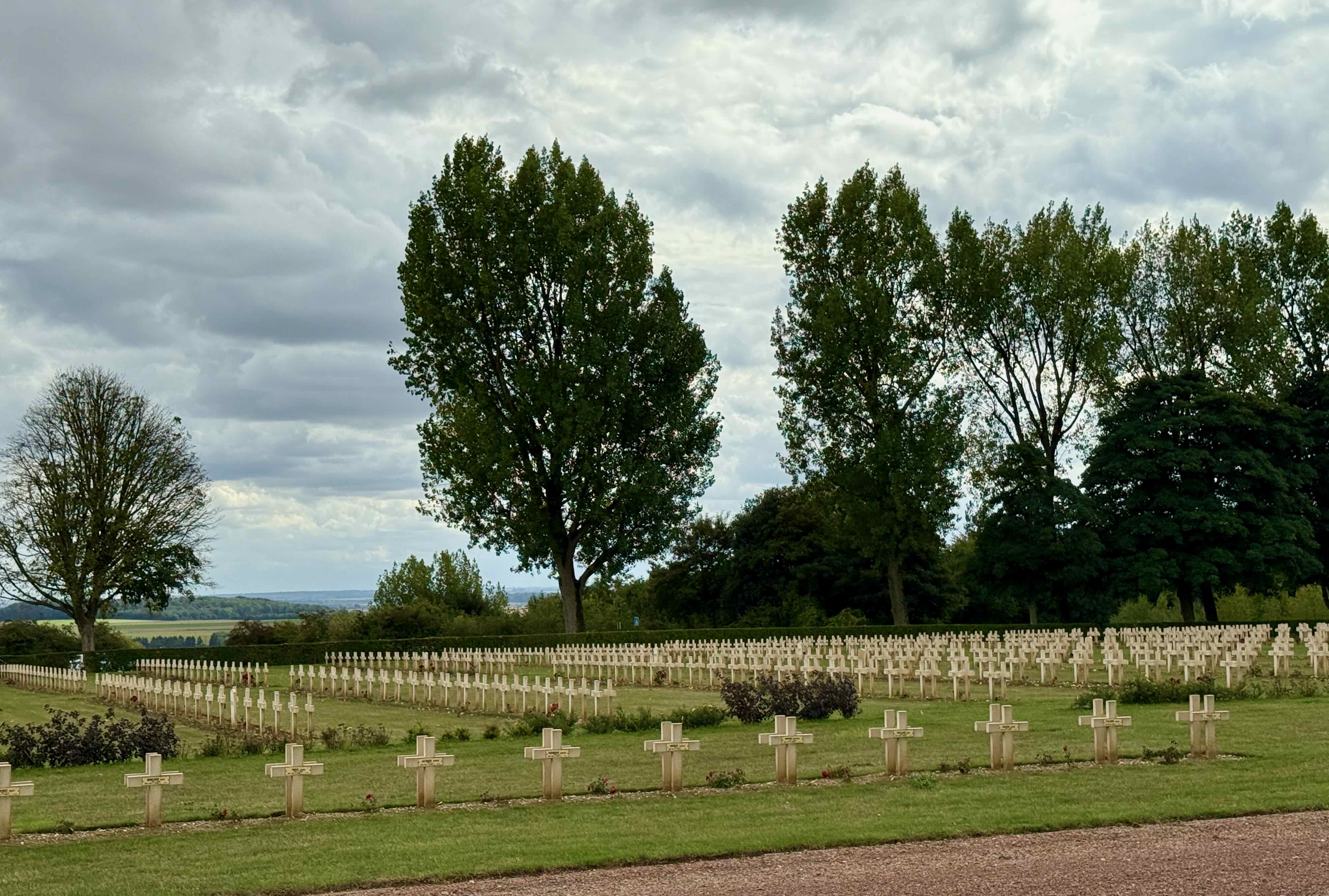
We walk over to the cemetery and there are thousands and thousands of crosses of fallen French soldiers, as far as the eye can see.

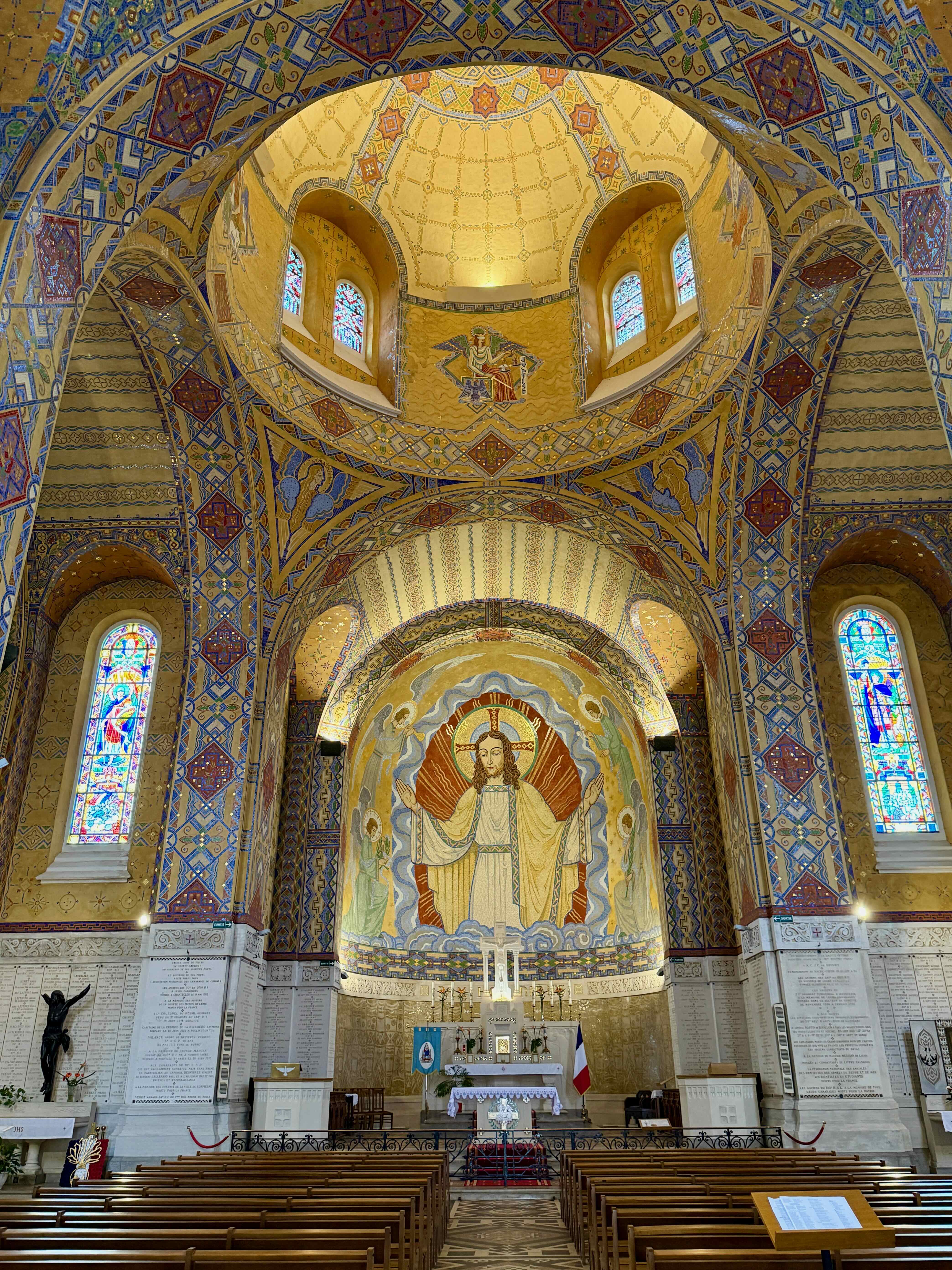
A photos is not able to show the size of this cemetery.  It is enormous and covers 25 hectares and holds over 40,000 bodies, half of which are in individual graves and the other half are in seven different ossuaries.  More than 150 battlefield cemeteries were moved to this location.There is a basilica onsite…

with more names of the dead inscribed on the walls.

I realize that I didn’t take a photo of the lantern Tower.  It is 52 meters tall and has a chapel in its base that contains the remains of over 6,000 unknown soldiers. At night there is a light that shines and rotates from the top of the tower.There is a small museum the Lantern Tower with personal items, photos and excerpts form diaries.  They are upsetting to see.  I can not imagine having to live through these experiences.  
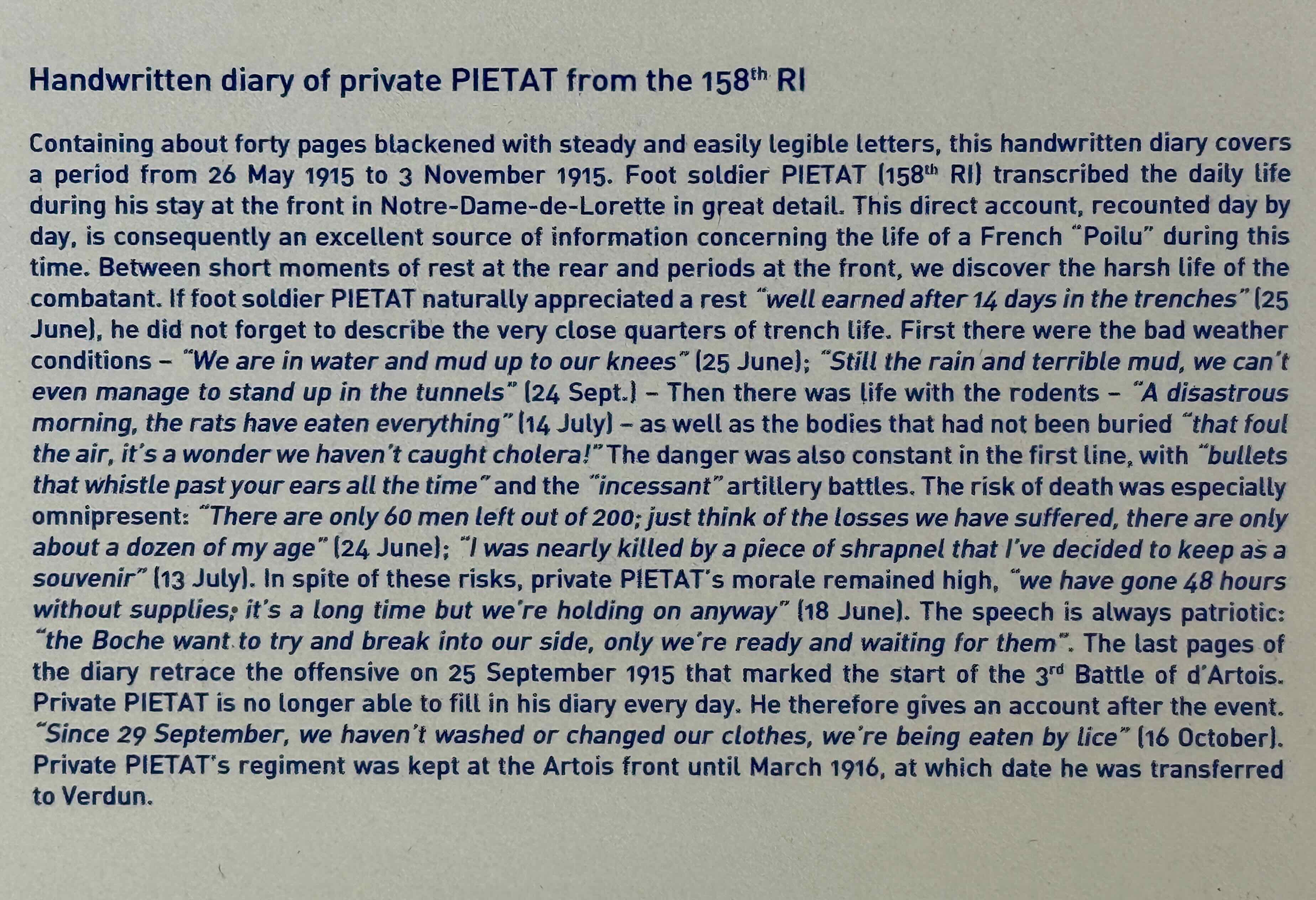
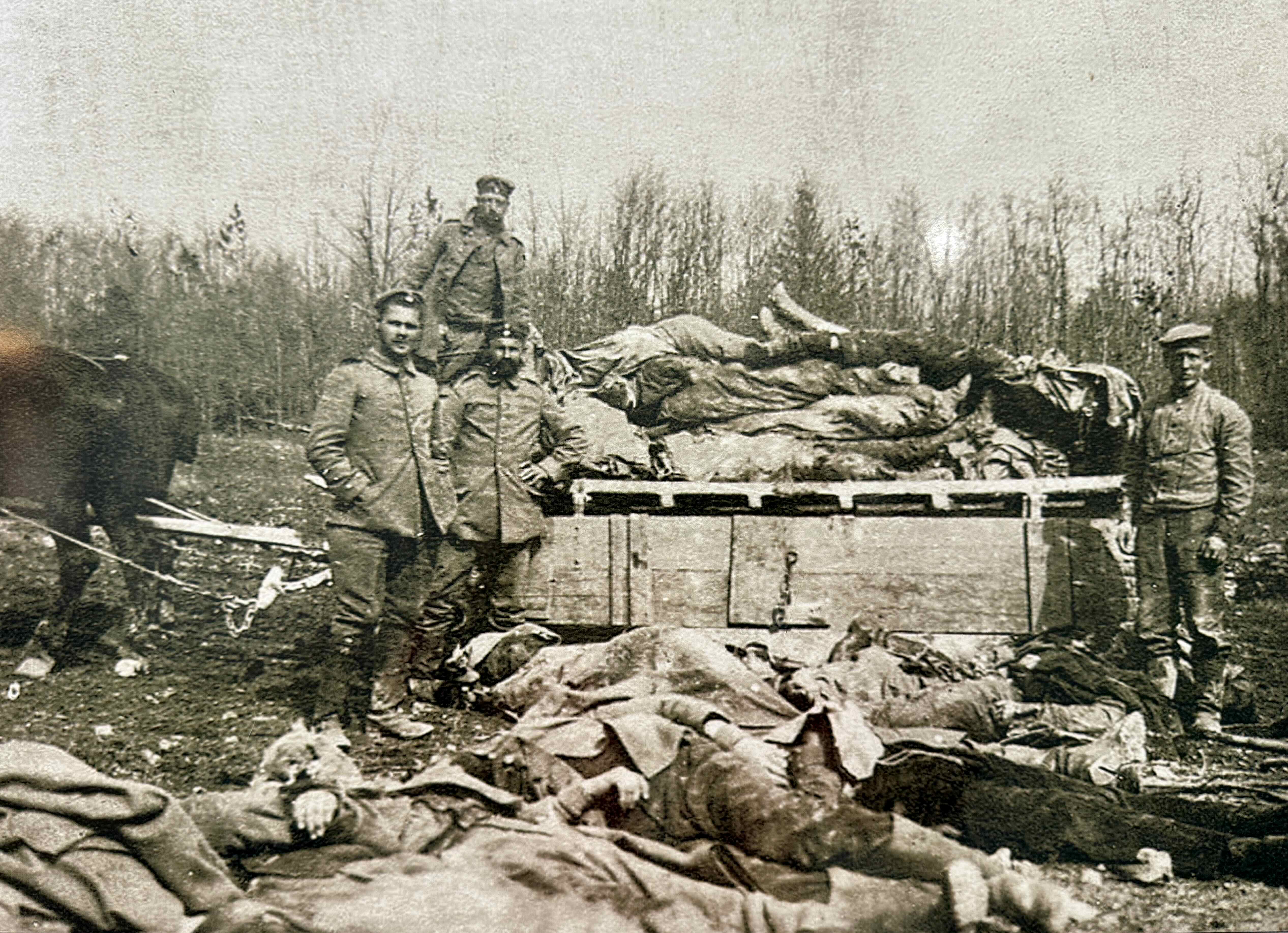
There were several photos showing the horror of war…gathering their dead comrades for burial.

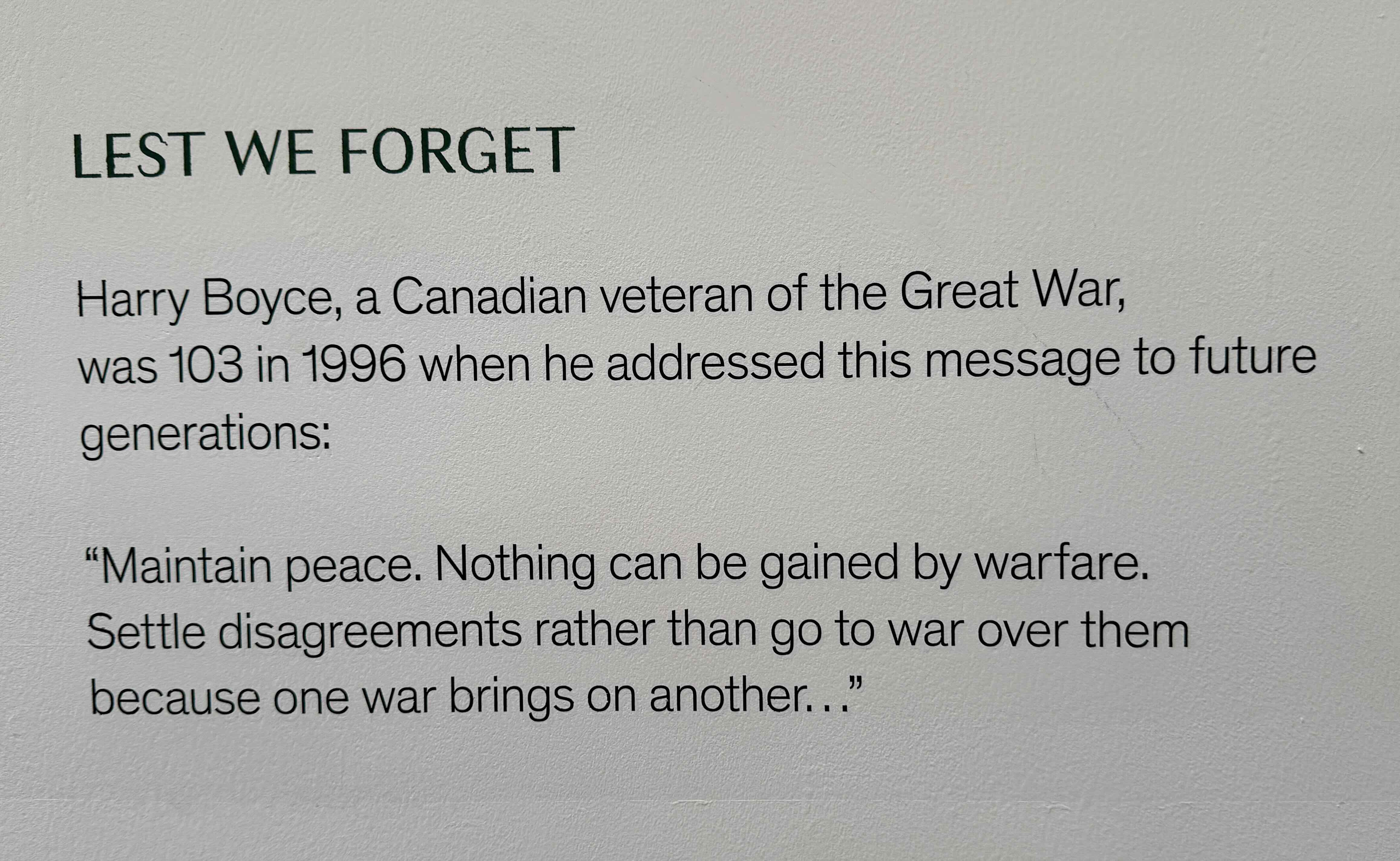
We drive from this cemetery to Vimy Ridge which was an important Canadian battle in the First World War, where we tour the underground tunnels and trenches.  This was on the wall of the memorial building, which is staffed by young Canadians.

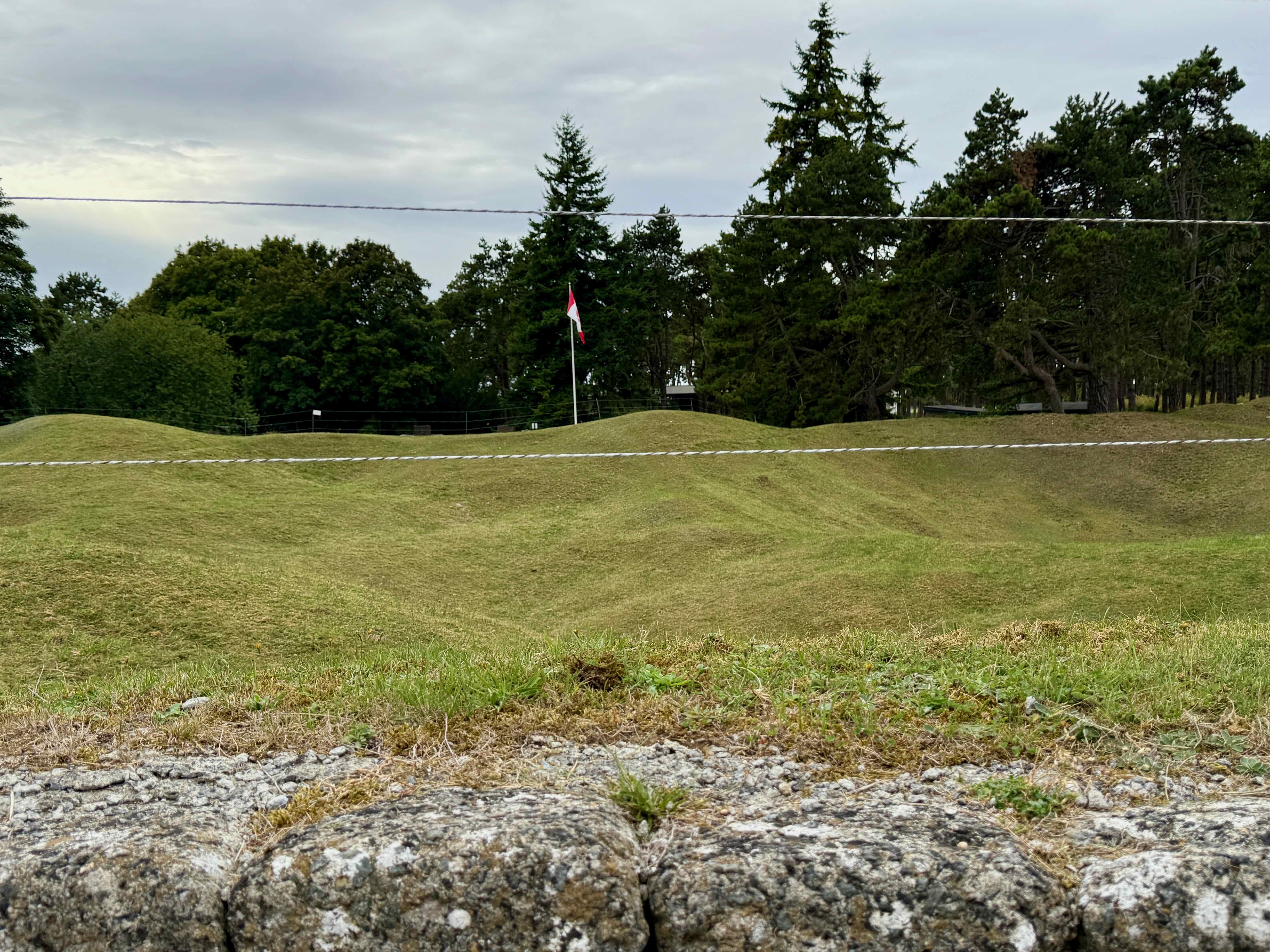
It is unfortunate that no one seems to have listened to his words.  By this time I am feeling quite overwhelmed and I only took two photos here. Tunnels were dug thirty feet deep under Vimy Ridge so that soldiers could place explosive devices under enemy lines.  This is a replica of one of those tunnels being dug.In some places the front lines of The Canadians and the Germans were only 20 meters apart.  This is the view from one of the German trenches towards the Canadian trenches beside the Canadian flag.  The soldiers were able to hear each other talking, they were so close together.

“”The battle began at 5:30 am on April 9, with the first wave of around 15,000 men advancing under the creeping barrage of almost 1000 heavy guns. Most objectives were taken on schedule, and by afternoon most of the ridge was captured, with the notable exception of The Pimple, a high point at the North end of the ridge, where defenders held out until April 12.

By April 12, the Canadians had taken all of their objectives, as well as 4,000 prisoners. The Canadians held Vimy Ridge. This victory came at a high cost as 3,598 Canadians lost their lives, and 7,000 were wounded during the four-day battle. April 9, 1917 is still the bloodiest day in Canadian military history.”  ~ The VImy Foundation

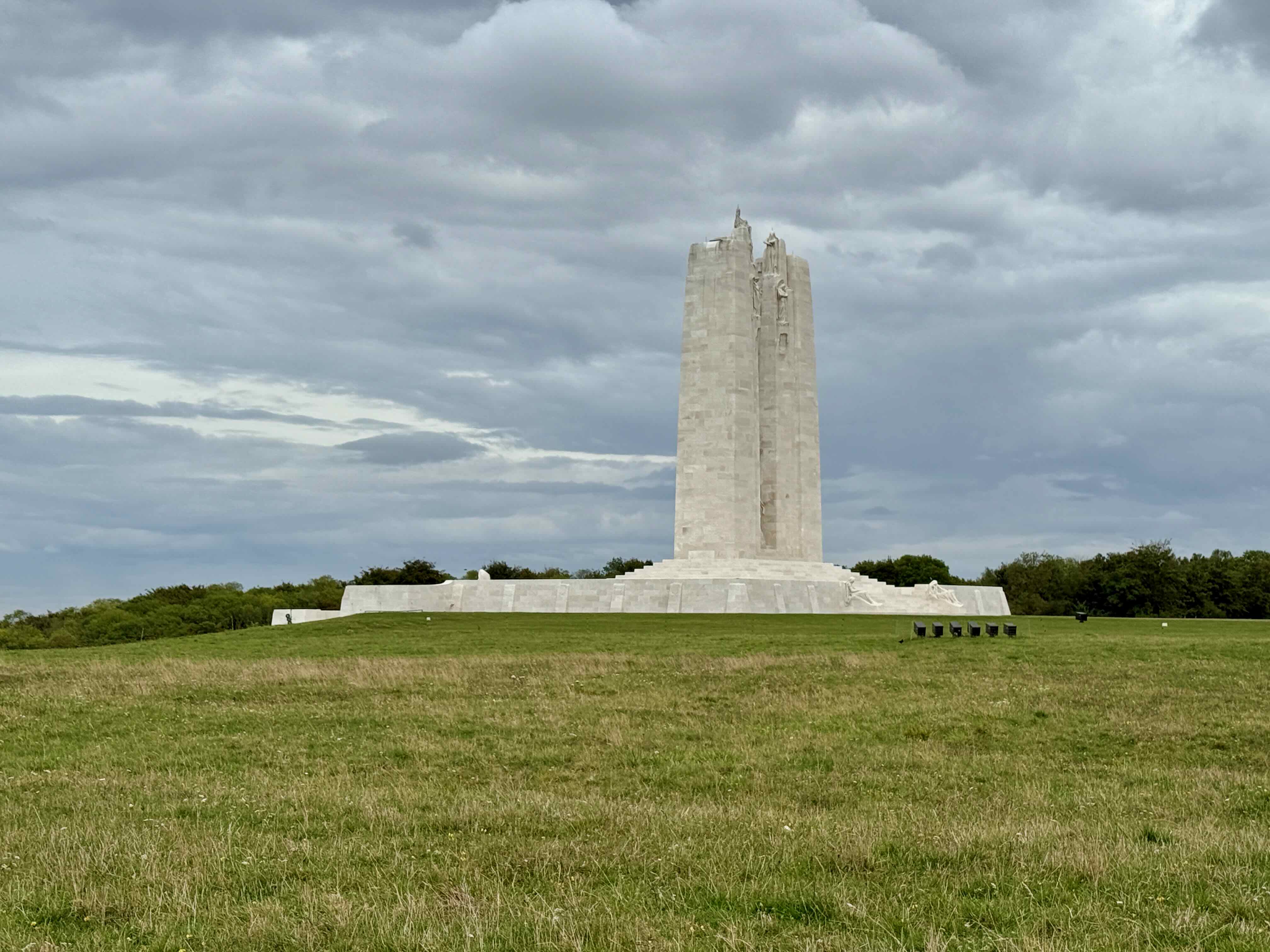
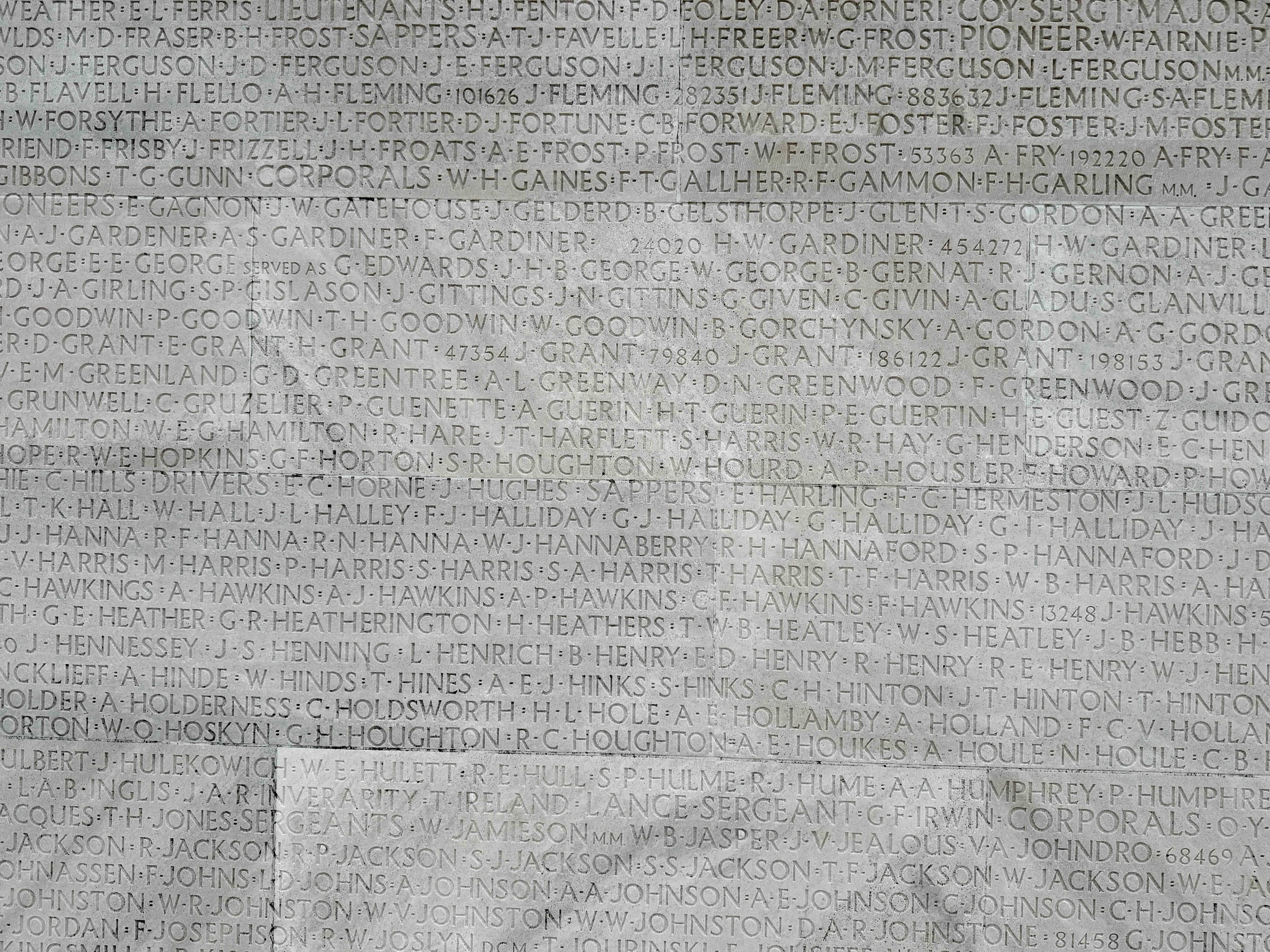
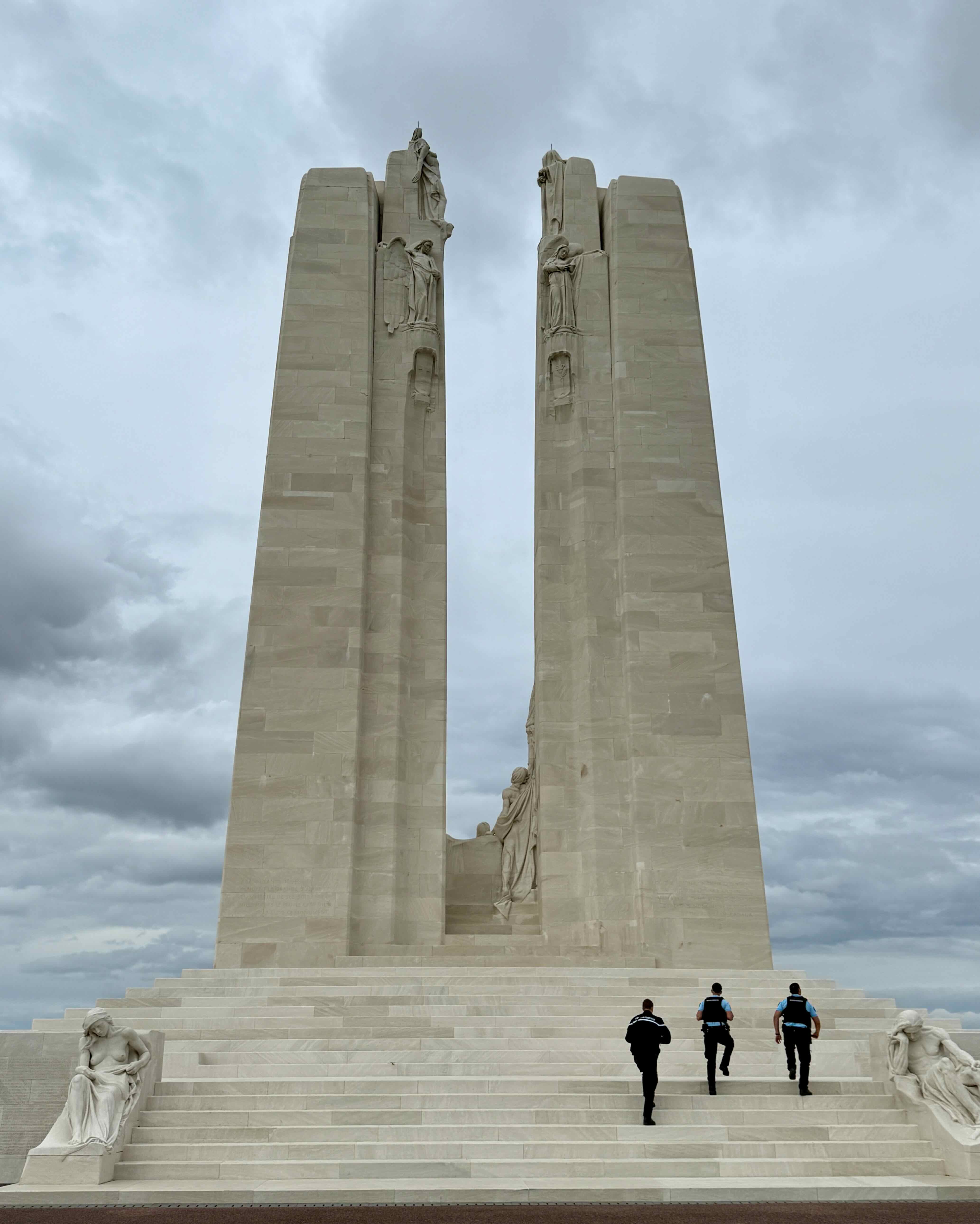
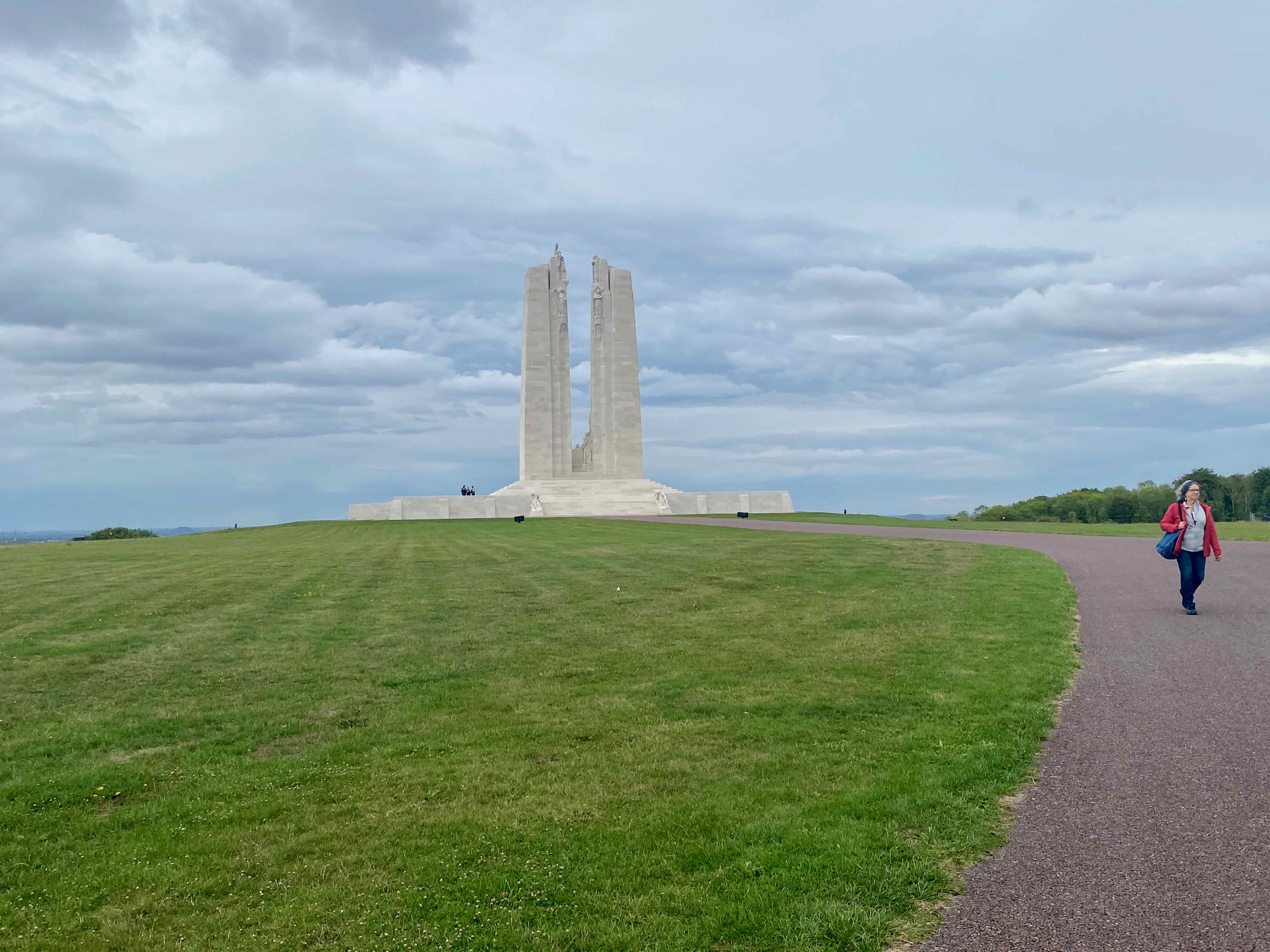
We drive a short distance to the Vimy Memorial. It overlooks the Douai Plain from the highest point of Vimy Ridge and was designed by the Canadian sculptor Wallace S. Allward.We didn’t see the front walk so took the long way around to the back of the memorial.Climbing the  steps we see more names of the dead.  So many names!  The name engraved here are of the 11, 285 missing Canadians who died in France during the Great War.
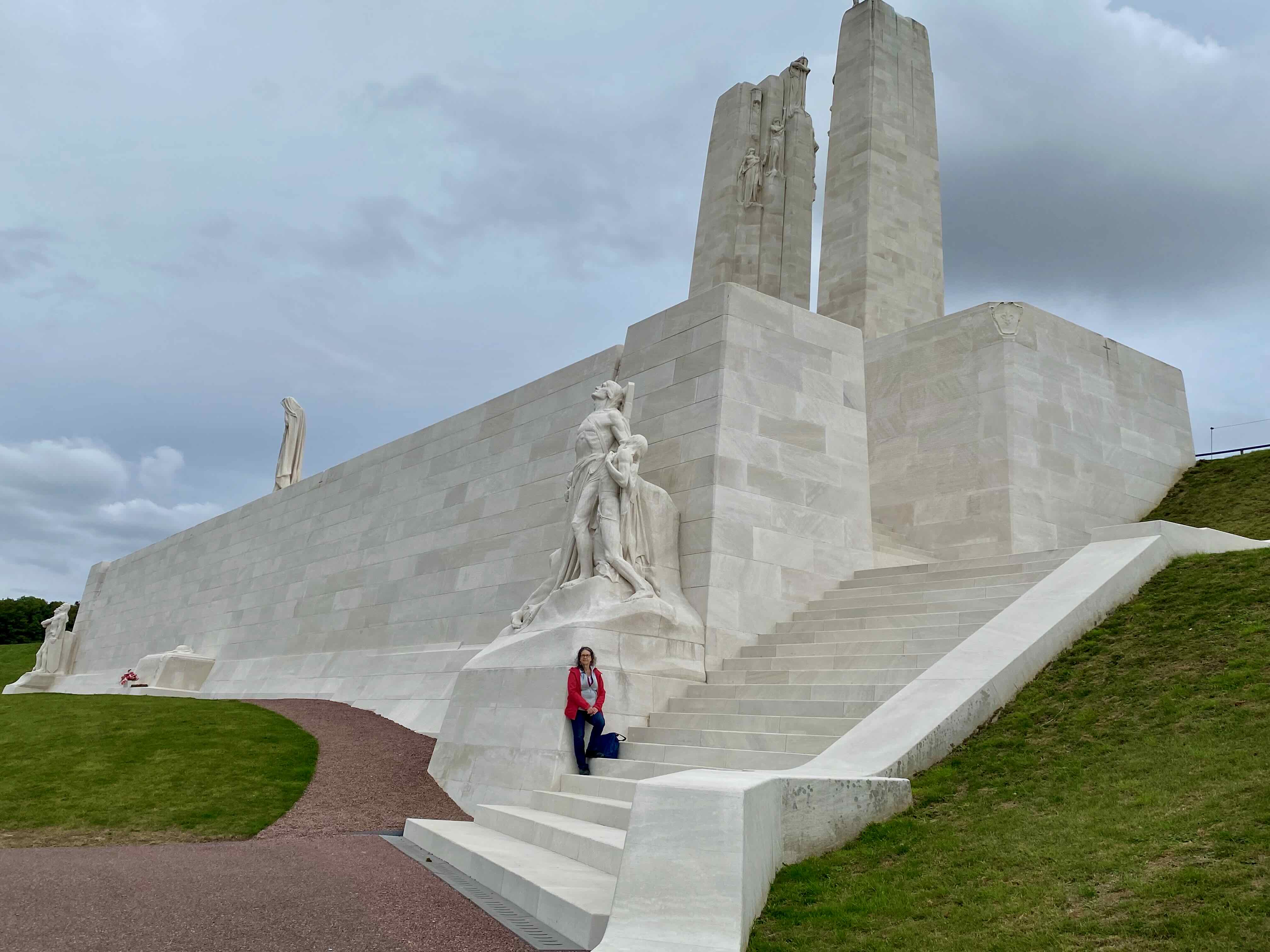
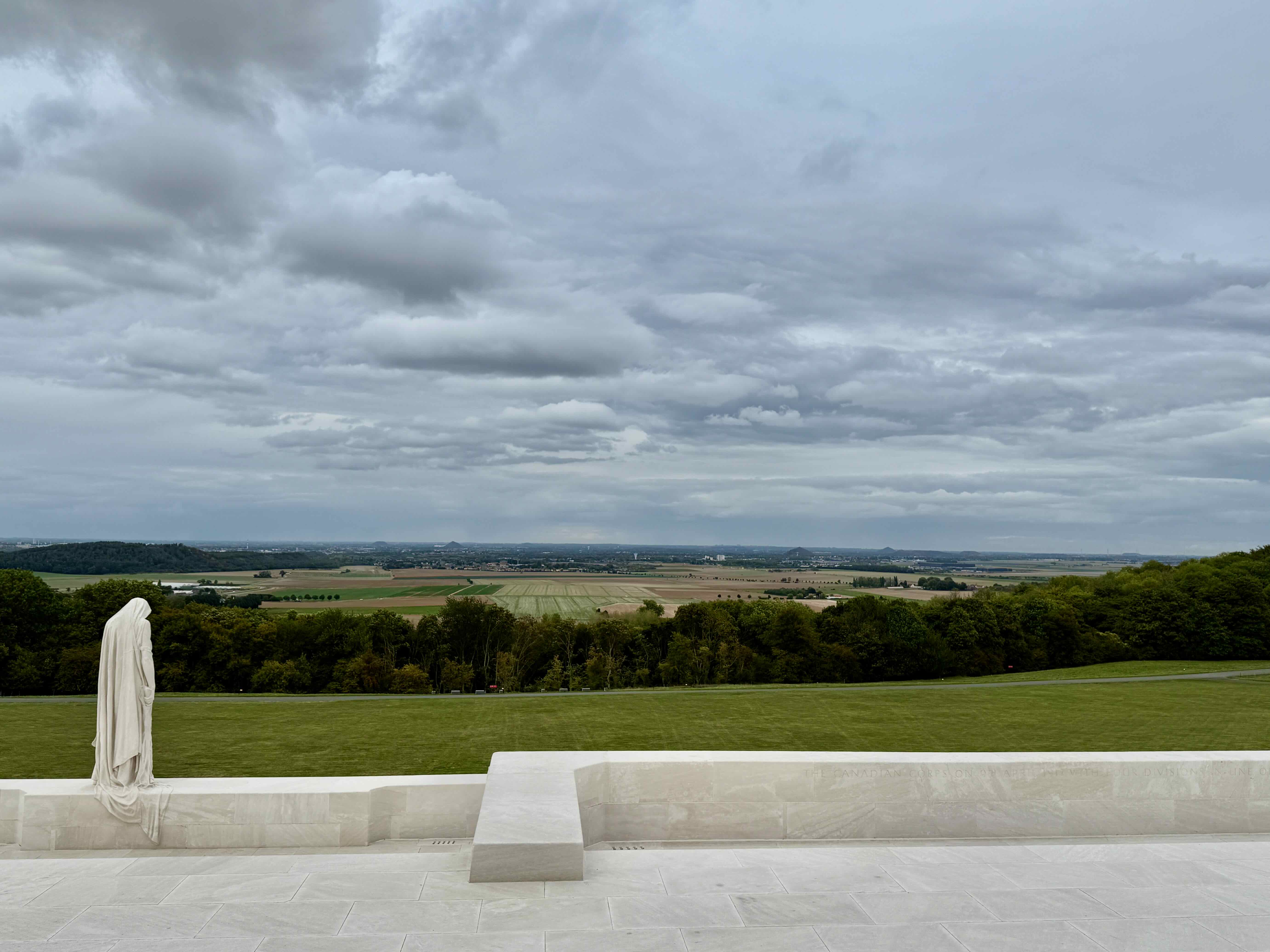
The monument looks over the surrounding valley.  Even the back of the sculpted figure on the ledge looks sorrowful.

As we leave the monument three police pass us on their rounds. The three policemen are barely visible on the left side of the monument as we head back to our car and head home.  it has been a heavy duty day.
Metier Museum, Picasso Museum, and Life Drawing

Day 8.    Sunday, September 7, 2025

We picked up our car this morning, a Ford Hybrid with a nice big trunk.  Driving back from Gare de Lyon to our bnb went well, and our host let us park in his yard for the night which we really appreciated.  There are next to no parking spots on the streets in this neighbourhood.

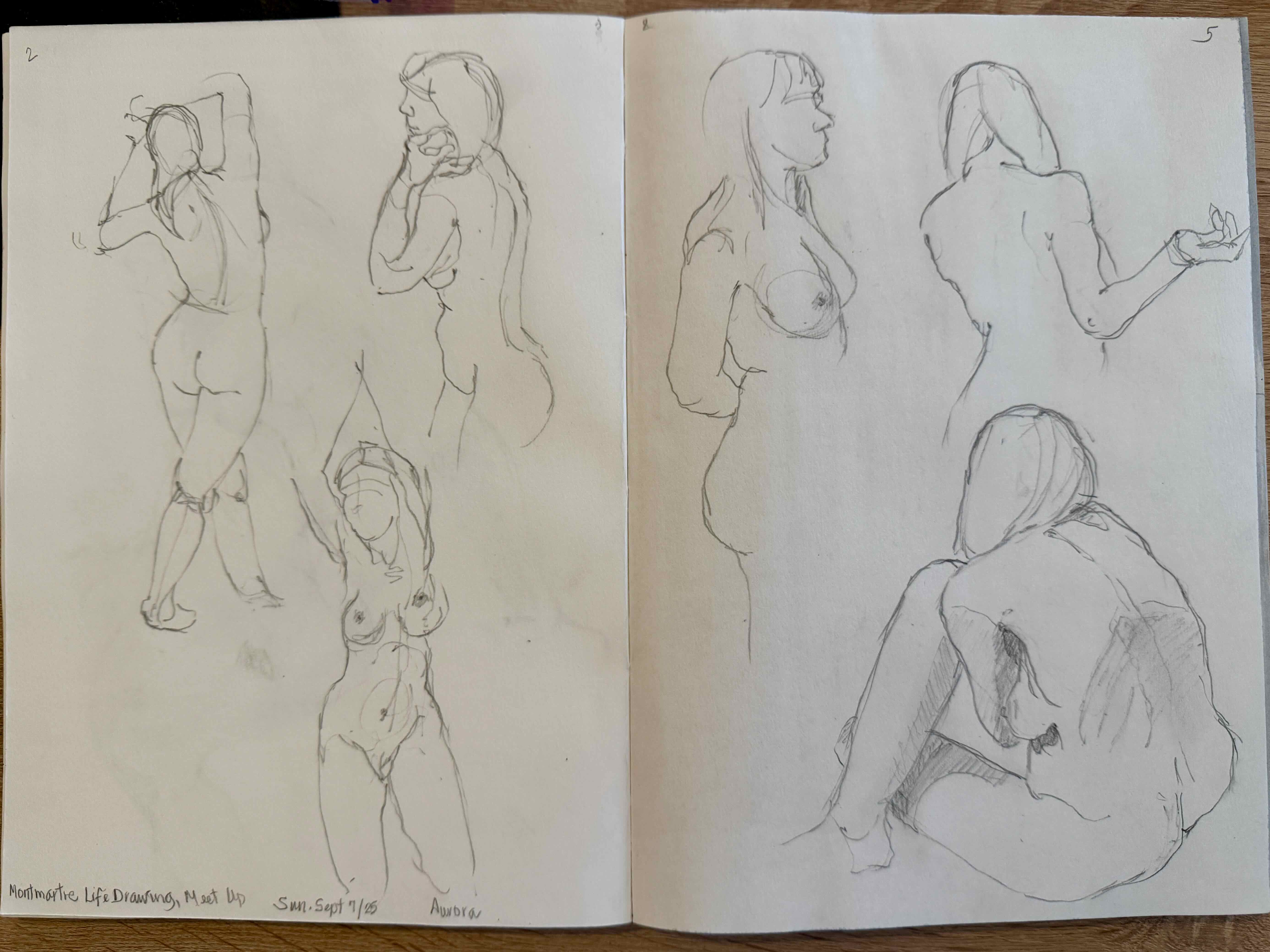
I left for drawing in Montmartre, which was an hour away.  I arrived just in time for the session, and the organizer, Deni, remembered me from the last time I was here, two years ago!

Aurora, five 2 minute poses, 1 5min pose

Two 5 minute poses, three 10 minute poses

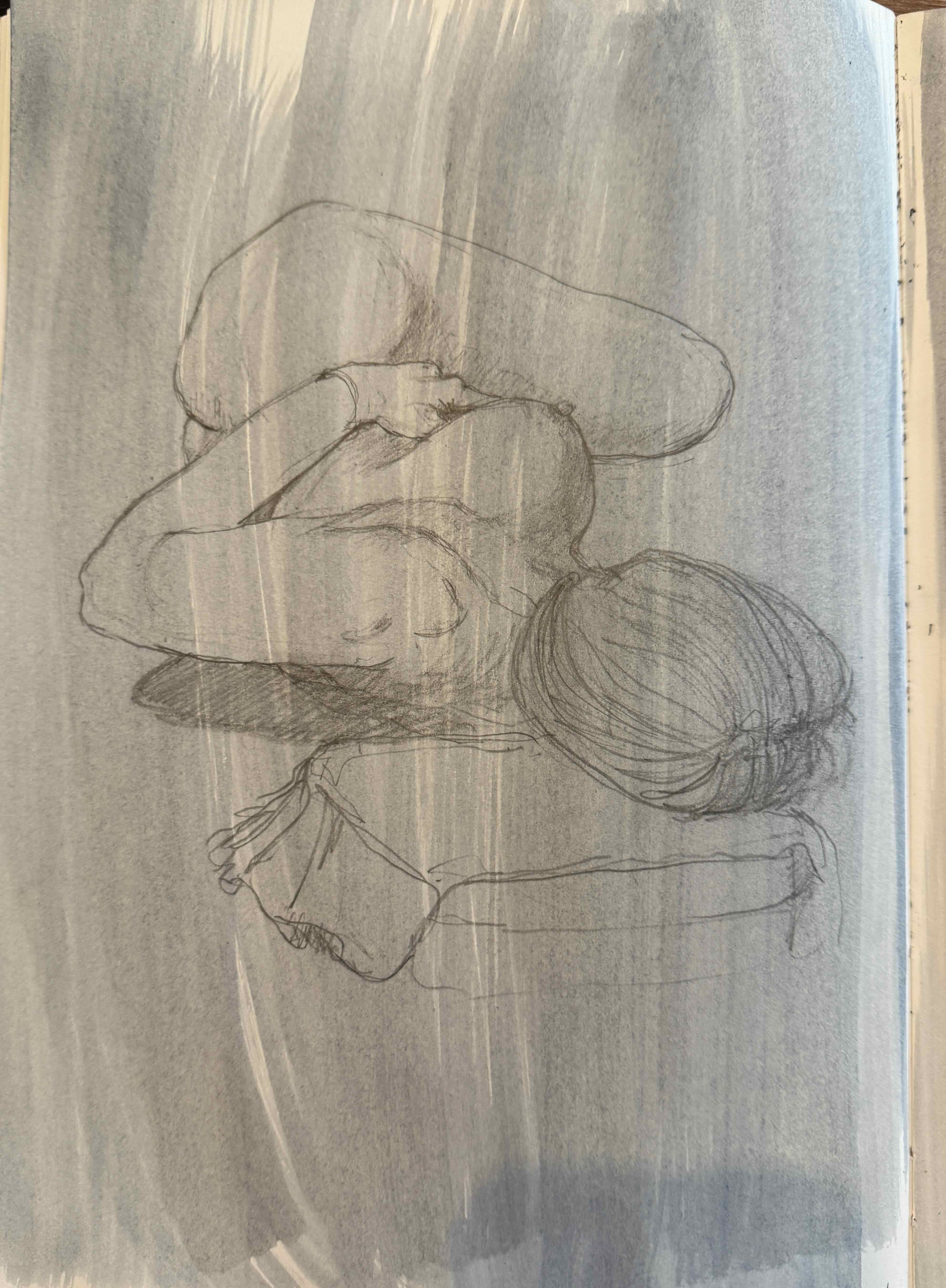
One very challenging foreshortened 25 minute pose.

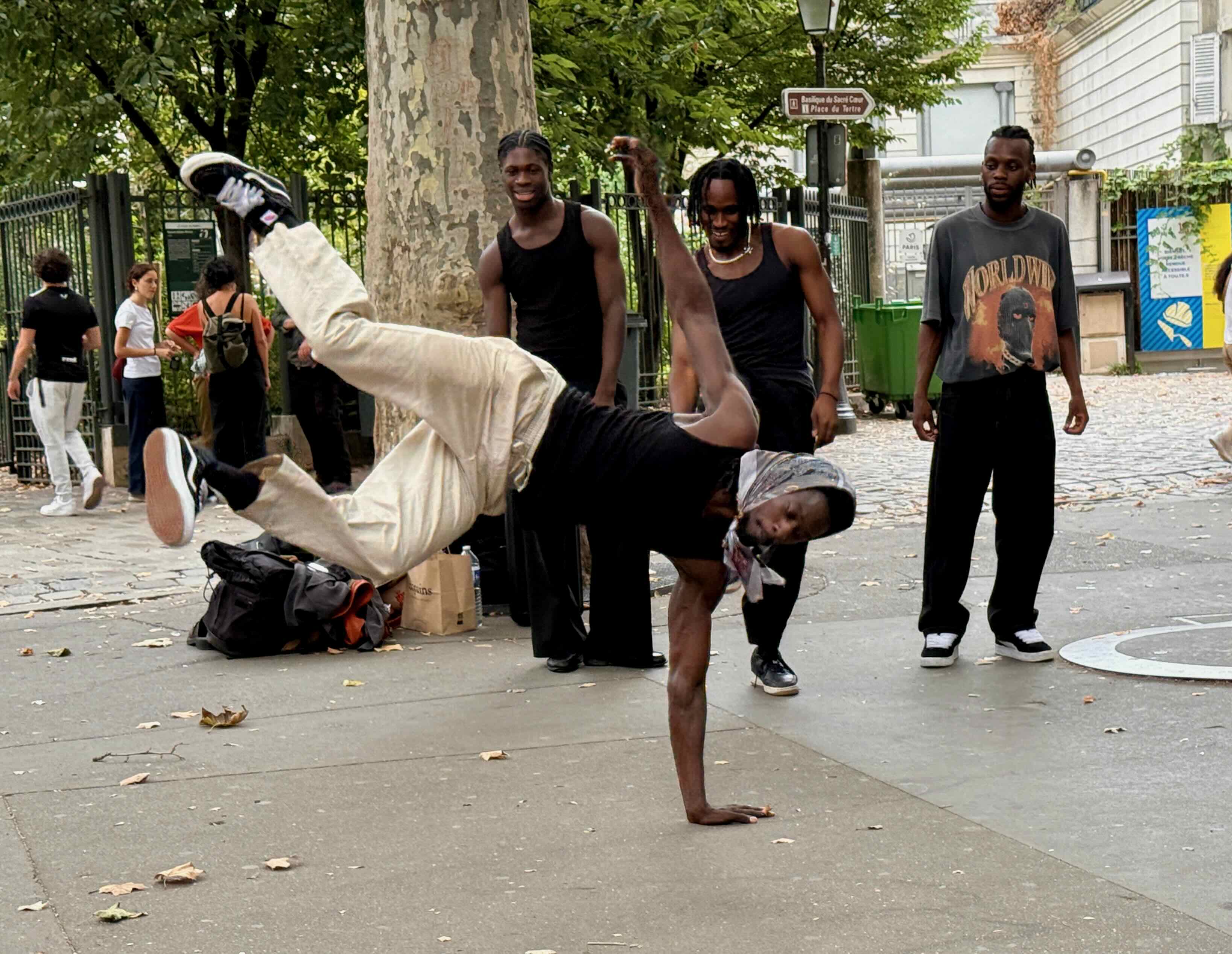
Before catching the metro home I stop to watch four very muscular handsome young men performing for donations, while I eat a yummy crepe sucré avec banane for my dinner.

There were a lot of steps on this metro trip so I decided to count them on the way home. Including these 104 spiral steps I went up and down 456 steps!!  So, going and coming from drawing I climbed up and down a total of 912 steps. No wonder French people are so healthy!  I was rather proud of myself climbing these spiral steps and passing a group of people much younger than I am huffing and puffing as they rested on one of the landings! 

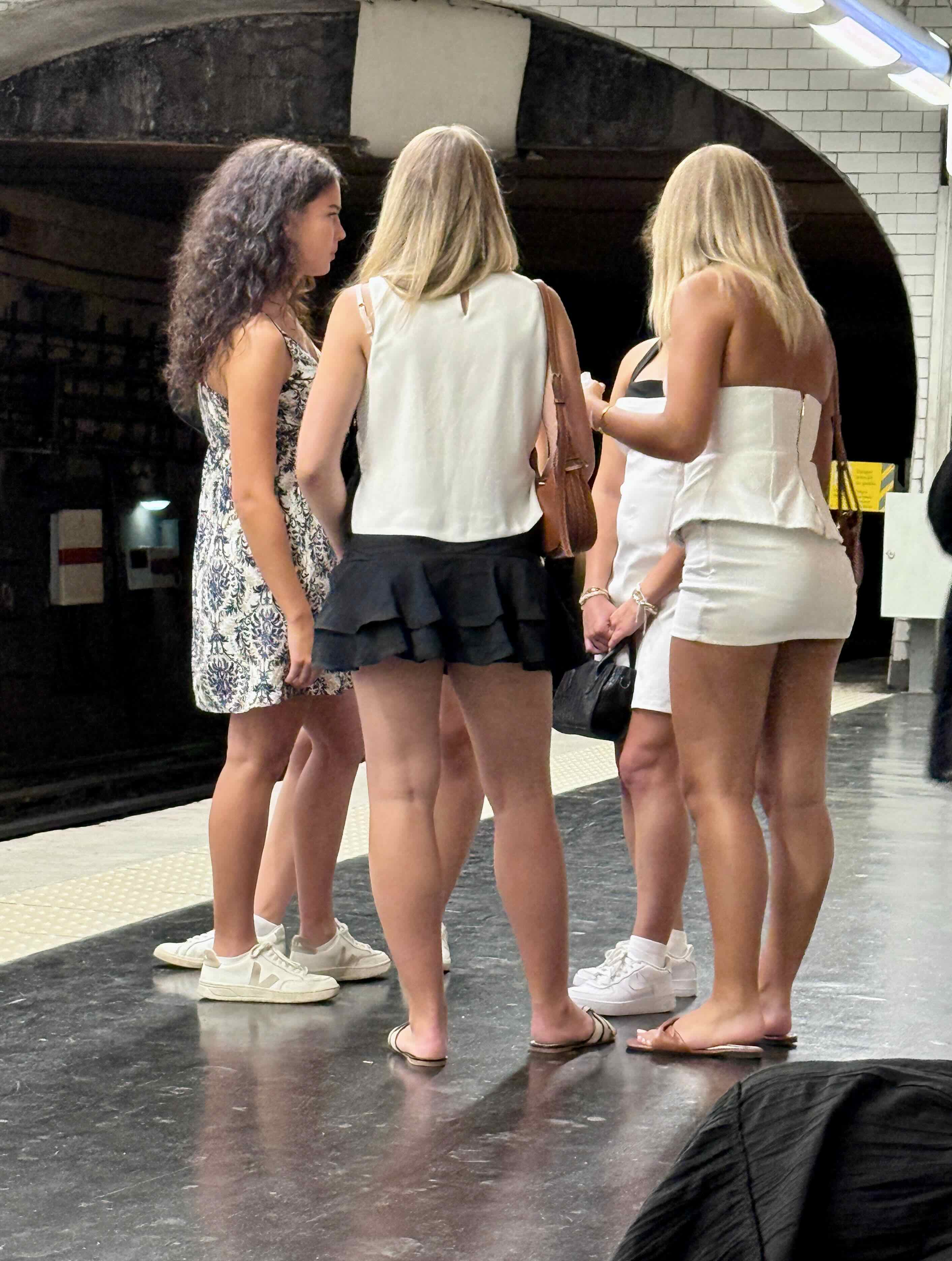
Short skirts are in fashion…very very short skirts!

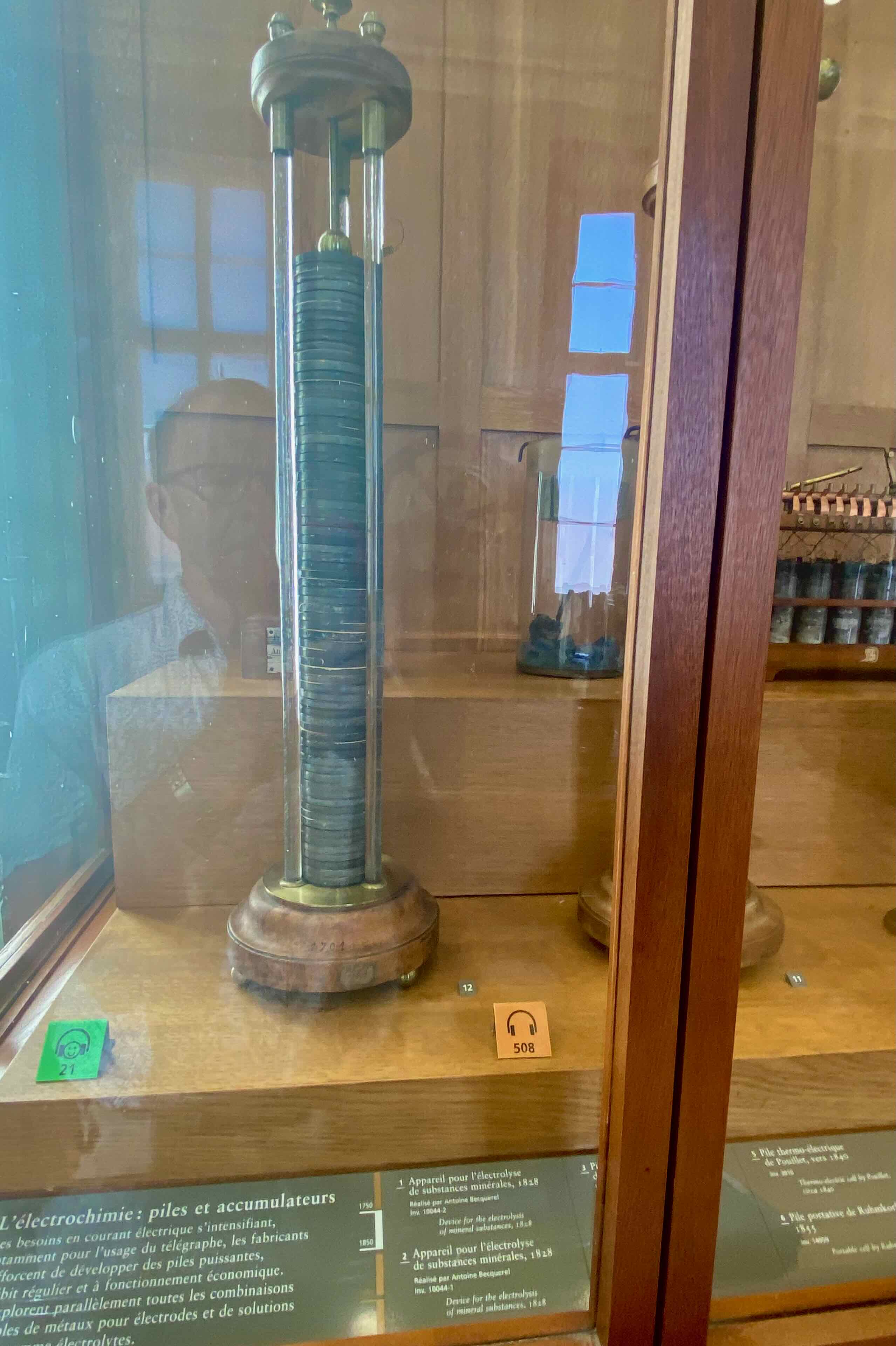
While I was at drawing Bob visited two museums.  The Musée des Arts et Métiers is a museum of technological innovation that exhibits over 2,400 inventions.  This is the first battery that was invented in 1799 by Volta.

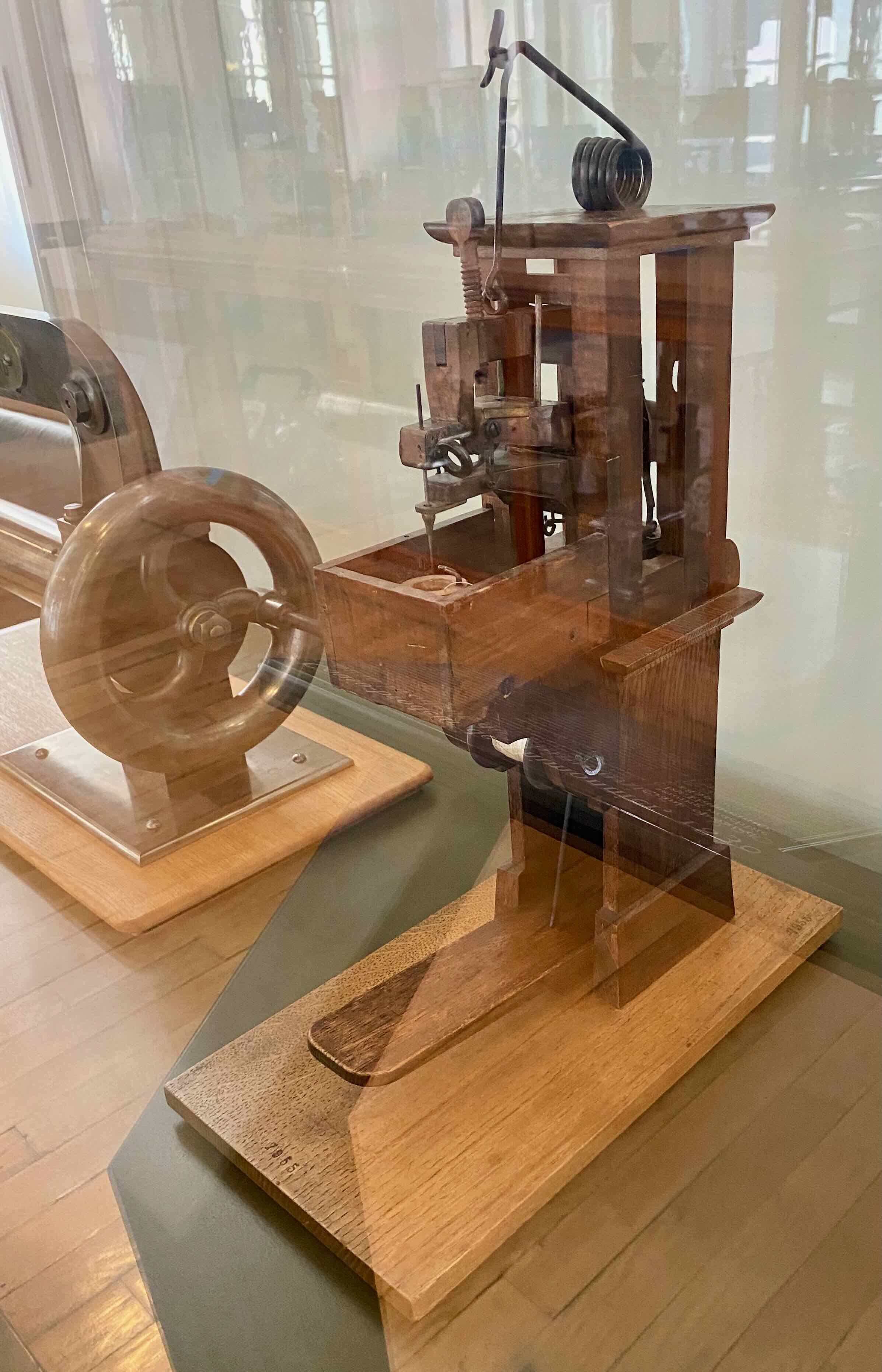
This first sewing machine was invented in 1830. Dozens of these machines were destroyed by 200 tailors in 1831 who feared for their jobs.

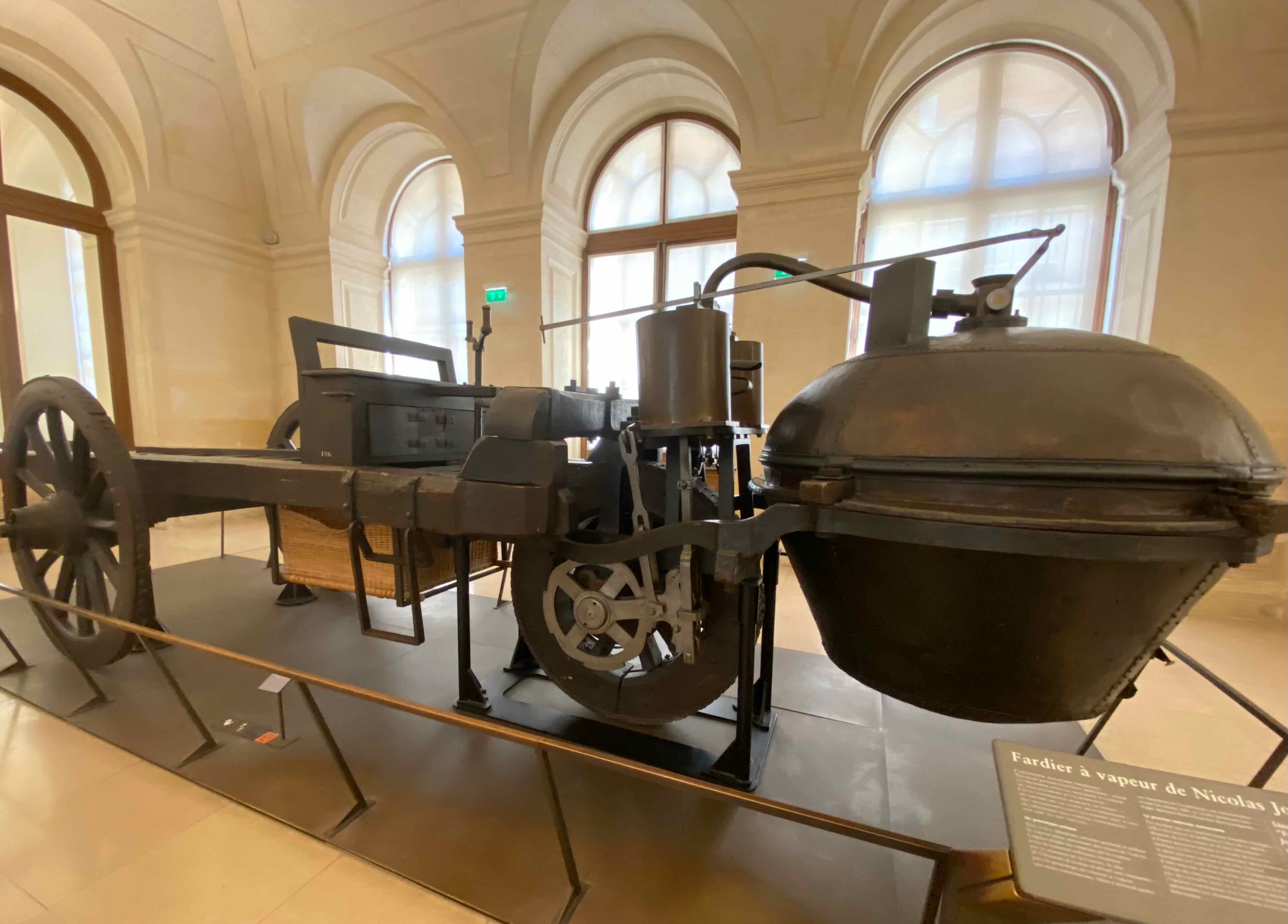
The first steam driven vehicle was invented in 1770.

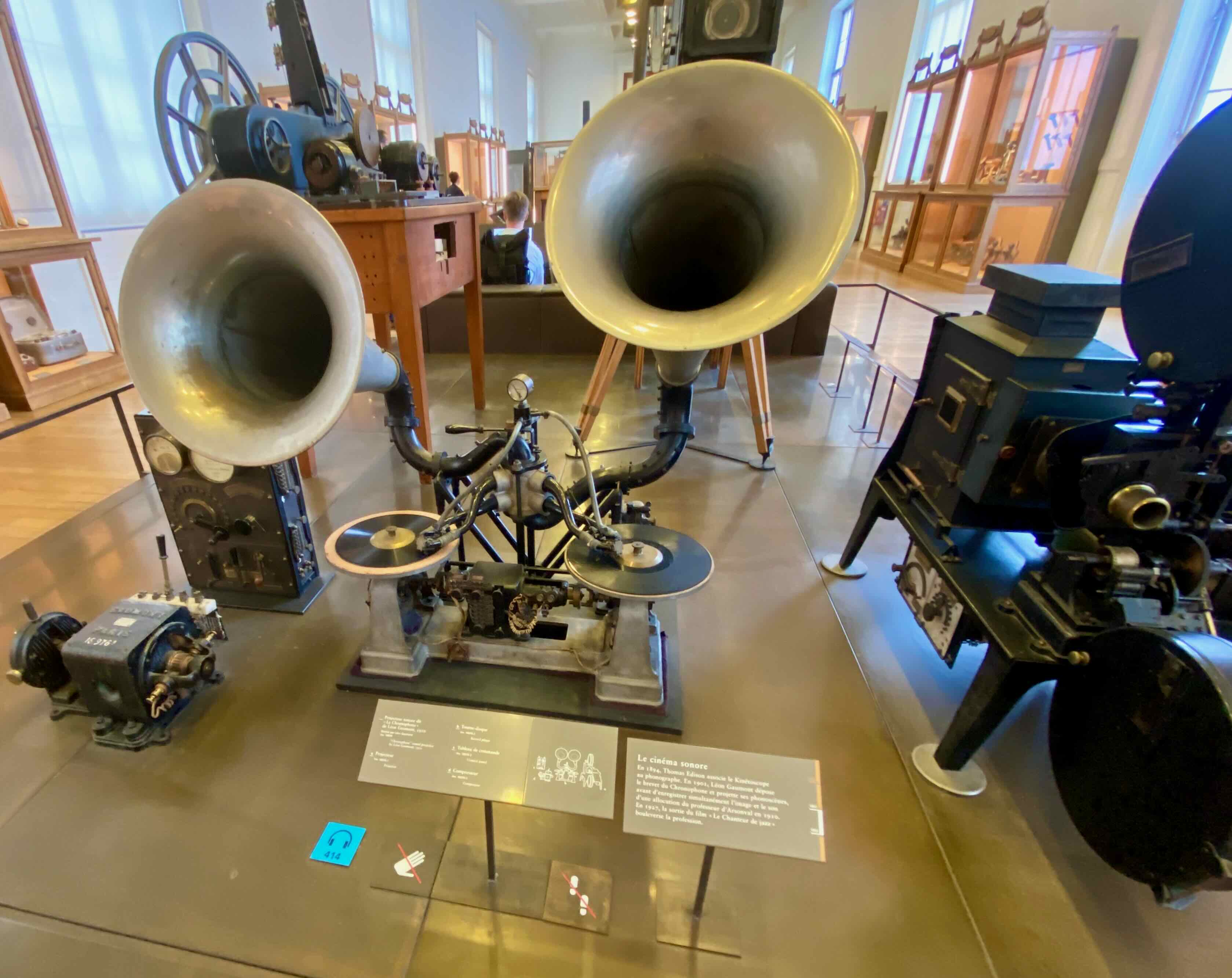
Leon Gaumont’s Sonophone combines image and sound for the first time in the history of cinema in 1900.

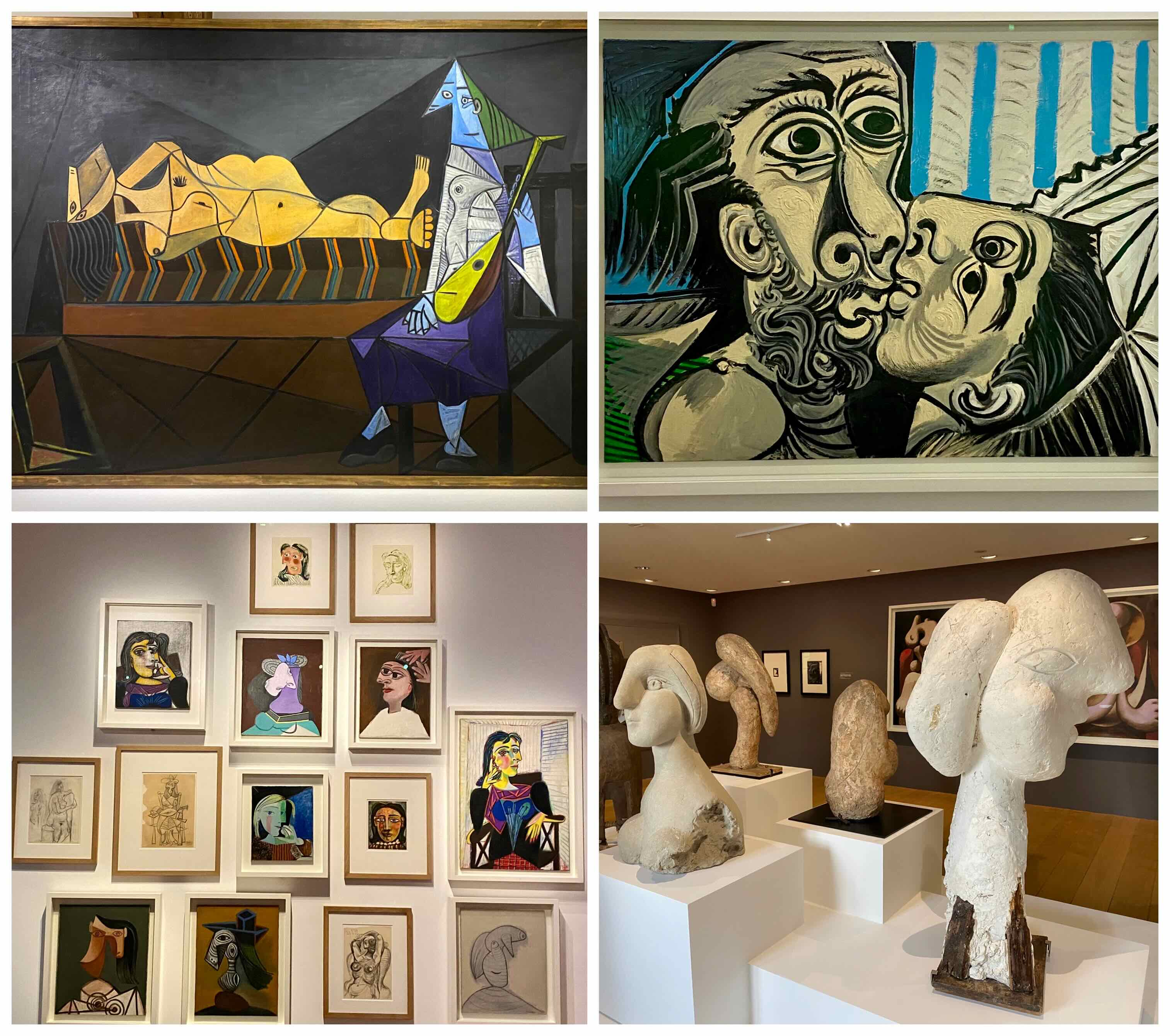
Bob spent a lot of time at the Picasso Museum…he texted me that he wasn’t sure what the exit door looks like!  The very large L’Aubade (1942) painting of two figures symbolized the violence of the war years.  Baiser, or the Kiss was painted in 1969. There was an interesting wall of portraits and a room with many of his sculptures. These are only a few of the 5,000 pieces of art at this museum.

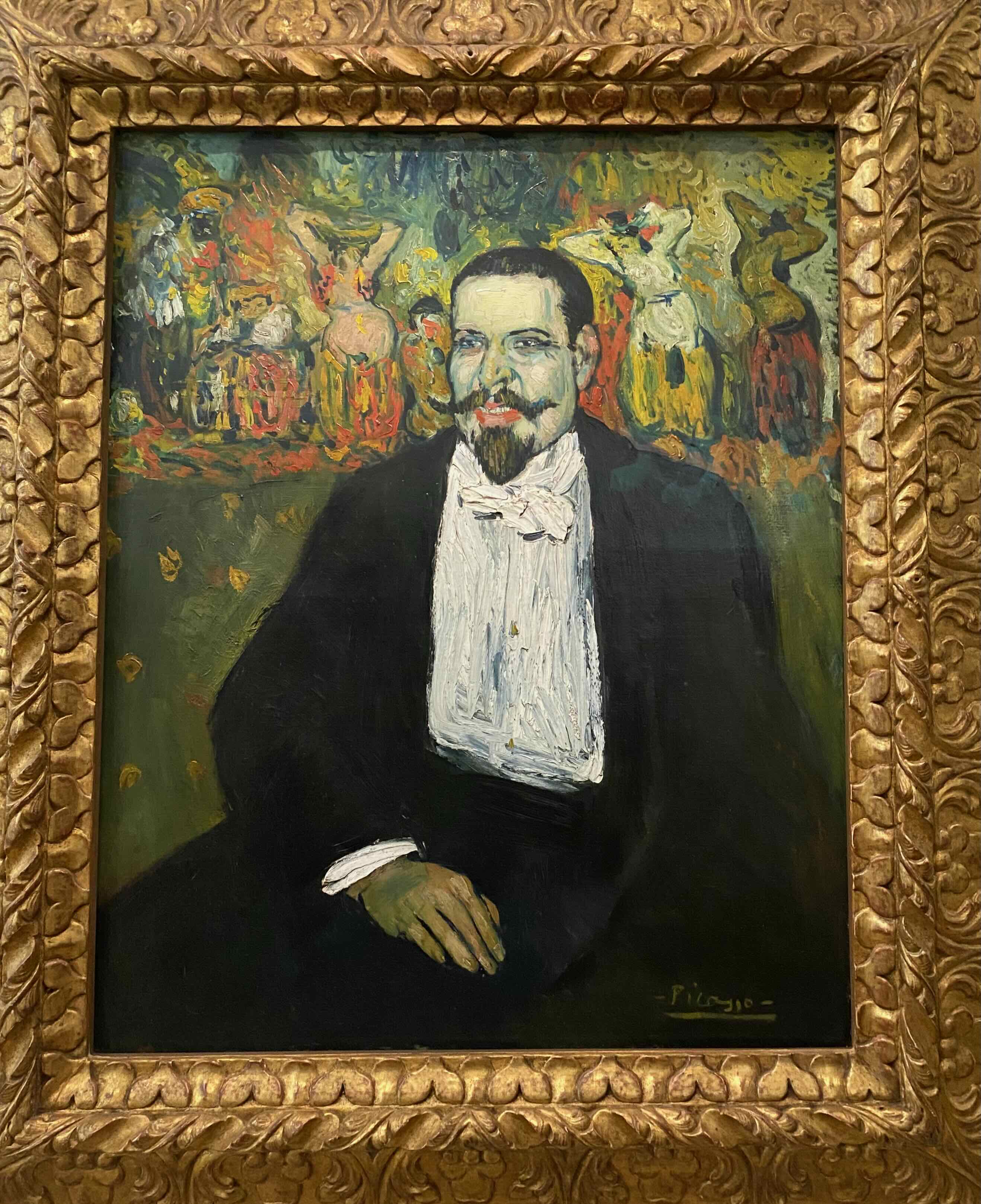
This early Picasso portrait of Gustave Coquot is from 1901.  Picasso’s started painting when he was eight years old and didn’t start cubism until his thirties.

Bob took a photo of this Modigliani just for me, because he knows that I love Modigliani’s paintings. It was in the Picasso museum because both artists were influenced by African art and Picasso admired Modigliani’s work. We drive to Arras tomorrow so tonight we pack and tidy up.  It was great being able to attend three life drawing sessions in three days but it was a bit tiring too.  I don’t think I will find many more life drawing groups for a while.
Eiffel Tower, Bourdelle Museum and Drink and Draw

Day 6,      Friday, September 5, 2025

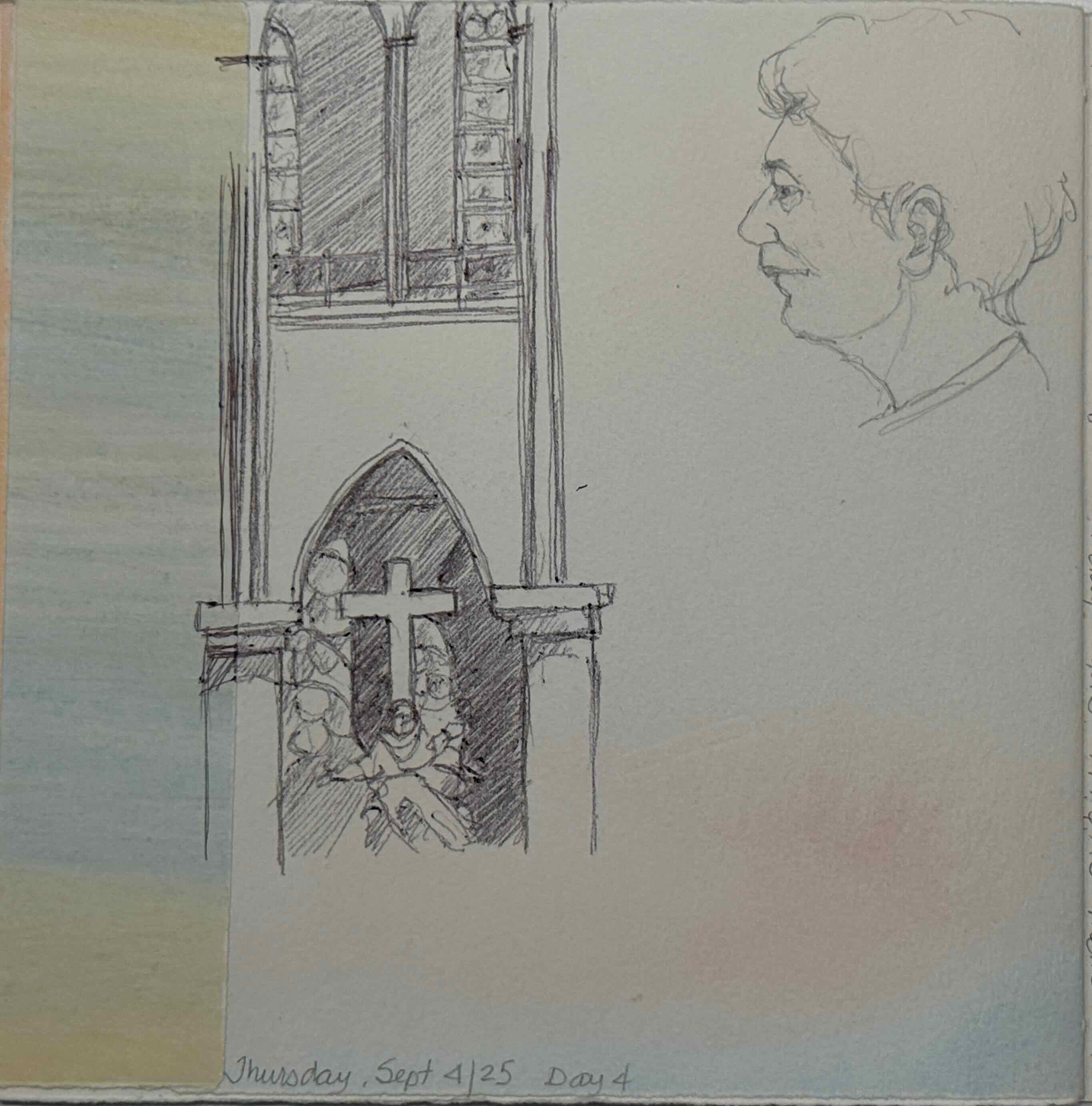
 It always takes me awhile to feel comfortable drawing when we are on holidays, and as I hadn’t done any drawing for almost a month before we left, I really had a hard time getting started.  While we were sitting in Notre Dame during Vespers yesterday I finally took the plunge.  

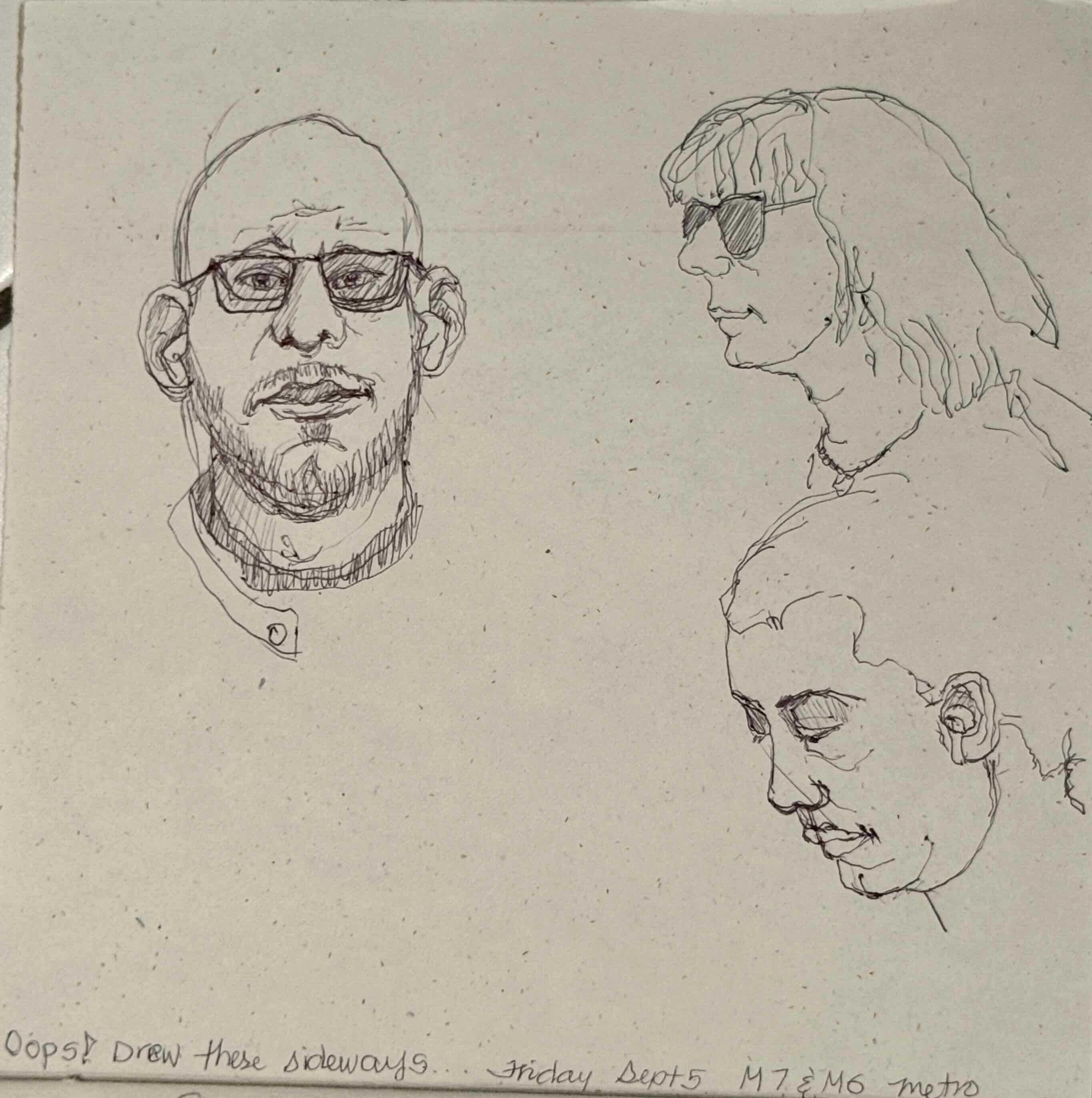
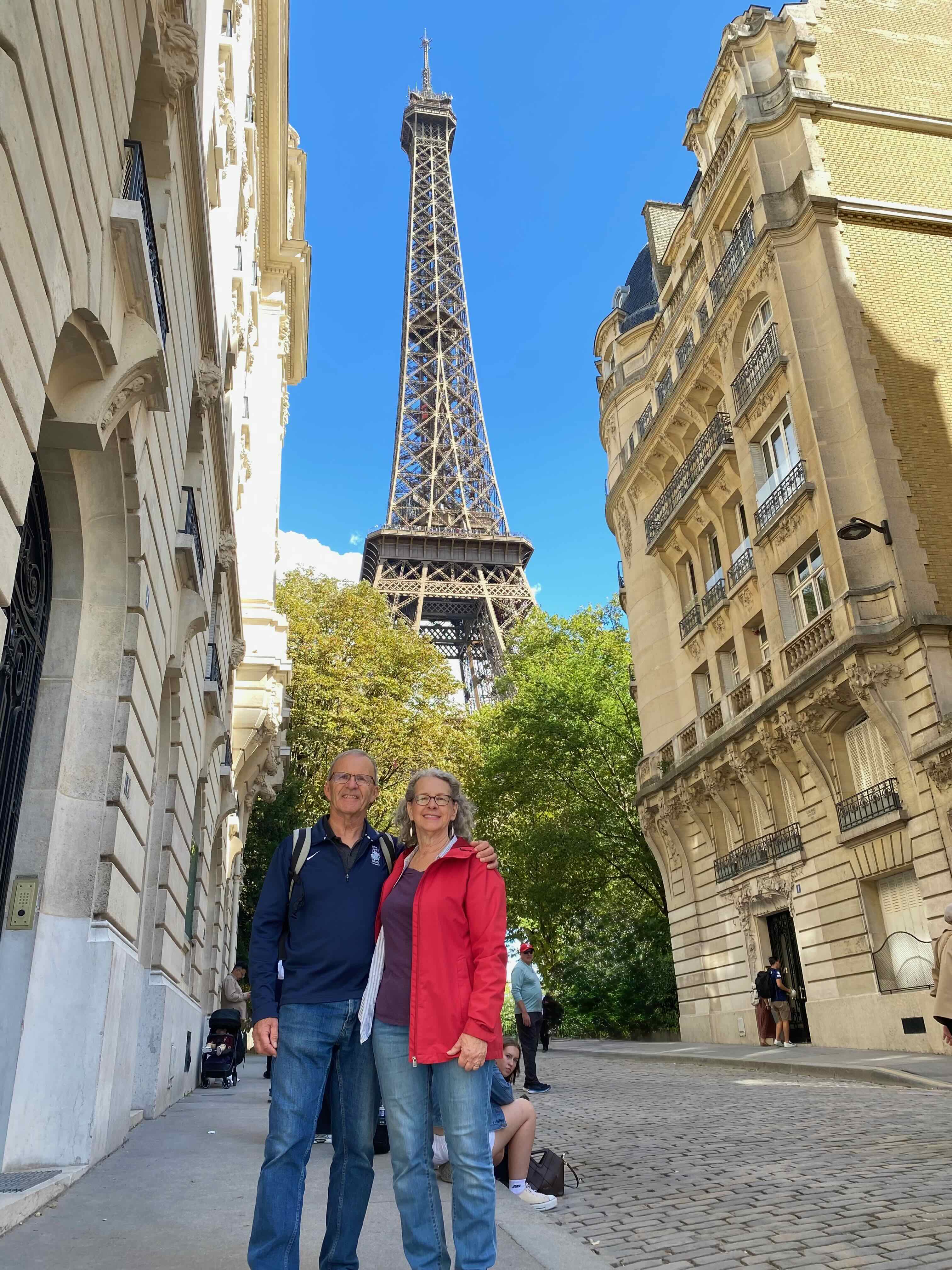
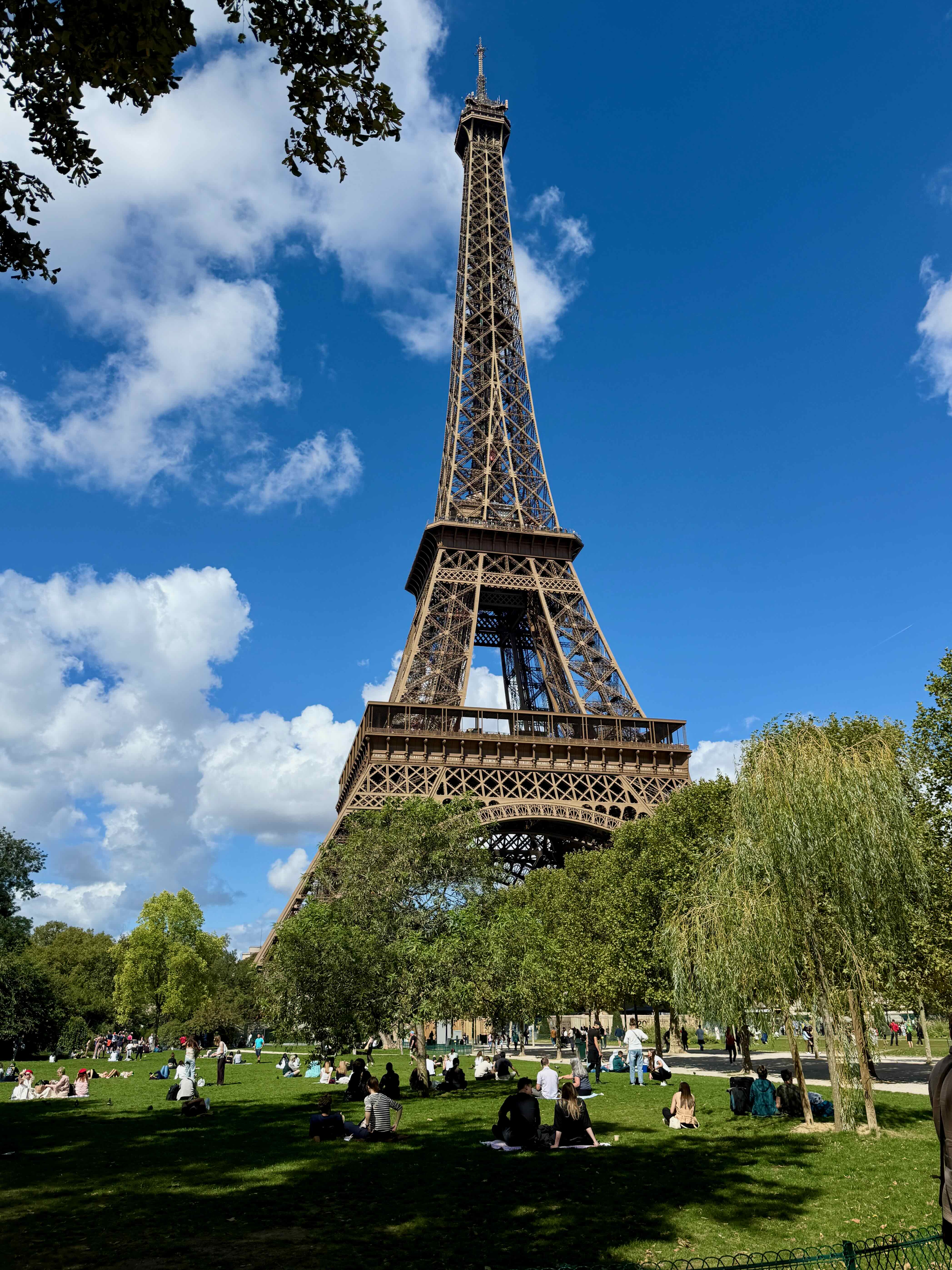
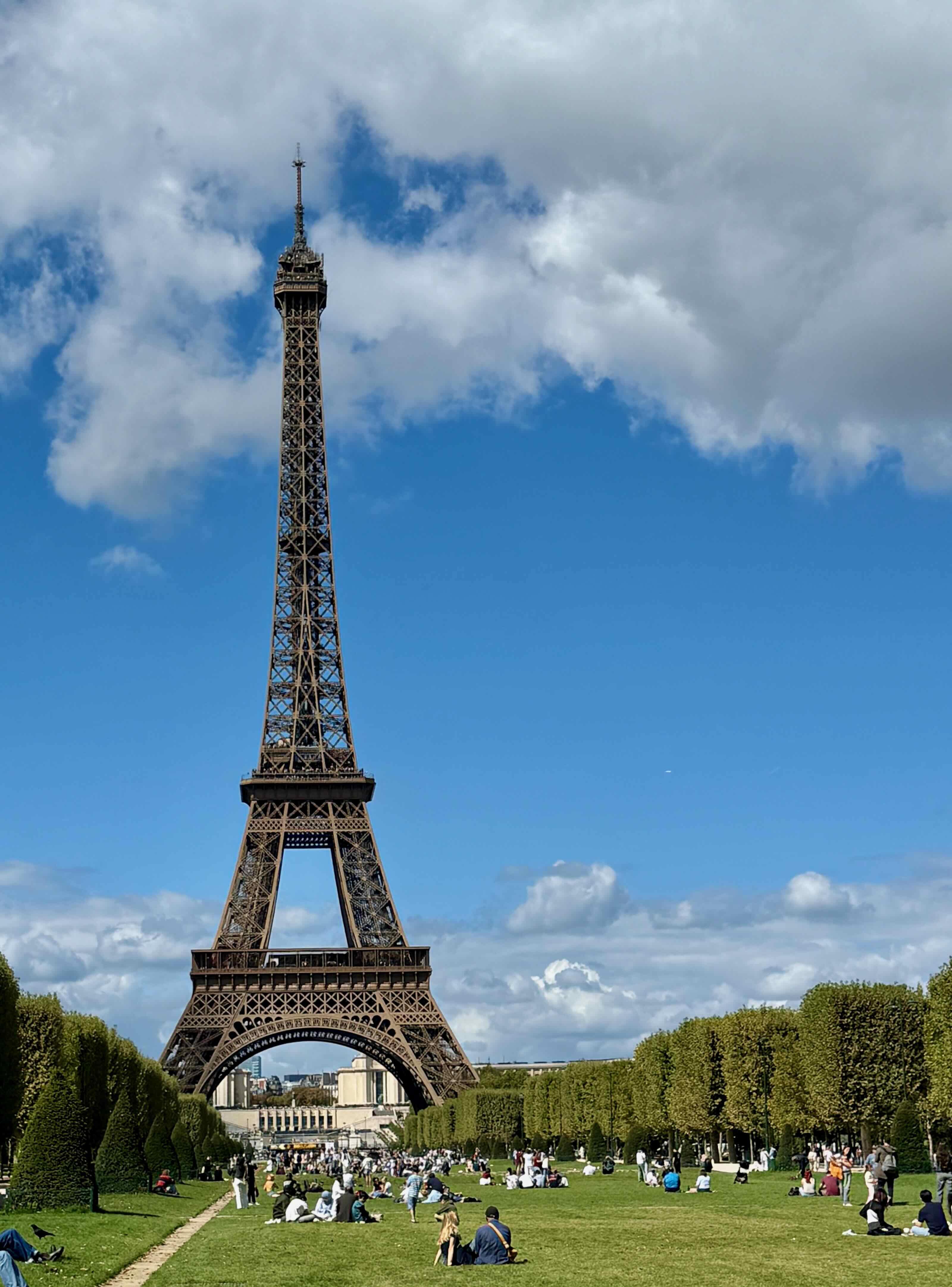
Then riding home the metro I did these quick sketches.Friday we managed to start our day at noon. Soon we were at the Eiffel Tower.  Somehow it doesn’t seem right to be in Paris and not visit this iconic landmark, even though we have visited it several times already including climbing to the second level. We will try and book a visit on our return to Paris at the end of our trip to go all the way to the very top level!  These tickets book up weeks ahead.Two years ago we picnicked on the grass near here, but there were not nearly as many people as there are today.
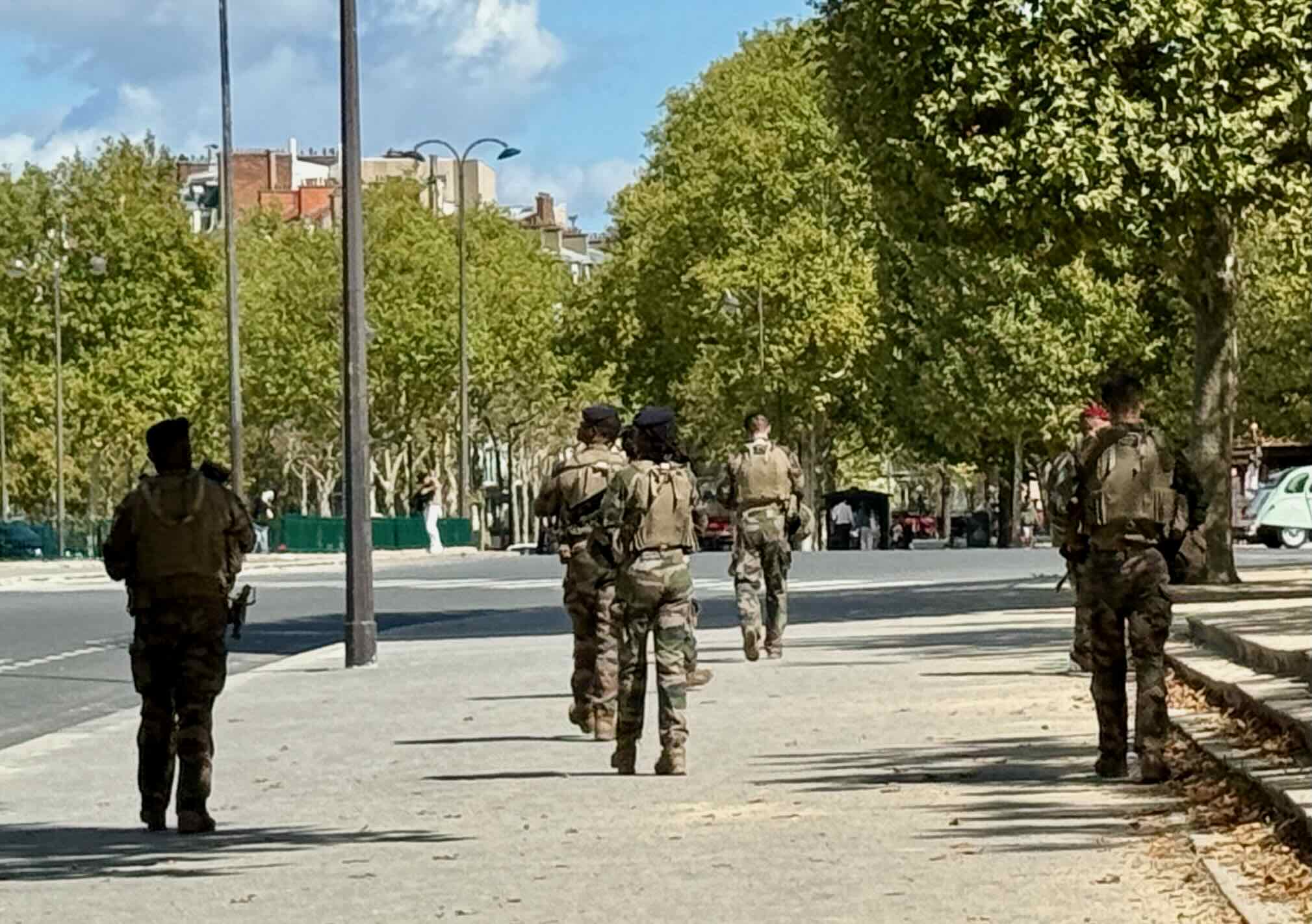
We found a bench in the shade away from the crowds to eat our lunch and watched as seven military personnel complete with machine guns approach on the path in front of us.  I held up my phone to take photo and the leader signalled towards me with his finger…then one of the men following him came over to tell us that we were not allowed to take photos.  I wonder if they do not want photos of their faces published anywhere…so after they passed and we were walking behind them I snapped this one.  France is on high alert right now, but these are the first fully armed military we have seen this trip.

One more view of the Eiffel Tower, looking towards the bridge across Seine behind it. There are people everywhere, enjoying the sunshine.  The first time we visited we could walk right under the four massive legs but now this area is all closed off behind glass panels and everyone who wants to get close has to go through a security checkpoint which includes bag checks and full body scan, just like at the airports.

It is a 45 minute walk from the Eiffel Tower to the Bourdelle Museum.  On the way we pass the UNESCO headquarters in Paris. You can still see the Eiffel Tower in the distance.

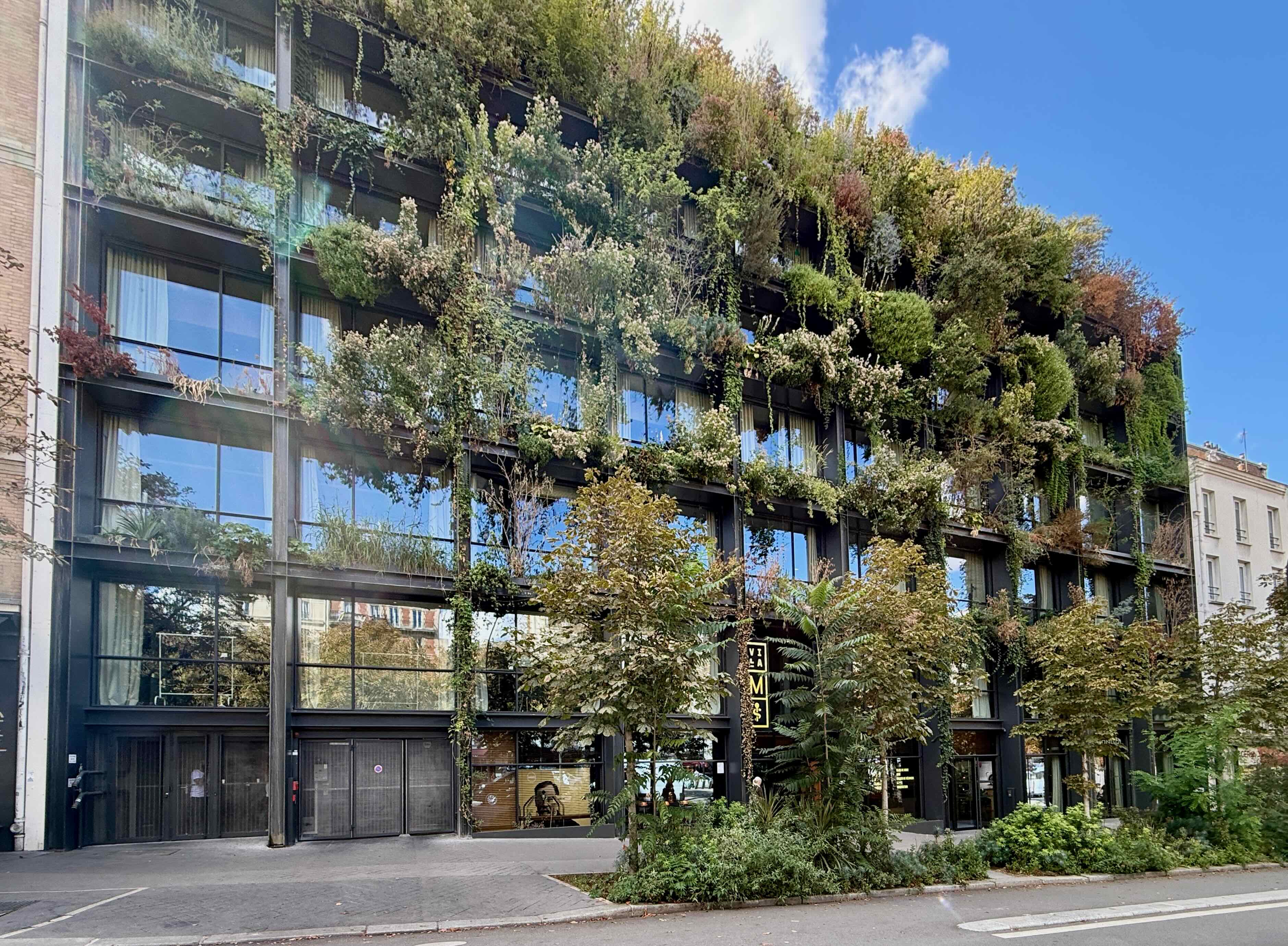
Just a bit further we pass this hotel that has trees and shrubs growing all over it.  I wonder what happens when they outgrow their planters?

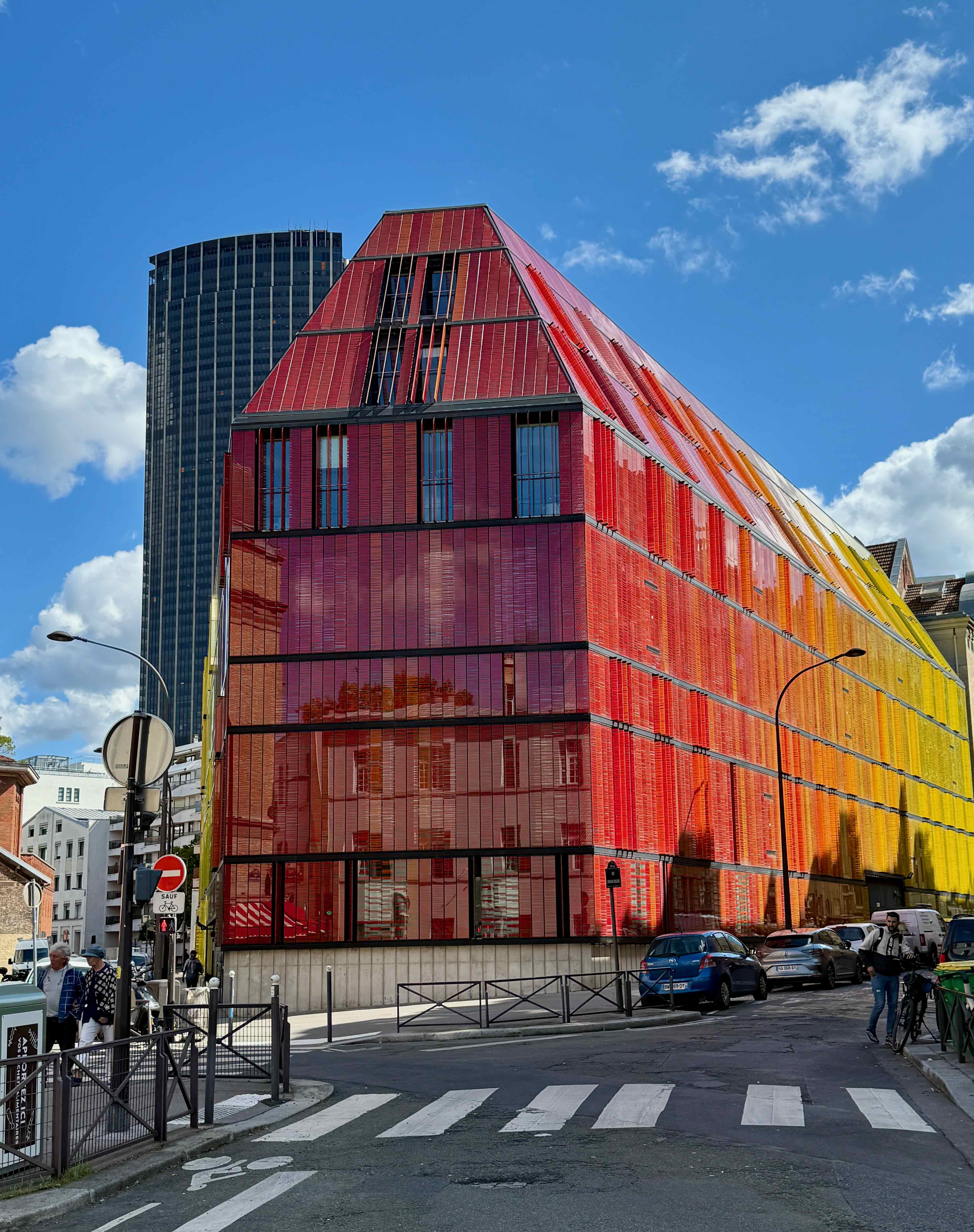
There are all sorts of interesting building in Paris.  As we near the museum we pass this car park, completely panelled in brilliant colours.

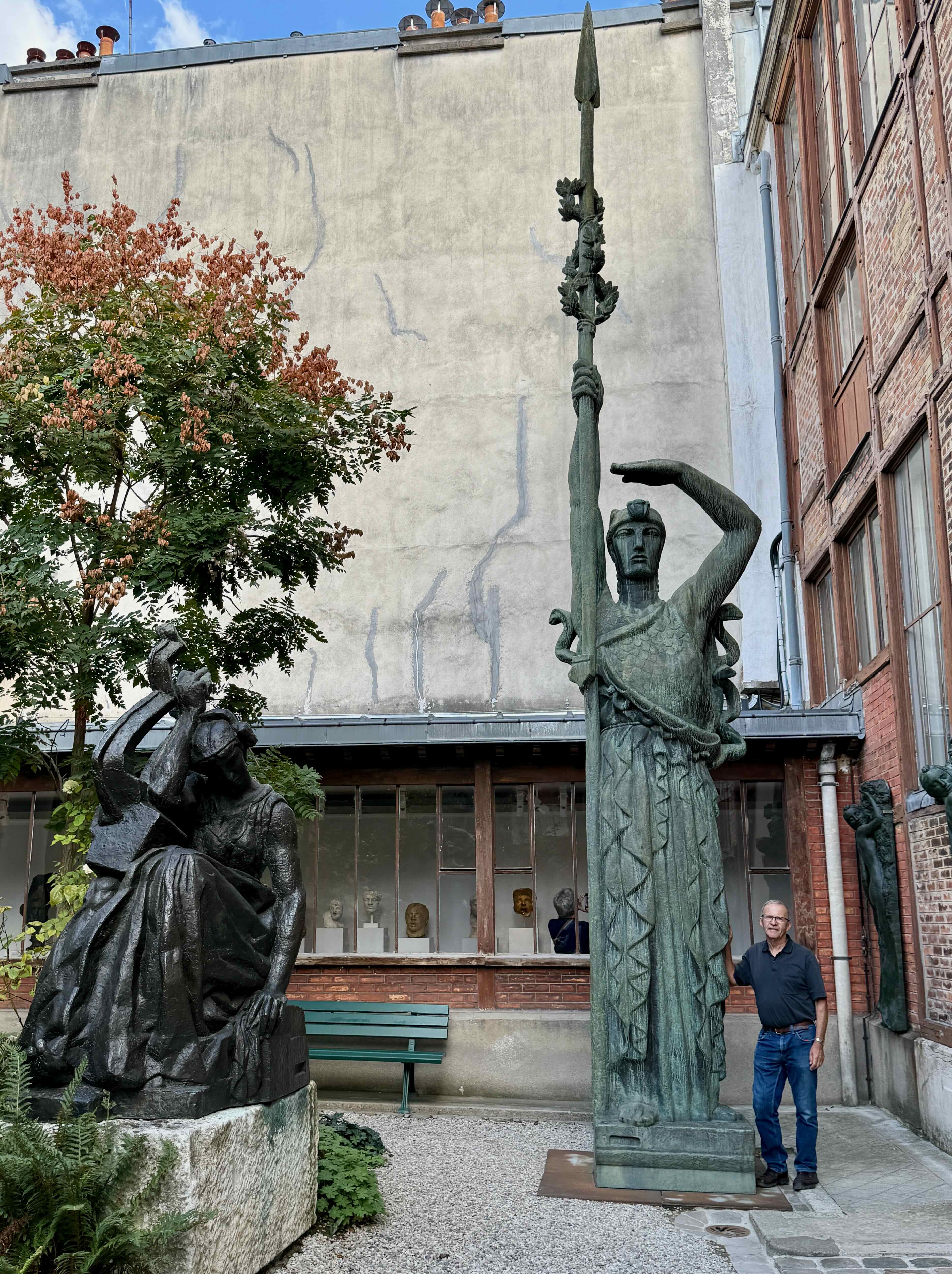
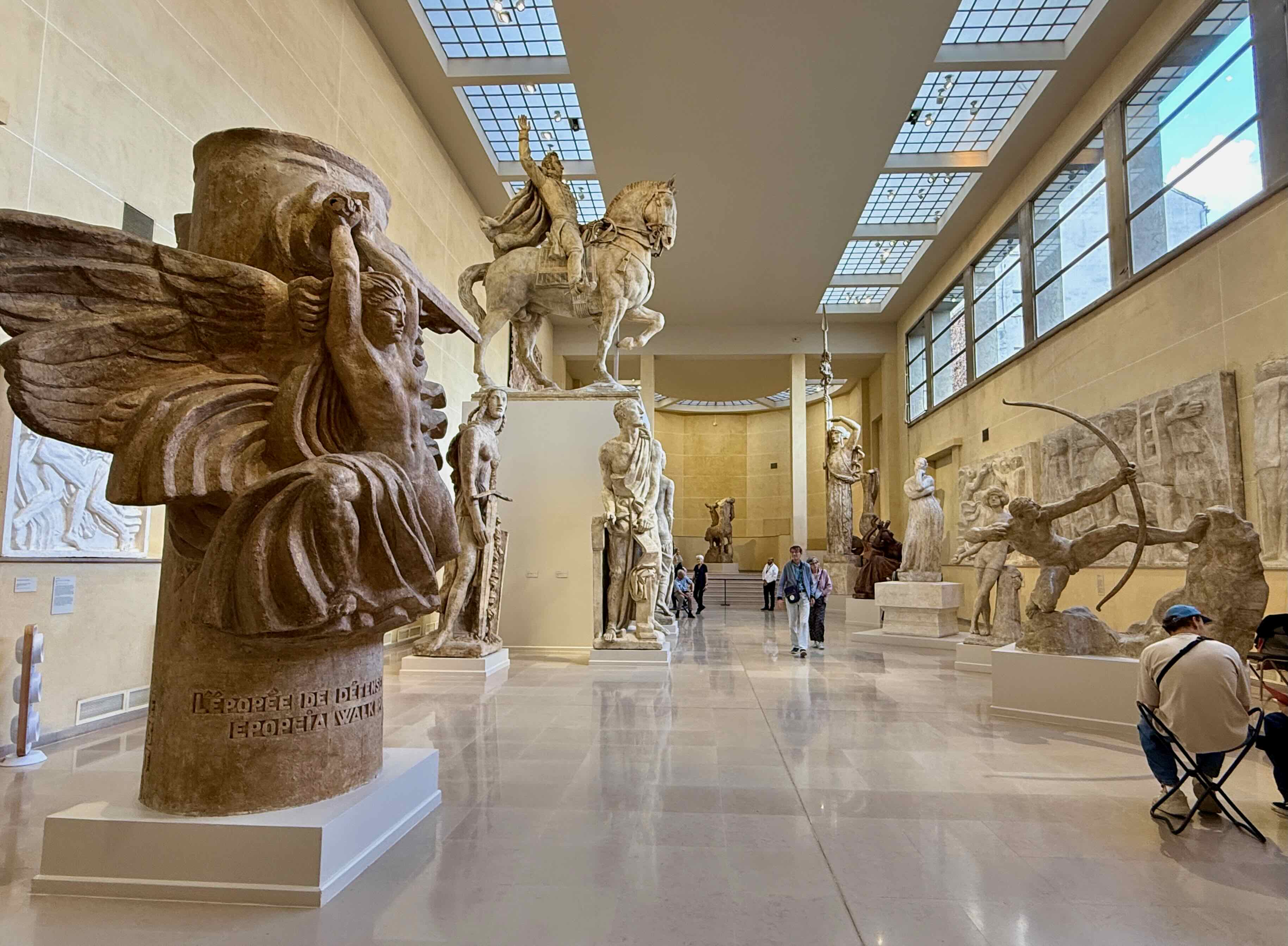
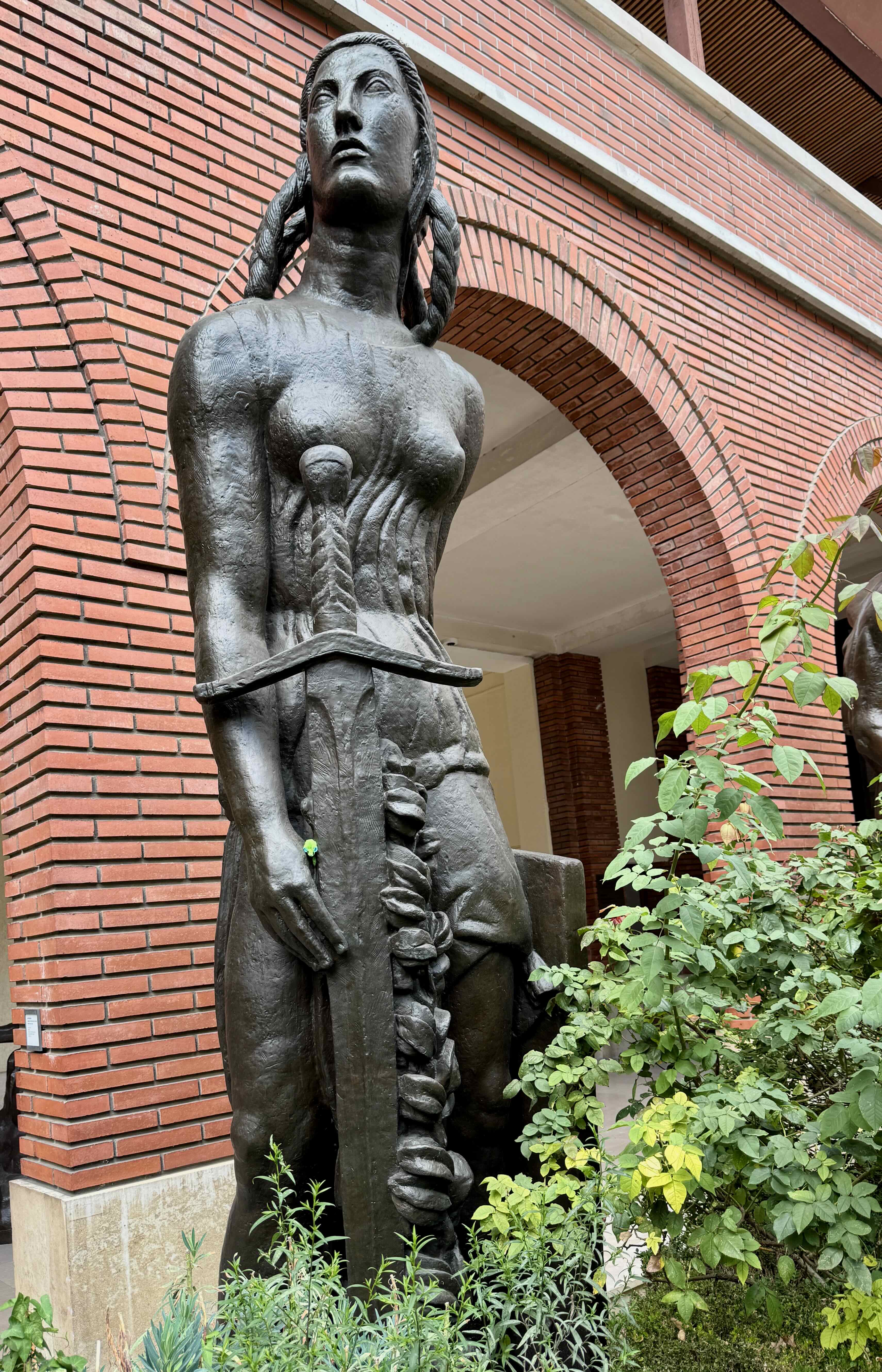
The museum dedicated to Antoine Bourdelle is free. We first find the cafe and have some tea and cookies.  It felt good to just sit and relax for a while.  Bourdelle was a student of Rodin and after Rodin’s death Bourdelle dominated the field of monumental sculpture.  We see many examples of these monumental sculptures.  The museum is at the site of Bourdelles original  studio. As he became successful he added more rooms and gardens until it appeared much as it does today.  

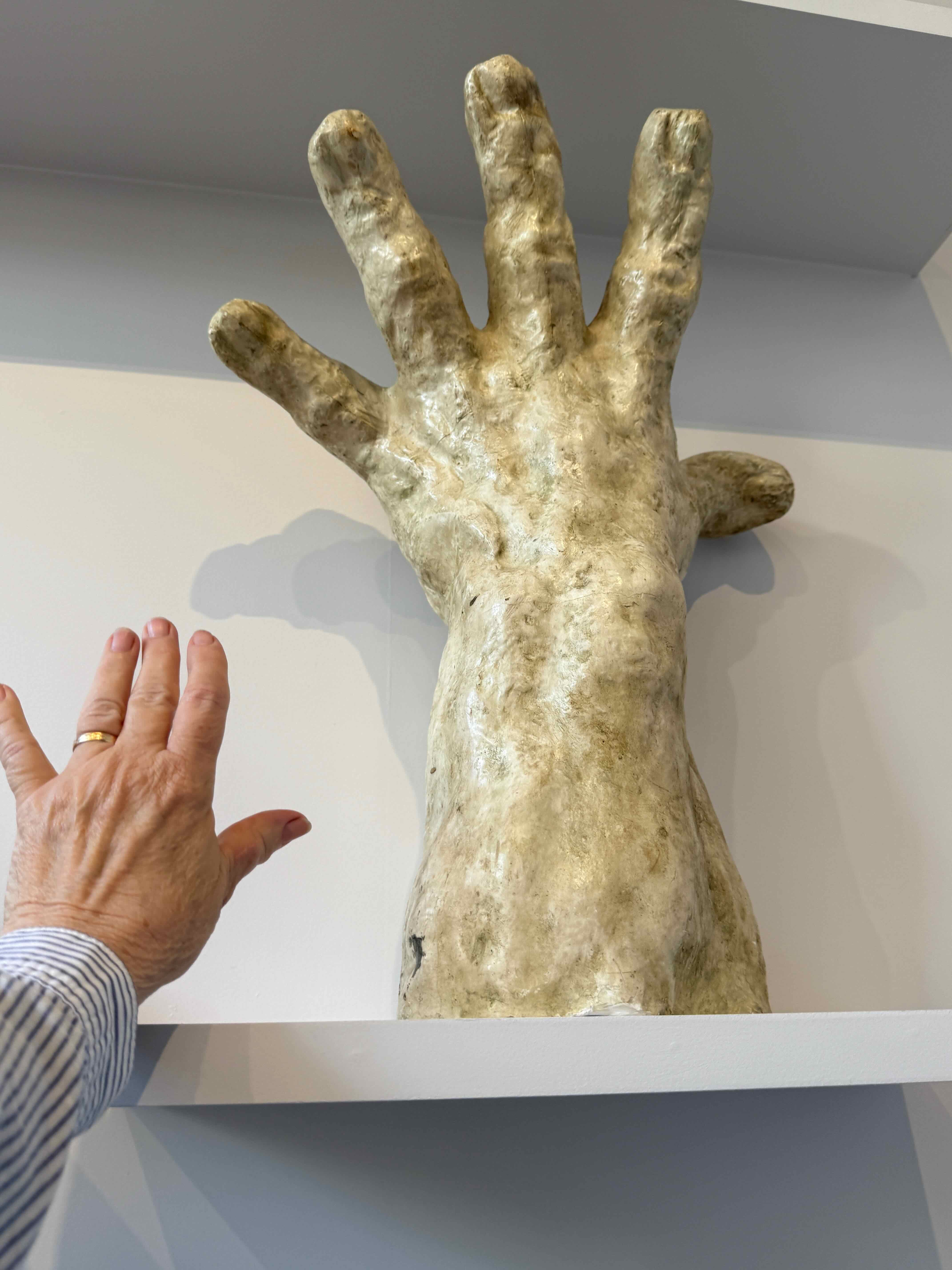
One of the studios has this huge study for a hand.

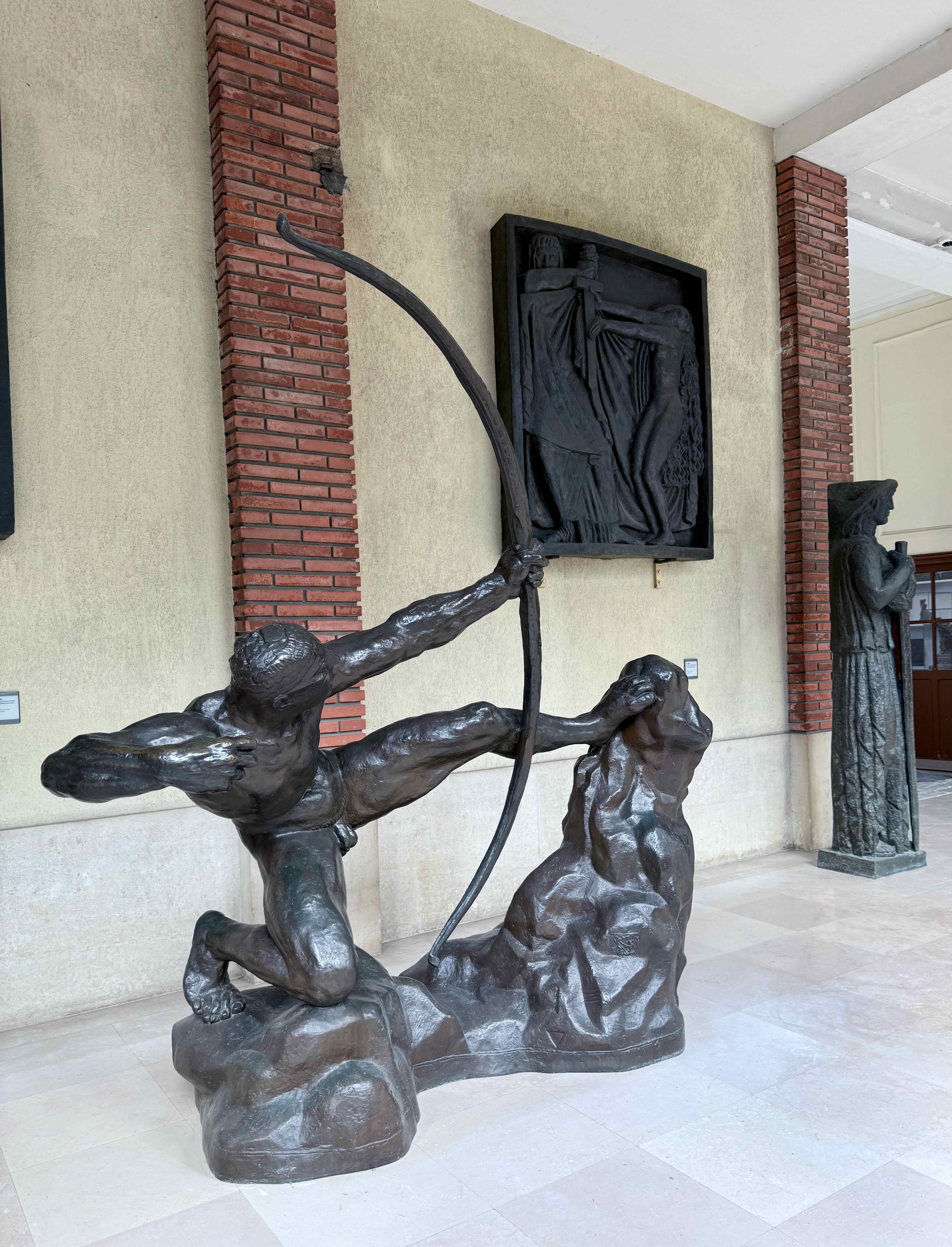
Bourdelle was 50 years old when he finally became successful thanks to his Hercules the Archer statue. It represents the Greek hero wielding his bow to shoot down the Stymphalian birds. Copies of this sculpture were created in three versions and are in numerous museums in France and abroad.

There is a room full of magnificent sculptures…

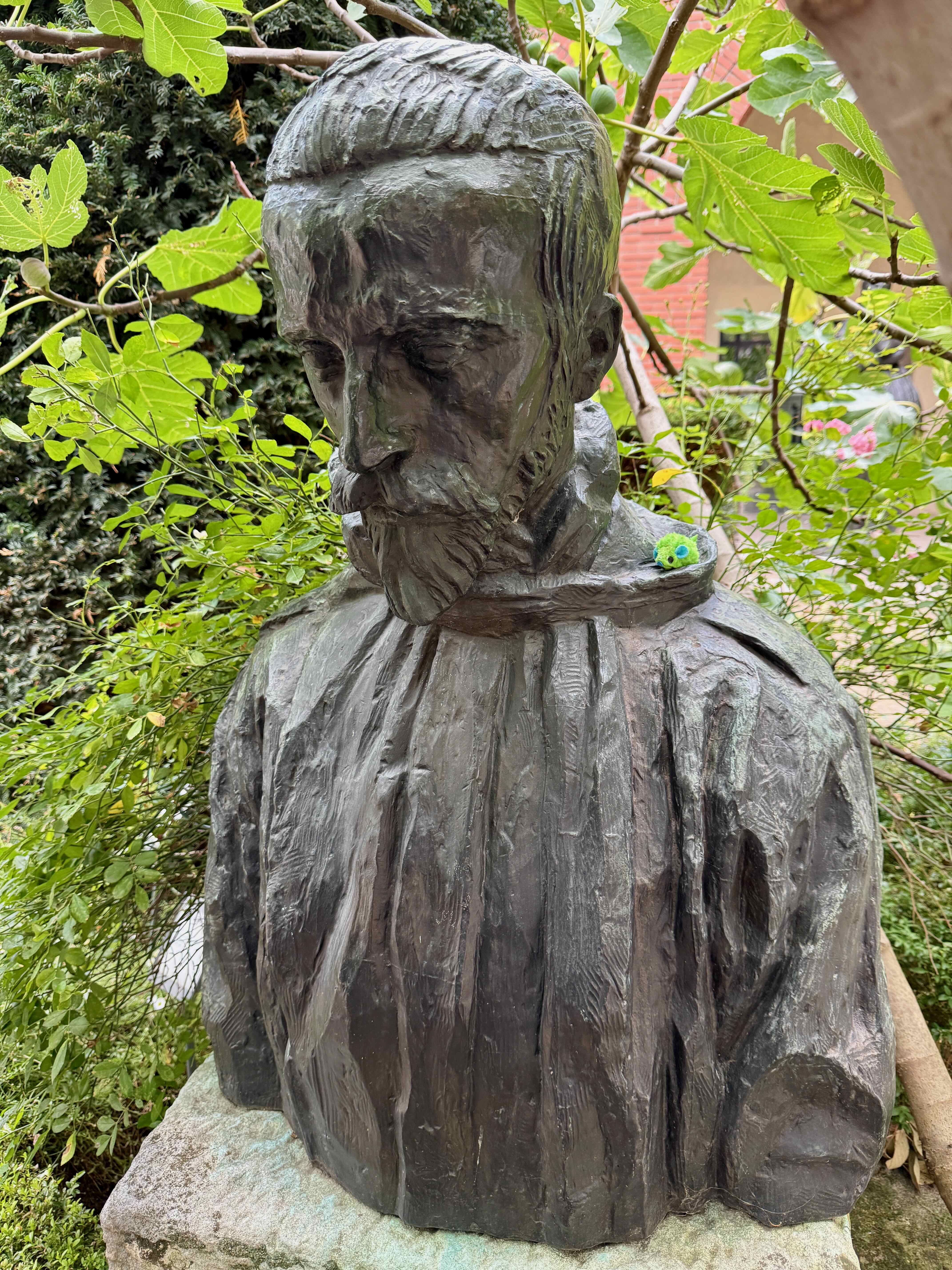
and there are more sculptures in the gardens and courtyards.  Can you see Sue? (short for souris which means mouse in French). Since this little green mouse stowed away in our luggage she insists on coming along with us on our travels.

Sue is very curious and likes to check thing out for herself.

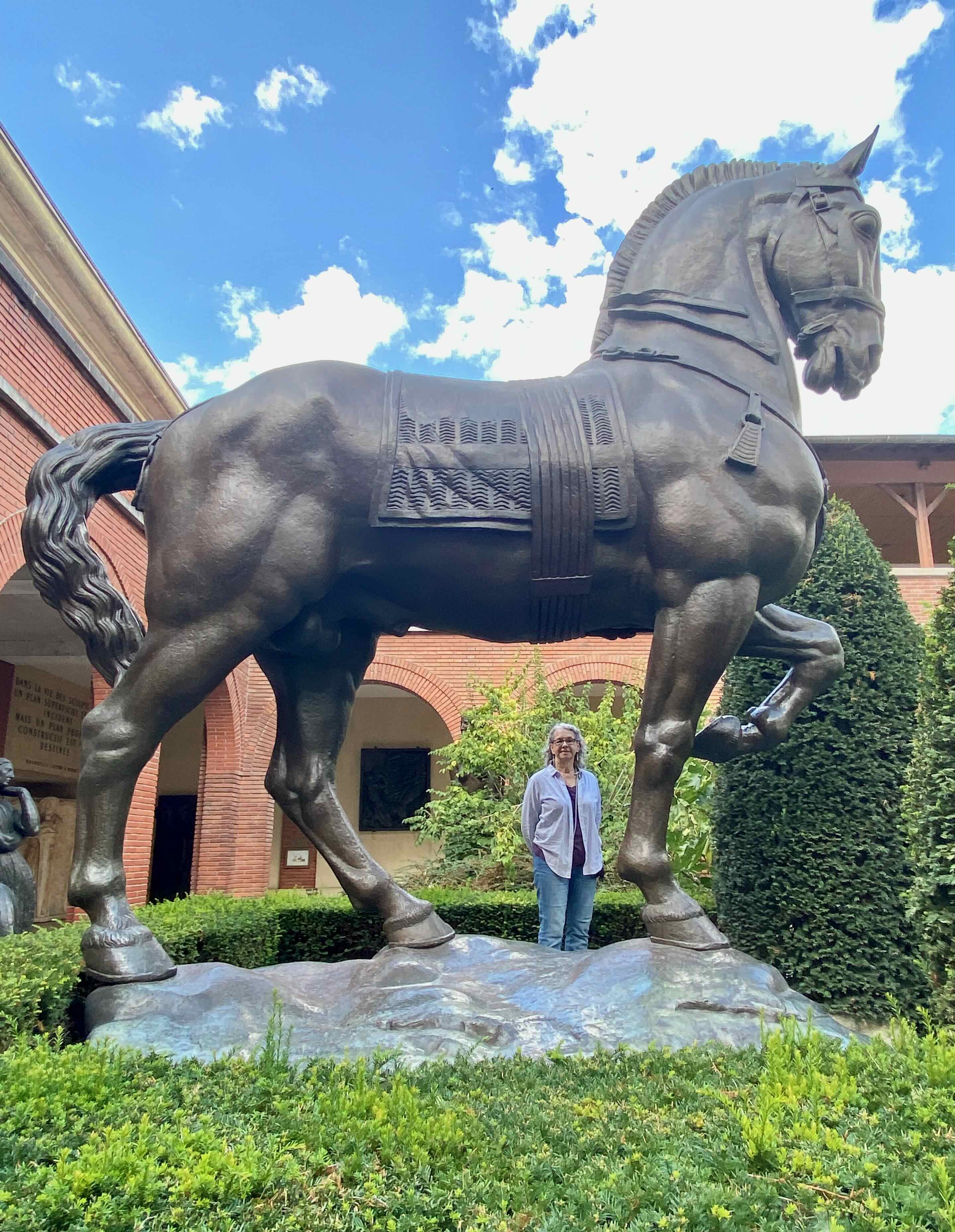
There are two of these huge horse sculptures at the museum.  

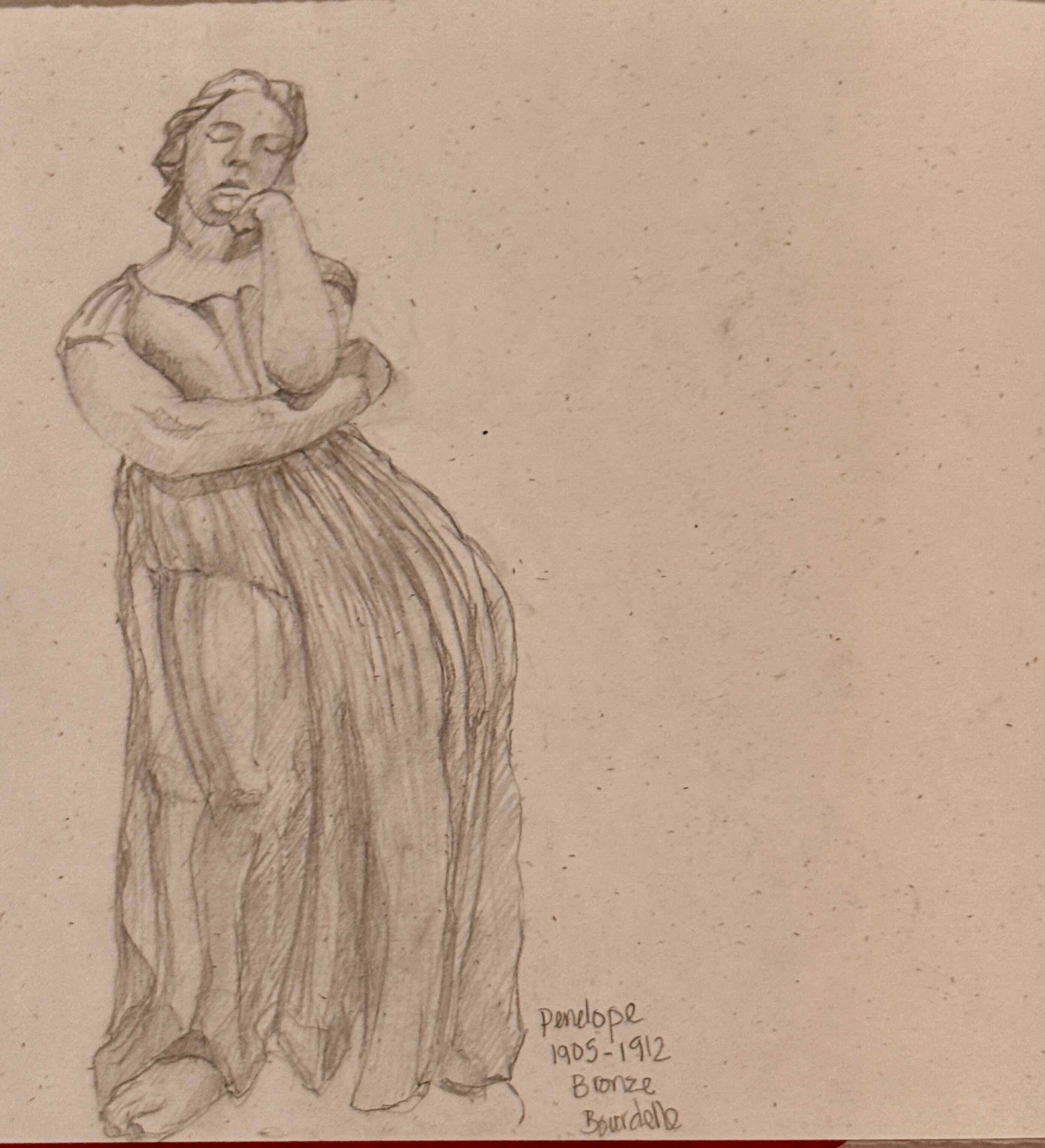
Bob sits in one of the gardens to read for a bit and I sketch one of the sculptures close by named Penelope, a larger than life size bronze of one of the wives of Odysseus, who waited faithfully for her husband to return. Bourdelle used the features of two women who loved him, he generous curves of his first wife, Stéphanie Van Parys, and the posture of his student, Cléopâtre Sevastos, the muse who would become his second wife.

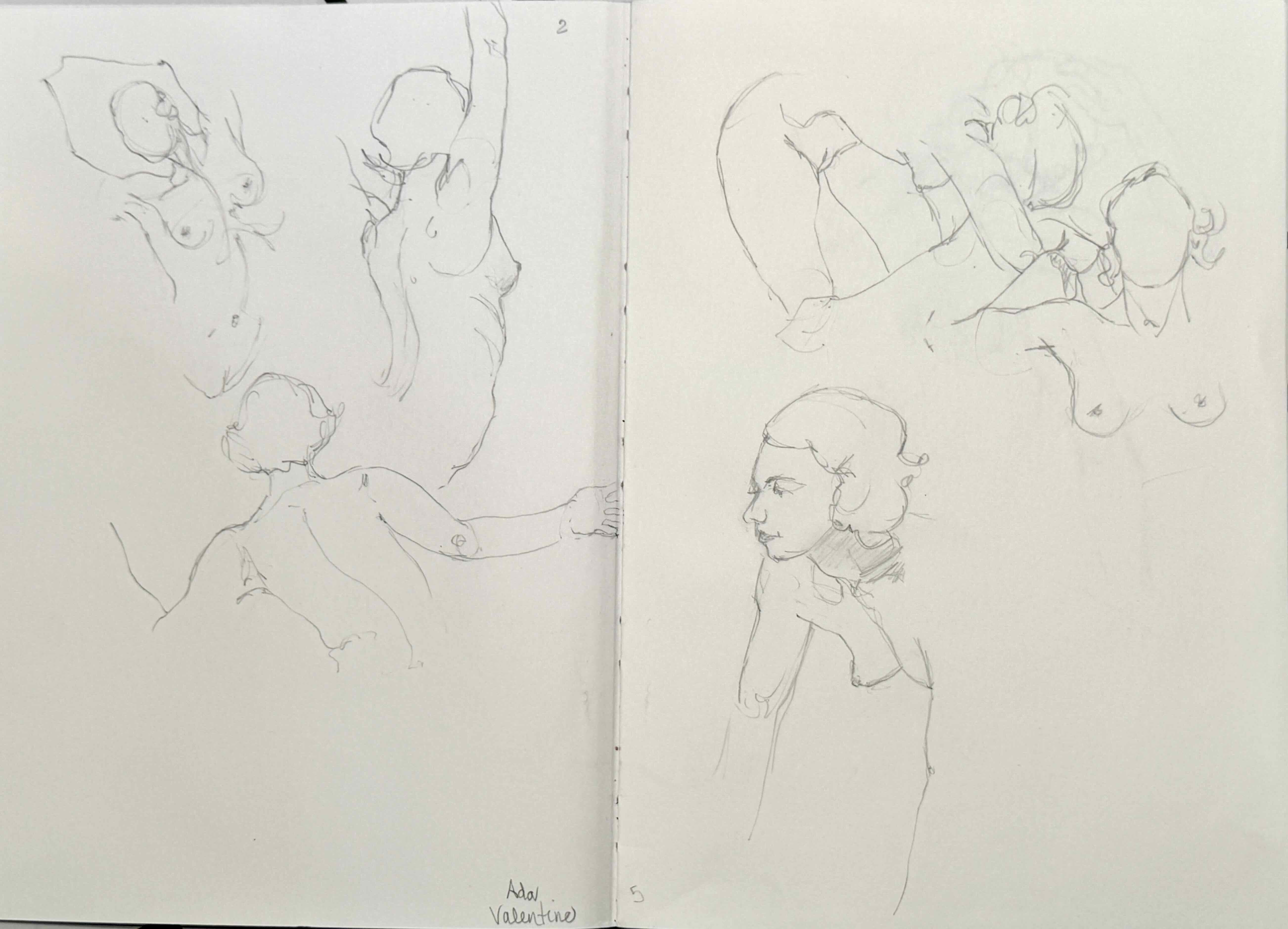
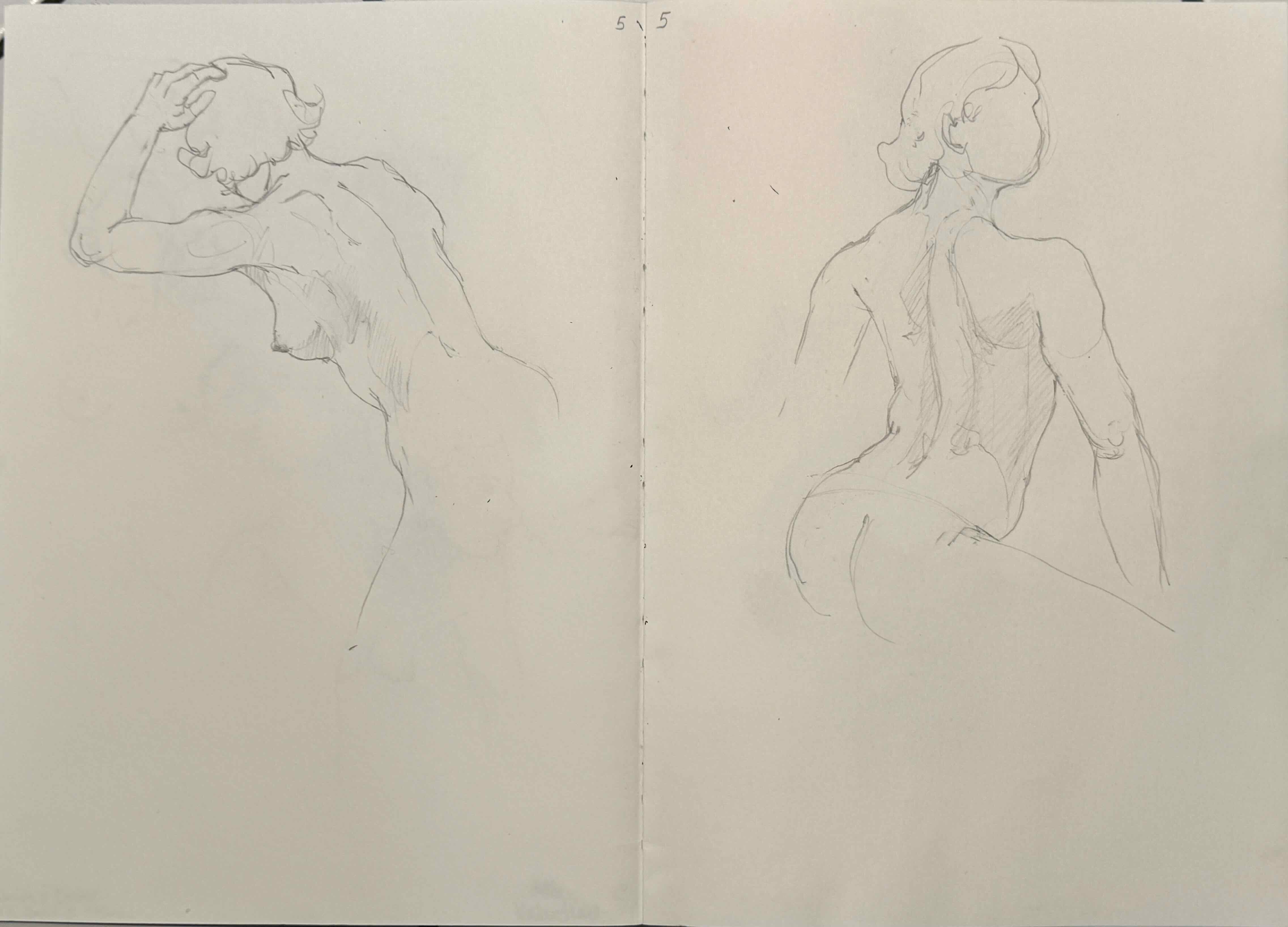
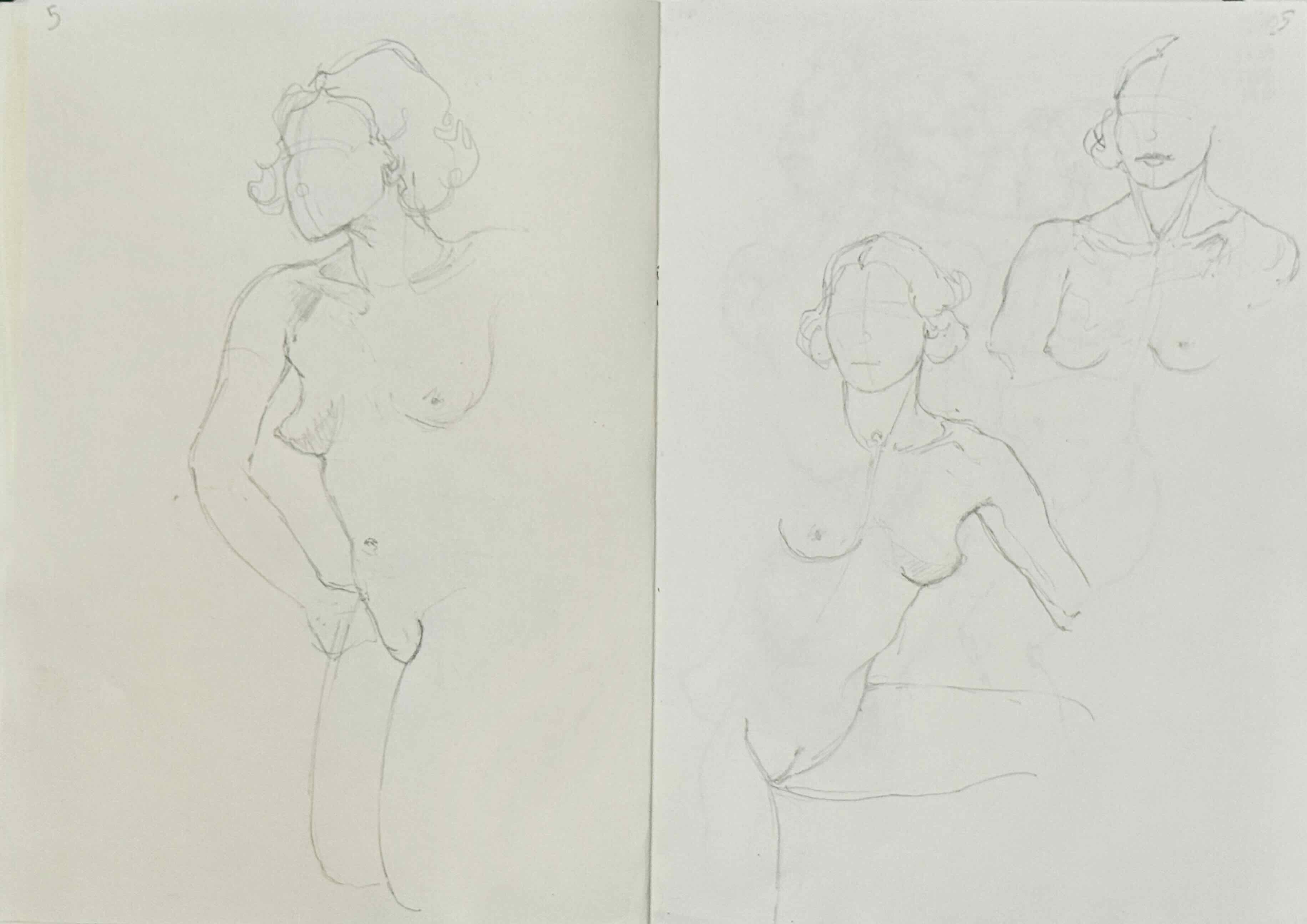
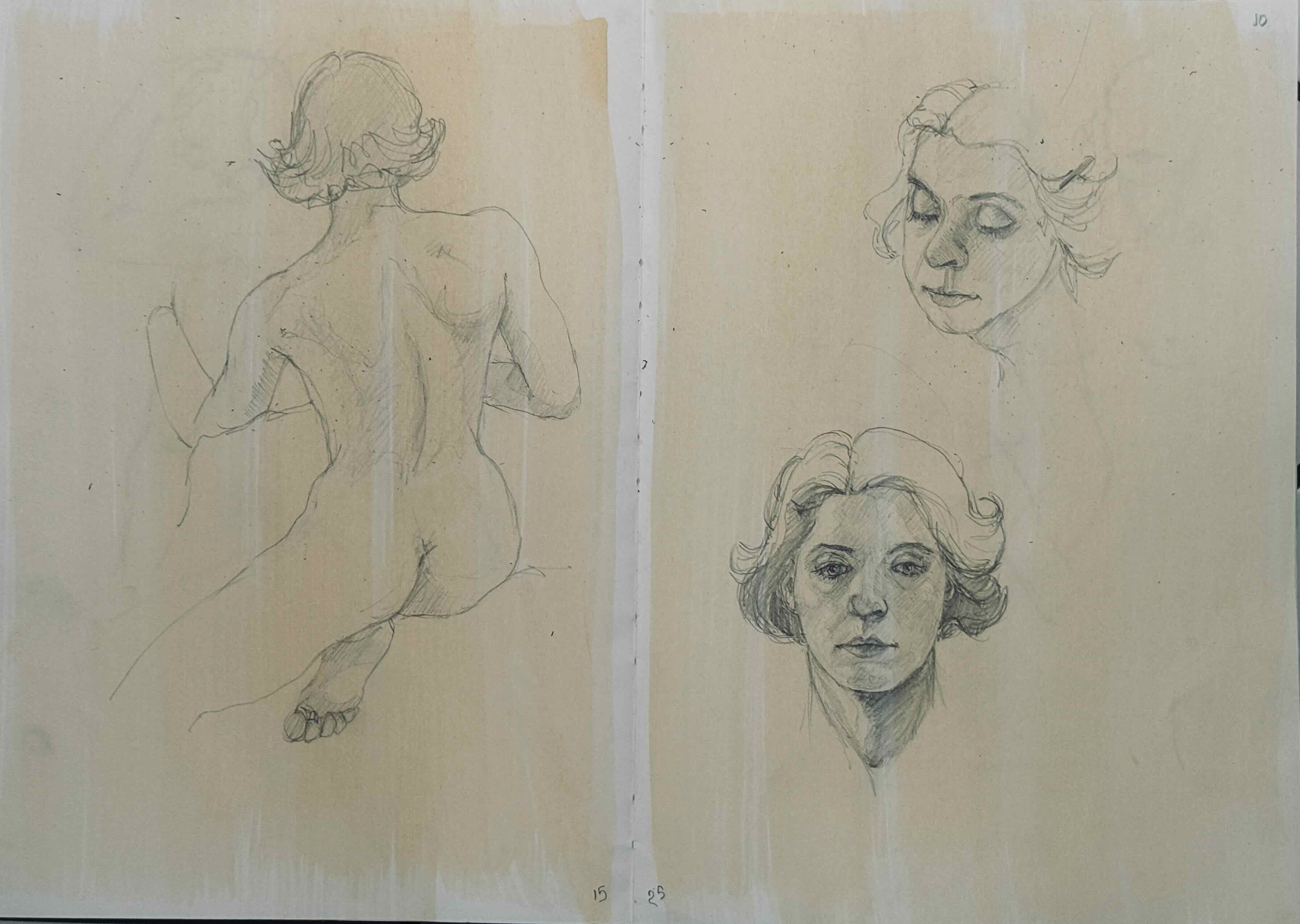
After our visit to the museum. I went to a Drink and Draw session nearby and Bob headed for home.  Here are the drawings from my first life drawing session this trip.

2 minute poses and one 5 minute pose…

two more 5 minute poses…

two 5 minute and one 10 minute pose…and a 15, a 10 and a 25 minute pose.  
Ada is our model tonight, and I am sure that I recognize her from a previous life drawing session in Paris. She thinks that she recognizes me too! but we are unable to figure out where I might have drawn her before. I will have to check my other holiday sketchbooks when I get home. I take the metro and get home at 10:00. Bob meets me at our metro stop and carries my art stuff home for me…I am pooped…it was a ten hour 15,000 steps day!

Boat Ride on the Seine and the Orangerie

First of all, if you are a subscriber and you are having trouble seeing the photos in yesterday’s post you should be able to click on the “View on Blog” option on the top right side of your email notification, or just type trudymason.com in your browser and you can see it properly there.  No idea why the photos aren’t showing up!  Sorry.

Day 89,  Saturday, November 25, 2023

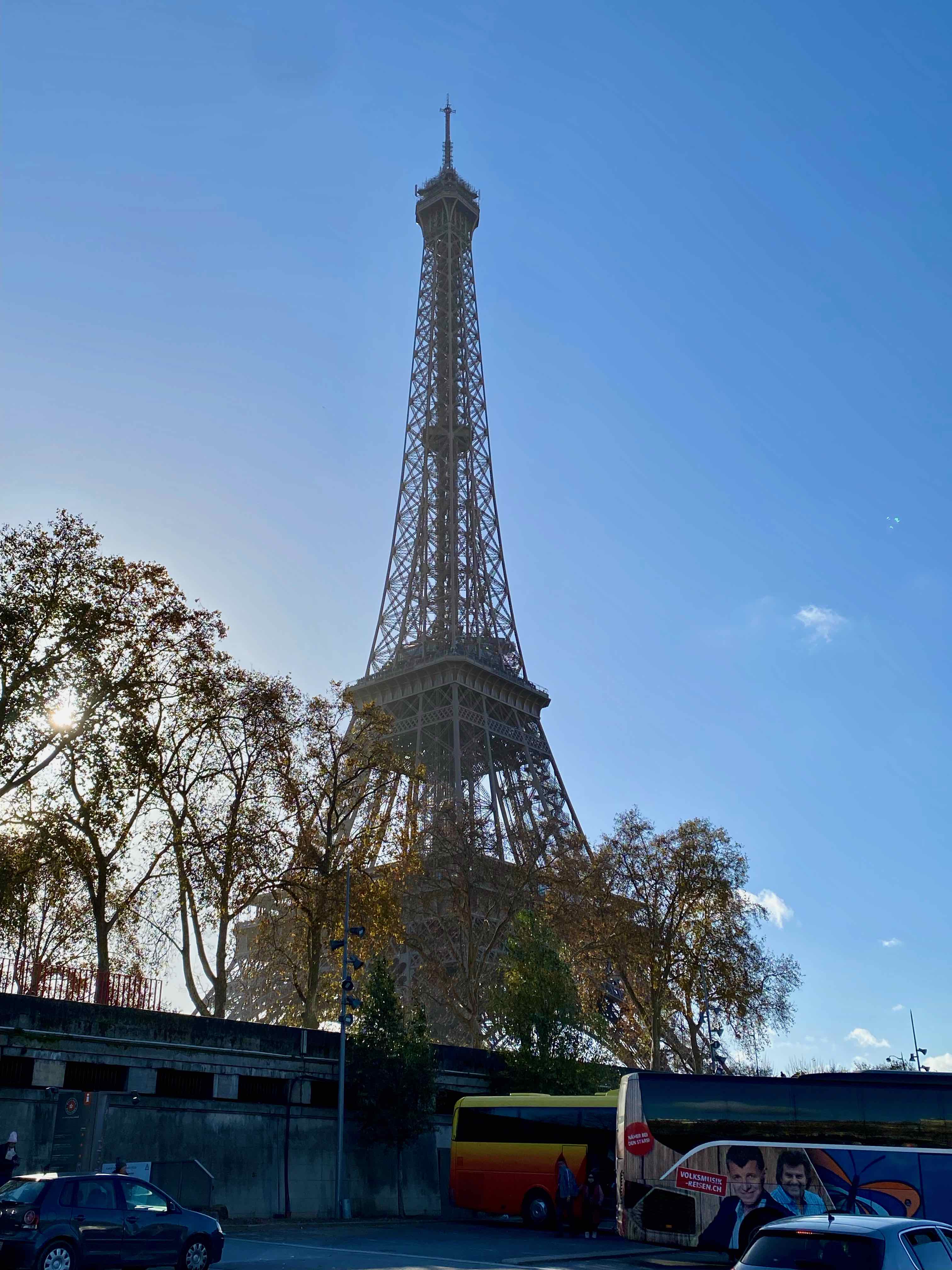
I am out of the apartment early to go shopping for those conté crayons I promised to get for my friend.  Then I need to meet Bob near the Eiffel Tower for Bob’s birthday boat ride.

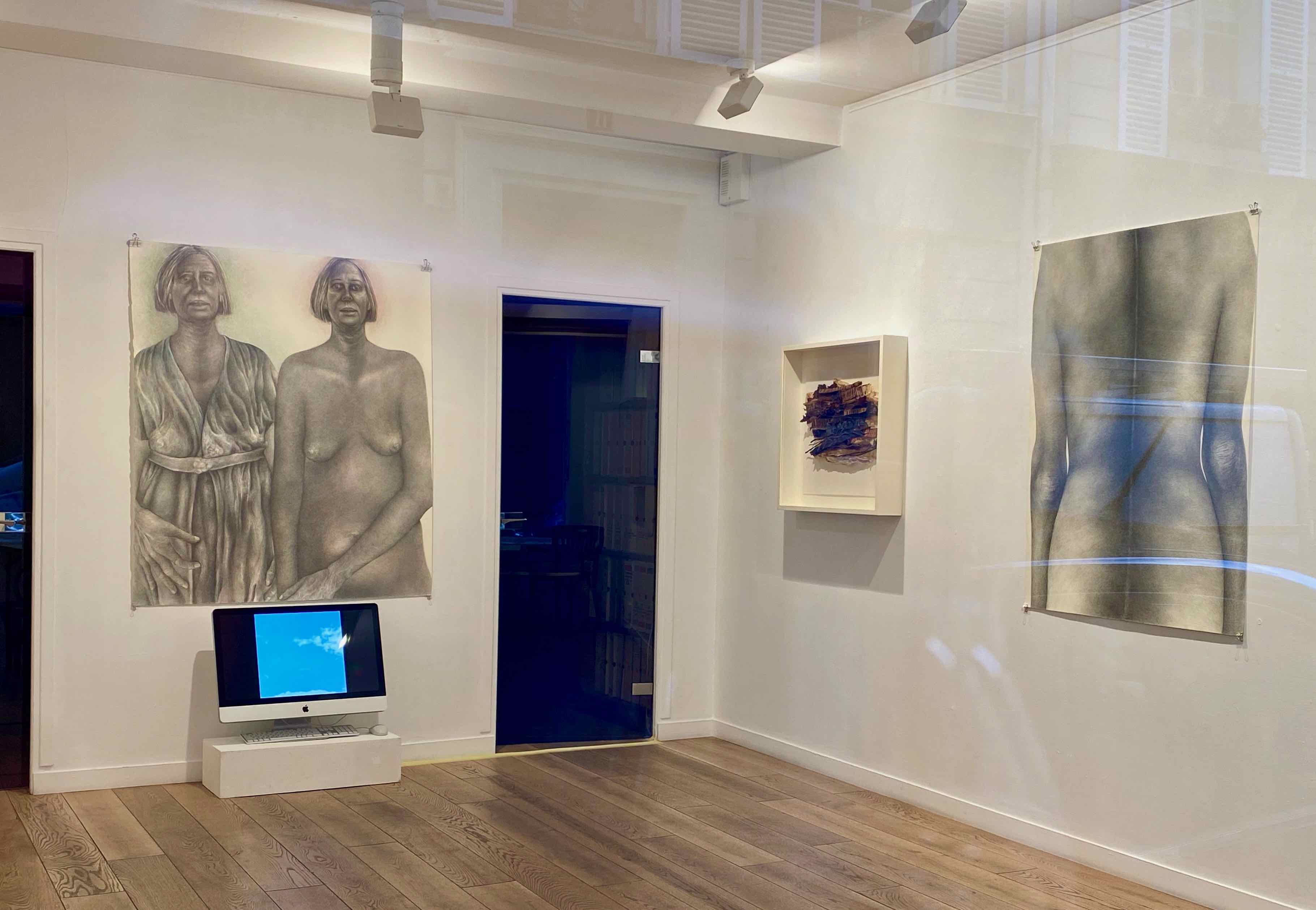
We arrived back in Paris on the 16th but other than going to my life drawing sessions I haven’t been out and about very much. Having Covid hit me much harder than Bob, and I have been pretty low energy ever since, so it is nice to wander the streets of Paris at least one more time before we head home. I check out a couple more art stores, but only find a stick or two of conté at each one! I head towards the main Sennelier store, hoping I will find what I need there.  On the way I pass several little galleries and peak in the windows.  I liked these large drawings by Diana Quinby at Galerie Arnaud Lefebvre.  I wonder if I will ever try doing such large drawings? Luckily the Sennelier store has all the conté crayons I need!  Yay!

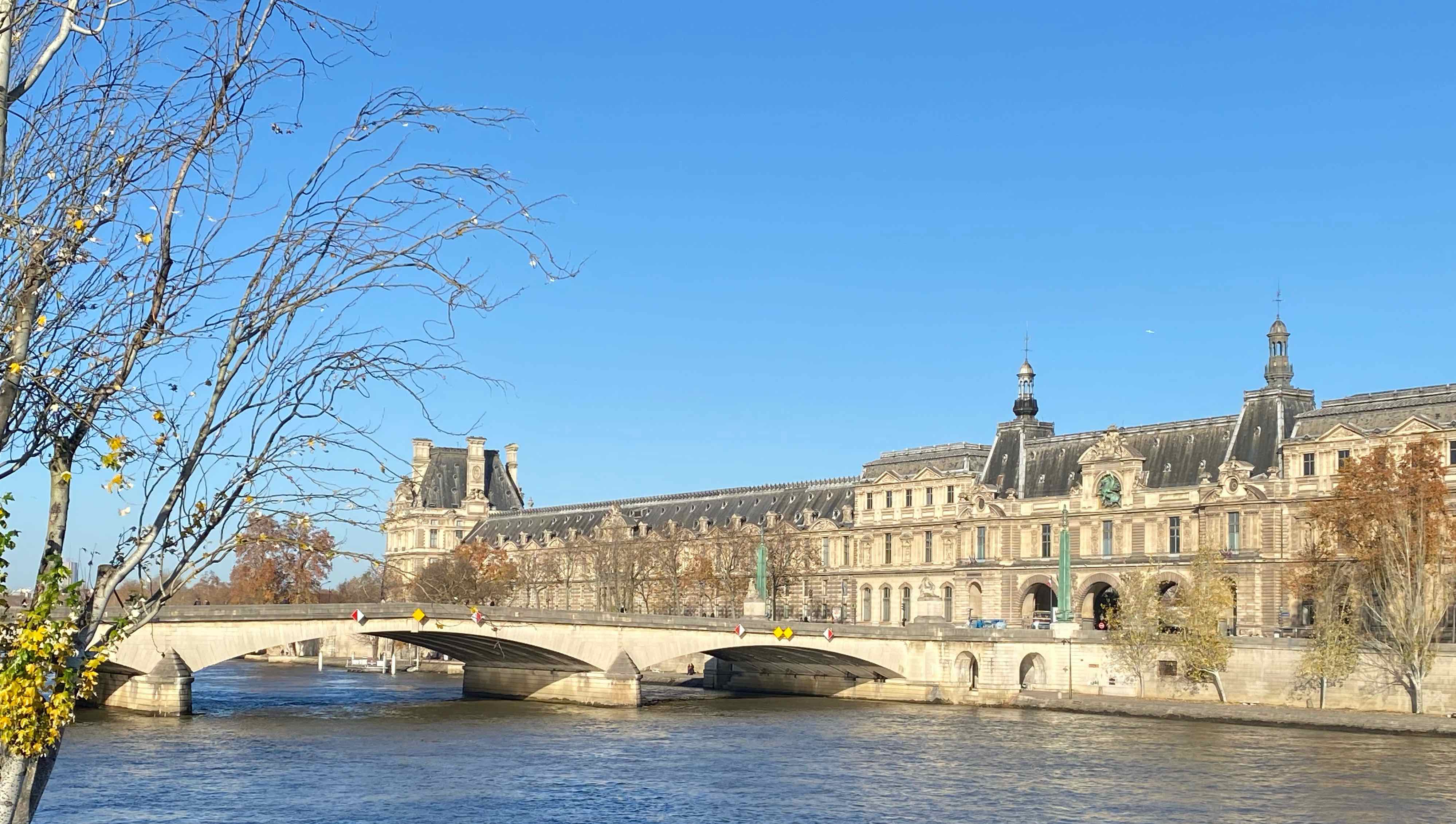
The Louvre on the other side of the river.  We didn’t even go inside this trip…just too many other things to do and see.

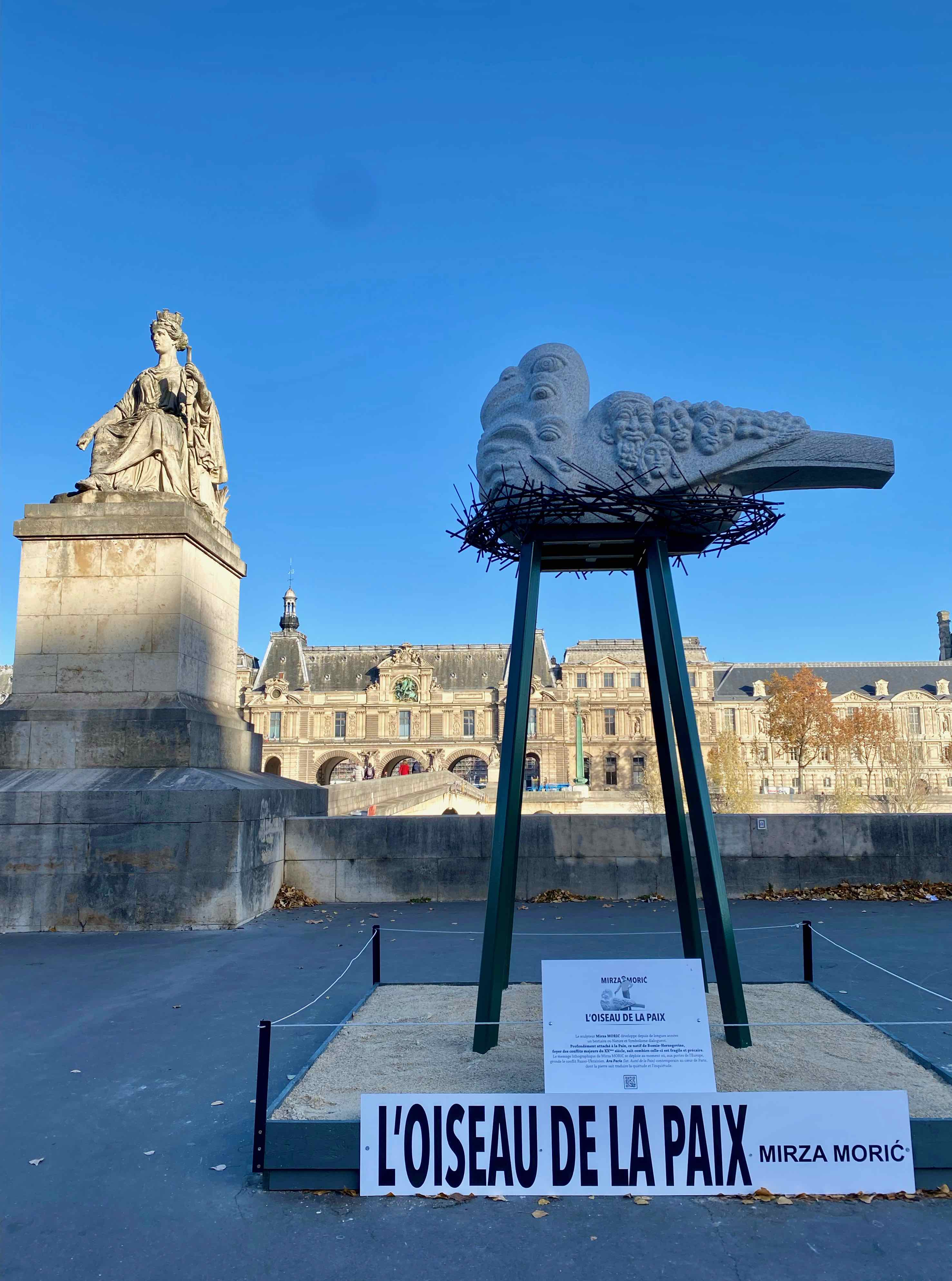
This sculpture is titled The Bird of Peace by Mira Morić.  We could certainly use a lot more peace in our world!

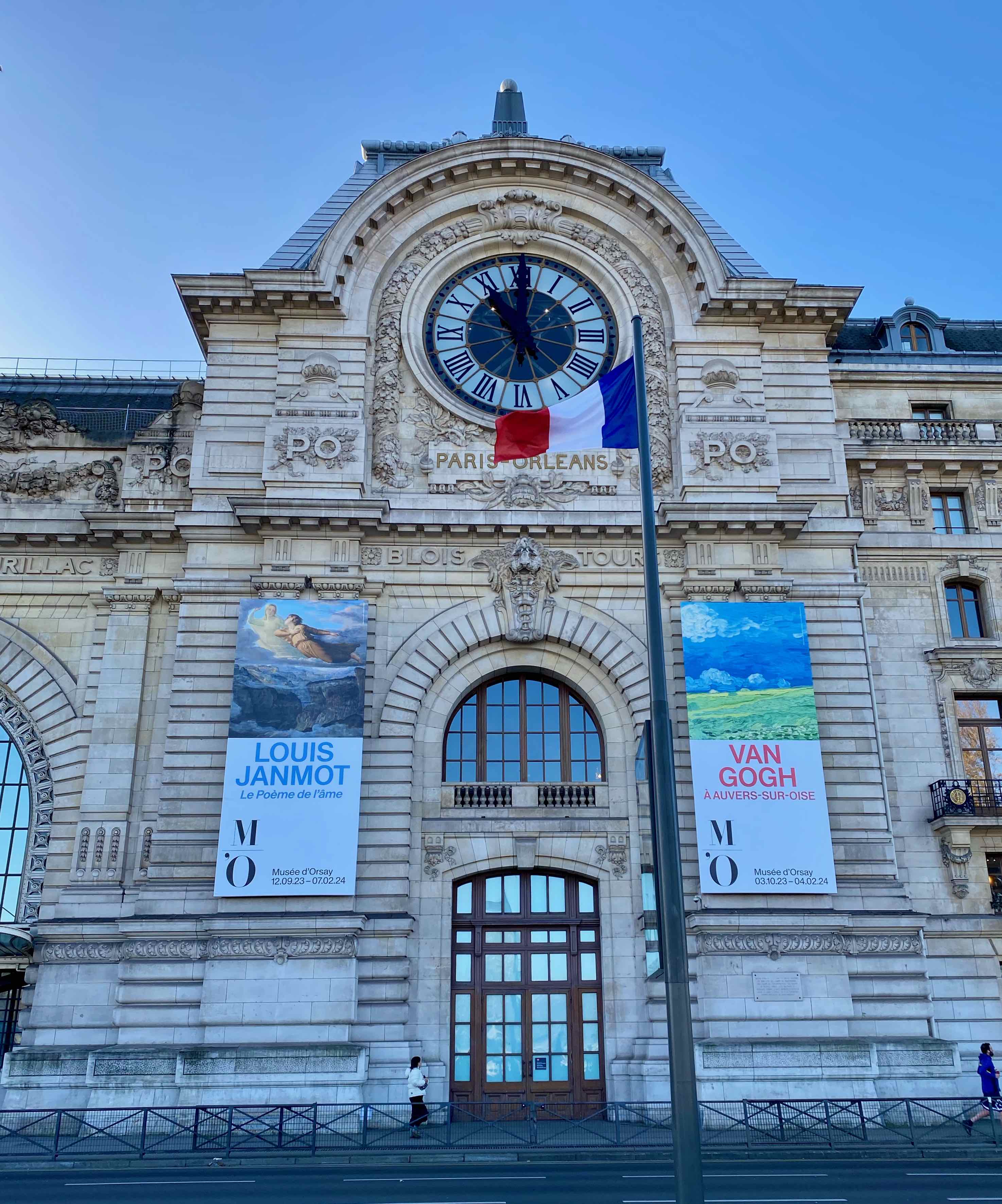
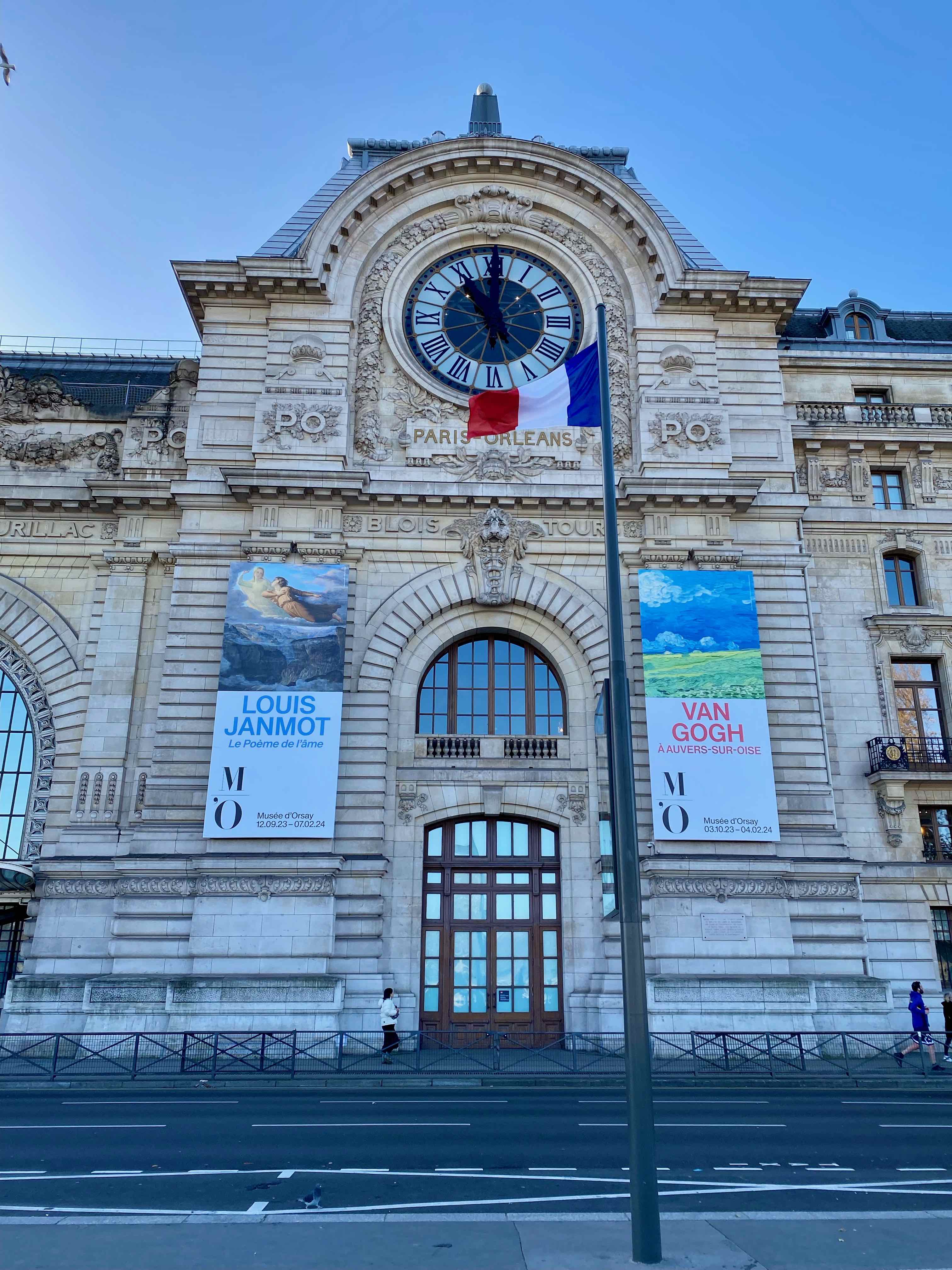
The front of the Musée D’Orsay with posters of the two shows we visited.  I do love this museum…it is big but almost doable in one day, unlike the Louvre, which is sometimes overwhelming.  The Louvre definitely needs several days to even begin to see most of the exhibits.

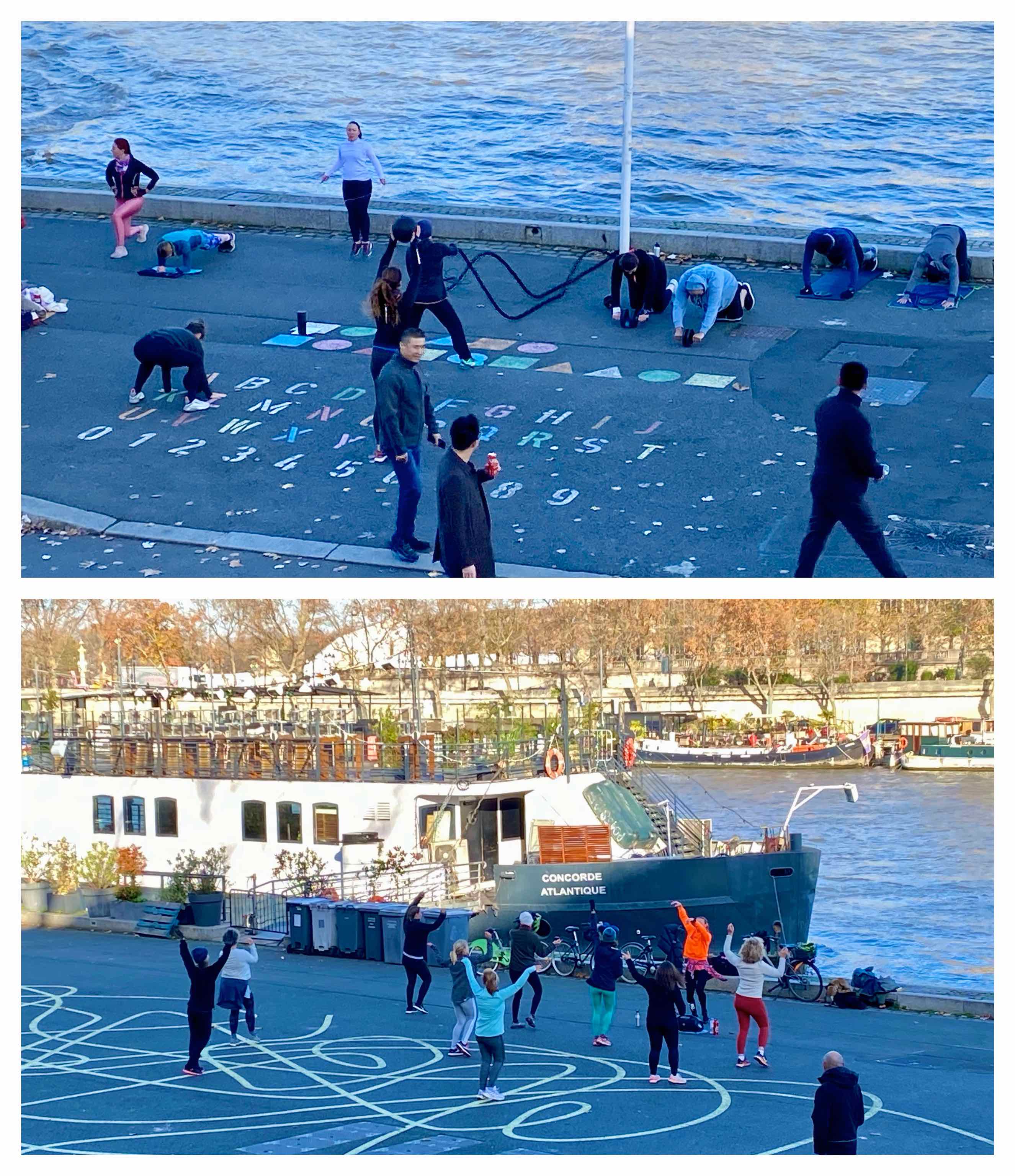
Even though it is cool today there are lots of people out walking and exercising along the Seine River. There are several group classes taking place as well as people working out individually.

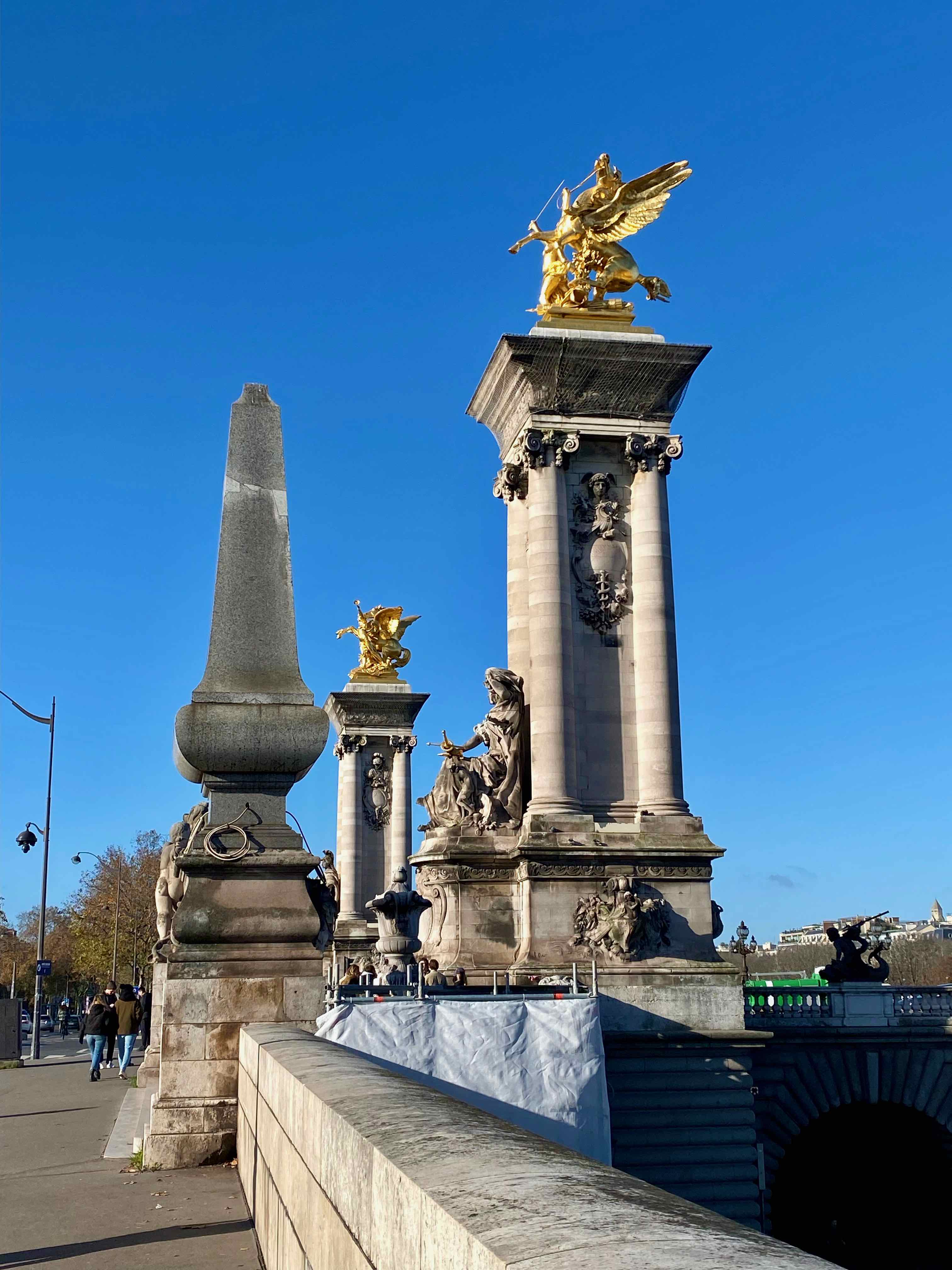
I walk by the entrance to the beautiful Pont Alexandre III, on my way to meet Bob.  I have never walked this route before so I enjoy seeing a bit more of Paris.

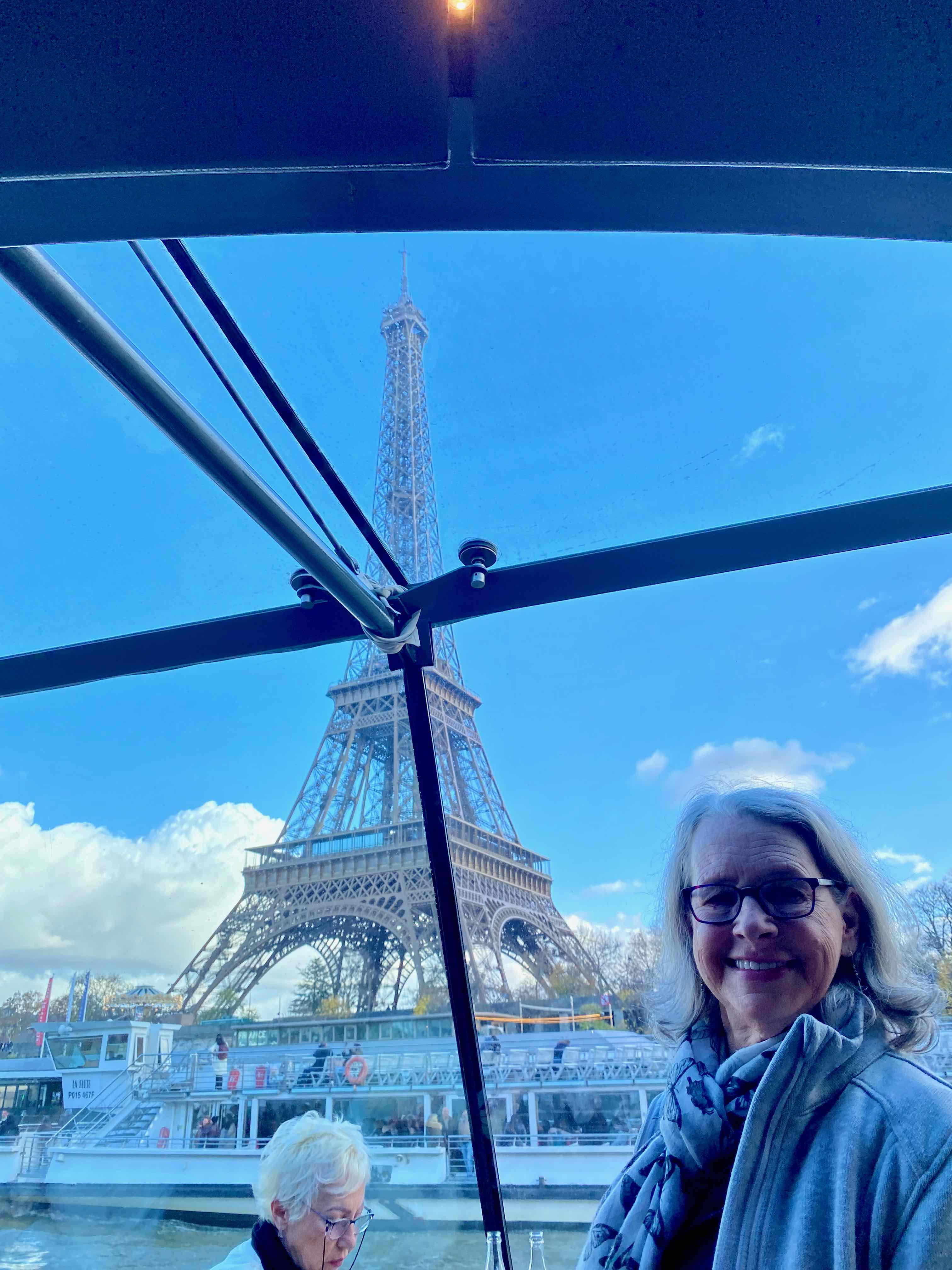
I am almost at the boat docks for Bob’s birthday lunch cruise.  It is near the Eiffel Tower.  I arrive before Bob and I am worried that we might be late, as people are already boarding, but all is well.

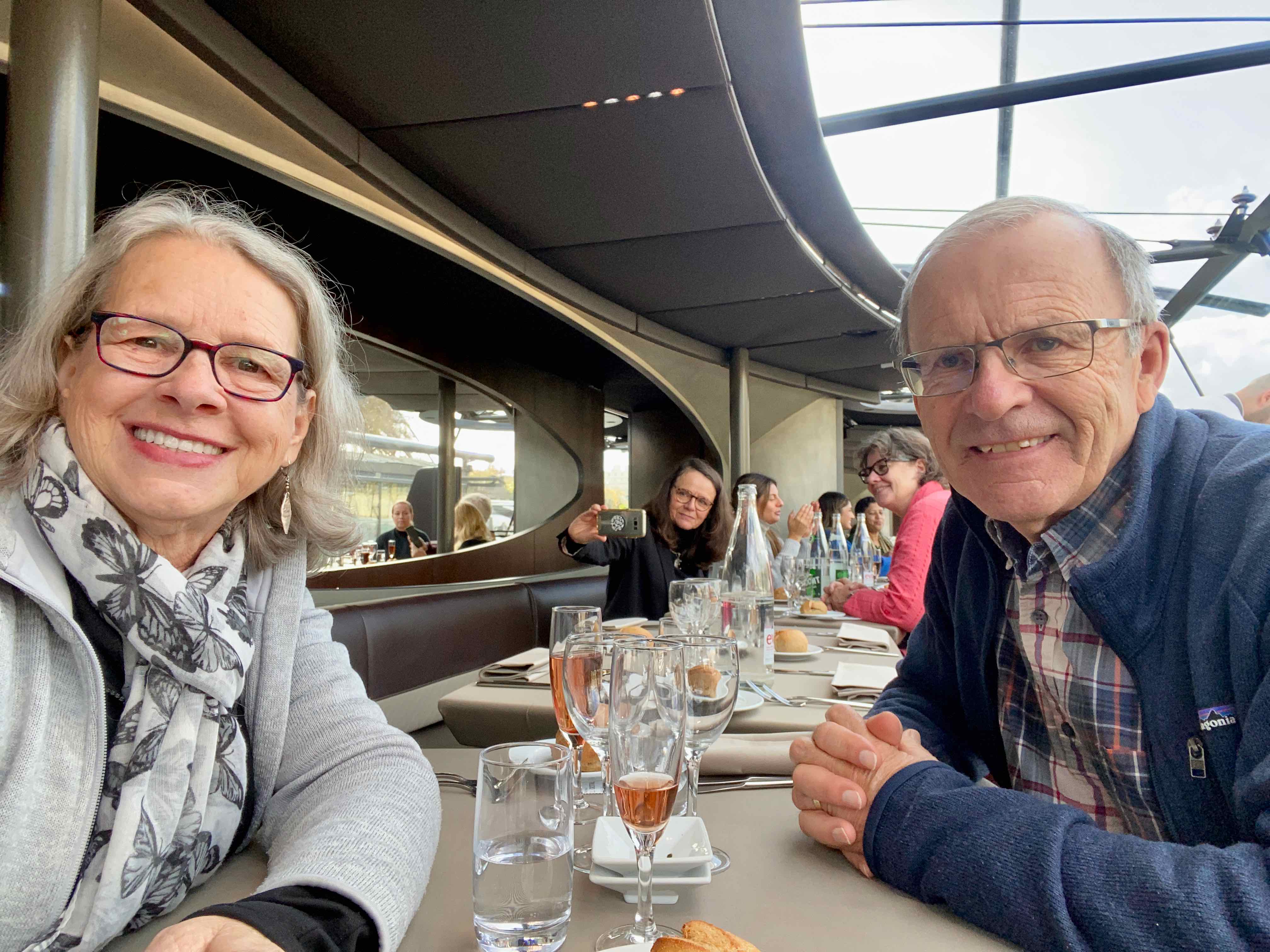
A selfie as we enjoy a glass of wine before our meal.  

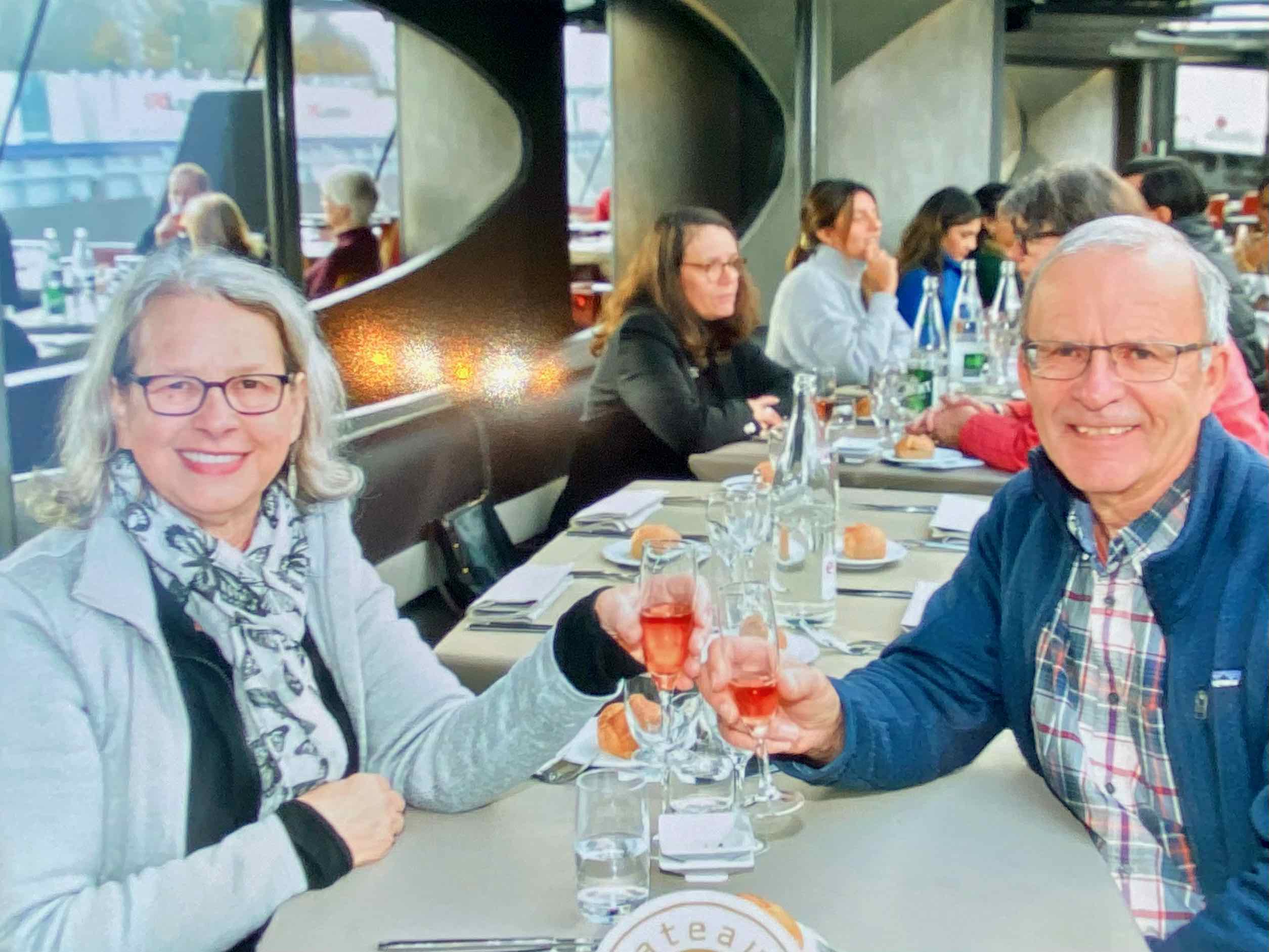
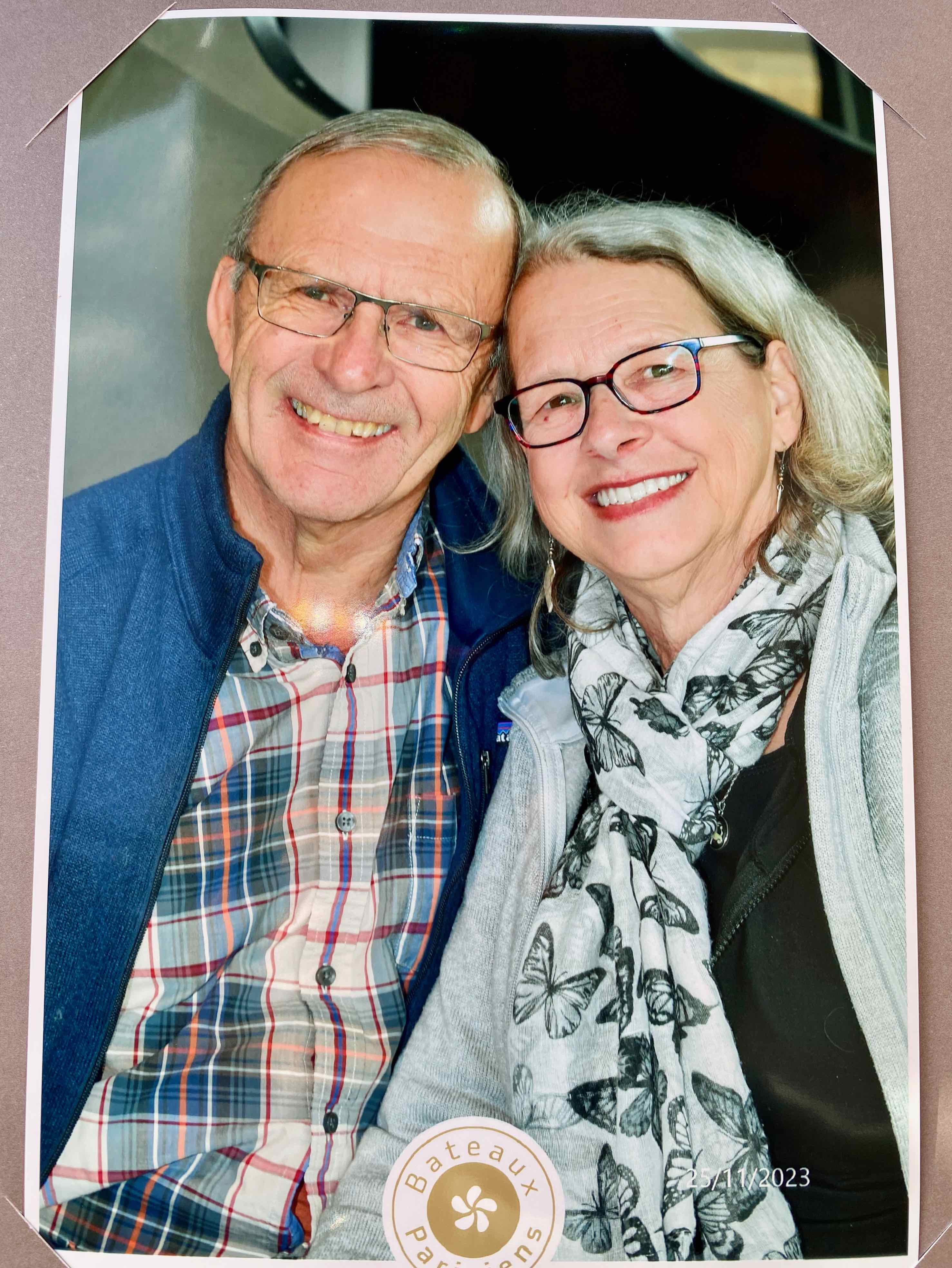
and then a photographer comes by and takes this picture for us. Because this trip is for our 50th wedding anniversary and today is Bob’s birthday we had almost a dozen photos taken of us, while everyone else only had two or three!

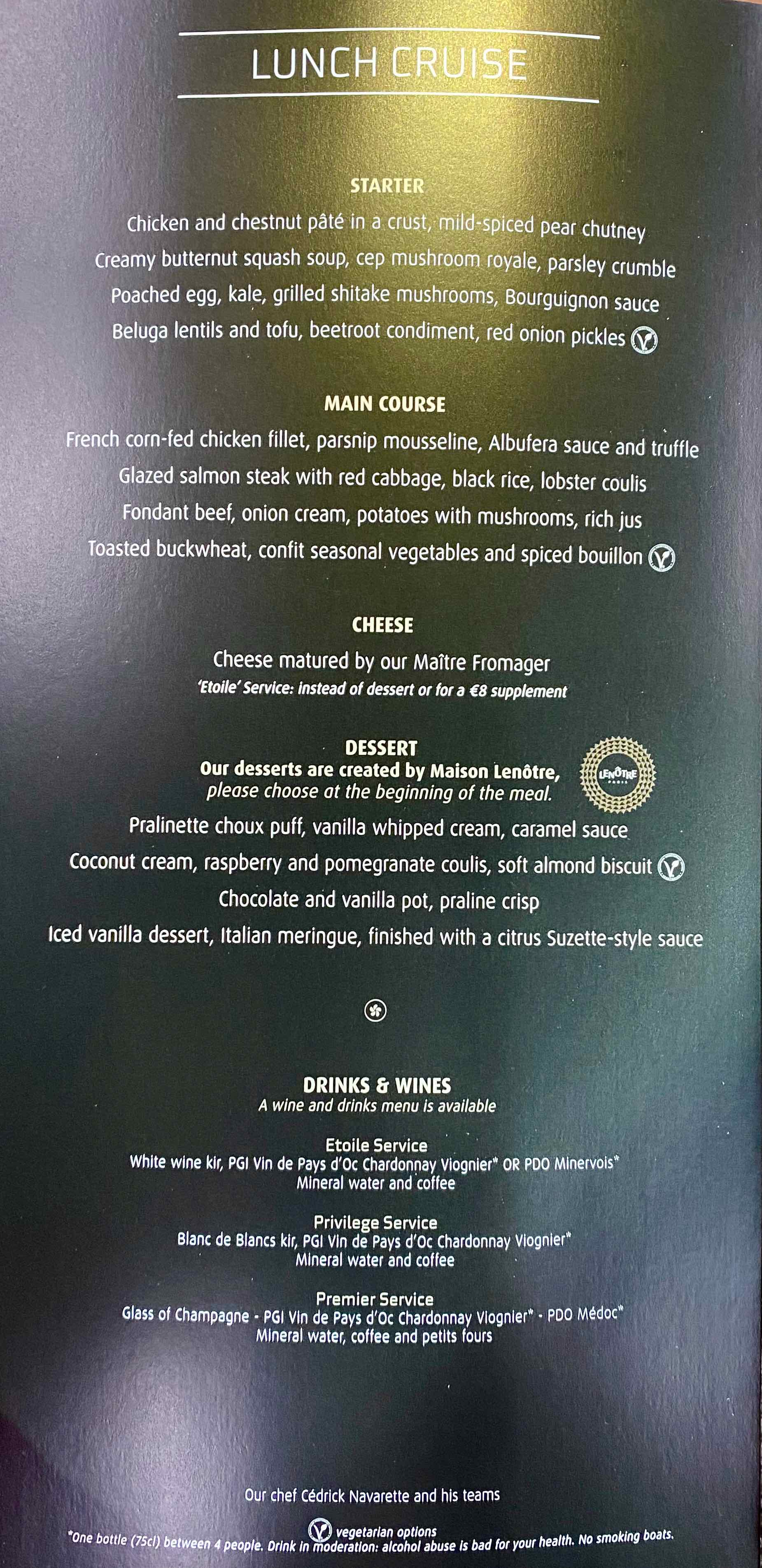
Our menu. 

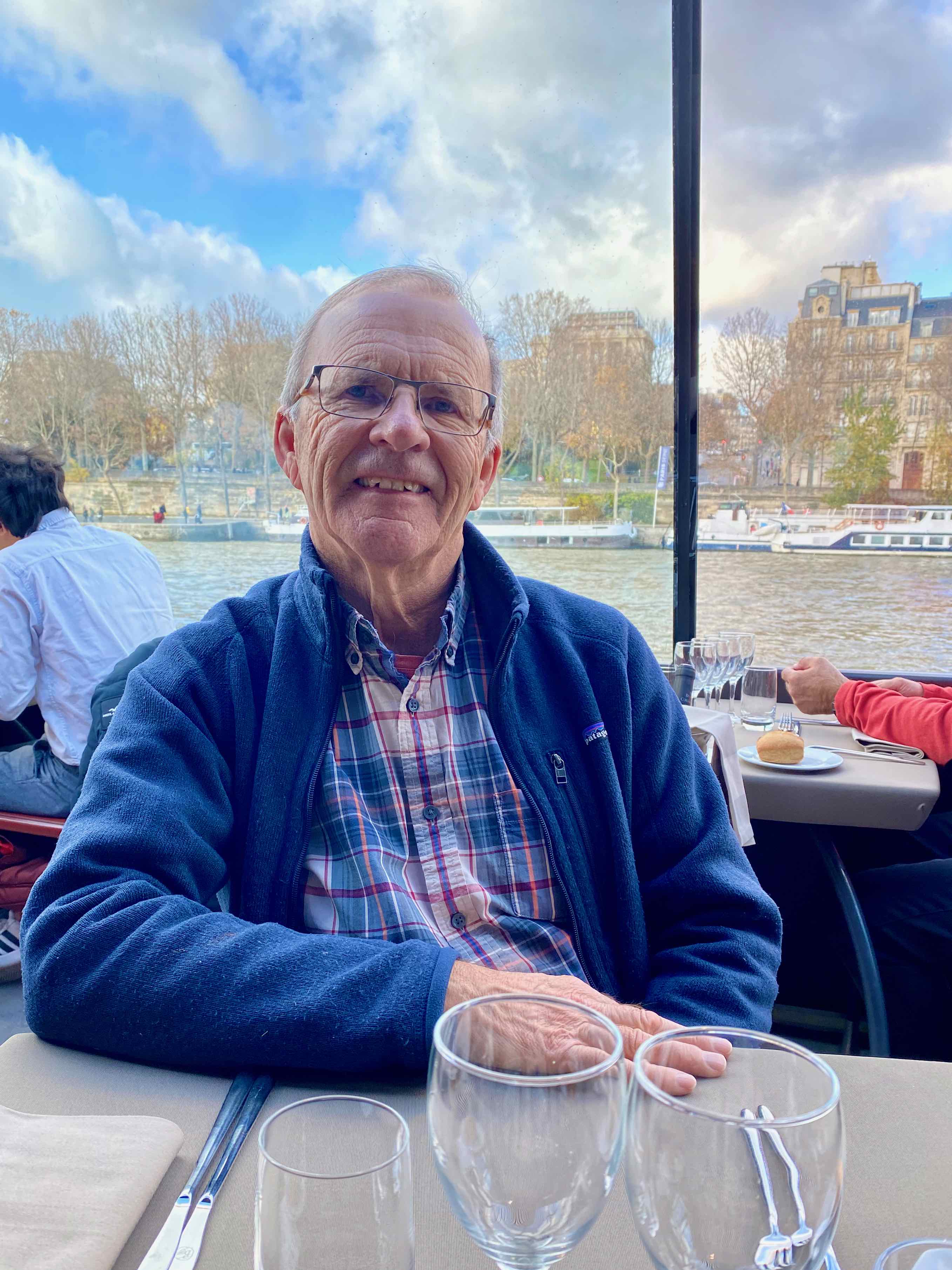
Bob is enjoying his birthday treat!

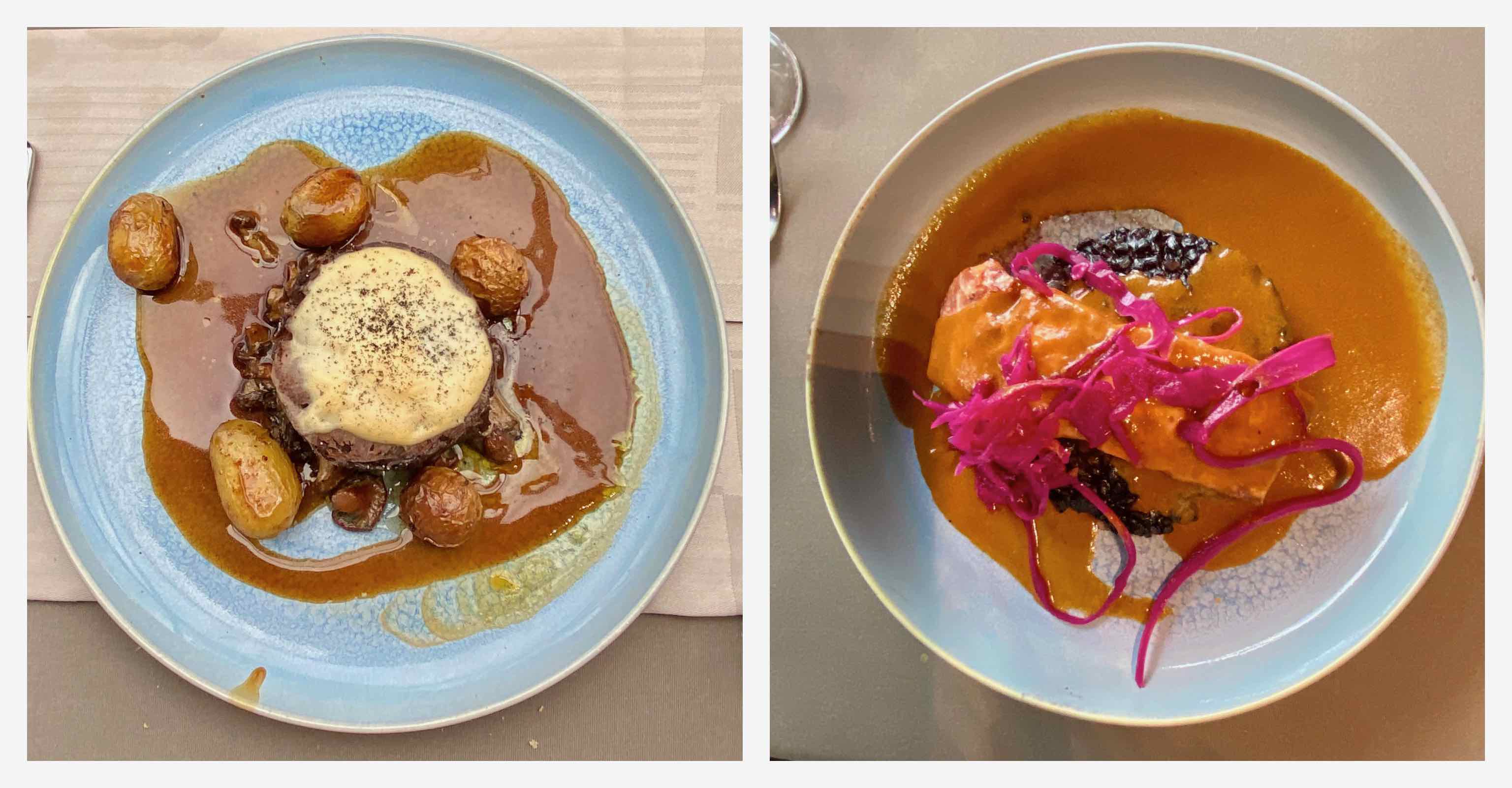
Bob’s Fondant Beef, onion cream, potatoes with mushrooms and rich jus, and my Glazed salmon steak with red cabbage, black rice and lobster coulis.  Both meals were delicious!

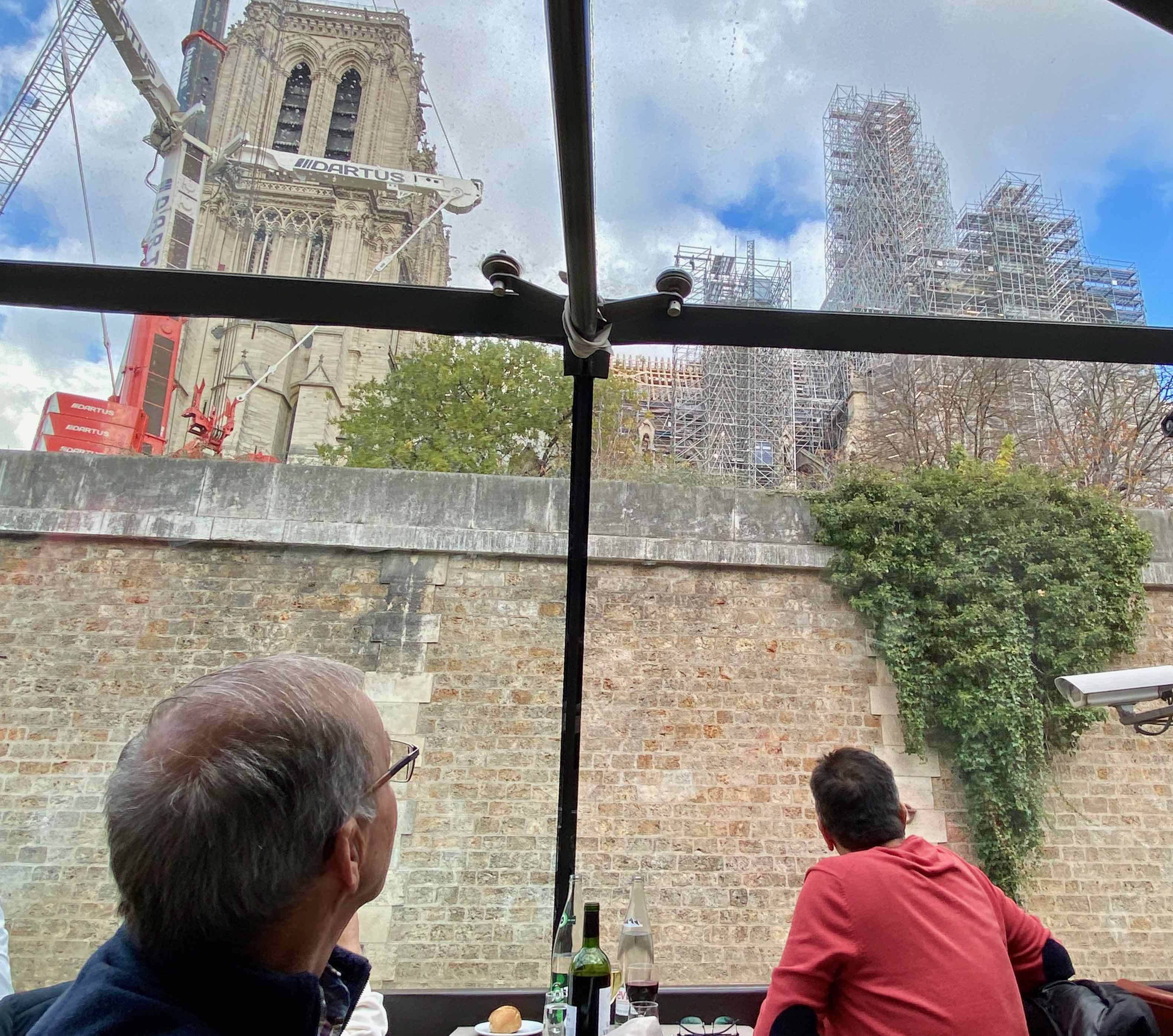
They are still working on restoring Notre dame and the building is covered in scaffolding.

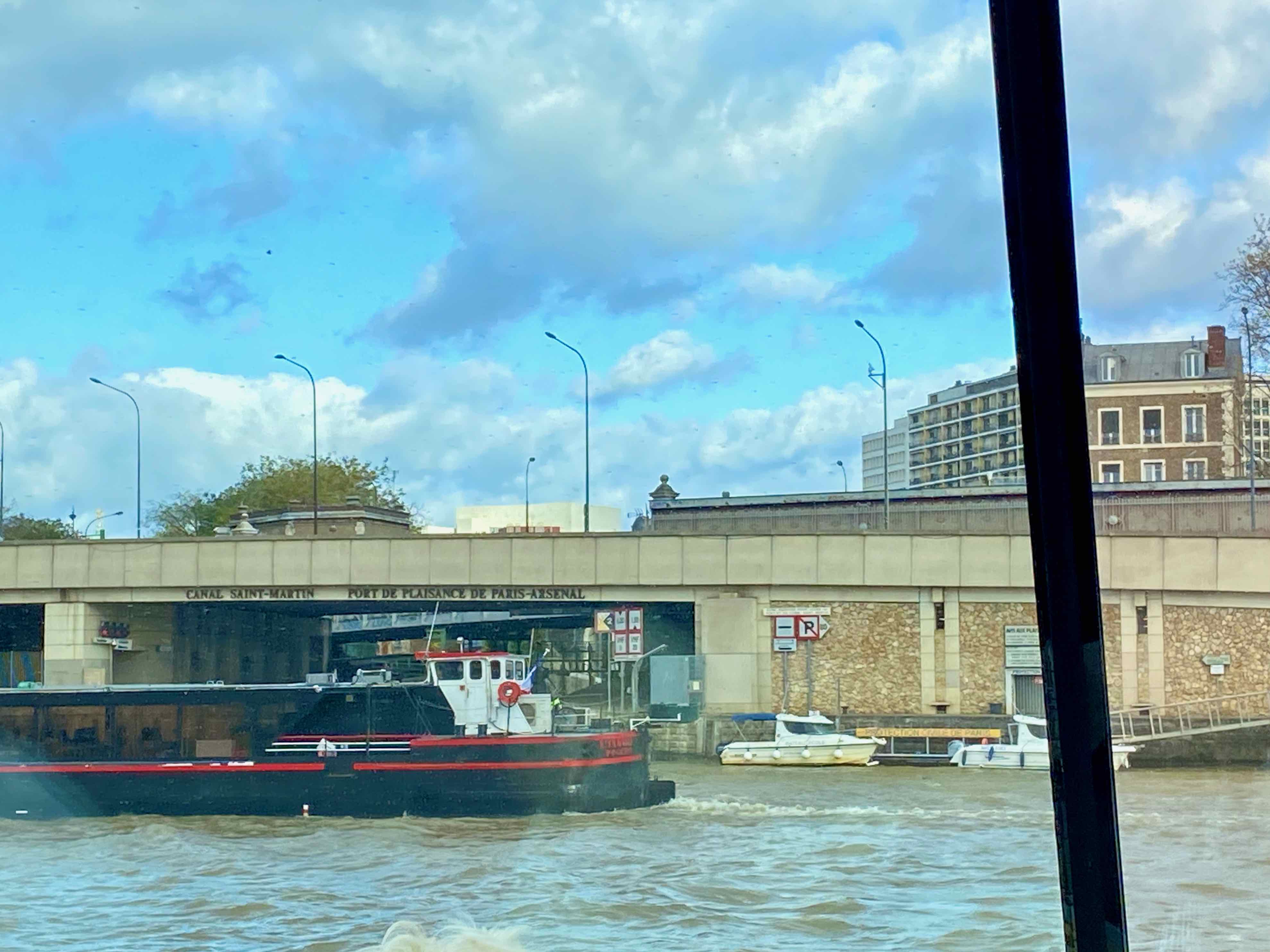
We headed east on the Seine River and see some of the more modern part of Paris before we turn around and head back towards the Eiffel Tower.

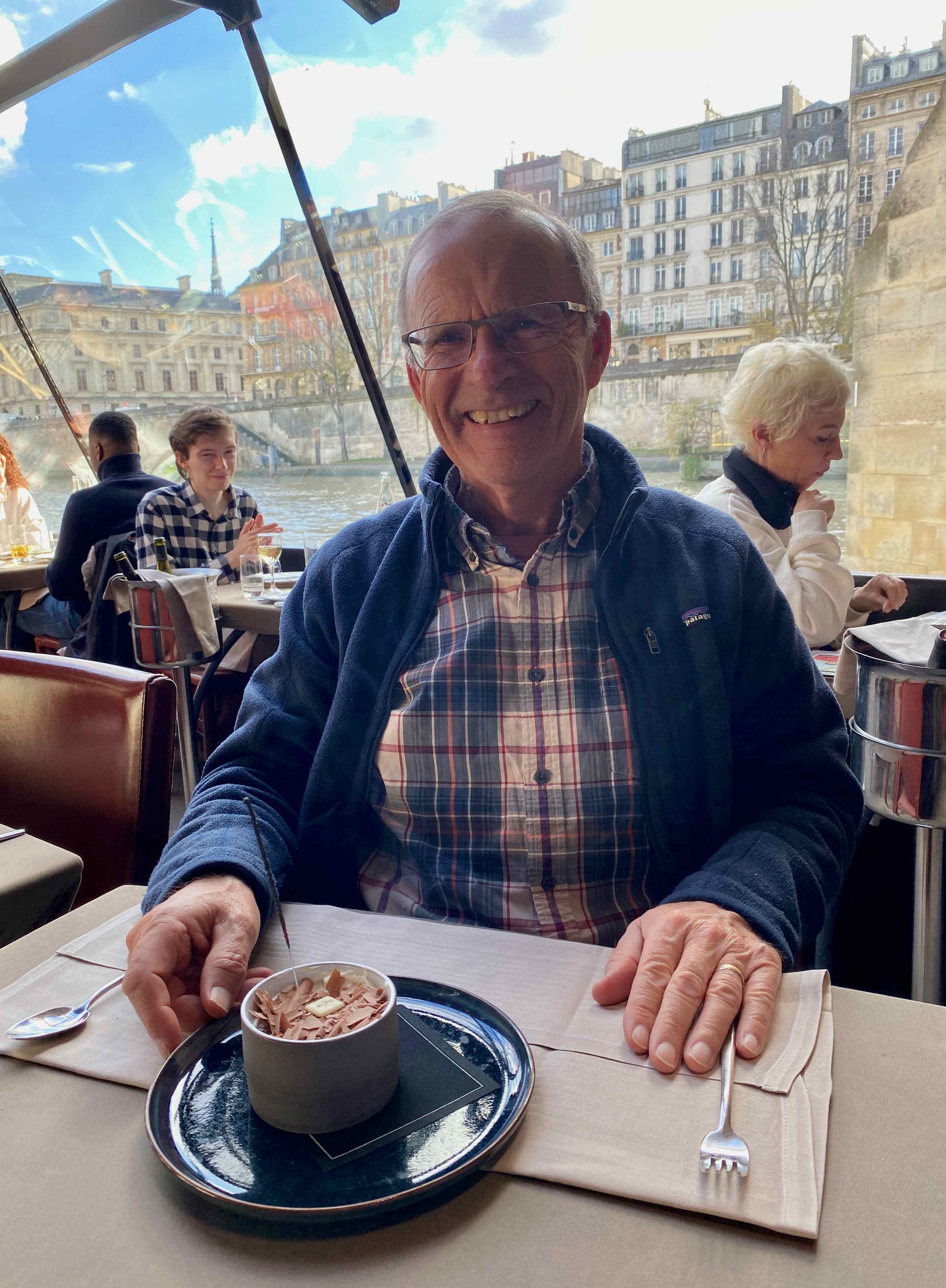
Bob’s dessert comes with a sparkler and the singing of ‘Happy Birthday’ and lots of clapping.  He definitely enjoys all the attention!

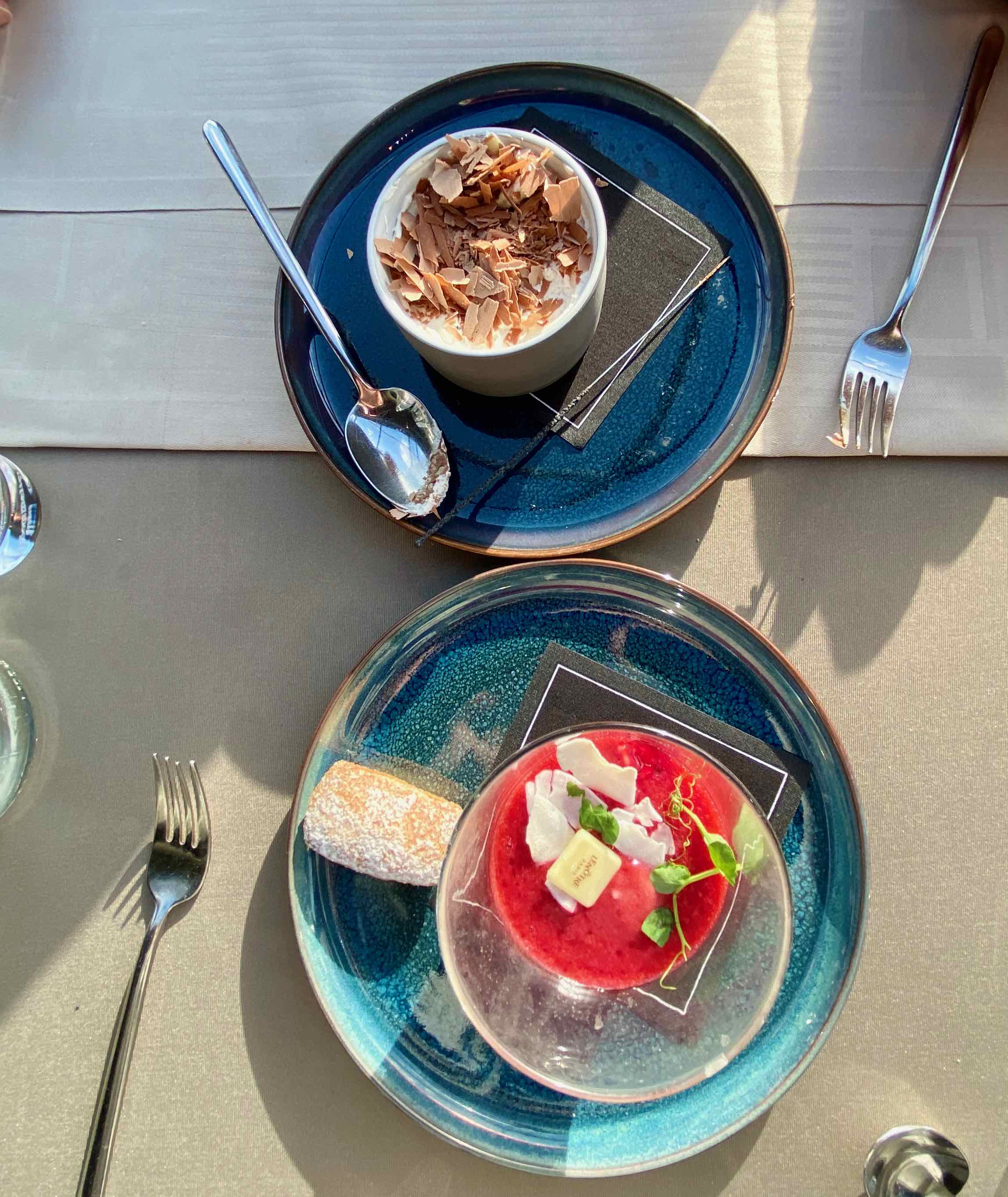
Bob has the Chocolate and vanilla pot with praline crisp and I love my Coconut cream, raspberry and pomegranate coulis with soft almond biscuit.  All our food was delicious.

We purchased this photo as a keepsake. I would have liked to buy a few more photos but they were €20 (about $30) each!We pass the dock near the Eiffel Tower…
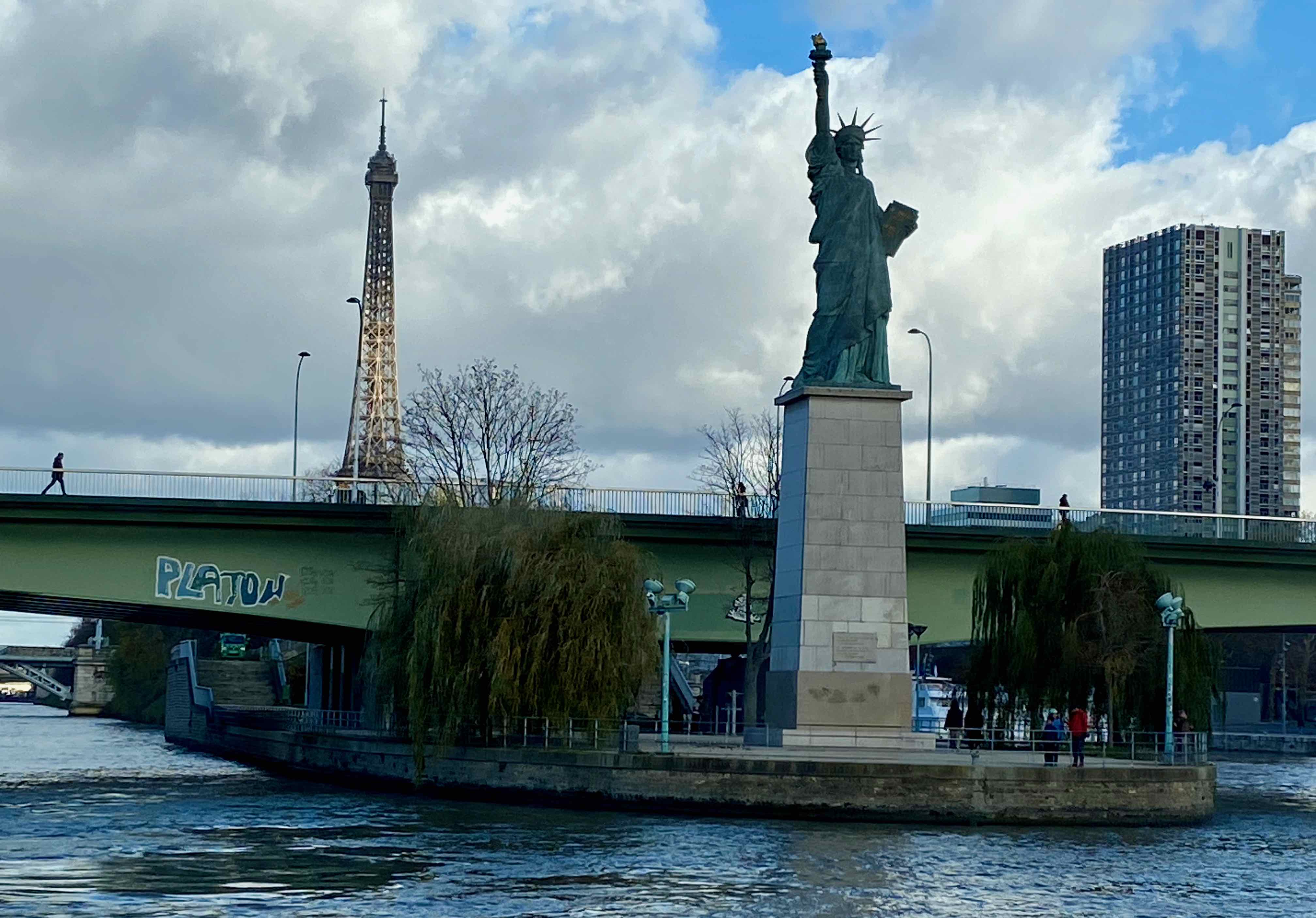
and the Statue of Liberty!  Bob was surprised to see this statue but I remembered her from my last trip.

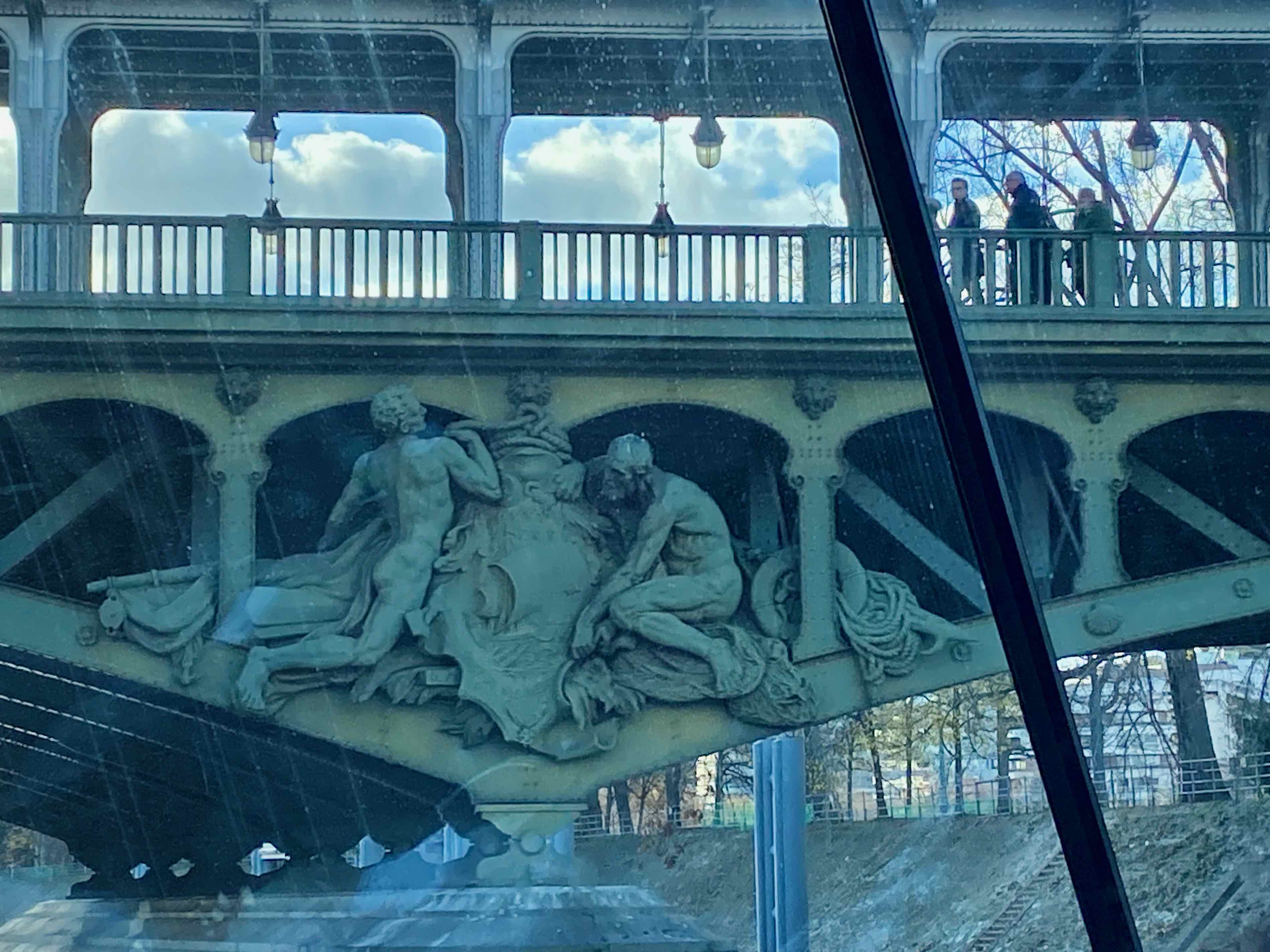
We pass under Le Pont de Bir-Hakeim with its  beautiful decorations before docking.  We both had such a great time and enjoyed seeing Paris from the Seine River.

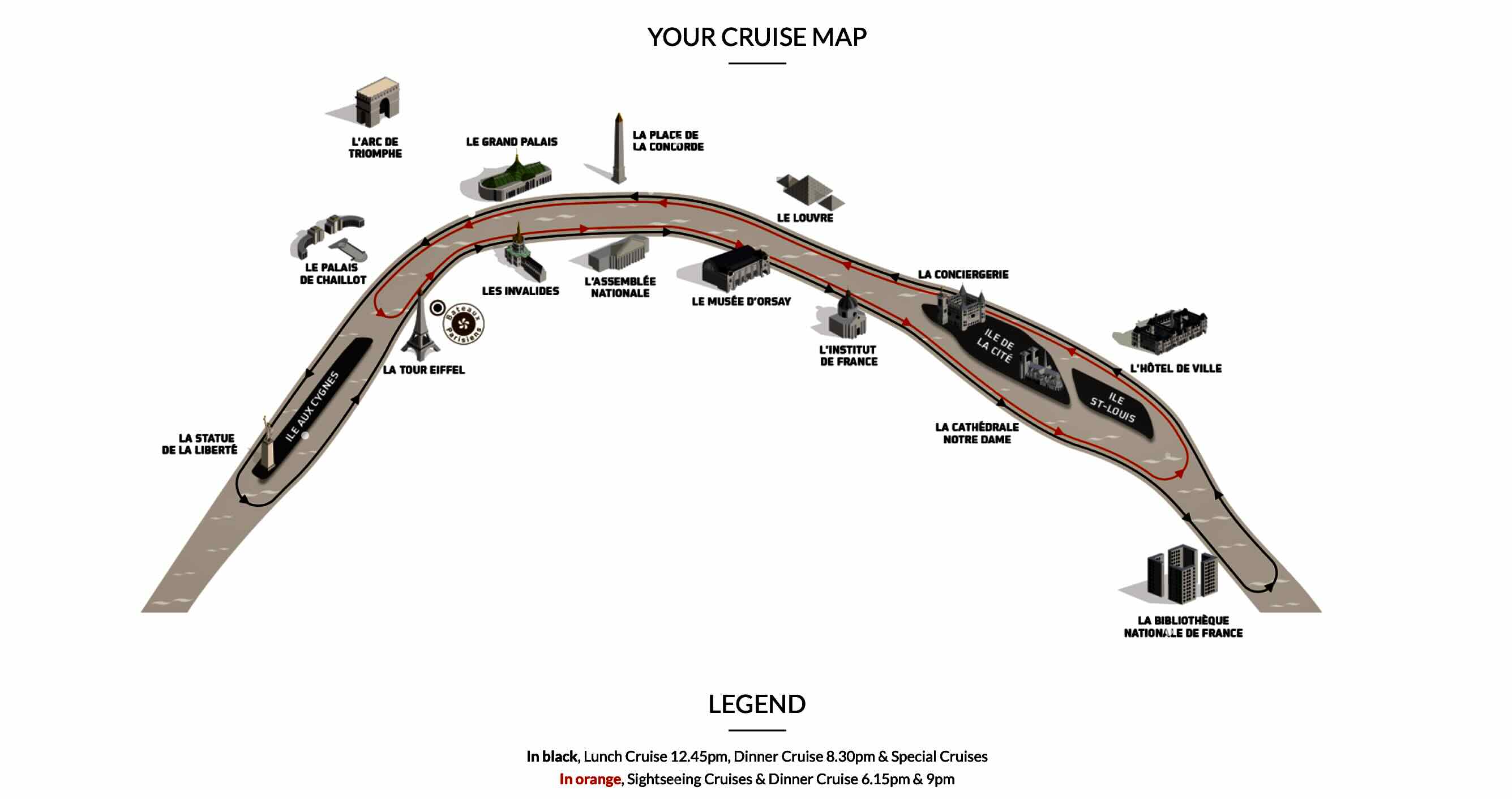
This map shows our route, the lunch cruise follows the black line on the map. You might have to zoom in a bit, I couldn’t manage to make this image any larger.

Screenshot

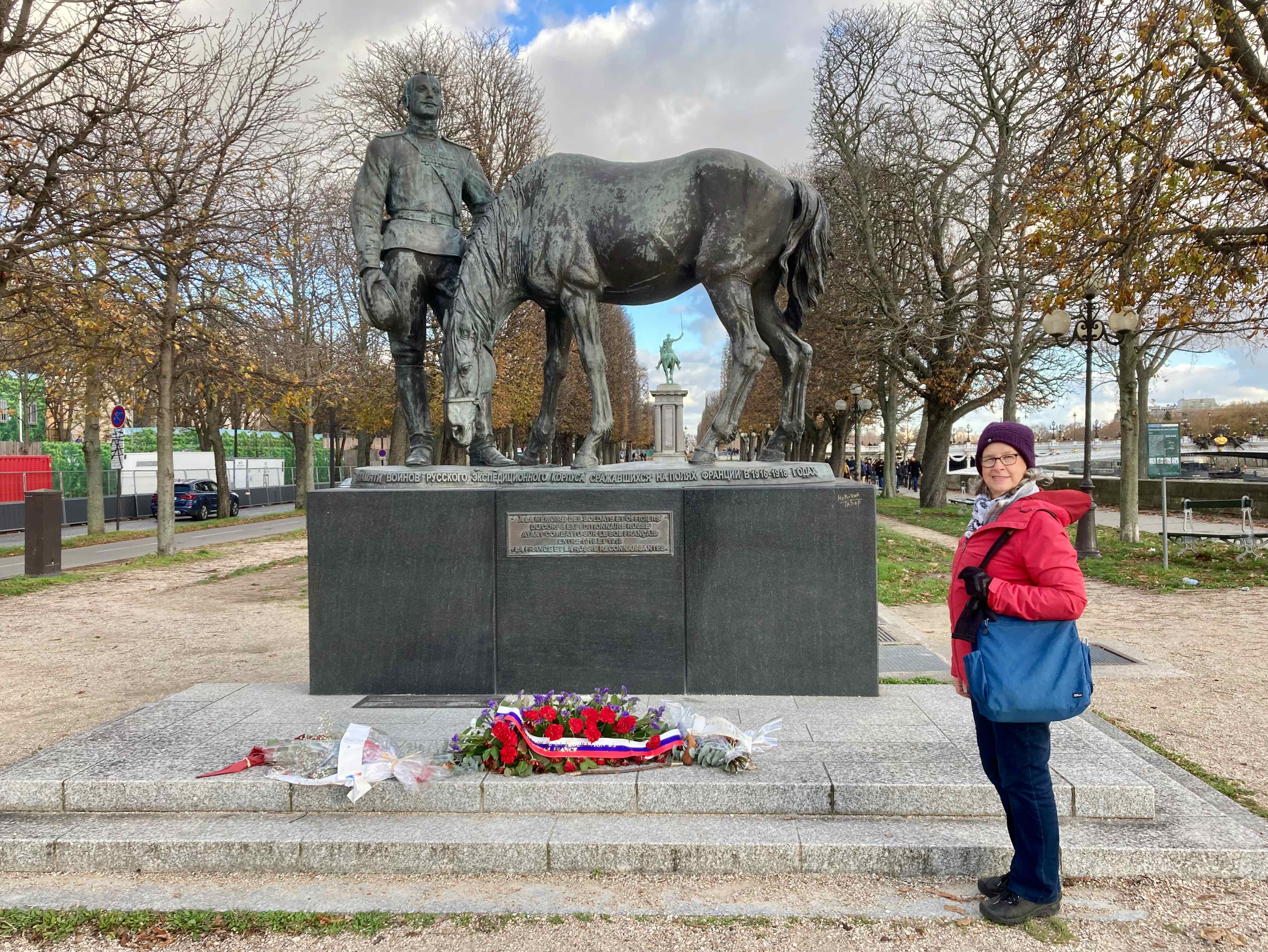
After our wonderful luncheon on the Seine we do a bit of exploring. As we walk along the north side of the Seine we see several monuments.  This one is dedicated to the Russian soldiers and officers killed on French soil between 1916 and 1918.

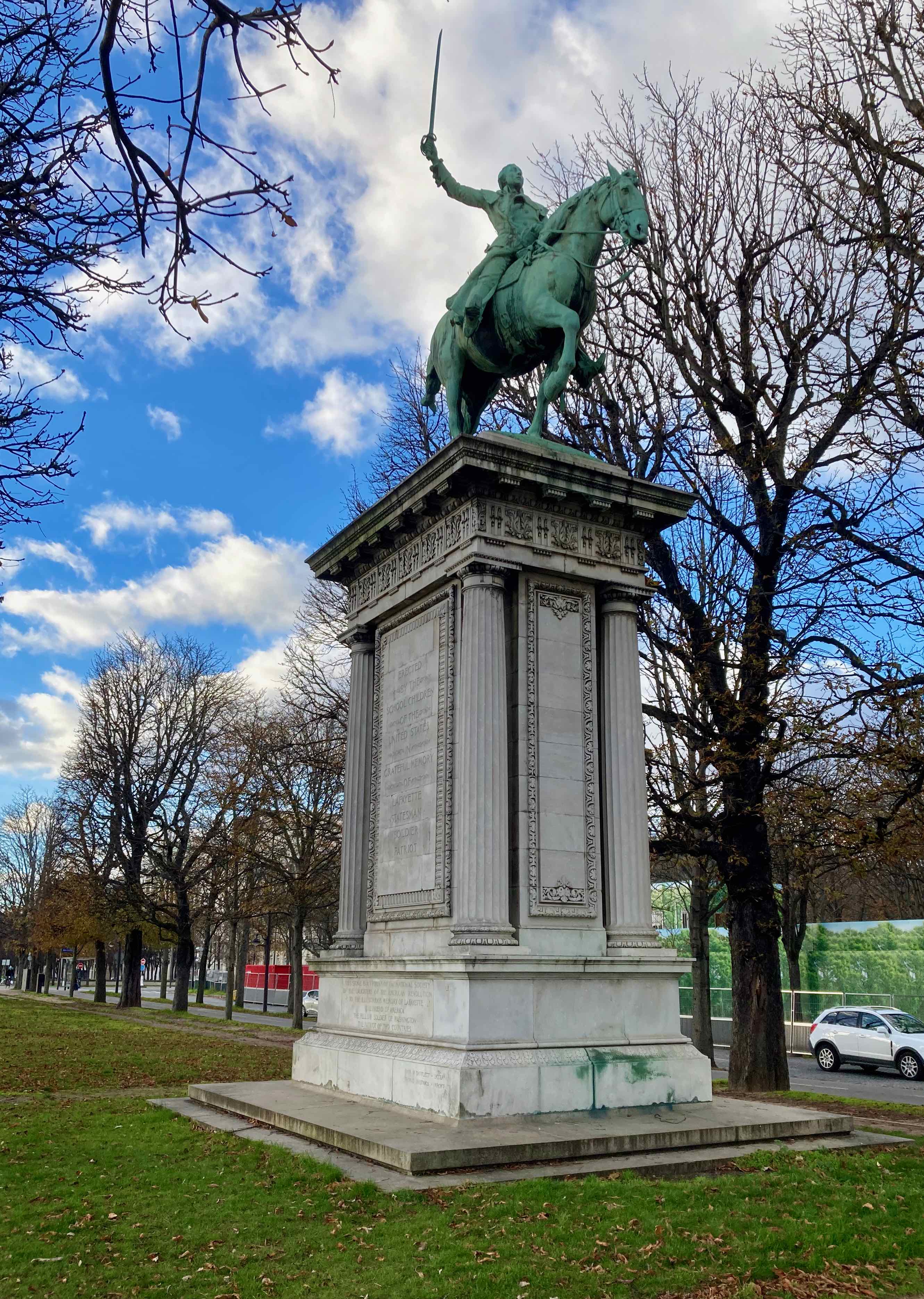
This monument was erected by the school children of the United States.  This link https://www.unjourdeplusaparis.com/en/paris-insolite/detail-insolite-statue-la-fayette shares an interesting, often overlooked detail about this monument, one we did not notice until I was doing a bit of research while writing this post.

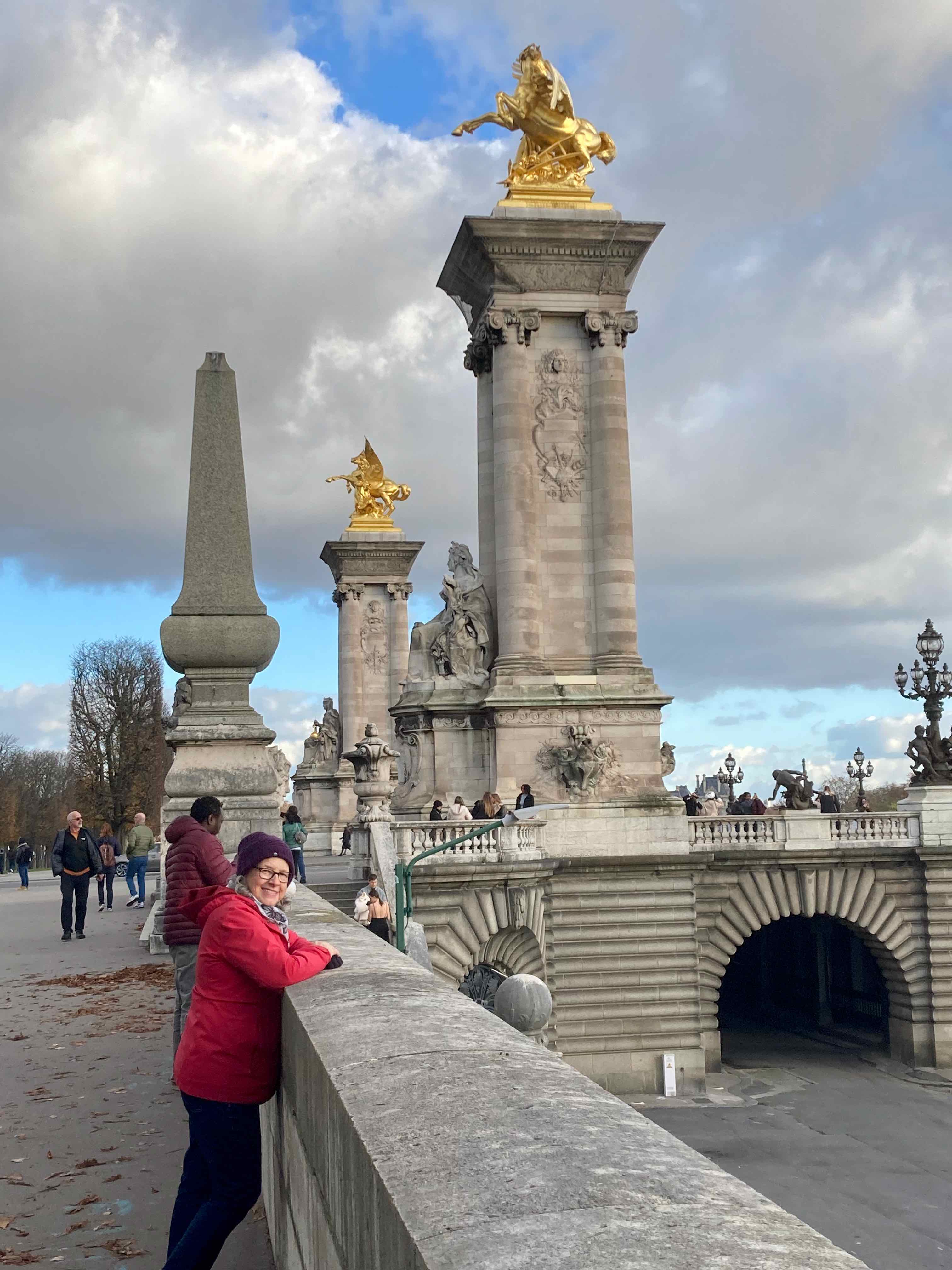
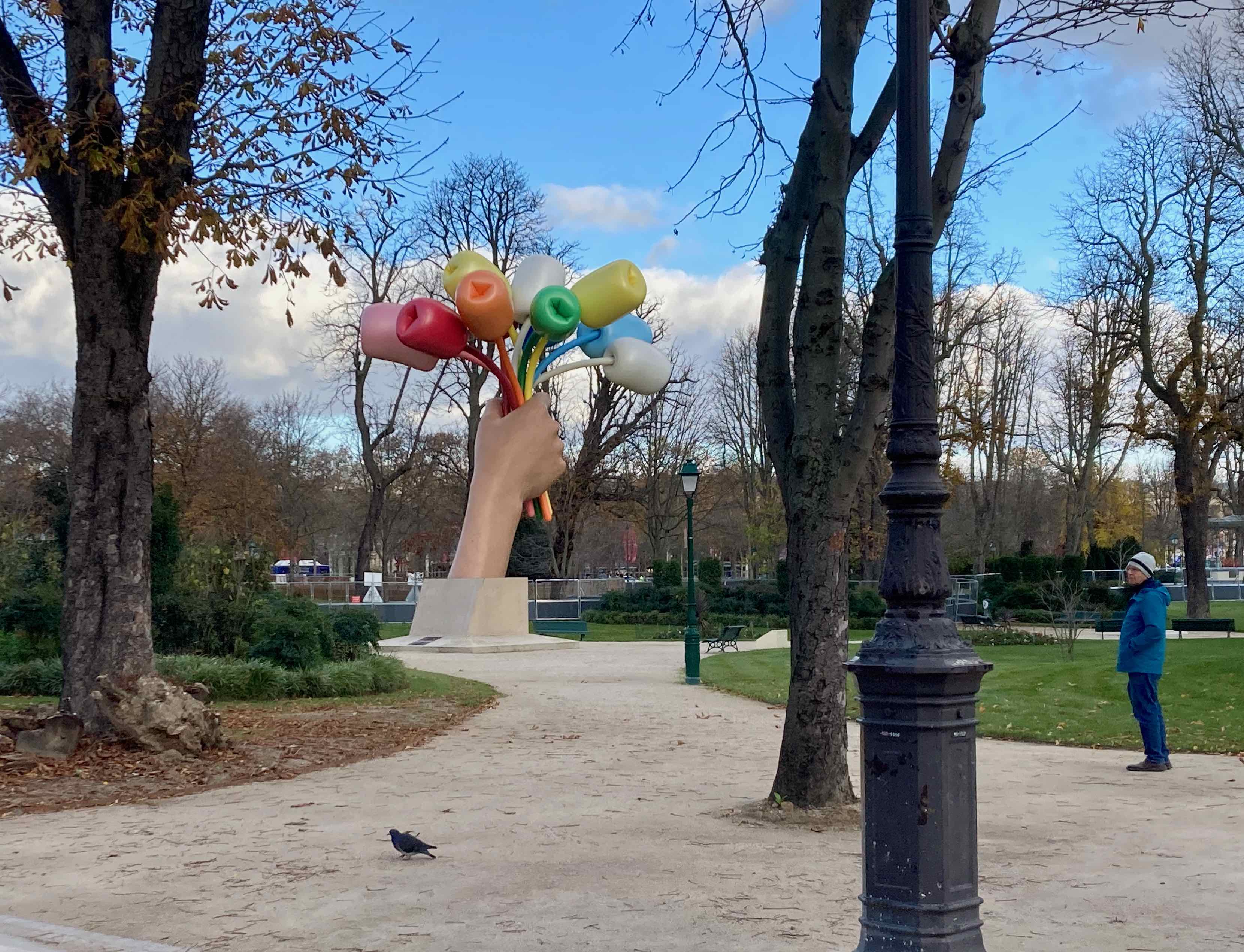
As we make our way back towards the Louvre, we stop for a photo of Le Pont Alexandre III.  It really is a magnificent bridge!Jeff Koons gifted his Bouquet Of Tulips to Paris in 2019. I did a bit or research trying to find out a bit more about this sculpture and came across this interesting article. https://www.museemusings.com/blog/jeff-koons-goes-to-paris

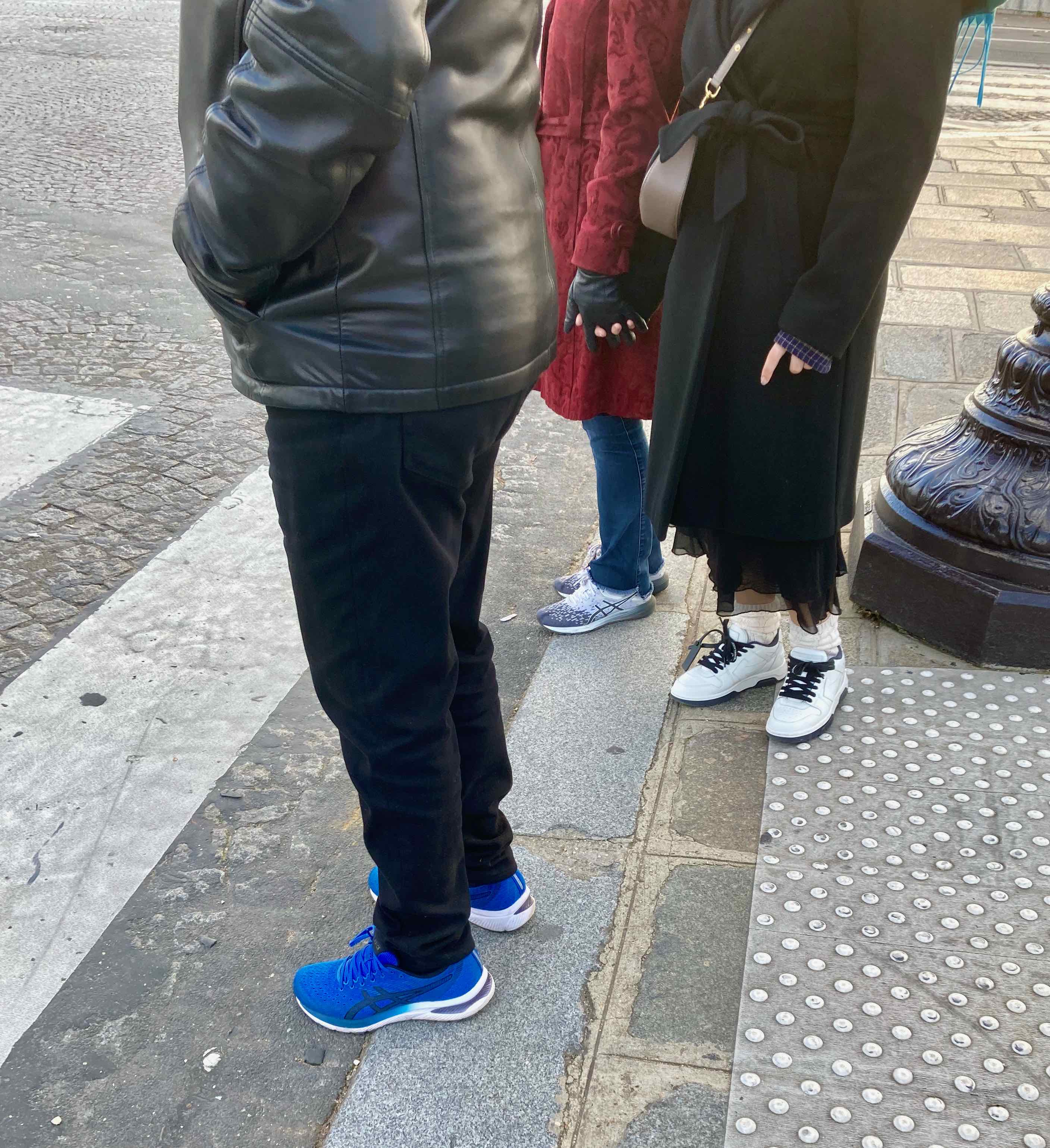
Parisien’s love their ‘baskets’ or running shoes.  Seems like everyone wears them now.

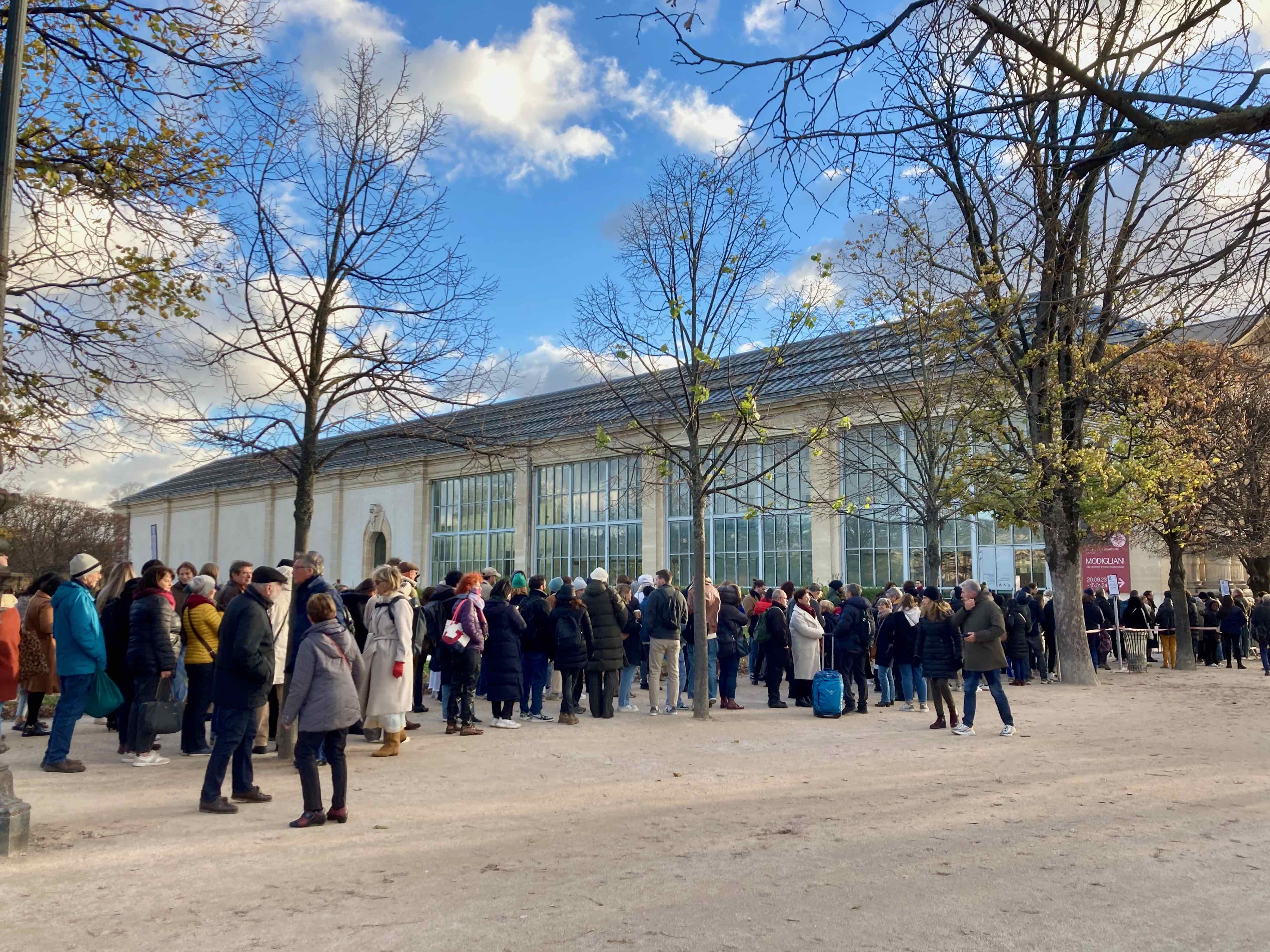
Next, we line up to enter the Orangerie to see Monet’s “Water Lilies”.  It is a good thing we have purchased our tickets in advance, because once again, the line up for those who do not have tickets is very long.  Our line was long enough…can you see Bob in his blue coat?

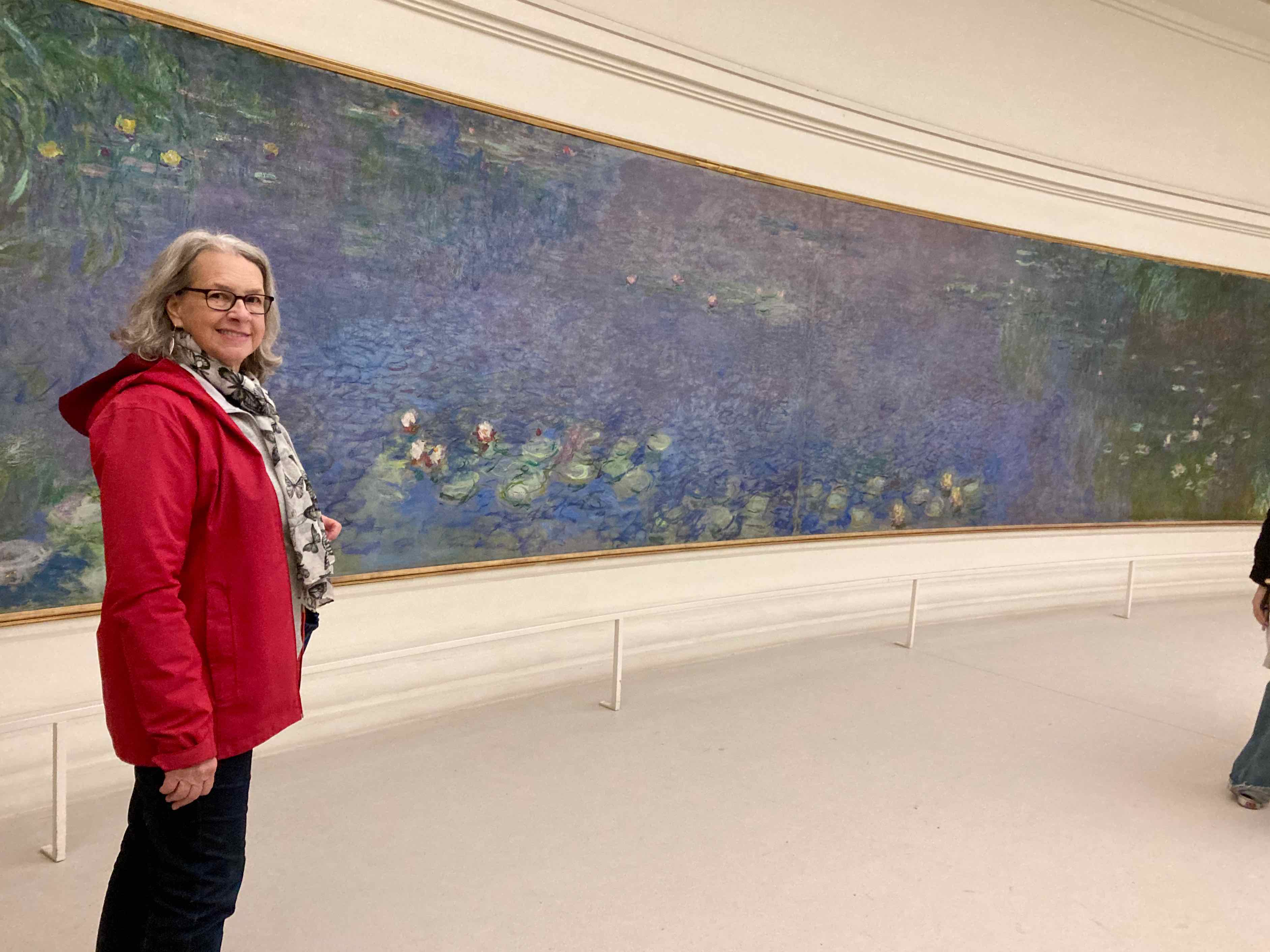
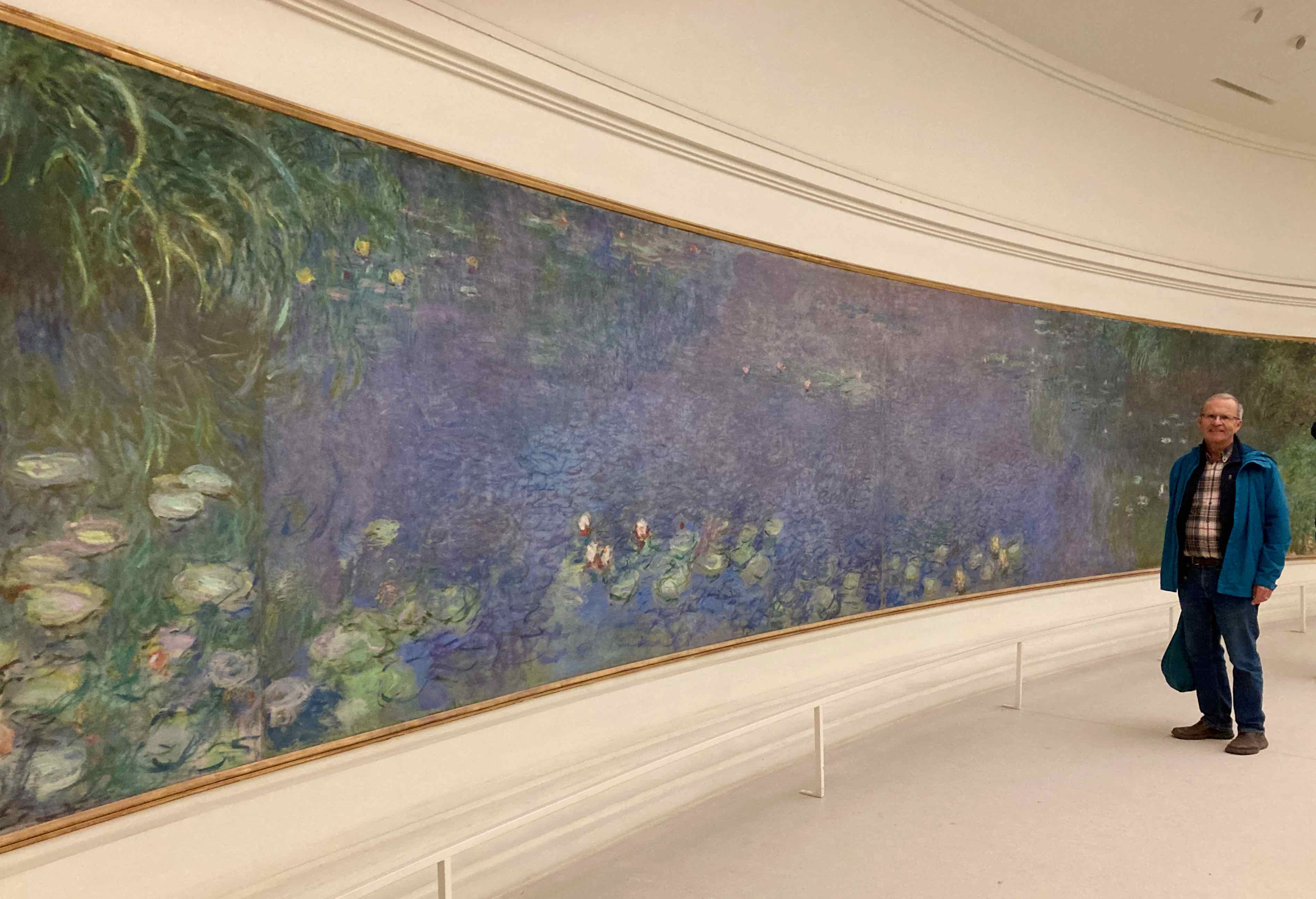
I was pleasantly surprised to see that it is now permissible to take photos inside the Orangerie.  When I visited in 2014 this was strictly prohibited.  

The paintings are enormous, and there are eight of them displayed in two oval rooms designed expressly for this purpose.  Bob is not as enamoured with these paintings as I am.

I was thrilled that there was a Modigliani show downstairs!  Amadeo Modigliani is one of my favourite painters and there were many paintings that I knew and many that were new to me.

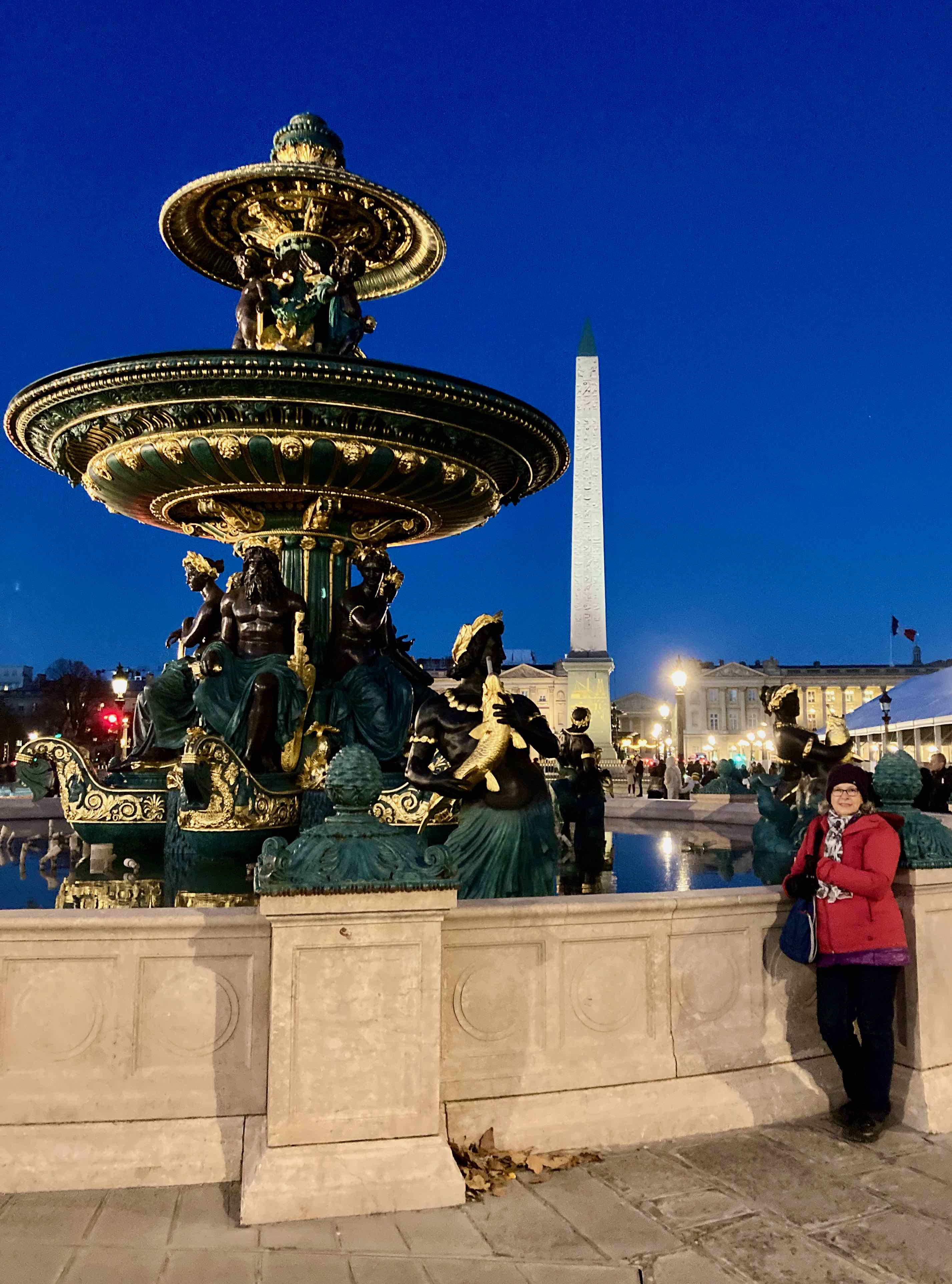
I wasn’t feeling well, so we left the Orangerie and walked a bit outside and the fresh air helped.  This is the fountain that Bob took a photo of several days ago…The Fountain of Rivers.  It is extremely ornate.

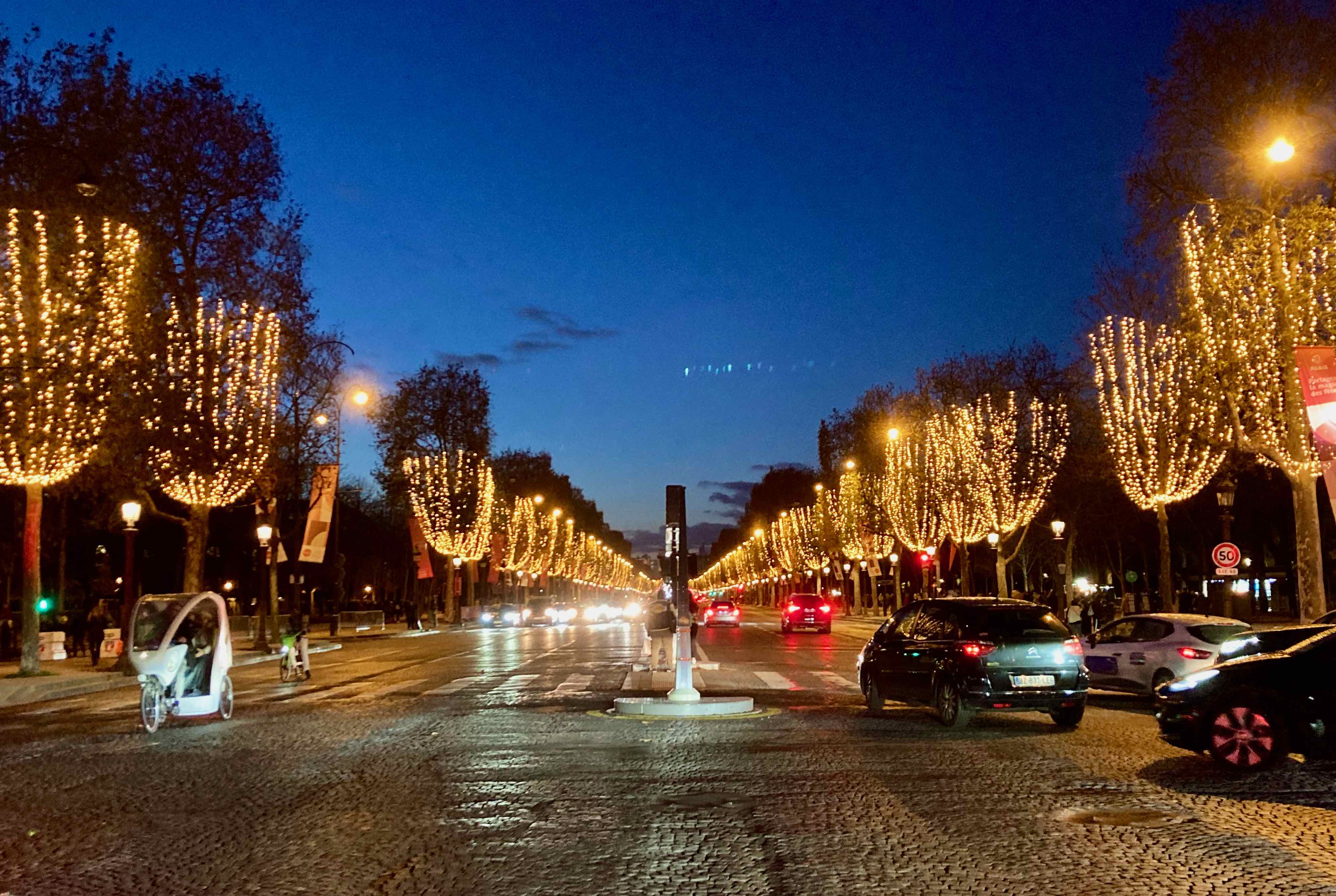
We decided to walk and see some of the Christmas lights on the Avenue des Champs Élysées before going back to our apartment.

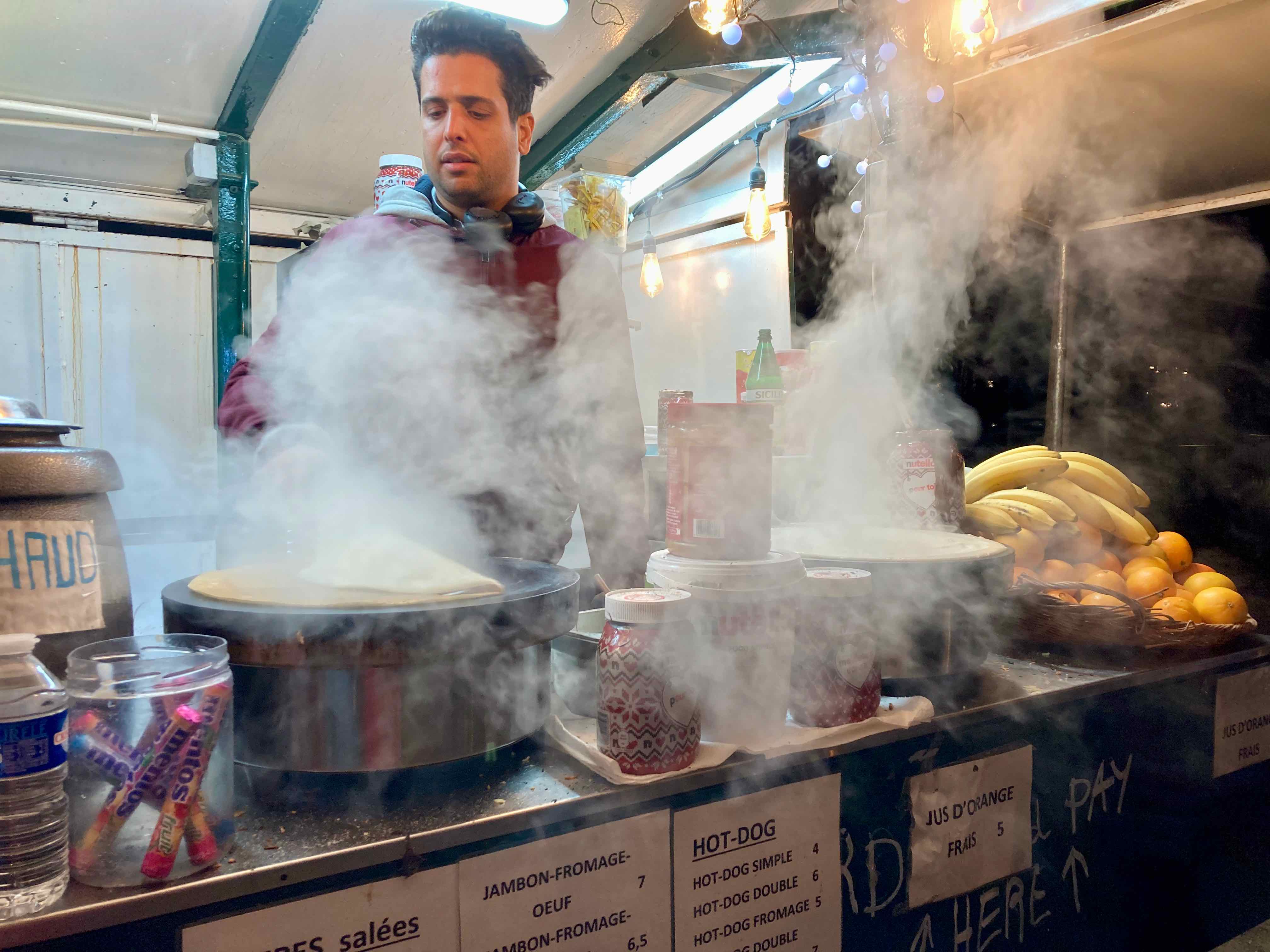
Nearby we see a small stand selling crêpes.  I simply have to have at least one crêpe, before I leave Paris… they are delicious.

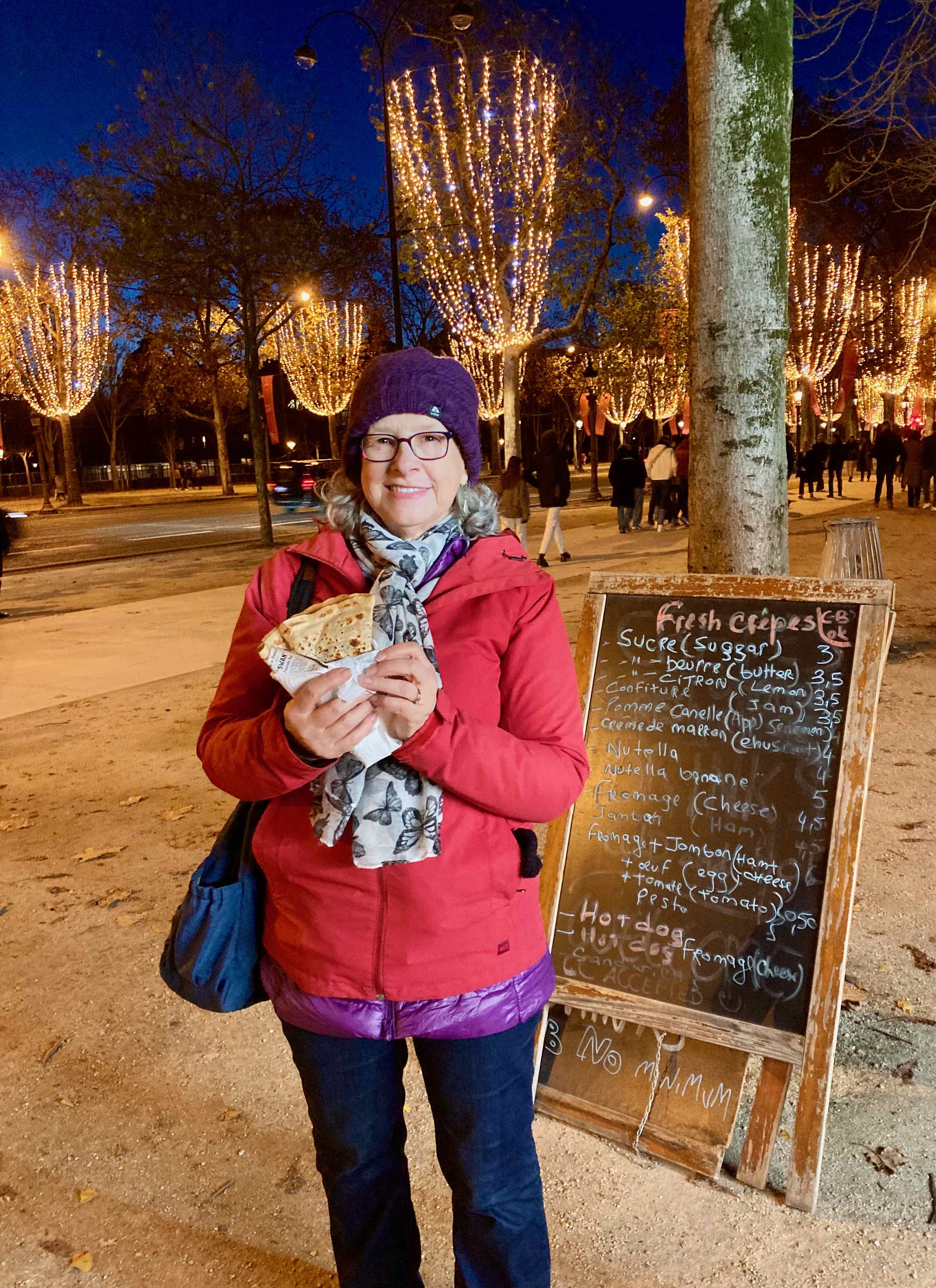
It is a bit chilly but the yummy crêpe warms my hands and tummy…now we can go home.

Musée D’Orsay

Day 87,  Thursday, November 23, 2023

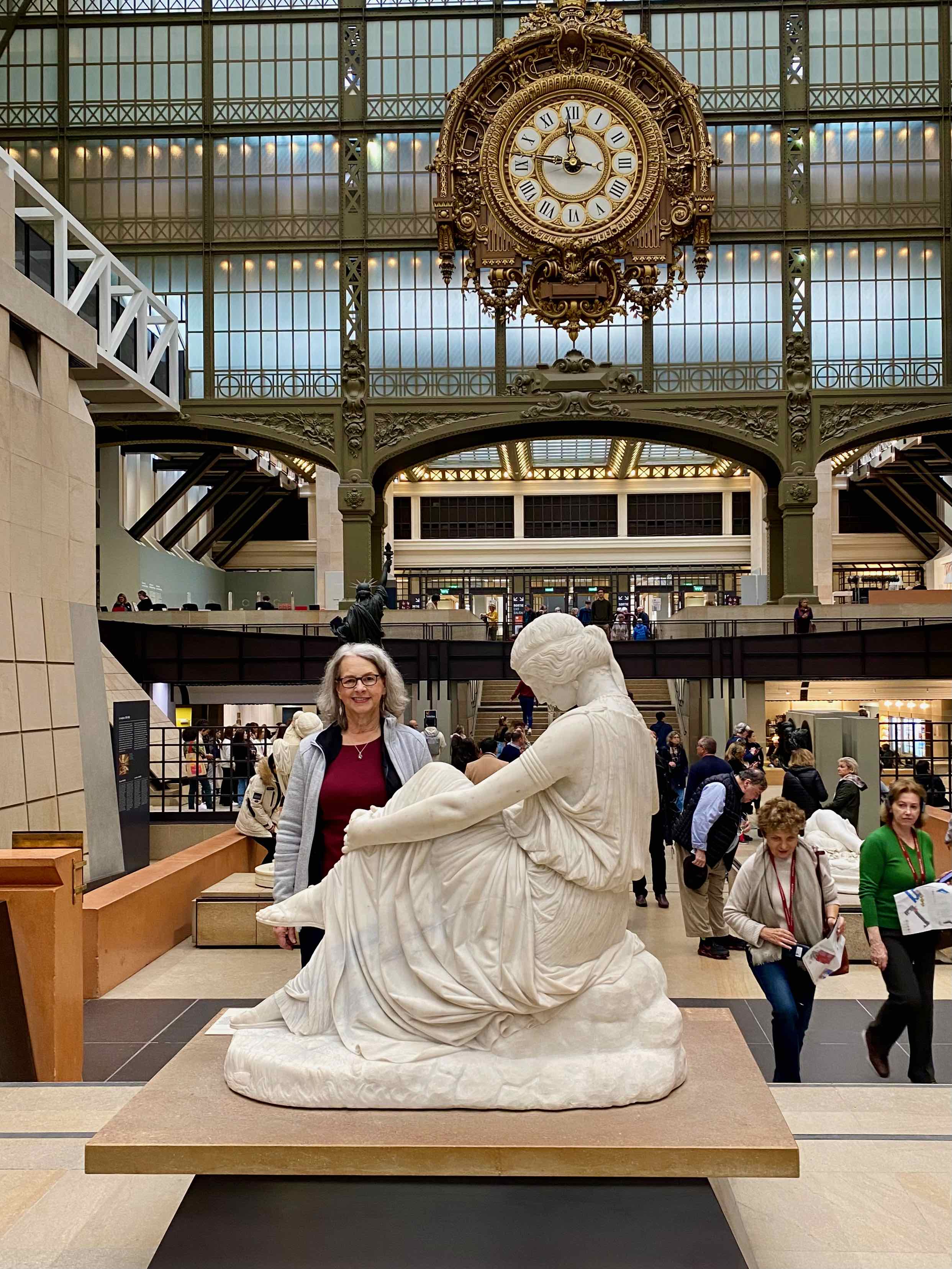
Today is dedicated to the Musée D’Orsay, one of my favourite museums in Paris. It is in the centre of Paris on the banks of the Seine, opposite the Tuileries Gardens. The museum is in the former Orsay railway station, built for the Universal Exhibition of 1900. So the building itself could be considered as the first “work of art” in the Musee d’Orsay, which displays collections of art from the period 1848 to 1914. There is a wonderful temporary Vincent Van Gogh exhibit that we really want to see, so we reserved a 12:00 time to enter the exhibit.  That was a wise move as the lineup without reservations is very long, and people are waiting for up to two hours to see the exhibit!  My friend, Ivy,  also told me about the Louis Janmot exhibit which she really loved, so I’m looking forward to seeing that too.

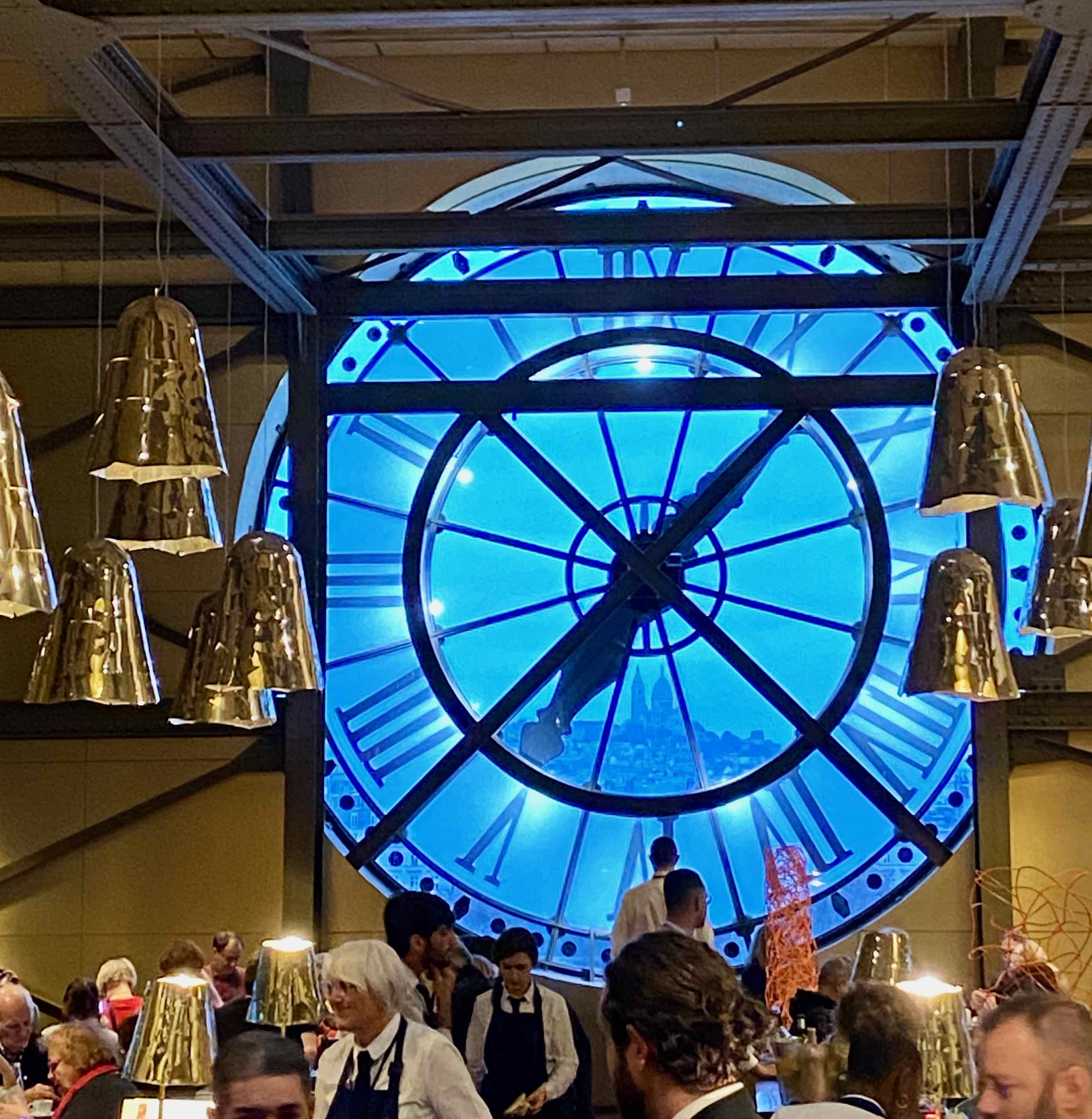
The Musée d’Orsay is a beautiful building, with two enormous clocks. It houses the largest collection of Impressionist and  post-impressionist masterpieces in the world, by painters including Berthe Morisot, Edouard Manet, Degas, Renoir, Cezanne, Seurat, Sisley, Gaugin and Van Gogh.

I think this is my fourth time visiting this fabulous museum and it is wonderful to revisit many of these paintings. There is always something new to notice and appreciate on return visits.  We are a bit early for our entry into the Vincent Van Gogh exhibit so we browse a bit. Here are a few of the main floor paintings.

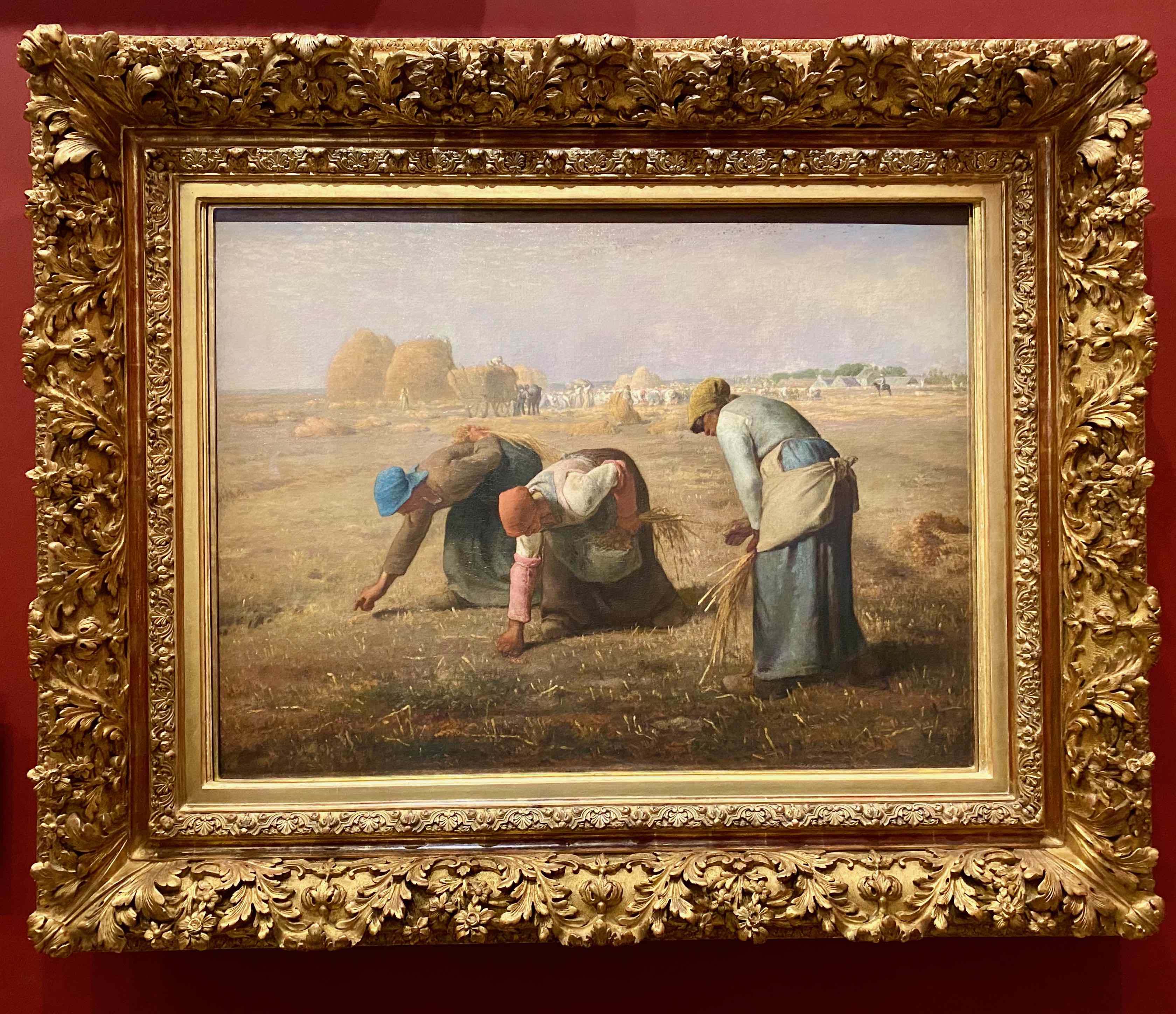
The Gleaners (1857) by Jean-François Millet

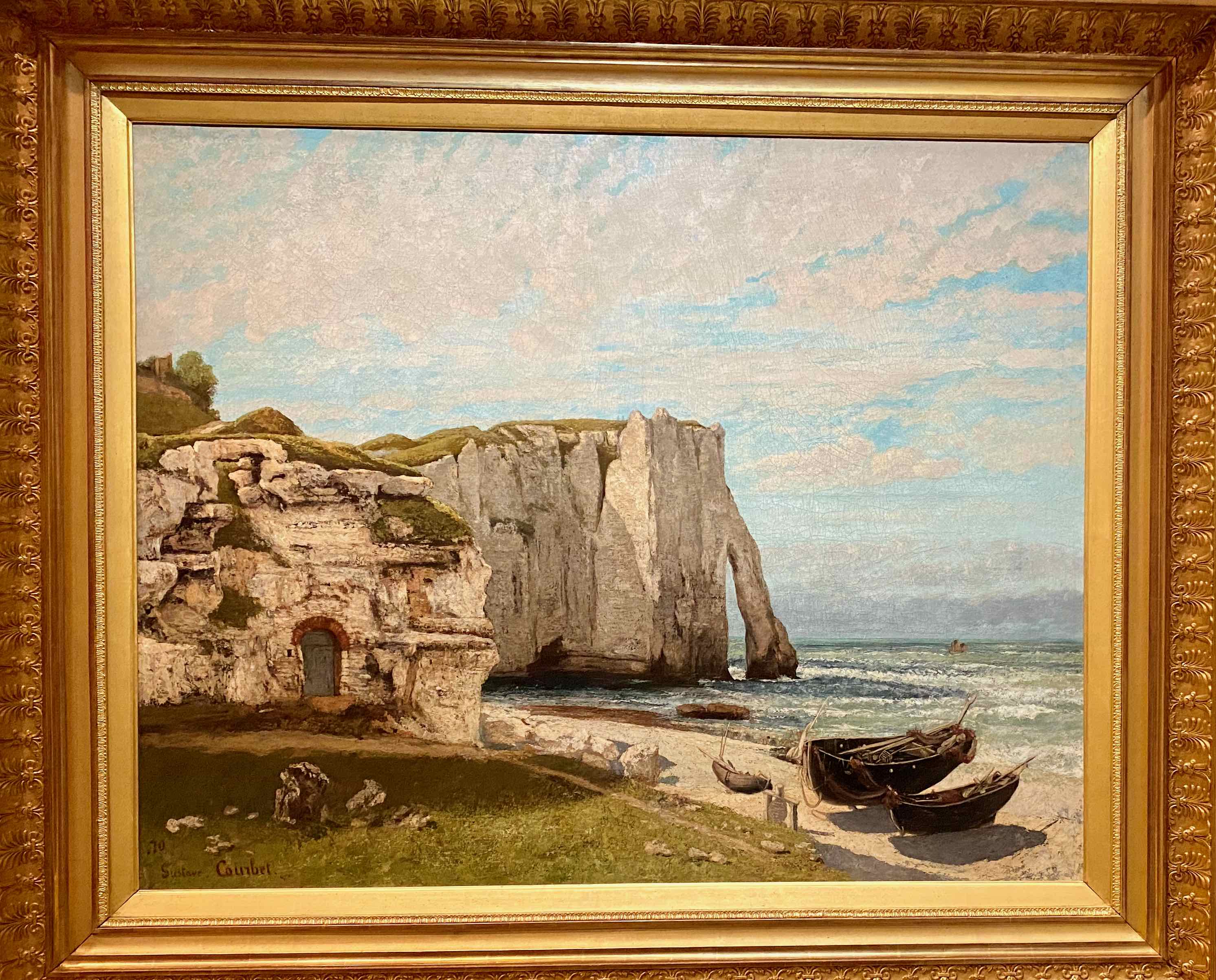
I didn’t remember seeing this painting before, Goustav Courbet’s ‘The Cliff at Etretat After the Storm’,1870 but it caught my eye.  We visited this exact location on the north shore of France earlier in our trip.  I sat and drew this very same cliff!

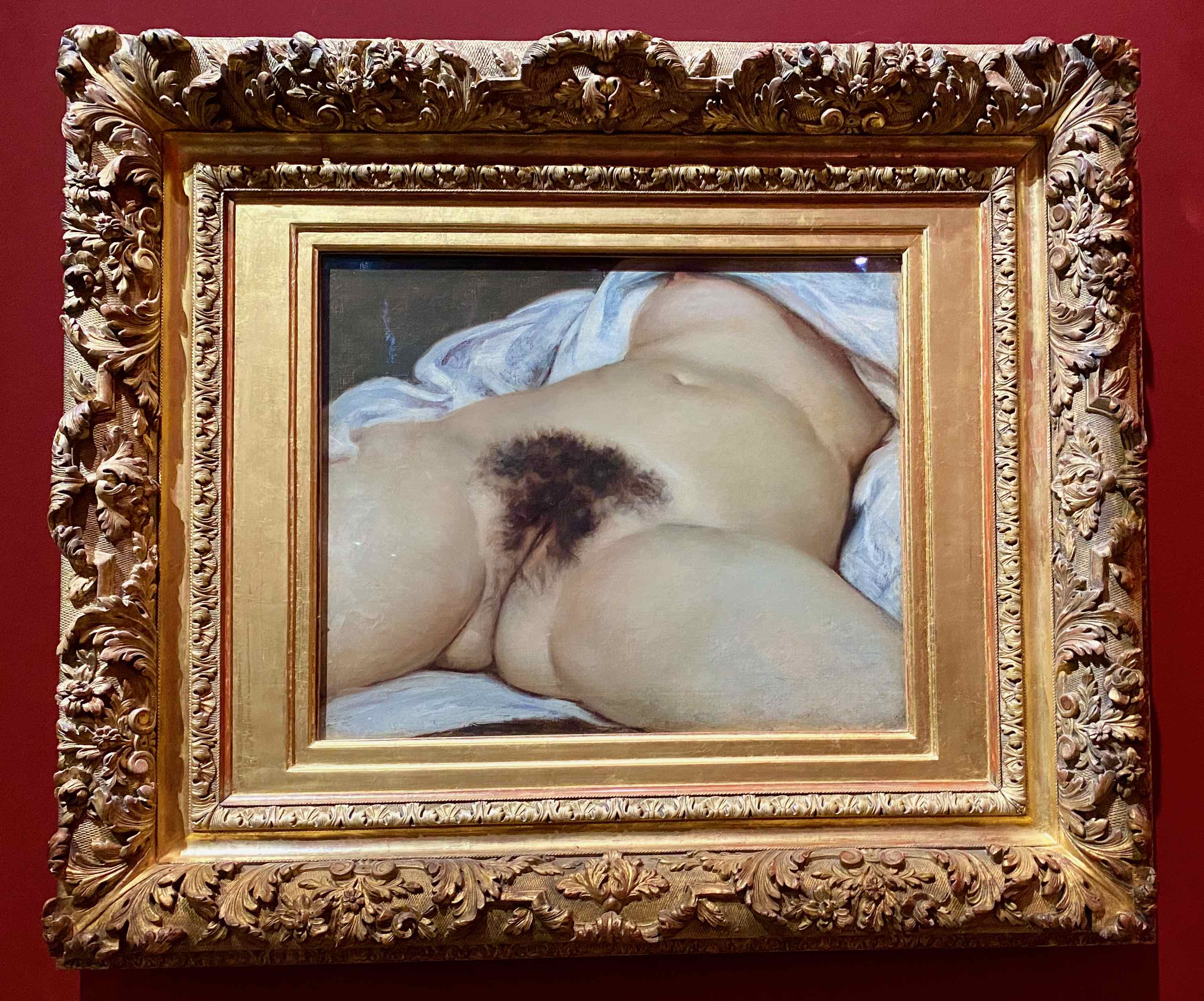
Goustav Courbet’s, The Origin of the World was daring when it was exhibited in1866 and still draws a crowd and lots of interesting comments. 

At noon we enter the Van Gogh exhibit.

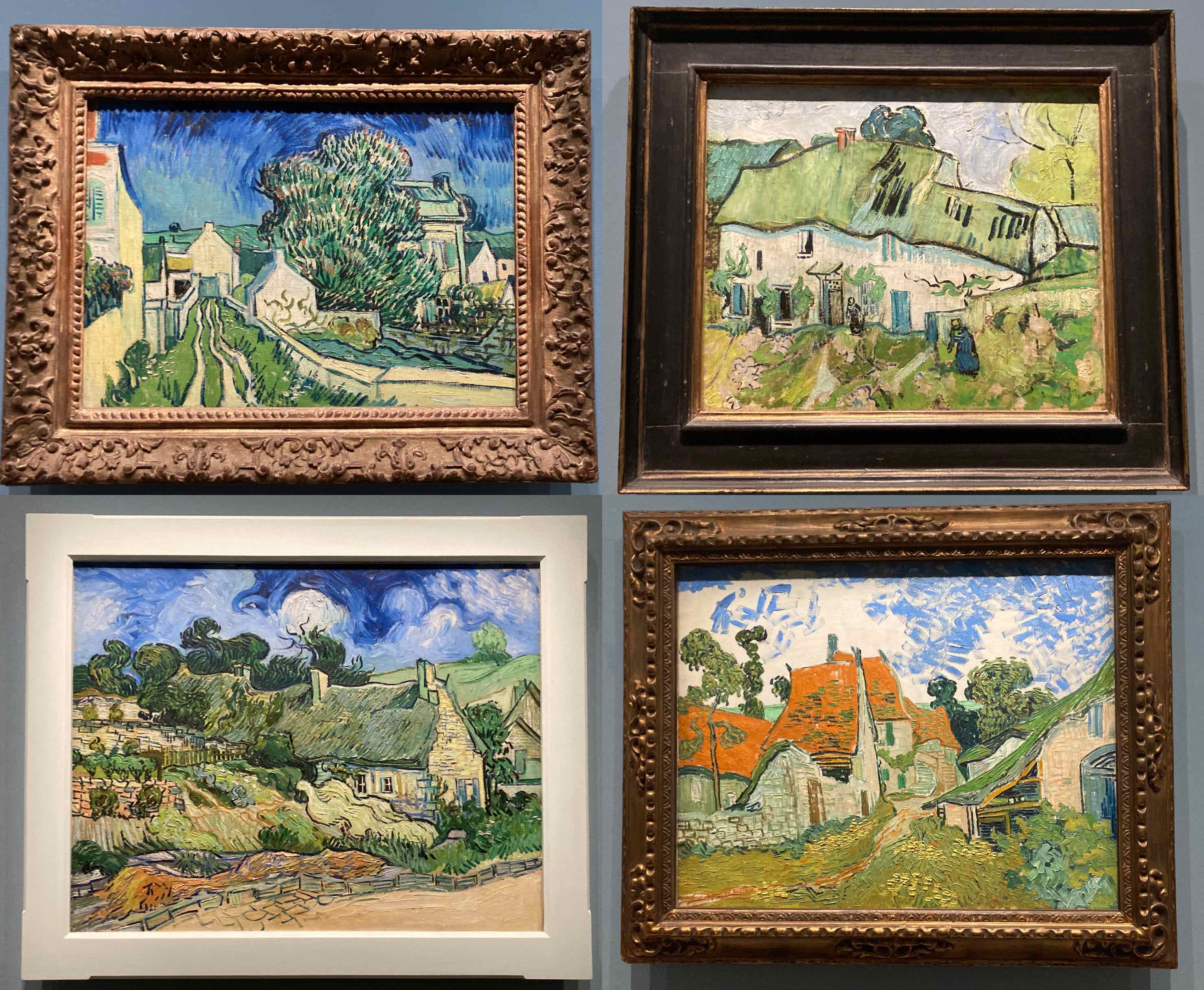
“This exhibition is the first to be devoted to the works produced by Vincent Van Gogh (1853-1890) during the last two months of his life, in Auvers-sur-Oise near Paris. Vincent Van Gogh arrived in Auvers-sur-Oise on May 20th 1890 and died there on July 29th following a suicide attempt. Although the painter only spent a little over two months in Auvers, the period was one of artistic renewal with its own style and development, marked by the psychic tension resulting from his new situation as well as by some of his greatest masterpieces.”  ~Musée d’Orsay website

I found this 12 minute video that has a walk through the exhibition…It takes me right back to our visit.  https://youtu.be/ntW7zadEEl4?si=aXna2cxoHvPw4lr-

Although I knew some of the paintings on exhibit here there were many new ones to discover. Here are some landscapes….

village and farm buildings….

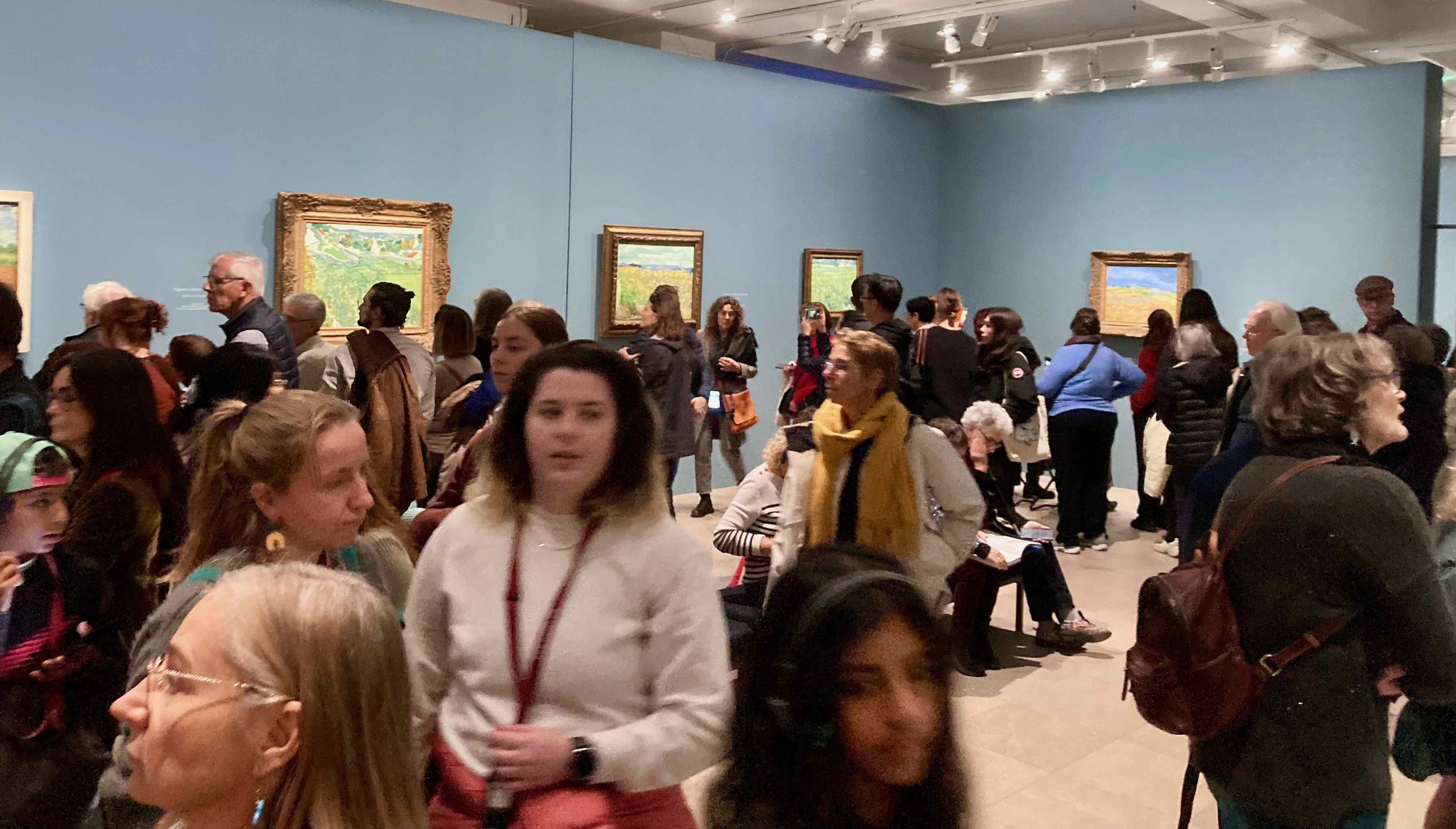
Oh, did I mention that it was very crowded!  Bob kindly sat and waited for me when I needed a bit more time than he did to view the paintings.

In just two months, Vincent Van Gogh produced 74 paintings and 33 drawings.   The exhibition here highlights 40 paintings and 20 drawings.

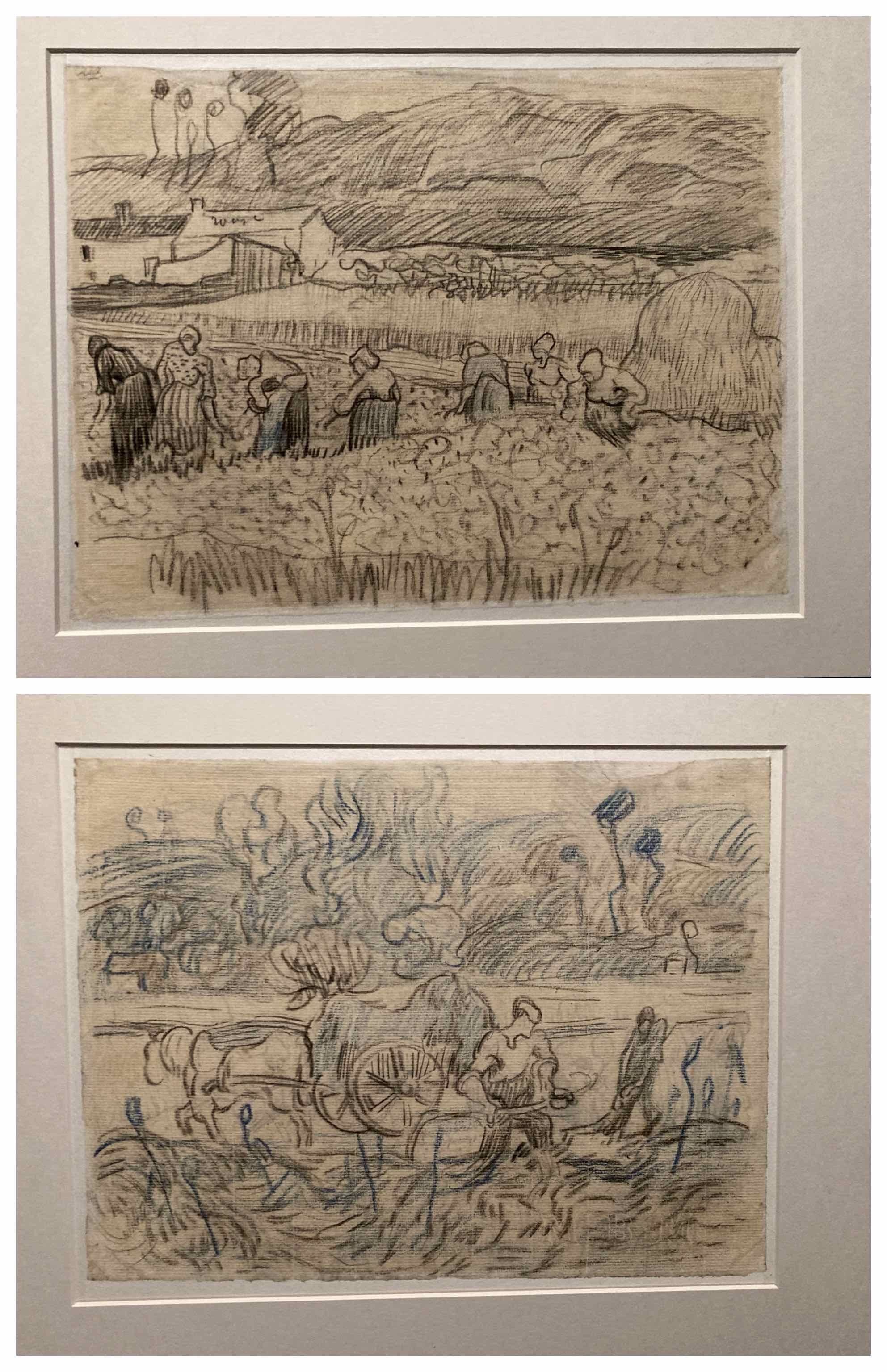
Drawings of peasants working in the fields.1890

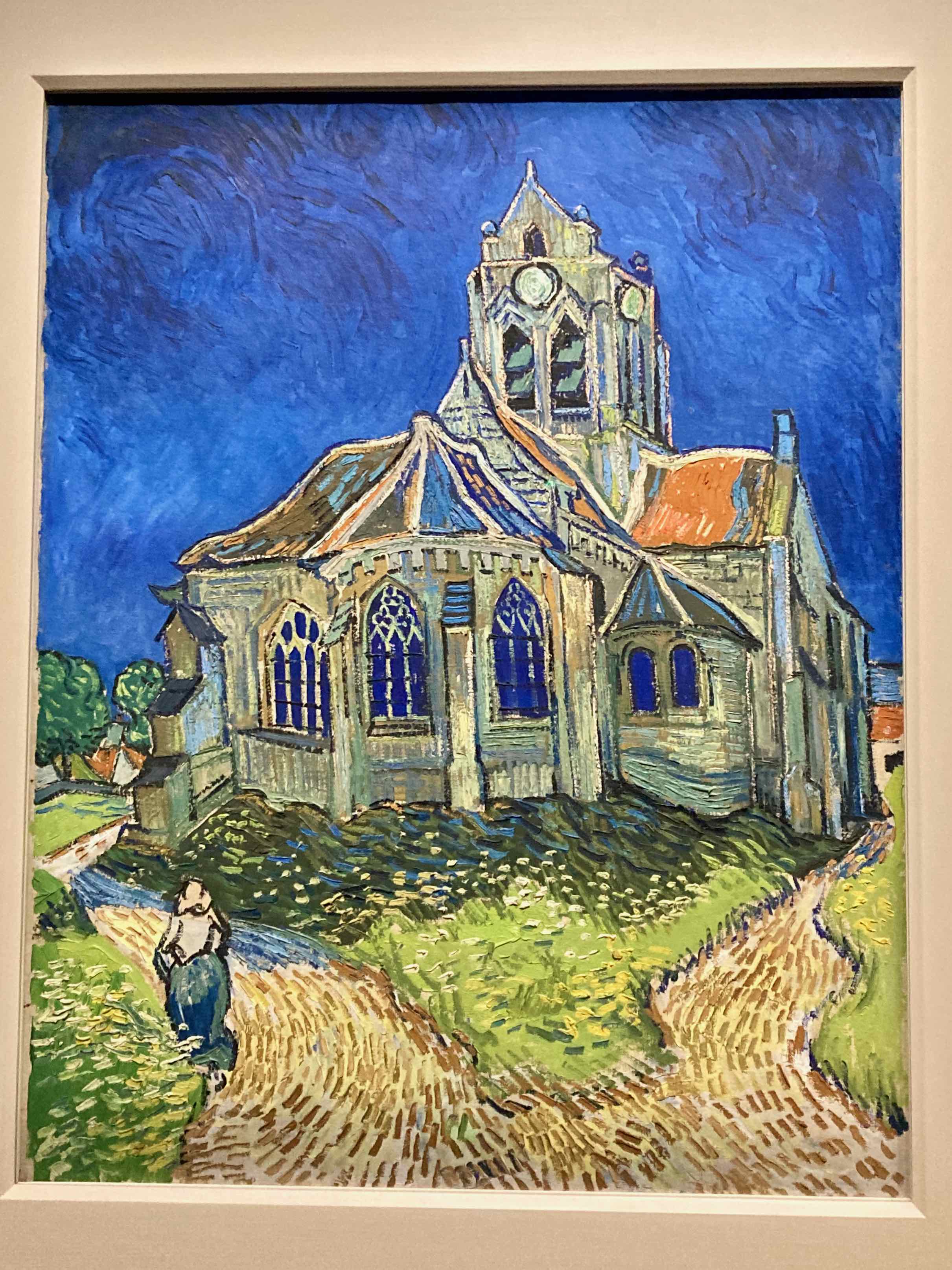
The church at Auvers-sur-Oise  

There were several of Vincent’s sketchbooks on view.  How I wished I could have held these in my hands, turned the pages and explored their contents.

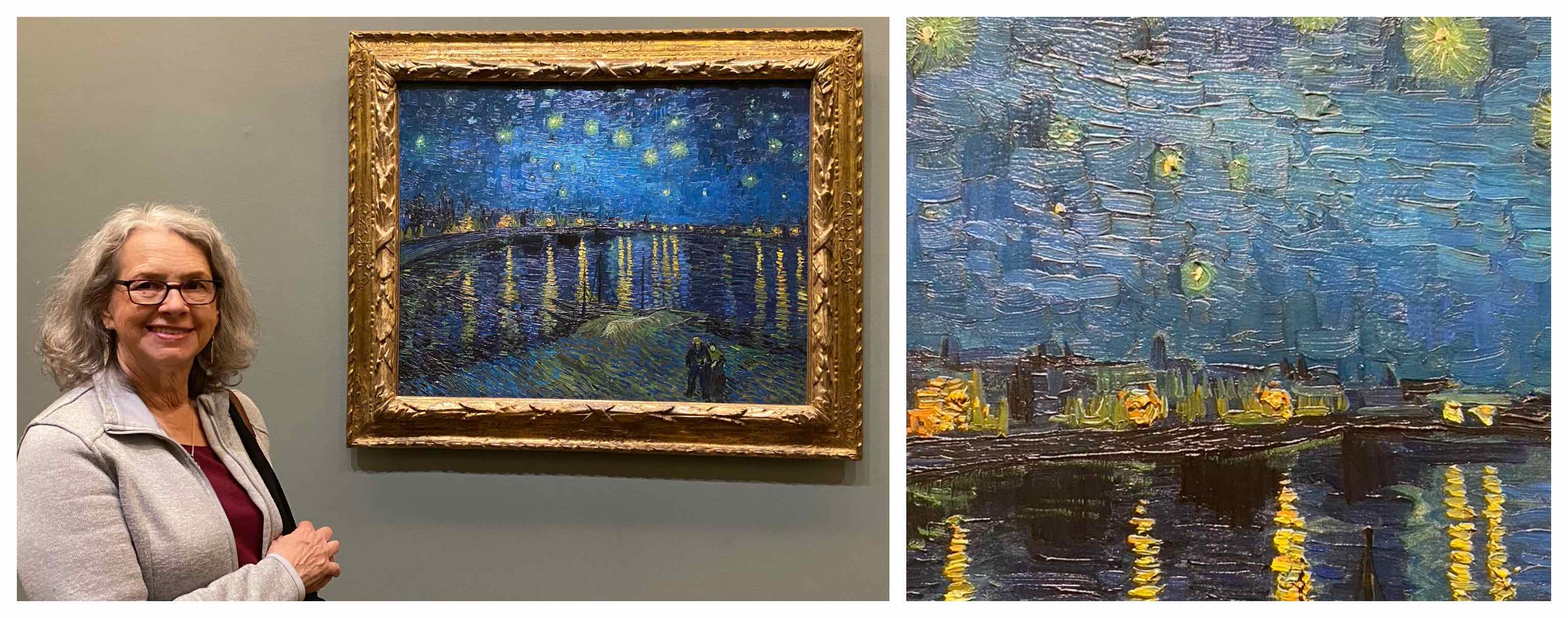
One room held thirteen ‘double square’ paintings which I thought were particularly intriguing.  These paintings were produced in just over a month right before the artist’s death. I have included a close up shot to show the brushwork with each of these.  

I recognized ‘Wheatfield With Crows’ but it was much more impactful in person. I also really appreciated that I was able to stand very close to all the works and really study the brushwork and details…no museum guards came to tell me not to stand so close!

It was crowded but I was able to take my time and spend enough time up close with each painting and drawing.  It was amazing to see so many of van Gogh’s paintings and drawings.

Next we visited the Louis Janmot Exhibit.  It was not nearly as crowded but it was a  wonderful exhibit as well.   I was not familiar with this artist until my friend Ivy told me about this exhibit yesterday when we went for coffee after life drawing.

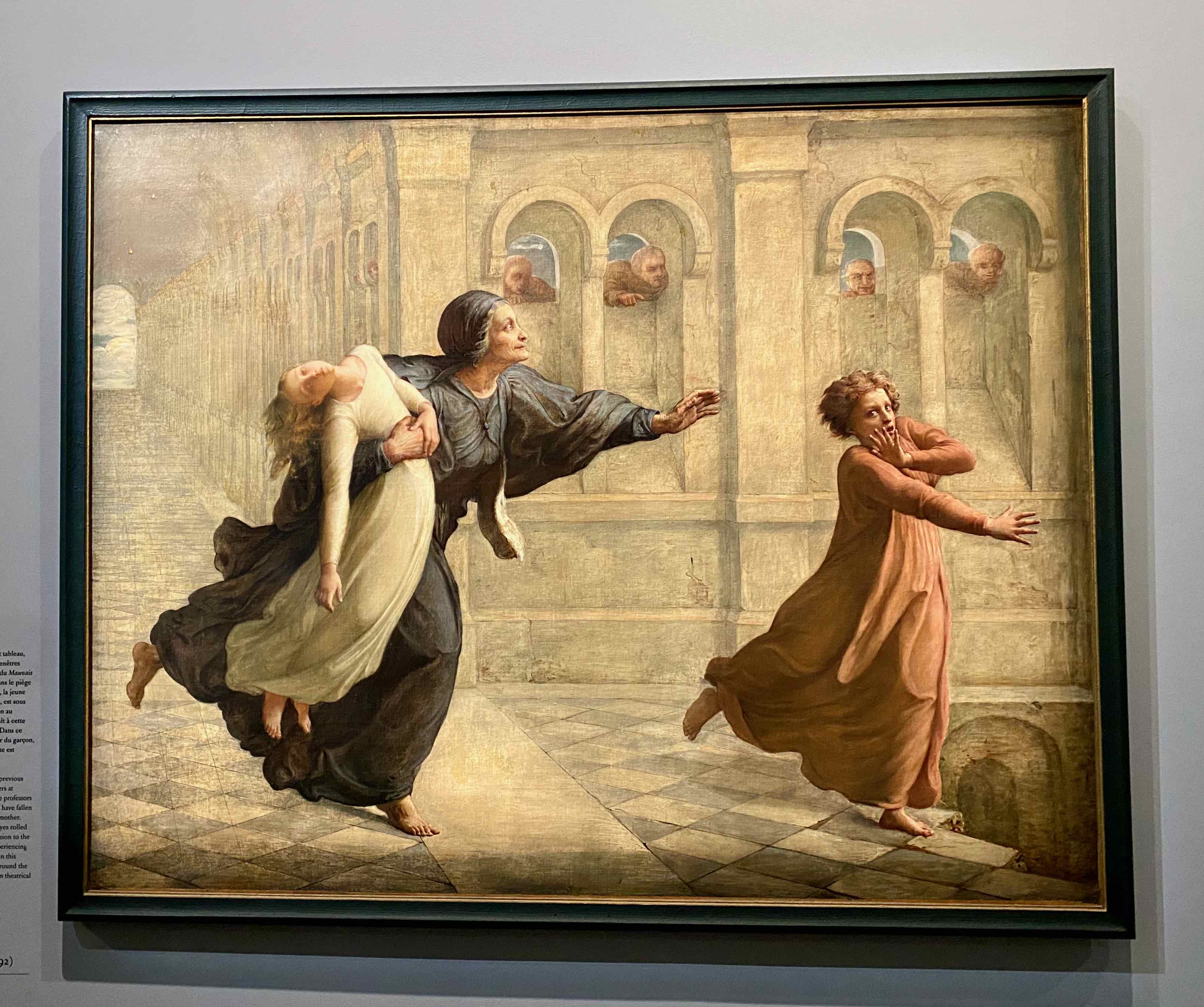
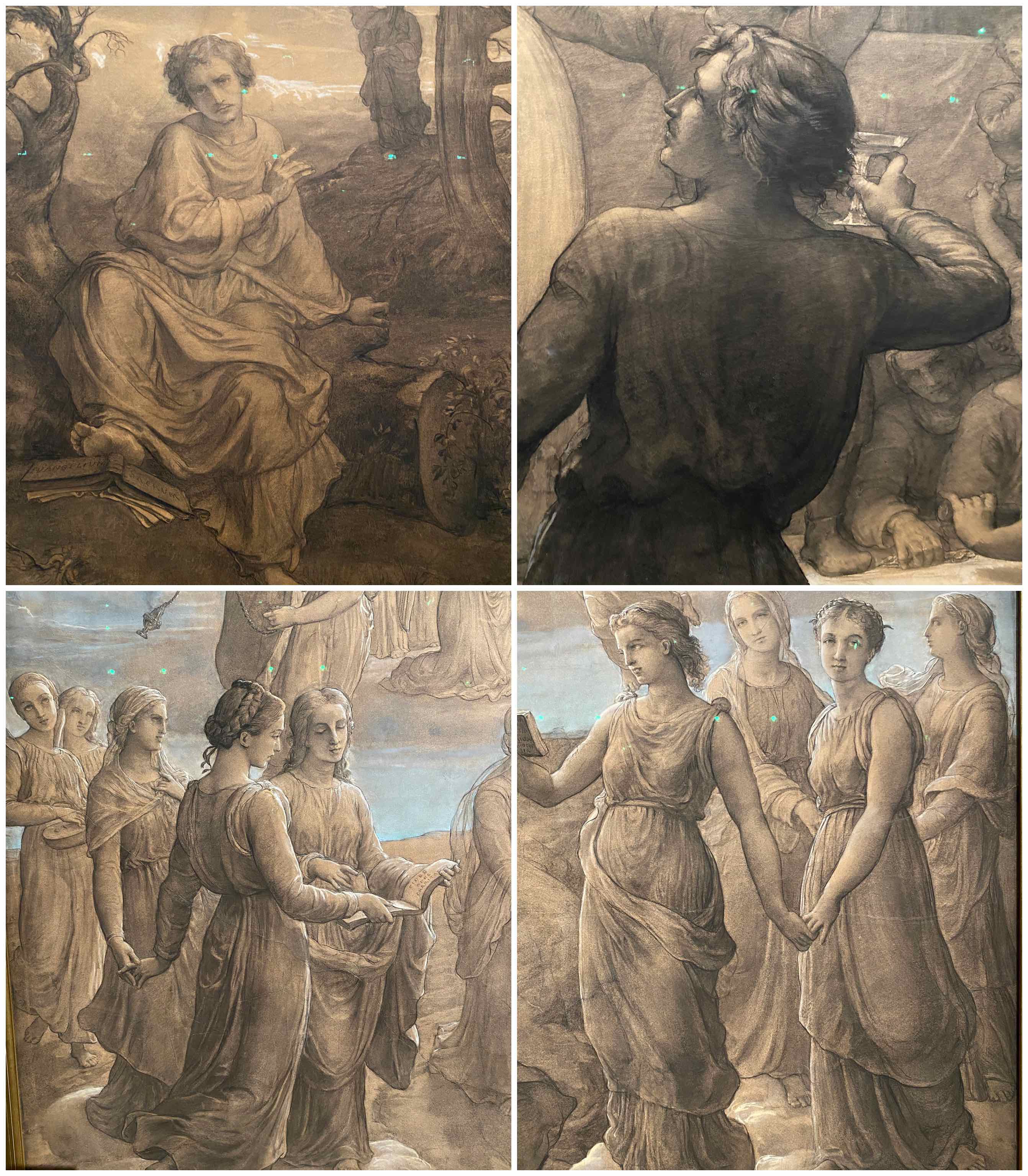
‘The Poem of the Soul’ is the great life-long project of the artist Louis Janmot in the 19th century. Begun in 1835 and completed in 1881, this ambitious work, consisting of 18 paintings and 16 drawings is accompanied by a poem of more than 2,000 verses. It recounts the journey of a soul on Earth.   This video explains the story behind all the works and walks the viewer through the exhibit.  It is in French but has English subtitles. It is long, almost 38 minutes but quite interesting.    https://youtu.be/yFImBcII72Y?si=oTBIhNgg6eqHP4eX

‘Nightmare’1849-50. The paintings were interesting, and well done but I was really intrigued with the drawings.

Details of some of the large charcoal drawings.  I loved them!

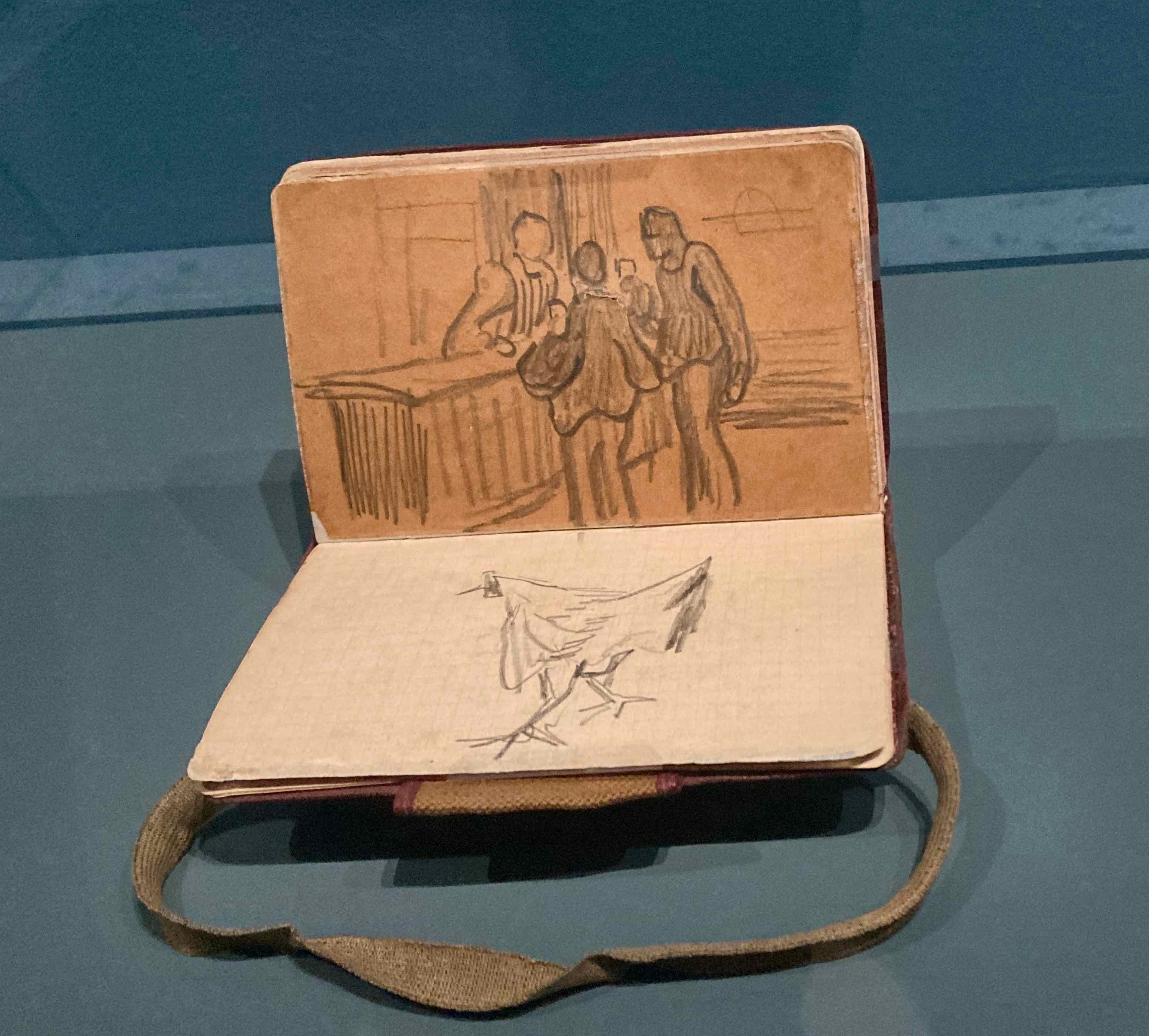
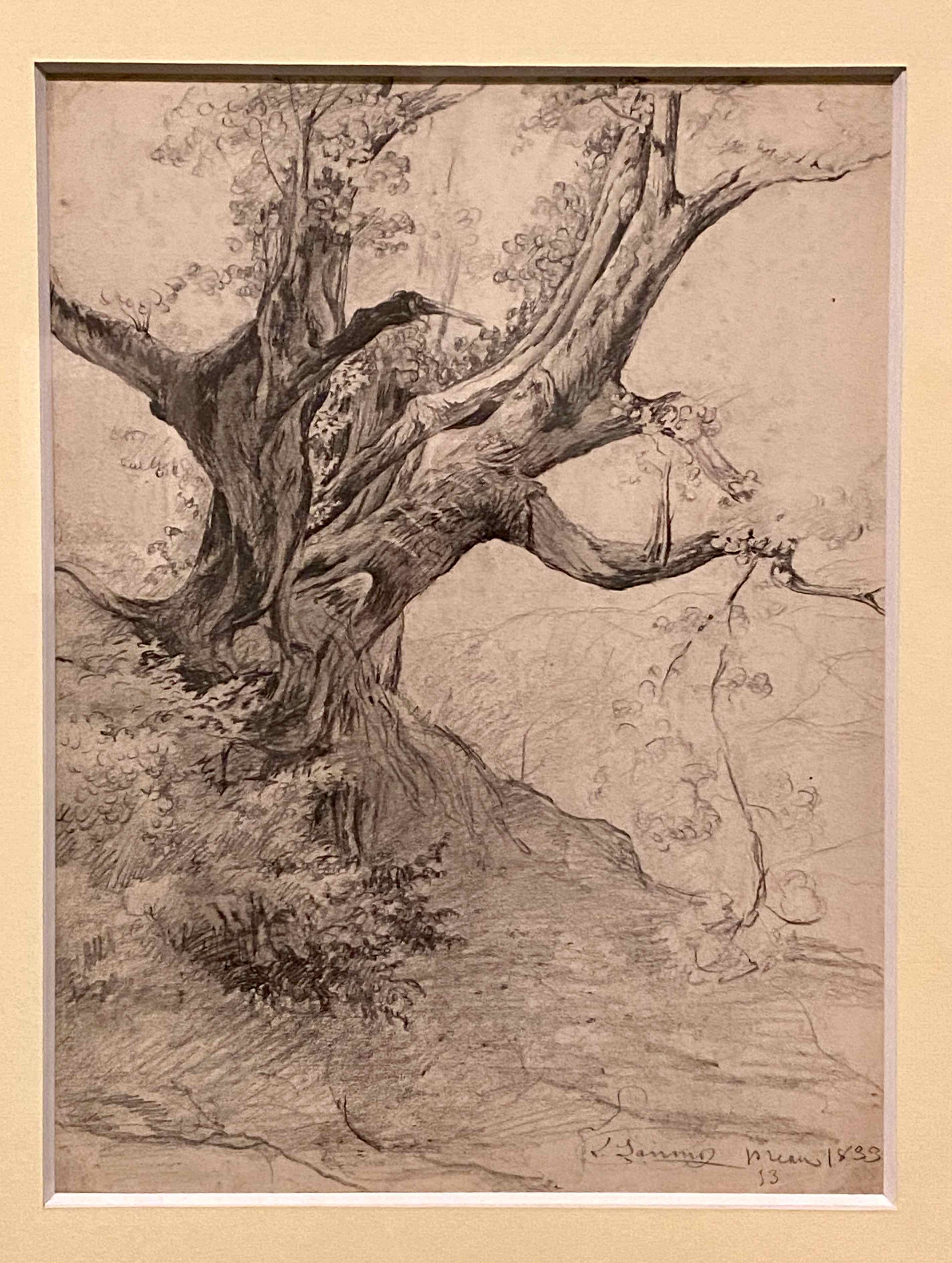
There were also studies that Janmot had made for his larger drawings.  These are particularly interesting as I can almost see the artist’s thinking and working process.

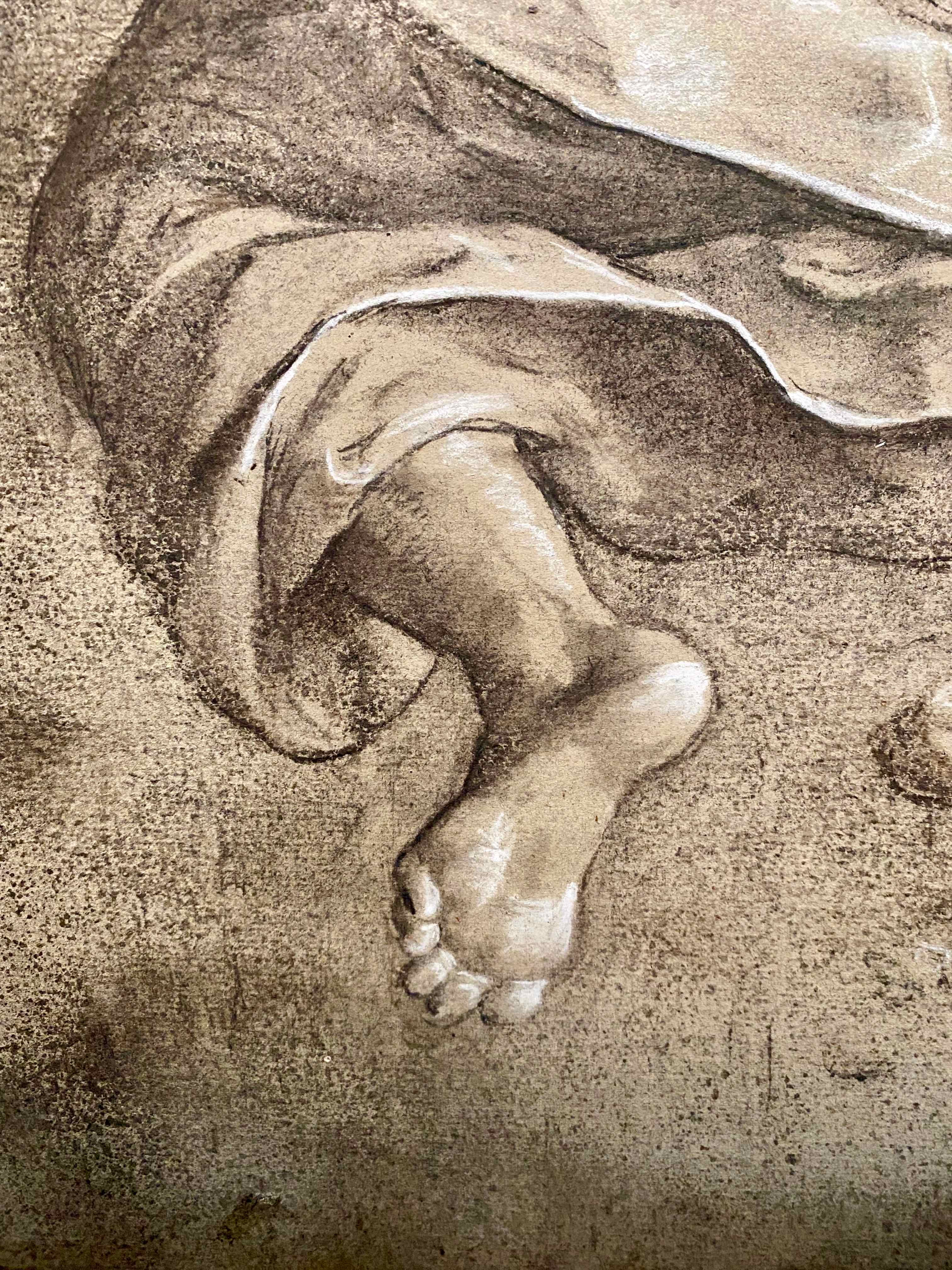
Study of a foot with interesting lighting.We decide it is time to find something to eat.  This restaurant is behind one of the Musées famous clocks but it is quite expensive and has a long line of people waiting for a table.  We do find a little cafeteria and we only have to wait about 15 minutes to get a table.  We are tired and hungry and it is so good to sit and rest for a while.  Museums are wonderful places to visit, but also very tiring.Refreshed, we head up to the top floor to see the permanent collection.  So many famous impressionist and post Impressionist paintings!  Cezanne’s ‘Still Life, Apples and Oranges’ and ‘The Card Players’, Berthe Morisot’s ‘The Cradle’ and ‘ The Dance Class’ by Edgar Degas
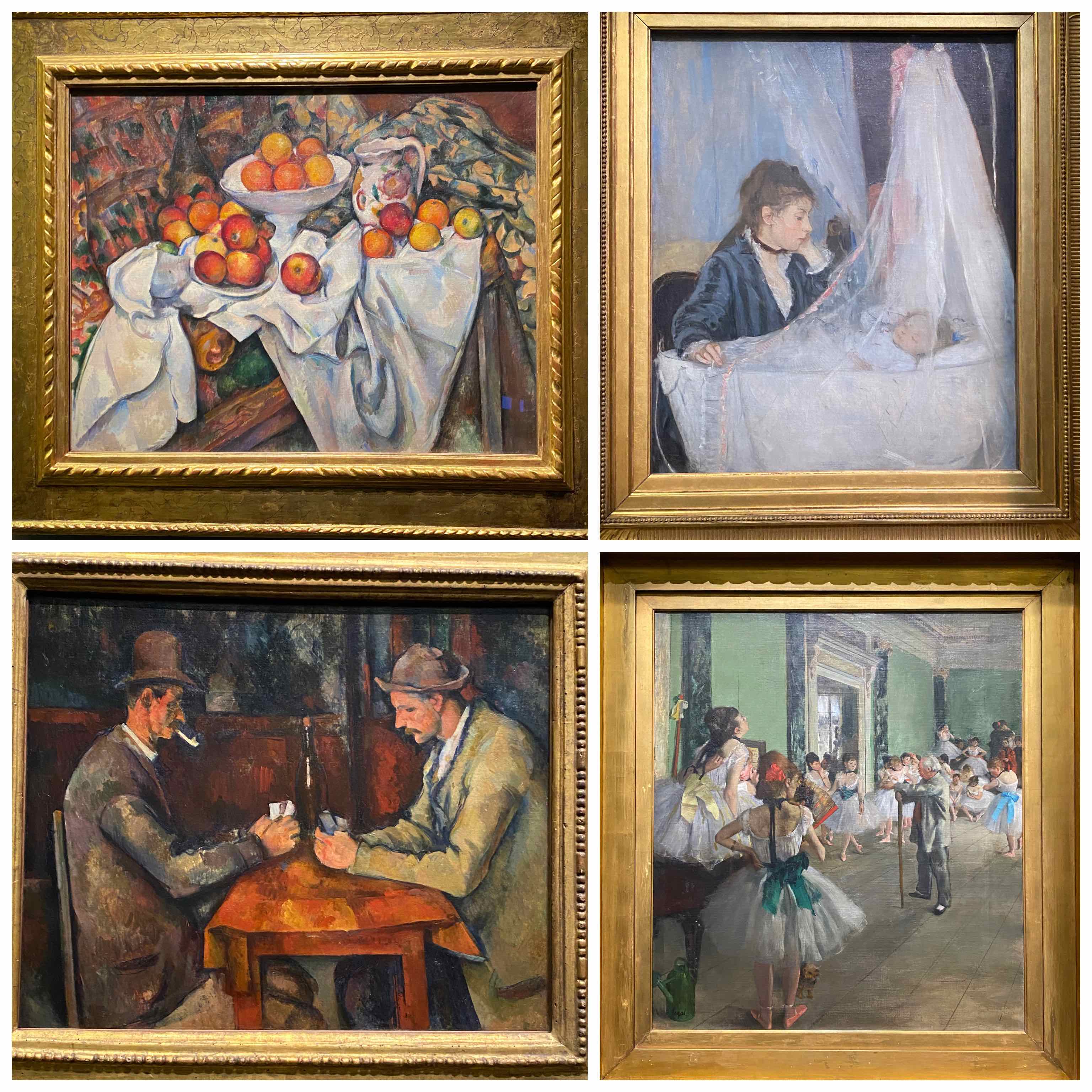
Gaugin’s ‘Tahiti Women’, Toulouse- Lautrec’s ‘The Clown Cha-U-Kao’, Van Gogh’s ‘Bedroom In Arles’, and an artist who I was not familiar with, Blanche Derousse’s ‘Two Little Girls’ which is a copy of Van Gogh painting.   VanGogh’s ‘Night Over the Rhone’.  We stood in the exact location where Vincent stood when he painted this. Check out the post here. http://Arles, France…Walking in Van Gogh’s Footsteps
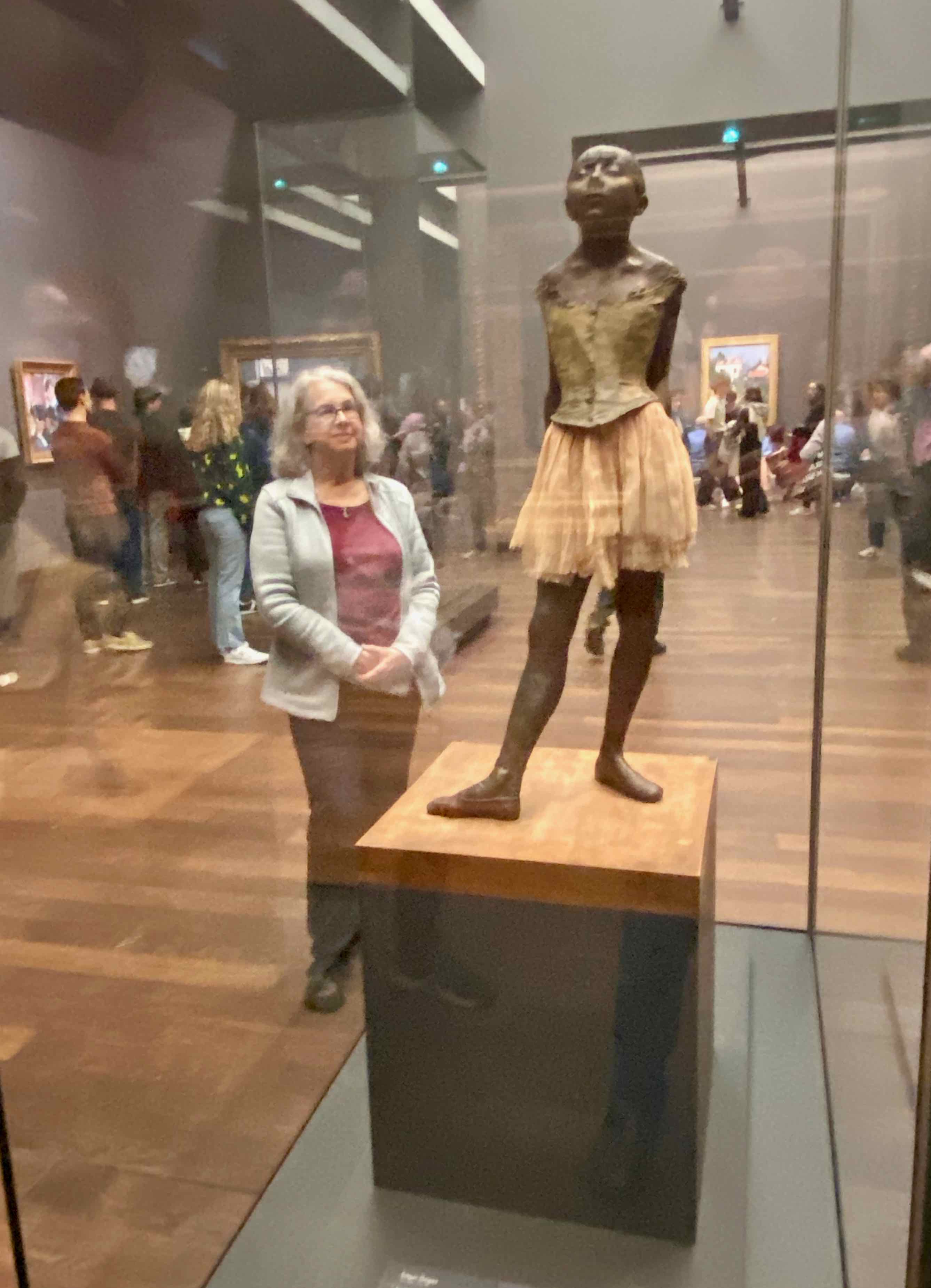
I have always loved Degas’ ‘Little Dancer’ and was pleased to have another visit with her.

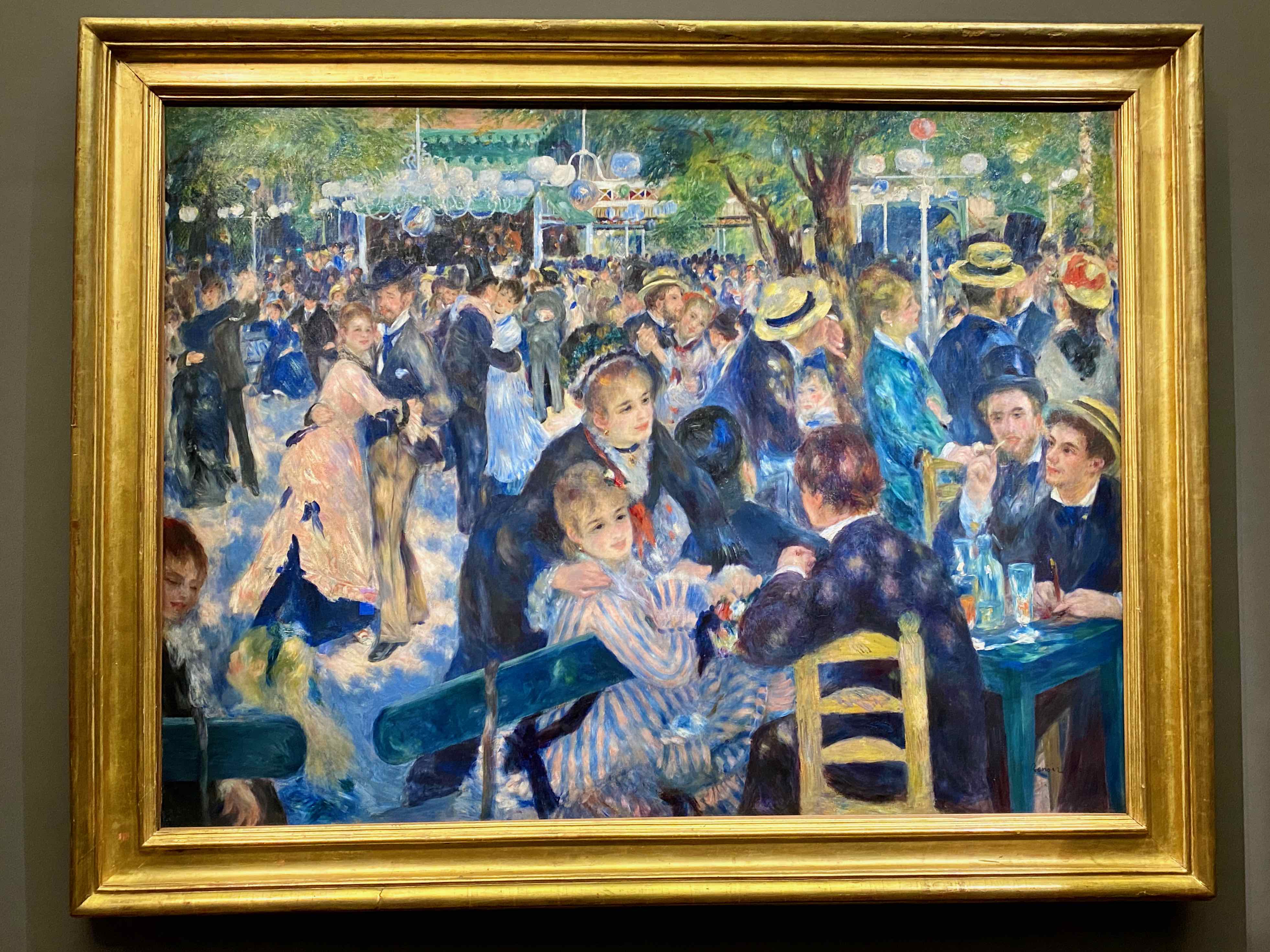
I am happy to see Renoir’s ‘Dance at the Moulin de la Galette’ once more…

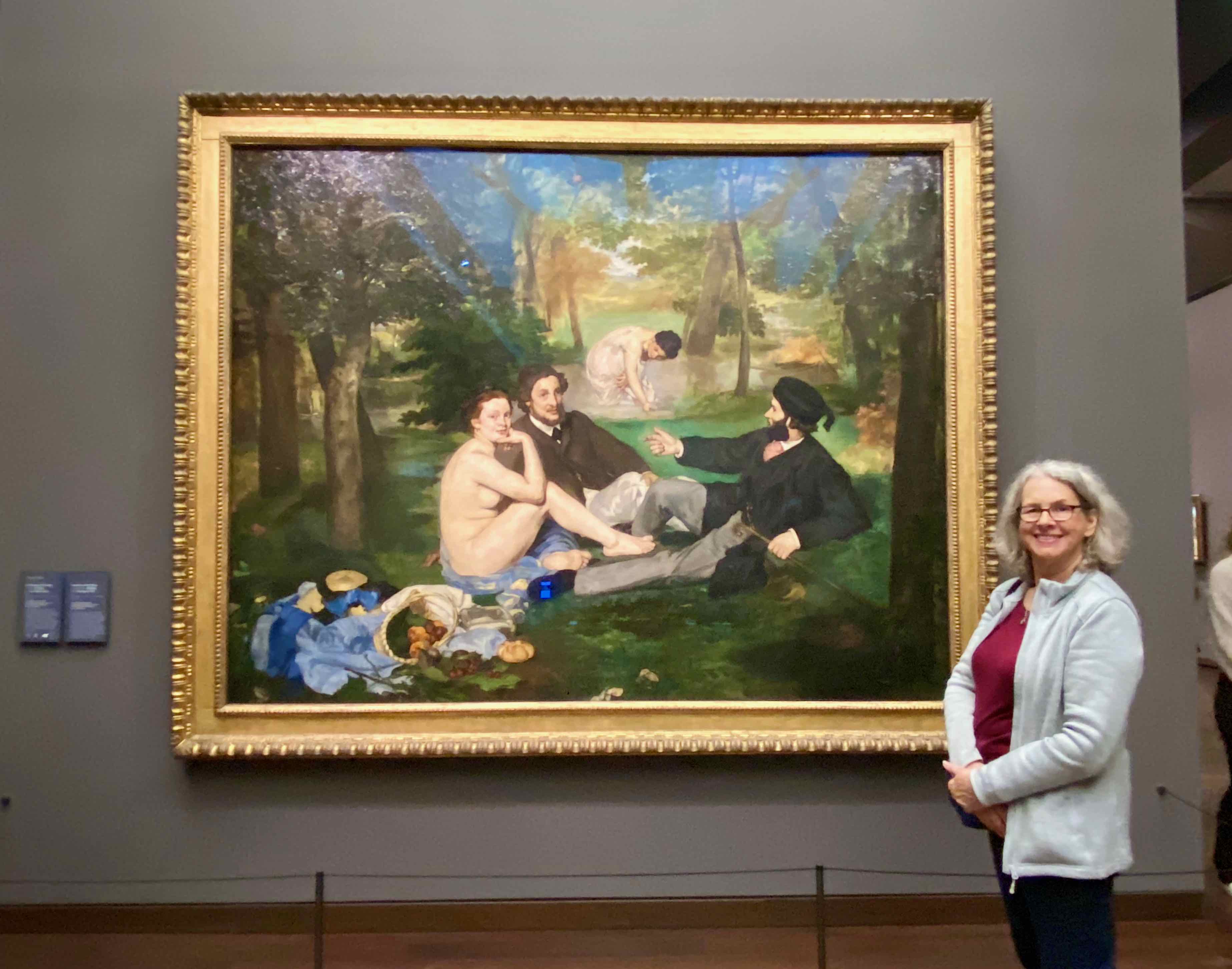
and of course Edouard Manet’s ‘Luncheon on the Grass’, which caused quite a scandal when it was first exhibited. A nude woman casually lunching with fully dressed men was an affront to audiences’ sense of propriety at the time.  

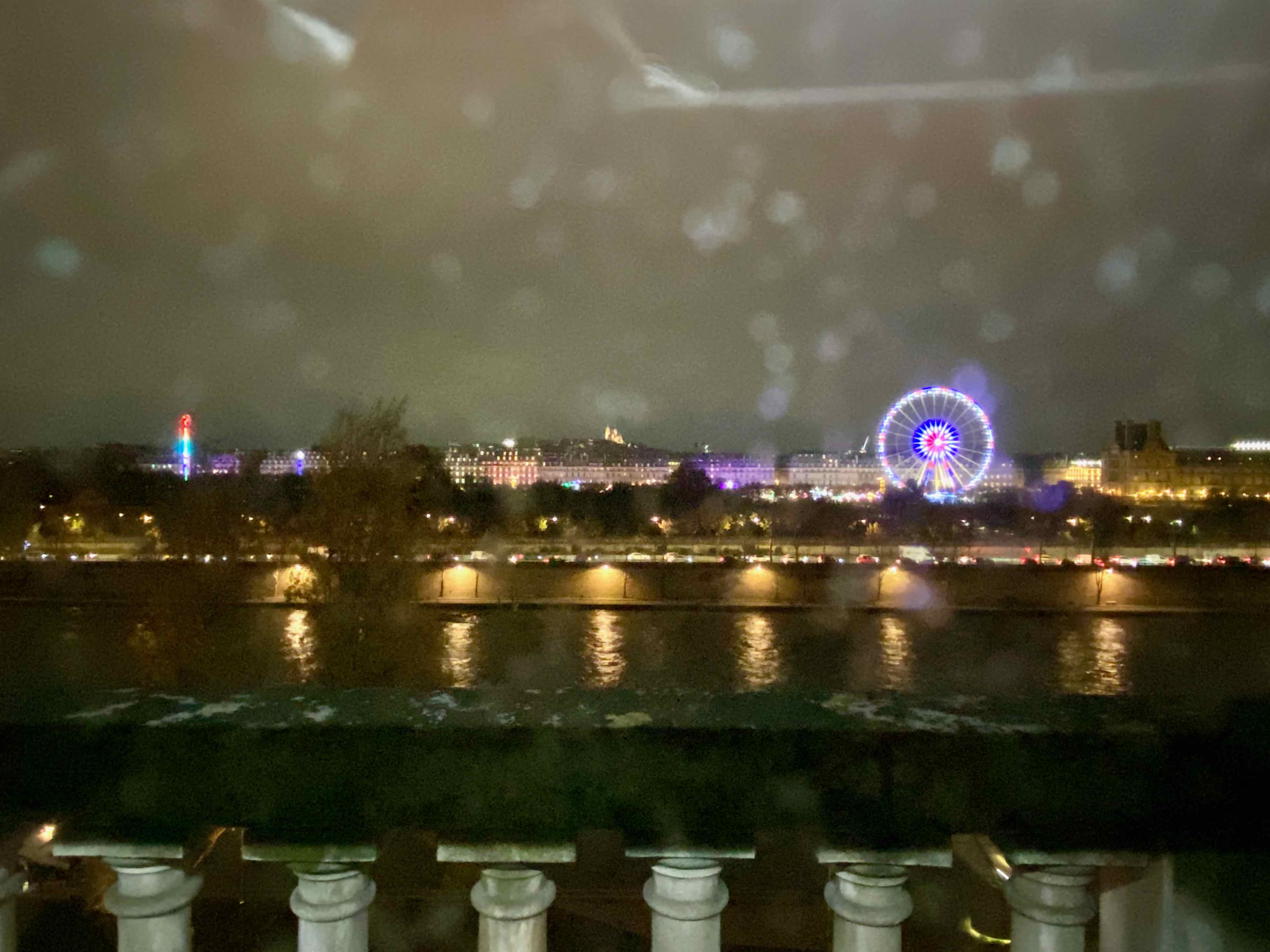
We peek out a window at the museum and discover that it is pouring rain. We can see the ferris wheel set up in the gardens just outside of the Louvre, across the Seine river.

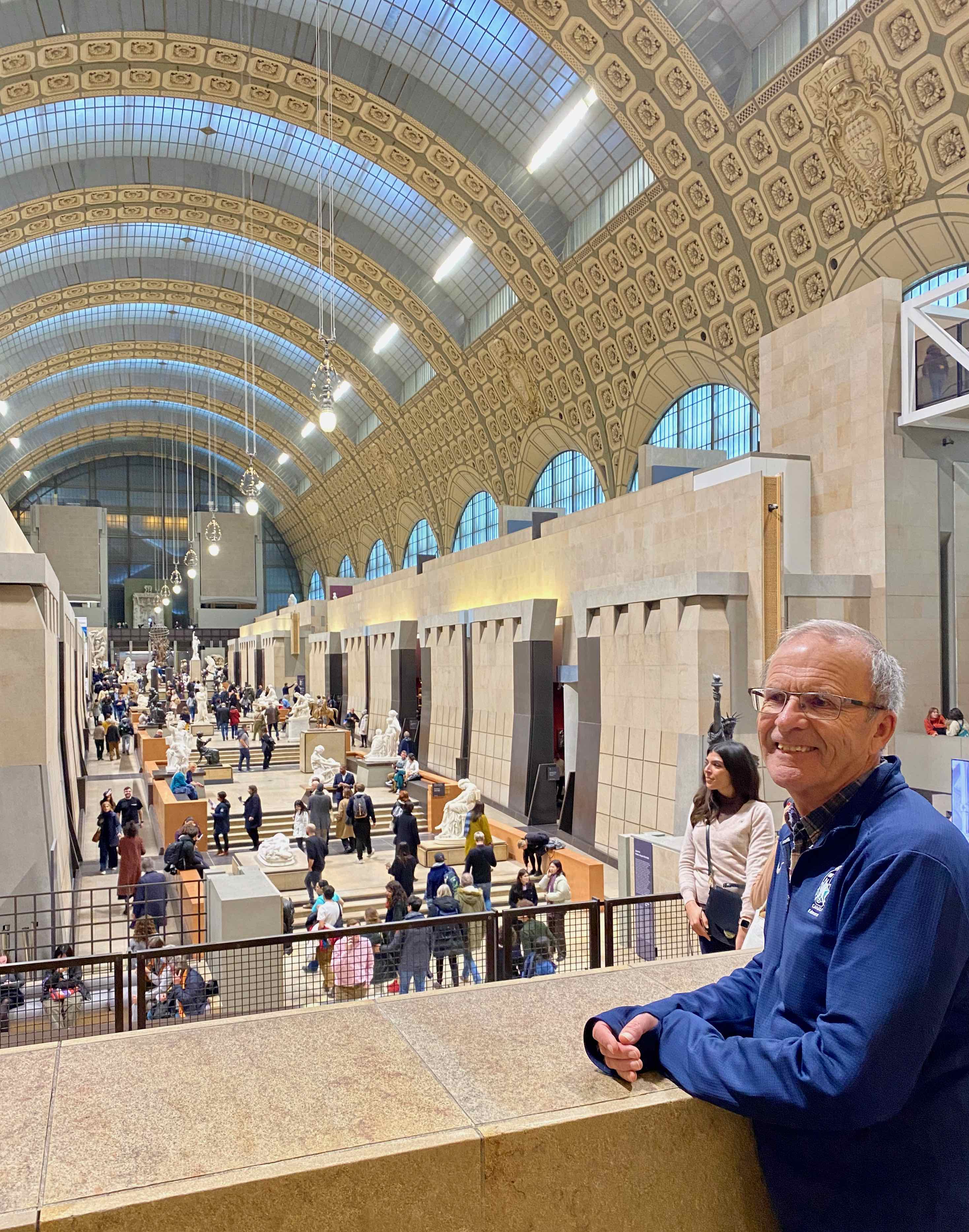
A view of the main floor of the museum. It is time to go home.  We have been here for over seven hours, and we still didn’t manage to see everything!  I guess we will have to return to Paris someday for another visit.

Académie De La Grande Chaumière and Les Invalides

Day 86,  Wednesday, November 22, 2023

I have a life drawing session at L’Académie de la Grande Chaumiere and Bob sets off to explore a bit more of Paris.

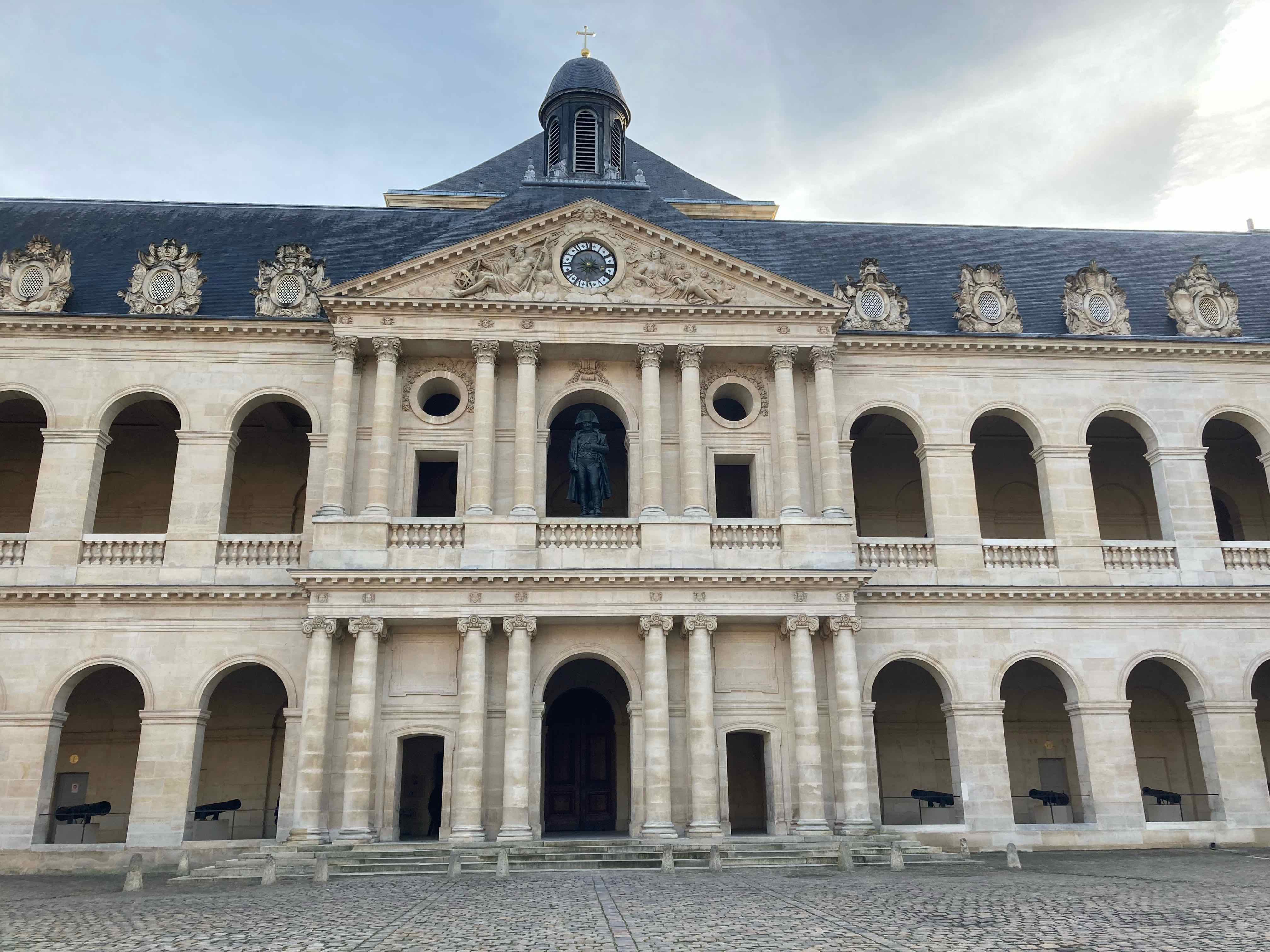
Today he visits Les Invalides, which was built in 1670 by Louis XIV in order to provide housing and hospital care for wounded soldiers. Today it is a museum, a monument, a mausoleum that contains the tomb of Napoleon and a hospital for war veterans.

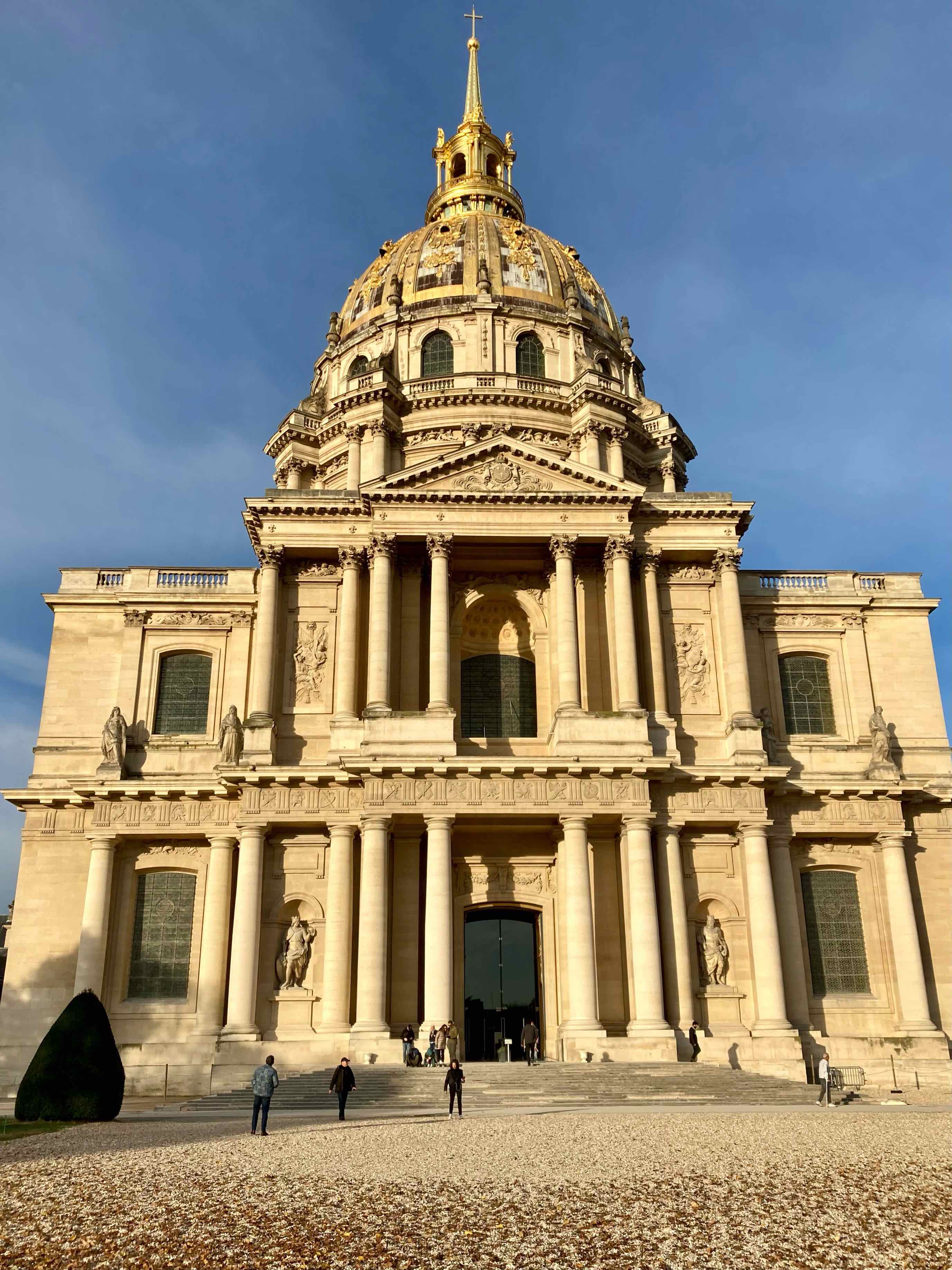
This was the tallest building in Paris before the Eiffel Tower was built.  Napoleon’s tomb is located below this golden dome.

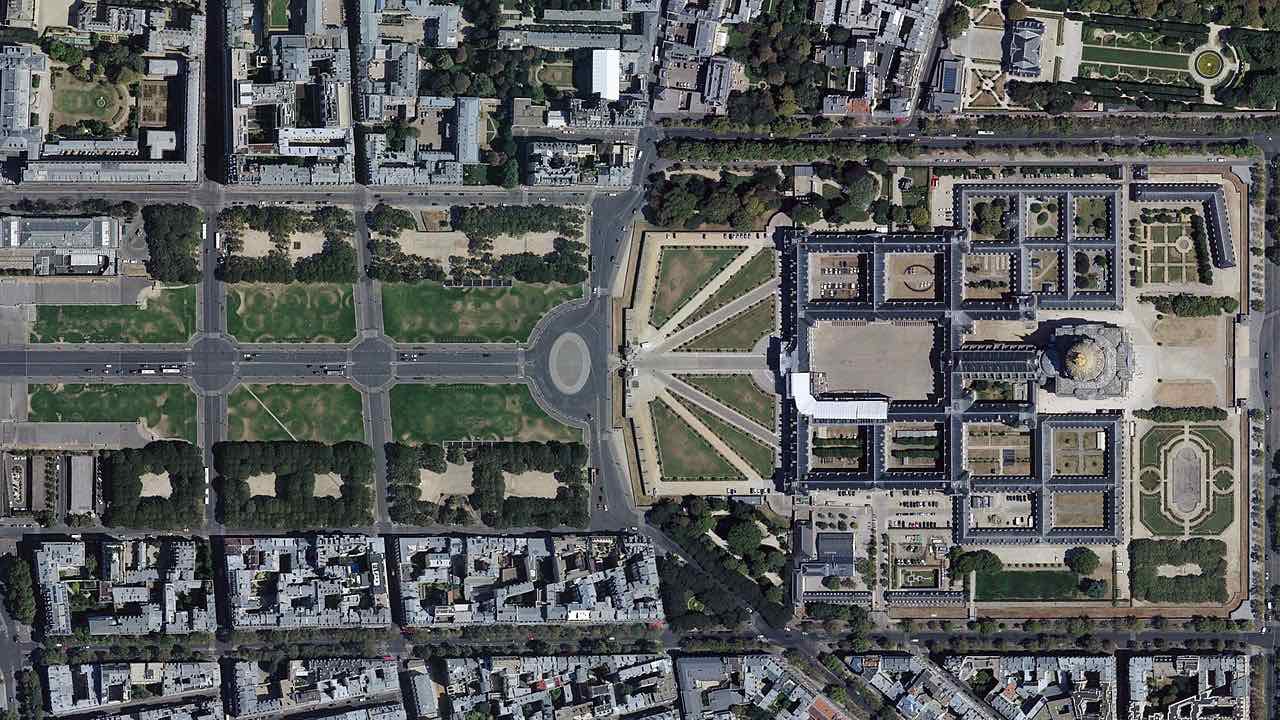
Les Invalides is enormous, and was once a city that housed over 4,00 inhabitants.  This arial view gives an idea of its size.

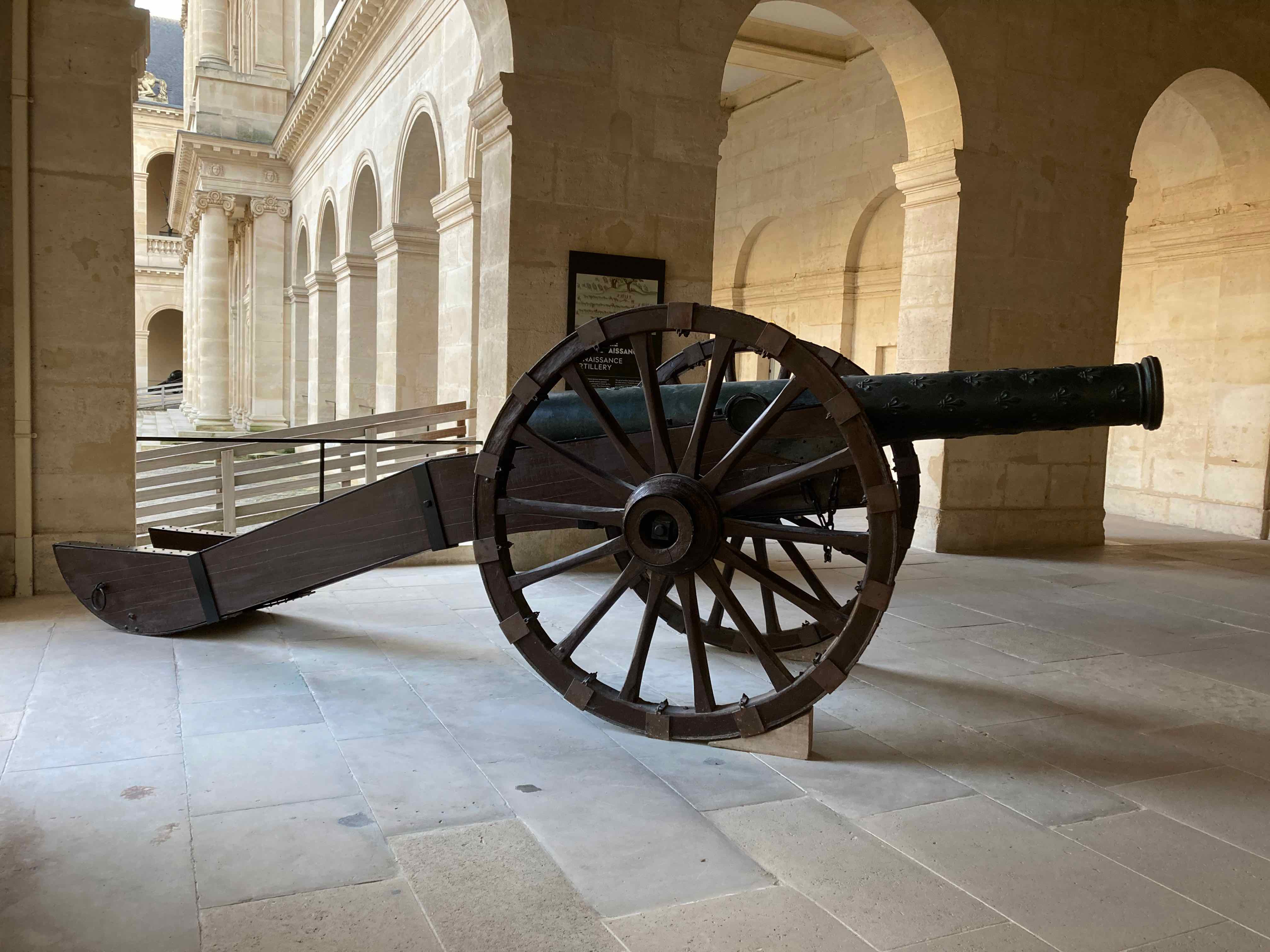
The huge central courtyard, which can be seen in the above photo houses a collection of cannons.This is one of the building entrances that face the central courtyard.  Les Invalides houses huge military museums with thousands of artifacts in its collection.  We visited inside on a previous trip.  It took a whole day to visit the numerous museums dedicated to all things military from ancient to modern times. Today Bob wanders outside, in the gardens and the courtyards.
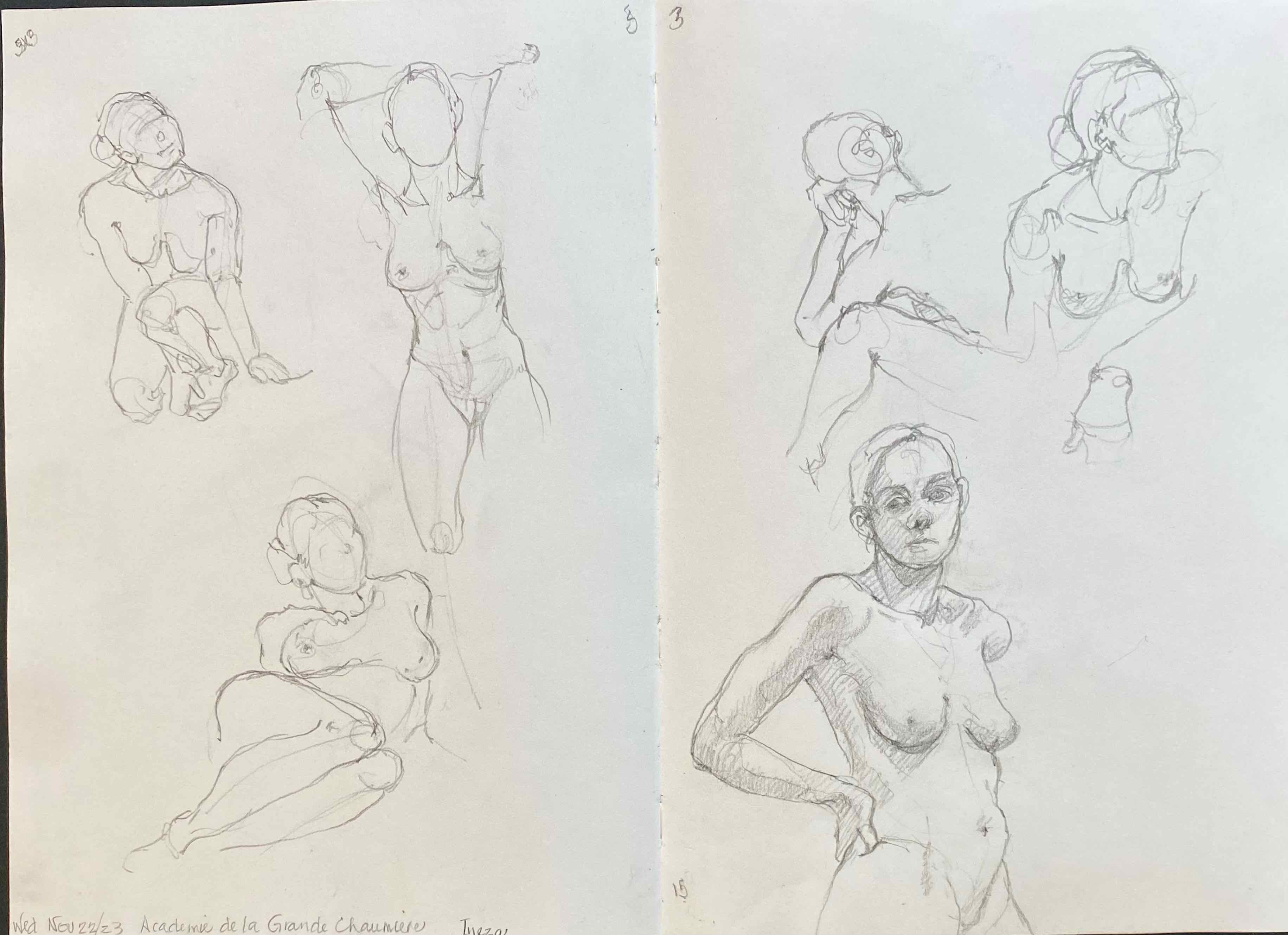
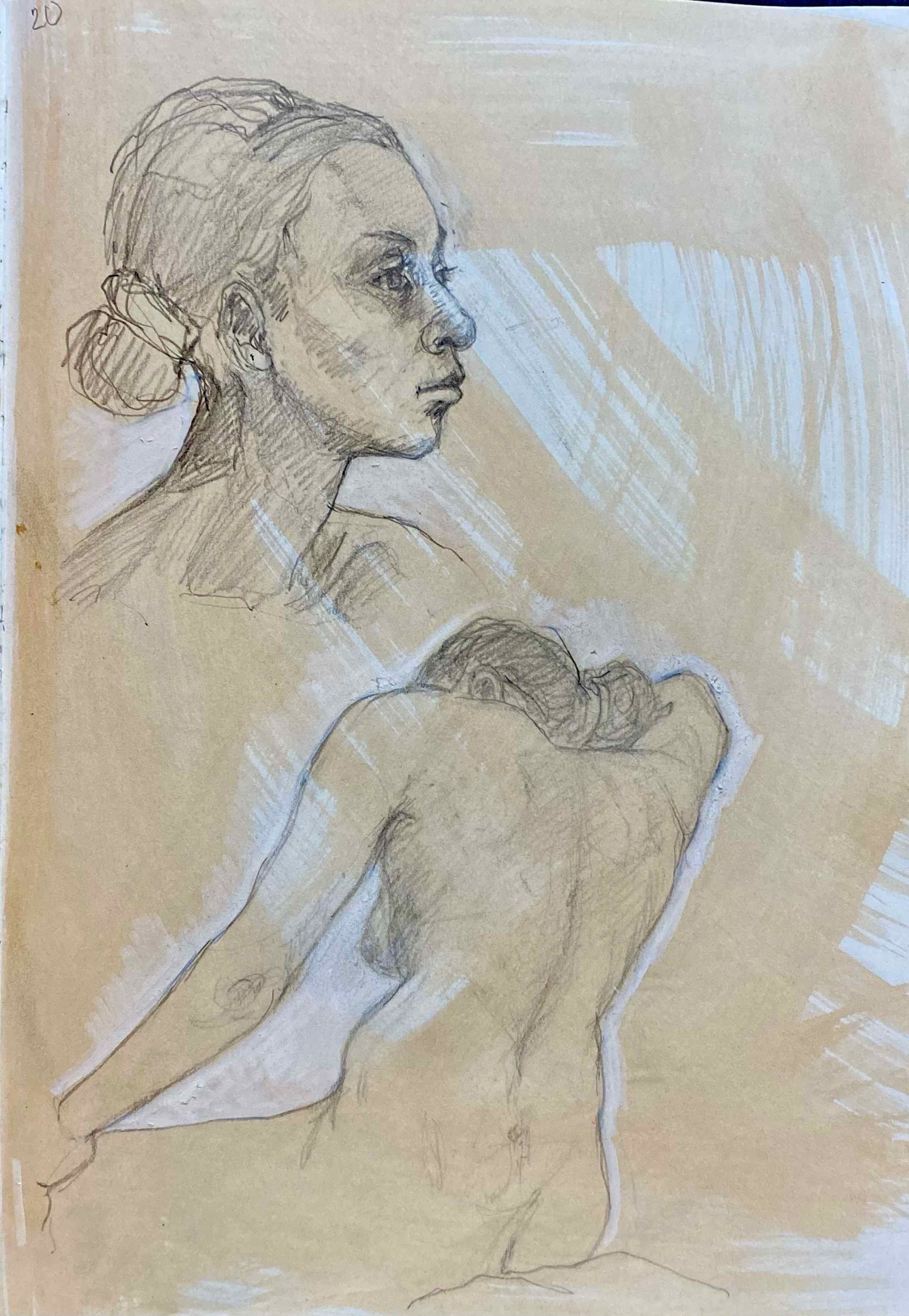
I spent the afternoon at my beloved Académie de la Chaumiere drawing a lovely model named Inez.  These are five 3 minute poses and one 15 minute.

Three 5 minutes, the portrait was a bit longer but I forgot to mark the time.

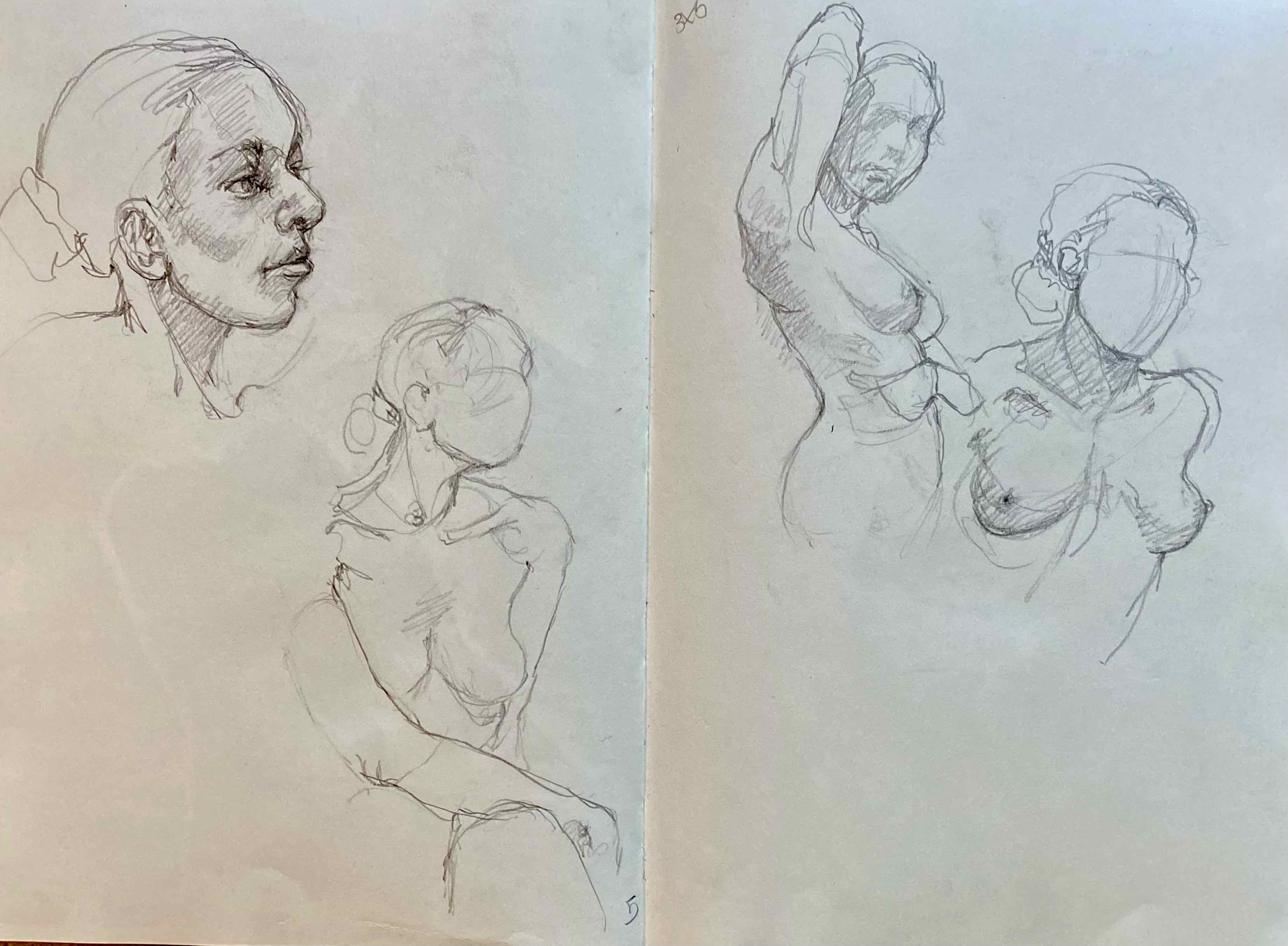
Two 20 minute poses

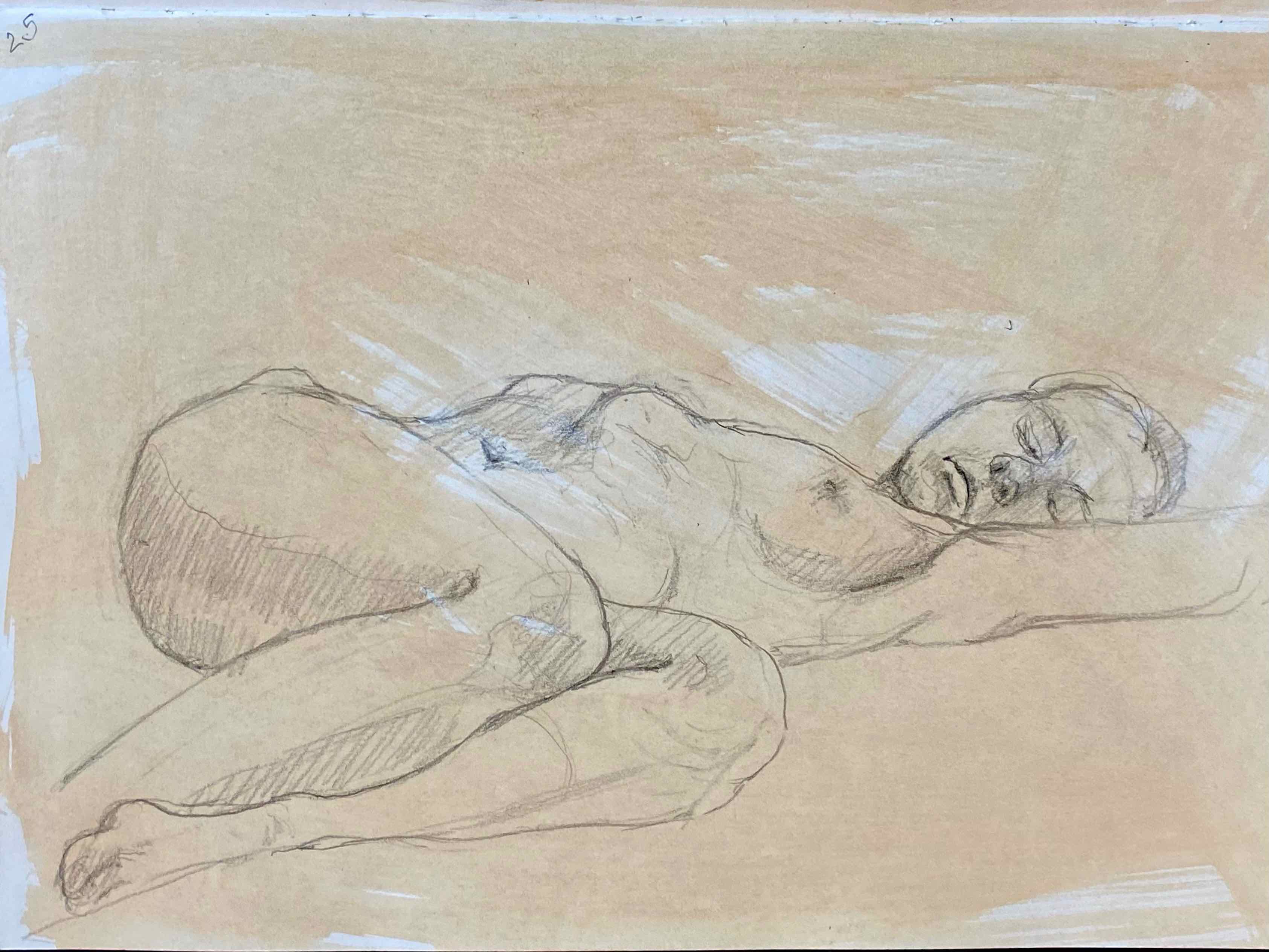
And a 25 minute pose.

I had arranged to meet a friend that I met years ago during my month in Paris.  Ivy met me at the Académie, we drew together and then went for tea at a nearby café. The same café that I visited in 2014!  We had a lovely visit, catching up on the last nine years!
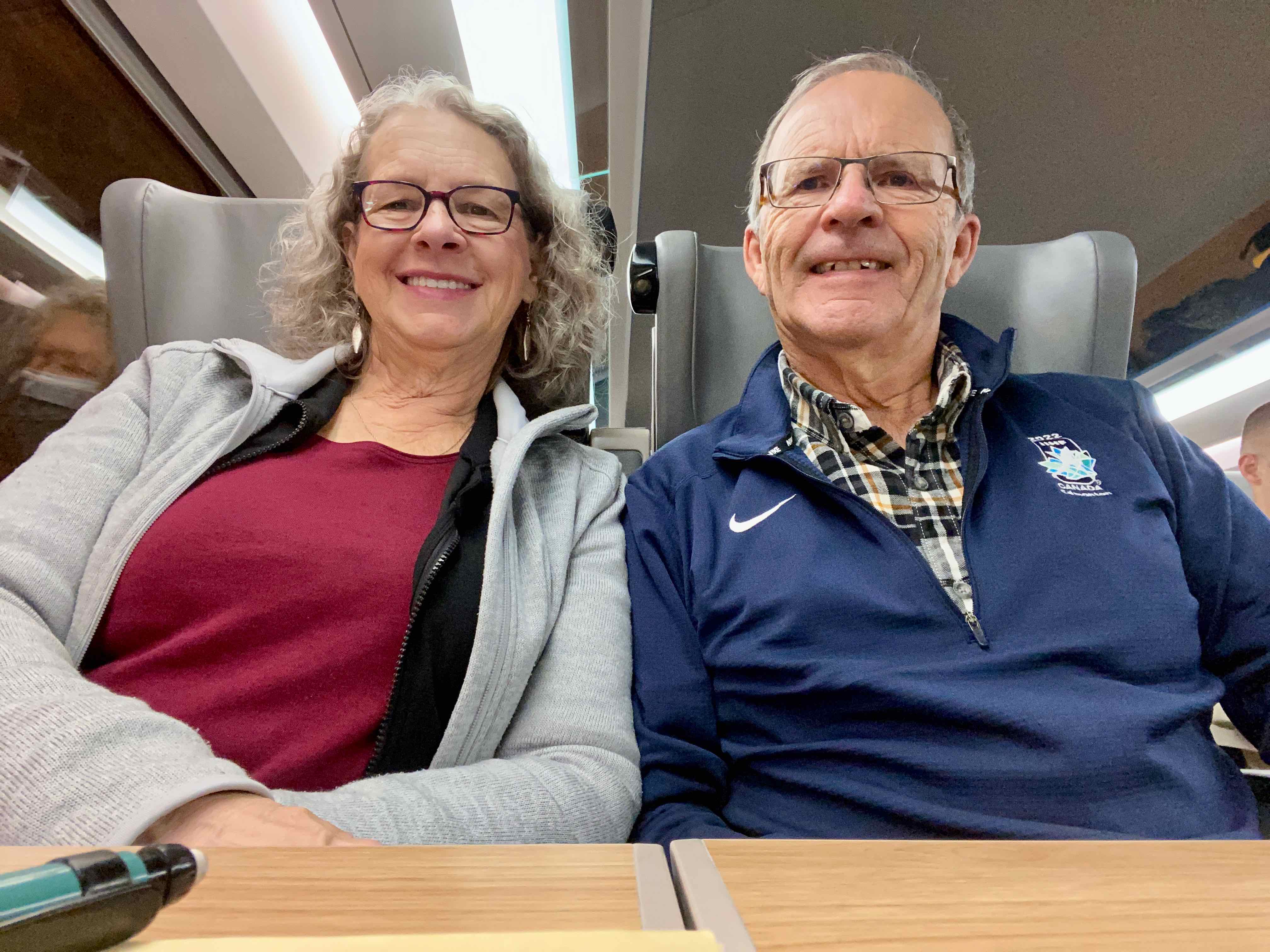
image Finally I headed home where Bob had supper waiting.  Quite a lovely day.
Le Mans, France

Day 85,  Tuesday, November 21, 2023

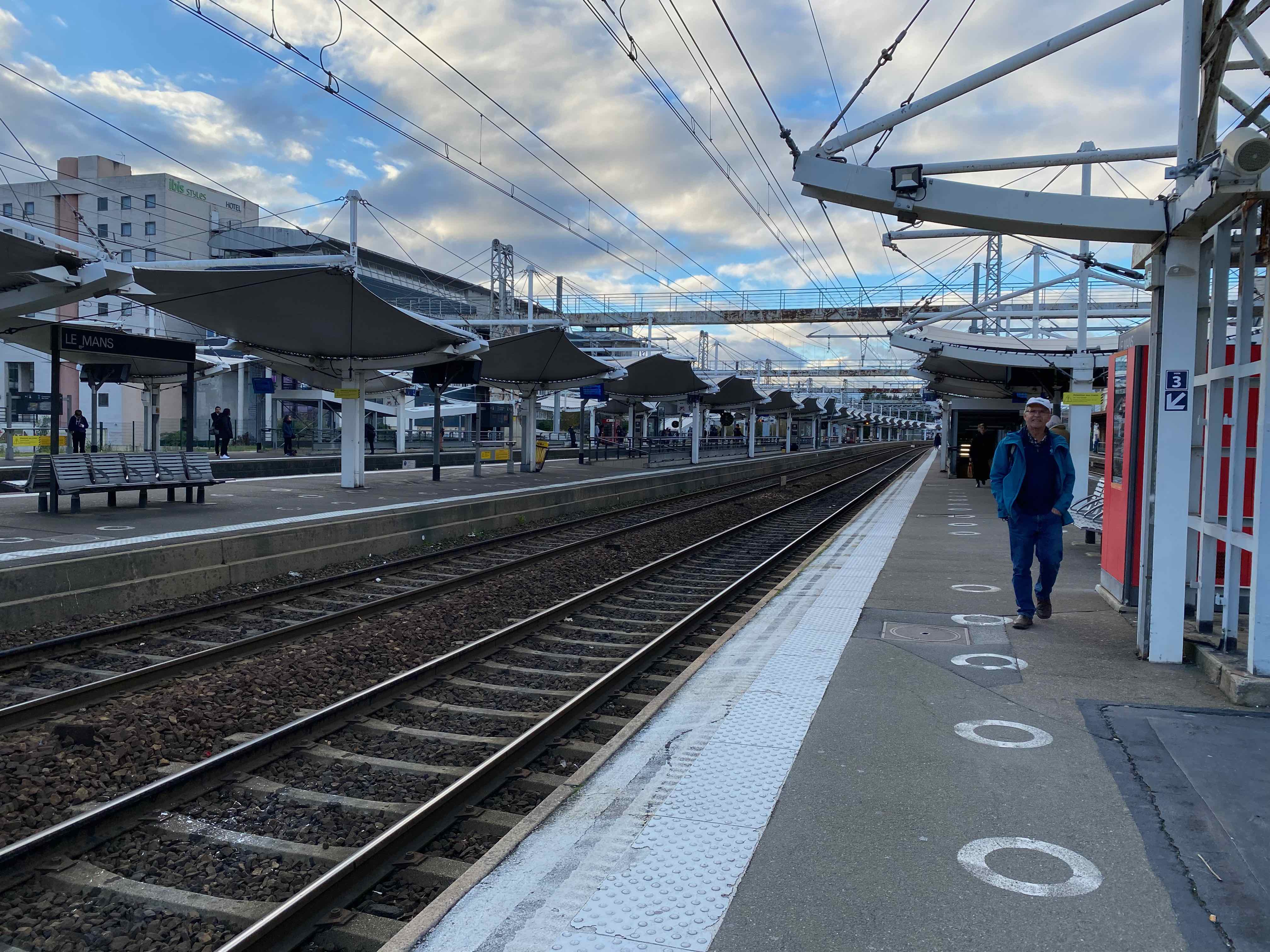
We are taking the TGV High speed Train to Le Mans.The train station with all the tracks and overhead electric lines that power the trains.
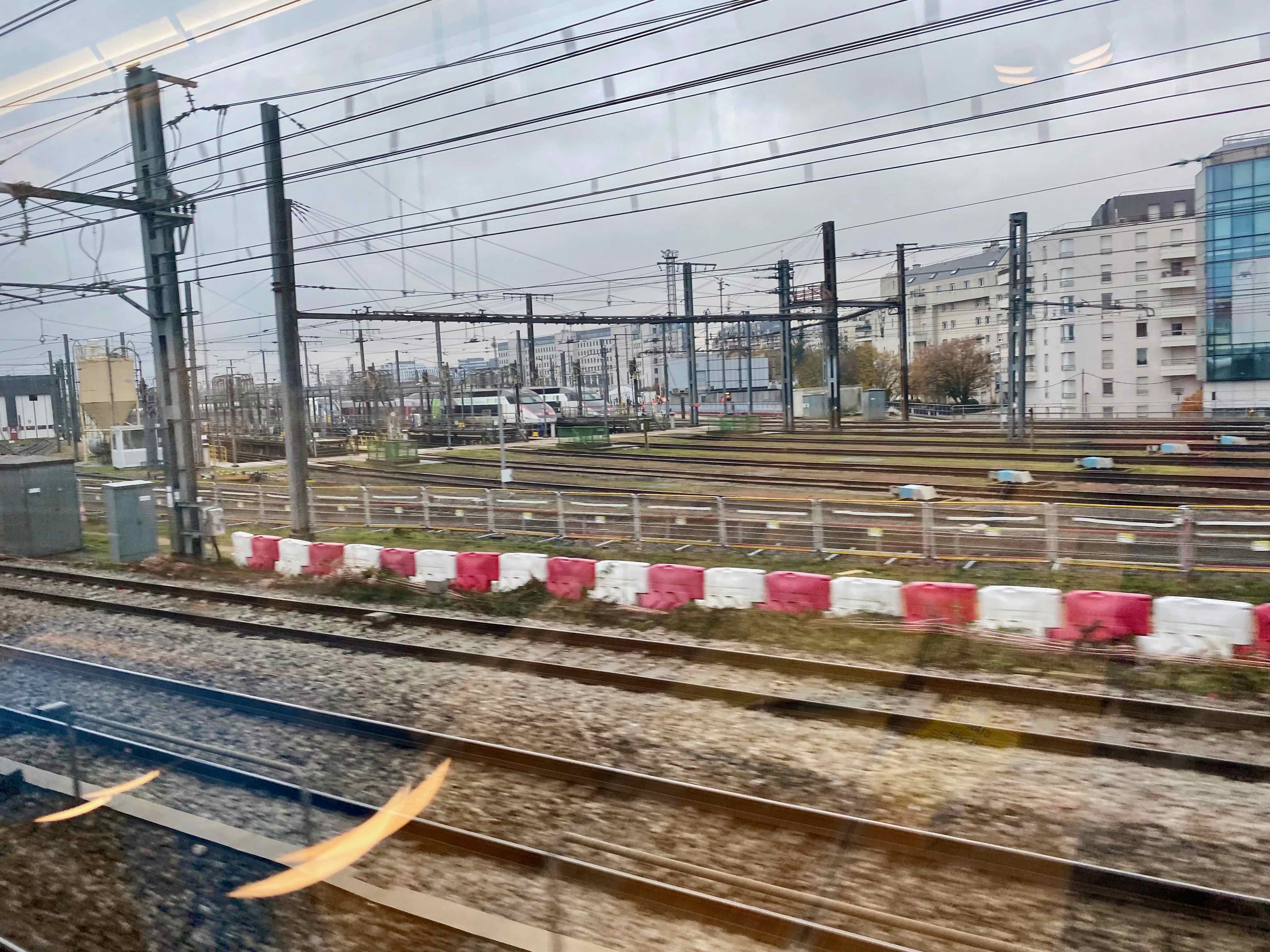
This link to a short video which shows how fast the countryside was flying by.  The vehicles on the highway are going 130 km an hour and we fly past them!  https://www.youtube.com/watch?v=0wt-AzdJG54

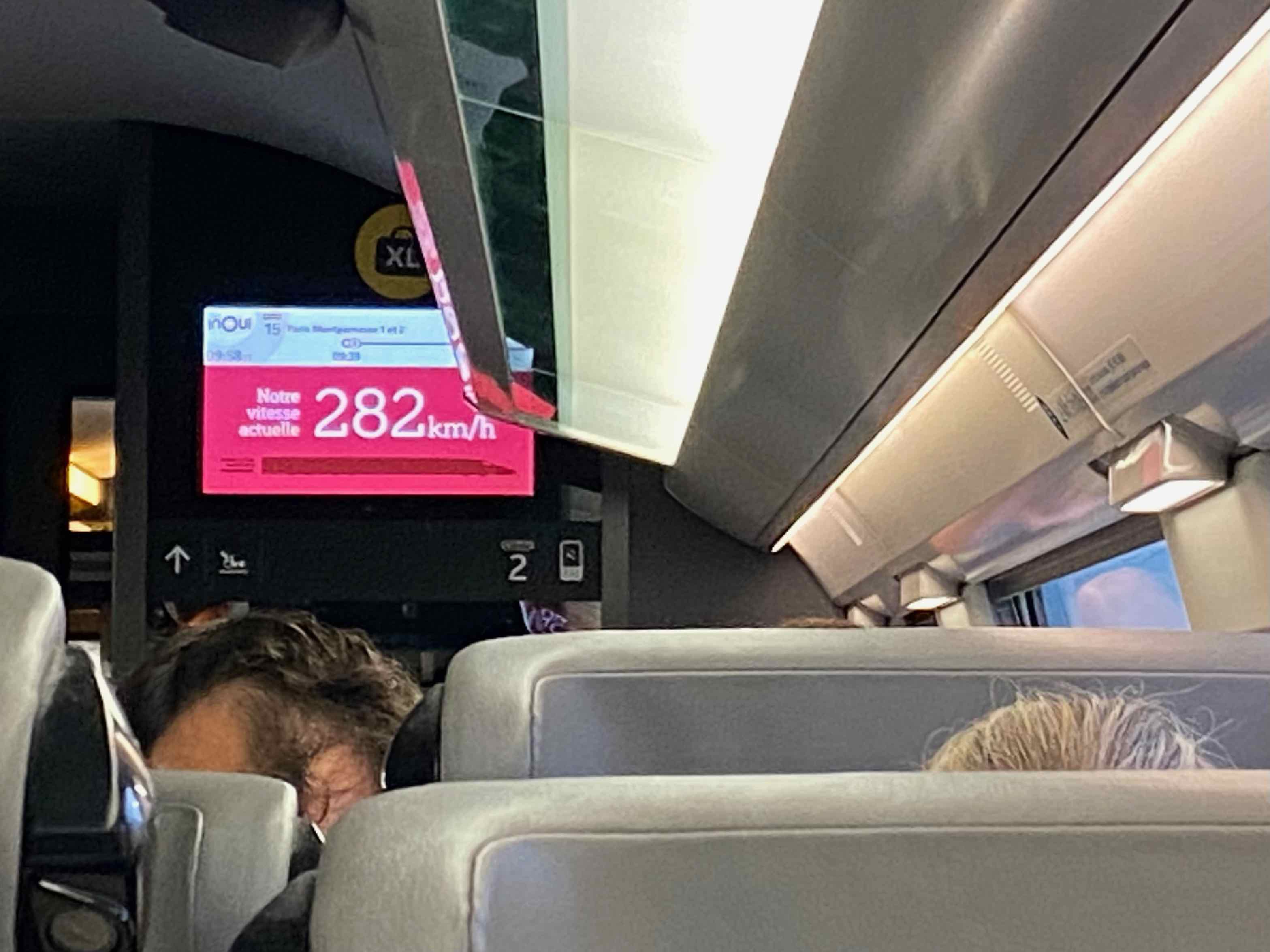
We are travelling 282 km an hour!

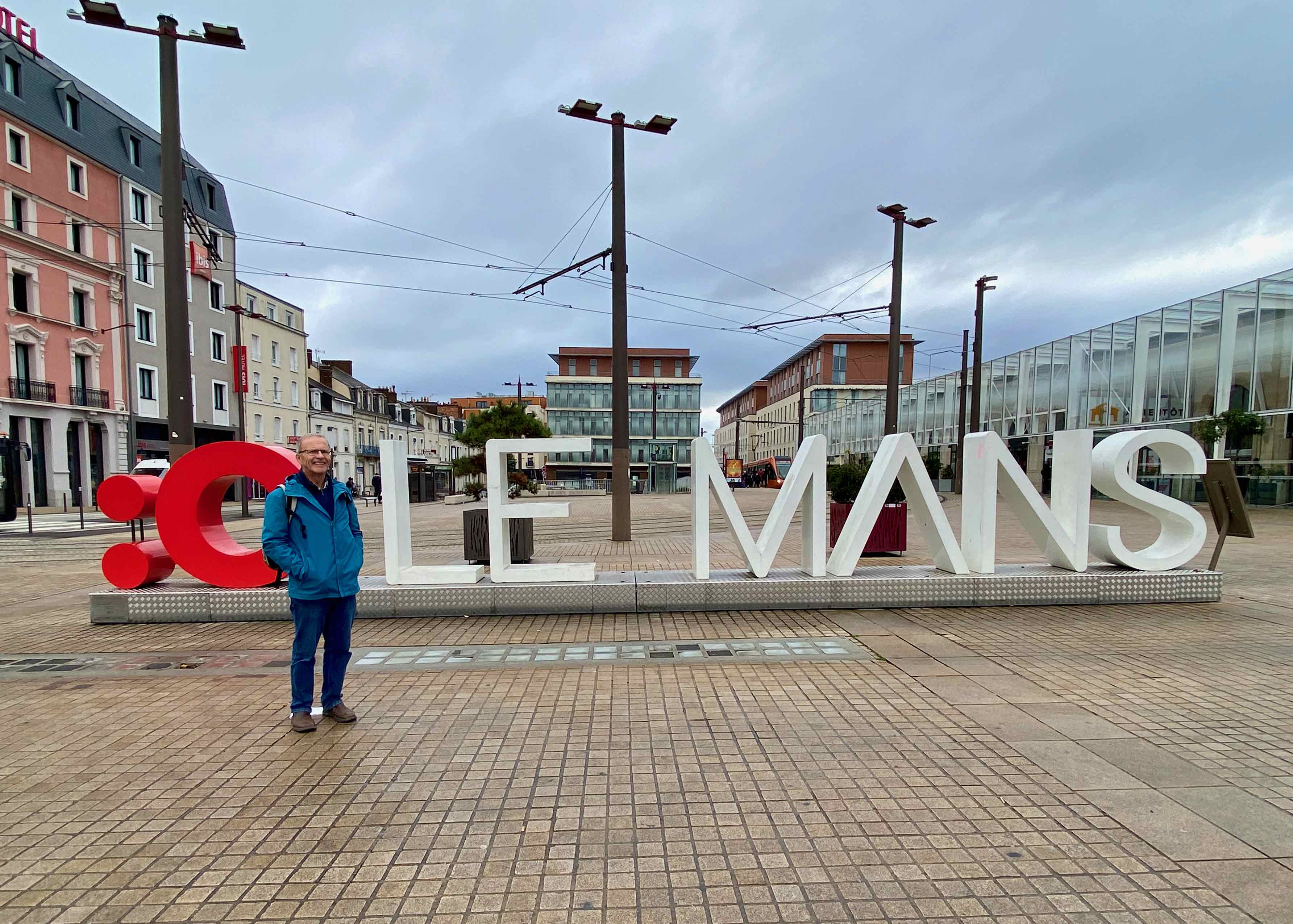
I thought I should snap a photo of our train.We are in Le Mans.

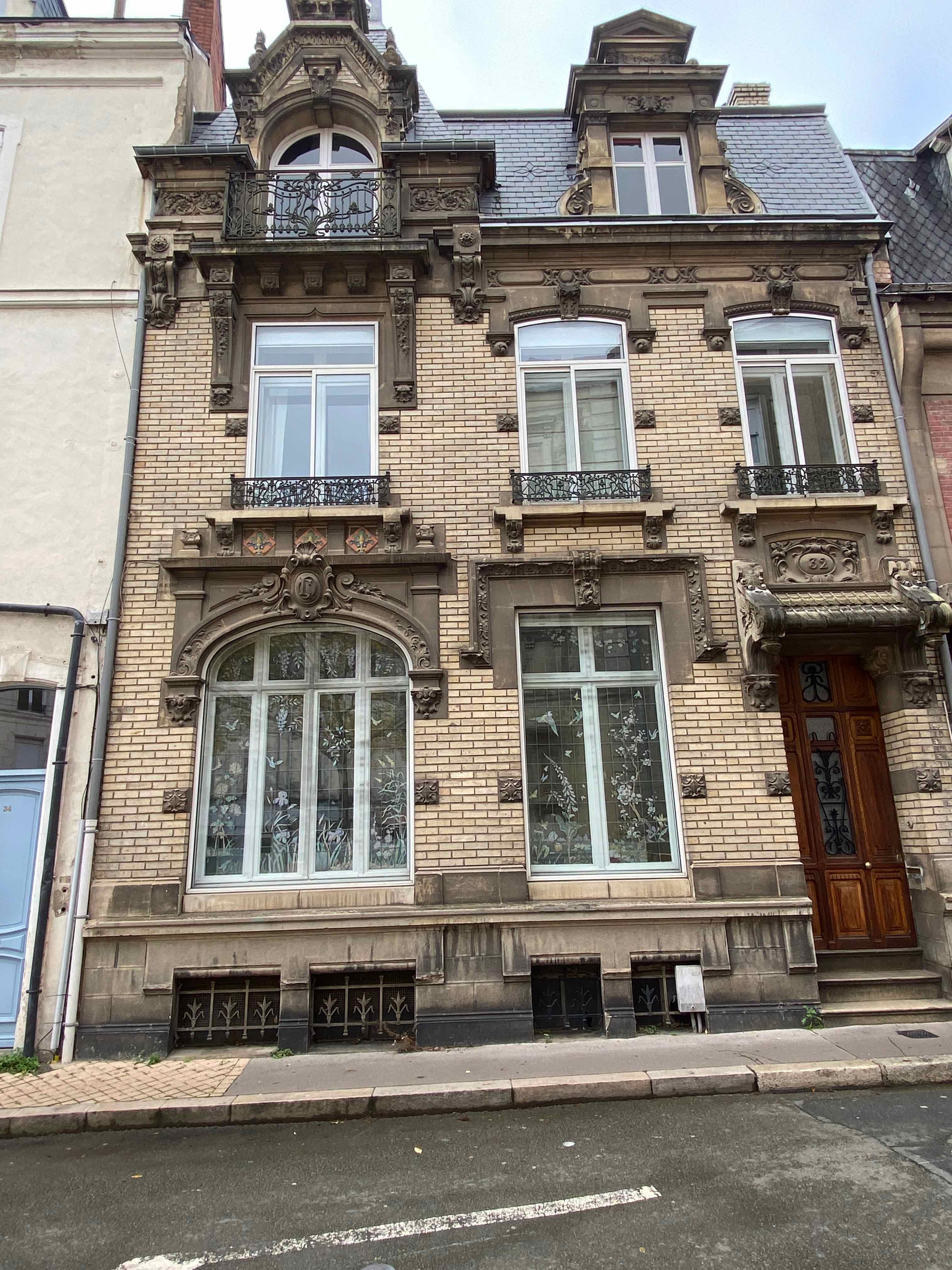
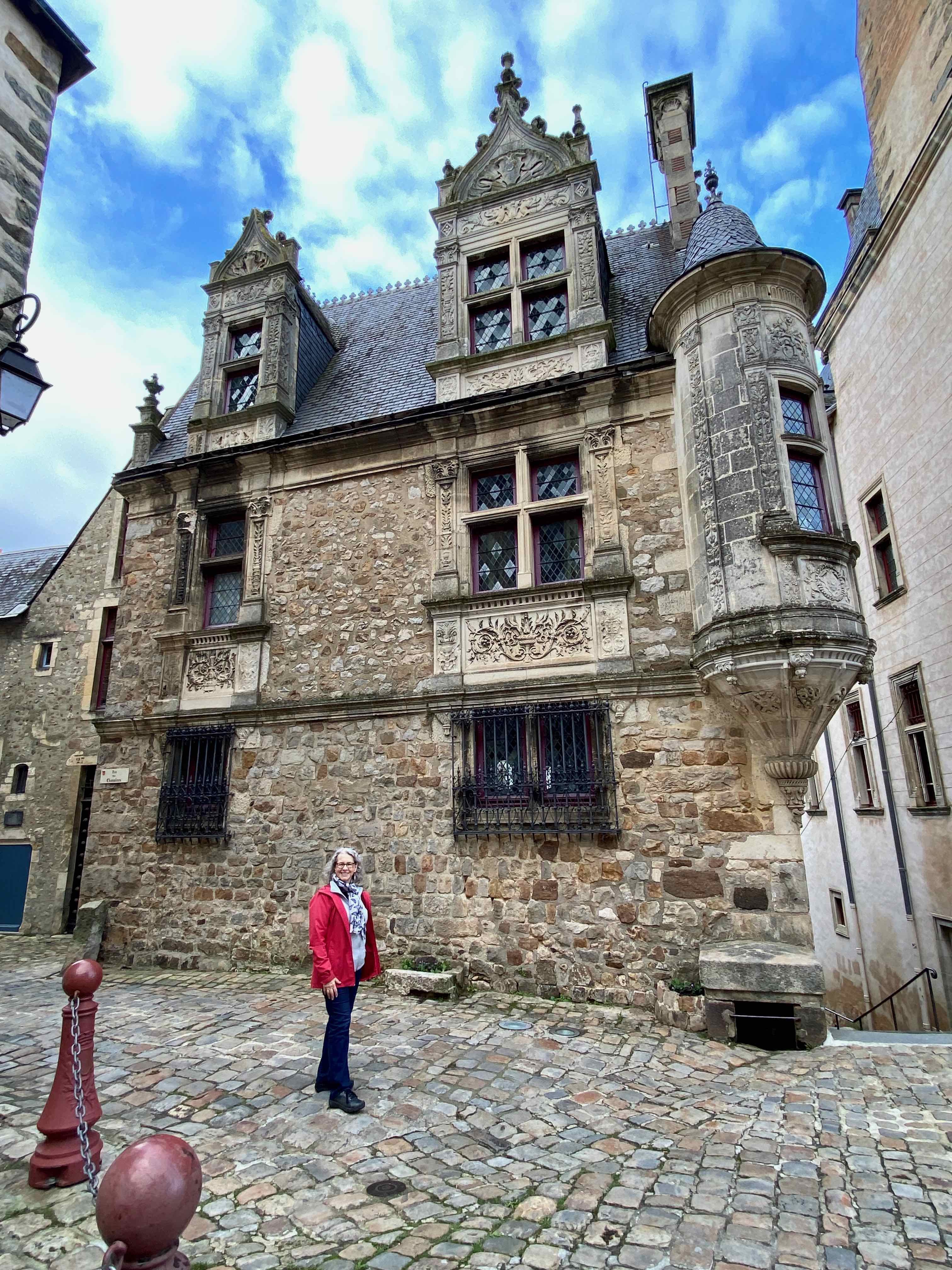
Just one of the many beautiful buildings in Le Mans.

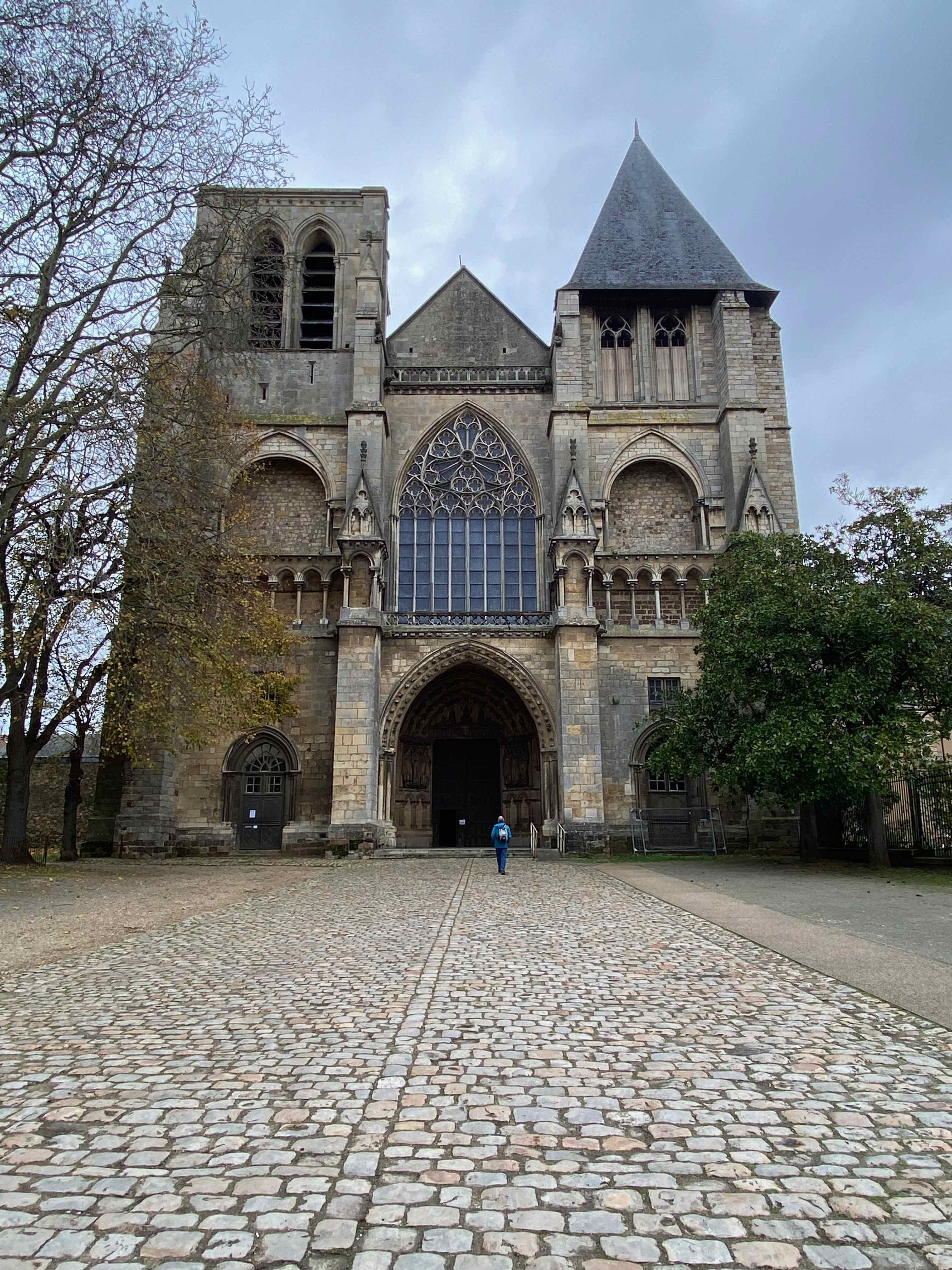
We decide to wander and see where we end up.  Notre Dame de la Couture dates mostly from the 12th century.

We were the only people visiting the church, which seems even larger inside than it did outside.

The pillars in the church are beautifully decorated.

We don’t really get tired of visiting all these magnificent old churches.  Each one has something different and interesting to see.

So many of the churches we have visited are undergoing restoration of some type, this one is no different.  I think if you are in the restoration business in France there is no shortage of work.

I loved this simple sculpture.

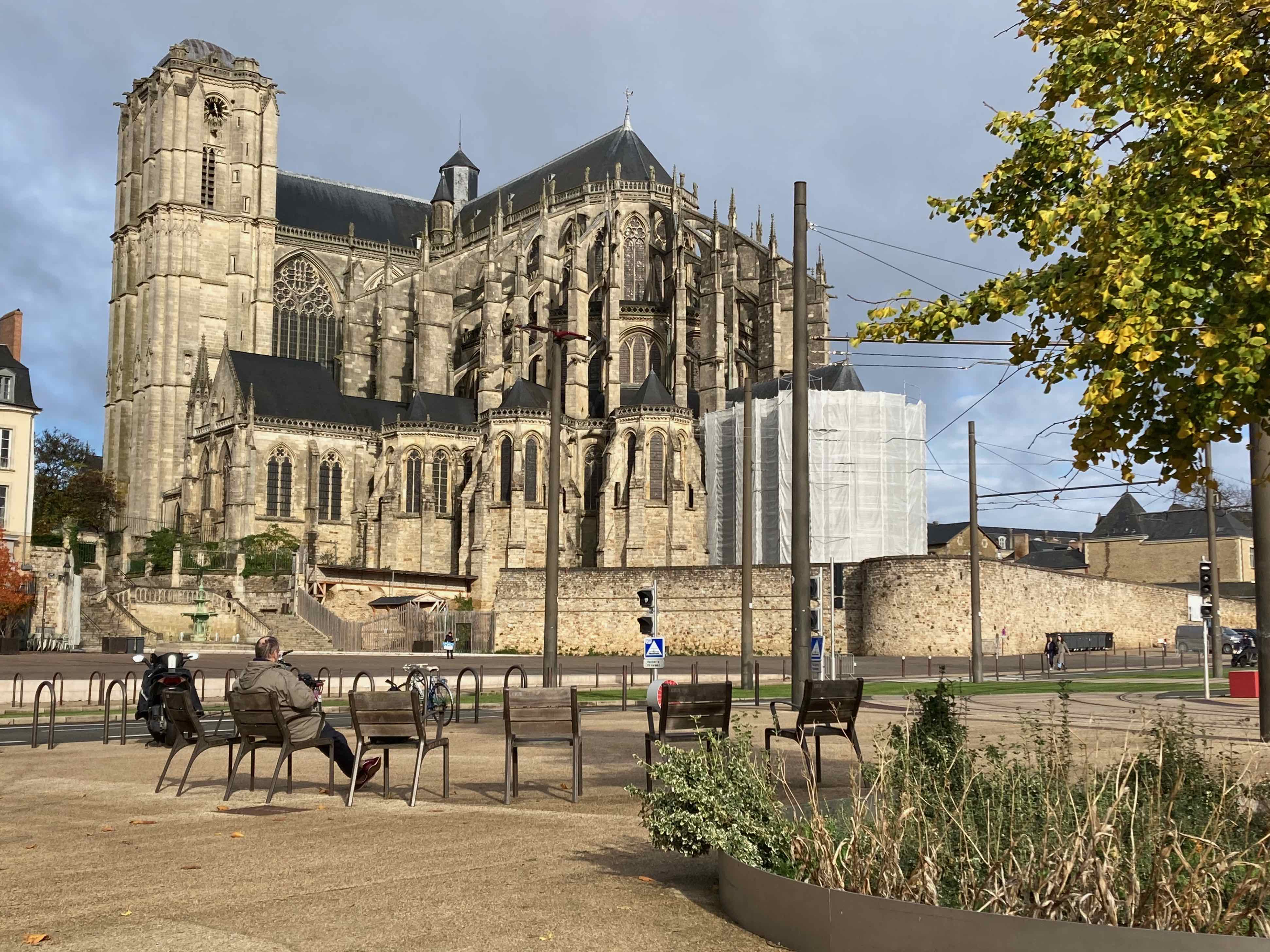
We sat in the sun with a view of the Cathédrale de Saint-Julien de Mans to enjoy our picnic lunch.

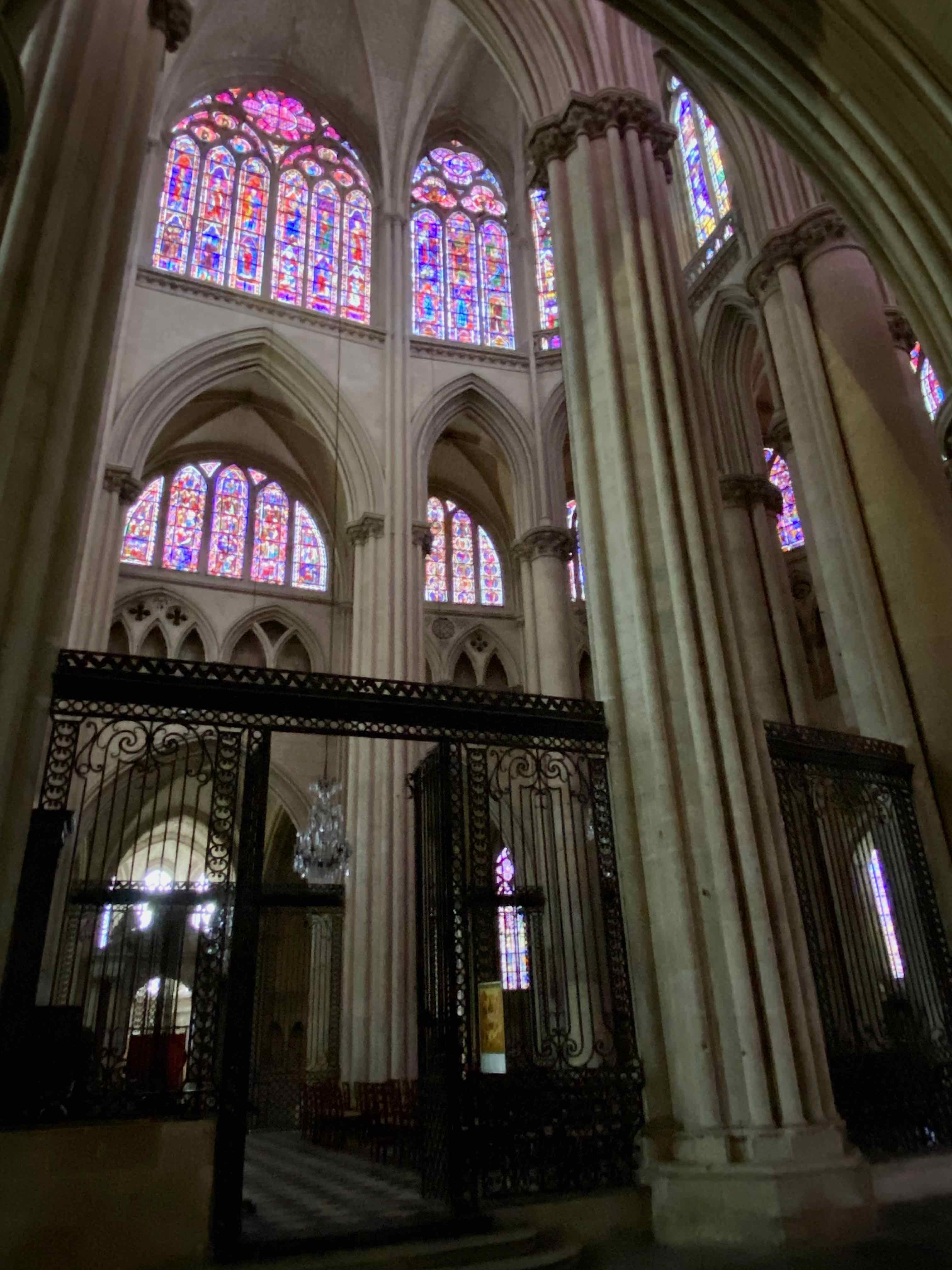
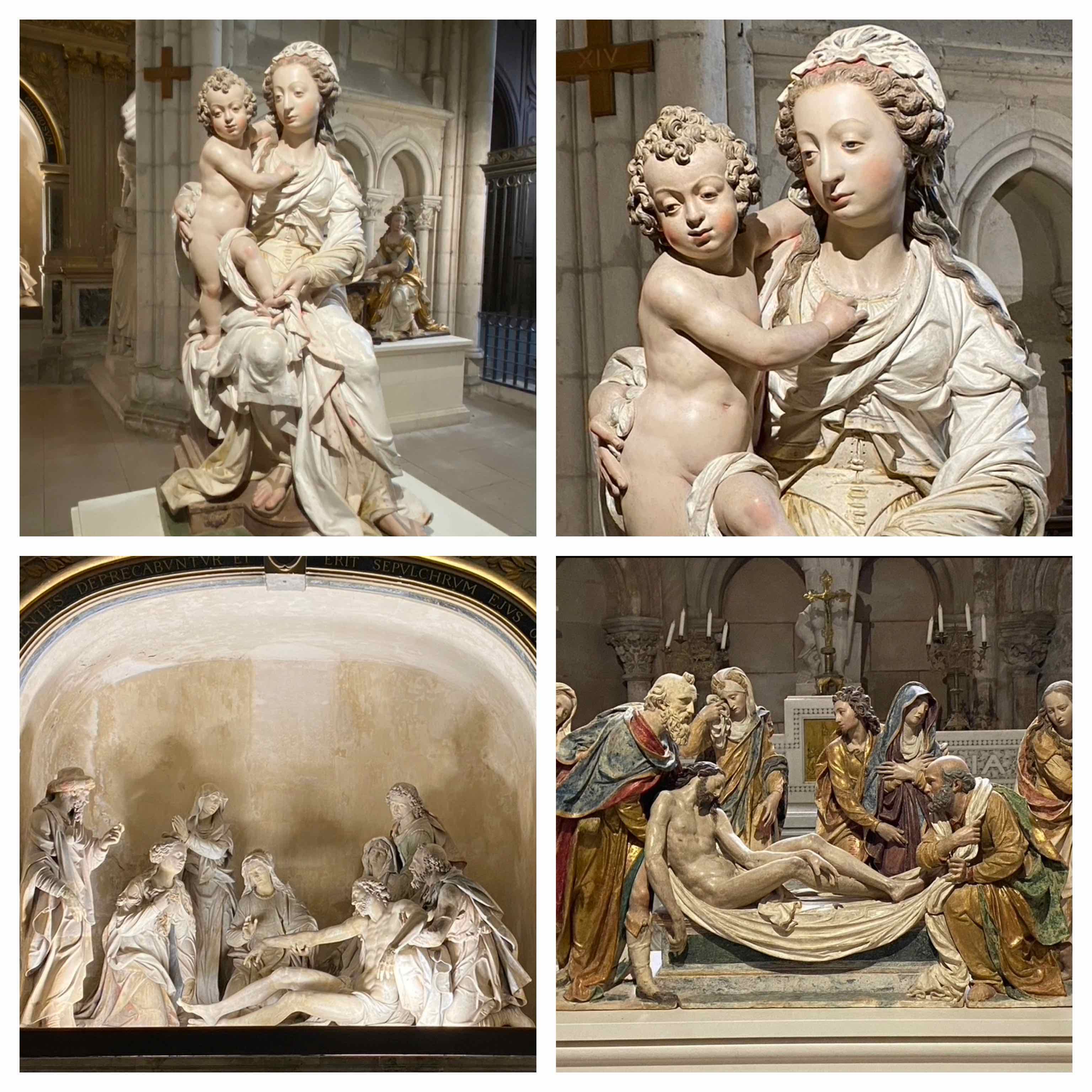
This cathedral was built between the eleventh and the fifteenth century in a mixture of architectural styles and has some of the oldest stained glass windows in France still in their original location.There are also many sculptures in this church that retain their original polychrome finish.  We are so used to seeing bare stone sculptures that it is easy to forget that many if not most sculptures were originally painted in realistic colours.  These are some of the most beautiful that we have seen on this trip.
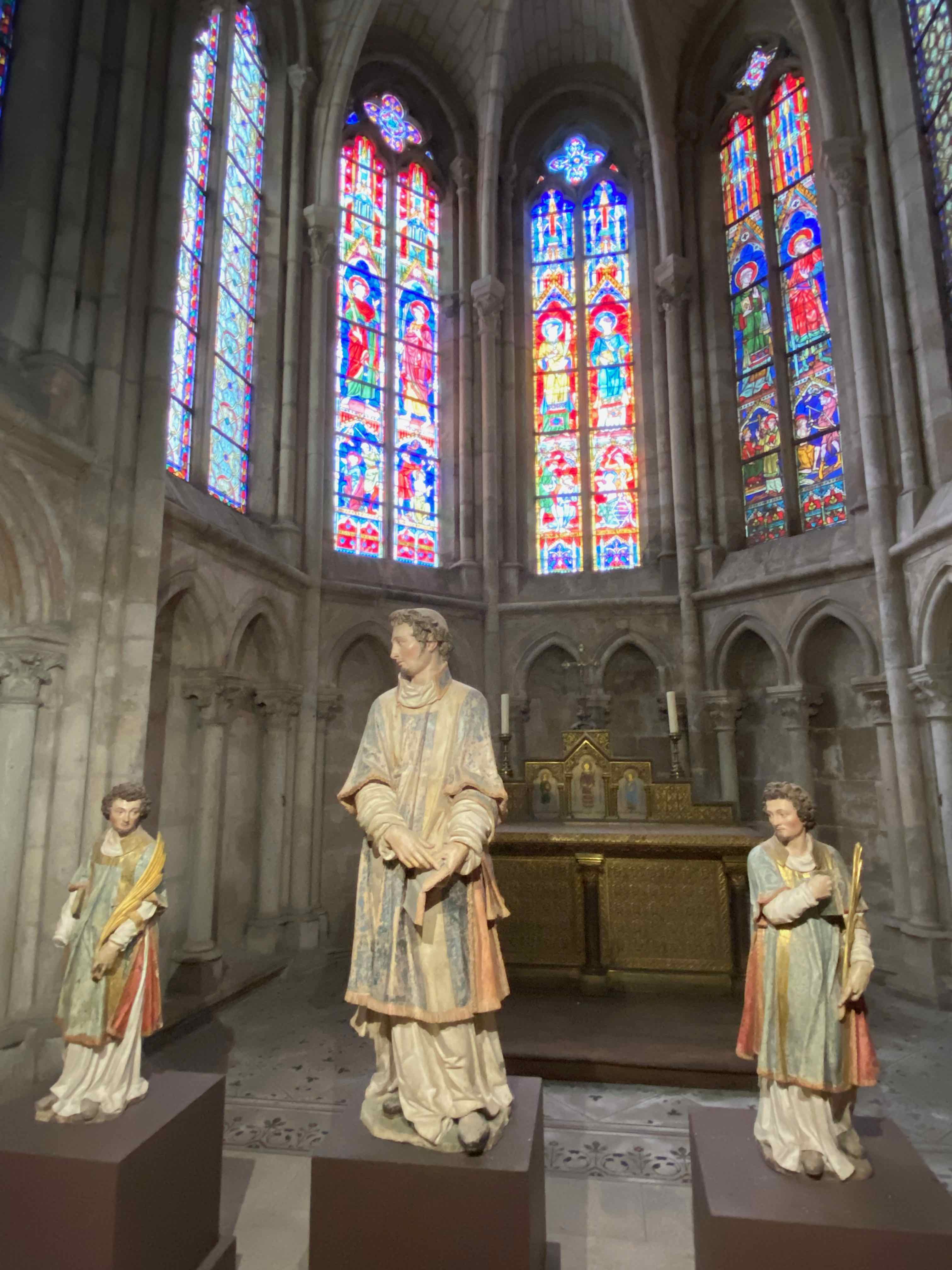
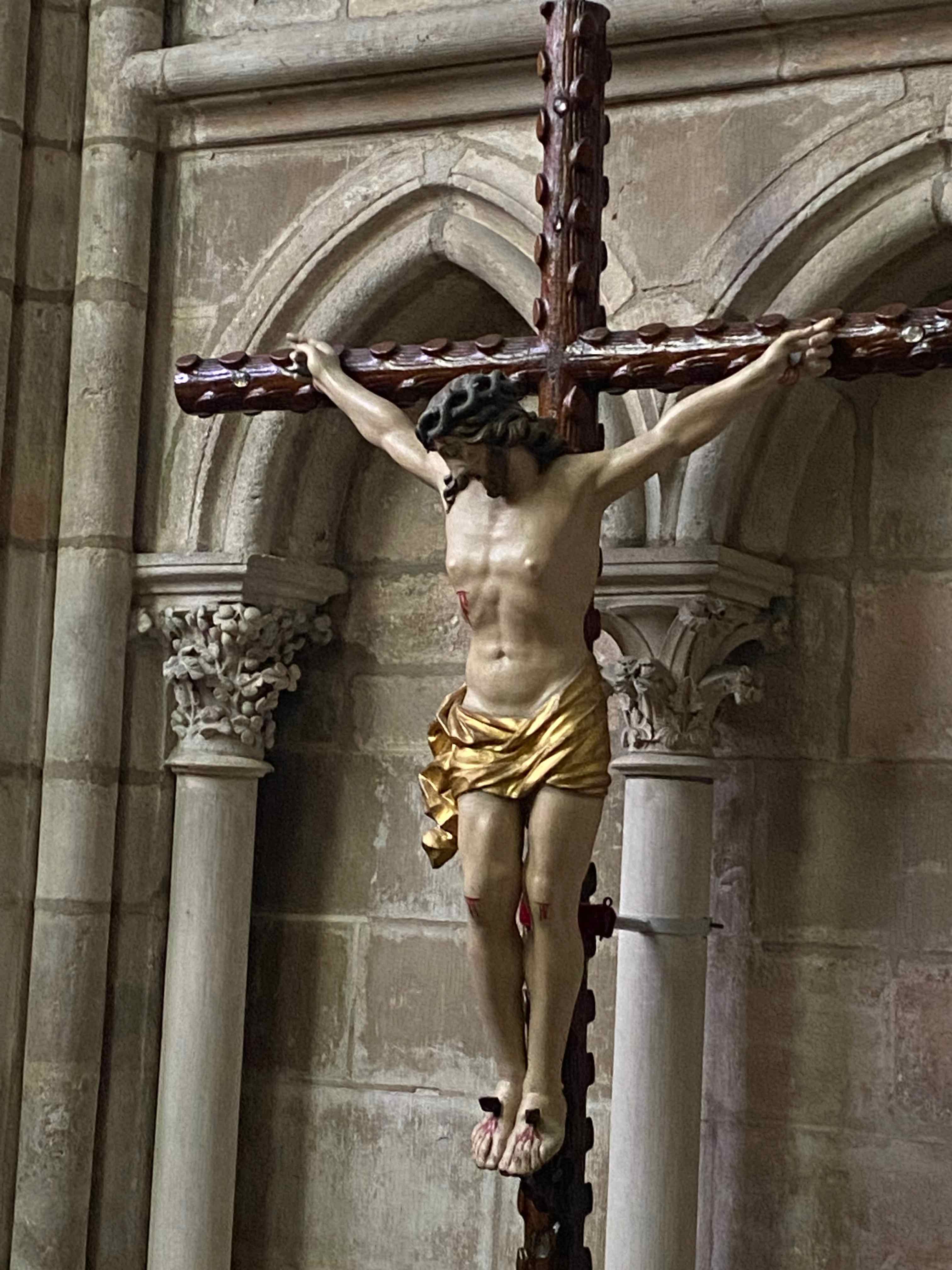
This Madonna and Child was stunning, as were the other polychrome sculptures in this church.

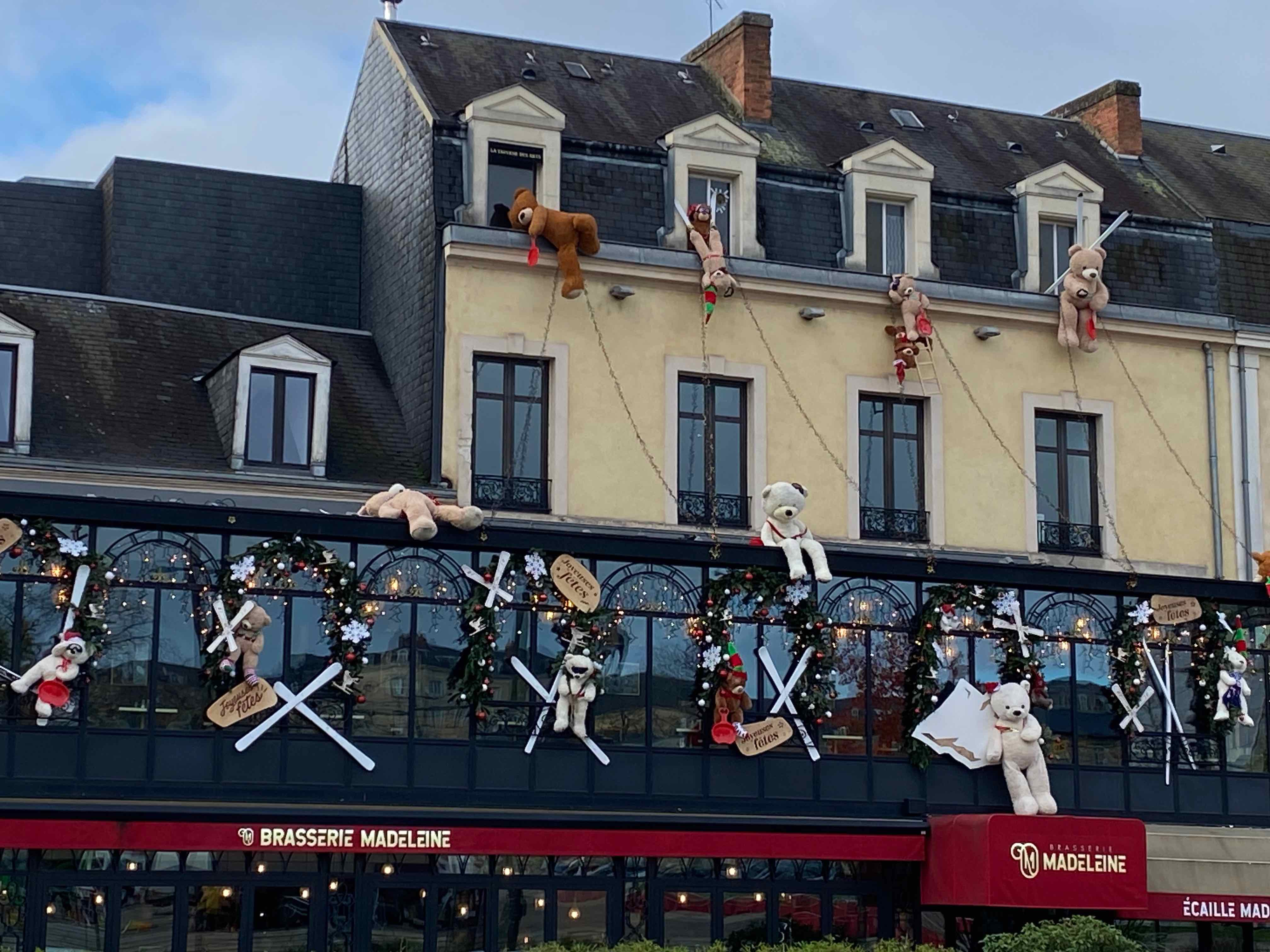
Some of the buildings in town have started to decorate for Christmas.  This one was rather unique!

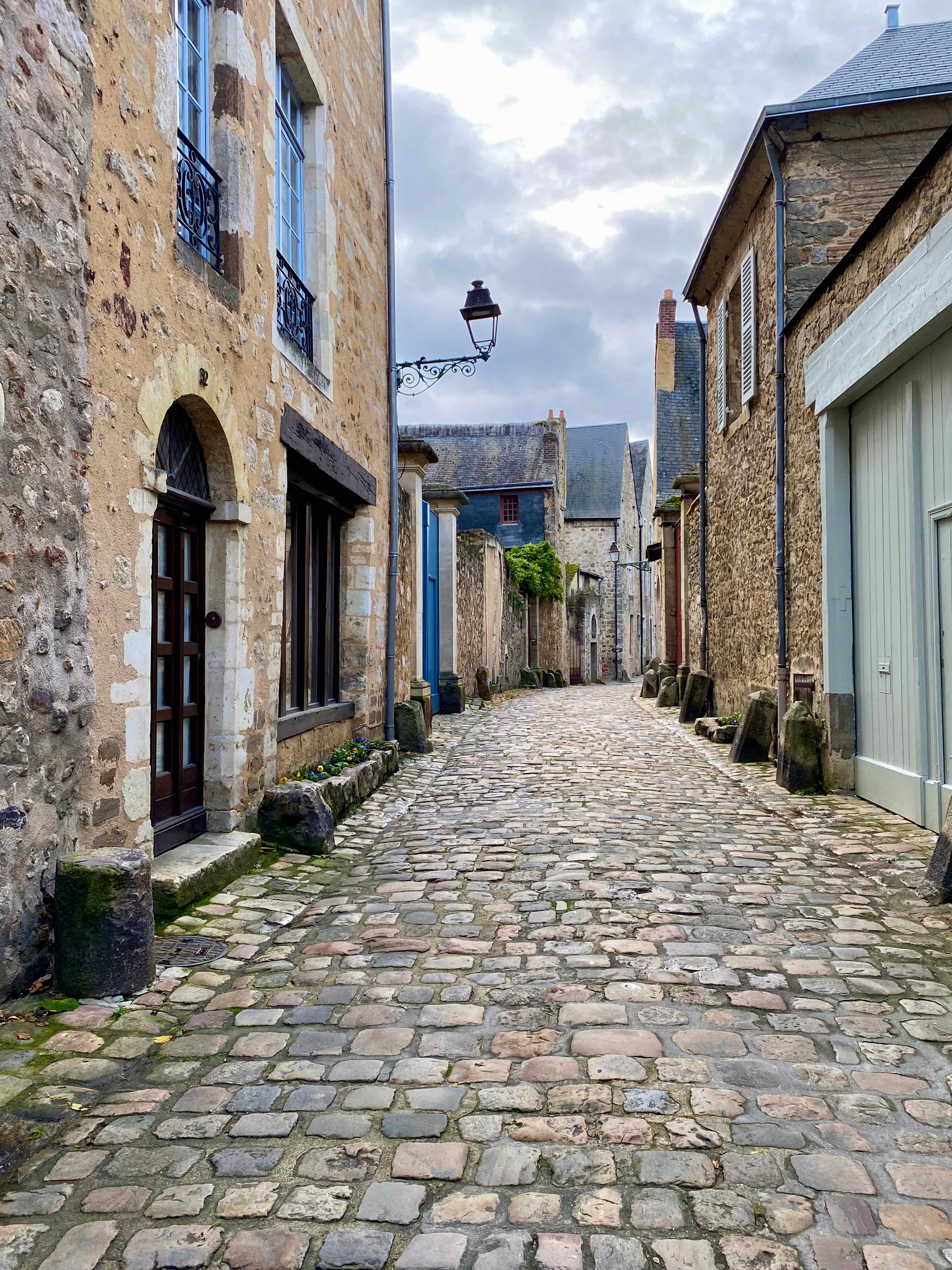
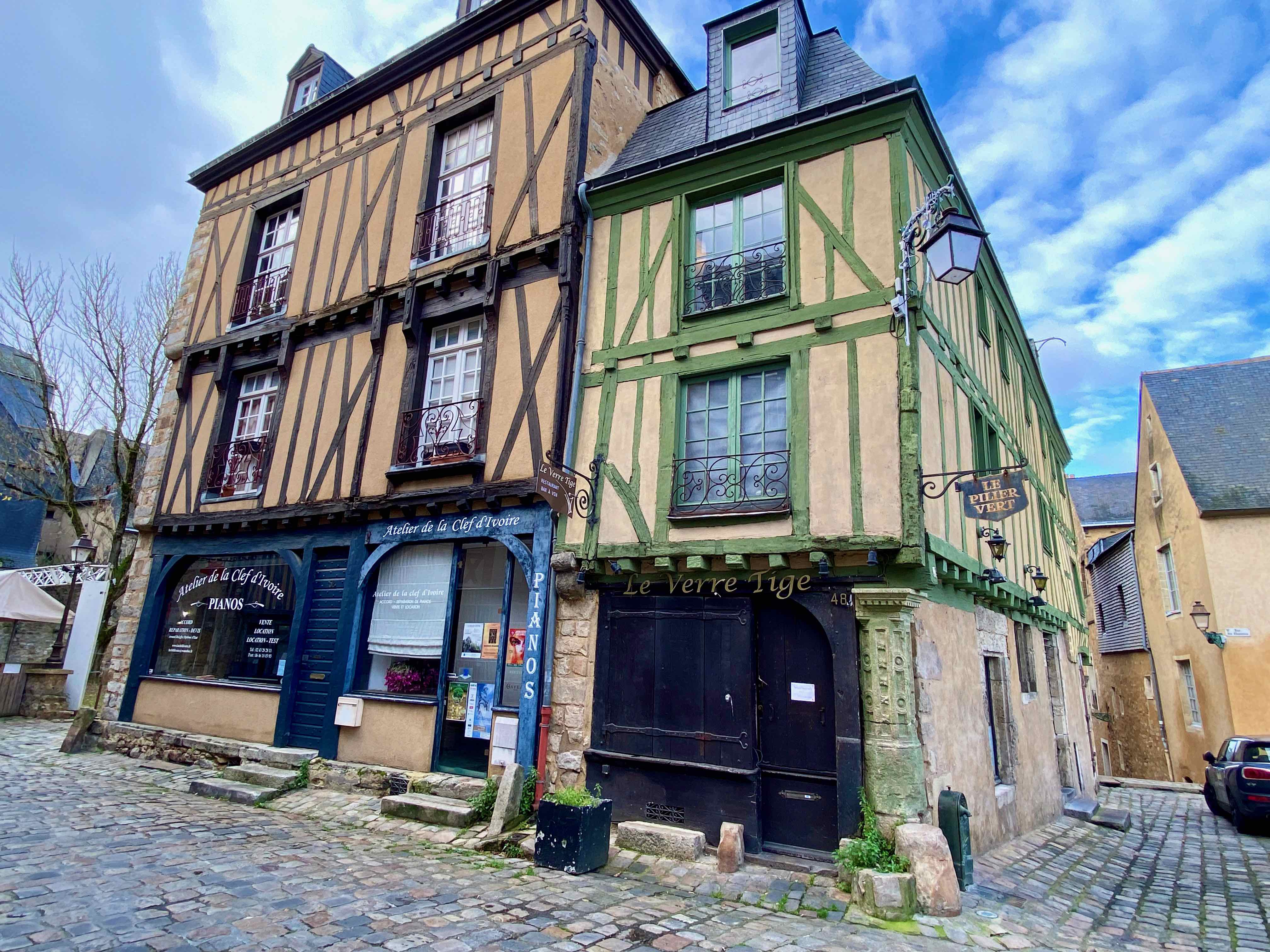
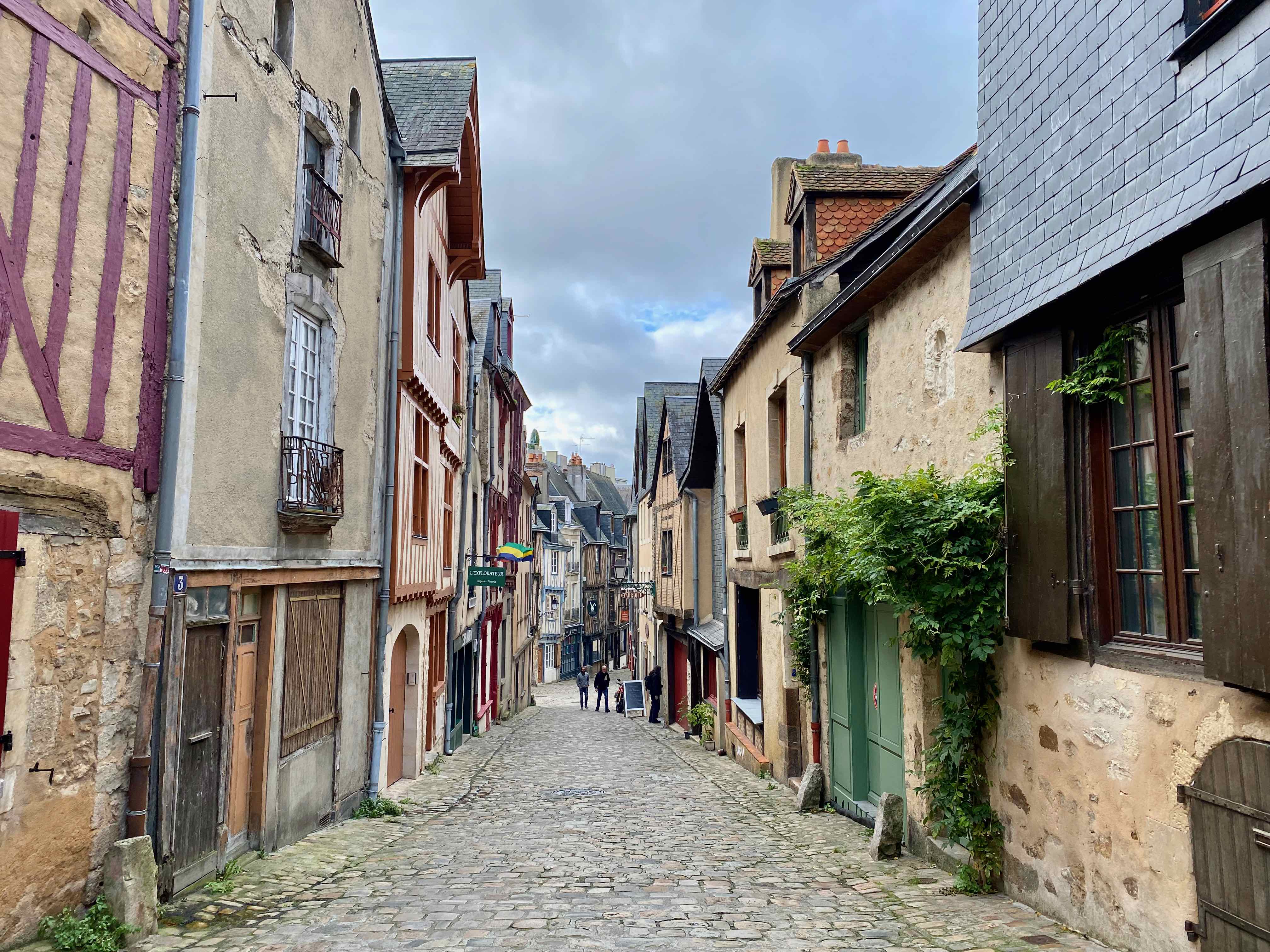
Another interesting old building…I wonder what the inside looks like? There are cobbled streets everywhere,

There aren’t many people out and about in the old town…we are the only people on the these streets.  It feels strange, like the place is abandoned.

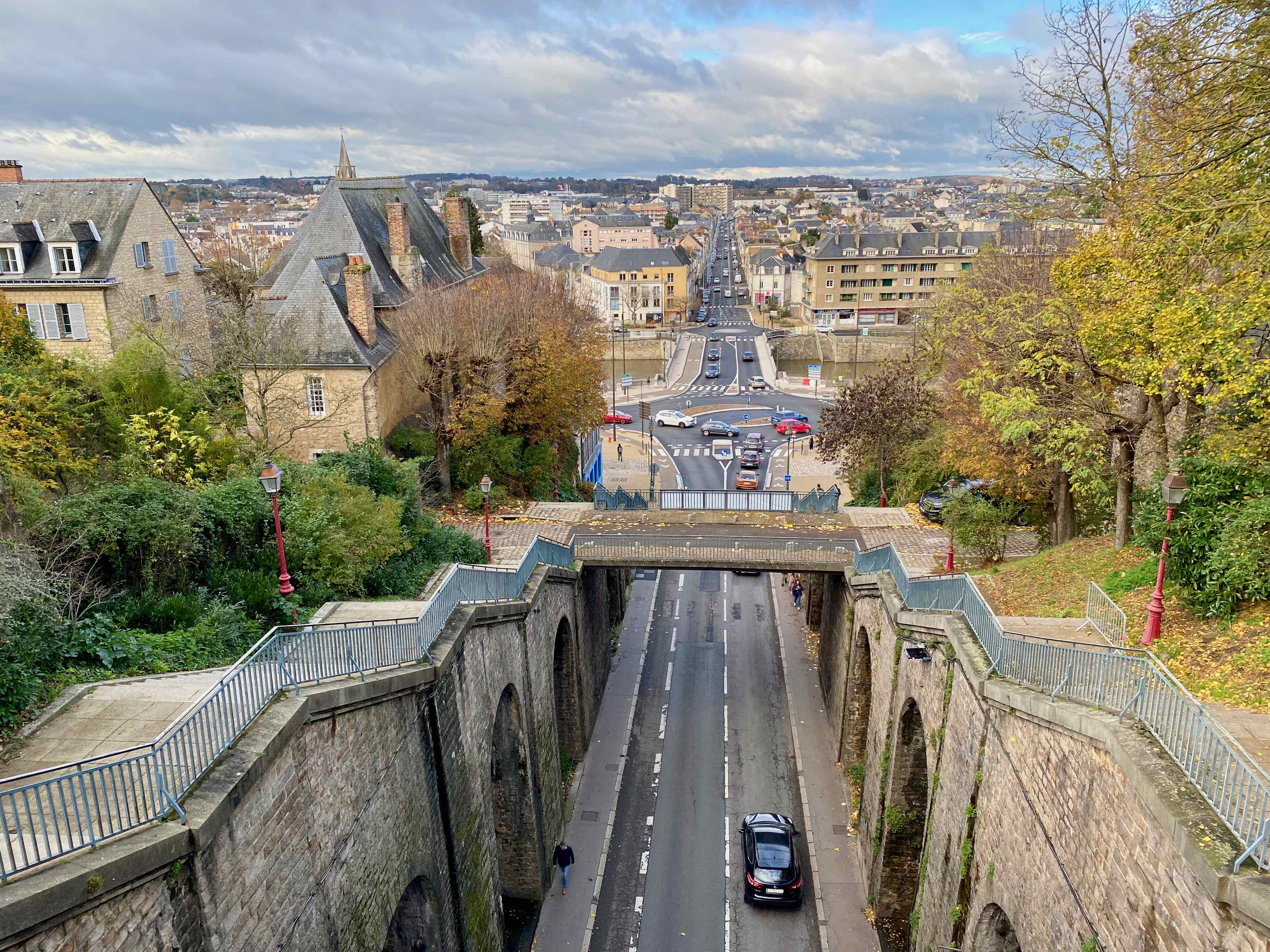
The old town is on high ground and we walk over this road which somehow passes beneath us…a tunnel perhaps?

More very old buildings, but everything is closed…too bad.

We finally see a few other people!

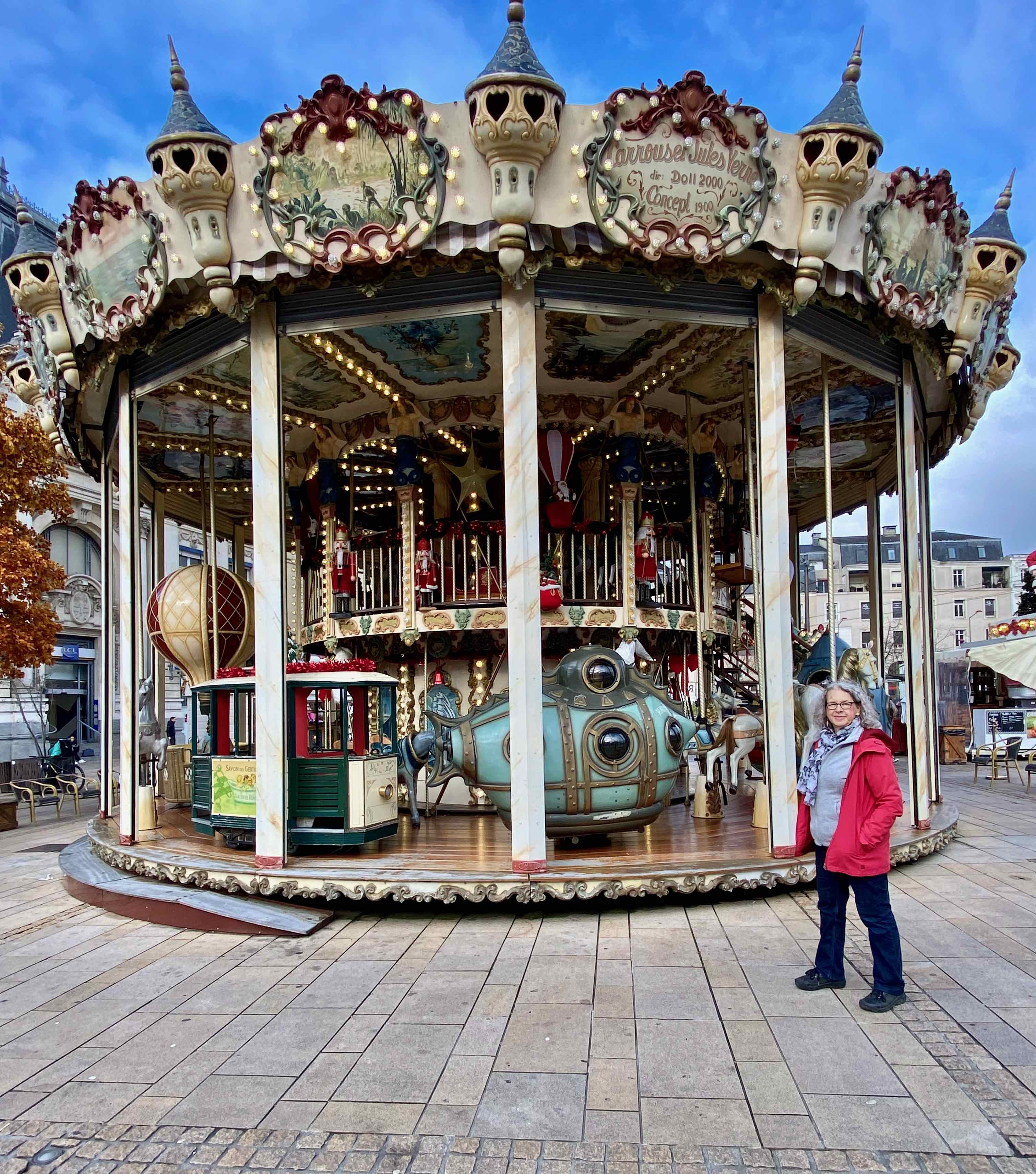
Even this beautiful, ornate merry-go-round is closed!  I love riding merry-go-rides. Too bad I won’t be able to try this one out.

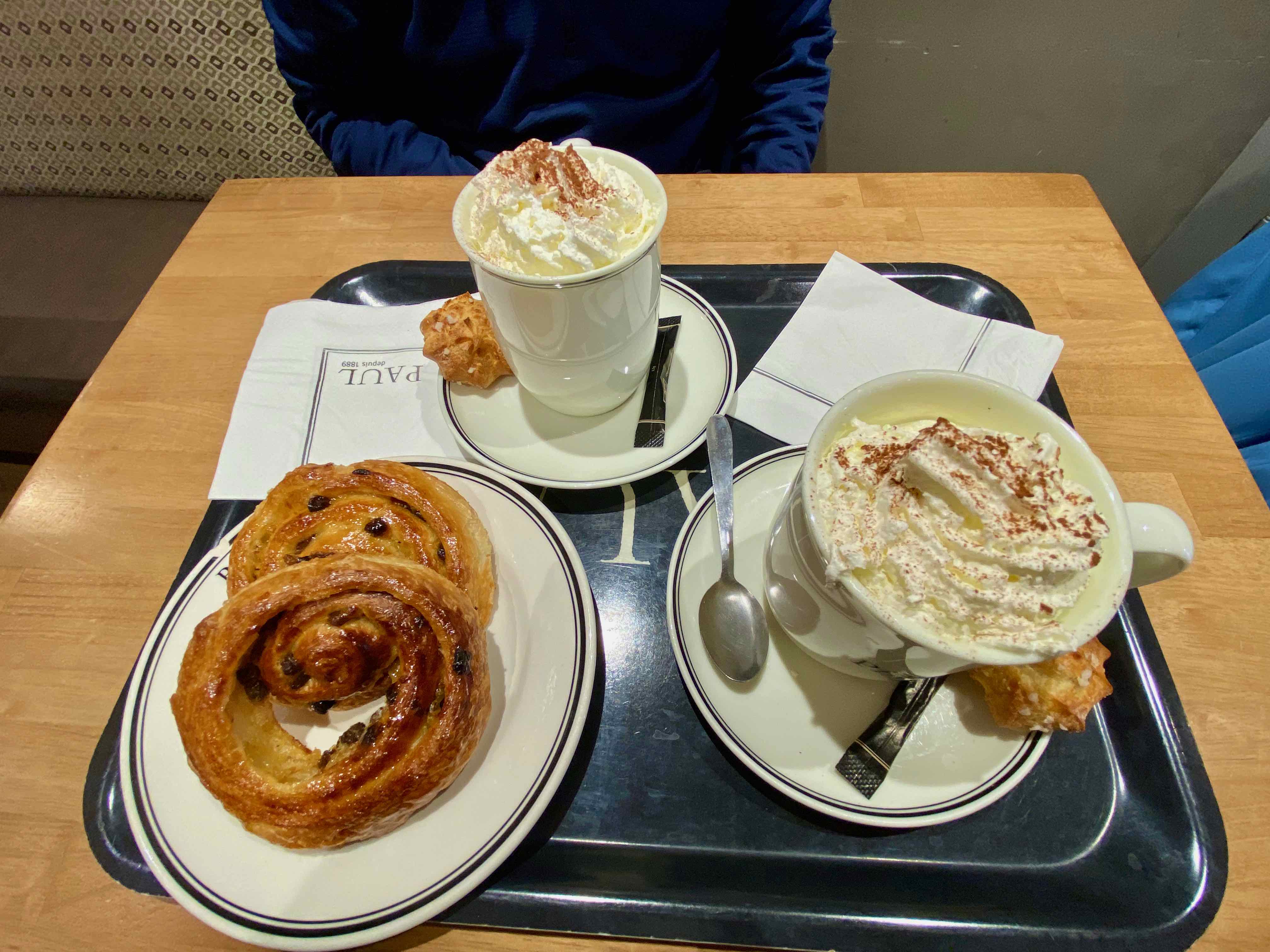
After much searching we find a Paul’s and have some hot chocolate and yummy pastries….only 22 euros, or $32.00 Canadian!!  At least it was all delicious.

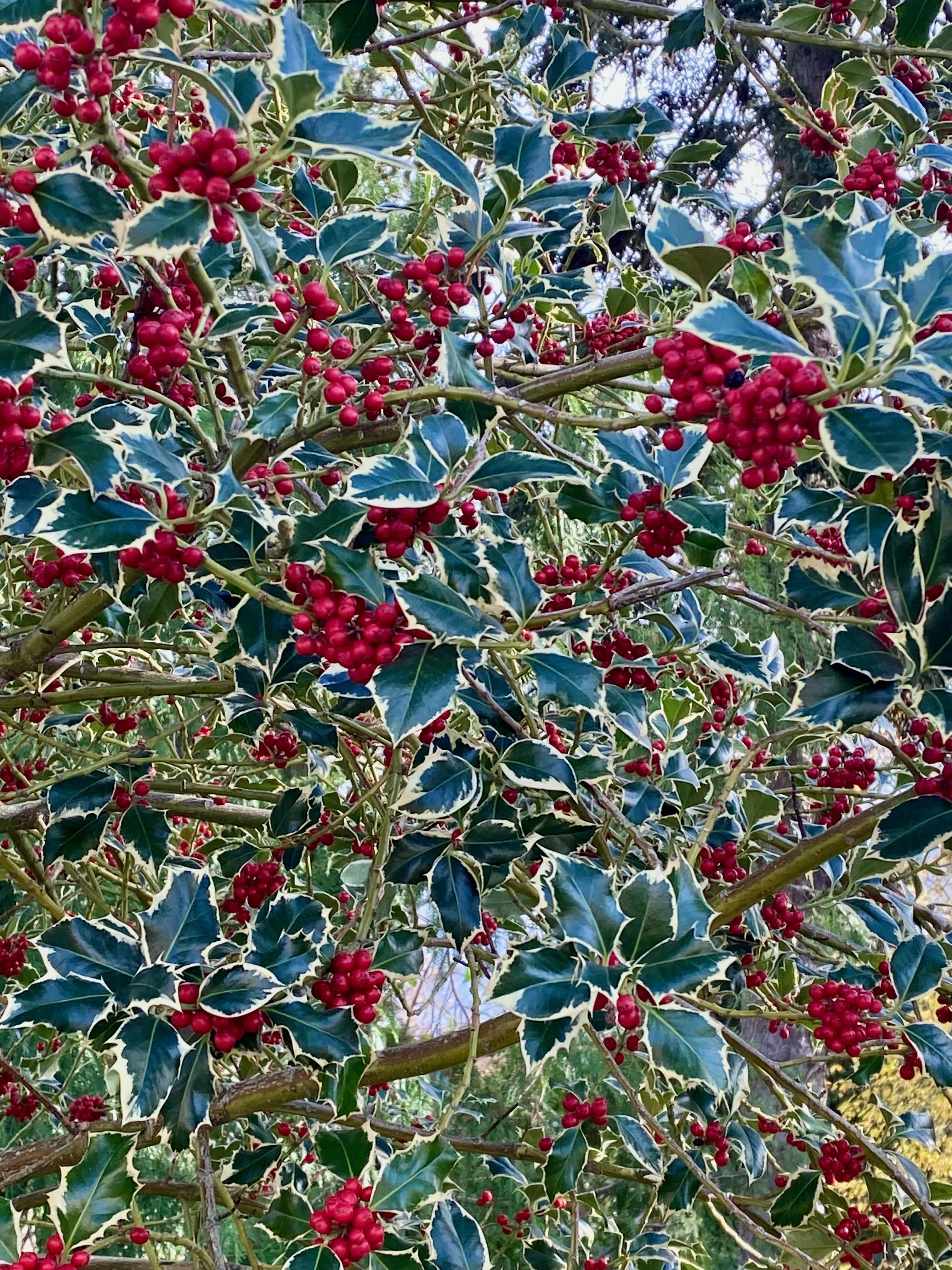
We walked past this beautiful variegated holly bush which was very Christmassy on our way to find the Musée de Tessé.We have seen several tree sculptures in different towns by this artist, whose name I have forgotten!  I quite liked them all.
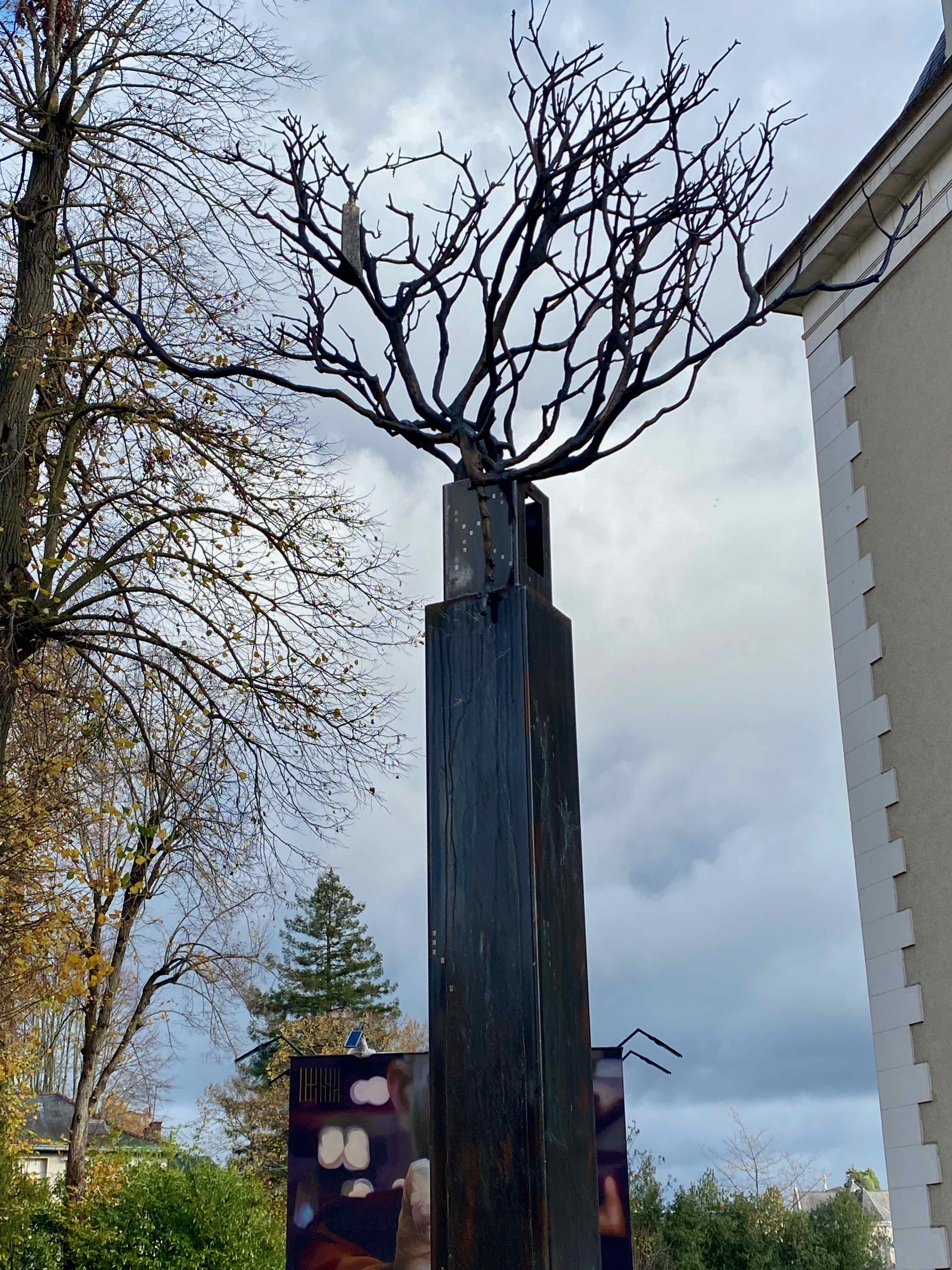
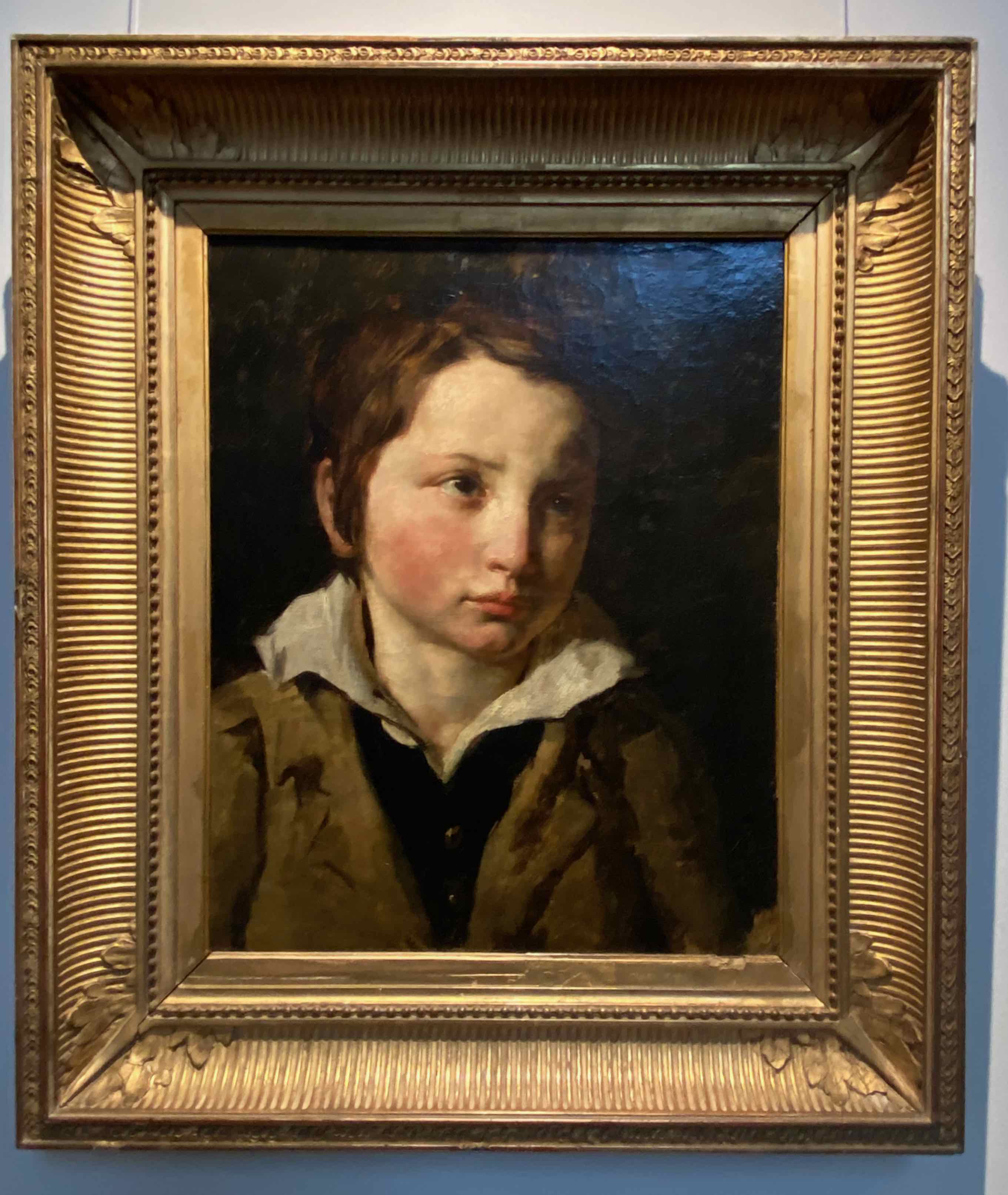
We find the Musée Tessé and are surprised that there is no admission fee.  It isn’t a big museum, but it is just the right size for an afternoon visit.  This museum opened in 1799, and is one of the oldest in France. It has a collection of French, Italian and Flemish paintings from the 14th to the 20th century and a unique space dedicated to ancient Egypt.  Each era has a room dedicated to that period with a nice selection of work…not too overwhelming which suits us well today.

I liked this little portrait by Théodore Gericault…

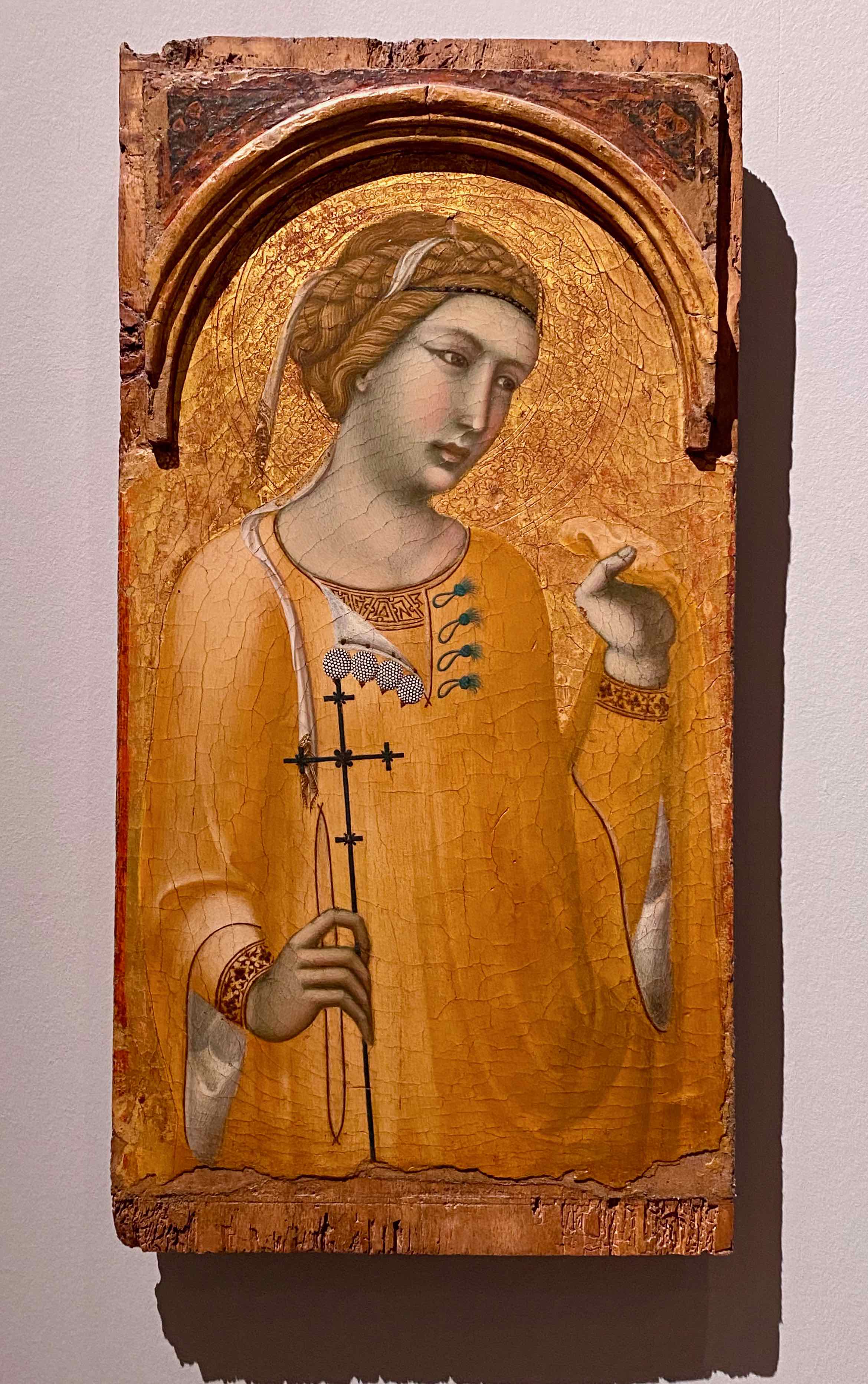
this tempera on wood painting of Saint Agathe from 1315…

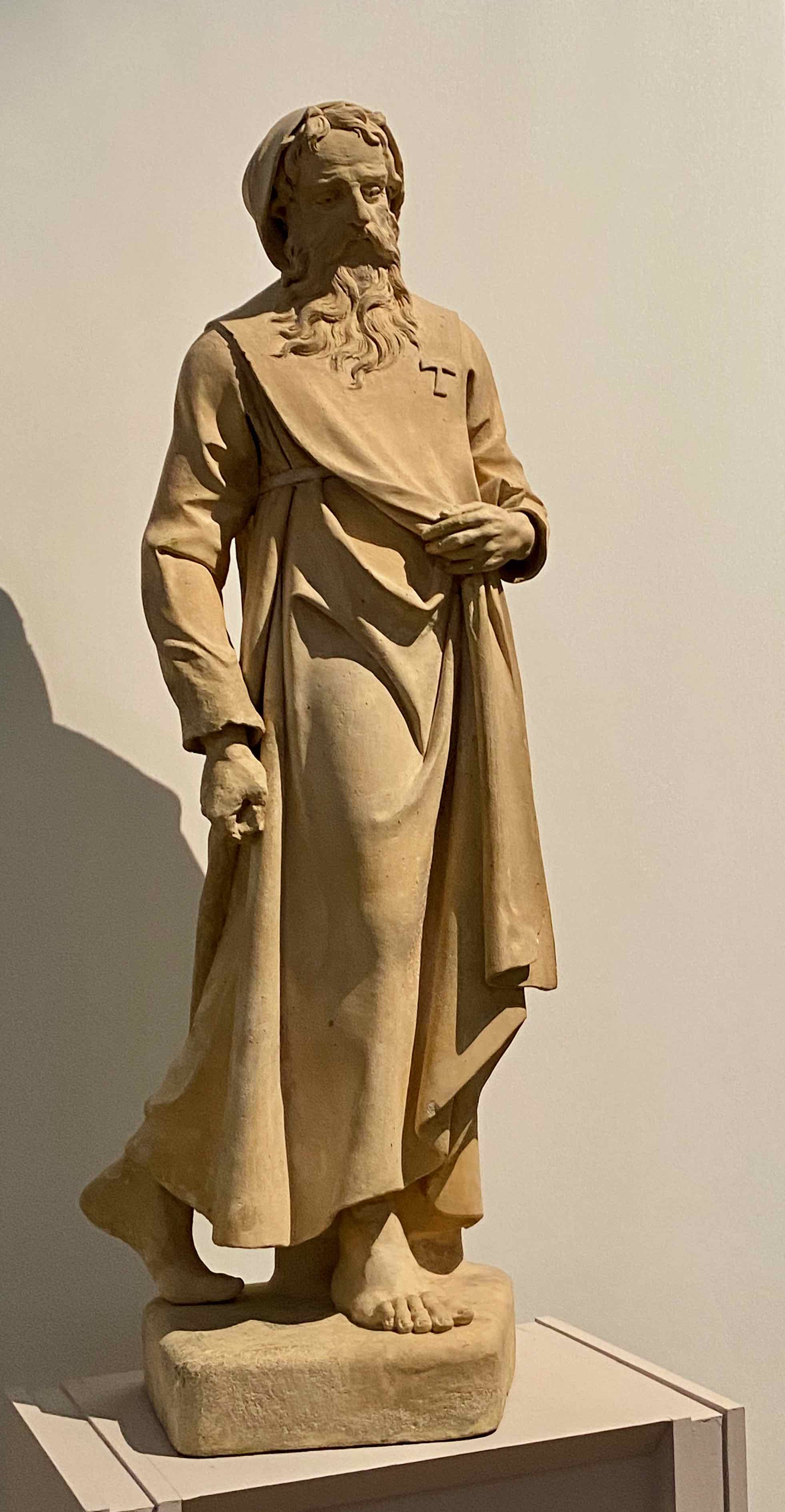
and this terra cotta sculpture of Saint Antoine from the last half of the 17th century.

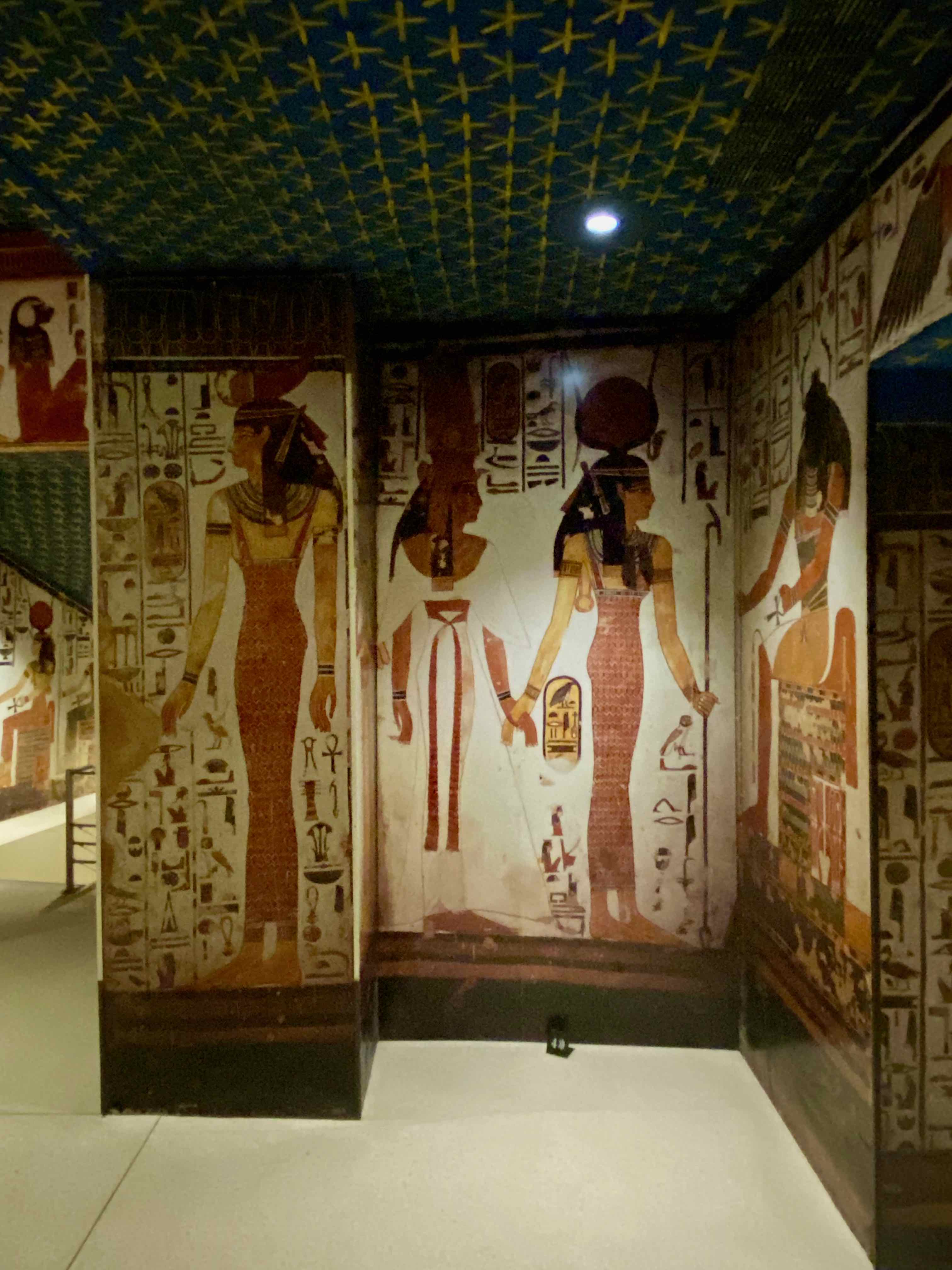
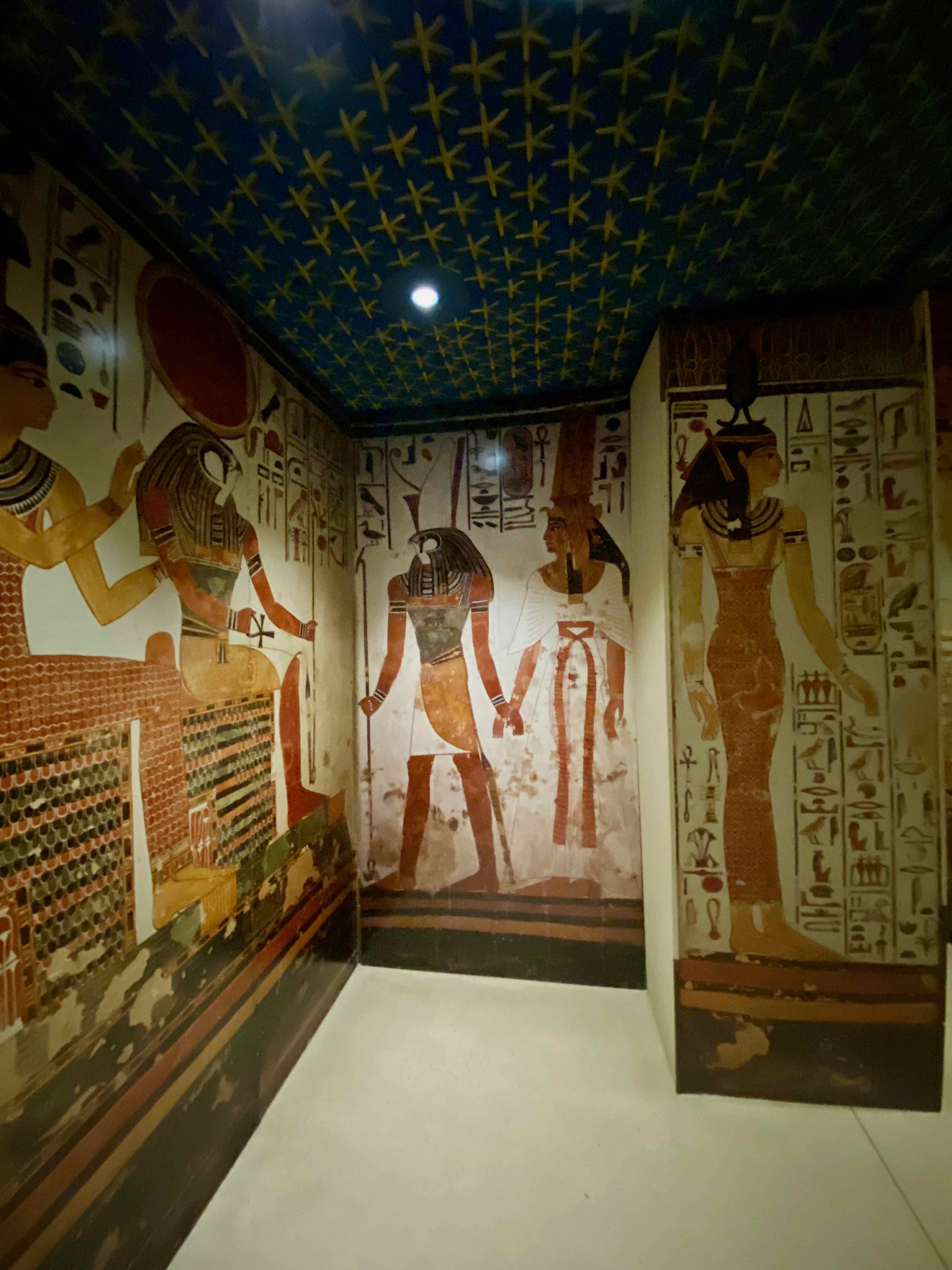
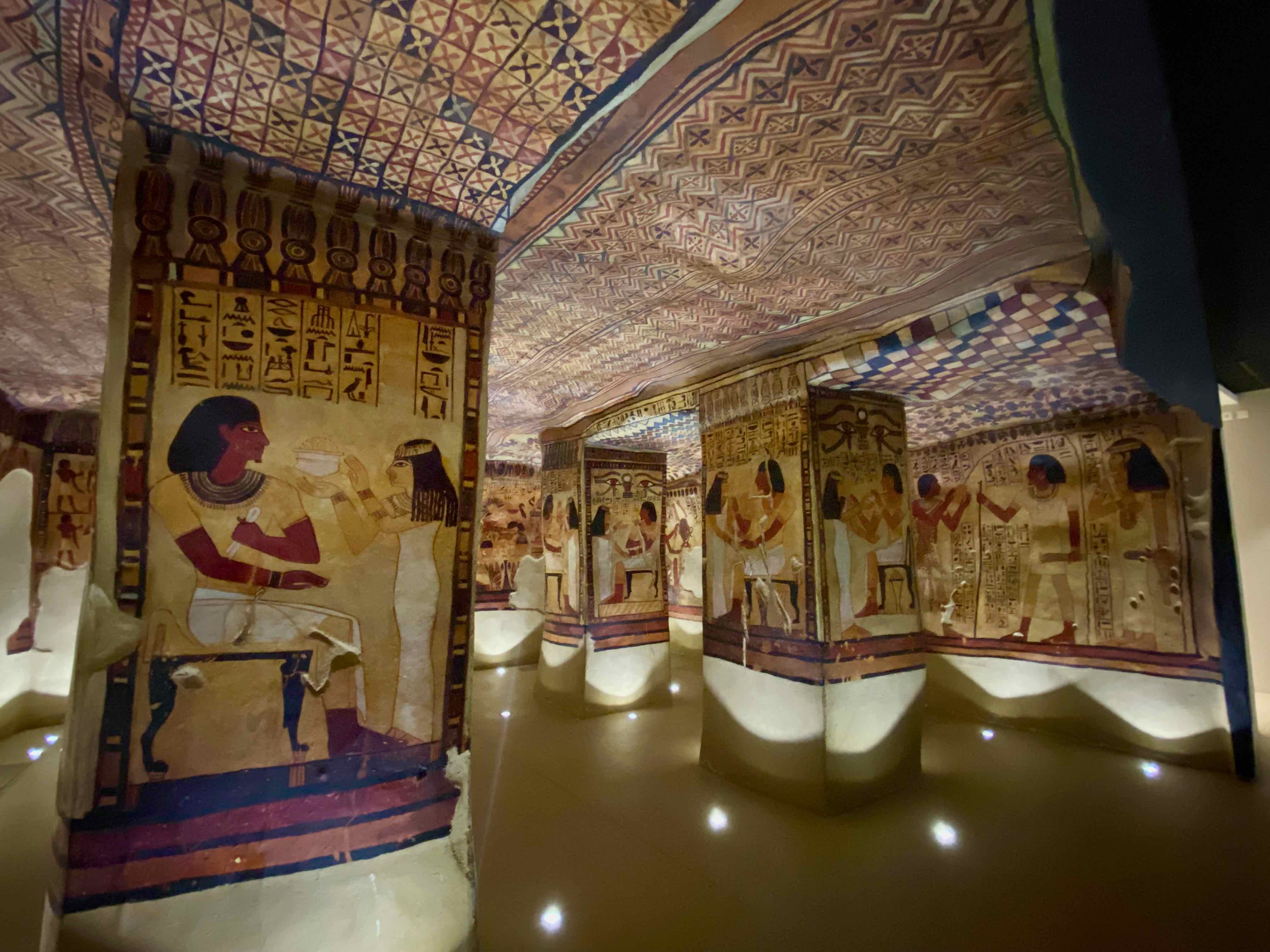
We make our way to the basement down several flights of stairs to discover an area which has the reconstructed tombs of Nefertari and Sennefer.  The photos with their light reflections do not do this area justice.  It really reminded us of our time in Egypt. We were able to visit the tomb of Nefertari in the Valley of the Queens.  This reconstruction is not the same as being in the real tomb but we really enjoyed seeing it all anyways.

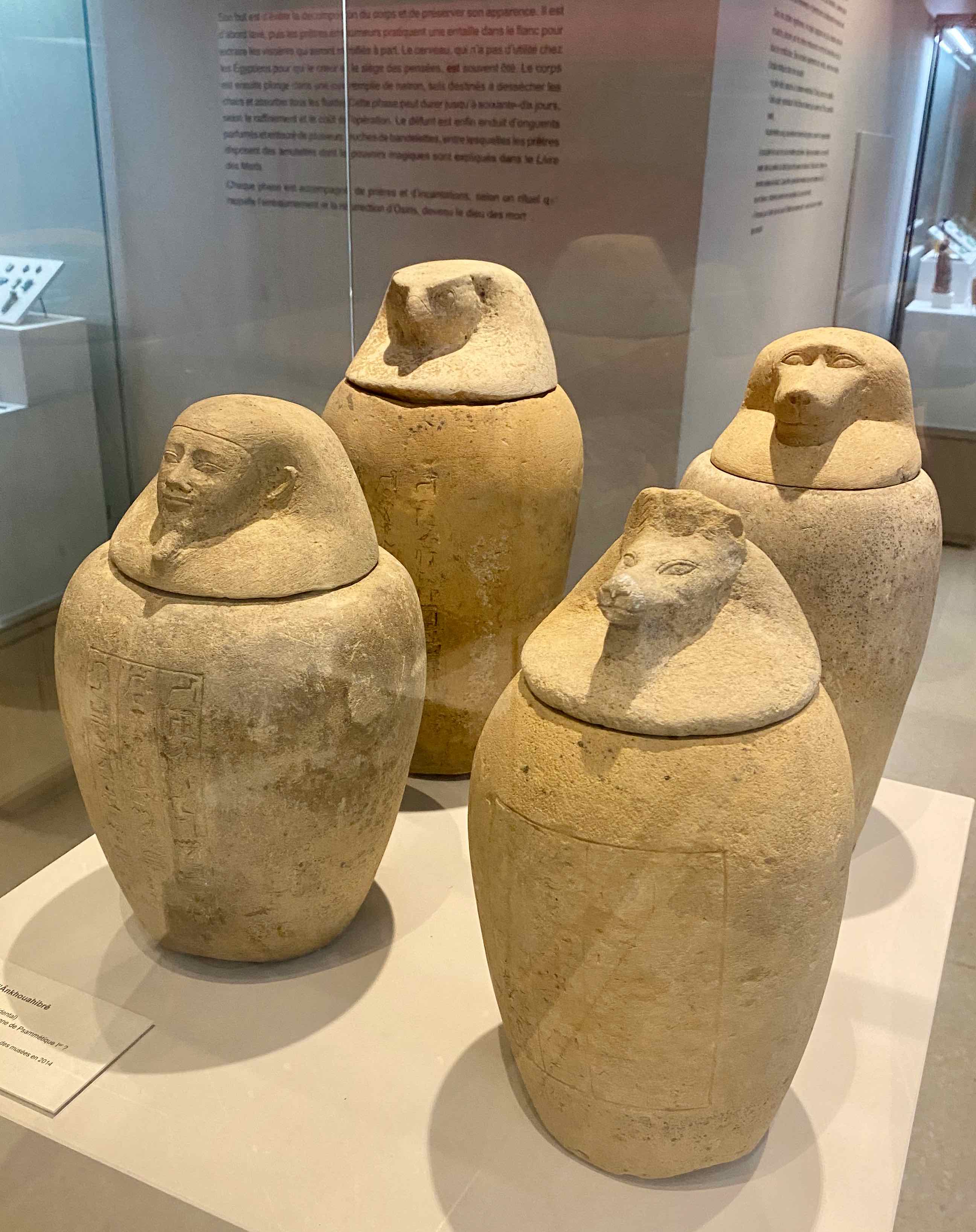
These are canopic jars that contained the organs of’Ânkhouahibrê  that were removed from the body in the process of mummification: the lungs, liver, intestines, and stomach.

I thought these bird mummies were interesting.  I have seen cat mummies before but cannot remember seeing any bird mummies.

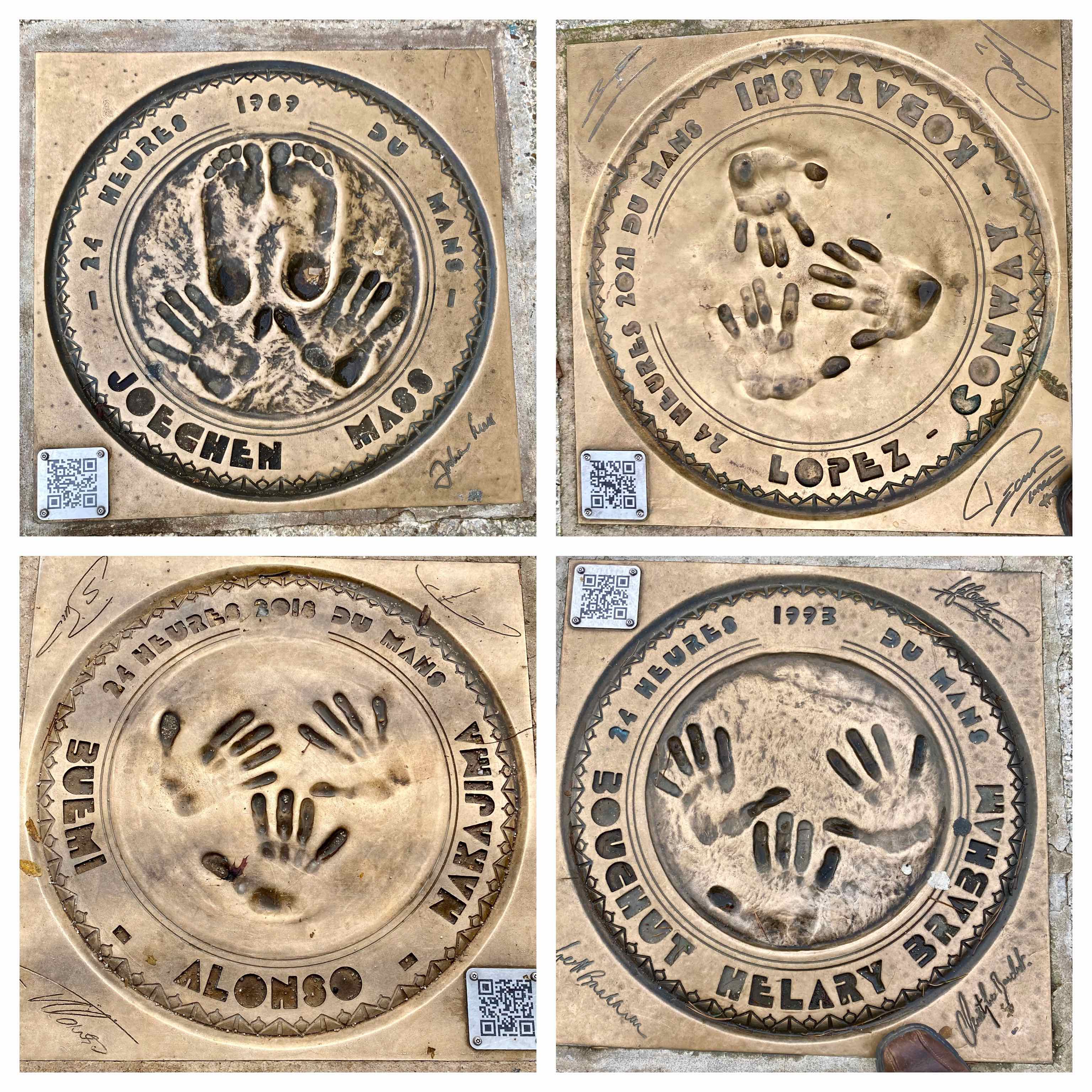
There are  bronze plaques of the ’24 Hours of Le Mans Race’ winning team’s hand prints set into the sidewalks of Le Mans.

All too soon it is time to catch the train back to Paris.  We didn’t have time to go visit the Le Mans Race museum as it was on the outskirts of town and it would have taken too long to go and visit, but we are happy with our day in Le Mans.

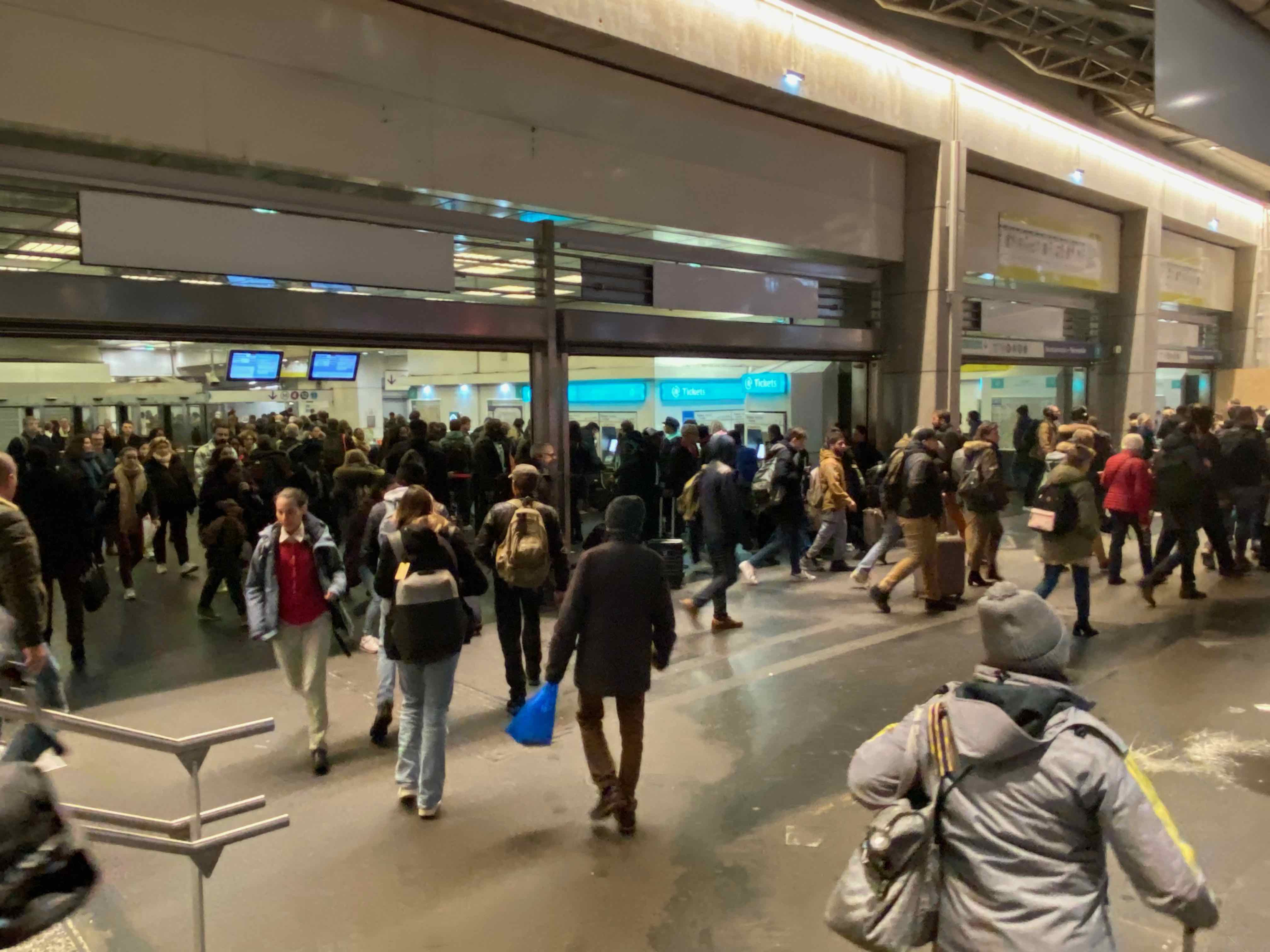
Catching the metro home…the station was very busy!  It has been full day and we are happy to be back home in our Paris apartment.

Reims Cathedral, Carnegie Library and the Saint Remi Museum

January 1. 2024

I have thirteen days left of our holiday that I did not post on my blog.  I really want to get them finished so I’ll be working on them this month.

Day 79,  Wednesday, November 15, 2023

This is our last day in Reims and we catch the metro downtown.  Reims has a great metro system that is all above ground because of all the champagne galleries beneath the city.

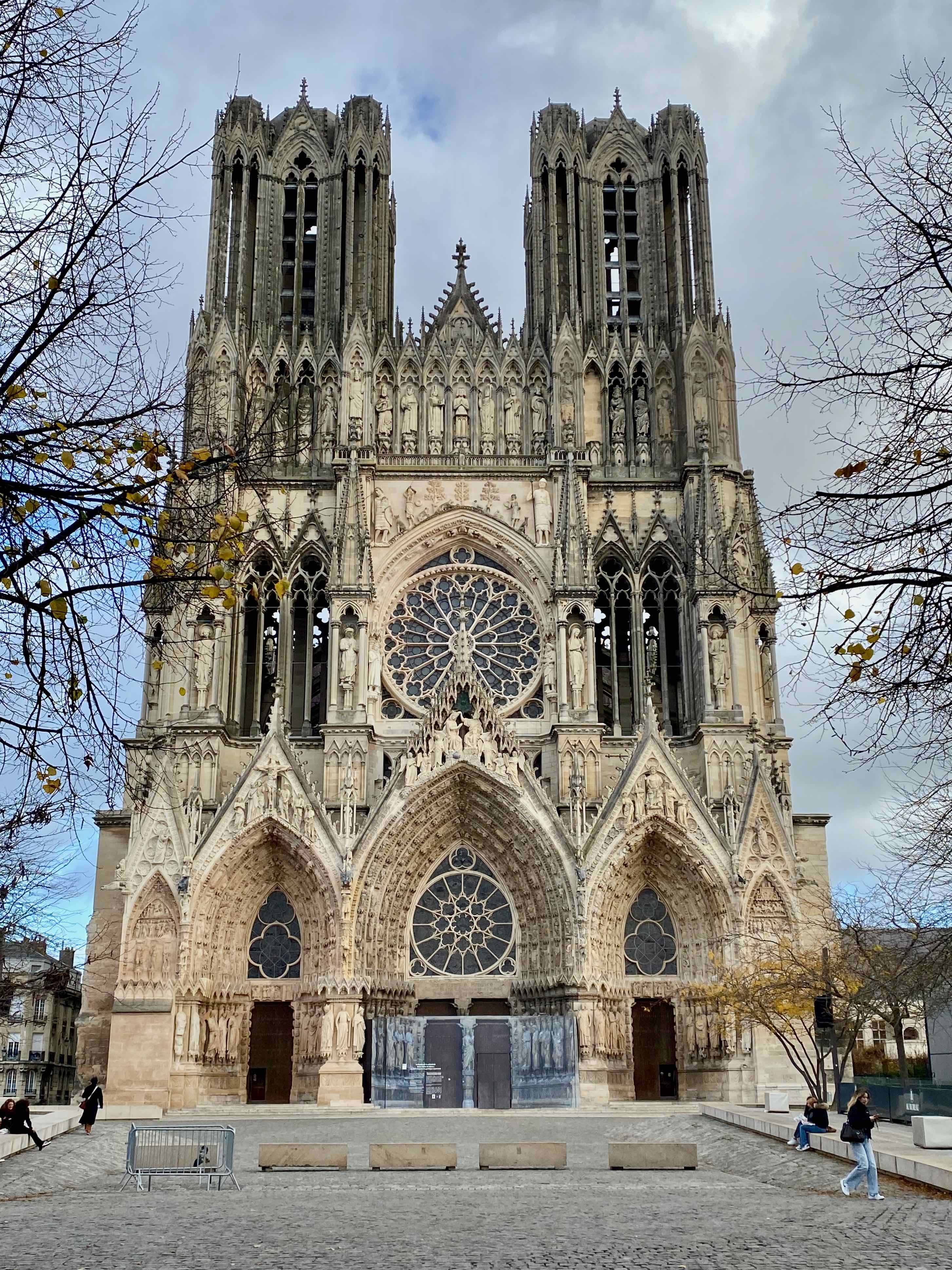
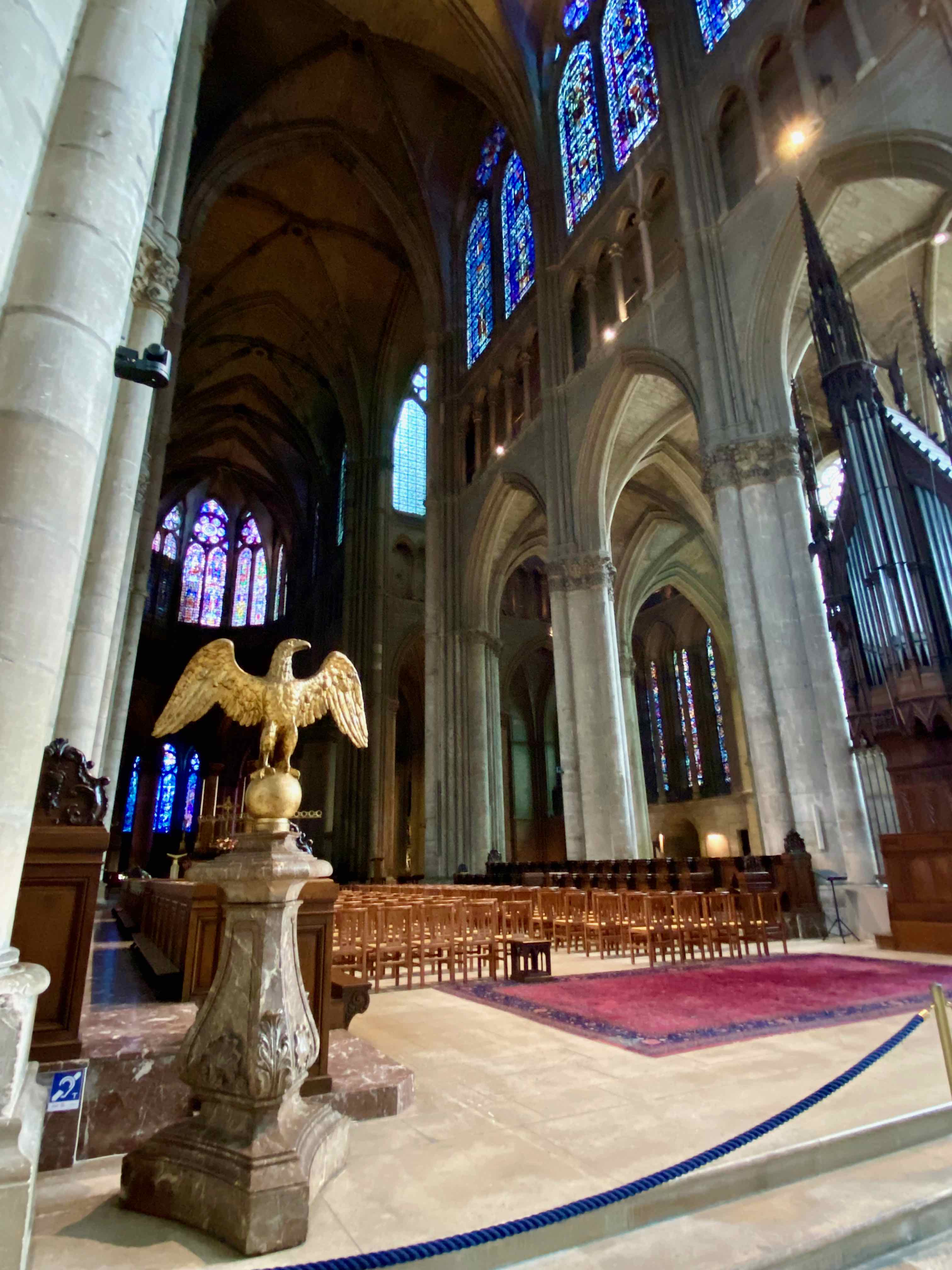
First stop is Reims’ famous cathedral, Notre-Dame de Reims which is a UNESCO World Heritage site. This cathedral is bigger than Notre Dame in Paris and has more than 2,300 statues on its facades, including a gallery of 56 kings.  All but seven of France’s kings were crowned at Reims.

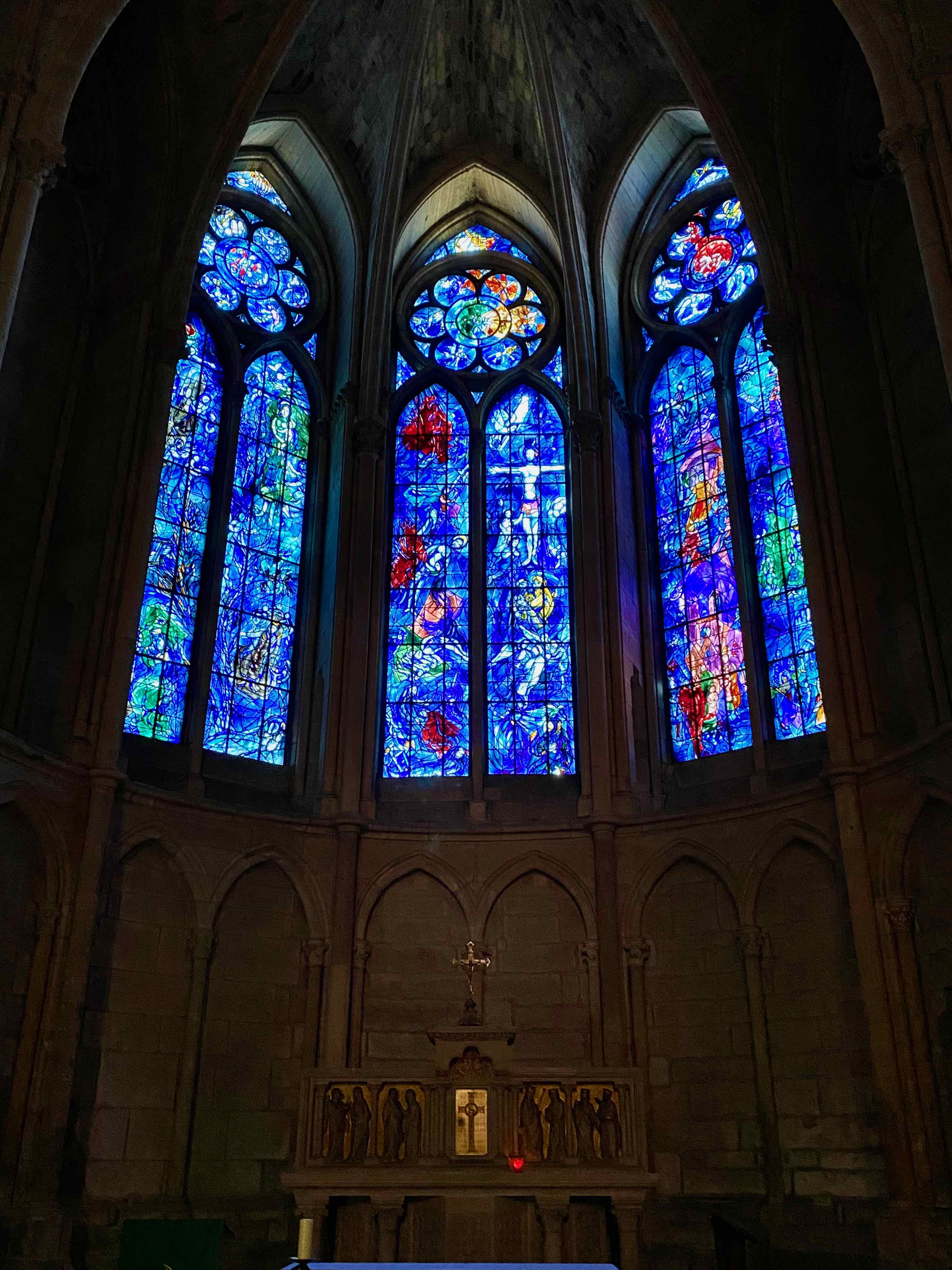
Inside there are wonderful stained glass windows. There are the traditional rose windows but there are also several modern windows, including this set of three windows behind the altar that were designed by Marc Chagall.
This golden eagle makes me think of the Nazi eagle symbol…it seems out of place here.  A bit of research and I discover that the eagle is also the symbol of John the Evangelist.

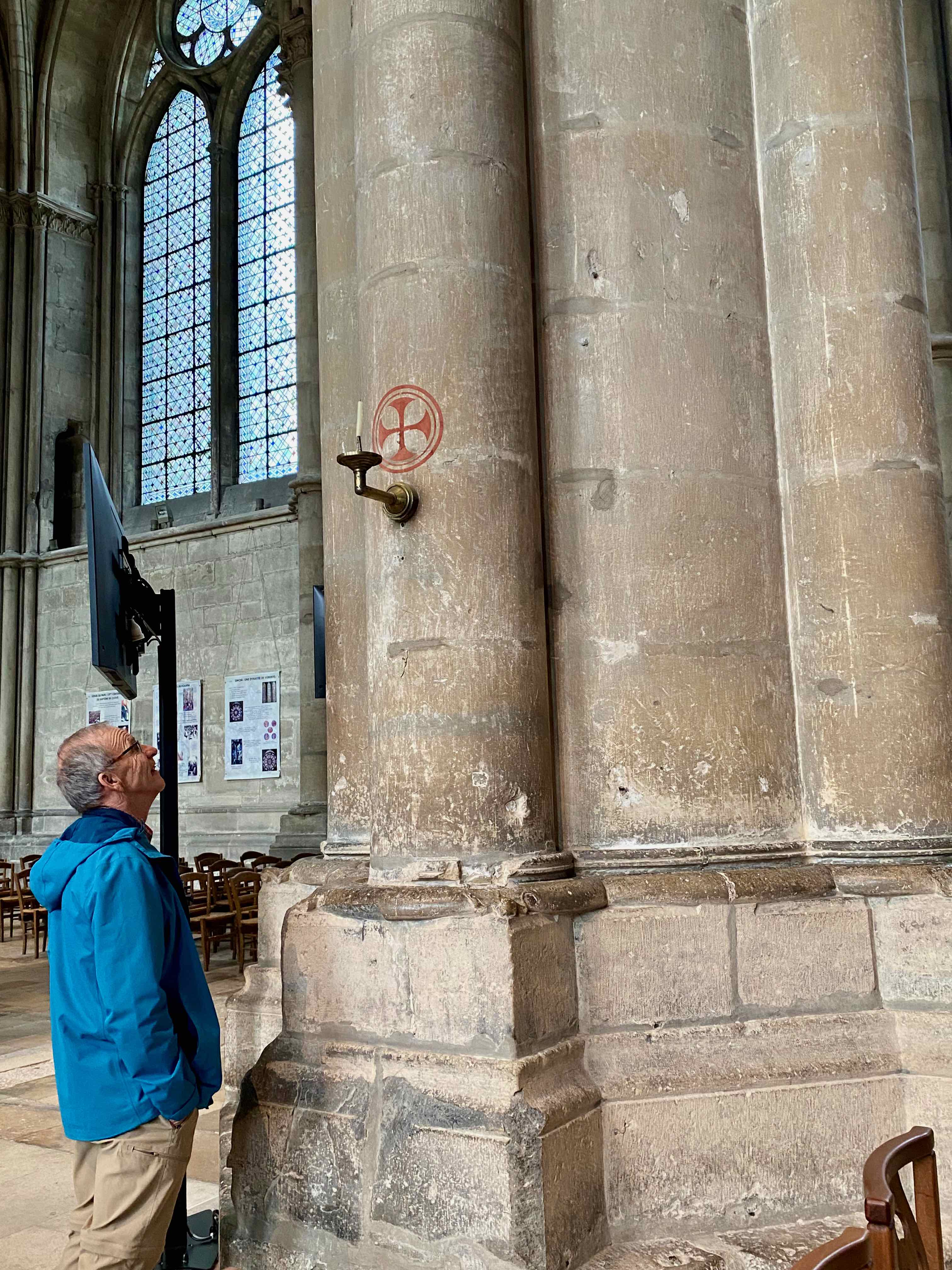
The enormous pillars each have a candle holder with a red cross in a circle painted on the pillar.  I wasn’t able to find any information about this symbol, but I am curious about their meaning.

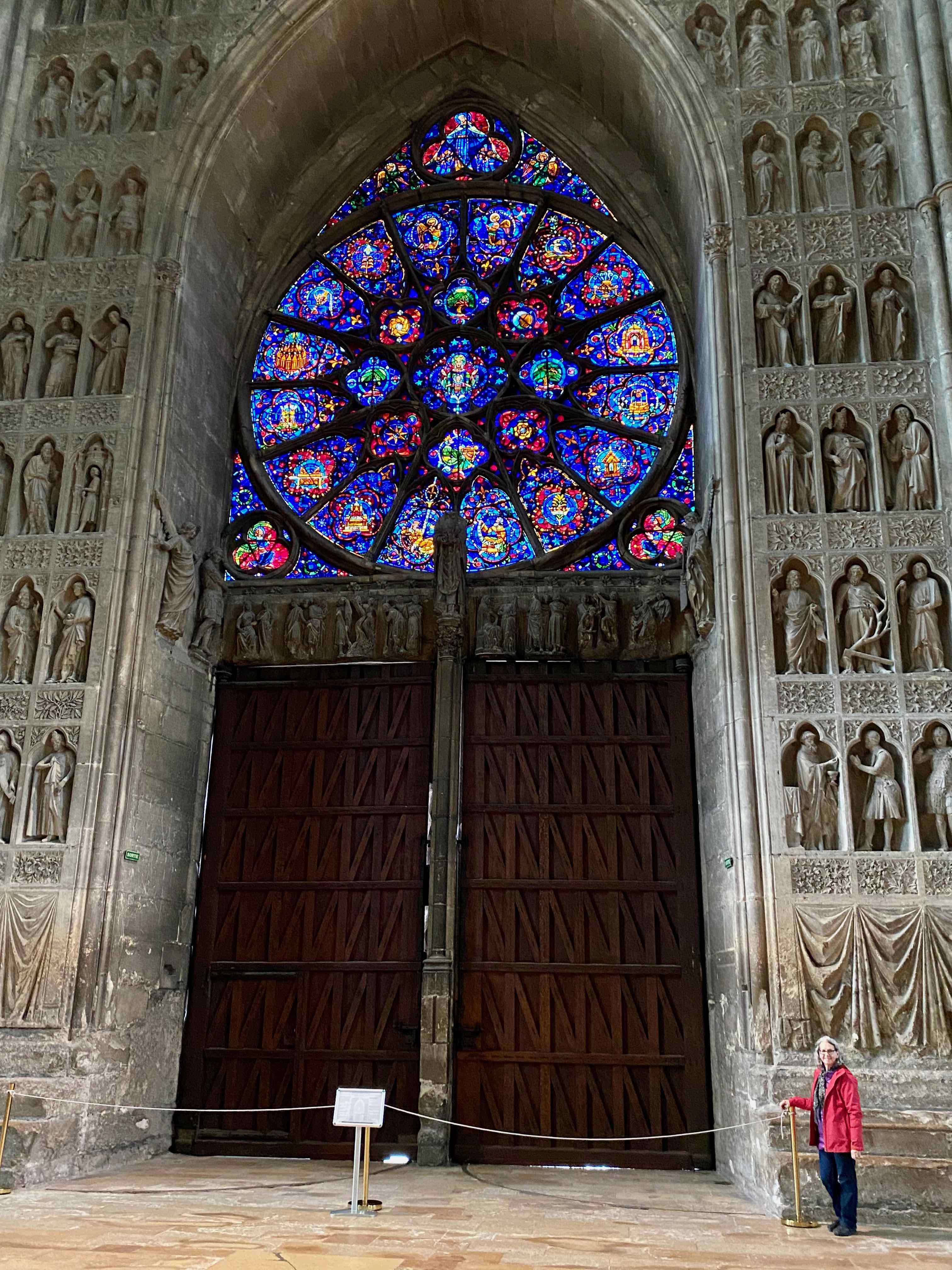
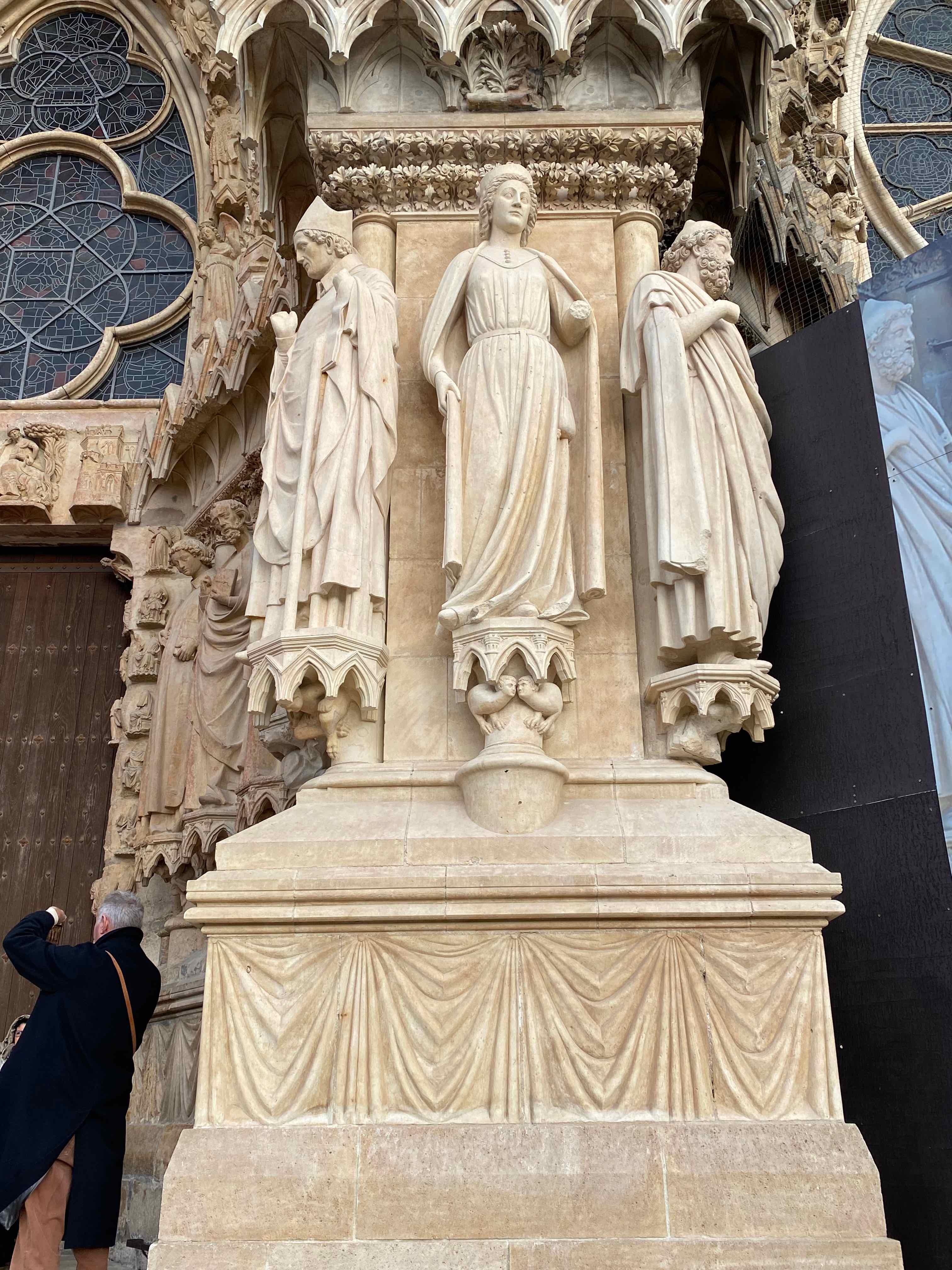
The front doors to the cathedral are enormous and they are flanked on either side by a wall of statues.

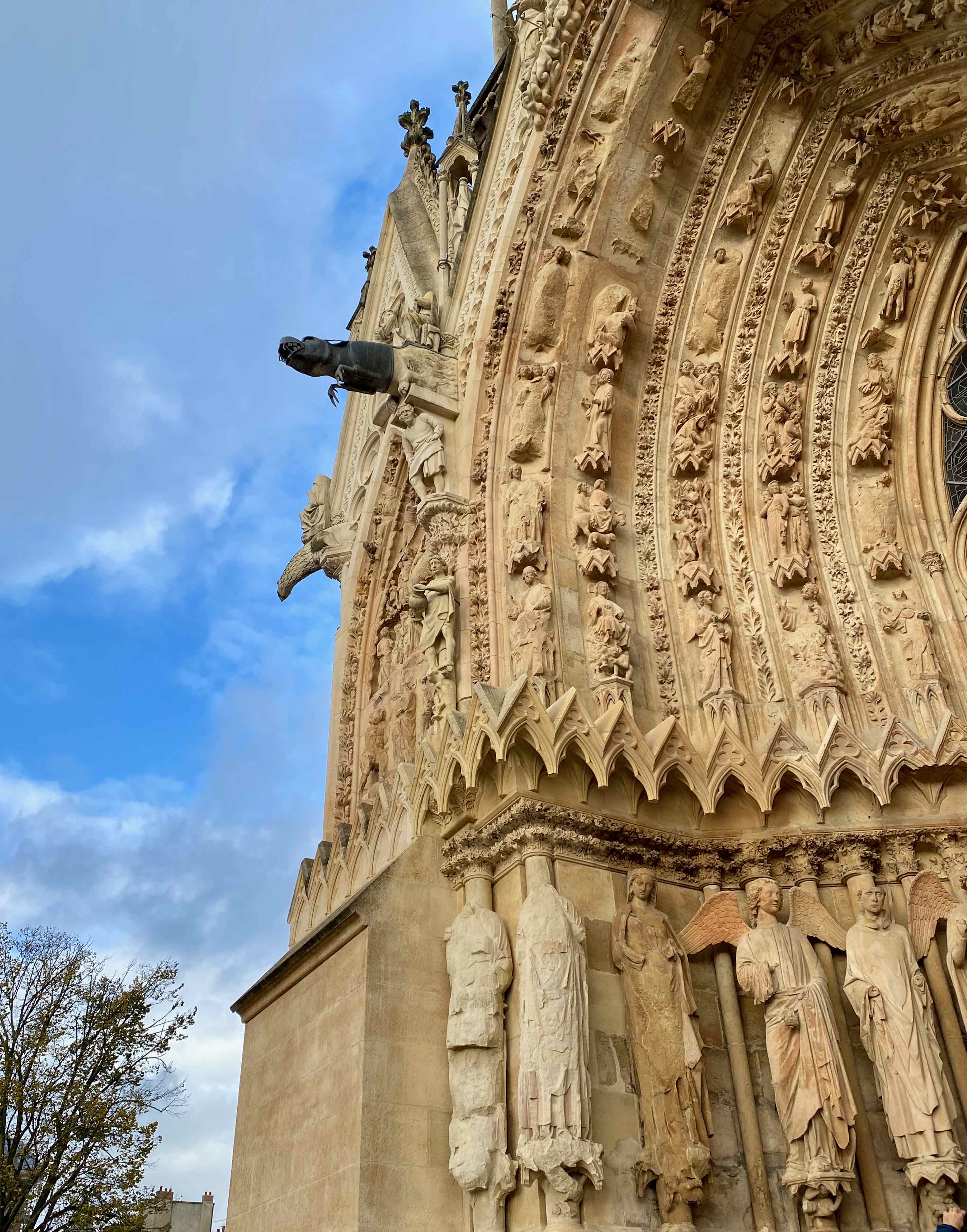
The second winged angel just to the right of the central statue is the Reims Cathedral’s famous Smiling Angel.  During WWI the cathedral was the target of German bombing. Struck by a beam of burning scaffolding, the angel was decapitated and its head broken into more than 20 pieces. It became a symbol of the suffering of the people of France, and its photo appeared on the front pages of newspapers around the world. A priest collected the 20 pieces of the head and with the help of a plaster cast of the statue kept in a museum, the angel was restored in 1926.

The cathedral was heavily damaged during the war and reconstruction appears to be an ongoing process…these statues look quite new.

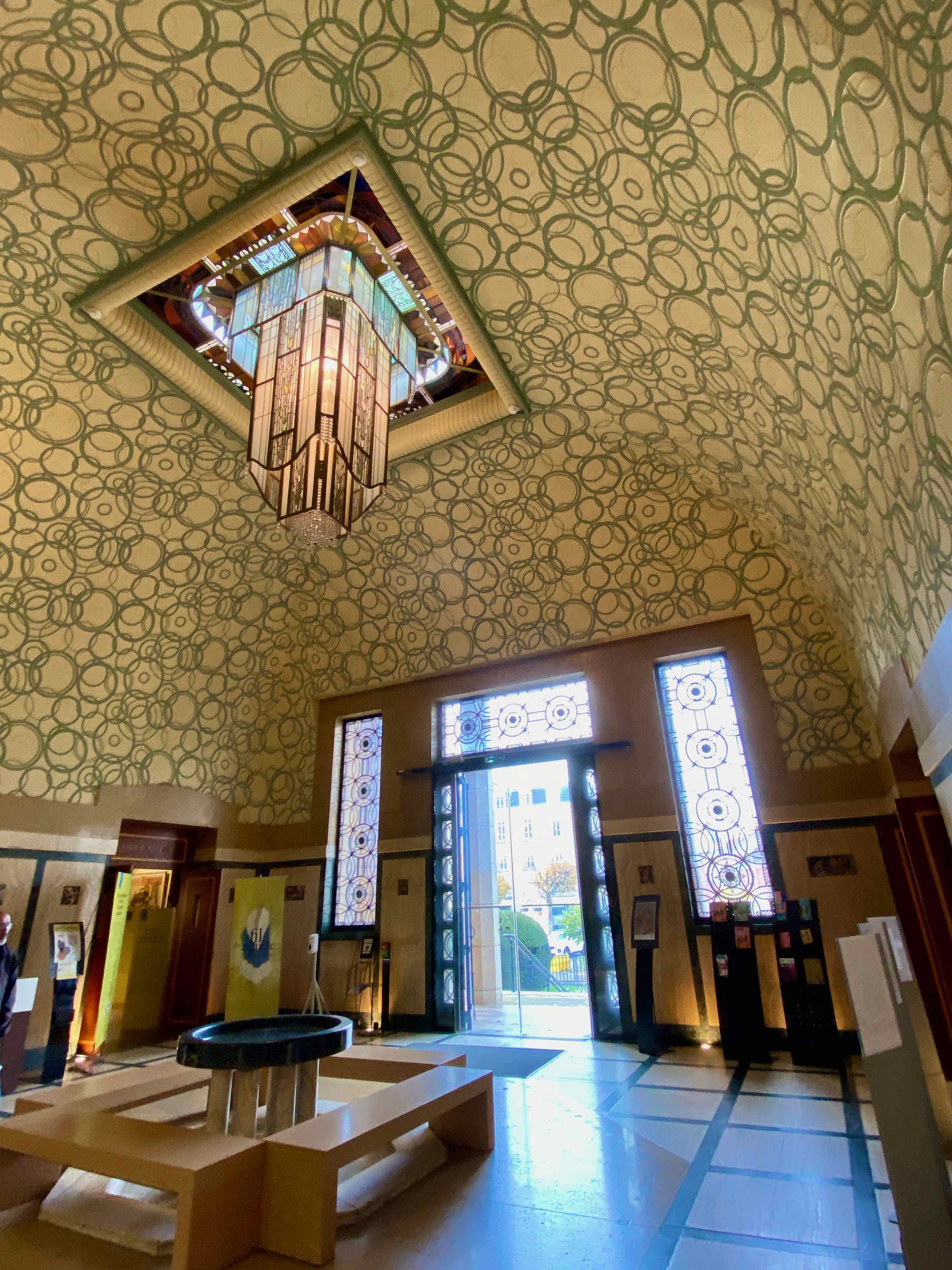
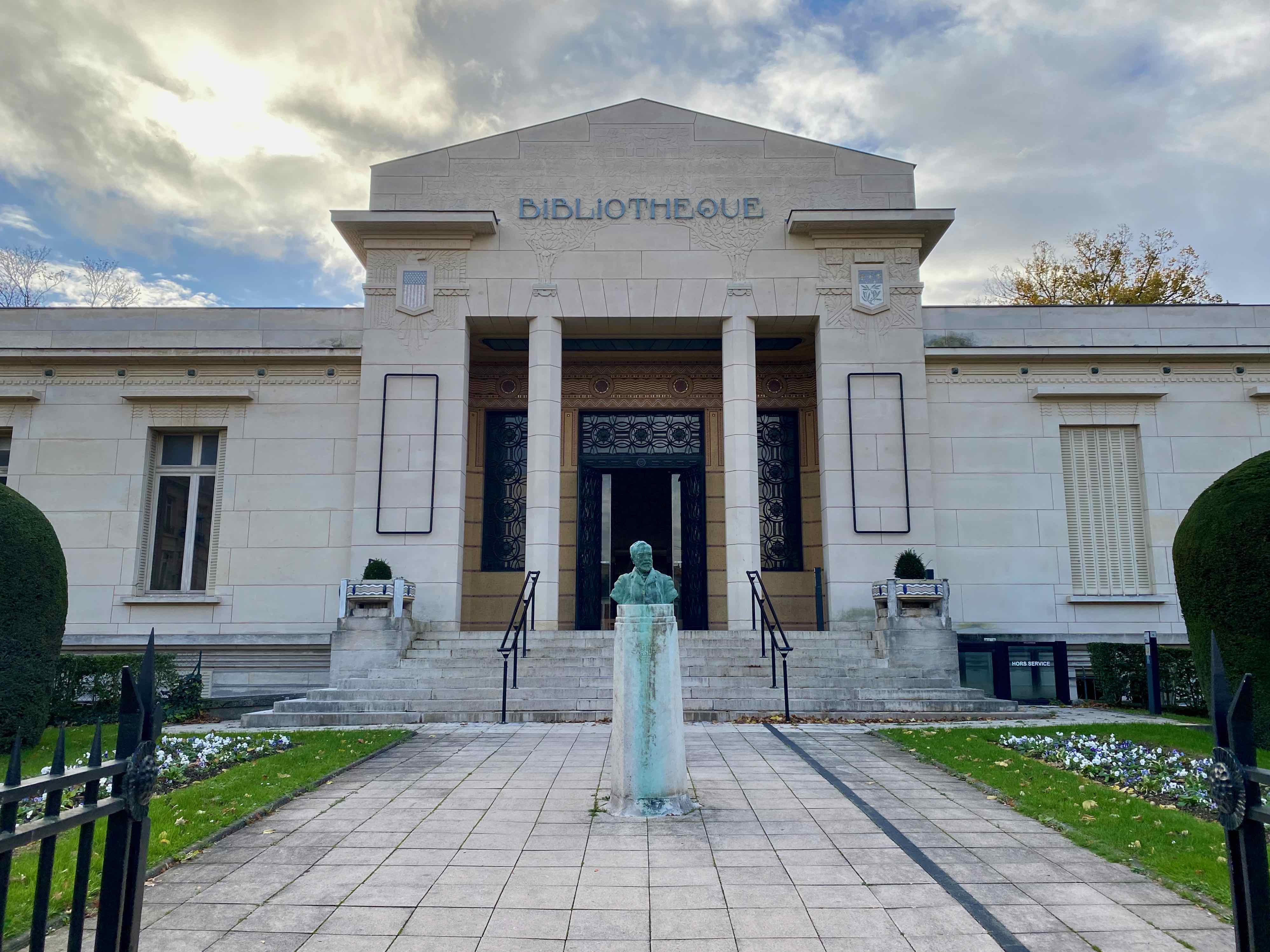
Next stop is the Carnegie Library. The Carnegie Library of Reims is a public library built with money donated by businessman and philanthropist Andrew Carnegie to the city of Reims after World War I. It is built in an Art Nouveau style and is very beautiful.

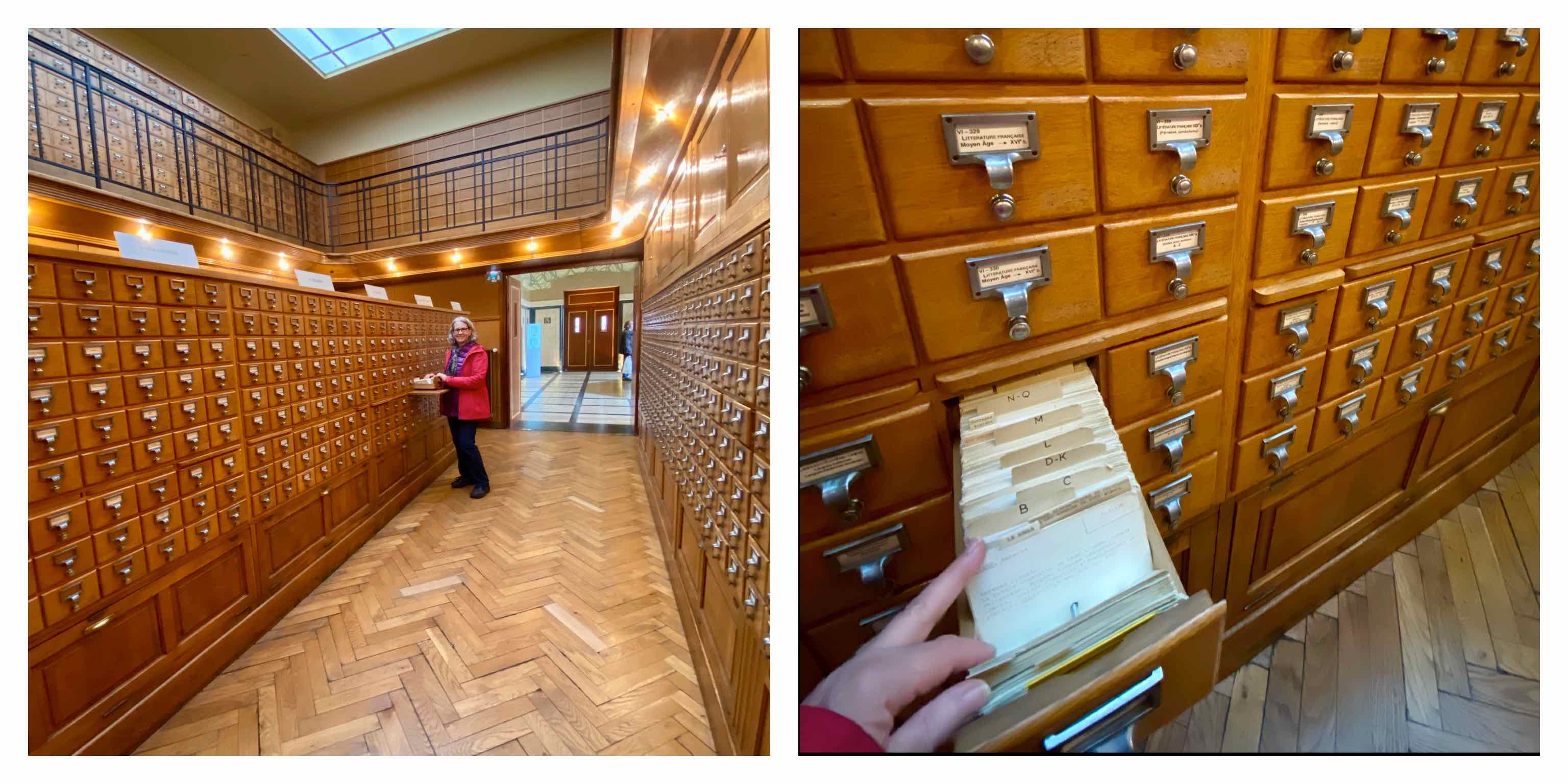
The card catalogue is still on display.  I remember looking up books using this system and now it is all computerized!

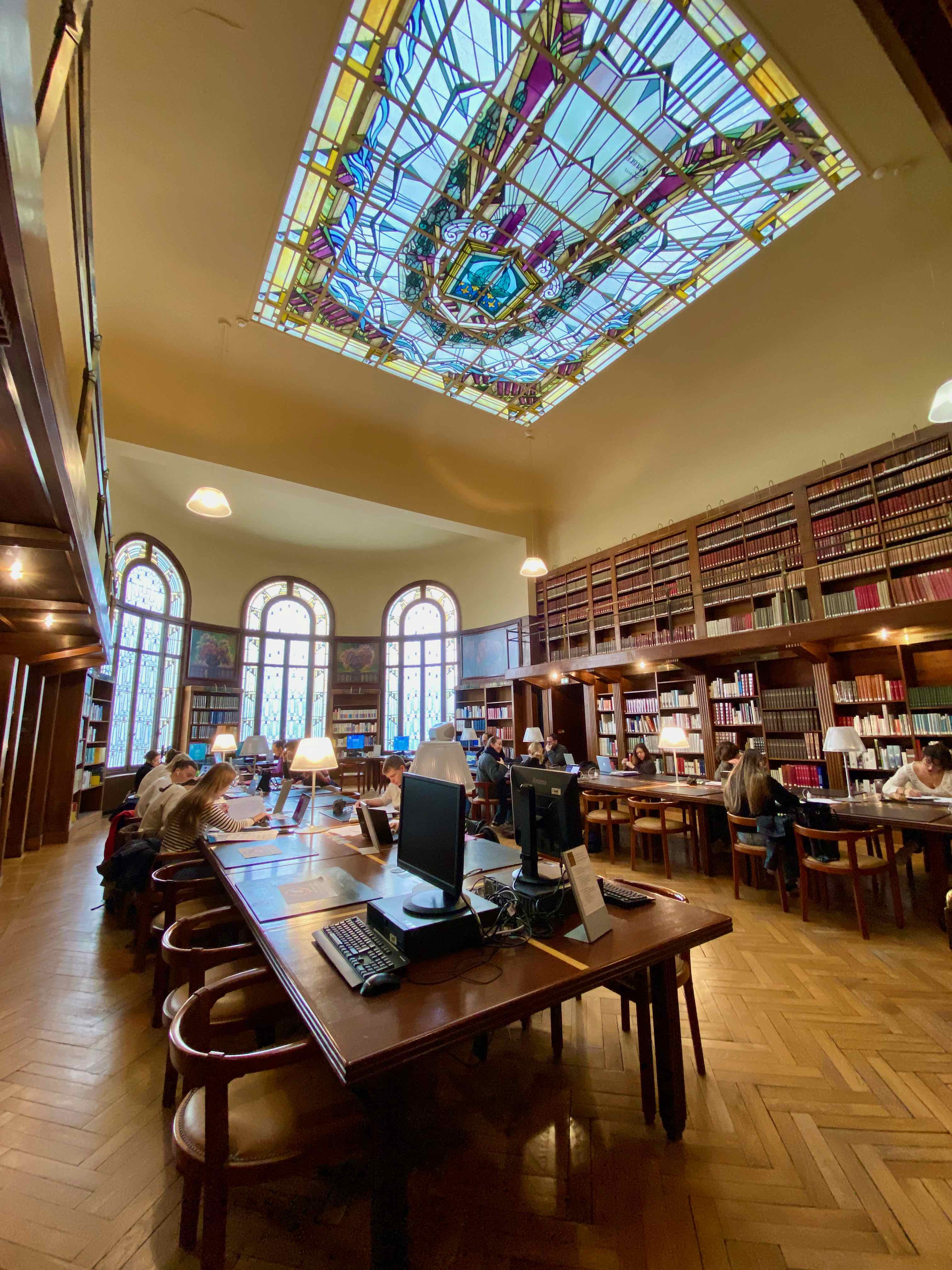
What a gorgeous place to study.  There is even a monitor to make sure all is well.
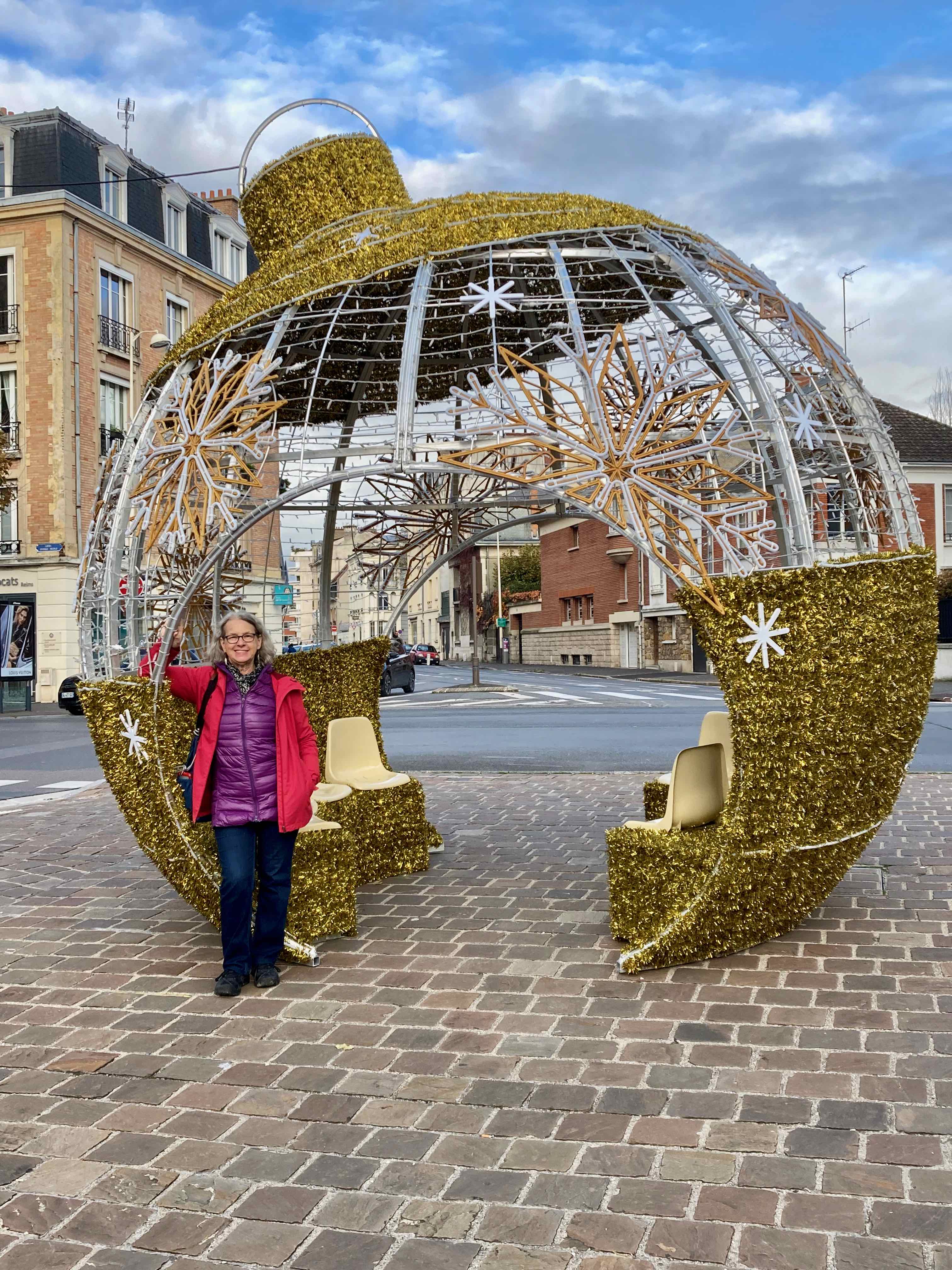
It isn’t a big library.We are beginning to see some Christmas decorations.  This huge Christmas ornament is just outside the library.
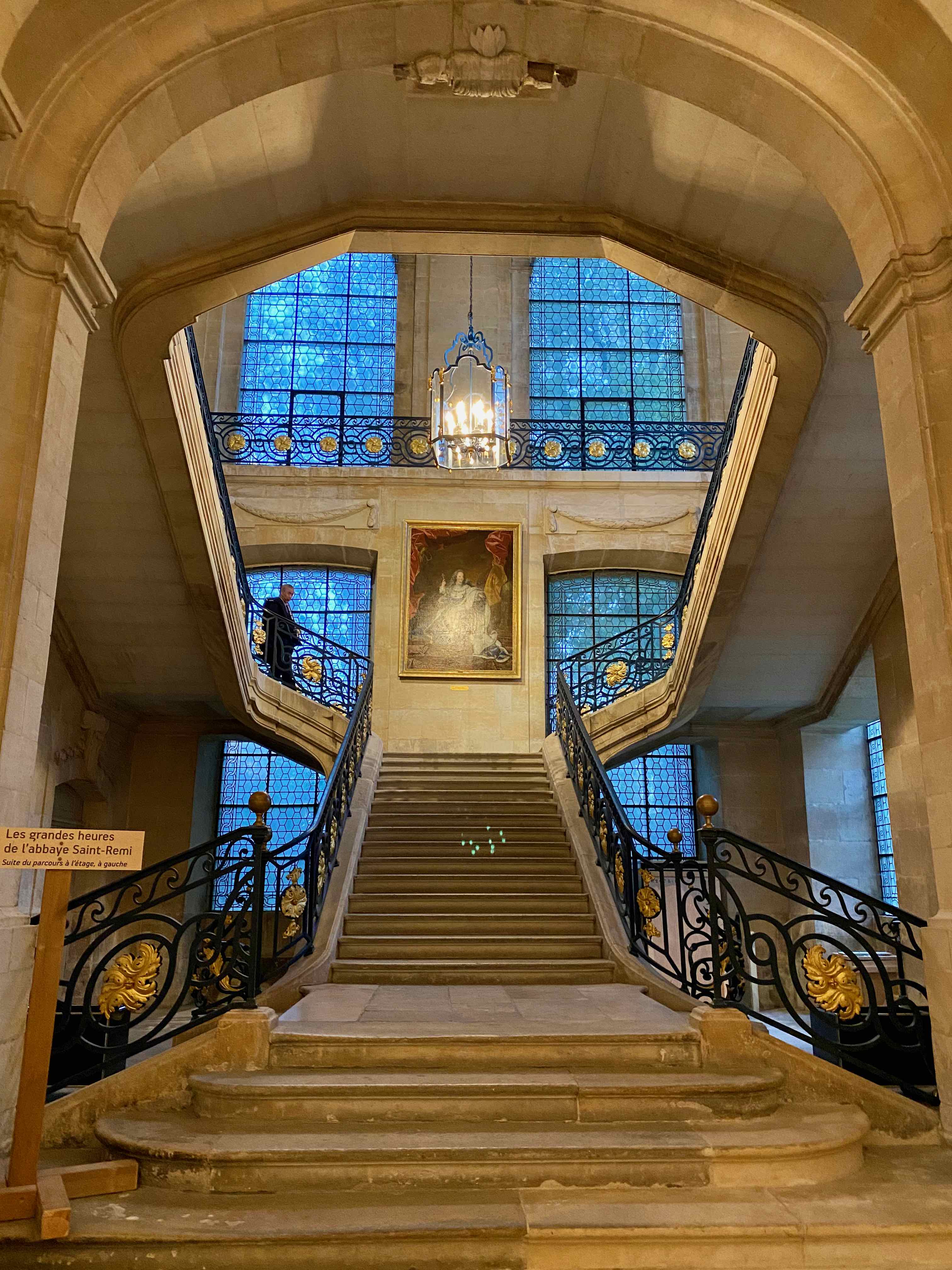
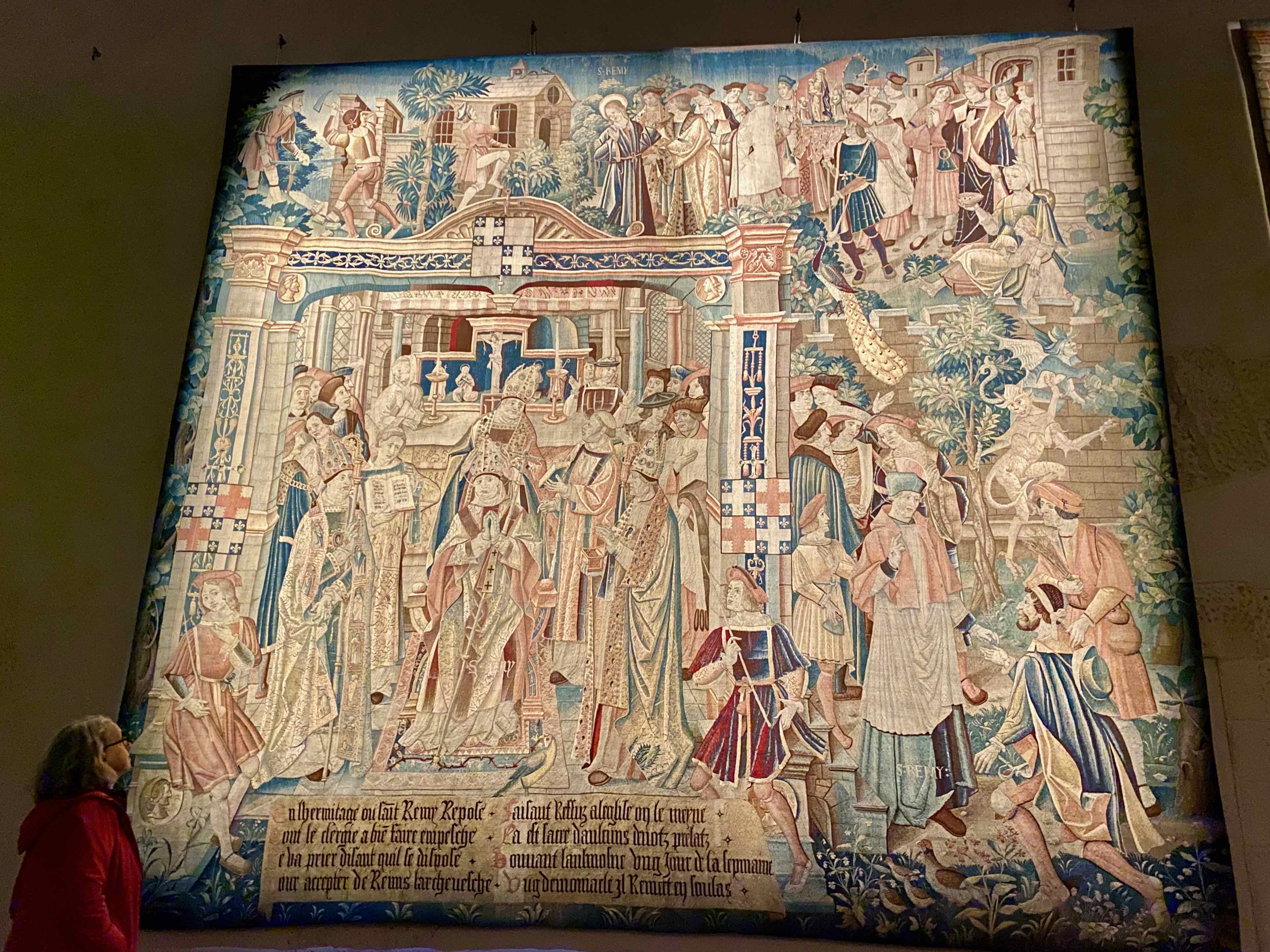
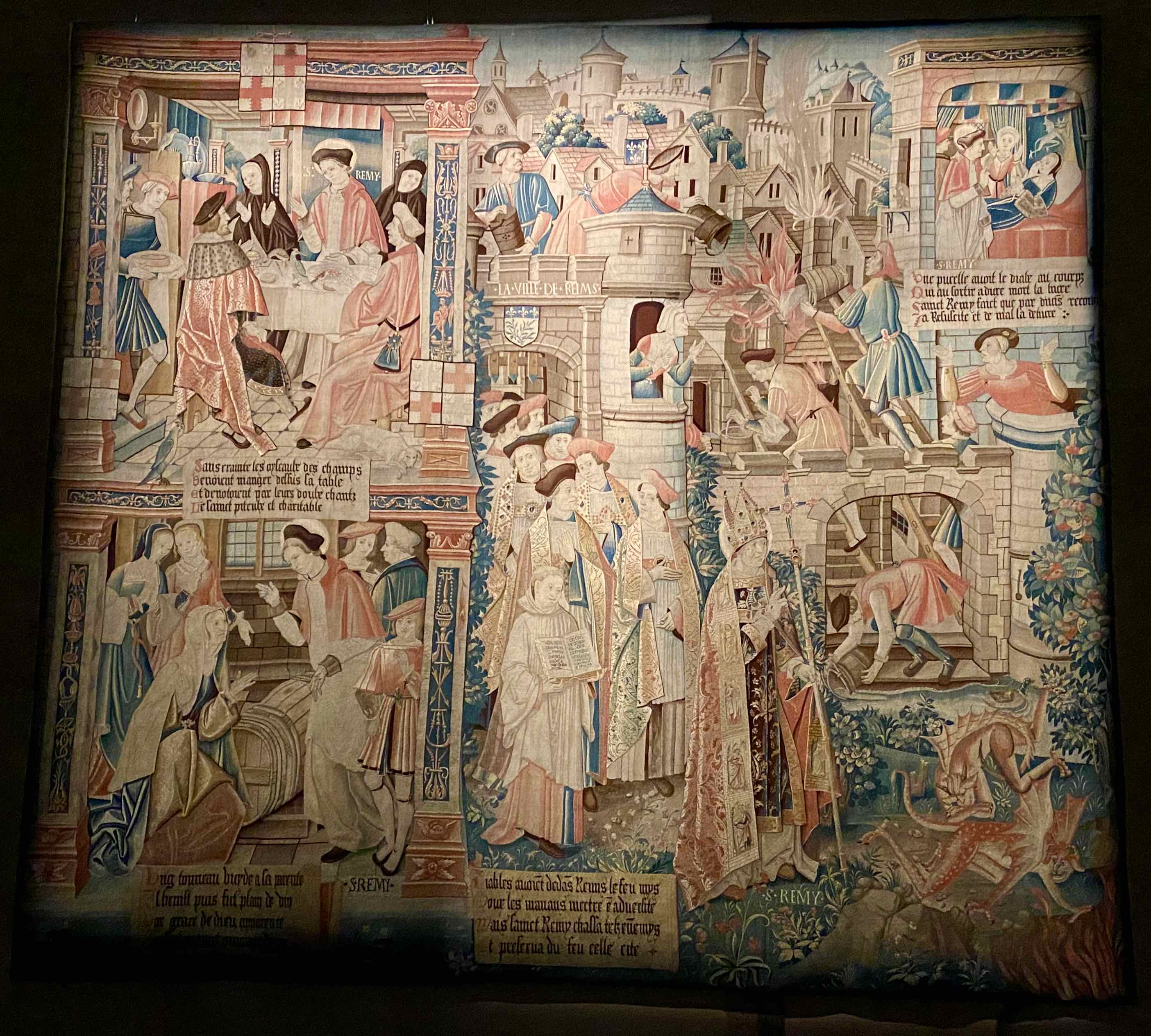
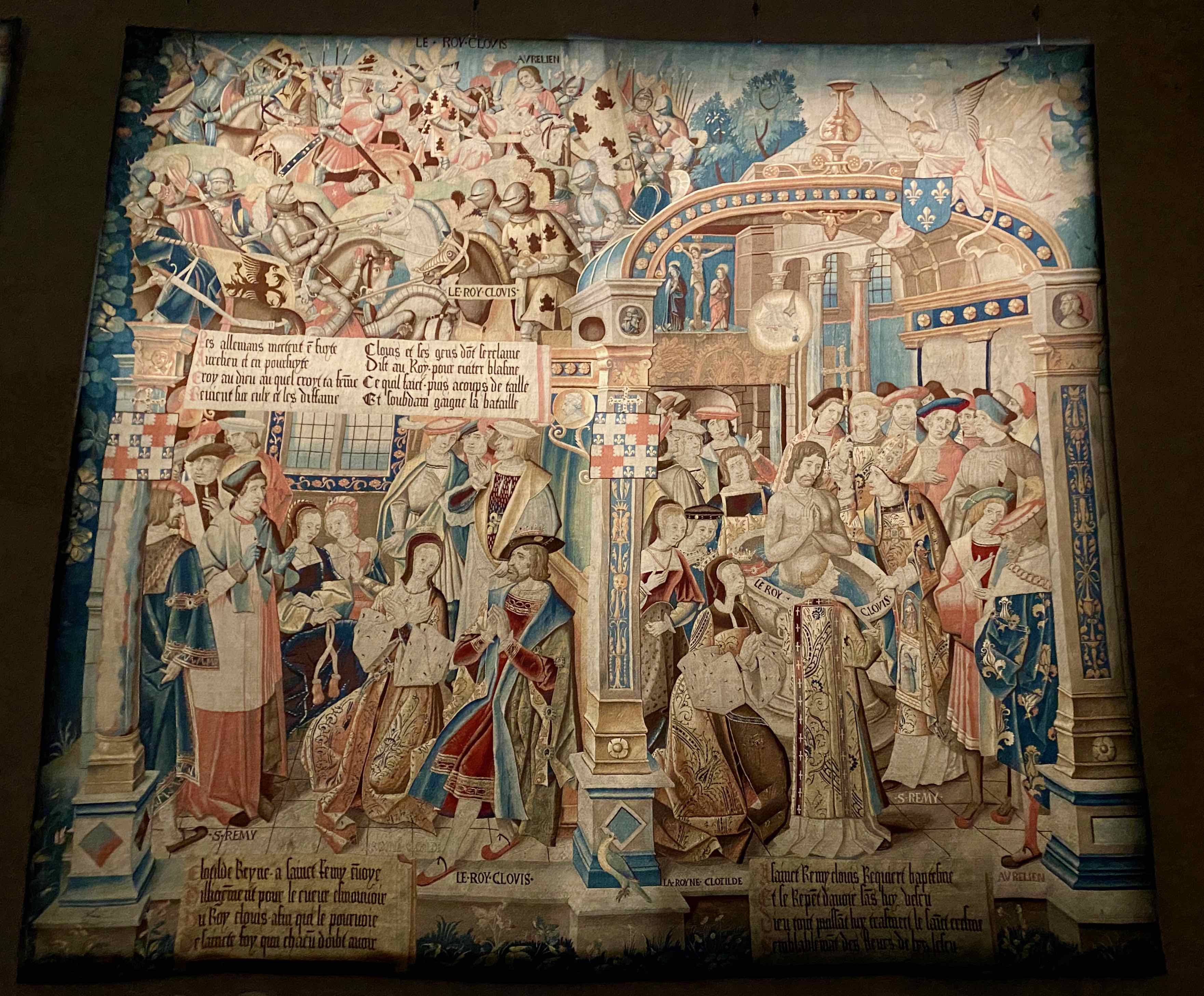
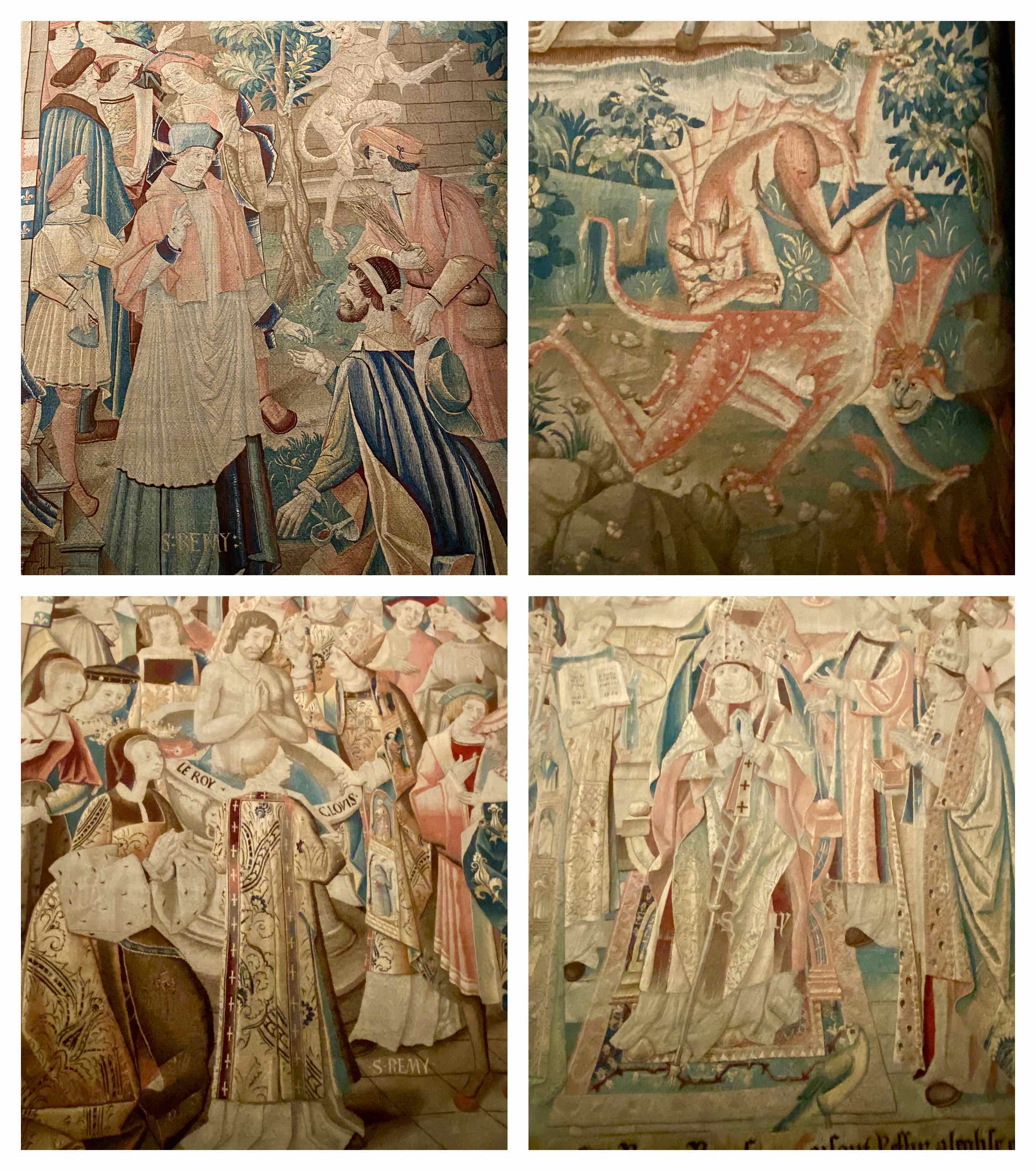
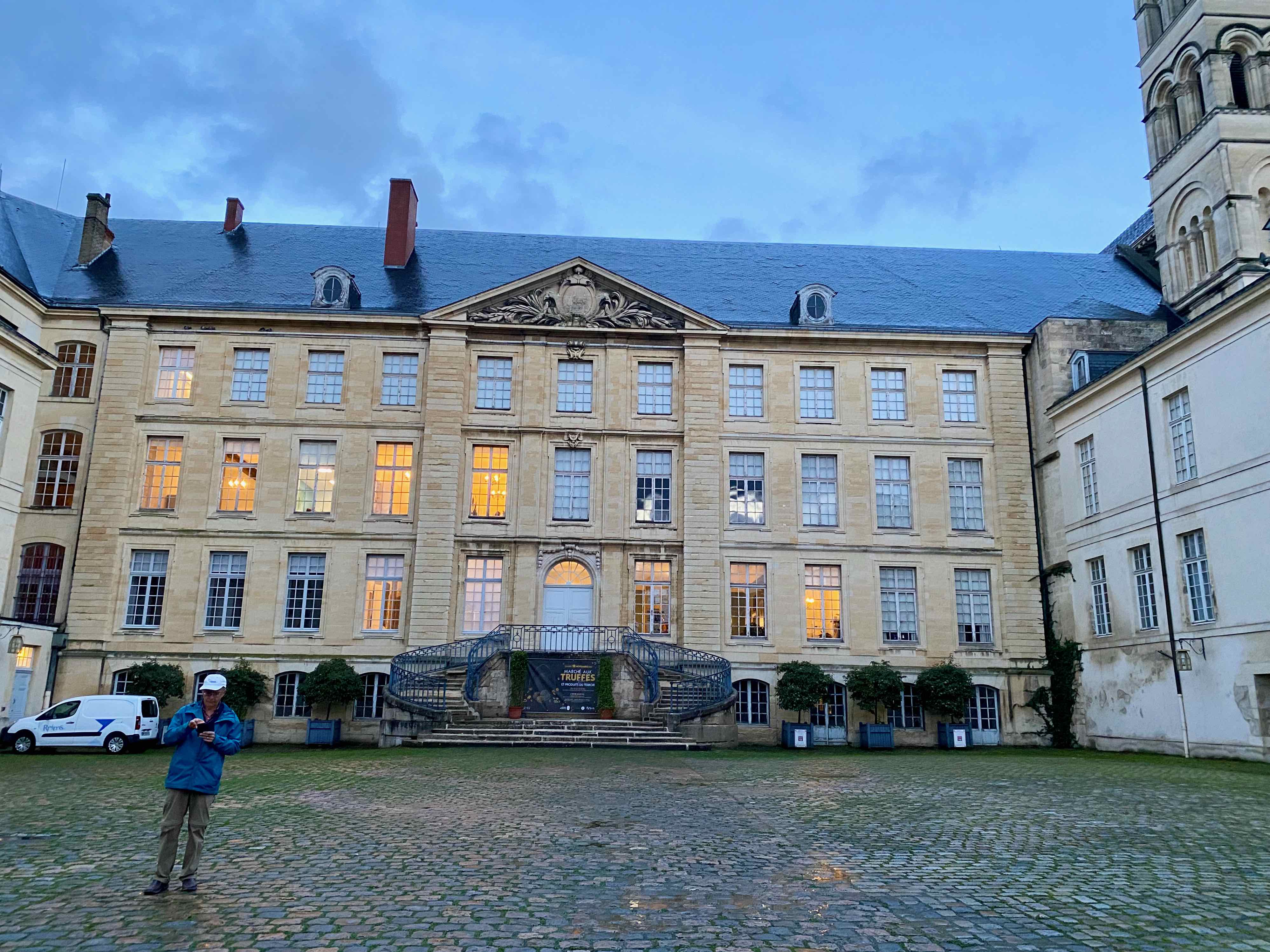
Next we walk for about half an hour, in light rain, to see some restored tapestries in the Musée Saint Remi.  It is a large museum with many other exhibits besides the restored tapestries depicting the life of Saint Rémi.  The museum is in a former abbey and has a magnificent central staircase.

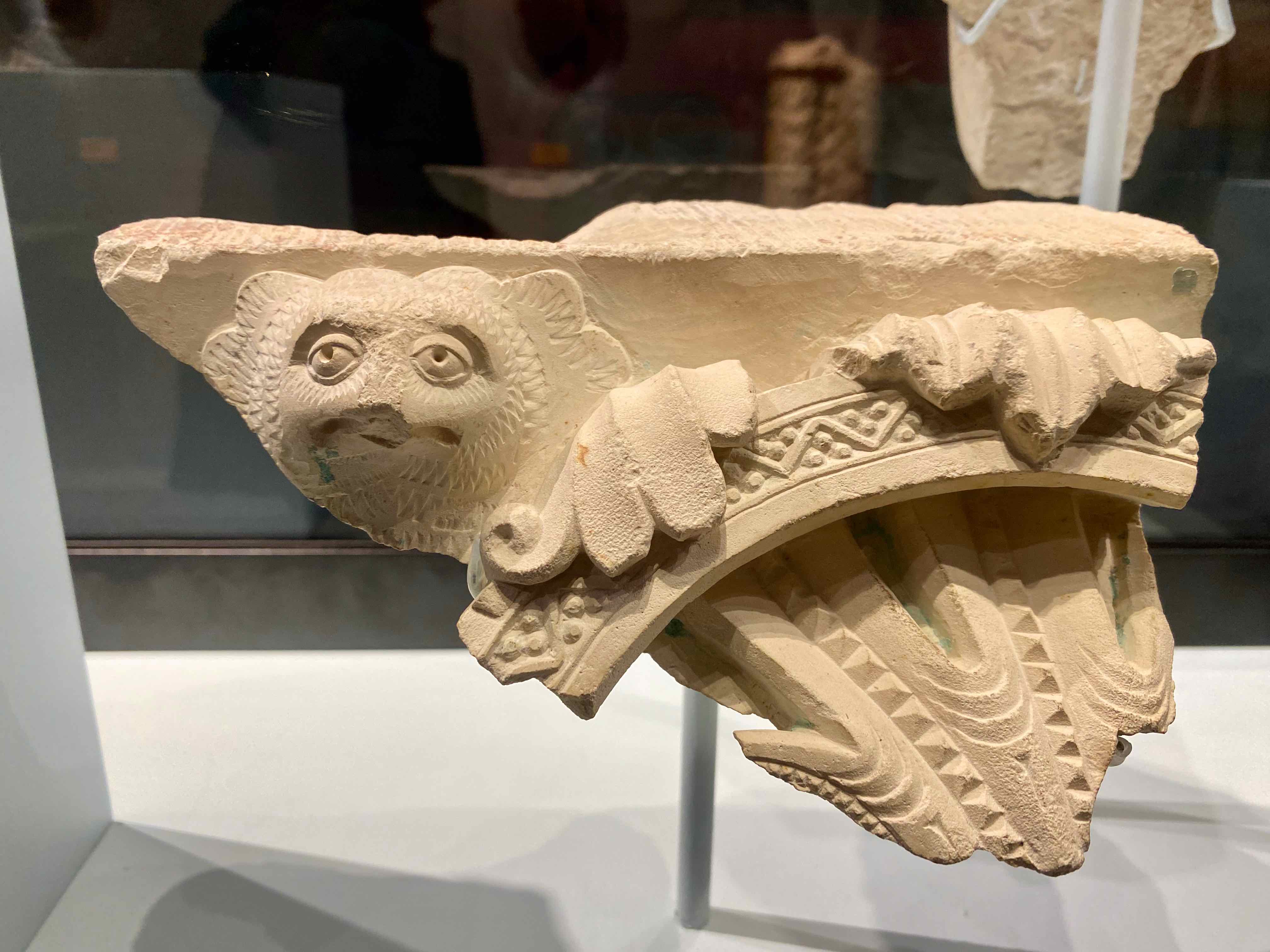
I adored the expression of this bird on a fragment of XII century sculpture.

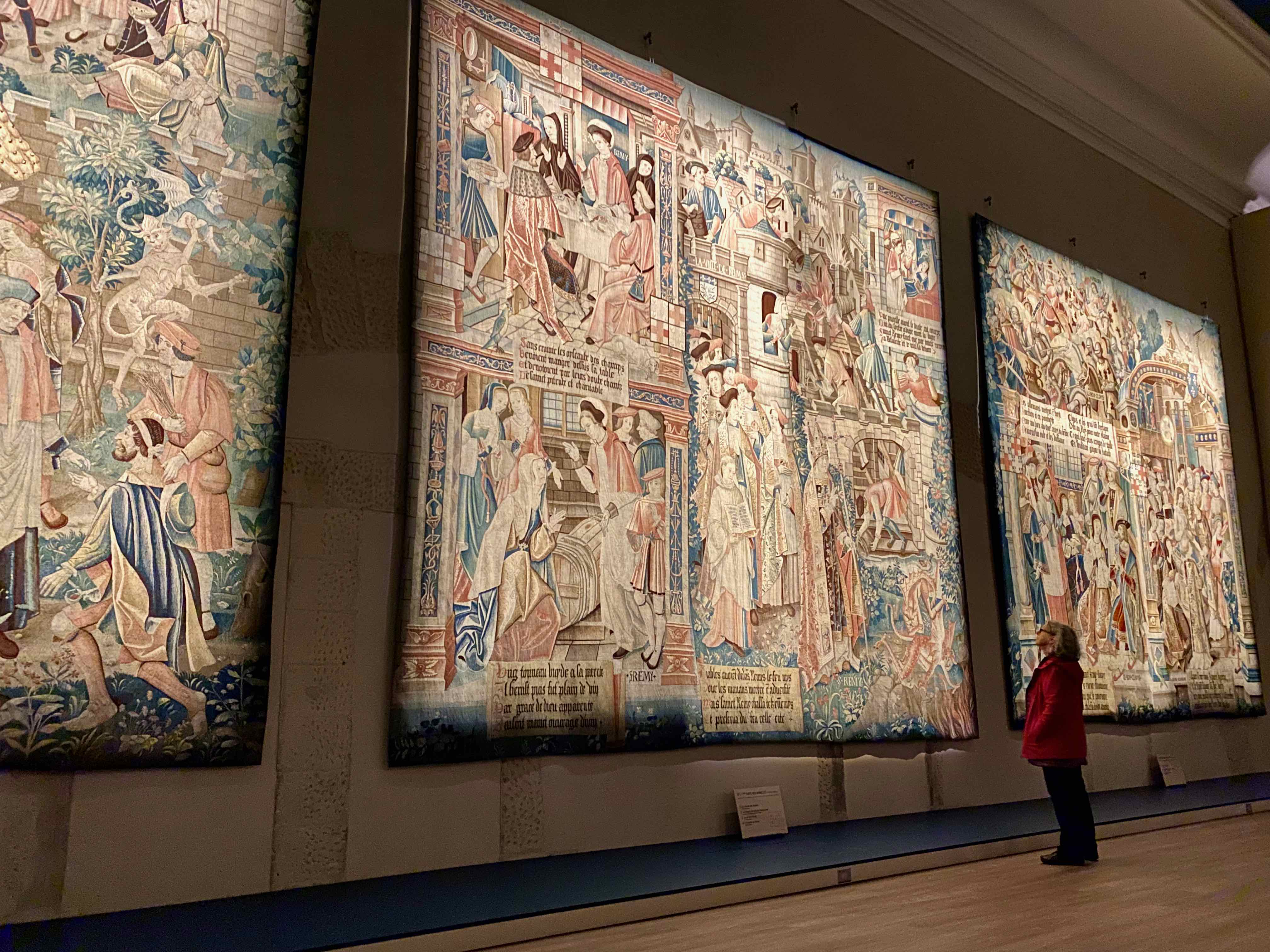
We finally find the room with the tapestries and once again we are absolutely astounded at the size, complexity and beauty of these tapestries.

There are only three panels of the original ten that have been restored and returned to the museum. Here are the other two tapestries.They are very large!

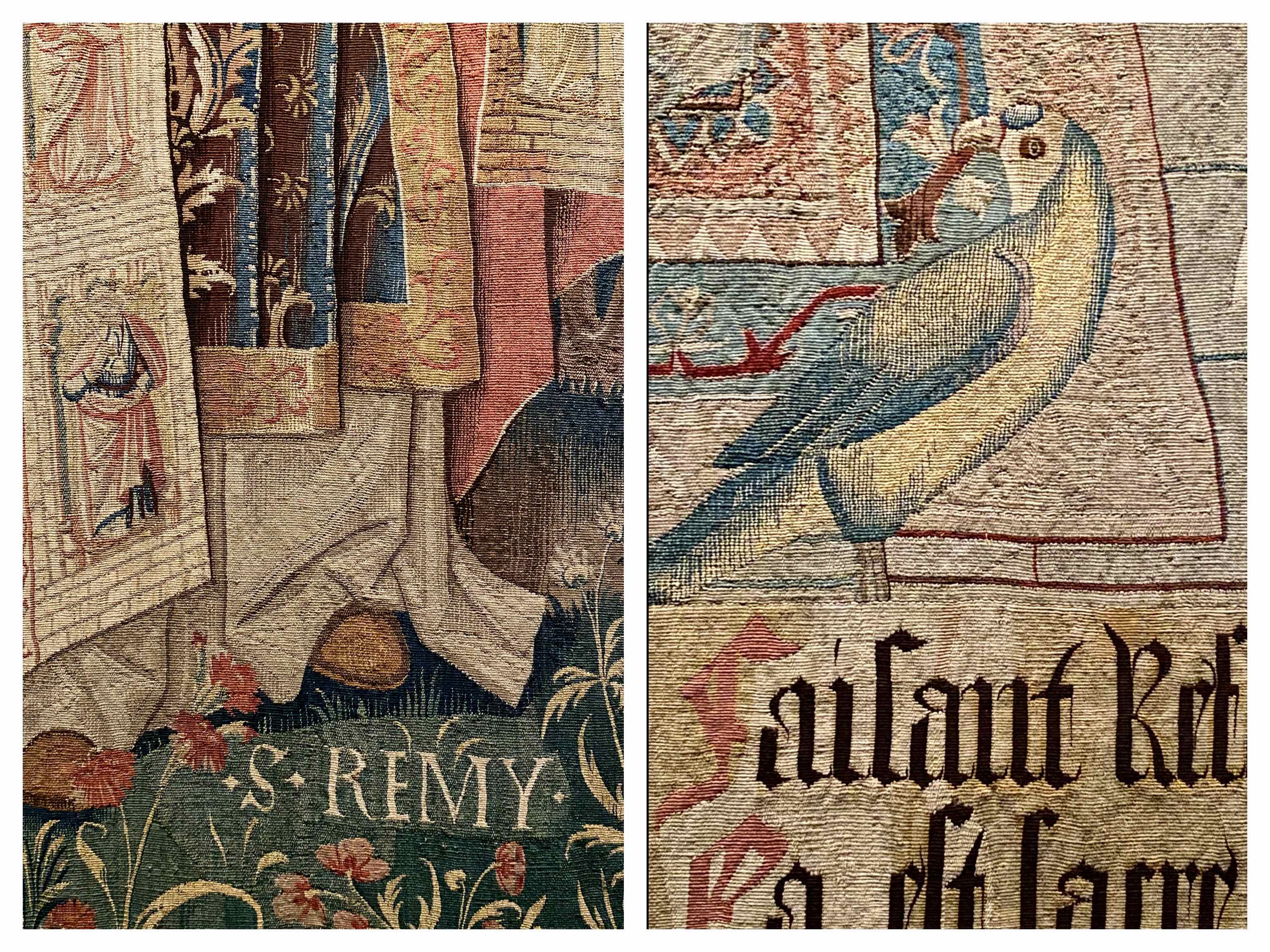
Close up photos showing some details…

and here’s a couple more.

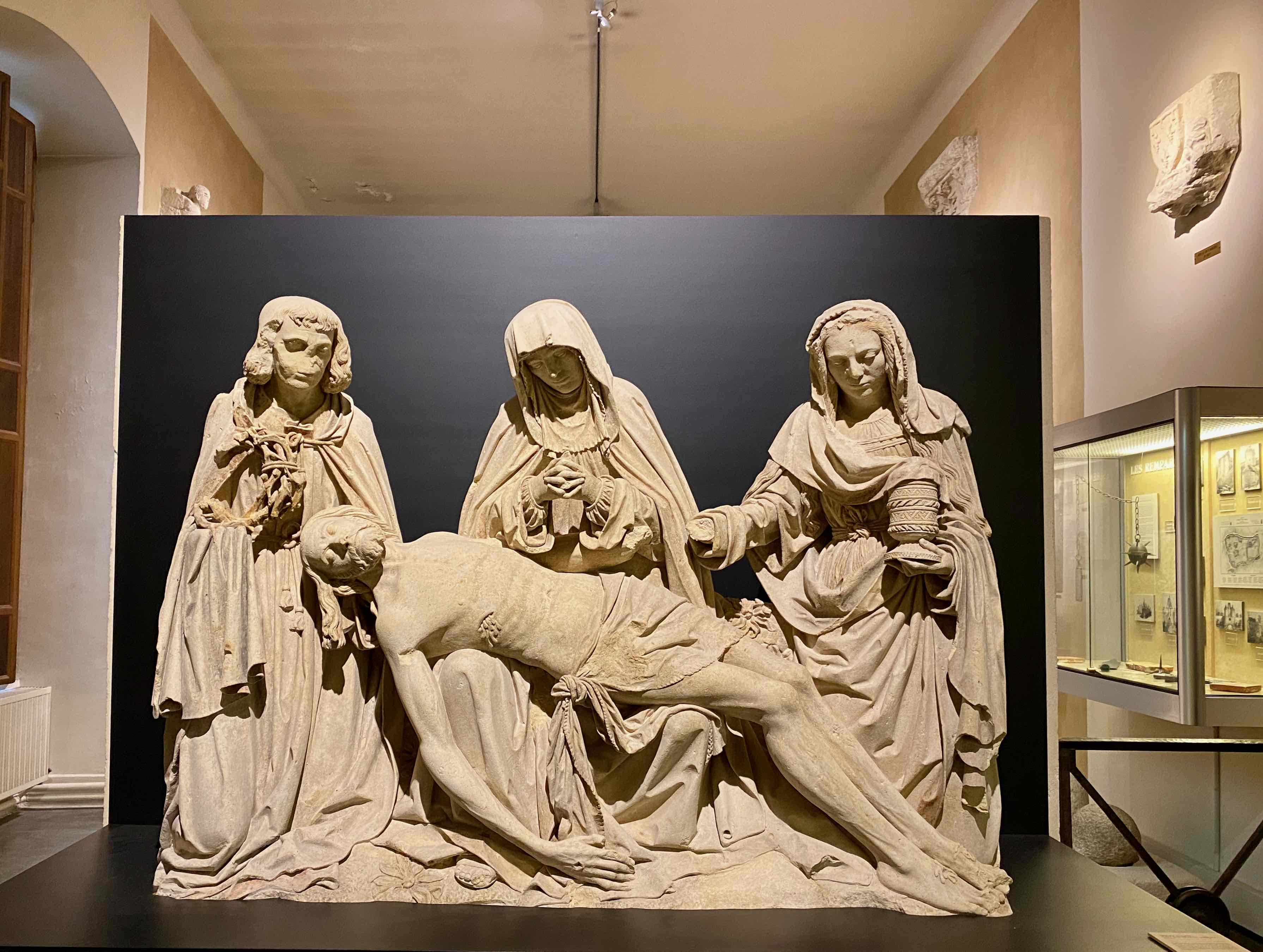
This large sculpture from 1500 was on one of the staircase landings.  I thought it was quite beautiful .

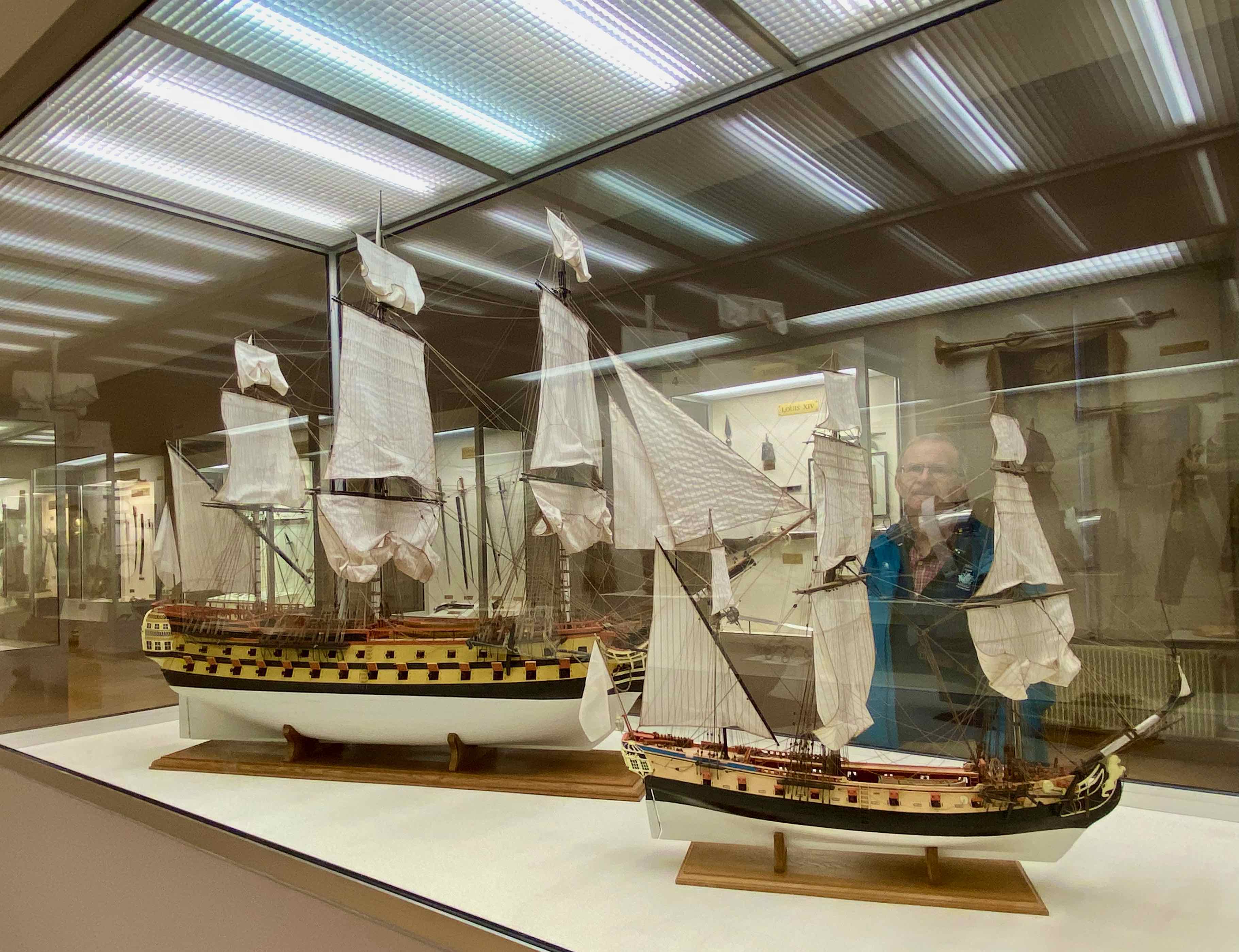
There was huge room full of model boats and other nautical items…

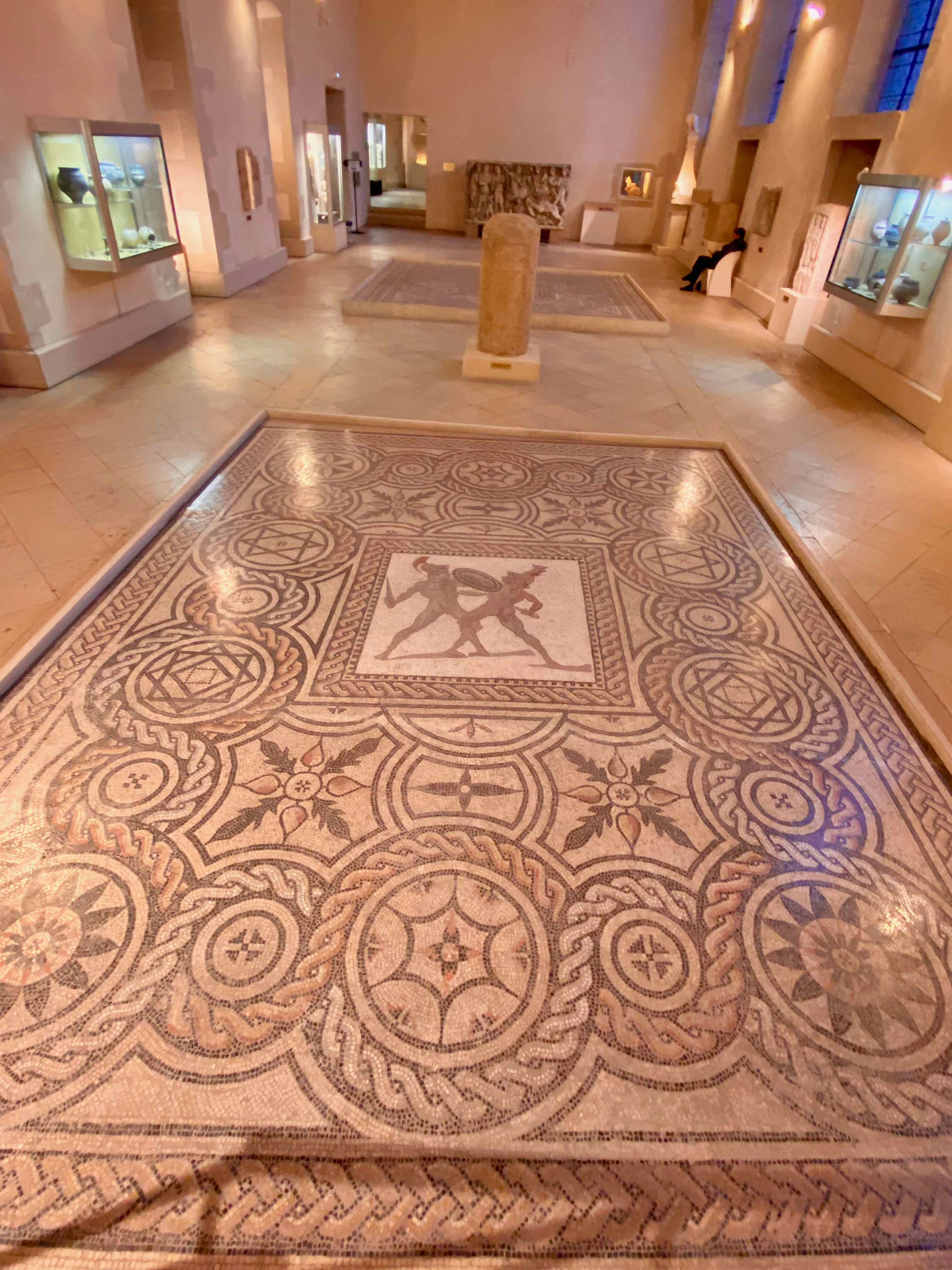
and rooms with amazing mosaic floors and Greek and Roman pottery.

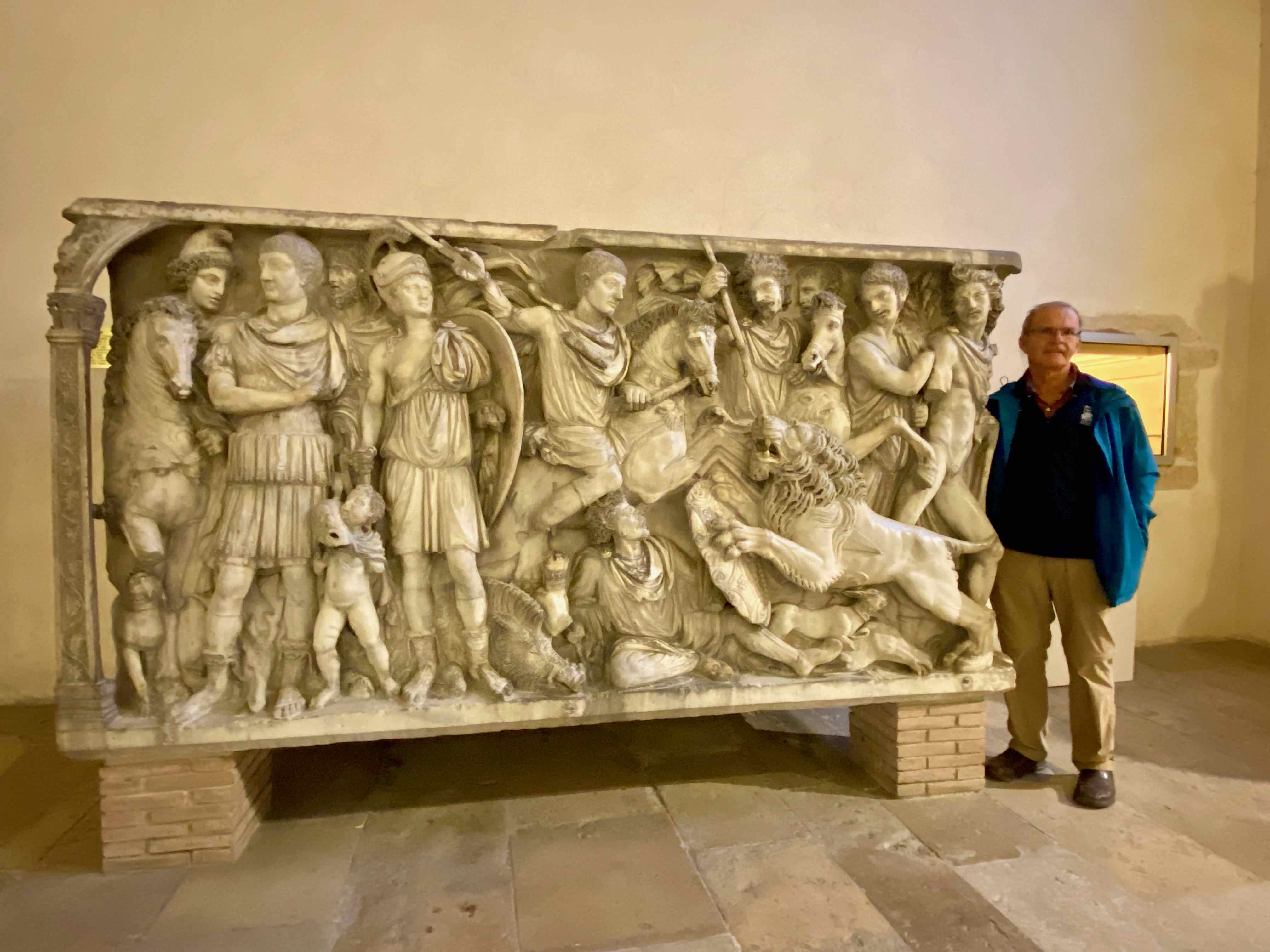
This very ornately carved piece is a sarcophagus from 367 A.D.

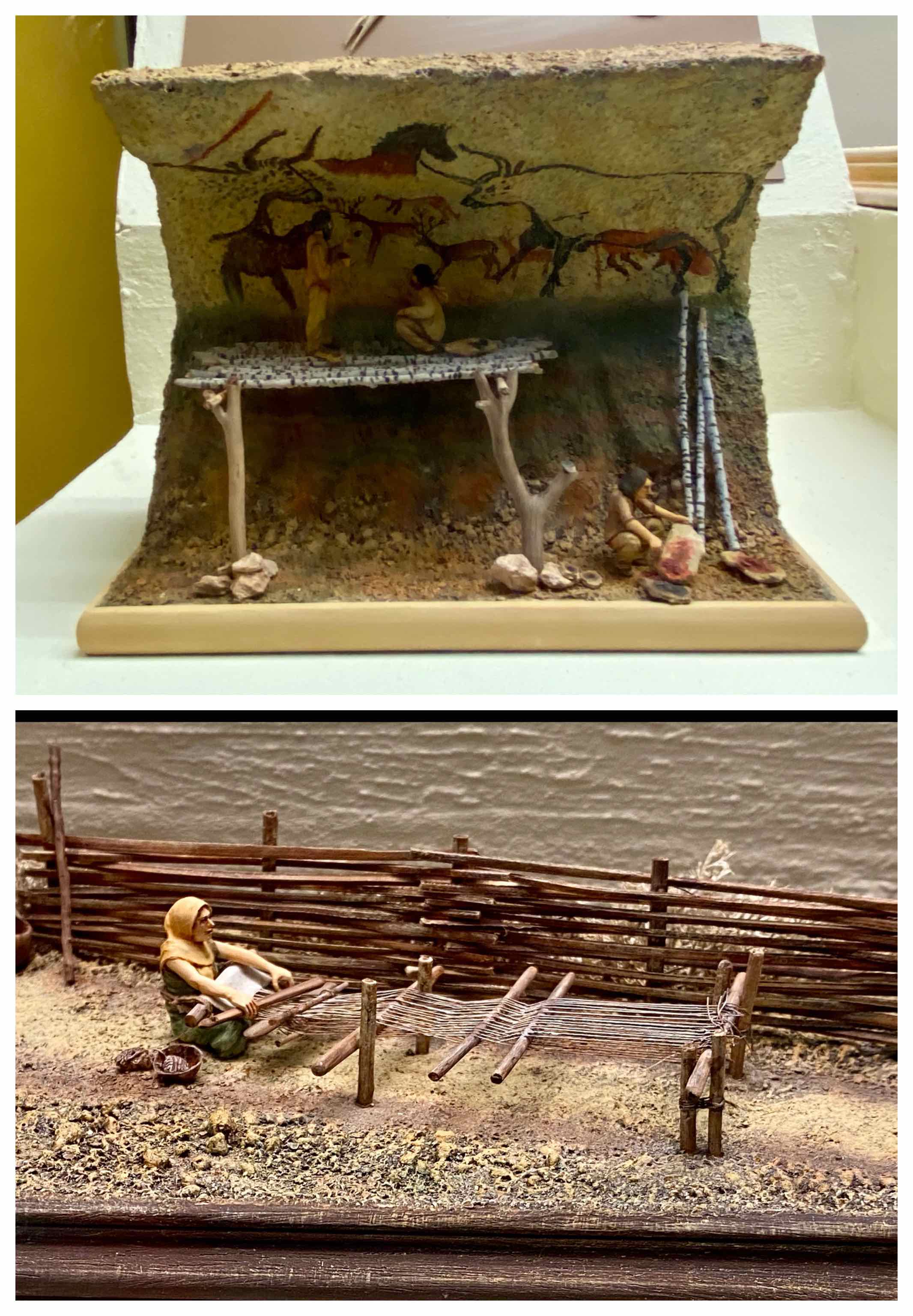
One of the people working at the museum told us to make sure we saw the display about early Magdalenian people who lived at Lascaux.  I particularly liked these wonderfully constructed miniature models.  We had visited so many caves and learned about the people who lived during this time.

The simple entrance to the museum is deceiving.  There was more than we could see in the time we had there.  All too soon the museum was closing and we were ushered out.  Bob is checking Google Maps to figure out how we are going to get home.  Thanks heavens for Google maps…it certainly makes it so much easier to find our way around.

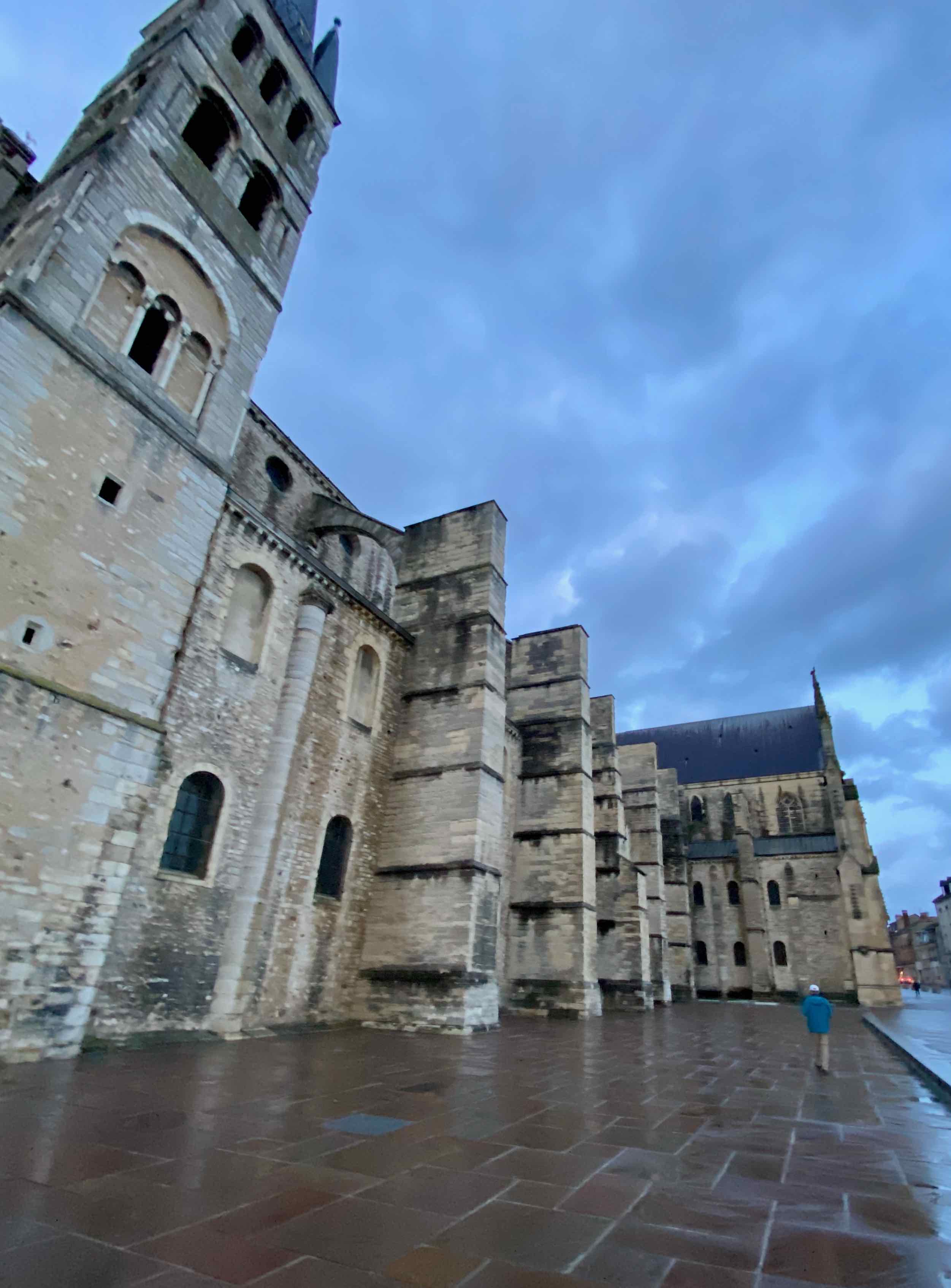
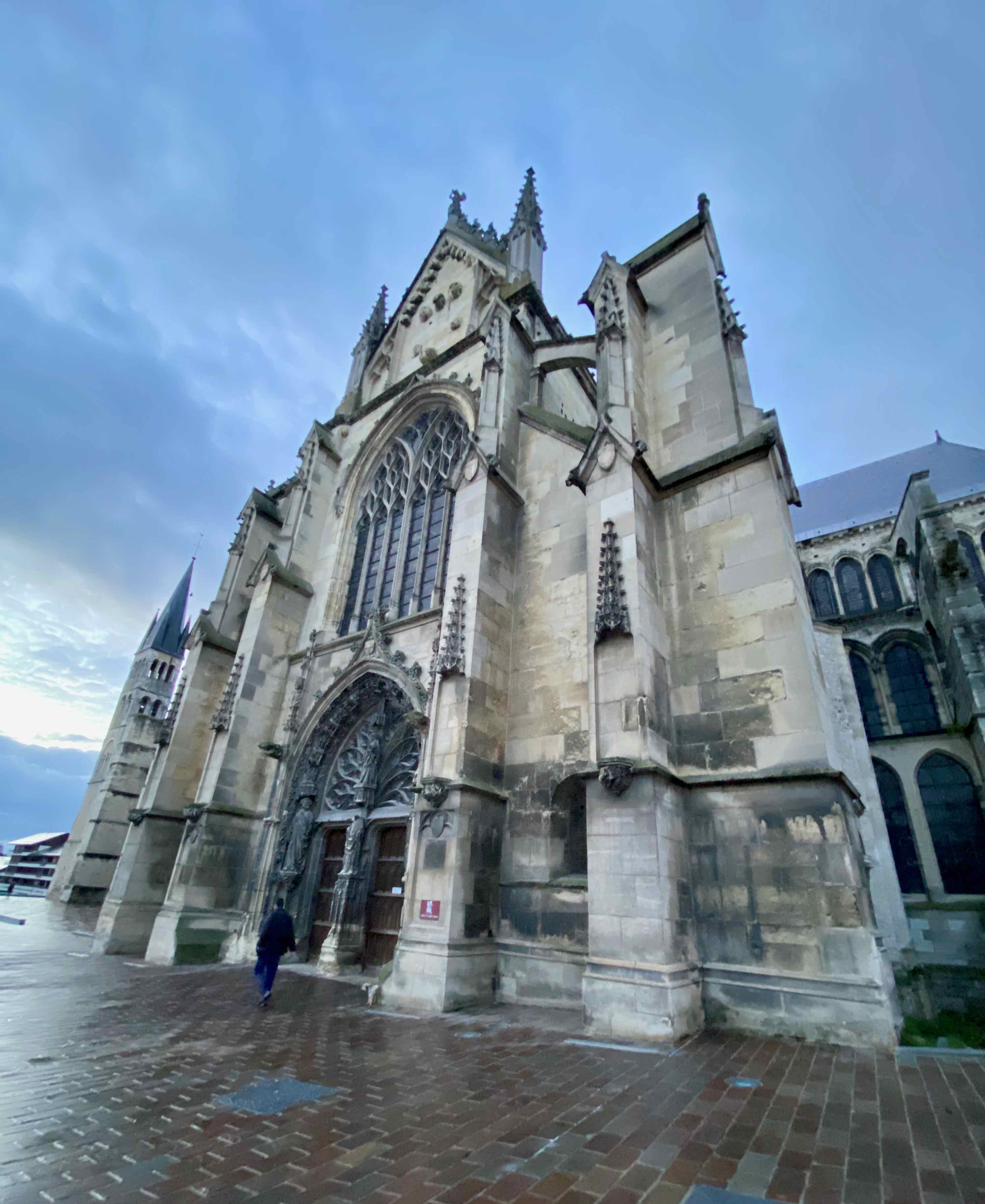
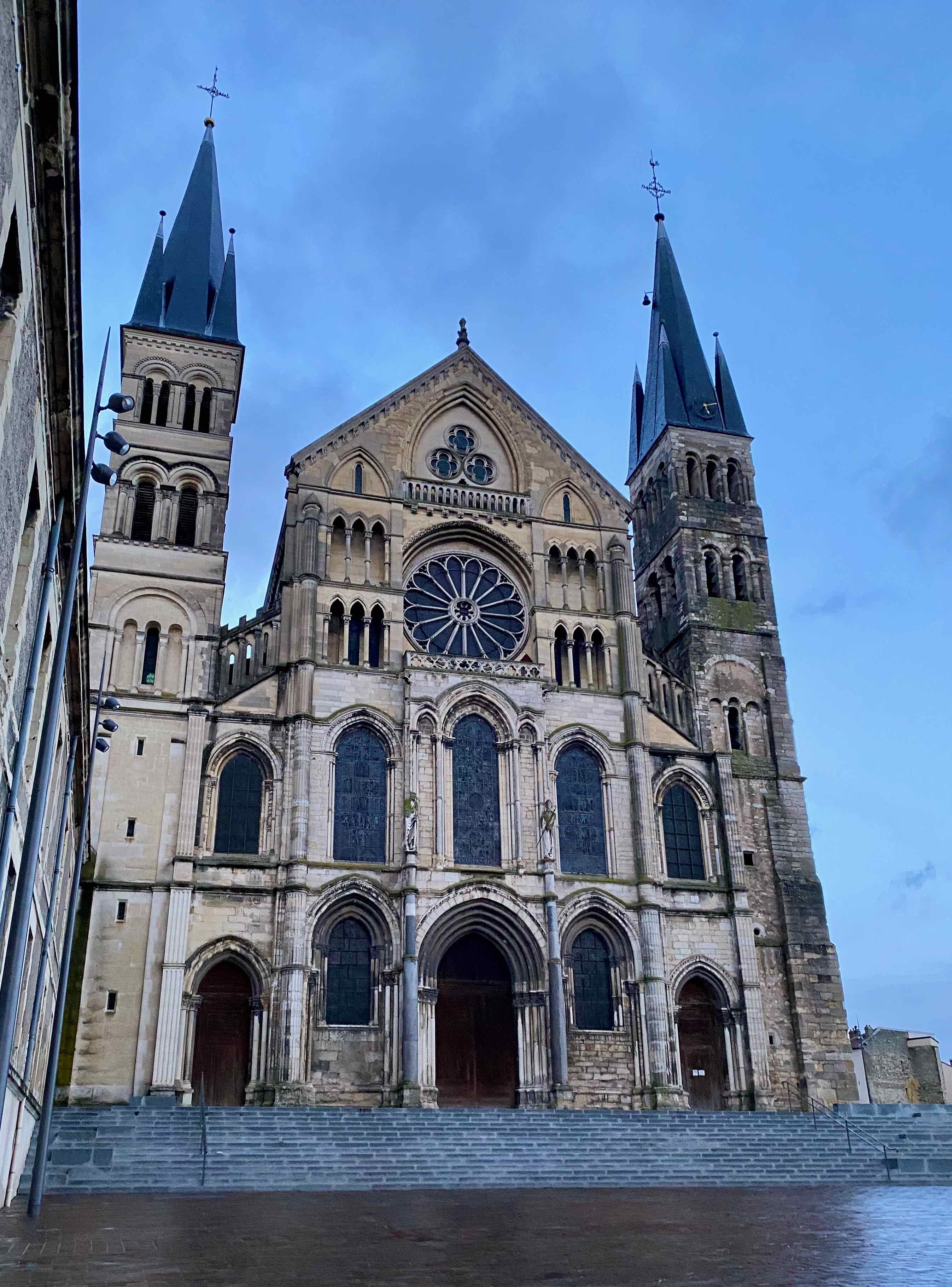
We walk past the enormous Saint Remi Basilica.

It seems to never end…

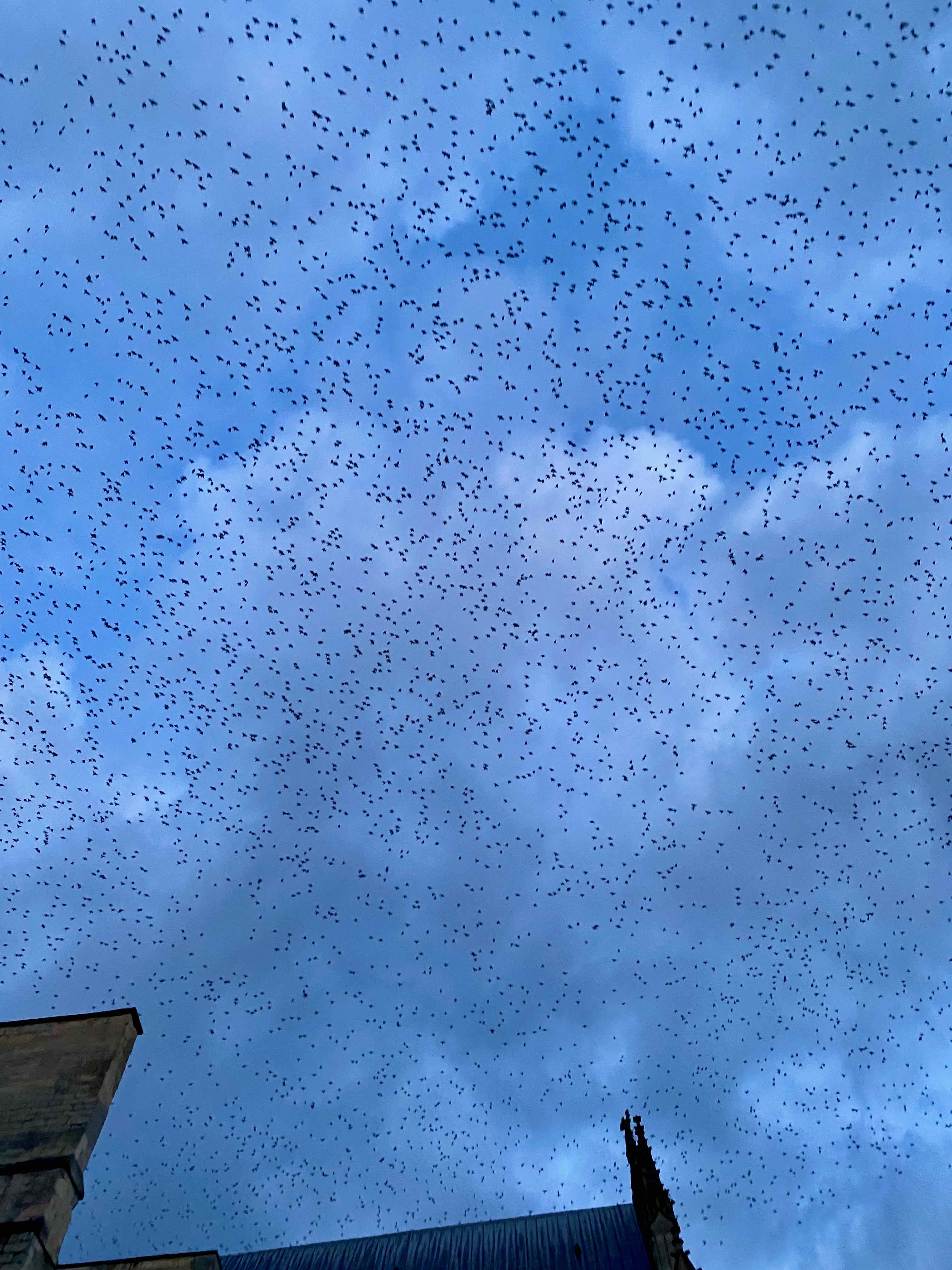
but we don’t get a chance to go inside as someone locks the entrance door just as we get near.  It is late anyways and time to head home.We saw starling murmurations as they were looking to settle down for the night.  It is such an amazing sight to see so many birds flying together.