Day 70, Monday November. 6, 2023
This morning when Bob is taking our stuff out to the car he meets the sniffer dog in the hallway. He was quite excited to start his bedbug hunt! I’m sure he gets treats when he does his job well.
Today we are driving to Dijon with a stop in Cluny. It is cloudy and rainy today and we are surprised to see these sunflowers still in full bloom. They were finished and harvested over a month ago elsewhere.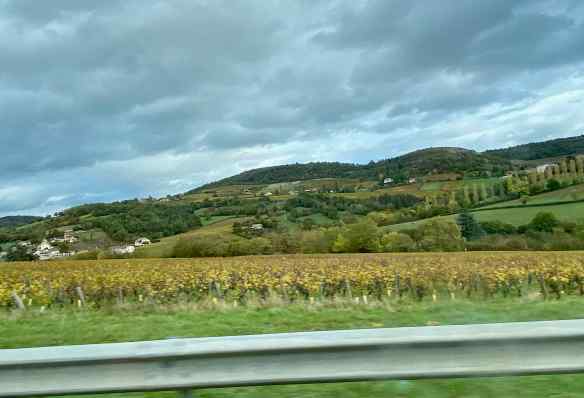
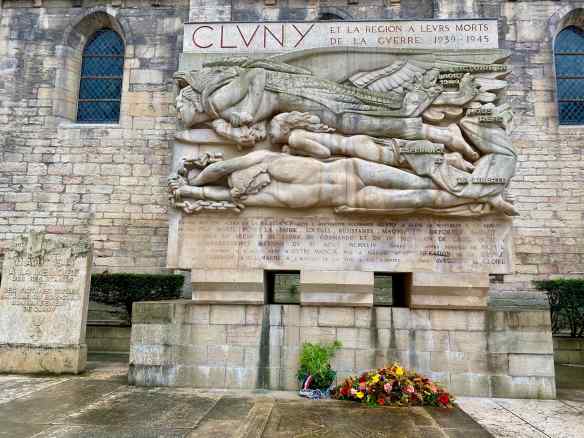
These medallions set in the road and sidewalks help us find our way…kind of like our walk in Vincent’s footsteps in Arles. They were really helpful, and before too long we arrive at the museum. We find out that the museum closes in half an hour so we barely have time to see everything. Good thing it is a small museum.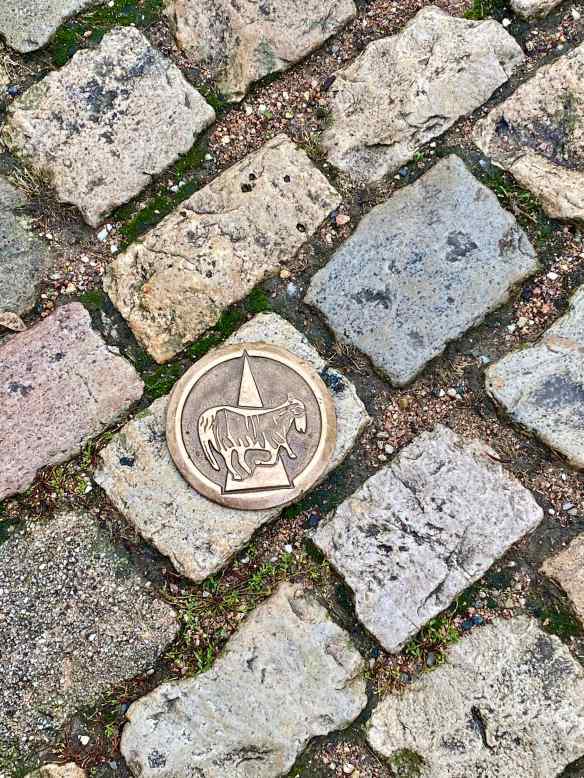
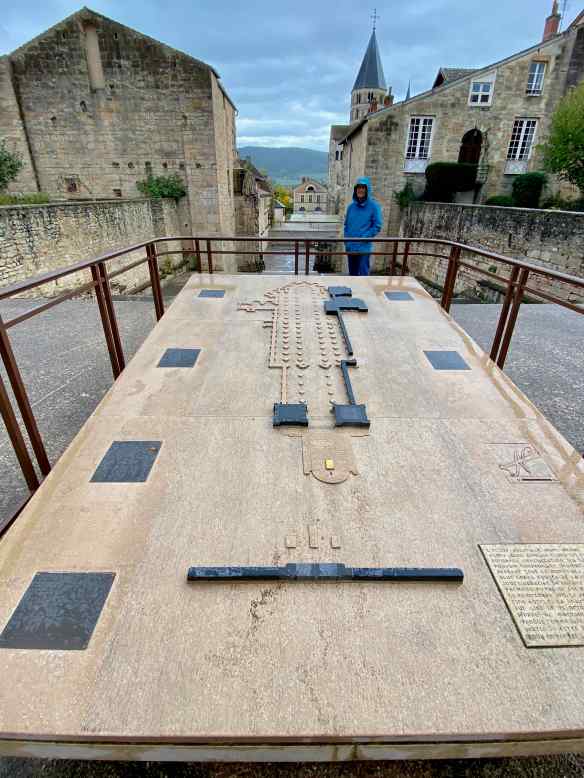
The museum is all about the Cluny Abbey, the oldest Abbey in France. It was founded in 910. This is a model of the Abbey in 1250 when it was at its peak.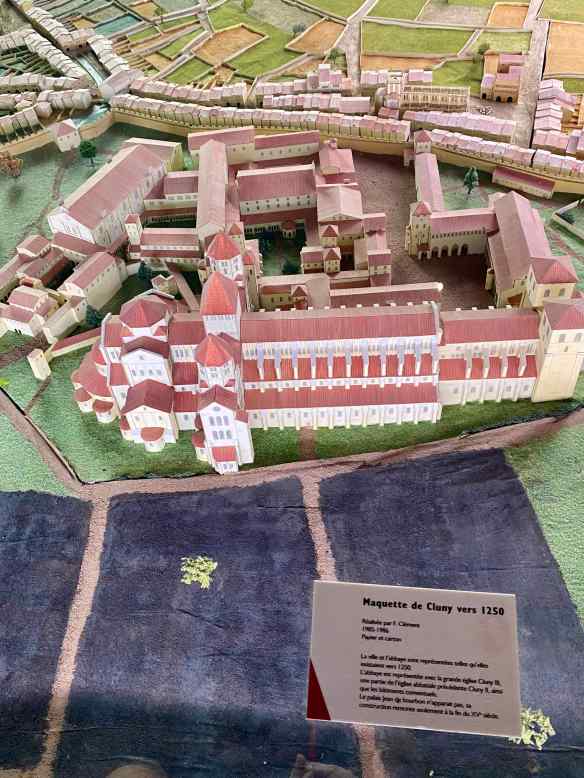
The lady who works at the museum suggested we visit the library before it closes. It has a lot of very old books and manuscripts but the room is not climate controlled, and I think the books are suffering because of that.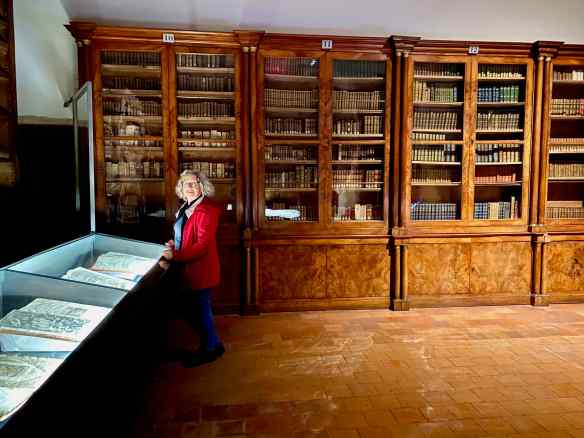
The books on display have warped, wrinkled pages…from moisture I wonder? It seems a shame but everything costs money and I don’t think this little museum would have the funds to make the library climate controlled. As soon as we left the library they locked the doors behind us…they kept it open so that we could see it. Nice!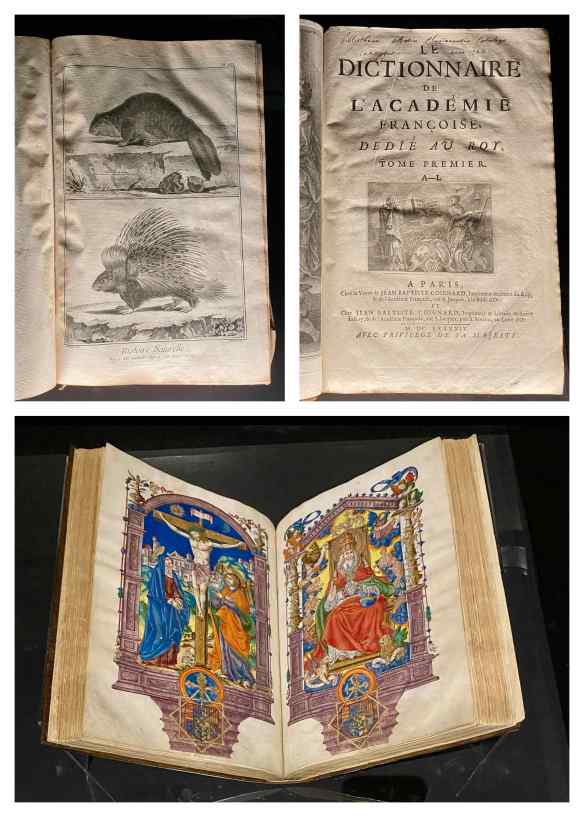
In the museum we see this carved stone with the same symbol as the bronze medallions that helped us find our way earlier. It is called the ‘keystone of the paschal lamb’. I looked up paschal and it means relating to Easter and the Jewish Passover.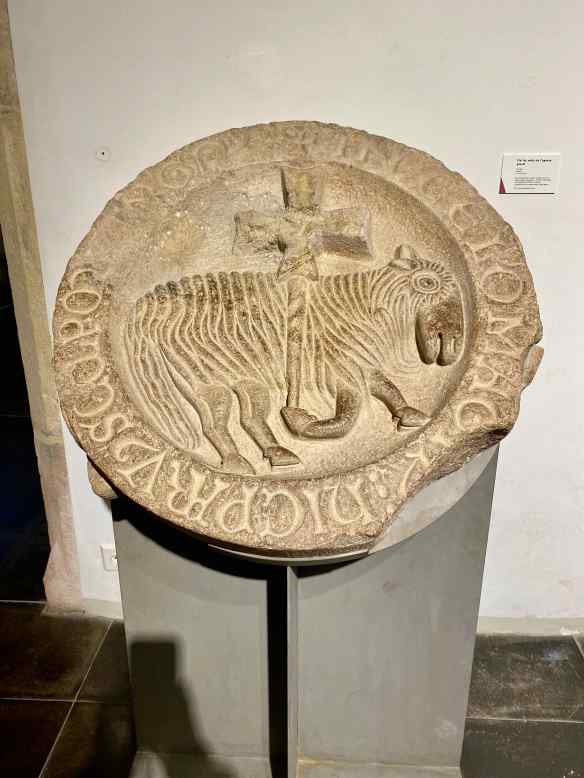
There were interesting carved panels that lined one of the museum rooms. Every circular design was different than the others.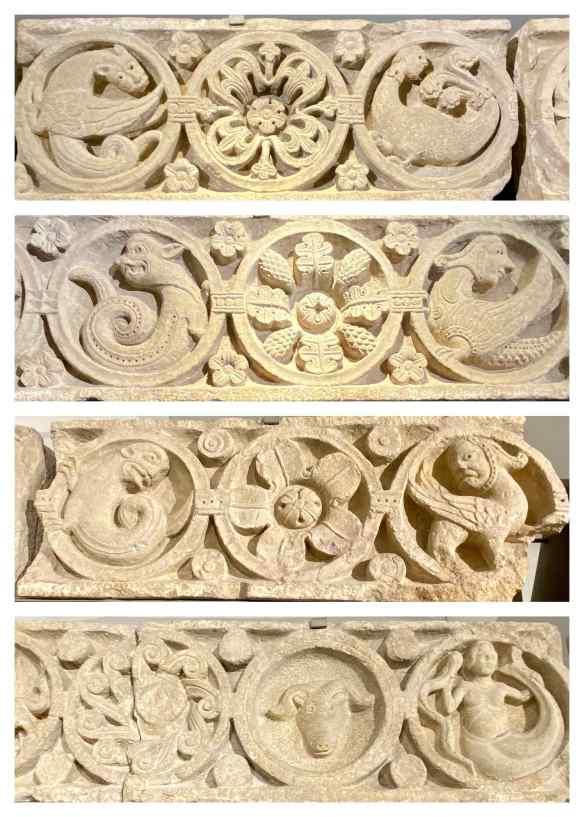
These reliquaries were interesting. The relic is usually so revered that the reliquary is traditionally made of precious metals or gems like these two below. Relics may include pieces of bone or hair, pieces of cloth, or natural objects that were significant in the lives of a saint or holy person. The bottom photo is of two unusual portrait reliquaries.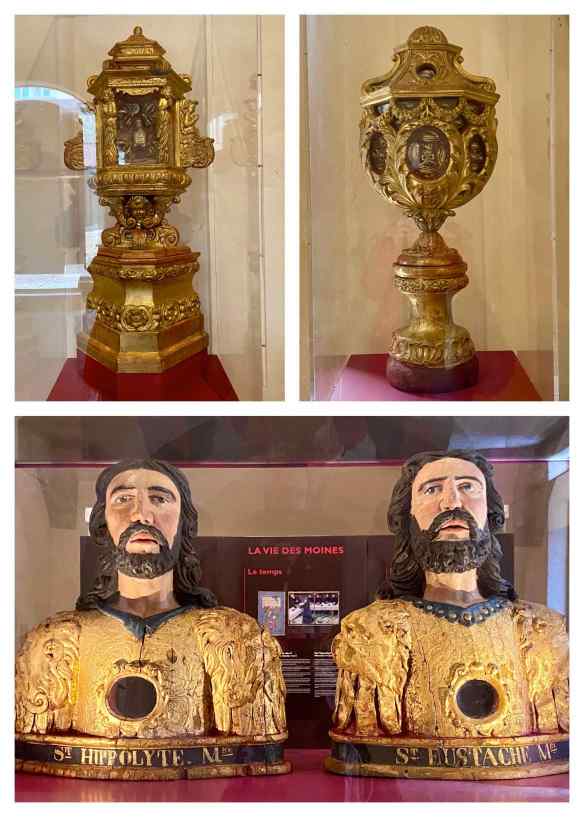 We have a rather quick look a the rest of the museum and then we are told that they need to close up so we go outside to find the ruins of the Abbey. On the way we walk by a lovely medieval herb garden.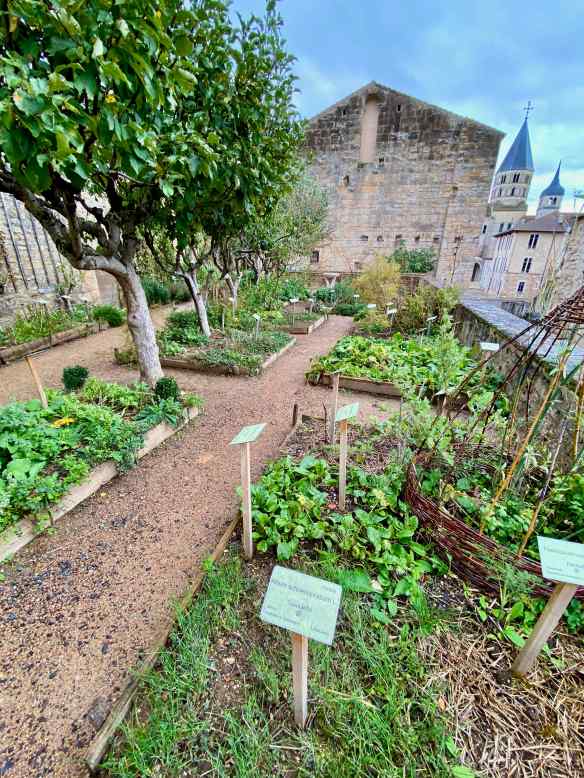
The Abbey Church was the largest church in the world until the construction of the St Peter’s Basilica in Rome. These are the remains of a few of the church pillars.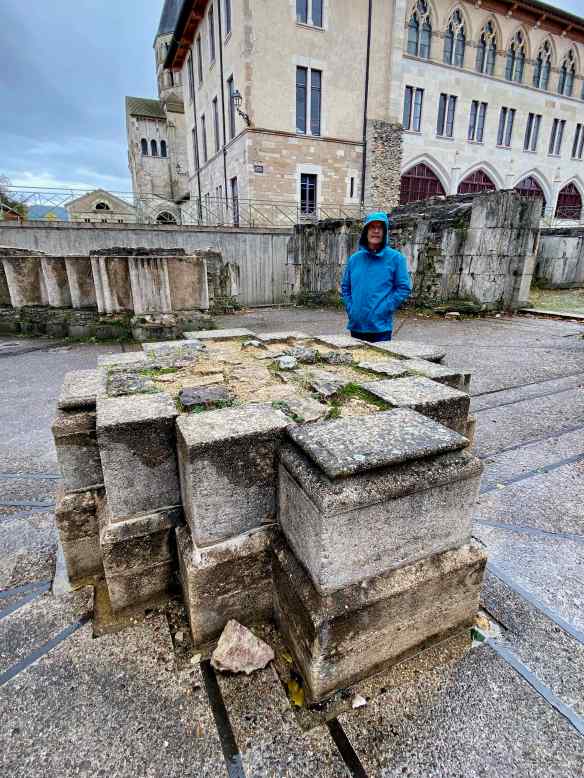
Our entrance to the museum also gives entrance to the Abbey. There is a fantastic 3D film that shows the construction of the Abbey and we walk through many of the existing Abbey buildings. Today only part of the transepts and bell tower remain of the Abbey Church. There is only 8% of the Church still in existence today, but that little bit is spectacular. 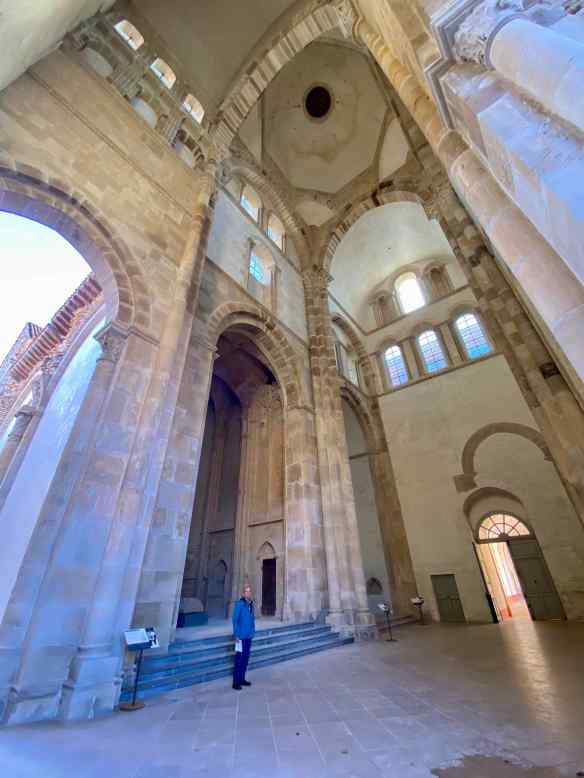
It is 30 meters up to the vault above us.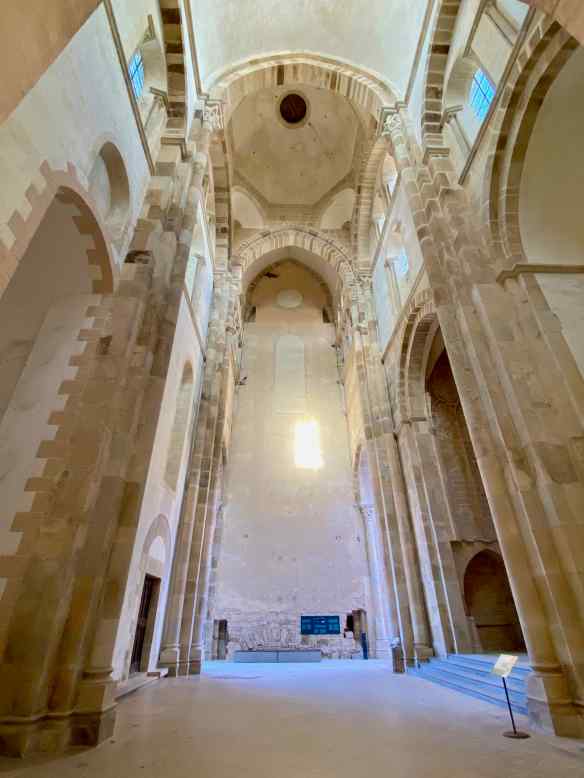
Around 1100, Cluny and its monastic order held authority over 10,000 monks and 1,500 monasteries across Europe. The decline set in from the end of the Middle Ages. The abbey became the target of an entrepreneur who used explosives to demolish the buildings, and sold the stones as building materials! 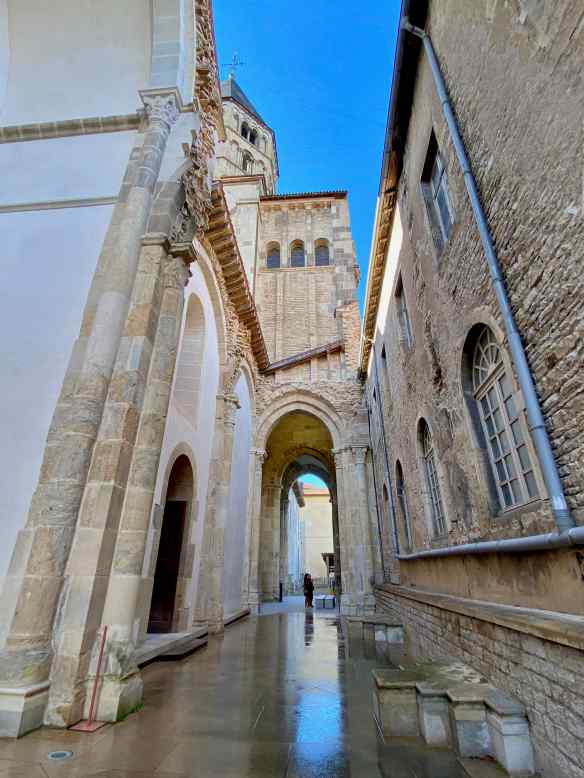
There is a small chapel with sculptures of biblical figures. Some of then still have bits of their original paint. We are used to seeing sculptures as bare stone and it is easy to forget that they used to be colourfully painted.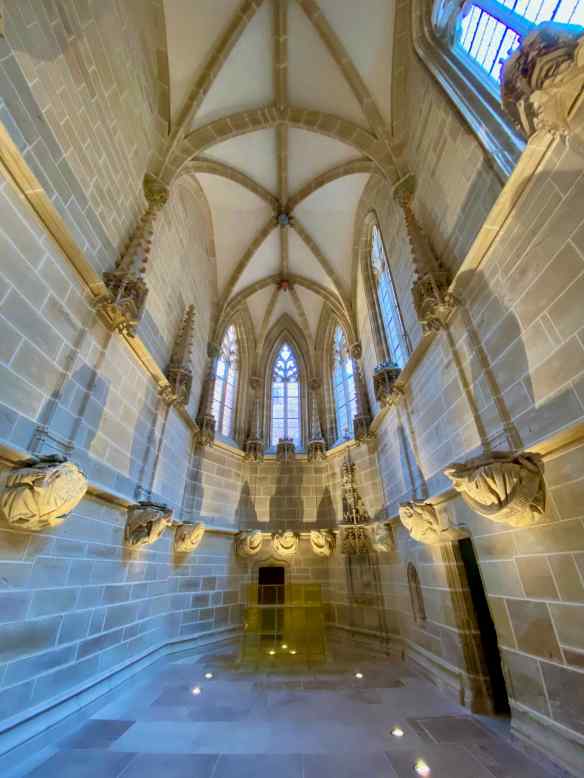
We marvel at this intricately carved stone and wonder at the skill it would have taken to carve such delicate work.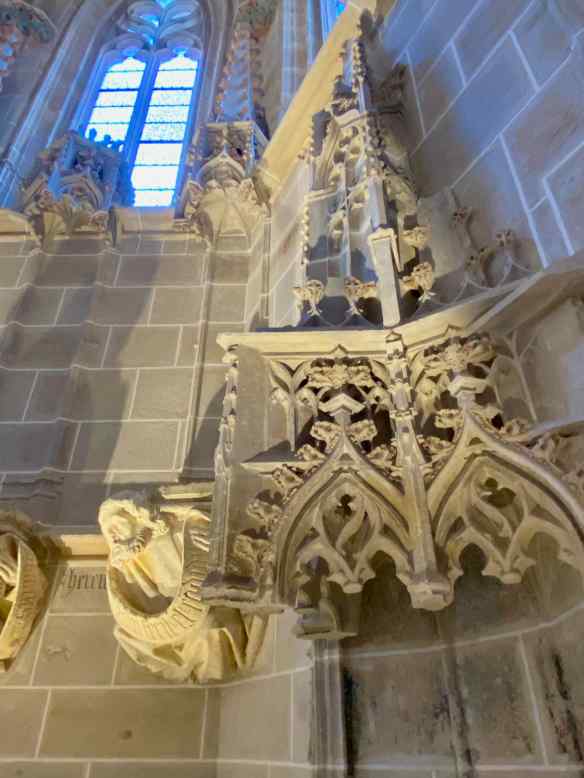
The remaining abbeys is currently a trade school. Here are some of the hallways around what used to be a cloister.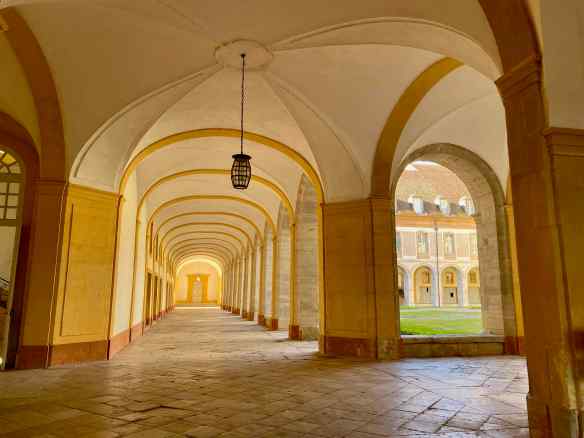
The granary has the most amazing wooden roof that was constructed using wooden dowels, which you can see in the bottom right photo. The basement of the grainery was used for storage.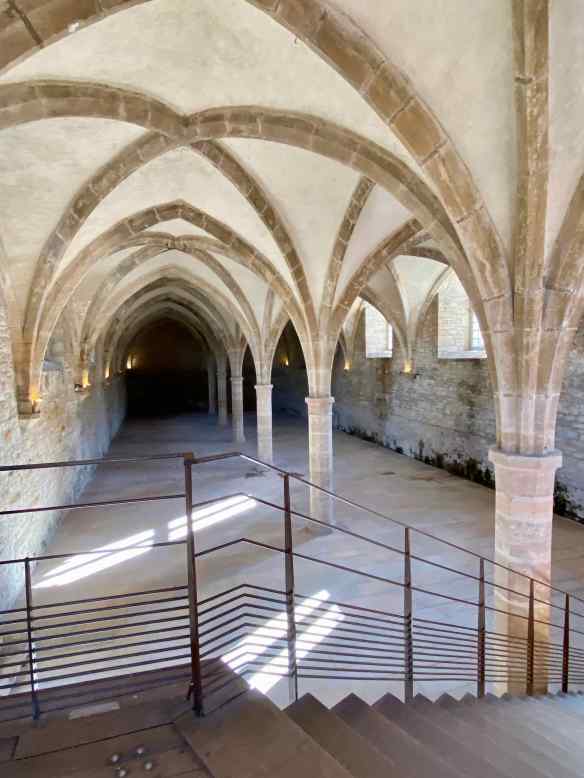
Parts of the remaining abbey are shown their age and really need major repairs.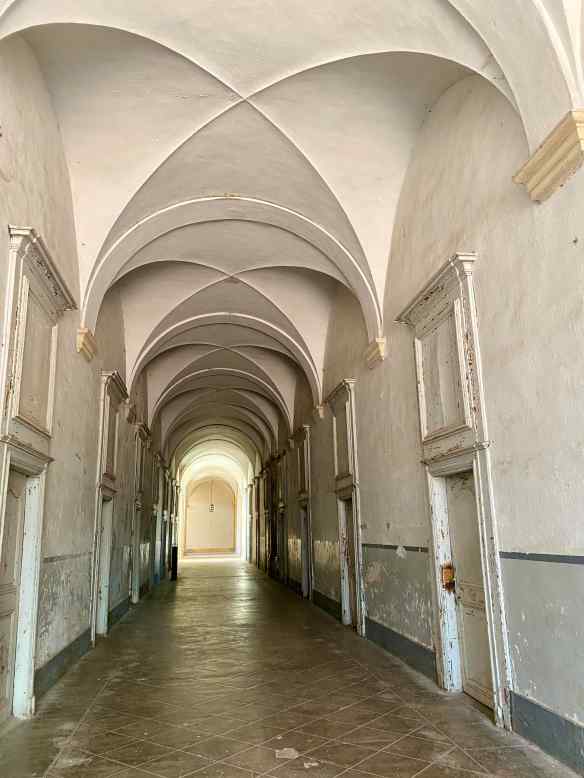
The cloister looks quite lovely…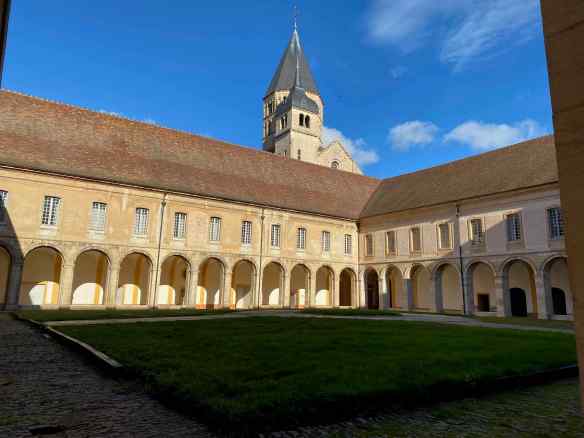 but when I hold my camera up to a broken panel in one of the doors along the cloister walkway this is what is inside! Not what I was expecting. I thought these doors would open into rooms but at least some of them seem to be storage rooms…for what looks like junk.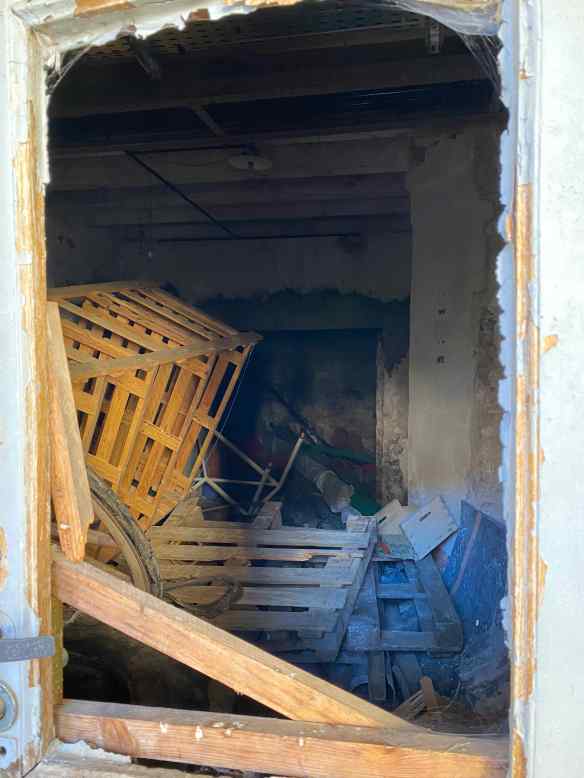
On our way back to the car we pass an artists studio, which is closed but I sneak a photo through the window. 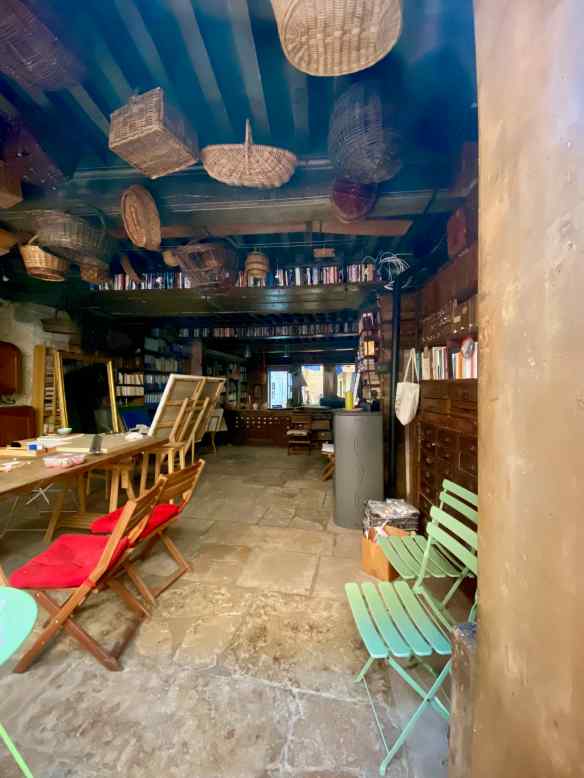
It is another two hour drive to Dijon and we see a lot of army trucks on the highway. We wonder where they are going. 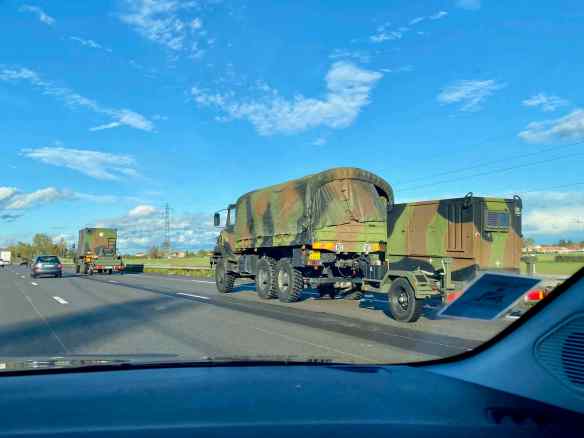
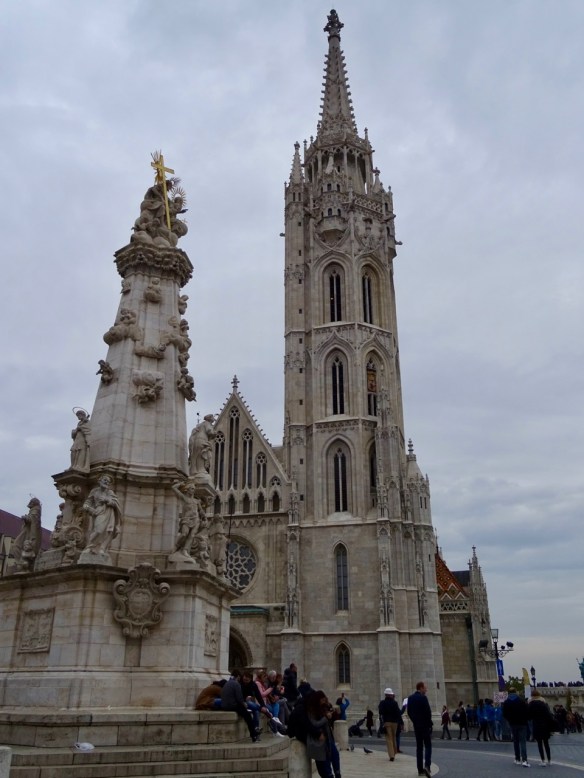
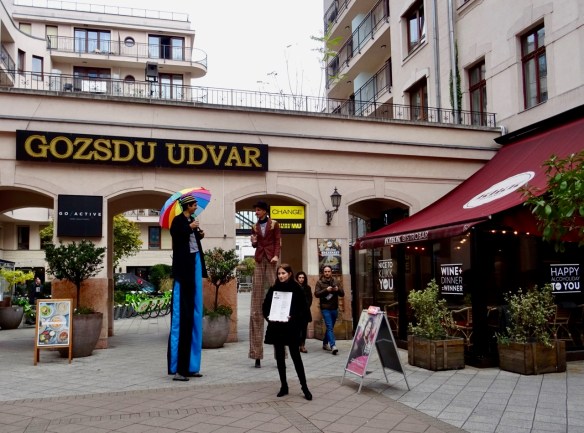 We visit the Buda side of Budapest today. First stop is the Matthias Church, located in the Holy Trinity Square in front of the Fisherman’s Bastion. It has a beautiful tiled roof and a 60 metre tall bell tower.
 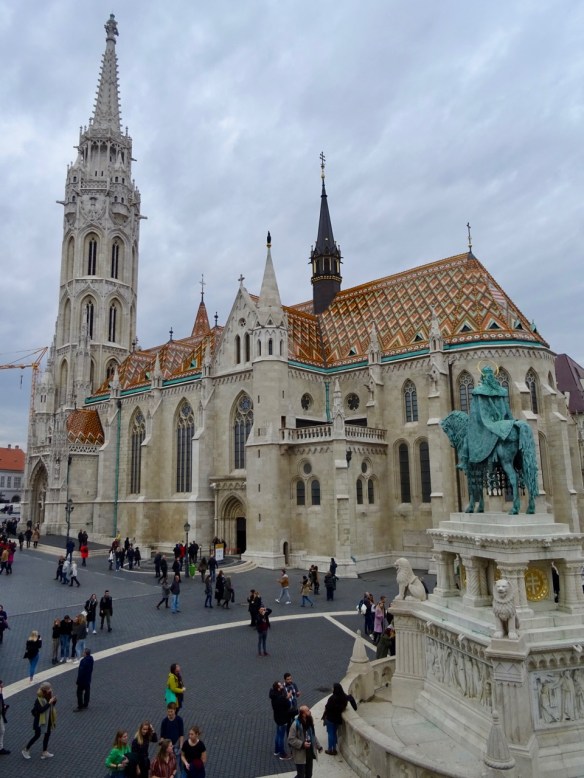 There are a lot of people here.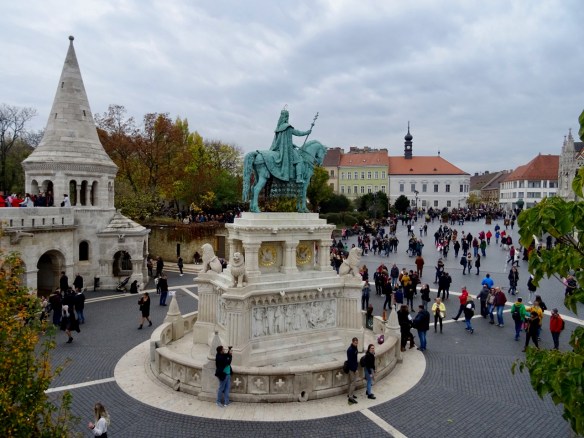
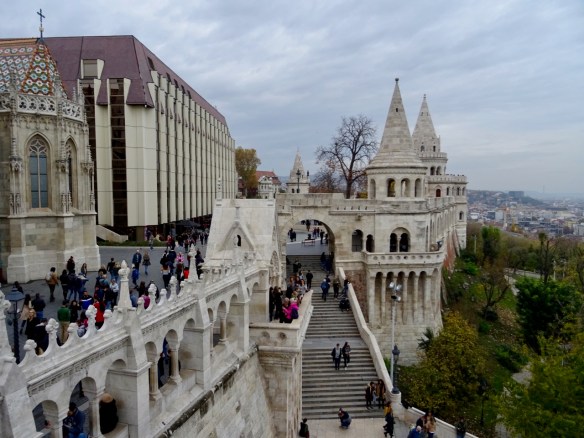 One of the many great views from the Bastion.
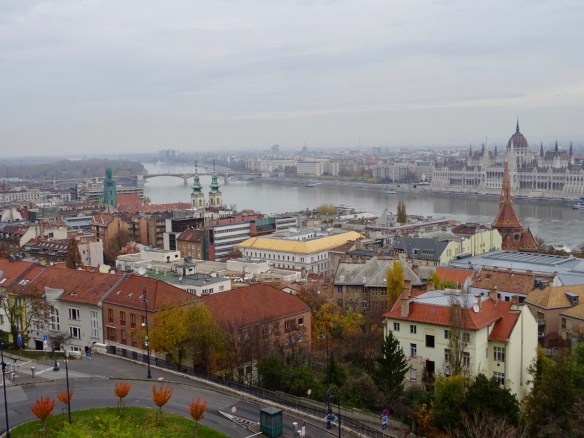 We had to wait a bit to find an arch not filled with other tourists. It often takes a while before I can get a decent photo, which involves deciding where I can get the best view and waiting until vehicles and other people are not in my picture frame. Bob is very patient, waiting for me to take photos. I probably take at least 5 or 6 photos for every one I use in this blog.
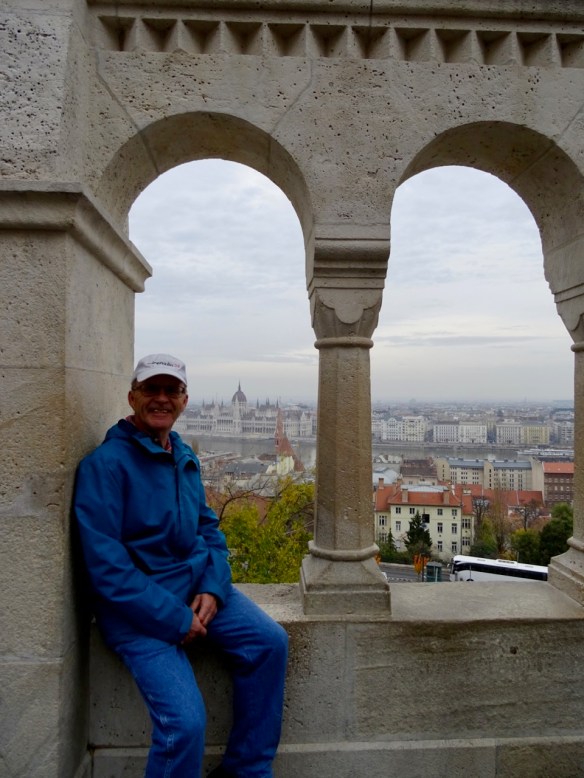 The Bastion was inspired by the architectural style of the early medieval times. It has many towers and was meant to feel like a fairy tale castle, as it wasn’t built for defence.
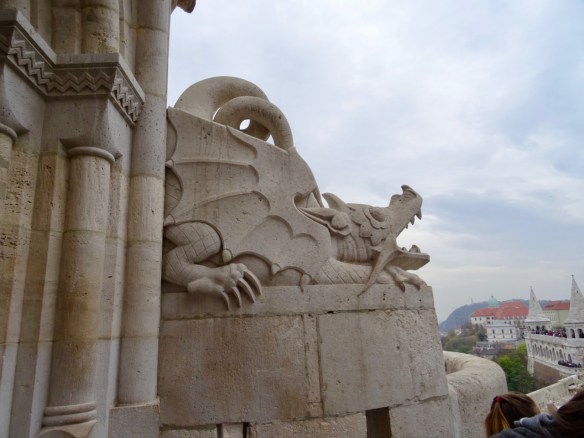
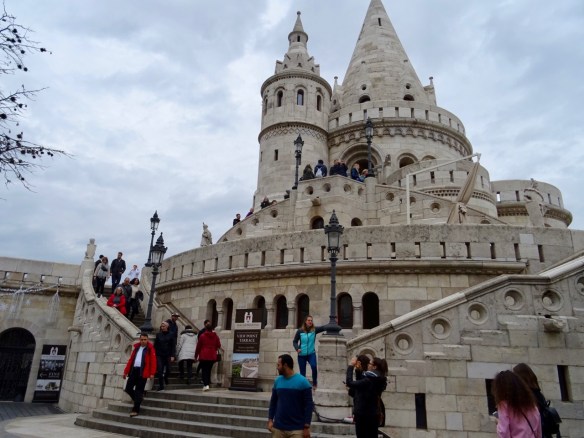 I am always happy when I find a dragon!
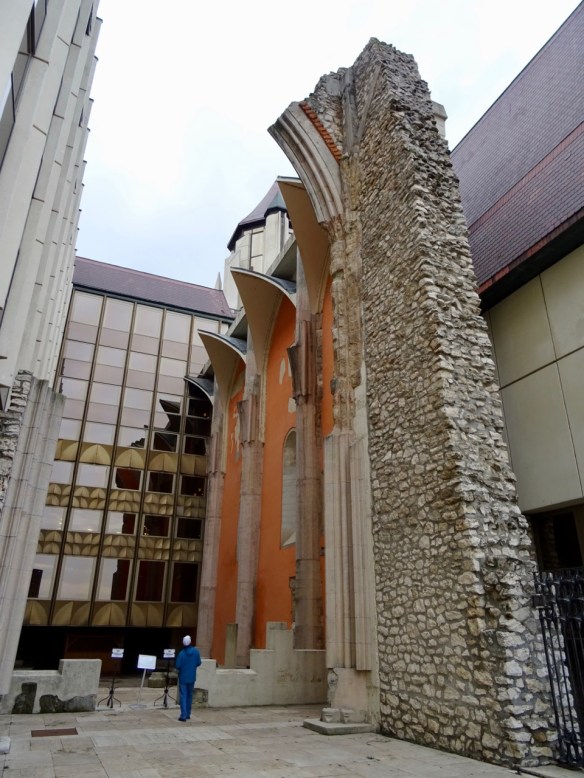
 These medieval church ruins were built into the modern Hilton Budapest Hotel.
 The Black Plague caused the death of 30-60% of Europe’s total population in 1691 and 1709. People believed that erecting a column would protect them from the plague. The carving on the top of the column represents the Holy Trinity. Below this the whole column is decorated with smaller statues depicting angels, and saints. The central sculpture shows King David praying to God to let his people avoid the outbreak of a plague. Residents believed the Holy Trinity Column did its job, as the plague never returned after 1709.
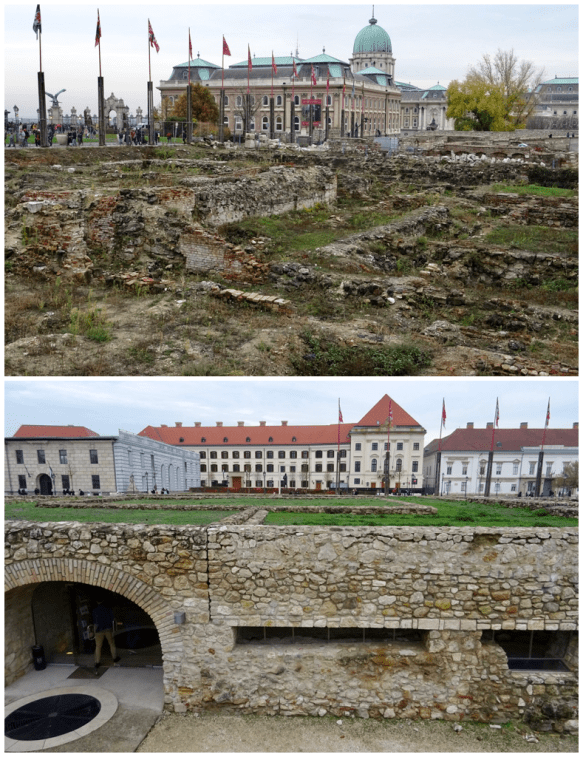
 On our walk to the nearby Buda Castle we pass these Medieval ruins. Beneath some of the ruins there is a wine cellar which offers wine tastings. It is located below the remains of a 13th century Dominican Cloister, which is part of a huge labyrinth system underneath the Castle Hill.
  King Matthias (1457-1458) adopted the crow as his heraldic emblem after catching one of them stealing a ring, and killing it to get his ring back. These gates are topped with a crow with a ring in its mouth. The gates are very bizarre, almost creepy looking.
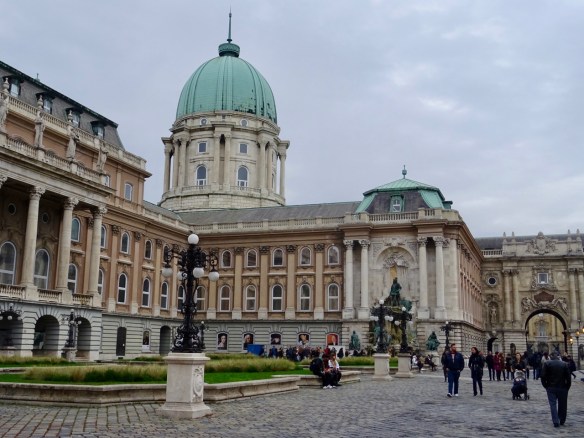
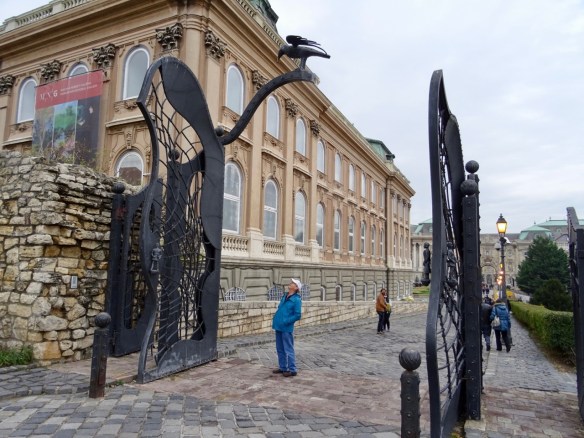 This is the back side of the Buda Castle…
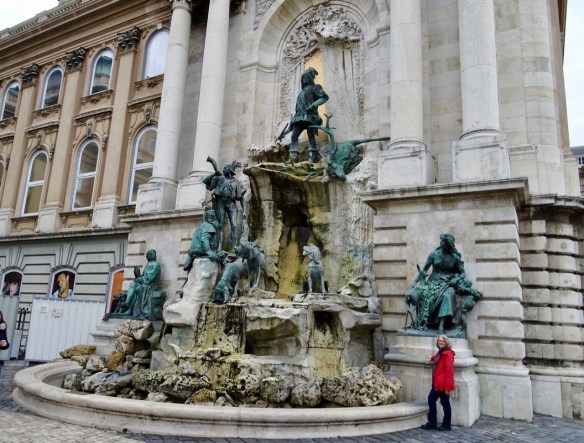
 and here is a close up of its fountain. Too bad the water in all the fountains in Budapest has already been turned off for the winter.
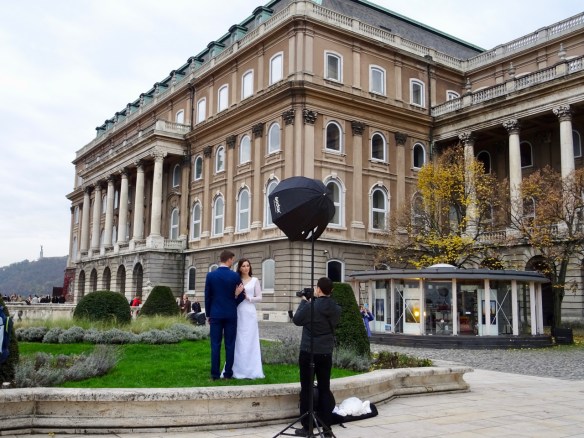
 The front of the Buda Castle with lots of tourists…
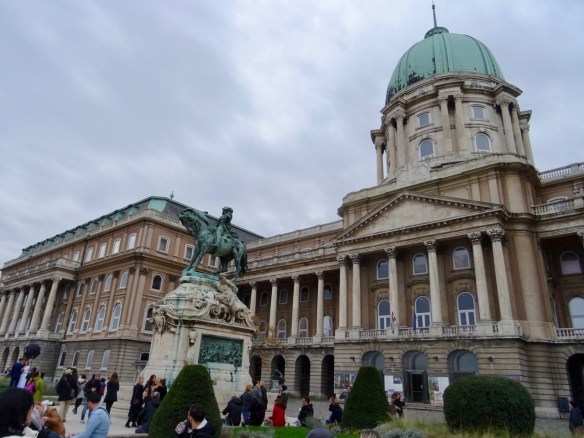 and a bride and groom taking their wedding photos. I wonder if the photographer has to photoshop out all the tourists?
 We see a large river cruise ship o the Danube.
 There are walkways high above Medieval walls.
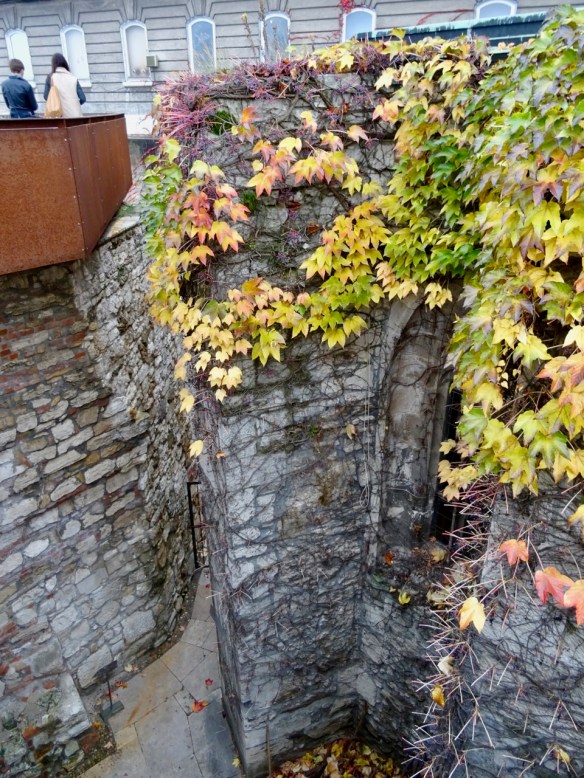 We walk down a flight of stairs below a statue of the Madonna and baby Jesus.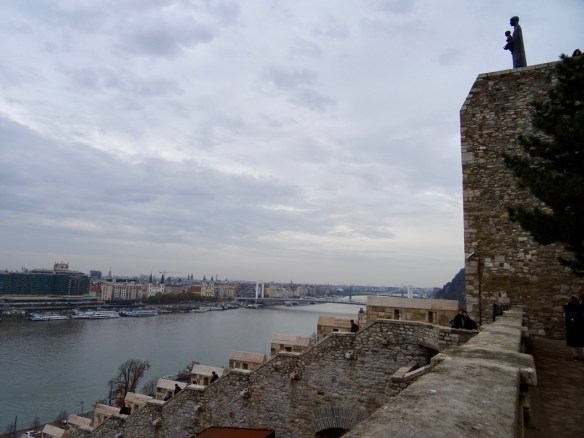
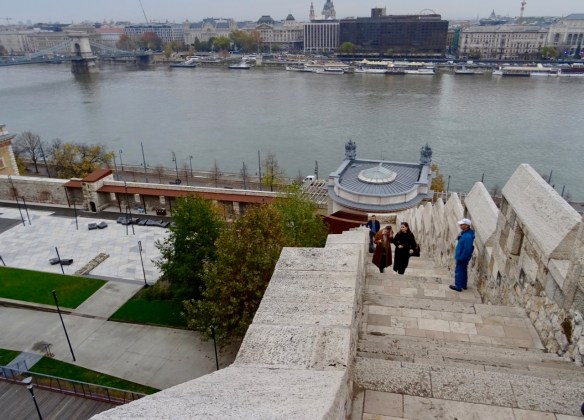 When we walk across this bridge we can see these same stairs on the far left side of this photo.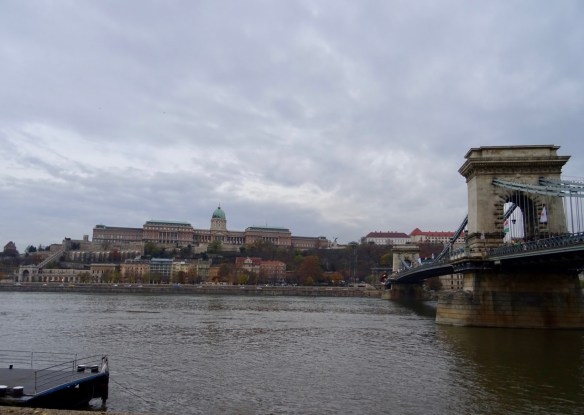
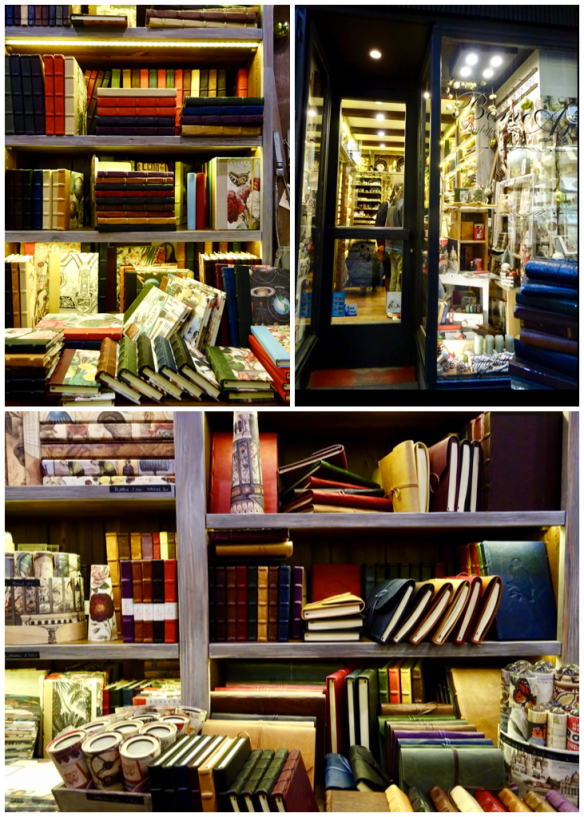
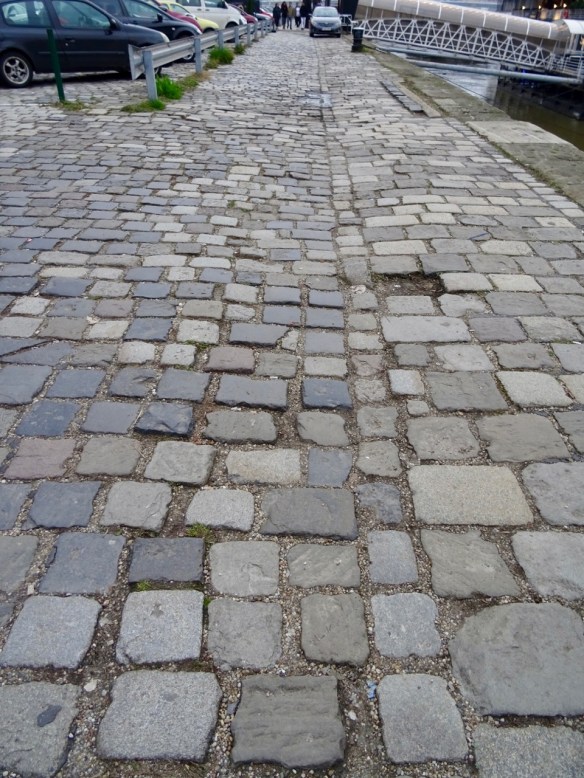 We are walking to this little bookstore that sells handmade journals. Bomo Art is a tiny store, less than 2 metres wide! It didn’t have any larger sketchbooks with good paper for drawing. Too bad, or maybe it was good. My suitcase is already pretty heavy with the two sketchbooks I bought in Linz, and the huge Dürer book I got in Vienna.
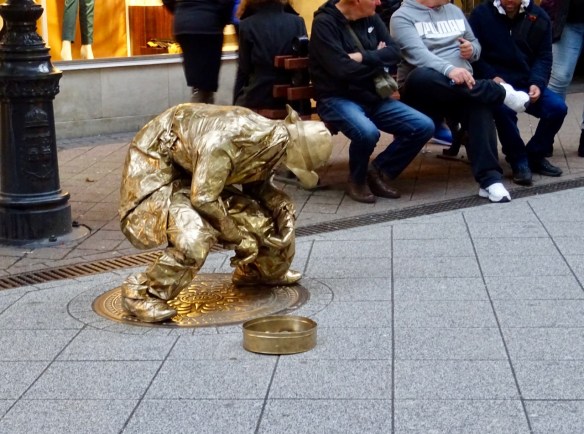
 We watched this street performer for a while and wondered how he was able to hold this difficult pose. We later saw him in a different position but when we walk by again we see a guy lean heavily on him and to our surprise he crumples! Turns out he is a mechanical man! People were putting lots of coins into his can, trying to get him to move. They had no idea they were being tricked into thinking this was a man in costume.
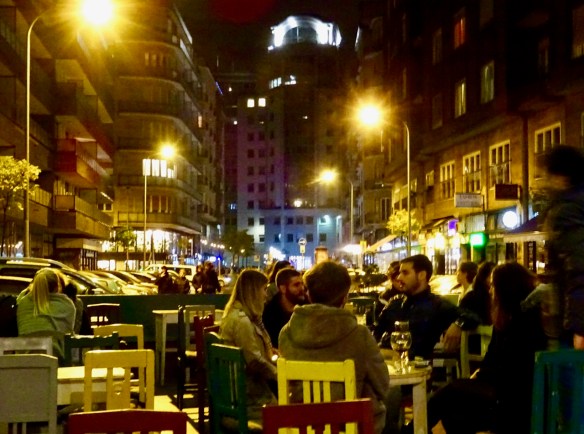
  It is quite cool at night but it doesn’t stop people from sitting outside drinking beer.
  One last walk down the decorated street towards the Christmas Market. There are so many more people out on the streets tonight.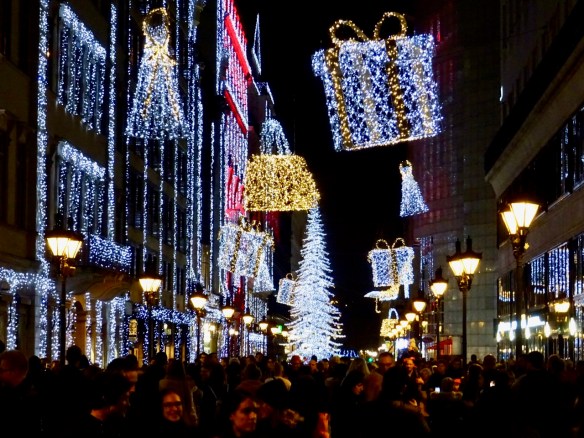
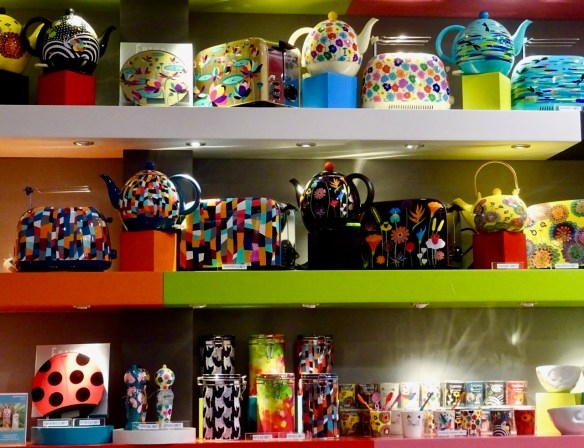 We stop at one of the stalls and I buy a couple small gifts I have been eyeing every time we walk by.
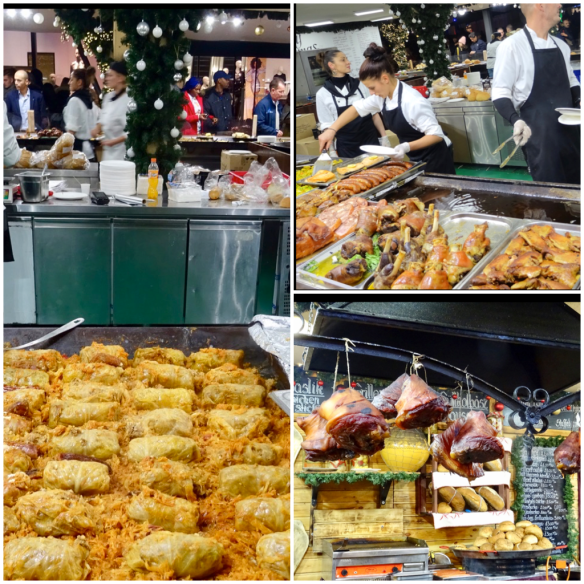
 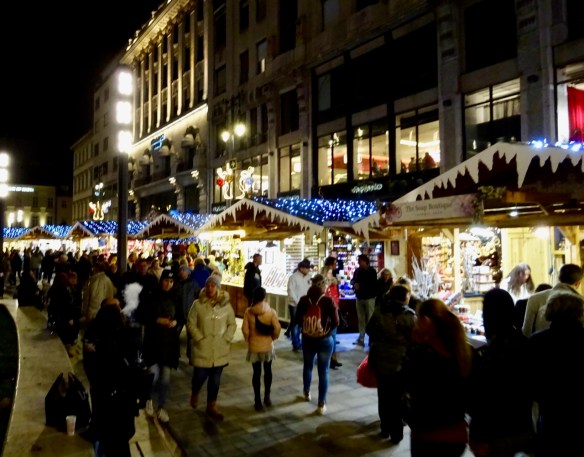 I also took photos of the food stands. Pork hocks are a big item here! We were going to buy a meal here a few days ago but quickly changed our minds when we discovered that one cabbage roll, albeit a big one, would cost us 5,000 Forints, the equivalent of $25 Canadian! A small plate with a sausage and two small helpings of side dishes was $35.00! We were rather shocked at how expensive it was. We saw other tourists change their mind and refuse to purchase what they had ordered when they realized the price.
 I saw lots of these sparkling balloons and thought they were so pretty. They were even nicer in person than in the photo. We spend the rest of the evening tidying the apartment and packing for our drive to Croatia tomorrow. Oh, and the puppet show we saw ws ‘Coraline’.
 trudymason.com