Day 47, Saturday, October 14, 2023.
Bob has been doing a fantastic job as tour director. He has found two little villages nearby that look interesting, Caunes-Minervois, which is known as the Red Marble Village, and Brousses, which has a working paper mill. First stop is the Red Marble Village. We find parking along a dry river bed and and a walkway with lots of red marble sculptures.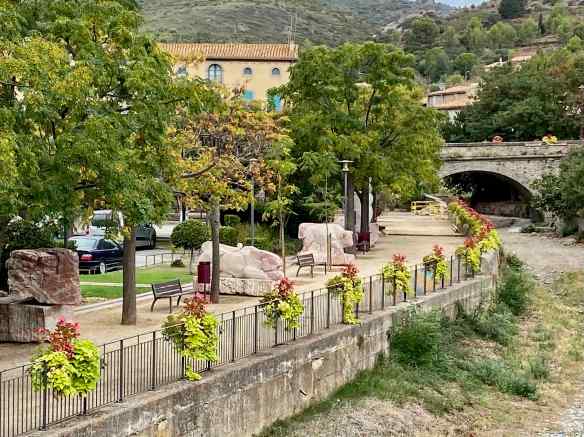
The sculptures are quite large…however this poor fellow has lost his horns.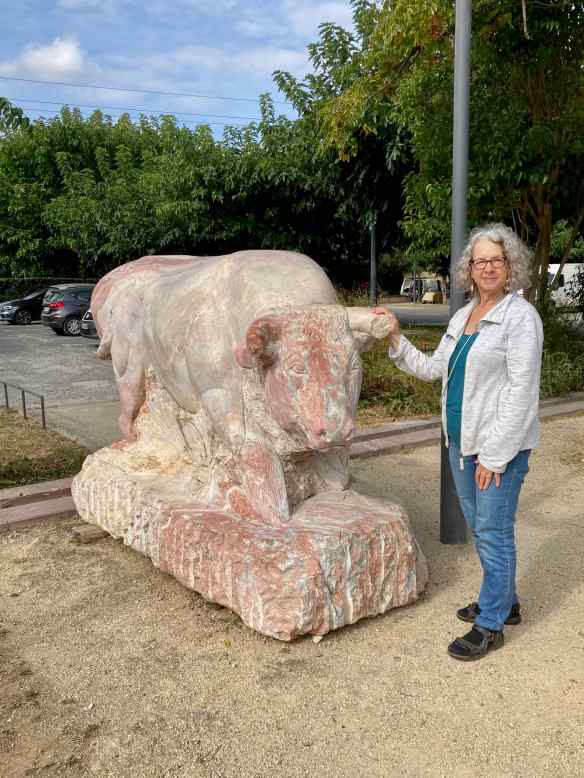
We walk into the town and turn the corner to find this lovely little park with an old fountain and the biggest Sycamore trees…or at least that is what I thought they were. The sign says that they are 200 year old Plane trees. I do a bit of Googling and it seems that a Sycamore is a type of Plane tree or maybe a Plane tree is a type of Sycamore? It isn’t clear but I am not going to spend any more time trying to figure it out. Guess I need to start calling these trees Plane trees.
This is quite a pretty little village, with flowering Morning Glory vines, 
and lots of narrow streets. 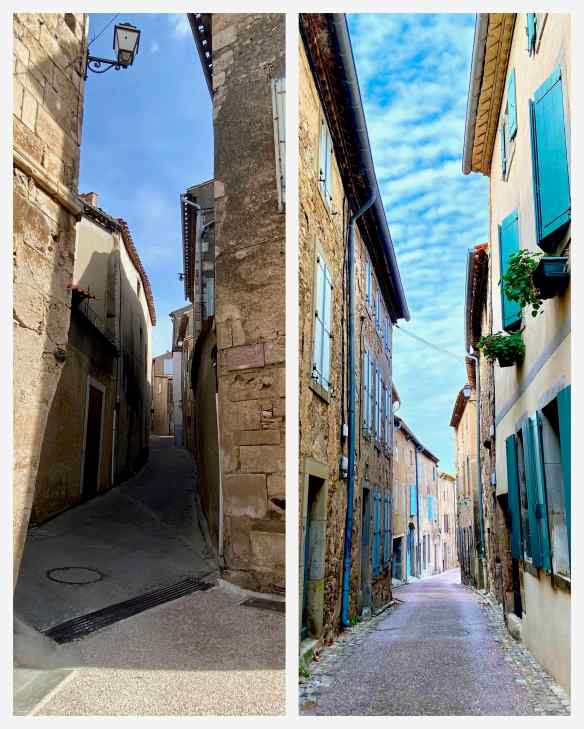
We had stopped at the tourist information and the walking map we picked up led us past this magnificent marble horse head. Of course I needed my photo with this one.
One interesting thing we saw was a couple being shown a very old, run down looking house by a real estate person (the man walking towards the doorway). Seems like they were seriously thinking of purchasing…it didn’t look very appealing to me, but?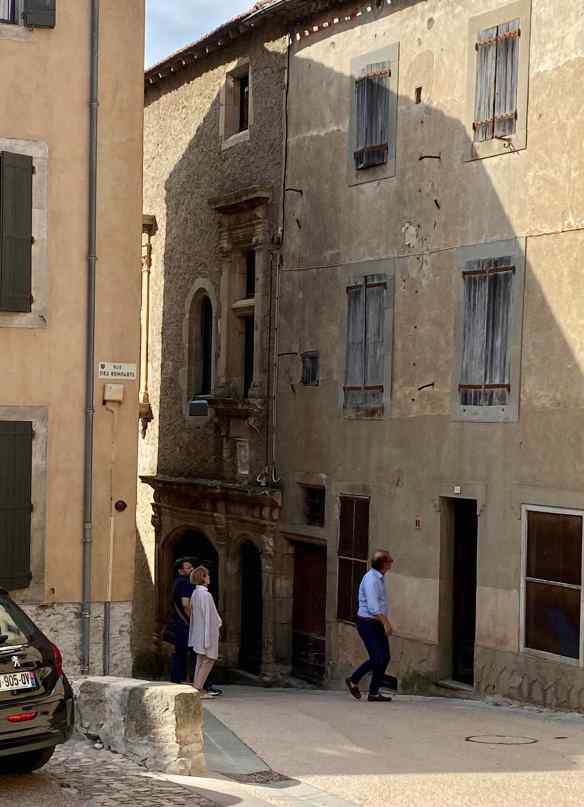
Our walking tour soon leads us back to the square with the ‘Plane’ trees. 
We follow the tourist map to this hilltop view of the valley and the village and do our best to find the trail to the red marble quarry, but have no luck. It certainly isn’t well marked, and the trail just seems to die out. We can see the backside of the quarry which is a huge long pile of stone rubble along the road, but we don’t see any way to go further. 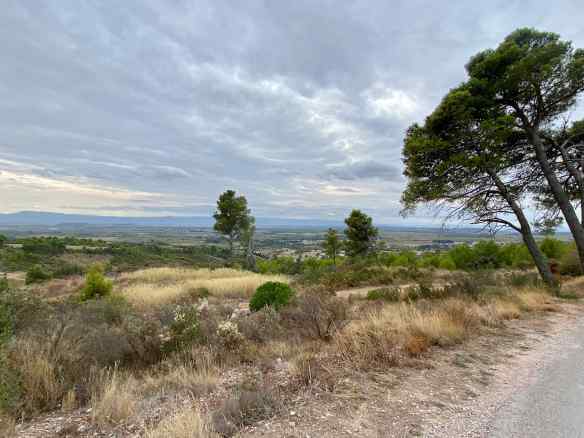
We go back to the car where we have our lunch and then on the way back to town stop at a little “marble garden” to see several more marble sculptures.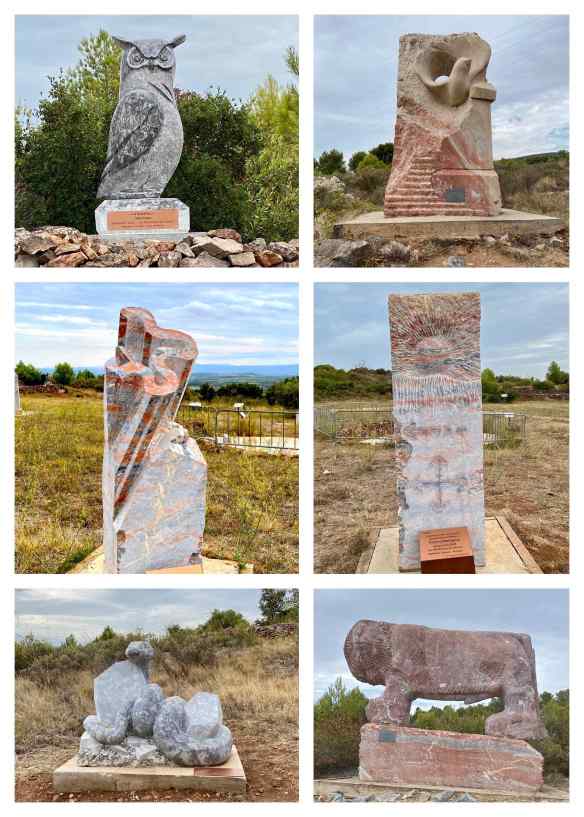
On our drive to the paper mill we pass the ruins of three castles. There is a walking trail but it looks a bit more strenuous than we thought so we decided to keep driving to the paper mill in Brousses.
It is a lovely drive through vineyard after vineyard…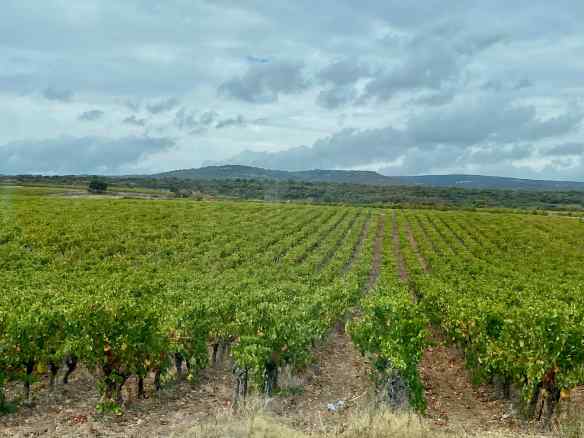
with hills off in the distance. I can’t help but think that owning a vineyard must be an awful lot of work and not nearly as idyllic and romantic as it is often portrayed in movies and novels.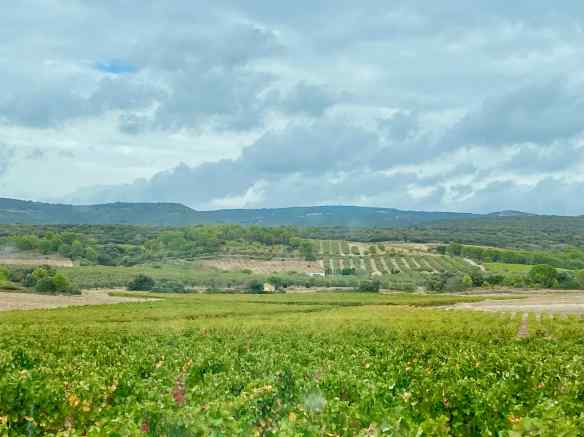
We stop to try to find out what this strange machine might be. There are several buildings at its base, but no sign or explanation. Both wheels are turning slowly…maybe someone knows what this is?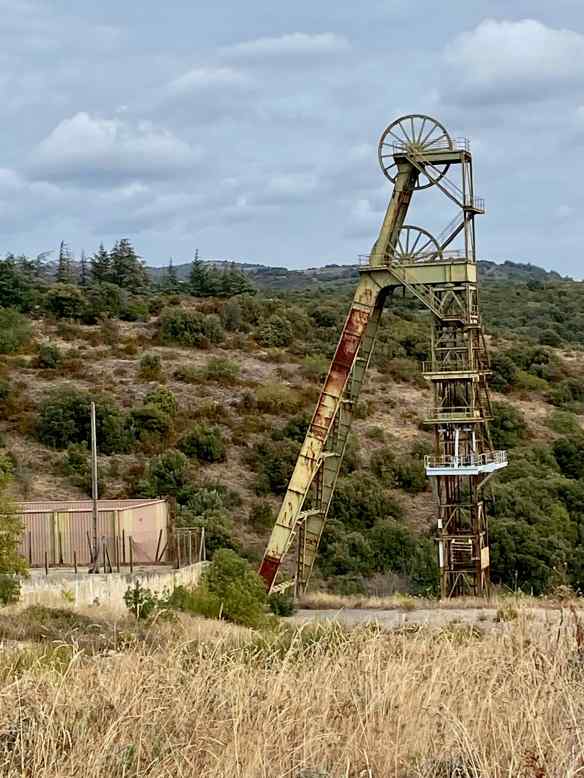
The machine above was located right next to a huge solar panel farm and the ground is littered with these tiny white snail shells, but no sign of any live snails.
It took us a while to find the paper mill. We had the wrong spot pinned on Google maps but we eventually sorted it out. The Moulin à Papier, or Paper Mill in Broussess wasn’t what I was expecting. It used to produce paper commercially but now the granddaughter runs the mill which has been in the family for seven generations. They now make paper by hand using pretty much the same process that I use back home with our Paper Arts Guild. After a sheet of paper is made it needs to be couched (pronounced “cooched”) or transfered to another surface. Here they have been couched onto synthetic interfacing, then pressed and hung to dry in the rafters. Every year, artist Catherine Cappeau makes a collection of paper dresses, which you can see on display in the paper mill. 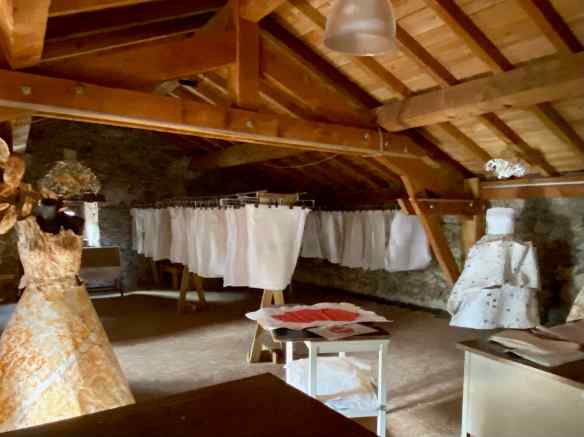
This huge old Hollander is no longer in use today It is probably five times a large as the one we use in our guild. This machine is used to beat the fibres to make the paper pulp.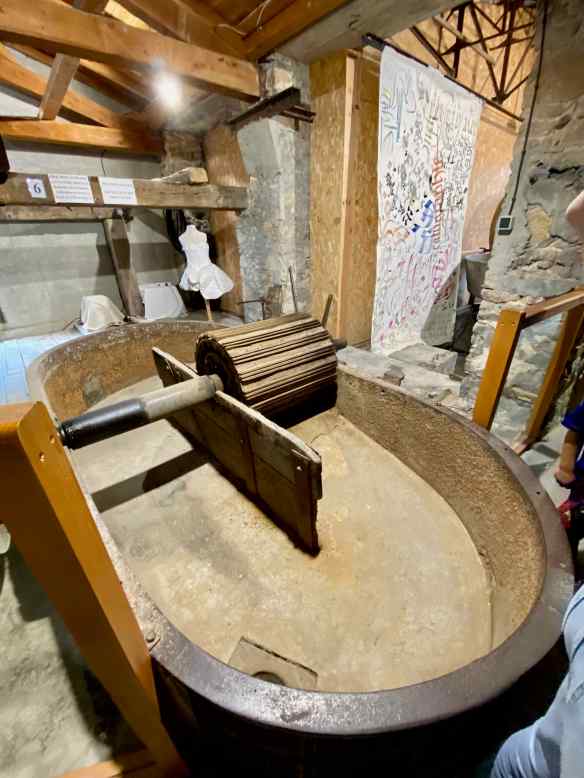
The Hollander in use today can be seen behind the hanging sheets. This is the area of the mill that is used for paper making. There are only two papermakers who work here today. They use a lot of recycled cotton cloth, mostly blue jeans and bed sheets. The only coloured paper they make comes from the colour of the cotton cloth that is used to make the pulp. The material is cut into small pieces and then processed in the Hollander. Interestingly, they also use horse and elephant dug to make paper as well.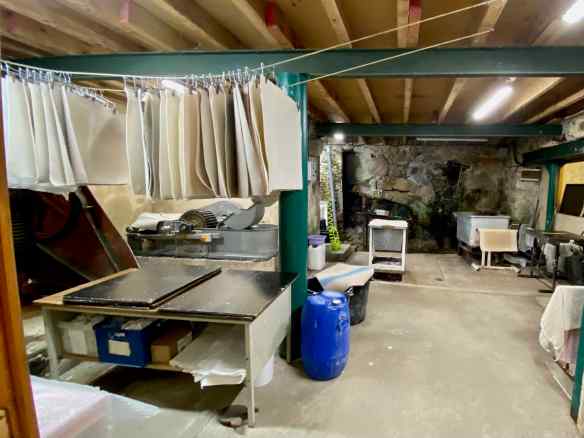
Now this is a press!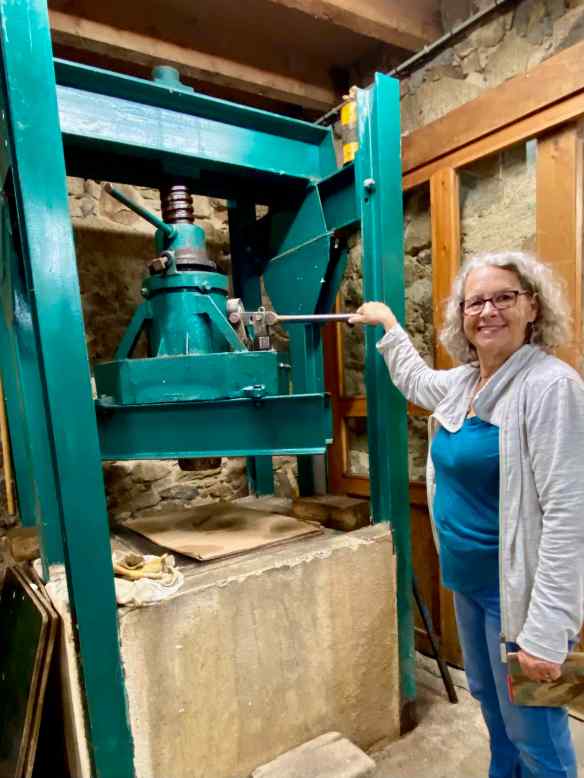
There is little store here, where paper, handmade books, cards and other paper related items are sold. I think that most of the mill’s income likely comes from the tours they offer several times a day, every day except Christmas and New Years! They are set up for school tours as well. It was interesting, and there was a lot of equipment that was in use 100 years ago when this mill was in full operation. However I didn’t really learn anything new, other than our Guild members back home makes really good quality handmade paper and we don’t charge nearly enough when we offer items for sale!
Today it is the last paper mill in operation in this area. There were six paper mills here in 1845. This millstone grinder, with its 3 tonne stones used to grind 300 kms of recycled paper fibres a day in 1954!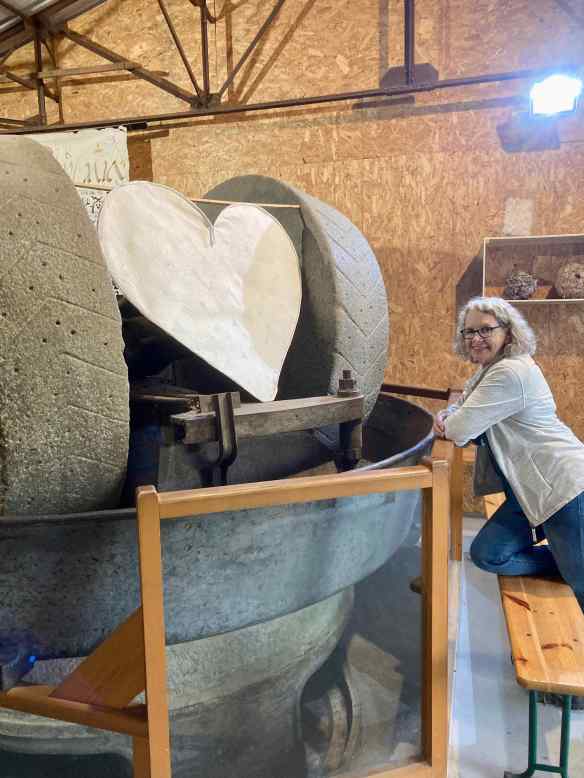
There is a bridge over the Dure River and a little picnic area.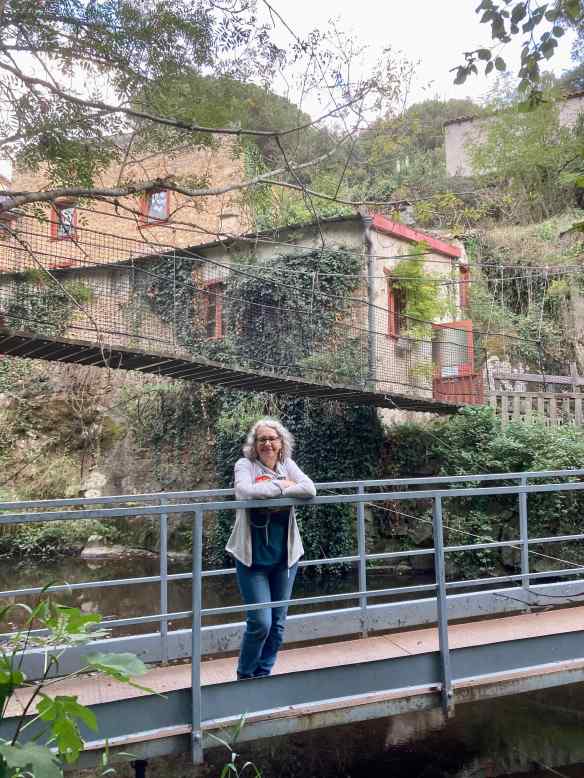
It is really pretty location.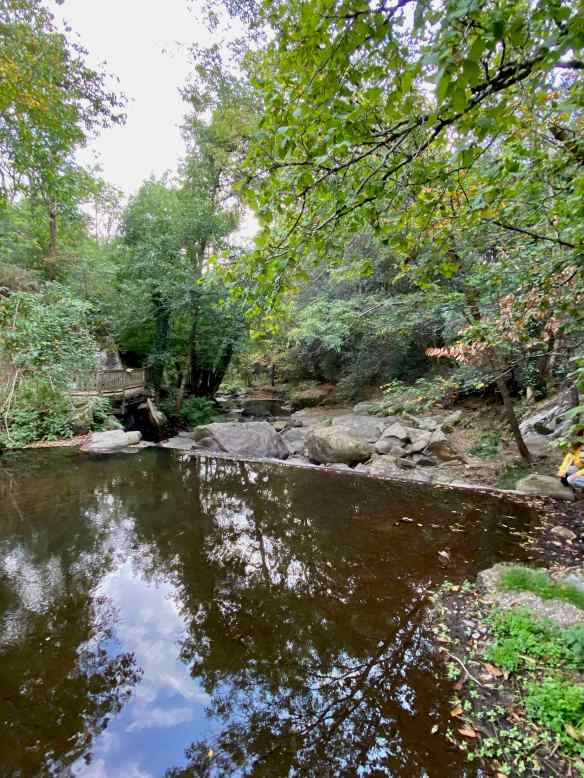
There are some interesting clouds with shafts of sunlight on the drive home.
 trudymason.com