Carcassonne, France

Day 43, Tuesday, October 10, 2023.

The first day after a travel day is often a stay at home day for me and I certainly needed that today. I have been dealing with a headache since we arrived in France and today it got a whole lot worse so I am happy to stay put.  Bob went our this afternoon to check out Carcassonne and find a grocery store.  Here is his first view of the medieval Cité, which we will be visiting while we are here..

Carcassonne, France                                                                                                   Day 44,  Wednesday October 11, 2023

I made an Osteopath appointment for this morning.  It is only a ten-minute drive but even navigating for that long is not easy the way I am feeling.  I feel most comfortable with a female osteopath and have had good luck with treatments that I have had on holidays in the past.  My osteopath today is very gentle, she says everything in my head and neck was ‘blocked’ and that I should start to feel better in a few hours.  We head home and I take it easy the rest of the day.

Sarlat to Carcassonne, France

Day 42, Monday, October 9, 2023

We have a long drive to Carcassone today so we are up early.  Bob moves the car closer to our apartment so we don’t have to carry everything for three blocks, and no one is even up and about yet.  We have our breakfast and evening meals at home so we have accumulated quite a few groceries, along with our other luggage.

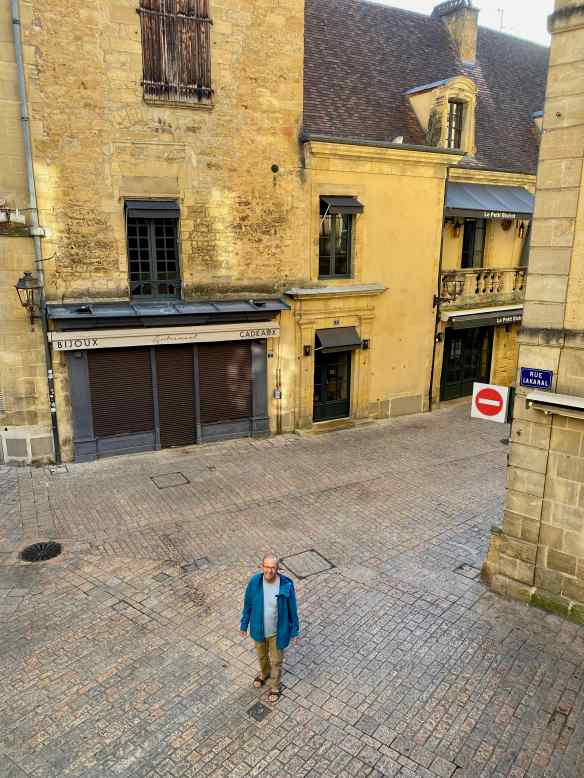
You can just make out the butcher’s stand on the street right beside the entrance to our apartment in the lower left corner of this photo.  He is the first merchant to open his doors, usually by 8:00 am and he is open until 8:00 pm, or even longer if there are still people on the street…and he works every day of the week!  When I told him that he works too hard he said only until today, then he gets two weeks holiday.

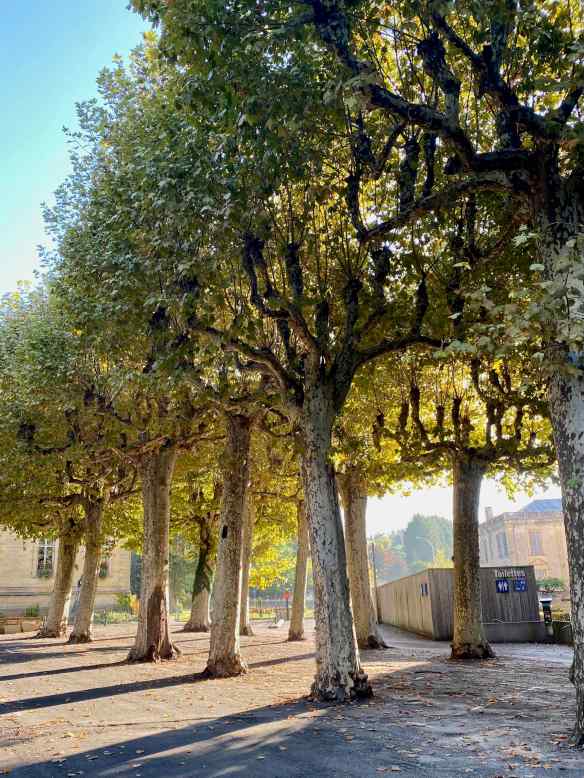
This is the paid parking lot near our apartment but it gives us an hour free time.  More than enough to load our car and get on the road.  I do love the Sycamore trees that we see everywhere in France.  They are magnificent, so huge, and they have the most interesting bark that looks like camouflage.  I have no idea how they survive in the middle of a paved parking lot… they can’t get much water.

It is a 3.5 hour drive to Carcassonne and we had planned to detour to Albi to visit the Musée Toulouse-Lautrec.  Lautrec was born in Albi and this museum has artwork that can only be seen here. However we didn’t even think about museums being closed on Mondays when we planned our bnb stays, so the museum is closed.  I am quite disappointed as I was really looking forward to seeing this artwork and especially the large  collection of Lautrec drawings that are in this museum.  Of course other museums we were interested in Toulouse were also closed so we decide to just drive and get to Carcassonne a bit earlier in the day.

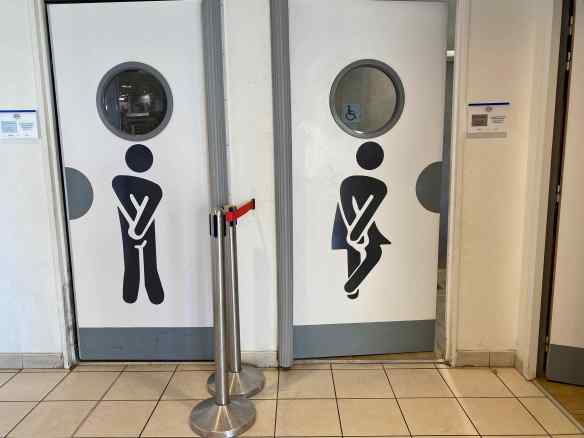
We have seen some interesting bathroom signs on our travels, this one made me chuckle.

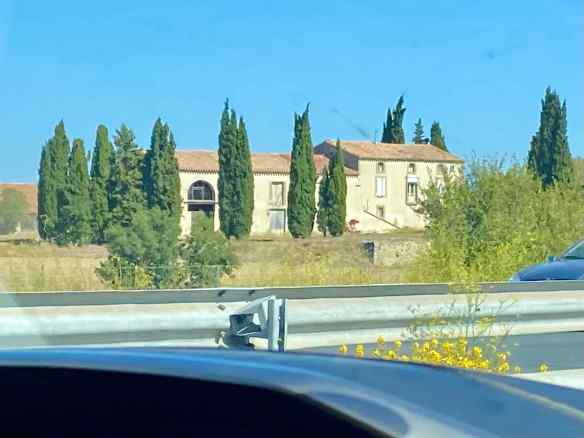
As we drive south we start to see the odd cypress trees, which makes me think of Vincent Van Gogh and all the cypress trees he painted.

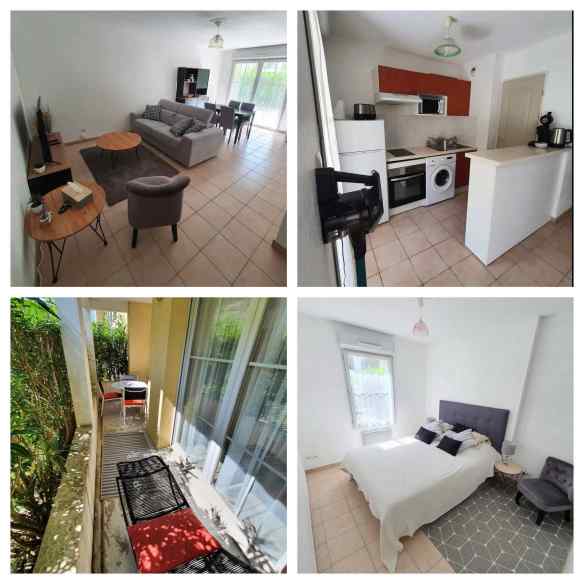
It is always an adventure, walking into a new Airbnb and checking it out…is it going to be what we were expecting?  So far we have chosen well and not been disappointed.


Canoeing on the Dordogne River, France

Day 41, Sunday, October 8, 2023

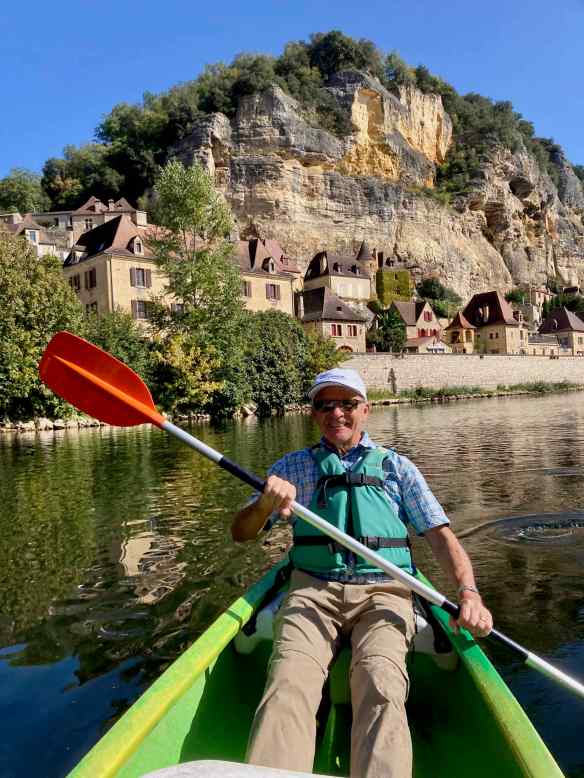
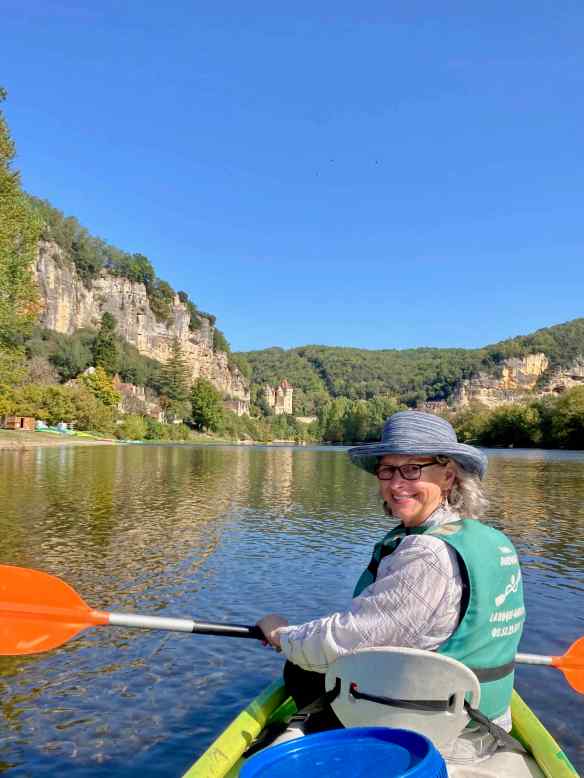
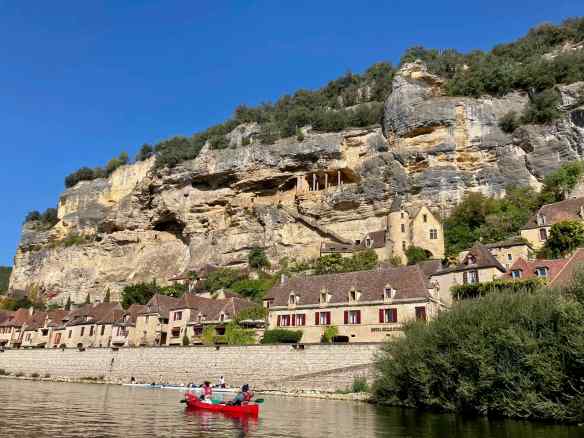
it is our last day in Sarlat and we are going for a canoe ride on the Dordogne River.  It took bit of doing though.  The first company we drove to was closed for the season but they didn’t bother to put that on their website.  We see a sign on the road for another company, and it says that they are open.  We go there and yes, they are open, just not at this location.  We give up and decide to drive La Roque-Gageac and walk around the town. I notice another canoe company near the river and before we know it we are in a canoe on the Dordogne River.

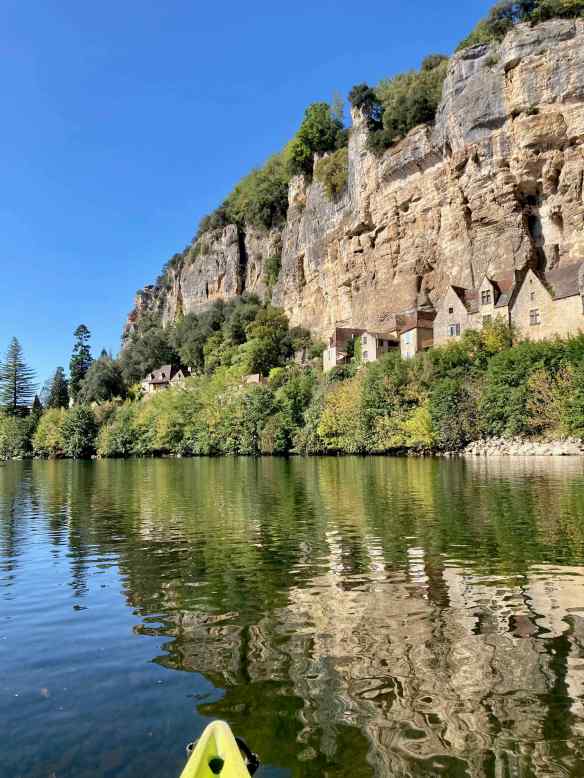
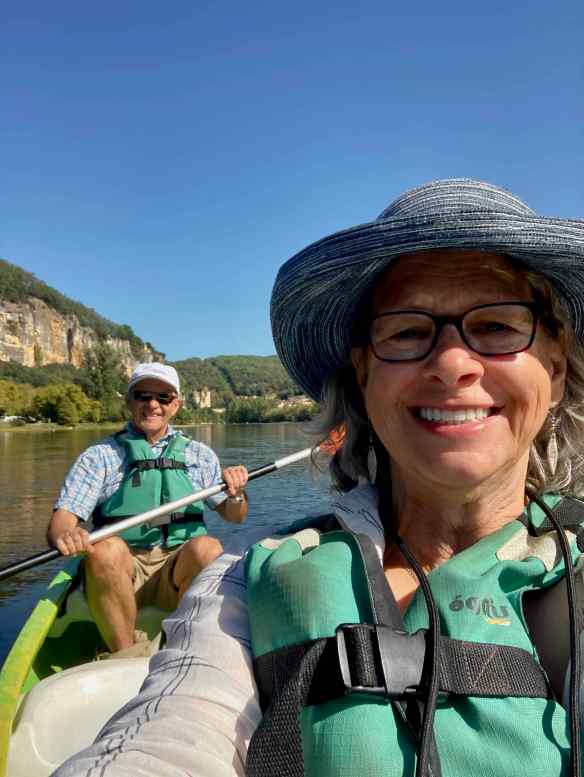
It is a beautiful day, +28 C, and there isn’t a cloud in the sky.  We pass houses built into the cliffs at Cénac-et-Saint-Julien.

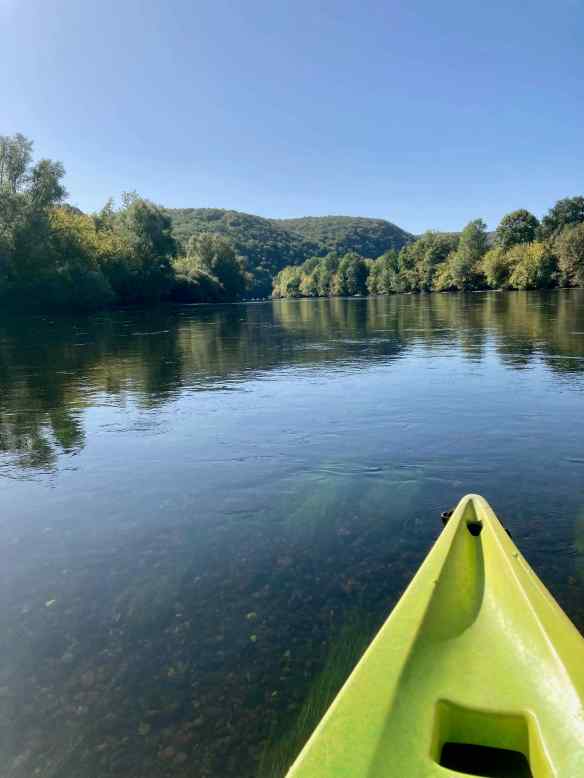
The river is calm with just enough current to make paddling easy.

It is so peaceful and…

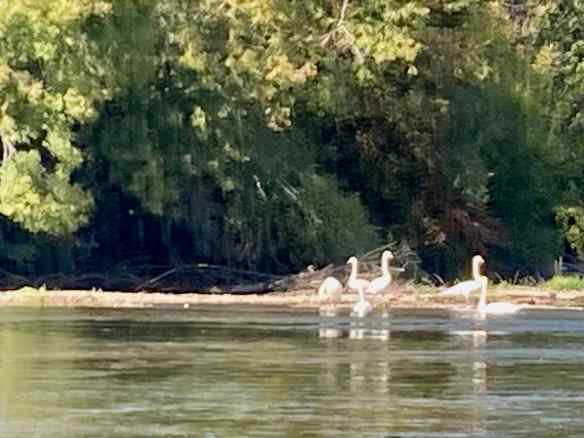
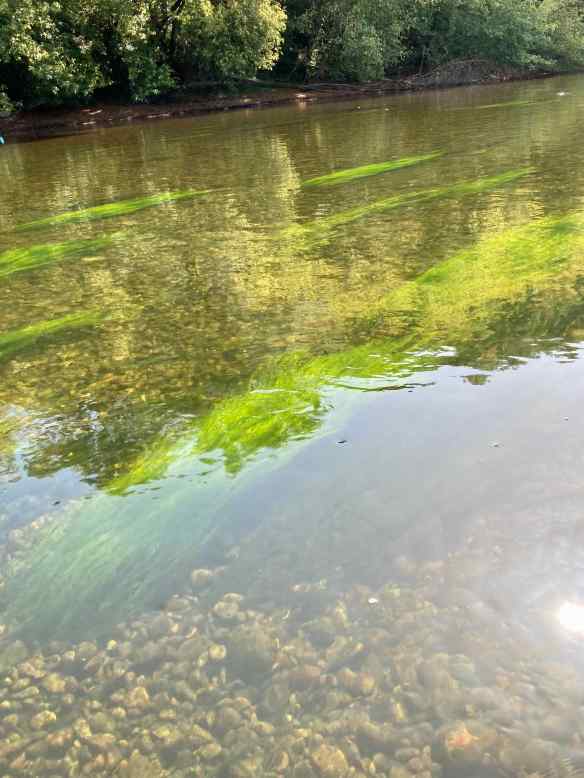
we see swans in several places along the river.There is the prettiest green seaweed and I see fish, Lots of fish, little ones and then some really big fish with whiskers…catfish? They particularly like hiding in the seaweed.  I keep showing them to Bob but he doesn’t see them.  I think he thought I was making up all these fish I was seeing until he took off his polarized sunglasses and then he can see the fish too.  He even gets to see one of the really big ones.  

We are having such a great time!

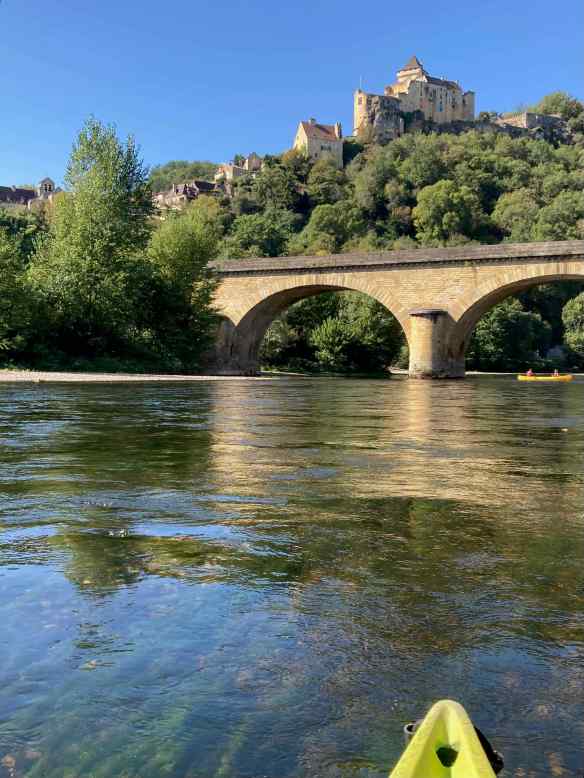
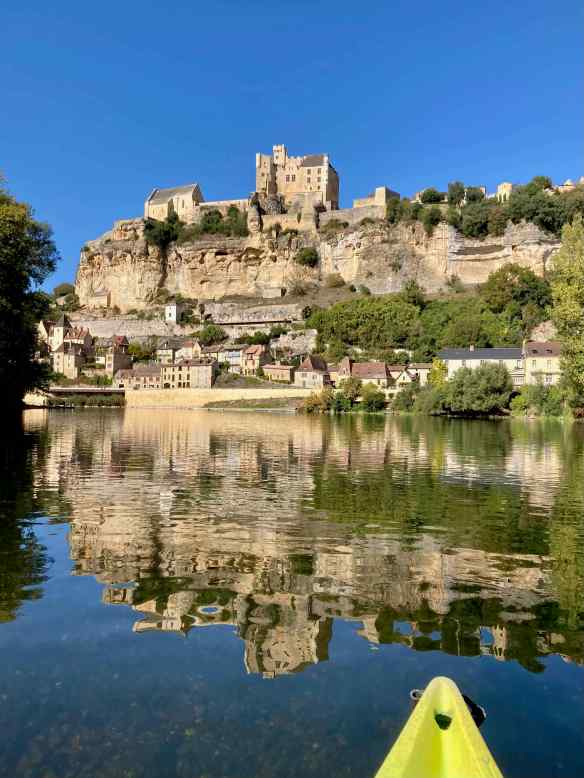
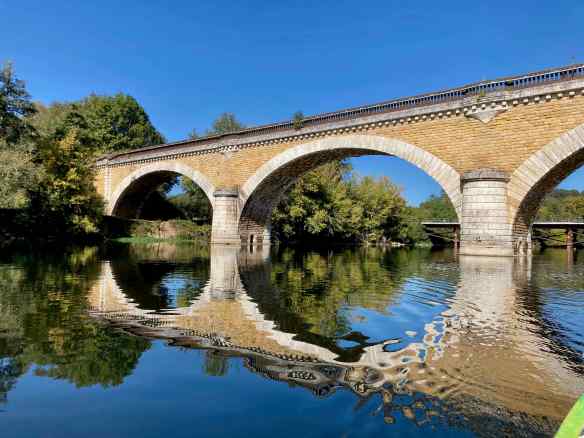
We pass three bridges and three villages with castles on our two and a half hour trip. This is the bridge at Vézac.

When we stop for our picnic lunch just before Vézac, these three sweet kids come down to the river bank to play.  I give them a plastic container to use as they are trying to build a dam on the side of the shore.  The little girl in the blue dress comes over and speaks very quickly to me and when I tell her I didn’t understand as I only speak a bit of French, her big brother comes over and very slowly and clearly tells me that it was very kind of me to give them the container and she was saying thank you.  When we  got back onto the river they waved to us and called out au revoir!

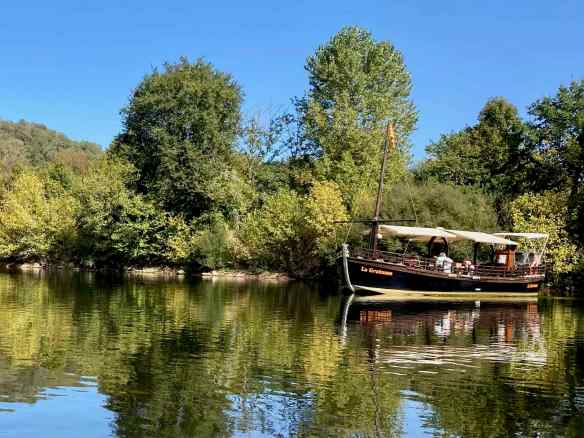
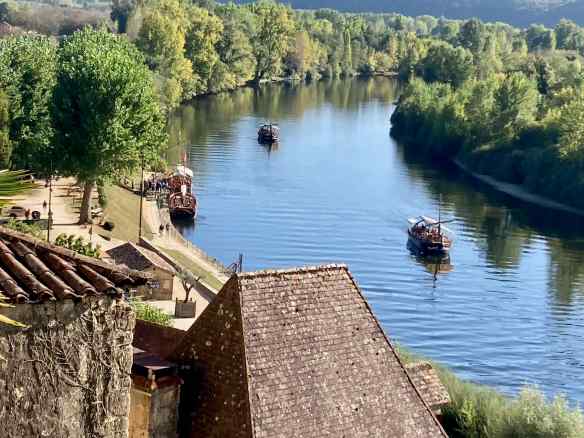
We pass ‘pirate’ tourist boats…

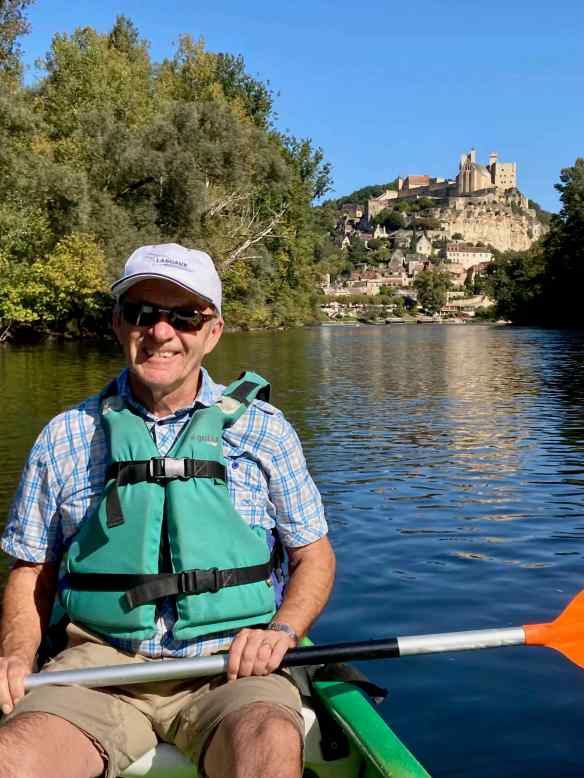
Beynac-et-Cazenac is another town built into the rock hillside…

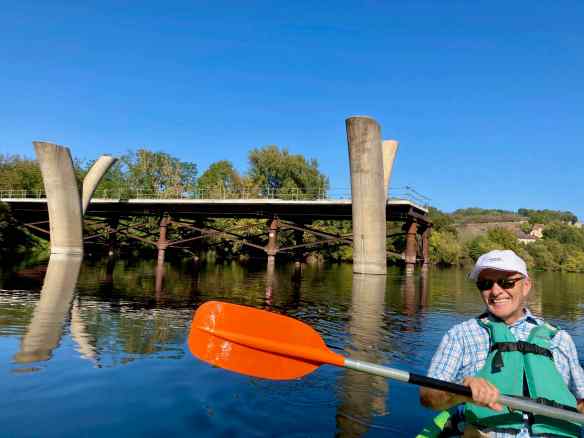
and now we have passed Castelnaud-la-Chapelle.  We are nearing the end of our trip. But first we pass two of these strange half built bridges.  It doesn’t look like they plan on completing either of them although the bridge with a road bed is on both sides of the river and just has one section missing.  We wonder why.

Here is the last of the three bridges that we pass on our trip.  Our pickup point is a kilometre past this bridge.  We pull in and a short time later two vans come to pickup us and the canoes. We spent the time waiting for our pick up visiting with some people from Australia and Switzerland. We are so glad we were finally able to find a canoe rental company that was open for business.  Although I must say that both the employees we dealt with were rather rude and certainly not very pleasant.  This is the first time we have encountered anyone on this trip who wasn’t pleasant and helpful.  It didn’t matter though, we had a wonderful afternoon on the river.

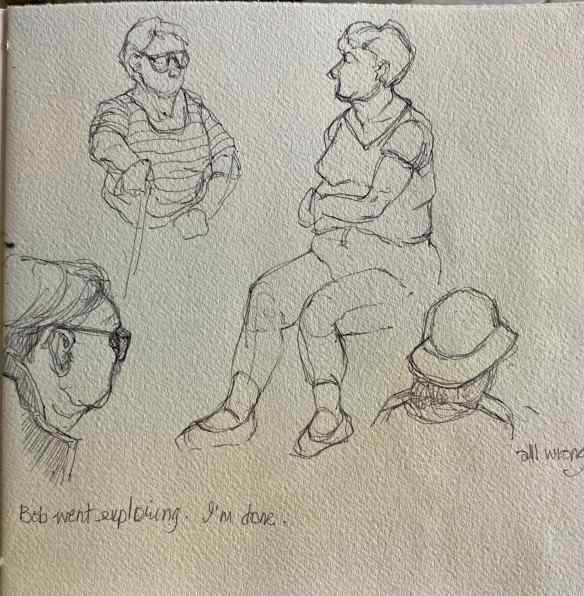
When we arrived back in La Roque-Gageac Bob wants to explore the town but I am tired and sit in the shade at a little park while he goes exploring.  I draw a few of the people sitting around me while I am waiting.

I think it was a good thing I didn’t go with him as there was a lot of uphill walking.

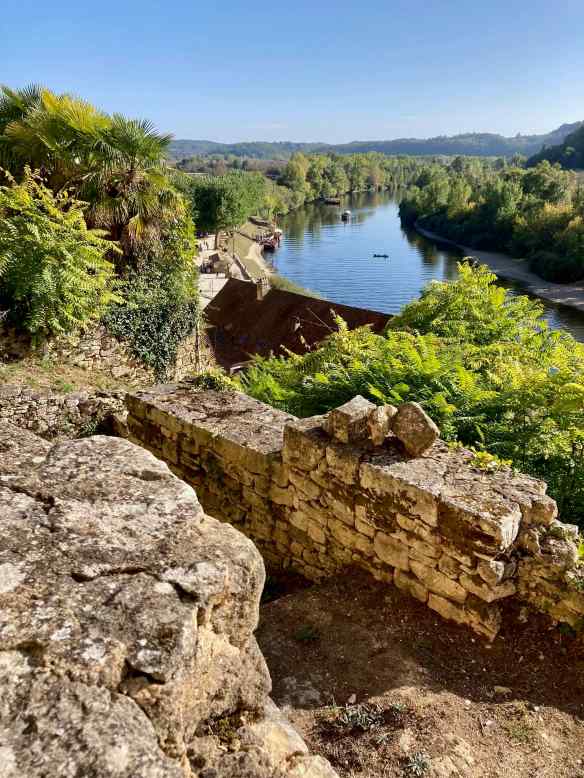
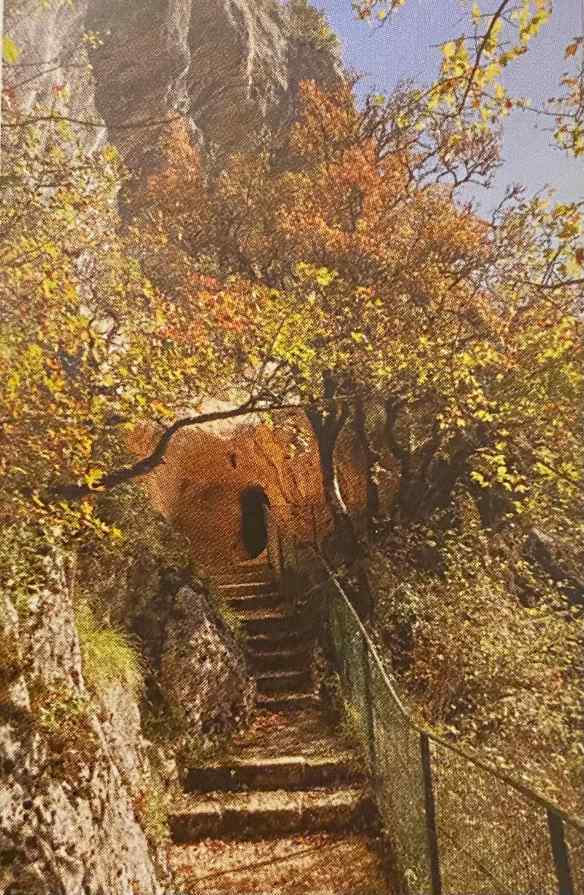
Bob climbed up towards the troglodyte (cave dwelling) fort set in the cliffs 40 metres above La Roque-Gageac.  It is the remains of the 12th century fort that is still standing. The strong defensive position of La Roque-Gageac and this fortress meant that it held an important strategic and defensive position in the area.  Seems that there was an awful lot of fighting and defending one’s home way back then.Another view from the streets on Bob’s walk, and of the ‘pirate’ tourist ships.

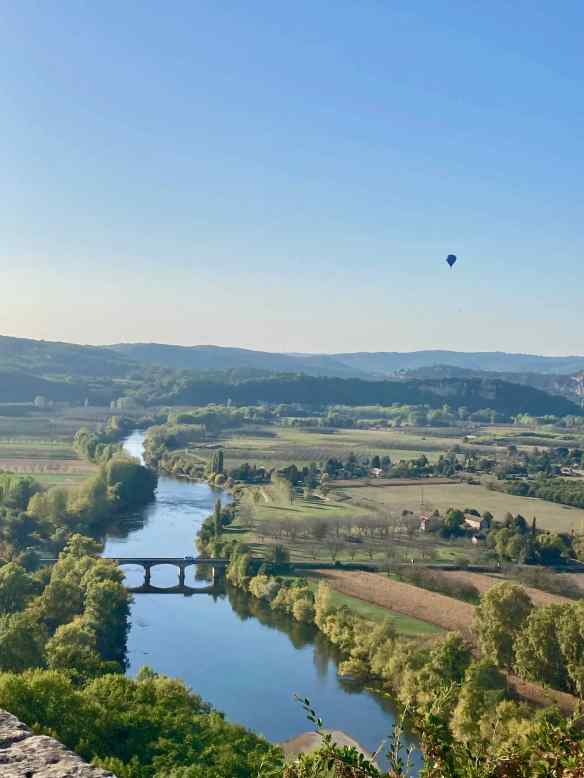
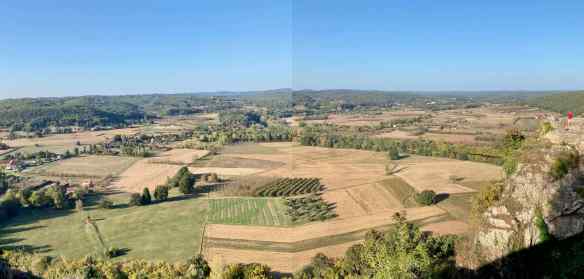
On the way home we detour to visit Domme, another of France’s prettiest towns.  We hit detours and it took a bit to finally find it, but the view from this town was amazing.  We watched several hot air balloons flying high above the valley.  On was very very high, much higher than I we thought hot air balloons usually flew.  It was probably twice as high as this one! We bought some refreshing sorbet and just enjoyed the view before heading home to Sarlat to pack.  Tomorrow we are on our way to Carcassonne.

Market day in Sarlat-le-Canéda, France

Day 40, Saturday, October 7, 2023

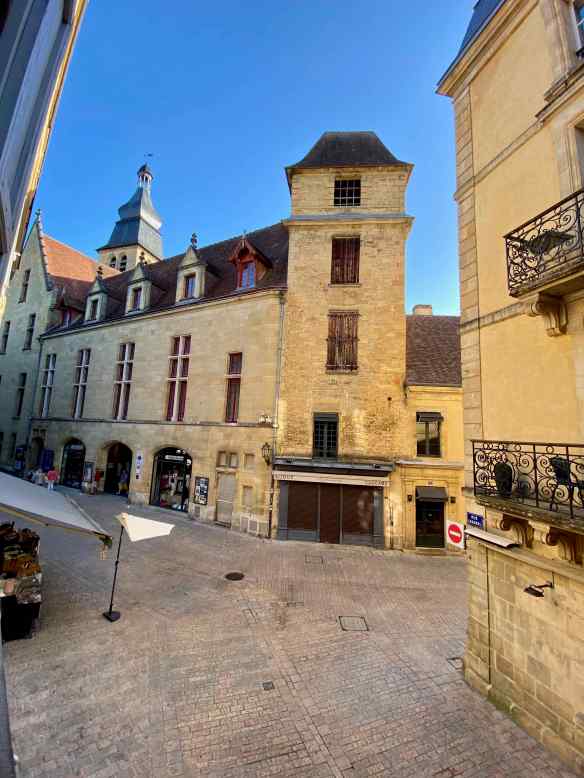
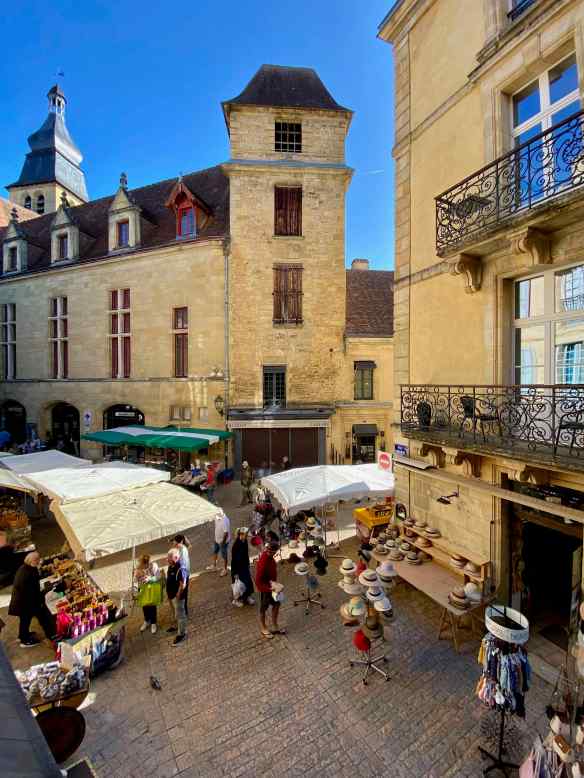
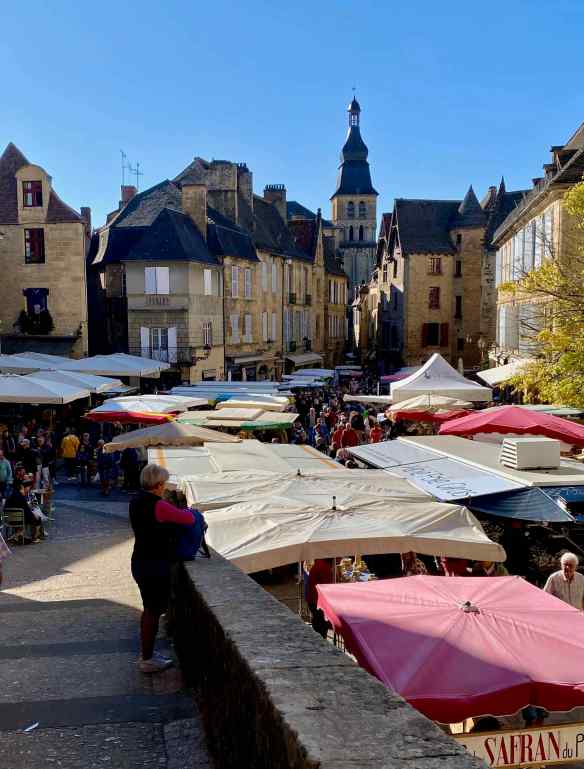
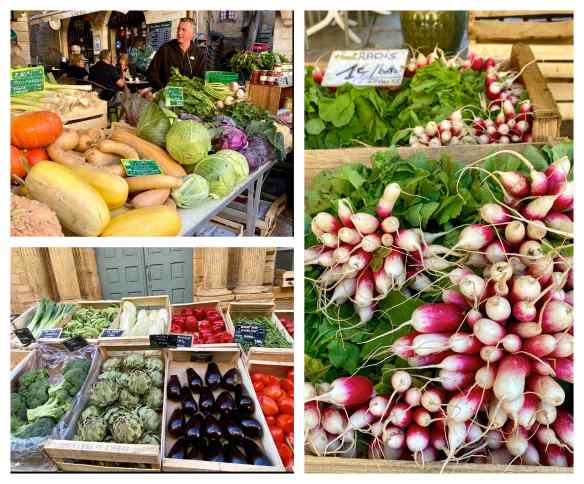
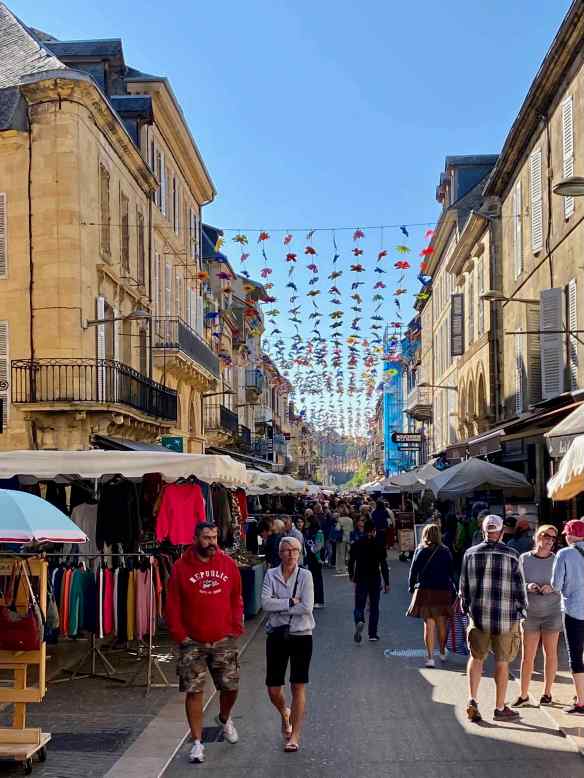
Saturday is market day.  We woke up to the sounds of vendors setting up their tents and tables.  This is the view from our window. After breakfast we go check out the market.  The streets are crammed with vendors…

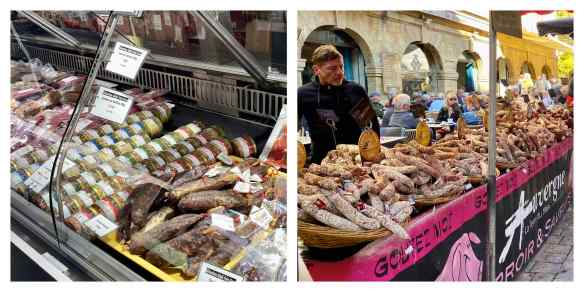
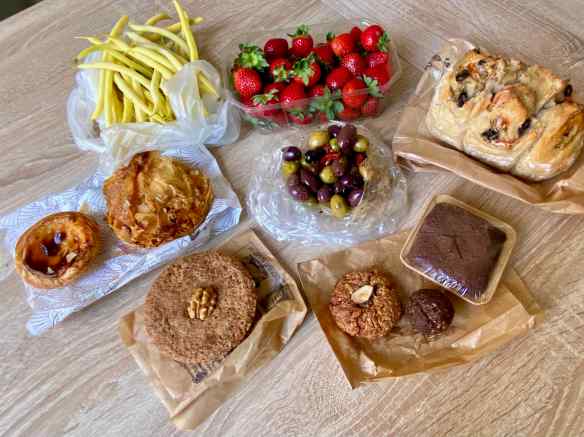
There are fresh fruits and vegetables.  These little radishes are so yummy, and very reasonable, just 1euro for a big bunch. However there are many more vendors selling a variety of meats and foie gras.  I’m afraid we weren’t tempted by these stalls.

These are duck and goose livers, and other items that I do not even recognize.  The chickens and I think perhaps grouse all still have their heads!

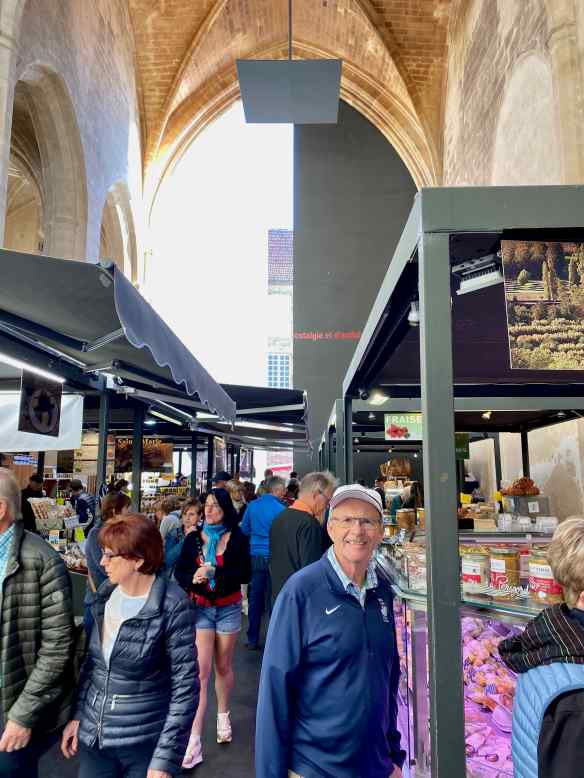
This is the old church that is now an indoor market.  You can see the big doors open behind Bob.

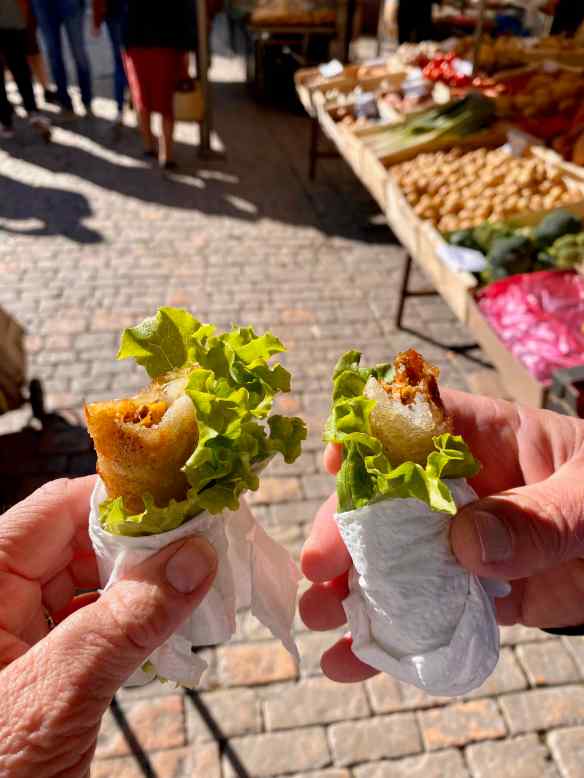
We try out some street food…

and after a stroll down another street…

We head back to our apartment for lunch, perhaps not the healthiest, but it sure was good.  We saved the beans for our dinner.

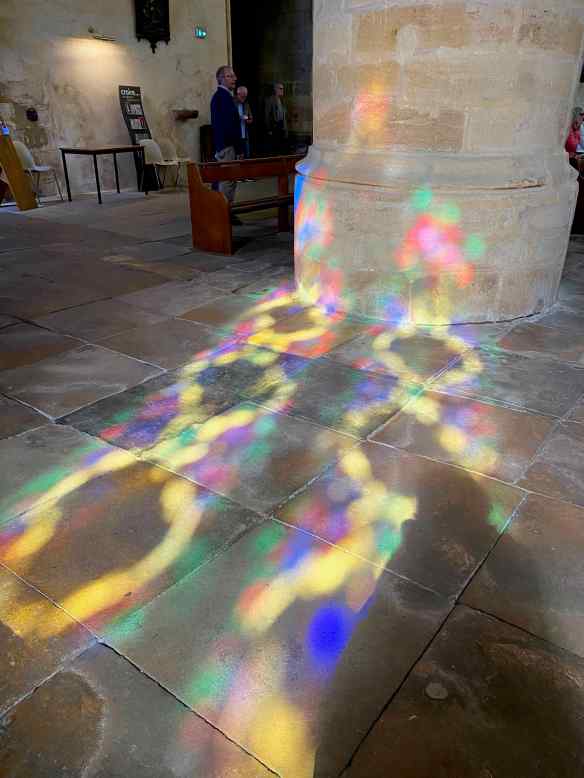
We wander through the Cathedral Saint-Sacerdos, and I find these beautiful reflections from the stained glass window. We visit the Hotel de Maleville which has an artist’s studio on the top floor attic.

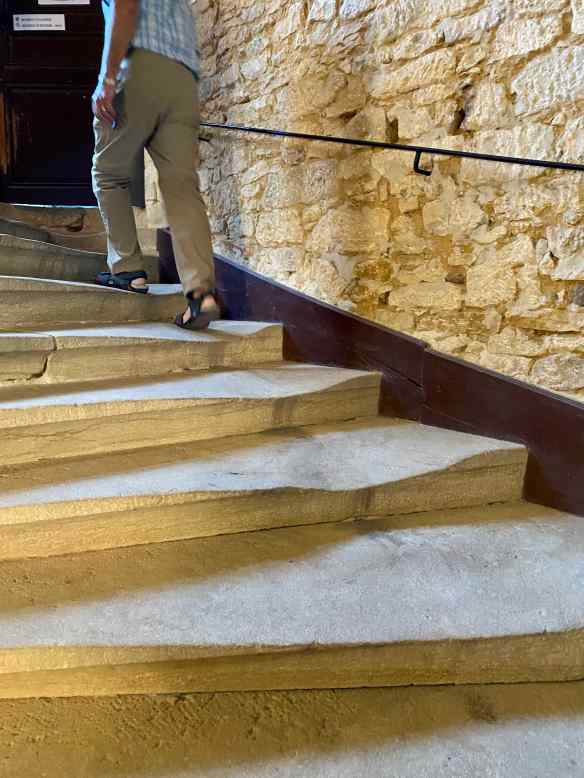
The stairs up to the attic have seen a lot of use.

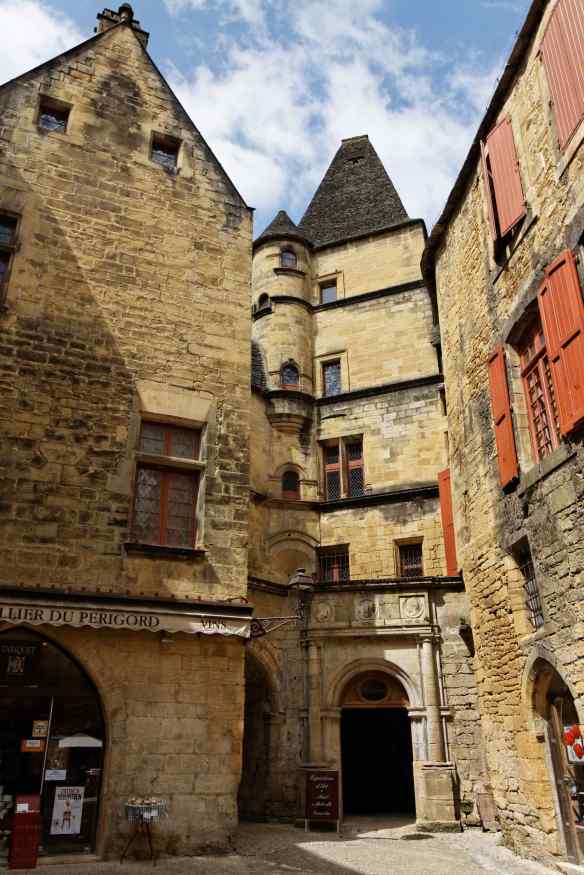
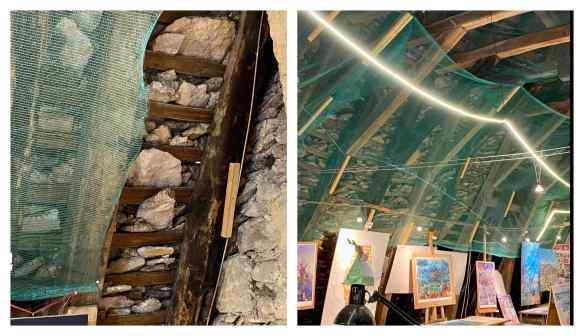
The attic roof is ‘shingled’ with fieldstone’s.  These ‘Thackstone’ roofs are very steep.  This shape distributes the weight throughout the walls.  Once a thackstone roof is installed, it does tend to stay in place! Here is a peek at the underside of one of these roofs.

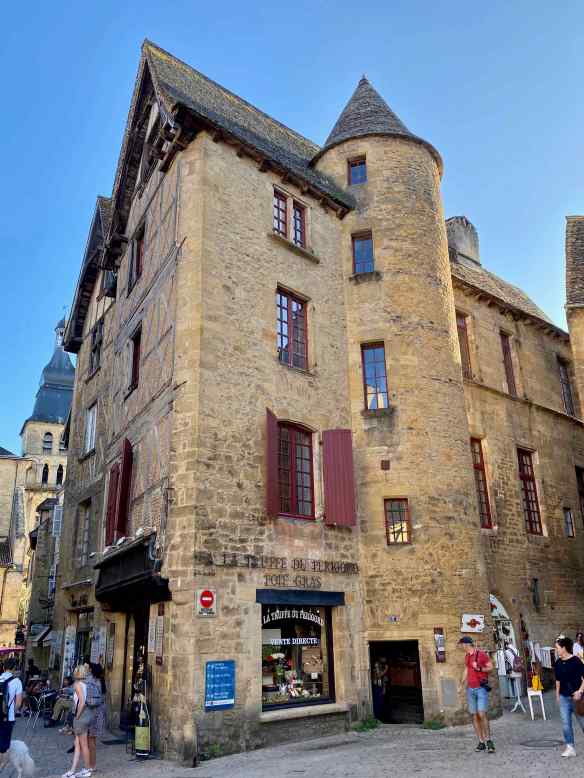
Here is what these roofs looks like from the outside.  The Gisson Manor is composed of two different buildings linked by a hexagonal stair tower. This manor’s origins are in the 13th century.

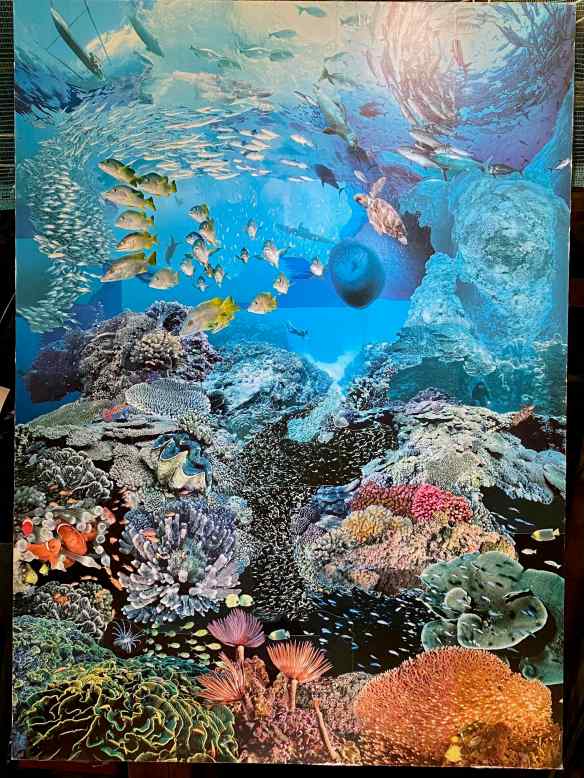
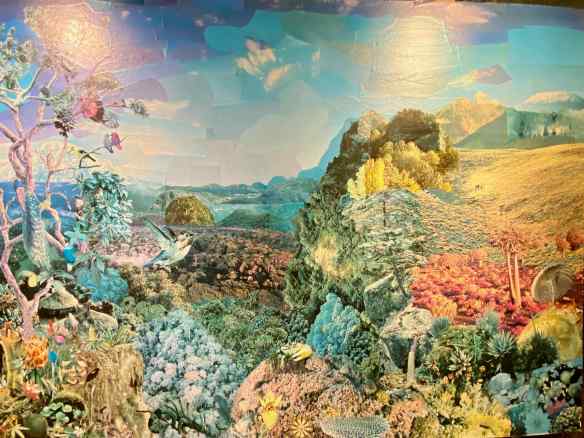
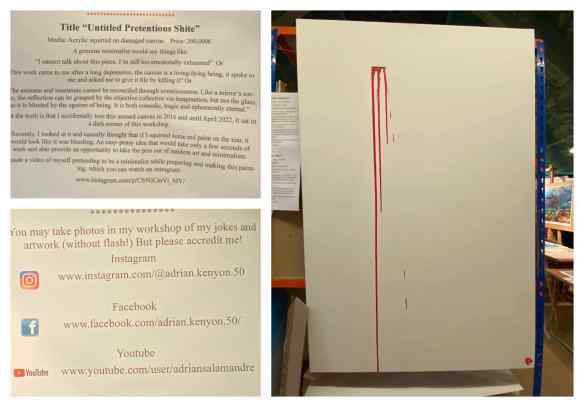
The artist, Adrien Kenyon, https://www.adriankenyon.com/ who works in this unique studio makes collages, and has an interesting sense of humour.  The collages are unique, and large.

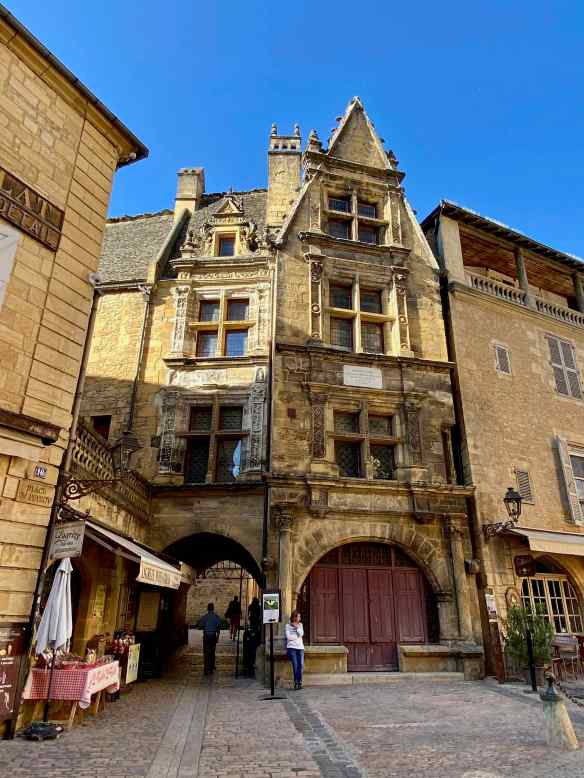
He doesn’t mind people taking photos and just asks to be given credit for his work.   Here is another beautiful old building, the house of Etienne de La Boétie.  He was born in Sarlat on November 1,1530 and died on August 18, 1563.  He was a French magistrate, classicist, writer, poet and political theorist who died when he was only 32.

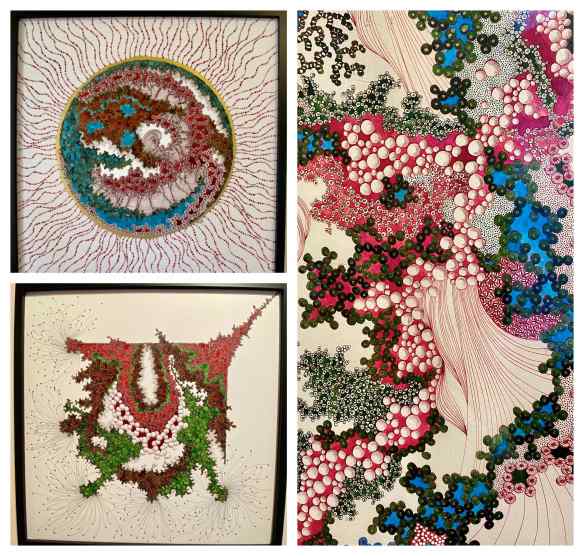
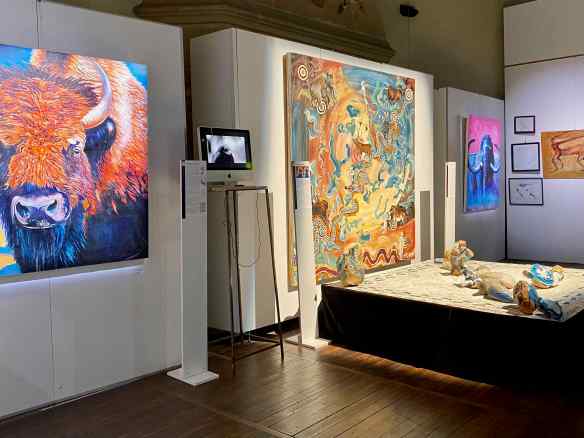
We find another building with artist’s studios and there are two rooms full of works similar to these.  I lost the artist’s card so don’t know her name, but I wonder about being able to draw all those tiny circles.  Some of the artwork is a 90 x 60 cm or larger.  

Another studio has a variety of work, some interesting, some not so much.

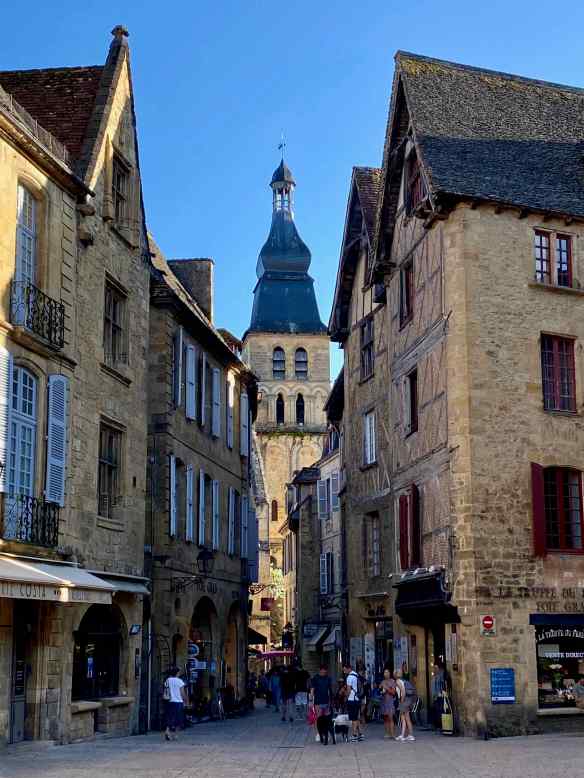
Time to go home, but first here is one more of Sarlat’s medieval streets.

La Grotte de Font de Gaume, and La Grotte de Rouffignac, France

Day 39, Friday, October 6, 2023

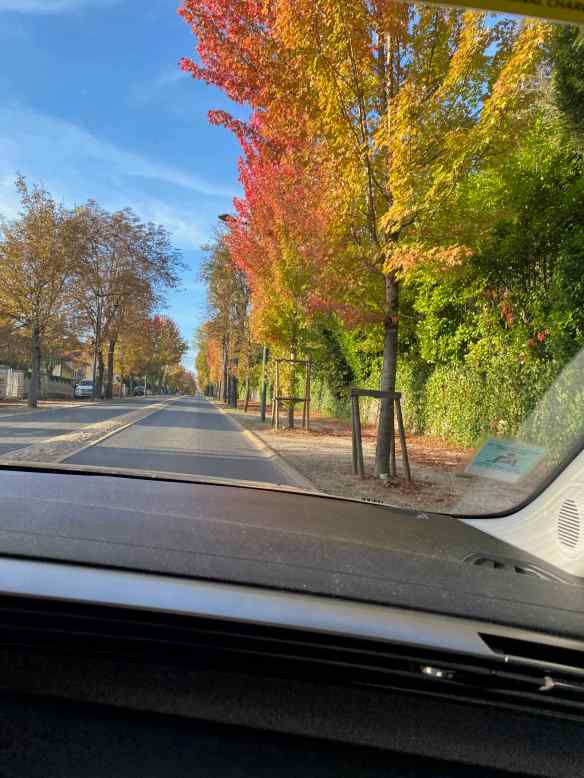
This morning we are on our way to Le Grotte de Font de Gaume.  Autumn is arriving here. These trees are the most colourful we have seen so far.

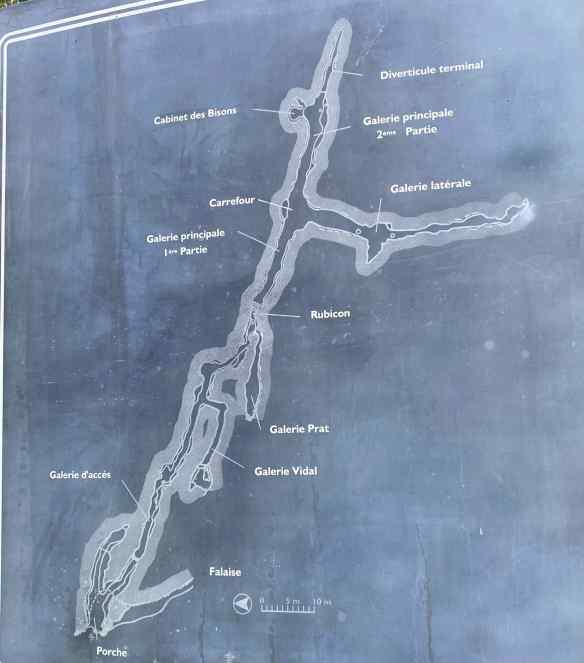
Fonte de Gaume is the only prehistoric site  with polychrome cave paintings that is still open to the public in France.  It became a UNESCO World Heritage site in 1979.  I forgot to take photo on the way up to the cave…I think I was excited about the upcoming tour.  This photo is from one of the tourist information brochures. There are more than 200 painted and engraved figures in Fonte de Gaume organized into compositions in the four main sections of this 120 meter long cave.  We visited all but the narrowest section in the Diverticule teminal and the short cave on the right of the entrance.

These drawings outside the cave give a hint of what we will be seeing inside.

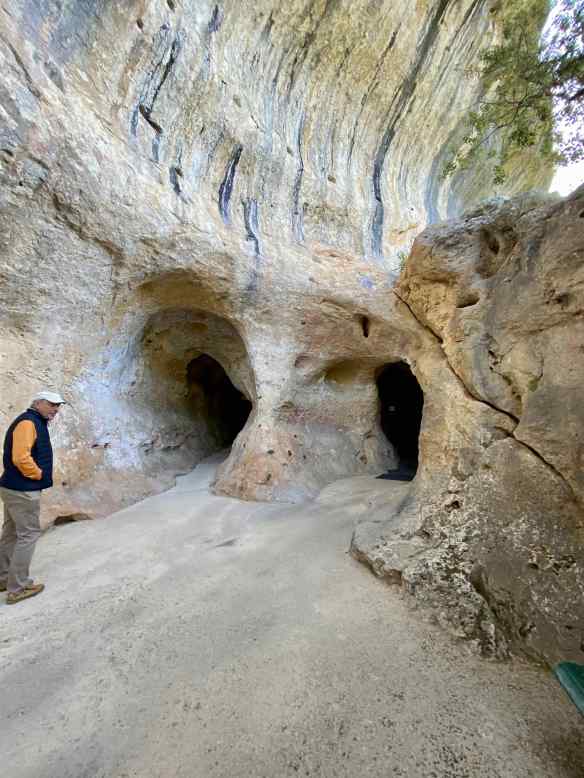
The entrance to the cave is the cave on the right, we do not go into the other one.  Our guide was wonderful, he conducted the tour in English with a lovely French accent and he was very passionate and knowledgeable about prehistoric art and this cave in particular.

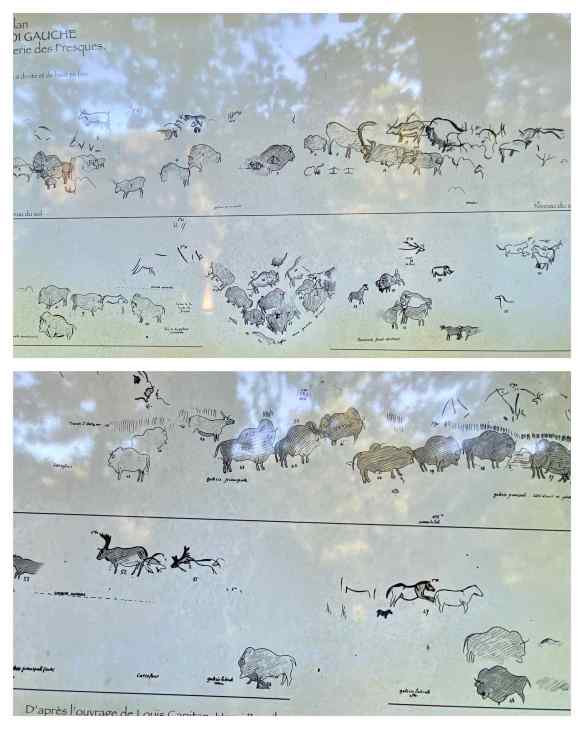
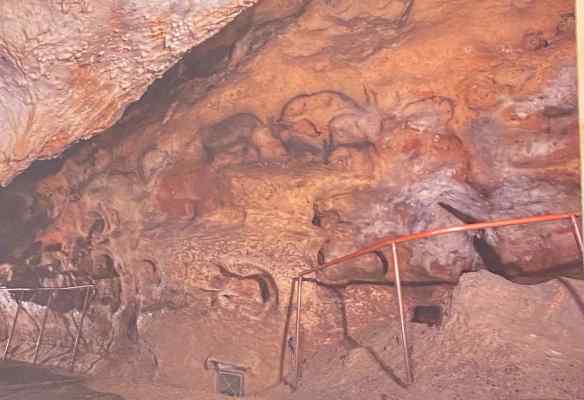
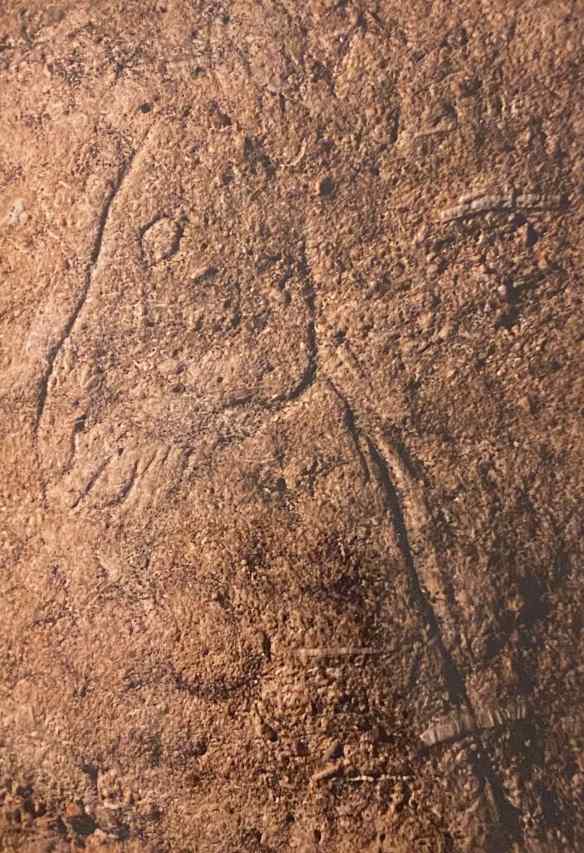
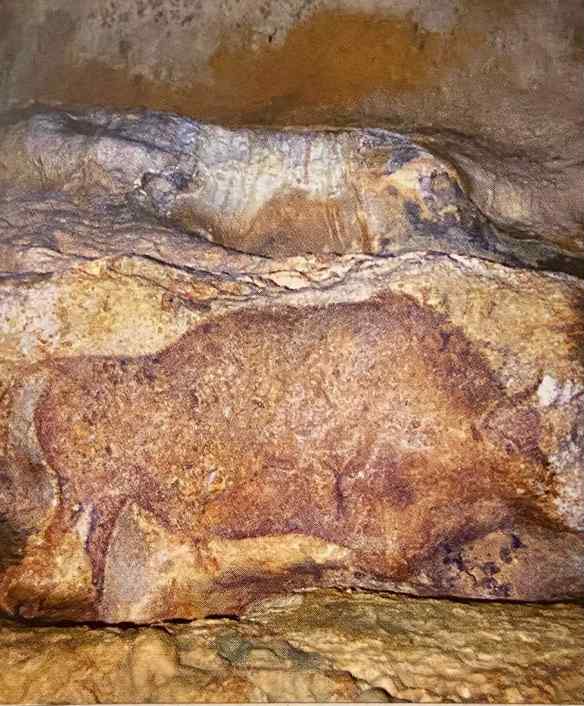
The paintings date from around 17,000 BC, during the Magdalenian period.  Many of the cave’s paintings have been discovered in recent decades. The cave’s most famous painting, a frieze of five bison, was discovered accidentally in 1966 while scientists were cleaning the cave!  No photos in the caves…so these pictures are from postcards and brochures.  Believe me, they in no way convey the beauty and grandeur of what we saw.

A very realistic engraving of a horse’s head.

There are many bison in the cave.  Our guide points our details and gives information about the paintings and engravings.  We are able to stand so close to these amazing paintings.  I am often standing in the same spot that the prehistoric artist who made this artwork stood.  Can you imagine?  It still gives me goosebumps just thinking about it.

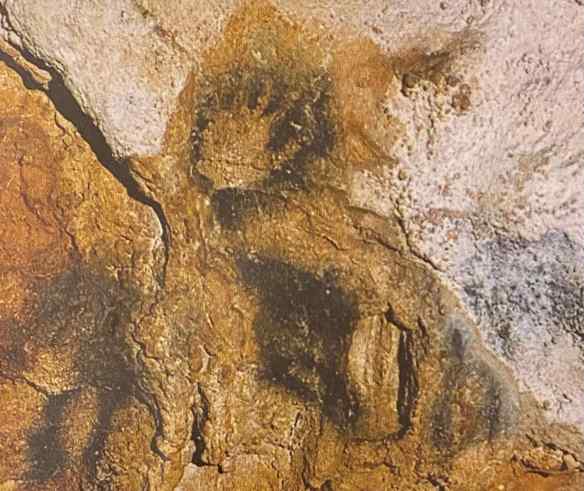
Our guide saved the best for last.  He had each of us squat down so we could look up into a small hollow in the wall of the cave…and there was the left handprint of the artist.   A man or woman had signed their work, before there was even the concept of a signature…and there it was, just inches away. It was an incredible, emotional moment.  

If you would like to see a video of the inside of the Grotte de la Font de Gaume click on the link below.  If you then copy and paste this link into Google chrome you can translate the video into English.  It  takes a bit to figure out how to navigate and see the different paintings but it gives a good view of the inside of this cave.  It is very narrow in places, and we have to almost turn sideways to get through parts of the cave without touching the walls. http://font-de-gaume.monuments-nationaux.fr/

This second link shows the part of the video where you can get a better look a the paintings.  http://font-de-gaume.monuments-nationaux.fr/fr/entree/carrefour/suite/les-bisons-polychromes/

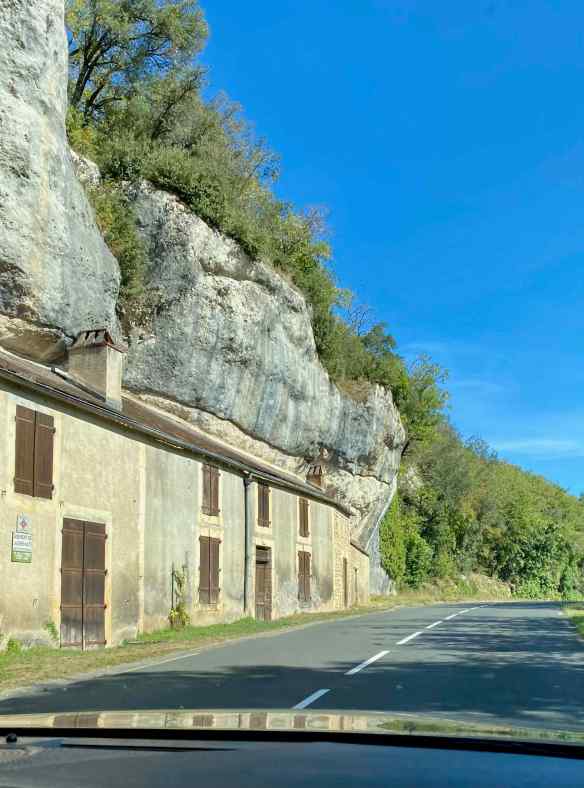
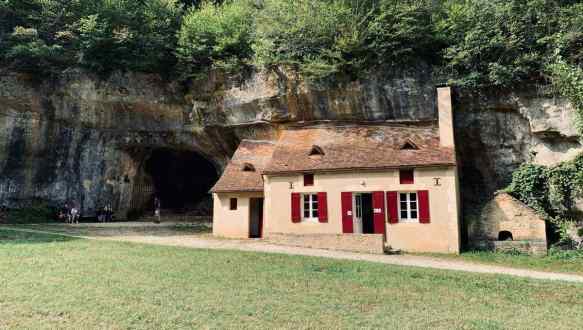
On the way to our last cave, La Grotte de Rouffignac, we pass several buildings that are built right in to the cliffs, and very close to the road.  Some look empty but many are still in use.

The roads also have a lot of overhanging rocks.

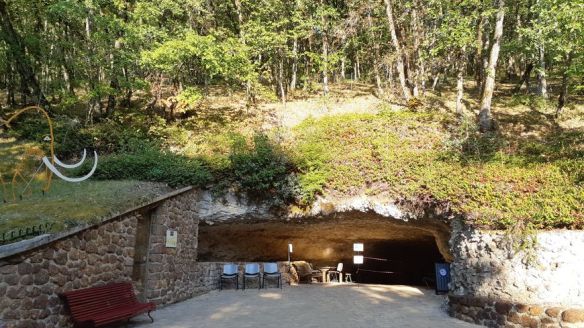
We get to the Rouffignac Cave early.  There are no online tickets, just first come first served. We find a pretty little picnic area beside the cave and have our lunch before walking up to the cave to wait for the 2:00 opening.  I found prescription glasses in a case near where we had our lunch.  Turns out they belong to one of the guides that works with school groups.  She lost them a few days before so she was very happy to get her glasses back.  My good deed for the day!  But somehow I forgot to take photos where I could.  The first photos here are courtesy of Perigord.com.

This is the entrance to the cave where we line up…we are first in line at this UNESCO World Heritage Site.

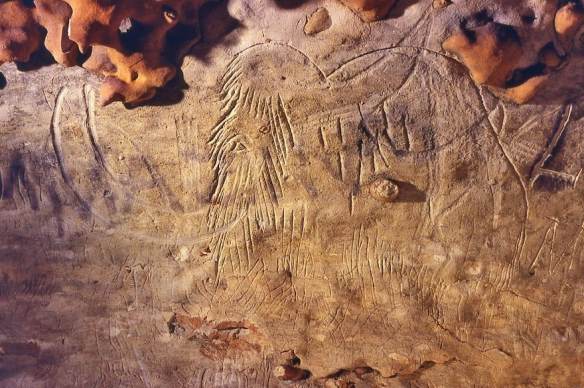
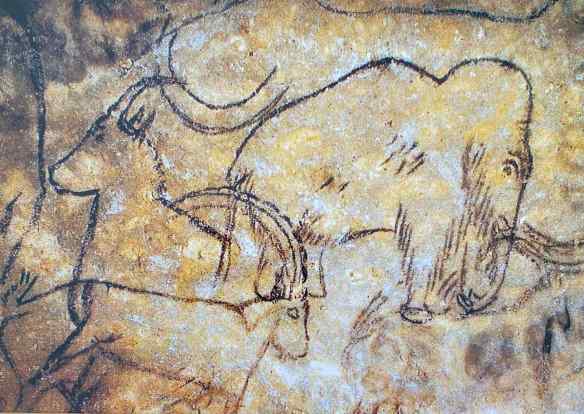
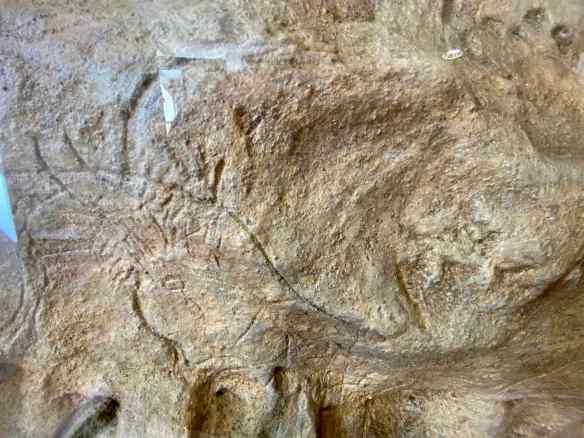
This cave is enormous, with almost 8 kms of caverns and tunnels on three levels.  We ride an electric train as our tour goes a kilometre into the caves.  It is also very cold, it seems colder than the 13 degree temperature of the caves we have already visited.  Perhaps because we are just sitting still? The first artworks we see are engravings…some of them were made by the artist using his fingers to mark the soft stone.  Rouffignac is famous for its Mammoths.  158 mammoths that have been found on the walls of this cave, this is 30% of all mammoth representations in prehistoric cave art.  Yet, curiously, there have been few mammoth bones found in this area. We also see cave bear claw marks all over the walls.  The parallel vertical lines below this mammoth are from a cave bear scratching his claws on the cave walls.

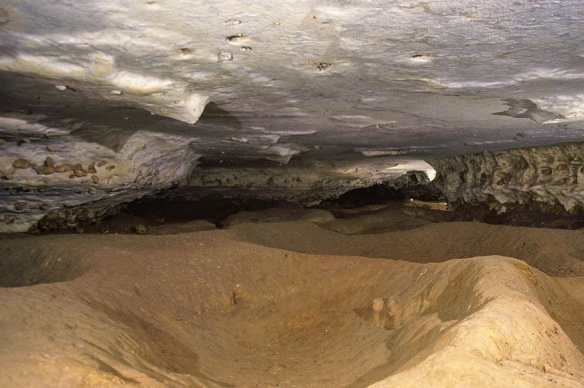
There were a lot of cave bears in this cave.  We pass through numerous hollow round areas.  These beds were made by cave bears to hibernate in the cave during the cold winters.  Cave bears were extinct long before the artwork on these walls was made…good thing!

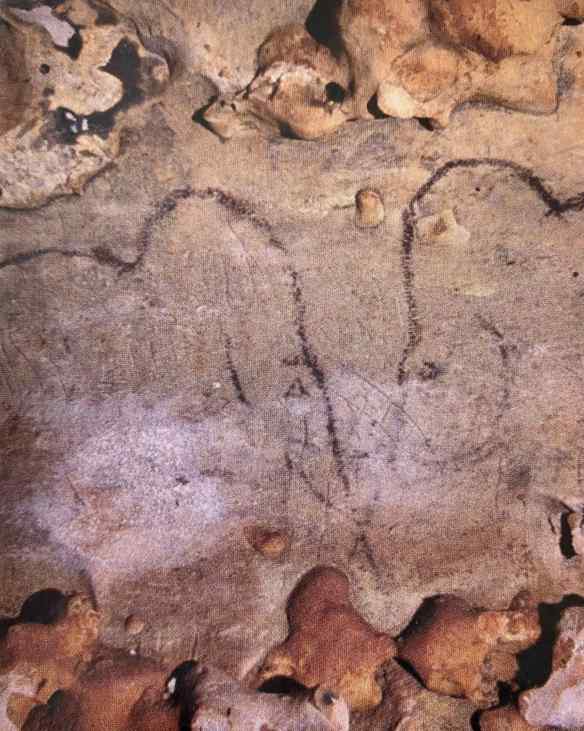
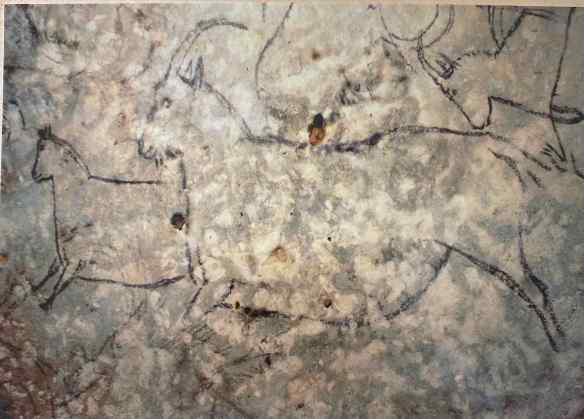
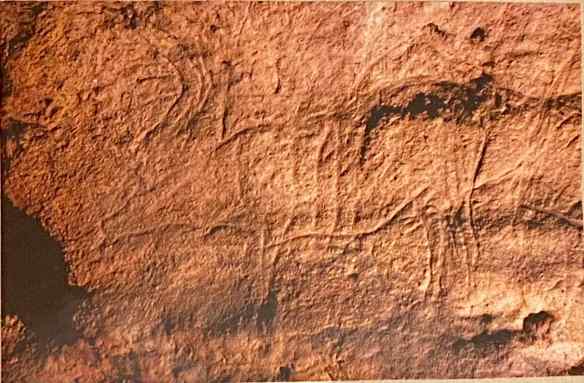
These photos of the cave’s black line drawings are from postcards.

We disembark from the train at the Grand Plafond, or the Large Ceiling (I think it sounds better in French). The ceiling is covered with drawings of mammoths, bison, horses, woolly rhinoceros, and ibex.   The artist had to lie on his back to create this incredible collection of drawings as there was not enough room to stand.  The floor has since been lowered so that visitors can access this area.  I am amazed at how fresh and vivid the drawings are.  I don’t really know how to explain the impact these drawings had.  They were so realistic, they looked as though they could have been drawn recently instead of 15,000 years ago at the end of the last ice age by Magdalenian hunter-gatherers.   I was surprised to see that almost everyone in the group turned towards our guide when he started talking and they stopped looking at the drawings!  Really?  Couldn’t they have listened but keep looking a the artwork above our heads? It seemed such a waste to be standing here and ignoring these ancient drawings.  One very interesting drawing of a mammoth showed its anal flap. Sorry, no photo of that one. Yes, this is a flap that covers the mammoth’s anus to keep it warm.  Only someone who had very close contact with a mammoth would know about this detail.  This fact was used to help authenticate these drawings, as they were thought to be modern fakes when they were first discovered..

This is the last cave we will be visiting here.  We loved all of them!

Gouffre de Padirac and Rocamadour, France

Day 38, Thursday, October 5, 2023

Today we are visiting the Gouffre de Padirac which is about 1 1/4 hours east of Sarlat. This cave was opened to visitors in 1899 and now receives 800,000 visitors a year.  A gouffre is sinkhole or pothole.  Well, this is one heck of a pothole!  
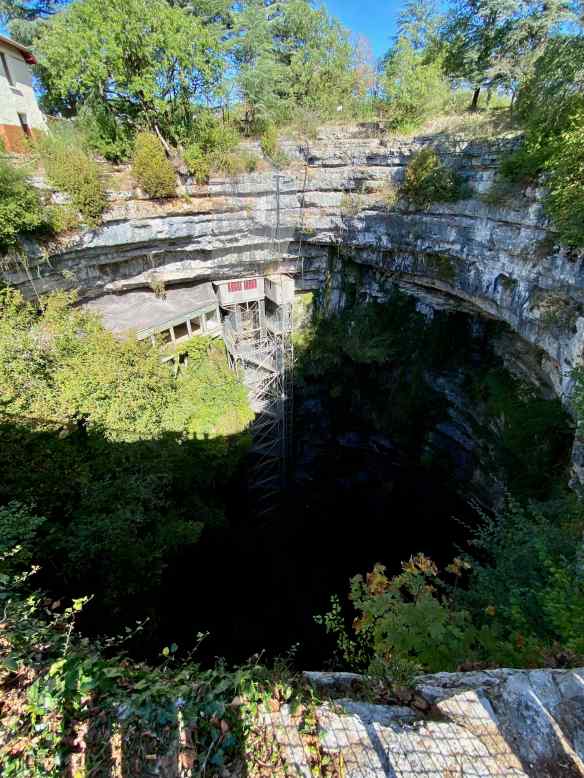
We climb down several flights of stairs cut into the rock and exit this first staircase to start descending the metal exposed stairs on the side of the gouffre.  We are going way down there.
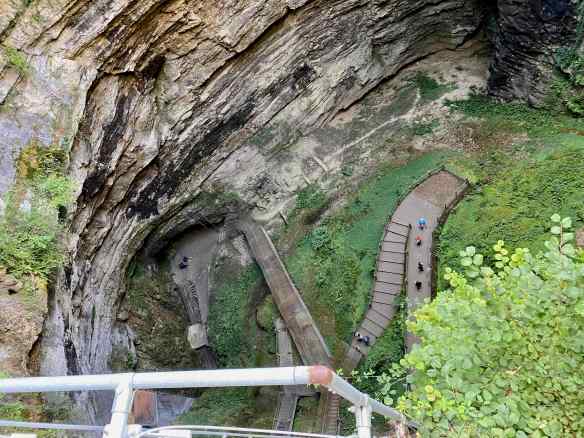
When we reach the bottom…we look up…way up…
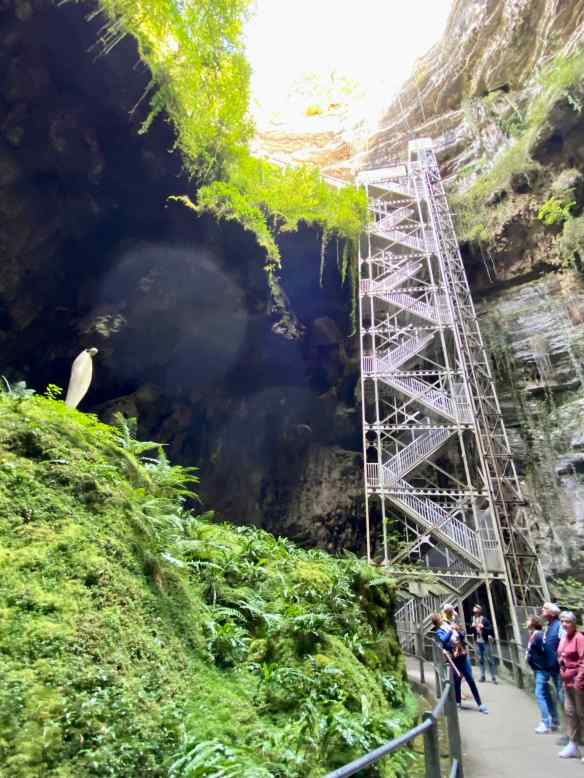
and then down…and surprise…more stairs. Once we are inside the cave there are even more stairs…
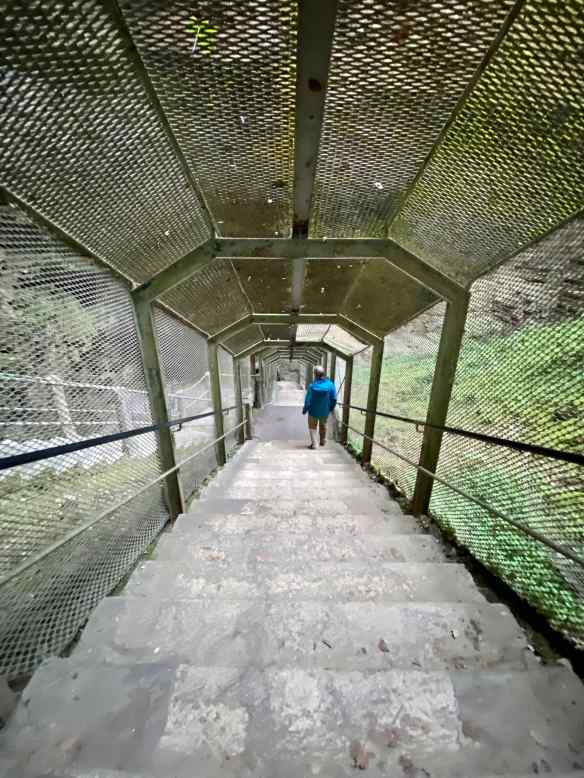
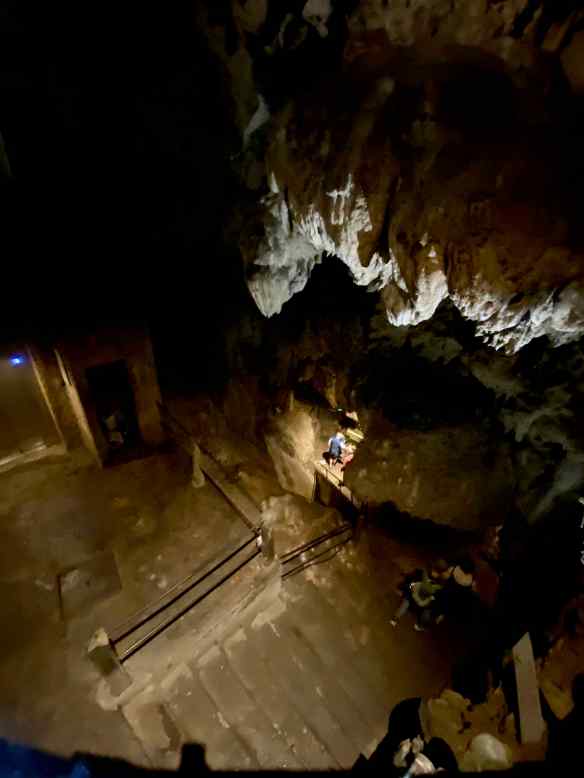
We finally reach the floor level of the cave, after descending 543 stairs!  But wow!  It was so worth it and non flash photos are allowed everywhere except during the boat rides, so I am happy.  Yes…there are lakes and two boat rides 103 meters below the surface!

I took this photo after we disembarked from our boat ride.  The lake that we rode on is called Lac de la Pluie, because it is always raining. We had light rain falling on us on that part of the boat ride.  Can you imagine continuous rain? and at 103 meters underground!
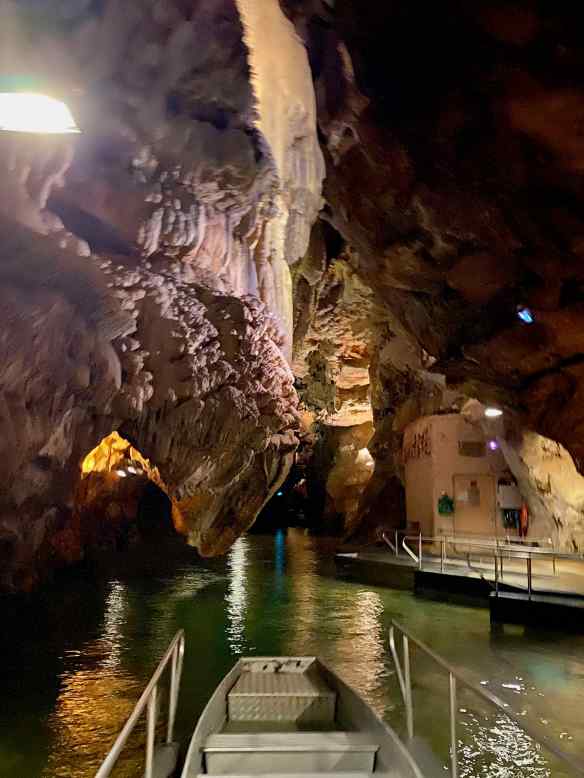
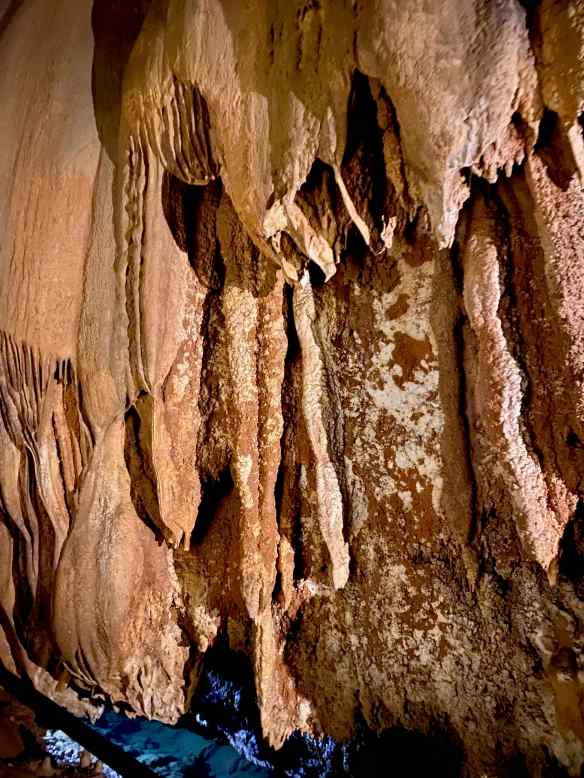
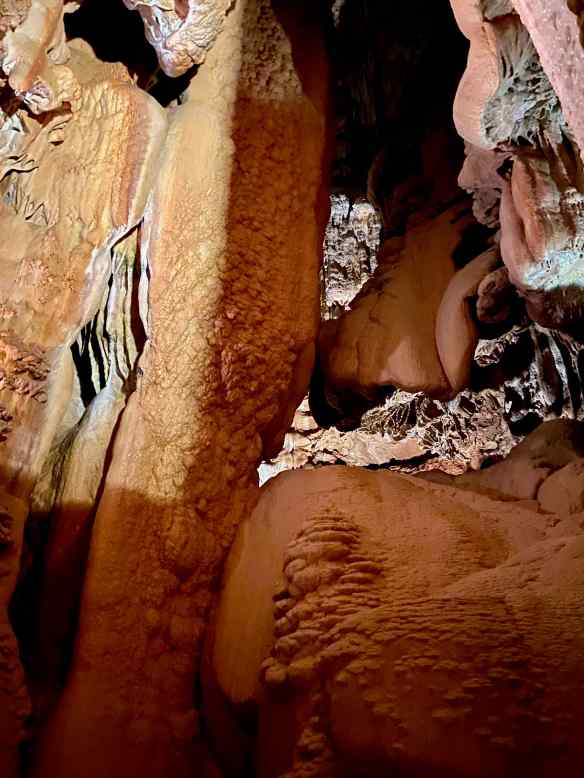
Our walk continues past amazing rock formations …
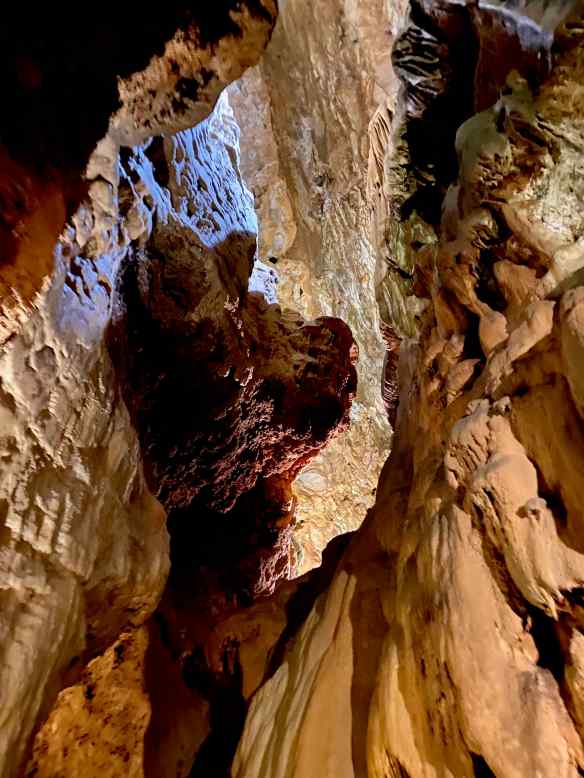
that are enormous…
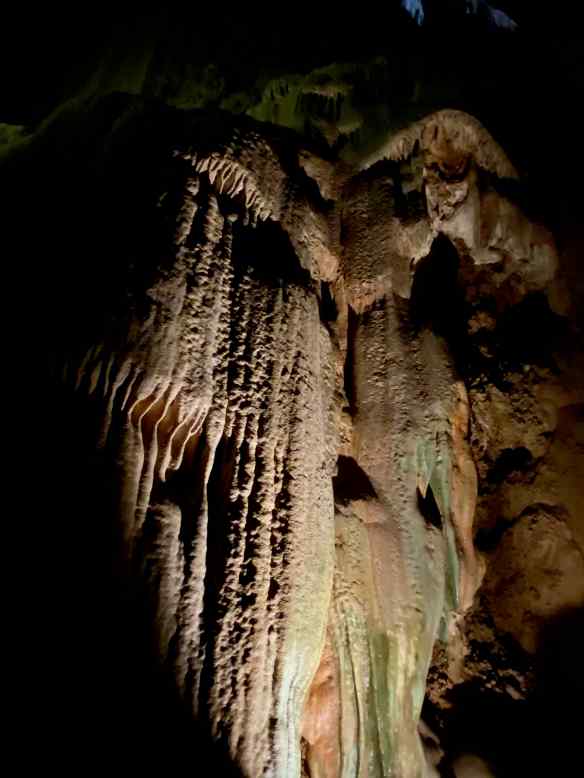
with incredible shapes and colours…
only to arrive at the beautiful Lac des Gours with crystal clear reflections.
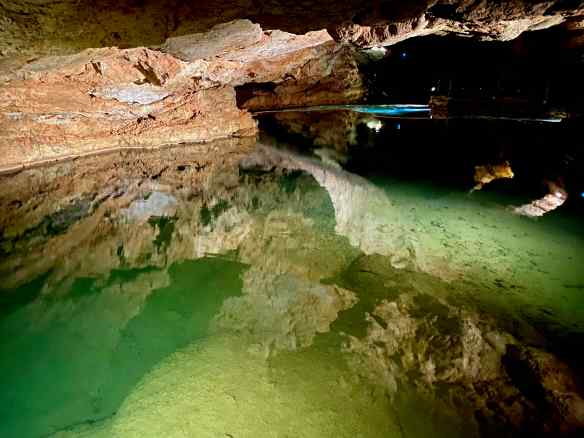
At the far end of this lake we can see the river below with an old boat.  I don’t think the public is allowed in that part of the cave.
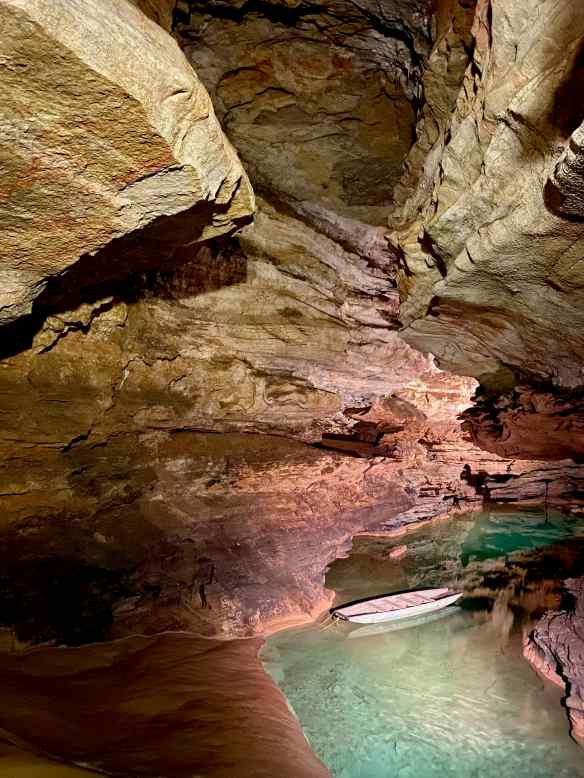
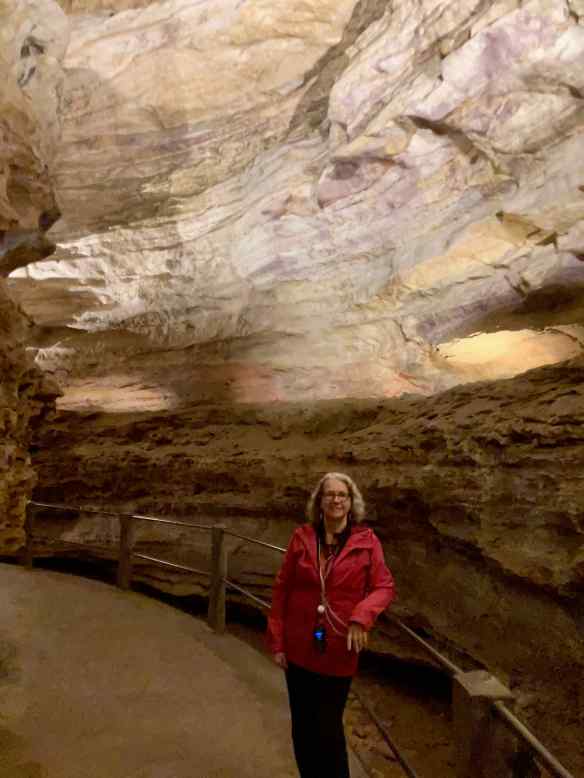
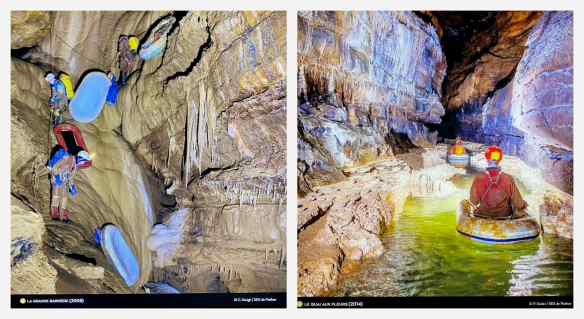
At this point we are given the option of returning the way we came or we can continue to another part of the cave that requires climbing more steps…lots more steps!  Of course we choose to continue further into the cave!The displays here shows some pictures of cave exploration…not for me..it looks cold, wet and exhausting and rather frightening as well. In all, 42 kilometres of galleries have been mapped by speleologists but there are still more areas that have not yet been explored.
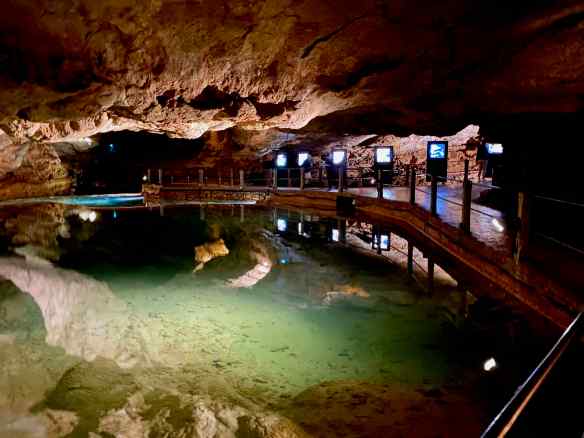
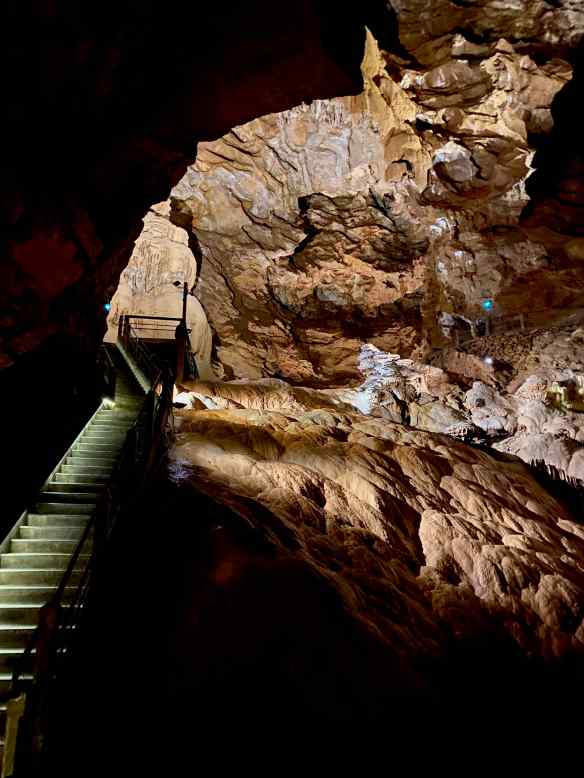
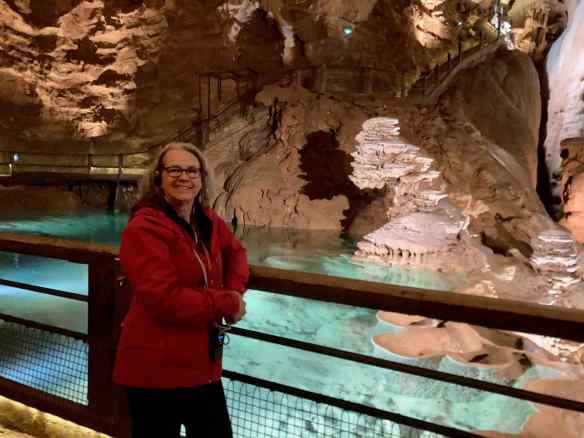
There is a warning that there are lots of stairs, and wet, slippery sections…that isn’t going to stop us.  So up we go… And there is another lake, twenty metres above the river!  Mind boggling!  Lake Superior (Upper Lake), is crystal clear and an incredible aqua colour.  The round tan shaped formations on the right hand of the photo form a dam that holds the water in this lake.“A remarkable stalagmite lies above the lake. It is nicknamed the Pile d’Assiettes (Pile of Plates) because of its surprising resemblance to stacked-up china. It is a typical high-roof stalagmite formed when such a structure exceeds several tens of metres in height. Drops of water fall to the ground at great speed and explode, depositing limestone in circles and giving rise to very flattened formations.”  ~ https://www.gouffre-de-padirac.com/en/salle-du-grand-dome   We are standing beneath the Grand Dome, which rises 94 meters above us.
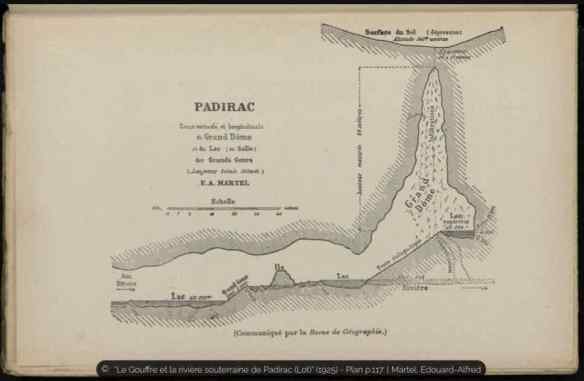
This diagram shows how high above the river Lake Superior is, and the incredible dome that rises above it.
There are still more steps, many more steps…
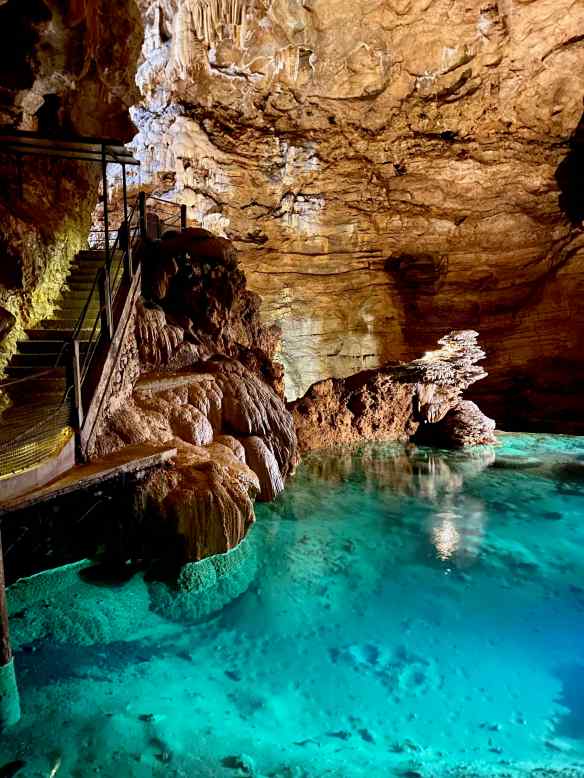
and many more amazing formations…

that are enormous. Bob is in the bottom of this photo to give an idea of their size. I am quite relieved that we do not have to climb these steps!
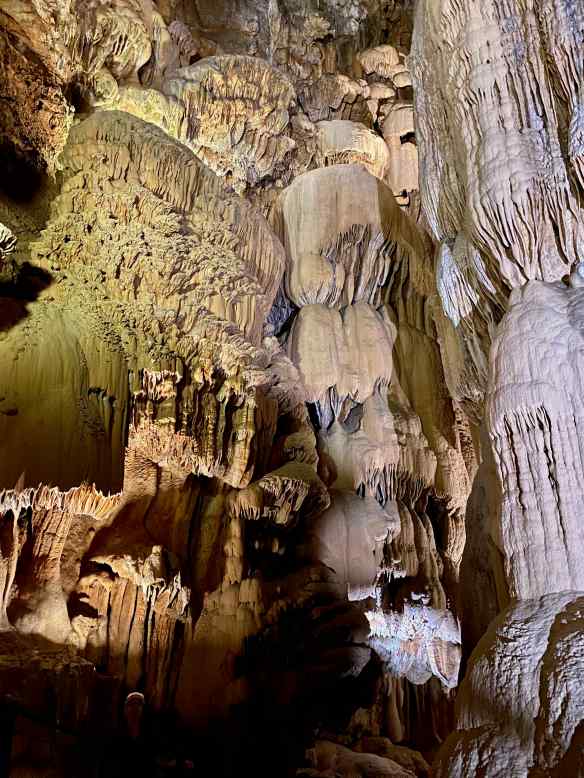
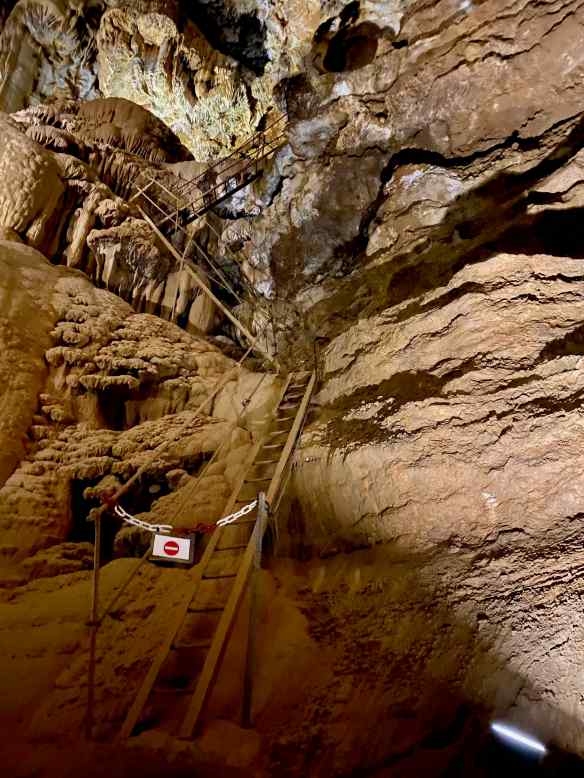
This is a magical underground world!
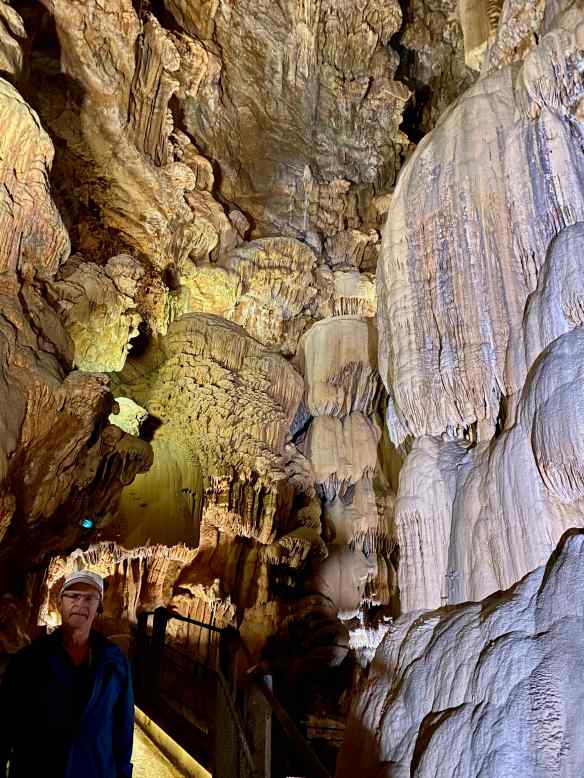
More formations, just because they are so wondrous…

and I am amazed by their colours. It is difficult not to include all even more photos.
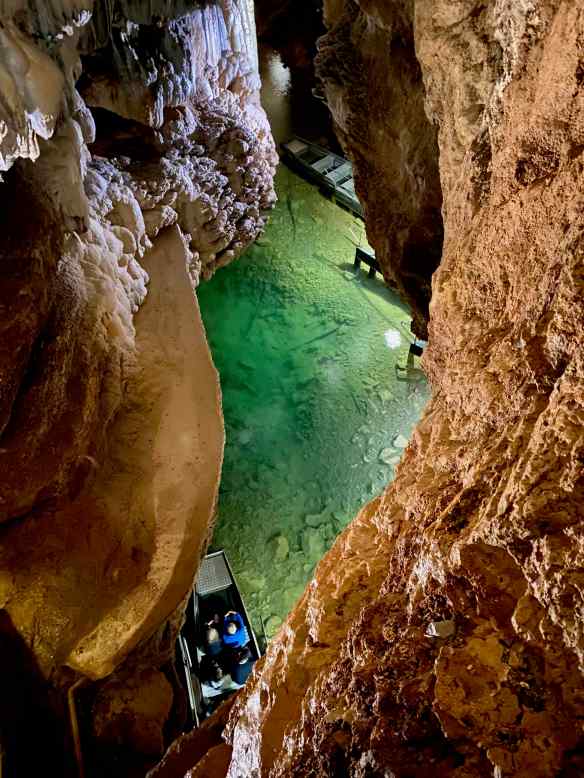
We need to descend way down there!
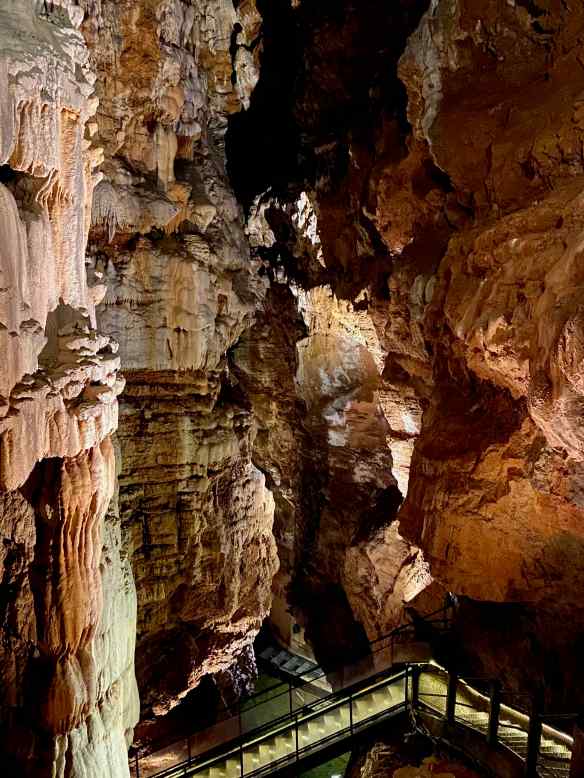
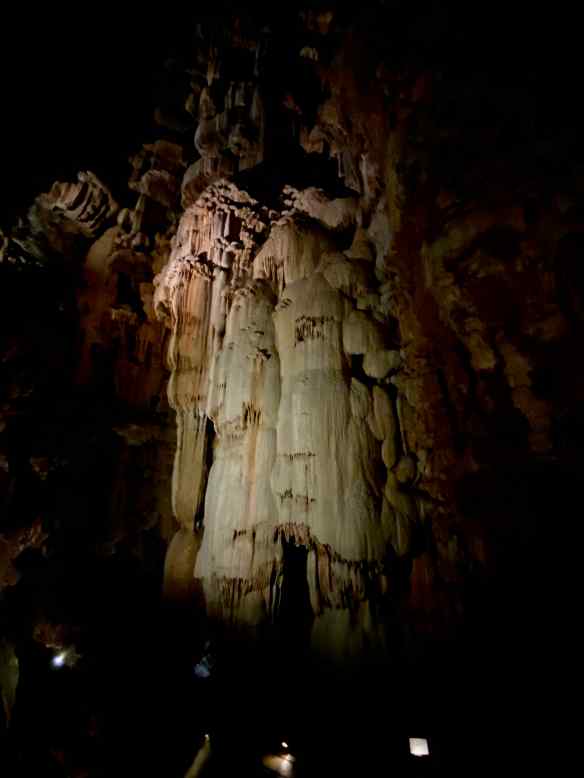
We continue to walk by so many rock formations…I have run out of words to describe how amazing they are.  Édouar-Alfred Martel, the discoverer of this cave said that these are “Marvellous areas that can only be lived in by fairies.”     
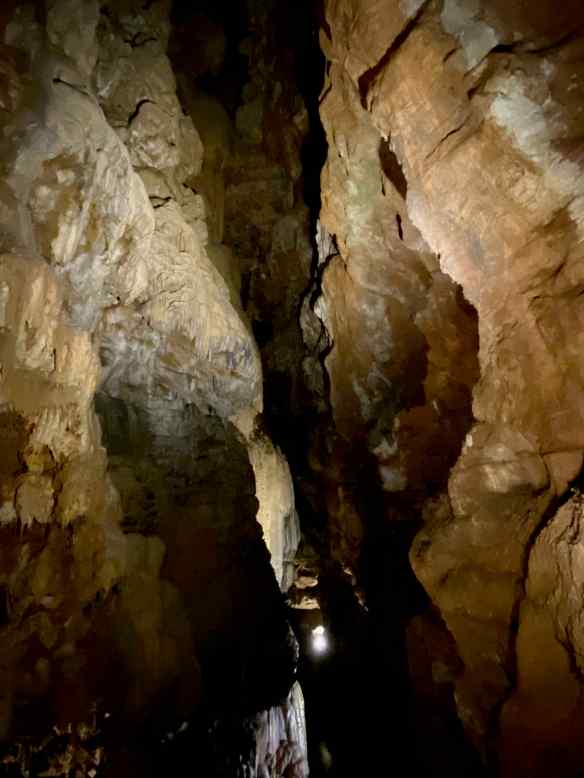
We need to go way down to where that light is.
Finally we can see the dock for our return boat ride.
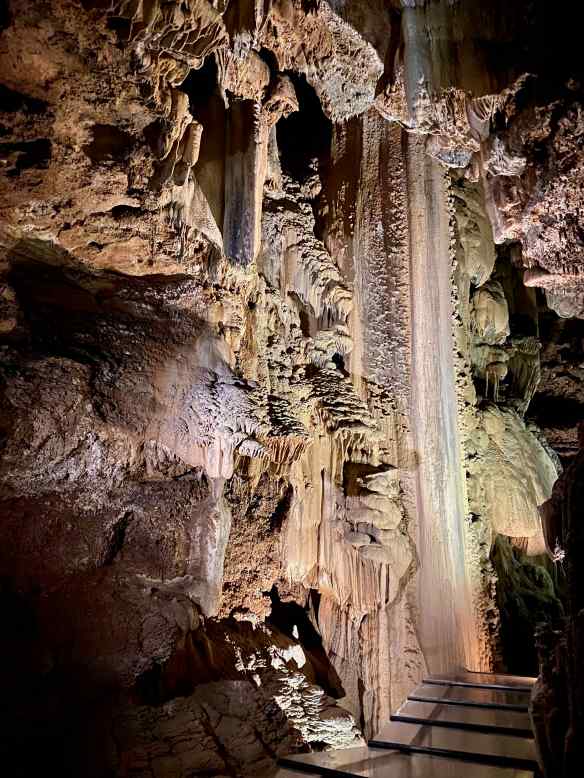
But first we still pass by even more formations.  The roof on the bottom right protects us from water drops as we walk past this one.
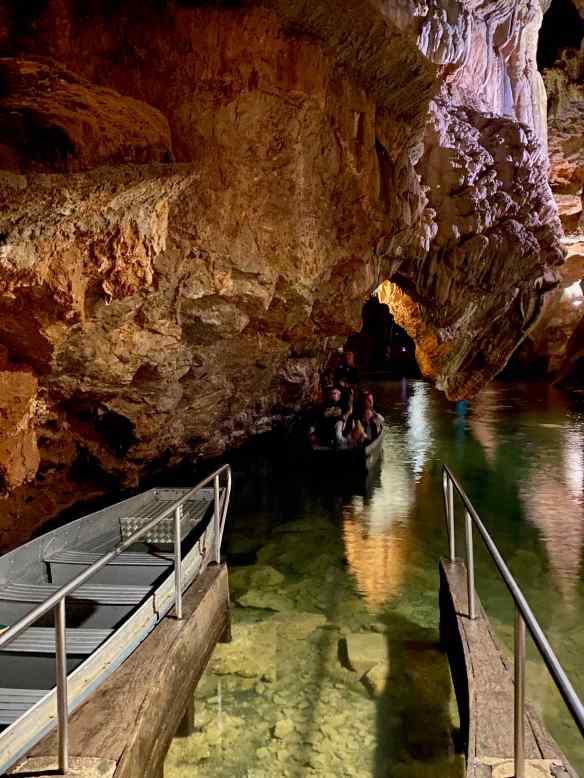
All too soon we are back at the boats.  Honestly, I would have been happy to just turn around and trace our steps a second time…but there are no washrooms down here!  This boat just arriving is the one we take on our return journey.
We sit right at the front, so we will have a great view of the Grande Pendeloque (Great Chandelier) which is a 60-m-long series of calcite formations that seems to hang in the air above our heads, but no photos are allowed on the boat trip.
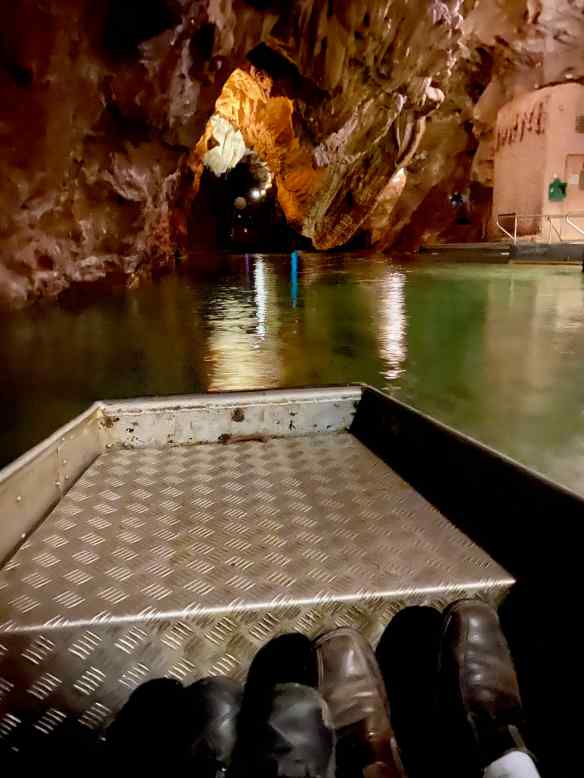
We reluctantly make our way back to the exit.  One last photo in the cave.

We decide to take the elevators back up to the surface from here.  We are going to visit Rocamadour this afternoon and it also has lots of steps.

It is less than a half hour drive to Rocamadour, which is a famous pilgrimage site and a  UNESCO World Heritage site.  It takes a while to figure out where to park but we finally find spot near the top rather than the bottom of this cliffside village. This it our view while having lunch.
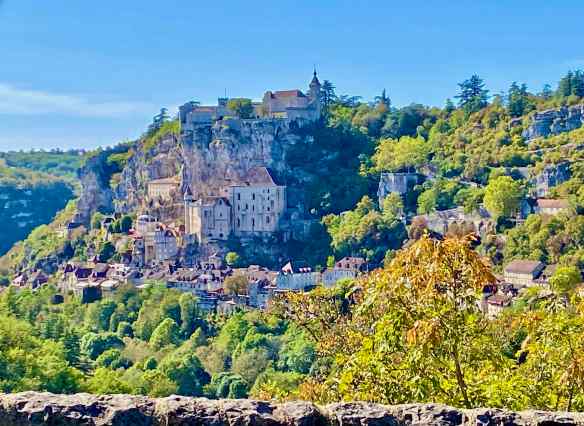
We are disappointed to discover that the ramparts are closed for restoration.  We were looking forward to the views from the ramparts,  so we start on our way down towards the church and chapels.  Part way down the winding path, this cave marks the end of the Stations Of The Cross.  Turns out we are starting at the end instead of the beginning.  
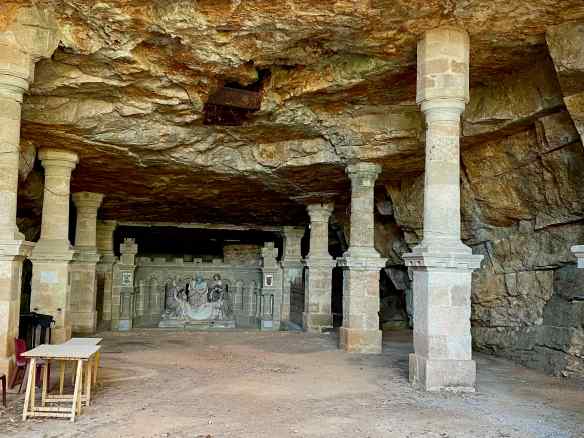
One of the fourteen Station of the Cross.
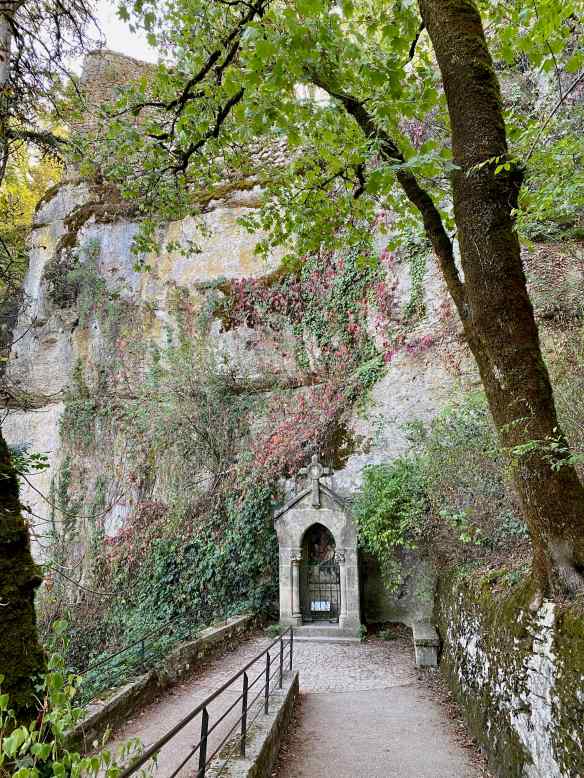
I did mention that it was a winding path, and fairly steep.
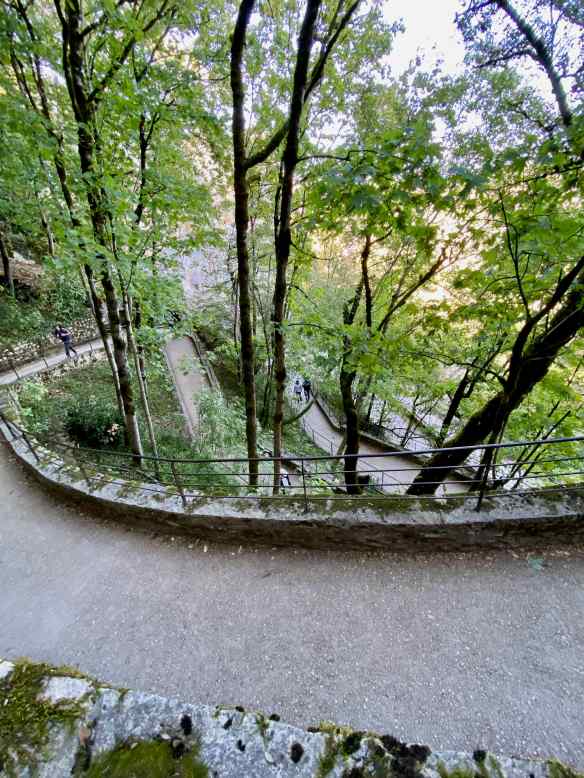
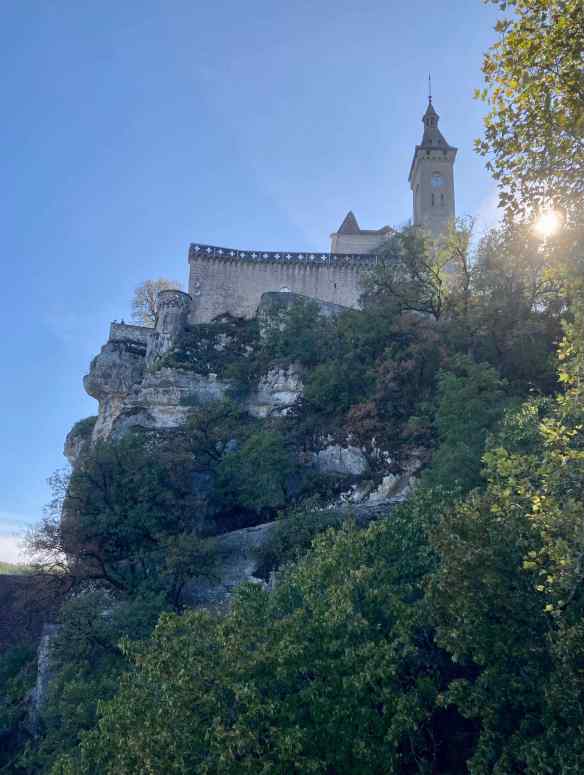
Looking up towards the ramparts, with the afternoon sun looking low in the sky because of the steep angle.
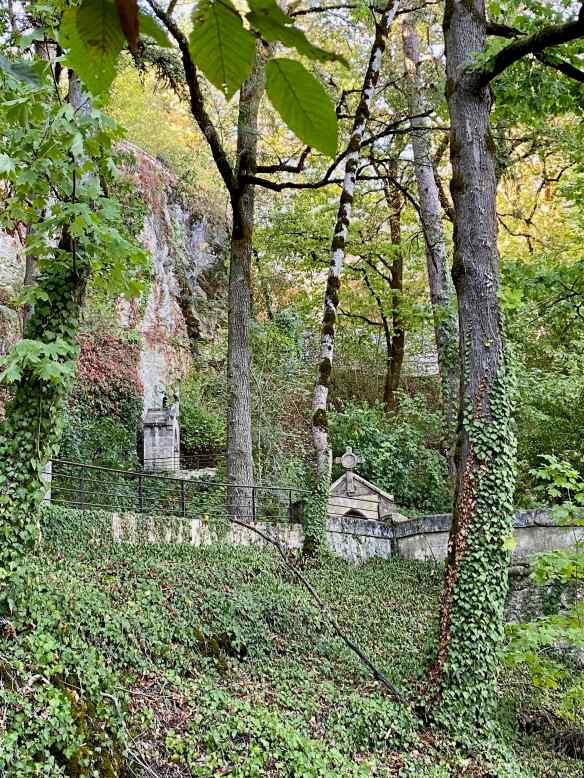
The trees and hillsides are covered with ivy.  The grounds are not terribly well kept here.
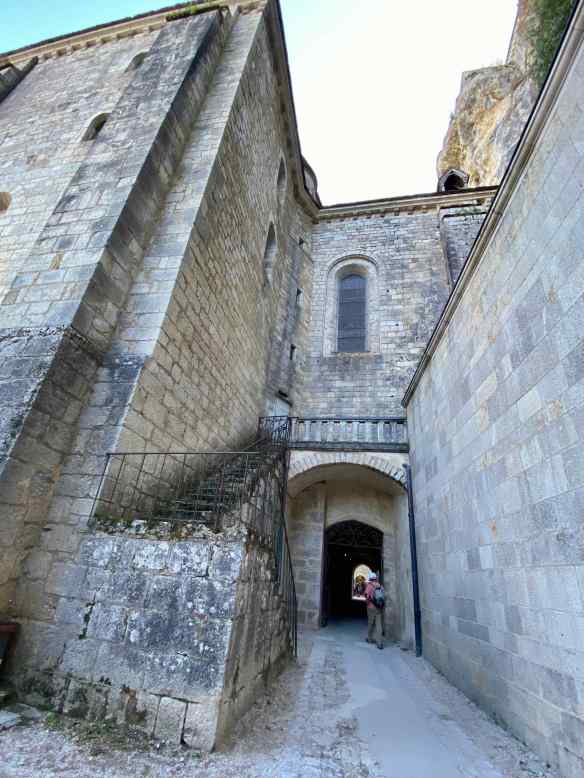
Finally we enter the Sanctuary… 
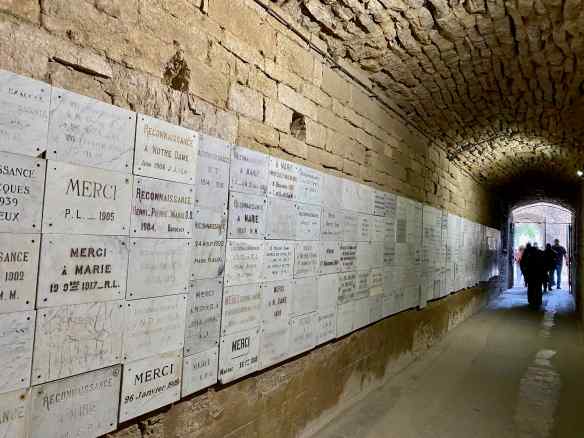
and walk past many plaques engraved with thanks for prayers answered.
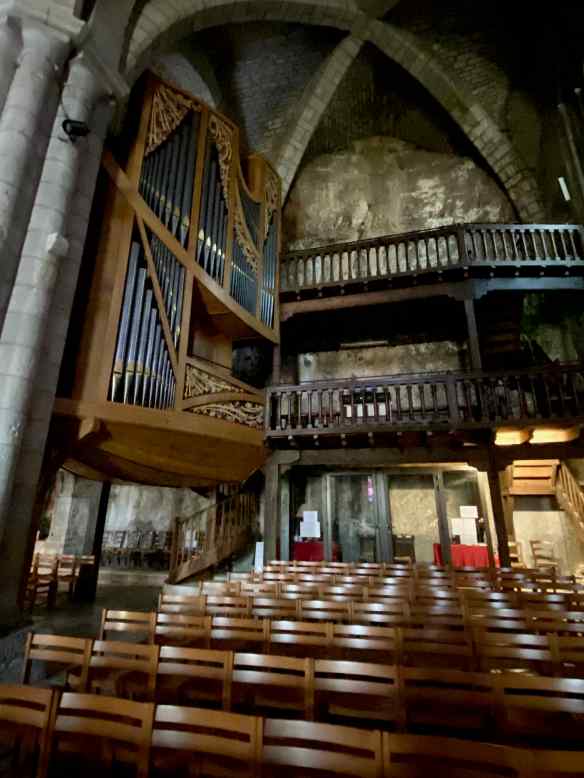
Some of the churches and chapels are built right into the stone cliffs, which are visible in the back of the 850 year old Basilica of St. Saviour.
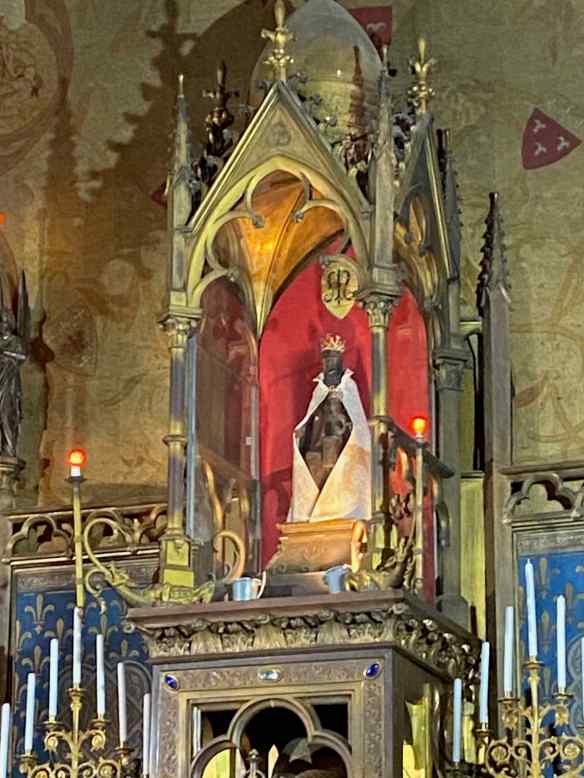
The Black Virgin in the Notre Dame Chapel.  A group has arrived for a private mass so we don’t stay long.  This is the second Black Virgin we have seen on our travels.
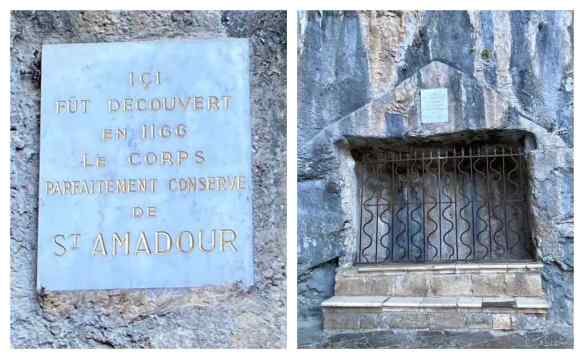
In this spot, in 1166 the perfectly preserved body of an early Christian hermit who died in 418 AD was discovered… St. Amadour.
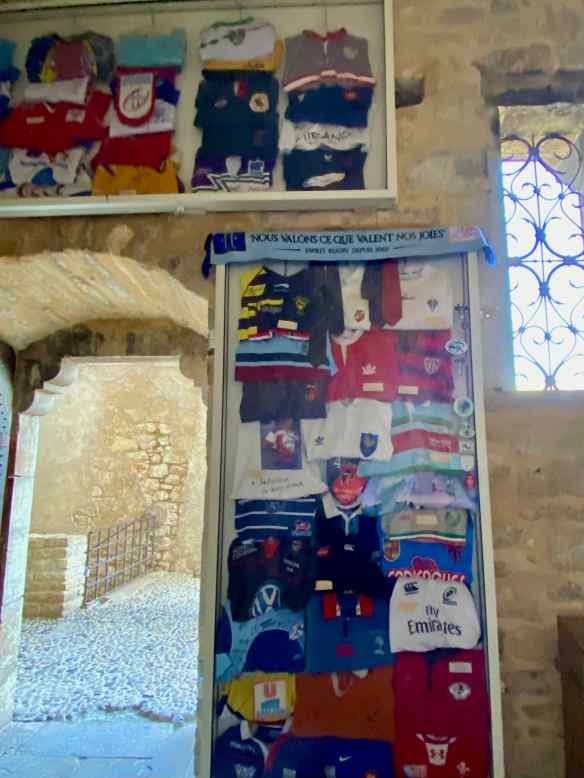
However, there is also a small chapel and a patron saint for Rugby!  We were not expecting that.
A view of the valley from the sanctuary.
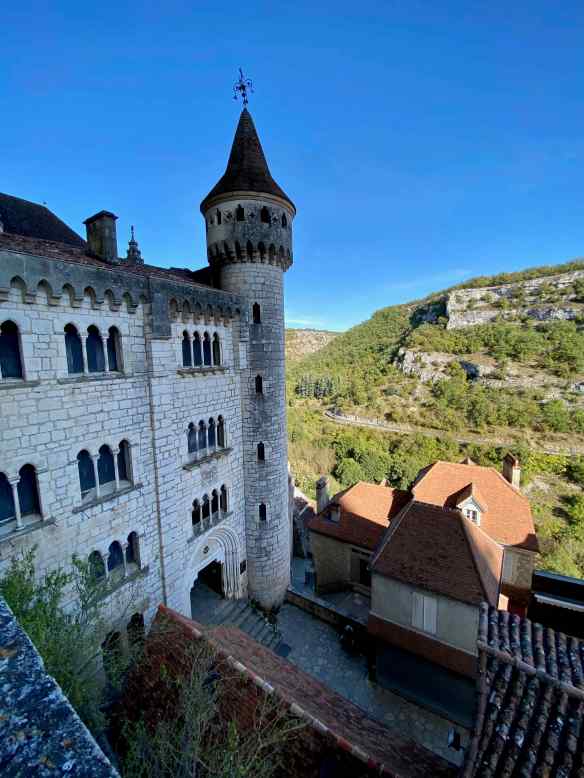
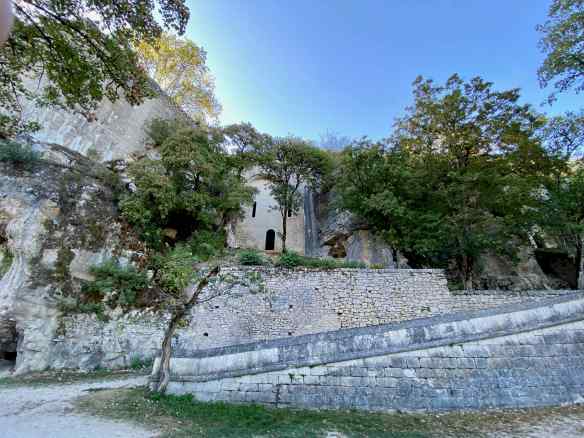
We start walking back up the hill to our carpark.  We decided not to go all the way down to the Medieval village at the bottom of Rocamadour.  It now consists of lots of shops selling tourist souvenirs and restaurants.  It has been a long day and we are ready to go home.
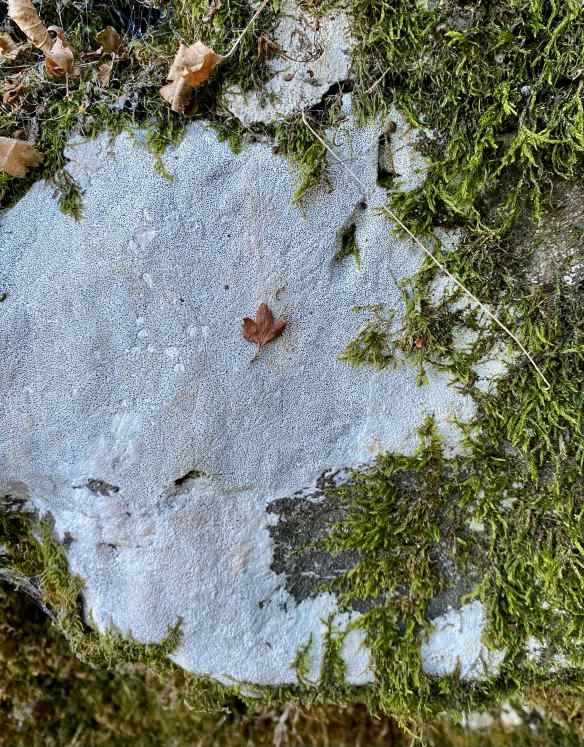
I loved this little red leaf stuck on the side of this rock.
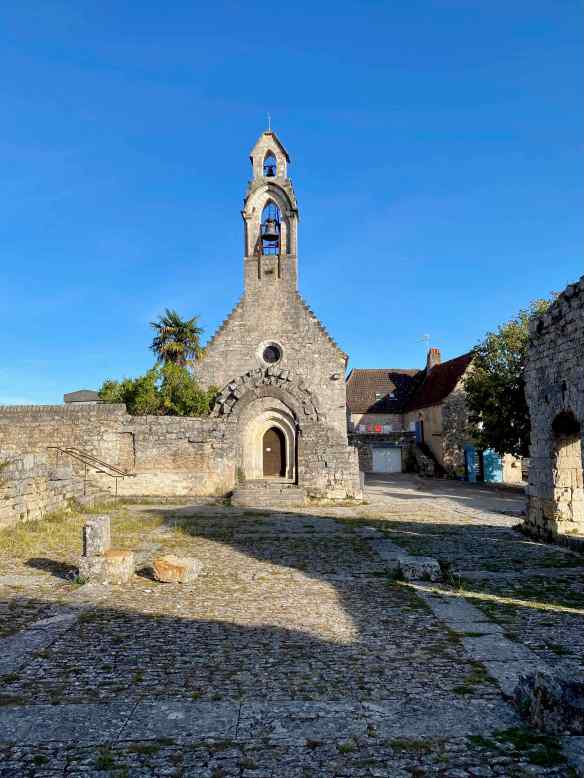
There is a little church in the hamlet of L’Hospitalet on our way to the carpark but it isn’t open so we head home.  We were both a bit underwhelmed by Rocamadour….it didn’t have the presence that we were expecting…although we are not really sure how to explain why.
L’Abri Cap Blanc and the Grotte des Combarelles, France

Day 37, Wednesday, October 4, 2023

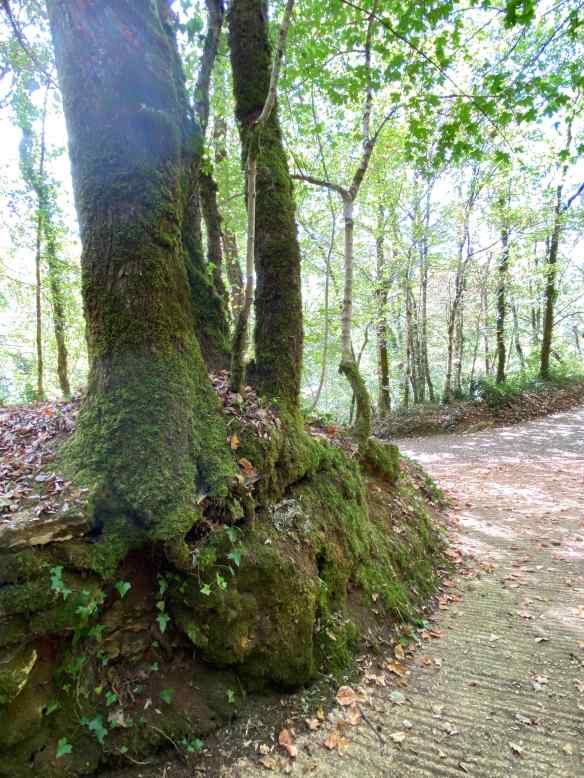
We visit two prehistoric sites today. This morning we tour the Cap Blanc rock shelter.  It is a masterpiece of prehistoric sculpture from the Cro-Magnon/Magdalenian Era.  The path to the site is pretty with lots of moss covered trees.

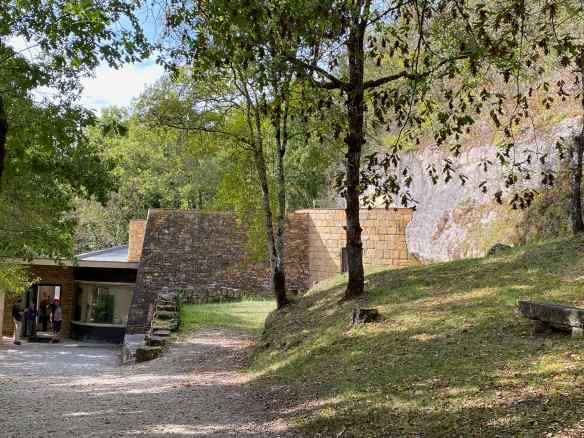
This is the building that was built to shelter the site.  It goes right up to the cliff face so that the sculptures are protected inside.

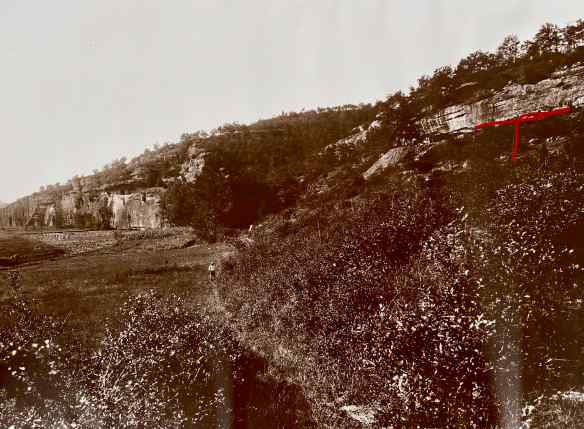
Today it is the only frieze of prehistoric sculptures in the world to be shown to the public.  And we are able to visit!  The red line is about where the frieze and the museum building is located.

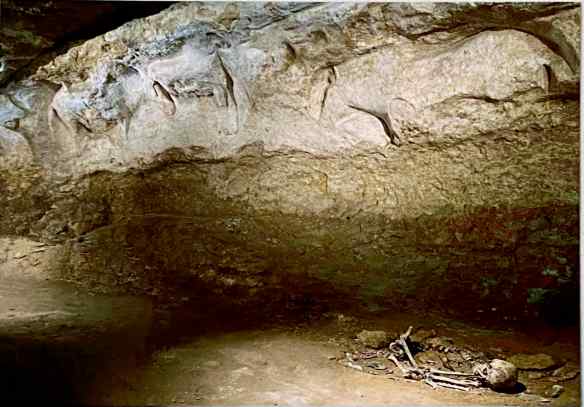
Of course, no photos are allowed. I buy a postcard so that I have a photo of the frieze, although it does not do it justice at all.  There is absolutely no substitute for standing in front of this  prehistoric sculpture which brings together horses, bison and deer.

The skeleton on the ground is a replica of the one that was found when the owner of the site dug down to build a wall to protect the site in the early 1900’s.  It is a female, approximately 5’1″ tall and between 30 and 35 years of age.  The owner of the site sold the original skeleton to a museum in Chicago where it still resides.  It was first thought to be a young girl and the Chicago Museum called this skeleton Magdalenian Girl.  Only later were scientists able to determine more accurate information about this skeleton, which has been carbon dated and is 30,000 years old.  The frieze was made over 15,000 years ago, another 15,000 years after this woman was buried here.  She was found in a fetal position with three large flat stones carefully placed over her body.  A spear head was found with the body but there is no way to know if that was the cause of her death or not.  The farmer who found this did not know anything about how to preserve information at an archeological site.

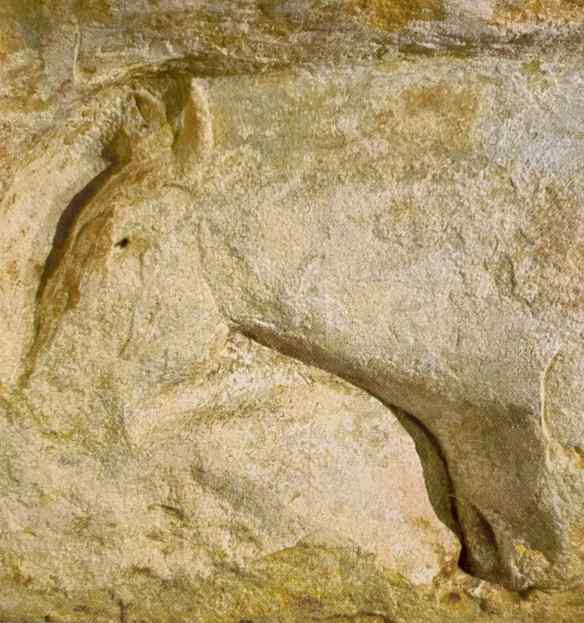
Here is a close up of one of the horses heads. I am amazed at how naturalistic they are, and the details that remain are amazing.  Unfortunately the bottom half of the frieze was carved in a softer limestone and has eroded so the legs of most of the animals are no longer visible. When the original site was discovered in 1909 part of the overhang had fallen down and dirt had built up so that most of the sculptures were covered. There was quite a lot of damage done to part of the frieze when it was being uncovered.  Pick axes were used to move the rock and dirt that had fallen down over the years and parts of the frieze were actually broken off by the very people who were trying to uncover it.  There were also notes made about the frieze being painted red, but the people who uncovered it decided to wash all the dirt off of the frieze and in doing so they washed off the red colouring!  Hard to believe, but archeology did not become systematic and disciplined in its approach to excavation until after the 1920’s.A scientist reconstructed the features of the skull that was found here.  I think she is quite beautiful and yes, much like a modern woman.  The jewellery is from an area near here but ti was not found with this skeleton.  Magdelenian man, or Cro-Magnon man is regarded as the closest ancestor to today’s humans.  

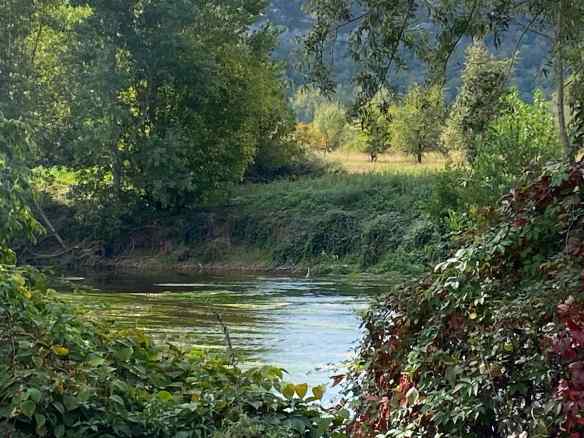
We have lunch in a little nearby village with a pretty little river and watch a heron try to catch its lunch.  You can just make it out near the centre of the far river bank.

Huge limestone cliffs tower over the village…

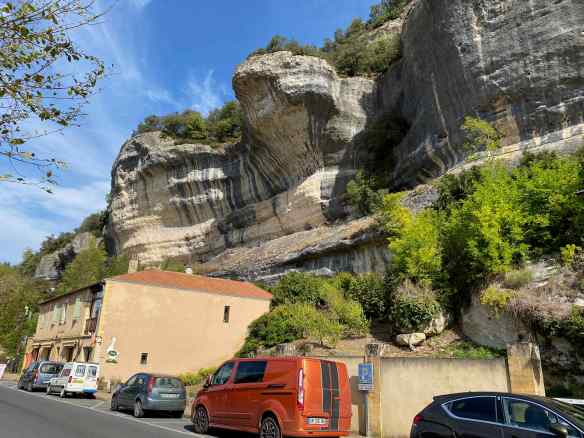
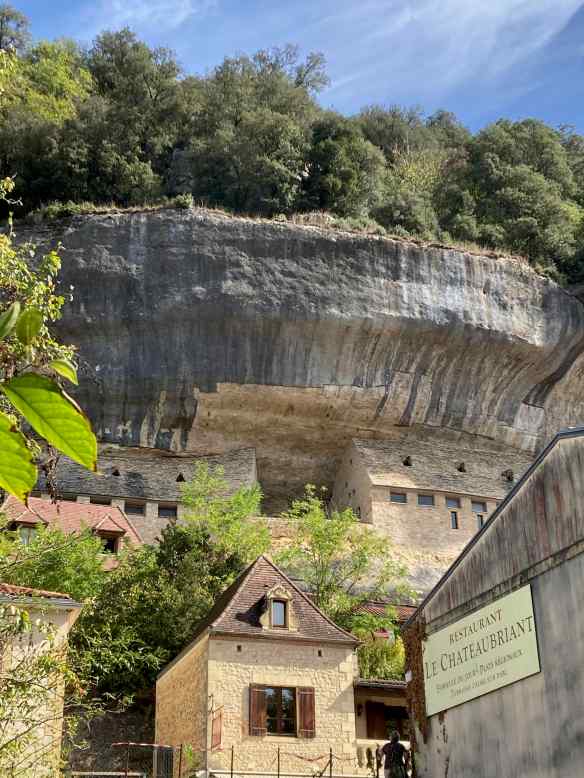
and there are houses and buildings still in use today that are built right into the cliffs.

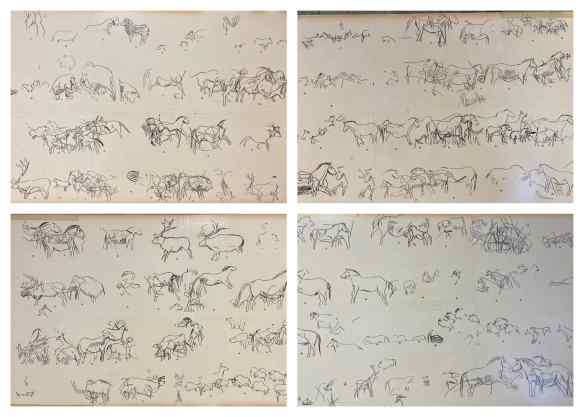
After lunch is a short drive to the Grotte des Combrelles.  Grotte is cave in French. Inside the entrance building there are some drawings of the etchings in this cave. There are more than 800 rock engravings dating back to the era of Magdalenians, including 300 mammals, 52 stylized human figures, abstract signs and half a dozen sexual symbols.
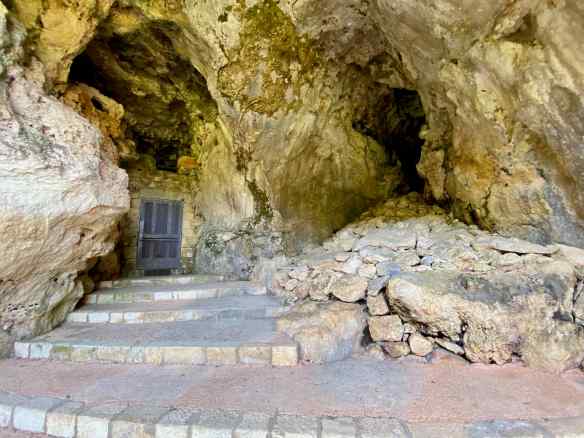
The entrance to the cave used to be used by a farmer to keep his animals before the entrance to the rest of the cave was discovered.

There are two entrances to the cave but only the one with the gate is accessible by the public.  

It is a long, narrow winding cave, 235 meters in length with no side channels.  A maximum  of seven people at a time are allowed in the cave because there just isn’t room for more than that to see the engravings in each location.  As it is we have to snuggle up so that we can all see the engravings pointed out by our guide.  This photo of a bison was in the office. The engravings are not always easy to see.

One of the best known engravings is the Drinking Reindeer.  There are some abstract signs and several human representations.  The humans are incomplete, they do not have heads, females are often represented by torsos or engravings of vulvas. Animals featured in the cave are horses, bison, aurochs, cattle, bears, reindeer, mammoths, ibex, antelopes, cave lions, rhinos and even the odd fox and fish. We only have time on our hour long tour to see the most prominent engravings, and part of the cave is not open to the public, but it is an amazing experience to stand just inches away from these engravings.  It gives me goosebumps to think that I am standing in the same spot as the artist who made these engravings thousands of years ago.

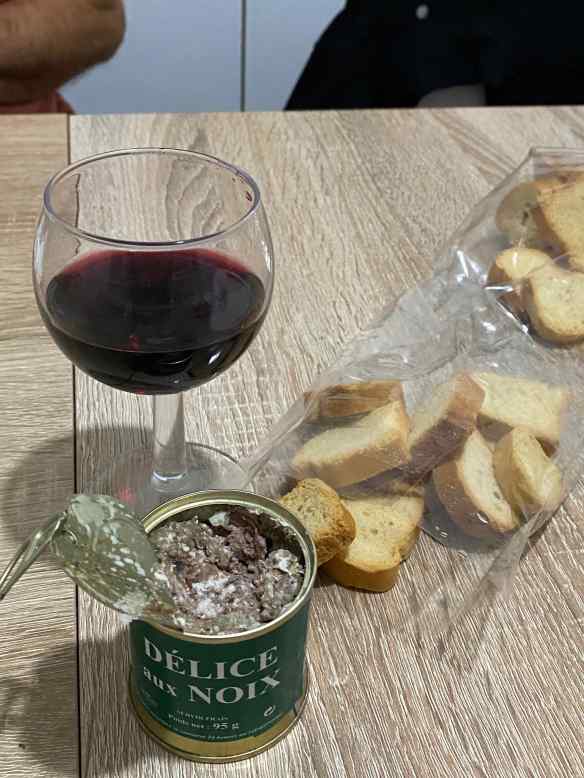
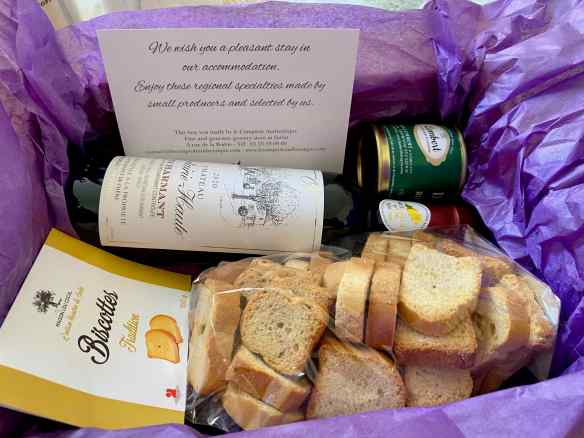
Back at our apartment Bob decides to taste the ingredients from our gift package.  Unfortunately, the foie gras with walnuts just isn’t very appealing.  It kind of looks like cat food and neither of us like it at all.

Sarlat le Canéda, France

Day 36, Tuesday, October 3, 2023

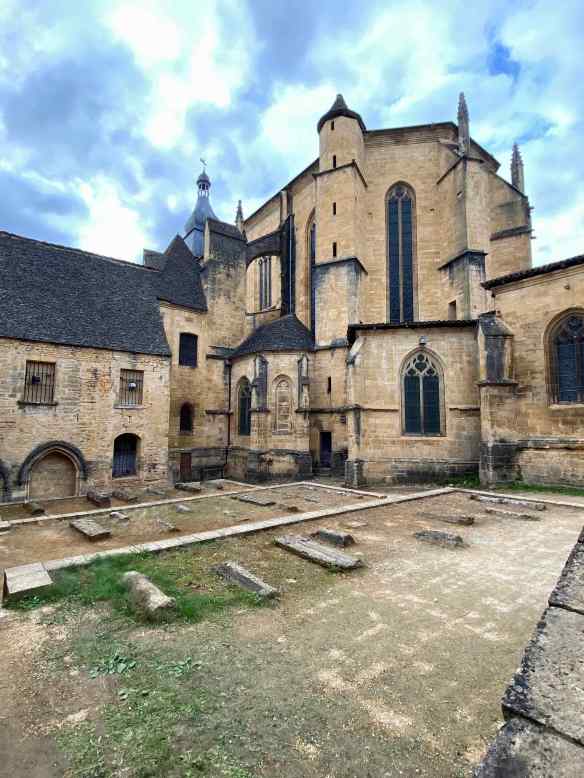
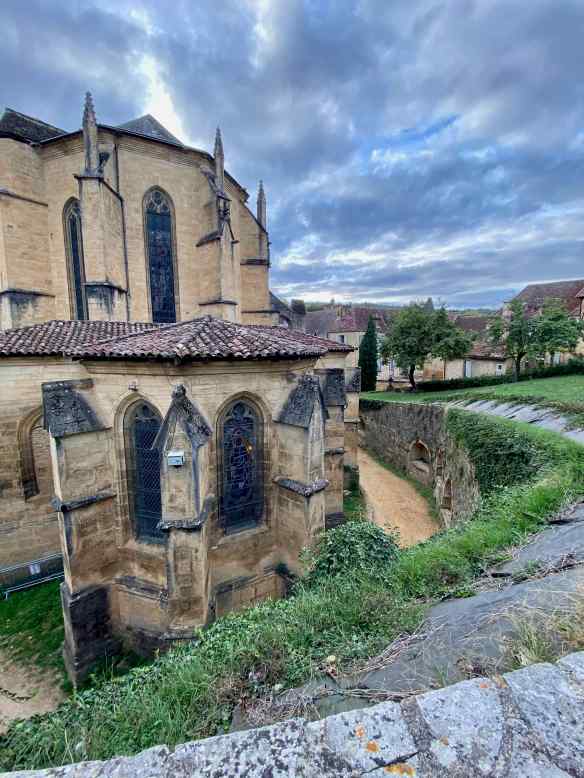
Bob is out early exploring the streets of Sarlat and he comes home to tell me how interesting this medieval town is. We both go out in the afternoon for a walk. Sarlat Cathedral, just around the corner from our apartment is a Roman Catholic church.  It is a national monument and was established in 1317!  We hear its bells chiming several times a day. It is a nice wake up call at 7:05 am when the bells chime for several minutes.  The ringing of the bells at 7:05 am and 7:05 pm each day is called “Angelus,” and that it is an ancient pattern of bell-ringing that is a call to prayer for Catholics to pray a particular prayer.  This is the back of the church, with several ancient sarcophagi, which I discovered is the plural form of sarcophagus.

We climb the steps behind the church and I notice a light shining through the stained glass window, although the church is closed at the moment.

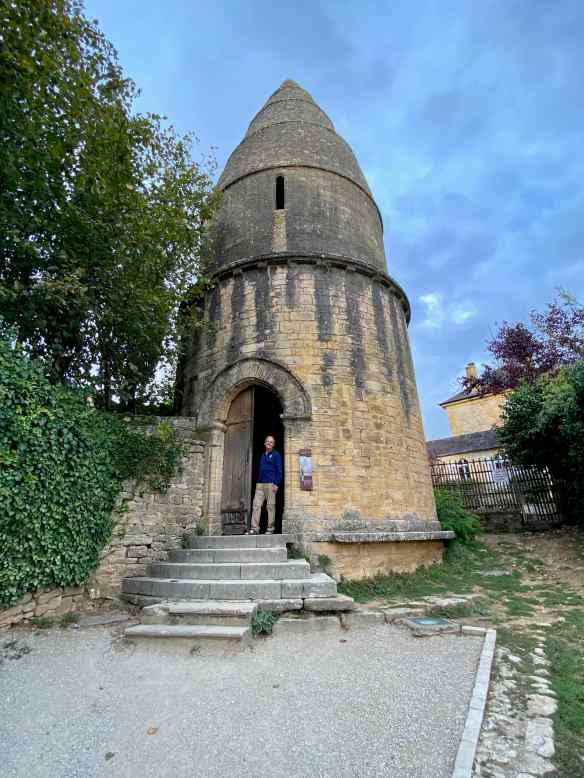
At the top of the steps behind the church we find this Lanterne des Mortes, which means Lantern of the Dead. Lanternes des Mortes are small stone towers. “Pierced with small openings at the top, a light was exhibited at night to indicate the position of a cemetery, hospital, or leper colony. These lanterns were originally constructed to warn passers-by of the danger of infection, as well as to illuminate cemeteries where it was feared that repenting souls, ghosts, and criminals could hide. Later, they were also erected at the intersections of important routes and roads.”  ~Wikipedia

Bob checks it out but there are no repenting souls, ghosts or criminals about.

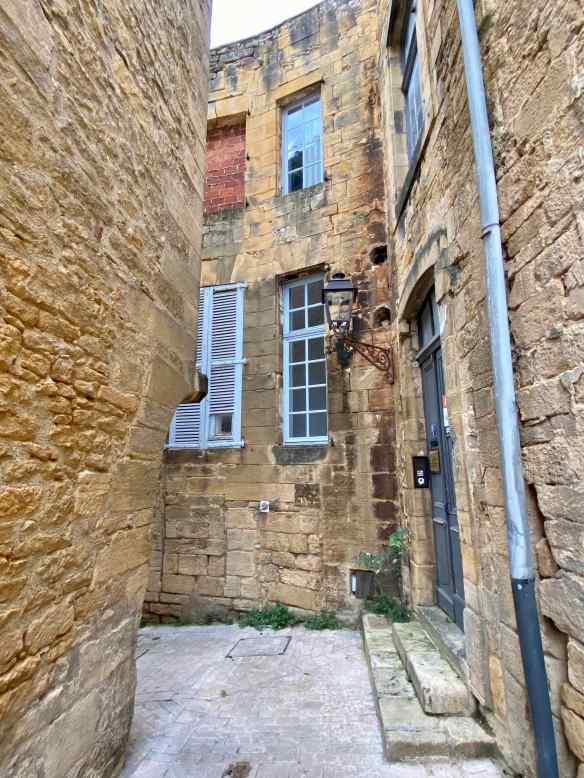
We continue to explore the old narrow streets.

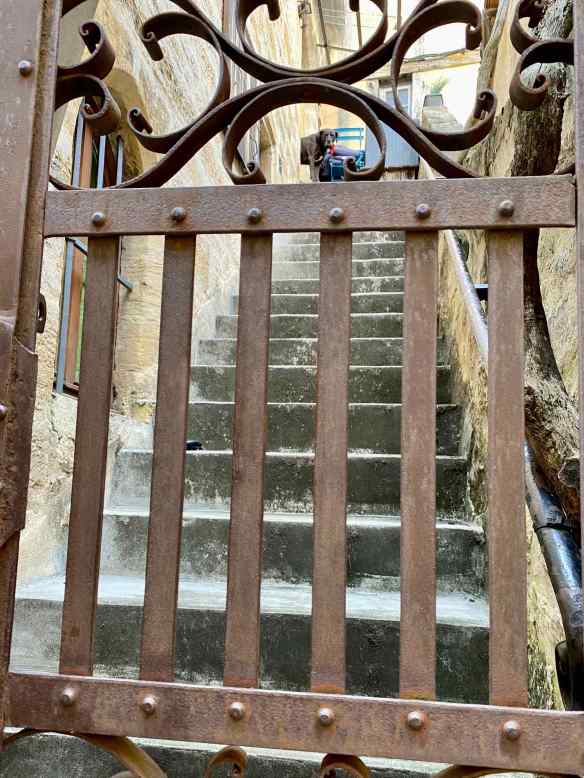
This very large dog just quietly watched us peek through the gate, even when I called to him he didn’t move a muscle.

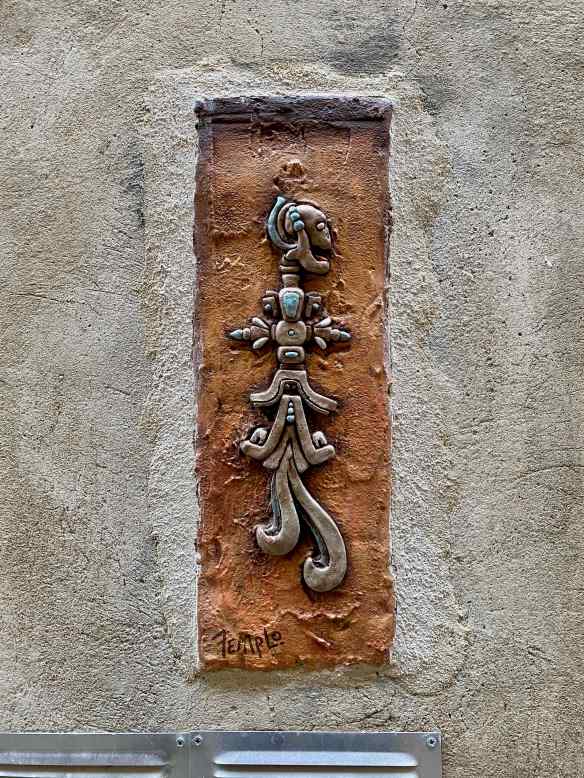
Someone cemented a little piece of art onto the wall on one of the side streets. It makes me smile.

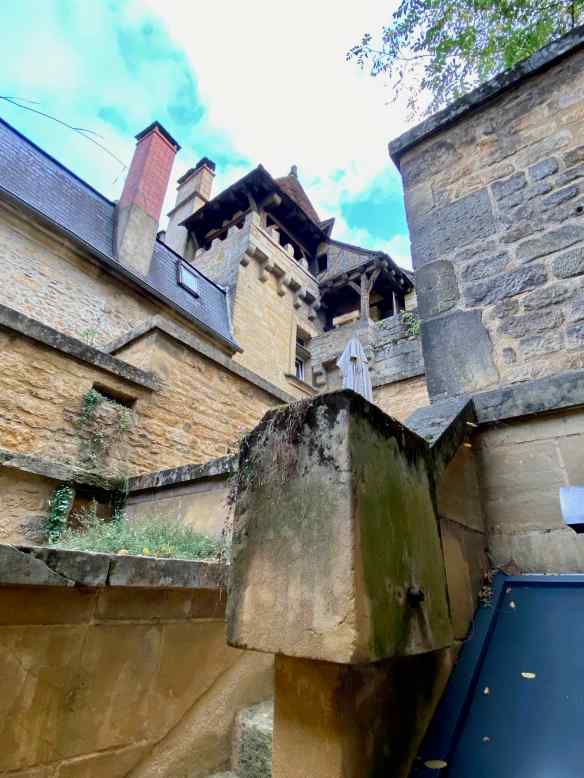
Everywhere we look the old buildings are crammed together, often one on top of another up the hillsides.  This one looks a bit castle like.

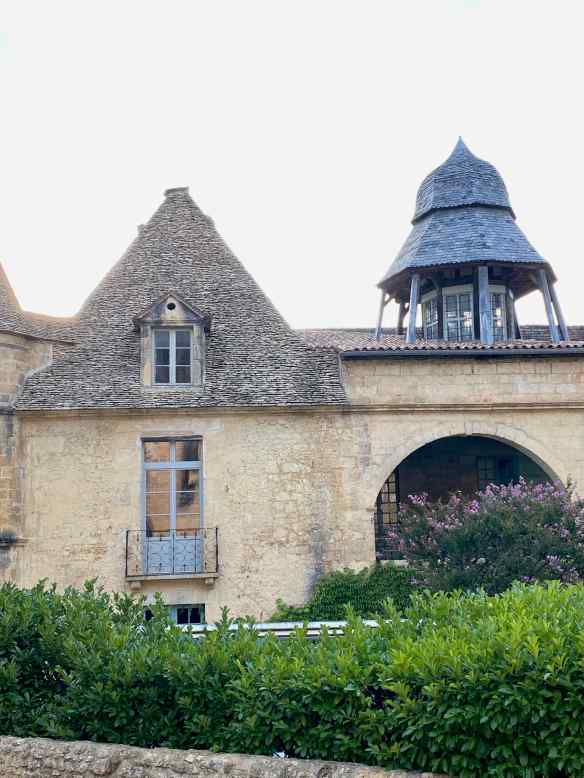
This charming little stained glass room is on the roof of the Présidial, which was built in the17th century.  At the time it was a sort of Court House where a Royal Officer would hear complaints and make rulings.  

I have mentioned that I love peeking in windows and courtyards whenever it is possible.  I don’t think this is being renovated, it just sits empty.  

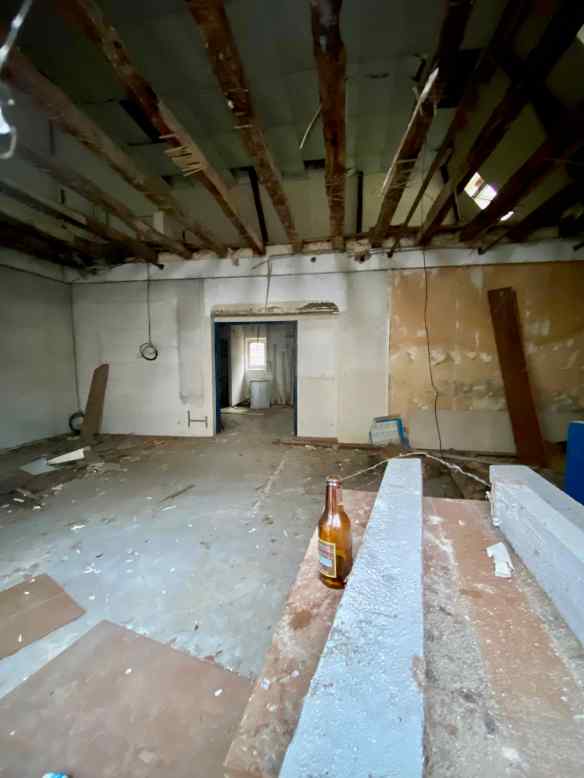
A block or so away a renovation is definitely taking place. there even was a box with old dishes sitting on the sidewalk, free for the taking.

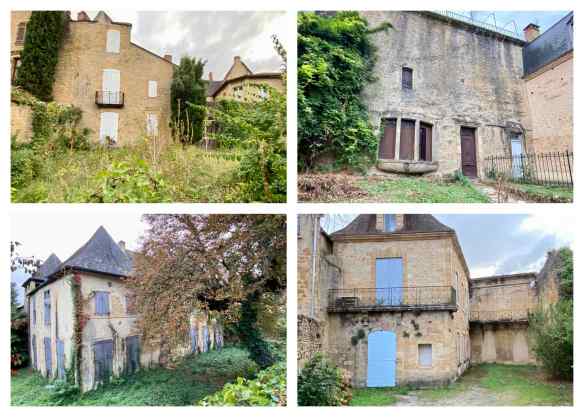
There are so many old houses boarded up and for sale.  I think we could probably buy one quite reasonably, but the renovations would be terribly expensive. If they are historic buildings, which they probably are, there are many restrictions on what renovations are able to be done and how they are done.  Guess we will pass on owning a little piece of Sarlat.

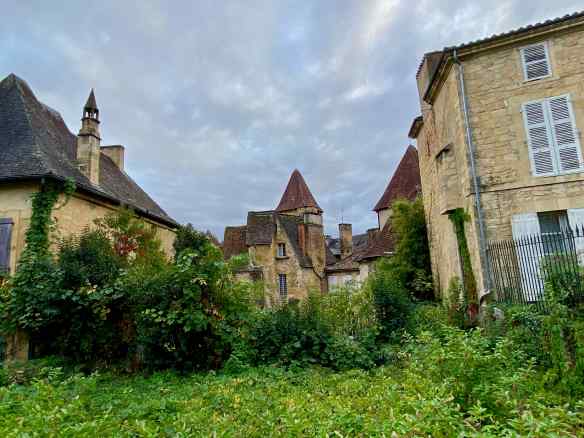
Most of the yards in this area are very overgrown and unkept.  Tidy gardens are not the norm here.

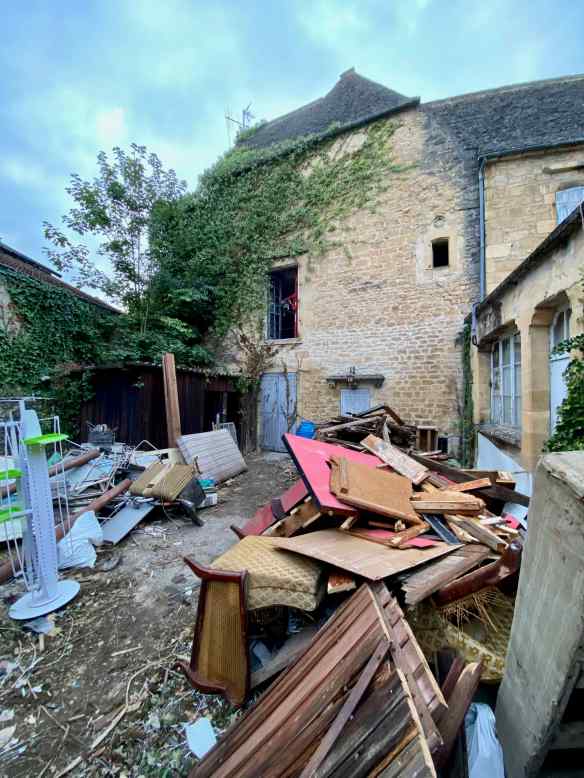
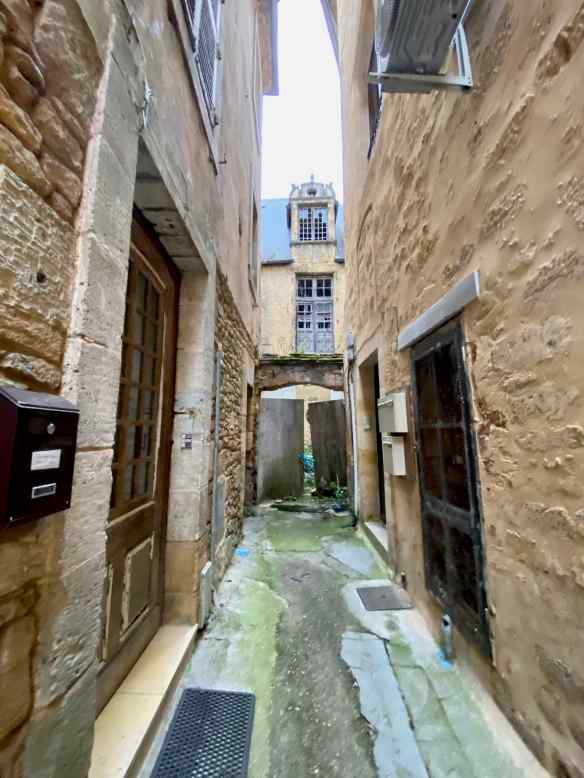
This narrow street ends in an abandoned overgrown yard and building with a lot of ‘stuff’ lying about.  Kind of creepy but just before the broken gate leading to this are doorways to apartments with new mailboxes and doors.  I wouldn’t want to be walking home at night here.

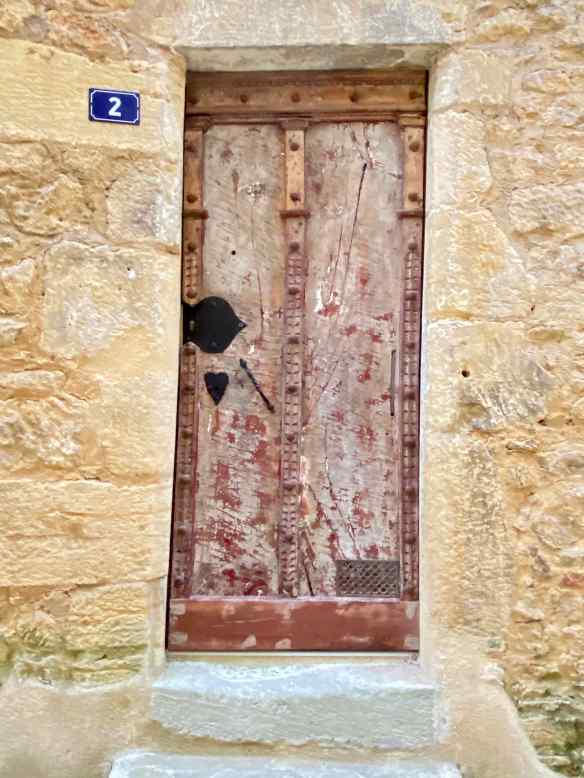
I don’t know what it is about French doors, but so many of them are very very old, and have peeling paint like this one.  But notice, it has nice new hardware…just not a new paint job.  There seems to be some sort of pride in having a very ancient looking door.

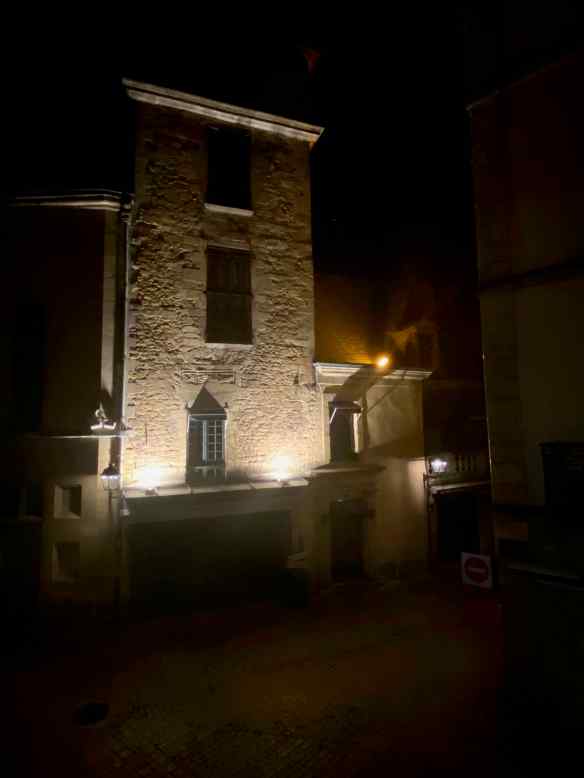
I forgot to take a daytime photo from our apartment window but this is the view when it is dark.

Lascaux II, Parc de Thot and Lascaux IV, France.

Day 35, Monday, October 2, 2023

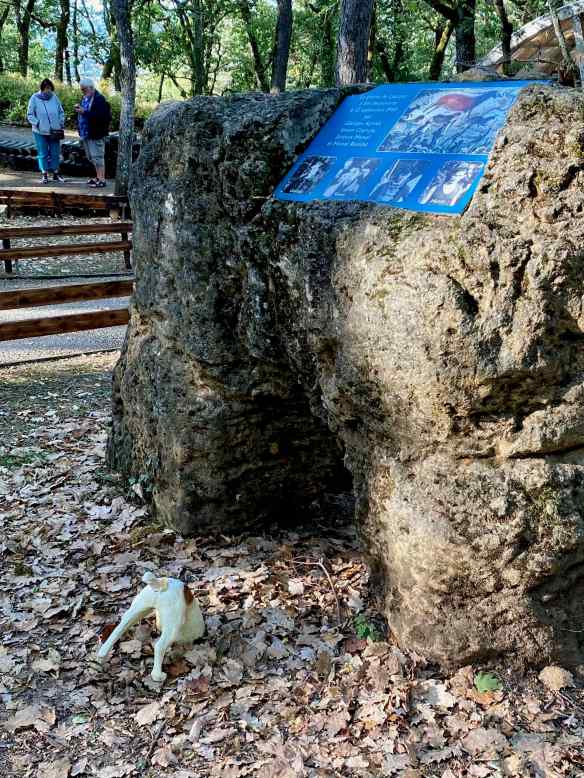
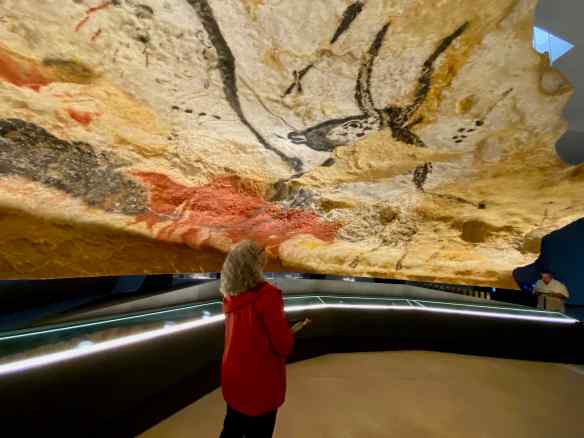
The Lascaux Cave contains one of the most outstanding displays of 20,000 year old prehistoric art in the world and it is a UNESCO World Heritage site.  We were very lucky to get tickets to visit Lascaux II.  We had completely forgotten about needing to book ahead but thankfully it is not high season and we were able to get tickets for an English tour of the cave.  The Lascaux Cave was discovered on September 12 1940 by 18 year old Marcel Ravidat when his dog Robot investigated a hole left by an uprooted tree that had fallen over in a storm.

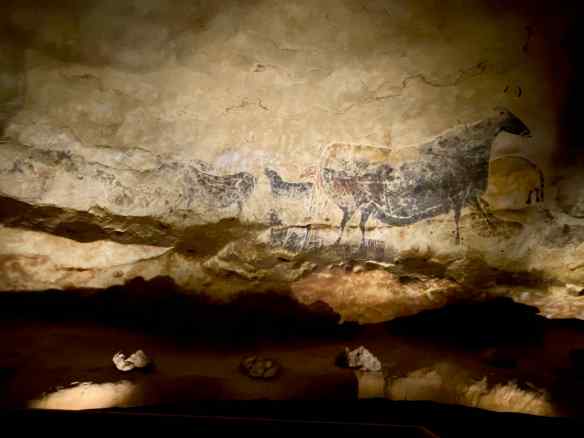
Of course we are visiting a replica cave. It was the first replica cave in the world when it opened in 1983 near the site of the original cave…however there are still no photos allowed.  The original cave was closed in April, 1963. The continuous flow of visitors (1500/day) and the carbon dioxide and human breath began to degrade the prehistoric paintings in the decorated cave.   Lascaux II is an exact replica of the two main chambers of the cave. This short video has a segment with a walk through the cave by torch light. This is what we experienced at Lascaux II.   We were standing in a dark cave, with only a flickering torch to illuminate these 20,000 year old cave paintings.  It was an amazing experience.    https://www.youtube.com/watch?v=VWUUiFxbEE4&t=87s

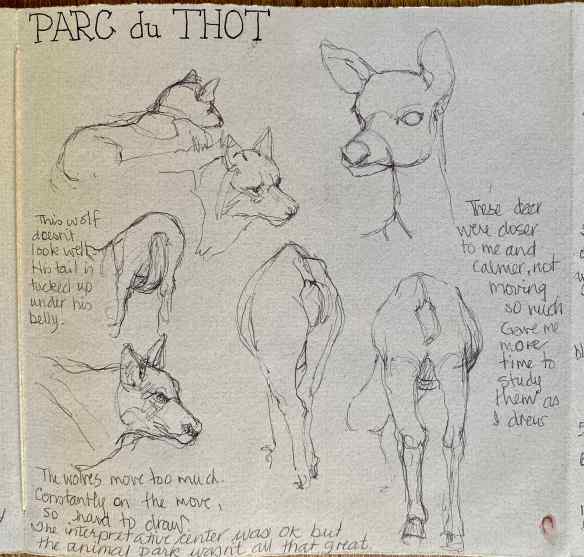
I manage to do a couple quick drawings while in the cave, but the lighting is poor and I decide to enjoy the experience and forget about trying to draw.

We visit Parc de Thot which is a small zoo with animals that are similar to those drawn in the caves…bisons, wolves, deer, and bulls.  There was an interesting short film and some displays in their building. It was a nice place to have our lunch but that was about it.

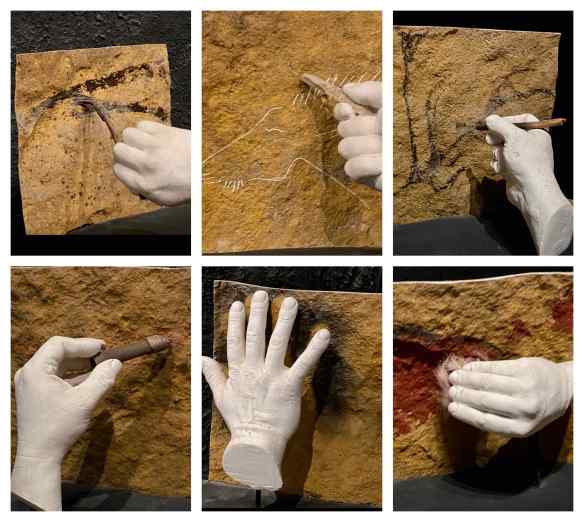
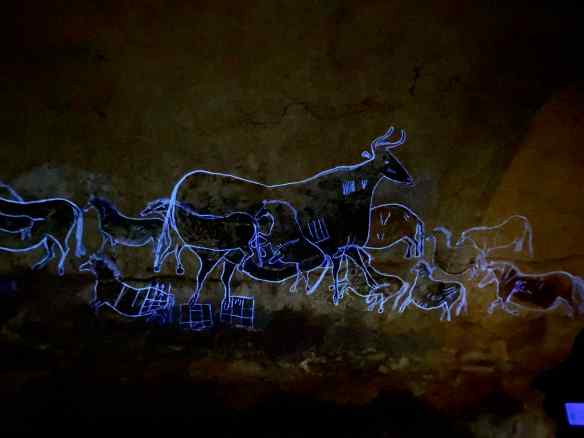
This display shows the different techniques that were used to make the cave paintings and engravings.  I was surprised to learn that paint brushes, pencils (pieces of pigment attached to sticks}, stencils and a primitive sort of airbrush were all used 20,000 years ago!  The artist would blow pigment from his, or perhaps her mouth onto the walls of the cave, sometimes even using a hollow bone for more accuracy.

This display shows one of the cave paintings…

and then uses black light to show all the engraved lines that are difficult to see.

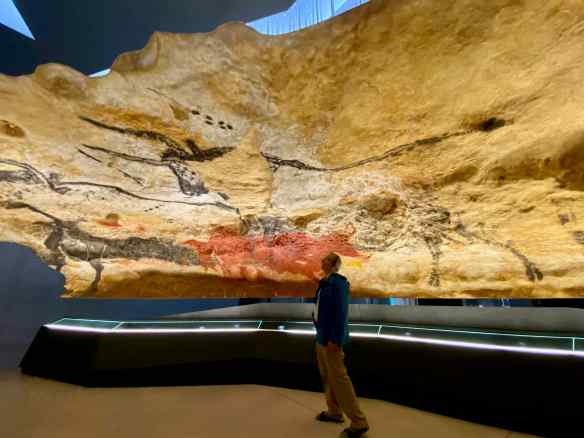
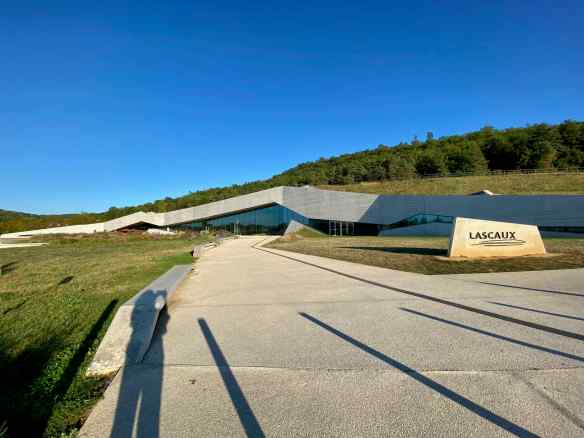
After we ate our lunch I did a bit of drawing and Bob did a bit of reading before we left for Lascaux IV.In 2016, a new replica, Lascaux IV, was opened to replace Lascaux II. It is adjacent to the original cave and offers an even more authentic experience than Lascaux II, with changes in air pressure, along with a series of atmospheric cave scents and sounds. Once again no photos allowed however there is an interpretive area that has more replica displays and we can take photos there.
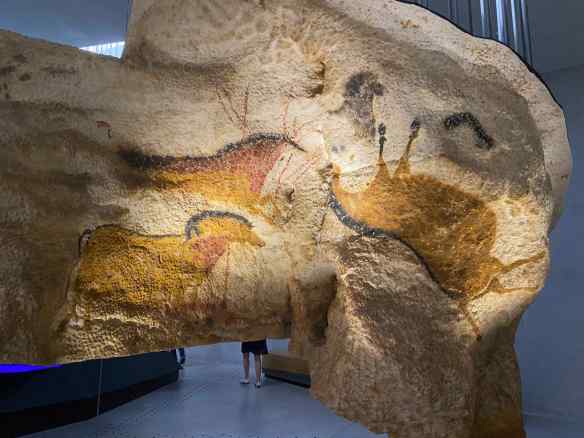
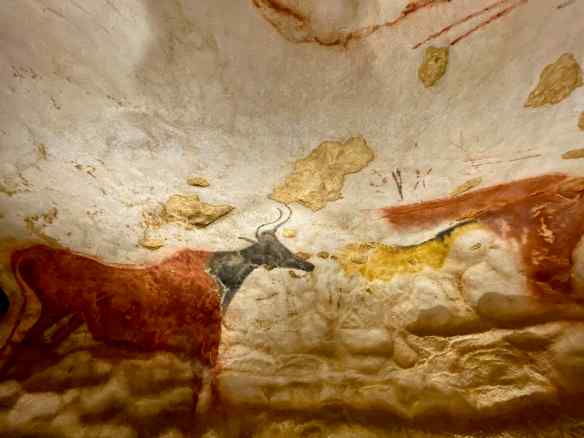
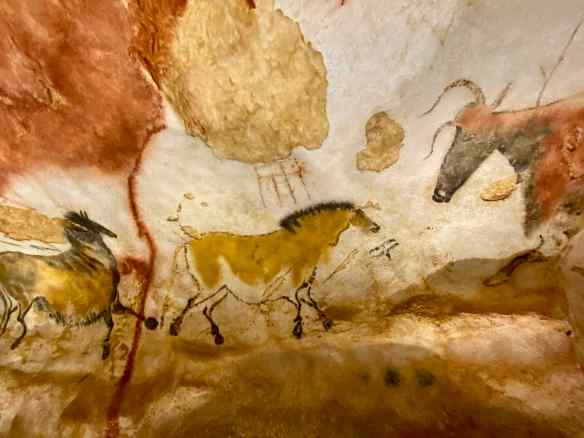
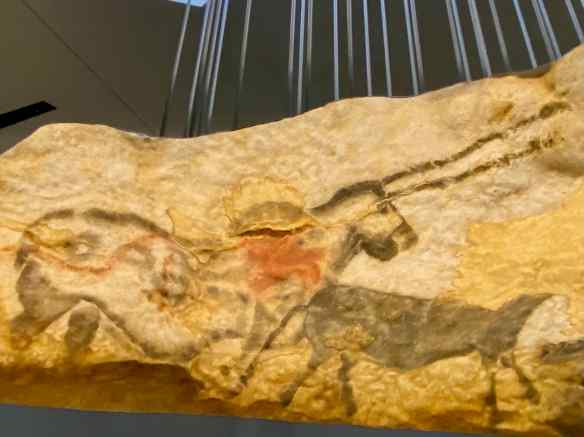
These displays are just as well done as the paintings in the cave..

It is nice to have a bit more time to really examine some of the the paintings up close and in better light.

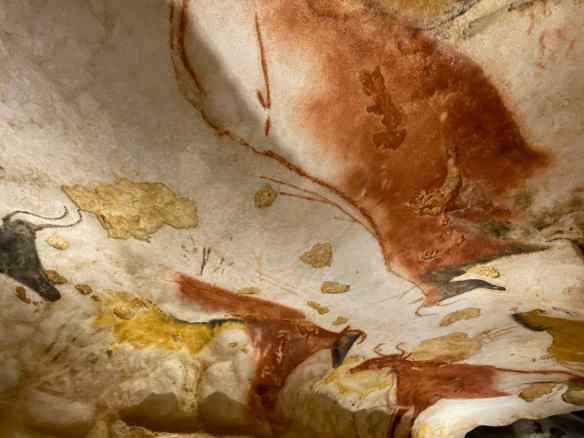
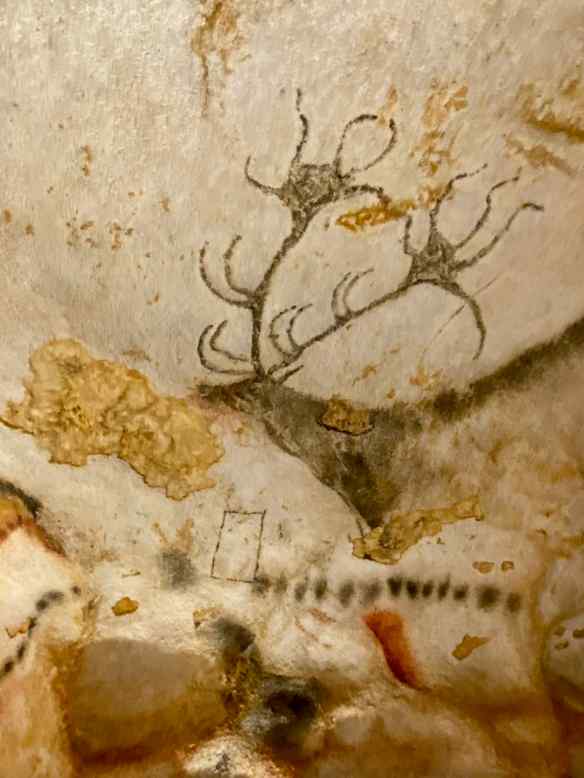
They are spectacular, and photos do not come anywhere near ot capturing this incredible art that was created 20,000 years ago by Cro-Magnons, who were the first early modern humans.

This stag is particularly beautiful with its magnificent set of antlers.

This is one of the first figures we see when we enter the cave.  It is called ‘The Unicorn’ even though it has two horns.  It is an animal drawn from the imagination of the artist and did not actually exist.

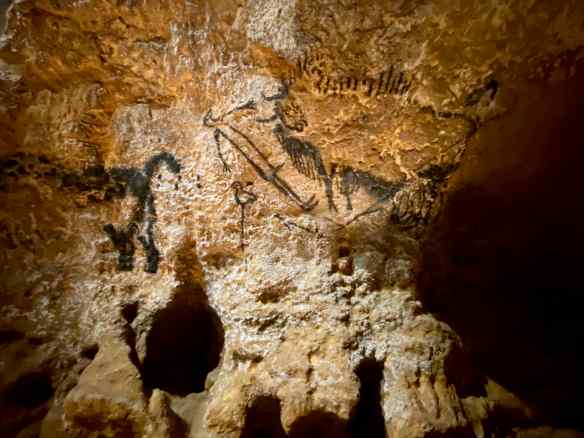
There is a deep shaft that has the only depiction of a human, although it does have the head of a bird.  This is also in the interpretive area as it would be impossible to climb down the shaft in the replica cave.  Here we can walk in at the bottom and look upwards to see the paintings.

This gives some idea of the size of these paintings.  This is one of the largest animals in the Lascaux caves.

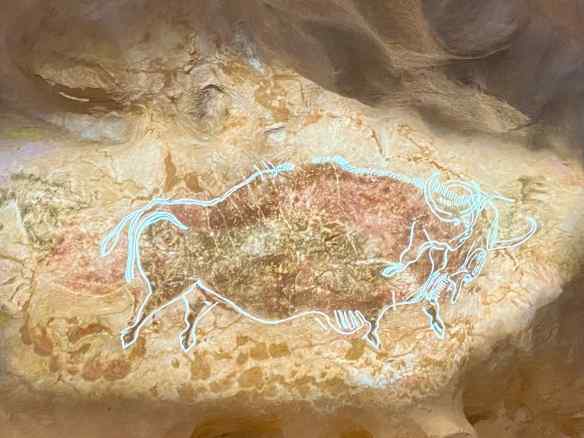
I like this bull.  It is the one I drew in Lascaux II.

This display showed the engraved lines of this bull.  Giving the bull two heads was used to portray movement.

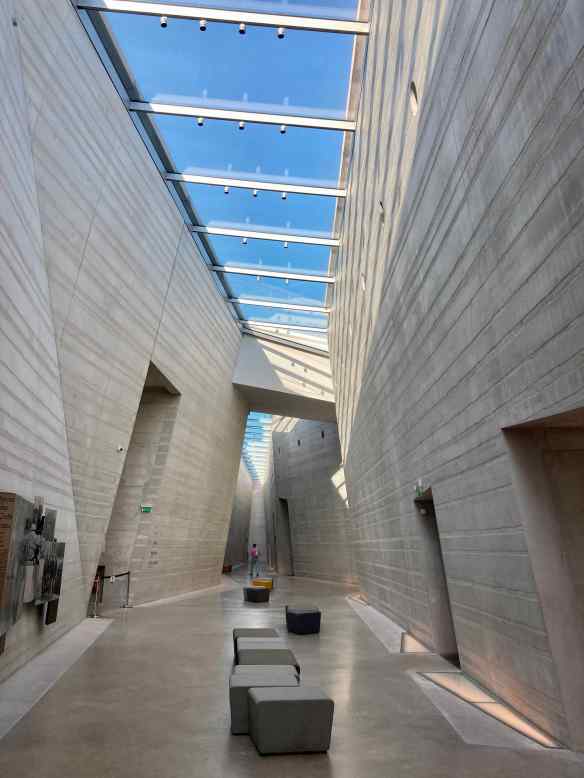
Leaving the interpretive area we walk down this long corridor which has several theatres with more information on Lascaux and the history of the discovery of the caves.  There are over 150 prehistoric sites in this area.The last room we entered had huge animations which travels across three walls and sometimes over the floor and ceiling as well.  I particularly liked this one which shows mammoths from the Rouffignac Cave, which we hope to visit later this week. https://www.youtube.com/watch?v=G2yv2ydzsJ0
We are the last people to leave and they lock the doors behind us after we walk out.  It was a great day.


Sarlat le Canéda, France

Day 34, Sunday, October 1, 2023

Our first day in Sarlat, Bob goes for a walk to check out the neighbourhood and I am quite content to watch the world go by from our window.  There is a knock at our door and when I answer it there is a box of local goodies from our Airbnb hosts.

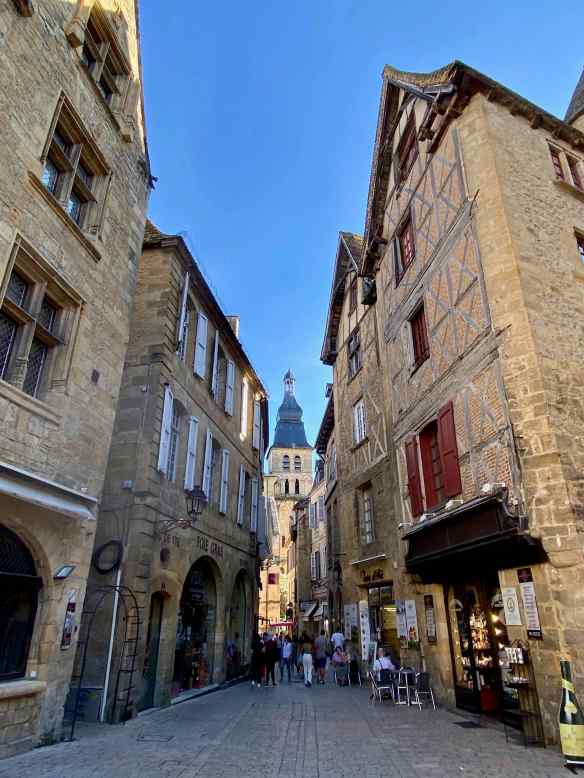
In the late afternoon we go for a little walk through the narrow cobblestoned streets.

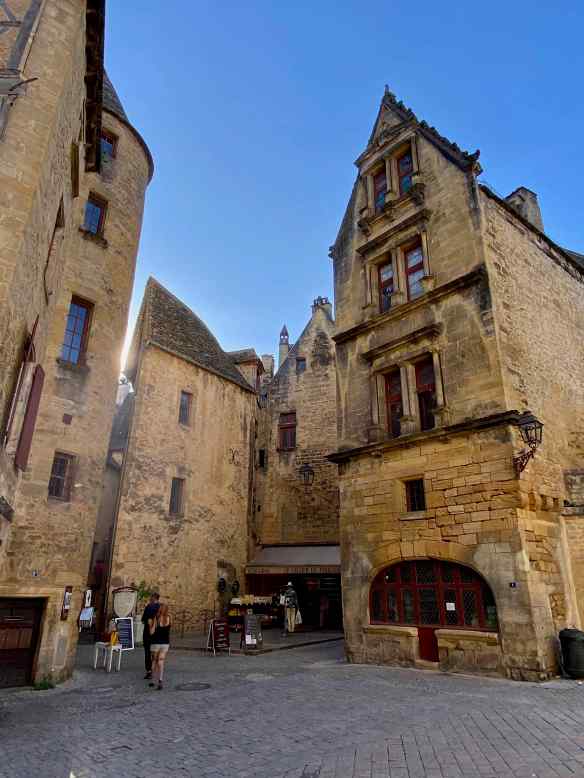
This is a Medieval town and most of the buildings date from the the 15th century and even some from the 13th century!

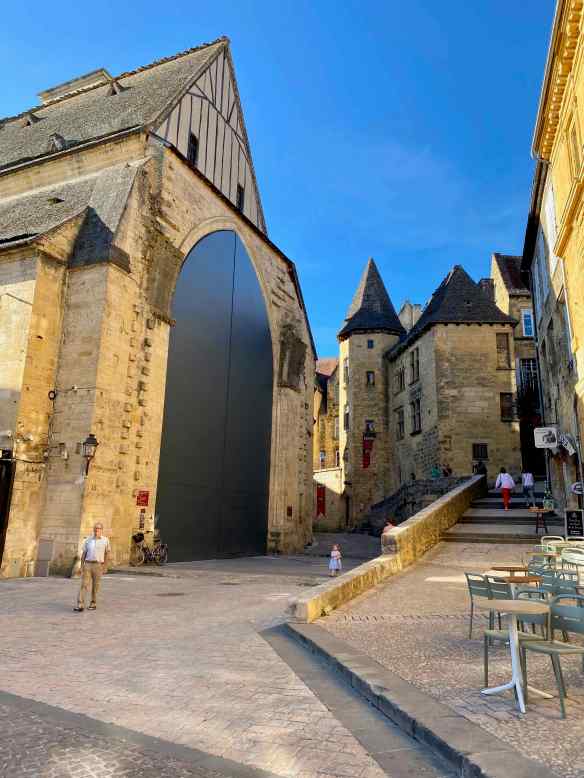
This old church is now an indoor market.  We will have to return when it is open.

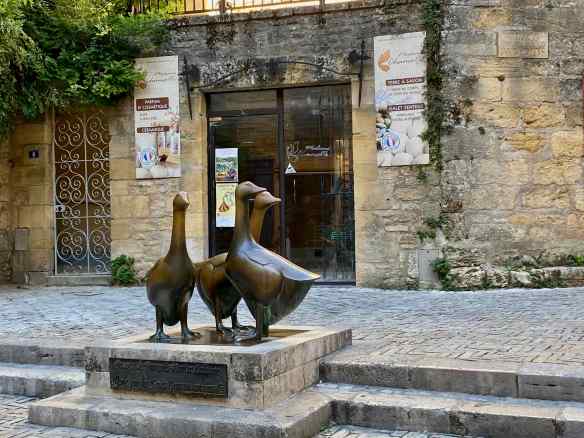
This statue of three geese is a reminder of the importance of the local fois gras industry.

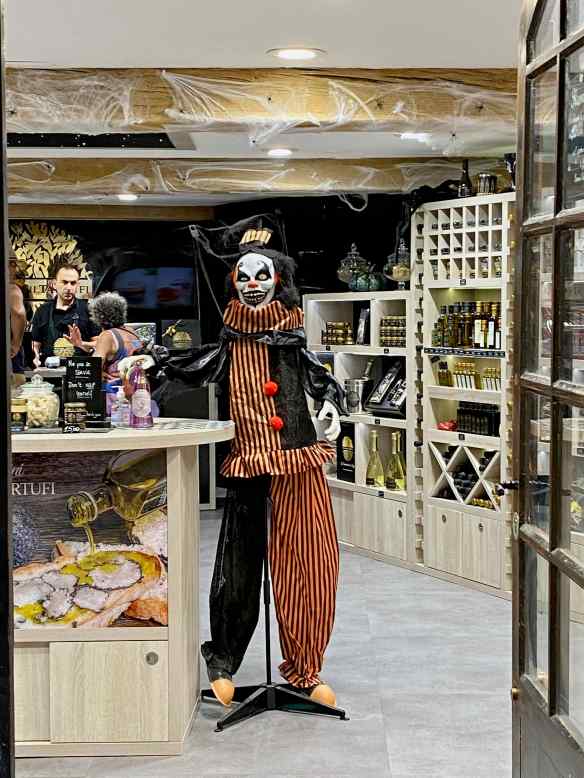
Some of the shops are already starting to decorate for Halloween.  This clown is particularly creepy.

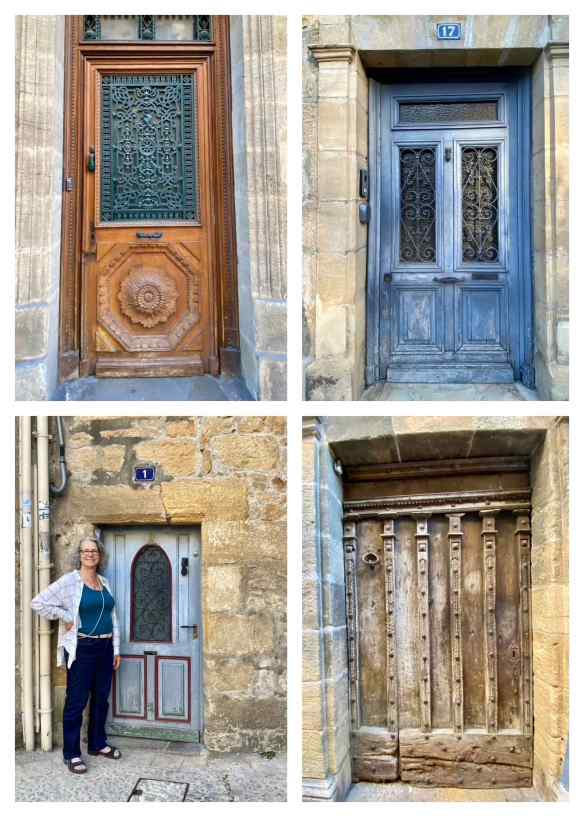
There are always interesting doors in French cities and towns.

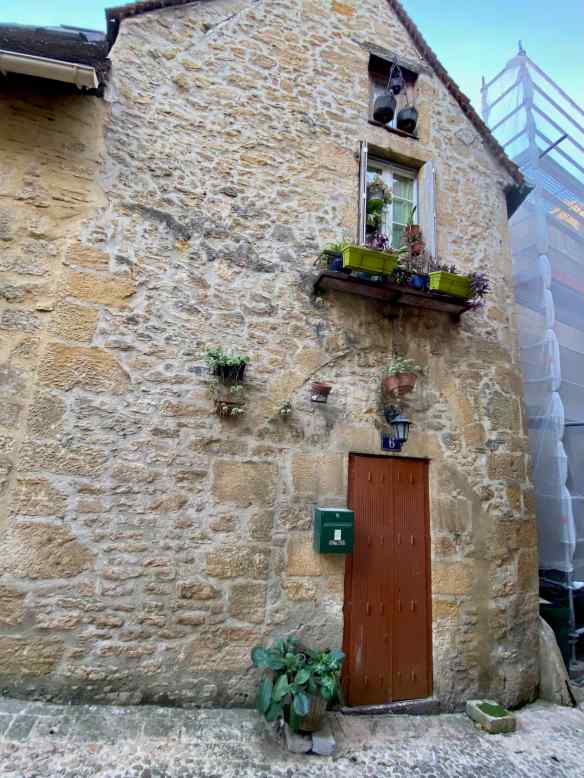
What to do when you want a garden but don’t have a yard.

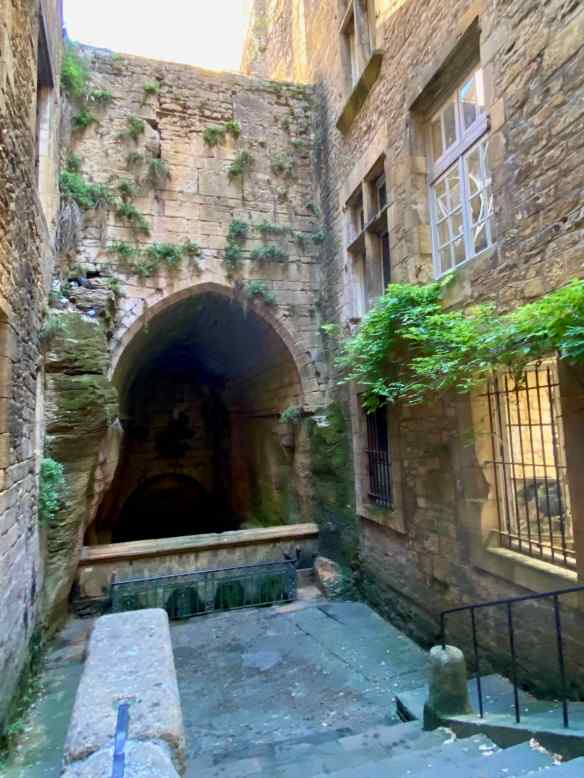
The Fontaine Sainte-Marie is nestled in a natural grotto not too far from our apartment.. This 12th century fountain was used until the 18th century when the water became polluted from nearby streets and stables.  

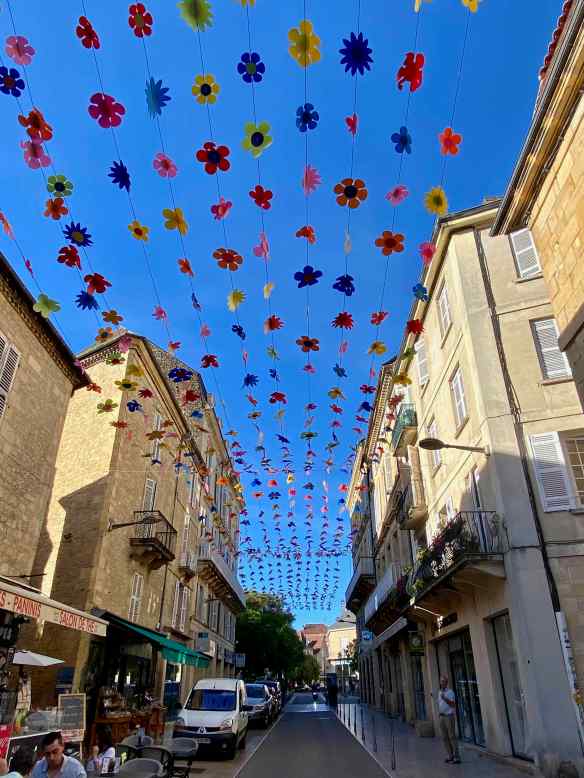
We walk back home under a street festooned with flowers.  This is going to be an interesting place to stay.