Day 45, Wednesday, October 9, 2019
Time to move on to our next destination. I took this picture because I know my mom will recognize the pot with blue designs beside the flowers. She has one just like it.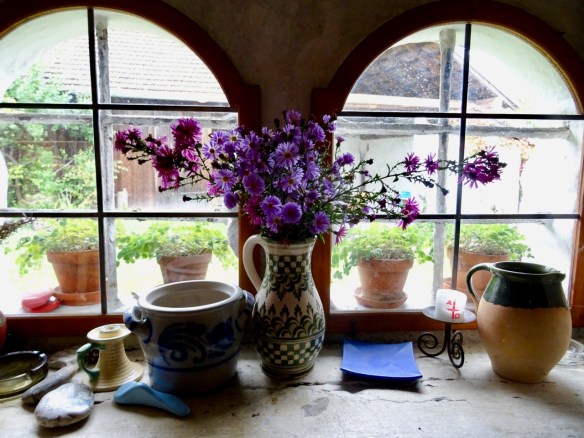
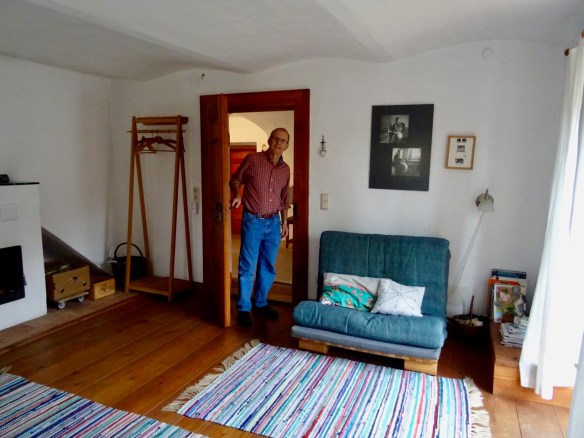
Bob closes the door as we leave. It is hard to see, but the picture on the wall is of the two old aunties who used to live here. I was going to take a close up of it and somehow forgot.
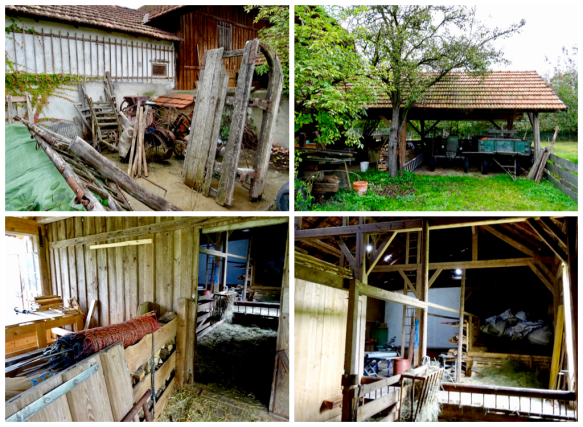
 On the way to say goodbye to my friends the sheep I snapped a few more photos of the farm buildings. There were certainly lots of interesting things to see here.
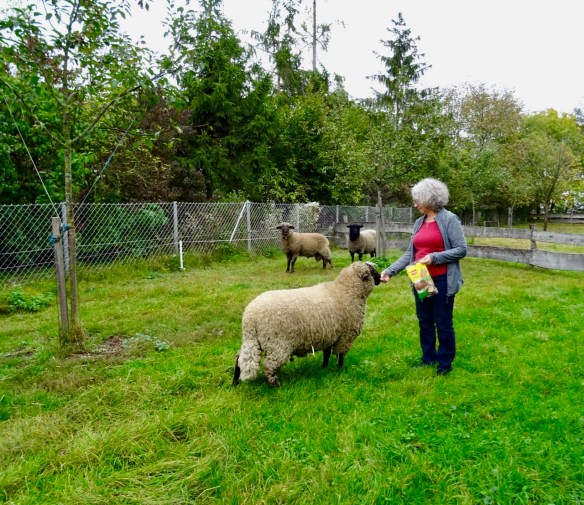
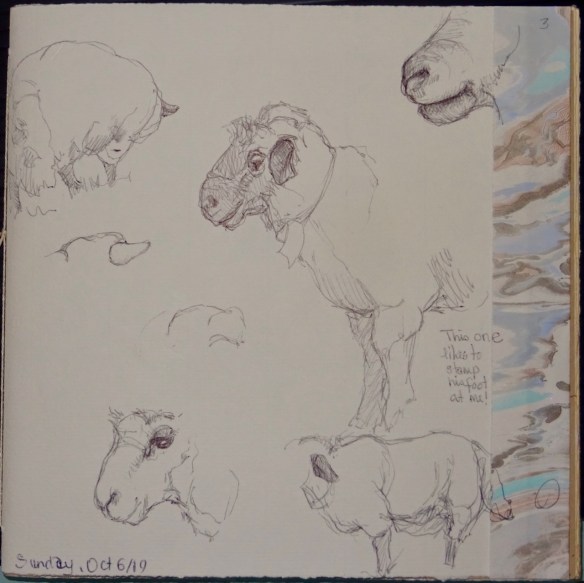
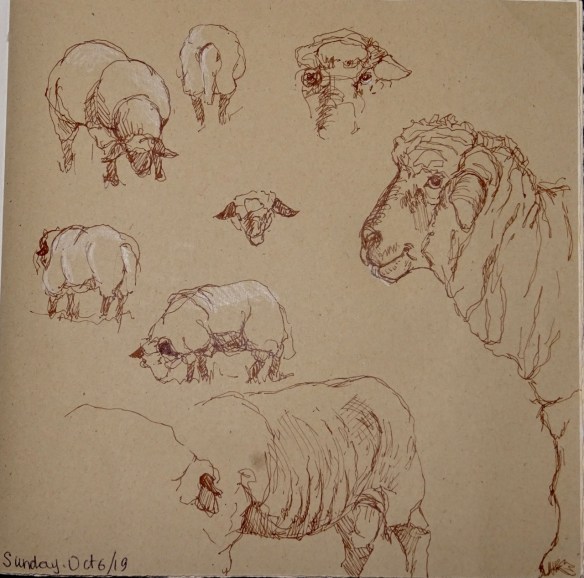
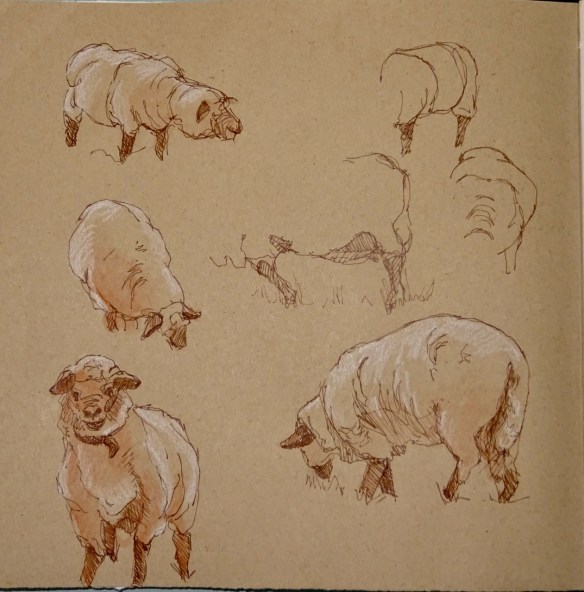
 Only the young fellow destined for the table came up to see me today. The other two were playing shy.
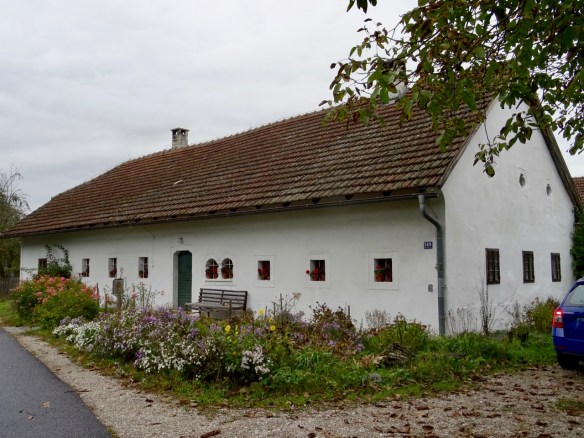
 This shows how long the front of the house is. The attic full of stuff ran almost the whole length of it. On the far end was the smaller attic above the two bedrooms in the auntie’s house.
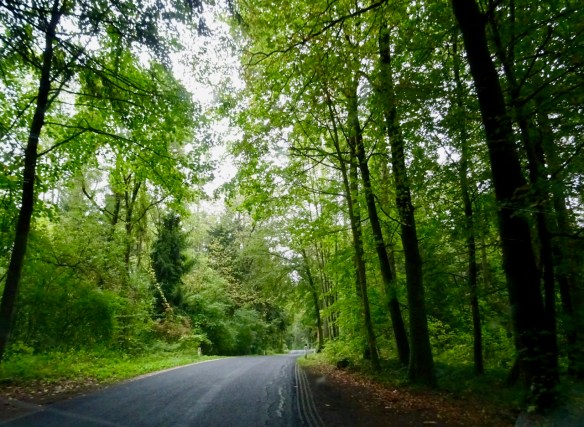
 Part of the route to St. Florian Monastery, which is our next stop, is a very narrow road through some woods.
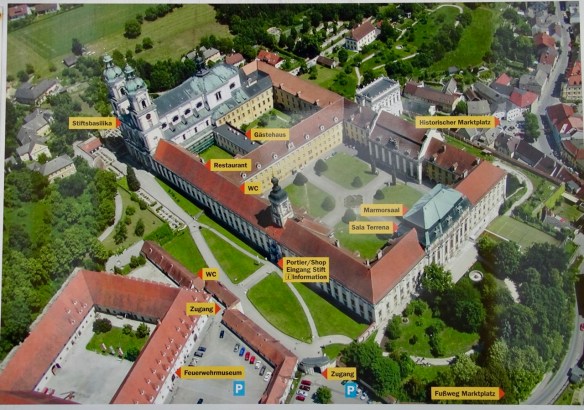
 The monastery is very large. The stretch of red roof from the church to the front corner is 200 metres long. It covers a corridor that runs its length.
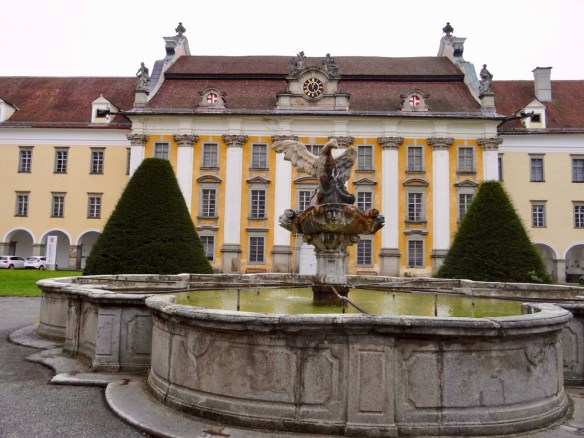
 This is the fountain in the middle of the large courtyard.
 I am so excited…we actually get to go into a library. This library has 150,000 books, 35,000 of which are in this one room. They are mainly books on Religion and History.
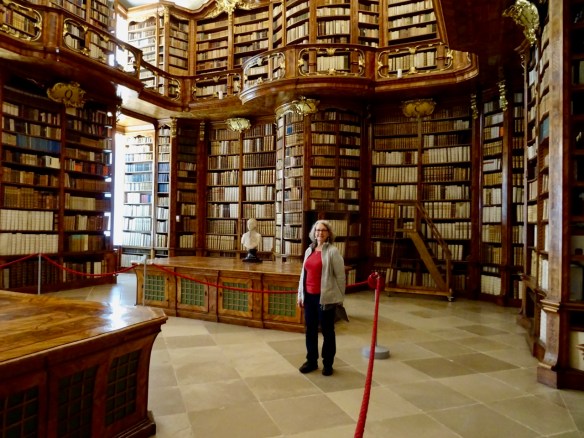 You can see the bookcase door that opens to another room. The spiral staircase to the second floor is in that room. There are many more rooms full of books but we only get to visit this one. We are told that this library is available for the public to use. Wish I lived closer!
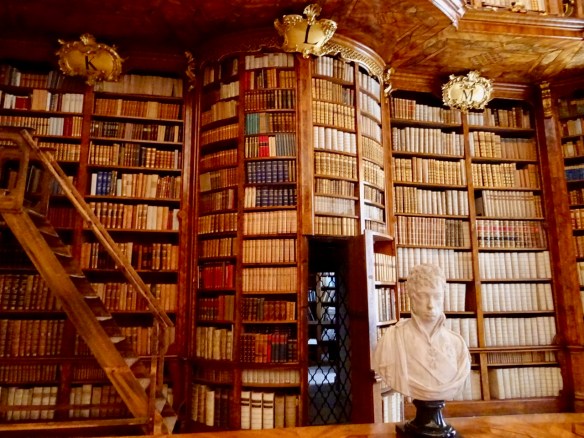 I love the library ‘ladders’ used ot reach books on high shelves. Heck, I pretty much love everything about this library!
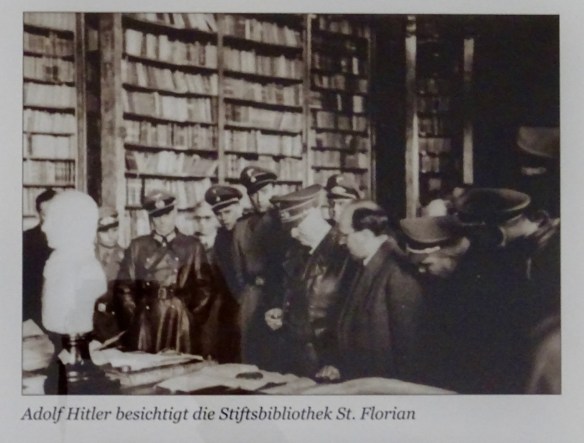
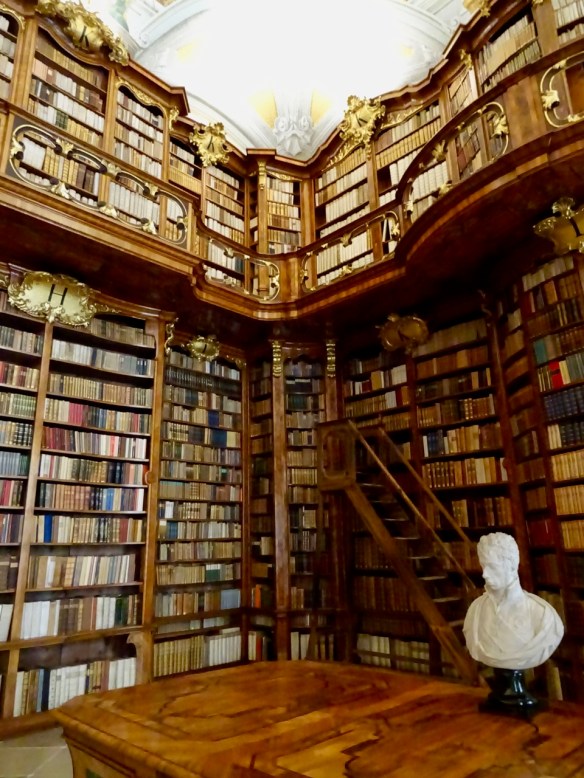 Later on during the tour we see this photo of Adolph Hiltler standing in the same place we had just stood. It is a strange thought…that we were someplace that he was.
 Of course this library also has a magnificent ceiling.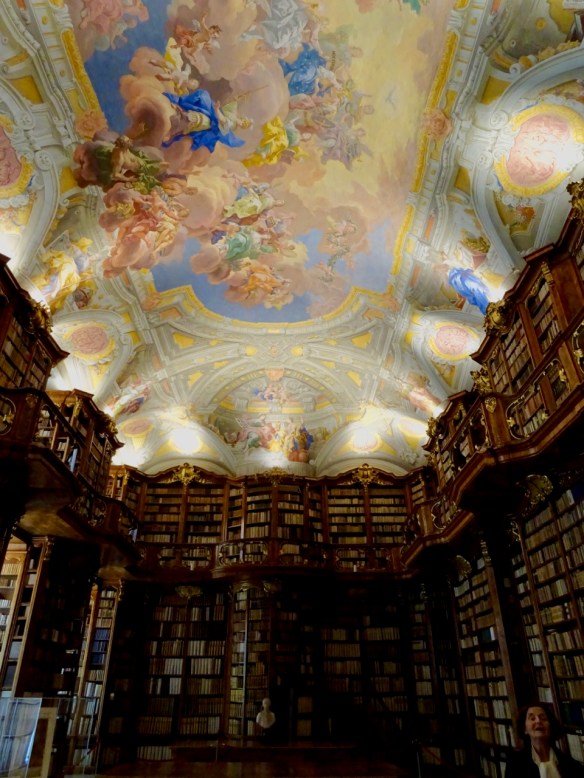
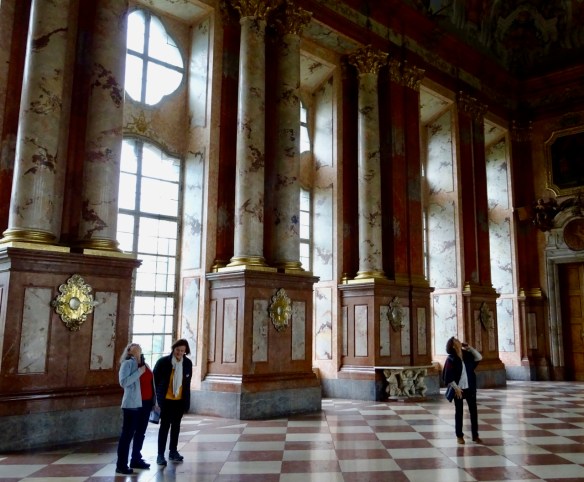
Next we visit the Marble Ballroom which represents the colours of the Habsburg Monarchy, red, white and yellow. This is why I end up with a sore neck after sightseeing!
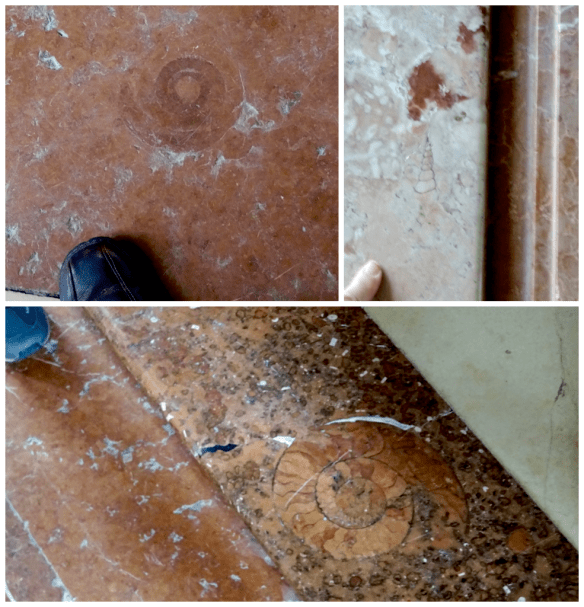
 Our guide pointed out some of the many fossils that are in the marble on the floors and walls. I never thought of marble as being a stone the came from ancient oceans. The big ammonite was on the fireplace hearth, notice the toe of a shoe in the corner for scale.
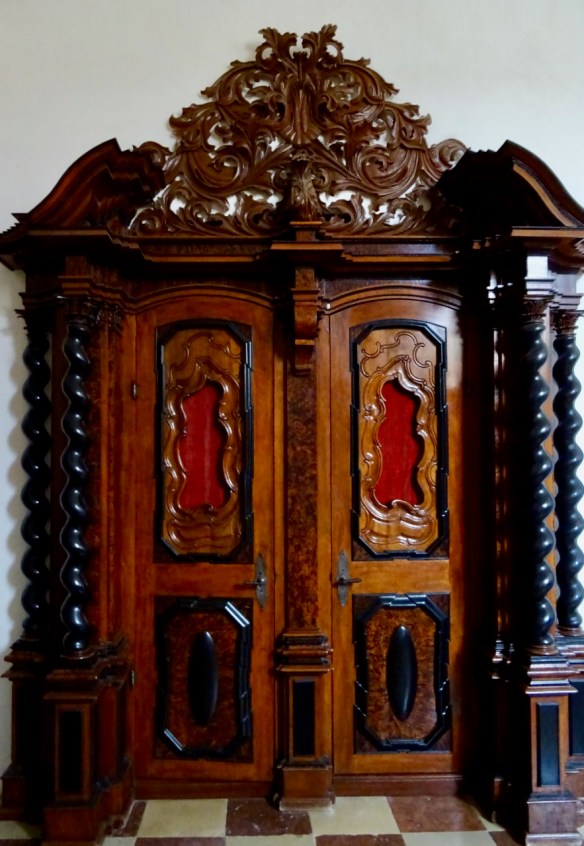
 One of the many very ornate carved wooden doors in the monastery.
 The Monastery church is grand. Lots of carved white stone and dark carved woodwork.
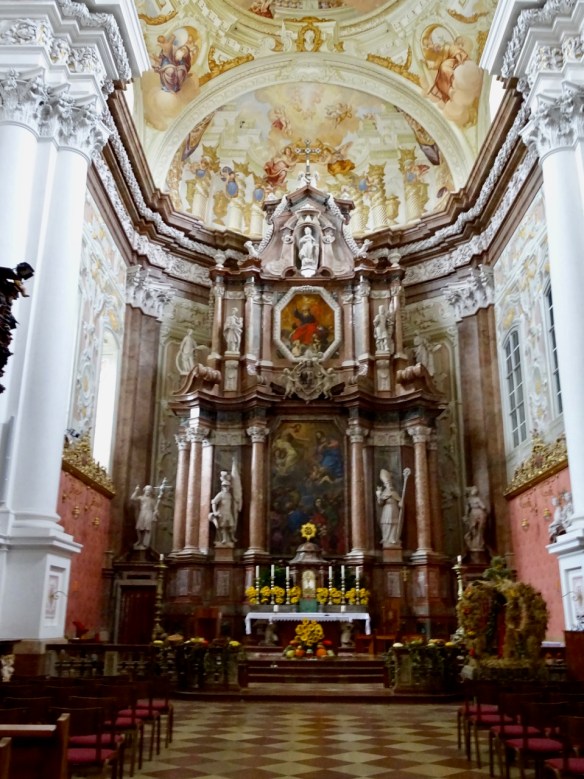 The altar is decorated with bouquets of sunflowers.
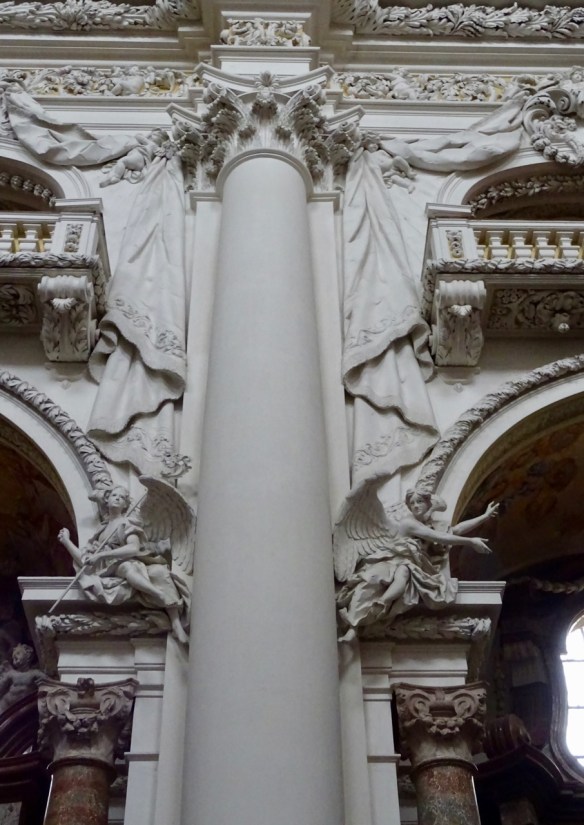
 We have never seen drapery carved in stone in a church before. Everything in this church looks so very well preserved, there are no broken or dirty bits. In fact everywhere in this monastery is very well taken care of. We wonder where the money to maintain a place this large comes from.
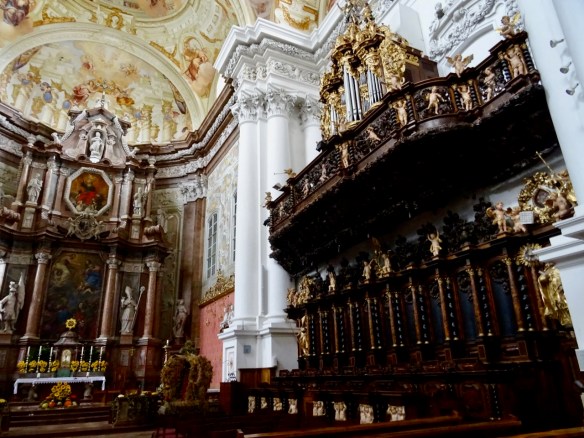
  The church organ was built in 1774 and it is one of the largest working organs in Austria. It is known as the Bruckner Organ as it was played by composer and organist Anton Bruckner. He had been a choir boy at the monastery, and he was the church organist, between 1848 and 1855.
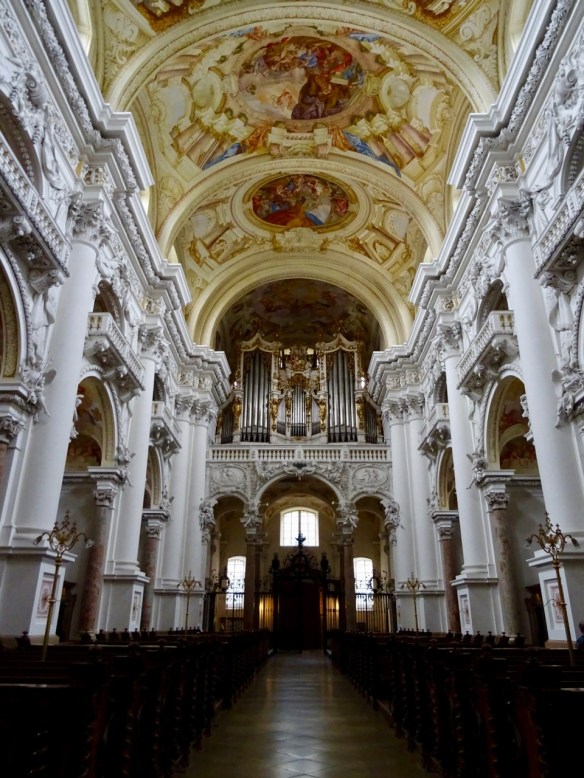 I do not know much about classical music so did not know anything about Anton Bruckner. He was a famous Austrian composer, organist, and music theorist best known for his symphonies and masses. On the floor directly below the organ is a memorial plaque and …
 in the crypt directly below this plaque is his sarcophagus. His wish was to be buried here at St. Florian Monastery even though he lived and died in Vienna.
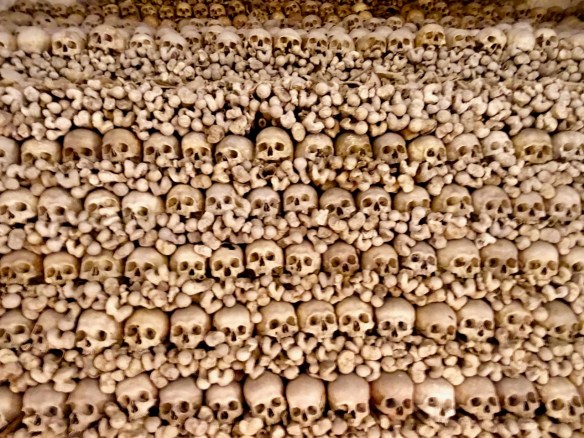
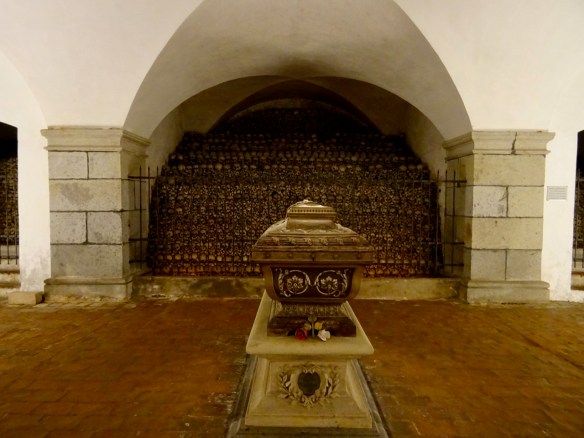 Yes, those are bones behind the sarcophagus, the bones of over 6,000 people, dating back to the 4th century. It is thought that the bones of St. Florian could possibly be in here.
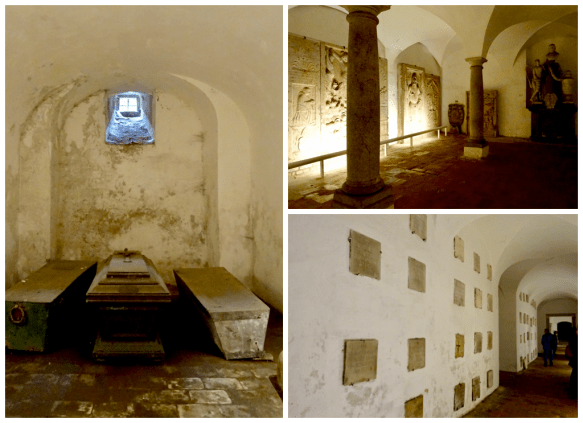
  A few more pictures of the 700 year old crypt which is still used today as a burial place for the monastery monks. The windows open to outside, there is no glass. I wonder if this was so decomposing bodies were ventilated?
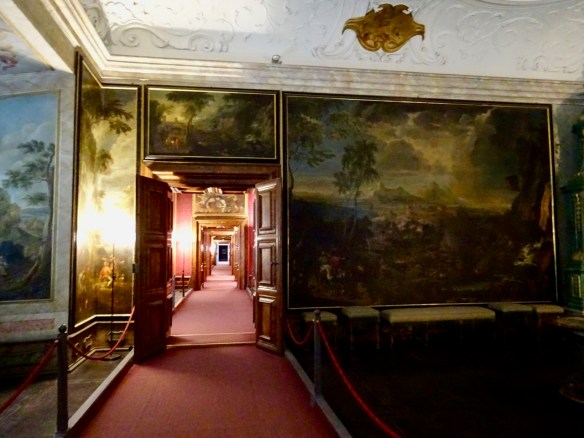
 We visit twelve guest rooms in the monastery. These rooms have not been used since the mid 18th century and have been preserved as a museum. These elaborately decorated rooms were reserved for royalty who might visit the monastery. These doorways connect all the rooms.
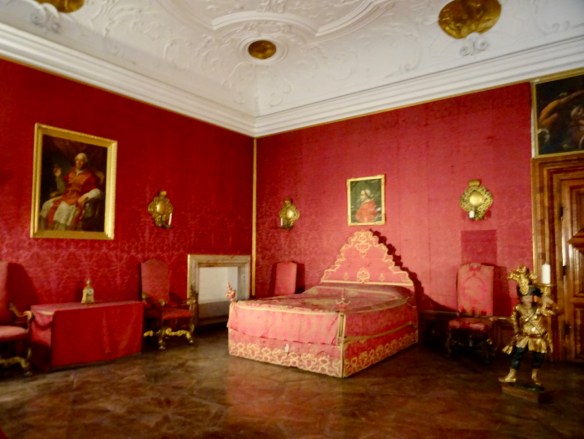
 The red bedroom was reserved for Pope Pius VI, although he only spent one night here.
 The walls and chairs in this room are covered in matching tapestries. There is a big masonry stove in each of these rooms.
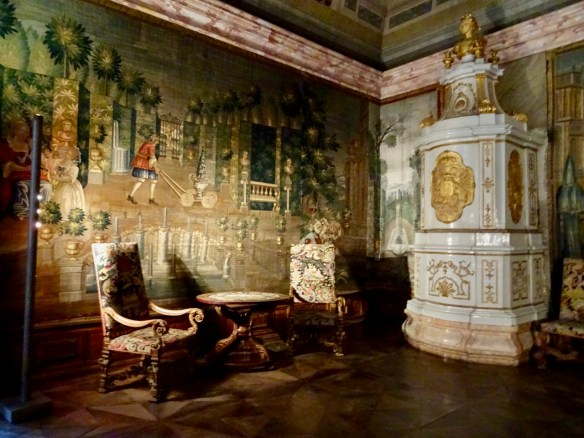 Each room is lavishly decorated.
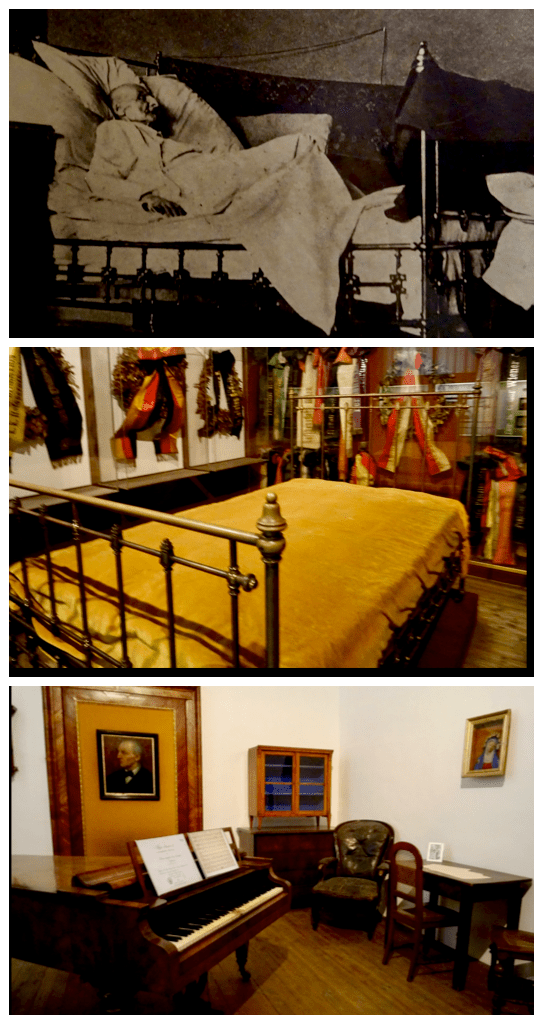
 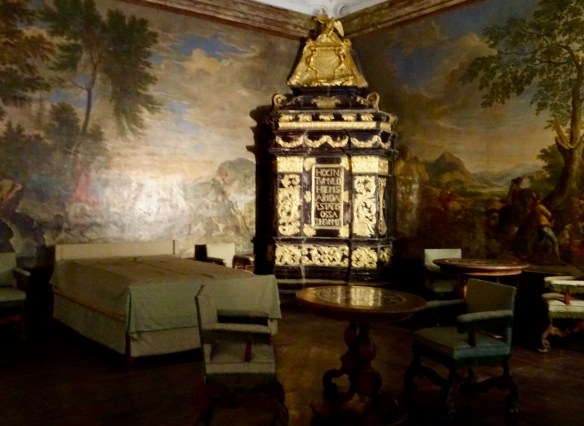 The last two rooms are a shrine to Anton Bruckner. The photo shows him in his bed in his Vienna apartment. He died in this bed, which is now on display here along with his other furniture.
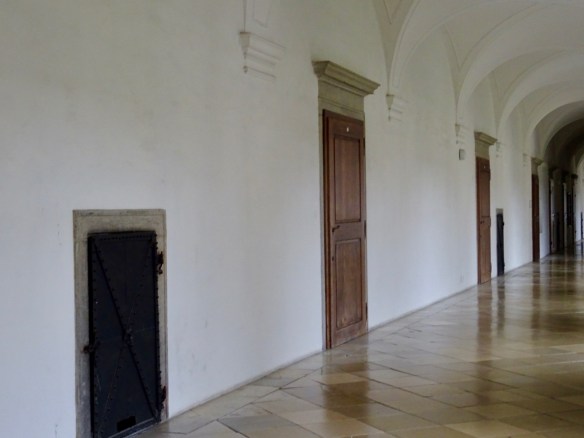
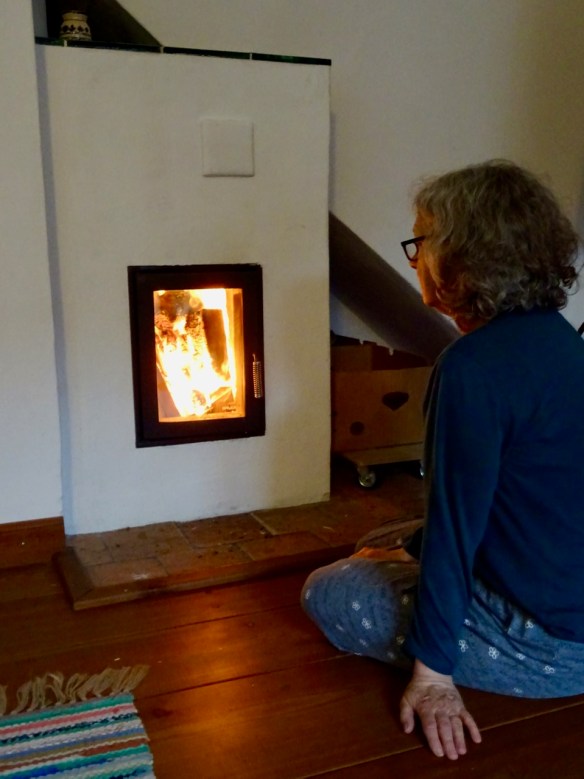
 Remember those big masonry stoves in the royal apartments? These metal doors in the hallway open to the inside of the stoves. This is how the fires in the stoves were cared for by servants without bothering the apartment occupants.
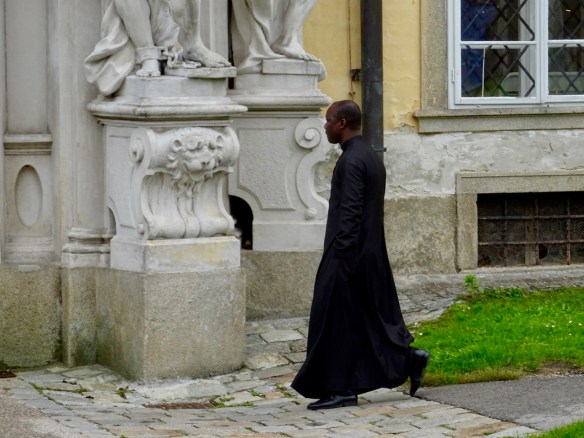
 There are thirty monks at this monastery. Only thirteen live here full time, the rest live in neighbouring parishes. Over the last 950 years the monastery had 108 monks at its peak and only three at its lowest. I am told that thirty monks is quite good ‘these days’. There is one young monk, several in their fifties and sixties and the rest are older. We see this monk as we are leaving and assume he is the one young one.
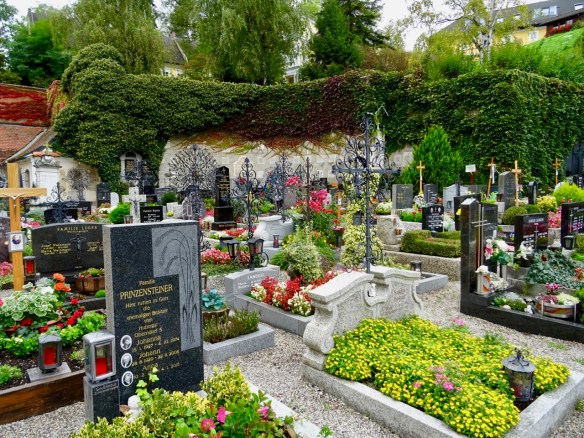
 The cemetery beside the church is the prettiest, most well cared for one we have ever visited.
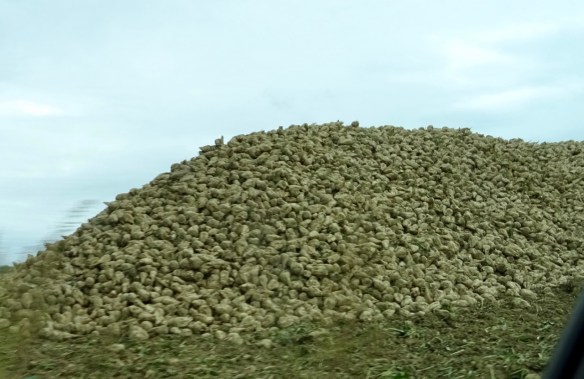
 As we drive towards Salzburg we pass several huge piles of sugar beets in the fields. Austria grows more than 3 million tonnes of sugar beets every year.
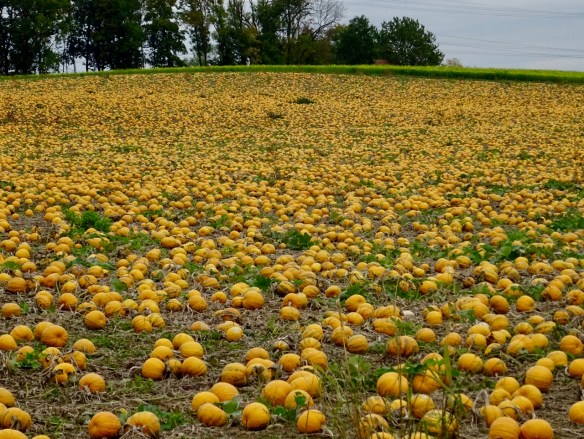
 Finally we find a safe place to pull off the road so I can get a photo of one of the fields of pumpkins we have seen along the way.
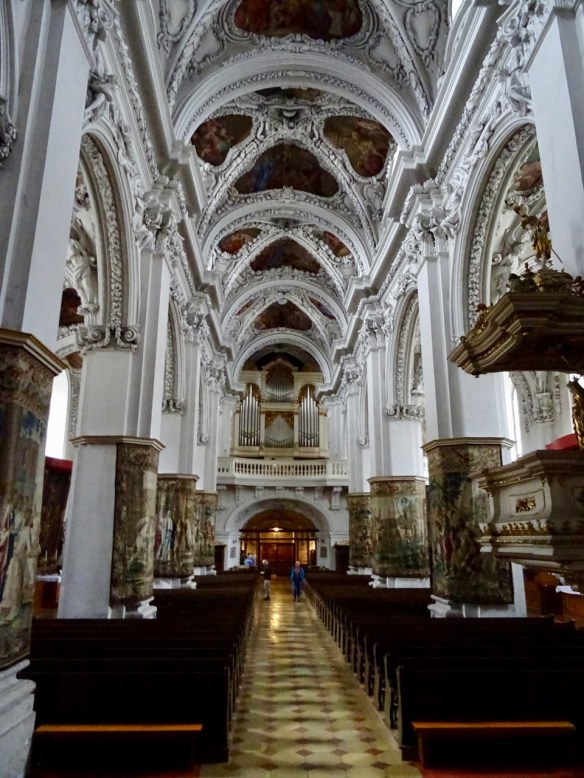
 We make a quick stop at Kremsmunster Monastery but it can only be visited by guided tours and we don’t have time. The church is open and it is the only one we have seen that has tapestries wrapped around its pillars.
 Back on the road, from a distance, I thought this was another field of pumpkins or maybe squash, but they are sunflowers.
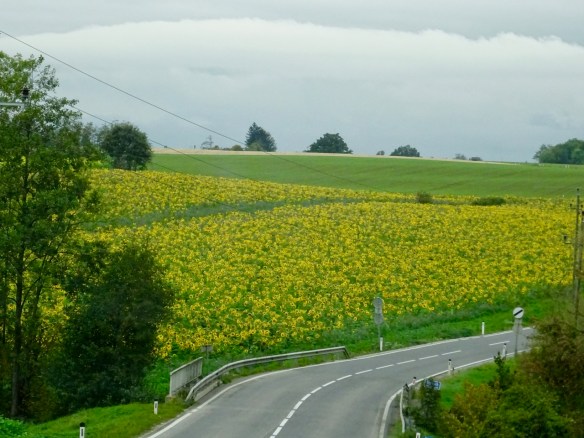 Good thing the sun wasn’t shining or I would have wanted to stay much longer and take many more photos. What a beautiful sight it was to see so many gorgeous sunflowers.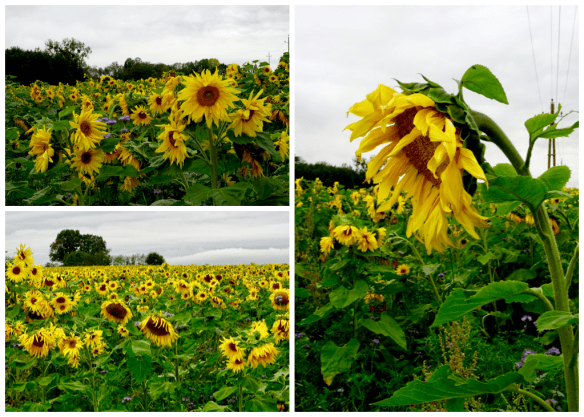
 On our way in to Linz we see this ‘green’ apartment. Lots of gardeners must live here.
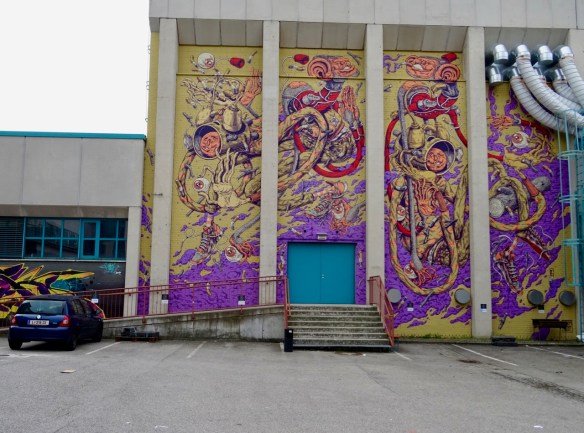
 It took some time to find the bike rental company. They weren’t easy to locate. We pass this big mural during our search.
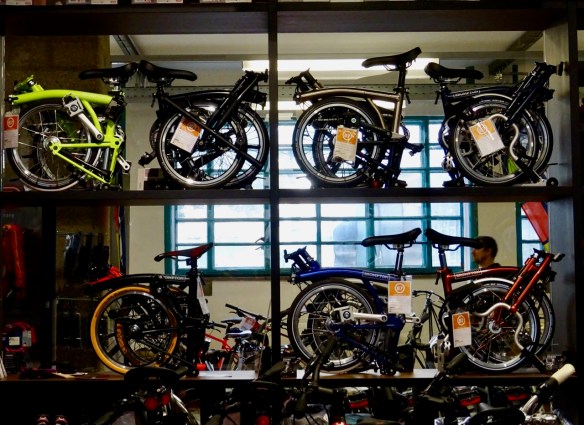
 I thought these bikes were quite interesting. They fold up compactly.
 We start out on our bike trip along the Danube. Bob wants dot take my photo while I was still in one piece!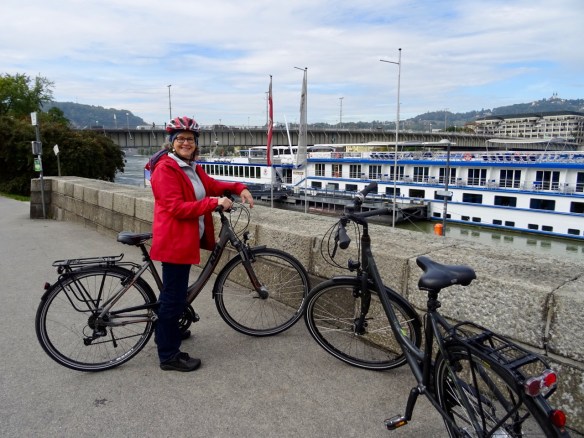
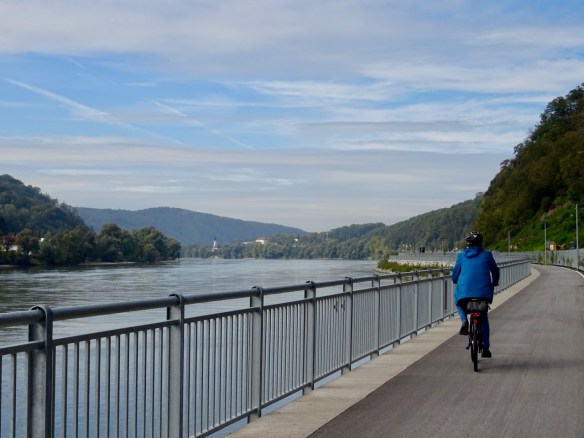 There are some great views along the way…
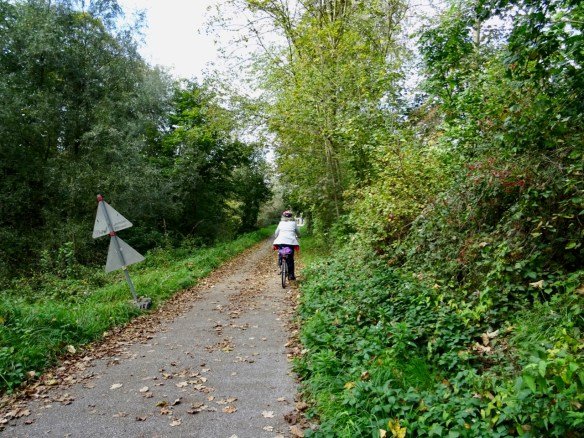
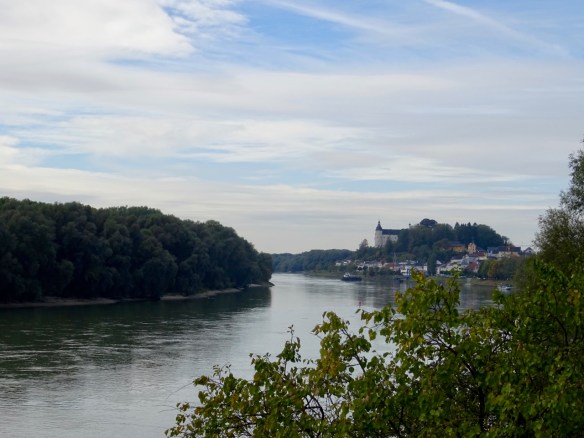 and some wooded trails. I did quite well until the killer hedge tried to get me…and then there was the vortex railing! If I got too close it tried to suck me in!
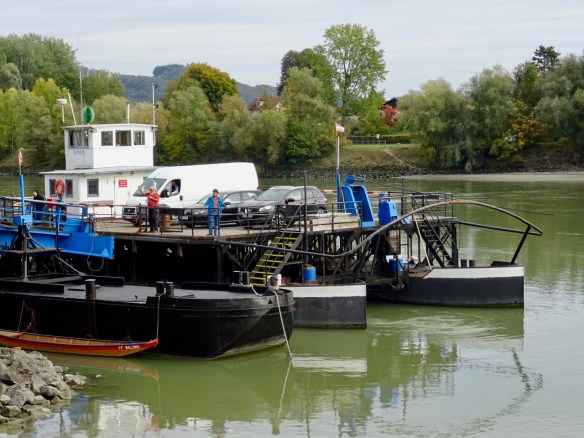
 Bob left me at a coffee shop to rest and sketch and he went a bit further down the river, crossed a bridge, and then returned on this strange looking ferry.
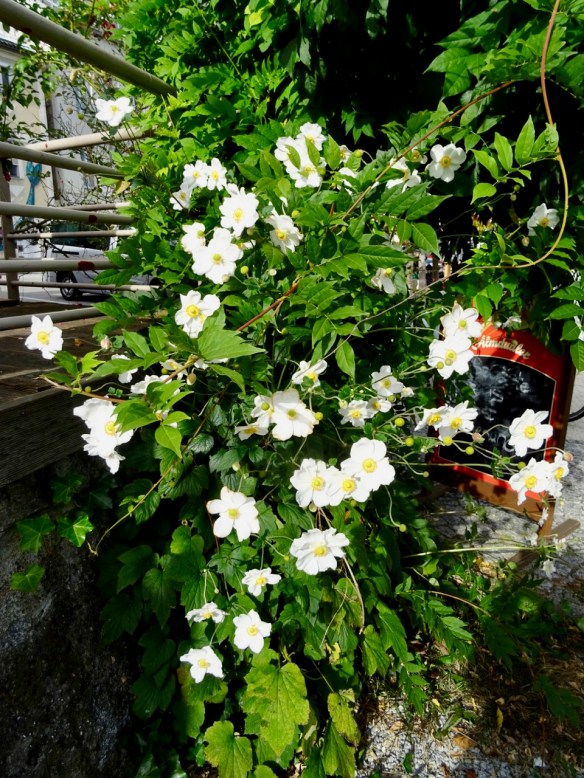
  These flowers are much like the anenomes we grow at home only much larger.
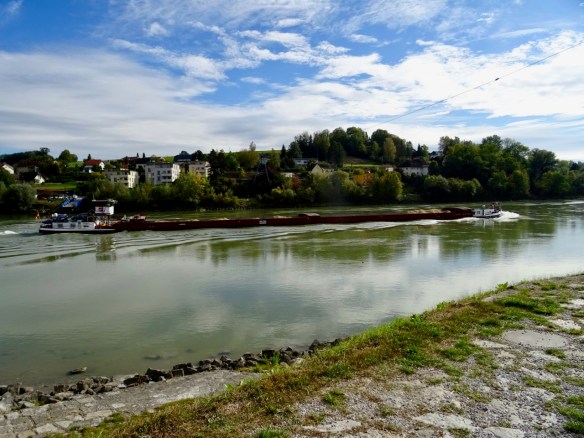
 We see the long barge steaming down the river.
 This curious mural is on a building near the café where I waited for Bob.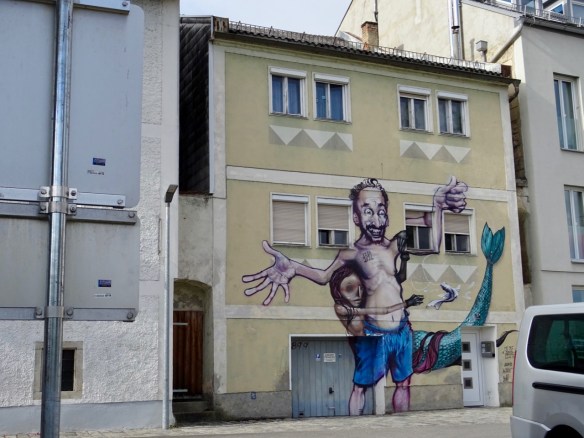
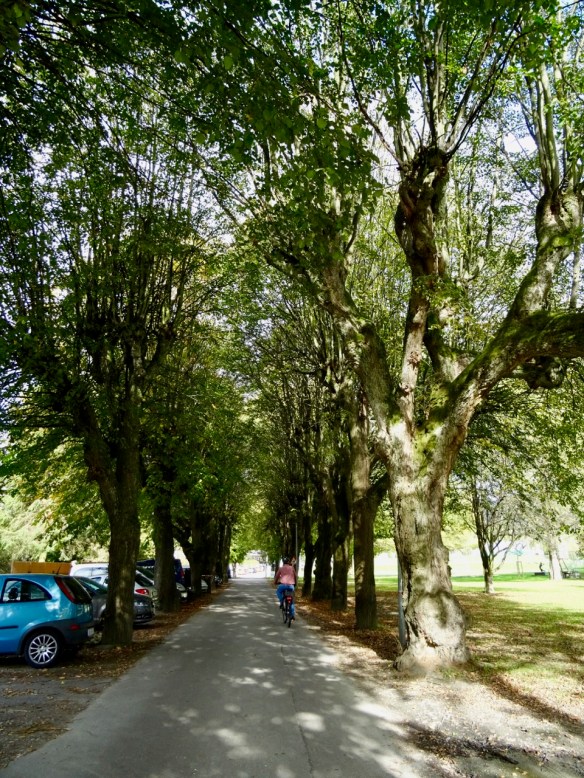 Our selfie along the Danube.
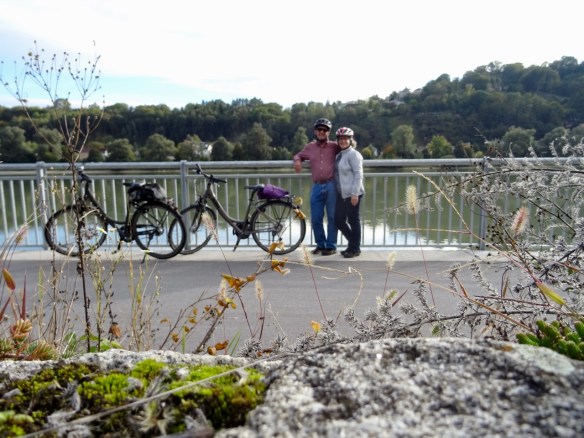 I need a few breaks on the ride home, so a photo is a good excuse for little rest 😉
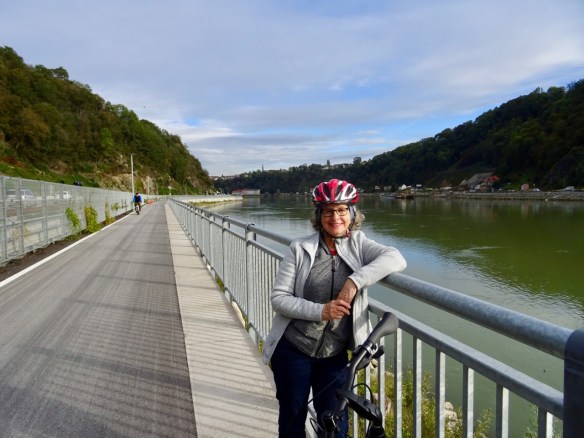 These river cruise boats remind us of our cruise on the Nile, where the cruise ships were lined up 6 or 7 deep along the shore. Passengers had to walk through all the ships, sometimes walking across the water on a narrow board between the ships, to get to shore.
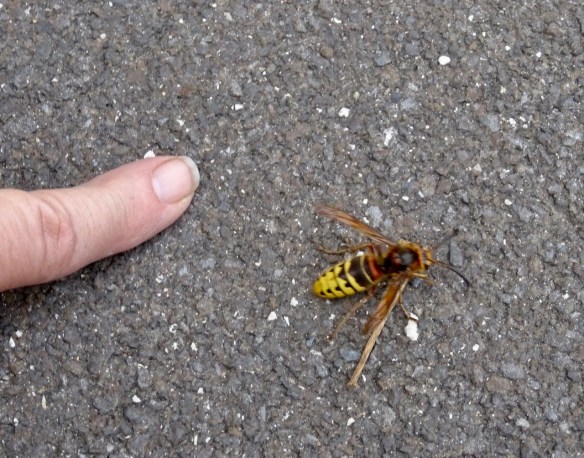
 This wasp was really big!
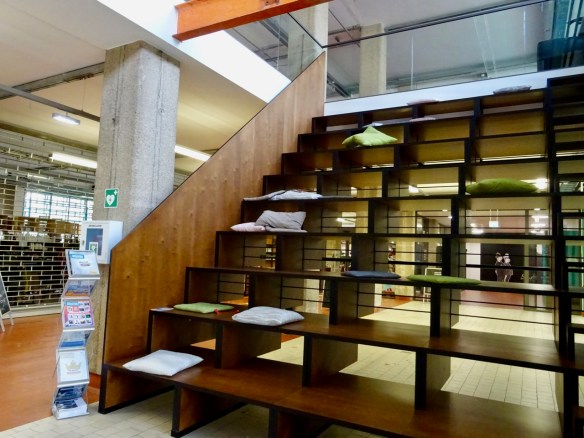
 We take our bikes back. They are in a building which is an incubation centre for start-ups. Looks like these steps are a place to relax, or even snooze.
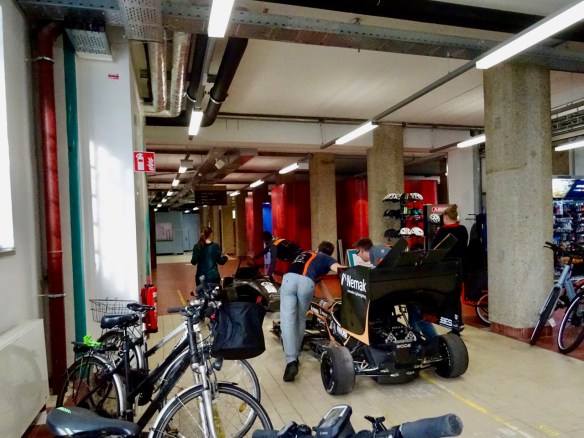
  We see two souped up go-carts being wheeled into the building.
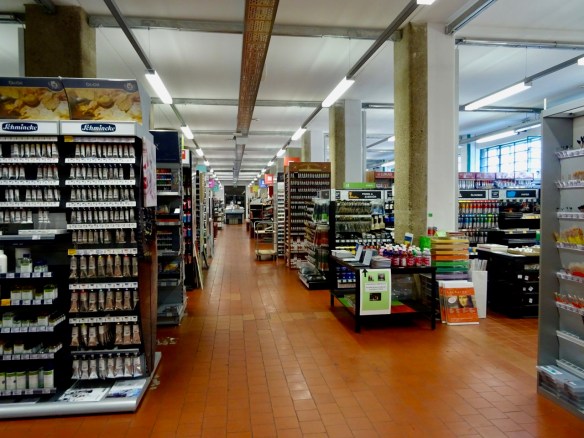
 I am happily surprised to discover Gerstäcker, a huge art store, in this building. After our ride I spend at least an hour exploring and find some new drawing pencils, and two really nice hardcover Hahnemühle Sketchbooks, a 10″ square and a 8.5″ x 12″ rectangular one. They were really reasonably priced too! I couldn’t resist even though my suitcase will be a lot heavier.
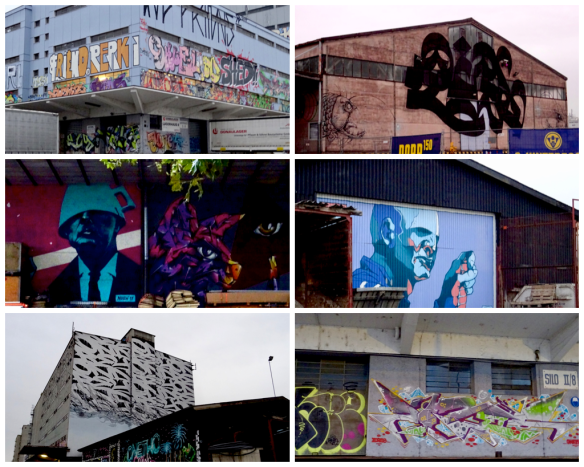
 Nearby is an industrial area called Mural Harbor. Artists from over 25 nations created more than 100 works of art on warehouse buildings.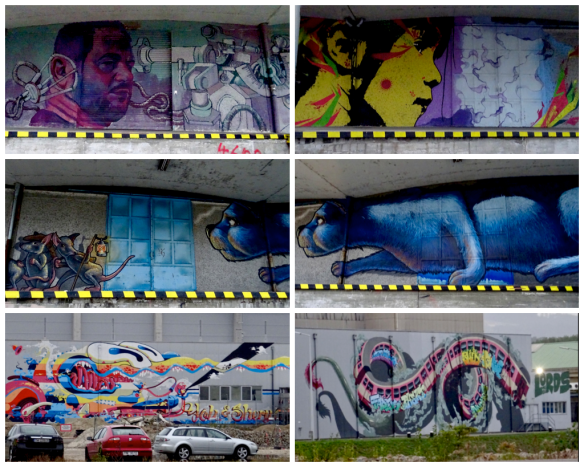
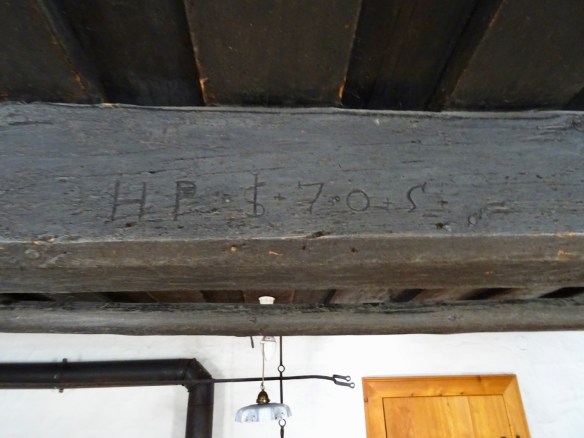
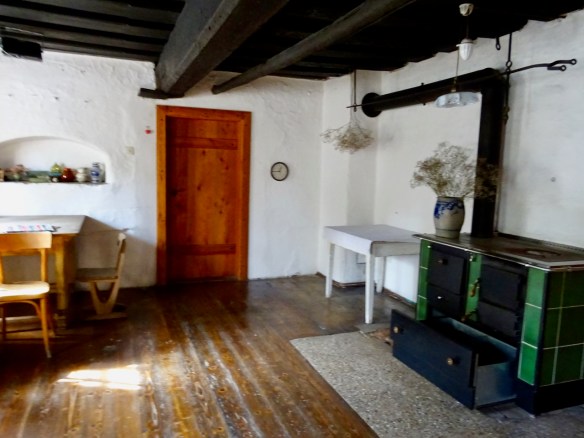 The date 1705 is carved in the ceiling beam, but Peter tells us that the cottage is actually 400 years old and was originally a fisherman’s cottage. He says this is a typical farmhouse. I never got a chance to ask him if the original fisherman’s house was always this big, or was it added on to over the years?
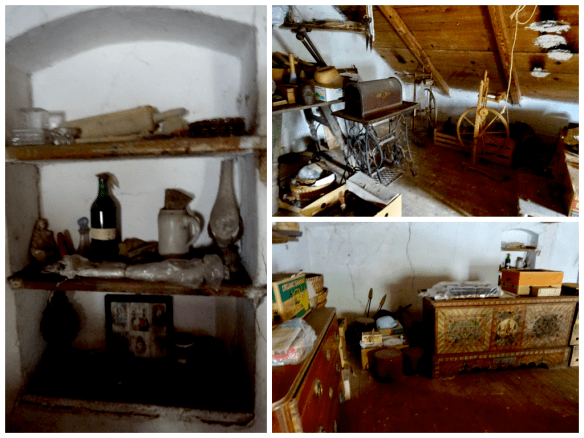
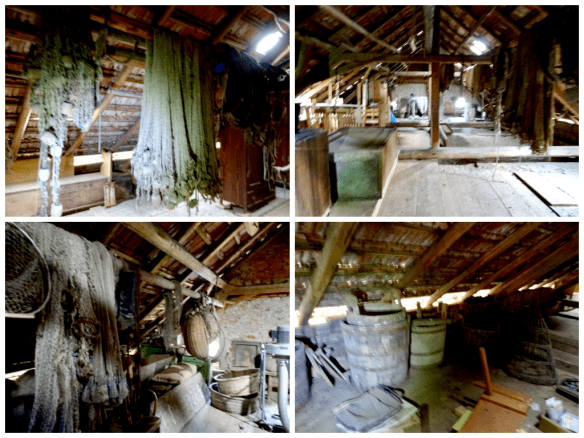
  I would love to be able to poke about in this attic! There are spinning wheels, a sewing machine, old chests and trunks, baskets, containers of all sorts, and lots of boxes filled with who knows what?
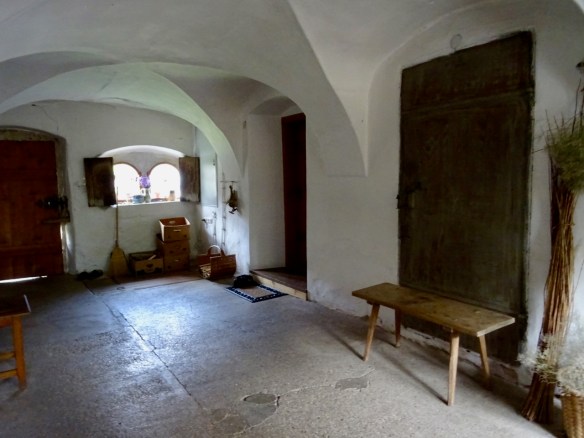
 The entry area between our apartment (which used to be a stable), and the living quarters has this big metal door behind the stool. Upstairs is another enormous attic that runs the length of the building.
 Here there are even more interesting things: old fishing nets, more chests and trunks, old baskets and wooden buckets and vats, and all sorts of interesting things that have probably been there many years. Now I look at all the houses we drive by and wonder what is up in those attics! I wonder what treasures might be hidden away in all these old houses?
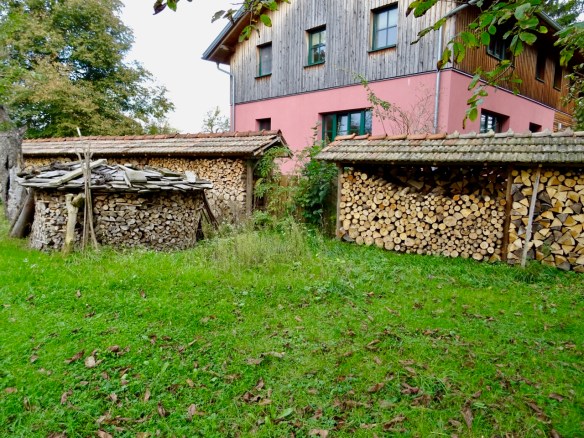
 This is only some of the huge woodpile Peter has cut and stacked, ready for the winter. We think that the air quality here must be very poor in the winter with all the wood burning that takes place. Most of the houses around here have enormous piles of stacked wood just like this.
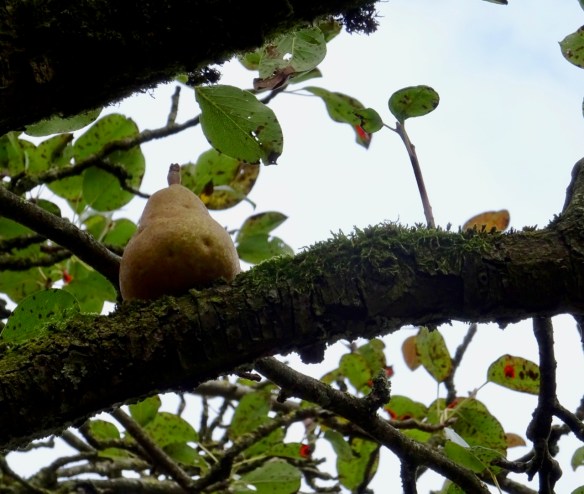
 I went out to pick a few apples to cook for dessert and noticed a pear tree. Most of the pears had fallen and weren’t good to eat but this one pear had landed on a branch and was sitting balanced there, just out of my reach!.
 One more view out a pretty window. Bob went for another bike ride this afternoon and I did a bit of blogging and relaxing. We are both finding it a nice change staying in the country. It is so quiet and peaceful. We have enjoyed our time in the cities, but this is a relaxing break from that routine.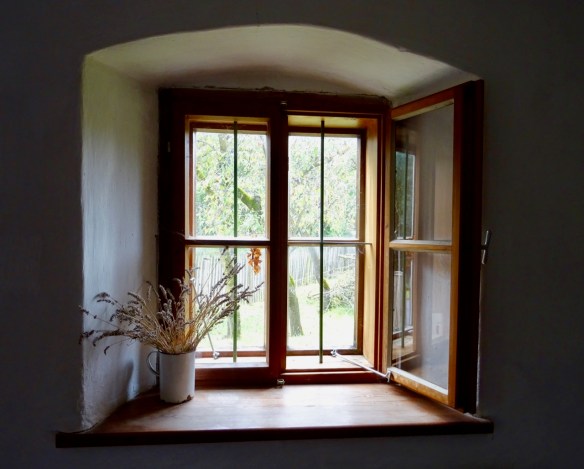
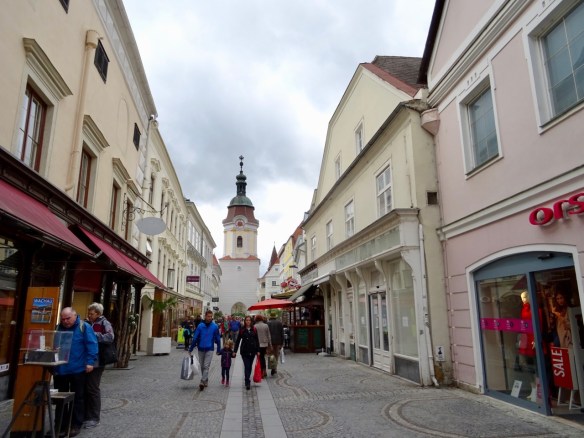 It is a long street lined with mostly modern shops. Not really what we were expecting.
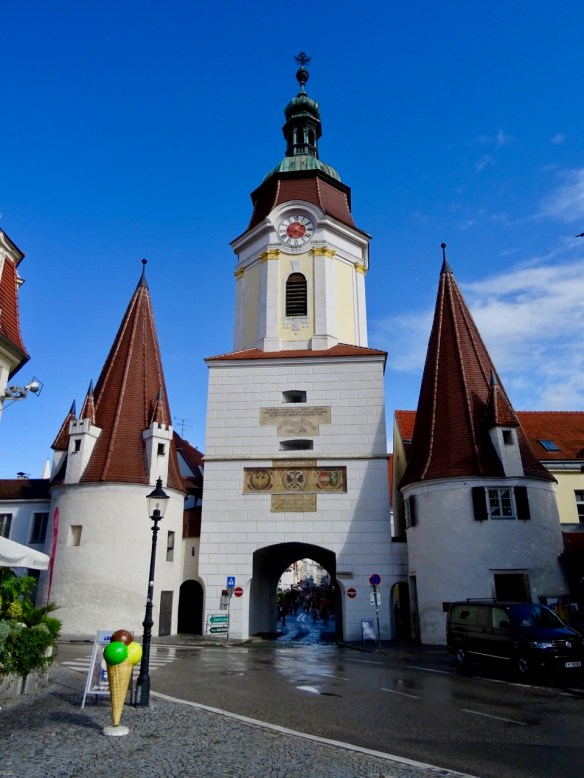
 This is the gate that leads onto the shop lined street. I do wonder why the geraniums grow so well here, Everywhere in Germany and Austria there are window boxes spilling over with blossoms. Mine at home don’t do nearly as well!
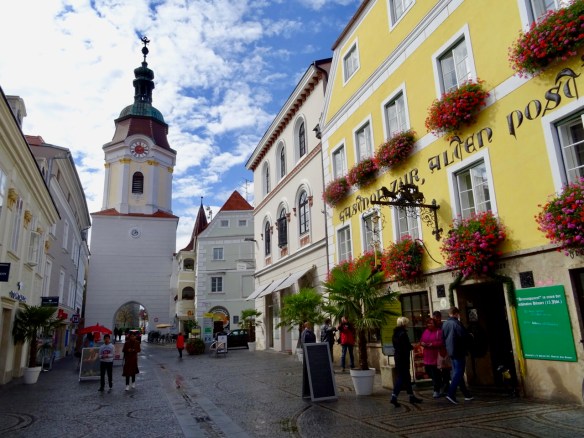 We wander through the gate, and decide it is time to leave.
 I do see these lovely prints in a little window inside the gate.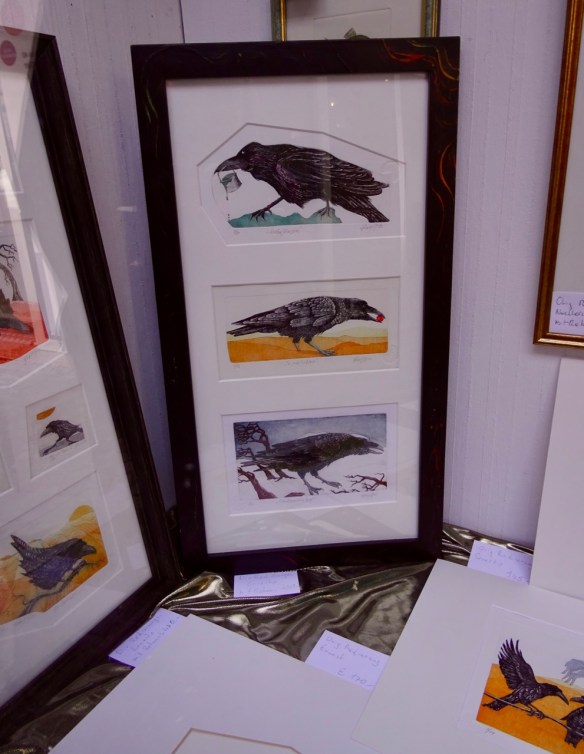
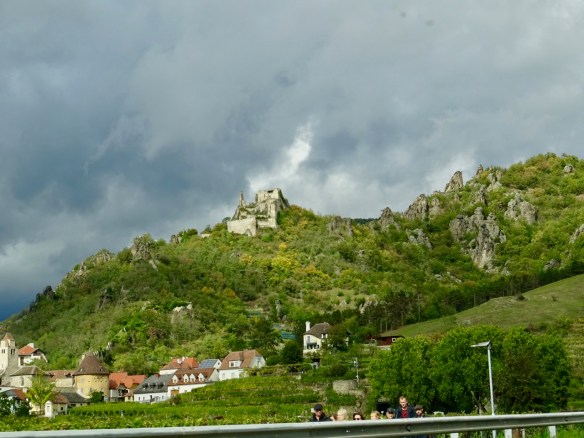 While we are getting information on how to hike to the castle the clouds get very dark and threatening.
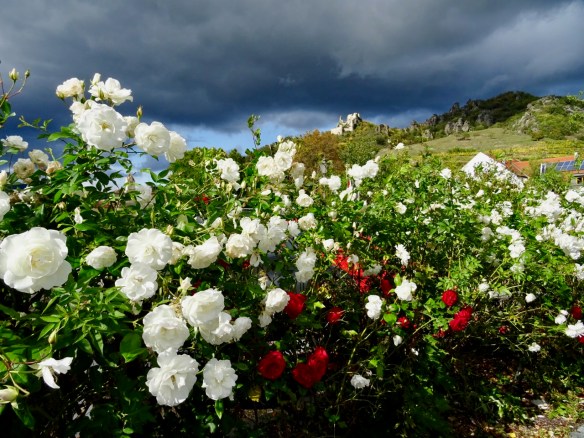 But just as quickly they start to blow over and in less than ten minutes the sky is relatively clear.
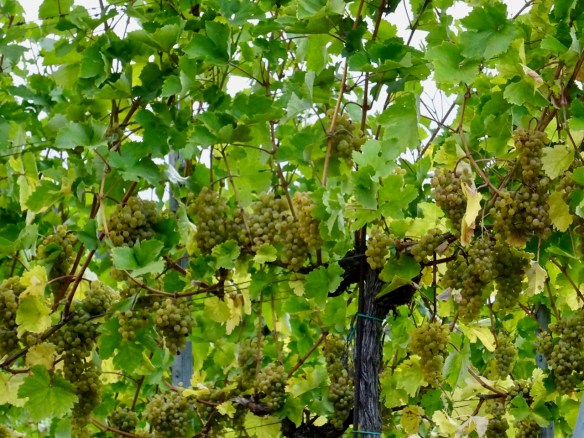
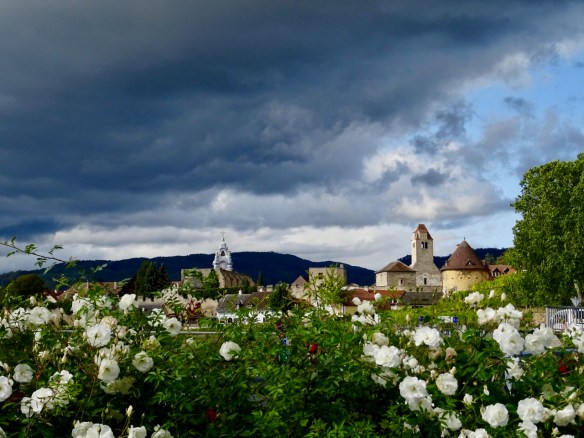 On the path towards town from the carpark we pass vineyards with lots of green grapes. They look ready to pick.
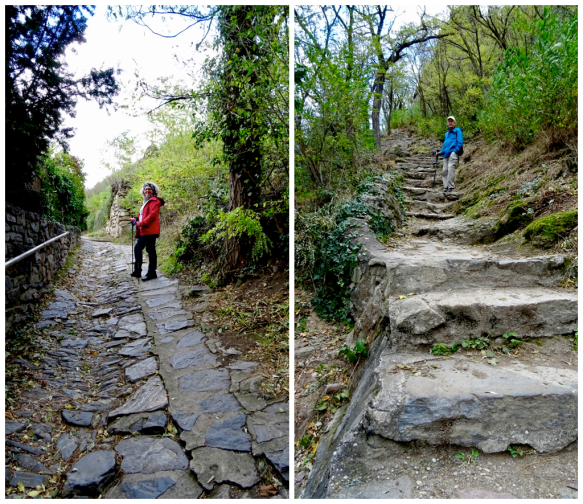
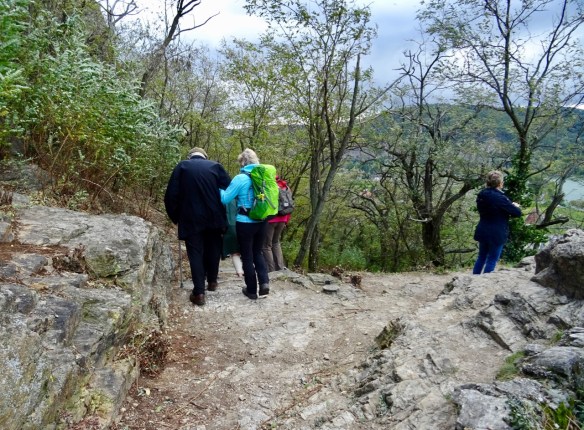
 We find the path and start our climb…and it is definitely a climb! I am so glad I have our hiking poles, they really help climbing these big uneven steps that seem to go on forever.
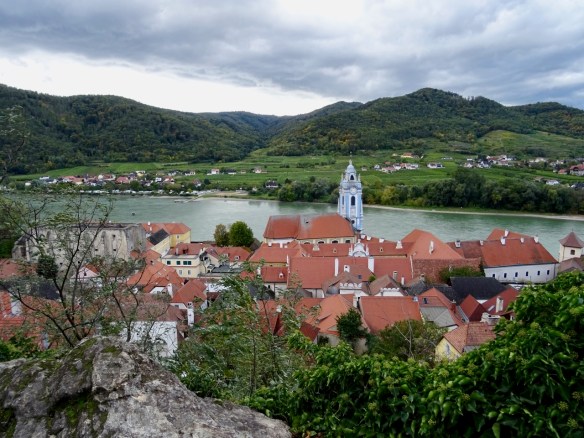
 A view of the town from a much needed little rest stop.
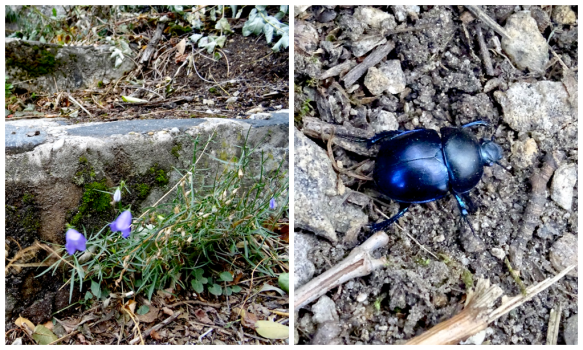
 These little blue bells are the same kind that I have growing at home. My oldest daughter brought me seeds from Dawson City many years ago and they grow quite happily in our flower garden. This gorgeous blue beetle glistened indigo and cobalt with touches of turquoise. He, or perhaps she, was about the size of my thumbnail and paused in its travels long enough to let me take its photo.
 It is hard to see, but this old gentleman and his wife (you can just make out her bandaged leg and green skirt), were being helped down the trail by some kind hikers who stopped to help them. We have no idea how they managed to get this far, as they were having difficulty walking here where the ground was fairly flat. Someone at the bottom of the trail had told us to “Look out for two old Brits on the trail…I don’t think they are going to be able to get down and will need to stay up there!” They were very fortunate that kind strangers stopped and came to their aid. I think they will be exhausted by the time they make it down, or maybe they will need even more assistance?
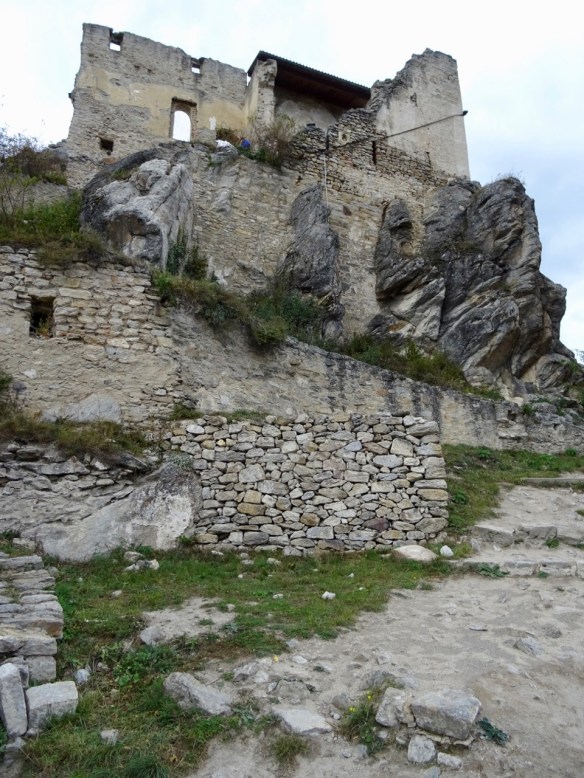
 This sign explains what the castle used to look like. We are able to make out a few of the areas but most of the castle has been destroyed.
 Some views of the castle.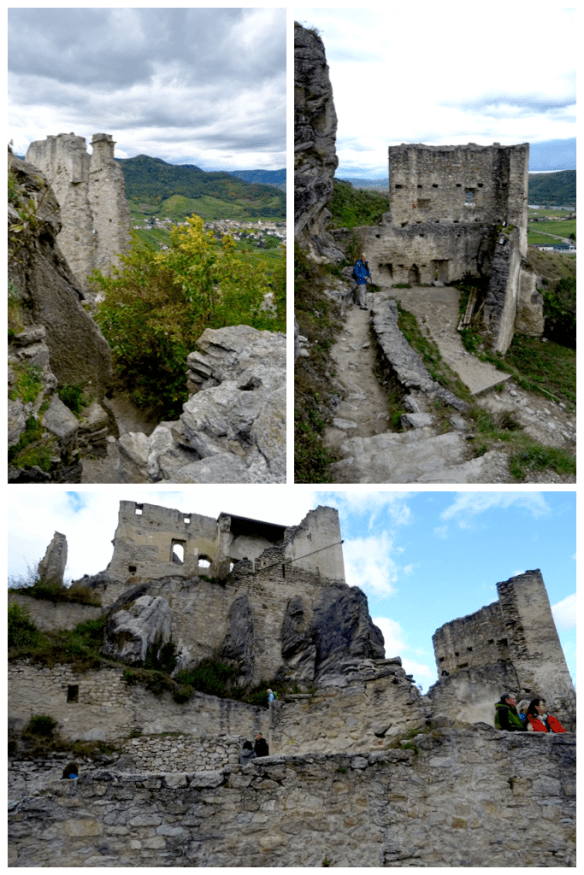
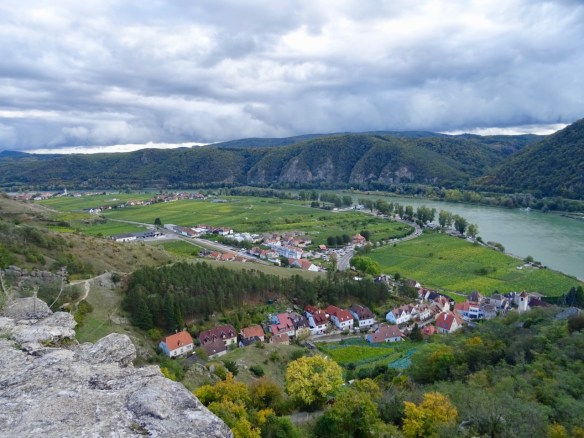
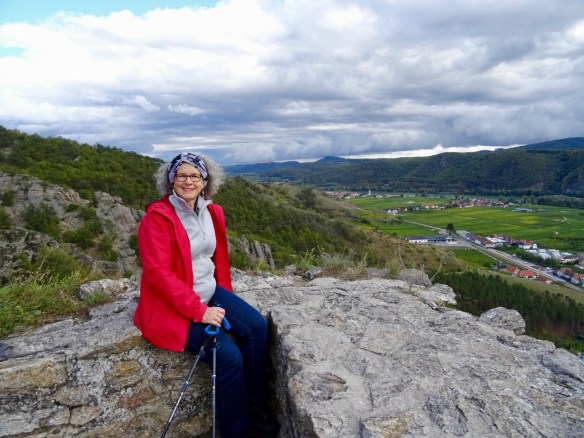 We see a riverboat cruising by on the Danube far below. It is starting to get very windy up here.
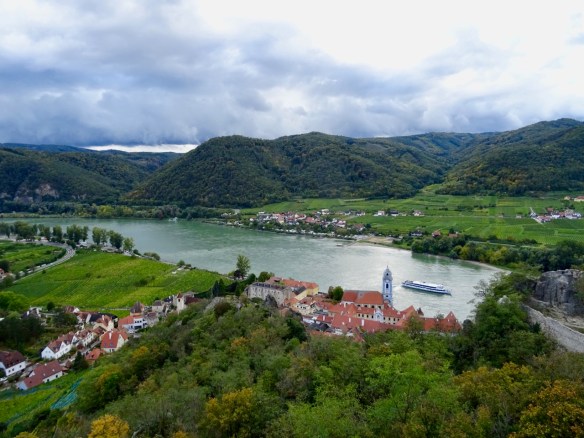 The valley is dotted with village after village as far as we can see.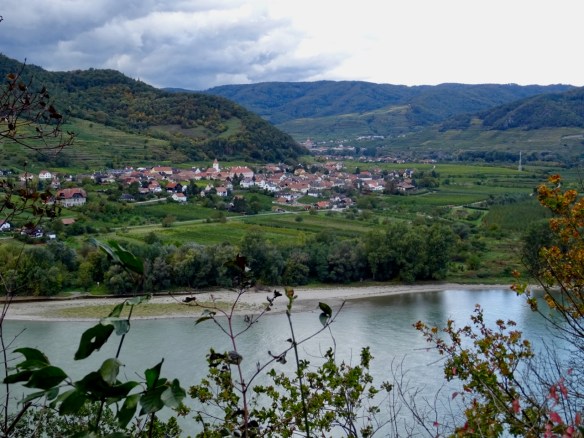
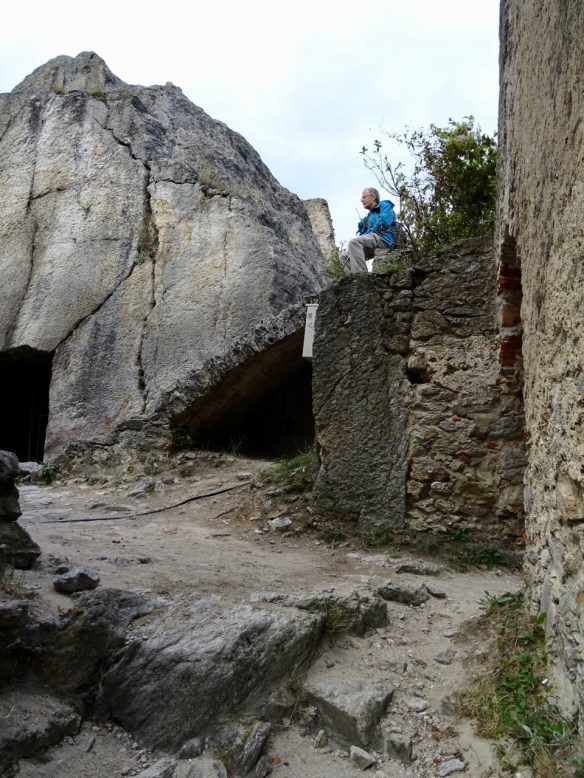 We wonder if this is where king Richard was kept prisoner?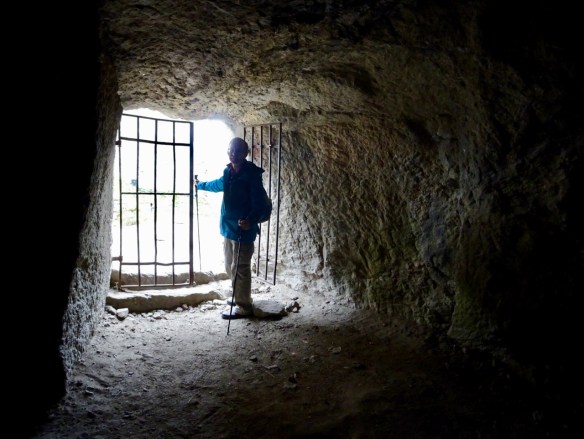
 You can see the castle walls stretching all the way down to the town.
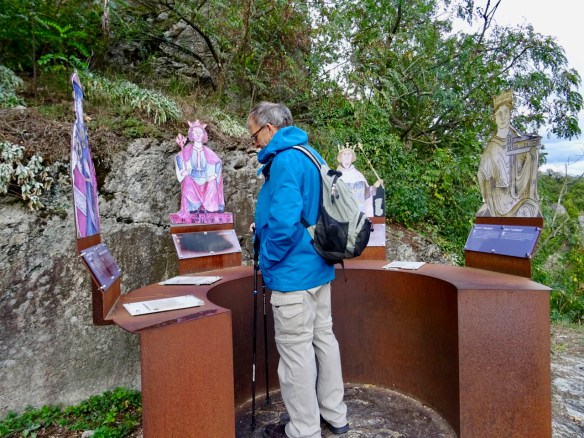
 We head down to town on a different path, one which is a bit easier than the one we climbed up. There are displays along the path explaining about the history of the Castle and King Richard the Lionheart.
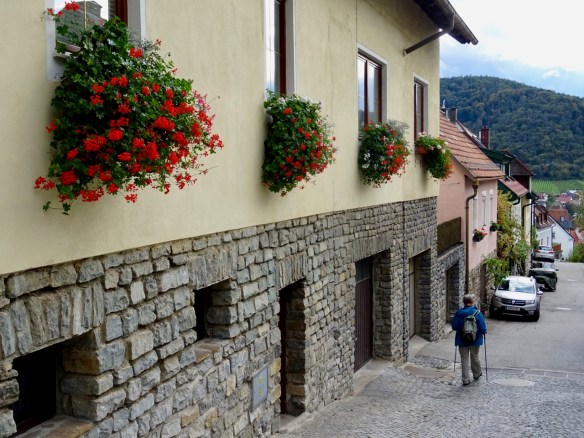
 The path ends back in town.
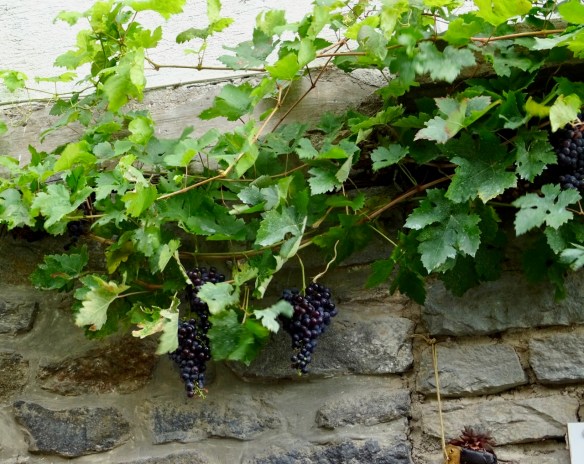
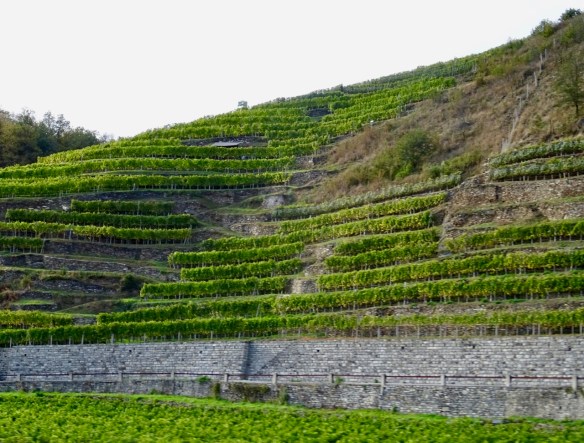
 We see black grapes growing along the road and hanging on houses. They are quite tasty.
 The castle walls go through the town all the way down to the river!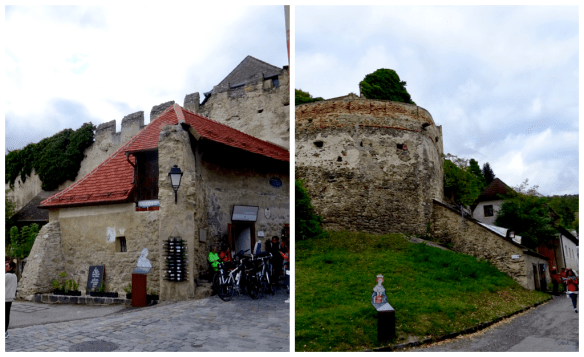
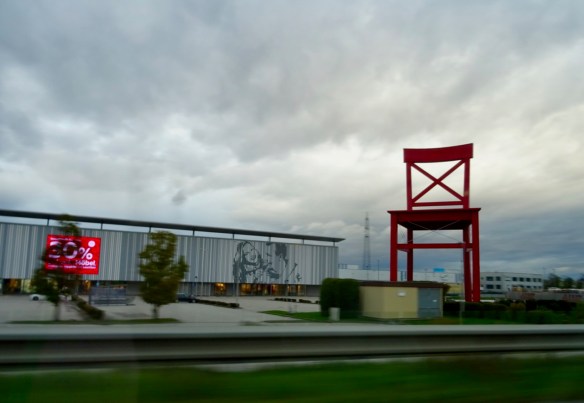
 Then we see a very large chair!
 The sky is quite dramatic and it is getting dark by the time we arrive in Hörsching, our home for the next three days.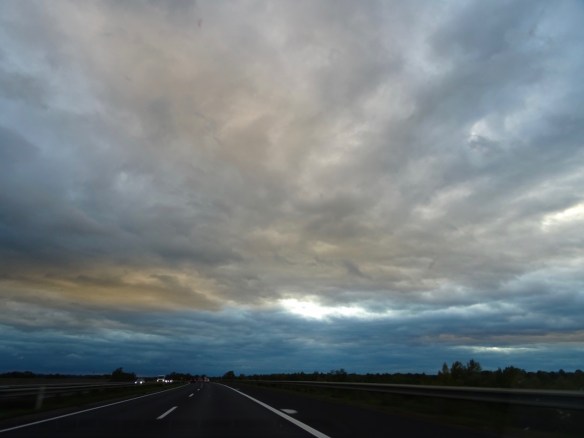
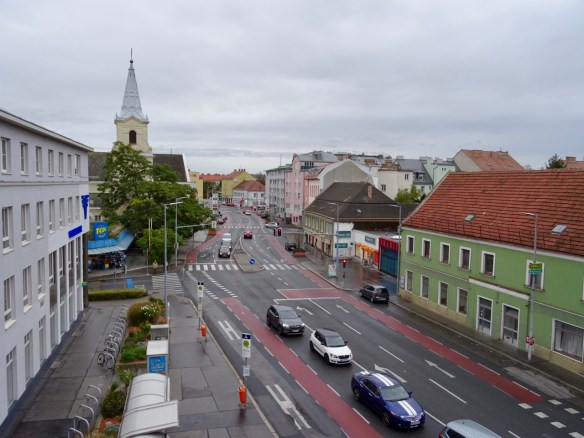 Austria has a “vignette’ sticker for travel on their highways. It costs 24 euros, instead of charging tolls on each highway.. So, we went to put it on our car and surprise, we have a parking ticket! No one else parked on the same street has a ticket and it is where our host told us to park! We can’t figure out why we got the ticket. We contact our host and he says we are legally parked. He thinks that maybe whoever issued the tickets doesn’t ‘like’ our Slovakian rental car and gave us a ticket!
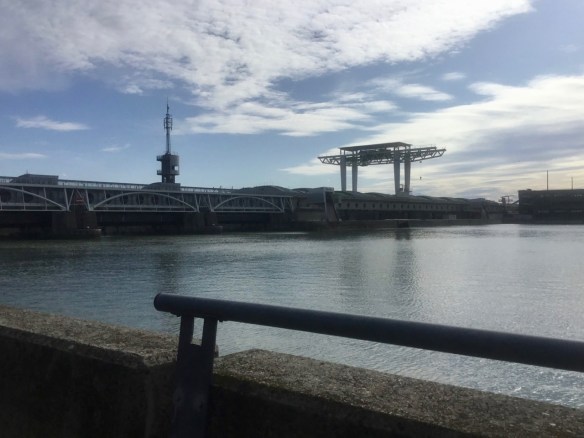 Bob was able to walk onto the dam see some of downtown Vienna in the distance. He also watched a ship go through the locks beside the dam. It took about 20 minutes for the water to fill the lock so the ship could pass upstream.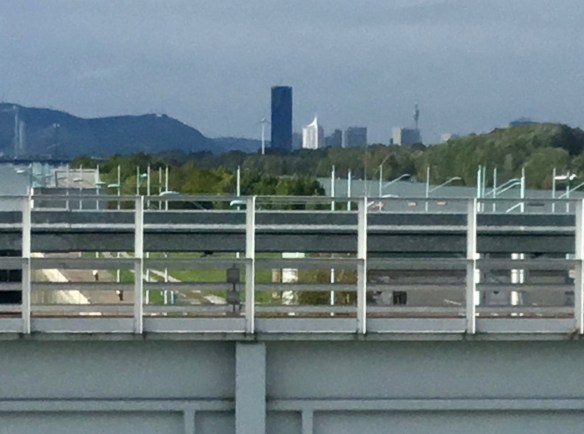
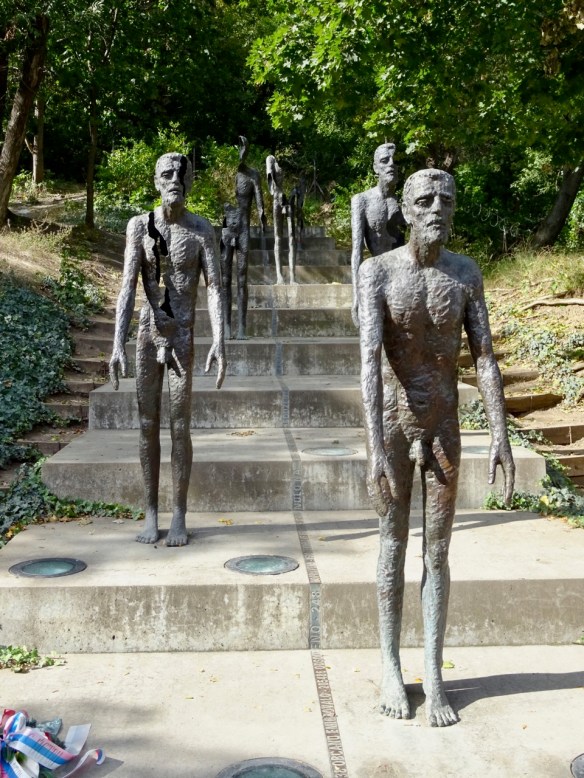 This sculpture makes us smile. It appears to have a dog drinking dish at its bottom.
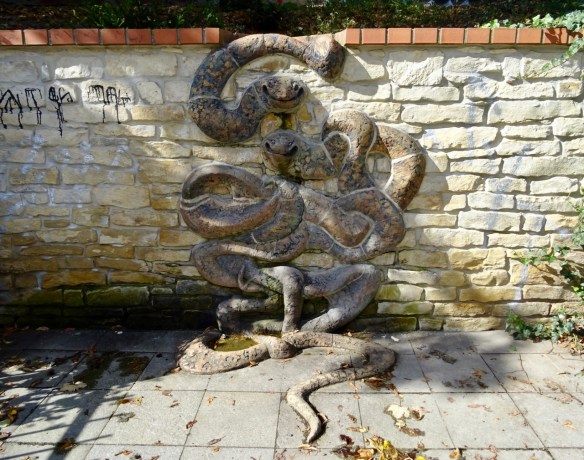 Peering into a church courtyard we see this crucifix right beside a gift shop. It seems strange to have an upscale gift shop in a church courtyard.
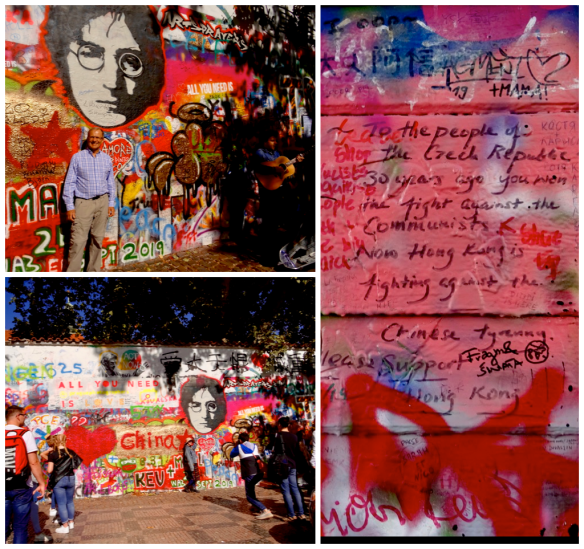
 Bob leads us down several little side streets to the John Lennon Wall. Since the 1980s it has been filled with John Lennon-inspired graffiti, pieces of lyrics from Beatles’ songs, and other designs relating to local and global causes.
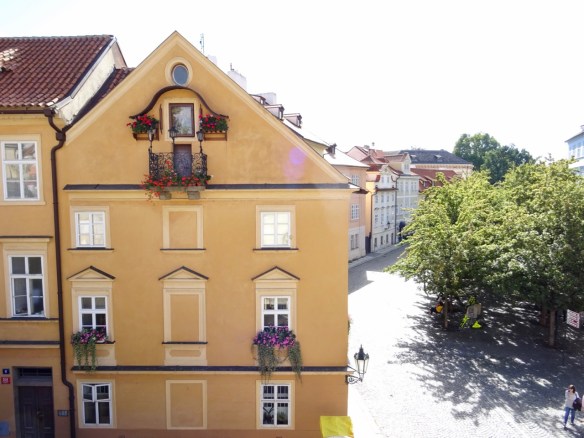
 We stop for a picnic lunch in this little park beside St. Charles Bridge…
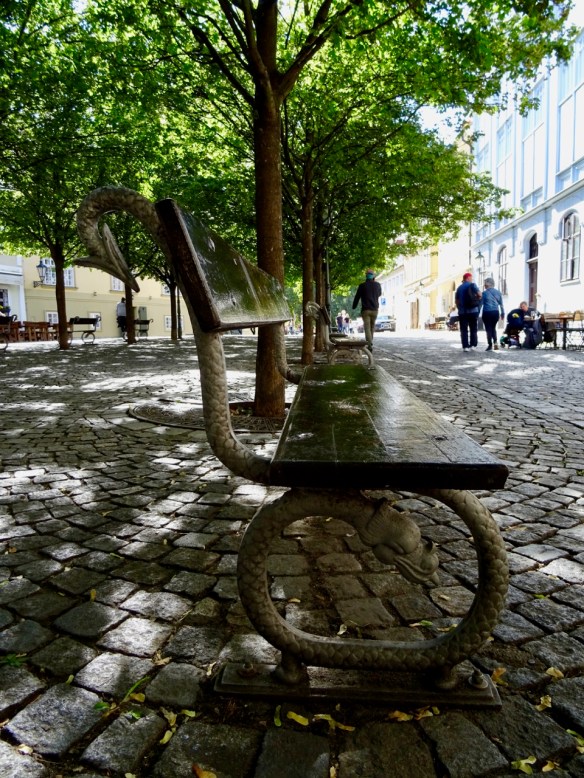
 and sit on a dragon bench.
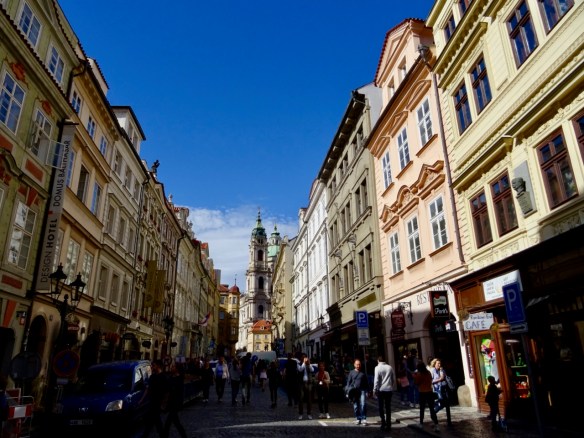
 The streets in Prague are busy no matter where we go. We wonder what they must be like during the summer months?
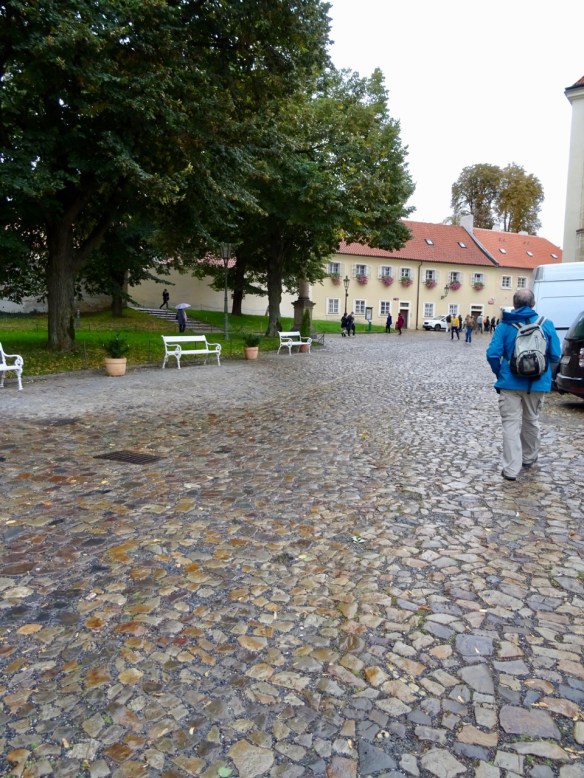
 It showers on and off as we arrive at the monastery. Note the cobbled road. All these uneven cobbled surfaces are quite hard on our feet and ankles.
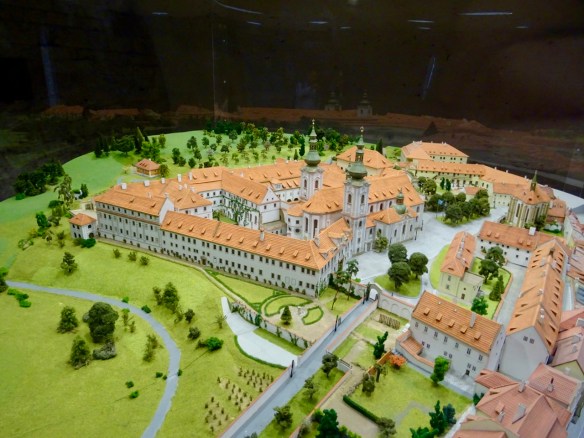
 The Strahov Monastery was founded in 1143 and has many buildings and extensive gardens.
 First stop is the Strahov Library and I am delighted to find that there is an exhibit of Cabinets of Curiosities!
 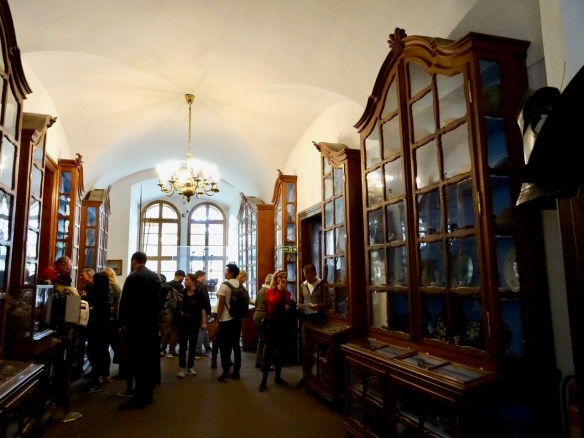 I love these cabinets and have several drawers at home with my own curiosities. Perhaps I need to make my own Cabinet of Curiosities?
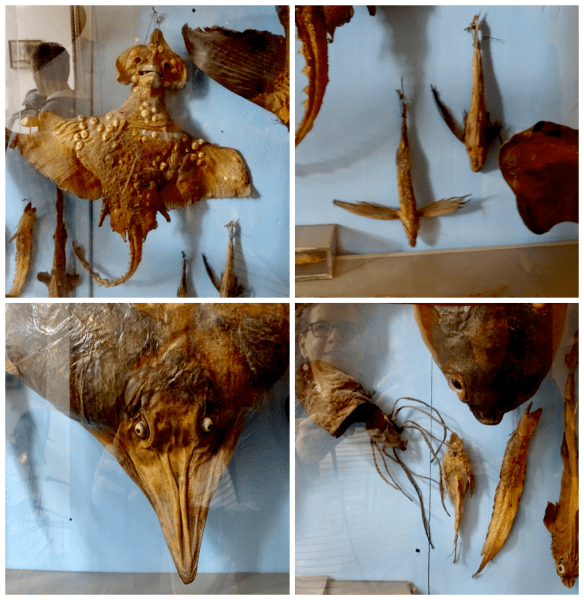
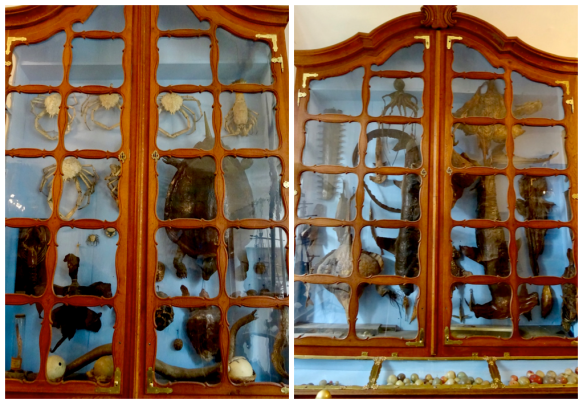 Some of the contents are rather strange.
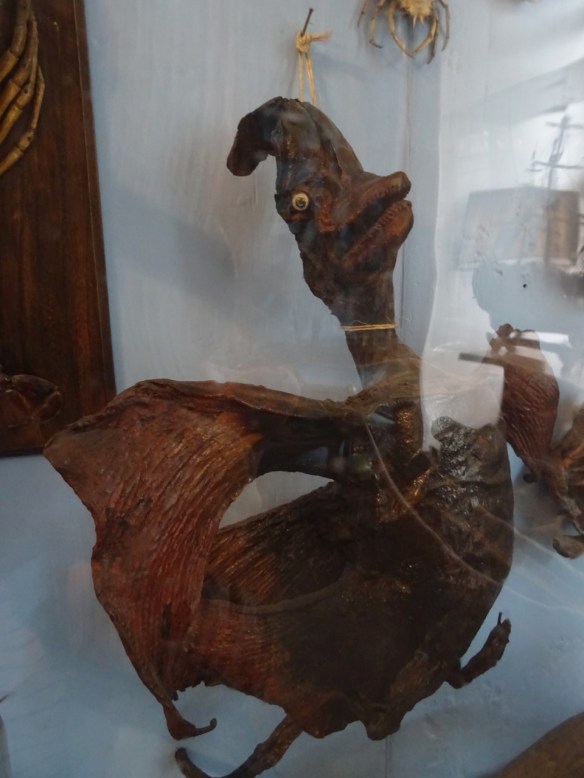
 We are told that this ‘might’ be a young dodo bird!
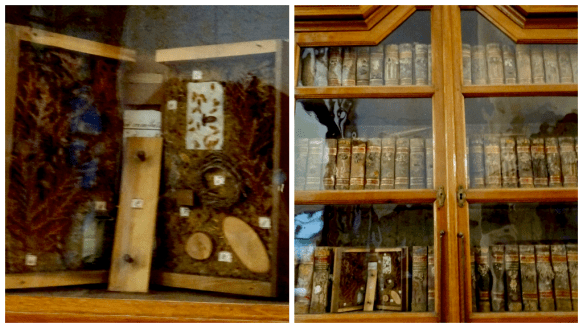
 These books are very unusual. This is a 68 volume Dendrological Library. Dendrology is the science and study of wooded plants. The covers of each volume are made of the wood of a particular tree, the spine has its name in Latin and German, and inside each volume are pieces of the roots, branches and twigs, as well as leaves, blossoms, fruit, and sometimes even insect pests. As a paper artist and bookmaker, I find these unusual volumes fascinating and inspiring.
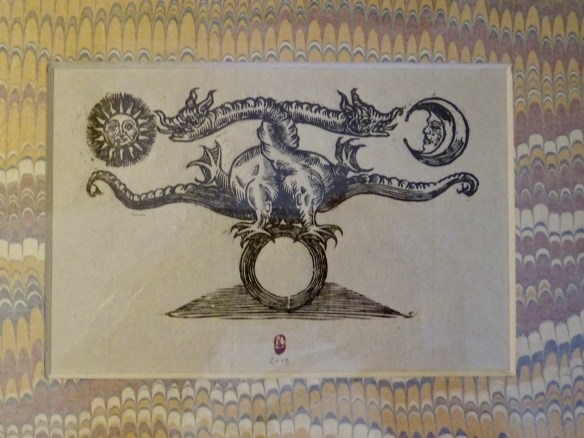
 Along the hallway between two magnificent libraries are display cases with very old volumes. This 1632 woodcut first appeared in a compilation of English Alchemical texts. This piece was printed by hand on Japanese hand made paper and the pass-partout, or mat, is covered in handmade marbled paper.
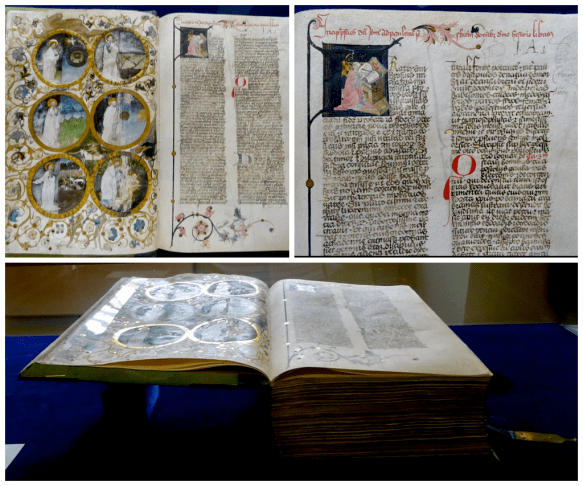
  The John of Šellmberk’s Bible preserves the oldest translation of the Bible into the Czech language and dates from the 1400’s. Notice how thick the volume is!
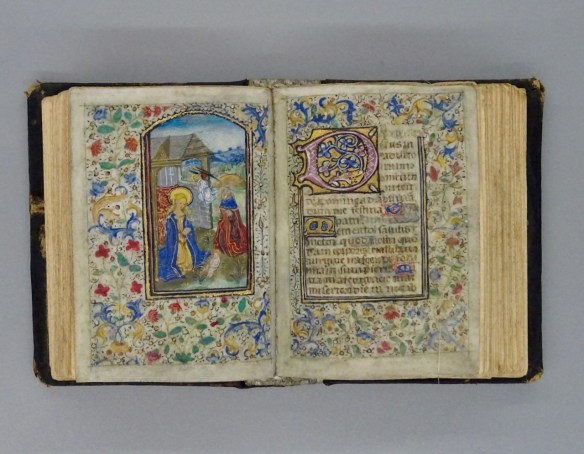
 This exquisite miniature book from the 15th century is only about 3″ x 4″ and would have belonged to a private citizen.
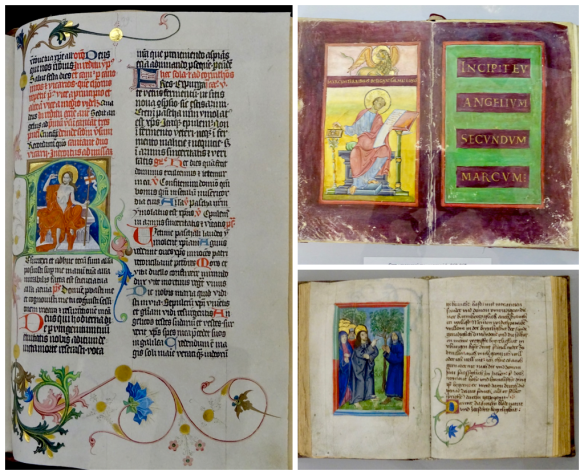
 A page from the Missale of Louka, 1483, illuminations from the Strahov Evangeliary, 860-865 AD and on the bottom right, a book for private use from the 15th century.
 The Theological Hall was built in the 1600’s and holds over 20,000 volumes. One whole wall is filled with various editions of the Bible, or its parts, in various languages.
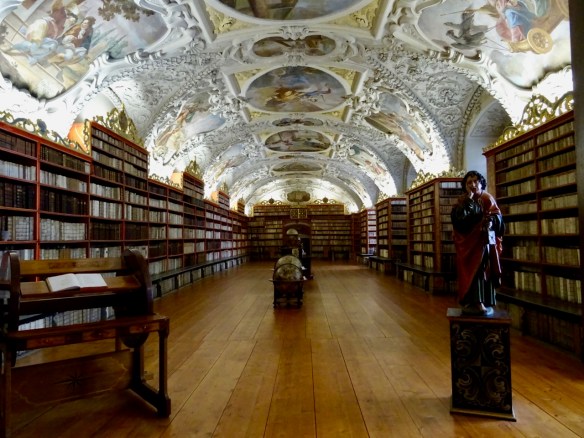 The ceiling depicts the life of the librarian.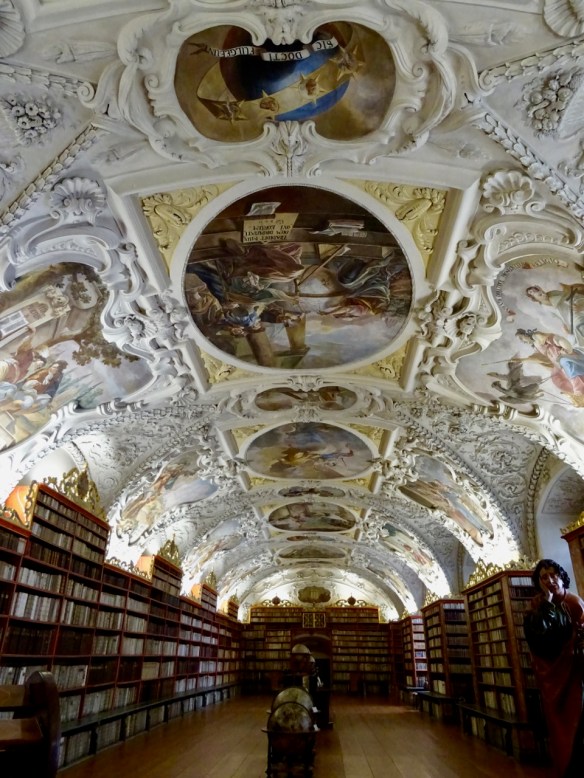
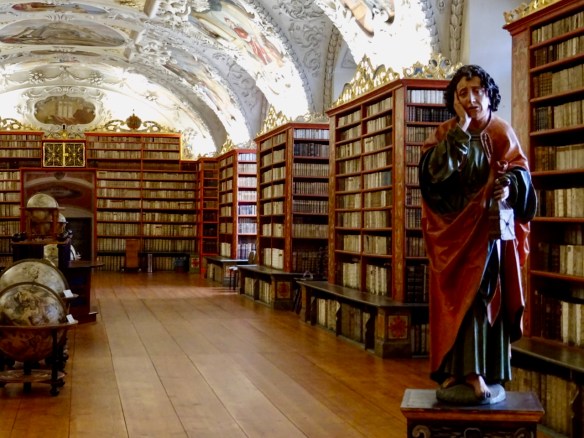 There are several globes, both terrestrial and astronomical, in the centre of the room and the interesting device on the left is a book wheel from 1678 for the study and compilation of books. The gear inside enabled the shelves to remain at the same angle when they are turned so that the books would not slide off the shelves.
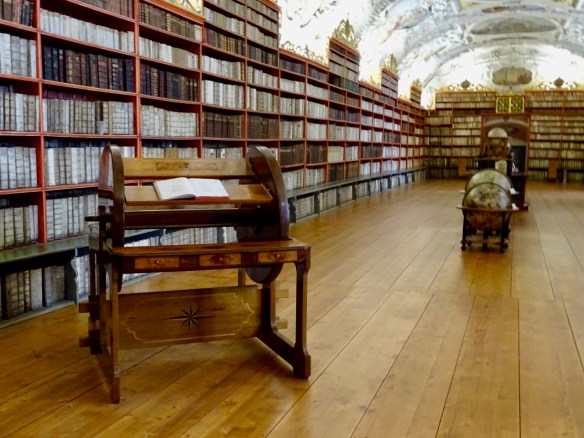 As magnificent as the Theological Hall is I think that the Philosophical Hall is even more impressive. This library, finished in 1794, is 32 metres long, 10 metres wide and 14 metres in height. The ceiling painting, ‘The Spiritual Development of Mankind’, was created by a Viennese artist, and one assistant in just six months!
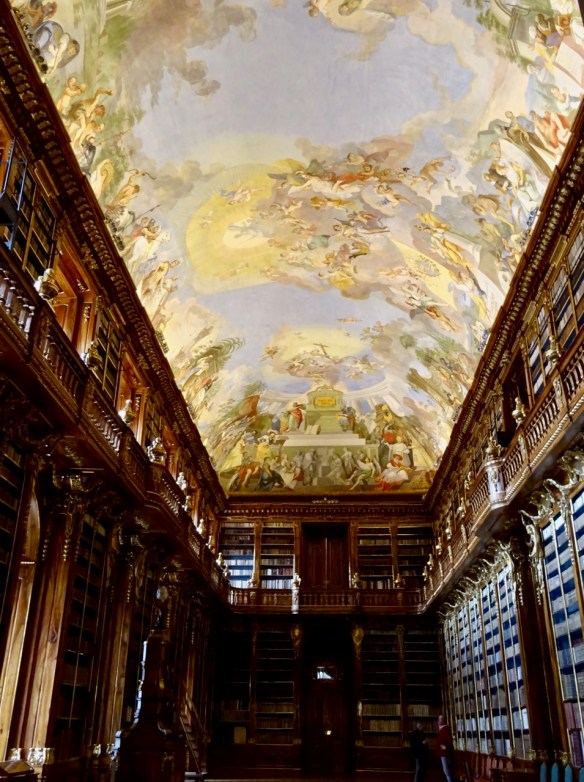 The shelves of books in the gallery are only accessible from hidden spiral staircases in both corners, masked by false book spines.
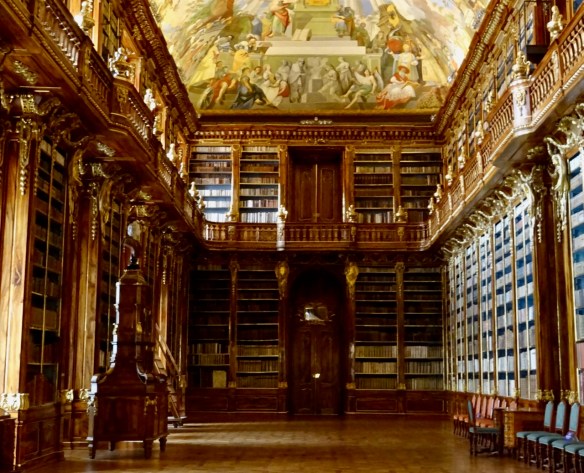 The books are shelved two deep. At one time tourists were allowed to walk through the library but this caused too much humidity and put the paintings and volumes at risk. Now we have to contend ourselves with peering in from the doorway. Too bad but it is still wonderful to see these incredible libraries.
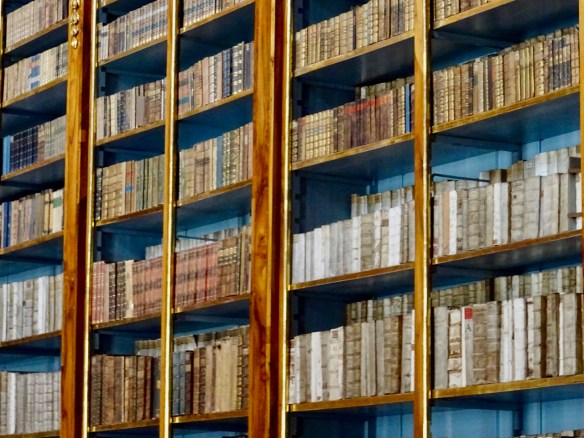 The Philosophical Hall contains more than 50,000 volumes on Philosophy, all the sciences, history, law, and natural sciences.
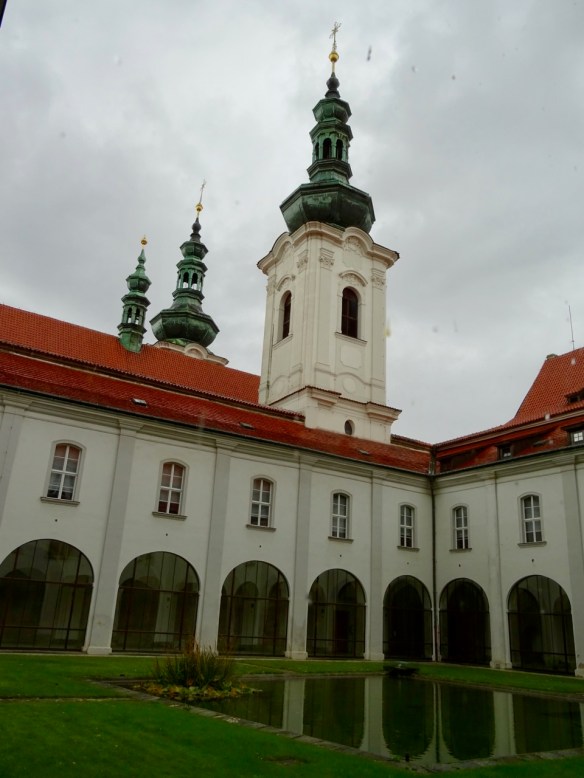
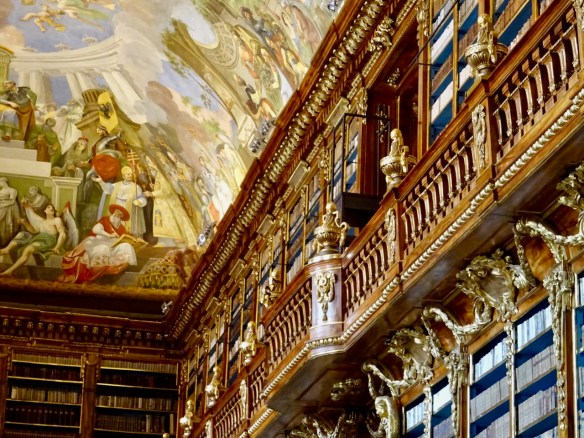 Next we visit the Convent Building which has galleries on two floors around this cloister with its unusual trapezoid pool.
 There is an exhibit of large restored paintings depicting the life of St. Norbert but they were difficult to see. My neck got sore from looking up all the time.
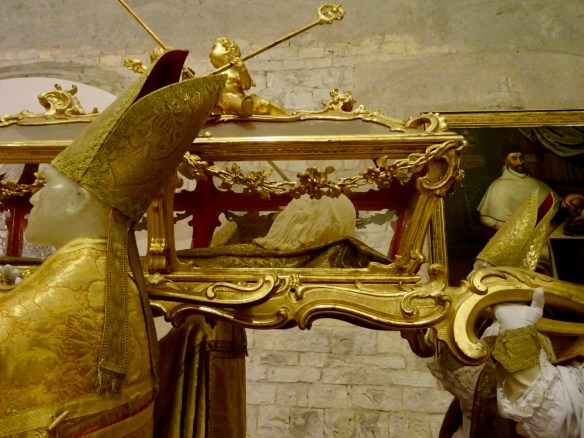
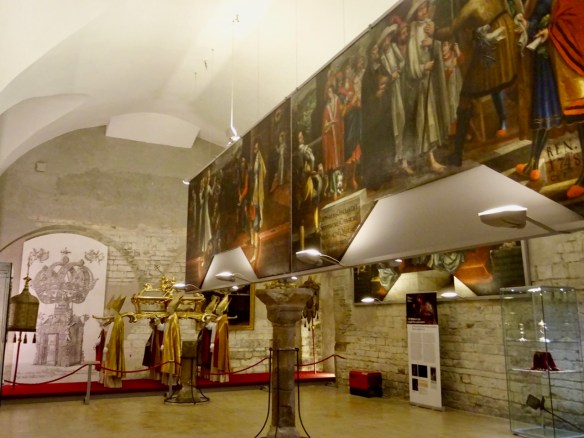 The ‘procession’ at the end of the room holds a reliquary with what appears to be part of St. Norbert’s skull.
 Another room has exhibits of beautifully embroidered church vestments and other liturgical objects including heavily jewelled monstrances.
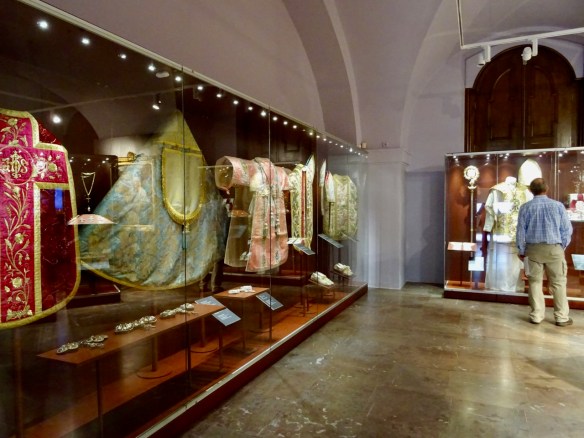 It does make me wonder just how much money the Catholic Church has?
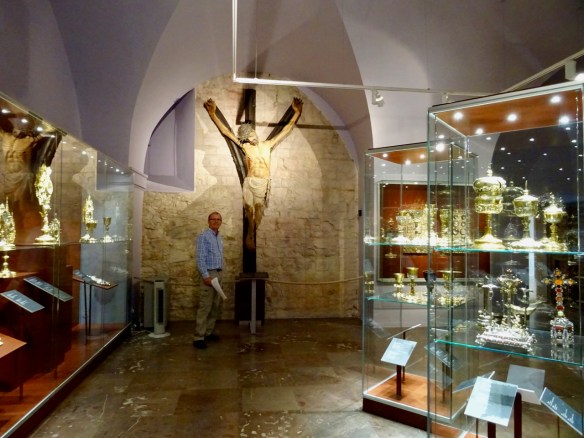 The second floor has a gallery around three sides of the cloister.
 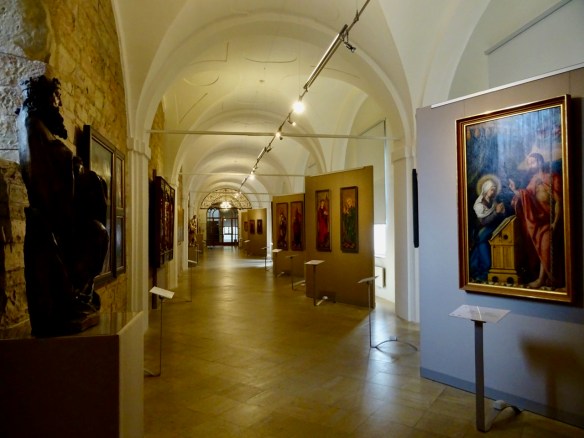 There were a few paintings I liked but most of them didn’t really impress either of us all that much.
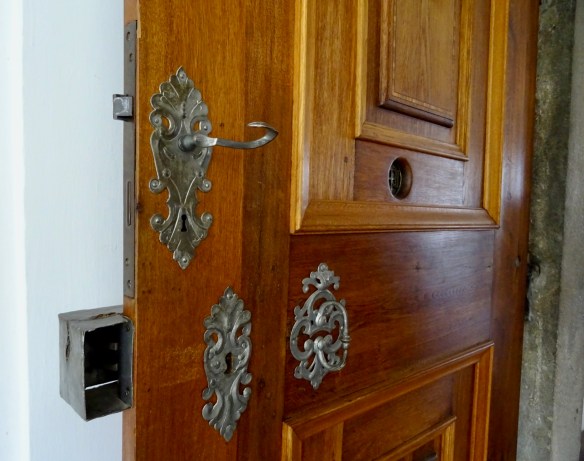
 Bob notices another ornate old lock.
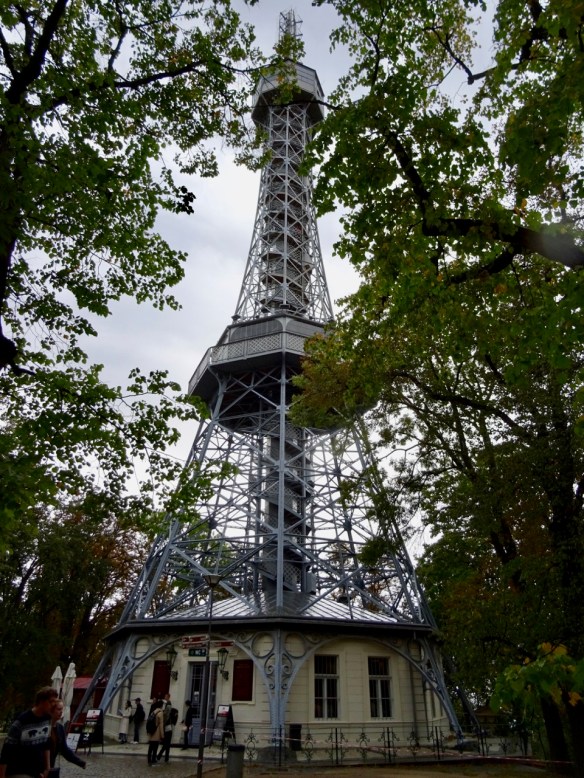
 As we leave the monastery grounds on our way to the Prague Funicular, we pass the 63.5 metre high Petrin Tower, which is reminiscent of the Eiffel Tower. This tower was built in 1891, and is used as an observation tower as well as a transmission tower.
 The 383 metre long funicular takes us back down to Prague city streets. I didn’t get much of a view because some young people kindly jumped up to give me a seat, so instead of standing where I could see I sat all the way down! The hazards of having grey hair!
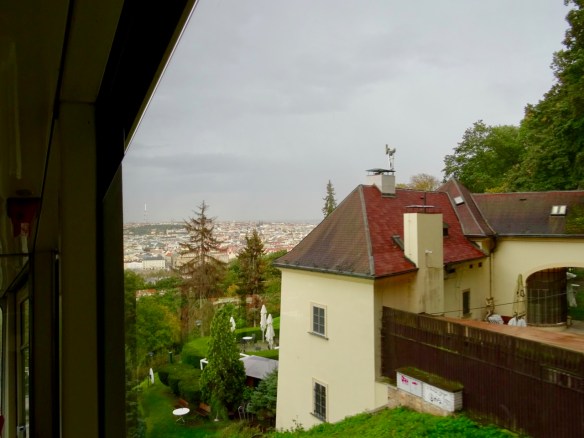 It has been a full day and we are happy to be home. I had planned on going to life drawing again tonight, but we need to clean and pack for our trip to Vienna tomorrow so I decide not to go.
 We had a good laugh. Bob thought that the two guards in the guard-boxes were wax mannequins. They were so motionless!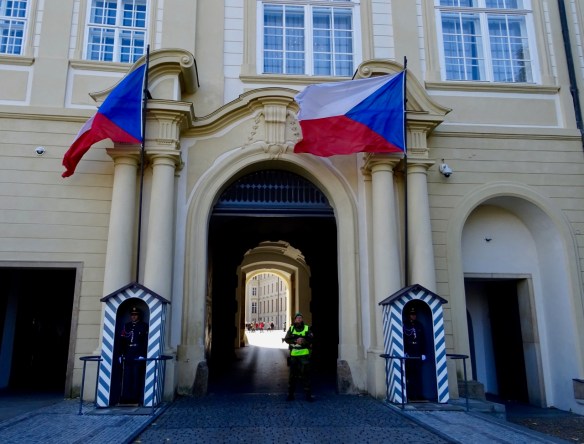
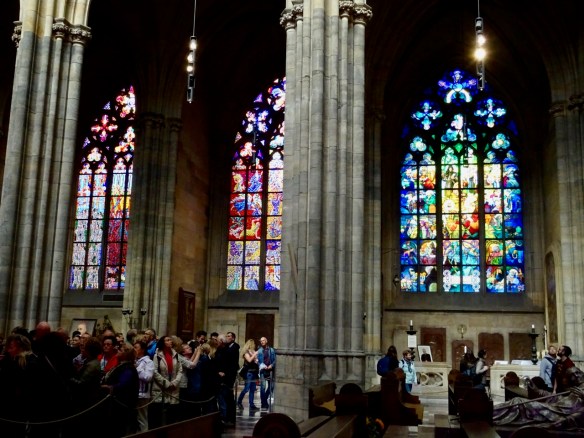
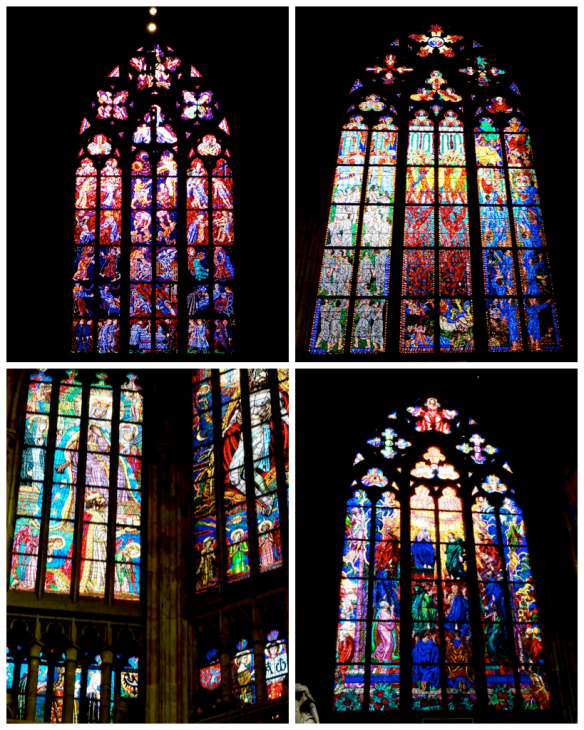
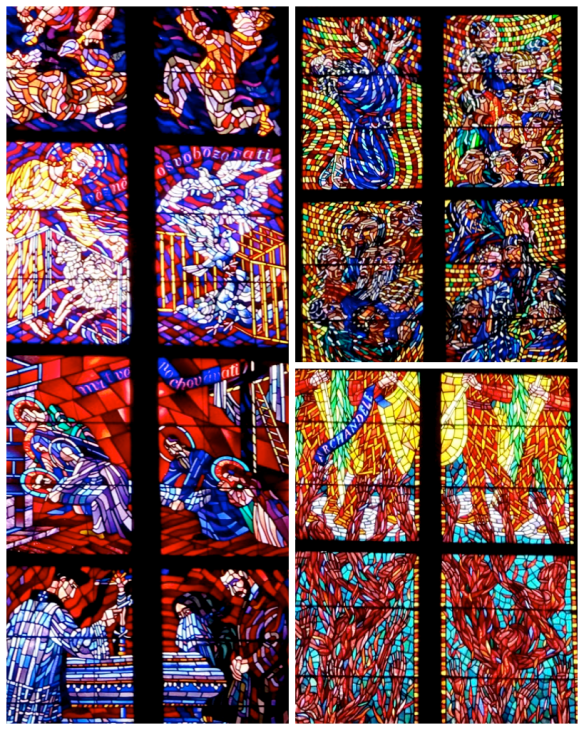 Perhaps my favourite is the window designed by Alphonse Mucha. You may remember we saw his design drawing for this window at the Mucha Museum yesterday.
 The beautiful rose window on the entrance wall of the cathedral was completed in 1925 and took two years to complete. The inscriptions on the stained glass tell the story of Creation as told in the Bible.
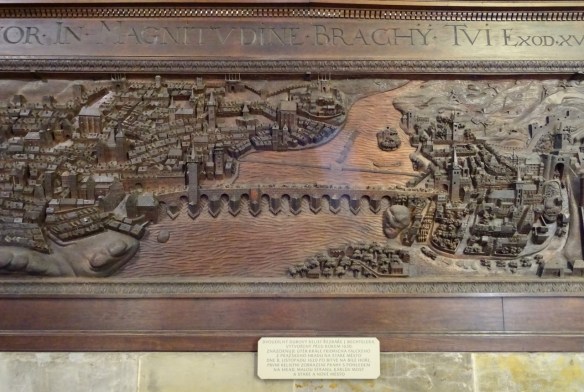
  This wooden panel from 1630 shows the St. Charles Bridge, built in 1403, that we visited on Saturday. The city doesn’t really look all that different, does it?
 St. Vitus is portrayed with a rooster by his side, because he was boiled to death in a pot with a rooster! These saints all seem to have had horrible tortuous deaths. St. Vitus never actually even visited this cathedral, but a relic, or pieces of his body, was brought here and the Cathedral was built to honour him.
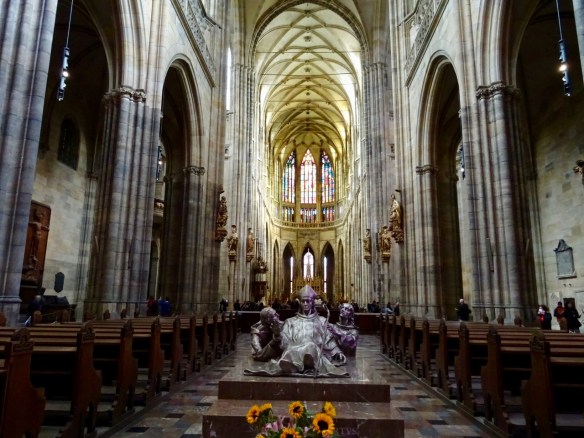
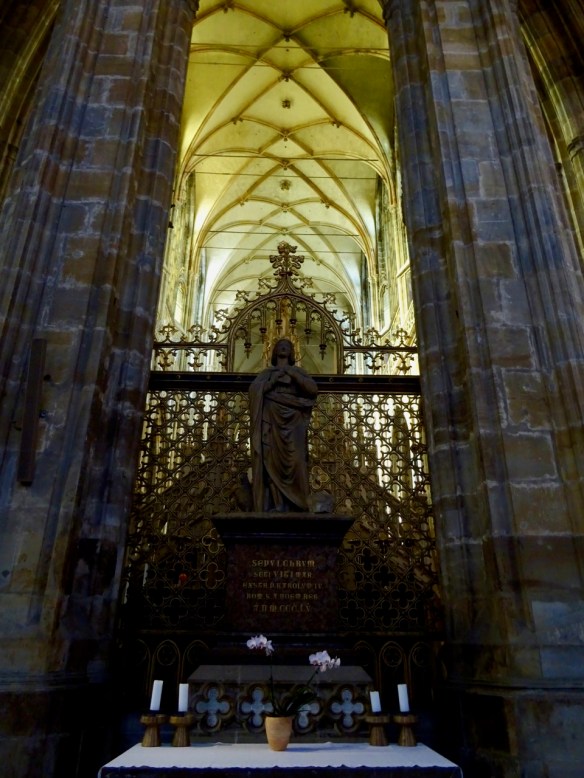 St John of Nepomuk’s tomb is an elaborate baroque silver tomb with angels supporting a draped canopy. It is said to contain two tonnes of silver. St. John is the patron saint of the Czechs. There are so many people visiting this cathedral that I had to take this photo looking back towards the tomb to get a decent shot.
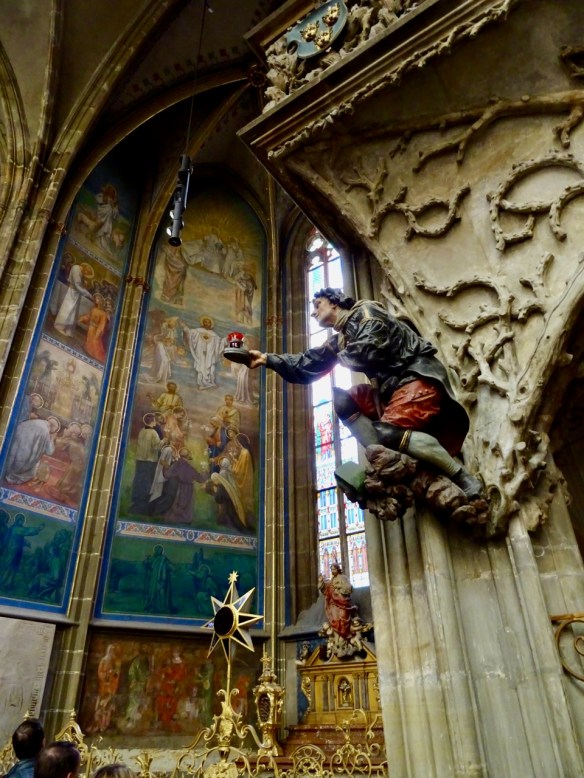 This is the chapel dedicated to St. Wenceslas, the king and patron saint of all the Czech lands. The lower part of the walls are decorated with more than 1300 gems and the joints between them are covered with gold. The walls are covered in frescoes and the relics of St. Wenceslas are kept in the red draped case.
 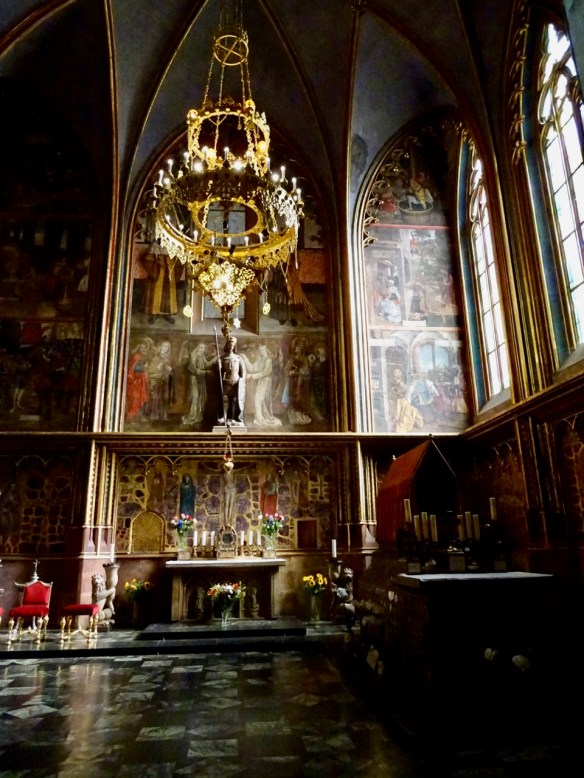 As we are leaving, the sun comes out for a bit and shines through the stained glass windows casting coloured light into the cathedral. Note the lady posing behind Bob. We seem to see her everywhere we go today and she is always posing ‘just so’ for a photo. I’m not sure her and her husband are even looking at the cathedral as anything but a backdrop for her photographs.
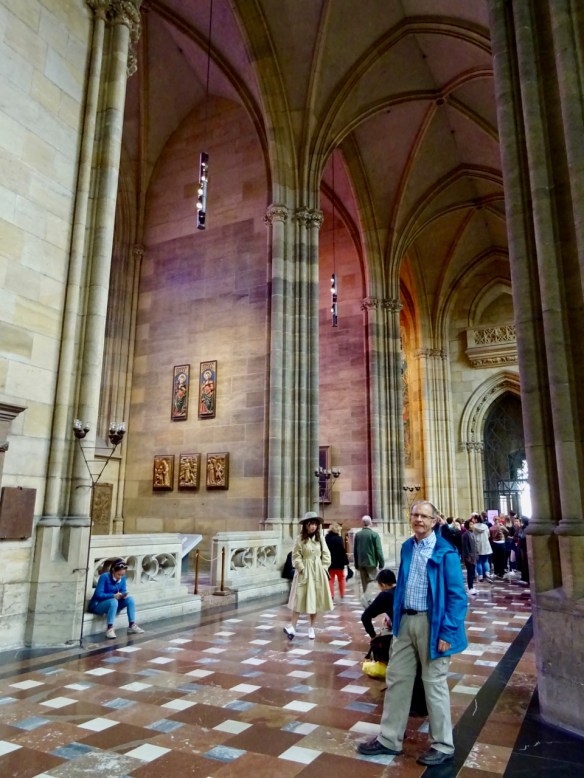 As beautiful as this cathedral is, I still love some of the simpler details that are easy to overlook with all the grandeur surrounding us.
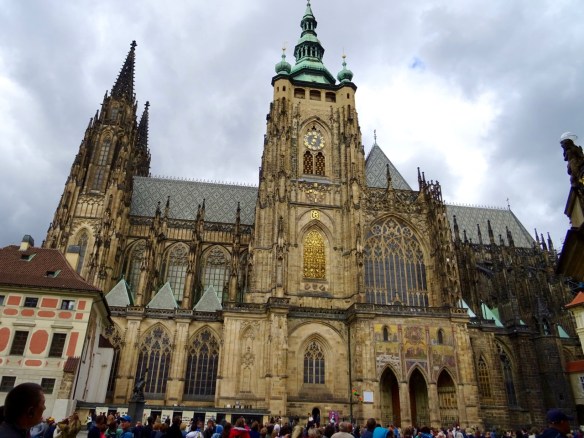
 A view of the Cathedral. This front entrance isn’t used by tourists, we entered on the end of the cathedral behind the building with orange panels.
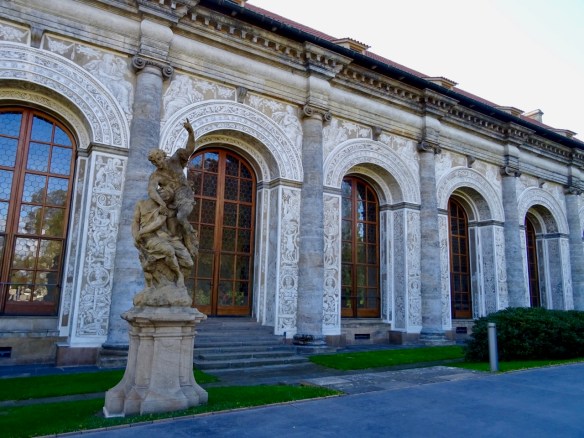
 since the 16th century, the Vladislav Hall in the Old Royal Place, was used for coronation festivities and banquets, knights’ tournaments and markets for luxurious goods. The Vladislav Hall still is used for state functions. It is an enormous room.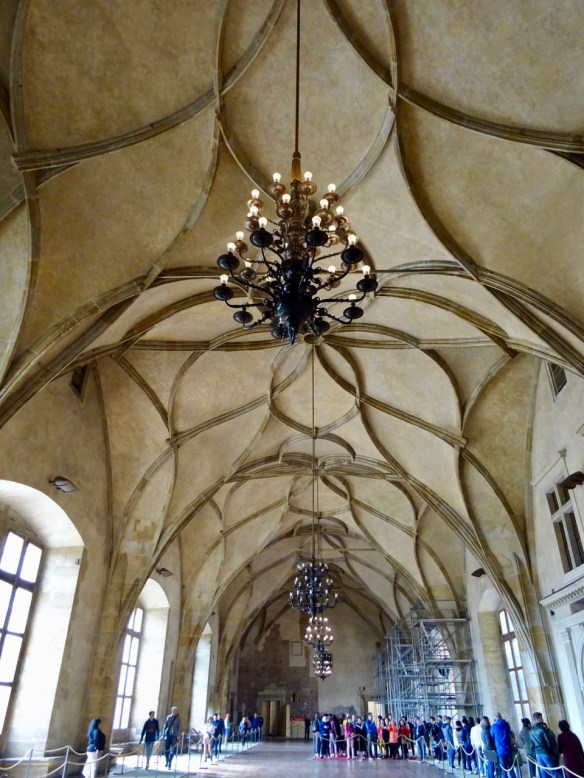
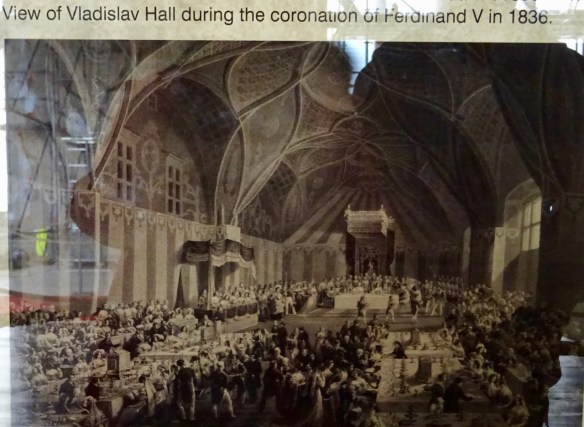 The Old Palace contained the Land Rolls, where all matters regarding property rights and criminal law were recorded.
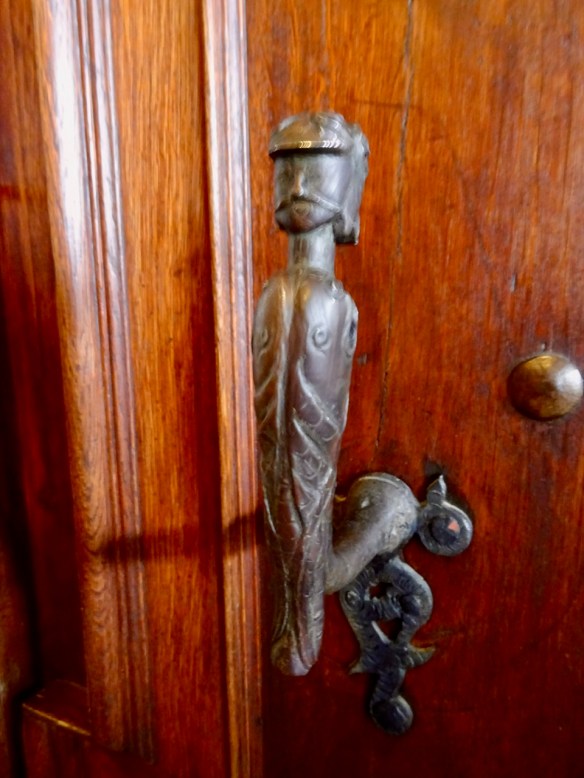
 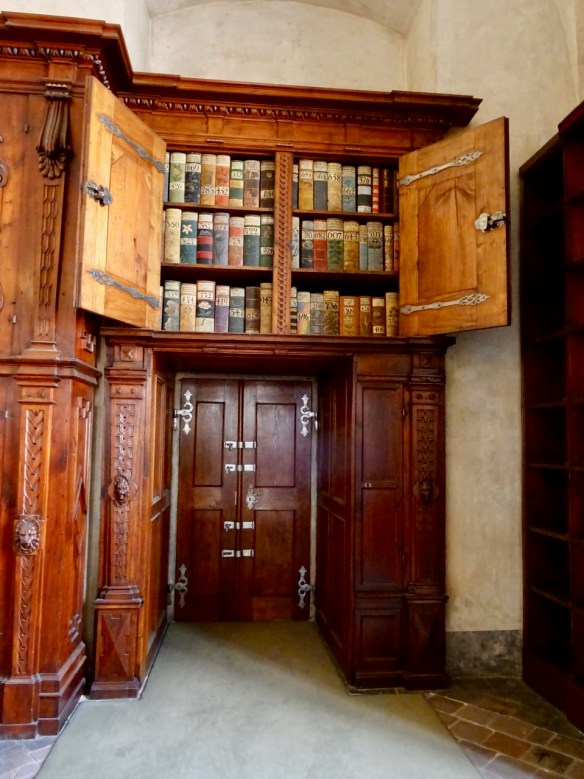 An interesting door handle.
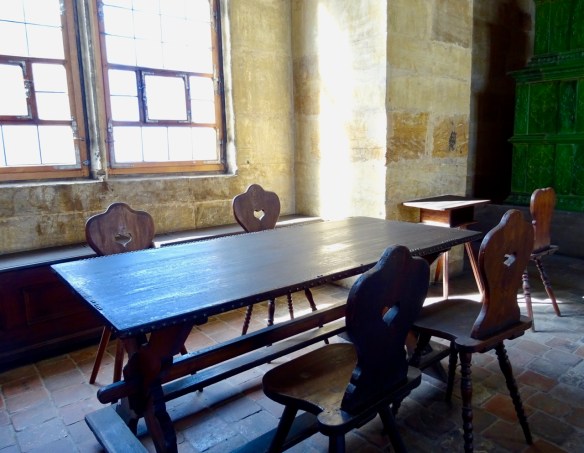
 One room had chairs which are almost the same as the ones my Swiss grandfather used to make, only he put more carving and decoration on his.
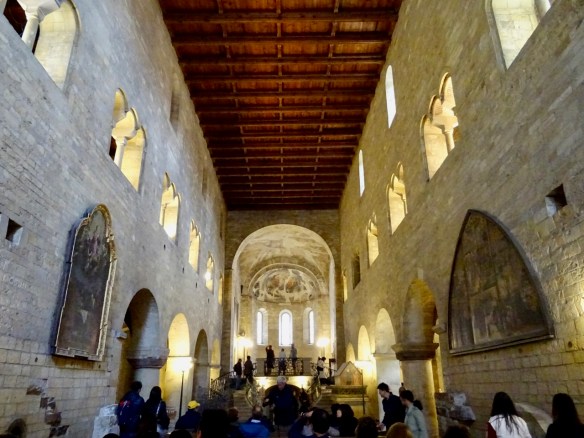
 The present day appearance of St. George’s Basilica dates to the reconstruction after a devastating fire in 1142. Now it is used for short-term art exhibitions.
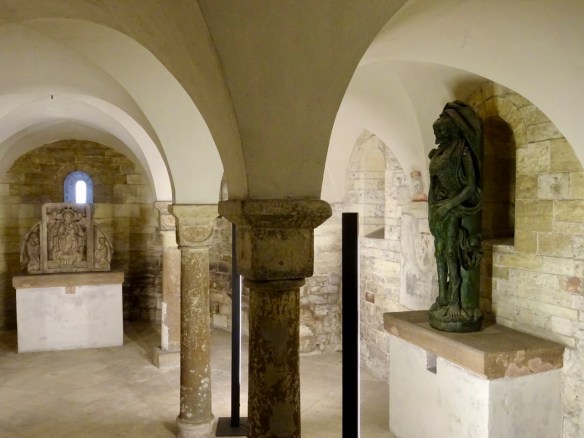
 We visit St. Georges 12th century crypt and see this rather bizarre sculpture. I did some research and discovered that it is “a Late Gothic Statue of Brigita, representing a dead and decaying girl´s body. It is a symbol of impermanence. A legend says that it was made by a sculptor, who killed his girlfriend and wanted to create her statue before he was executed. However, he was only able to make it as a dead body, because of his despair.” ~.www.prague.cz
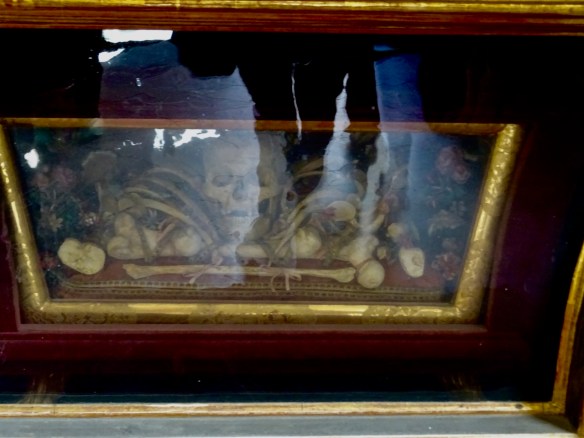
  On the way out we see this collection of relics, but have no idea who they are. These relics seem a bit bizarre. Not only was the poor person usually tortured and killed but then their bones were carted off, often to several different locations and put on display. Hmmm.
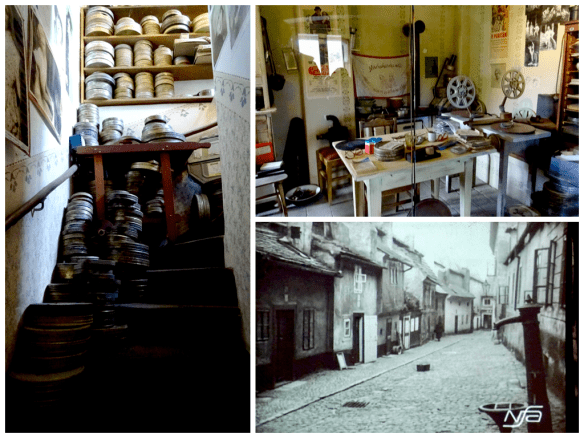
 This is the Golden Lane. This lane of tiny houses was built against the northern wall of the castle. These tiny houses were occupied until World War II and have been preserved so that the character of this lane has not changed. From 1916 to 1917 house No. 22 was inhabited by the writer Franz Kafka.
 The name of the Lane is derived from goldsmiths who used to live there. I struck up a conversation with a gentleman who told me that he and his father were both goldsmiths and that the tools have not changed at all. He also said his father died young and that he quit because some of the processes involved are very toxic.
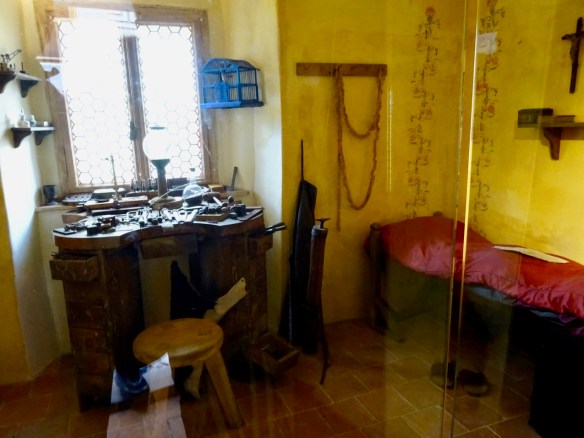 The houses are tiny and have tiny doors.
 This was a fortune teller’s house whose predictions about the early fall of the Third Reich resulted in her being arrested and tortured to death by the Gestapo.
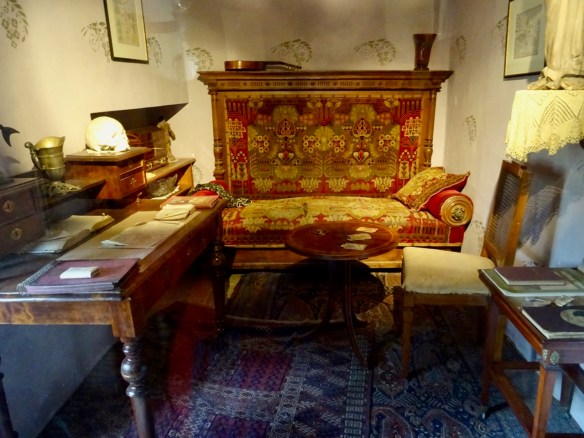 An amateur historian who saved many copies of old films that were intended for disposal during the Second World War lived here. We watch one film that showed scenes of Prague and this Golden Lane. It looks much like it does today.
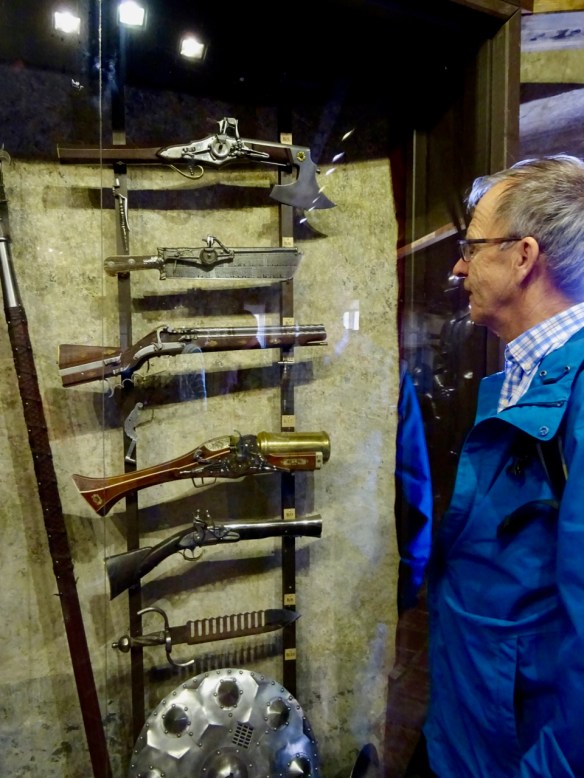
 We almost missed seeing a huge display of old armaments and armour. It was quite interesting. Some the swords have pistols built into them, or axes attached!
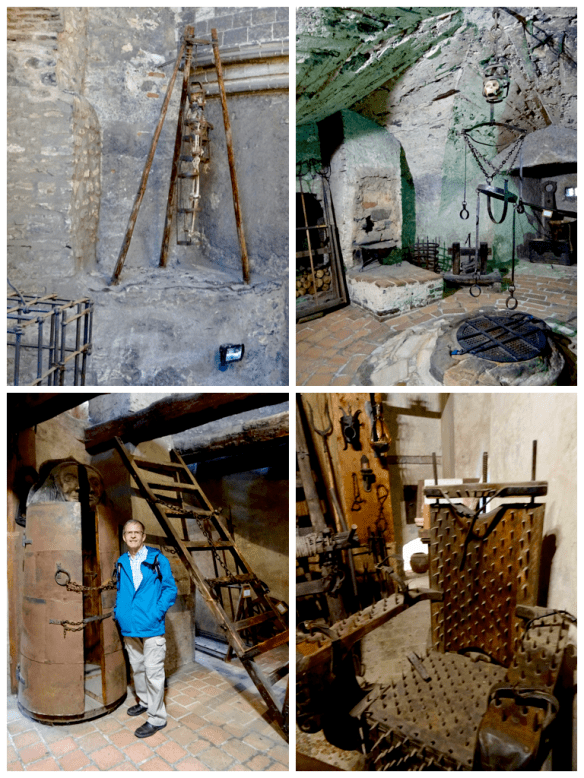
 And then there is the torture chamber. These places give me the creeps. It is just so hard ot think of people subjecting each other to such pain and terror. Bob is standing beside an Iron Maiden, which has spikes inside just long enough to pierce the body and make sure that the person inside dies a slow painful death. There are two spikes placed so that they will pierce the eyes of whoever is placed inside, and take a look at that chair! It is enough to give me nightmares.
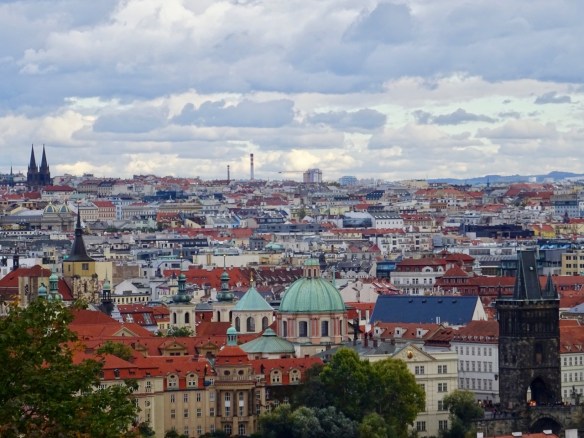
 After the torture chamber we see some great views of Prague…
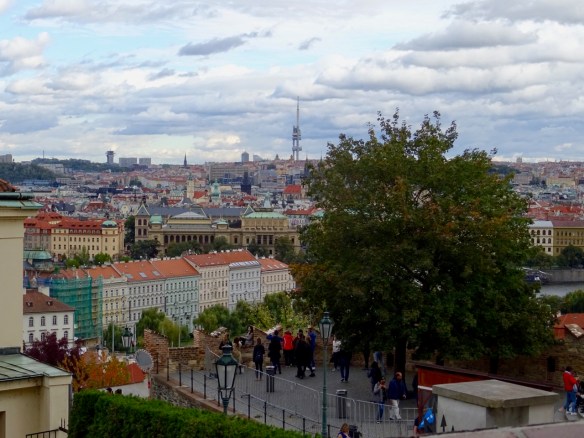
 can you spot our TV Tower? It is hard to miss.
 As we leave the castle the changing of the guards marches past. A couple of the guards have their hats blown off by the wind but they just keep marching, although they did smile! It was crazy windy today and a bit cold so it was a good day to be inside.
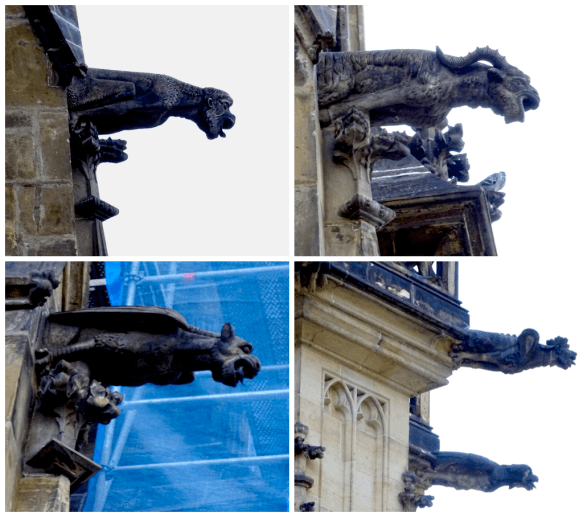
 Walking past the Cathedral towards the exit I thought to look up, and yes, there were gargoyles! I love gargoyles, in case you didn’t know.
 This shrub was near the exit. I have no idea what it is and wonder if anyone else might know?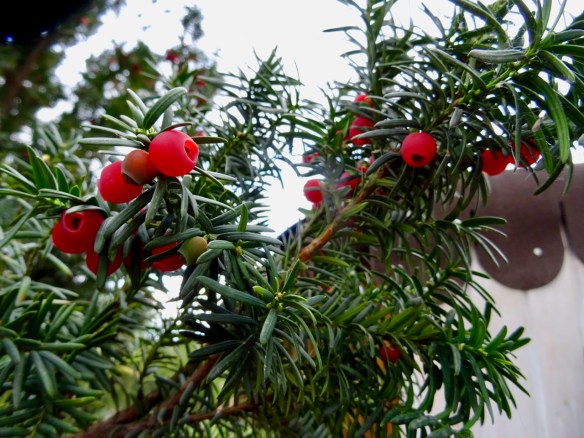
 The grounds in front of the palace. We have our picnic lunch and then visit the Bildergalerie.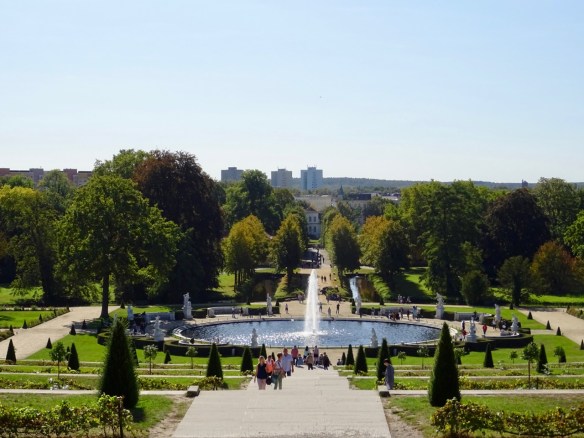
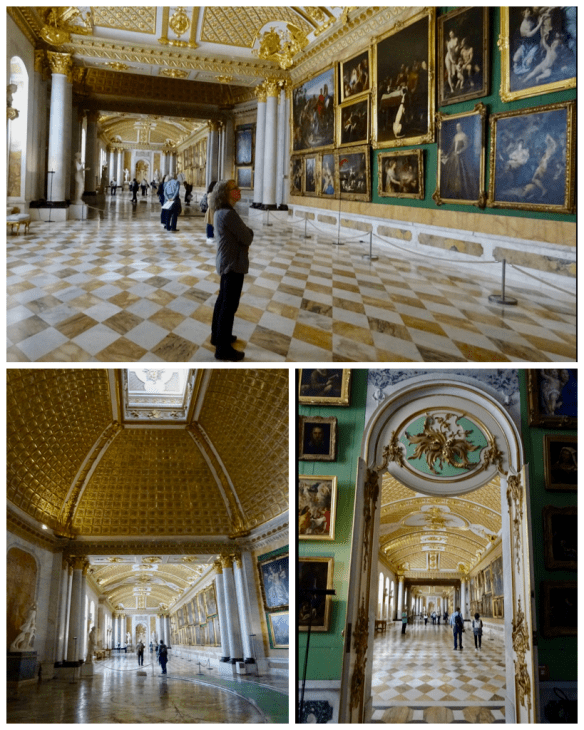
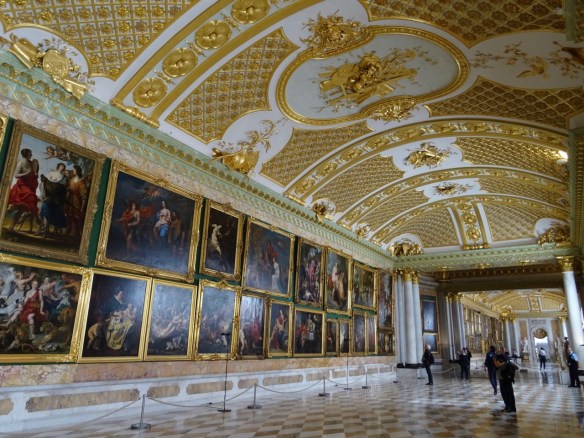 connected by a round room with a vaulted gold ceiling. At the far end there is a room for small paintings. The last photo is taken looking out from this room. There are a lot of beautiful paintings but they were a bit hard to see because of the glare from the windows on the opposite wall. I am surprised that they allow the much sunlight to enter the gallery, but it did make the space bright and very attractive.
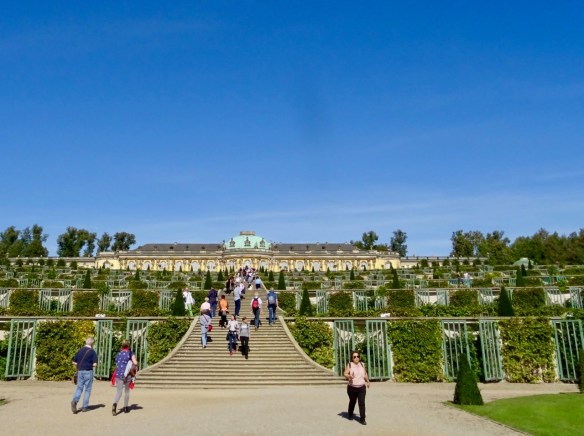
 We still had a bit of time before our palace visit so we walked down to the gardens. The layout here is reminiscent of Versailles in France, only on a smaller scale.
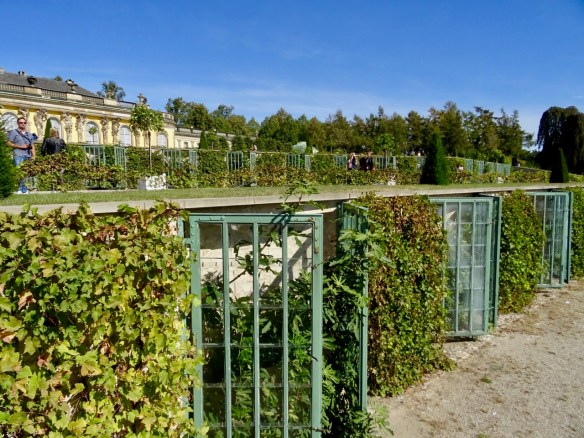
  All the terraces have these nooks with glass doors that can close when cold to protect the plants. Frederich loved to garden and grow fruit trees and grapes.
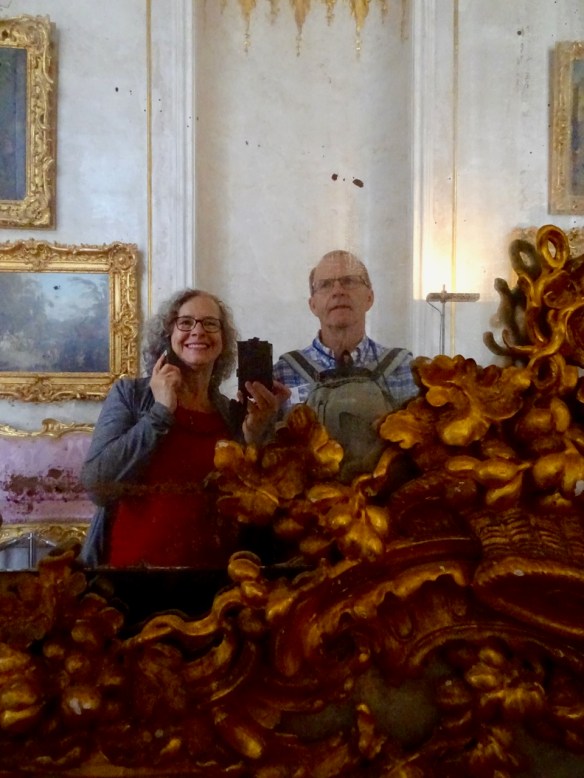
 We enter the palace and take this selfie in the first room. It contains artwork and is an entrance hallway, not very wide at all.
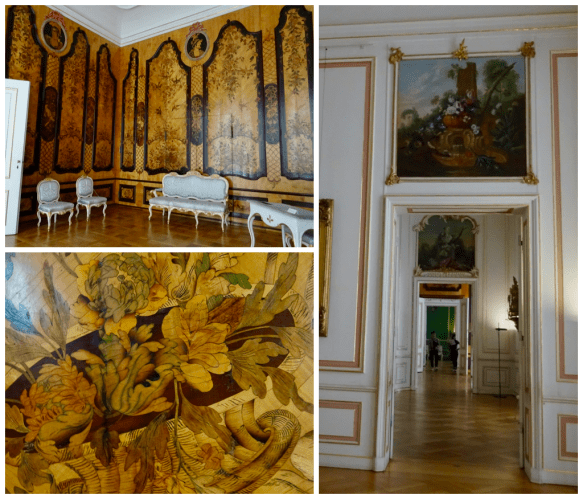
 The palace only contains twelve rooms. They are all connected by doors in a straight line that lead from one room to another. The room below is panelled in wood with inlaid botanical designs. They are very intricate.
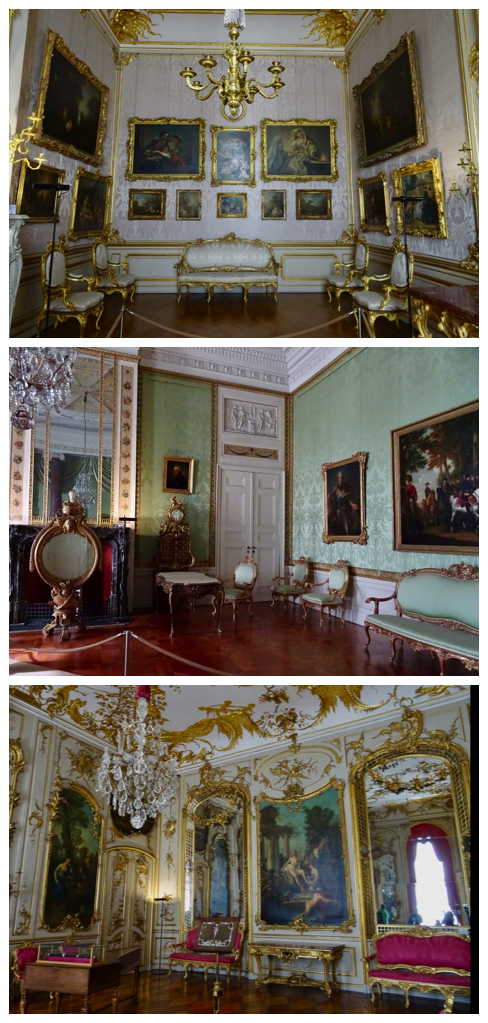
 We walk through the rooms, each seeming to be a bit more elaborate than the next.
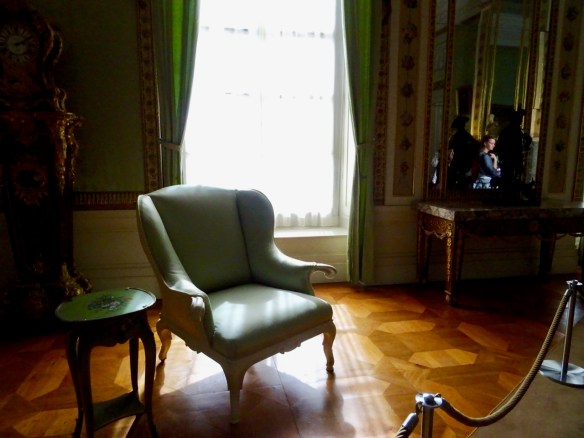
 The green room above was Frederick’s study. He suffered from asthma, gout and other ailments and he often slept in the green chair below as it was too difficult to lie in a bed. He died in this chair when he was 74.
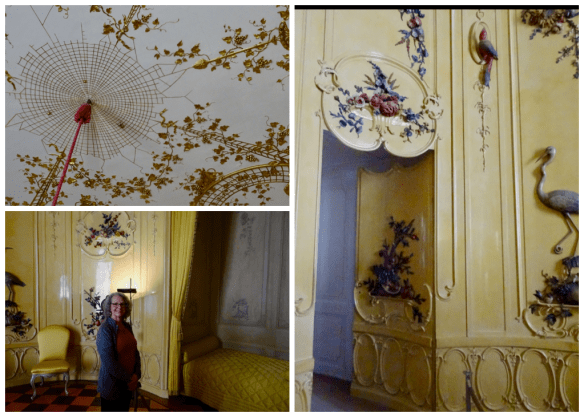
 Frederick loved nature and the palace was decorated with botanical themes. The palace was his refuge and he lived there from April to October. Sanssouci is from the French “sans soucci”, which means “without worry”. Frederick was married but lived separately from his wife. He only married because his father threatened him with imprisonment if he did not comply. His father was very strict and made his Frederick’s life miserable. He had a miserable childhood as his father thought him effeminate and tried to change him. Frederick was gay and surrounded himself with male friends and companions at Sanssouci. Women were not welcome there. The yellow room below has raised carved decorations, and a sleeping nook for the bed, as did all the bedrooms. Notice the spiders on the ceiling decoration.
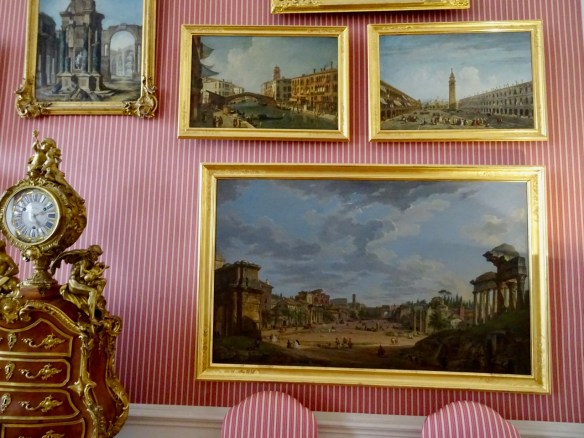
 Frederick was unable to travel to Rome and Venice but his palace had many paintings of these cities, which he greatly admired. I think how lucky we have been to visit these cities.
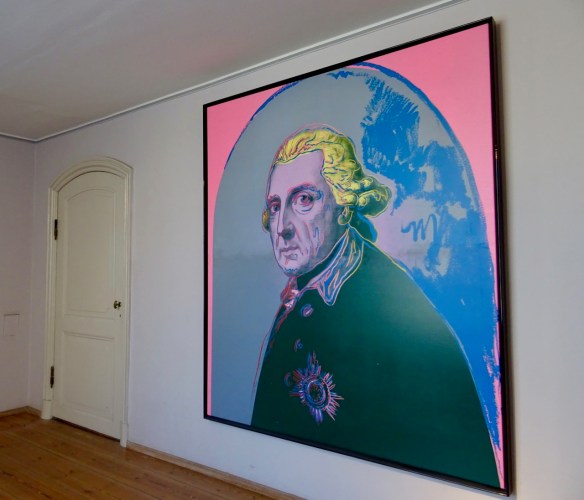
 As we exit the palace there is a huge painting of Frederick the Great by Andy Warhol. It is quite a dramatic change from the other artwork we have seen here.
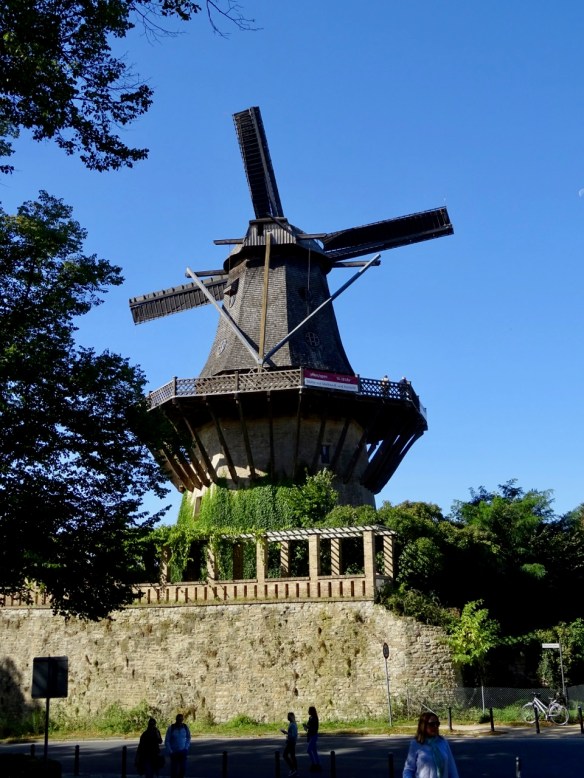
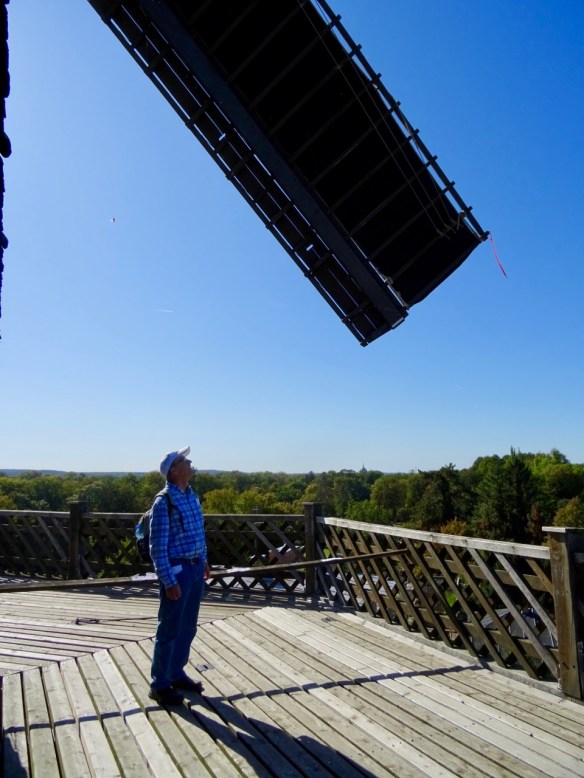
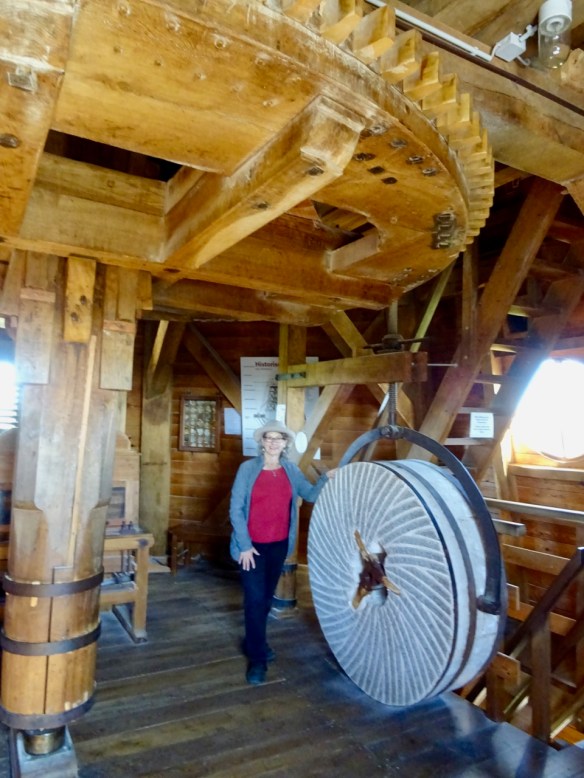
 We climb the interior of the windmill and step outside to check out the huge blades.
 This is still a working windmill. We are amazed at the size of the wooden wheels and cogs.
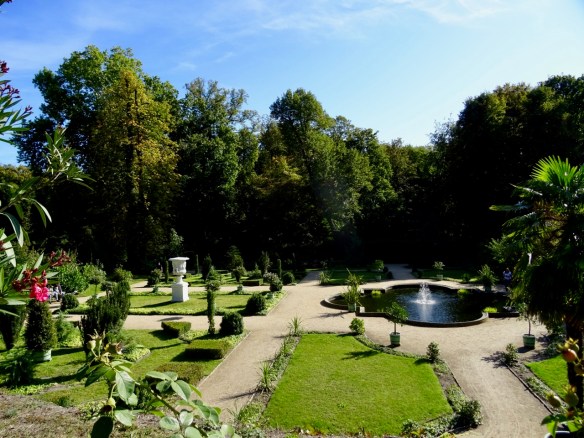
 We walk through the park with its gardens and fountains towards the Orangerie.
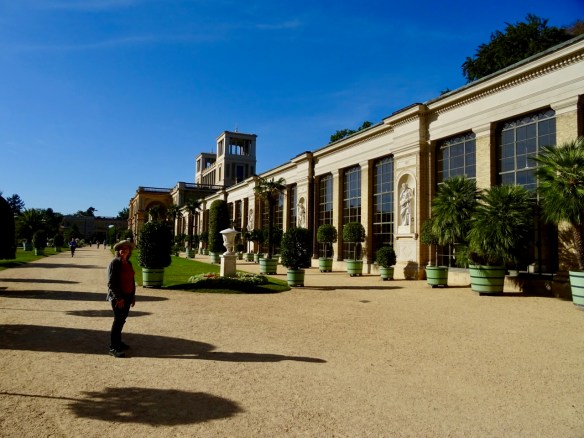
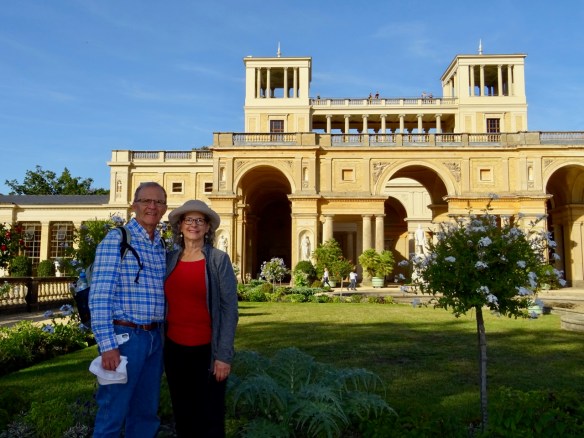
 Wow! We have never seen an orangerie this large. It is enormous! This photo shows one wing and the entrance behind me. There is another wing just as long on the other side of that entrance. This Orangerie was built by Frederich William IV in 1851-1864. It is 300 meters long.
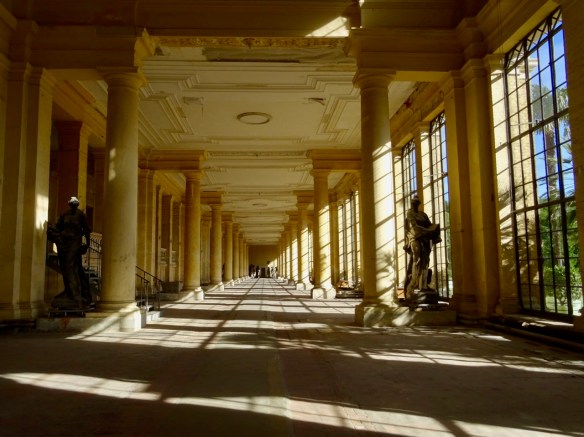
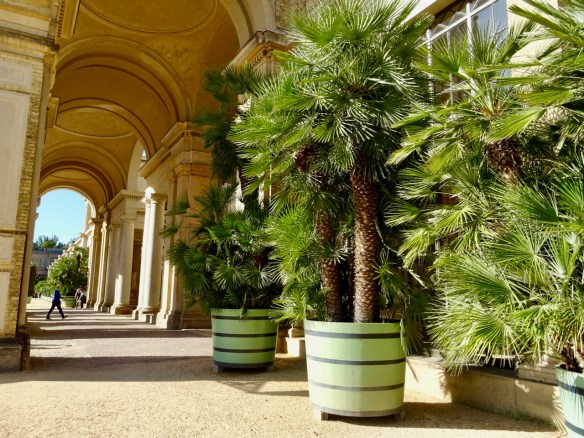
 Looking inside one of the wings of this huge orangerie. This is where all the potted plants that would not survive winter temperatures are kept. Like the potted plants in the photo above,
 Some of the plants are huge. These large potted palms definitely need a fork lift to be moved. No idea how they ever transplant them when needed? The pots are almost as tall as I am!
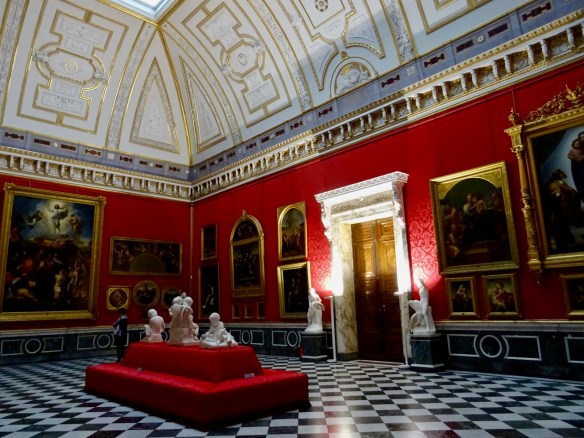
 We are surprised to find more furnished rooms and another art gallery in the Orangerie. The Raphael Hall has over 50 copies of Renaissance paintings.
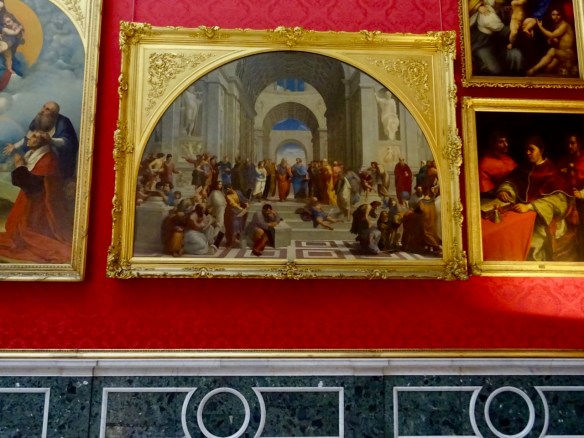
 We saw the original of this painting in Italy at the Vatican.
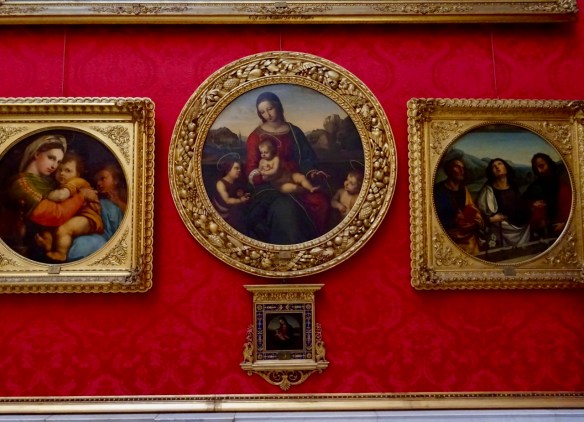
 Do you recognize the tondo by Raphael that we saw at the Gemäldegalerie earlier this week? Interesting how copying famous artworks was such a common accepted practice. Today I think it would be called forgery.
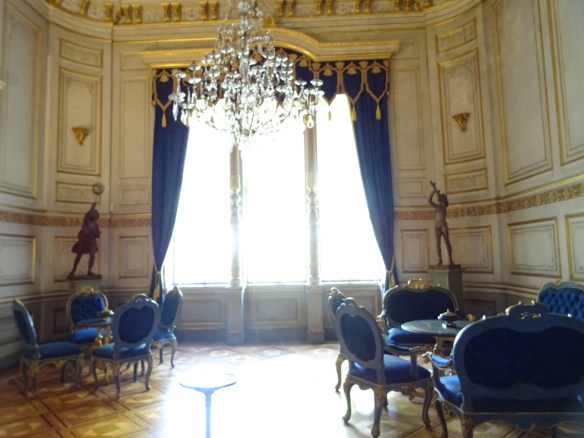
 Another room in the Orangerie Palace.
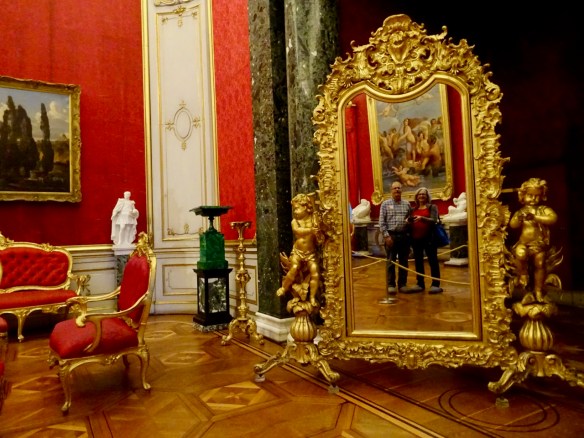
 And another selfie reflection in a very ornate mirror. Notice our big slippers!
 These are some of the stairs we climb to the top of the Orangerie.
  And more stairs…
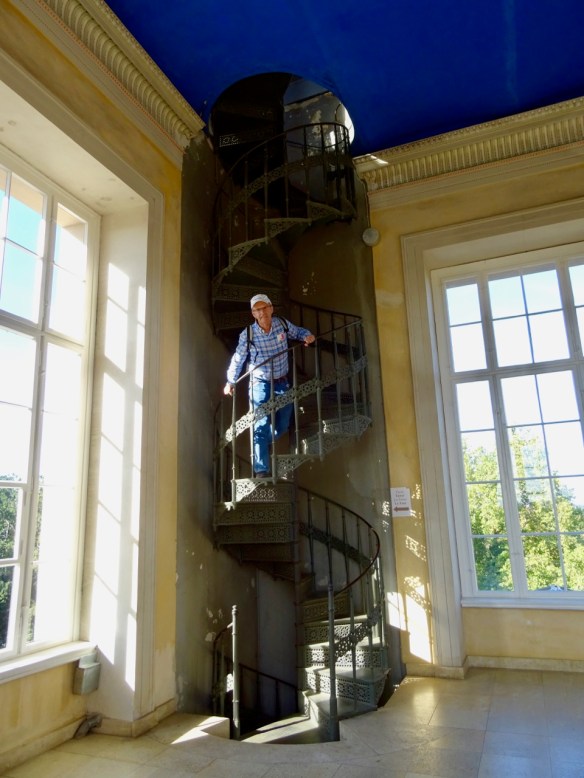 to get this view.
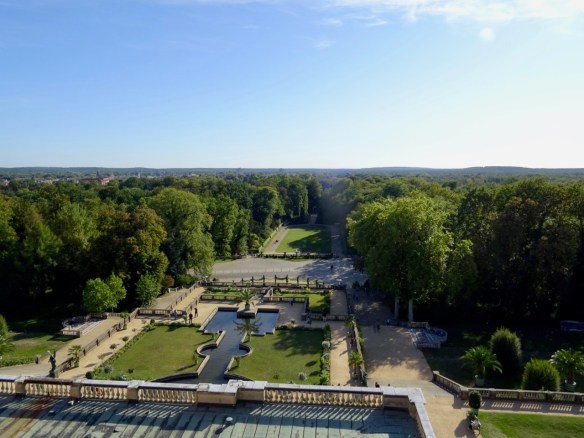 There is the East wing of this enormous building.
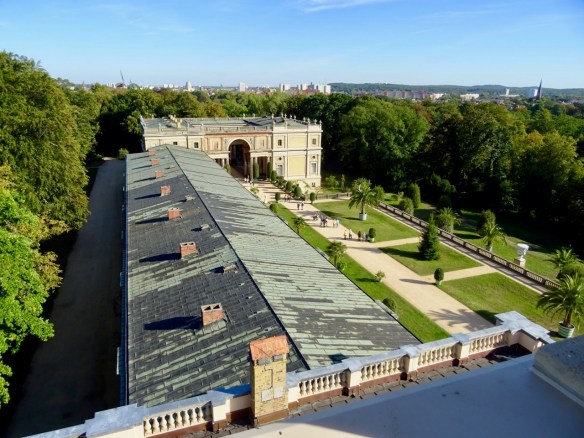 That dome way in the distance is another palace. The New Palace, built by King Frederick, is the largest and most impressive complex at Sansoucci, but it is way too far of a walk for us today and the park is closing soon.
 In front of the Orangerie.
 Every path here has a view at the end of it…something to entice you to walk and explore.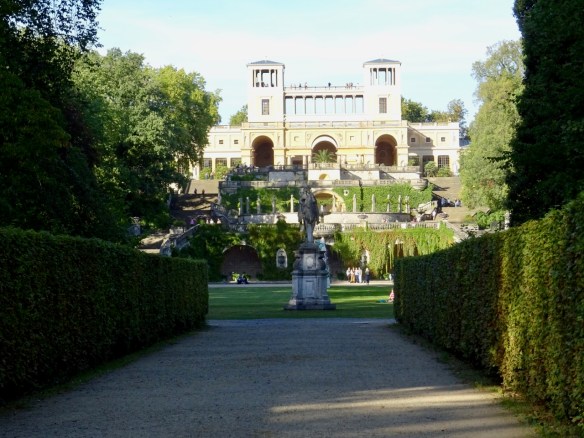
 We find the Chinese House which Frederick had built to enhance his flower and vegetable gardens and we can imagine elaborate picnics here in the summer. We make our way to the main gate just as Sanssouci is closing and catch the metro home. We had a beautiful warm day for our time here. A perfect day really.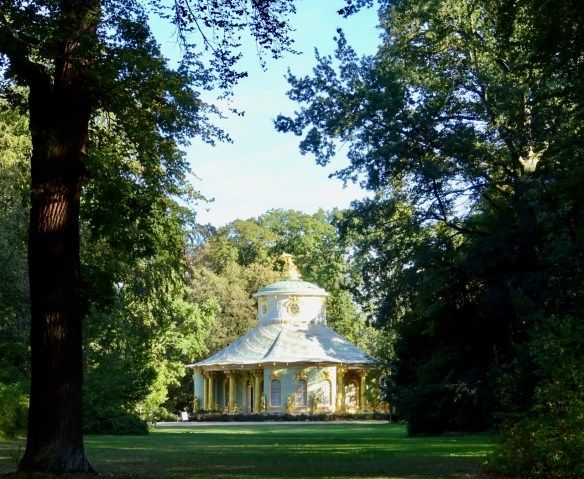
 trudymason.com