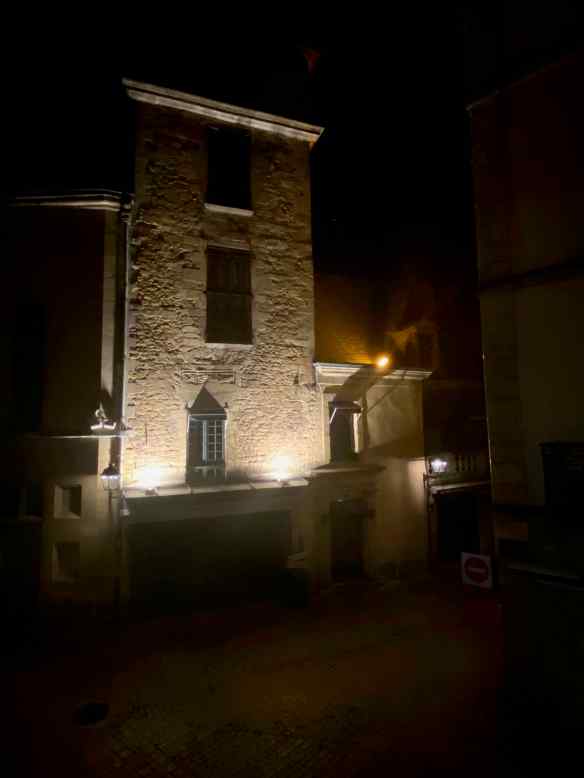
Avignon, France

Day 64 Tuesday,  October 31, 2023.

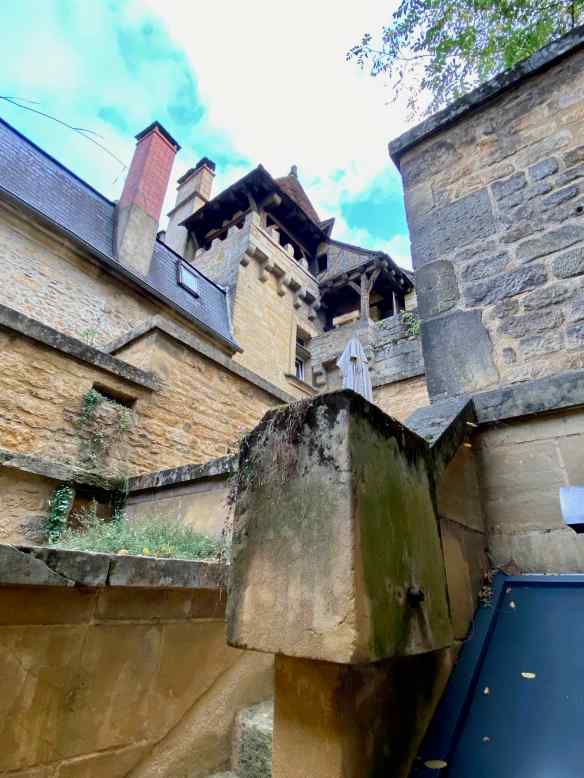
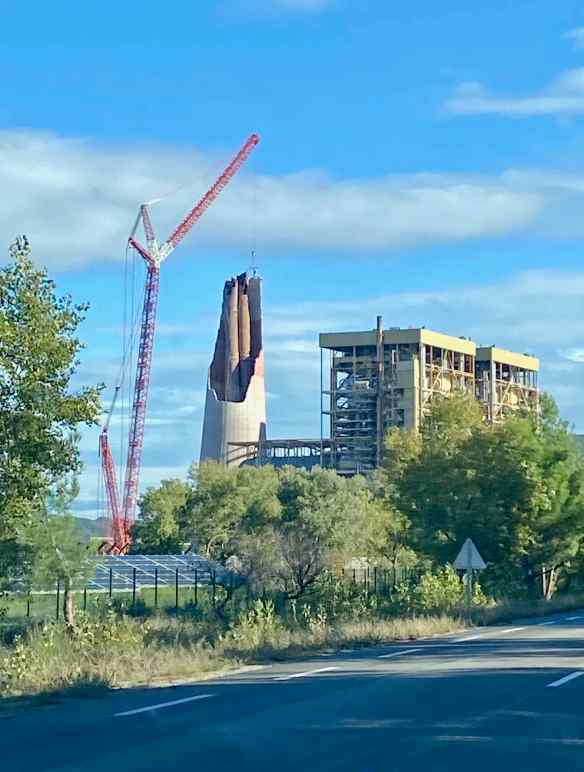
We are visiting Avignon today.  There is always something interesting to see on our drives.  I think this is an old chimney stack that is being dismantled.
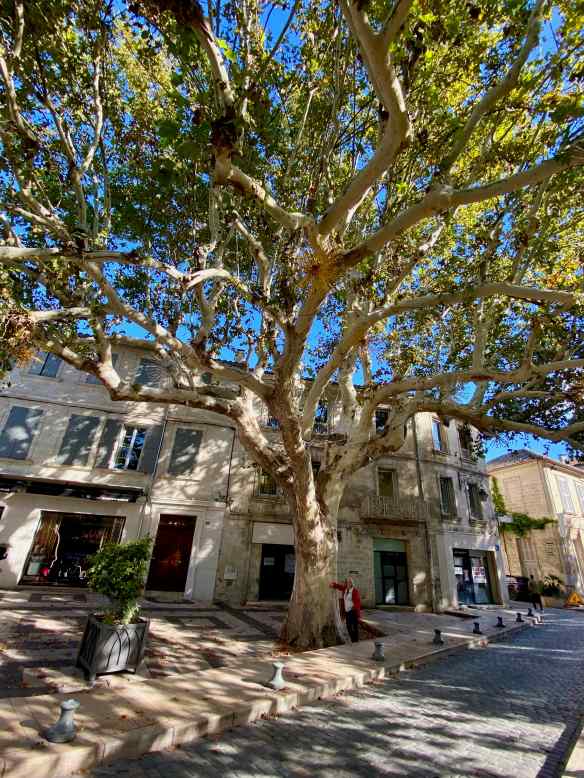
There is a free parking lot on an island near Avignon with a free bus ride into town.  The first thing we see when walk through the town gate is this magnificent tree.  I know…lots of tree photos, but I do love these beautiful huge trees.  It is too bad our winters at home are too cold for these beauties.
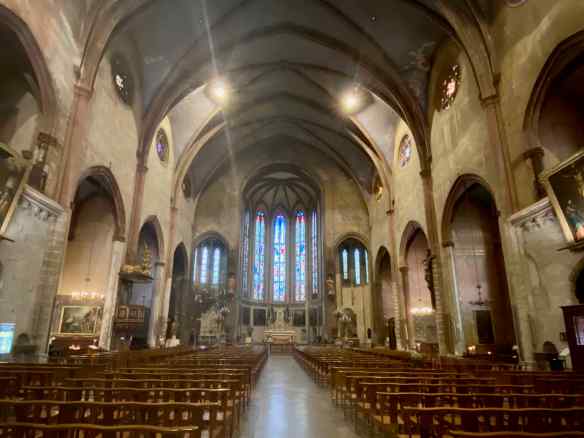
We have seen so many churches…but every time we enter another one it is different and sometimes there are little jewels to discover.  I loved the contrast between the modern paintings and this ancient Gothic church that was built in the early 1300’s…Saint Agricol Church.  There has been a church on this site since 660.  Then there is the sunlight streaming through the stained glass windows!

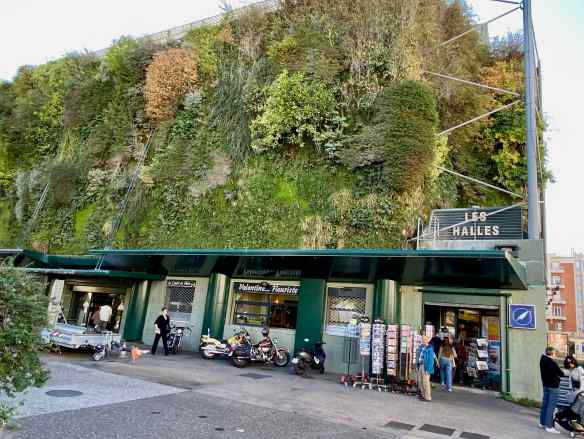
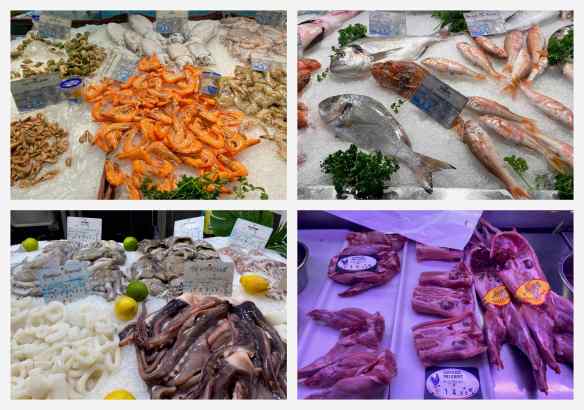
The indoor market has a living wall… and lots of seafood.  Too bad neither Bob nor I are fans.  The very last picture is of Lapin…Rabbit.  Not something we are used to seeing.  I had rabbit once many years ago and although it was OK, it isn’t something I am interested  in trying again.  
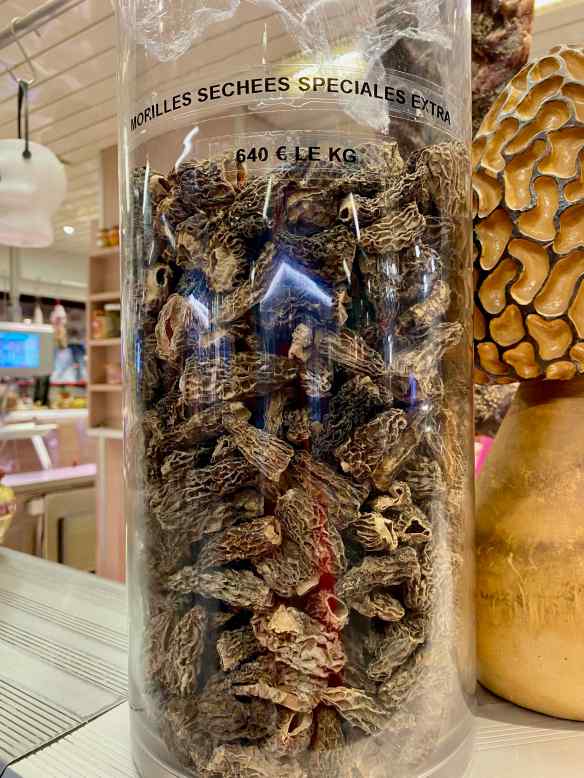
We used to pick and dry these same mushrooms.  I knew they were a delicacy but I had no idea that Morels were so expensive … 640€ a kilogram!!
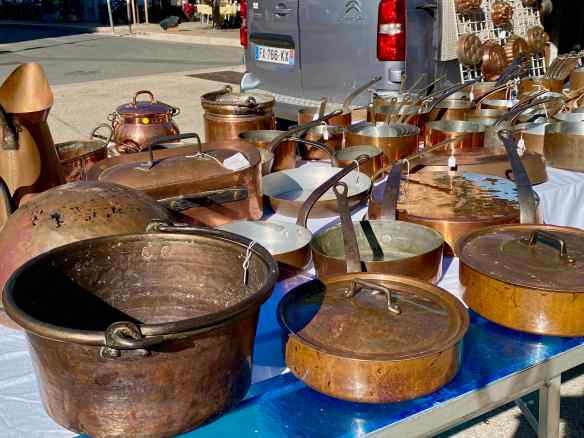
There is a flea market outside the  indoor market.  These old copper pots make me think of my grandparents and their copper pots.
After having our lunch we walk through this narrow street built between the walls of the Popes Palace and a rock cliff.
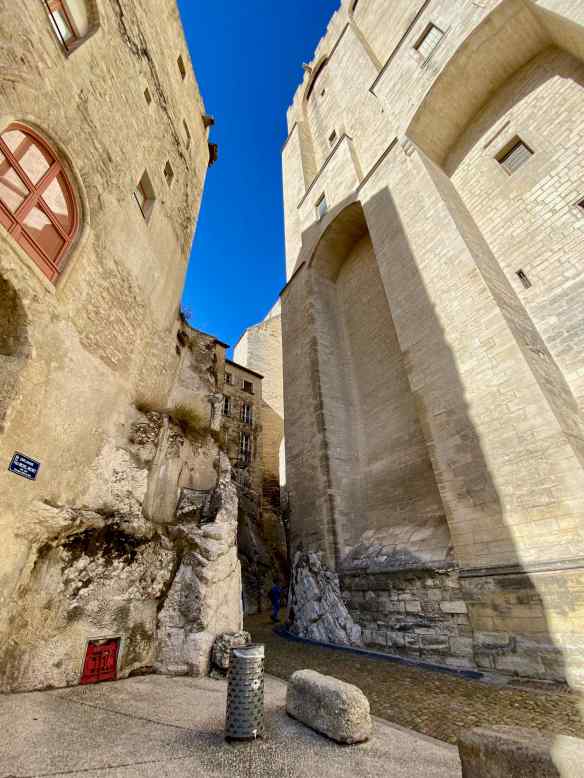
Bob has taken some amazing photos this trip…he might become a photographer yet!
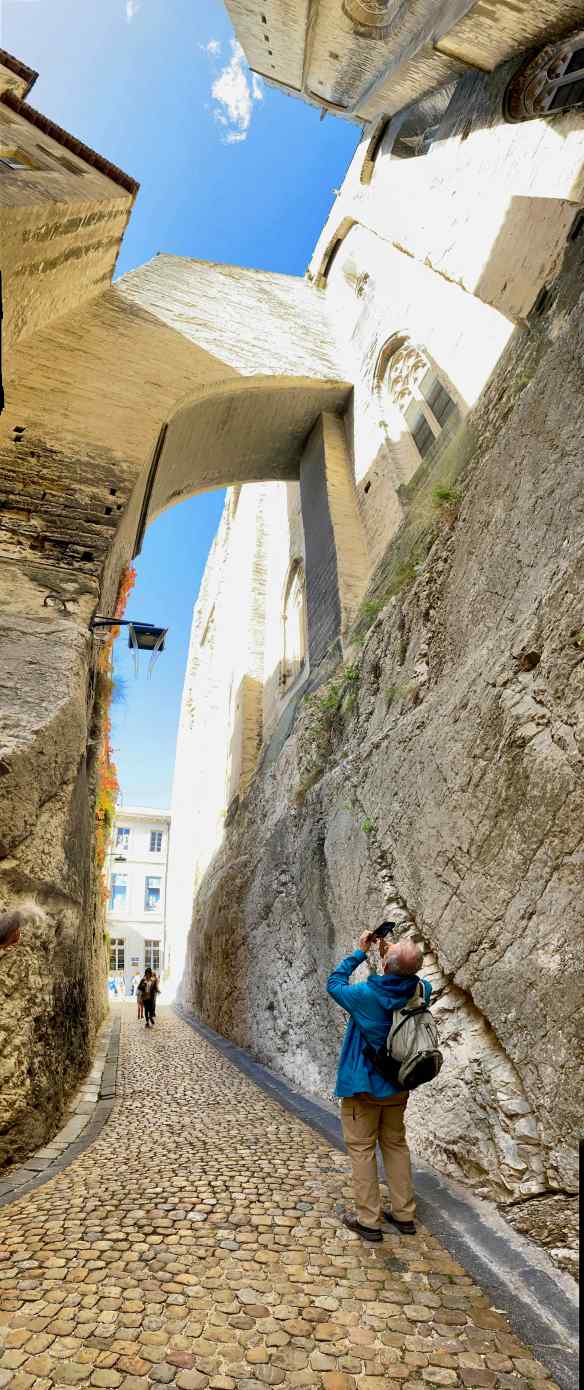
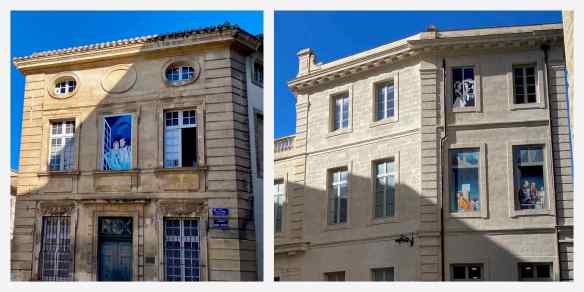
At the end of this street there are some painted windows.  We see several buildings whose windows contain paintings of people.  They make me smile.
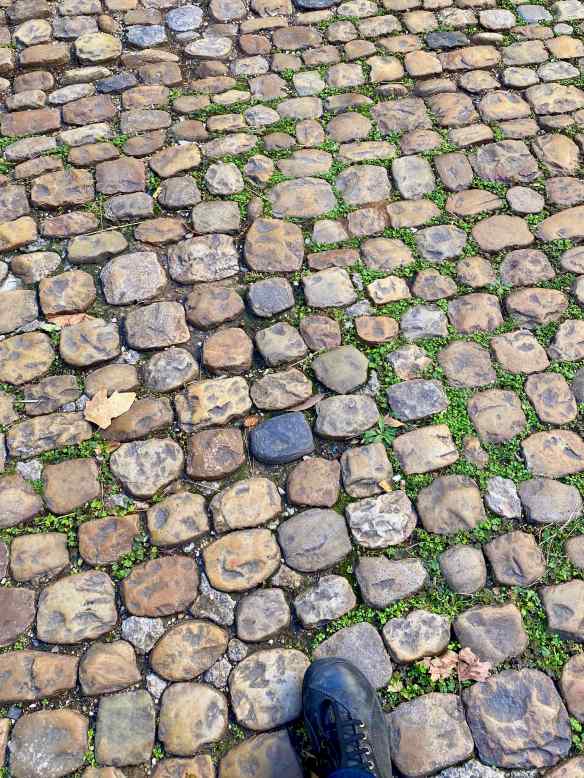
I love the look of all the cobbled streets but they sure are hard to walk on for a long time.
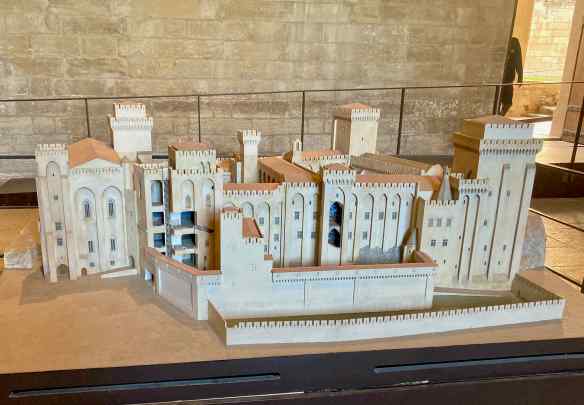
This is a scale model of Le Palais des Papes (Palace of the Popes). It is the largest Gothic building in Europe!   It was a fortress, a palace, and the seat of Western Christianity during the 14th Century.  Nine popes lived here and it is a UNESCO World Heritage Site.
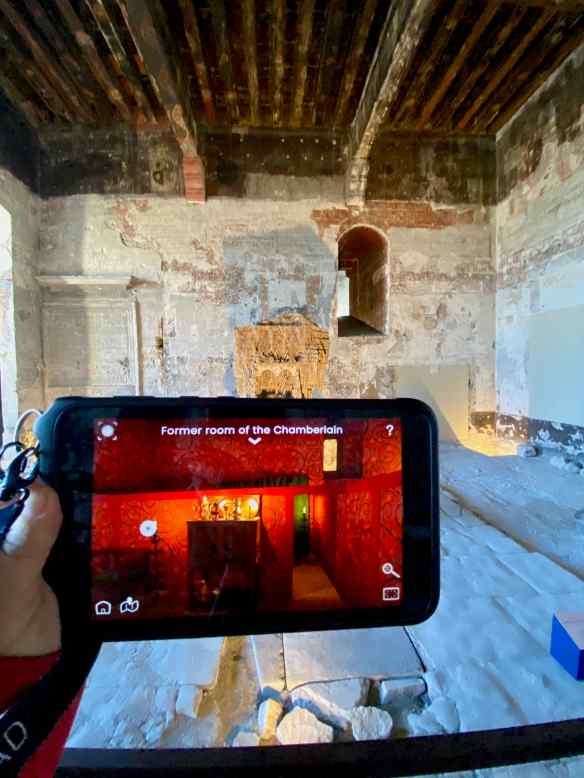
Our 12€ admission tickets includes the use of a Histopad.  This device allows us to look in any direction, as well as up or down and the Histopad screen shows us what the  room would have looked like in the 14th century.  
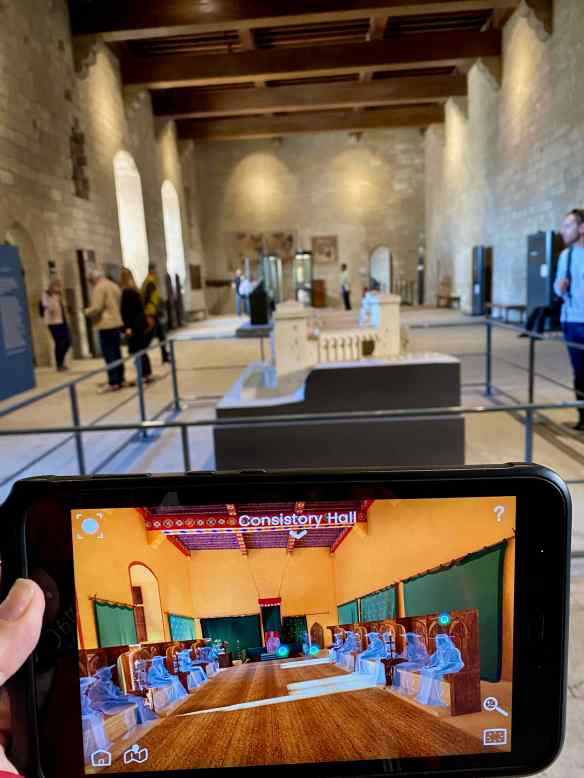
I usually wait and try not to have a lot of people in my photos, but it was really hard to do that today.  Everyone stands transfixed, viewing these rooms as they might have been. This room was the treasury and in 1995 a secret chamber was discovered under the stone floor, that still contained precious treasures from hundreds of years ago.  There was no information on how this chamber was discovered.  It is amazing that it would still be there after all this time.  Bob is standing beside this secret chamber in the photo.
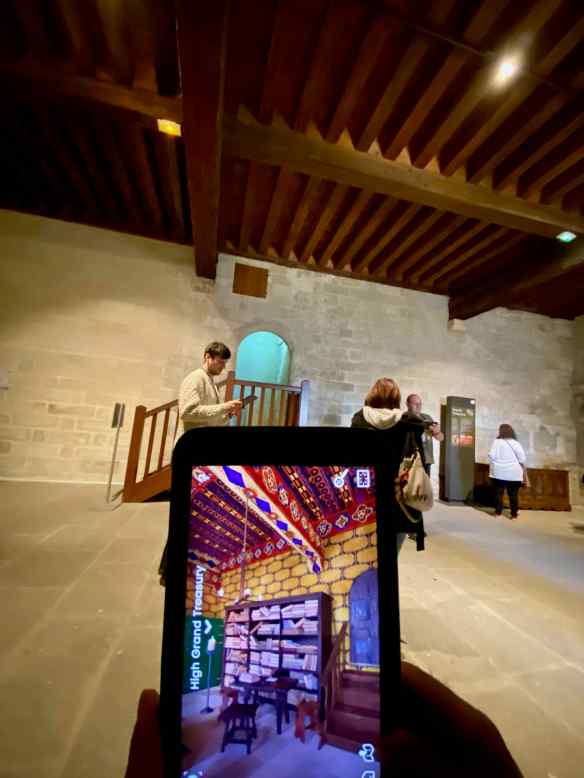
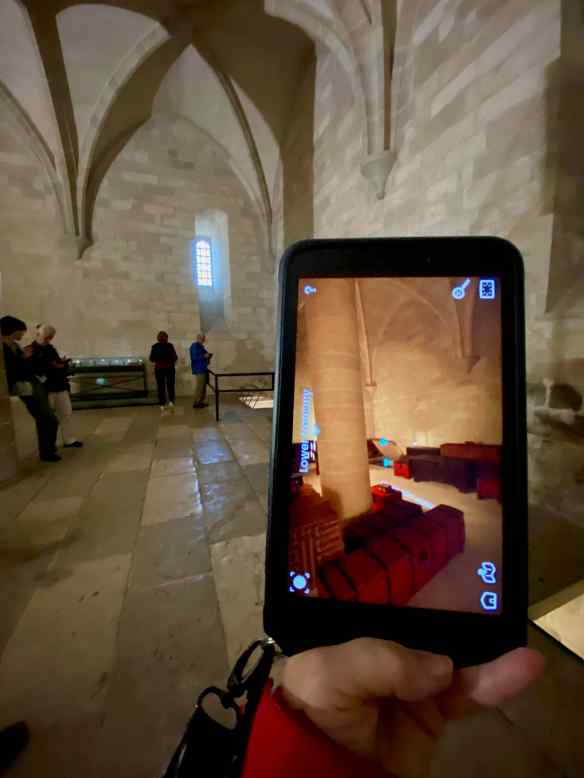
In this photo you can just see the top of a sculpture behind the Histogram…
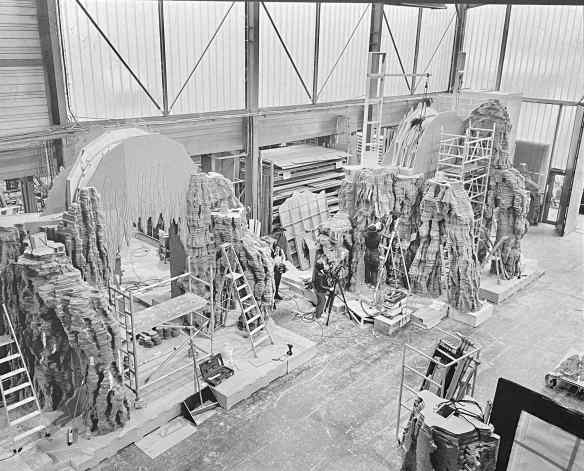
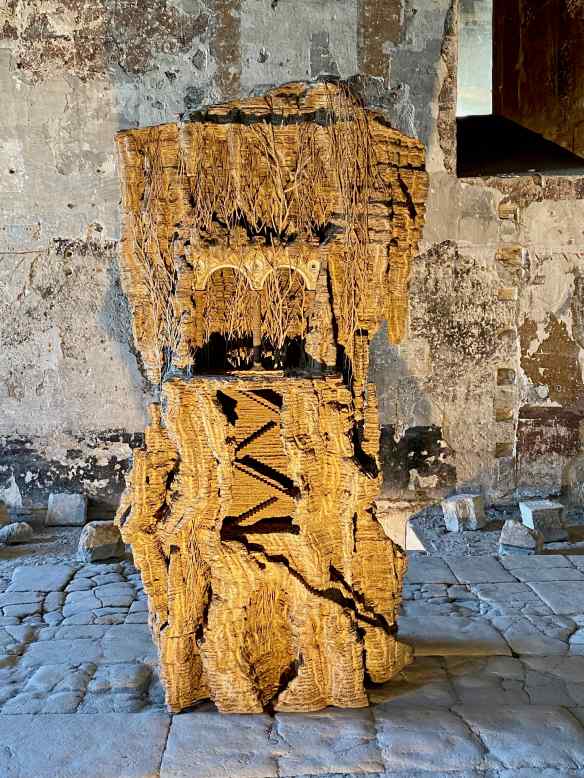
It is made from corrugated cardboard and stands about 5 feet tall by Paris artist Eva Jospin.  I think it is fascinating.  
We take a break in the palace gardens and try to buy a hot chocolate from a machine that only accepts credit cards…it was beyond both of us!  No hot chocolate for us today.
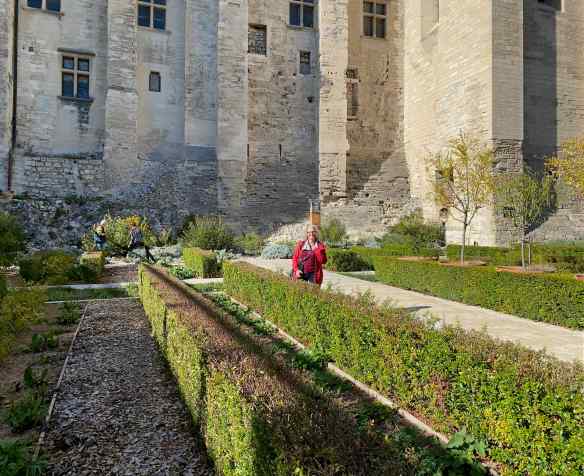
The palace walls rise 52 meters above the garden!
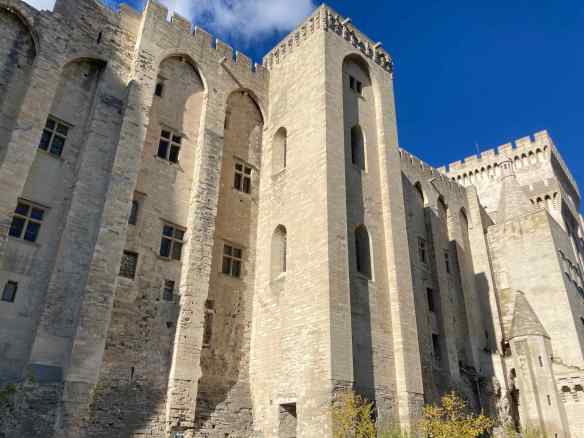
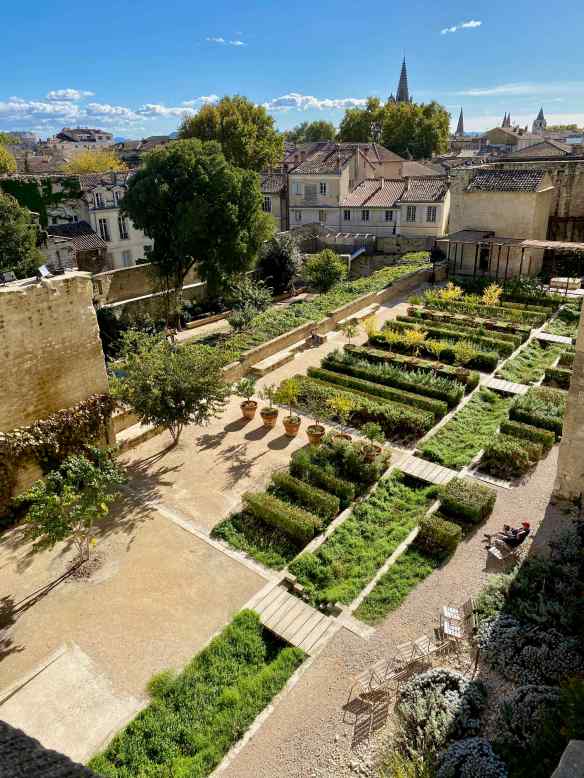
The gardens look lovely from afar but they were actually a bit neglected.  
We return to the inside for the last part of our tour.  However the Histopad photo is not what grabs my attention.
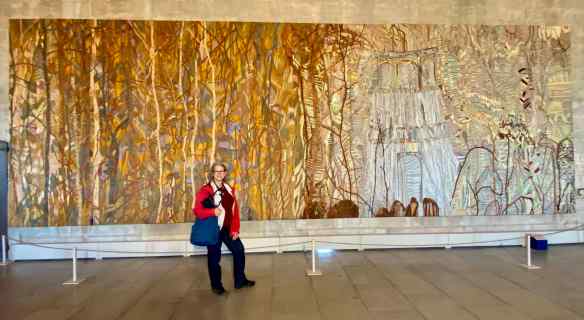
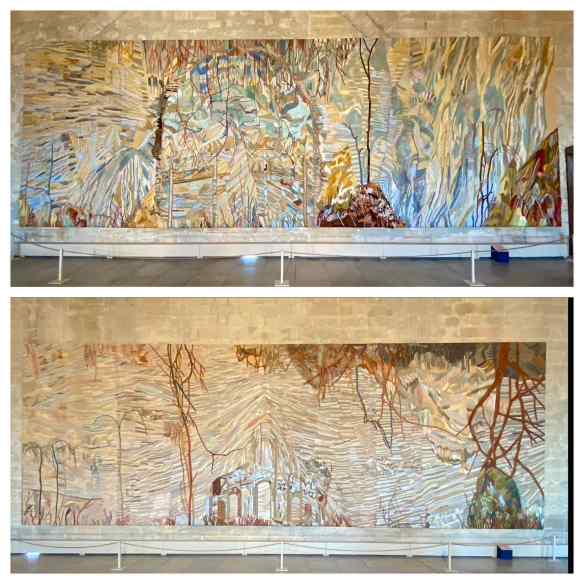
Rather it is the three enormous silk embroidered wall hangings displayed on one of the long walls.  ‘Chamber de Soie’  or ‘Silk Room’ is also created by Eva Jospin.  

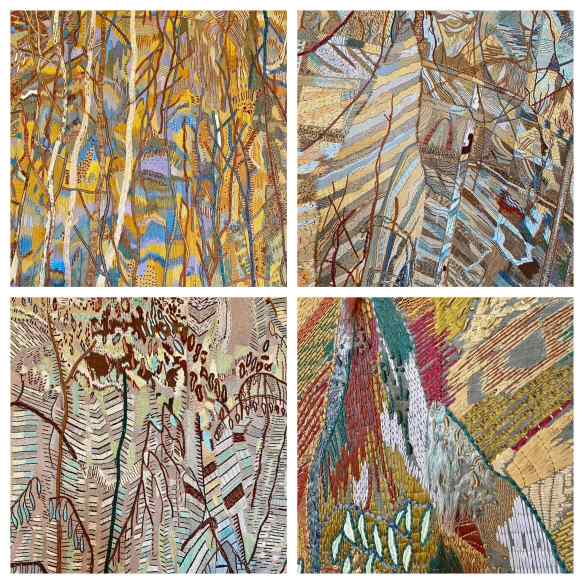
We spend a lot of time here as I walk back and forth, studying these huge embroidered panels.  I can not believe how much work it would take to make these.
Here are the other two…
along with some close-ups of the embroidery.
Next door is a small room that used to be a kitchen.  It also has artwork, including this sculpture, ‘Empyrée’, that is suspended from the top of the huge chimney in the center of the room.   Empyrée is from mythology and means ‘Highest part of the sky, where the gods reside’.  I am astounded to read that this is also by the same artist, Eva Jospin.
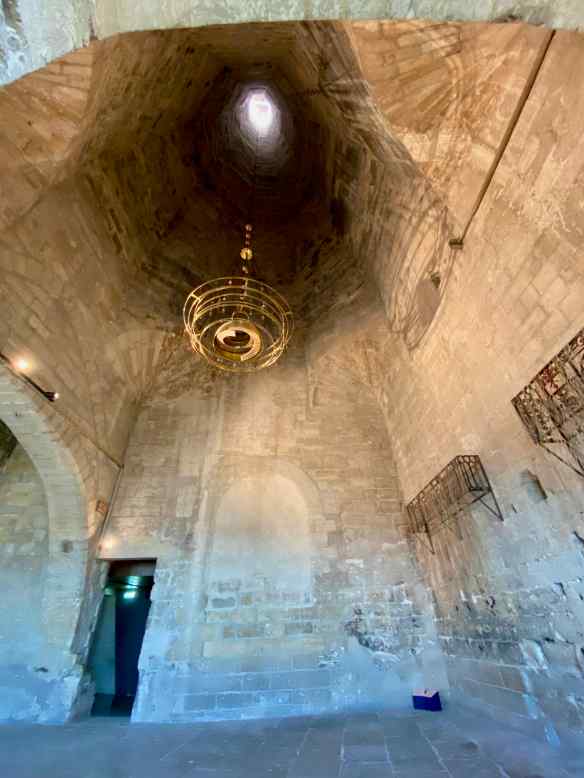
But then we walk into the next room and see this sculpture that is made completely from corrugated cardboard!  Wow, It is astounding.  I spend a lot of time here as well.  There is so much to look at in ‘Forest Galleria’, or Forest Gallery.  And who is the artist?  Eva Jospin!
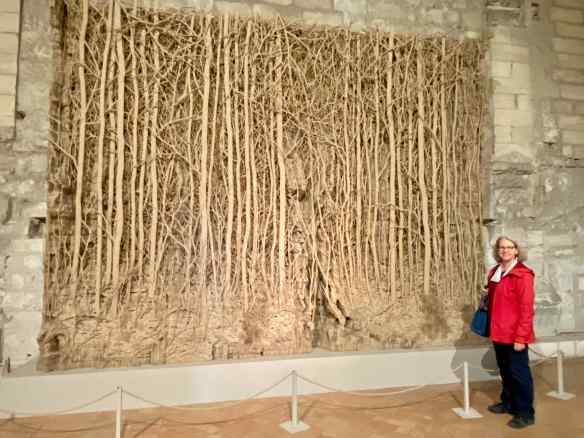
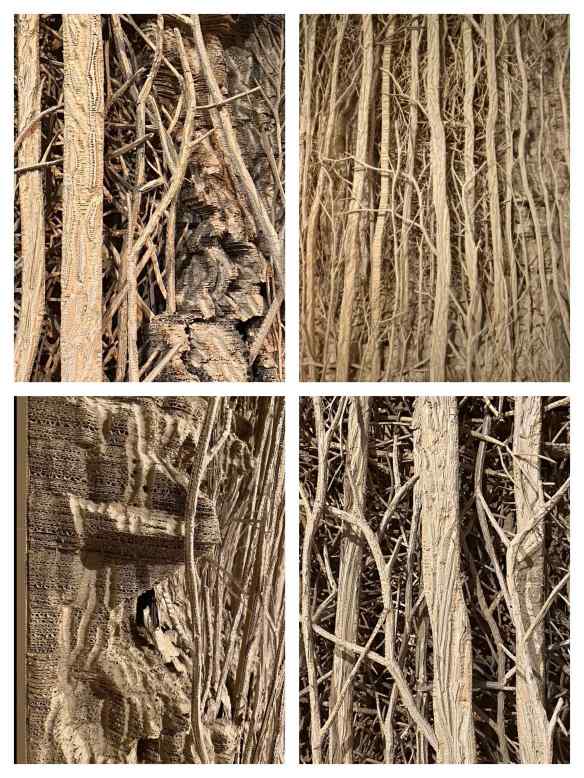
Some close-ups of the different techniques used to create this forest.  I cannot believe the size and complexity of this sculpture…
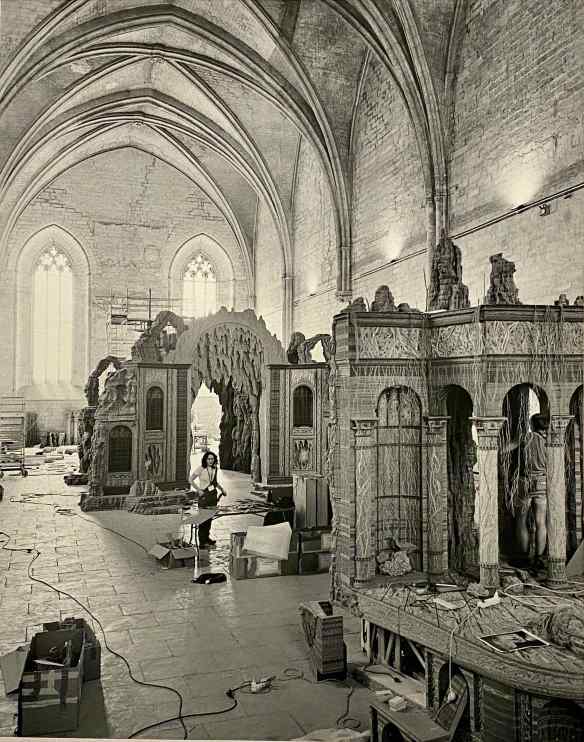
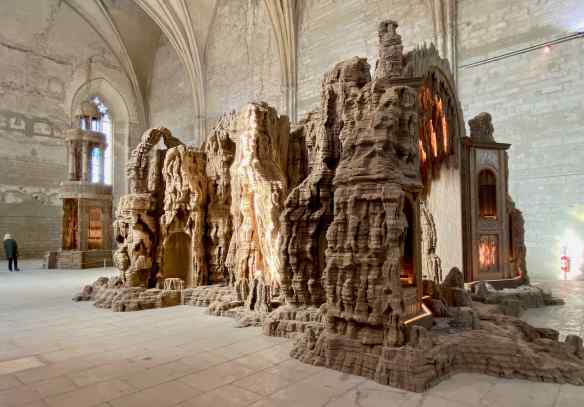
until we walk into the next huge room.  OMG!!  There are simply no words to adequately explain this work called ‘Paysages’, or ‘Landscapes’.  There are three enormous sculptures in this equally enormous chamber.  This one is actually the smallest of them all and they are all made with corrugated cardboard!
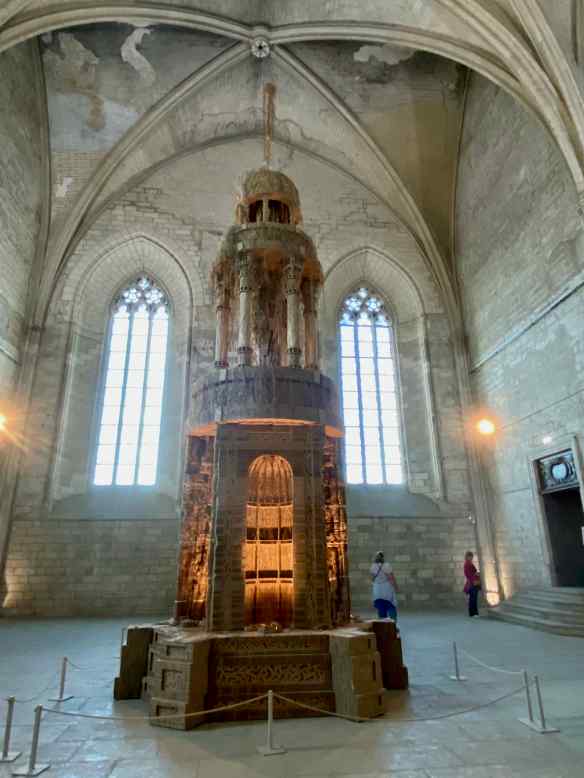
This piece is reminiscent of a classical temple on one side…
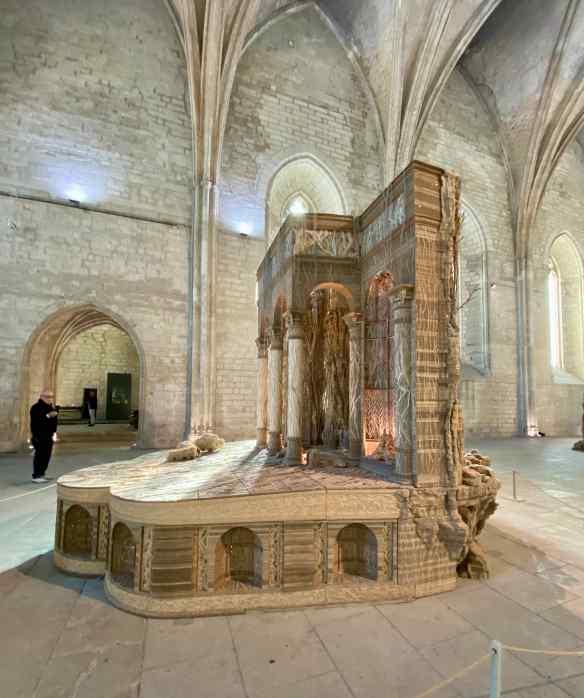
and here is the back, all overgrown with trees!
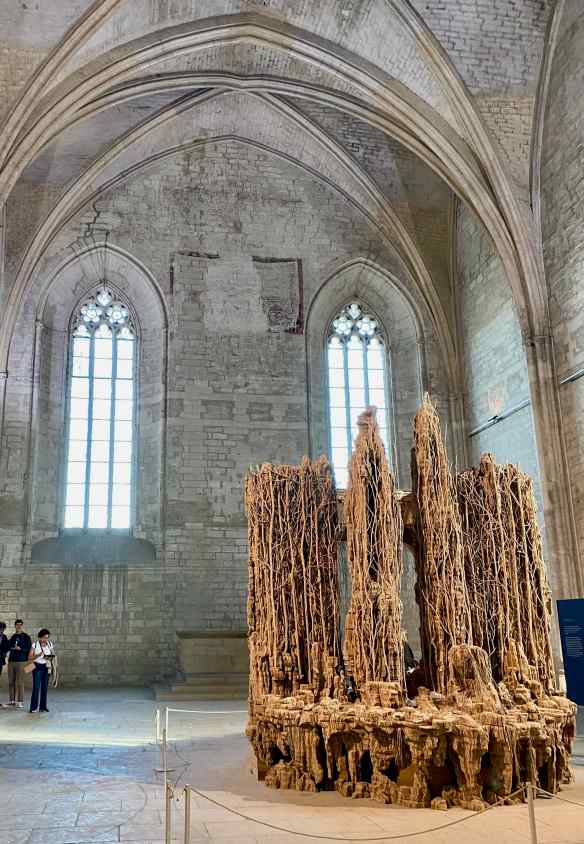
These two sculptures are astounding…but then there is this absolutely unbelievable piece that is placed between the other two.  What can I say?

A close up of part of the front…
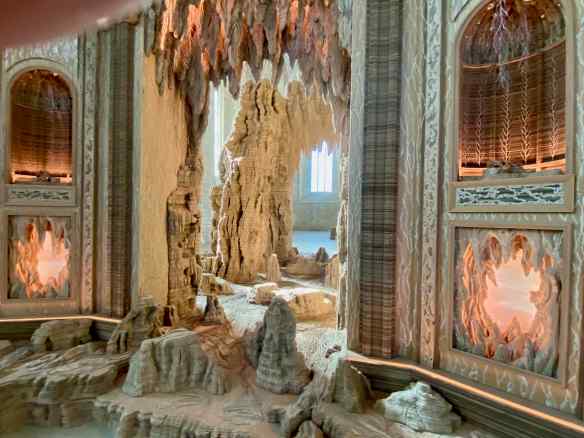
a side view.  I did say it is very large!
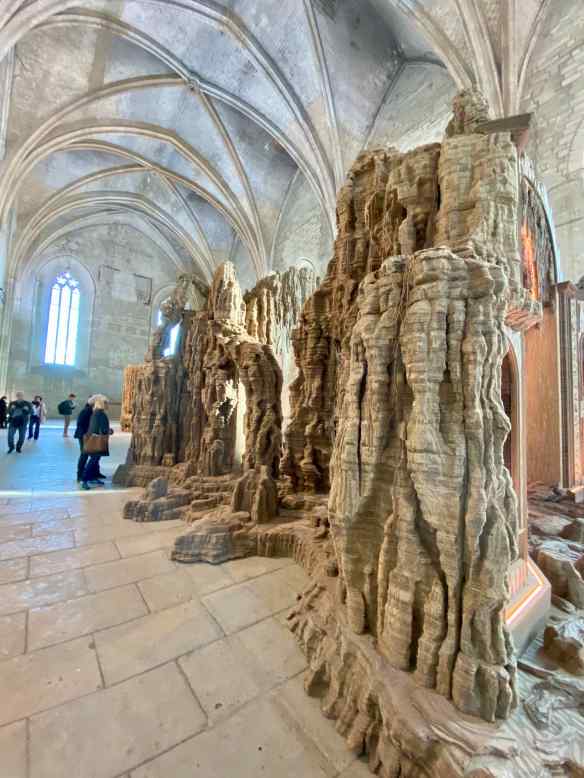
And a view through the center, which reminds me of a river flowing through a rocky canyon.
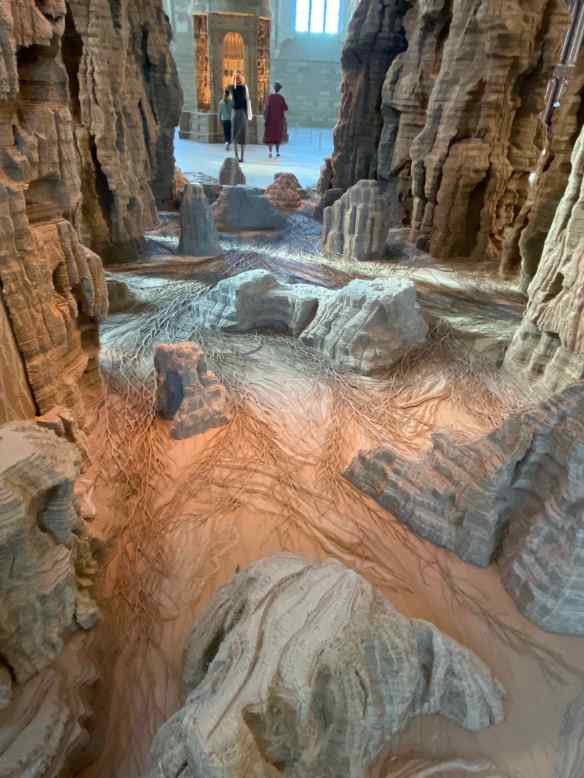
Honestly,  photos cannot capture the grandeur of this work! I did find a video explaining how these pieces are constructed with corrugated cardboard, but sorry, it is a FaceBook video so not everyone may be able to view it.   https://www.facebook.com/watch/?v=437873248434139.      
And here is the link to Eva Jospin’s website.

https://www.suzanne-tarasieve.com/artist/eva-jospin/?lang=en&show=

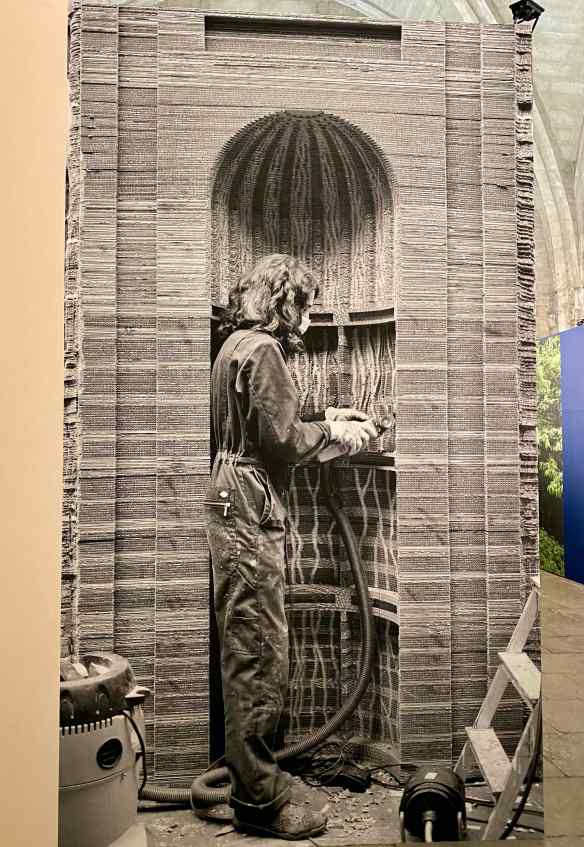
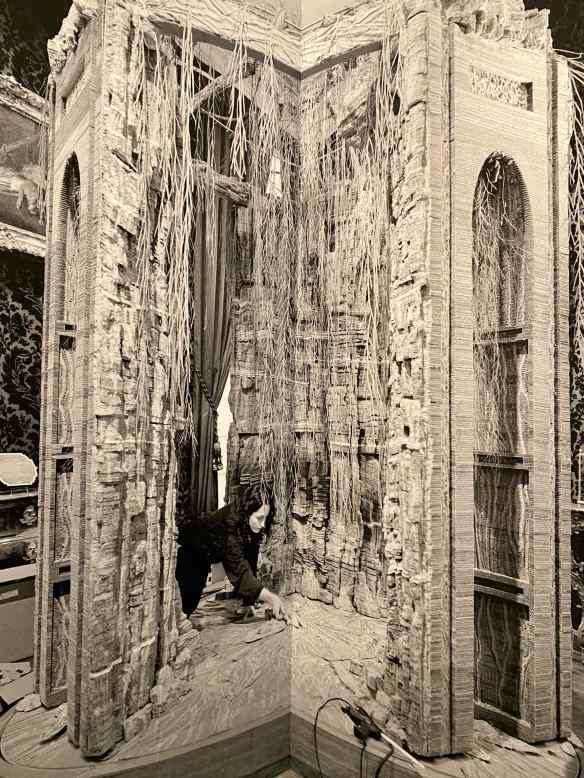
There was also a room with a video about Eva Jospin and some photos of the process for creating these pieces.  I am in complete awe.
We climb lots of stairs to the roof of the palace.  We started our tour way down there, under the raised seating of this outdoor theatre.

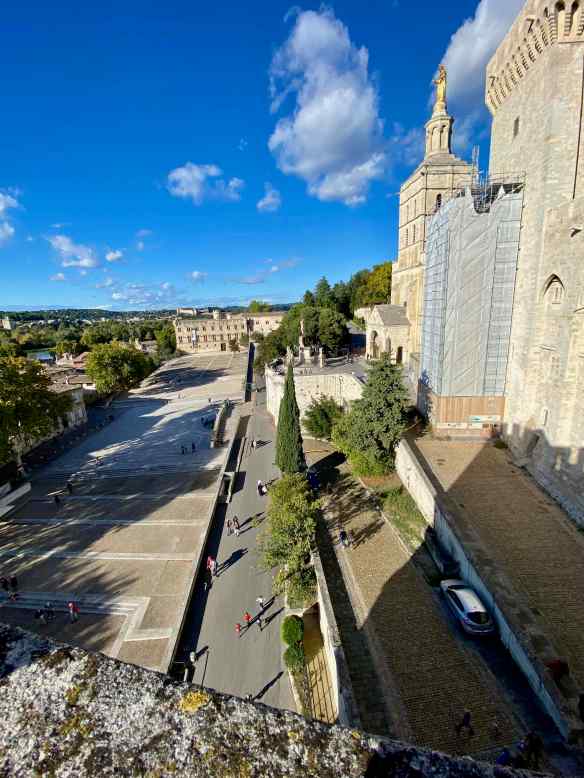
The views from the top are amazing, but it is time to start heading back home.
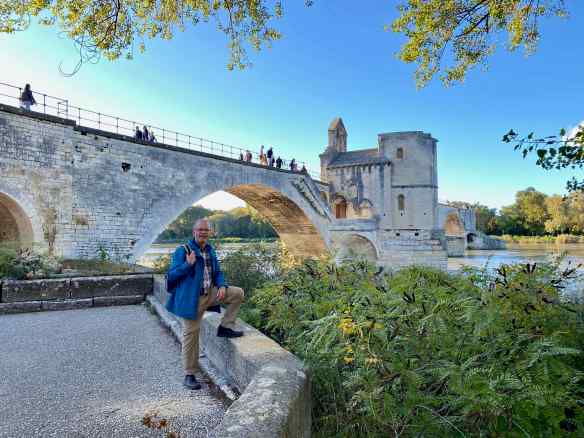
As we walk back to catch the bus to our car we walk under the Pont d’Avignon.  Bob said they used to sing the French children’s folksong ‘Sur le Pont d’Avignon’ when he was in elementary school.   https://www.youtube.com/watch?v=_r8eALyO8E4
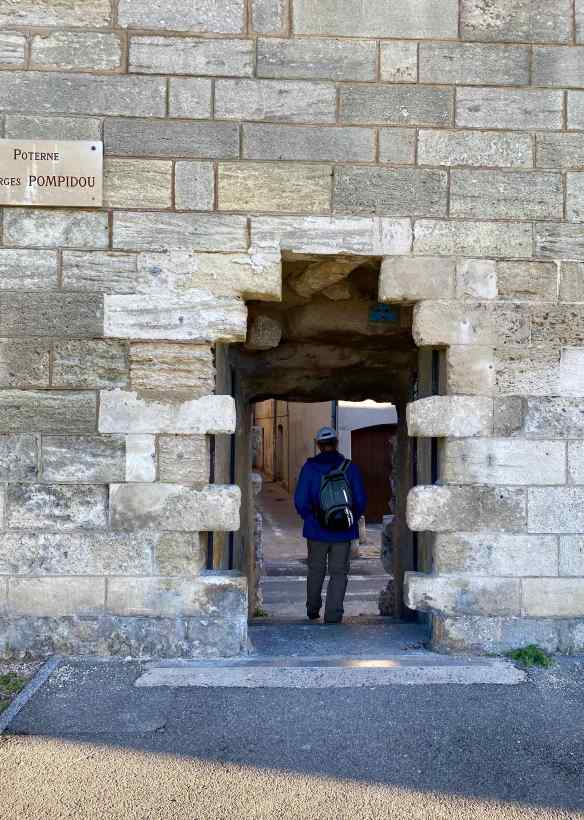
We walk through the fortified walls through this rather makeshift looking doorway.
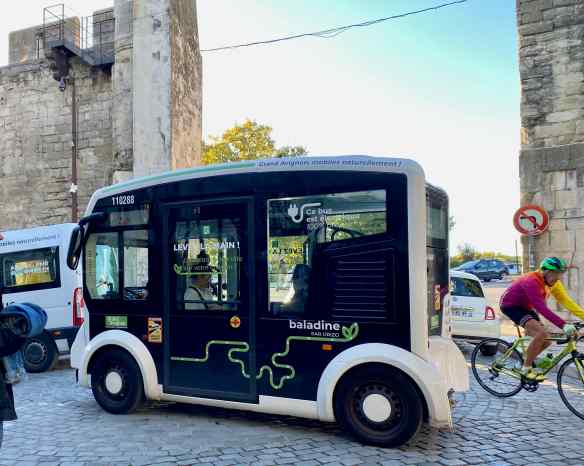
Just as we are leaving to catch our bus one of the town’s little busses passes by.  This is the tiniest bus we have ever seen.
Thanks, if you are still reading and made it this far.  I know this is a really long post, but I want to remember all of it.  I actually pruned out a whole lot more photos!
Arles, France…Walking in Van Gogh’s Footsteps

Day 62,  Sunday, October 29, 2023

“Vincent van Gogh arrived in Arles in February 1888.  This was the start of an intense period of activity for the artist, in the Mediterranean light.  Indeed, it was his most productive era and during this 15 months in Arles, Van Gogh produced over 300 paintings and drawings, thus forging one of the most important periods in the history of art.  In May, 1989, Vincent left Arles for the Saint-Rémy de Provence asylum, leaving the name of Vincent van Gogh linked to that of Arles forever.” ~ Arles Tourism brochure.

Vincent spent a year at the asylum before moving to Auvers-sur-Oise in May 1890, where committed suicide on July 27th 1890.

Today we are going to follow Vincent’s footsteps as we walk through Arles, looking for the places where he stood at his easel creating some of his most loved paintings. Arles has placed a copy of each of his paintings at the location where Van Gogh would have stood.

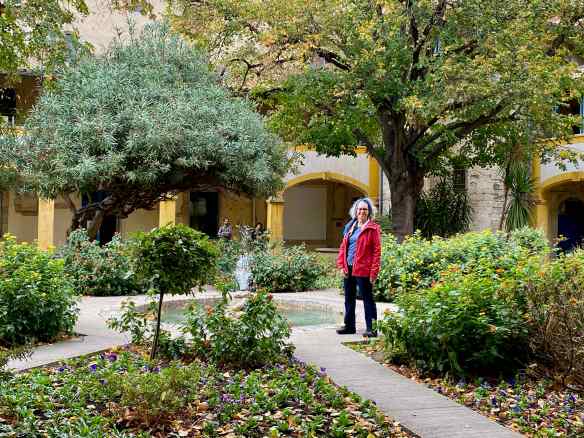
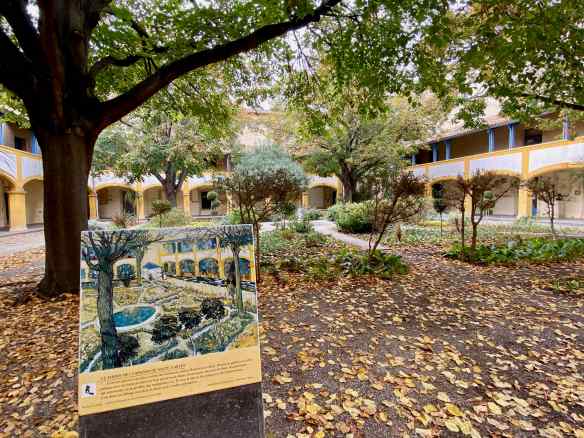
First stop is the courtyard at the hospital in Arles.  Vincent stayed at this hospital three times between December 1888 and May 1889.

I feel like I have walked into a painting…

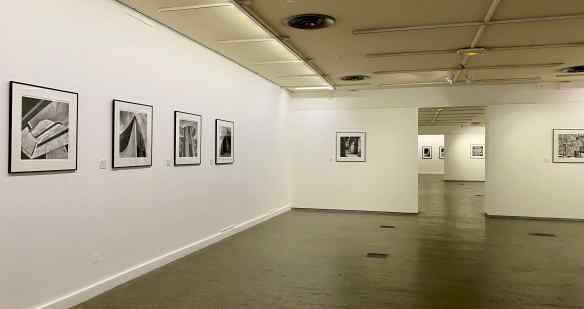
In the old hospital buildings there is also a wonderful photography exhibit by Pierre Vallet.  We later see some more of his work on display in the Arles Amphitheatre.

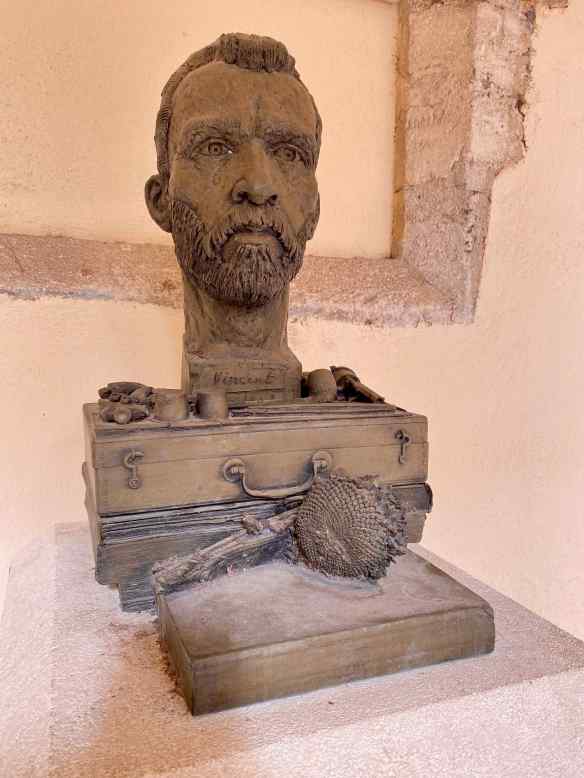
There is a sculpture of Van Gogh in the courtyard.

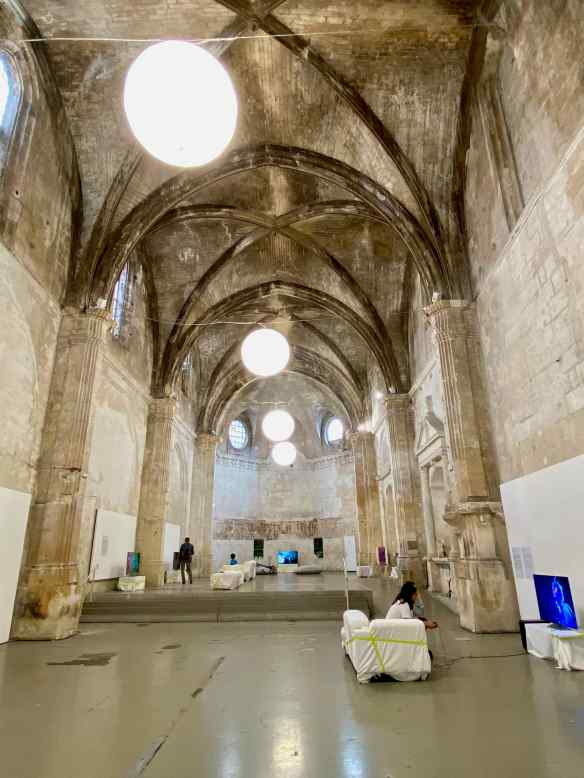
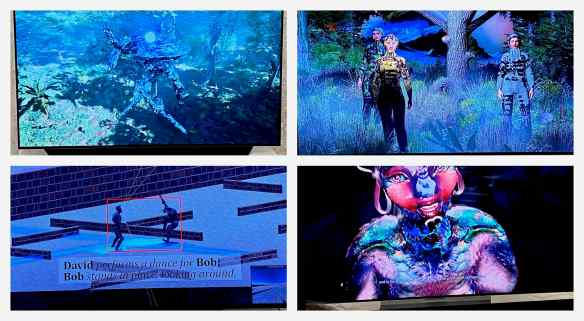
On our way to the next location we pass an old church that is hosting an AI exhibition. The audience is invited to sit and interact with these AI games.Here are the screenshots of some of the other games…notice that one of them has a character named Bob.
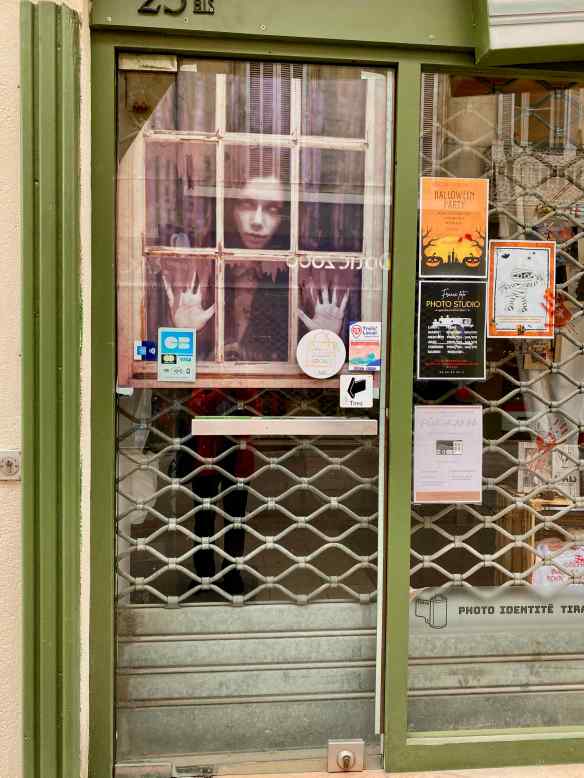
We pass a shop window with a creepy window.  Halloween is only two days away!

Arles is a pretty town.  We are trying to follow the not very clear map to find the next location when I notice…

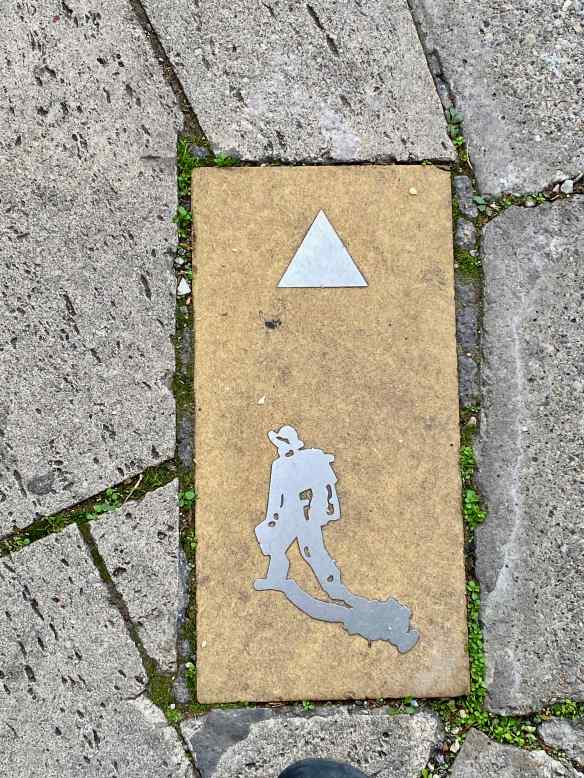
this plaque set into the sidewalk.  So now we just have to follow the plaques, and it feels like a treasure hunt!

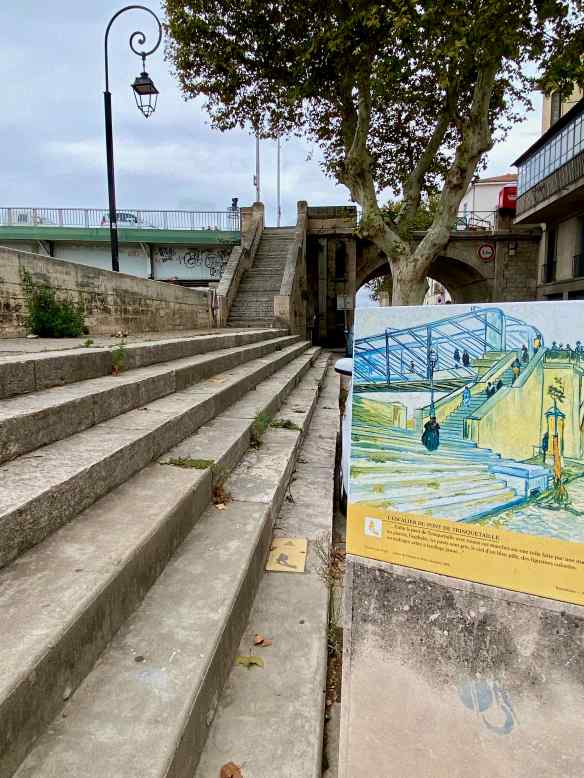
The stairs of the Trinquetaille Bridge was painted from this spot.

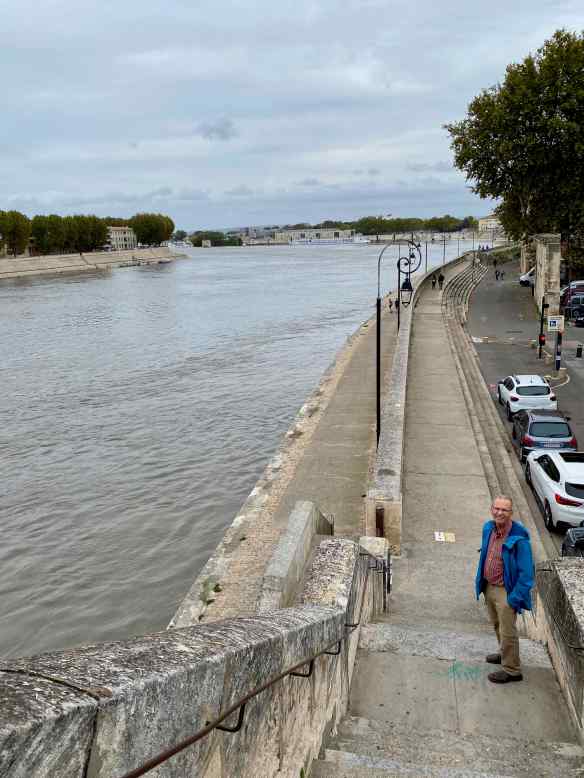
We climb the steps and cross the bridge, walking beside the Rhône River to our next destination.

We pass these ruins which are Roman baths…looks interesting but we are on a mission.

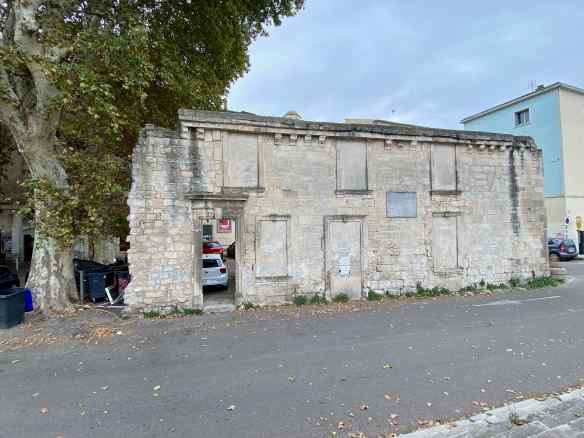
We pass a couple of old stone façades, just one wall left standing.  Back home it would have been torn down.

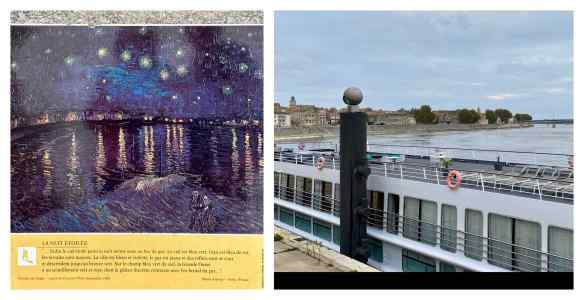
Starry Night over the Rhône…too bad the river cruise boats are in the way of our view, but we are able to pick our several of the landmarks in the painting.

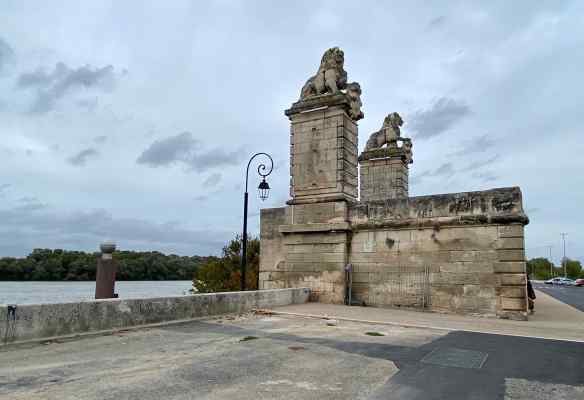
We make small detour to check out the remains of a bridge that was destroyed in the bombardment of Arles in 1944.  There are many reminders of both the First and Second World War in every town and city that we have visited.

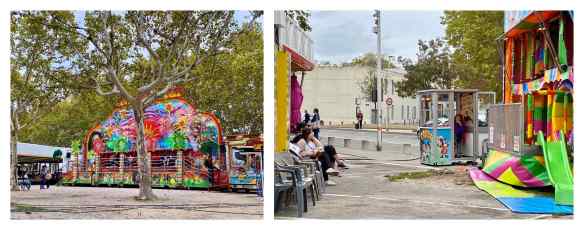
Then we pass a little carnival that was just getting set up.  I thought it was interesting that they have chairs for the parents to sit while their children are on the rides.  

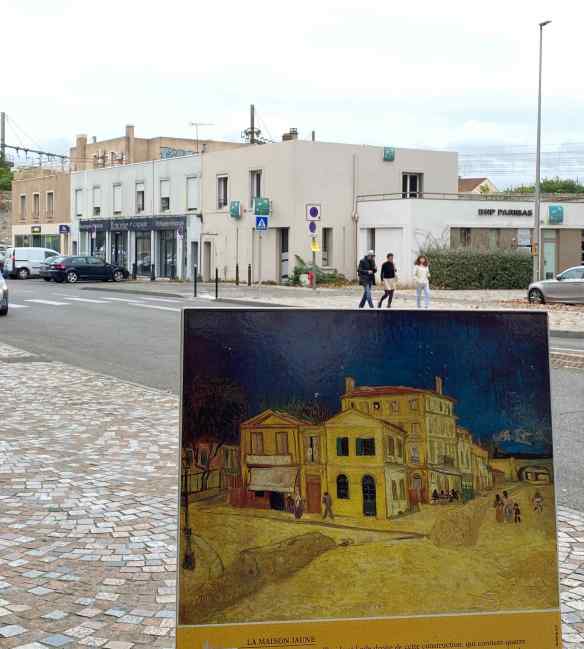
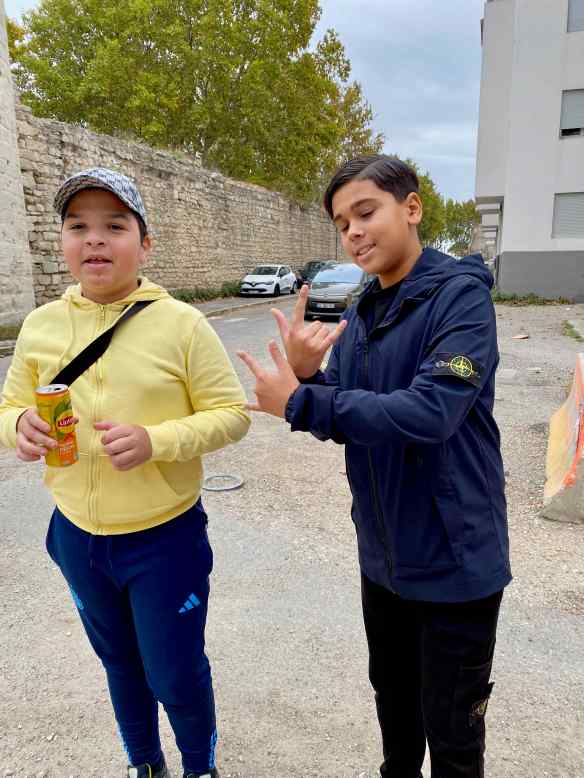
Unfortunately the Yellow House that Van Gogh shared with Gaugin was also destroyed during the bombardment. It stood on this very street corner.Several young boys were hanging about and one of them, Leron (in the blue jacket) asked me to take his photo.  They were fun.
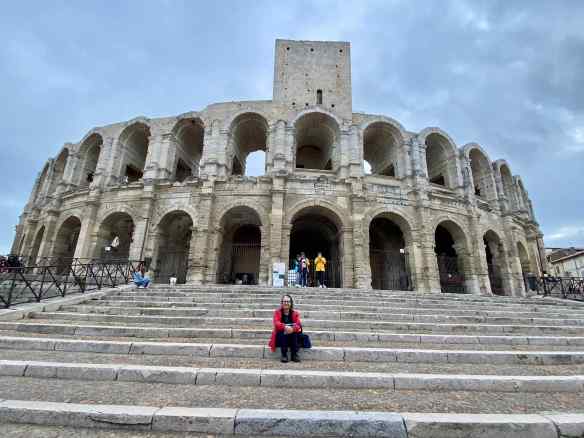
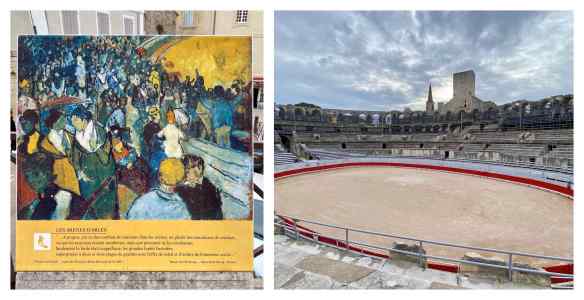
Van Gogh’s next painting was done in the amphitheater, so we buy tickets to go inside, even though the plaque is outside for tourists to see. The Amphitheatre painting shows the arena full of people, but there aren’t many people here today.
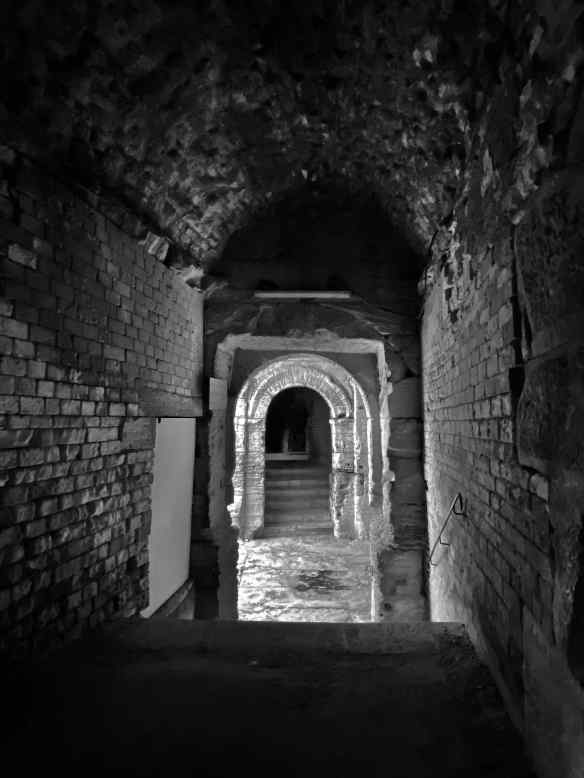
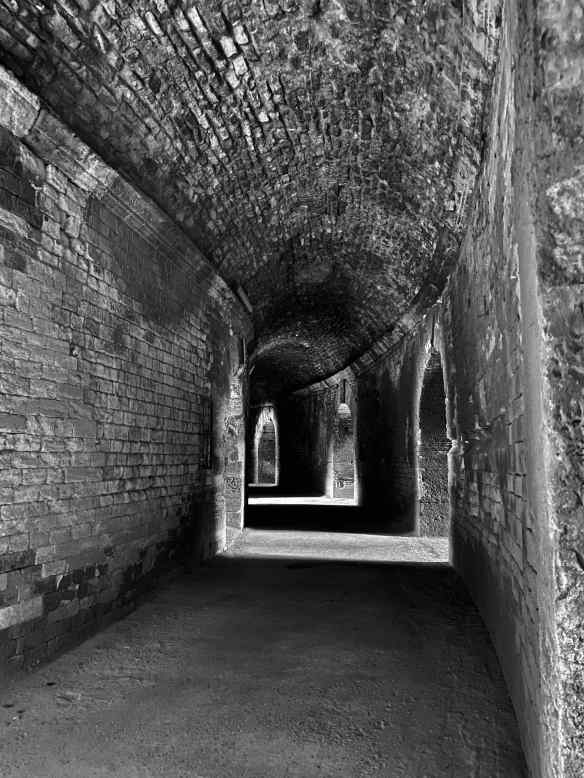
I took some black and white photos in the passageways beneath the seats.  I like how the light streamed in through the openings and all the old stones.

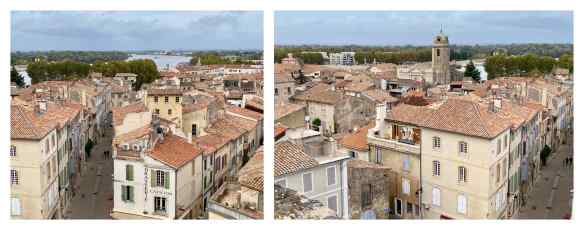
We climb to the top of the amphitheatre tower and get a great view of all the very French rooftops.

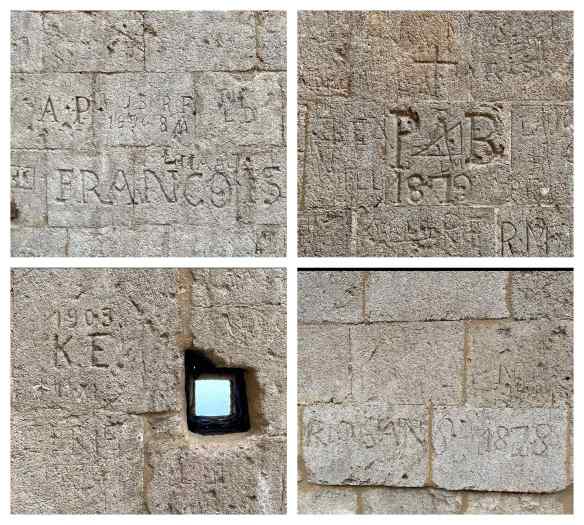
And up in the tower what do I find?  Graffiti!  It has been around for a long, long time.

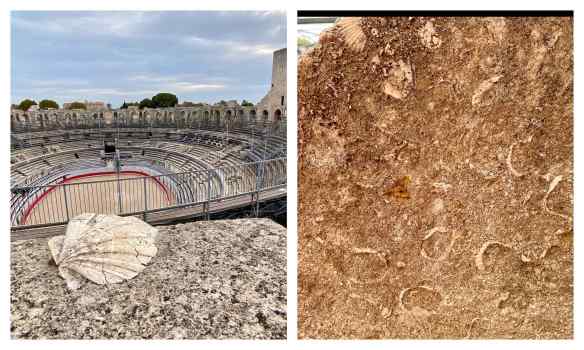
Set in one of the stones at the top of the staircase to the tower is a sea shell, partially buried in the stone and just below it another stone block that is full of smaller sea shells.  I love it when we notice these little kinds of details, details that I am sure many people don’t ever notice.

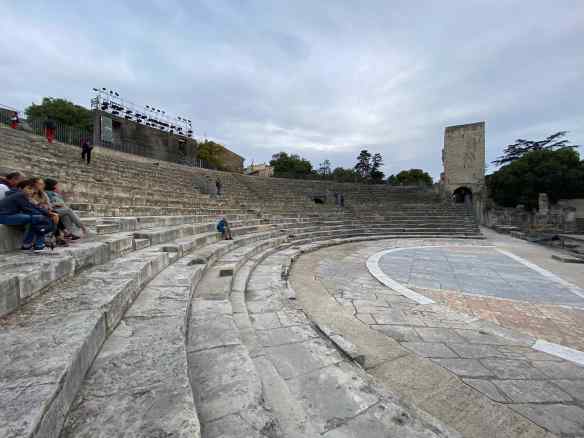
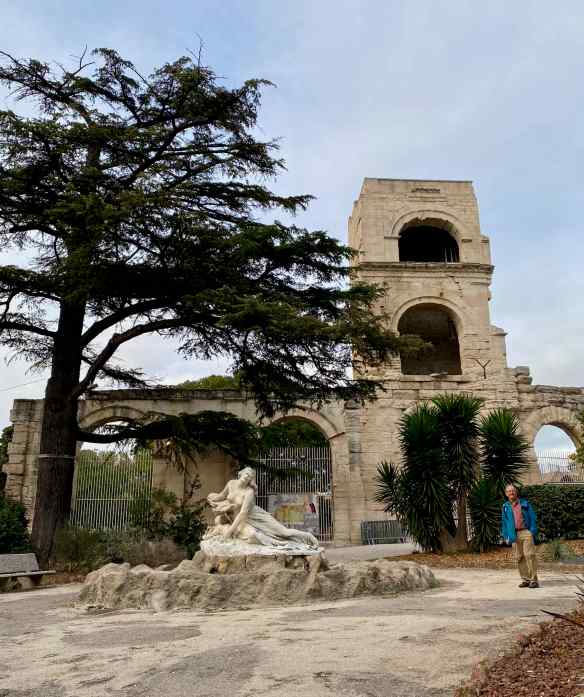
We take another detour to visit the The Roman Theatre of Arles.  It  is a 1st-century Roman theatre, built during the reign of Caesar Augustus.  Bob is sitting consulting our map to figure out where to go next, as we have wandered off the path laid out by the plaques in the sidewalk.

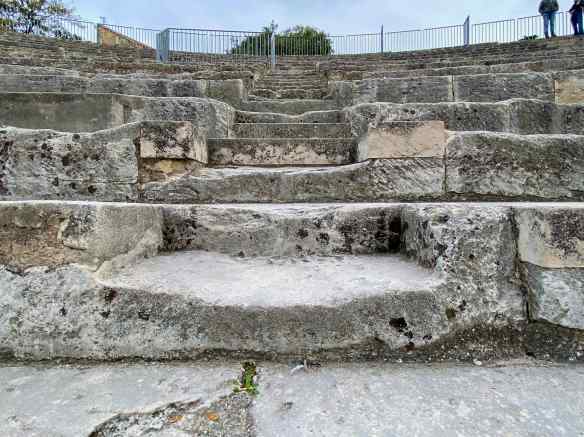
I just love the way the stone steps have been worn down by countless footsteps over the centuries.

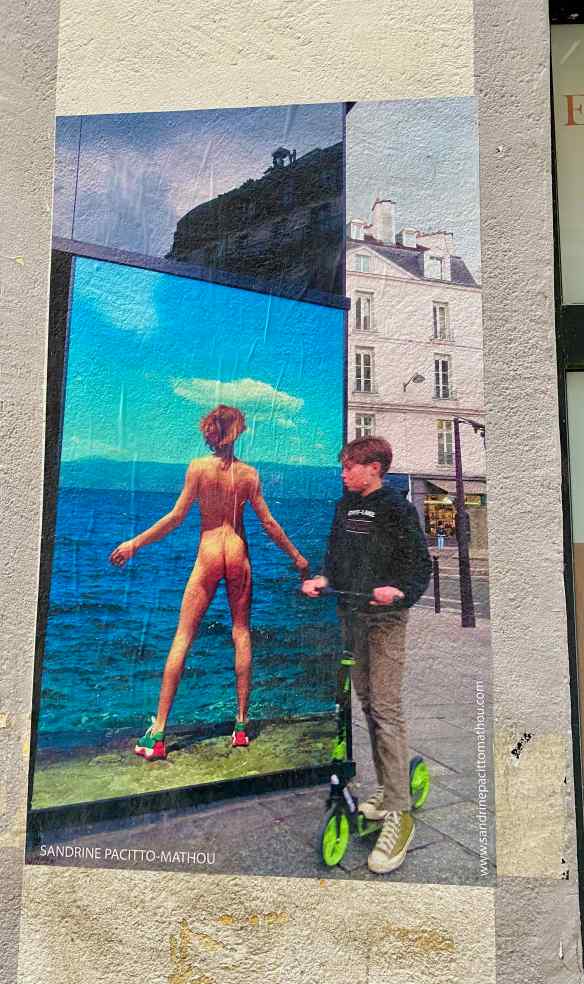
We pass this poster of a young man who is carefully looking at another poster

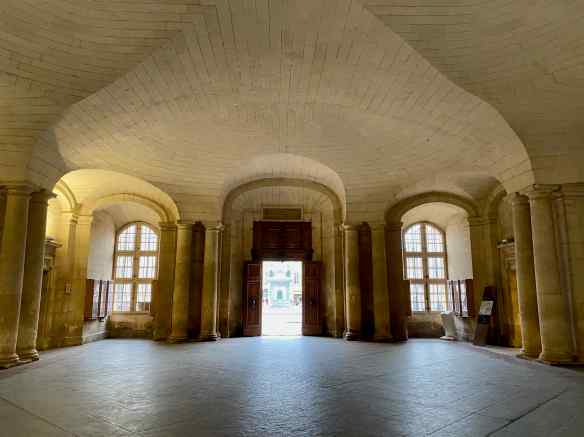
We walk through this old building to reach the square on the other side…

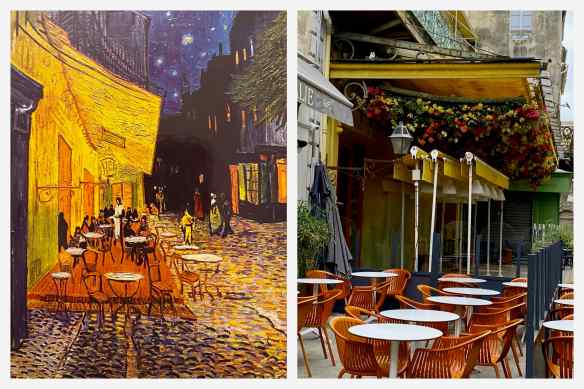
to look for the painting, Café Terrace At Night.  We find the cafe but there is no sign of the plaque with the painting.  We find the location which must have been very close to the spot where Van Gogh stood.

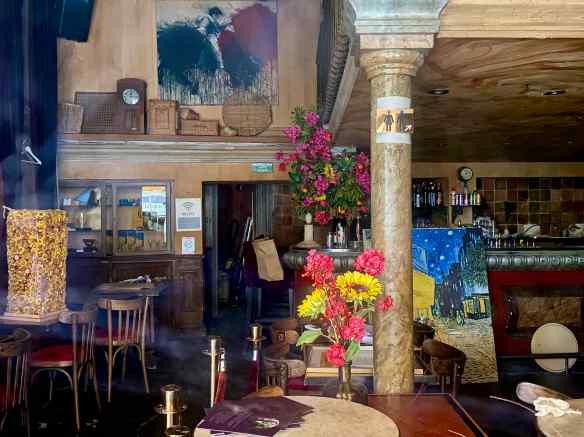
I noticed that the café isn’t open so I went up to take a peek in the windows.  Everything inside looks ready to receive customers, and there is the plaque that we were looking for!  However….

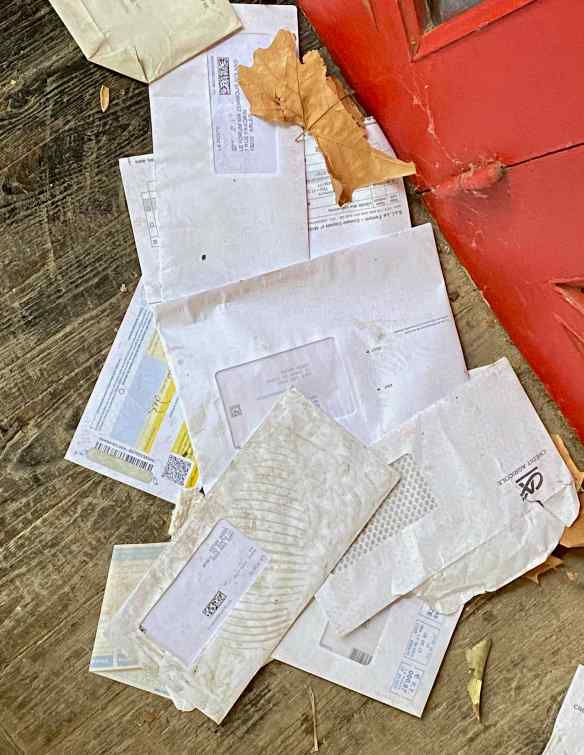
I think it has been closed for a while, as there is a pile of old  mail on the ground at the door.  Too bad, It would have been nice to go inside for a drink.Walking through this plaza I notice another photography exhibit but it is getting late and we still have one more painting spot to find, so we decide not to go in.
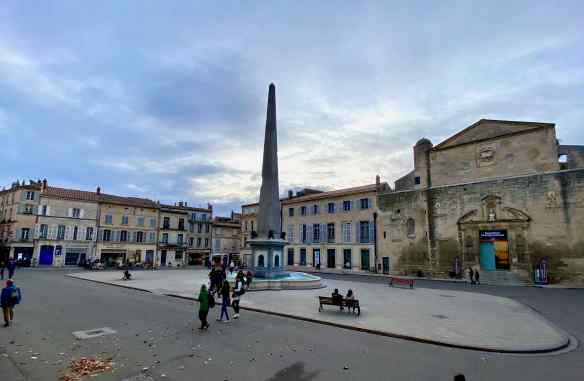
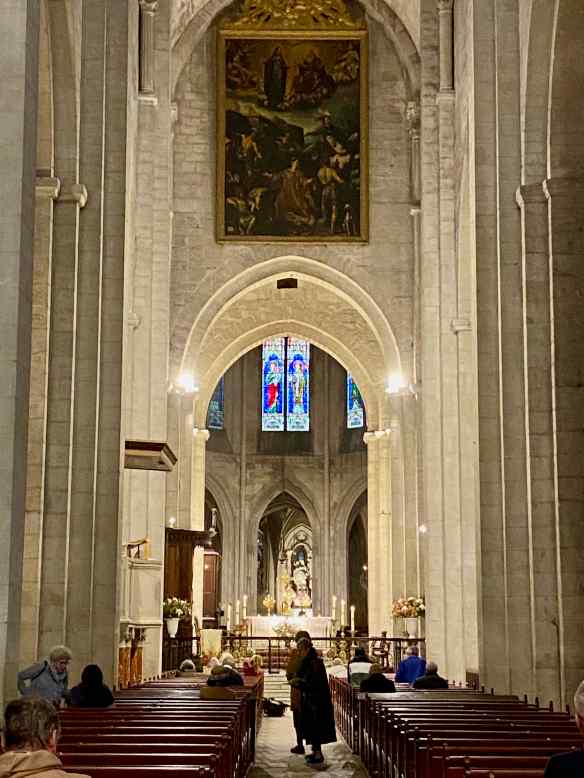
But we do a quick peek inside the Church of Saint-Trophime.  We never know what we will find behind church doors.  Every church is different, ranging from quite austere to the incredible elaborate.

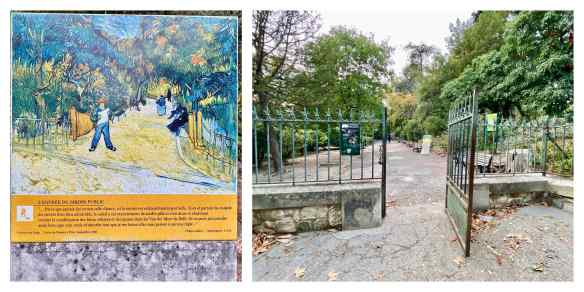
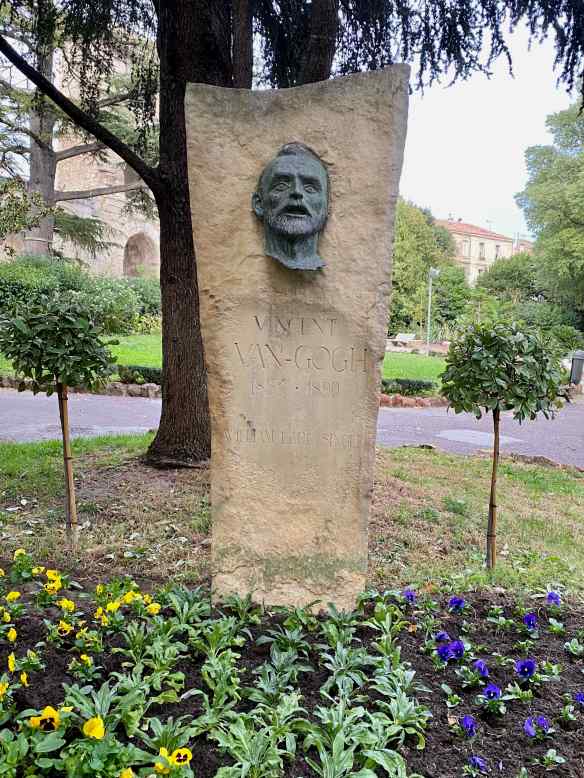
We find the park where the next painting should be located and a monument to Vincent but we can’t locate the painting.  Pansies have been recently planted for the winter garden around this monument.

Bob checks out one part of the park and I go look in another.  The tower is part of the Roman Theatre that we sat in earlier.

Finally we find it!  But looking at these photos, I think we should have turned around and taken the photo of the garden in the other direction.  Guess we were getting tired.  There were three more spots on this walking tour but they are almost on the town’s outskirts and we have once again run out of daylight.

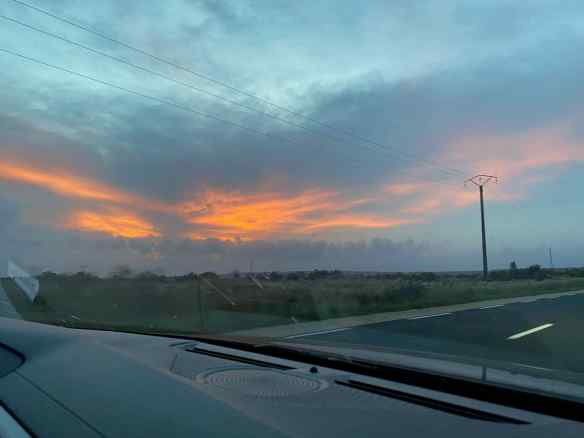
It is only 45 minutes to Nîmes and here we are driving in the dark once more.  One more interesting fact, the whole old town of Arles is a UNESCO World Heritage Site!

Nîmes, France

Day 59, Thursday, October 26, 2023

Nîmes is a pretty city.  It the most Roman city outside of Italy, and it was the regional capital during the Roman Empire.  Today it has a population of about 150,000.

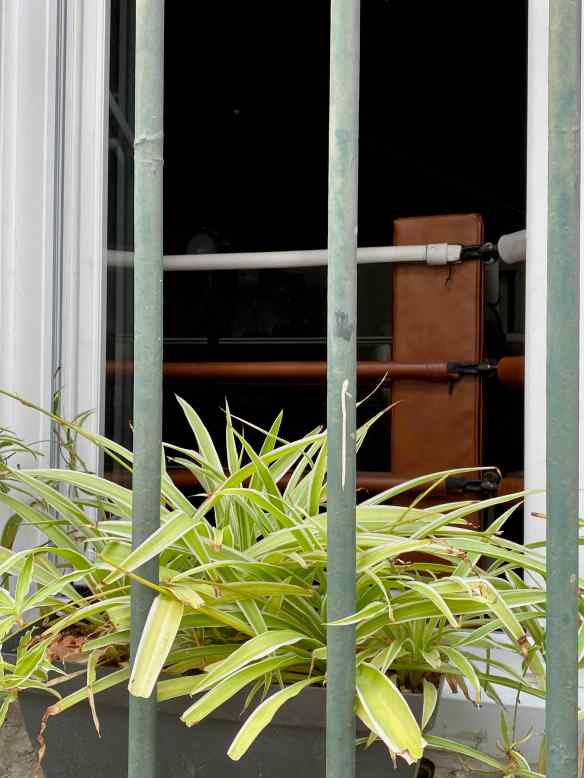
On our way to the center of town I peek inside this open window and I am surprised to see a boxing ring!

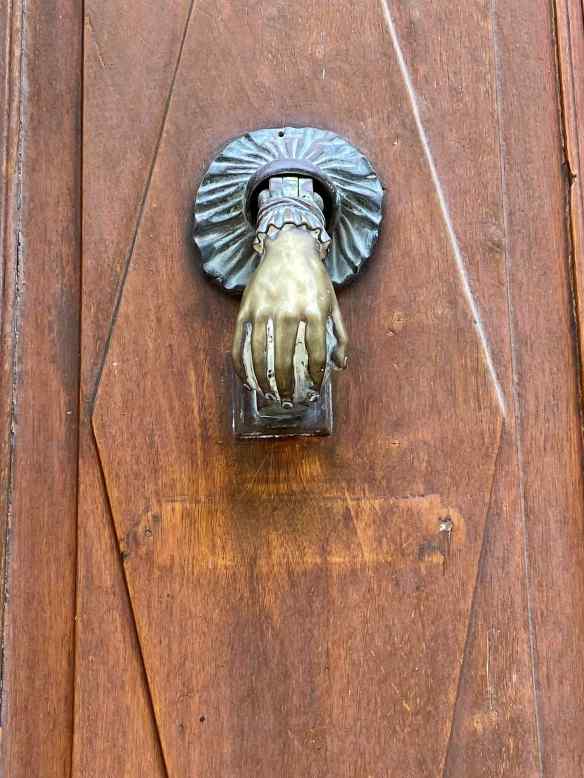
I love this door knocker and it even looks a bit ‘Halloweenish’.

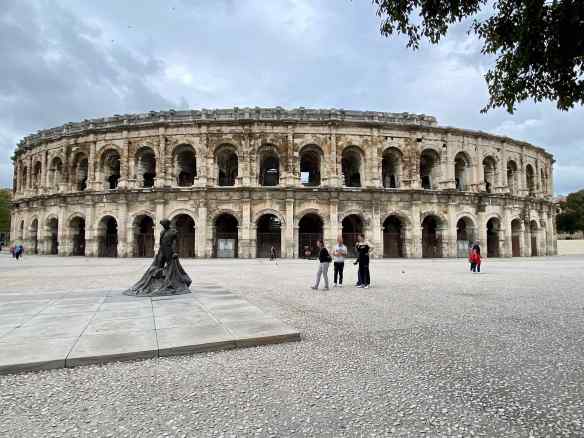
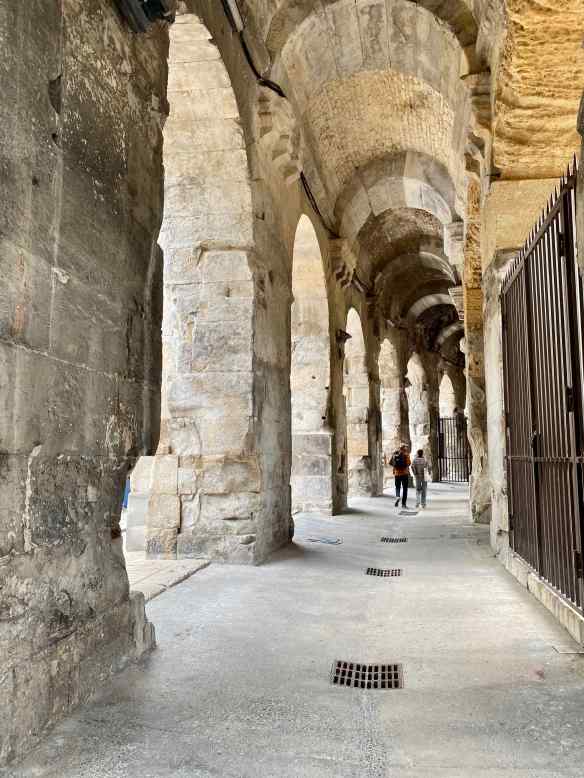
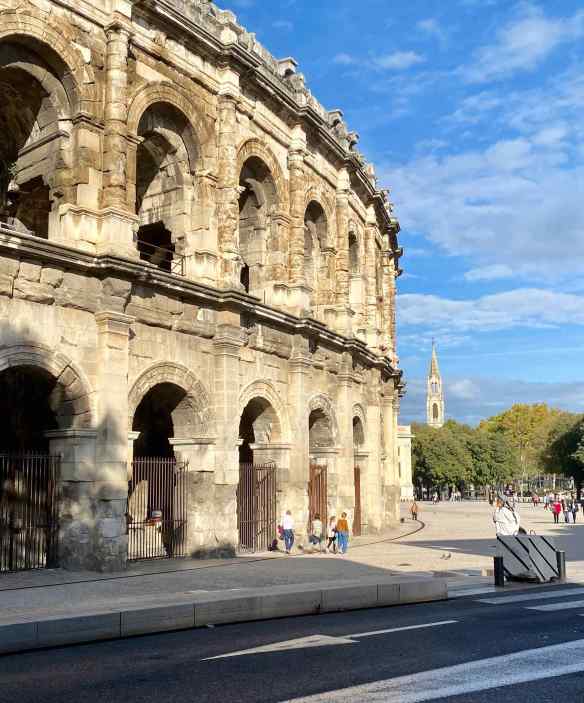
We turn the corner and there it is.  The Amphitheater of Nîmes, or the Arènes de Nîmes.  It held over 20,000 spectators and is the best preserved Roman Amphitheater in the World.  It is so well preserved because it has been in constant use since it was built.  In the 6th century it was turned into a fortress, and in the 14th century it was filled with houses, workshops and warehouses.  In 1809 this was all demolished and work was done to restore it to its original state.

Today, the amphitheater hosts bullfights, concerts and sporting events.  It host many cultural and festive shows all summer long.  We will come back and visit the interior another day…today we are just strolling.

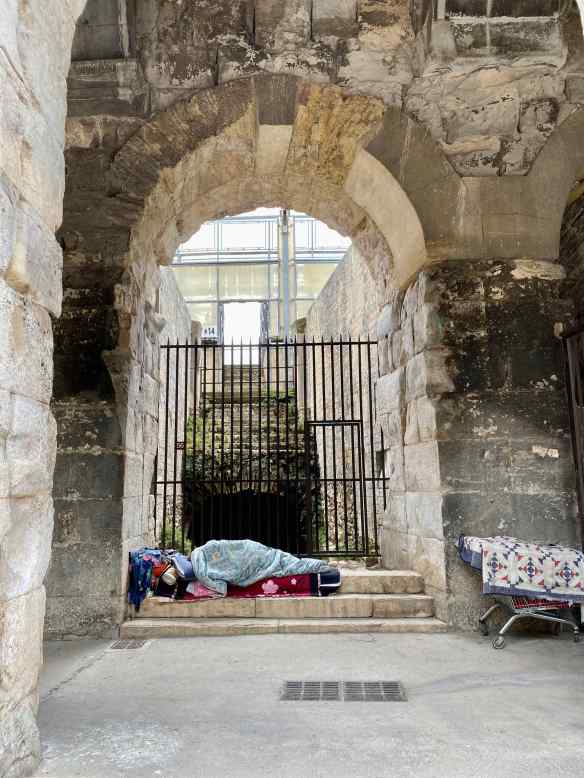
Today it is also offering shelter for this homeless person. The Maison Carrée is a very well preserved white limestone Roman temple that is about 2,000 years old.
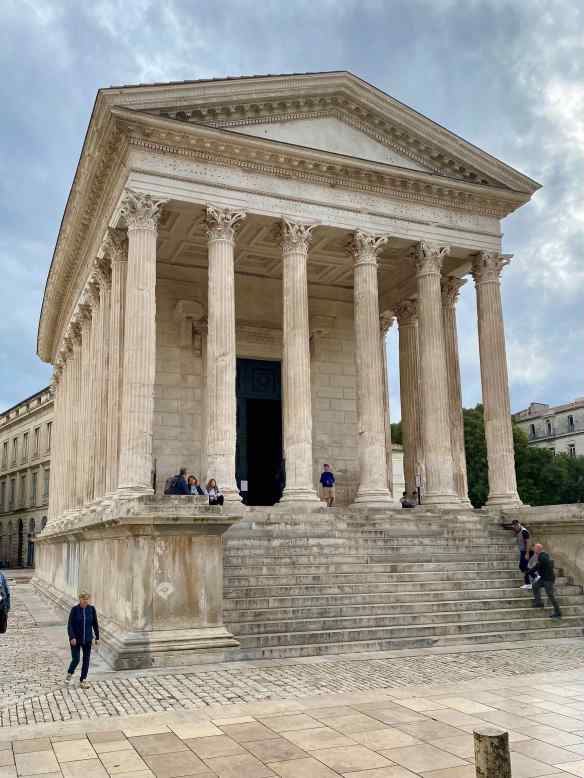
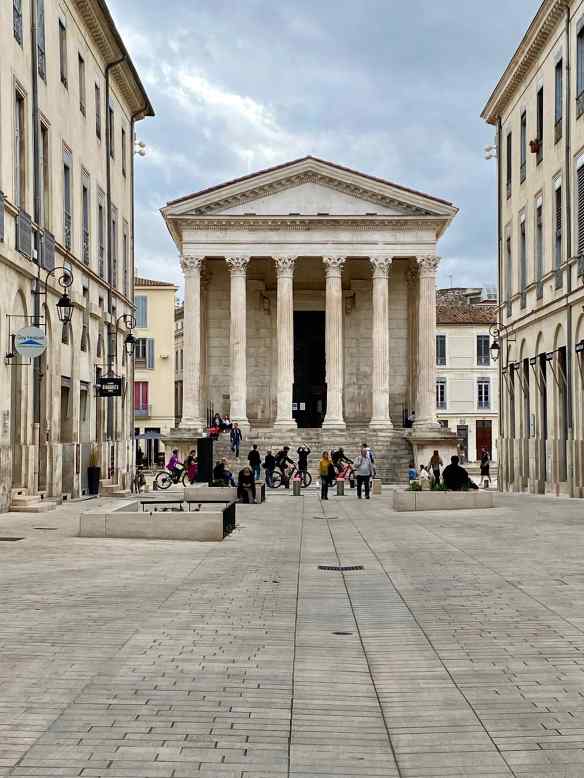
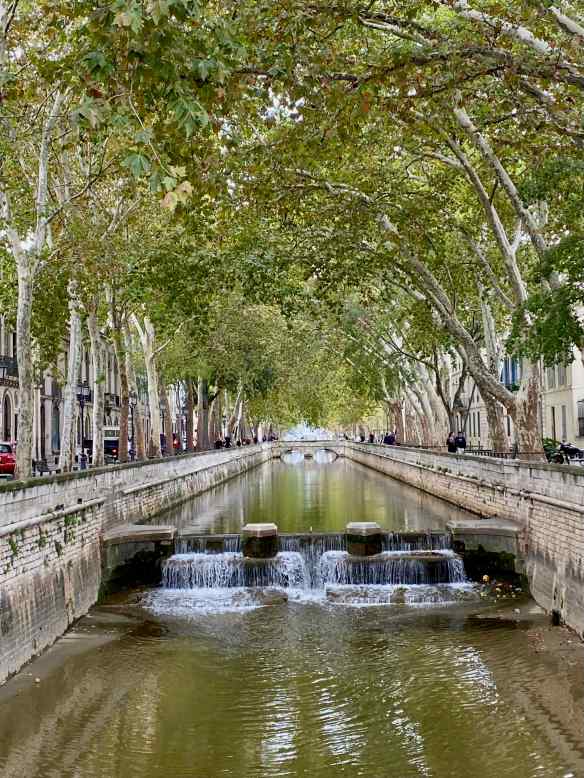
Here is another view of the the Maison Carrée from the street opposite to it.  It is impressive.  Both the Amphitheater and the Maison Carée are UNESCO World Heritage sites.

In the 1700’s canals were built to supply a better source of drinking water and to power textile mills.  These mills made ‘serge de Nimes’ or as we know it today ‘denim’ (‘de’ or ‘from’ Nimes)!  Today it is a beautiful park with exotic plants, statues and walkways.

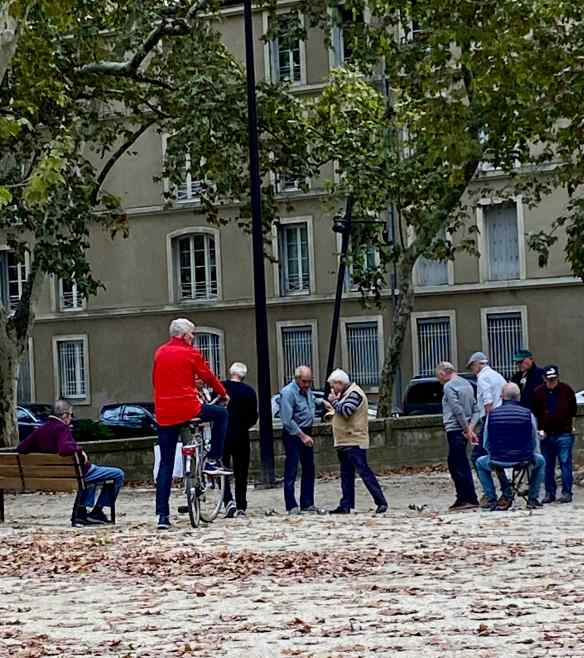
We walk along the canals and find some Pétanque players.  This is a popular pastime everywhere in France, although we have only seen one female player. It is more common to see elderly men playing when we are out and about in the afternoon.  We noticed this extraordinarily tall man on his bicycle which Bob says is the tallest bike he has ever seen.  The men around him barely come up to his armpits!

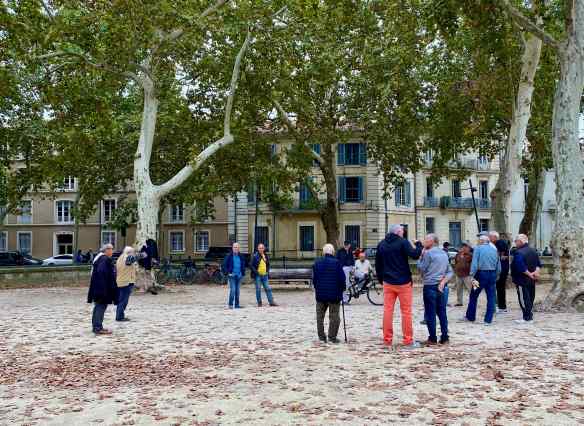
A Pétanque game in progress, with observers and critics!  The players are incredibly skilled and can knock an opponent’s ball out of the game with one throw.

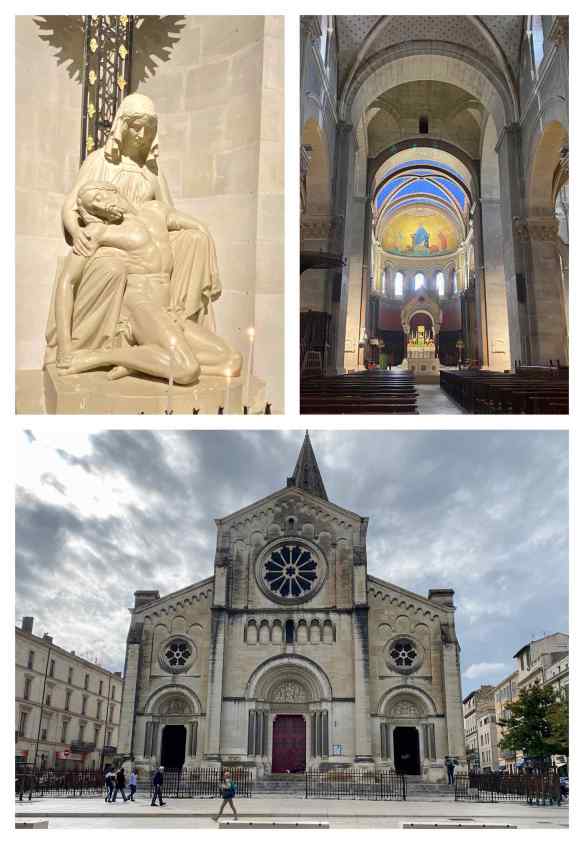
On the way home we pass St. Paul Church and go inside.  I really liked the sculpture right by the entrance and the dome is beautiful.

One more view of the amphitheater on the way home.  This is only a couple blocks from our Airbnb.

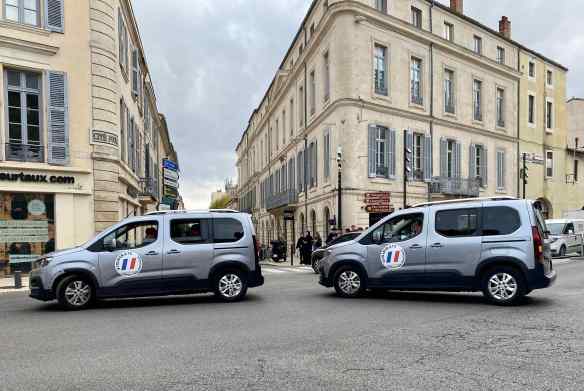
As we were waiting to cross the road two vehicles with fully armed military drive by.  There were four soldiers in each vehicle and they were scanning the surroundings as they drive by.  The sign on the side of their cars says Vigipirate Operation Sentinelle.  They are part of the 10,000 soldiers that are currently active in this operation to defend and protect the French.  As France is currently on high alert the Vigipirate Security Alert System has been at its highest ‘Emergency Attack’ level since October 15th.   This means that our bags are searched when we enter tourist sites, museums and other places where there are lots of people.  We stay aware of our surroundings and we certainly avoid anything that looks like a protest, or large gathering of people.  So not to worry, we are safe.

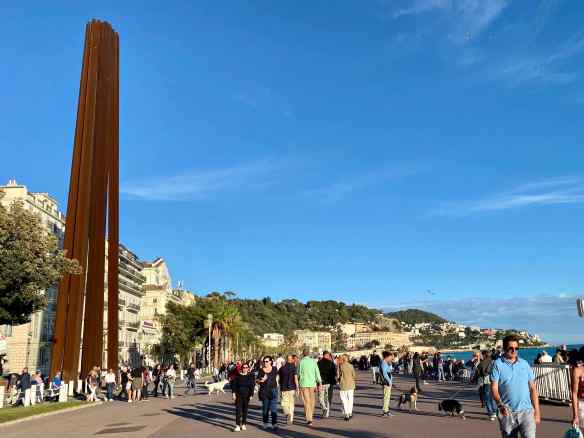
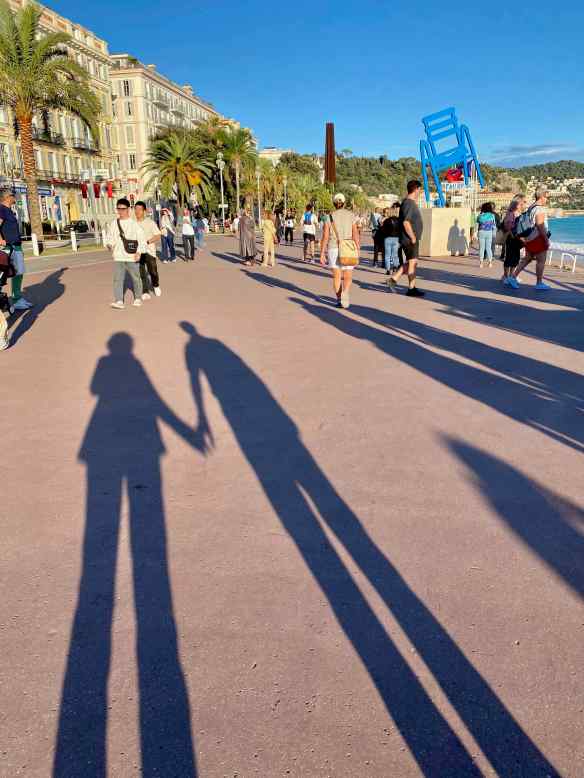
Nice, France

Day 54, Saturday, October 21, 2023

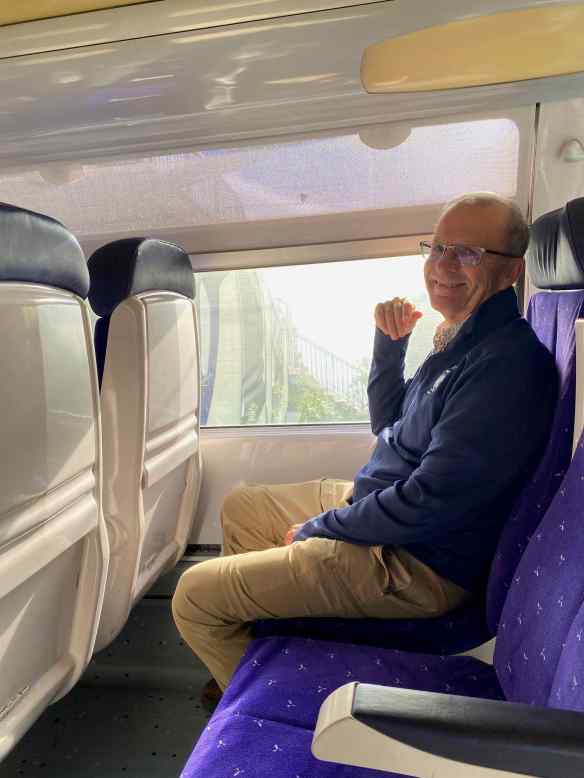
We catch the train to Nice this morning. We are both happy to be sitting on a train instead of driving and navigating.  It is a nice change and Bob can watch the scenery go by instead of concentrating on driving.

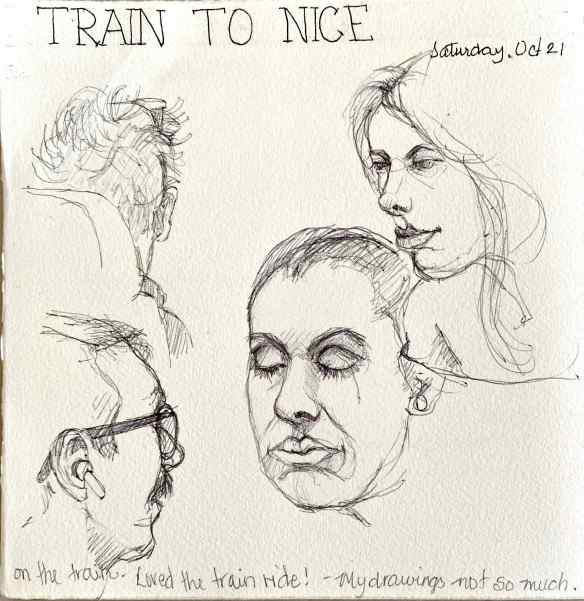
I draw on the train. I feel out of practice but it is still nice to be drawing…I haven’t done nearly as much of it as I had hoped to this trip.The Nice train station is really big, clean and airy.
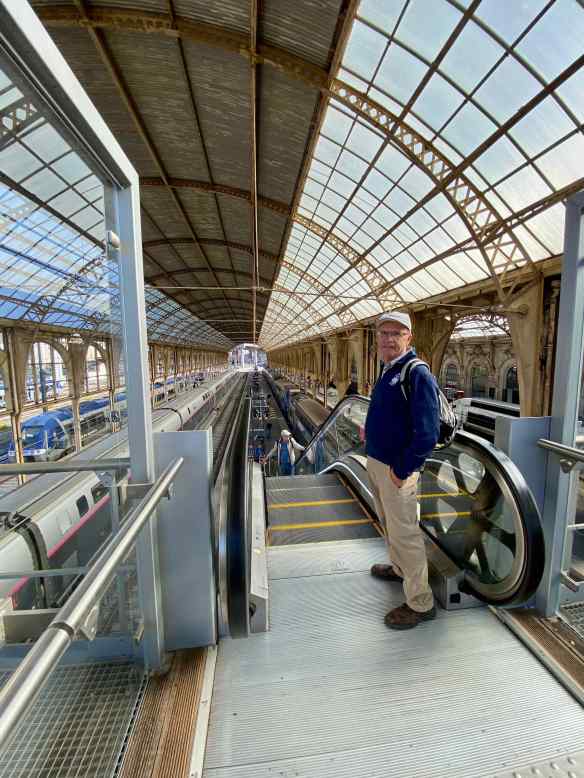
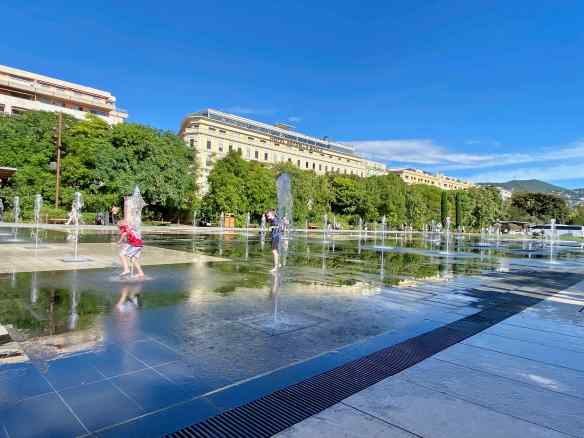
It is a short walk from the train station to the main tourist area by the beach.  We stop at a park for our lunch, and I wonder if the water is from yesterday’s big rain…or if it is a fountain?

A couple minutes later I have my answer.  These two young boys had the best time playing in the water jets.

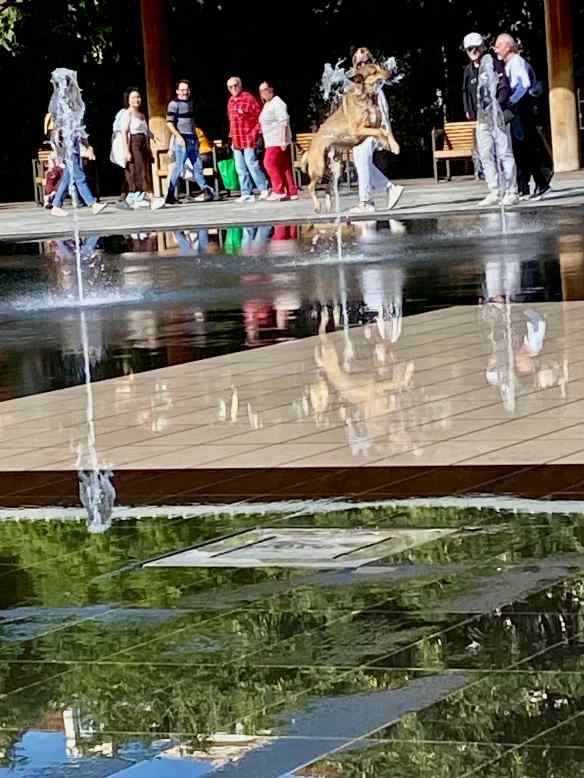
We laughed at this big dog who jumped and tried to bite every jet of water he passed.  He was having such fun.  There were such neat reflections too.

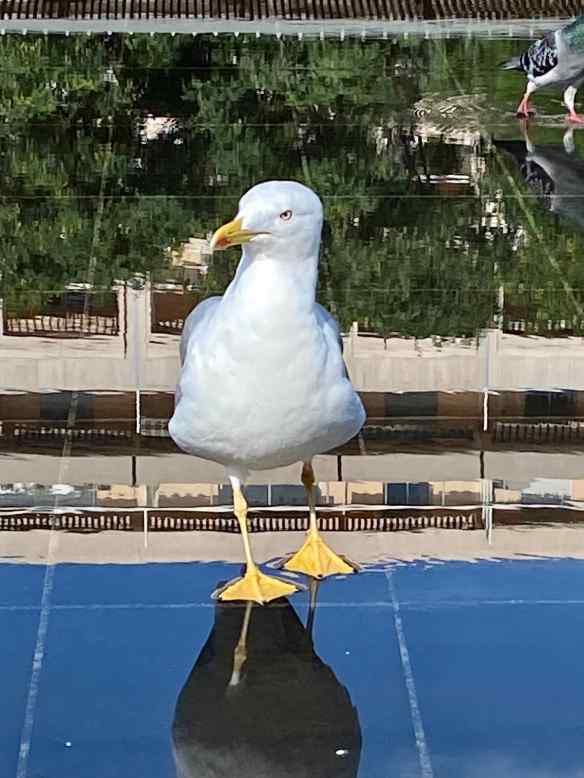
This very large sea gull was eyeing our lunch, just hoping a few crumbs would fall his way…I’m afraid a few did…who could resist that gaze?

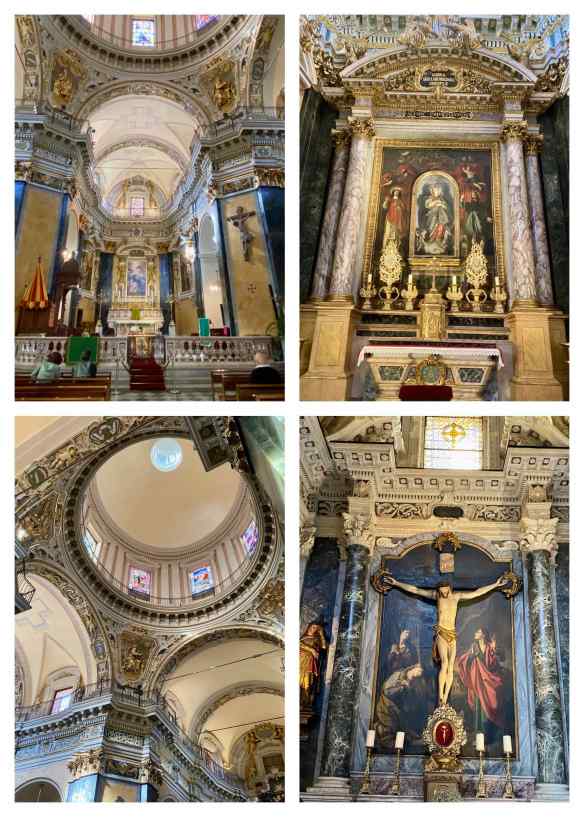
After lunch we visit the Cathedral of Saint Reparata., which is a National Monument.  It is very ornate and in great shape…no peeling paint here.  

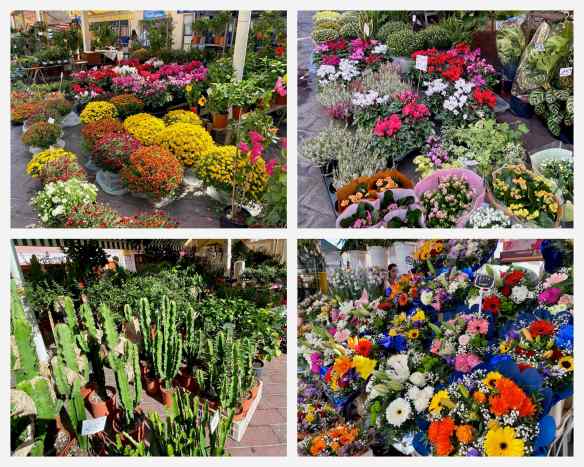
The flower market is beautiful and the prices are very reasonable.

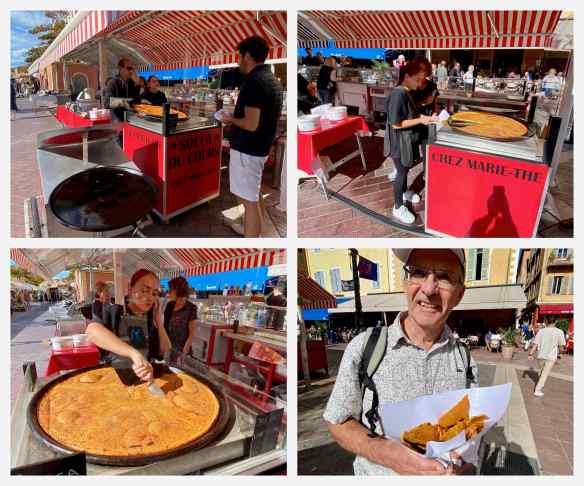
We try some socca. It is a thin chickpea bread that is sprinkled with pepper.  We have to wait a few minutes for a fresh pan to arrive (it is brought hot from the ovens in a wheeled cart) and it is delicious! It is also a bargain at just 3€ for a huge slice.  I am going to have to try making this at home.

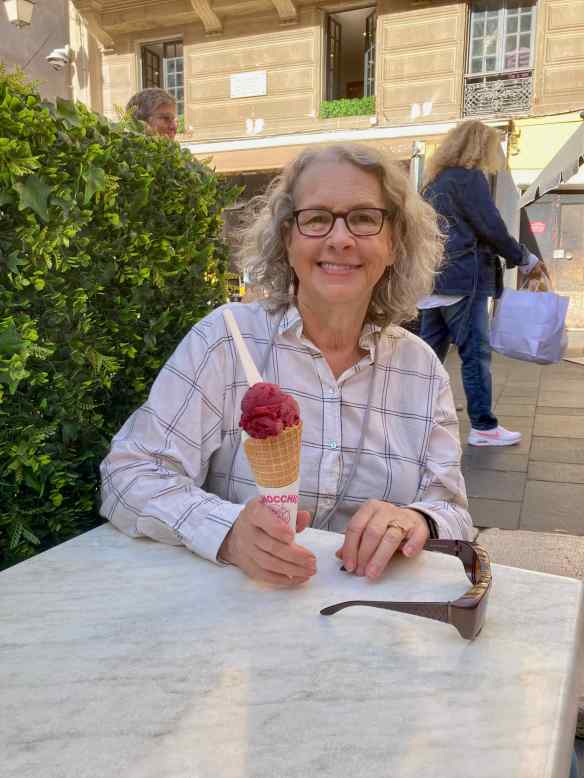
Even though we have just had lunch, and socca, I am craving a cassis (black current) sorbet from Fenocchio’s, a world famous ice cream shop. They have 94 flavors of  ice creams and 35 of sorbet, but I stick with my favourite.  

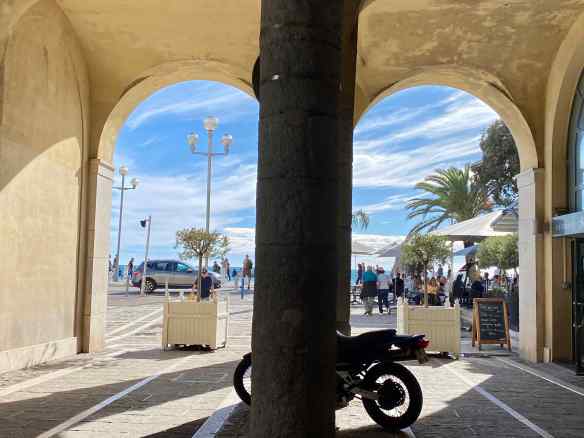
After my sorbet we walk towards the beach.  

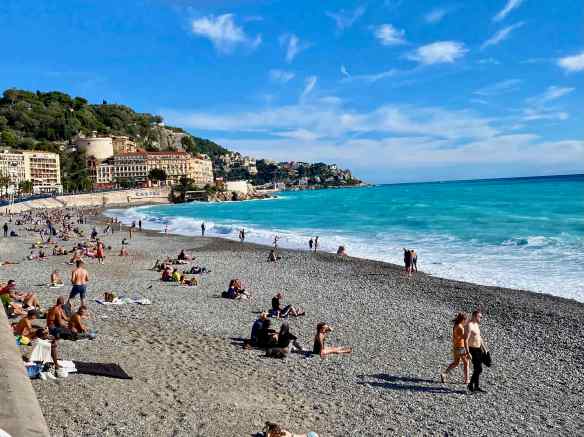
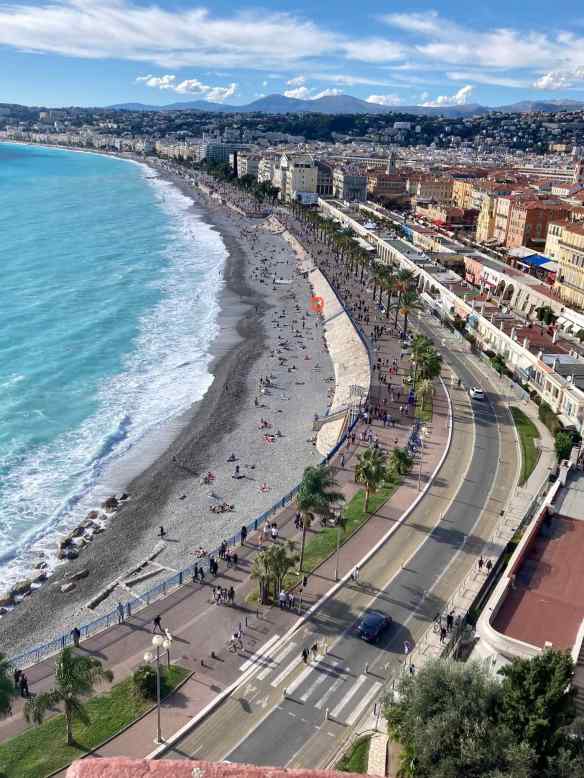
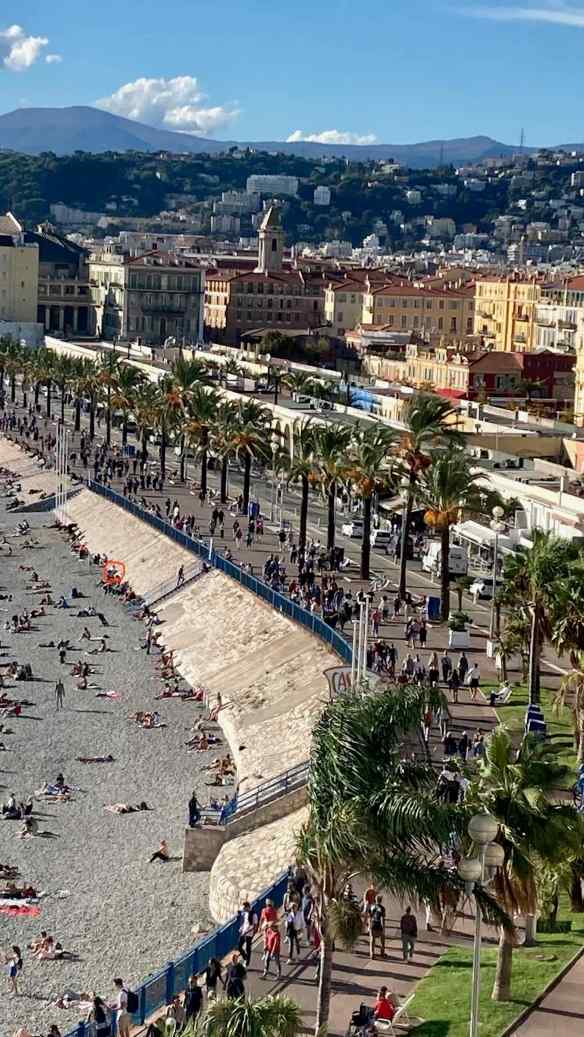
Nice has a pebble beach, and lots of sun worshippers.  I stay at the beach to draw some of them and Bob goes for a walk and climbs to two viewpoint.  There is one on top of the cream round structure in the distance and another higher up on top of the hill.

I take a photo of someone who I think is Bob…and he takes a photo trying to find me on the beach.  Do we think alike?

This is definitely me, I am sitting right beside the two rinse towers…and I get a light spray every time someone rinses off!  I was settled in by the time this happens the first time so I decide to stay put, in spite of the occasional mist of water that floats my way.

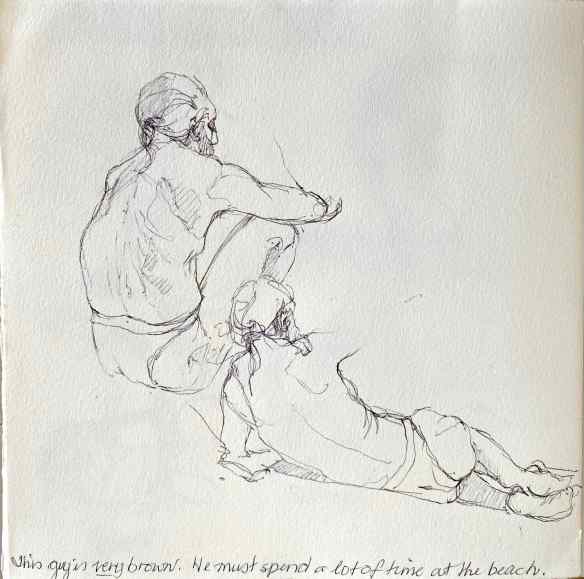
I am happier with my beach drawings.

This fellow was sitting beside me and he was very brown.  He was also wearing black underpants, which appears to be a common thing here.  People are not shy about changing on the beach, women pull off their tops and bras to change into their bathing suits and I saw lots of men just wearing underpants as their bathing suit.  There were a few topless women as well…it is the French Riviera after all.

We do a bit of window shopping, or as they say here, leche-vitrine, which translates to lick the windows!  I have had a couple treats here, but gluten really doesn’t agree with me so I have to content myself with a bit of window licking!  Oh and did you notice the prices?  

We stroll along the boardwalk, people watching and enjoying the sunshine…

but the sun is getting glow in the sky and we head back to catch our train.

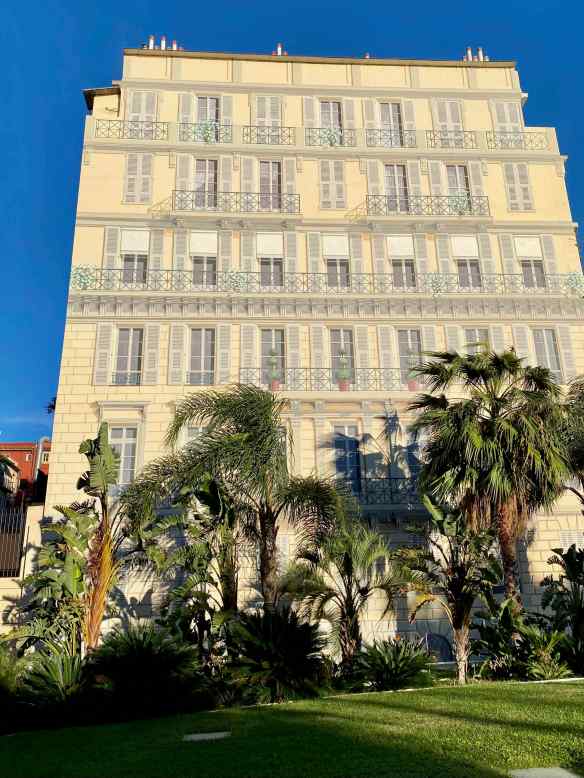
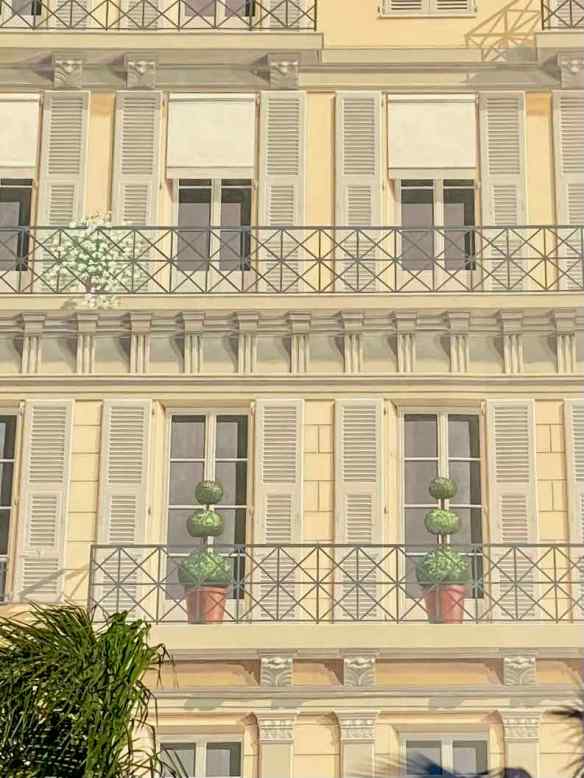
Bob notices something strange about this building… Here is a clue.

Yes, the whole side of the building is a giant mural!  We pass this interesting fountain…

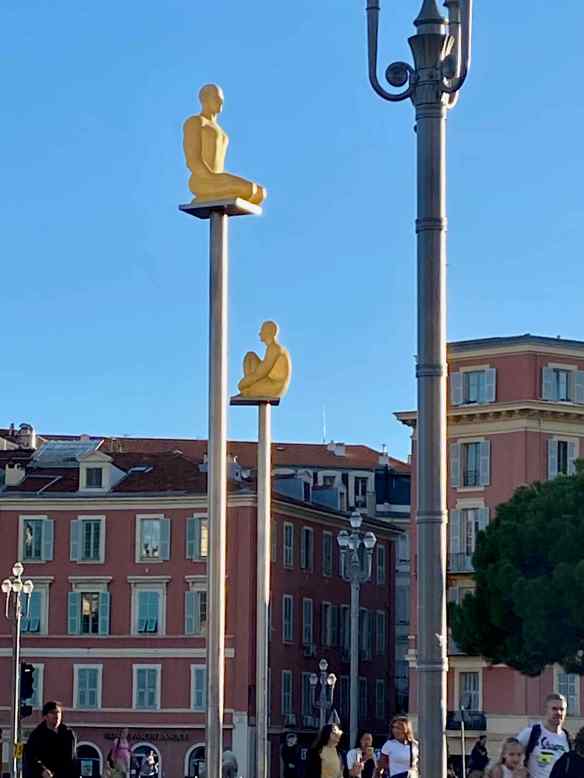
and there are seven of these statues high on poles above the street.  Google tells me that they were created by Jaume Plensa, a Spanish artist who specializes in monumental art.

They represent the seven continents and the communication between the different communities of today’s society. They are titled “Conversation à Nice”and they are illuminated every night, with slowly changing colours.  Too bad we won’t see that but it is a long ride home.

We were in Nice over 40 years ago and visited the Matisse Museum.  I was hoping to visit it again today, but it closes during the noon hour, and then we just ran out of time.  I am OK with not visiting so many museums this trip, there are so many other things to do and only so much time.

Carcassonne to Cannes and The Fonsernes 9 Locks

Day 49, Monday, October 16th, 2023

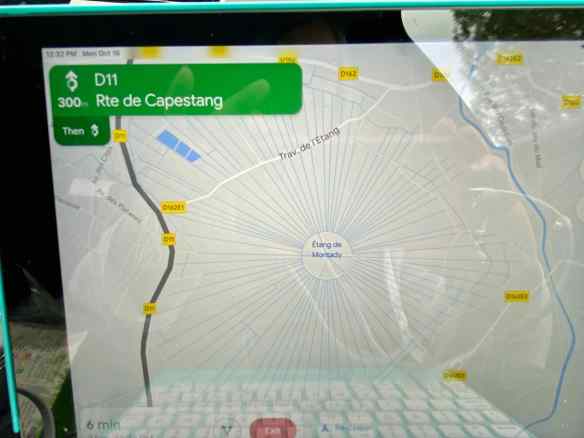
Today we travel from Carcassonne to Cannes.  It is a 4 1/2 hour drive if we use the toll highway and 7 1/2 hours without so we decide to pay the tolls.  We make a side trip to Beziers to visit the Fonsernes 9 Locks.  On our way there we drive by a very strange design on Google maps… I wonder if it might be some sort of irrigation system?

A bit of research solves the puzzle.  Who knew?

‘The Étang de Montady, or Pond of Montady is a drained pond or lagoon.. It was built by monks and wealthy Béziers landowners during the second half of the 13th century. The Étang de Montady was drained to provide farmland by making radial ditches from a single center point out to the extremities.  The water flows to this center point and is then drained by sixteen vertical shafts to an underground culvert.’~ info from Wikipedia.

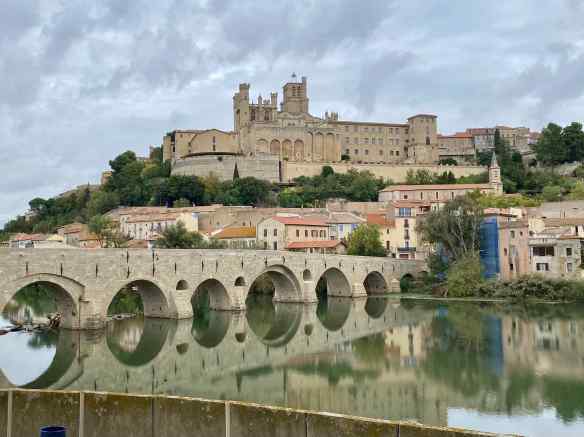
It was a bit of a challenge to find the locks.  First of all we drove to the town of Beziers where we thought we would find the locks, but there were no locks in sight.  We did find a spot to have our lunch though, overlooking a pretty river and the Cathedral Saint-Nazaire.

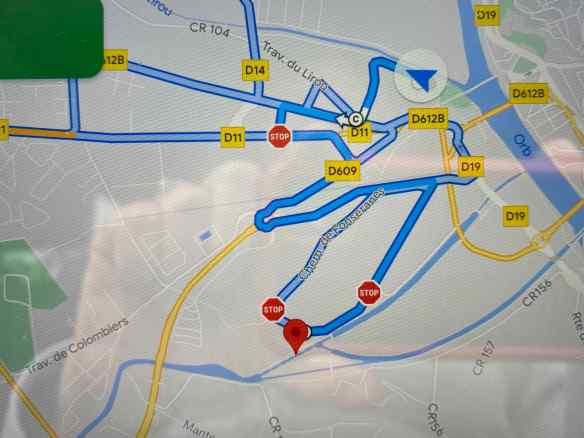
We check at the location again and this is what google maps tells us!  Really??  We need to get from the blue arrow to the red pin…and we do it!  Pretty impressive navigating and driving I think! I wanted a photo of this pretty bush covered with orange berries, and Bob hams it up by giving himself an orange moustache.
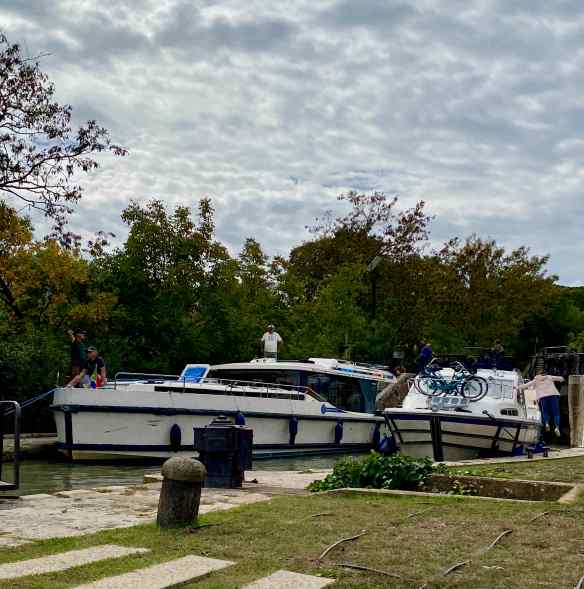
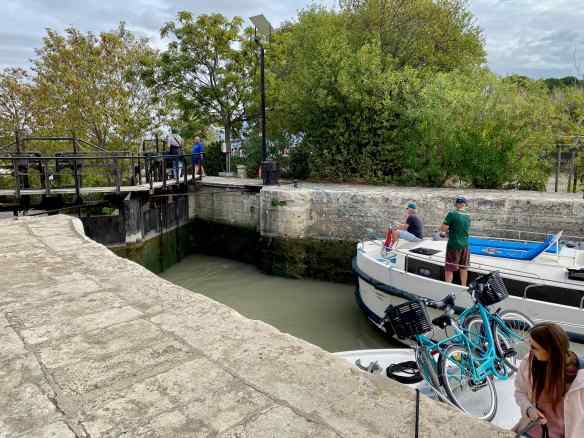
The Canal du Midi connects the Mediterranean Sea to Toulouse.  It has 360 navigable kilometers and there is a drop of more than twenty meters from this location to the town of Beziers.  The locks were built in 1676 to deal with that change in elevation.

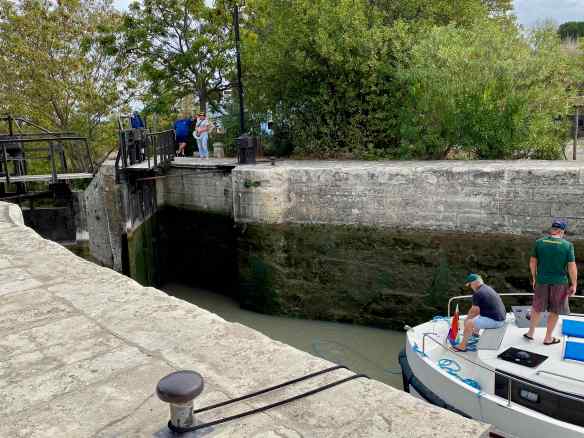
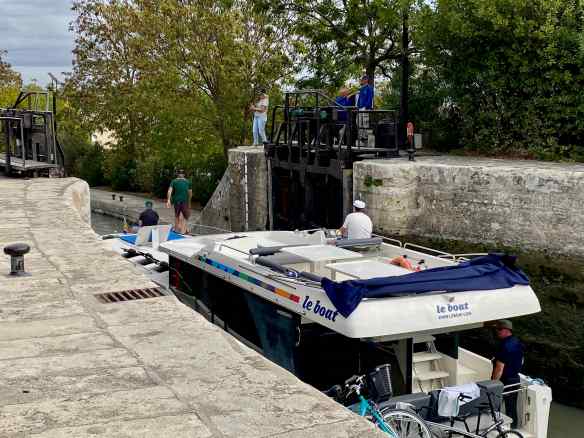
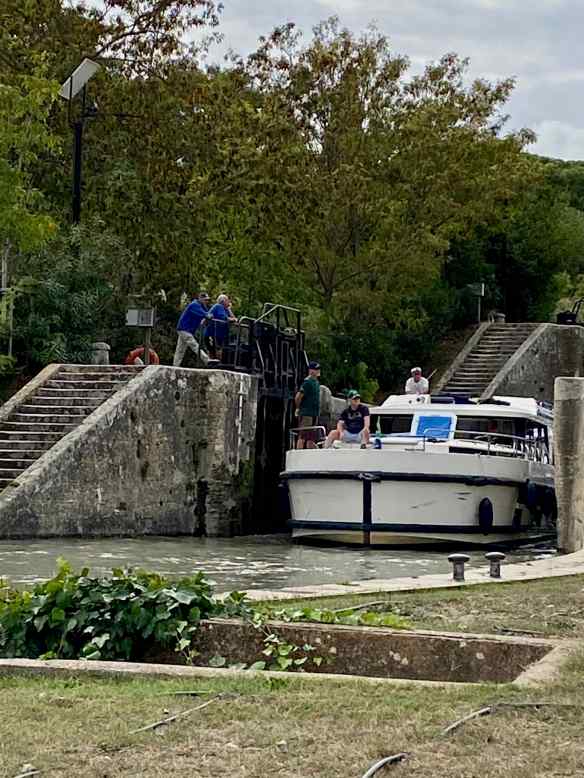
We watched these two boats make their way through the locks.

The water level begins to lower…as the water pours into the basin below.

Soon the water levels in the two basins are equal and the lock gates open…

and the boats advance to the next basin and this process is repeated 7more times.

This boat with four couples from South Africa barely has room to squeeze through the open gates.

The 9 locks of Fonseranes have a total of 8 ovoid-shaped basins and 9 doors and in 1996, they were declared a UNESCO World Heritage Site, as is the entire Canal du Midi.

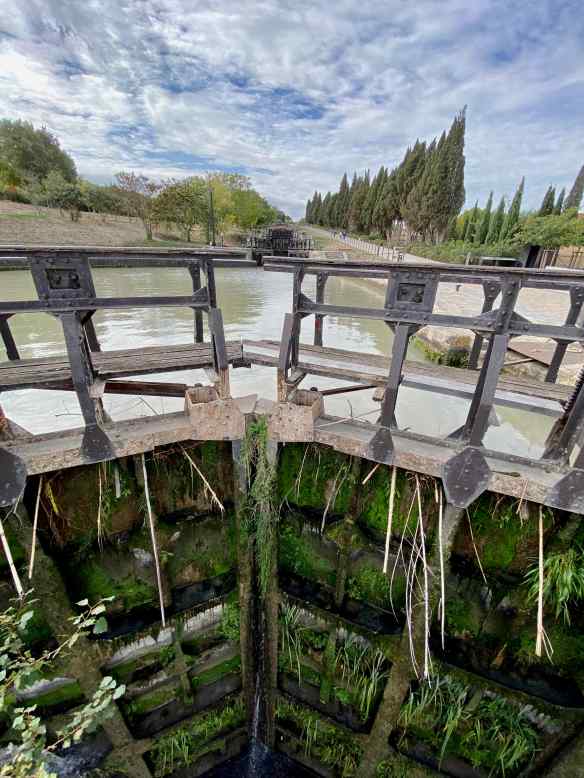
At the bottom of the locks there is a gate that appears unused for some time.  It has grown a water garden on its backside.

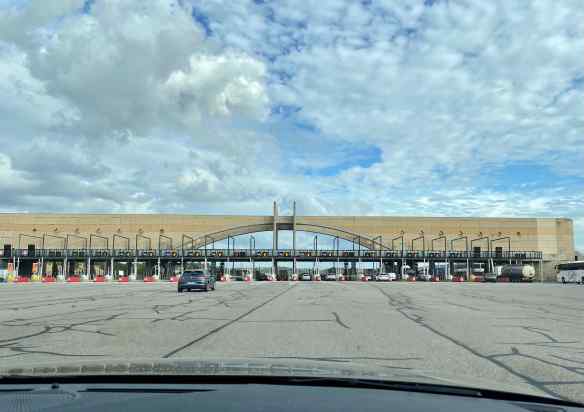
Back on the highway we pass through yet another toll booth.  This one is pretty big.  The crazy thing is that on the other side there are no lanes.  Once you pay your toll the gate goes up and all the cars need to merge back onto the highway.  It is kind of crazy.

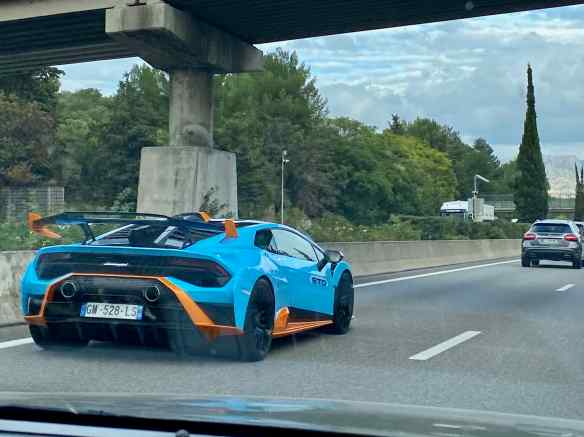
Bob says he can tell we are getting close to the French Riviera because there are expensive cars on the road.  A Lamborghini costs anywhere from $221,000 to more than three million dollars!  I can’t even imagine driving a car that is that expensive.

The turn off to Cannes is a bit convoluted…we have had a lot of strange routes on this trip.

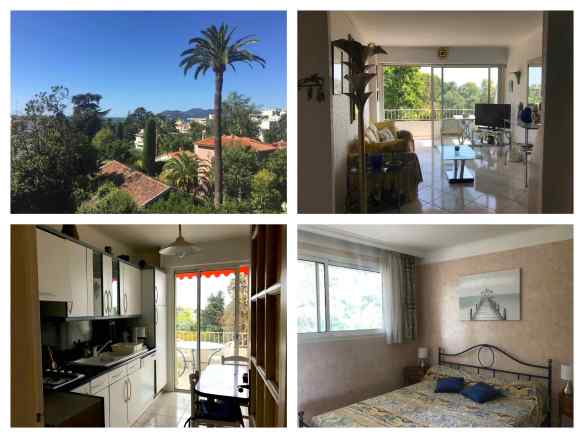
We check into our next Airbnb…only this one has palm trees and a view of the ocean in the distance.


Montolieu, Village of Books

Day 48, Sunday, October 15, 2023.

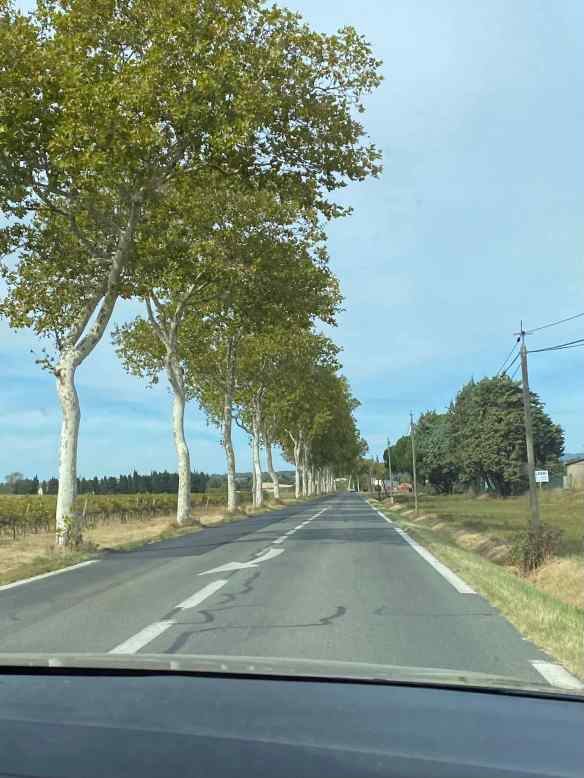
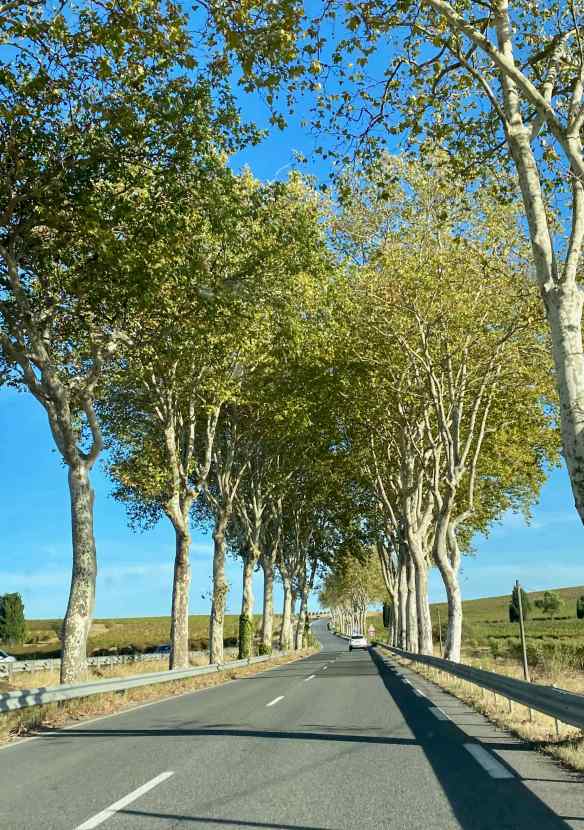
We are on our way to Montolieu which is known as a Book Town.  I love driving down these pretty.tree lined roads.

The happy story about this village, with 800 residents, and books, would not have been written without the desire, charisma and enthusiasm of Michel Braibant, a Belgian bookbinder who was living in Carcassonne, who sadly died just two years after his lifetime mission was completed in 1992. Aware of the concept of ‘book towns’ in Europe, he decided to create a new Book Village in Montolieu, which would be home to bookshops and craftspeople, as well as a conservatory for Book Arts and Trades.”   ~ Carcassonne Tourism Booklet

We find a bench in this little park next to the Saint-André church for our picnic lunch.

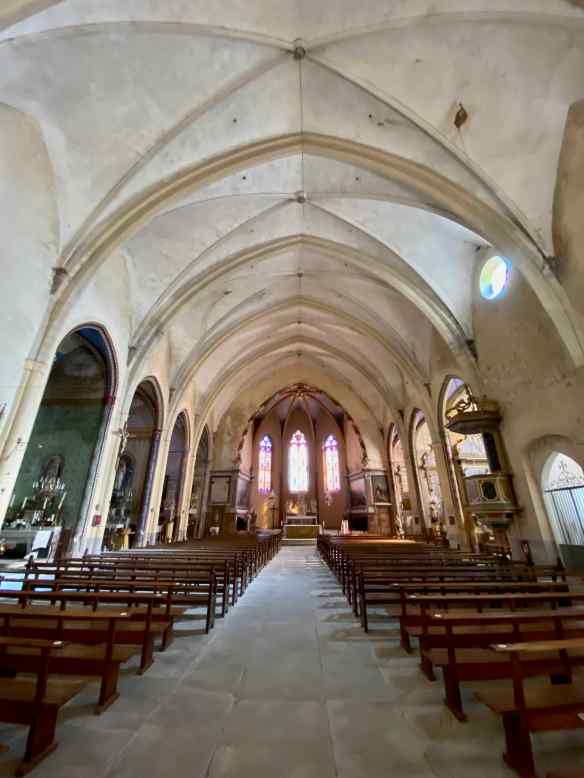
The inside of Saint-André is well preserved…

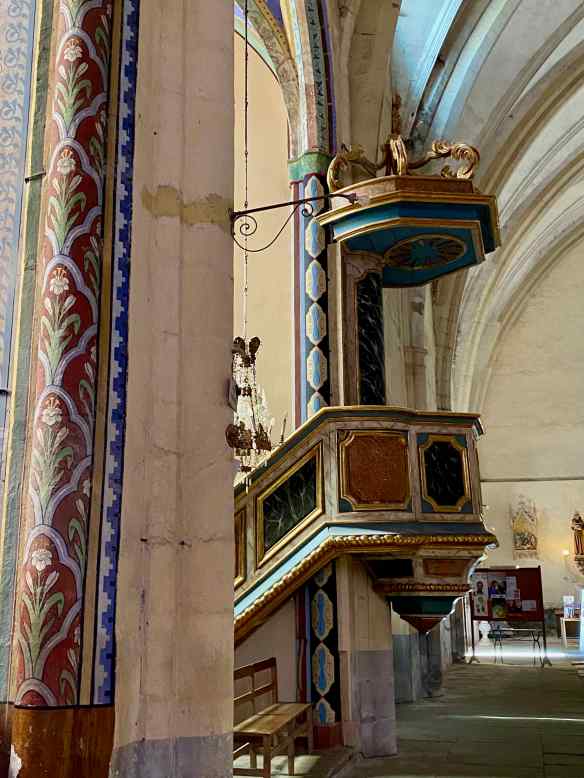
with lots of decorative paintings in the chapels.  But take look at those pews in the photo above….they were most uncomfortable!

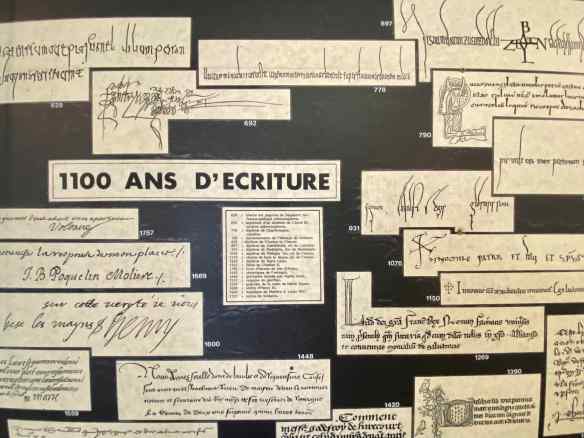
We are at the Museum of Book Arts and Crafts when it opens its doors at 2:00.  This display of 1,100 years of handwriting was interesting.

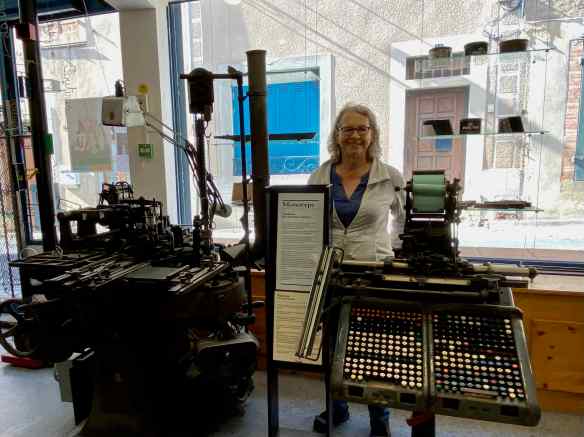
There were many different types of print making machines and printing presses, most of which I had never heard of.  This Linotype machine uses hot metal injected into a mold made by ‘typing’ on all those keys to make lines of text, which was much faster to use than hand setting individual lead type letters.  After they were finished printing the type would be melted down and reused.  Quite ingenious.

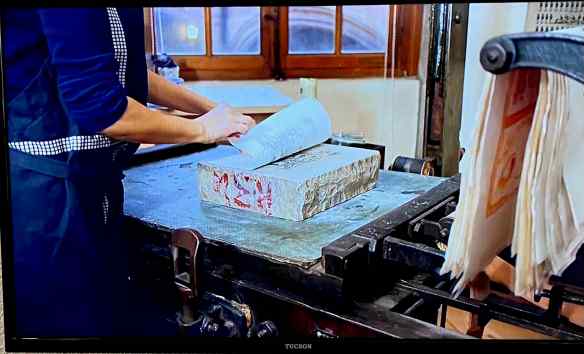
A little film explaining lithographic printing brought back memories of my university days and all night printing sessions!  Bob used to help me with these printing sessions, so he found it interesting too.

Now, this made me feel rather old!  This Gestetner machine is just like the one I used when I first started teaching way back in the ’70’s.  It was messy and slow and the machine was very temperamental.  This is what we used for handouts before photo copy machines were in common use.

This large paper cutter is from the late 1800’s

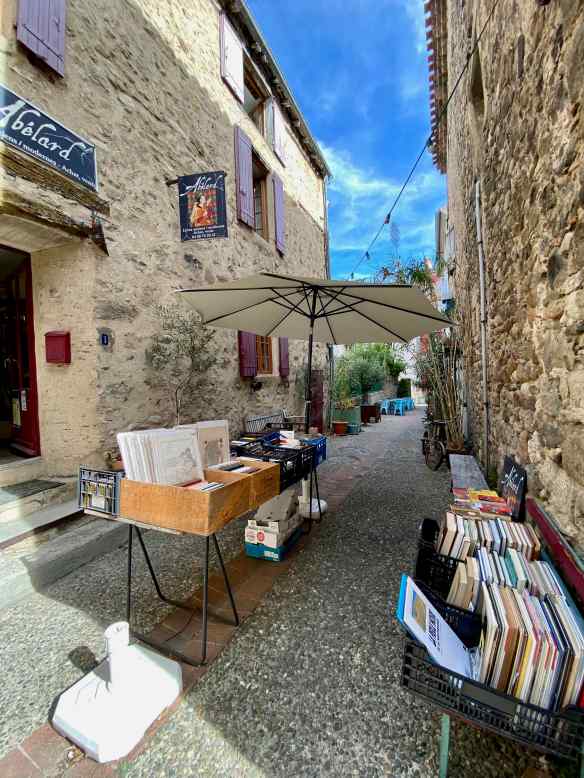
We spend an hour and a half in the museum and when we leave, the bookstores that were closed for lunch are now open.  There are 15 bookstores in this tiny town and they only sell second hand books.  

Most of them have bins of books out on the street to entice customers.

A peek inside one of the bigger bookstores.There are some interesting book themed signs, although we are not sure what this stake of burnt looking books is supposed to represent.
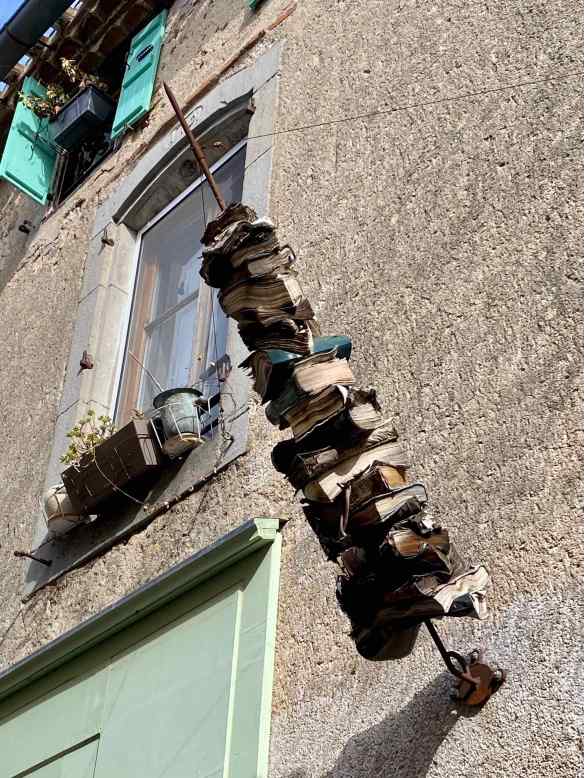
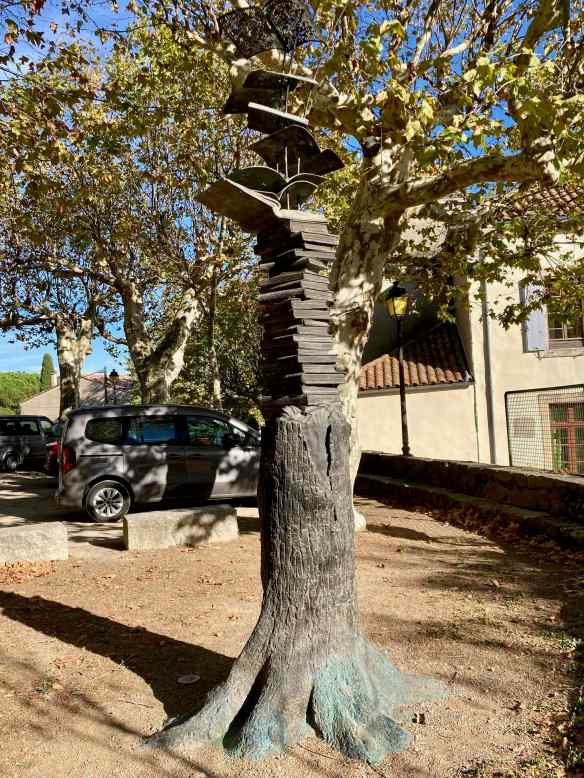
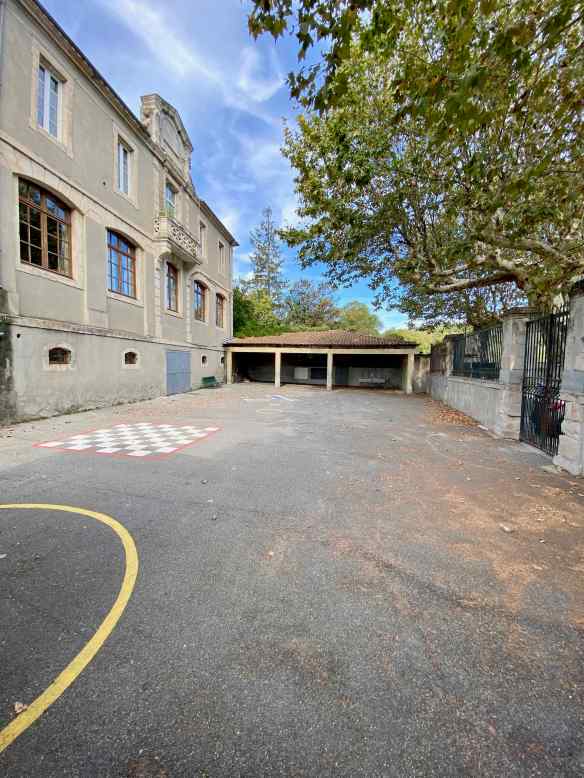
Another book sculpture….seems staked books are a bit of a theme? I do feel a bit sorry for French children.  This is a typical French school playground. Cities and towns have few areas where children can run and play on grass.  Most parks have signs to keep off the grass, if there is even any grass!  I think because the population is so dense, that if people were allowed on the grass it just wouldn’t survive the heavy use.
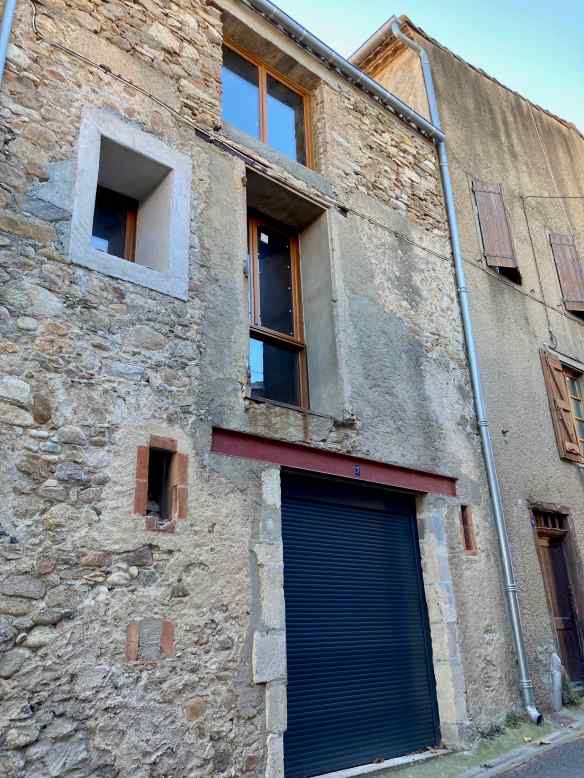
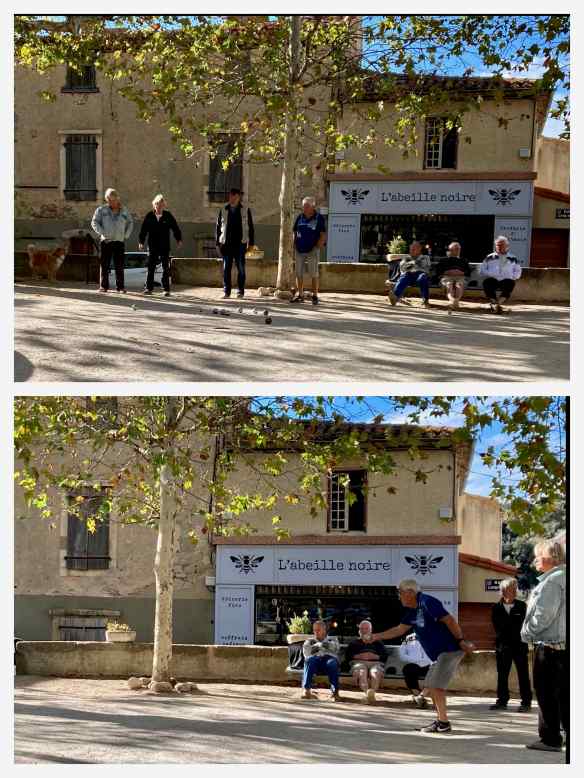
These old houses have very thick walls.  New windows are installed here but look at how deep set they are.

We sit for a while watching these Pétanque players. They often take this game quite seriously and they are very good players.  We have to laugh though when one of the players takes the little target ball from another team and hides it.  They were just like young boys playing keep-away, passing the little ball from one to the other all the while exclaiming loudly that they didn’t have the ball at all!  Too funny.

More tree lined streets on the drive home.  I will miss these beautiful trees when we leave.

Carcassonne, Friday 13th…

Day 46, Friday, October 13, 2023.

Bob decided he does not want to drive on Friday 13.  I didn’t know he was so superstitious!  That works for me.  I am happy stay put for a bit.  We had originally planned a couple day trips from Carcassonne: to Albi to visit the Toulouse Lautrec museum and to Toulouse for a tour of the AirBus factory.  That isn’t going to happen now as I’m not feeling up to two long days of travel and sightseeing.  Too bad but it is what it is.  So I have a quiet morning and Bob goes exploring. He climbs the hill to visit the back side of La Cité.

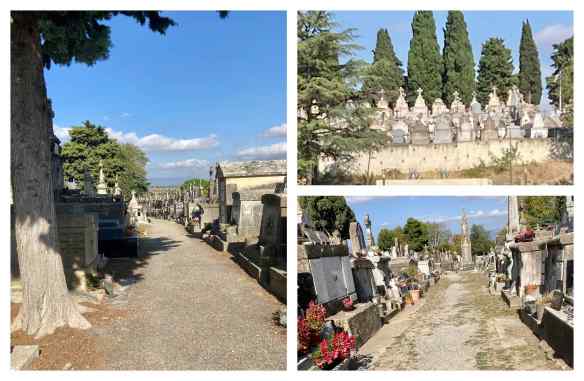
He walks over to the cemetery we saw in the distance yesterday.  We both enjoy visiting old cemeteries.

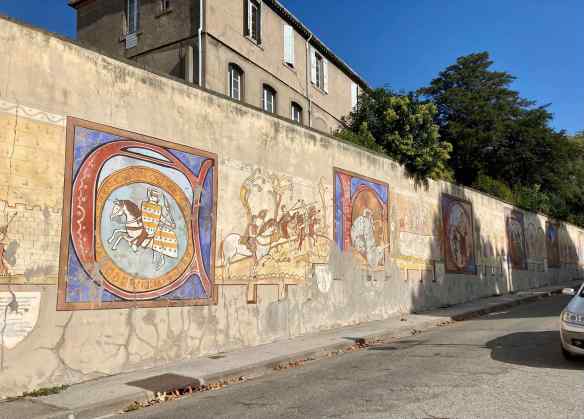
On the way to La Cité he walks along a wall covered with a medieval style mural spelling out the name Carcassonne.  We saw this at the end of street when we walked to La Cité yesterday but didn’t look at it then. I was unable to find out any information about this, which is a shame. It is really quite lovely.,

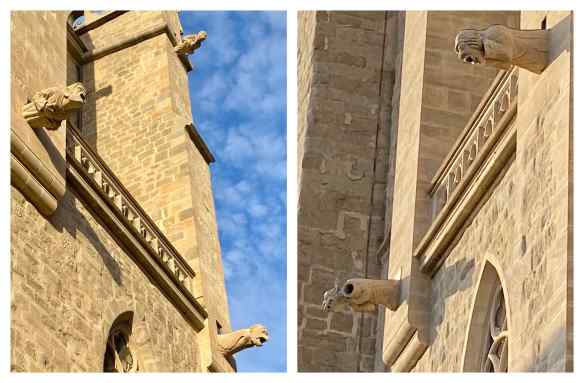
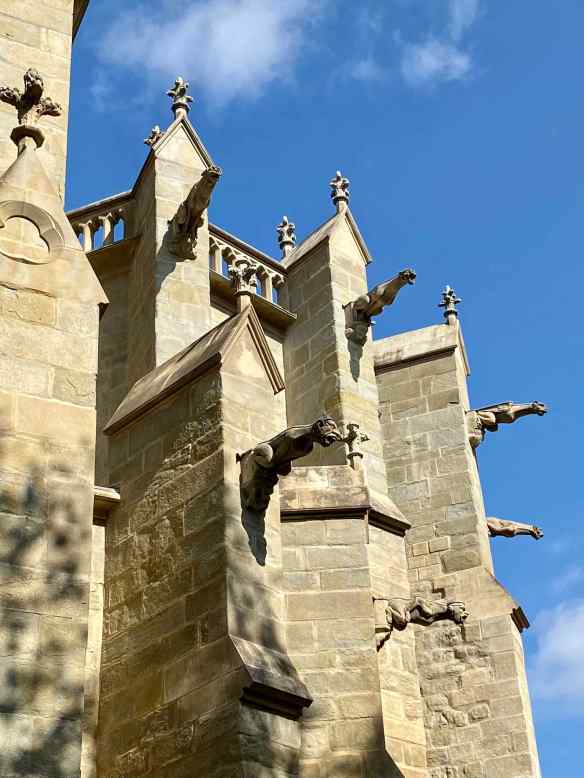
In the late afternoon we both go for a little walk.  I find more gargoyles, well…actually Bob was the one who spotted these.

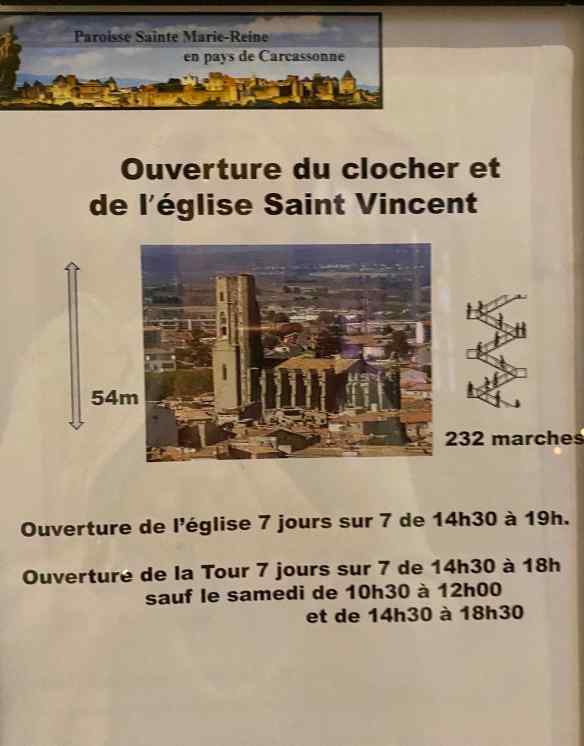
We go into Église Saint Vincent and… discover that we can climb the bell tower for just 2.5 euros!  I’m not wanting to do it today but I hope we can get back another day.  We have climbed a lot of bell towers on our other trips, but so far not a one this time.
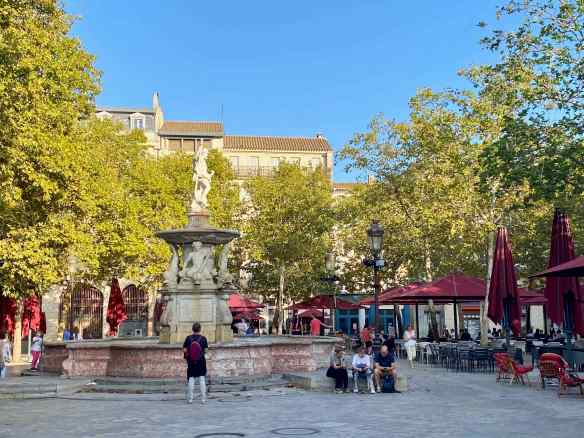
The old city in Carcassone has a lovely big open square with a fountain and lots of restaurants and cafés around its perimeter.  There are lots of people sitting outside enjoying the lovely evening.

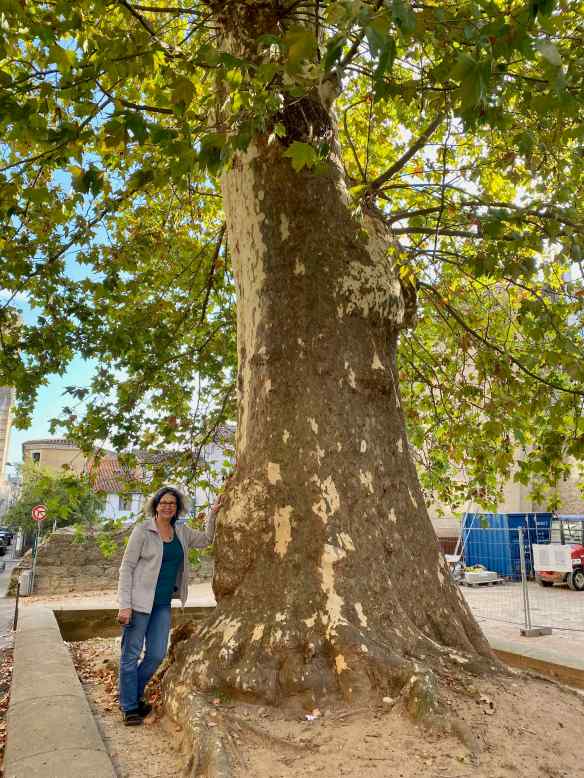
I had to get a photo of this huge old Sycamore tree.  I wish they would grow back home.  Our winters are just too cold.

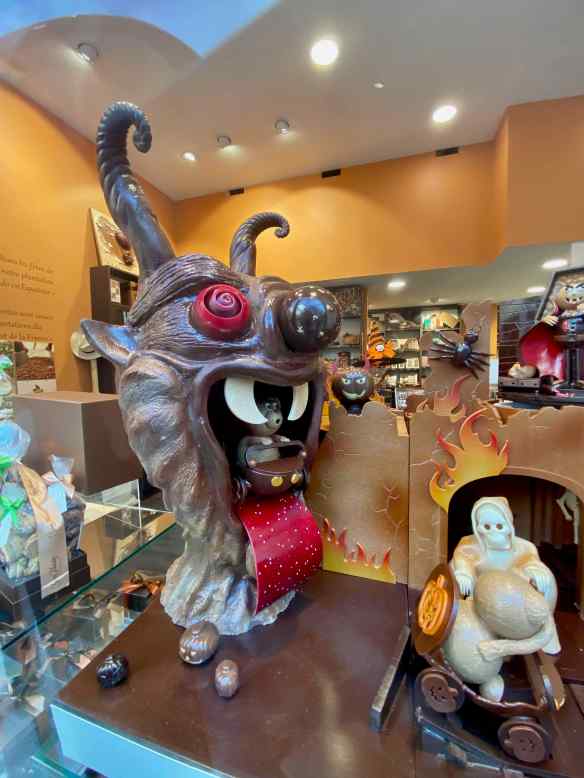
Shop windows are starting to display Halloween items.  These creatures are all made of chocolate.  We have seen so many closed shops, restaurants and galleries.  Every block in this old part of town, which is frequented by tourists, has at least one or two shops that have shut down.  On some streets almost every second shop is closed. I am pretty sure this is because of Covid.  It makes me quite sad.


Medieval Cité in Carcassonne, France

Day 45, Thursday, October 12, 2023.

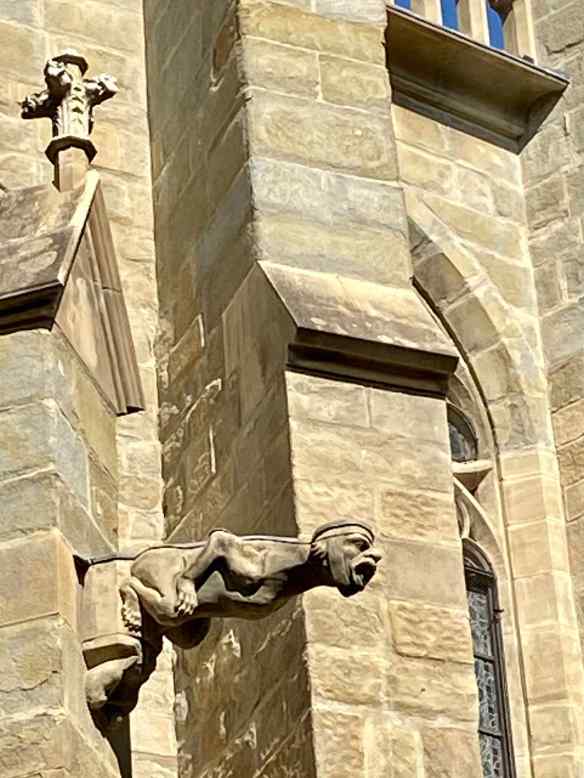
I’m feeling bit better this morning so we go visit the medieval citadel called la Cité.  It is a half hour walk and we pass a church on the way that has incredible gargoyles.  I love gargoyles.

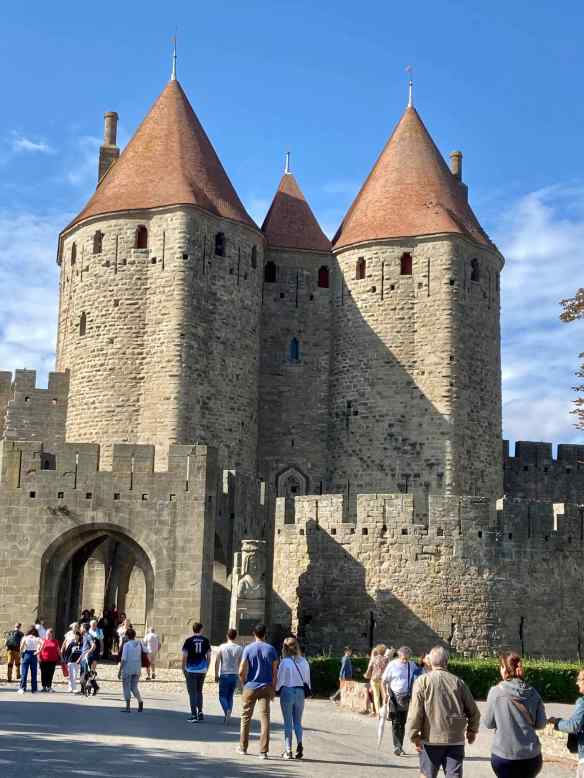
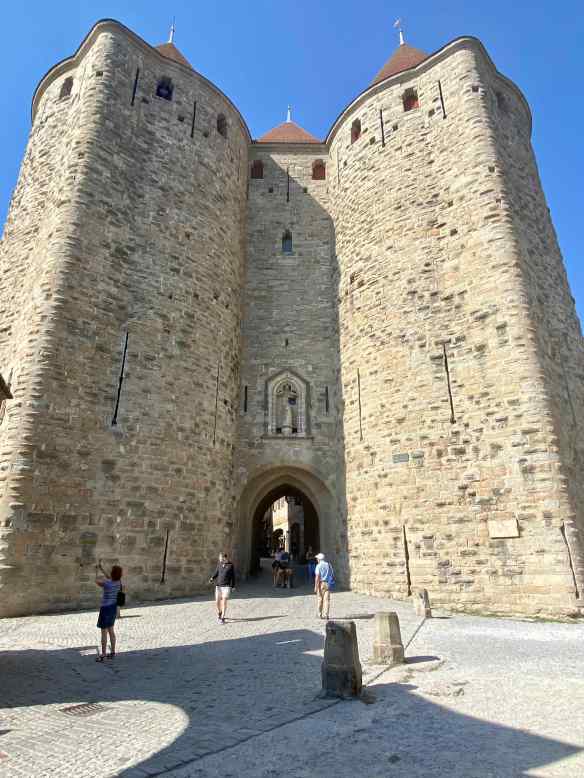
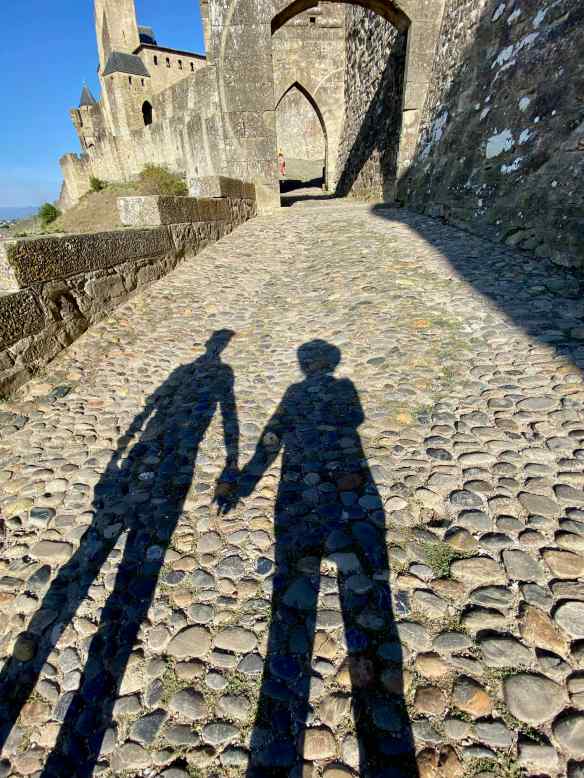
I thought this one was particularly interesting. This is one of the entrance gates to the old city of Carcassone.
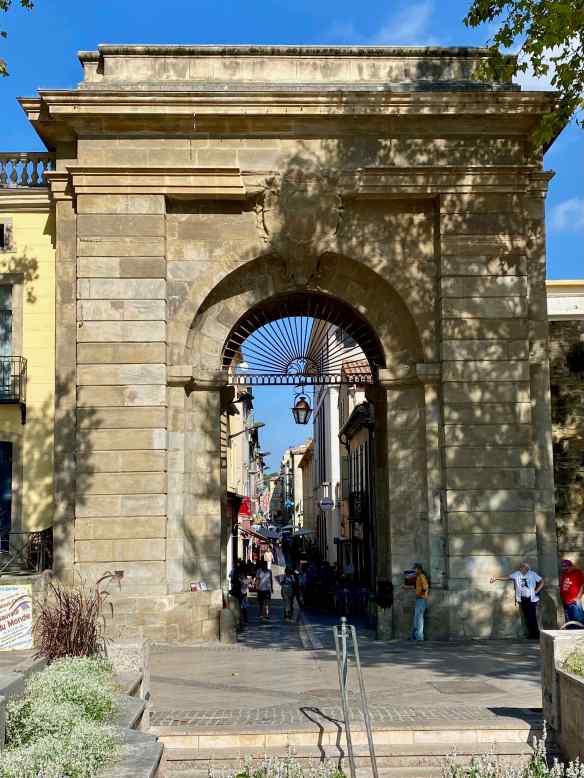
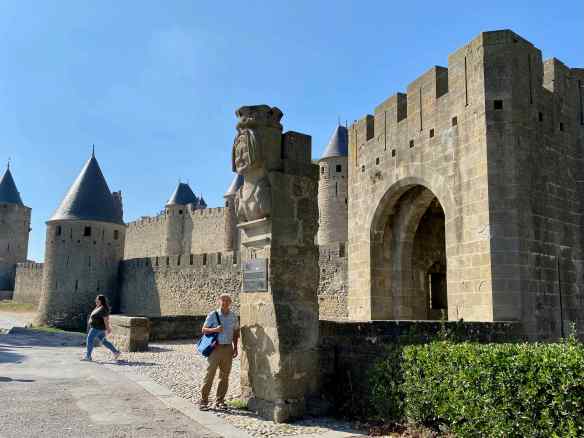
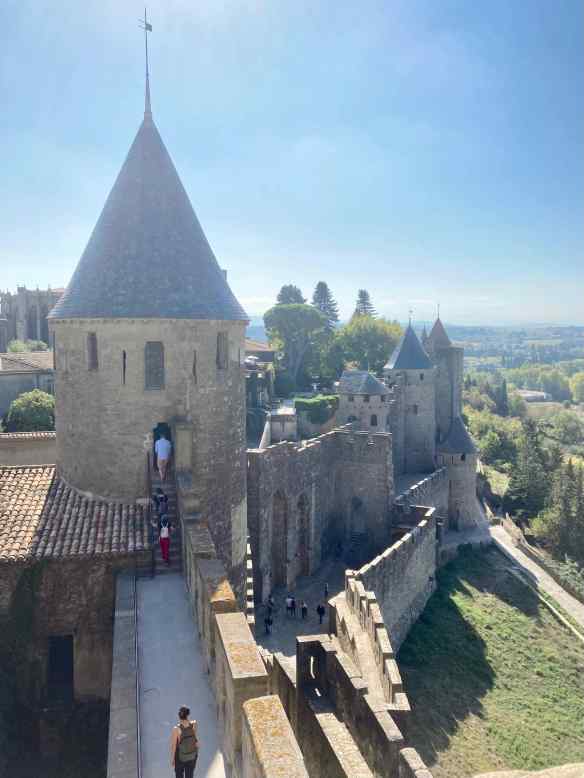
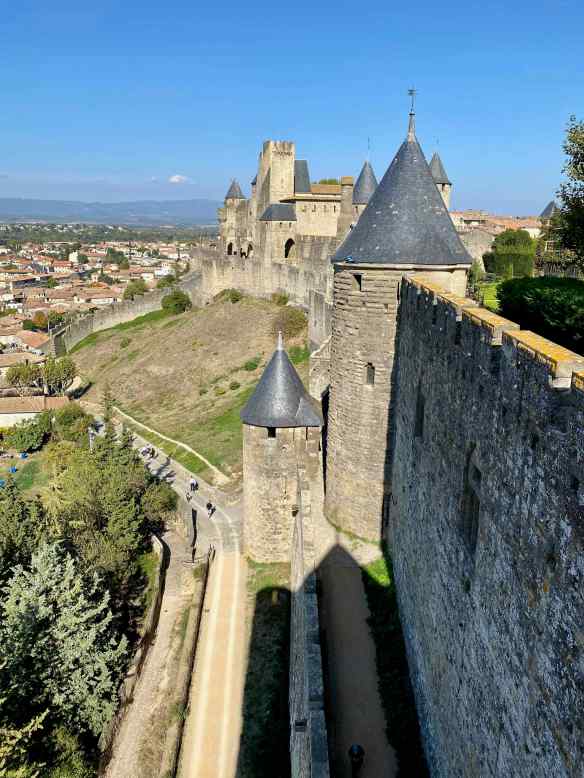
The medieval city, a UNESCO World Heritage site, has 52 towers and 2 ramparts.  Bob is standing beside a sculpture of Dame Carcas who ruled the city when it was attacked by Charlemagne in the 8th Century.   After being under siege for five years, there was only a sack of grain and one pig left to eat.  Dame Carcas fed the sack of wheat to the pig and threw it over the ramparts at the enemy, who thought that they must have a lot of food left if they could throw it over the walls, so they called off the siege and left. Dame Carcas had the bells of the city rung in victory, “Carcas… sonne” means  “Carcas is ringing”.

This is the massive entrance past the outer ramparts into the Cité.  This citadel has two sets of walls and two ramparts for protection.

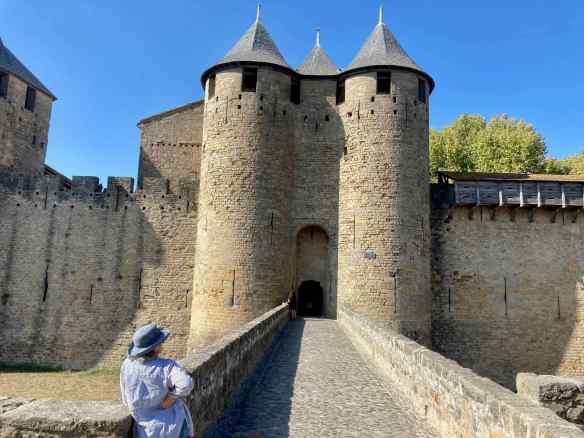
and I am standing at the entrance to the residence of the ruling family built inside the fortress in 1130.

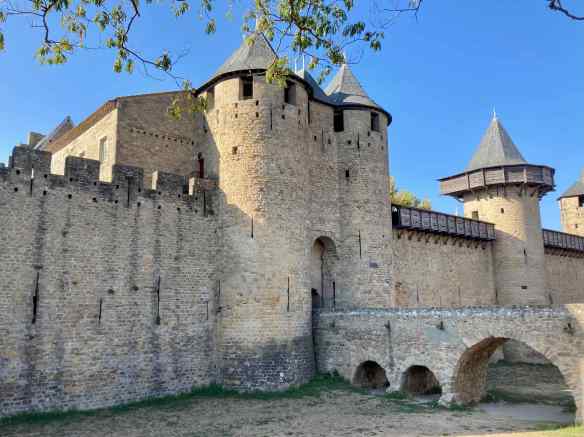
Here is another view of what is really a fortress within a fortress.

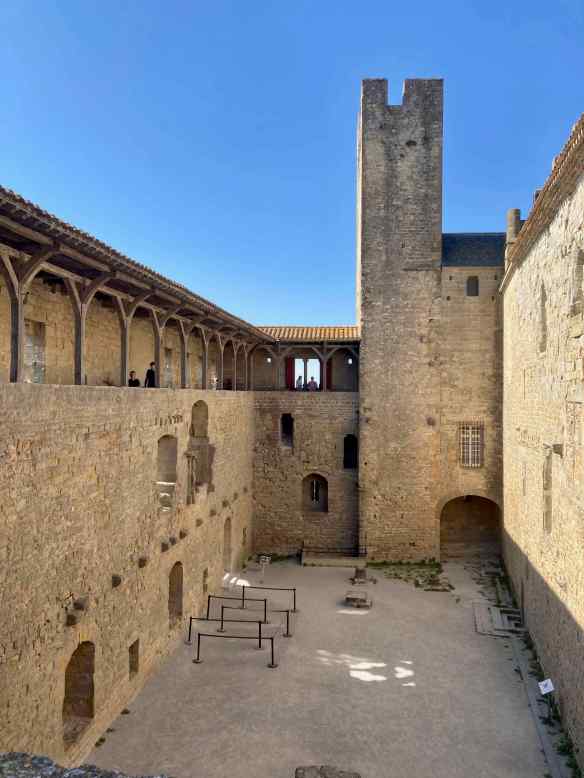
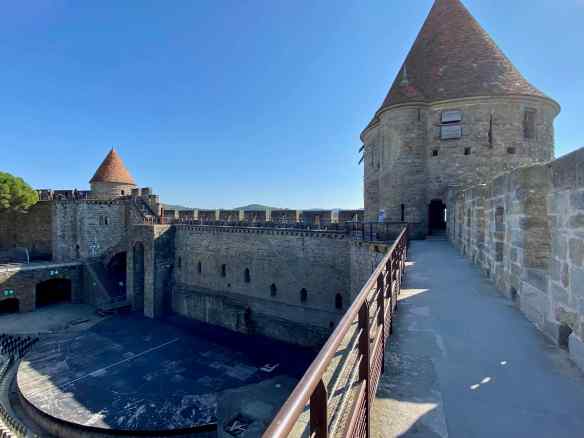
Our visit starts with a walk along part of the ramparts overlooking an interior courtyard…

and continues through some of the buildings and towers.

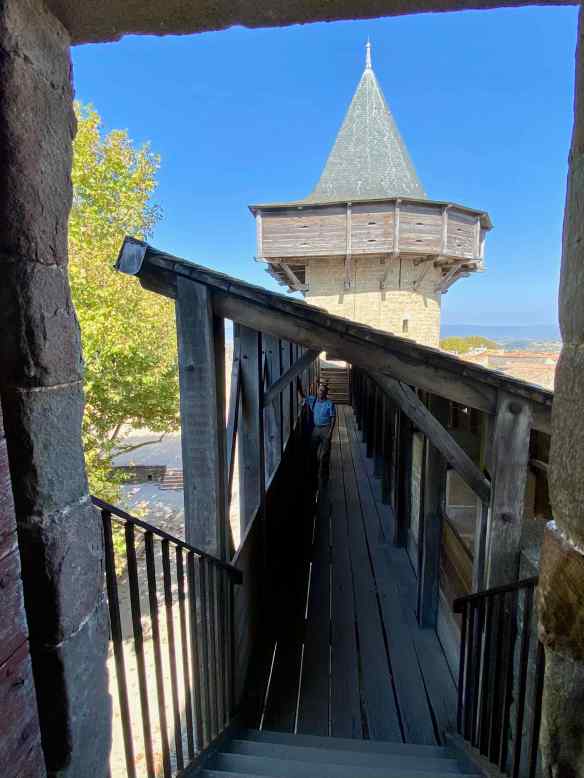
These wooden additions to the ramparts allowed soldiers to attack the enemy from above.  There are holes in the floor to allow attack from above on anyone trying to enter the fortress.

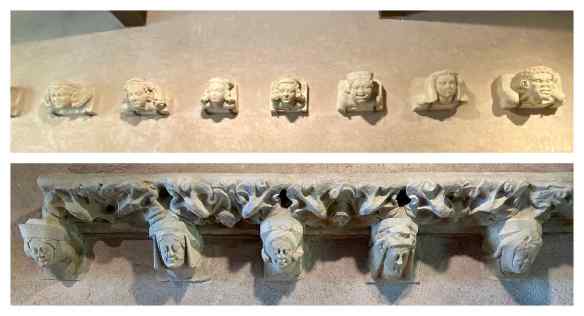
I was expecting to see furnished rooms, similar to our visits to the chateaus of the Loire Valley but any rooms we walk through are unfurnished.  A couple room have sculptures that were removed from Saint-Nazaire Church during the restoration of this walled city in 1846 and placed here for preservation.  I particularly liked these carved heads that were part of the exterior cornice.  They are all smiling cheerfully.This is mostly an opportunity to see the fortifications that make this citadel so unique.
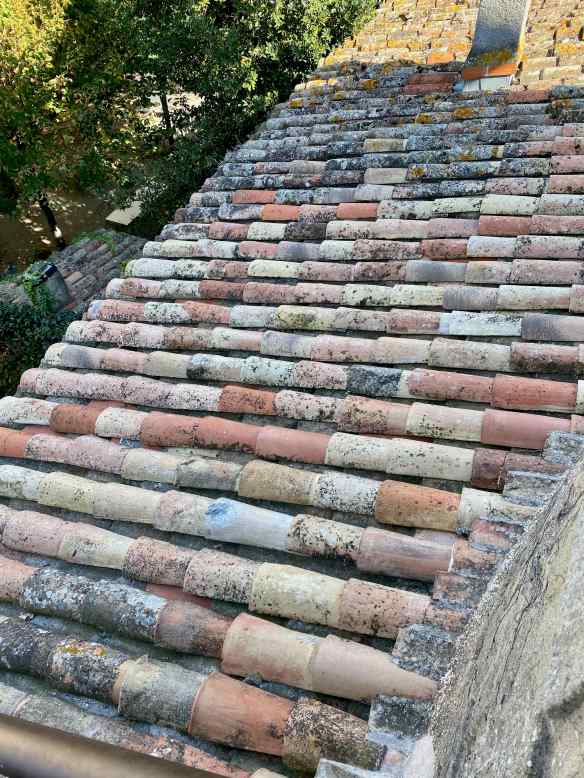
I love all the colours on this old tiled roof.

From the ramparts we can see the path we will be taking when we leave the citadel, however we found a set of stairs near the beginning of this long ramp that is a much shorter route.Carcassonne  is now considered to be the largest and best conserved medieval fortress in Europe.  It is impressive with its set of double walls and ramparts.  Both sets of walls and the area between them can be seen in this photo.
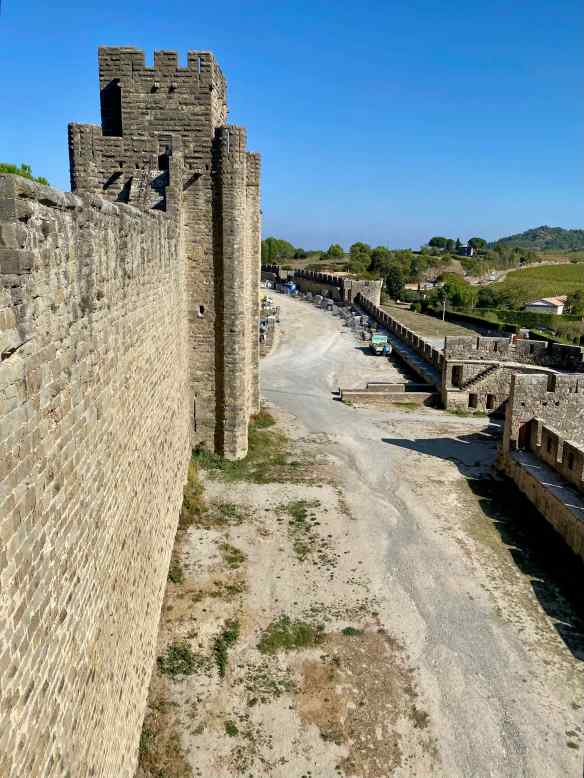
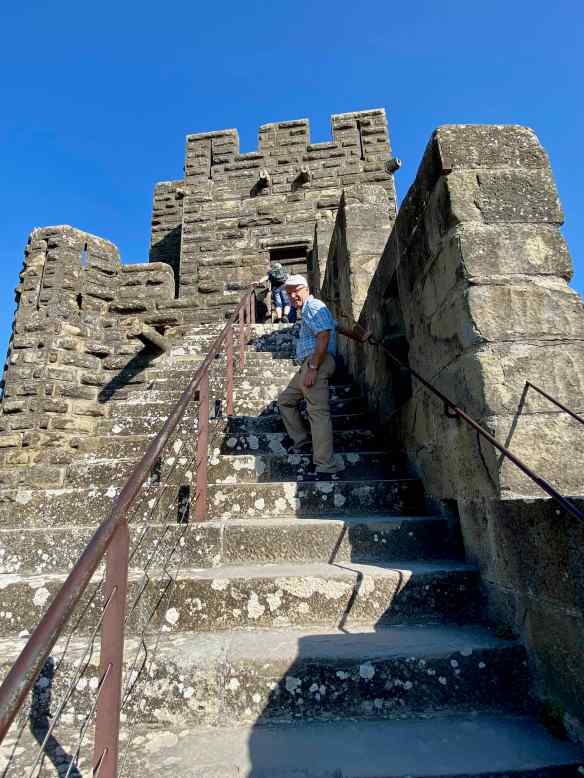
This one tower looked out of place, it was built with different stone blocks and had a different look that the rest.  

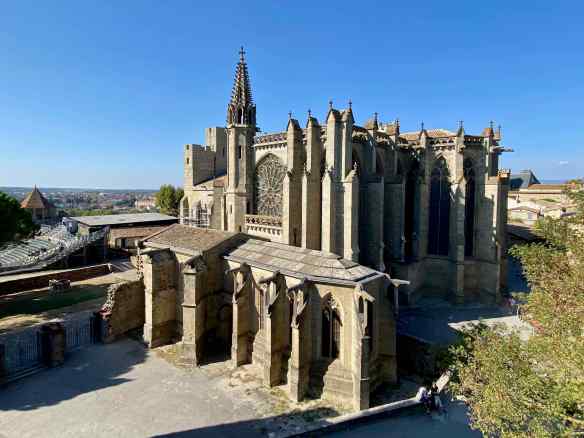
The Saint-Nazaire Basilica has an outdoor theatre that was built where the cloister once stood.  It is just visible behind the church and has 5,000 seats and is in use for productions every summer.

We sit for a while inside the church listening to beautiful cello music.  I think the musician just liked the acoustics…he played several songs and then just got up and left.

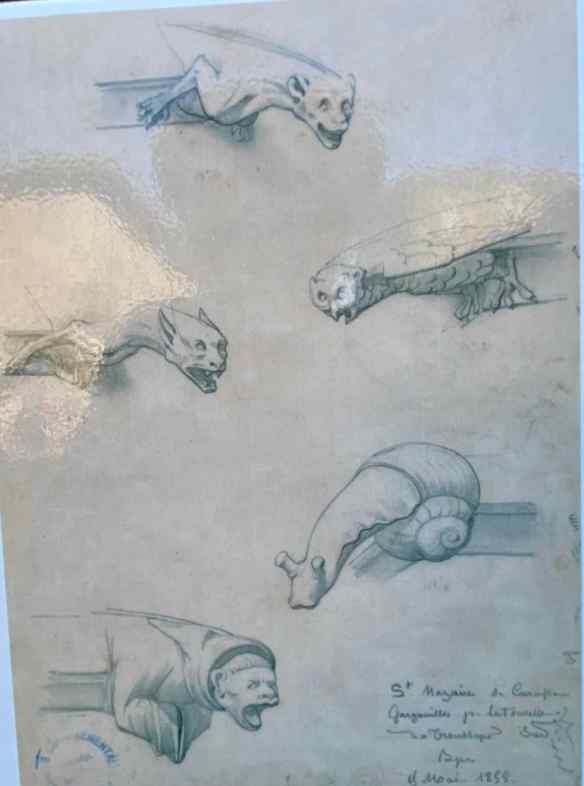
On a plaque outside the church is a reproduction of drawings of some of the church’s gargoyles drawn in 1858.  I guess I am not the only one who likes gargoyles!

On our way home.


Gouffre de Padirac and Rocamadour, France

Day 38, Thursday, October 5, 2023

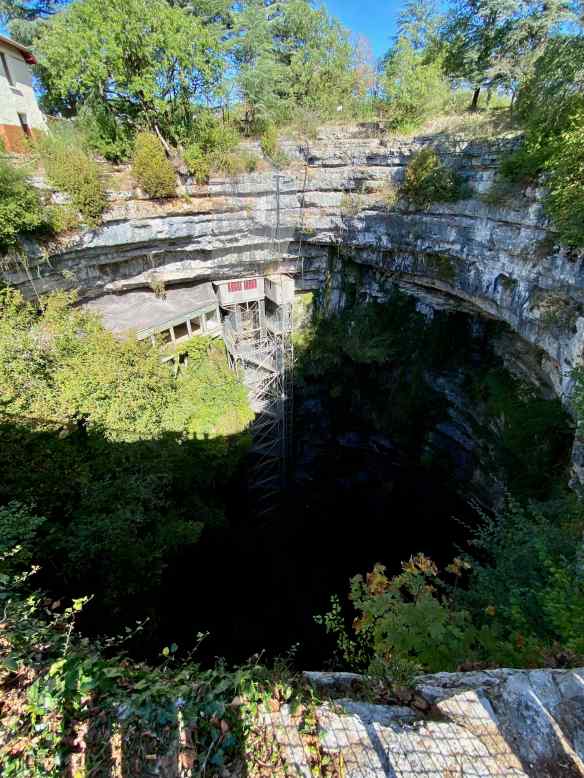
Today we are visiting the Gouffre de Padirac which is about 1 1/4 hours east of Sarlat. This cave was opened to visitors in 1899 and now receives 800,000 visitors a year.  A gouffre is sinkhole or pothole.  Well, this is one heck of a pothole!  

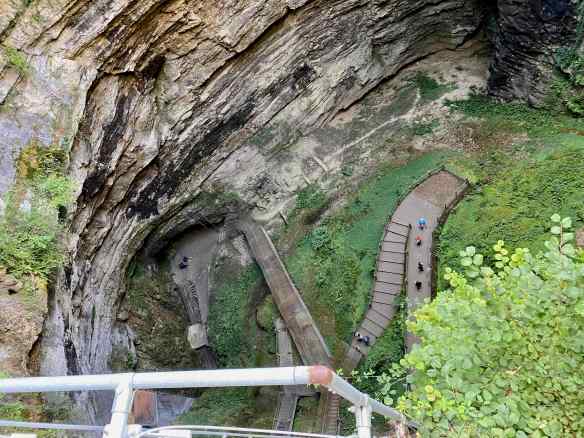
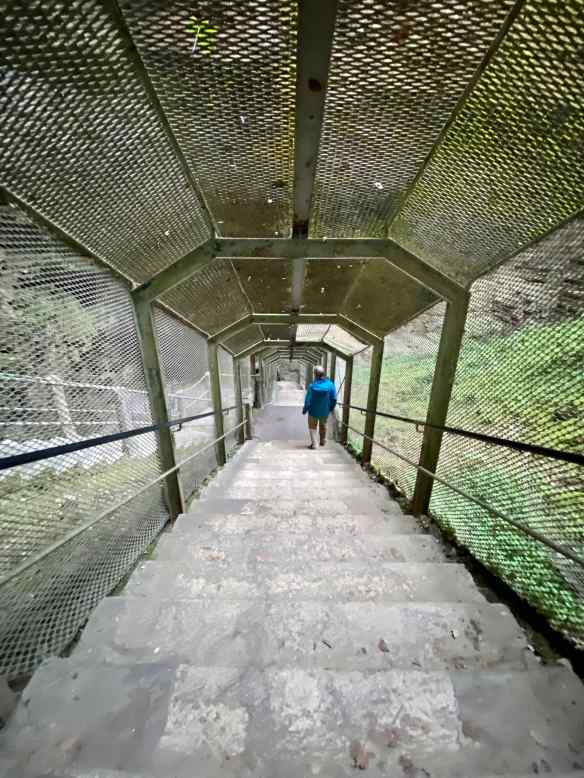
We climb down several flights of stairs cut into the rock and exit this first staircase to start descending the metal exposed stairs on the side of the gouffre.  We are going way down there.

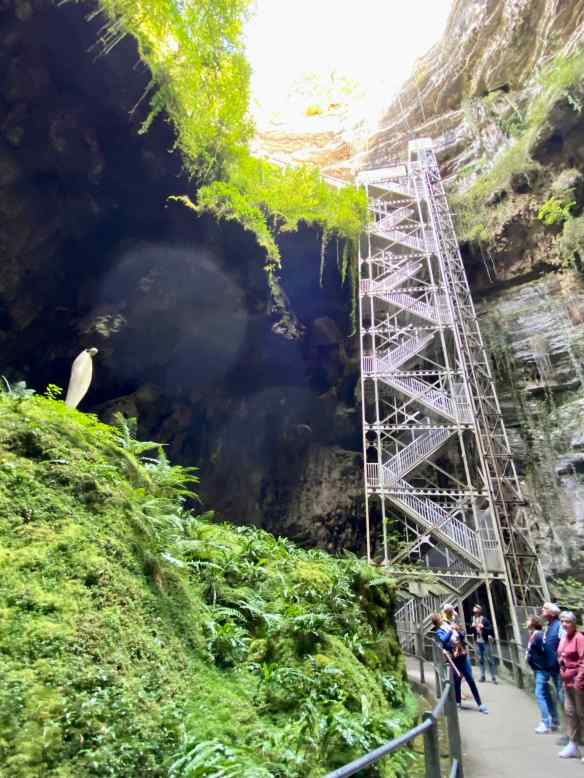
When we reach the bottom…we look up…way up…

and then down…and surprise…more stairs. Once we are inside the cave there are even more stairs…
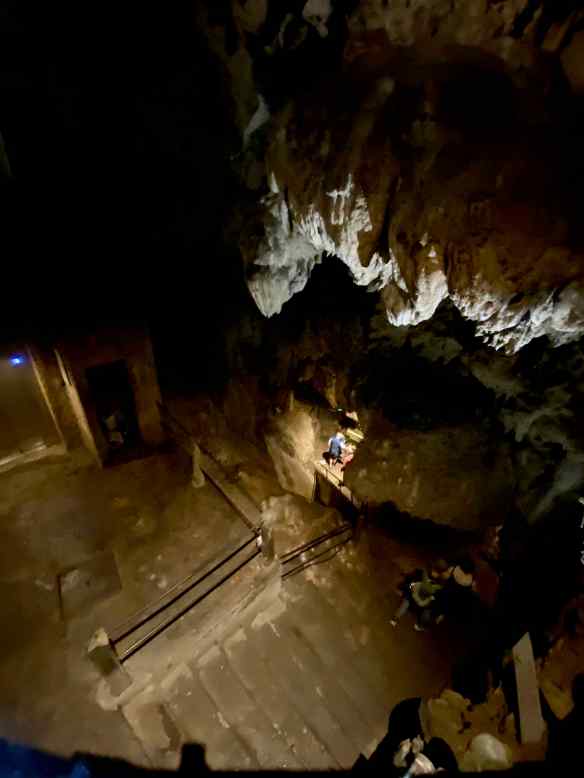
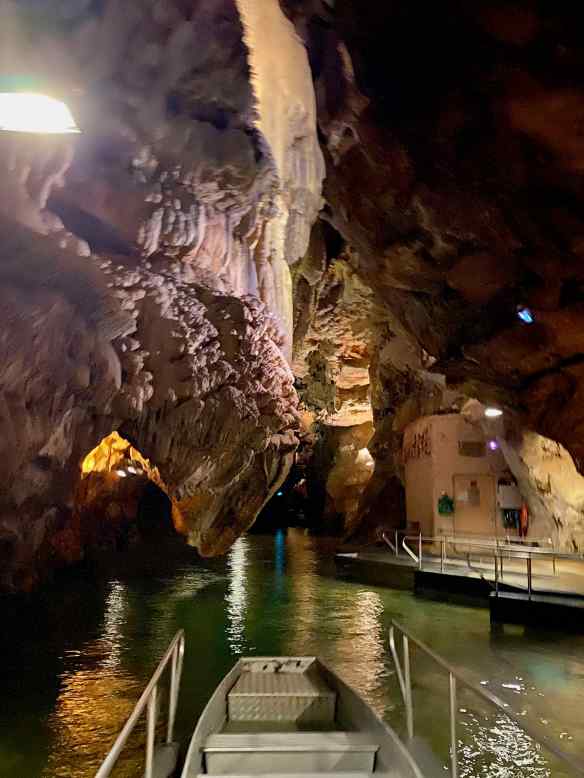
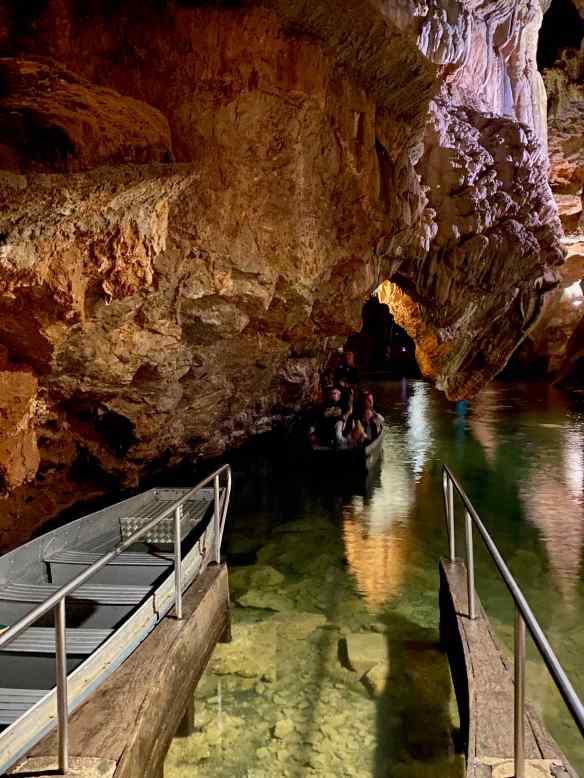
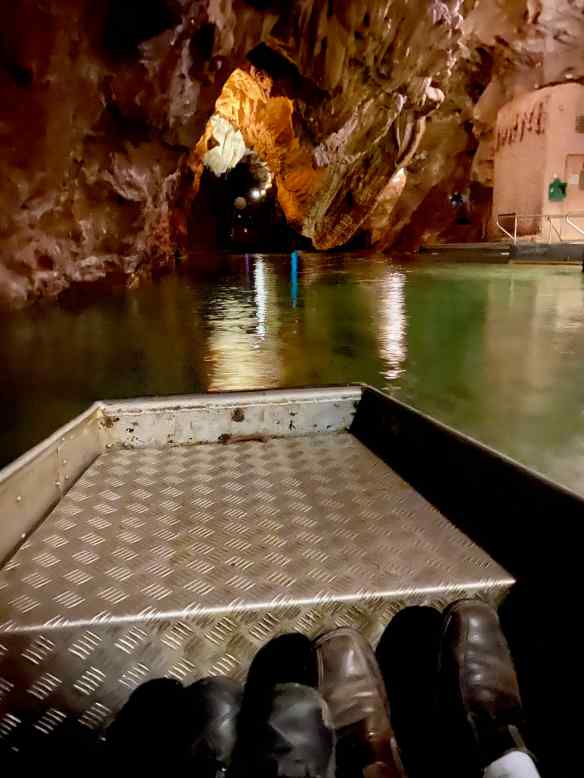
We finally reach the floor level of the cave, after descending 543 stairs!  But wow!  It was so worth it and non flash photos are allowed everywhere except during the boat rides, so I am happy.  Yes…there are lakes and two boat rides 103 meters below the surface!

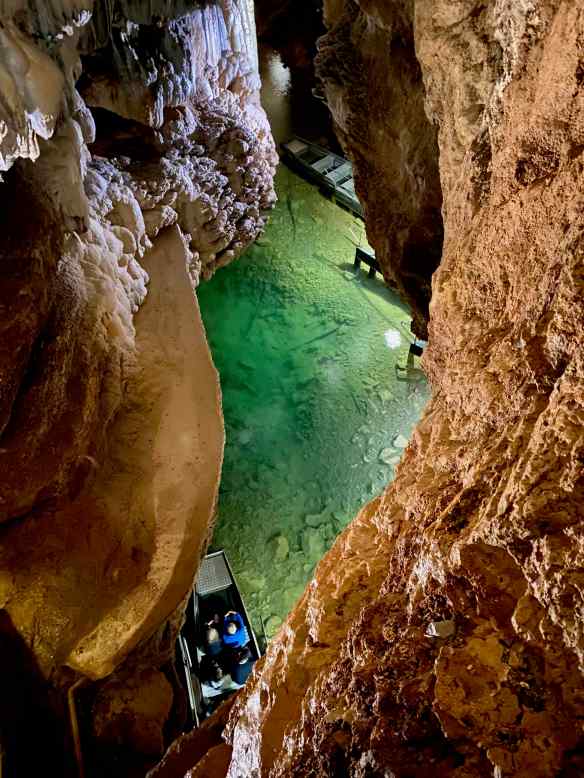
I took this photo after we disembarked from our boat ride.  The lake that we rode on is called Lac de la Pluie, because it is always raining. We had light rain falling on us on that part of the boat ride.  Can you imagine continuous rain? and at 103 meters underground!

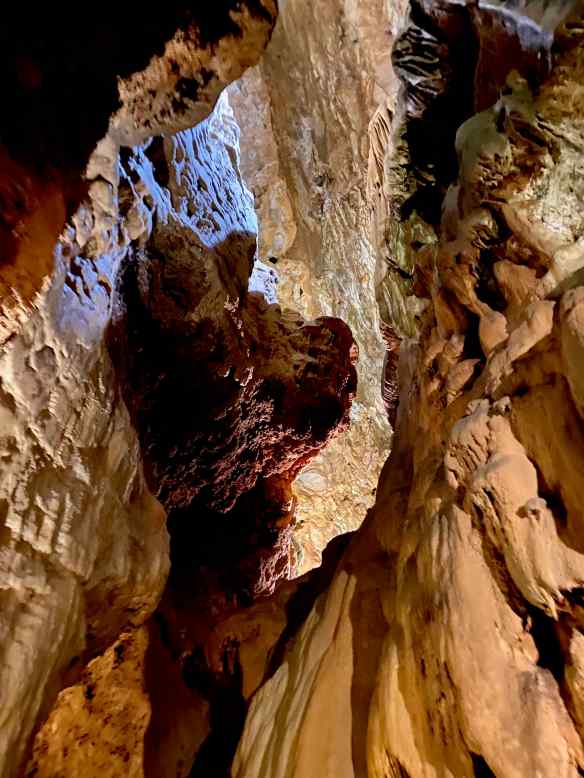
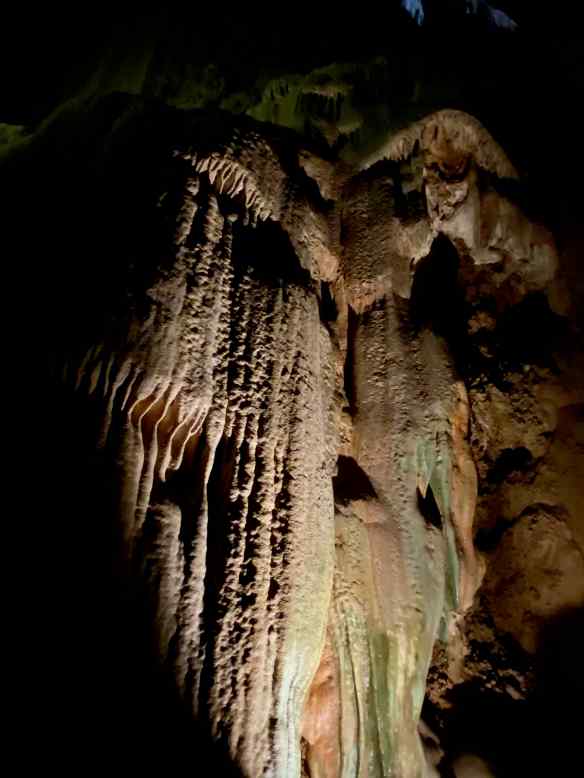
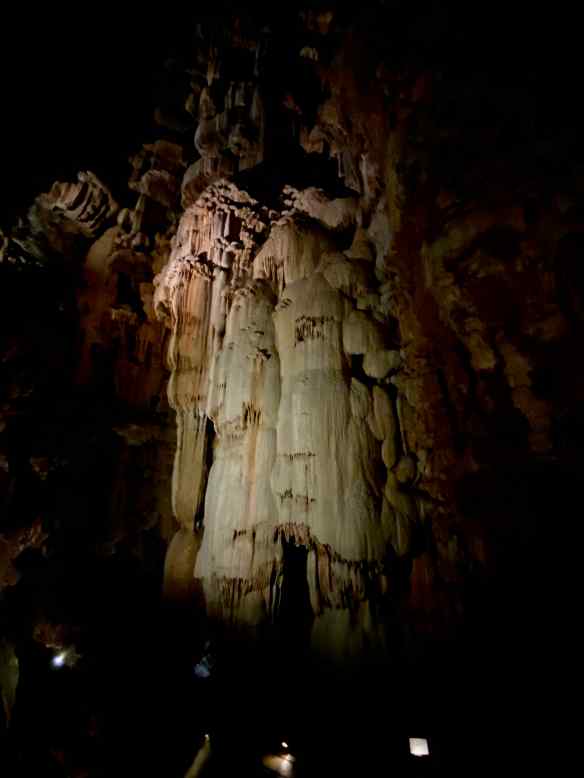
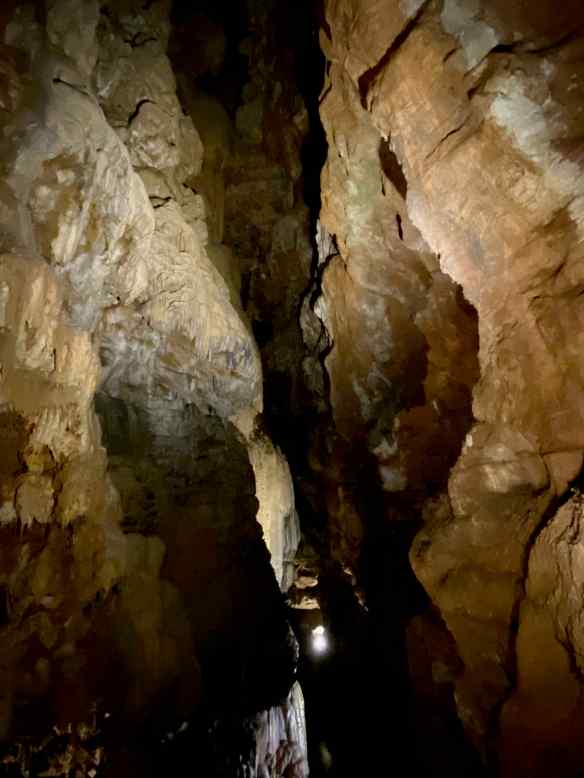
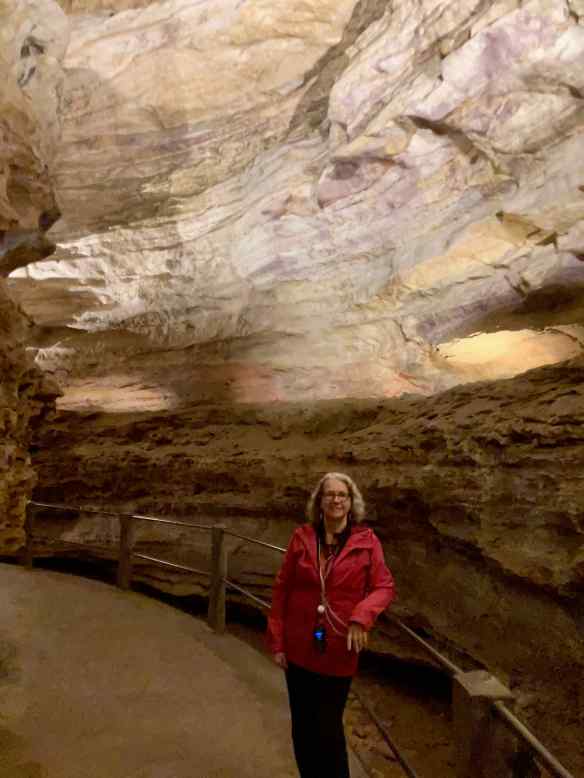
Our walk continues past amazing rock formations …

that are enormous…

with incredible shapes and colours…

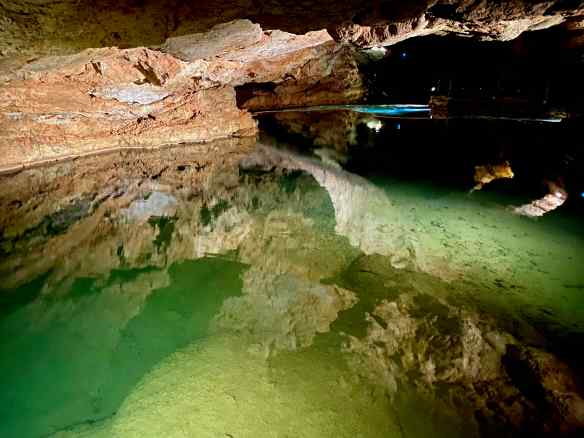
only to arrive at the beautiful Lac des Gours with crystal clear reflections.

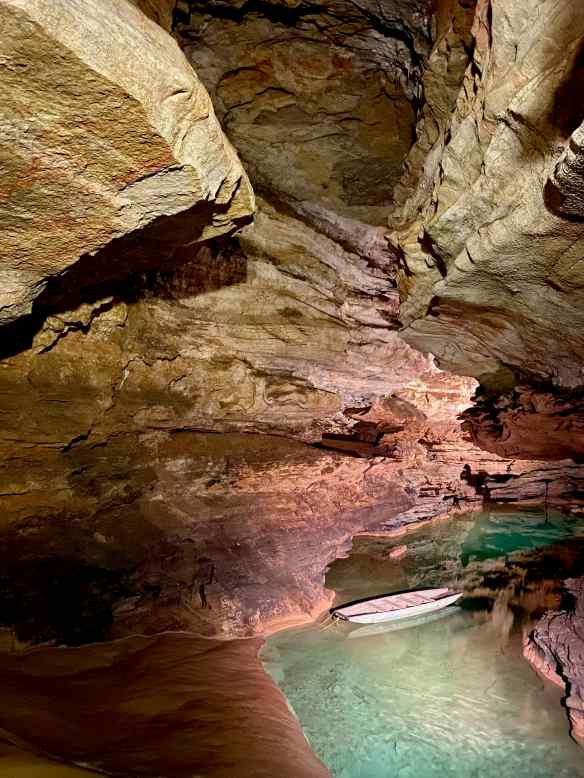
At the far end of this lake we can see the river below with an old boat.  I don’t think the public is allowed in that part of the cave.

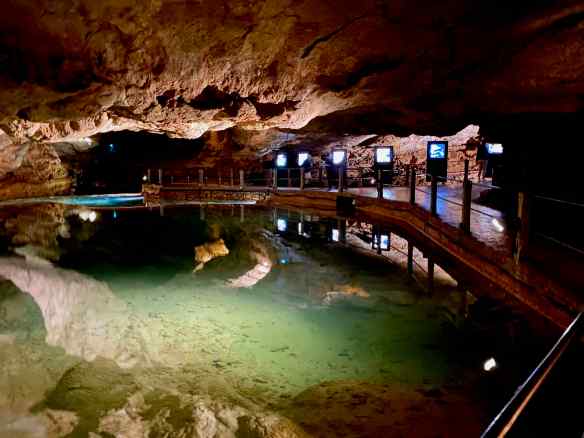
At this point we are given the option of returning the way we came or we can continue to another part of the cave that requires climbing more steps…lots more steps!  Of course we choose to continue further into the cave!The displays here shows some pictures of cave exploration…not for me..it looks cold, wet and exhausting and rather frightening as well. In all, 42 kilometres of galleries have been mapped by speleologists but there are still more areas that have not yet been explored.
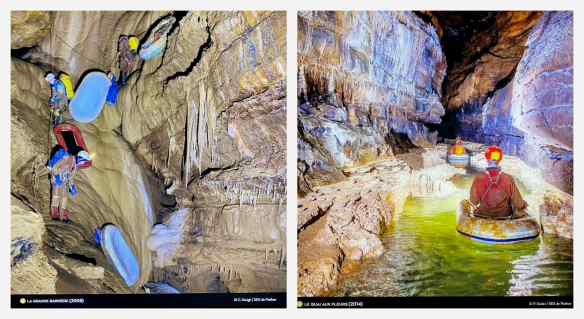
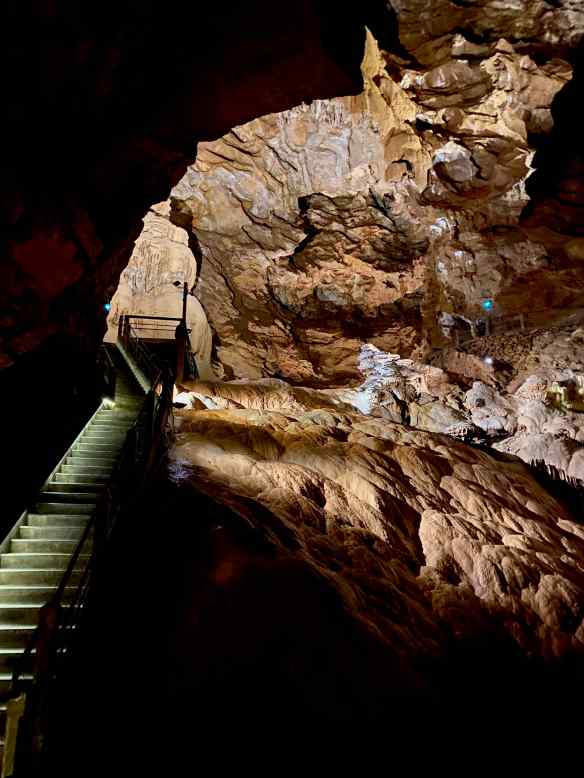
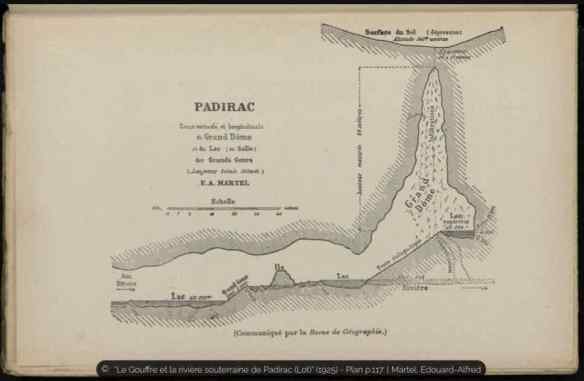
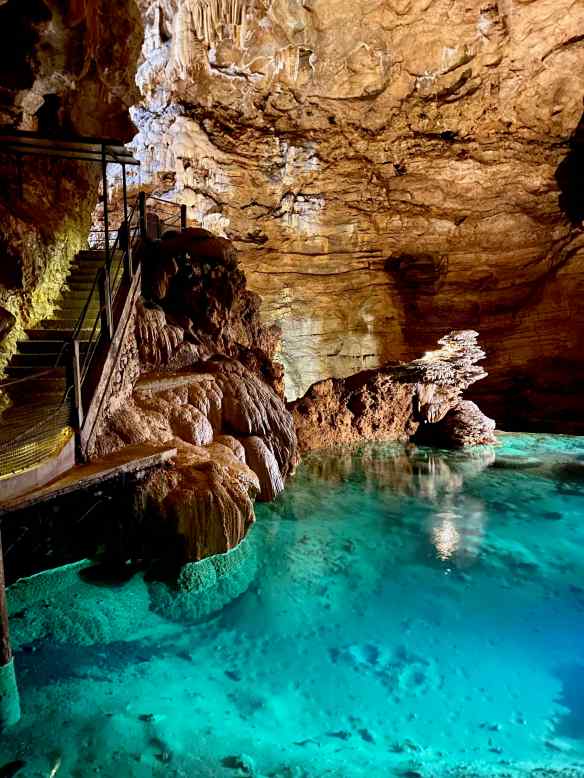
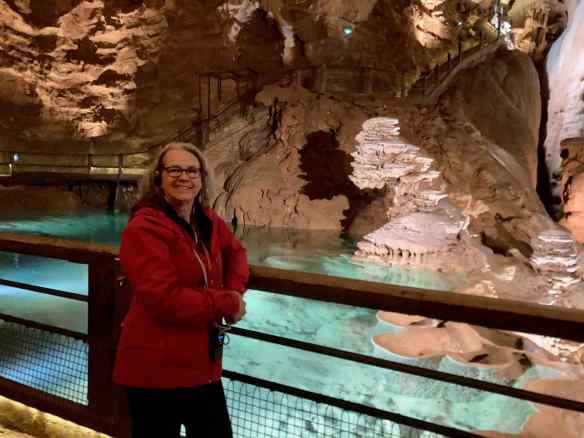
There is a warning that there are lots of stairs, and wet, slippery sections…that isn’t going to stop us.  So up we go… And there is another lake, twenty metres above the river!  Mind boggling!  Lake Superior (Upper Lake), is crystal clear and an incredible aqua colour.  The round tan shaped formations on the right hand of the photo form a dam that holds the water in this lake.“A remarkable stalagmite lies above the lake. It is nicknamed the Pile d’Assiettes (Pile of Plates) because of its surprising resemblance to stacked-up china. It is a typical high-roof stalagmite formed when such a structure exceeds several tens of metres in height. Drops of water fall to the ground at great speed and explode, depositing limestone in circles and giving rise to very flattened formations.”  ~ https://www.gouffre-de-padirac.com/en/salle-du-grand-dome   We are standing beneath the Grand Dome, which rises 94 meters above us.
This diagram shows how high above the river Lake Superior is, and the incredible dome that rises above it.

There are still more steps, many more steps…

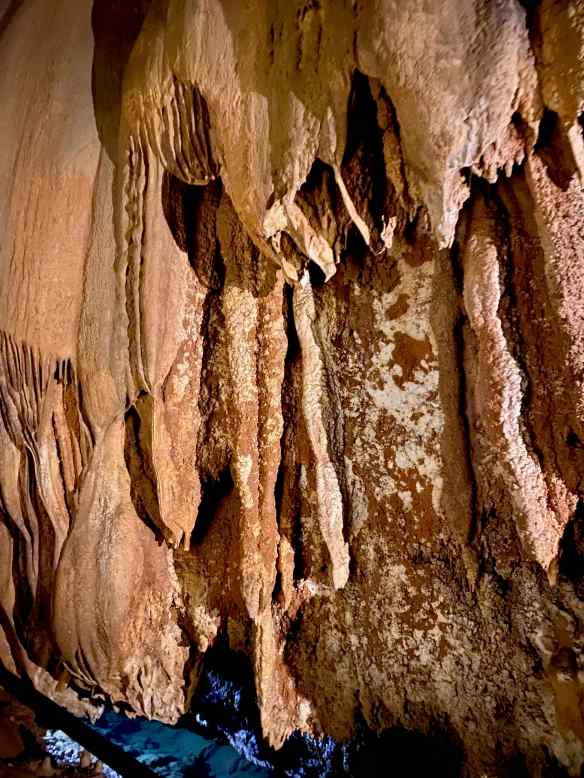
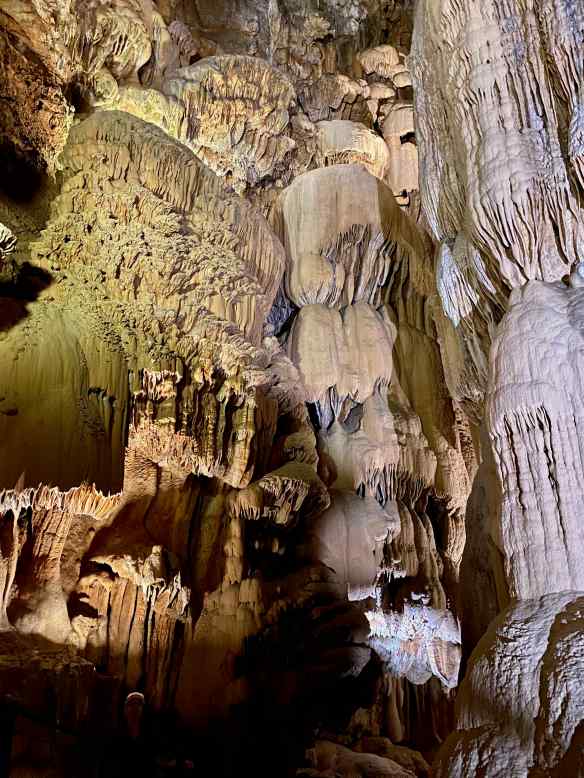
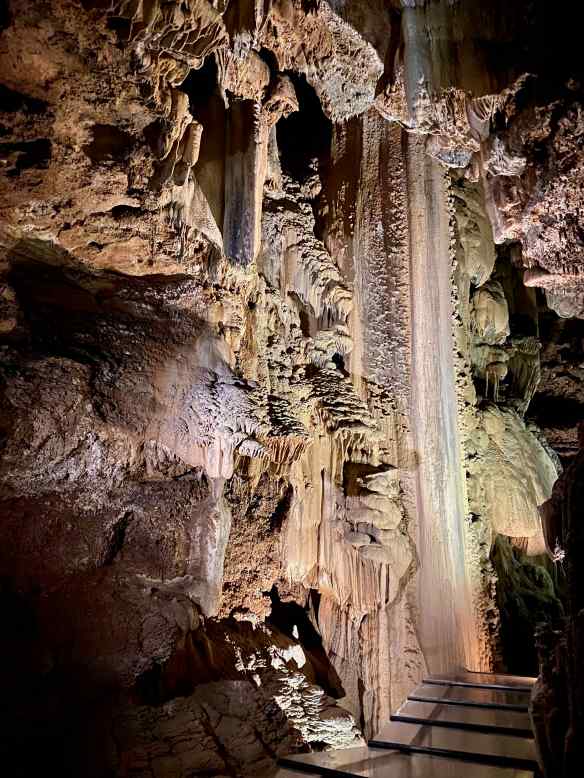
and many more amazing formations…

that are enormous. Bob is in the bottom of this photo to give an idea of their size. I am quite relieved that we do not have to climb these steps!
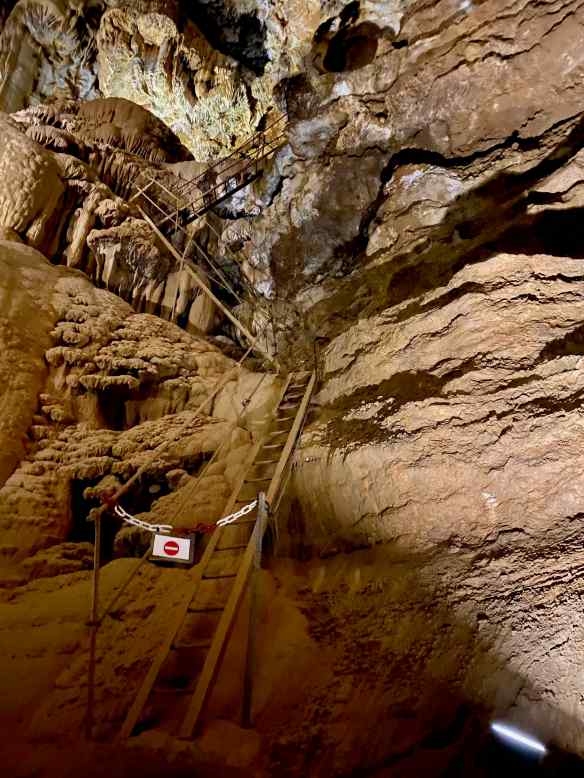
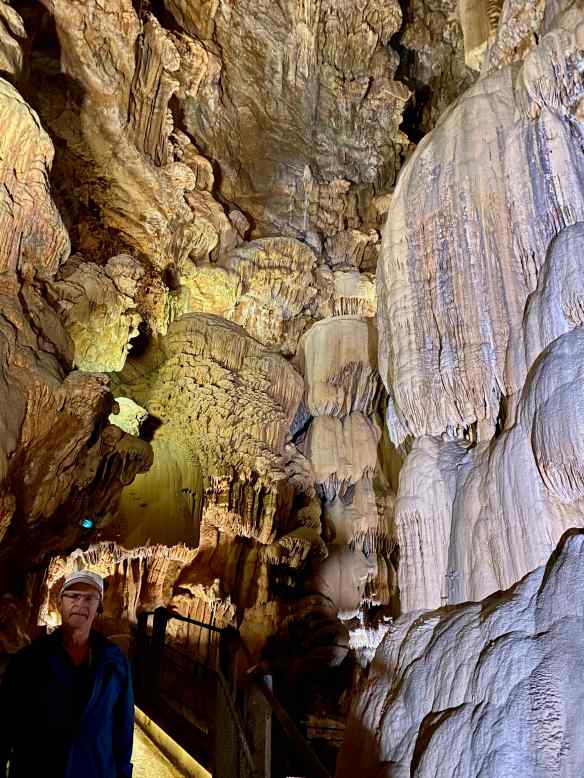
This is a magical underground world!

More formations, just because they are so wondrous…

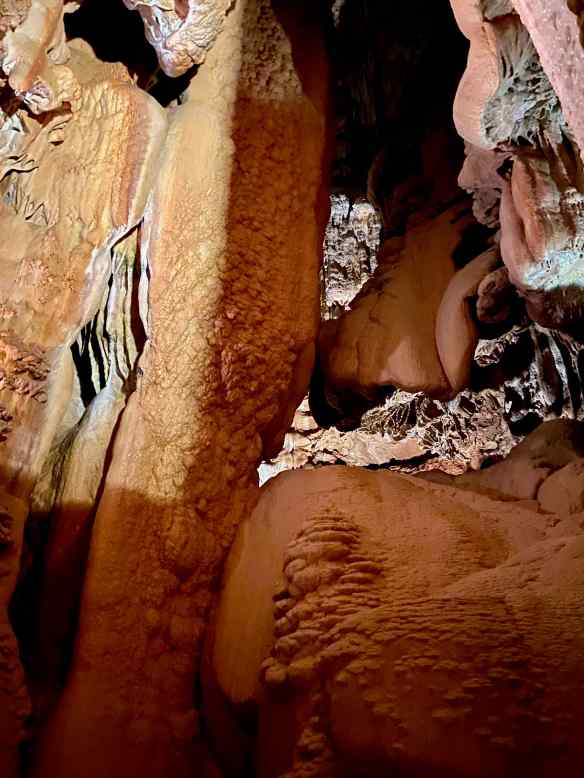
and I am amazed by their colours. It is difficult not to include all even more photos.

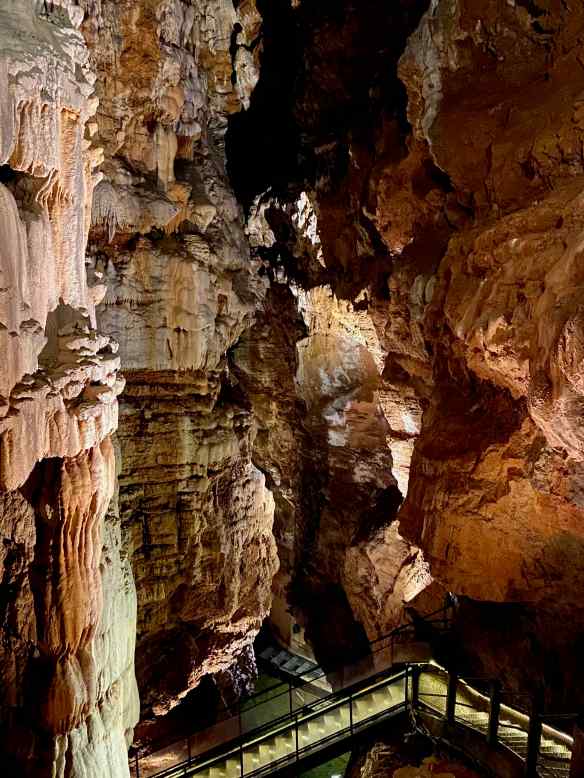
We need to descend way down there!

We continue to walk by so many rock formations…I have run out of words to describe how amazing they are.  Édouar-Alfred Martel, the discoverer of this cave said that these are “Marvellous areas that can only be lived in by fairies.”     

We need to go way down to where that light is.

Finally we can see the dock for our return boat ride.

But first we still pass by even more formations.  The roof on the bottom right protects us from water drops as we walk past this one.

All too soon we are back at the boats.  Honestly, I would have been happy to just turn around and trace our steps a second time…but there are no washrooms down here!  This boat just arriving is the one we take on our return journey.

We sit right at the front, so we will have a great view of the Grande Pendeloque (Great Chandelier) which is a 60-m-long series of calcite formations that seems to hang in the air above our heads, but no photos are allowed on the boat trip.

We reluctantly make our way back to the exit.  One last photo in the cave.
We decide to take the elevators back up to the surface from here.  We are going to visit Rocamadour this afternoon and it also has lots of steps.

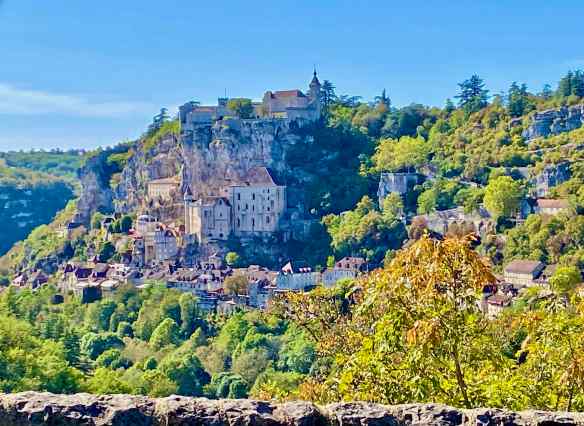
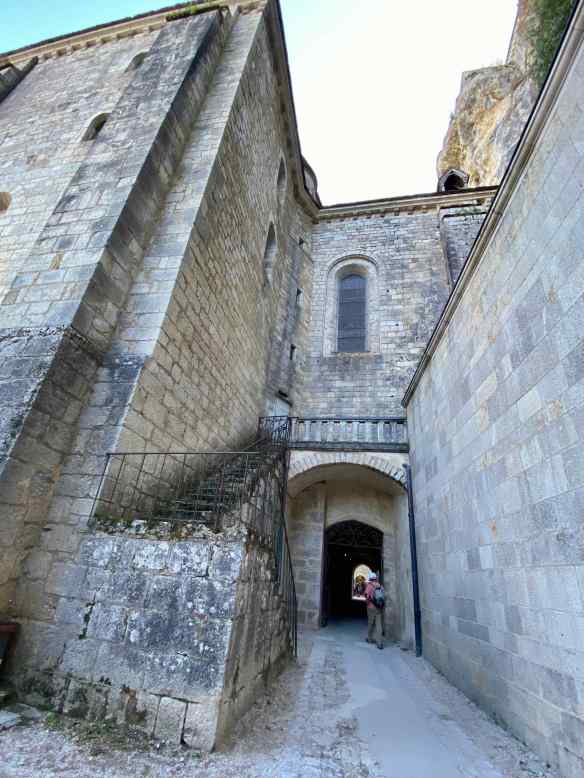
It is less than a half hour drive to Rocamadour, which is a famous pilgrimage site and a  UNESCO World Heritage site.  It takes a while to figure out where to park but we finally find spot near the top rather than the bottom of this cliffside village. This it our view while having lunch.

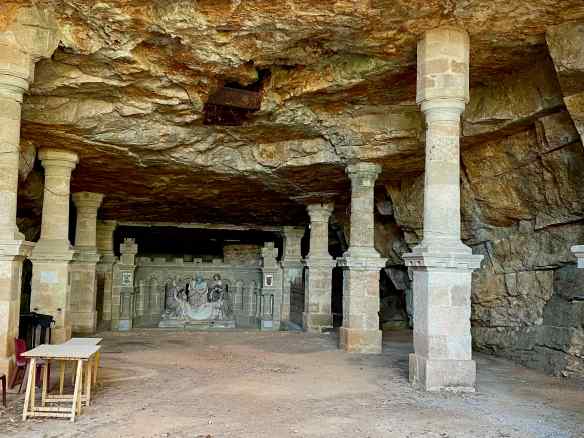
We are disappointed to discover that the ramparts are closed for restoration.  We were looking forward to the views from the ramparts,  so we start on our way down towards the church and chapels.  Part way down the winding path, this cave marks the end of the Stations Of The Cross.  Turns out we are starting at the end instead of the beginning.  

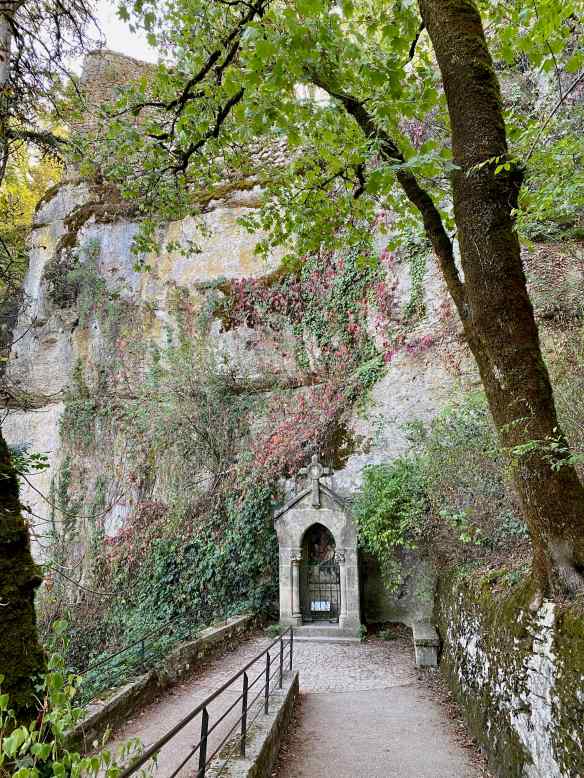
One of the fourteen Station of the Cross.

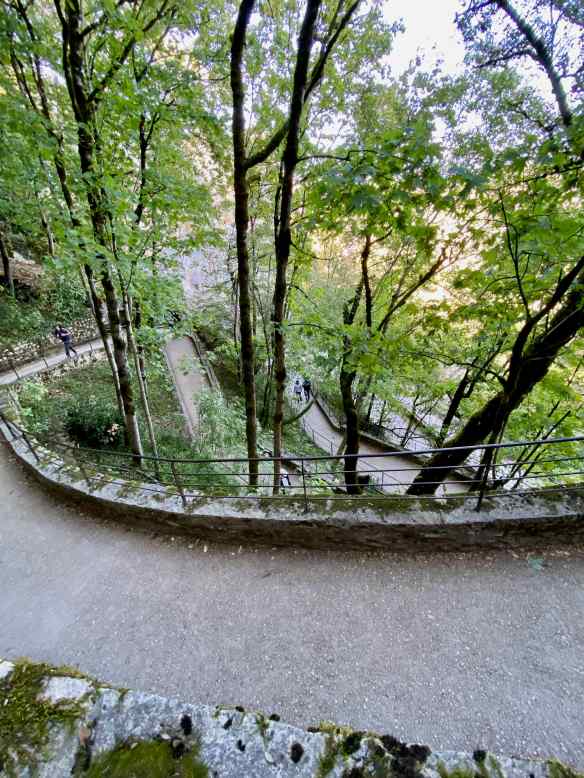
I did mention that it was a winding path, and fairly steep.

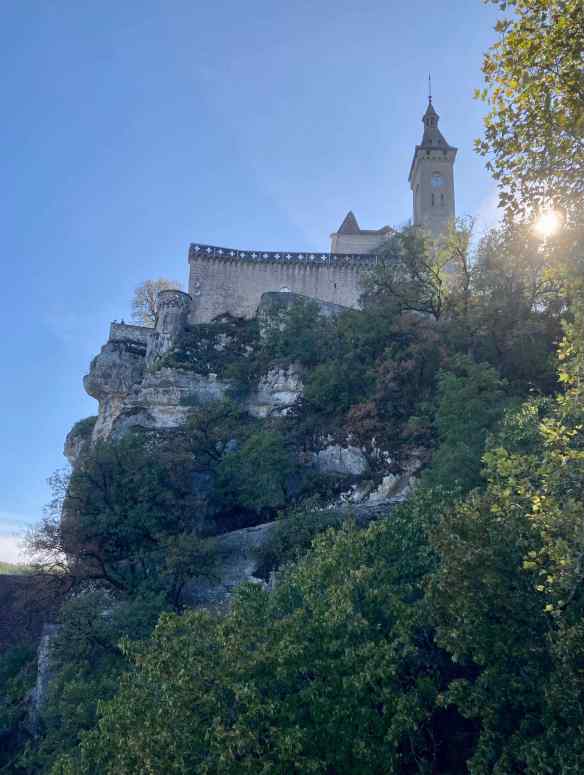
Looking up towards the ramparts, with the afternoon sun looking low in the sky because of the steep angle.

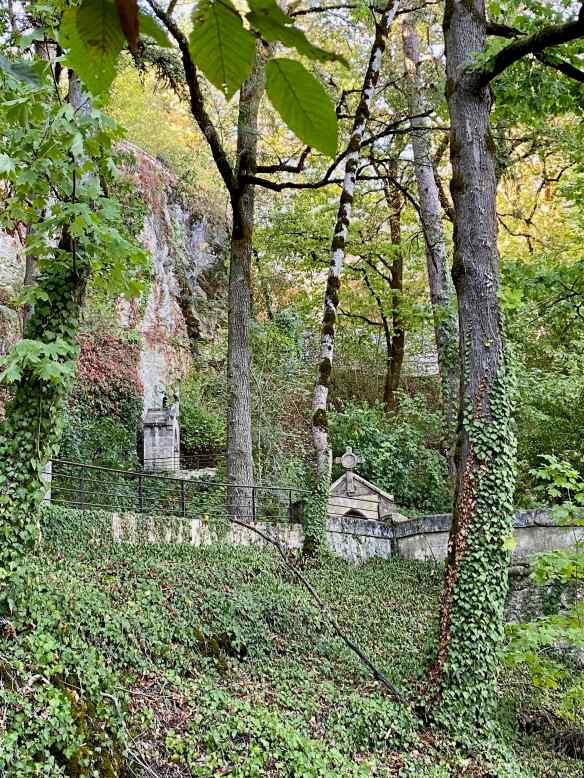
The trees and hillsides are covered with ivy.  The grounds are not terribly well kept here.

Finally we enter the Sanctuary… 

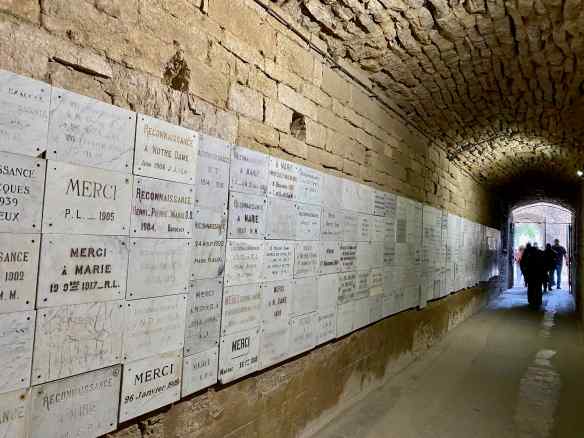
and walk past many plaques engraved with thanks for prayers answered.

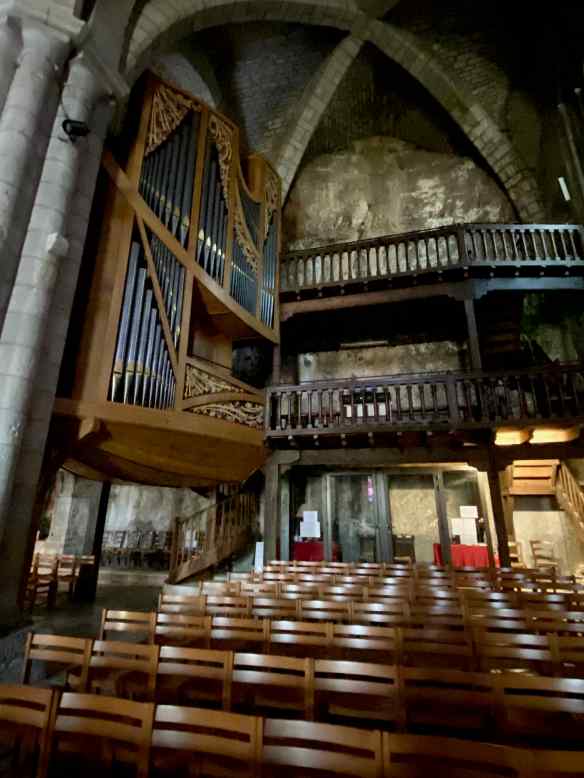
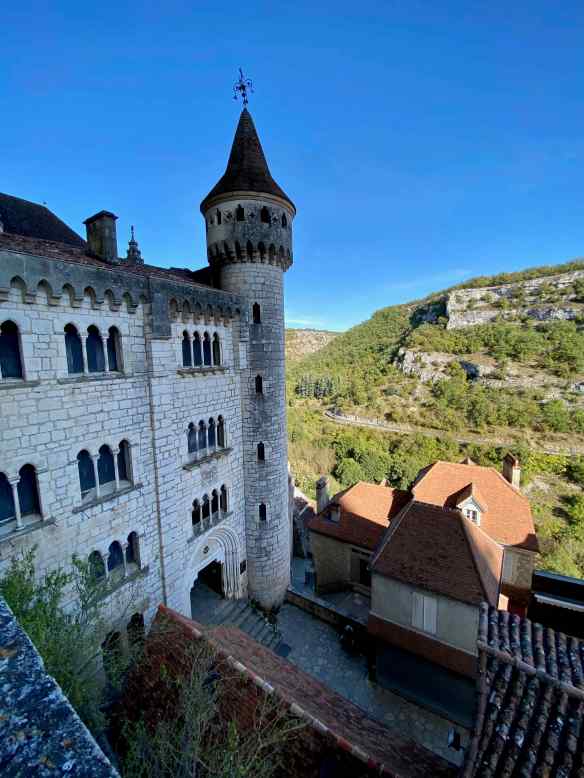
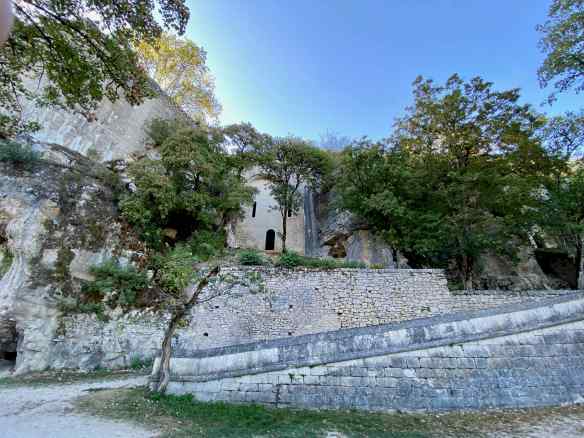
Some of the churches and chapels are built right into the stone cliffs, which are visible in the back of the 850 year old Basilica of St. Saviour.

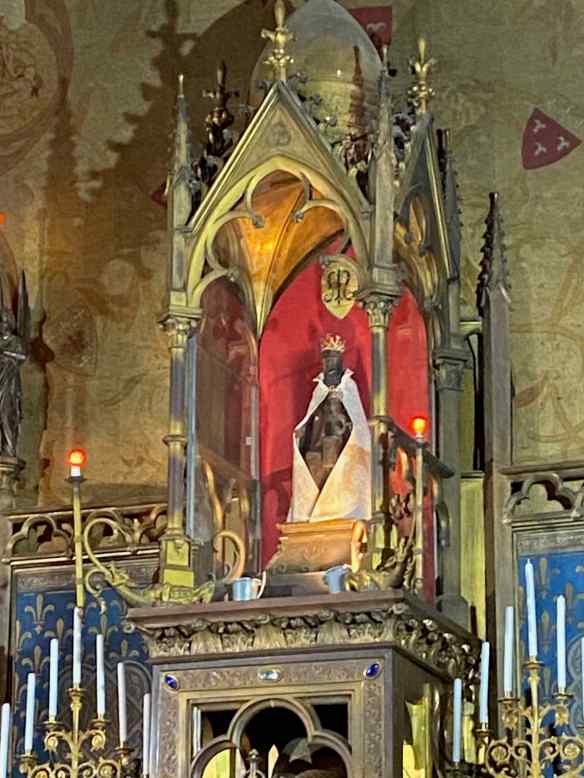
The Black Virgin in the Notre Dame Chapel.  A group has arrived for a private mass so we don’t stay long.  This is the second Black Virgin we have seen on our travels.

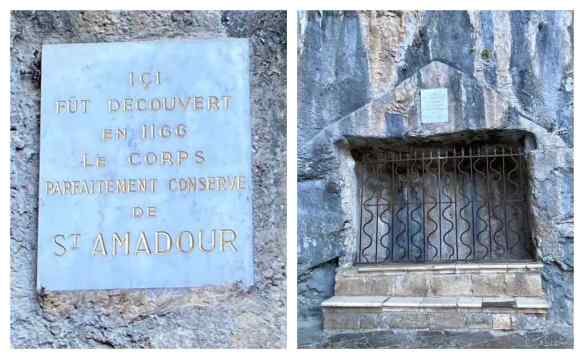
In this spot, in 1166 the perfectly preserved body of an early Christian hermit who died in 418 AD was discovered… St. Amadour.

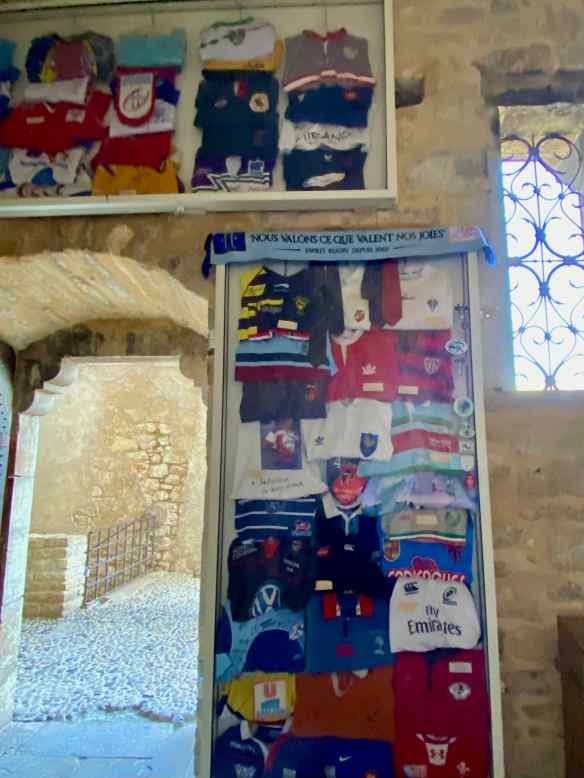
However, there is also a small chapel and a patron saint for Rugby!  We were not expecting that.

A view of the valley from the sanctuary.

We start walking back up the hill to our carpark.  We decided not to go all the way down to the Medieval village at the bottom of Rocamadour.  It now consists of lots of shops selling tourist souvenirs and restaurants.  It has been a long day and we are ready to go home.

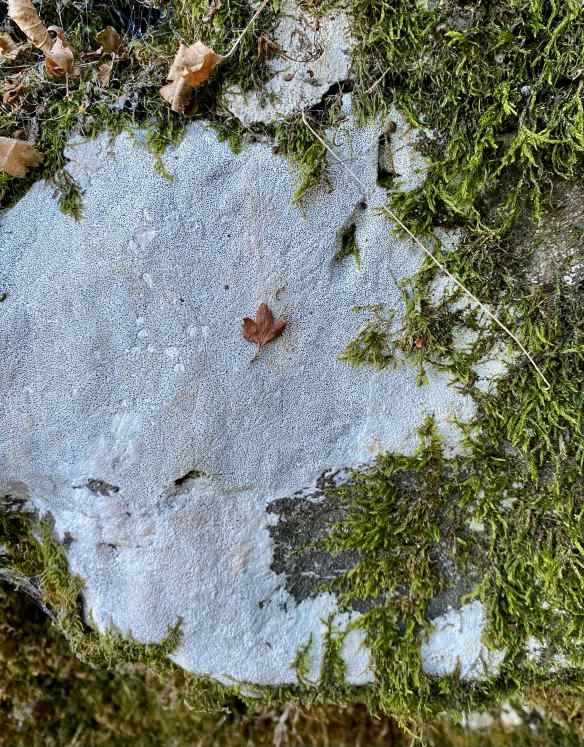
I loved this little red leaf stuck on the side of this rock.

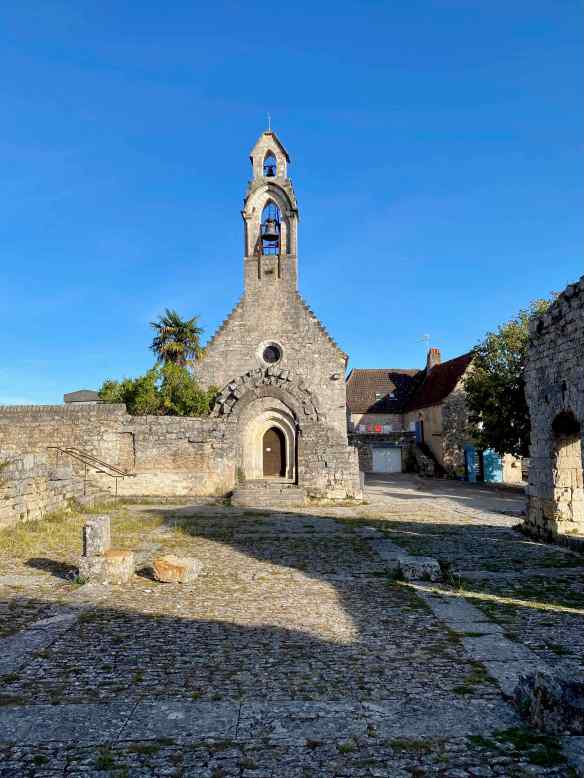
There is a little church in the hamlet of L’Hospitalet on our way to the carpark but it isn’t open so we head home.  We were both a bit underwhelmed by Rocamadour….it didn’t have the presence that we were expecting…although we are not really sure how to explain why.

Sarlat le Canéda, France

Day 36, Tuesday, October 3, 2023

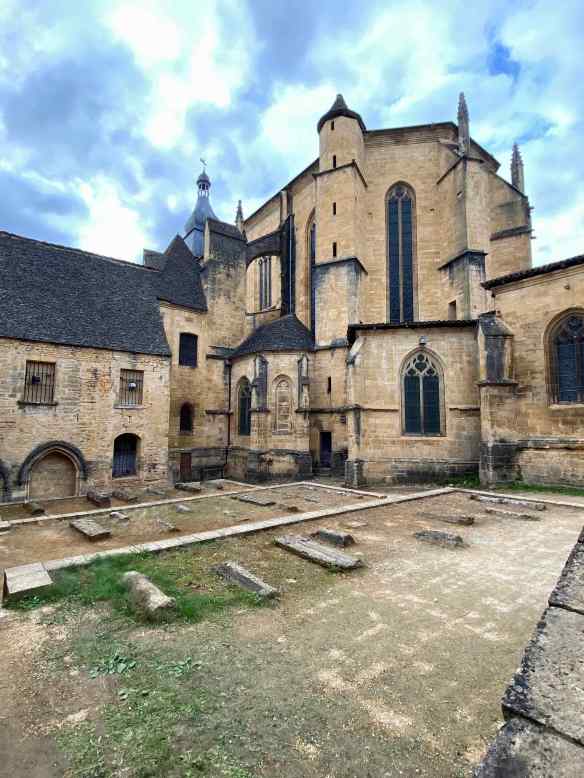
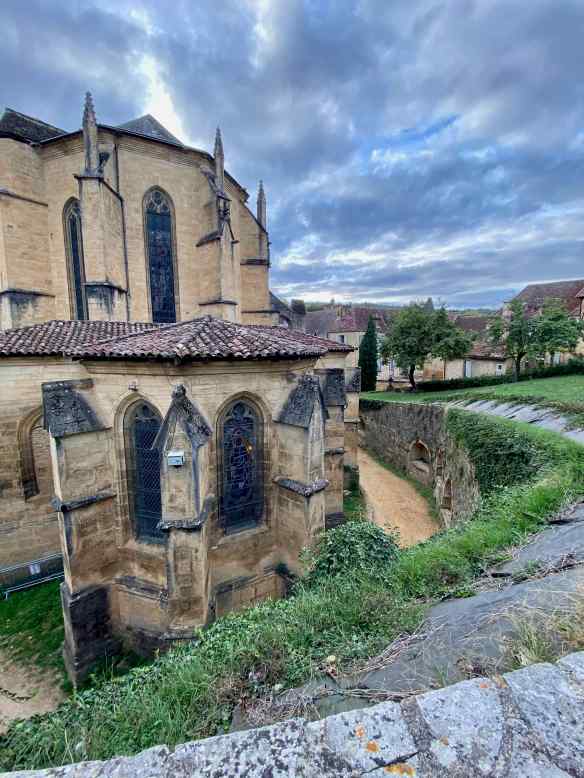
Bob is out early exploring the streets of Sarlat and he comes home to tell me how interesting this medieval town is. We both go out in the afternoon for a walk. Sarlat Cathedral, just around the corner from our apartment is a Roman Catholic church.  It is a national monument and was established in 1317!  We hear its bells chiming several times a day. It is a nice wake up call at 7:05 am when the bells chime for several minutes.  The ringing of the bells at 7:05 am and 7:05 pm each day is called “Angelus,” and that it is an ancient pattern of bell-ringing that is a call to prayer for Catholics to pray a particular prayer.  This is the back of the church, with several ancient sarcophagi, which I discovered is the plural form of sarcophagus.

We climb the steps behind the church and I notice a light shining through the stained glass window, although the church is closed at the moment.

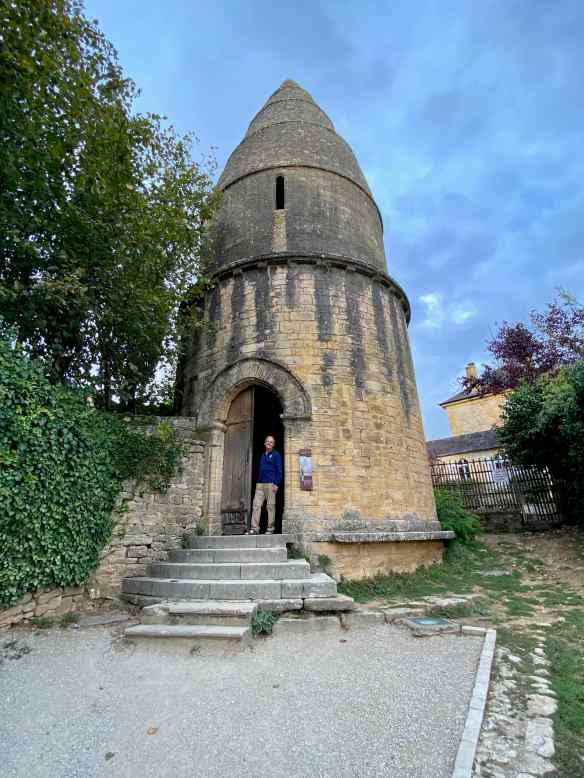
At the top of the steps behind the church we find this Lanterne des Mortes, which means Lantern of the Dead. Lanternes des Mortes are small stone towers. “Pierced with small openings at the top, a light was exhibited at night to indicate the position of a cemetery, hospital, or leper colony. These lanterns were originally constructed to warn passers-by of the danger of infection, as well as to illuminate cemeteries where it was feared that repenting souls, ghosts, and criminals could hide. Later, they were also erected at the intersections of important routes and roads.”  ~Wikipedia

Bob checks it out but there are no repenting souls, ghosts or criminals about.

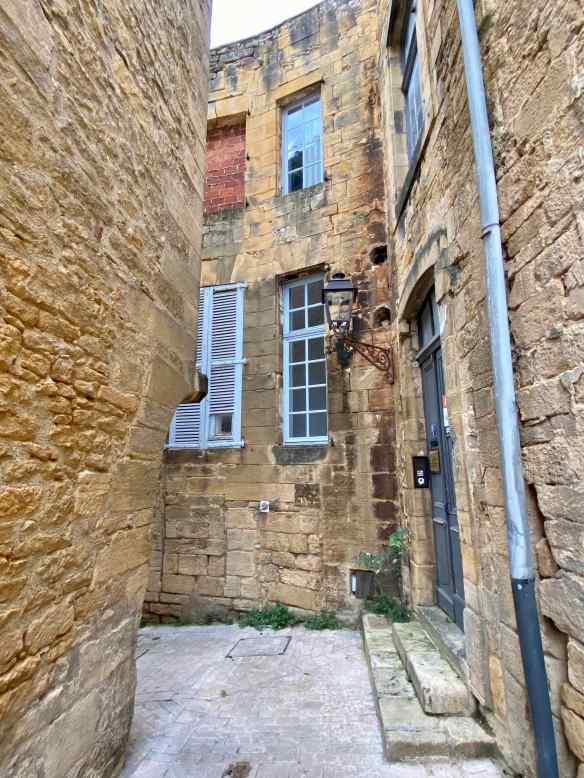
We continue to explore the old narrow streets.

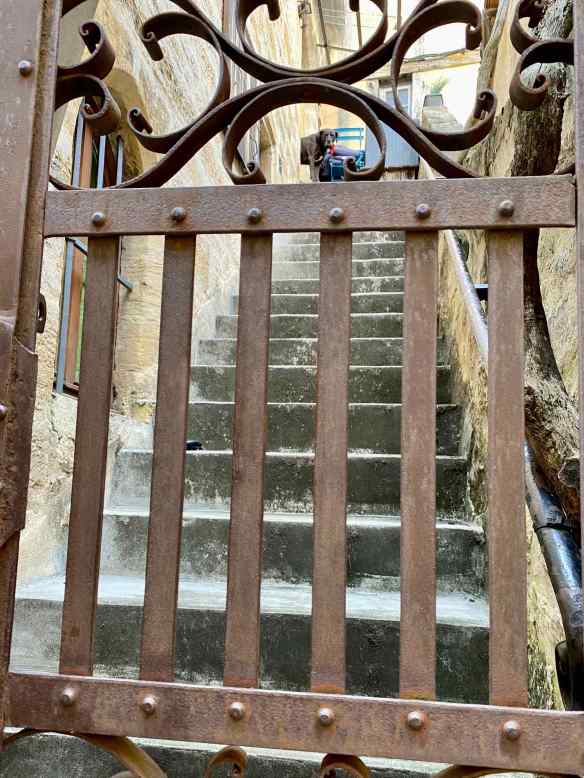
This very large dog just quietly watched us peek through the gate, even when I called to him he didn’t move a muscle.

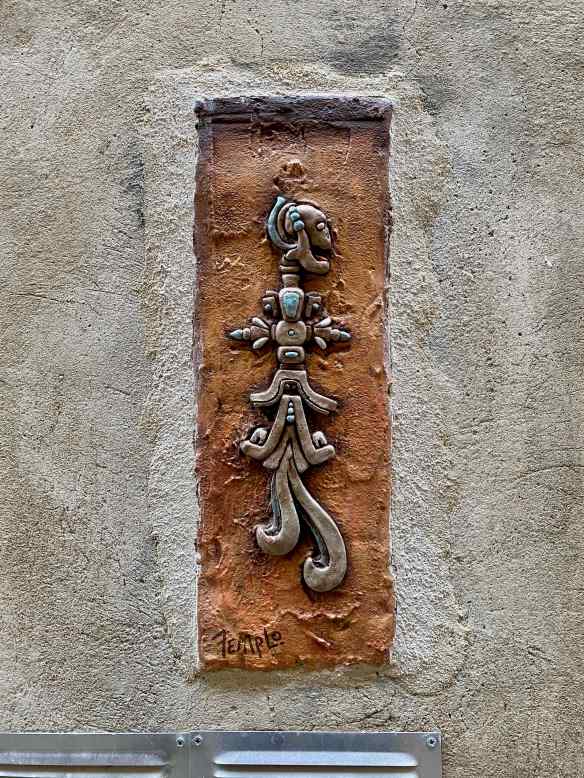
Someone cemented a little piece of art onto the wall on one of the side streets. It makes me smile.

Everywhere we look the old buildings are crammed together, often one on top of another up the hillsides.  This one looks a bit castle like.

This charming little stained glass room is on the roof of the Présidial, which was built in the17th century.  At the time it was a sort of Court House where a Royal Officer would hear complaints and make rulings.  

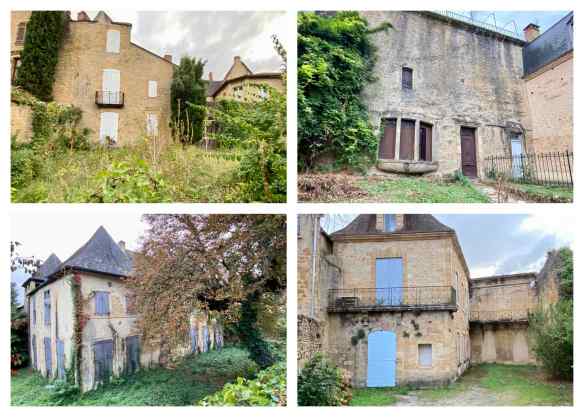
I have mentioned that I love peeking in windows and courtyards whenever it is possible.  I don’t think this is being renovated, it just sits empty.  

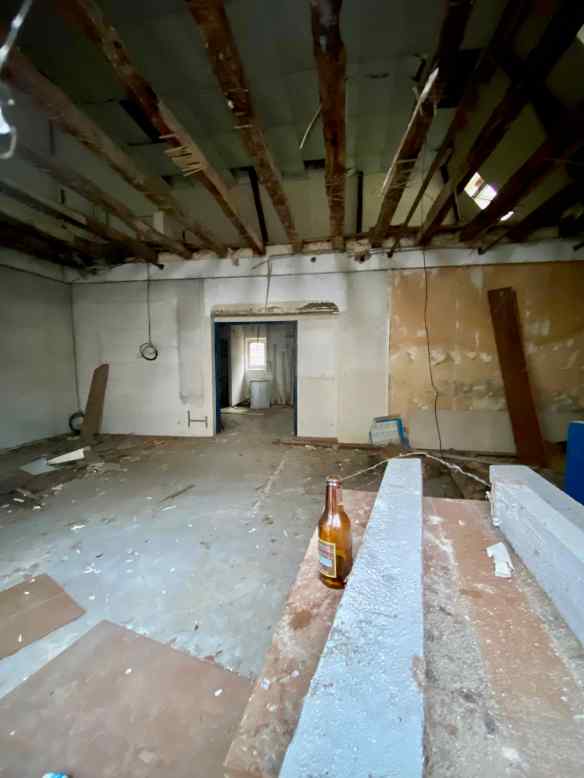
A block or so away a renovation is definitely taking place. there even was a box with old dishes sitting on the sidewalk, free for the taking.

There are so many old houses boarded up and for sale.  I think we could probably buy one quite reasonably, but the renovations would be terribly expensive. If they are historic buildings, which they probably are, there are many restrictions on what renovations are able to be done and how they are done.  Guess we will pass on owning a little piece of Sarlat.

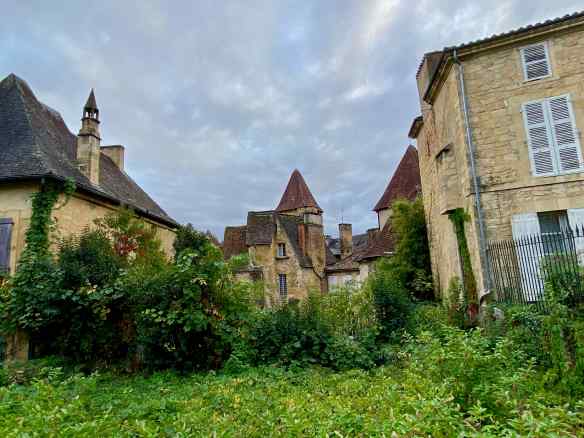
Most of the yards in this area are very overgrown and unkept.  Tidy gardens are not the norm here.

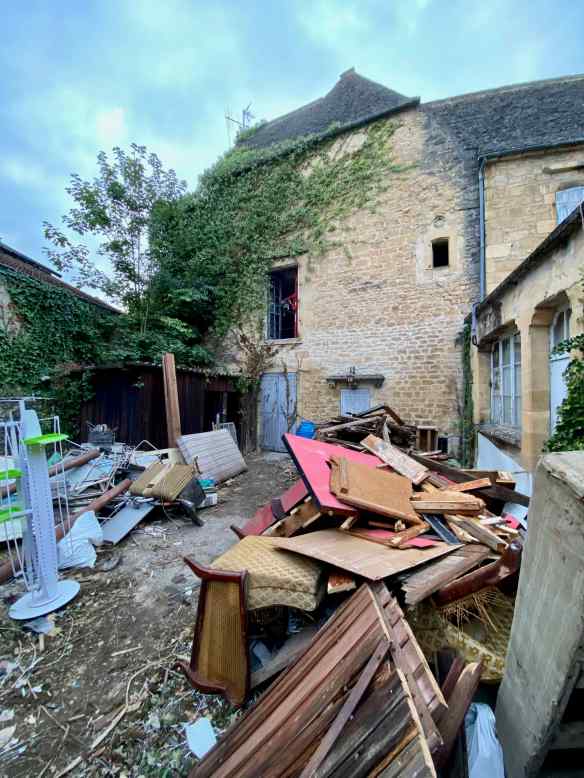
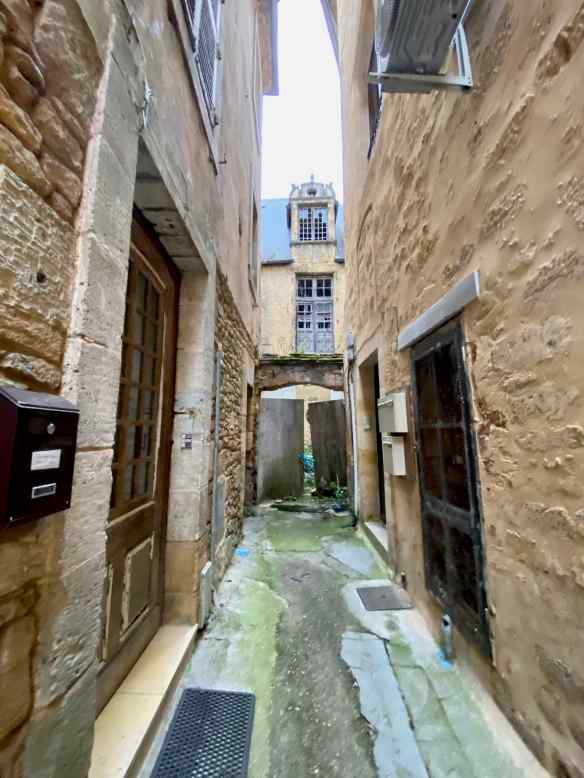
This narrow street ends in an abandoned overgrown yard and building with a lot of ‘stuff’ lying about.  Kind of creepy but just before the broken gate leading to this are doorways to apartments with new mailboxes and doors.  I wouldn’t want to be walking home at night here.

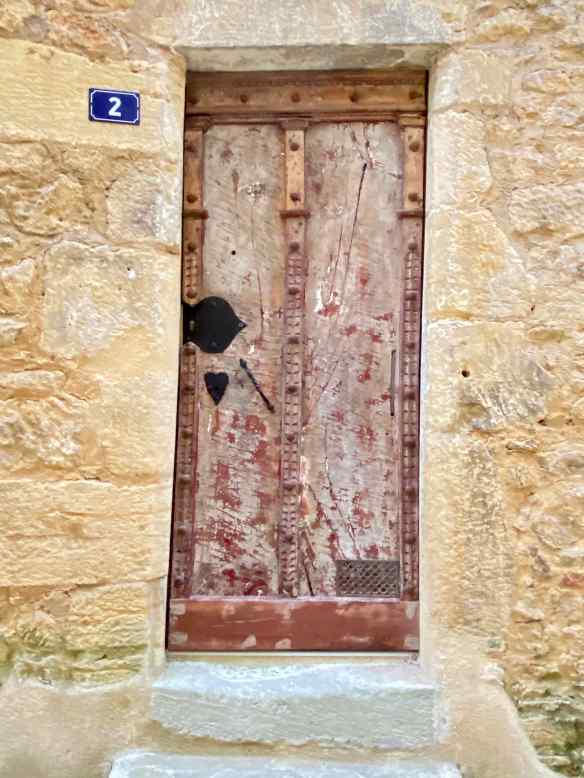
I don’t know what it is about French doors, but so many of them are very very old, and have peeling paint like this one.  But notice, it has nice new hardware…just not a new paint job.  There seems to be some sort of pride in having a very ancient looking door.

I forgot to take a daytime photo from our apartment window but this is the view when it is dark.