Day 37 Monday, October 6, 2025
On our drive to Stuttgart we stop at Worms, Germany. Worms is pronounced Vurmz. We passed through this huge gate on the bridge over the Rhine River.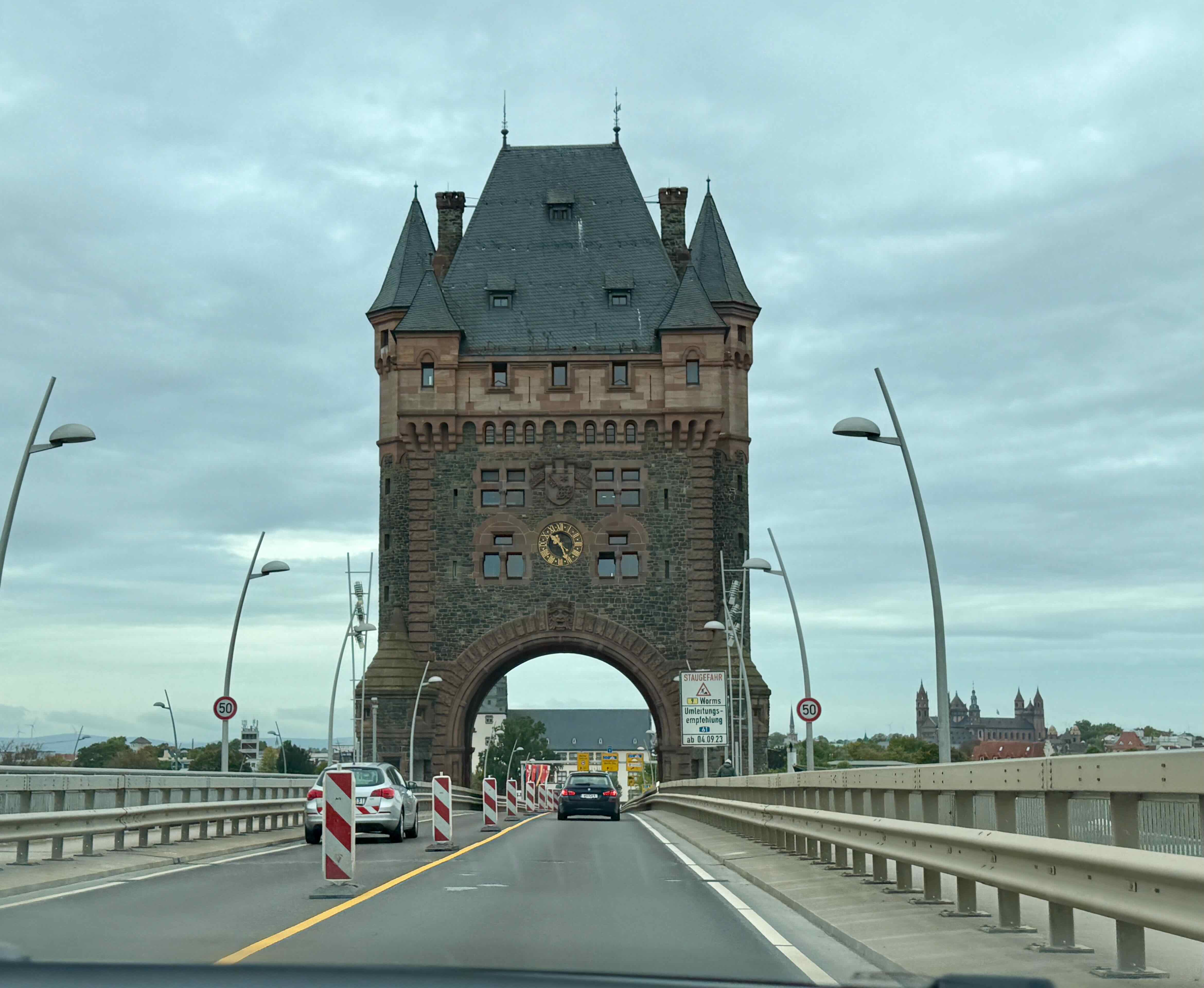
We find a place to park on the street but have to move to a parkade because the street machine won’t take our euros…big surprise! St Peter’s Cathedral is our first stop but we can’t find the door to get inside! 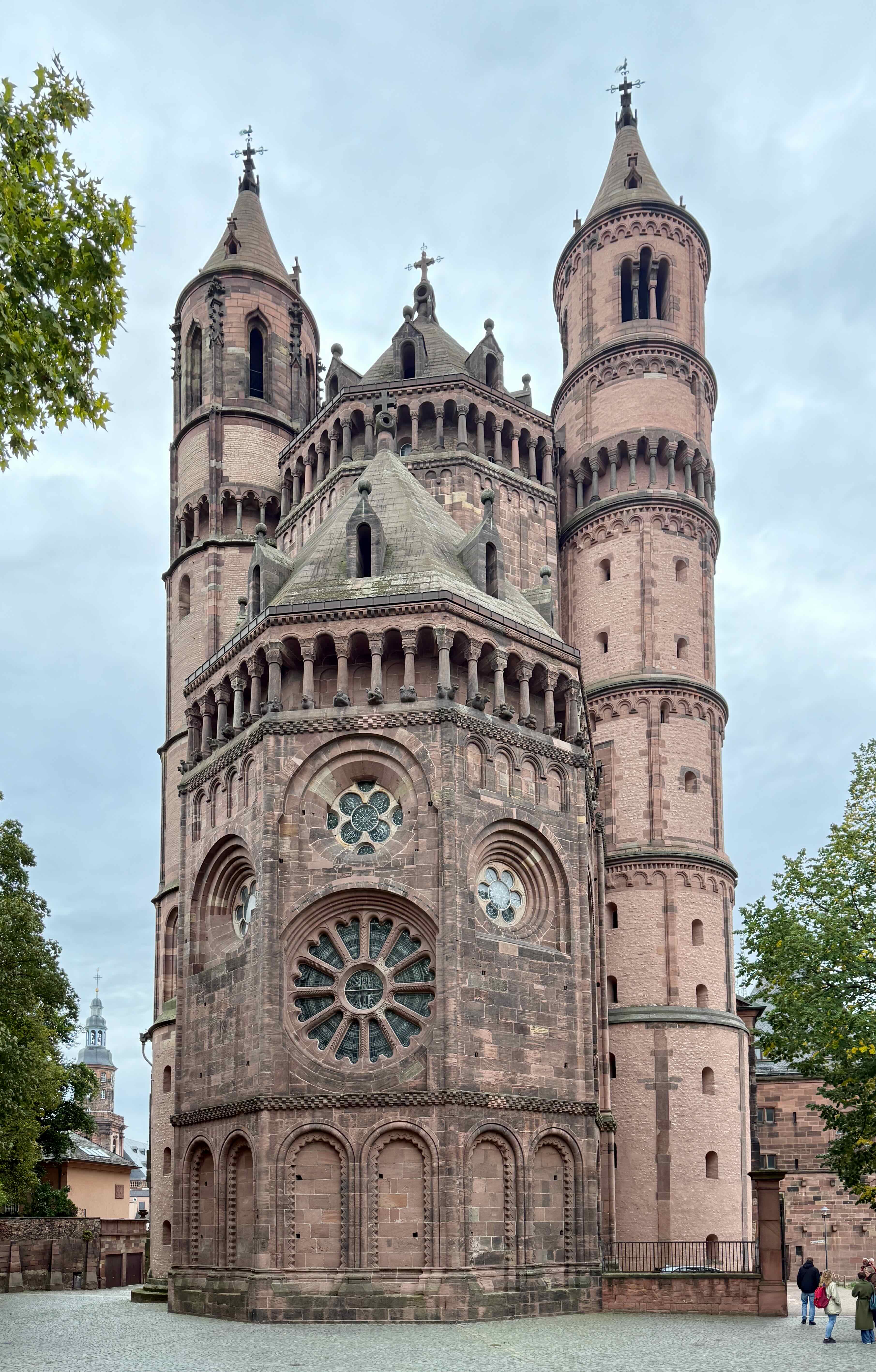
In our walk around the church I see steps leading into what looked like a private area, but I take a look anyways and it is actually a public garden so we go inside. When I see something like this I am so curious. I wonder what it is, why it is there and where does it lead to? 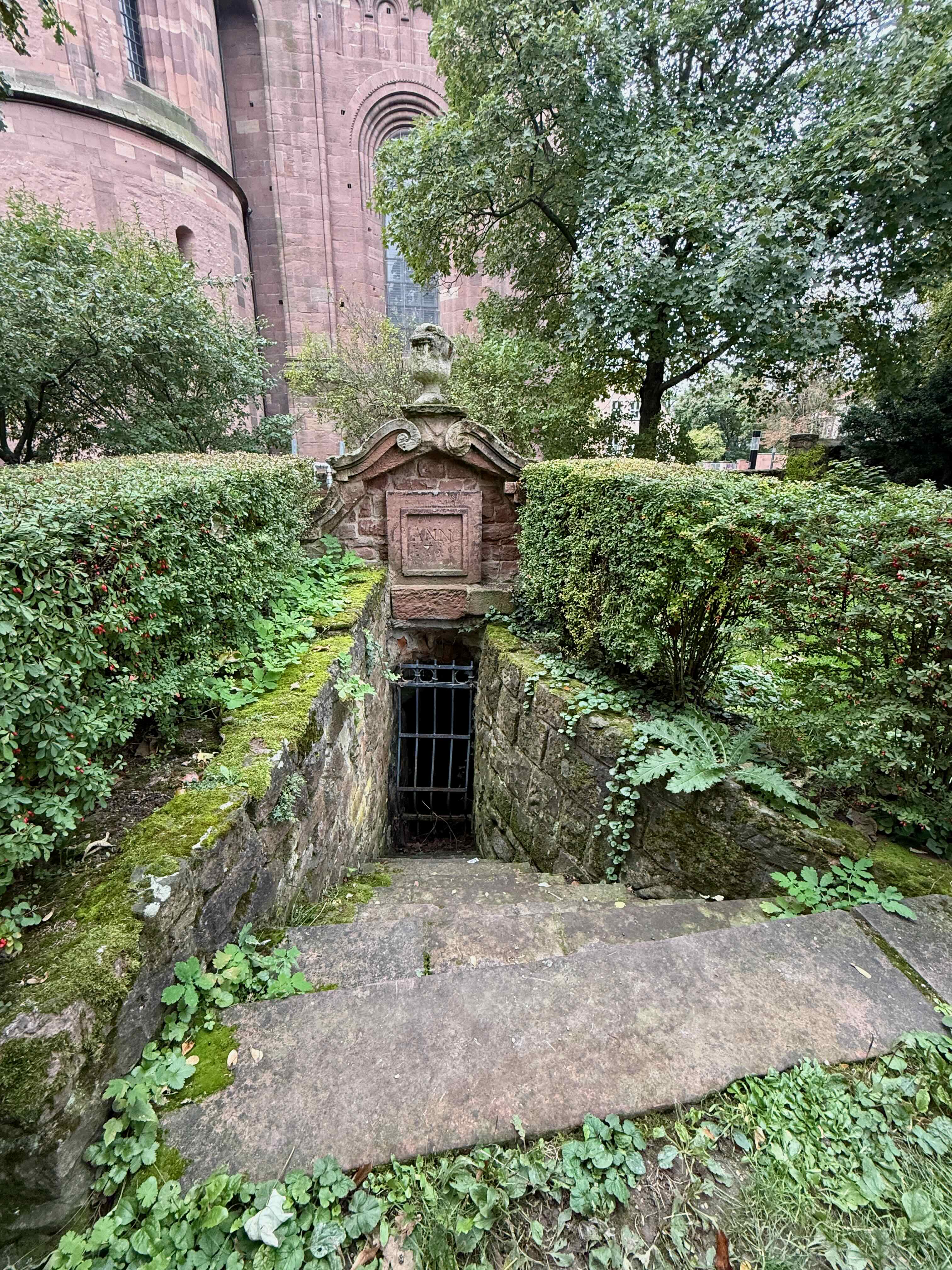
Turns out this garden marks the location where Martin Luther refused to recant his beliefs at the Diet of Worms in 1521. This was the beginning of the Protestant Church and its split from the Catholic Church. These large bronze shoes in Worms’ Heylshof Park shoes are part of a 2017 memorial sculpture, which allows visitors to symbolically “step into Luther’s shoes” at the spot where he stood and defended his doctrines.
A ‘Diet’ was an assembly or meeting of authorities to make decisions on important matters. The Diet of Worms of 1521 was convened to determine how political and religious authorities should respond to Martin Luther’s teachings. Because the Diet was held in Worms, it is know as the Diet of Worms which still makes me smile because of course I think of eating worms.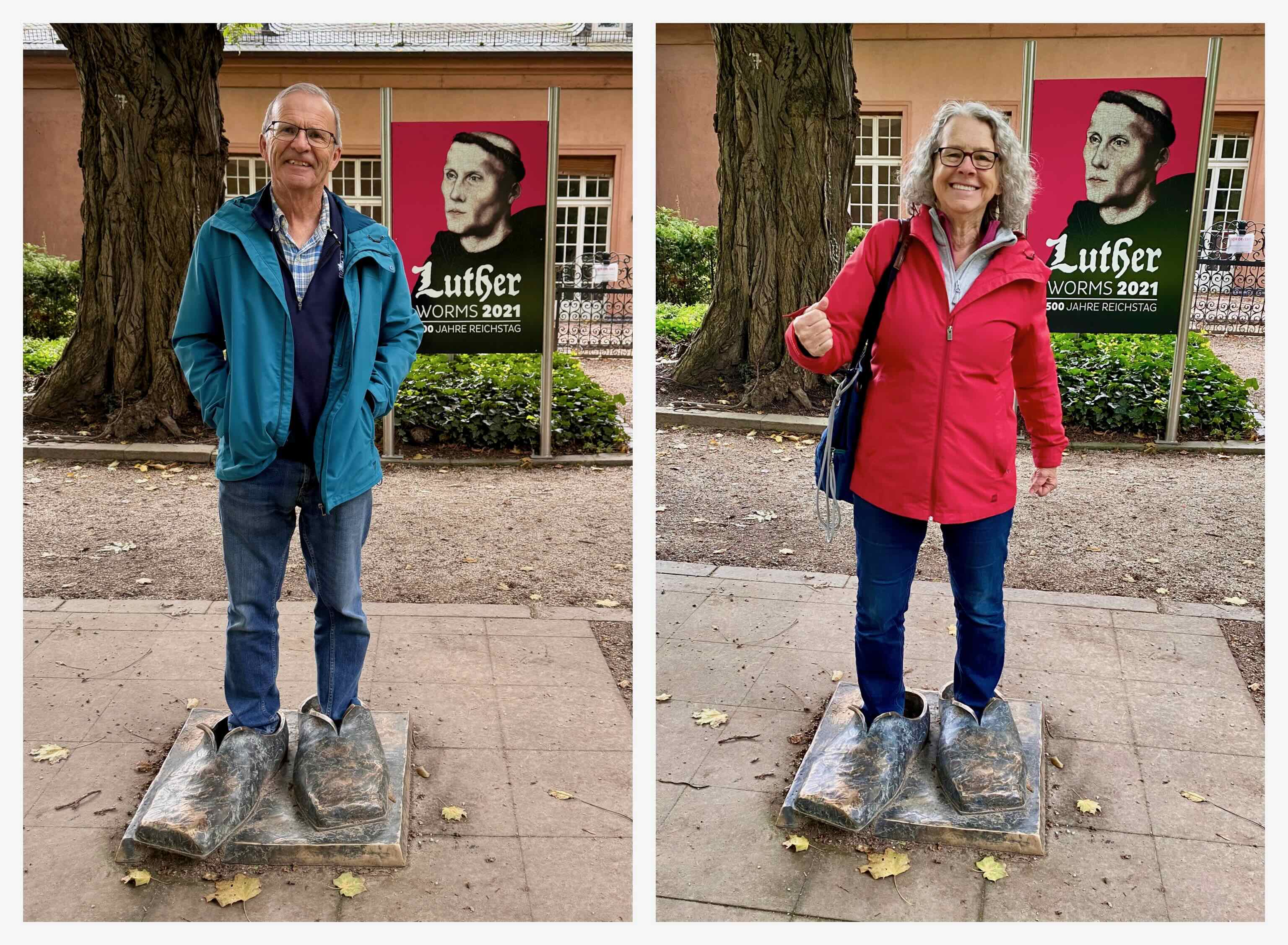
We leave the garden and go back to the church, passing a kindergarten with this colourful mosaic mural.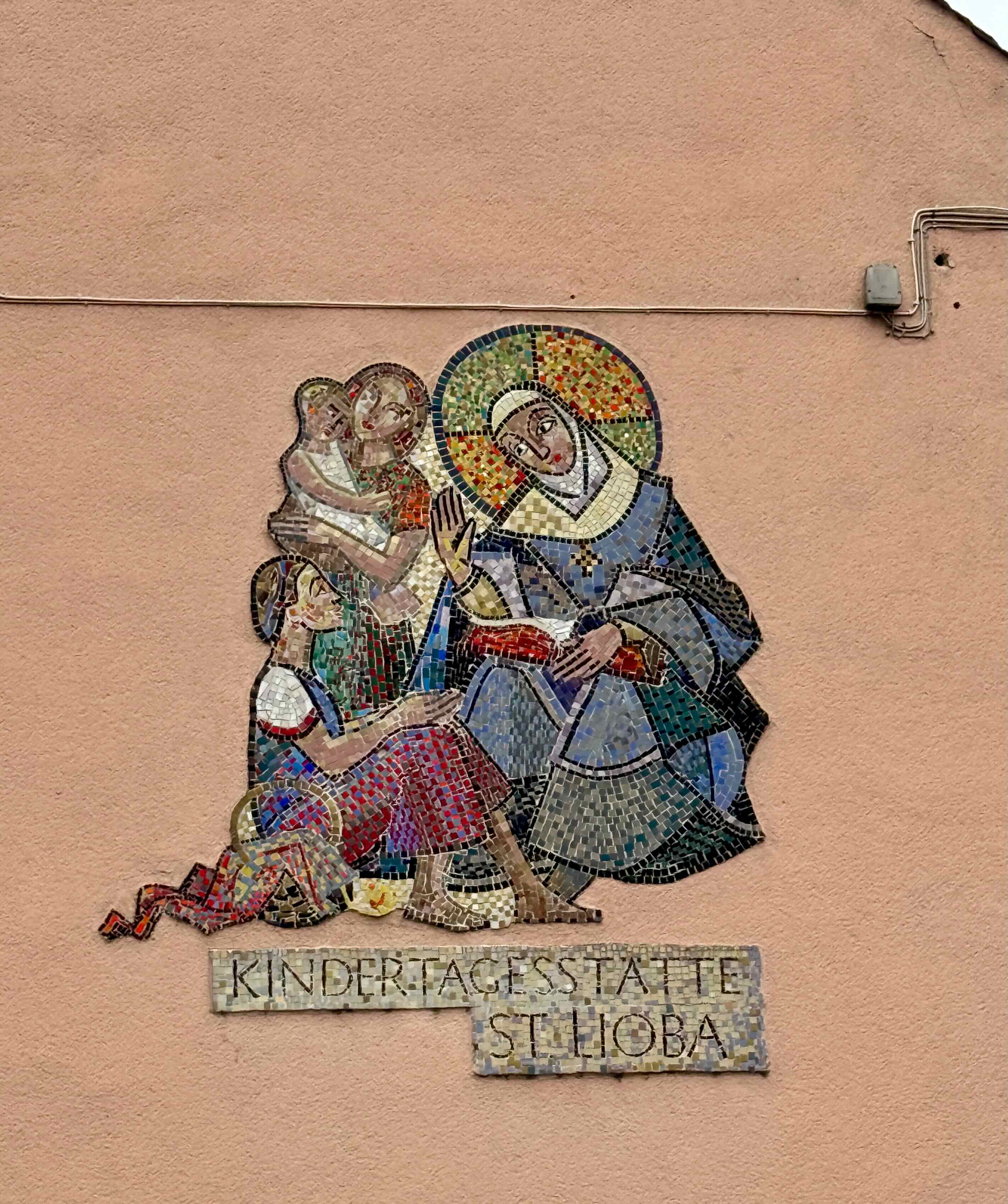
St Peters Cathedral is another cathedral that escaped destruction during the war. Curious, I did a bit of of research and learned that the high belltowers and steeples of cathedrals were used by the Allies as navigational landmarks and that sometimes military planners made conscious efforts to protect major cultural and religious sites. So perhaps not divine intervention after all?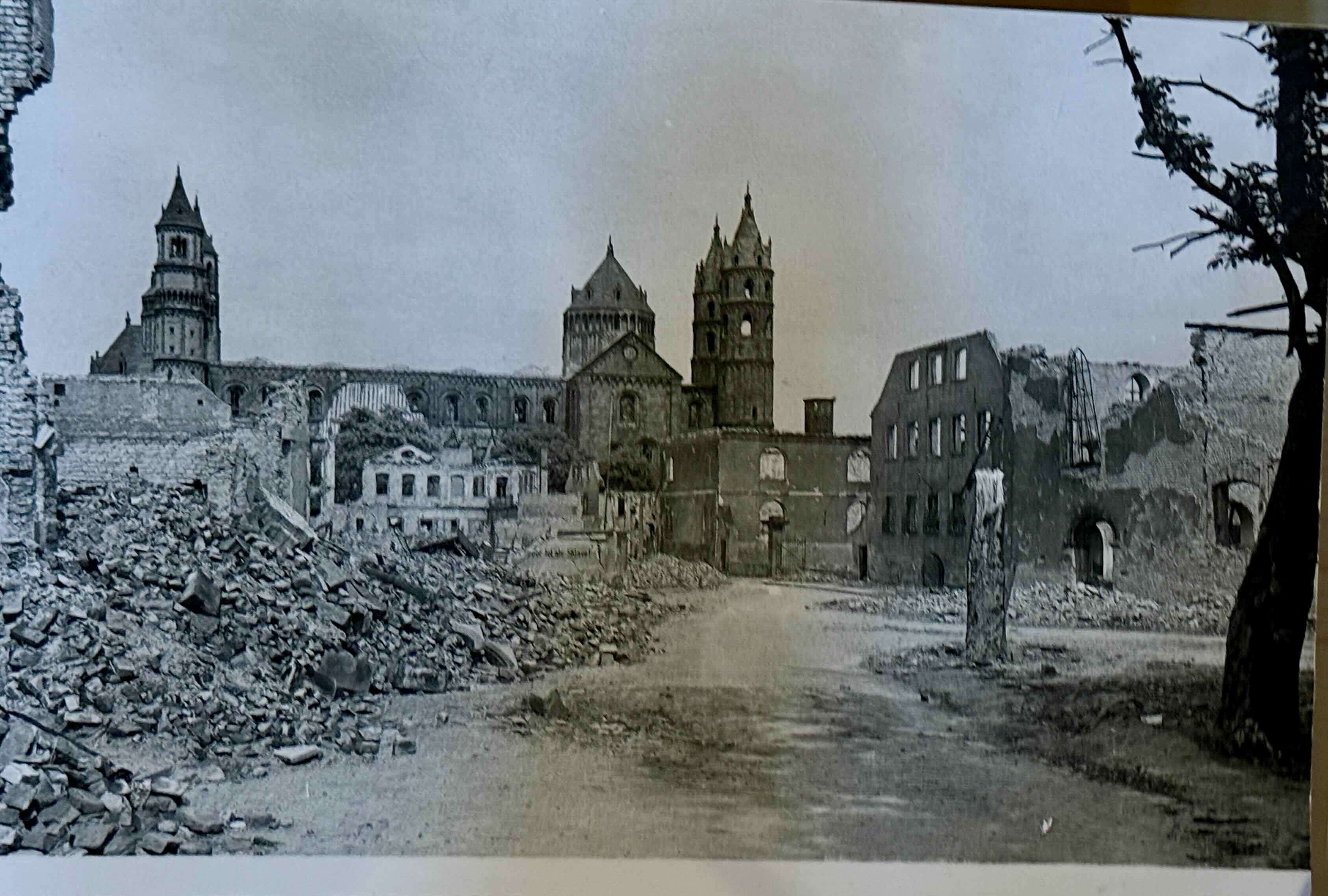
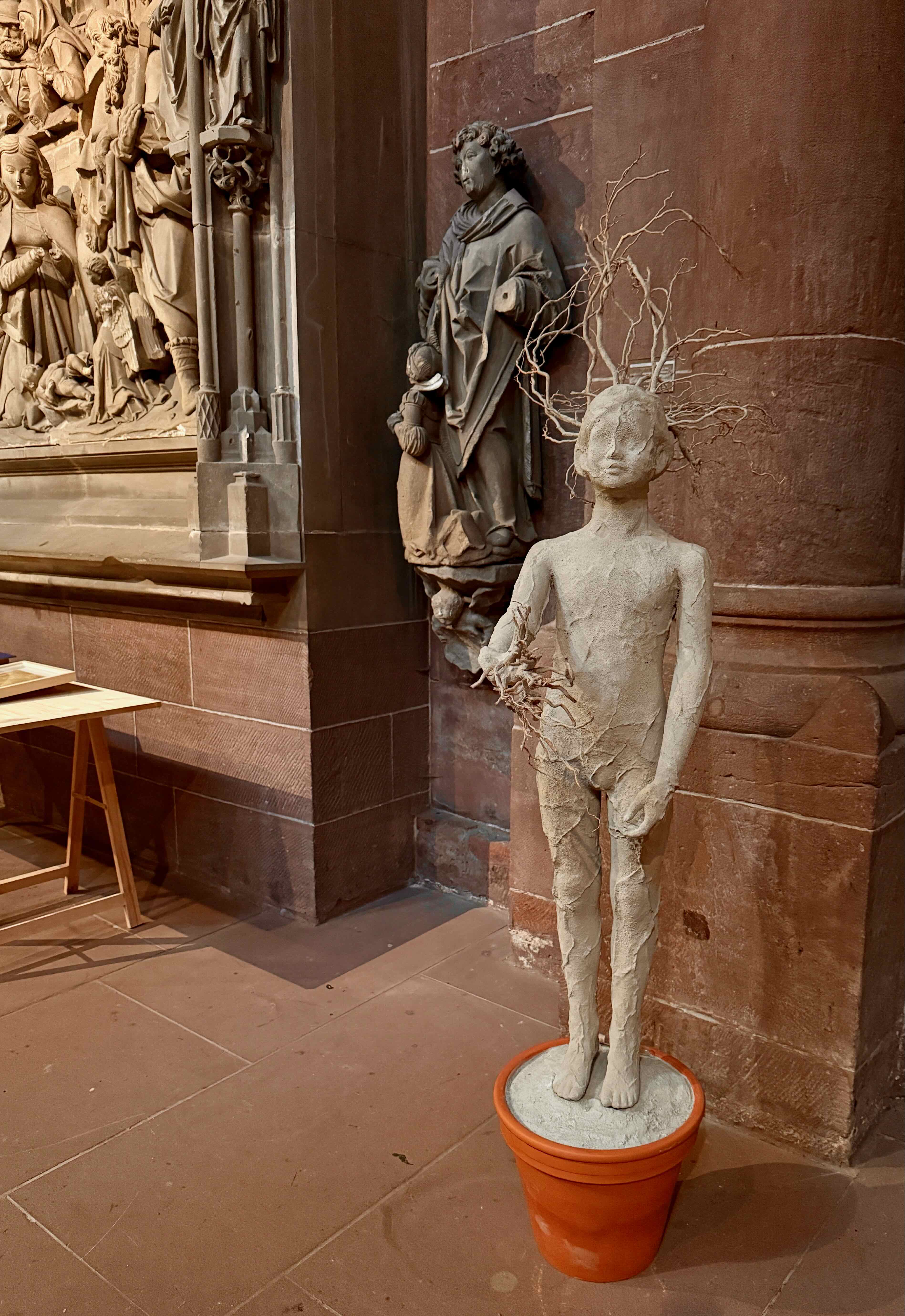
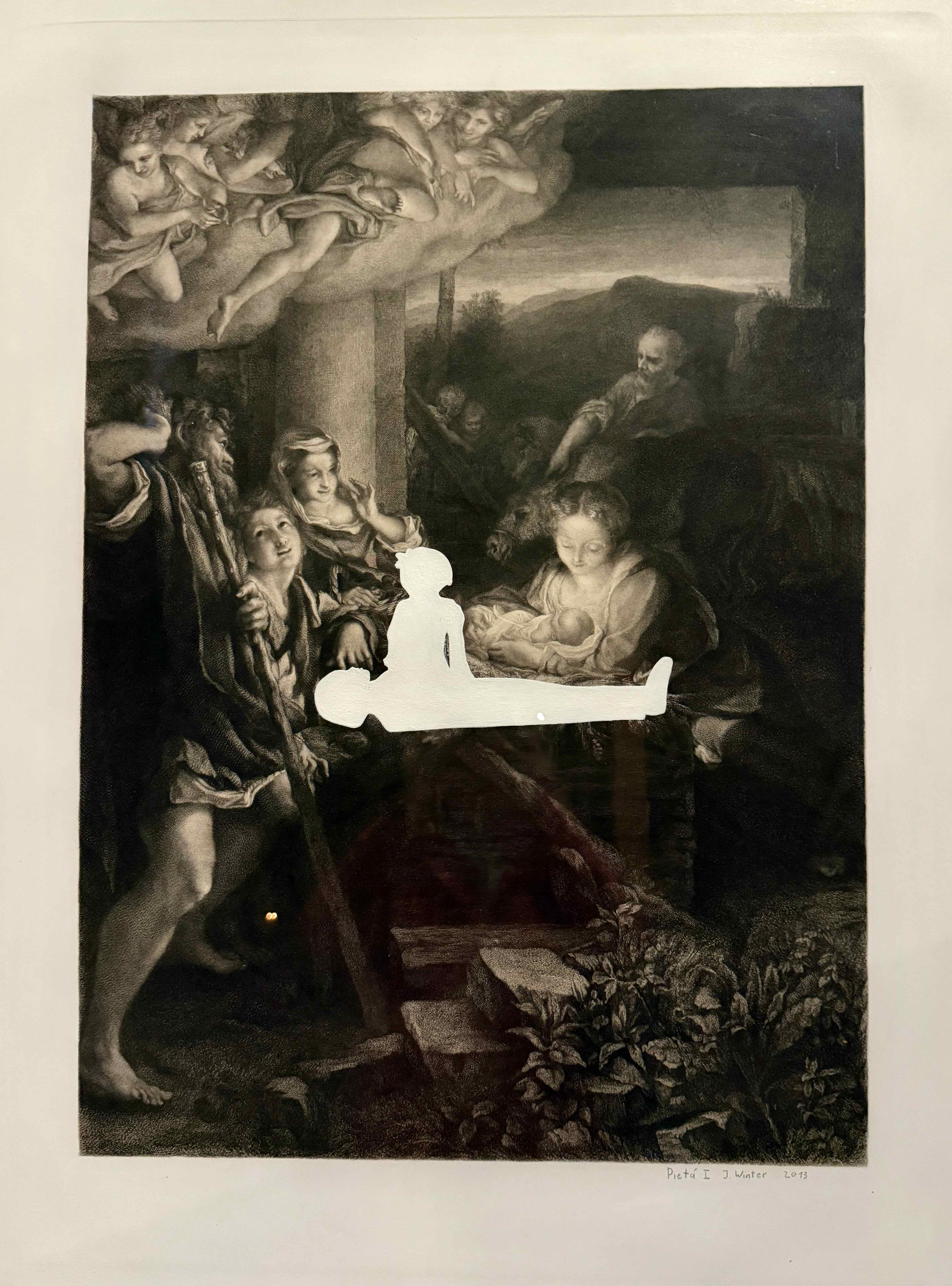
We do finally find small side door that allows us entrance to the church. There is an art display in the cathedral by a group called Atelierblau. There are some really interesting pieces. Unfortunately I couldn’t find the names of the artists or the works they created. Here are a few of them.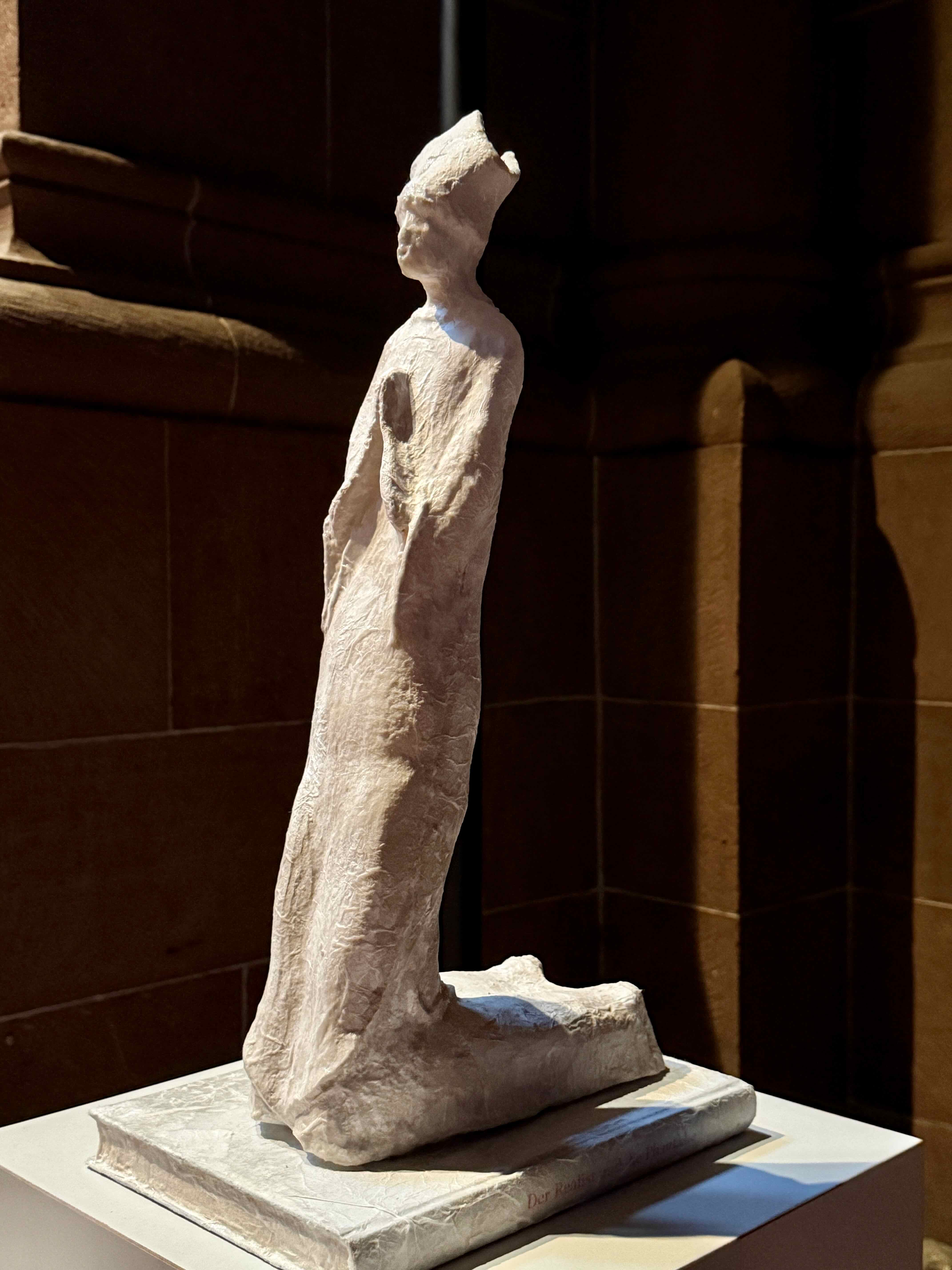
 The sign on the trunk reads “A thousand roses for a thousand lives”.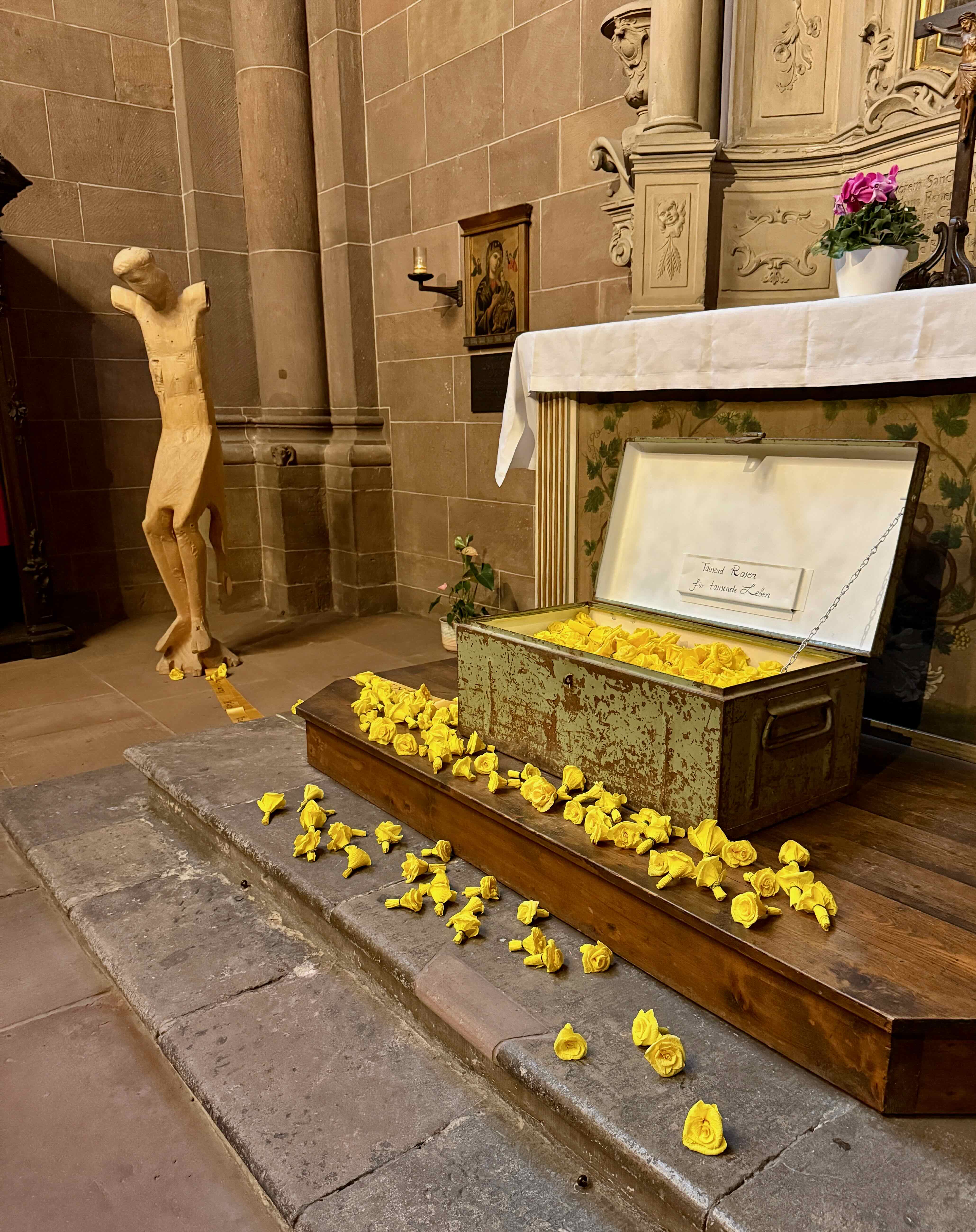
There are several large sculptural pieces that are from the church cloister. I think they were placed inside the church as a method of keeping them safe from damage.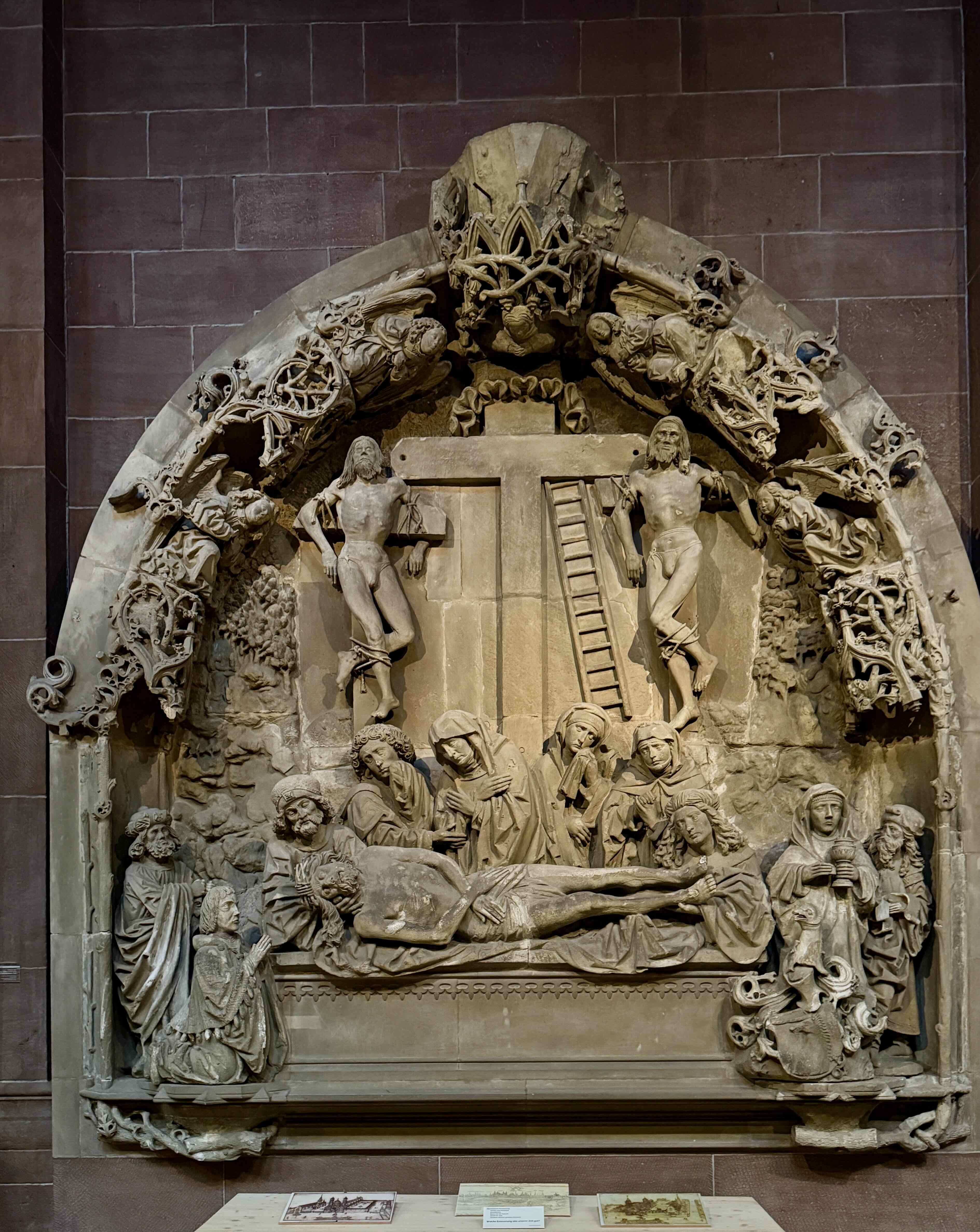
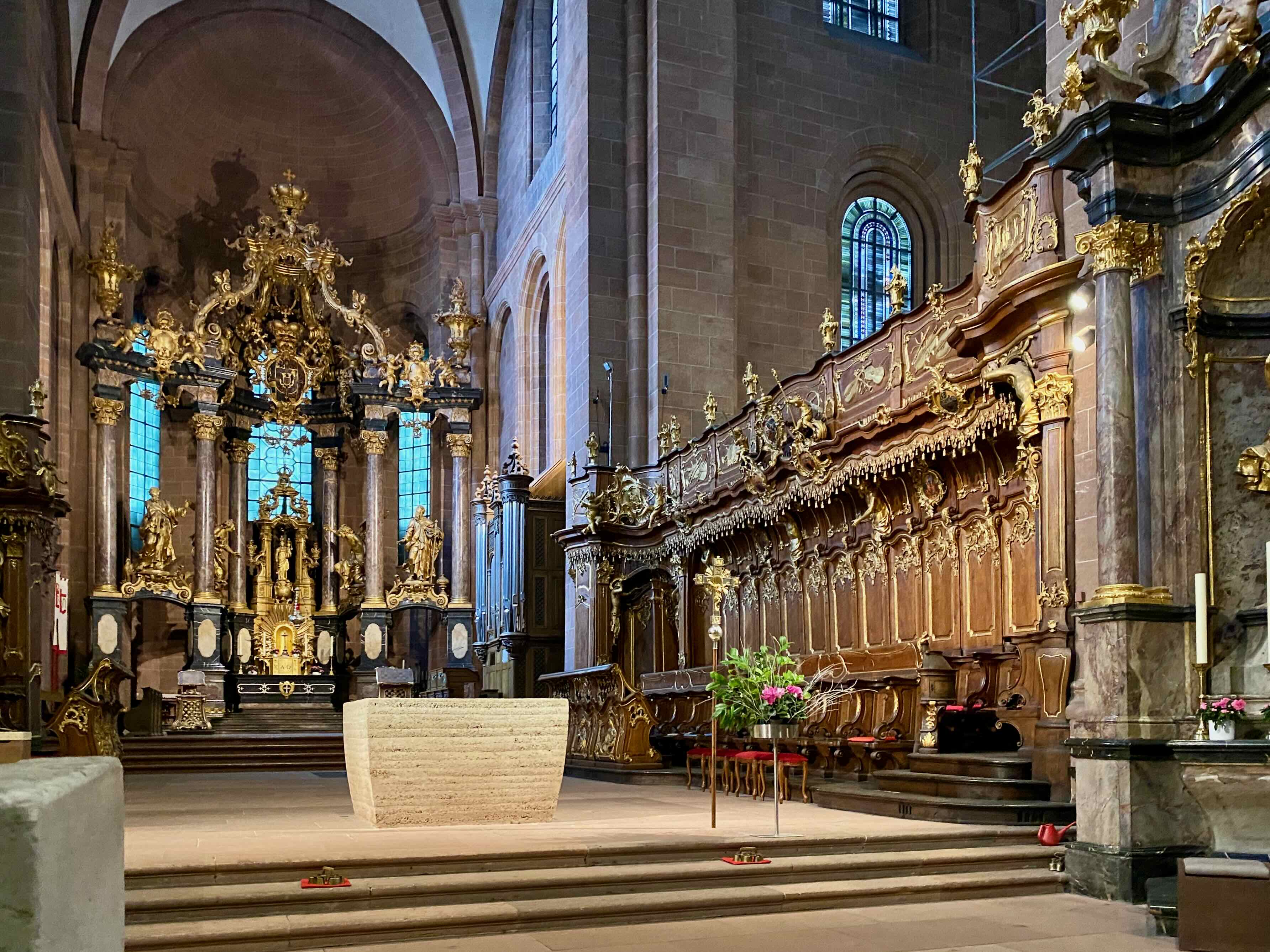
Built with red sandstone between the years 1130 and 1181, the church has a relatively simple interior…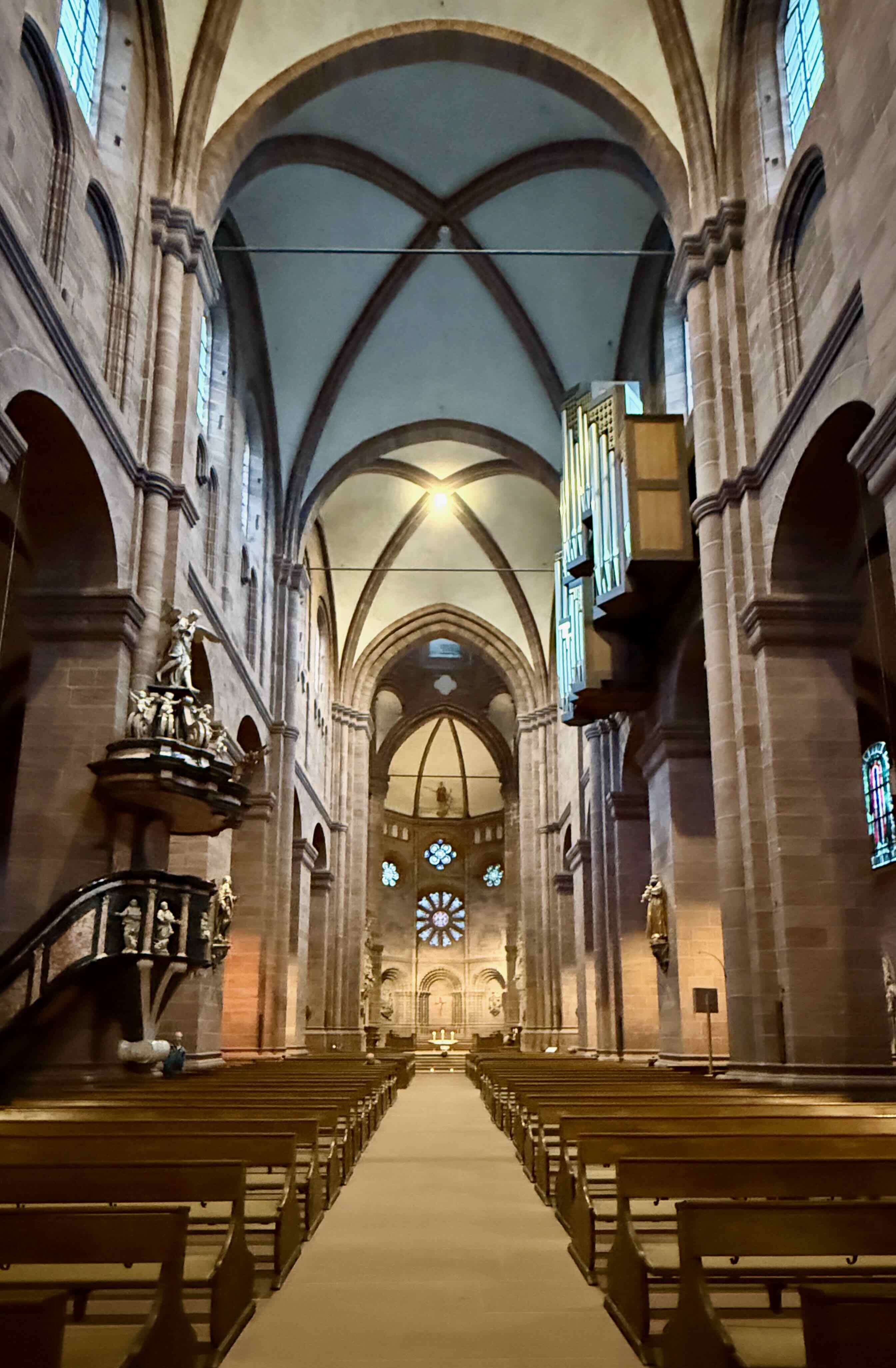 …except for the choir and altar.
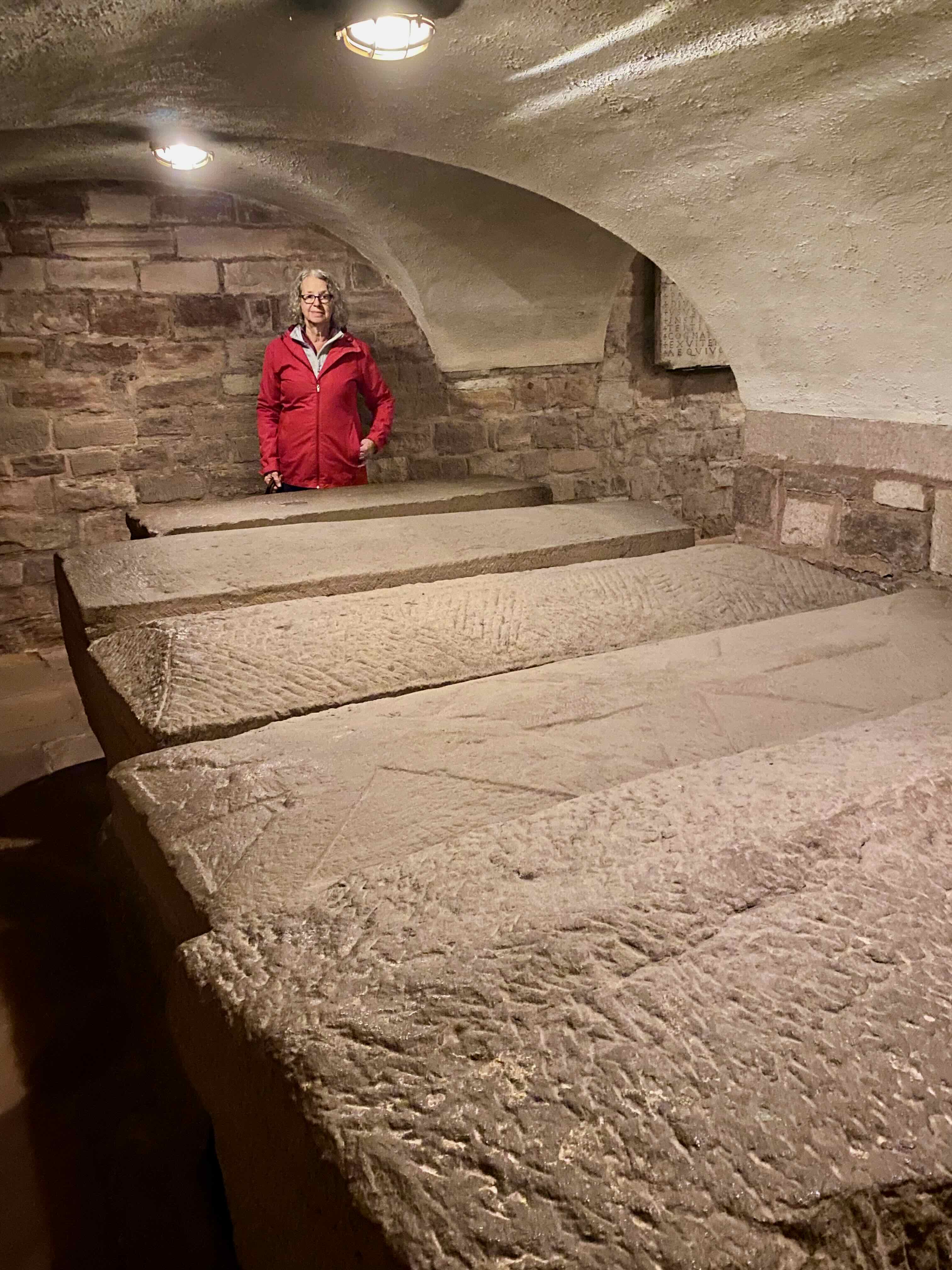
 Bob noticed a side entrance to the crypt which contains the tombs of early rulers from 990 to 1040 AD.
 Outside I see what appears to be ancient graffiti.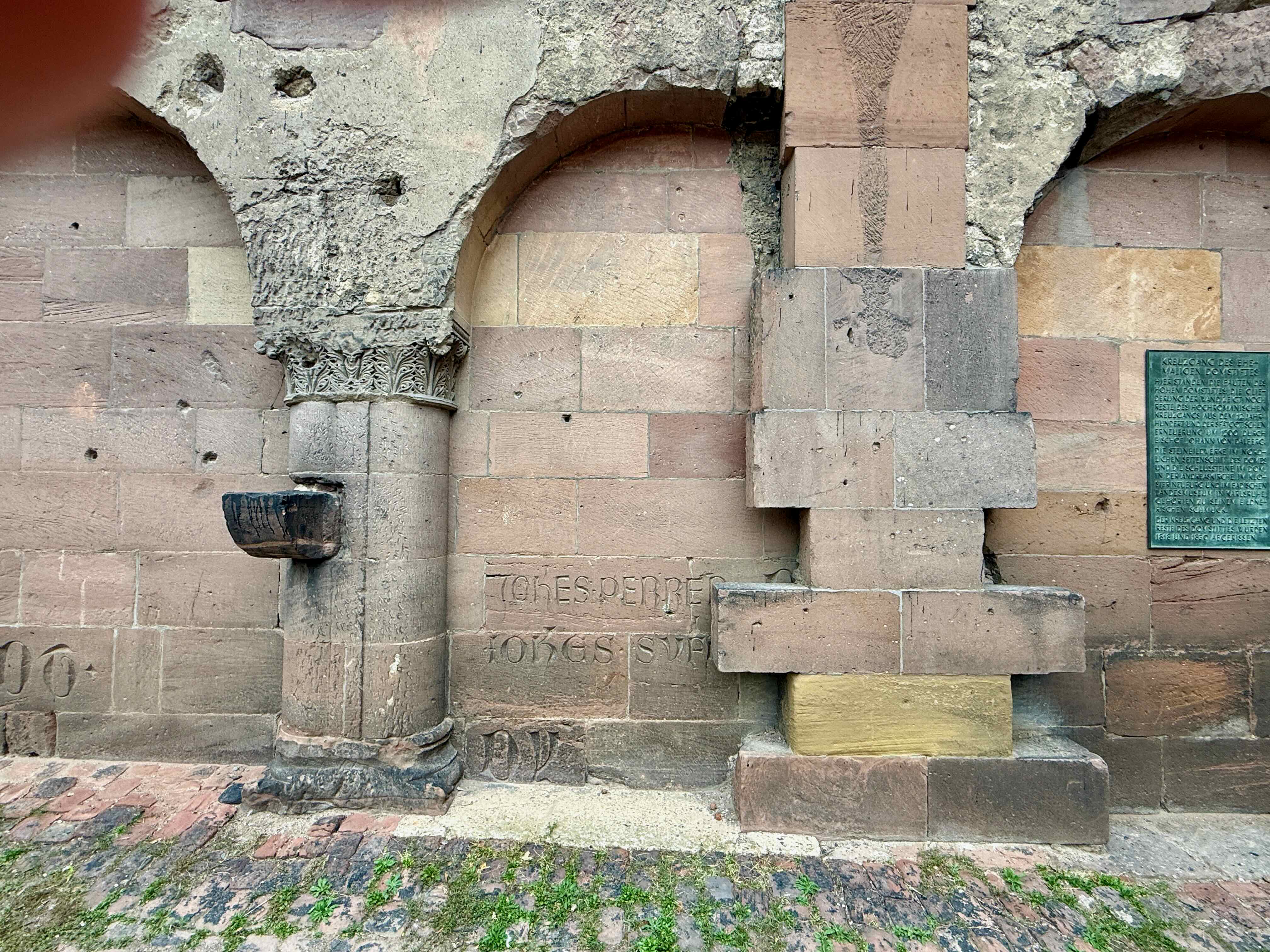
This fountain is at the end of part of the old town wall.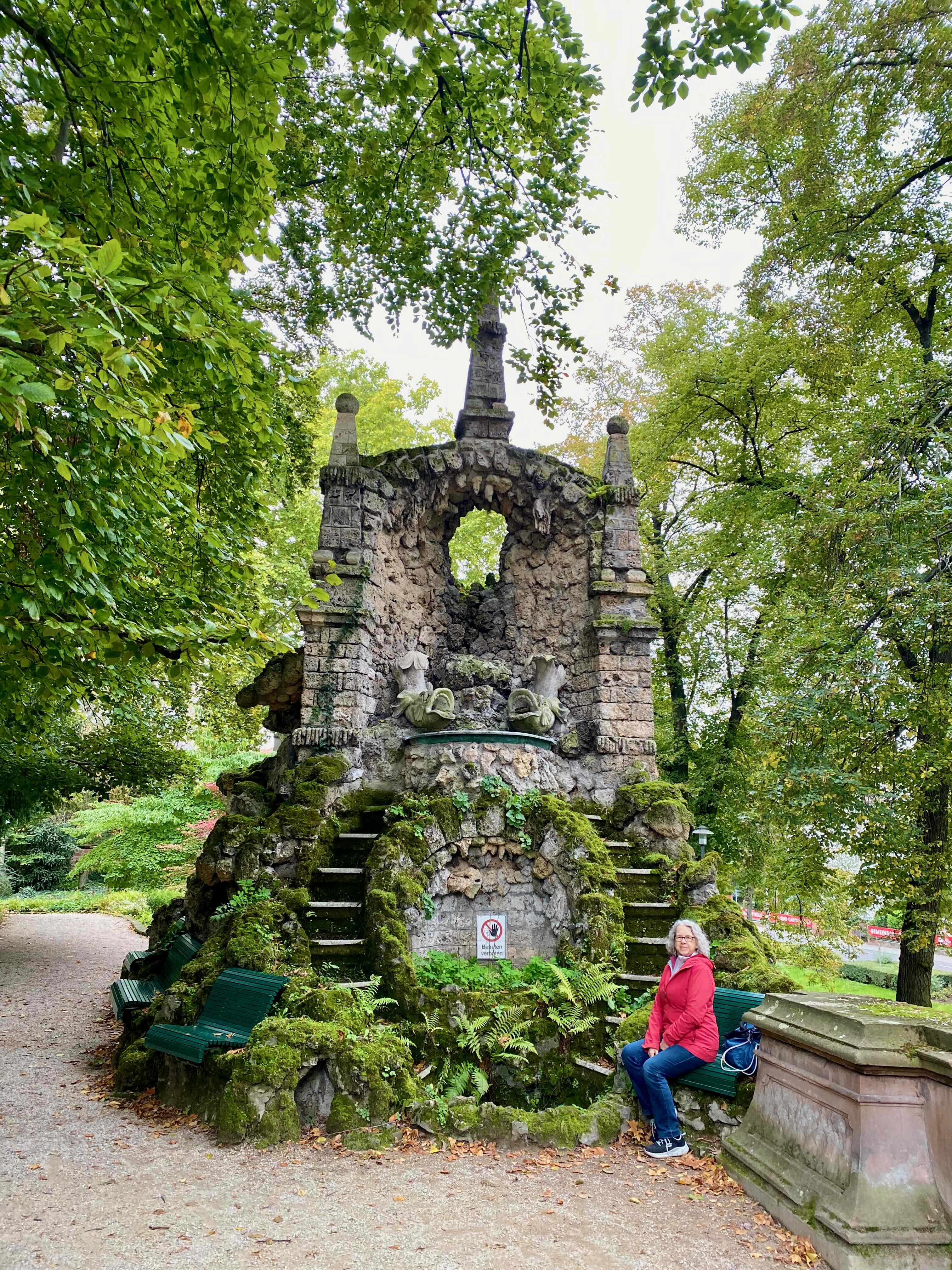
More graffiti, only on a tree this time.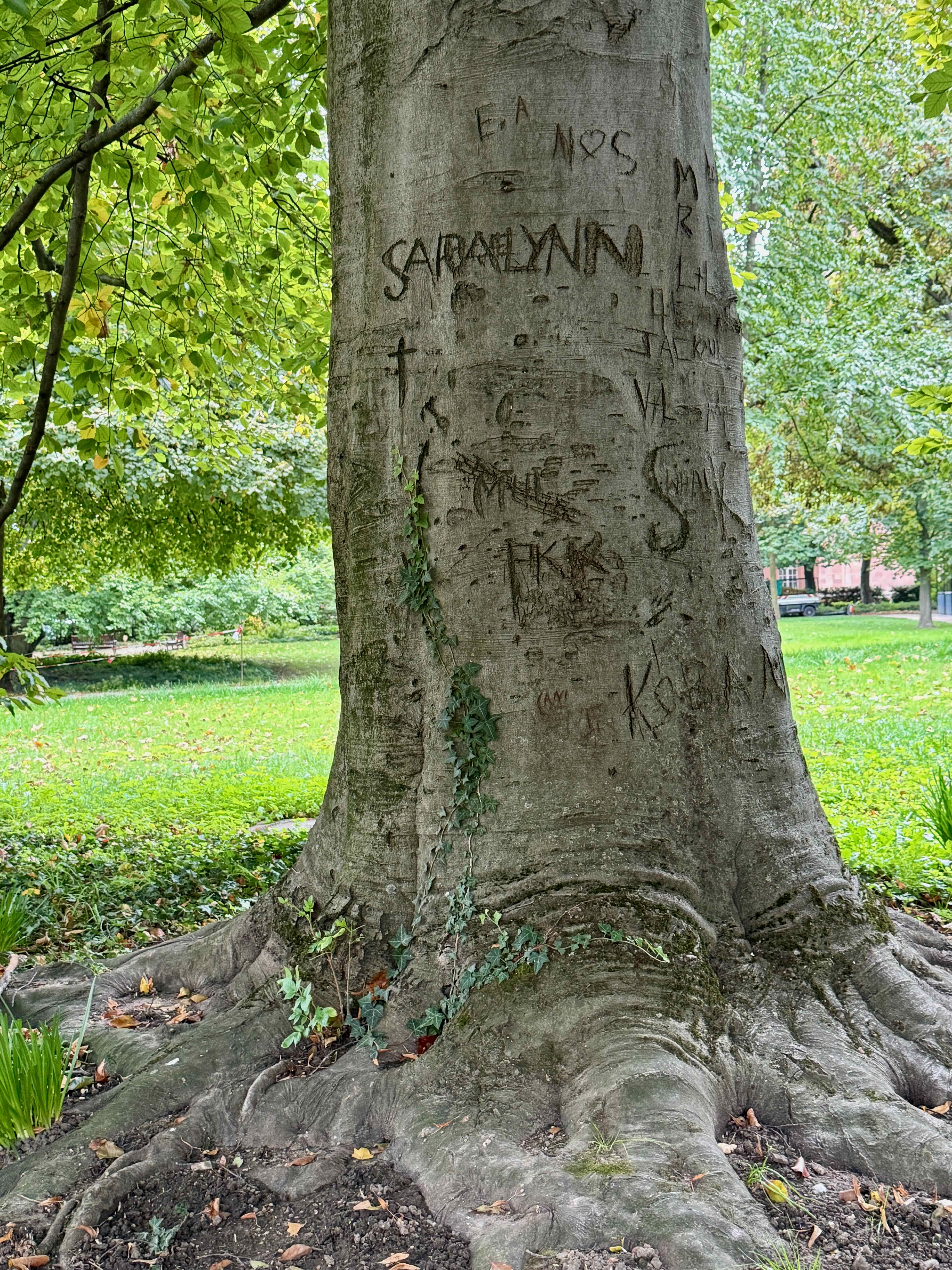
This little bird sculpture with its huge beak, ragged wings and stubby body caught our eye…we both really liked it.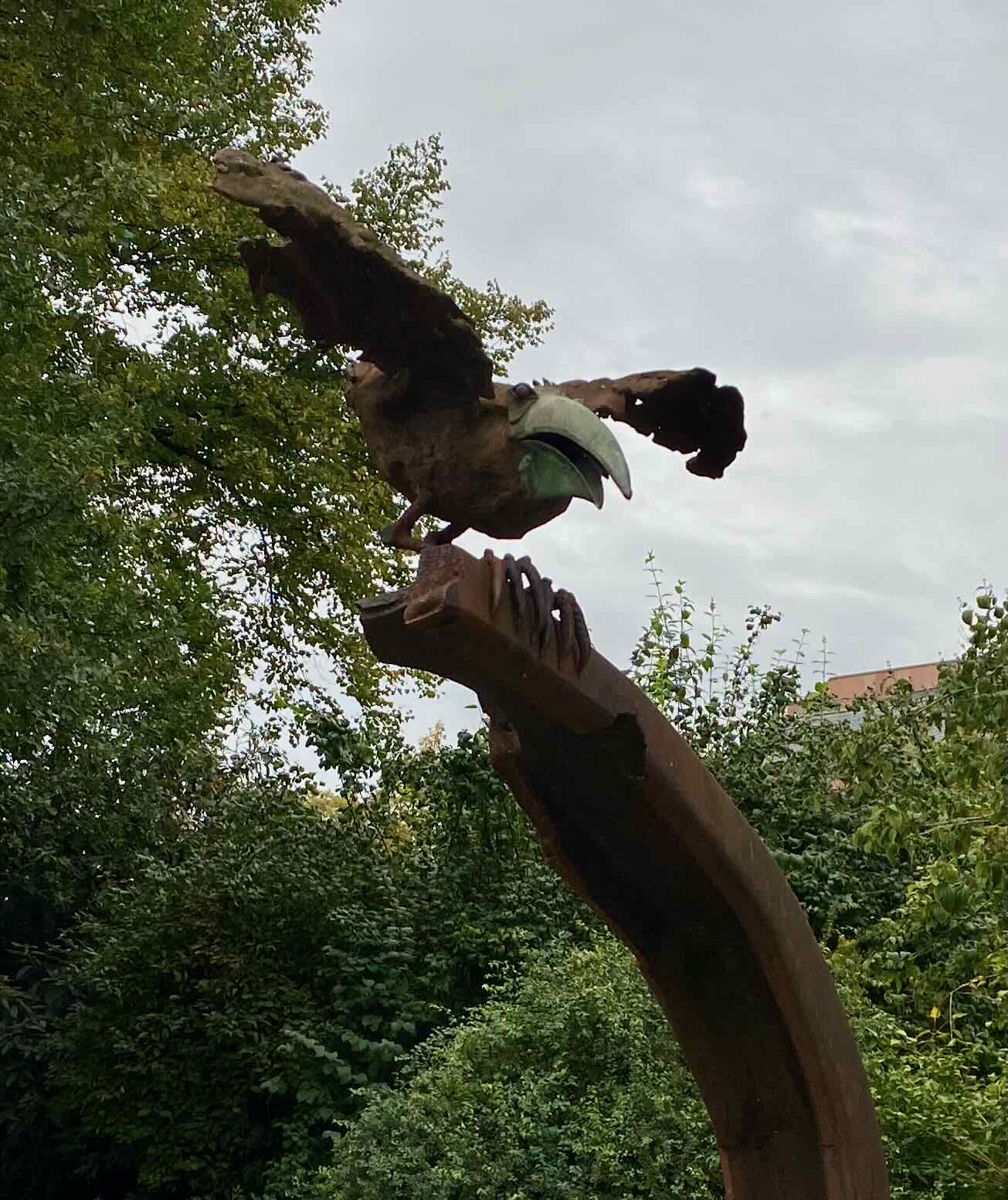
The Luther Monument is a group of statues. Martin Luther stands surrounded by bronze statues of the individuals that supported him. Plaques of the towns that supported Luther and the Protestant Reformation are placed on the walls of the monument.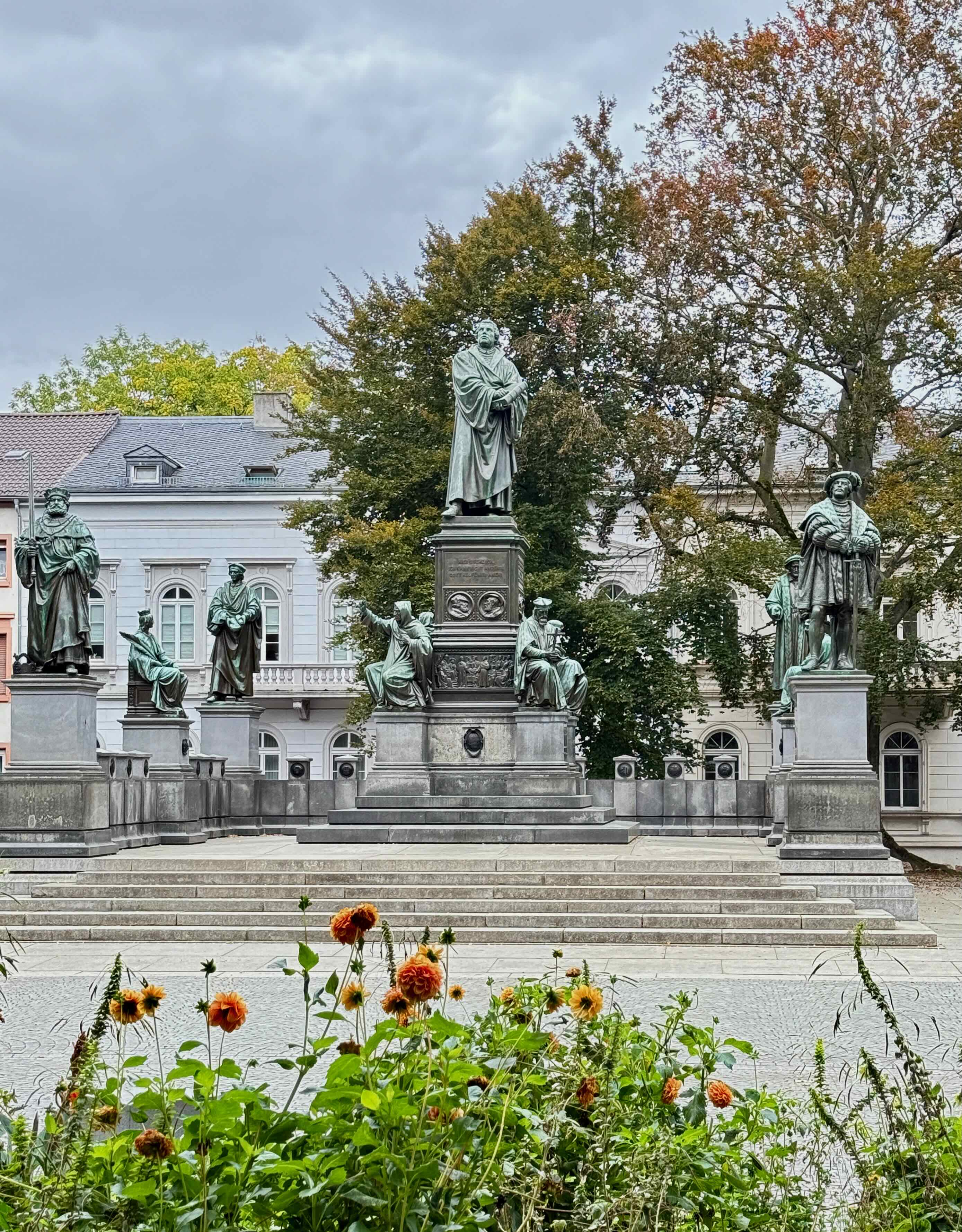
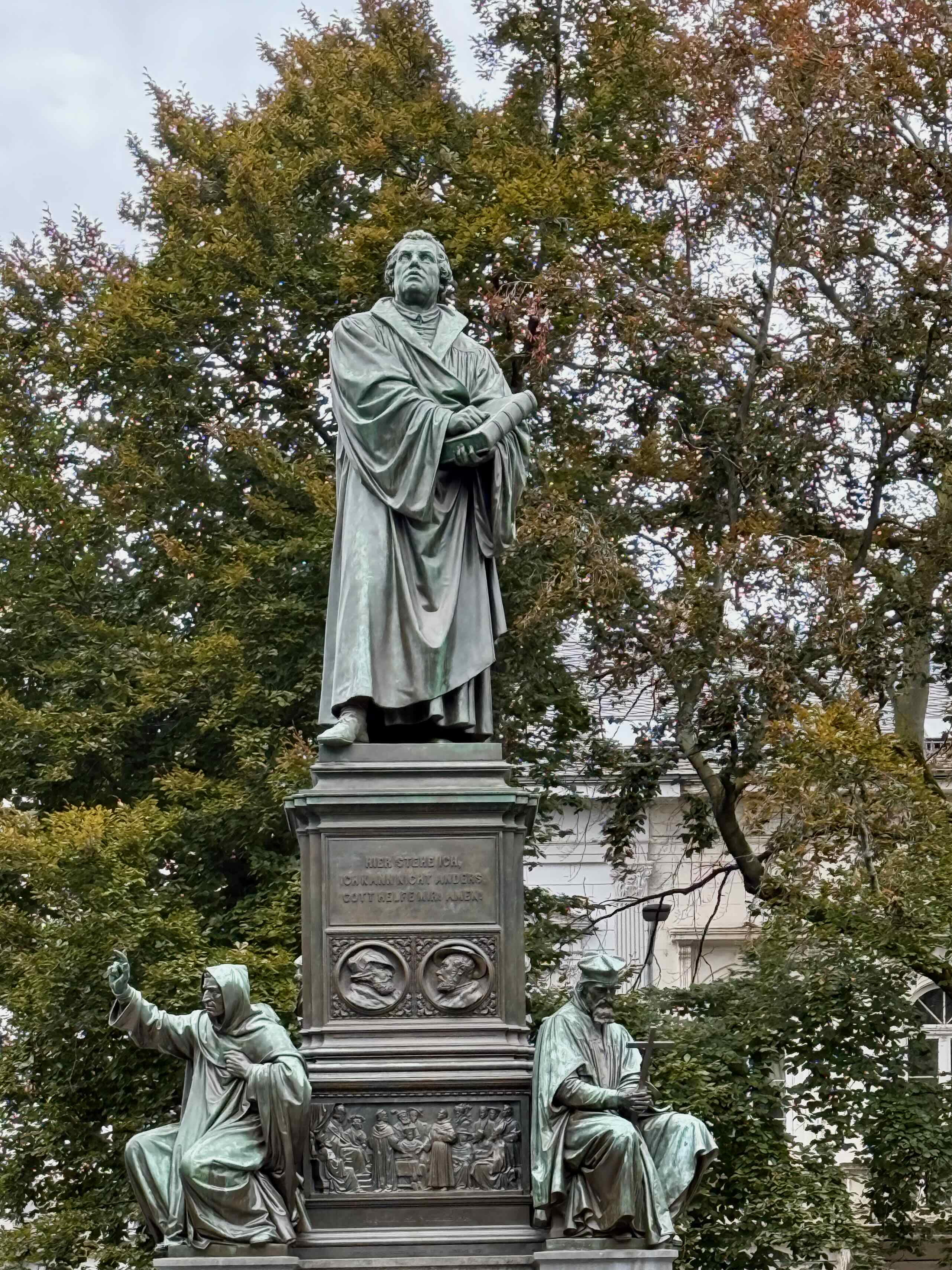
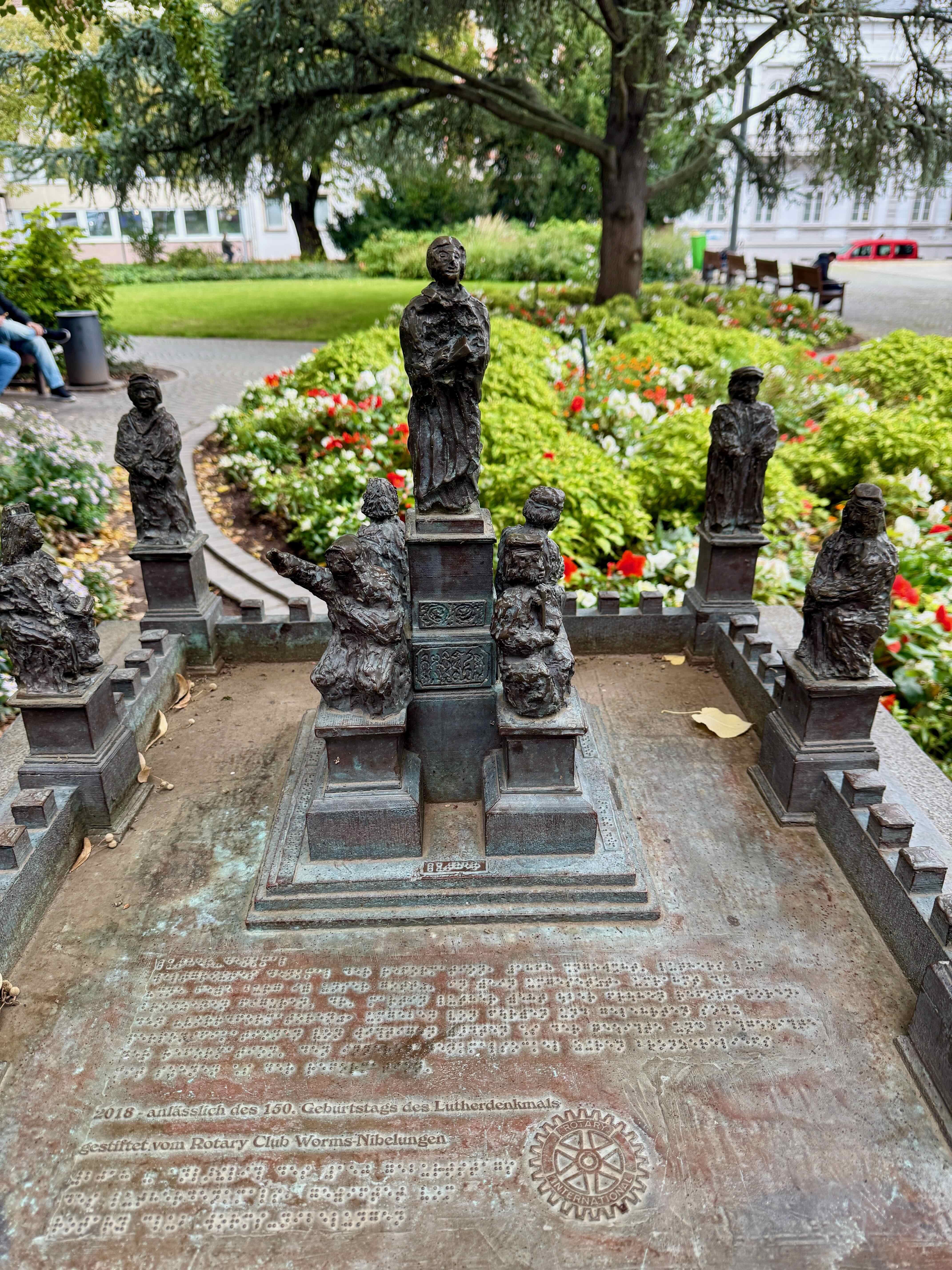
This monument is in a lovely park near the Cathedral.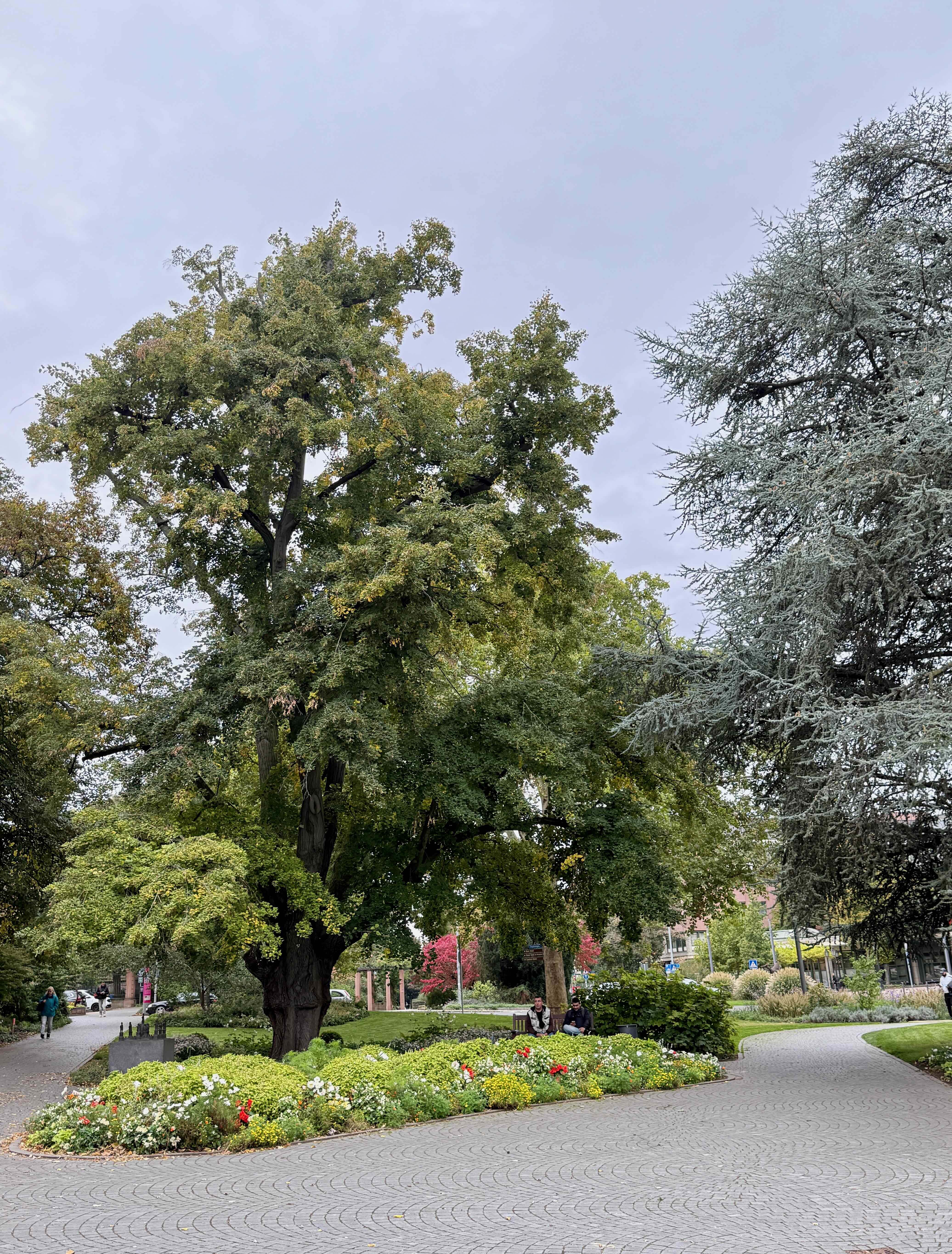 There is a model of the statue with information in Braille, which was unique.
 Back on the road I finally manage to get a photo of the Ausfahrt sign…which simply means Exit. I remember that we found this quite hilarious on our first trip to Germany with our daughter many years ago.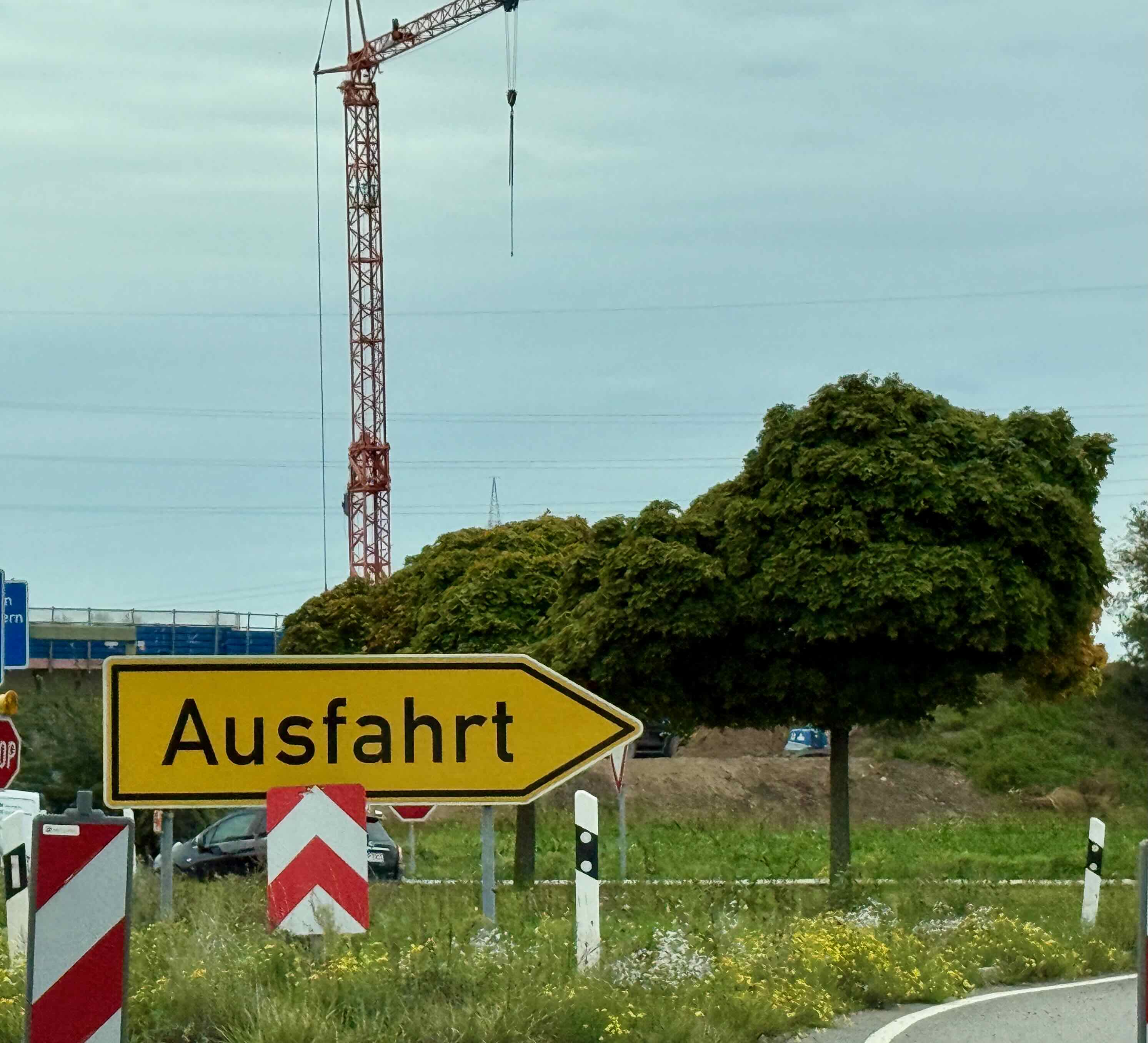
Next stop is Heidelberg where we are going to visit Heidelberg Castle that Bob says is like Versailles. We have a hard time finding the entrance to the funicular, even using Google Maps! Finally I notice a small picture of a train on the wall of what looks like the entrance to a mall…we only walked past it two times! The part of the journey we take is all underground.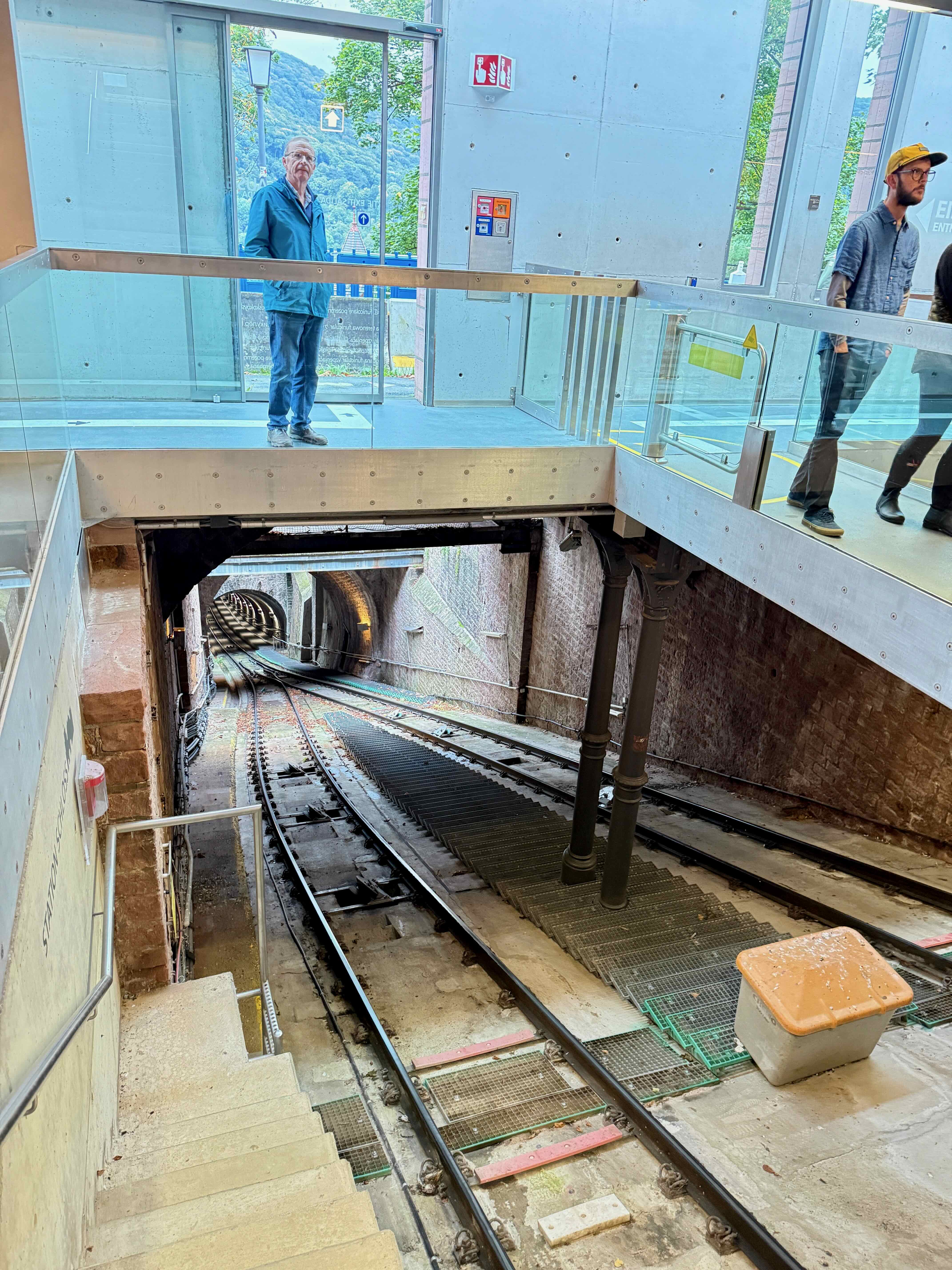
We walk to the castle but all we see is ruins…turns out Bob mixed up his castles! It is fine though as this looks interesting anyways. There is an in depth tour through the ruins in an hour and a half but we decide to just wander and see what we can. This gate was built in one night by King Frederick V for his wife as a birthday present.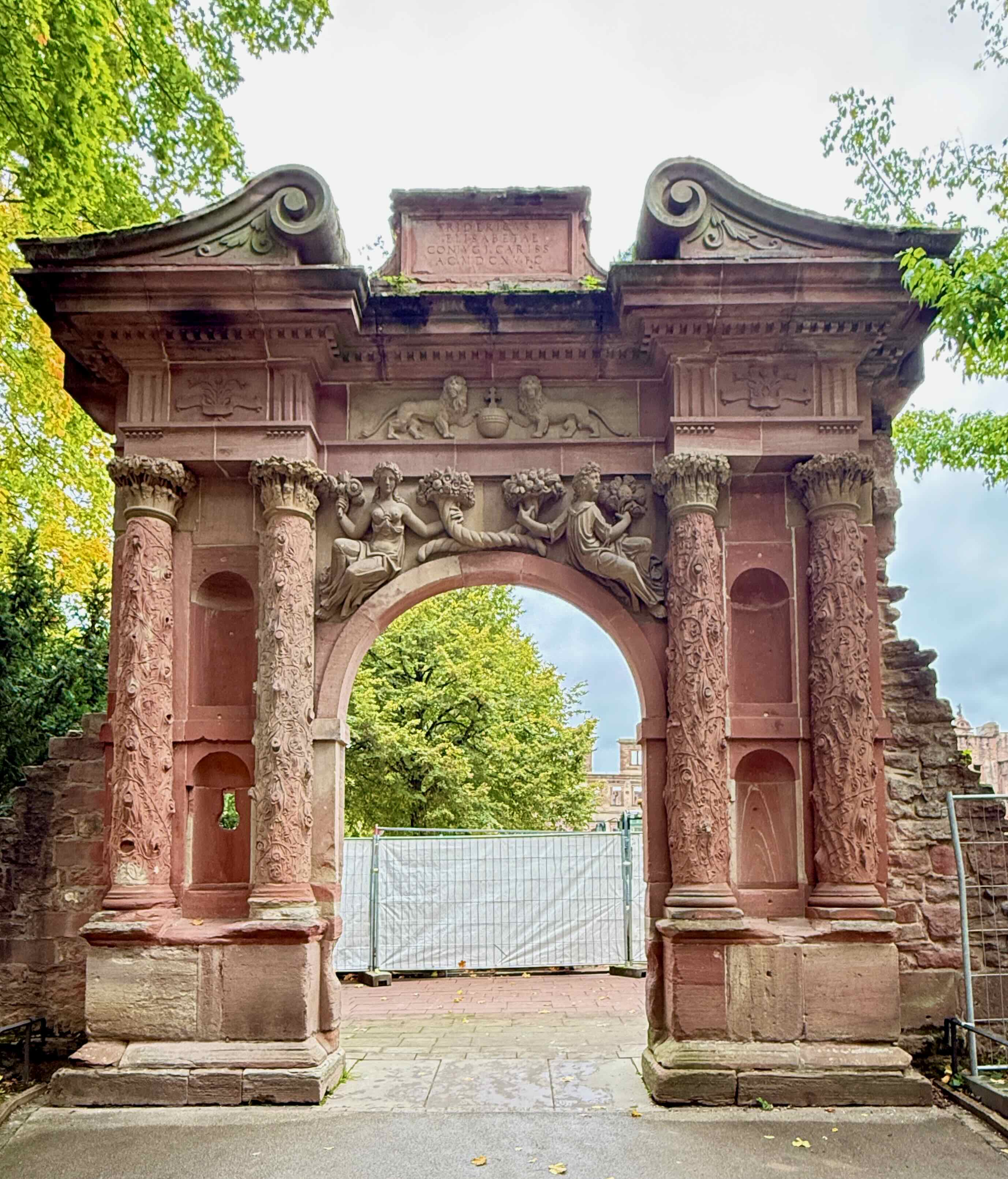
Our funicular ticket gives us access to the courtyard, the German Pharmacy Museum, and the Big Wine Barrel. We walk through the gate to the courtyard…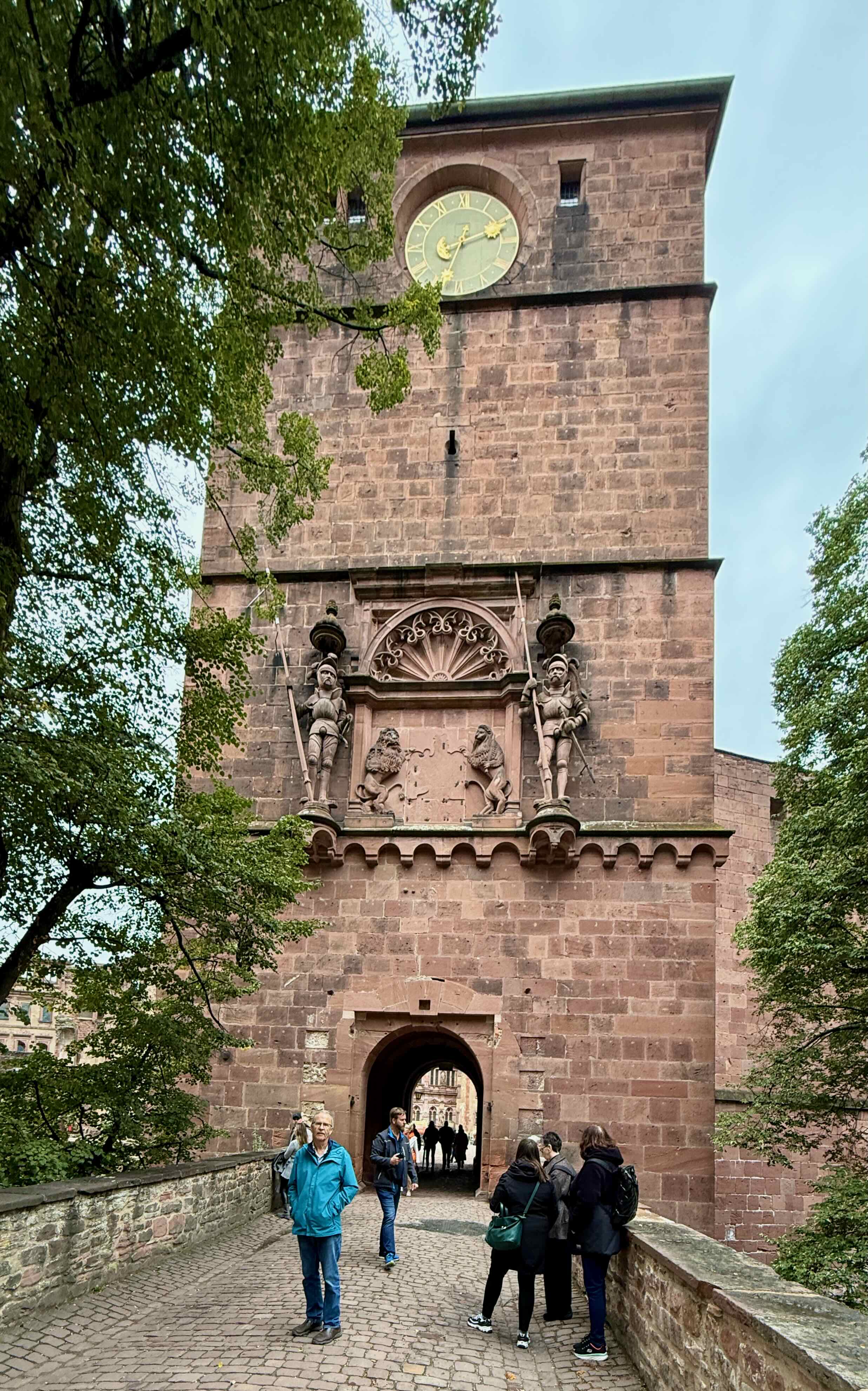
…and we are greeted with views of the ruins of what must have been a very impressive castle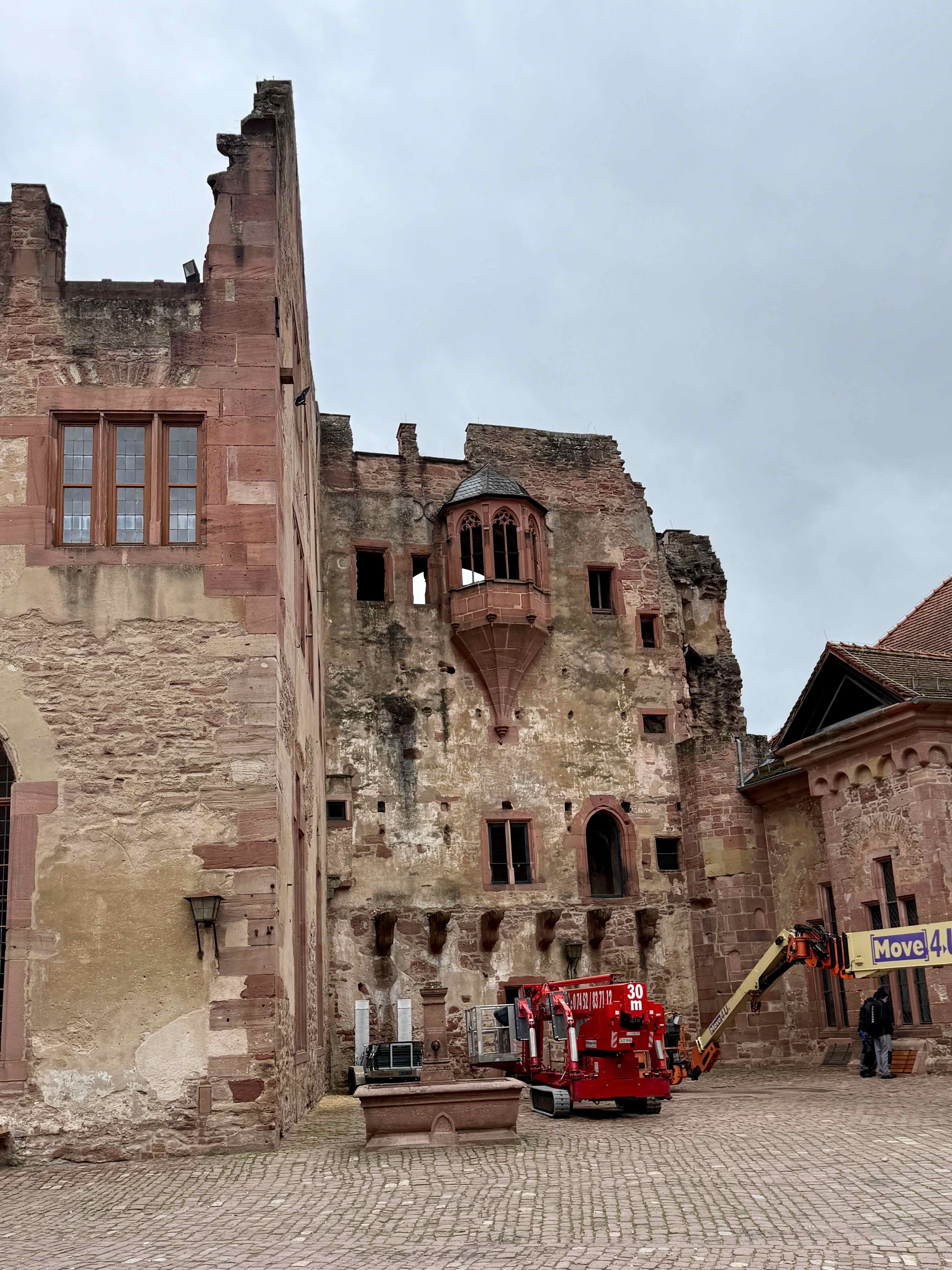
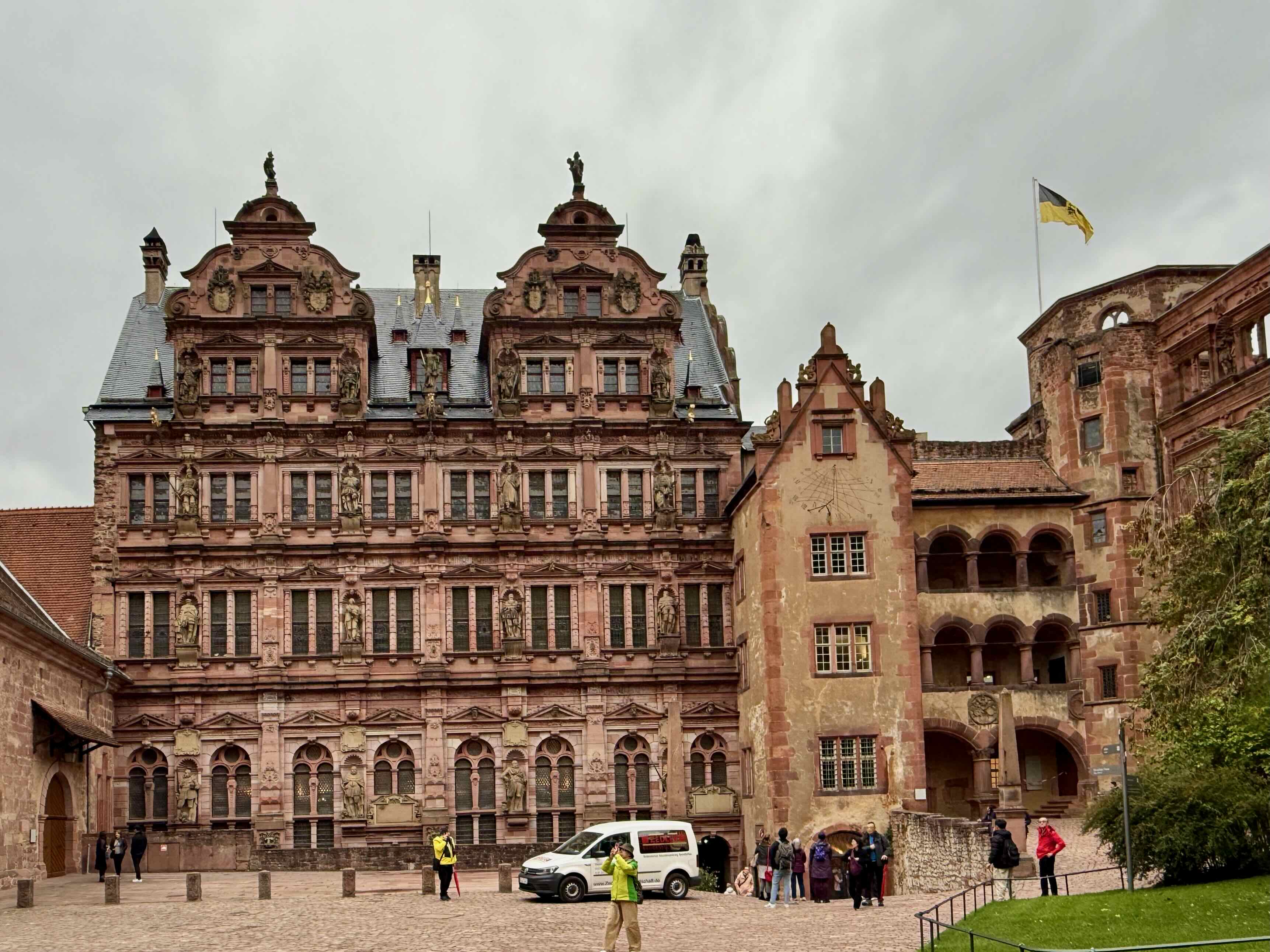
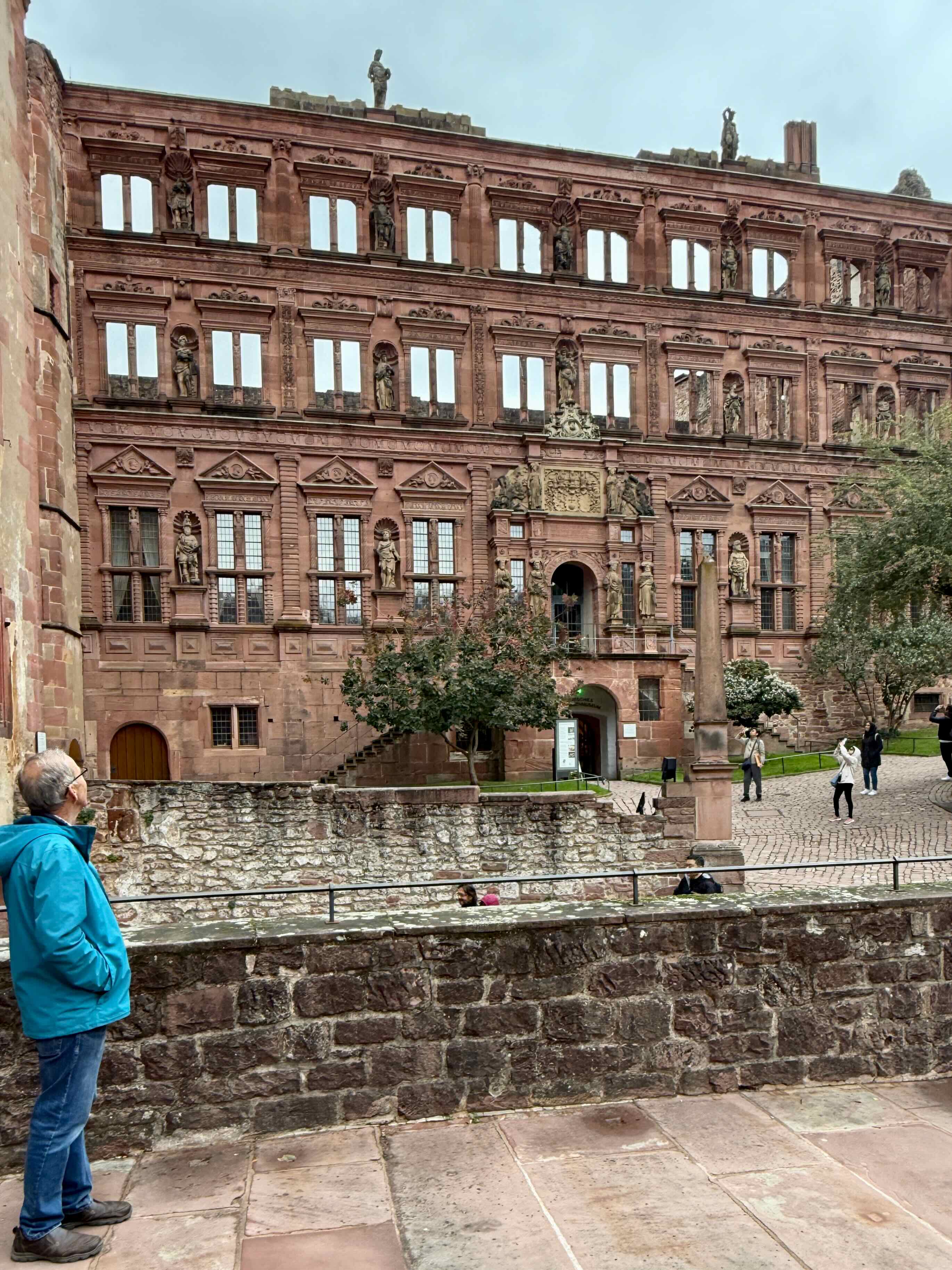
Walking through the doorway in the above photo we arrive on a huge balcony overlooking the Rhine River with views of Heidelberg below.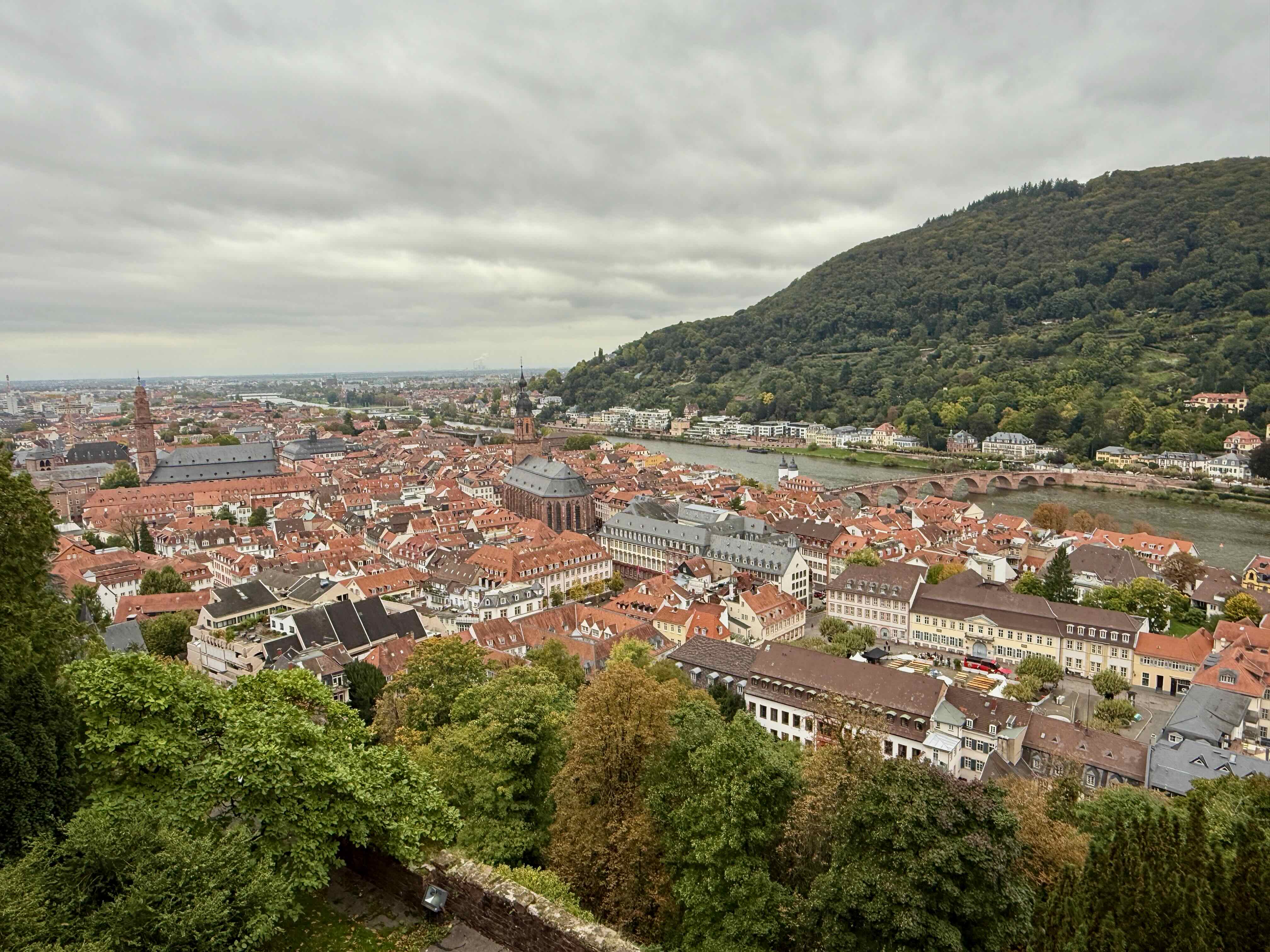 A view of the ruins as seen from the balcony.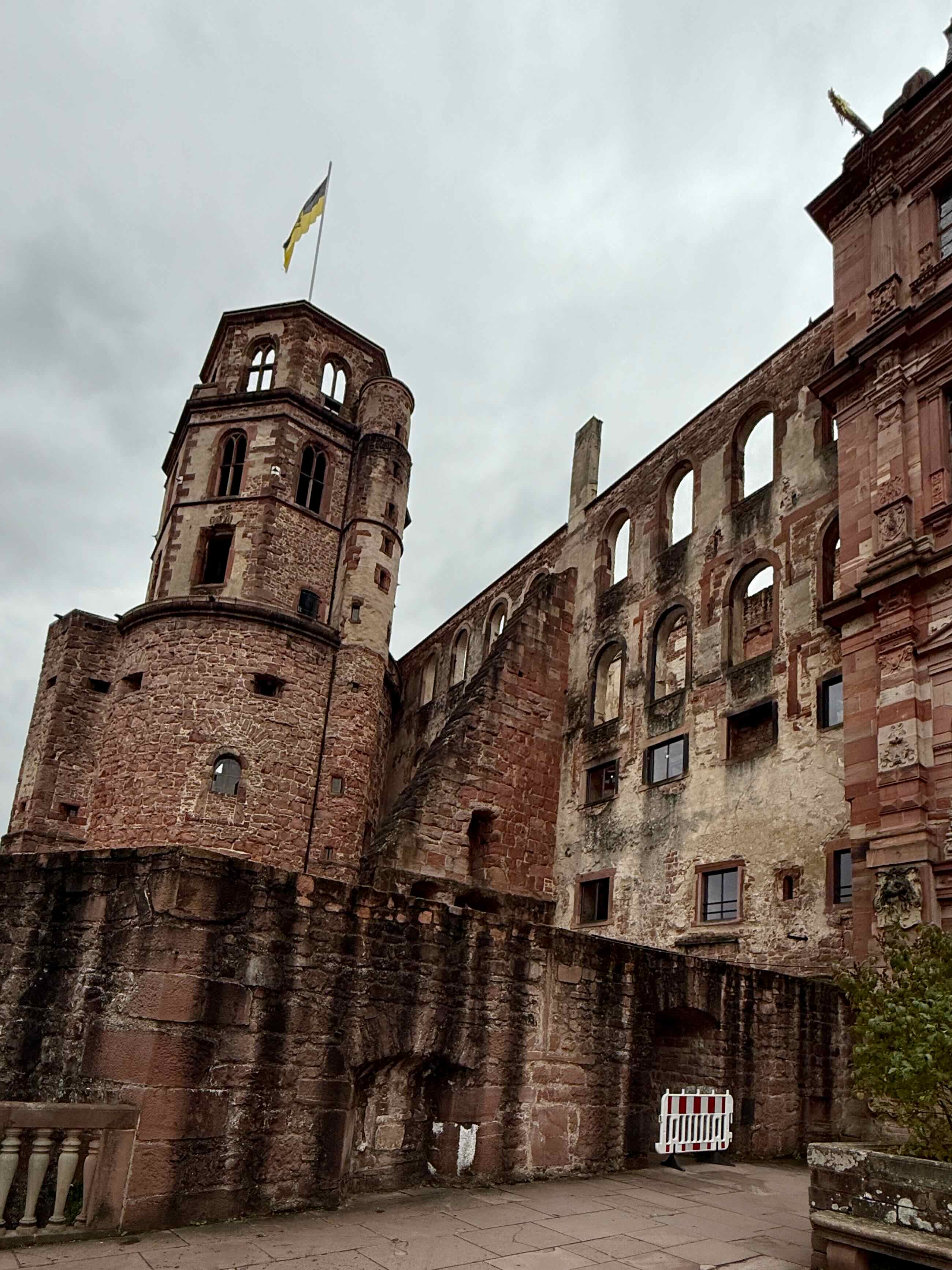
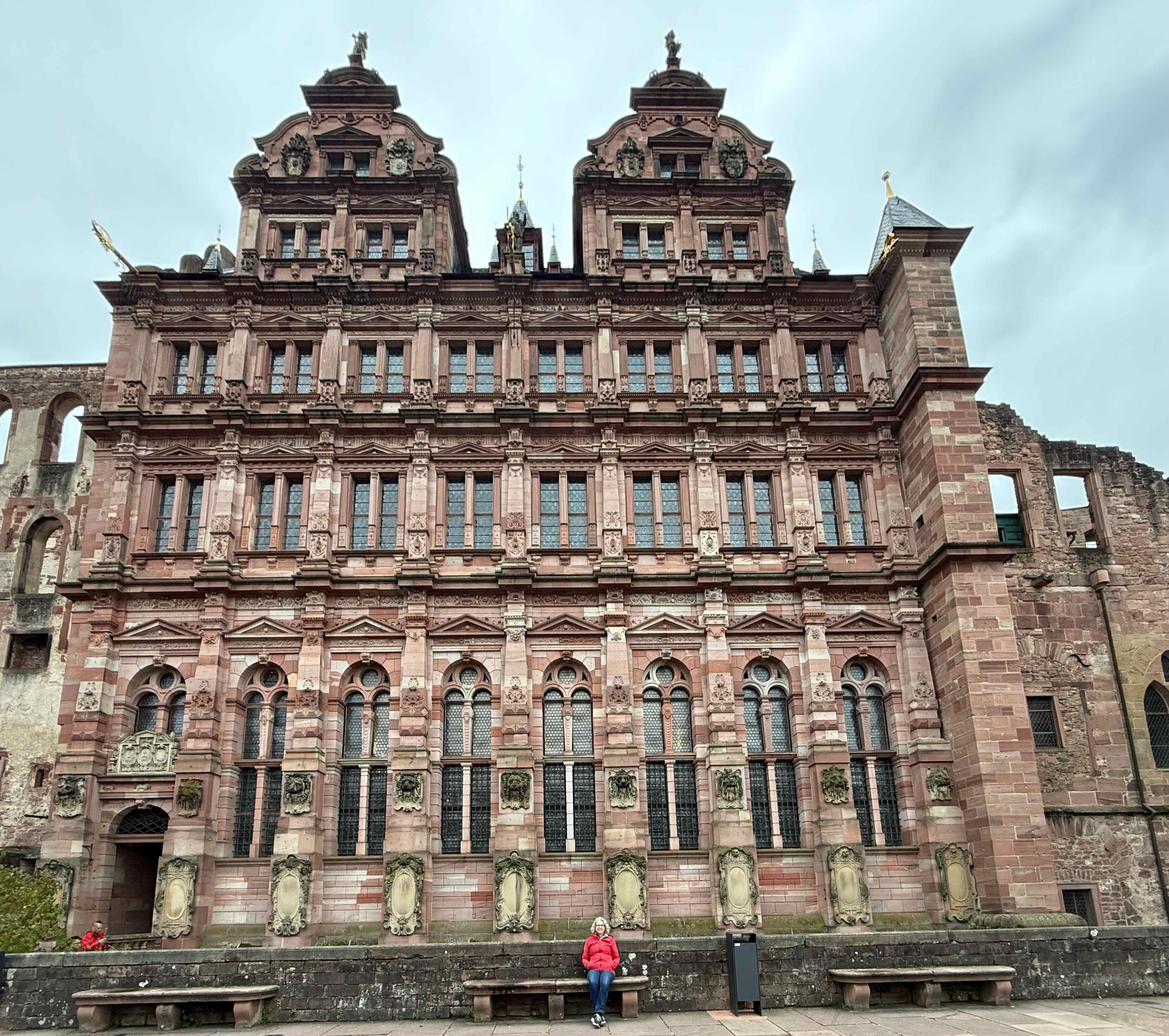
It is cold out so we go inside to see the Big Wine Barrel. It is pretty impressive and I take this photo and then walk around the corner while Bob is inspecting the barrel. I come back and tell him “You need to come and see the BIG Wine Barrel!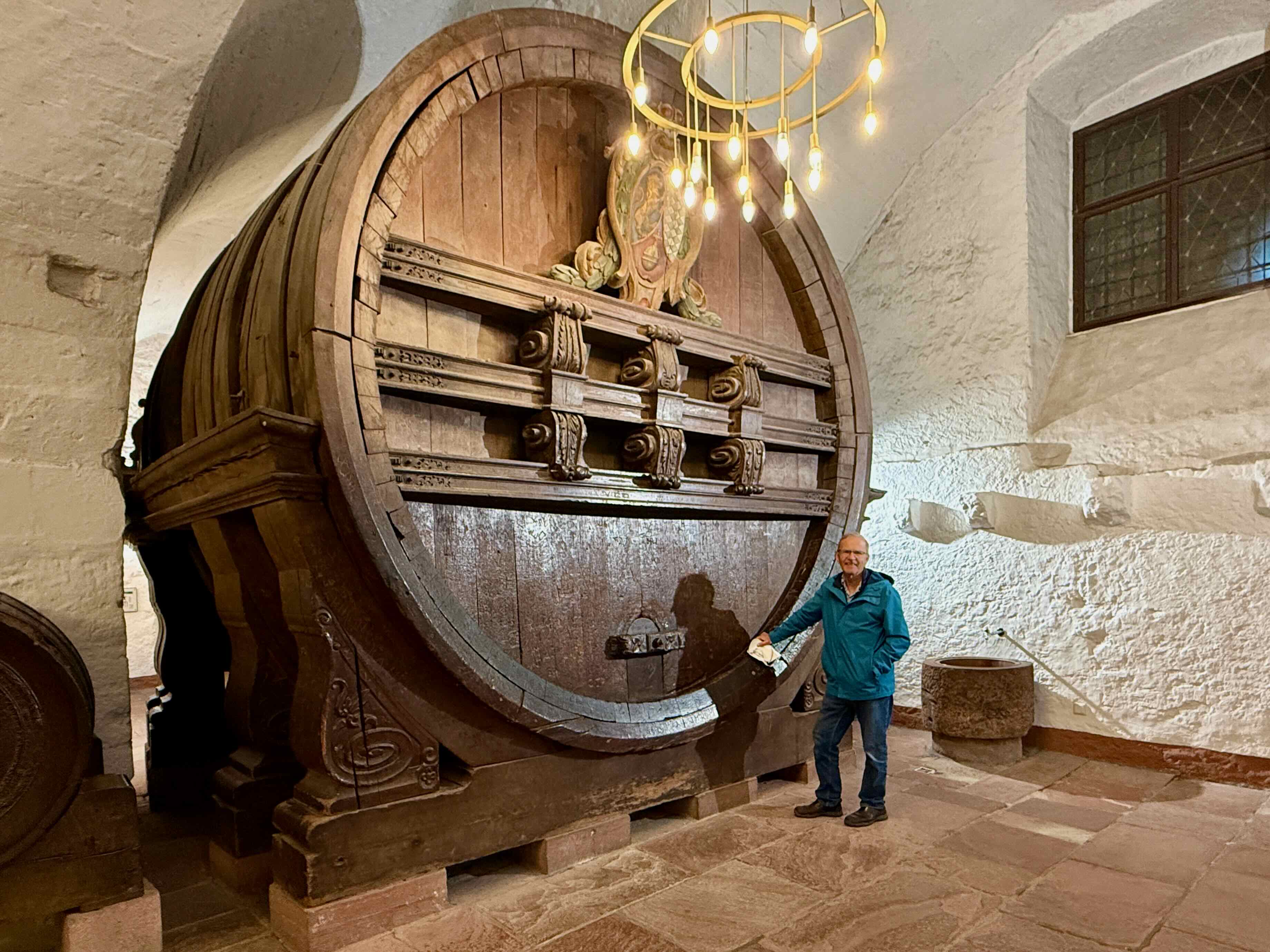
Here it is!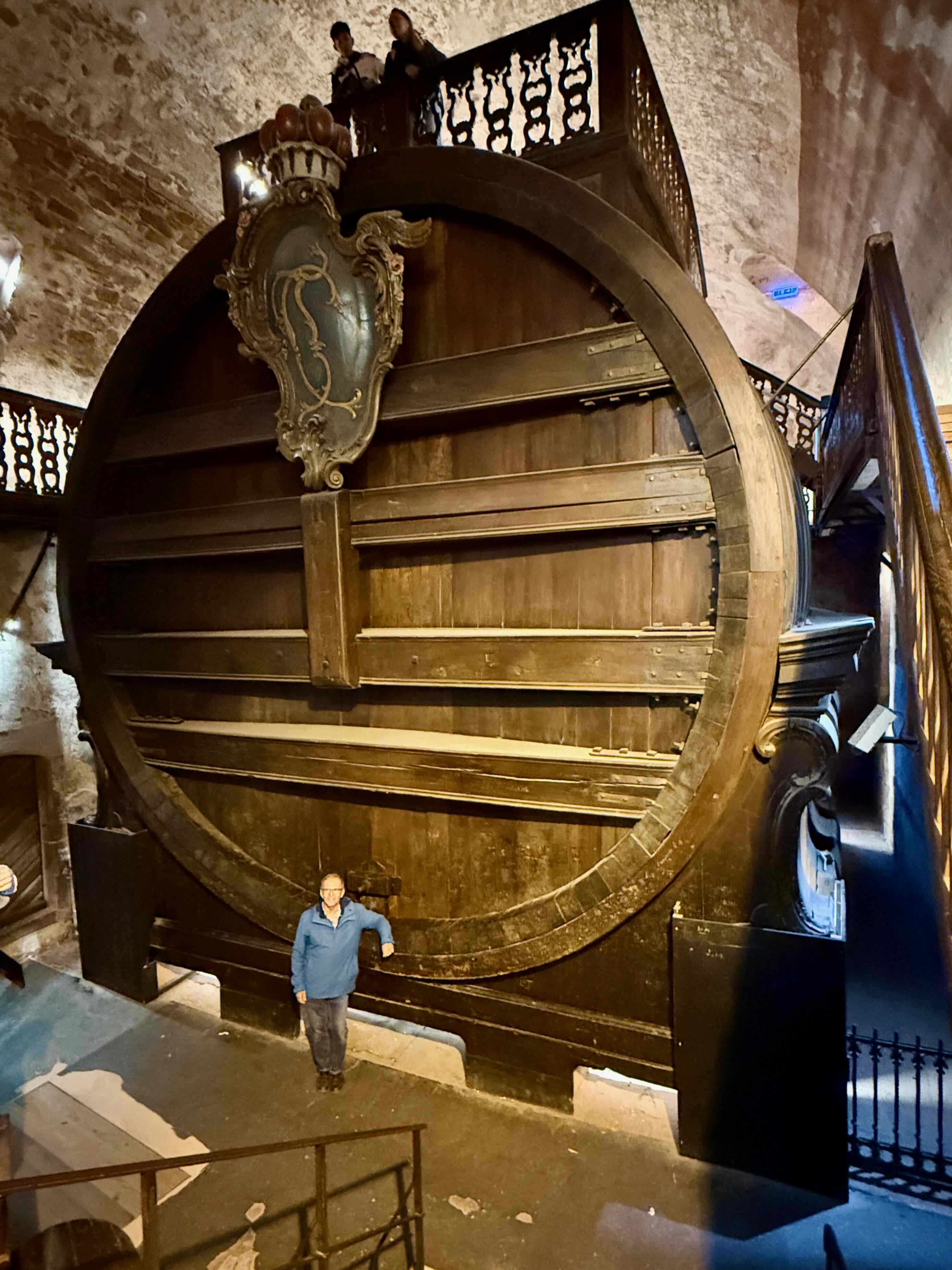
This wine barrel held 220,000 liters of wine. The stairs I am standing on lead to a platform above the barrel that was likely used as a dance floor! 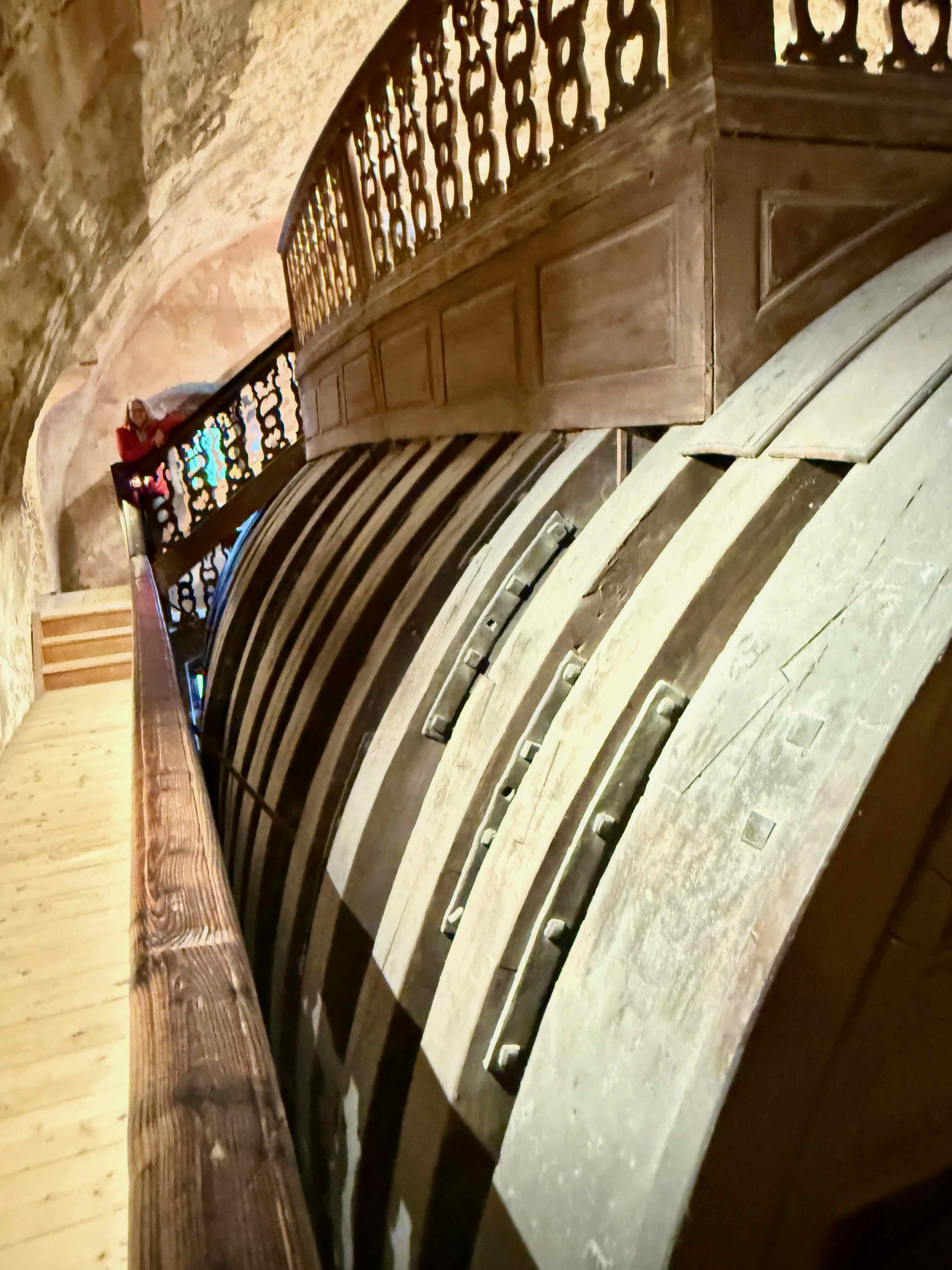
Last stop is the German Apothecary Museum. It is warm inside, which I really appreciate. Aspirin was a commercially sold product in 1889. 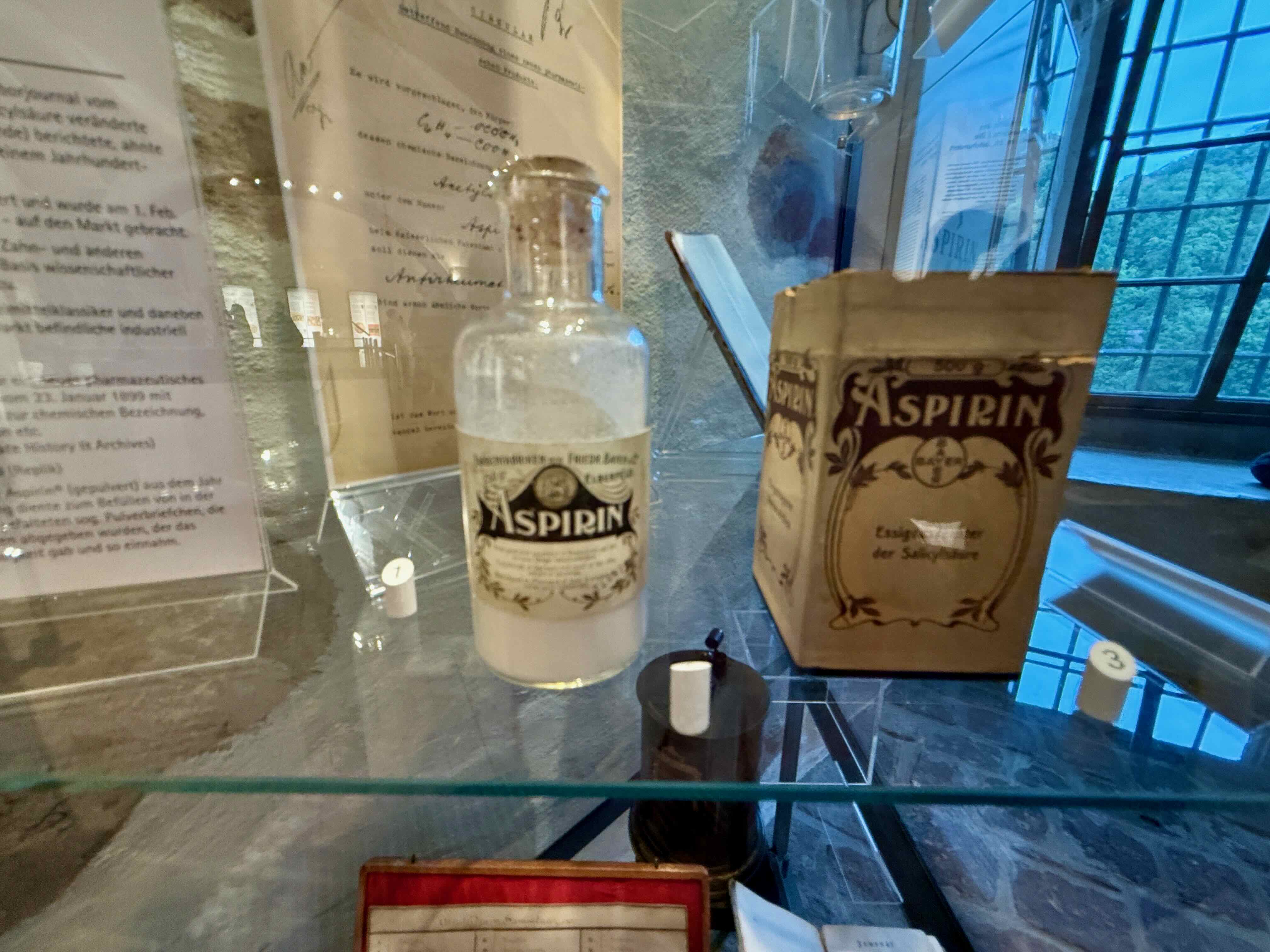
This chest of homeopathic medicines from 1890 contains 312 vials of homeopathic remedies.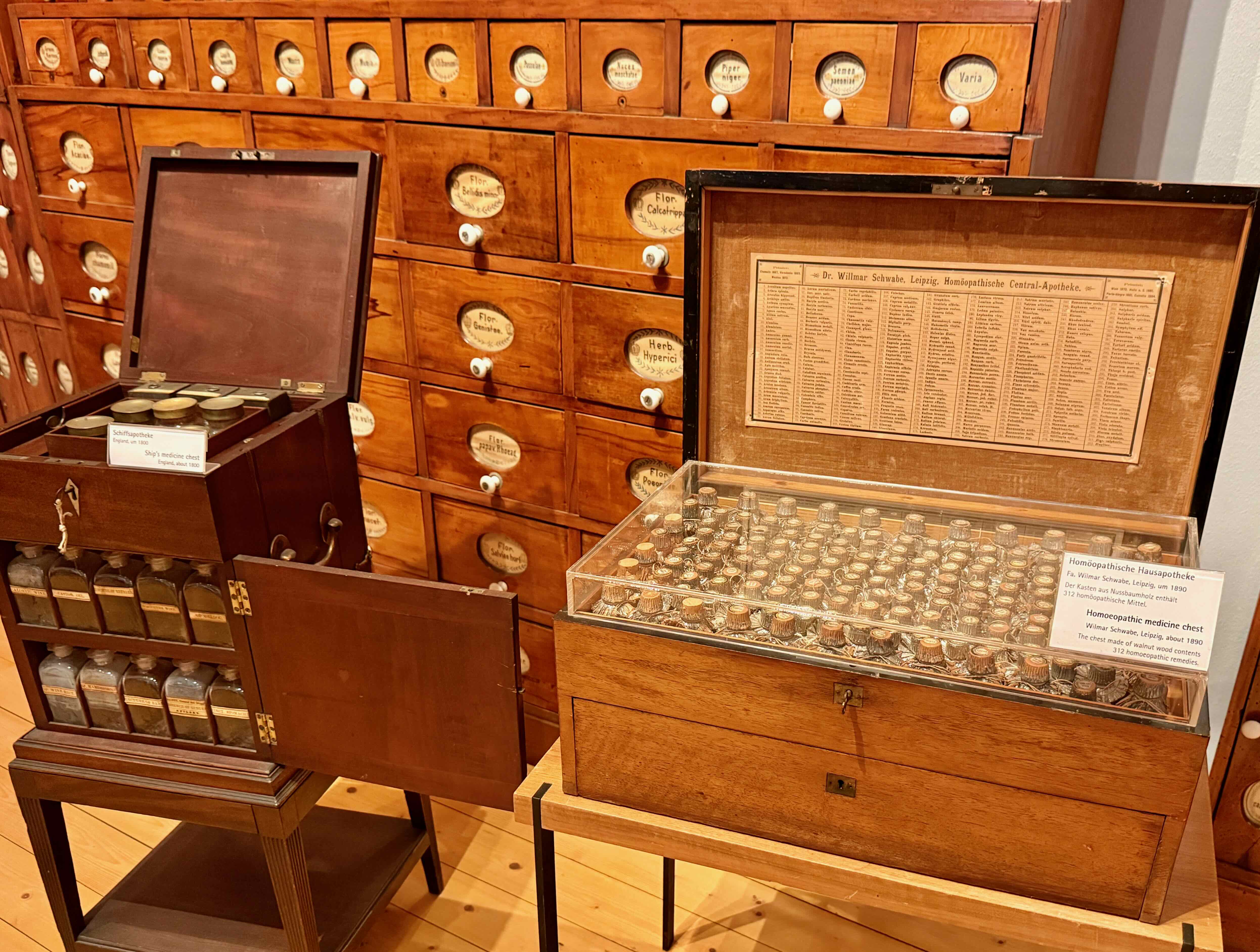
What is it about chests with lots of little drawers that I find so appealing?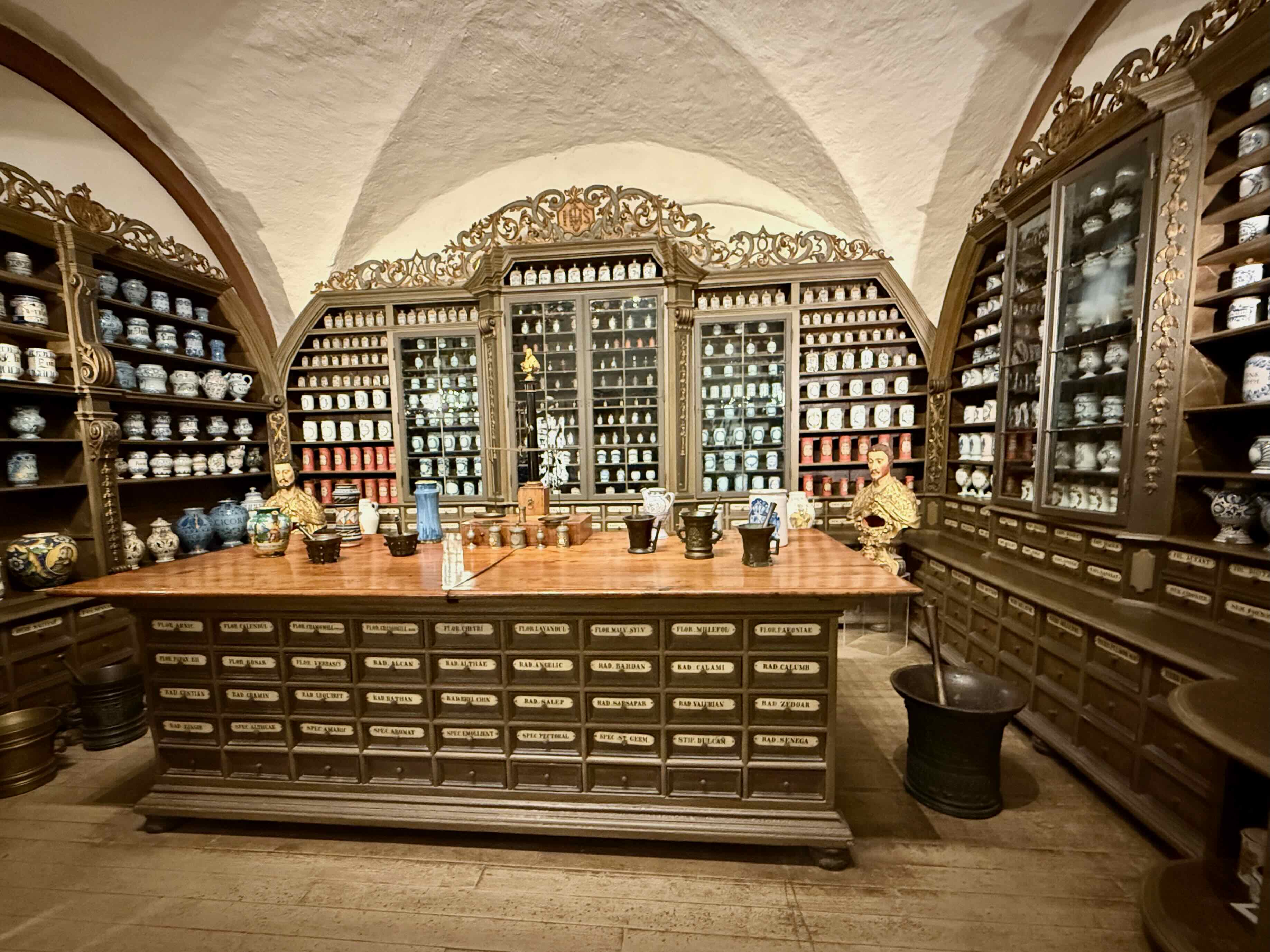
Of course, ground unicorn horns were in big demand as a cure for ailments such as fever, plaque, poisoning convulsions and epilepsy! Unicorn horns were just long tusks from narwhals or other animals but they were an expensive medication reserved for royalty and the very rich. 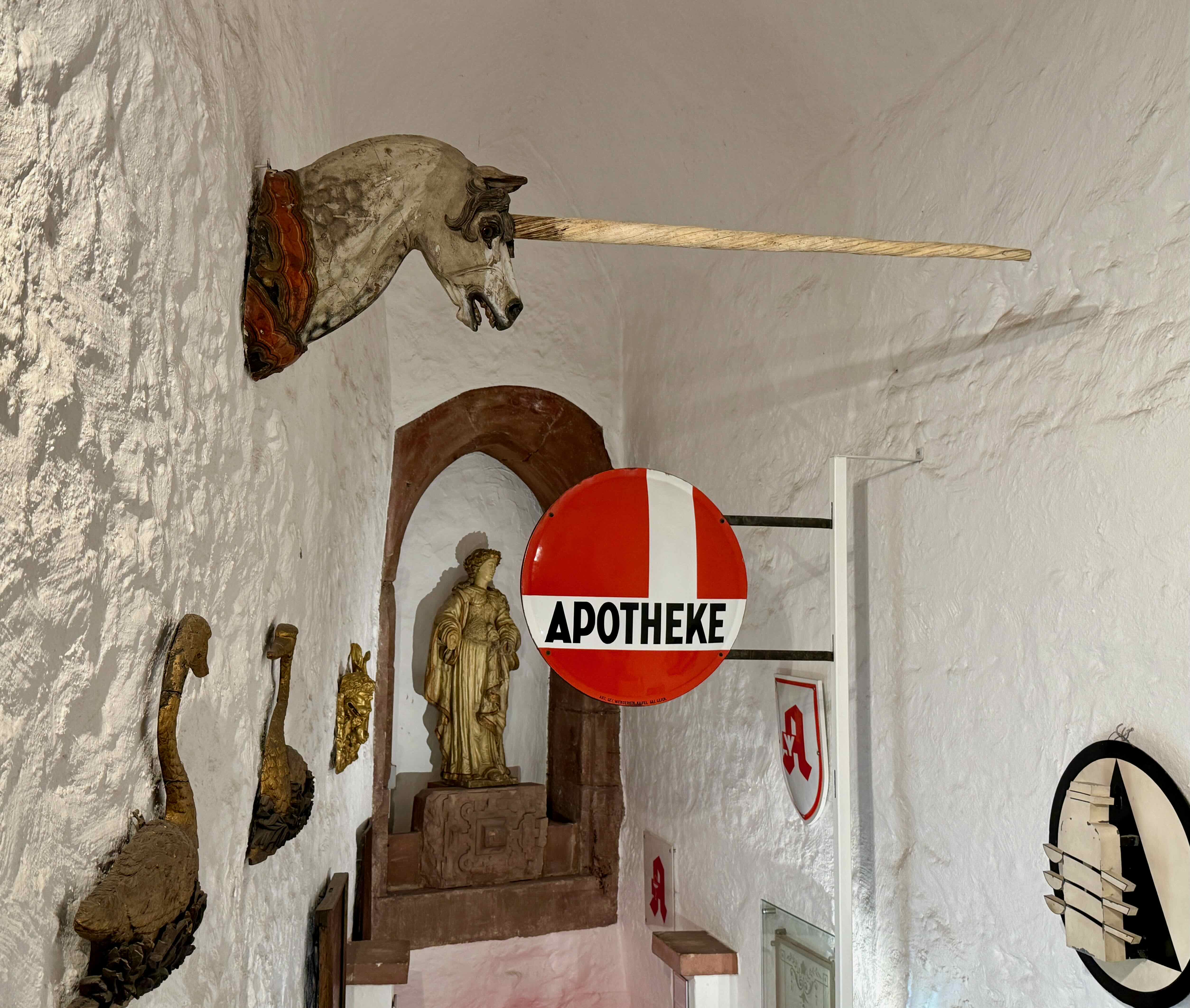
An early distillery…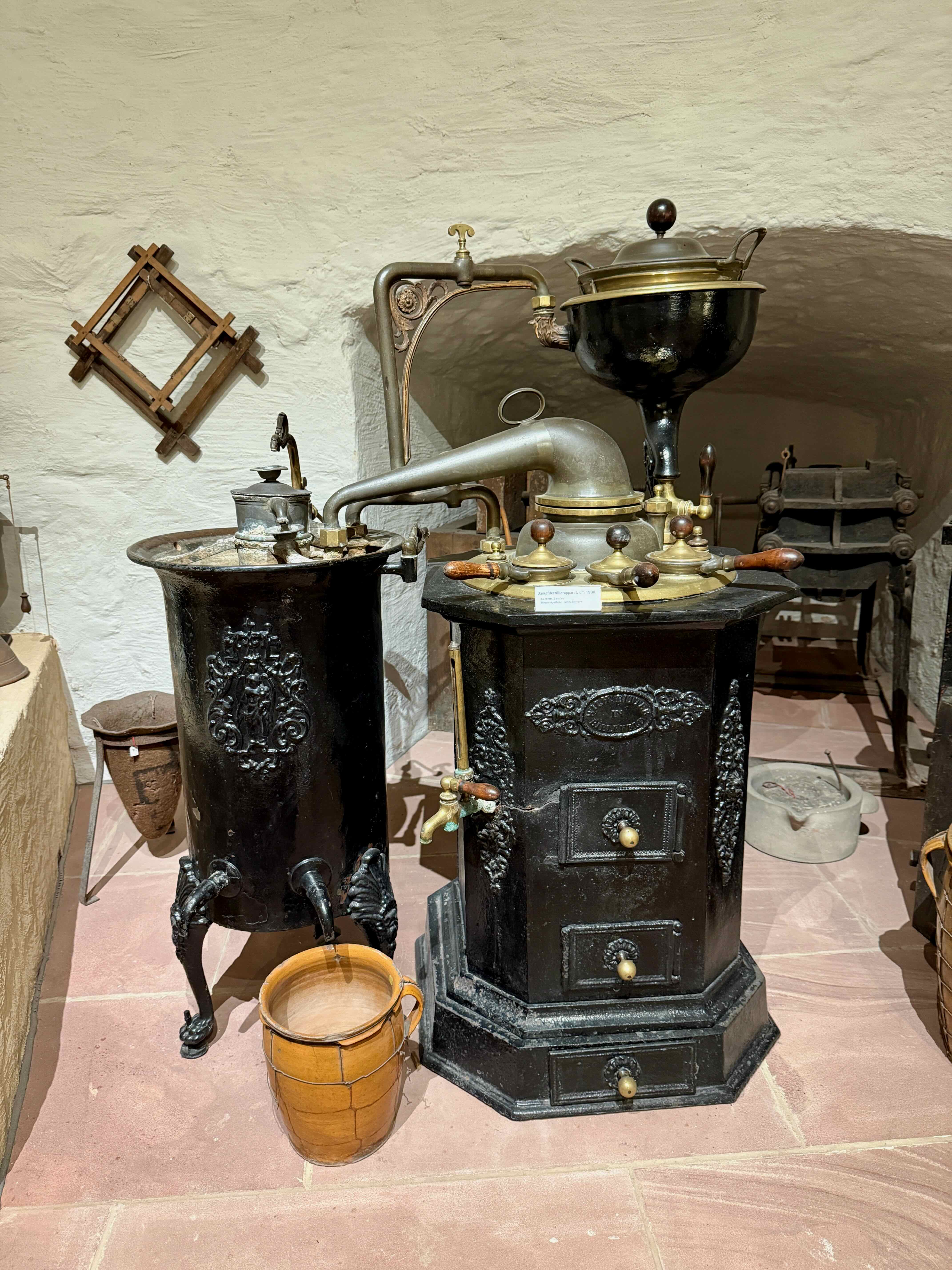
…bunsen burners and a telescope from 1780.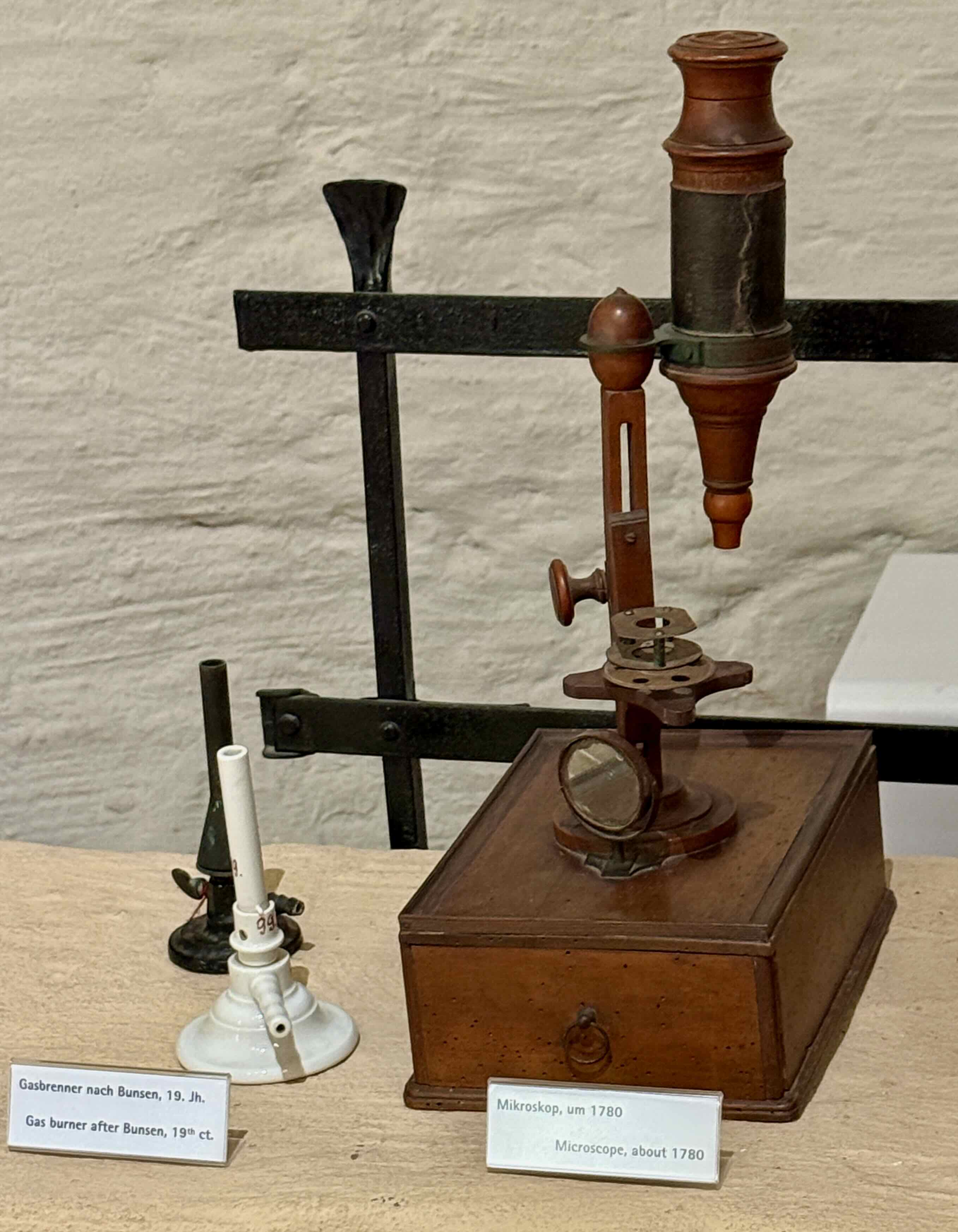 We had such a hard time finding the entrance to the funicular and wondered where this castle was located…well, on our way back to the parkade I Iooked up…and there it was! We both laughed, but then we couldn’t find the entrance to the parkade! We looked everywhere and finally walked down the out ramp, and there was the door to the exit. We checked it out and the stairs outside were right beside the ramp we just walked down…no sign or markers though!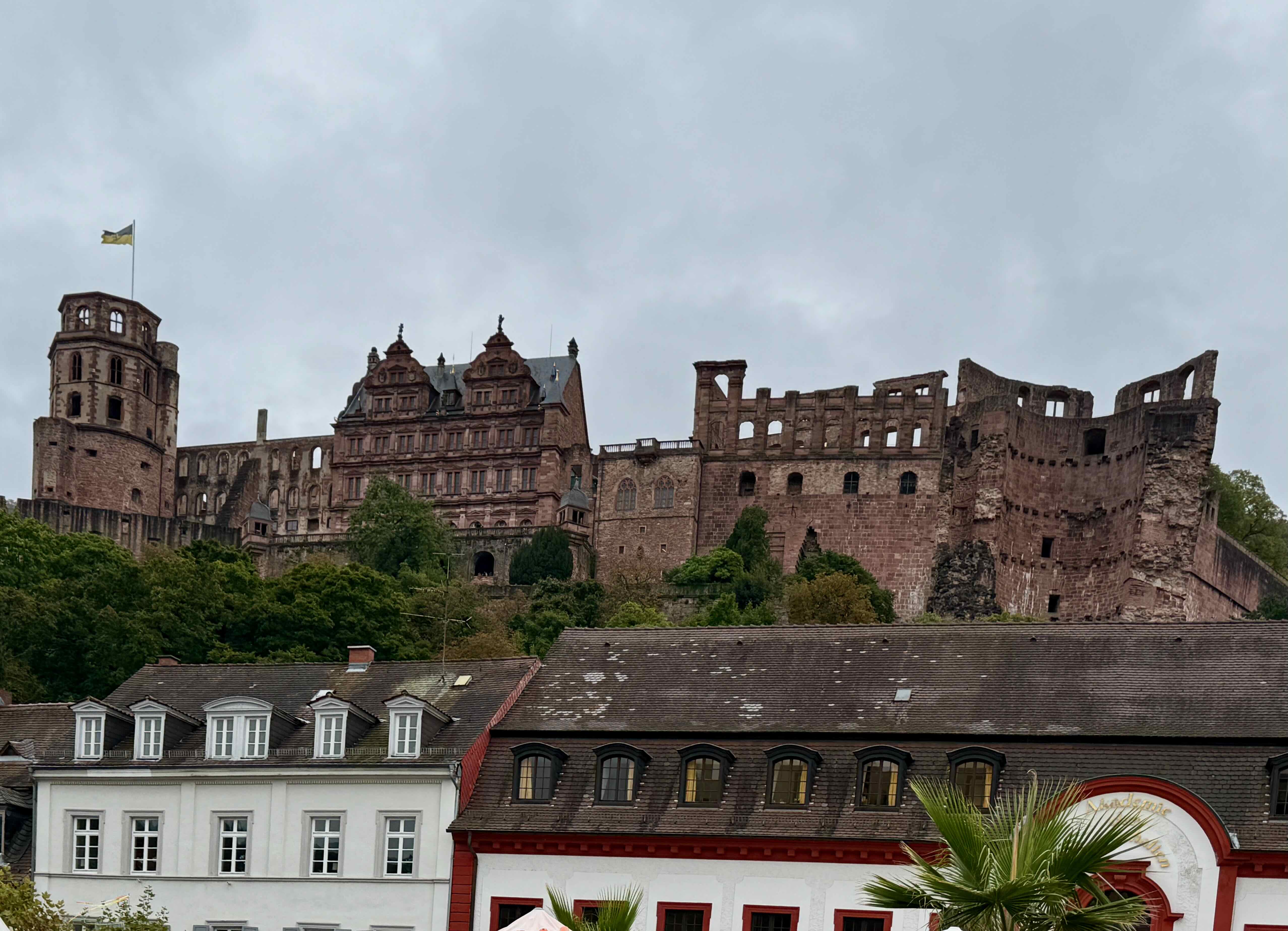
Back on the road to stuttgart…and it is raining again.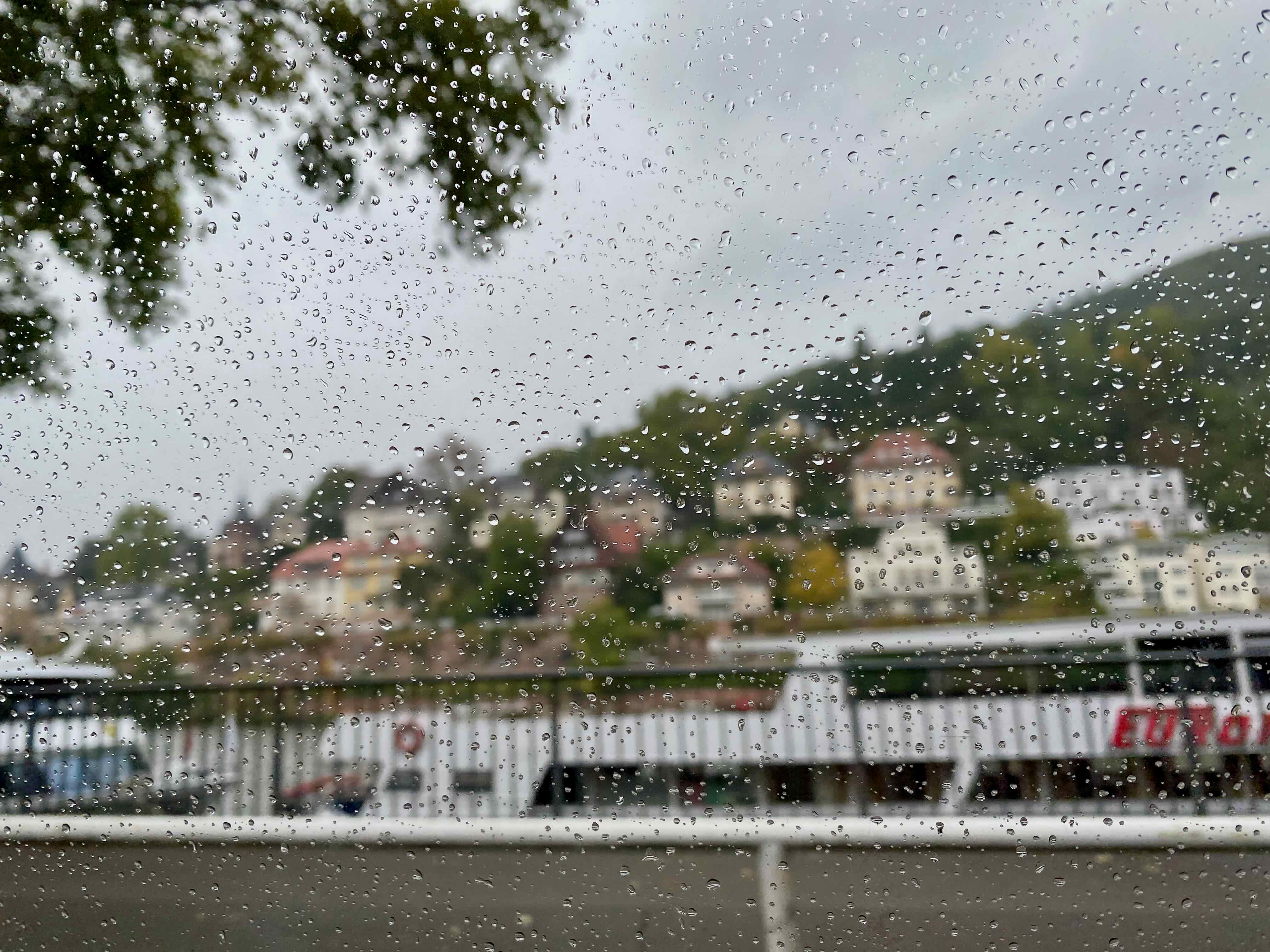
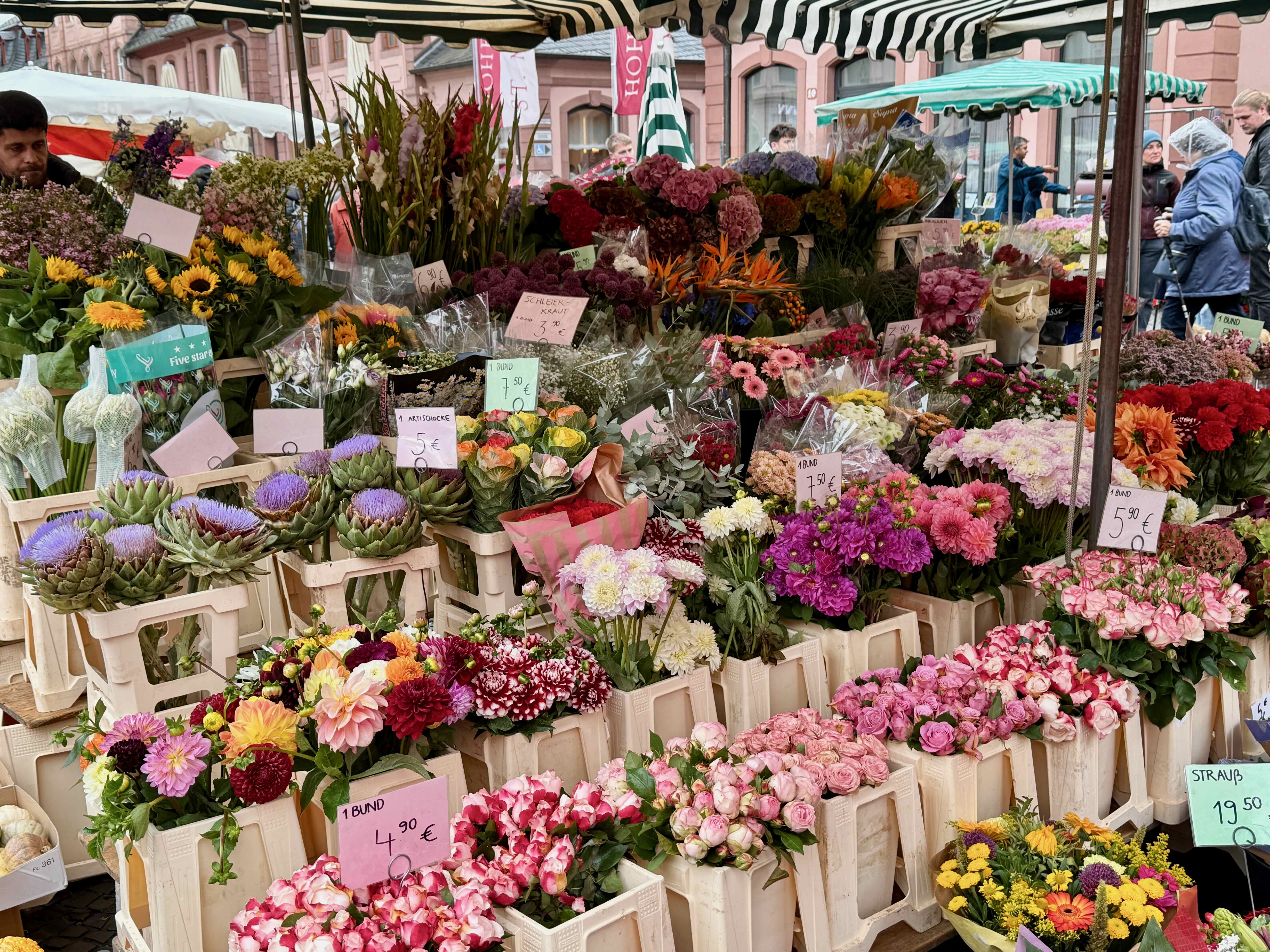
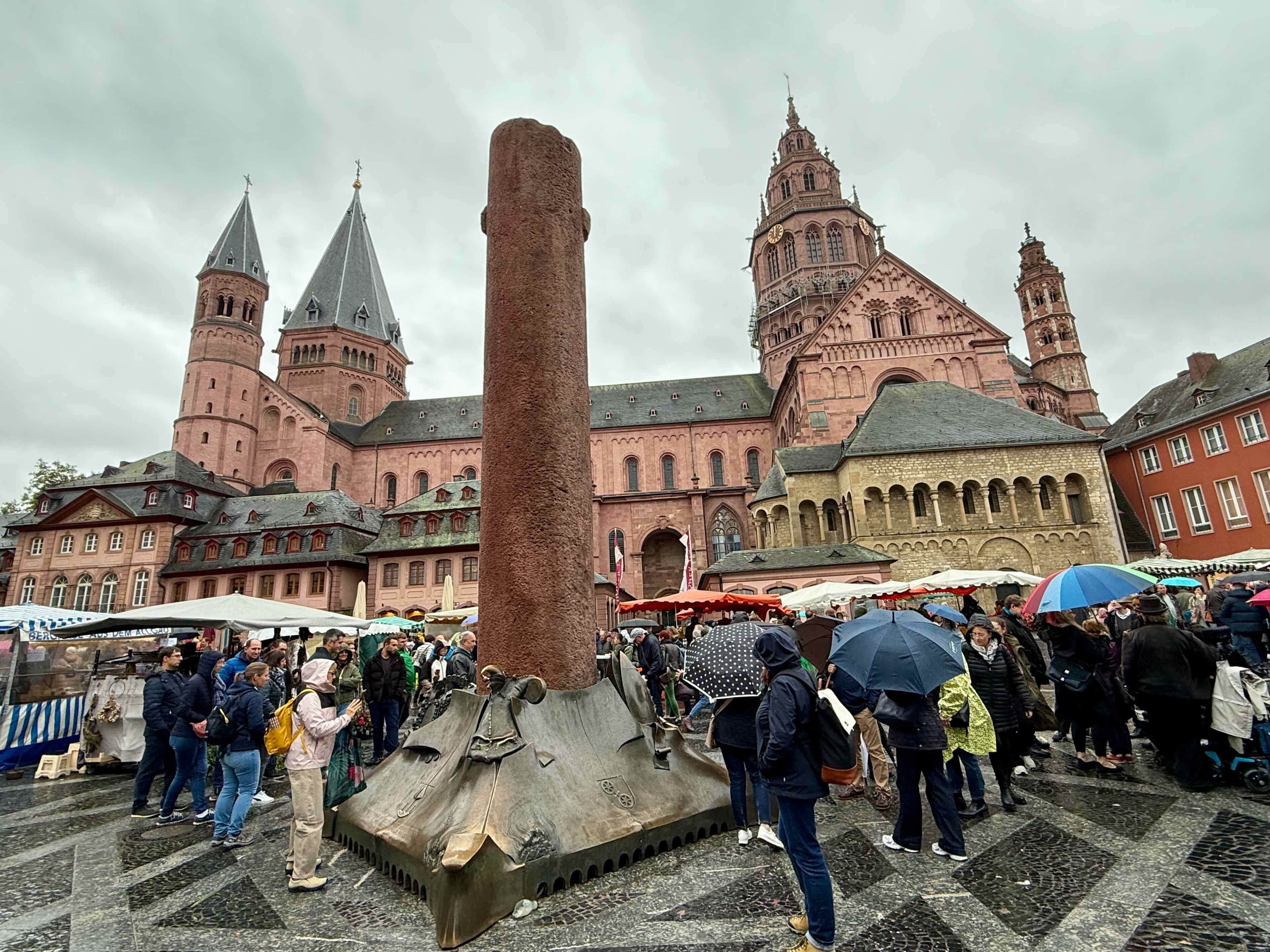
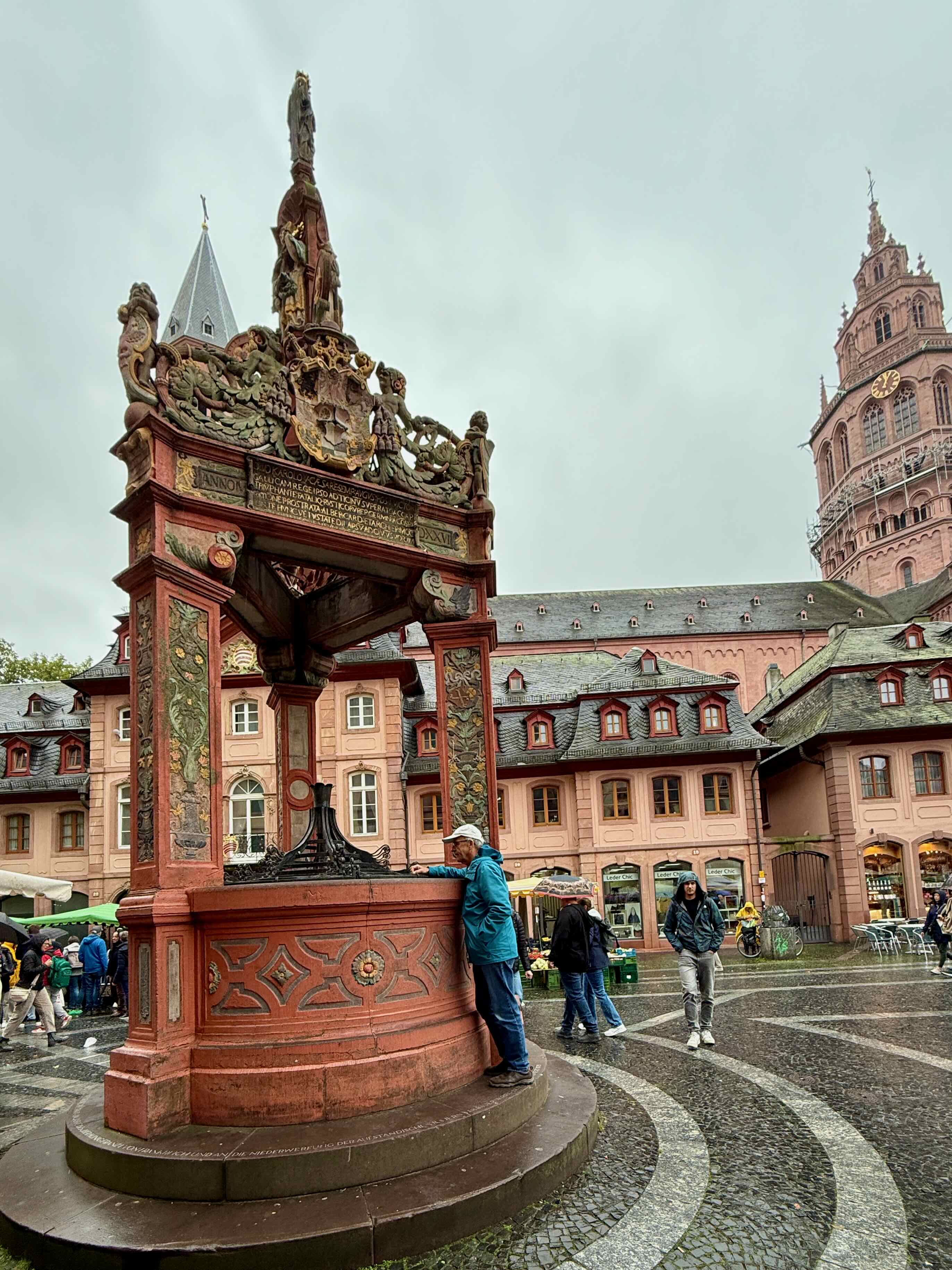
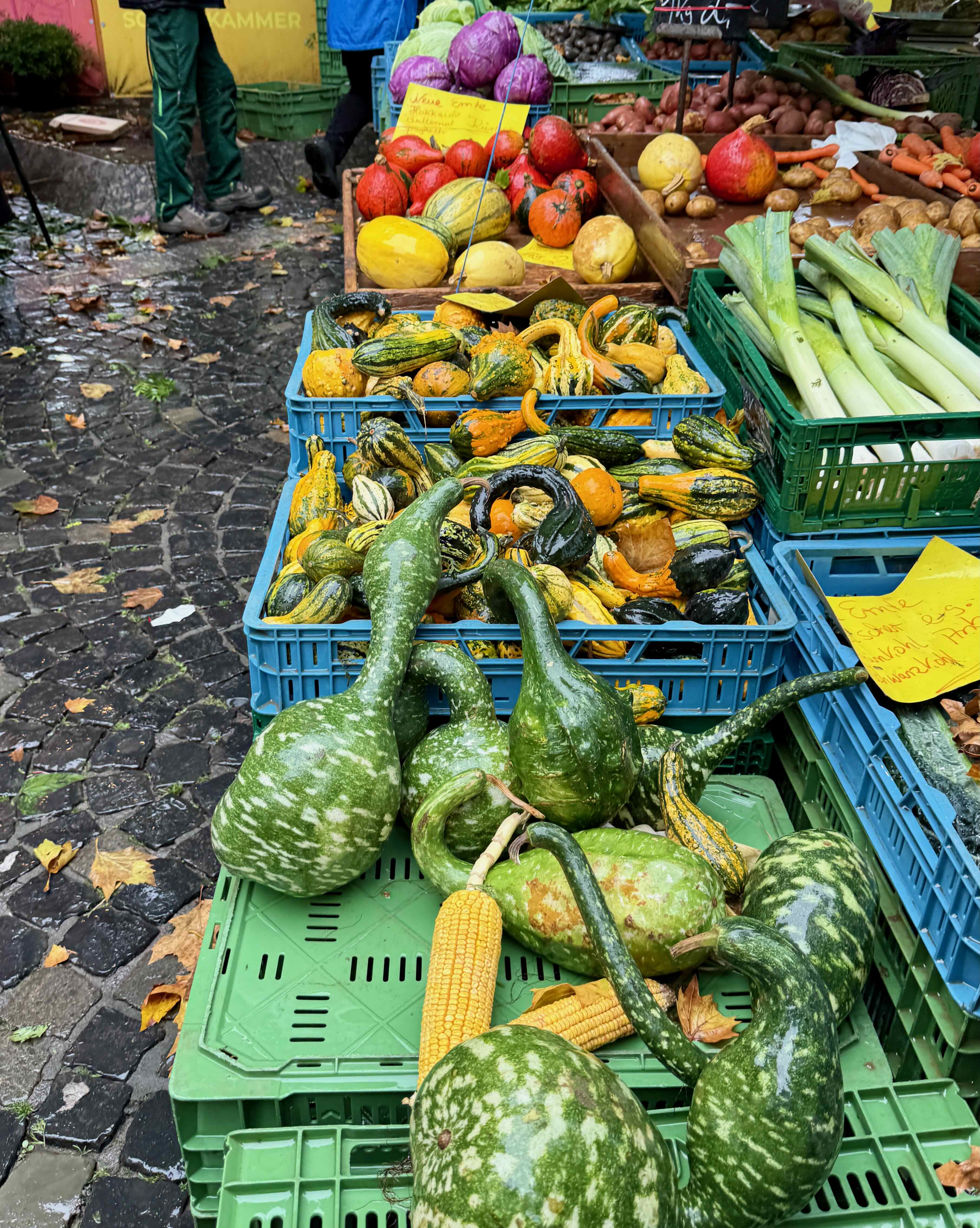
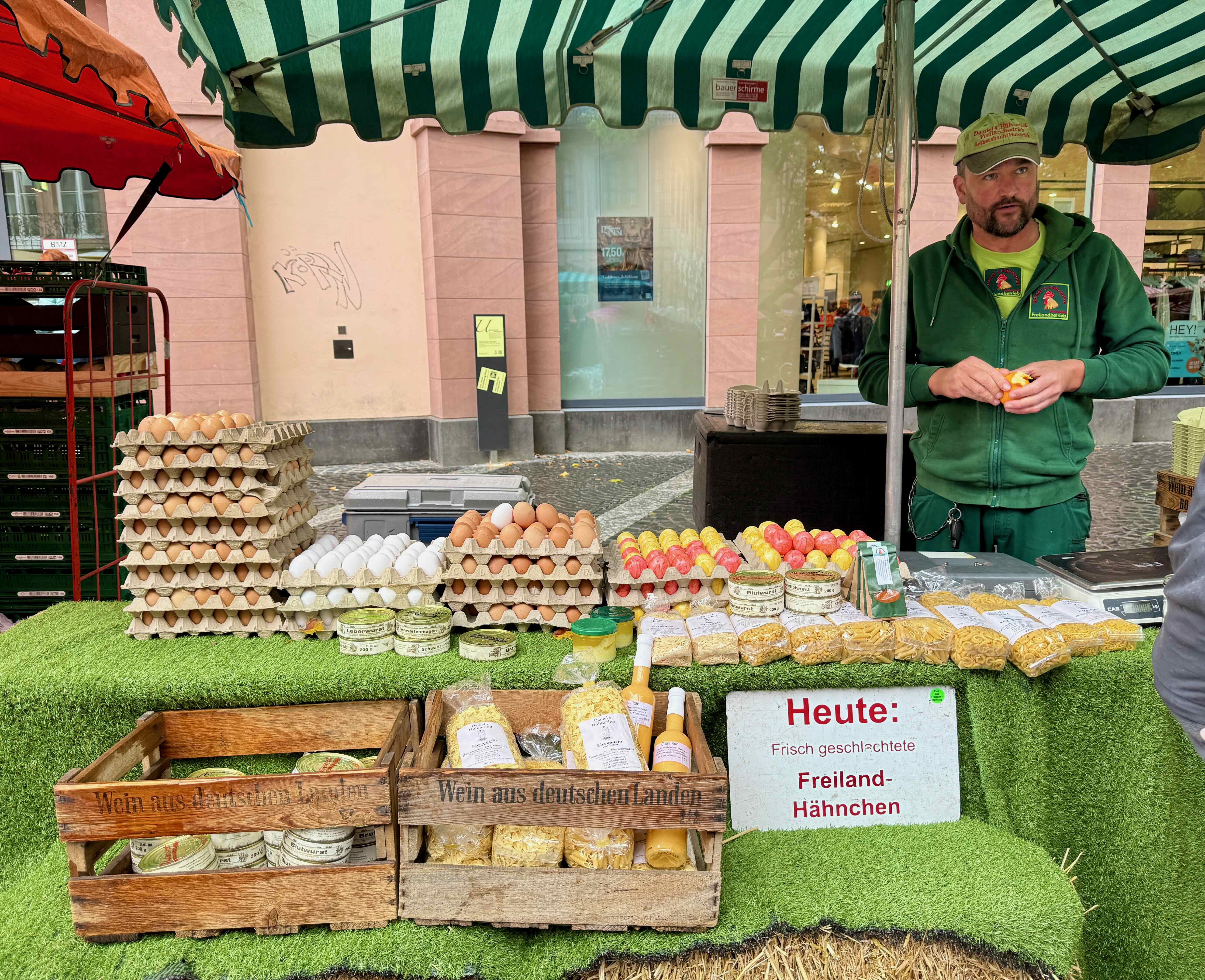
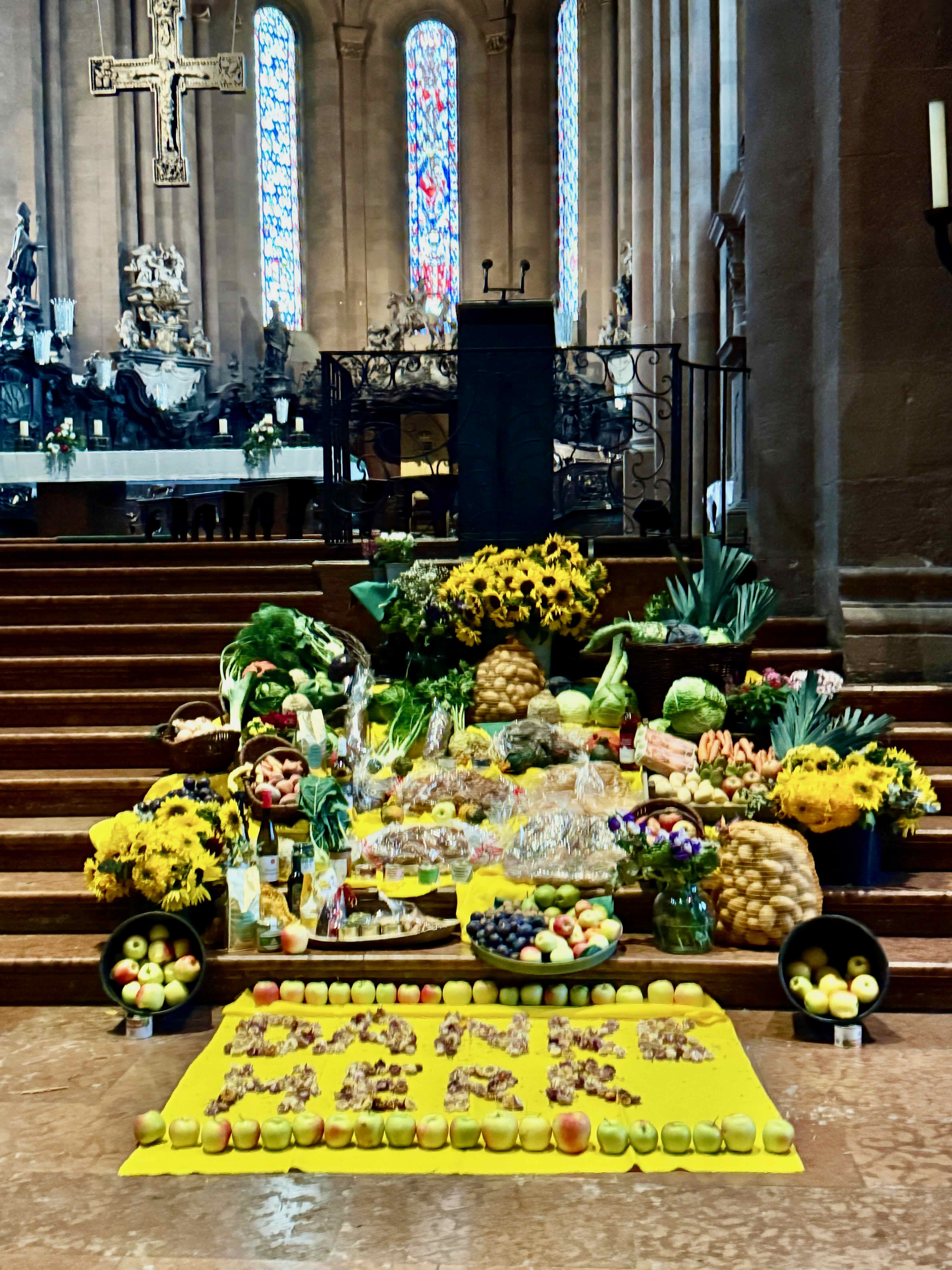
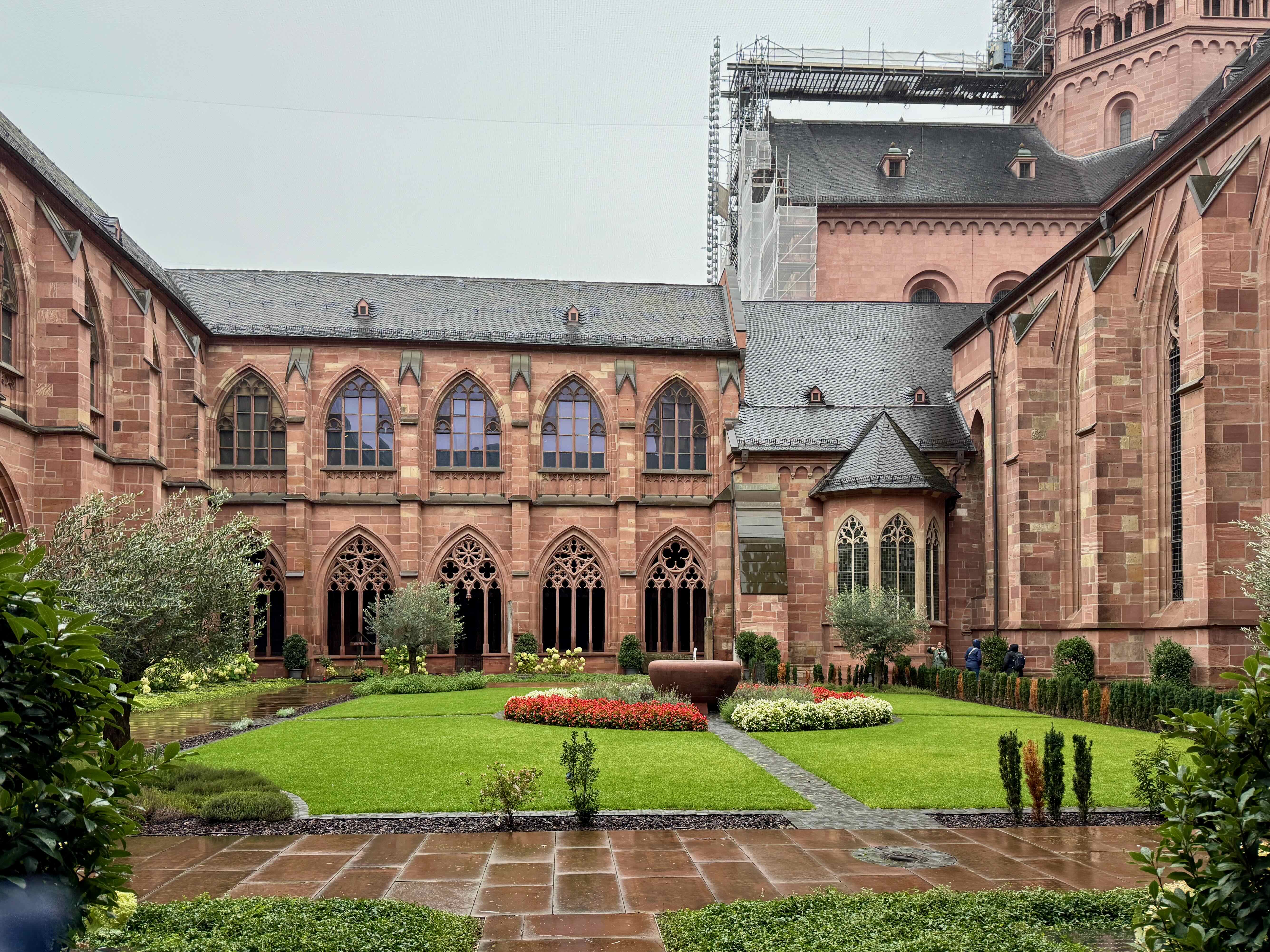
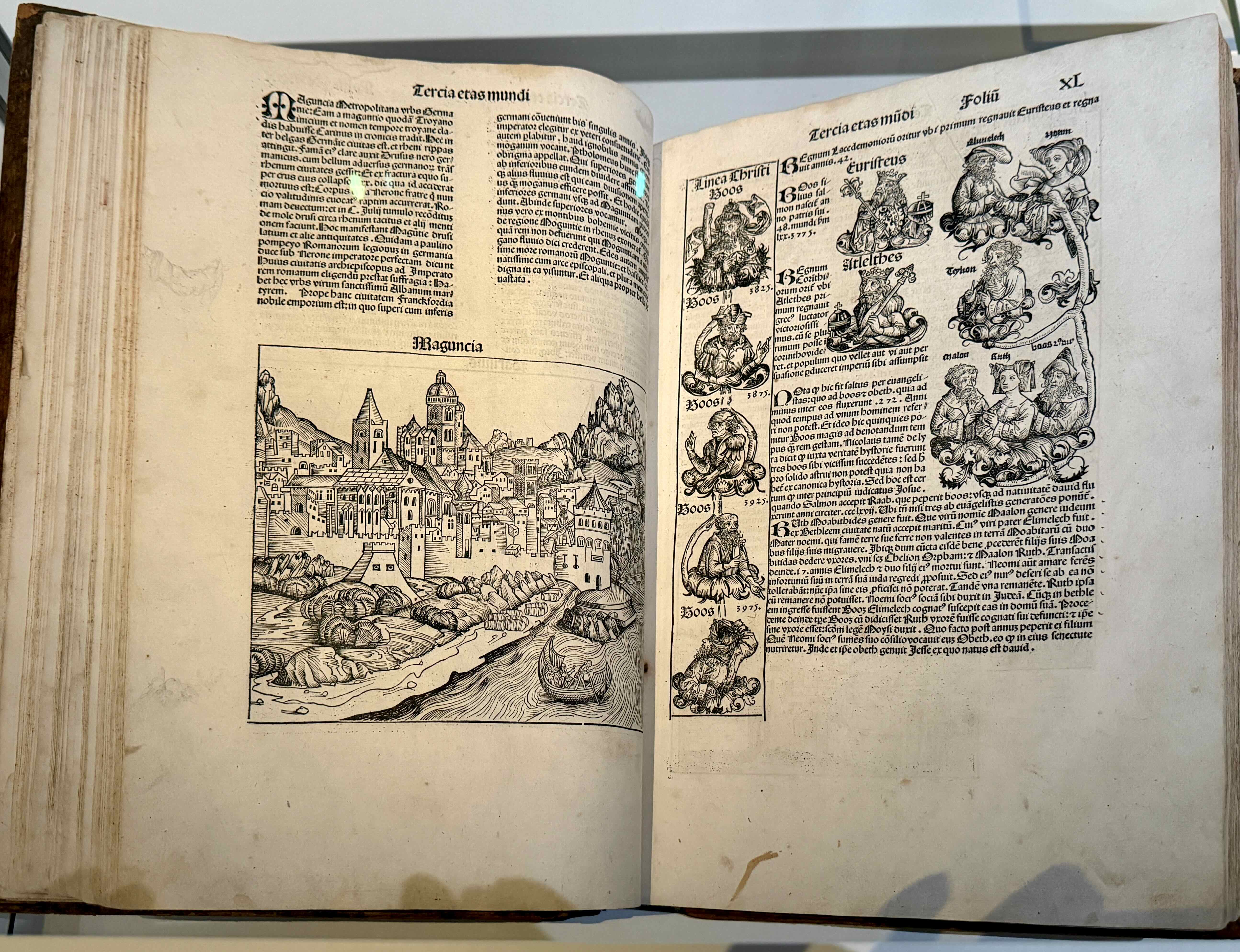
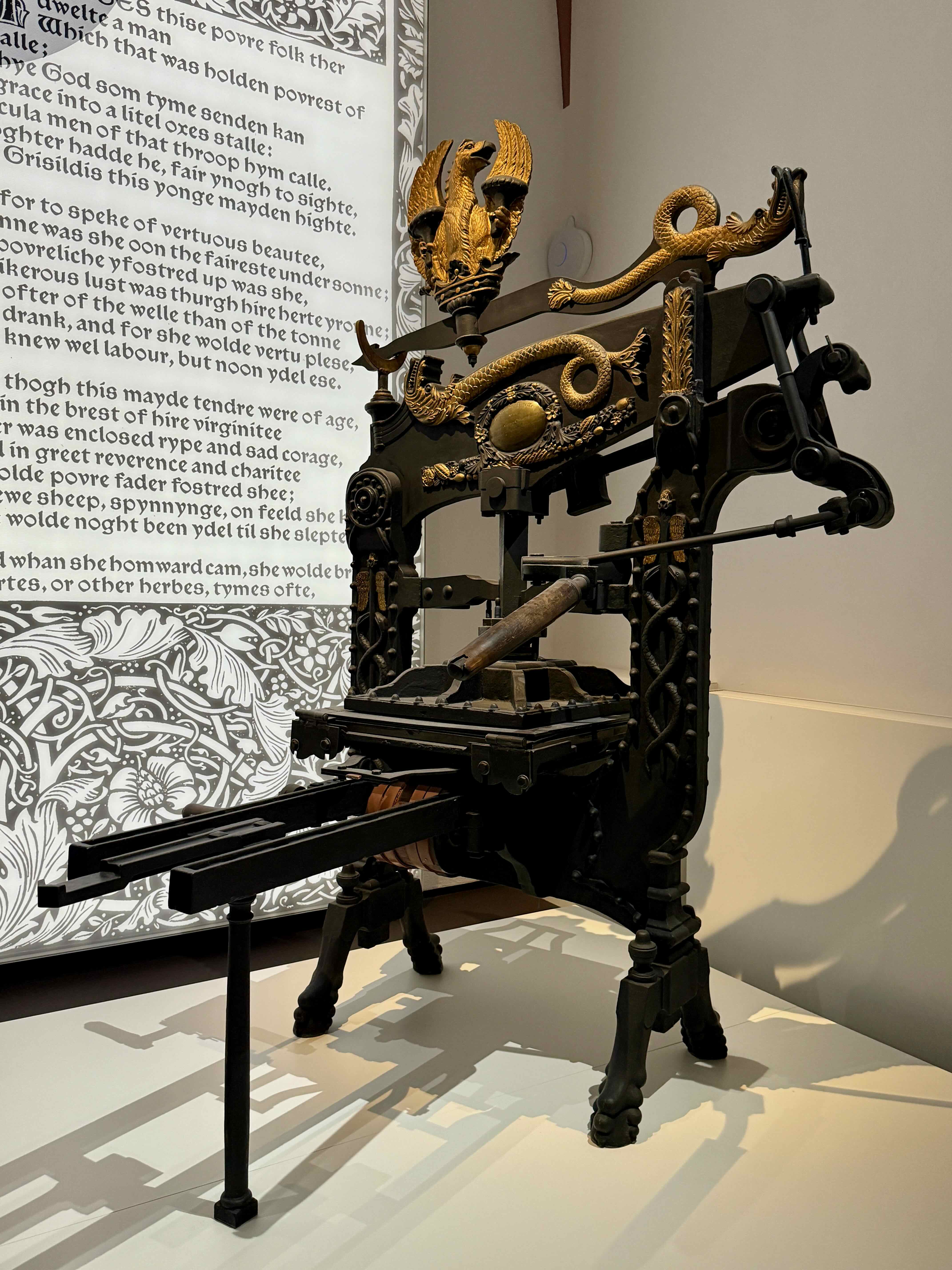
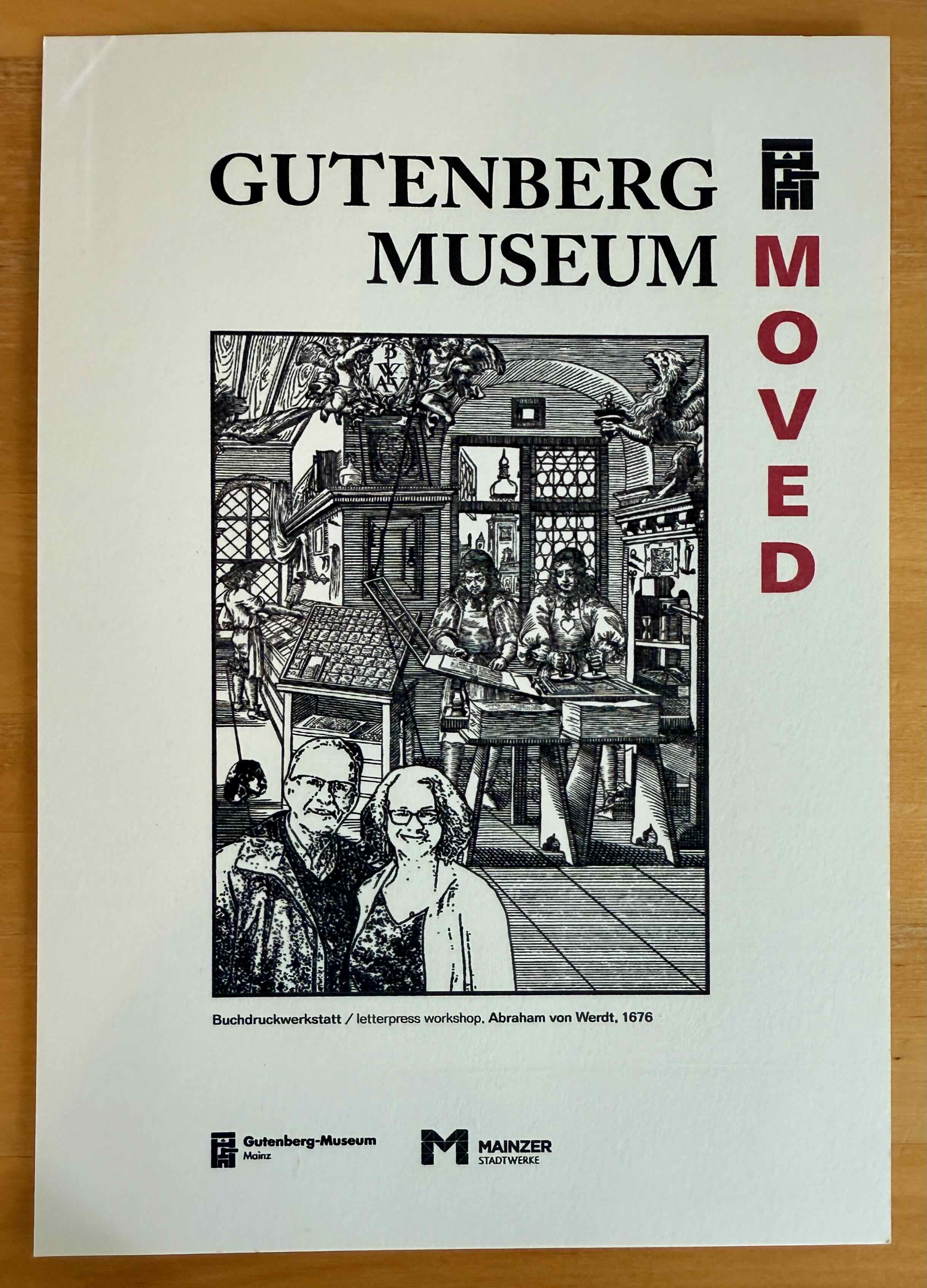
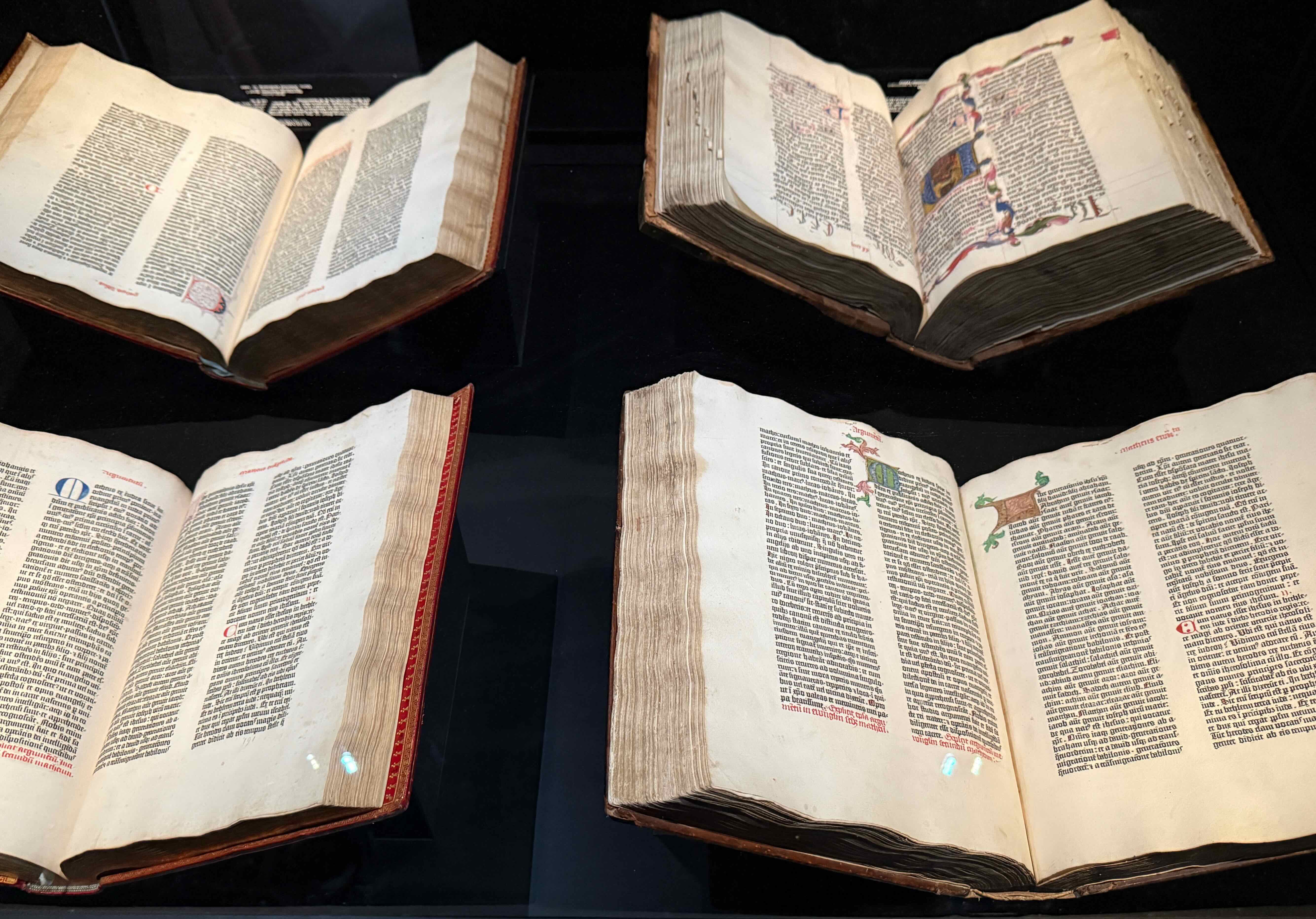
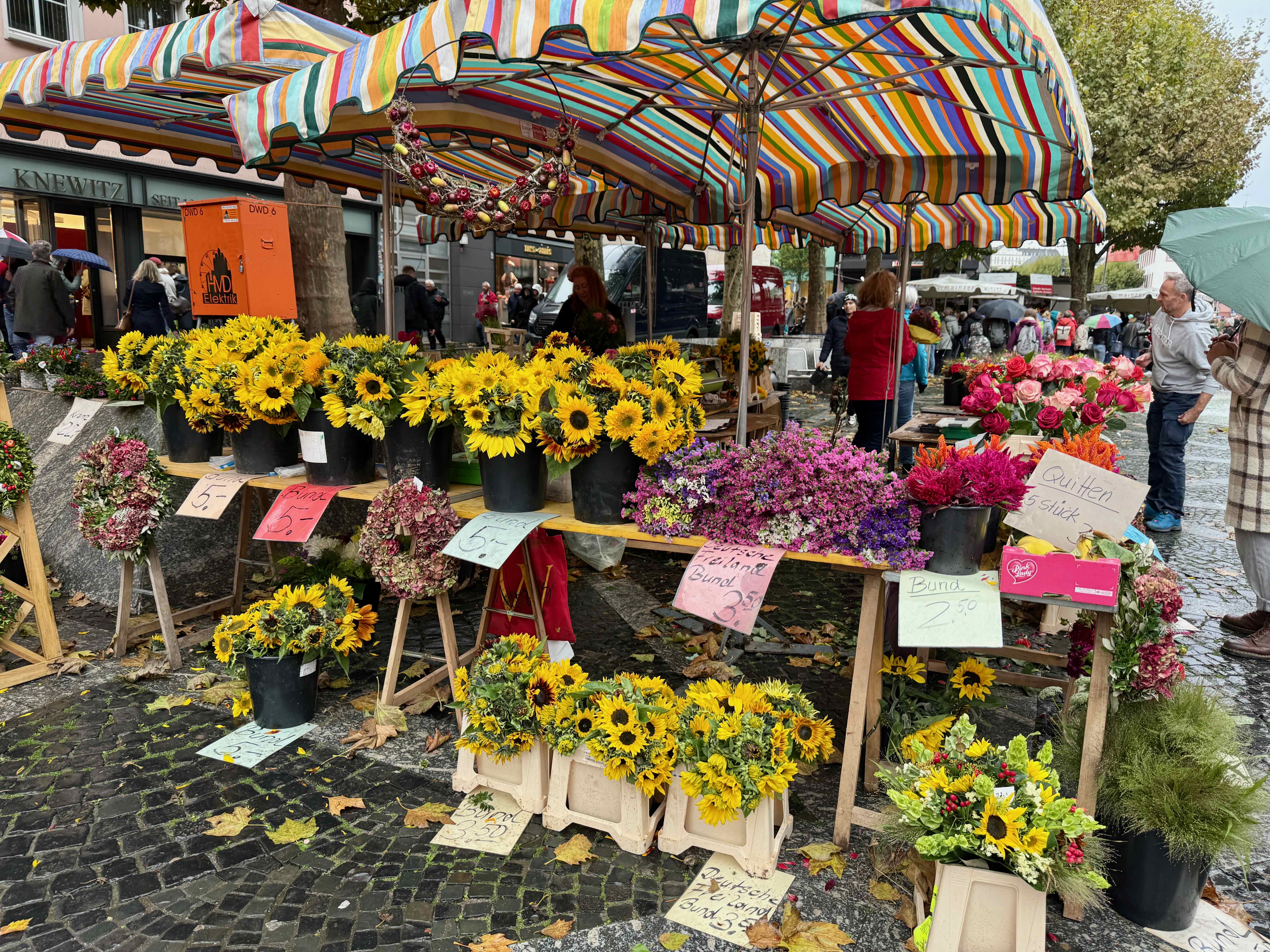 Next stop in the Mainz Cathedral. We are met at the door and told that there is a concert starting and if we enter the church we have to stay for the 45 minute concert. Sounds perfect as it is raining and cool outside!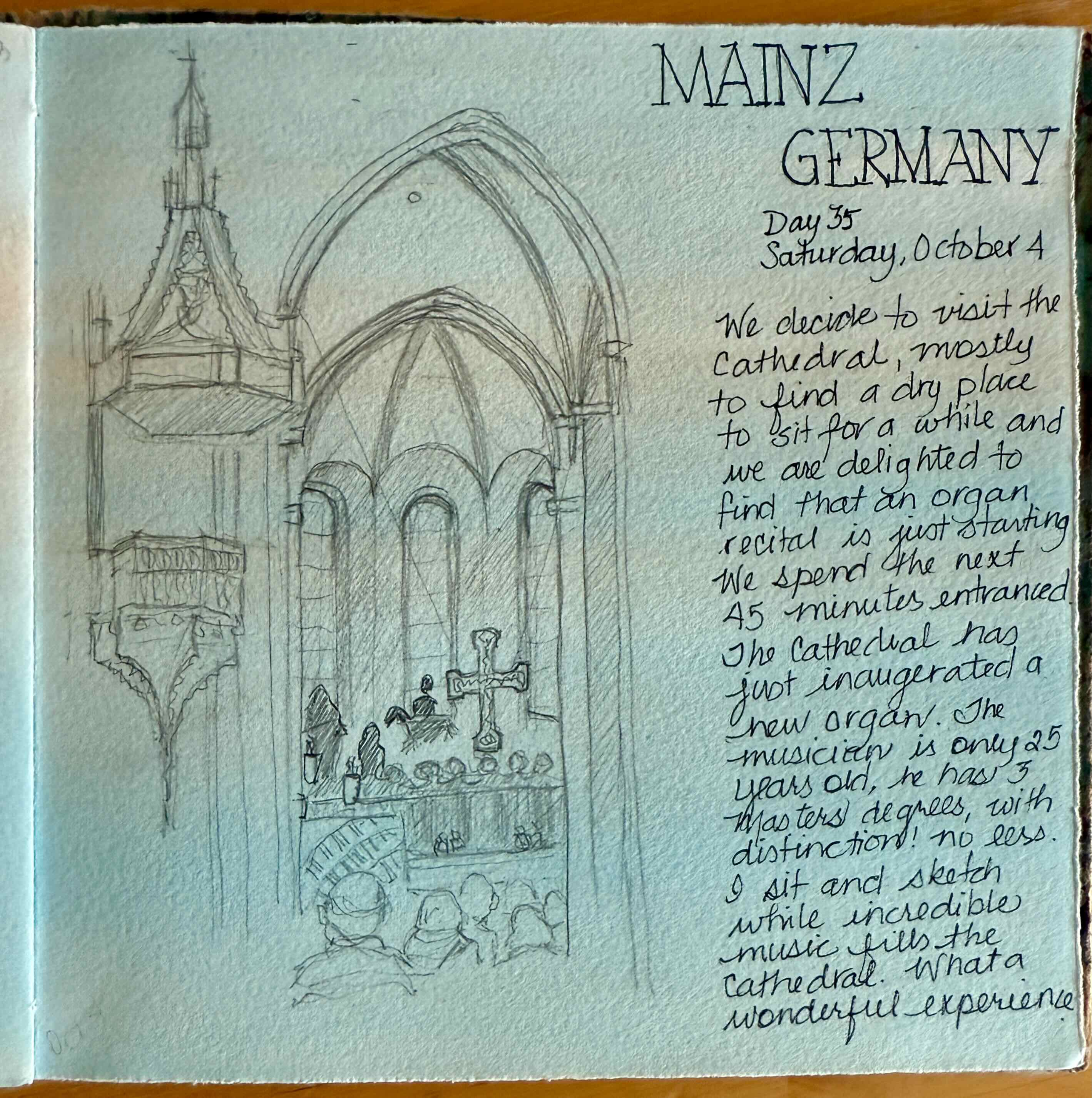
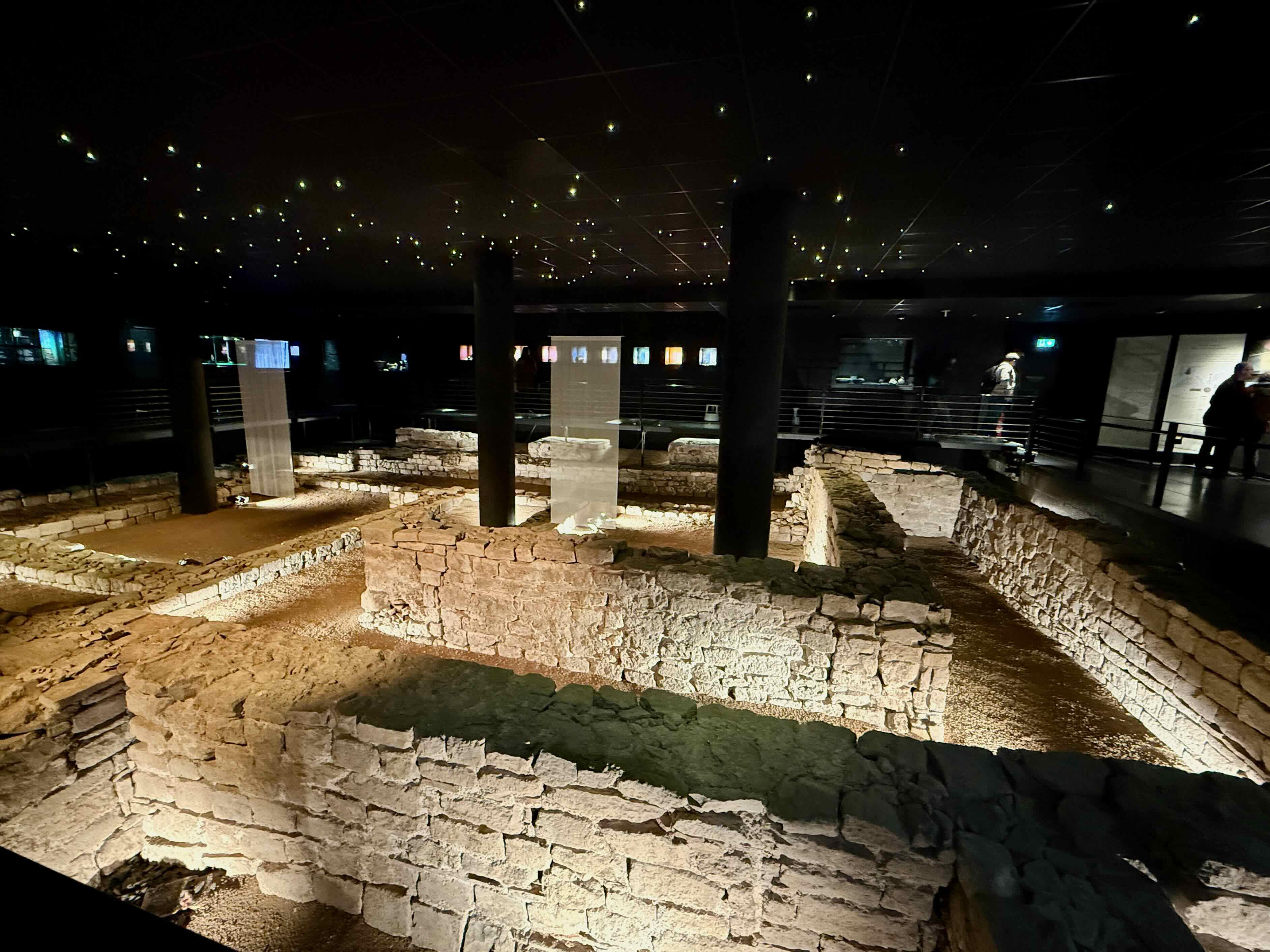
 Next on Bob’s agenda is a visit to a small museum underneath a shopping mall. We see Roman ruins from before the fall of the Roman Empire in the 5th century. These ruins were discovered when excavations began for the shopping mall. The area was thoroughly excavated and recorded, but ultimately the mall was built and most of the ruins were destroyed.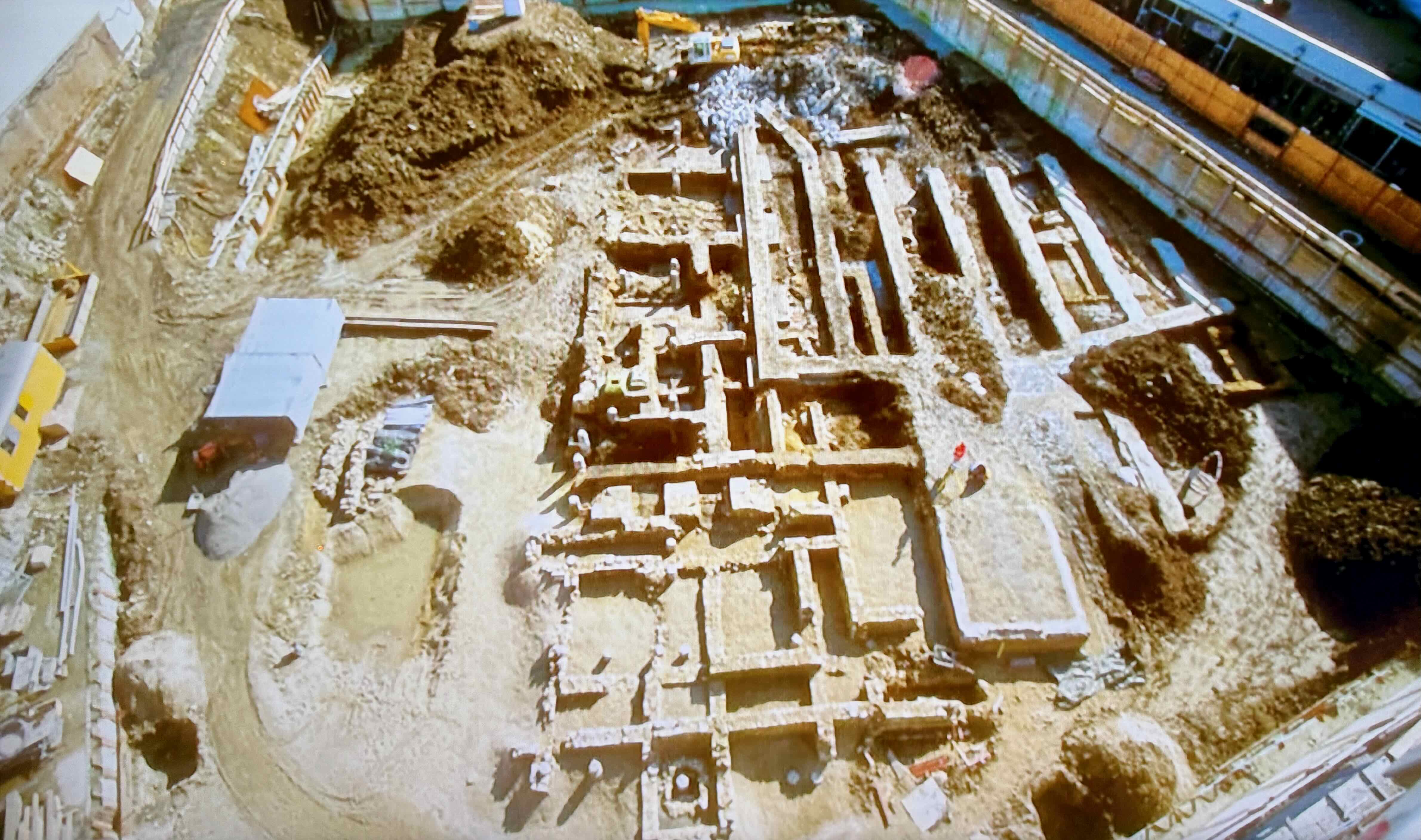
 Some of the items found when the ruins were excavated. Well endowed males were well represented.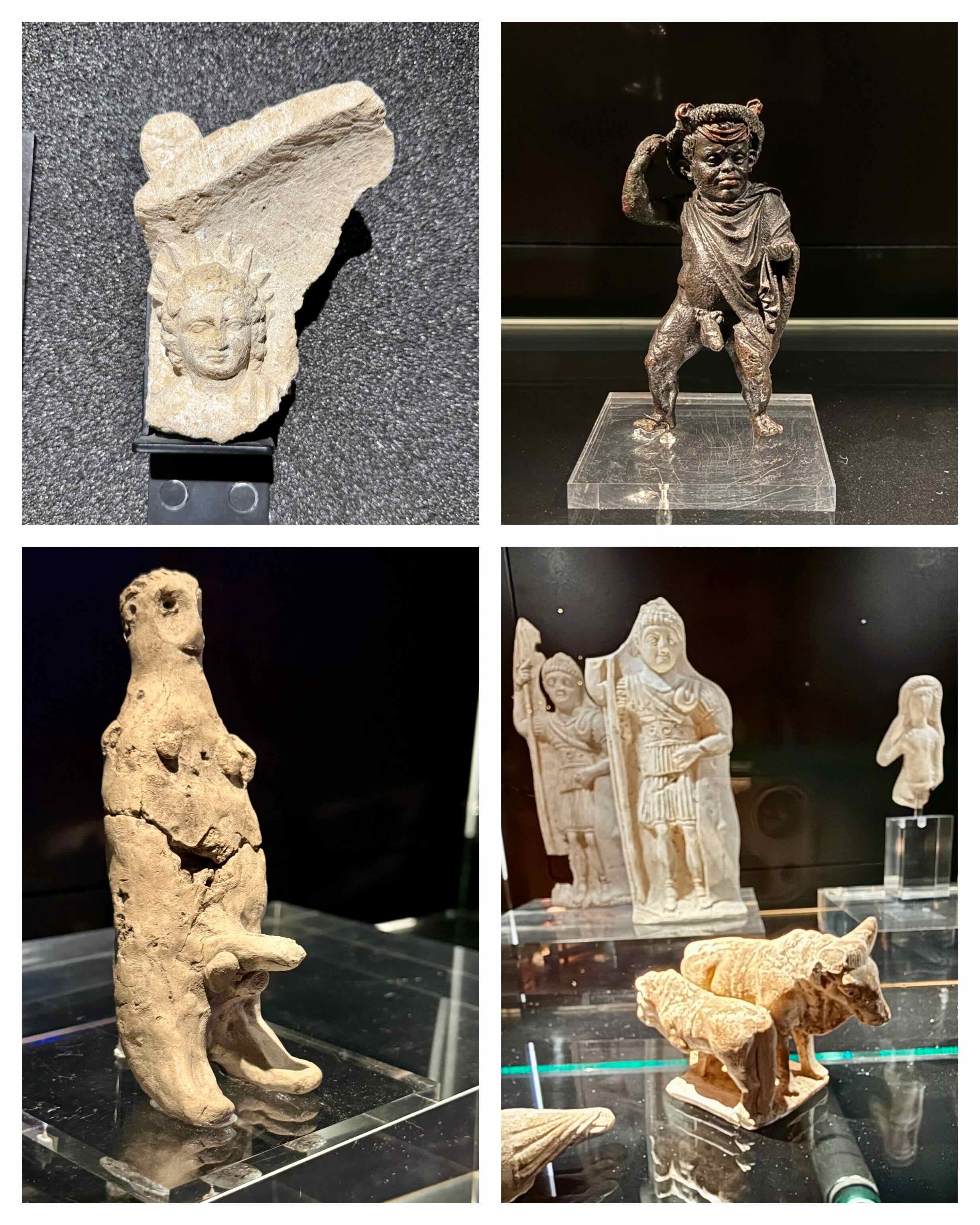
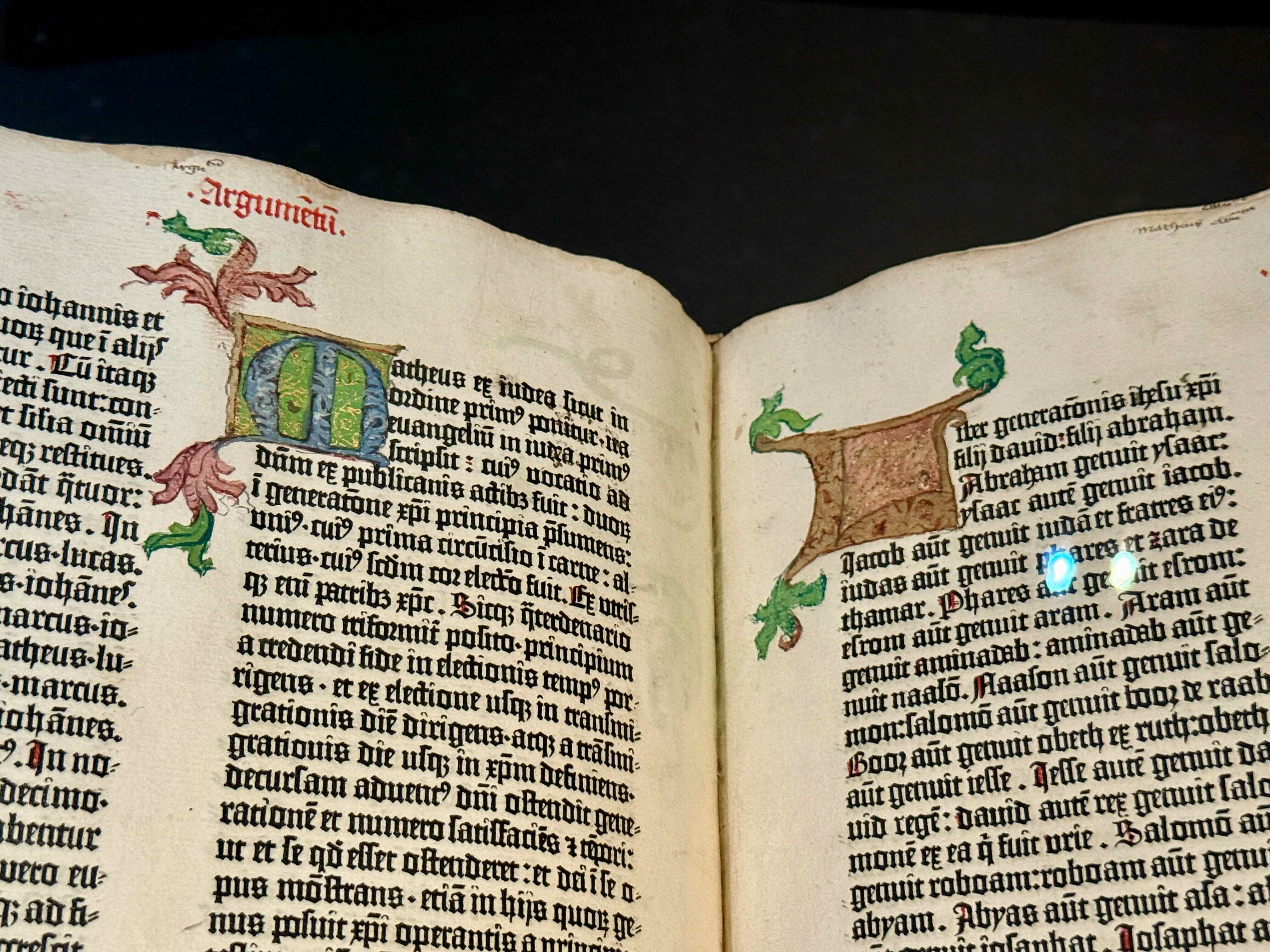
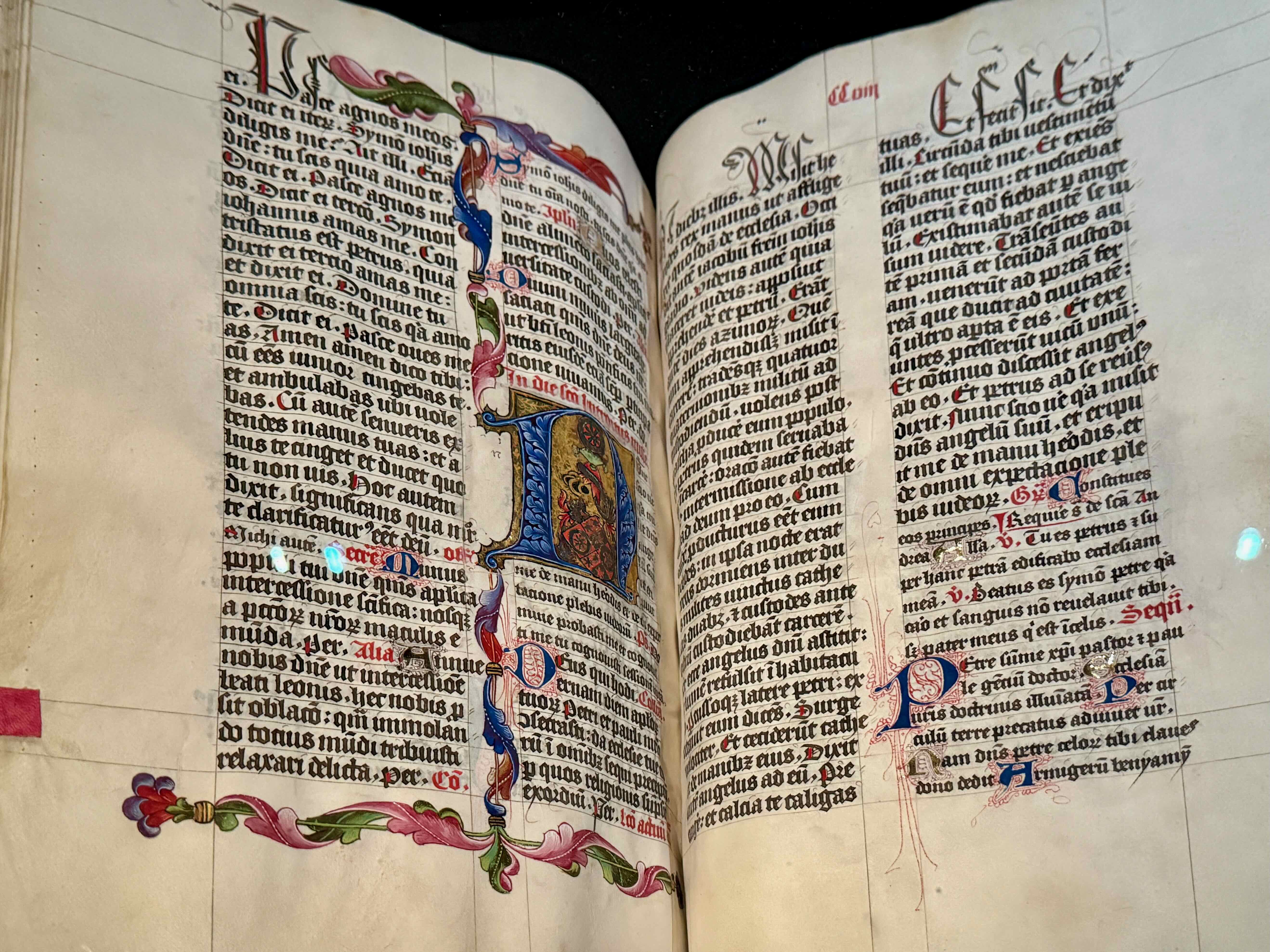
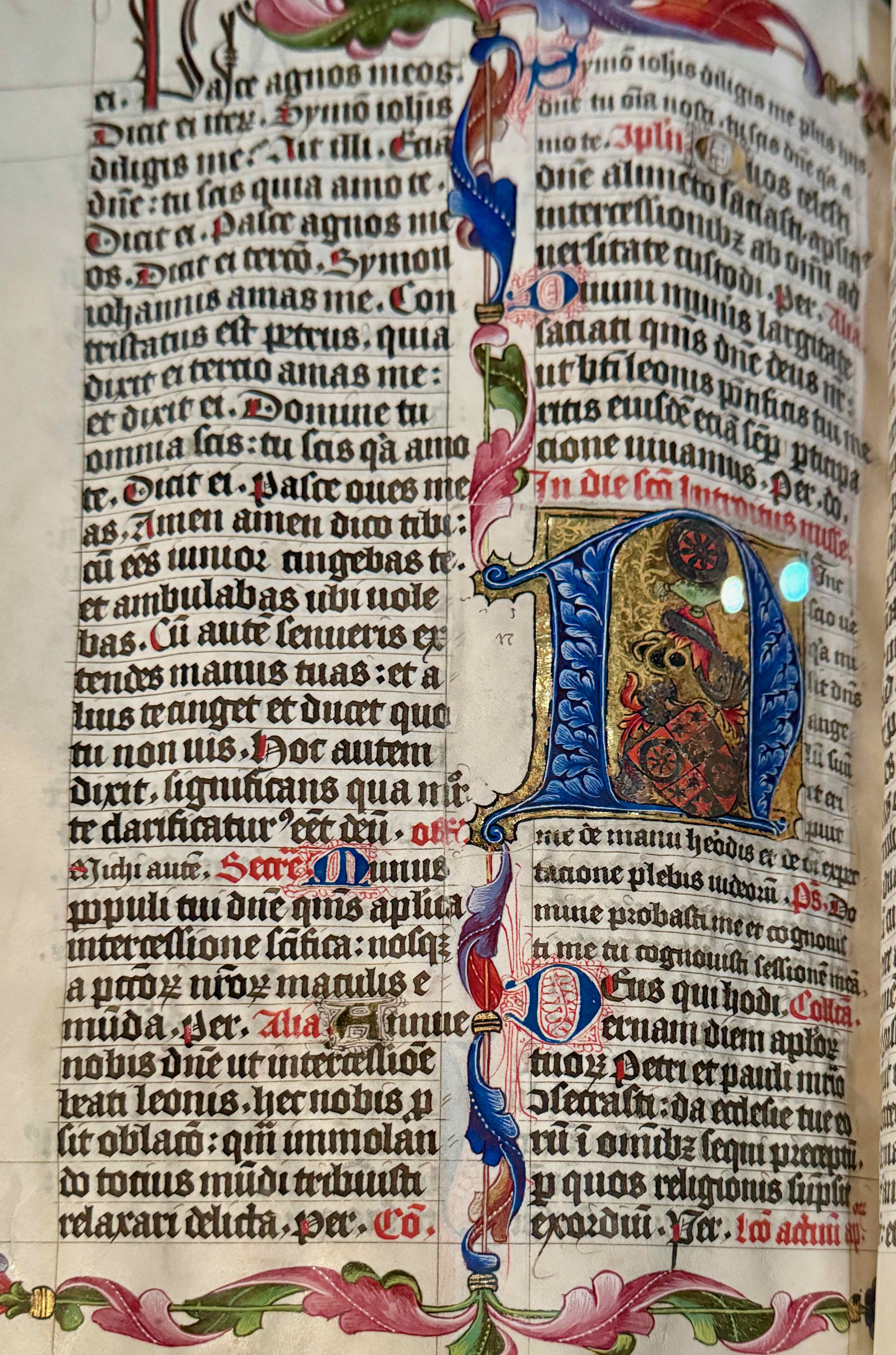

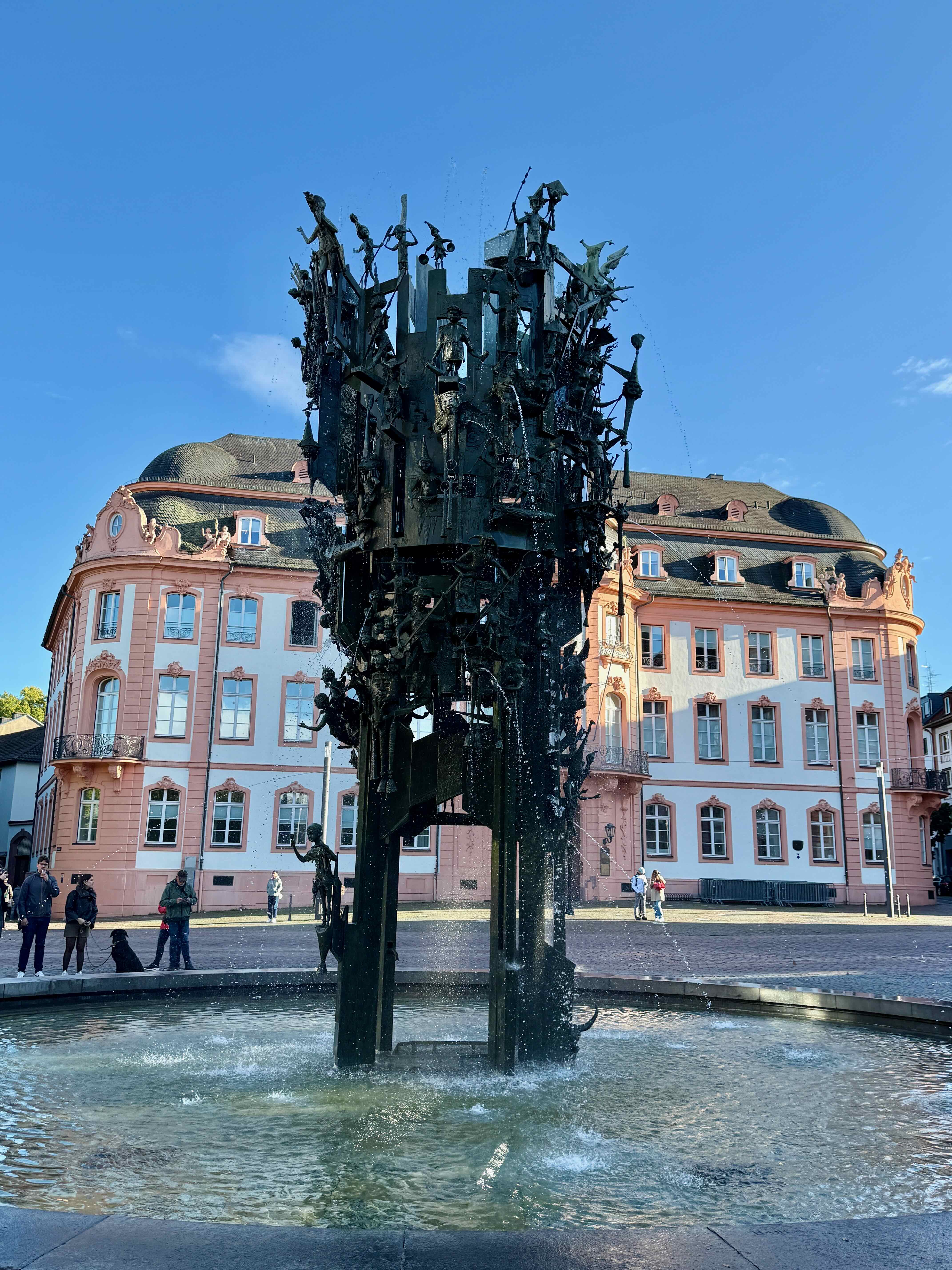
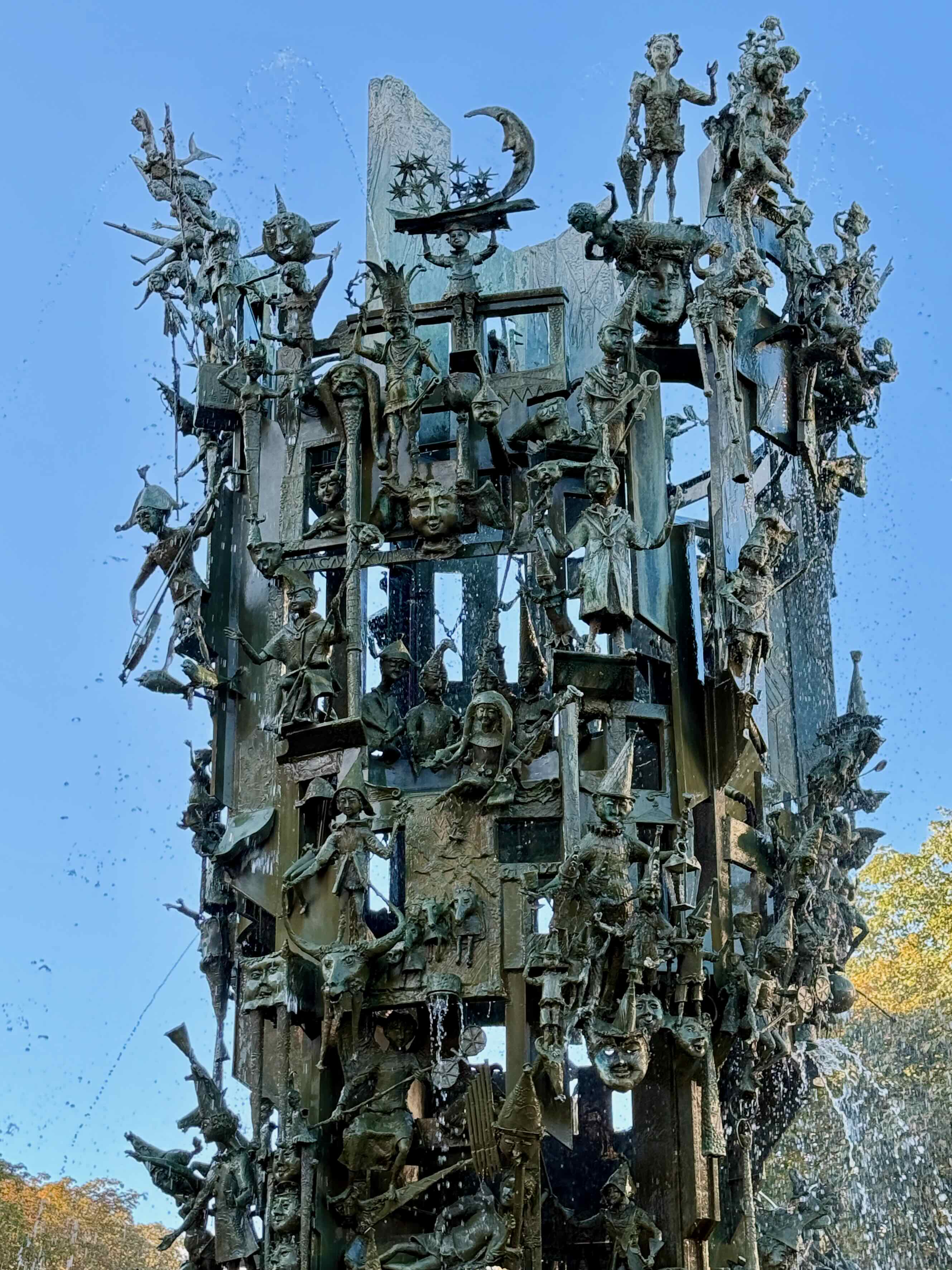
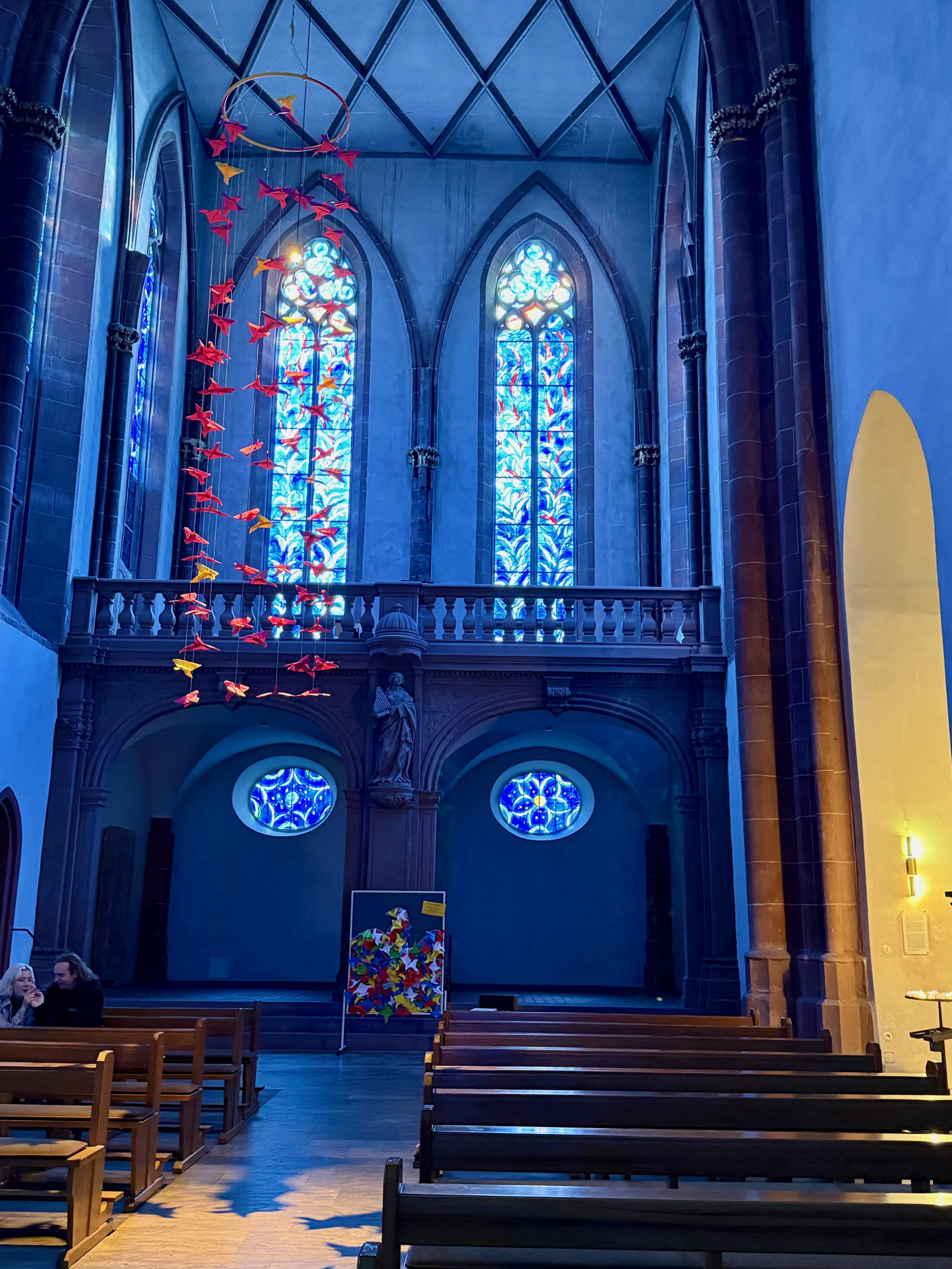
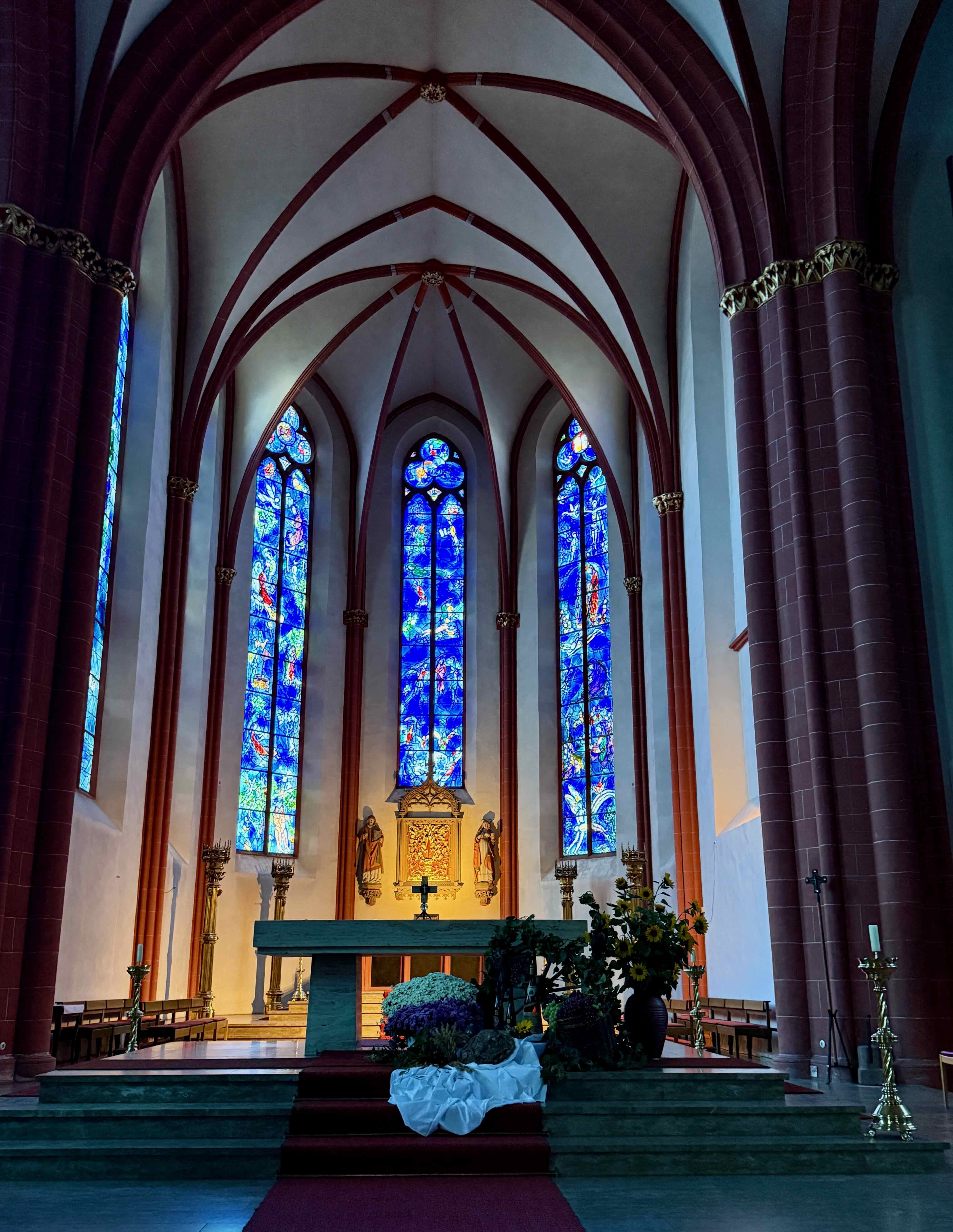

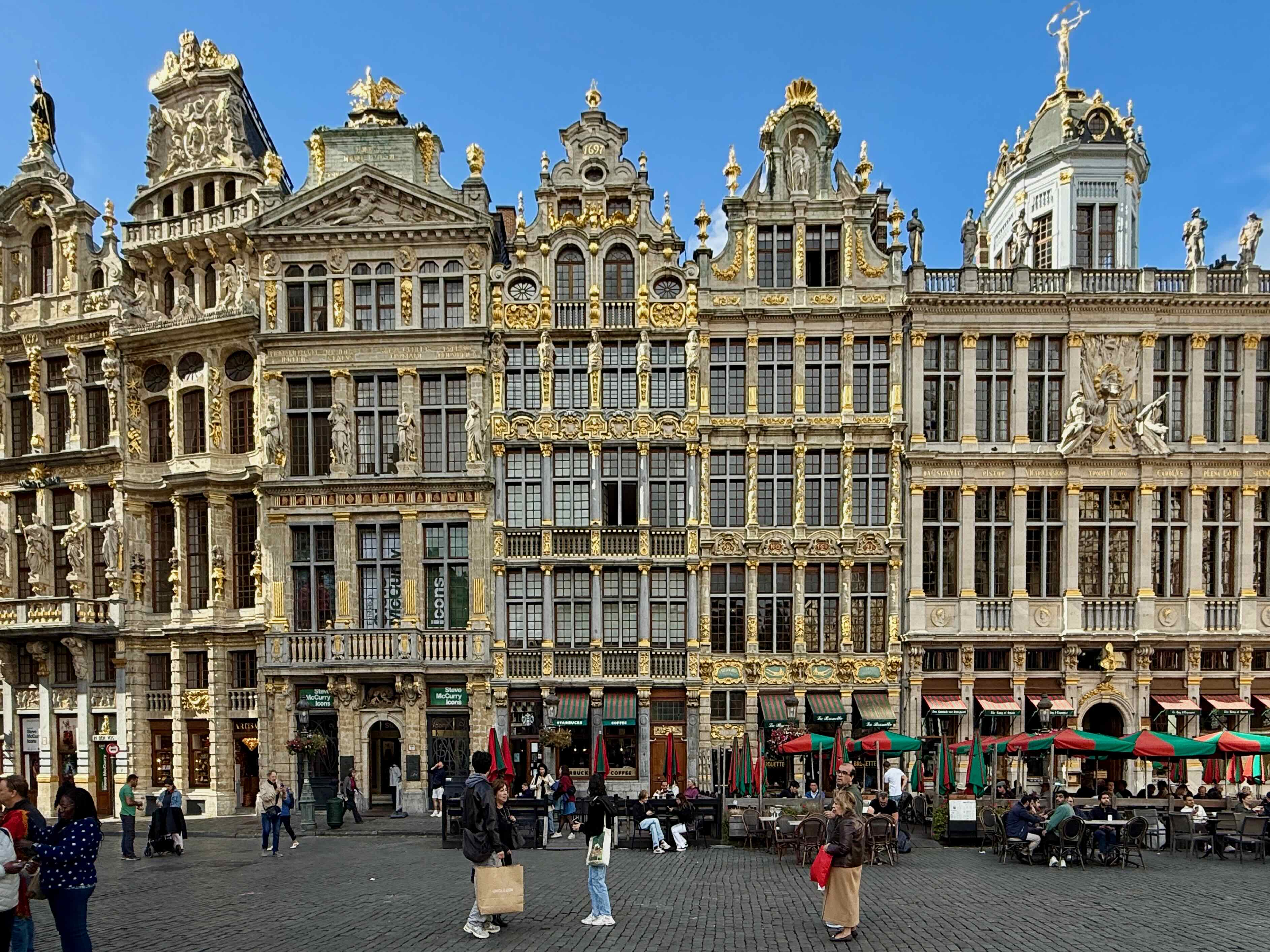
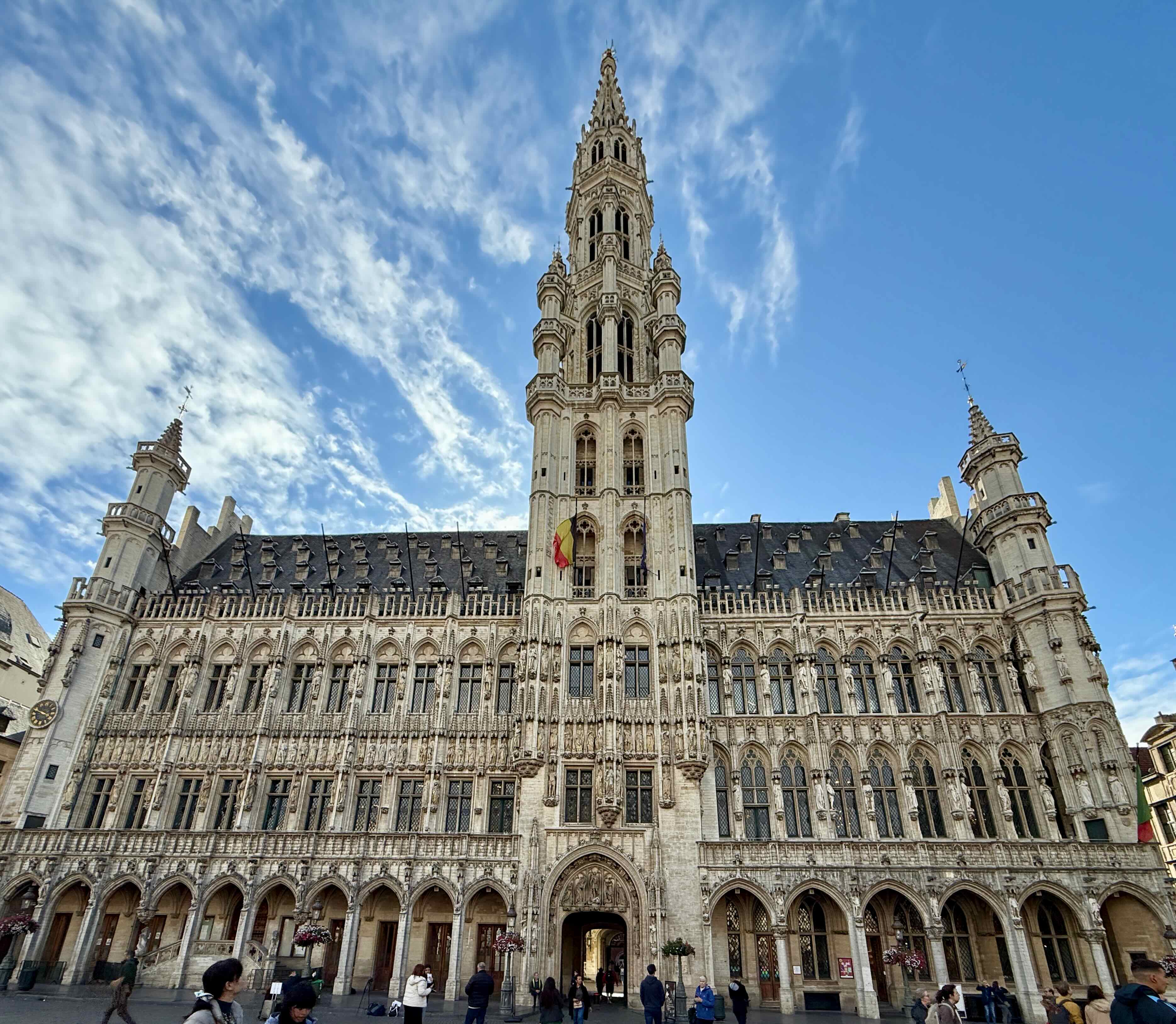

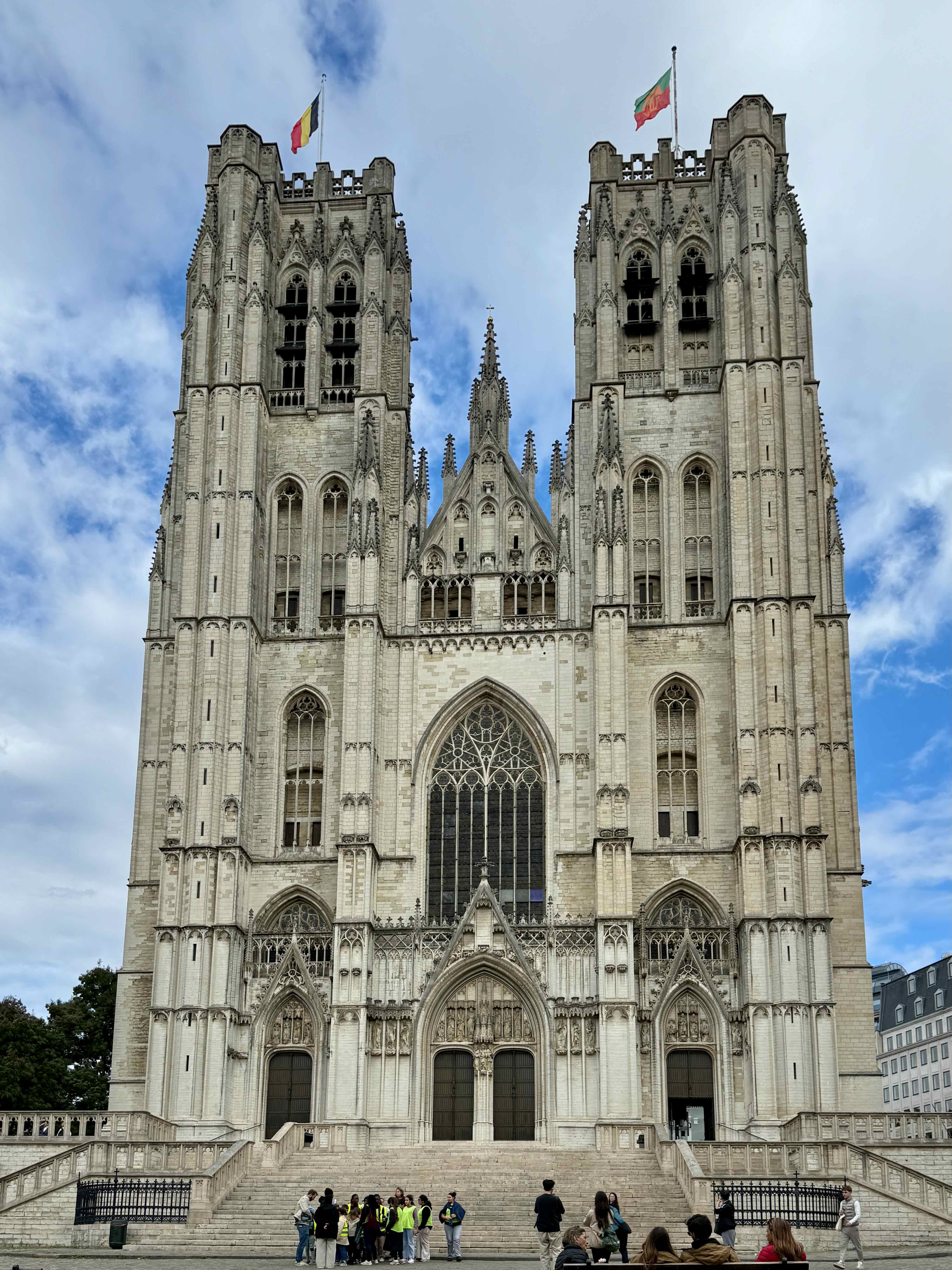
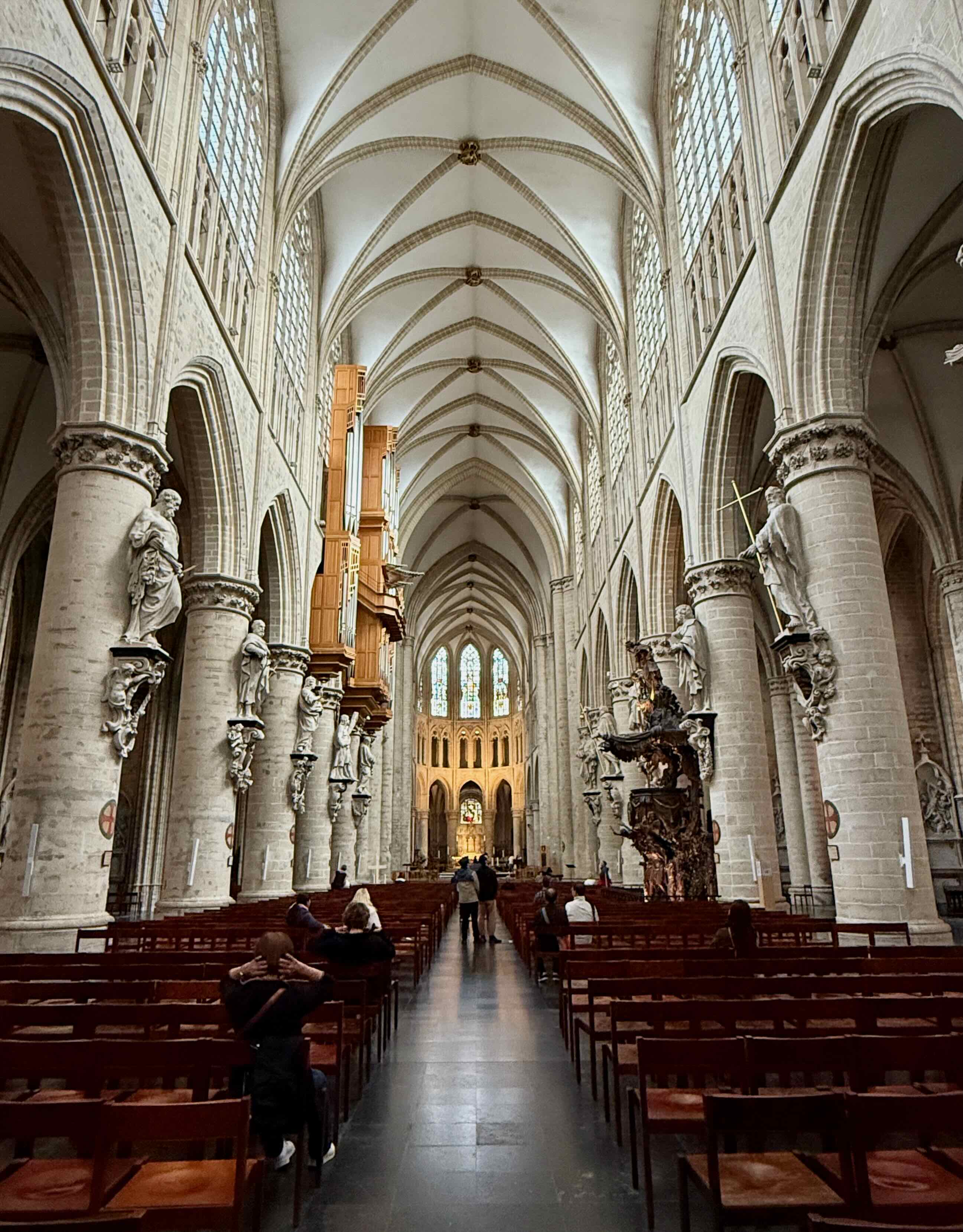 There are many stunning stained glass windows surrounding the ornate altar.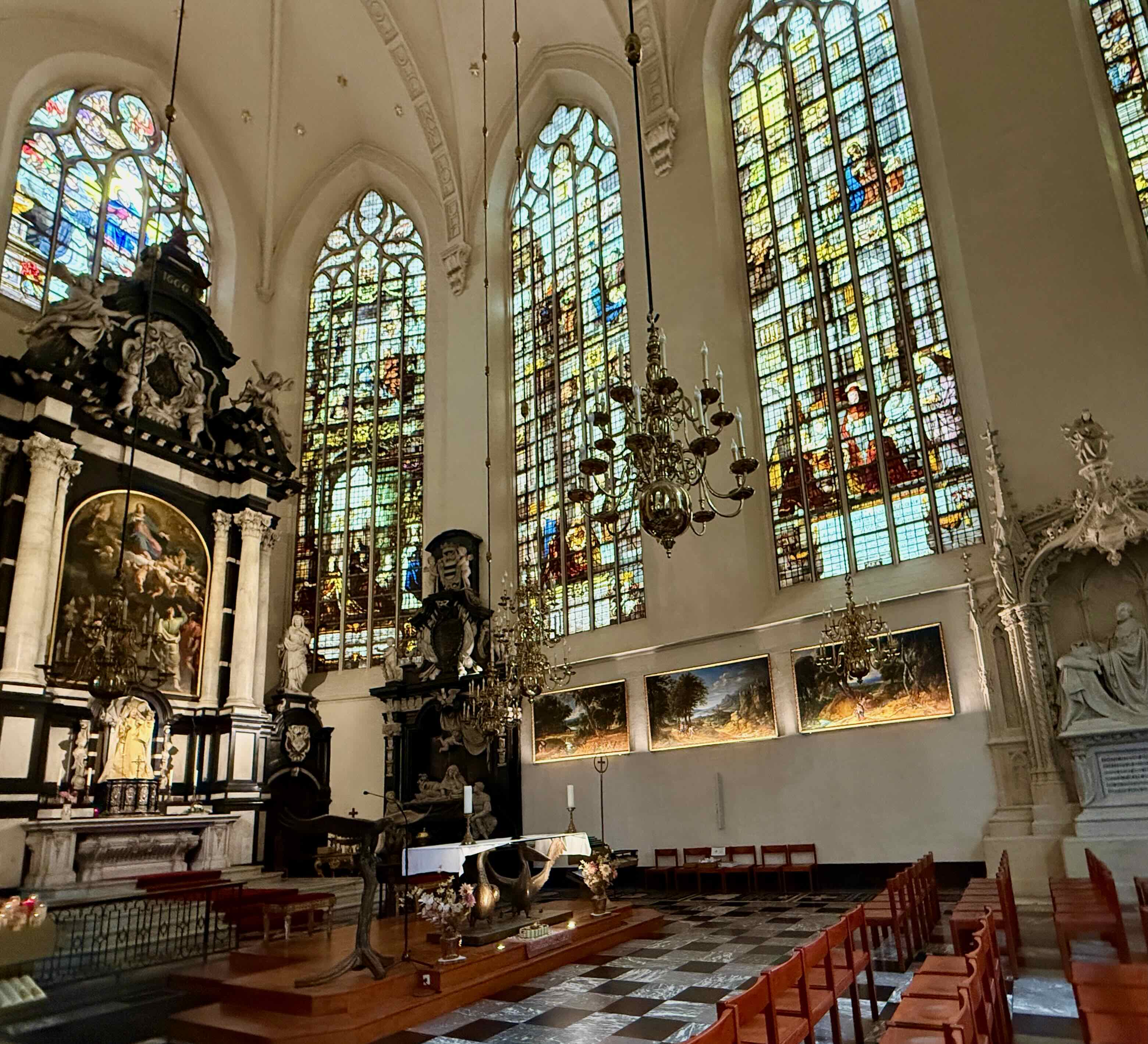
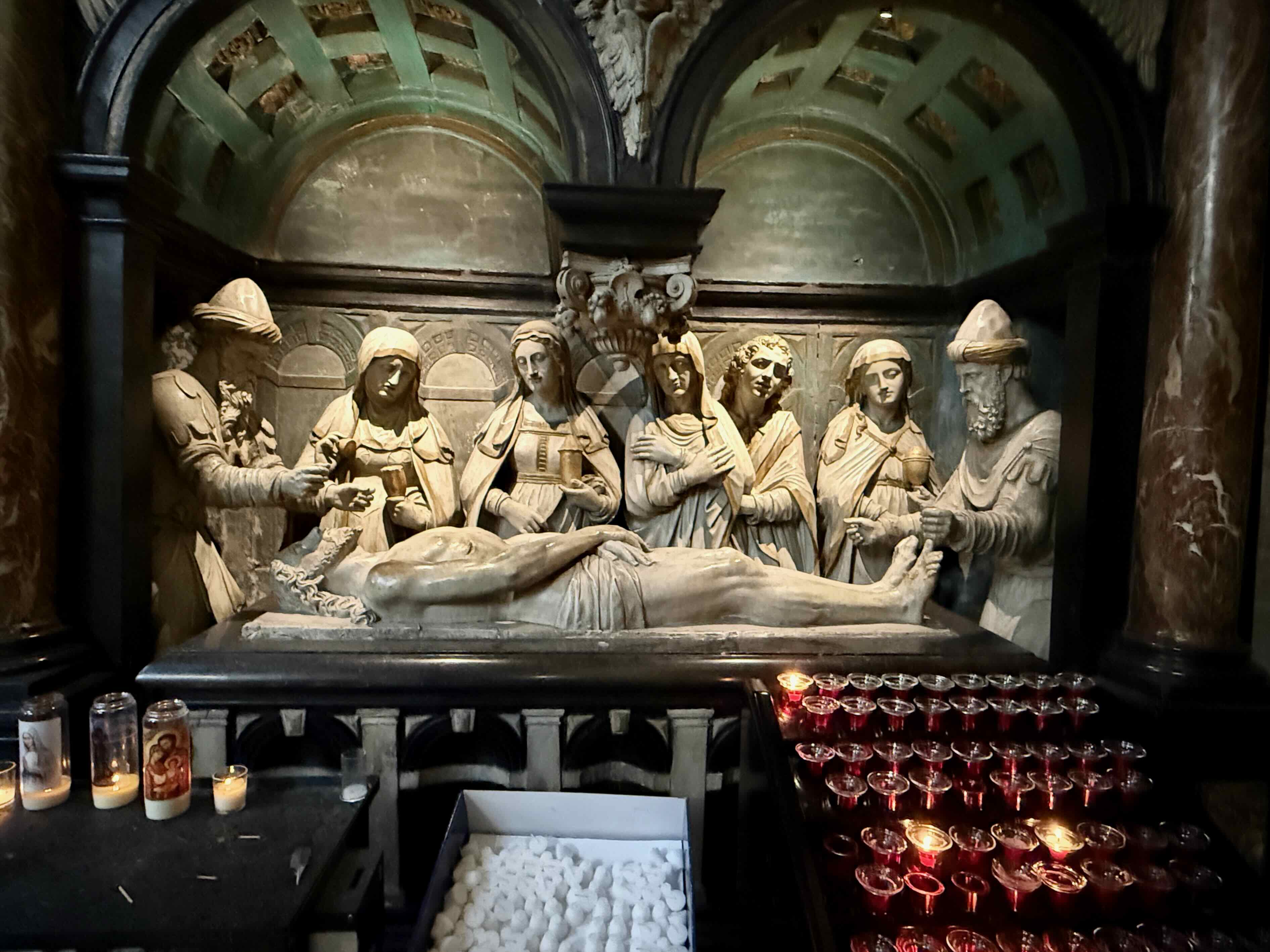
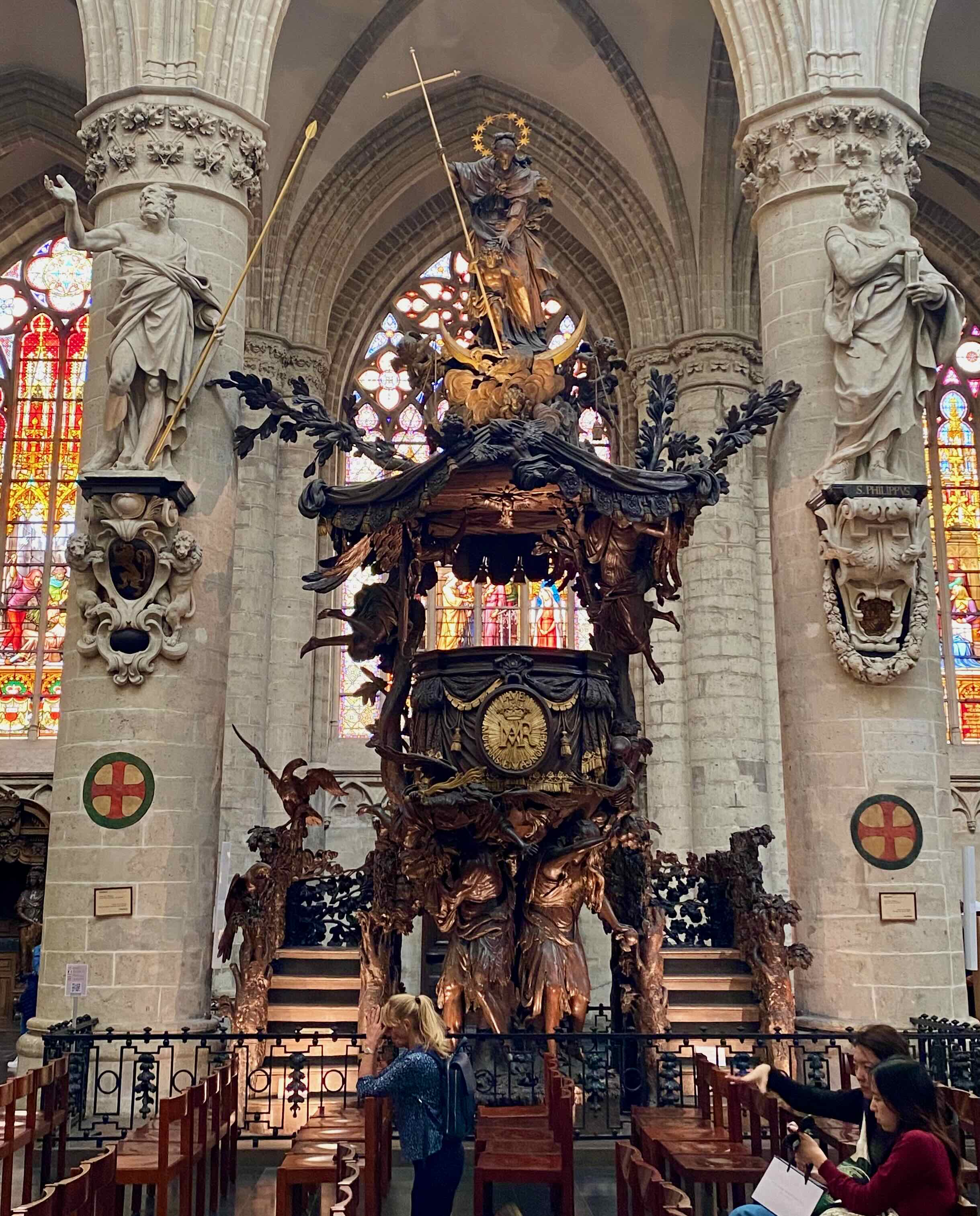
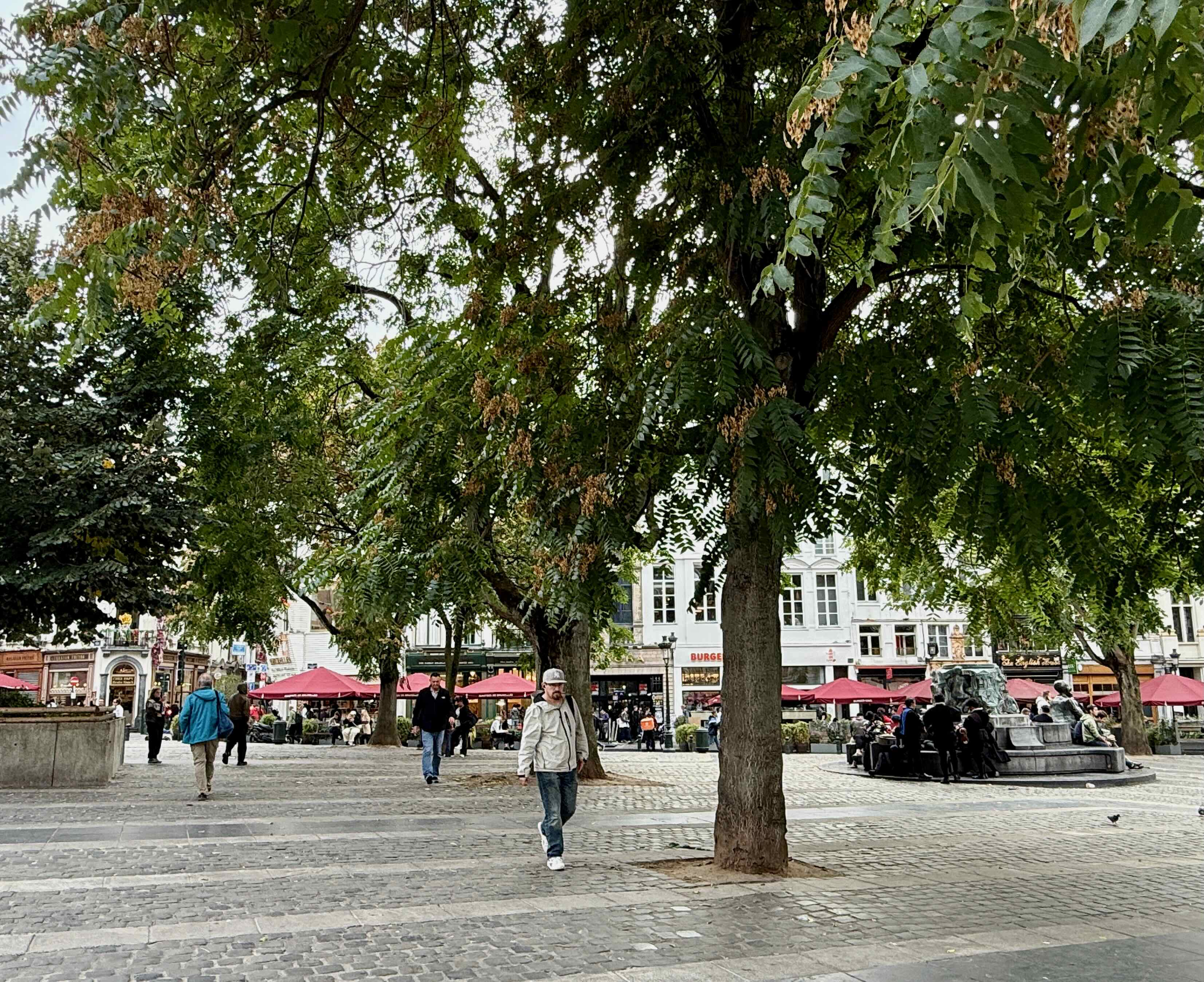
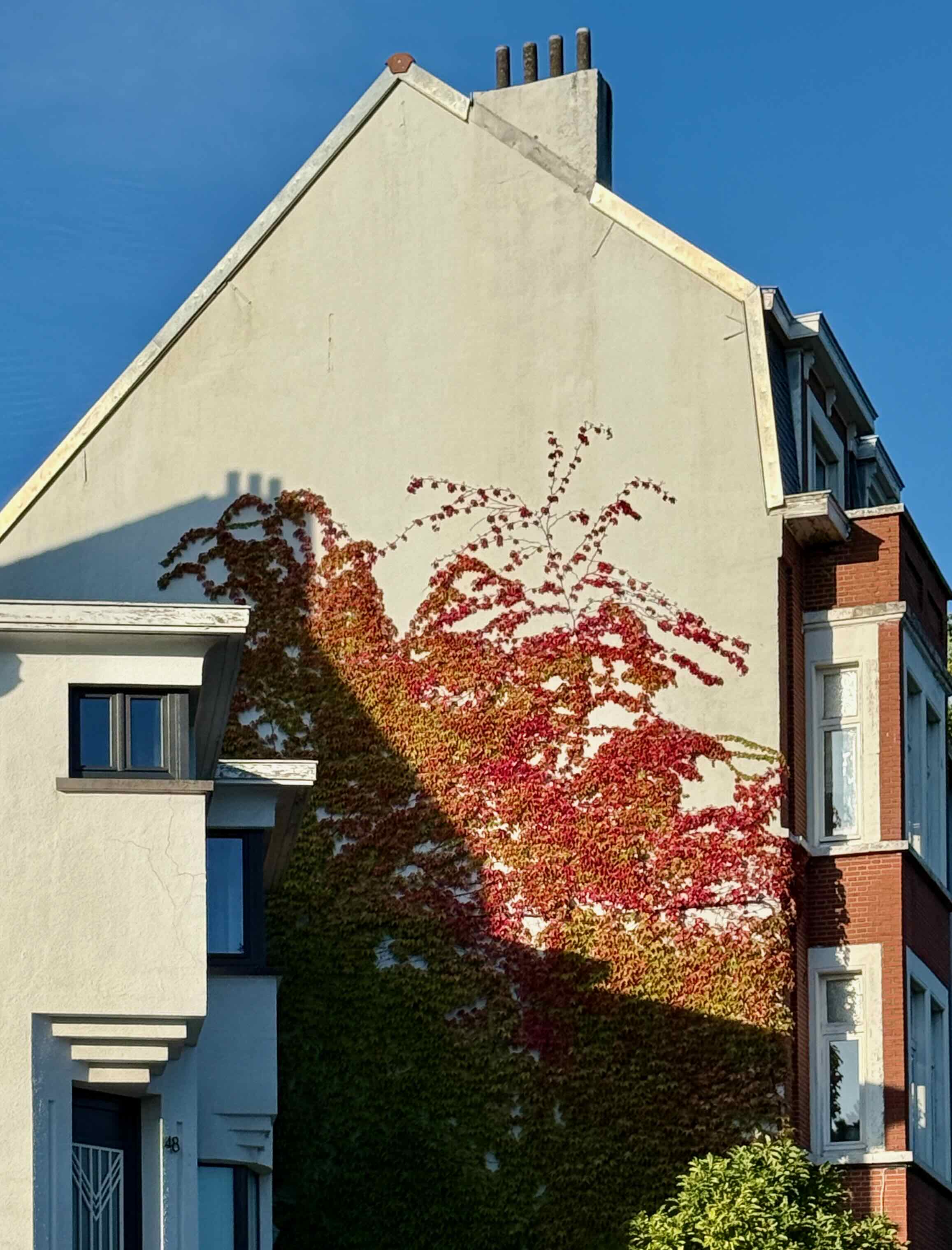
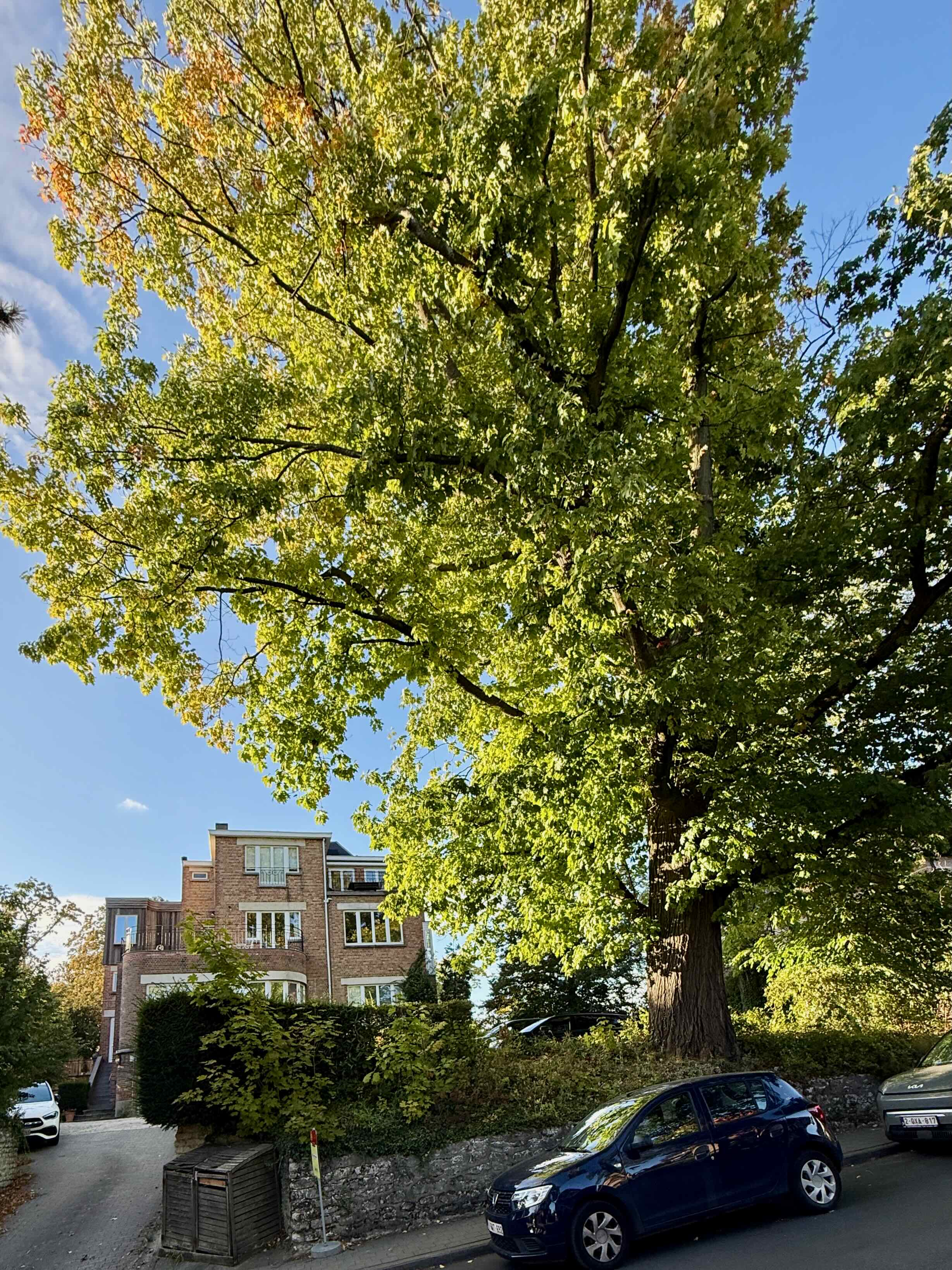
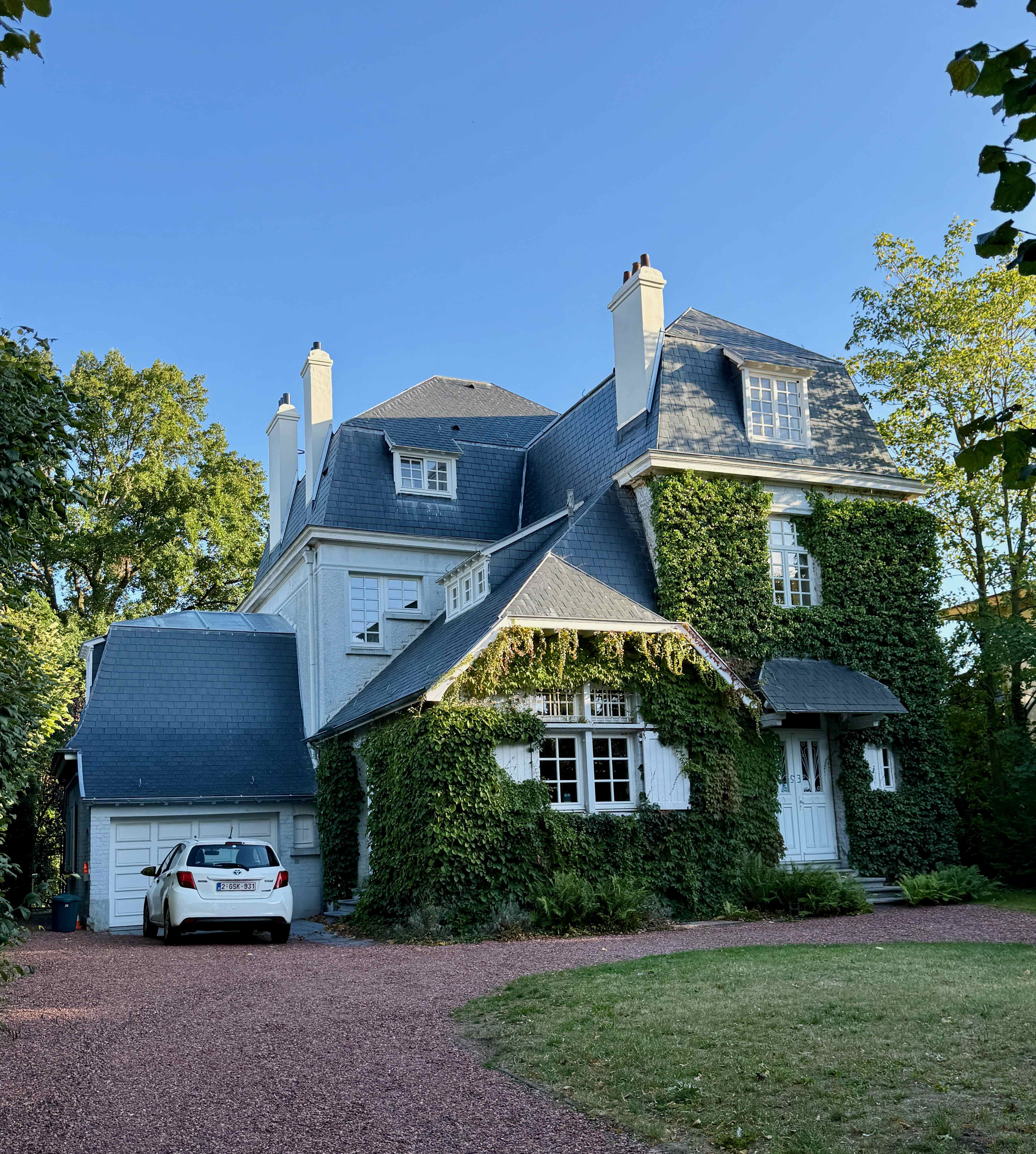

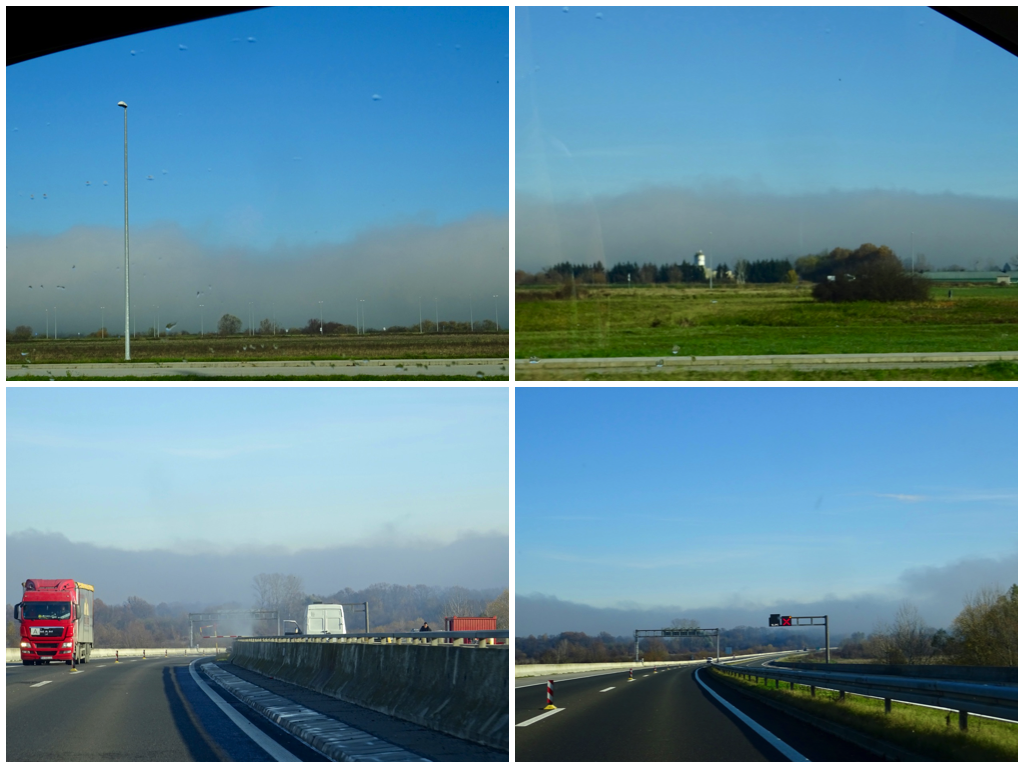
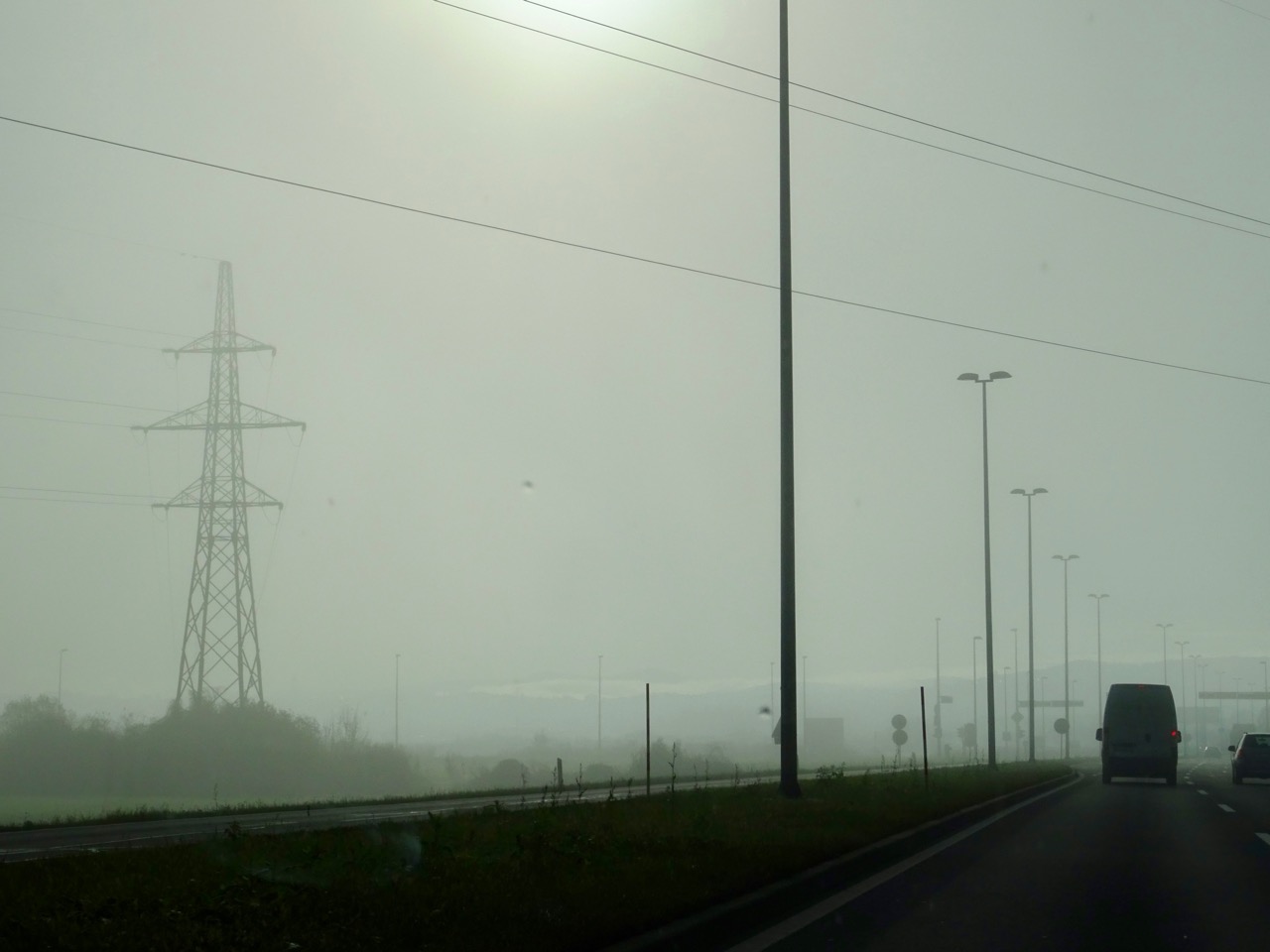 It clears up for a bit but then we drive back into the band of smog that stretches across the countryside. We have never seen anything quite like this before.
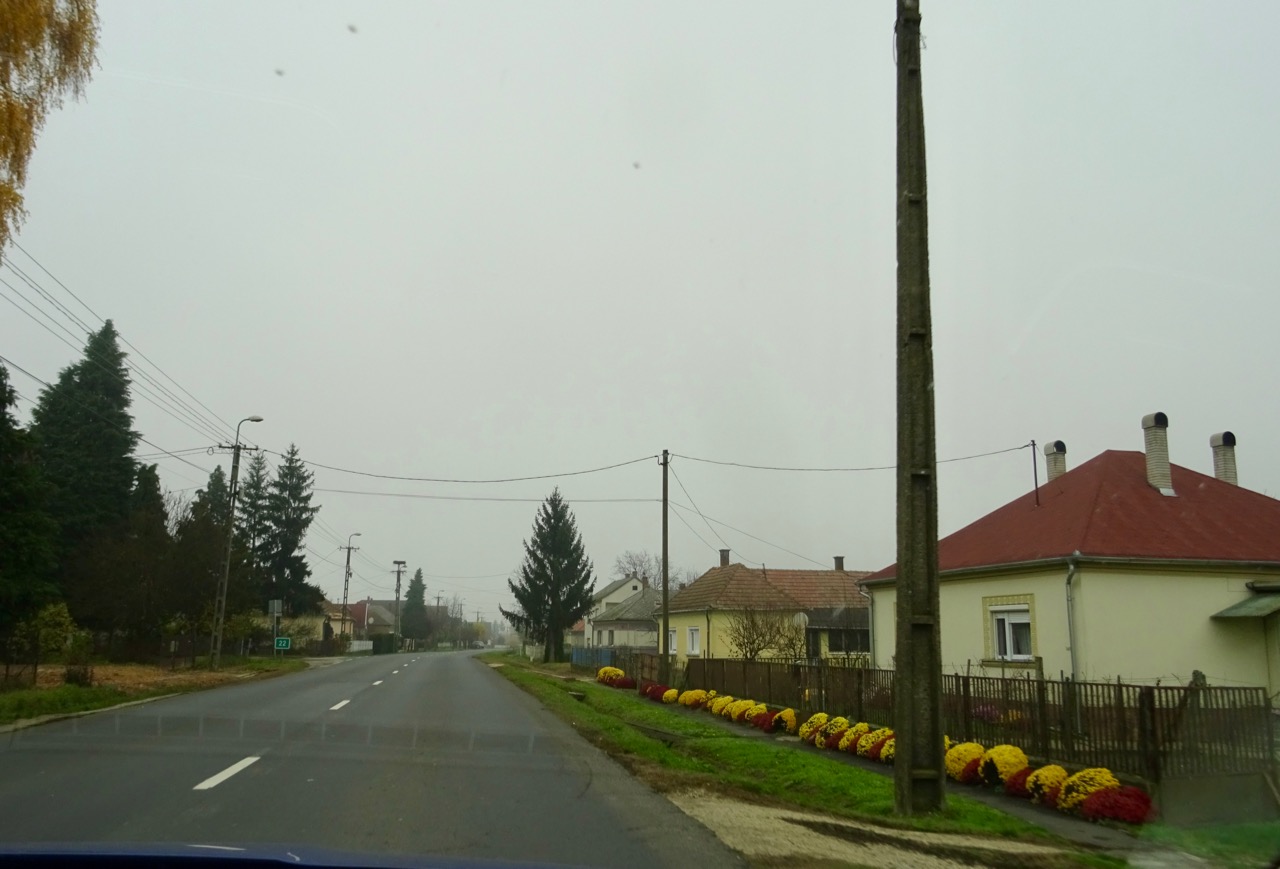
 One of the many small villages in Croatia. Most of these villages only have one row of houses along the highway, no side streets at all. Notice the pretty yellow and purple chrysanthemums growing along the fence. We saw lots of these flowers along the way.
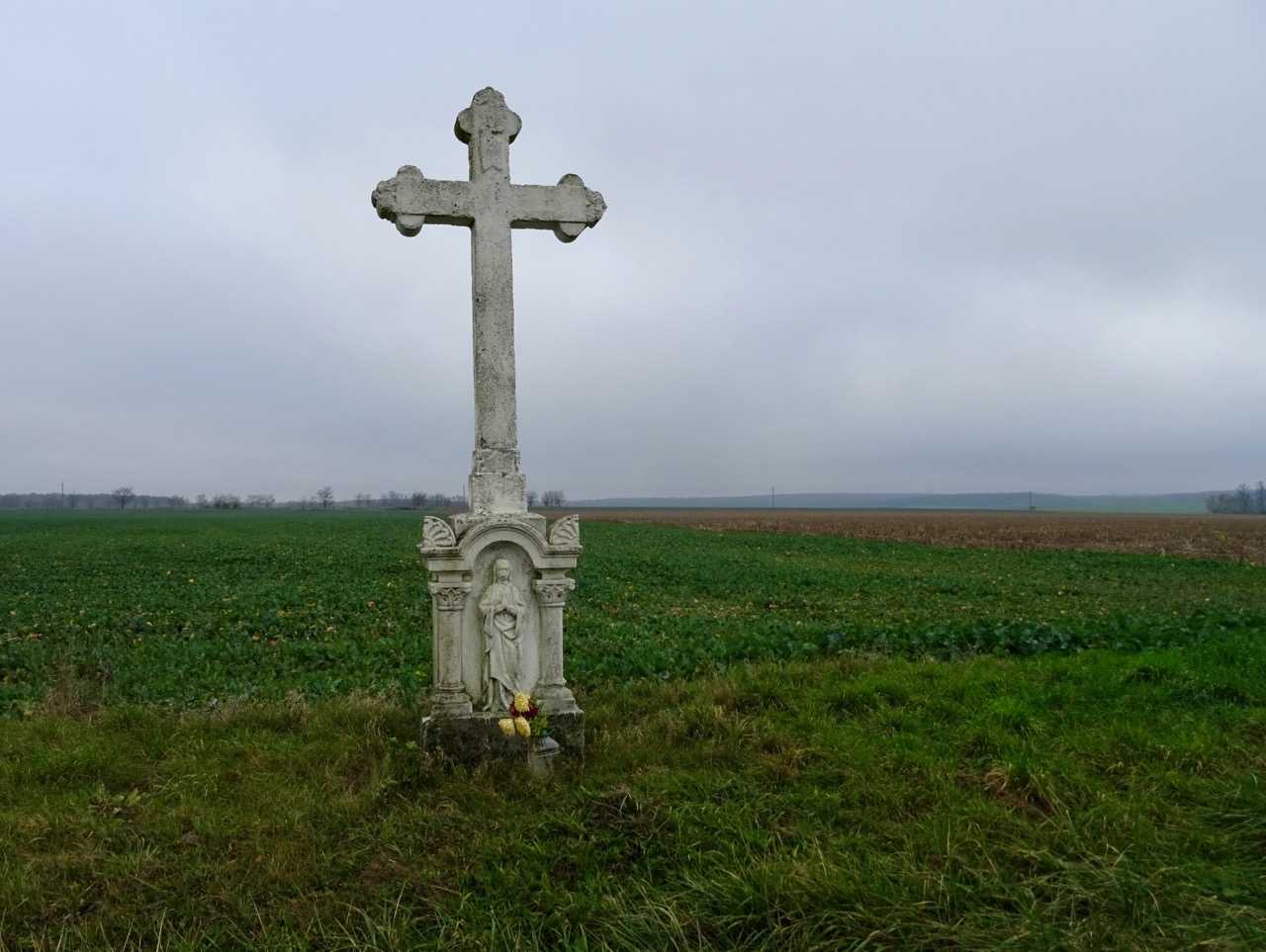
 One fairly long stretch of the road has a shrine every 300 to 500 metres, and each one had fresh flowers placed in front of it.
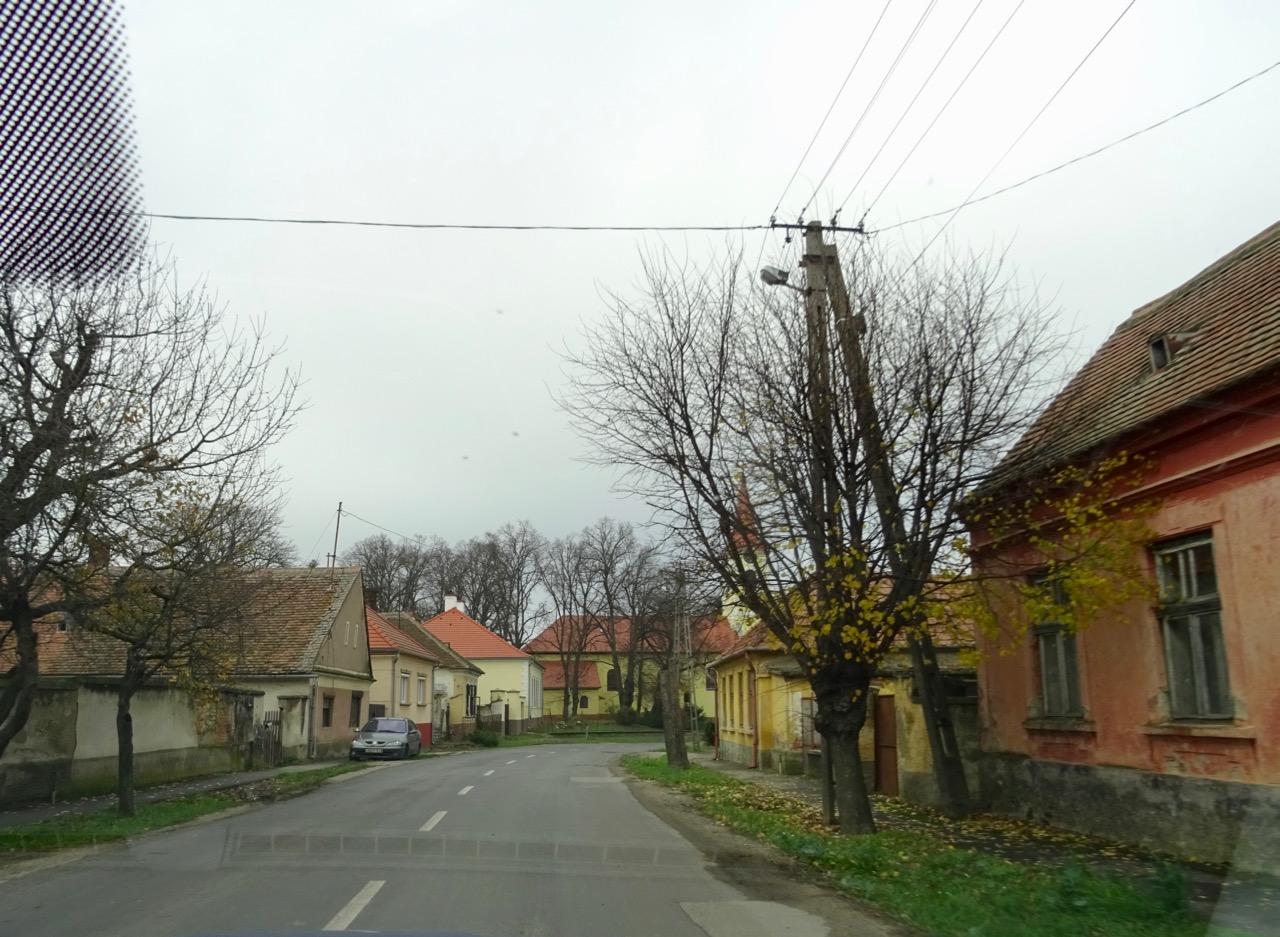
 Another little village. We don’t see many people about and think that they probably have a hard time keeping people from moving to bigger urban centres.
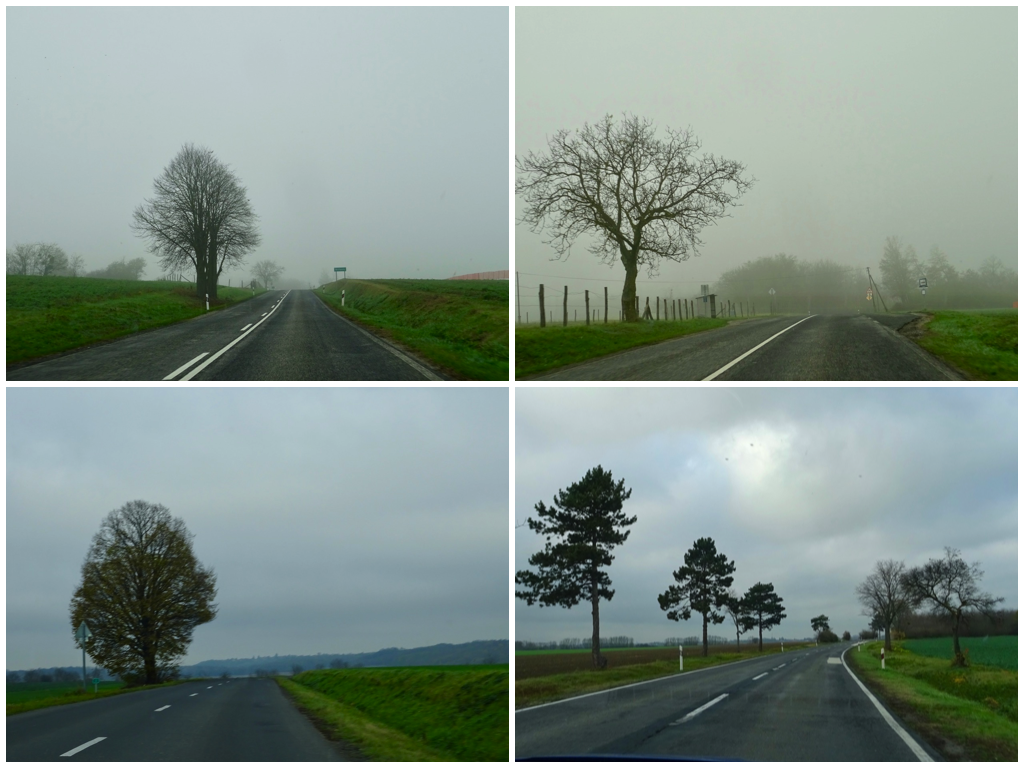
 The highway mainly passes through farmland, and I quite like all the trees along the side of the road.
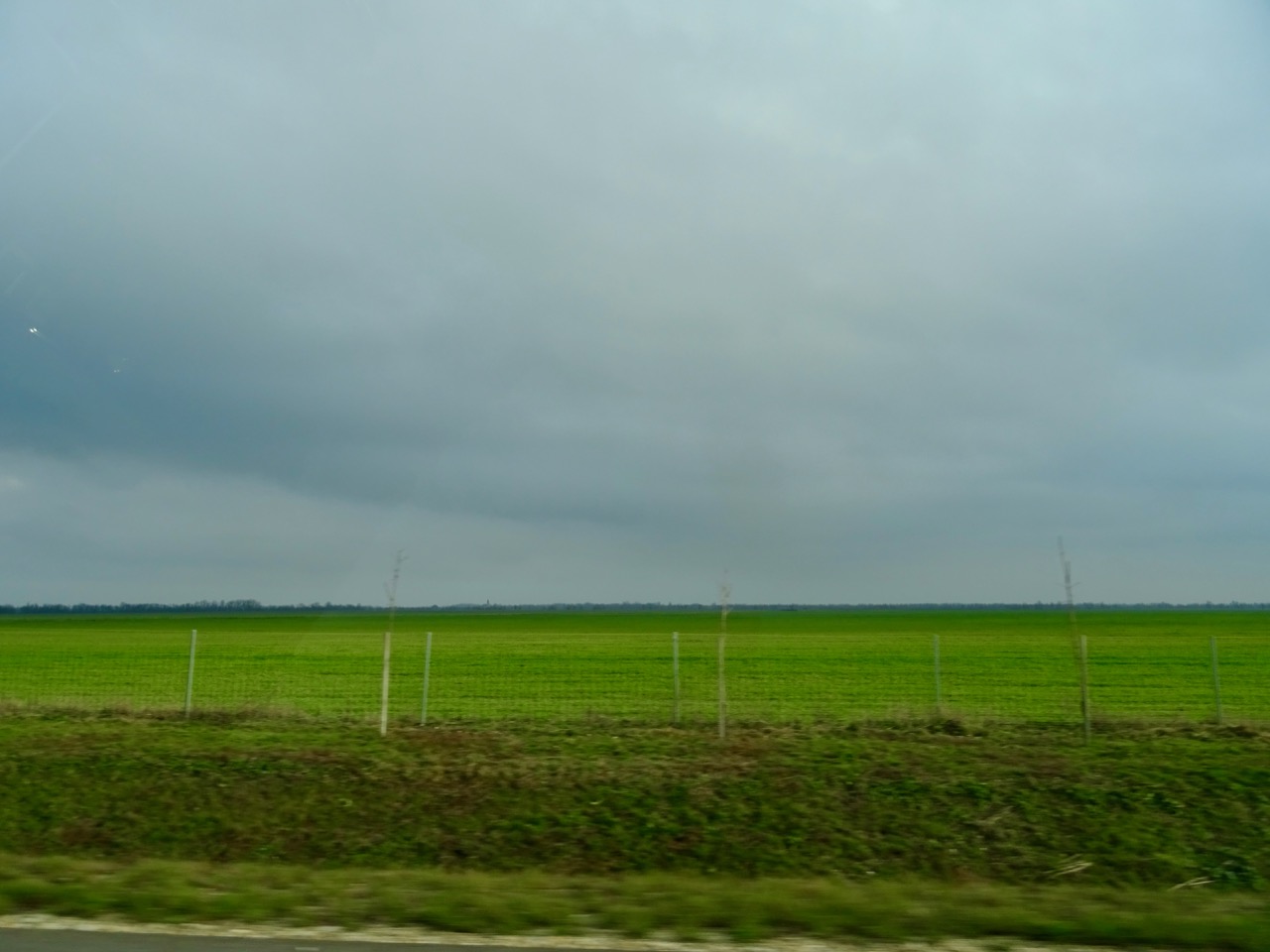
 We finally get a bit of sunshine. There are winter crops planted which are just beginning to grow that are many different shades of green.
 We get to Bratislava about 3:00 pm, return our rental car and catch the Flixbus one last time back to our apartment in Vienna. We are surprised how quickly it gets dark now. This is photo taken on the bus just after 4:30pm.
 We catch an Uber from the Main Bus Depot. Twenty euros well spent. We are dropped off at our apartment door, which is the same apartment we had a couple weeks ago in Vienna. It almost feels like coming home. In three more sleeps we will really be home.
 We visit the Buda side of Budapest today. First stop is the Matthias Church, located in the Holy Trinity Square in front of the Fisherman’s Bastion. It has a beautiful tiled roof and a 60 metre tall bell tower.
 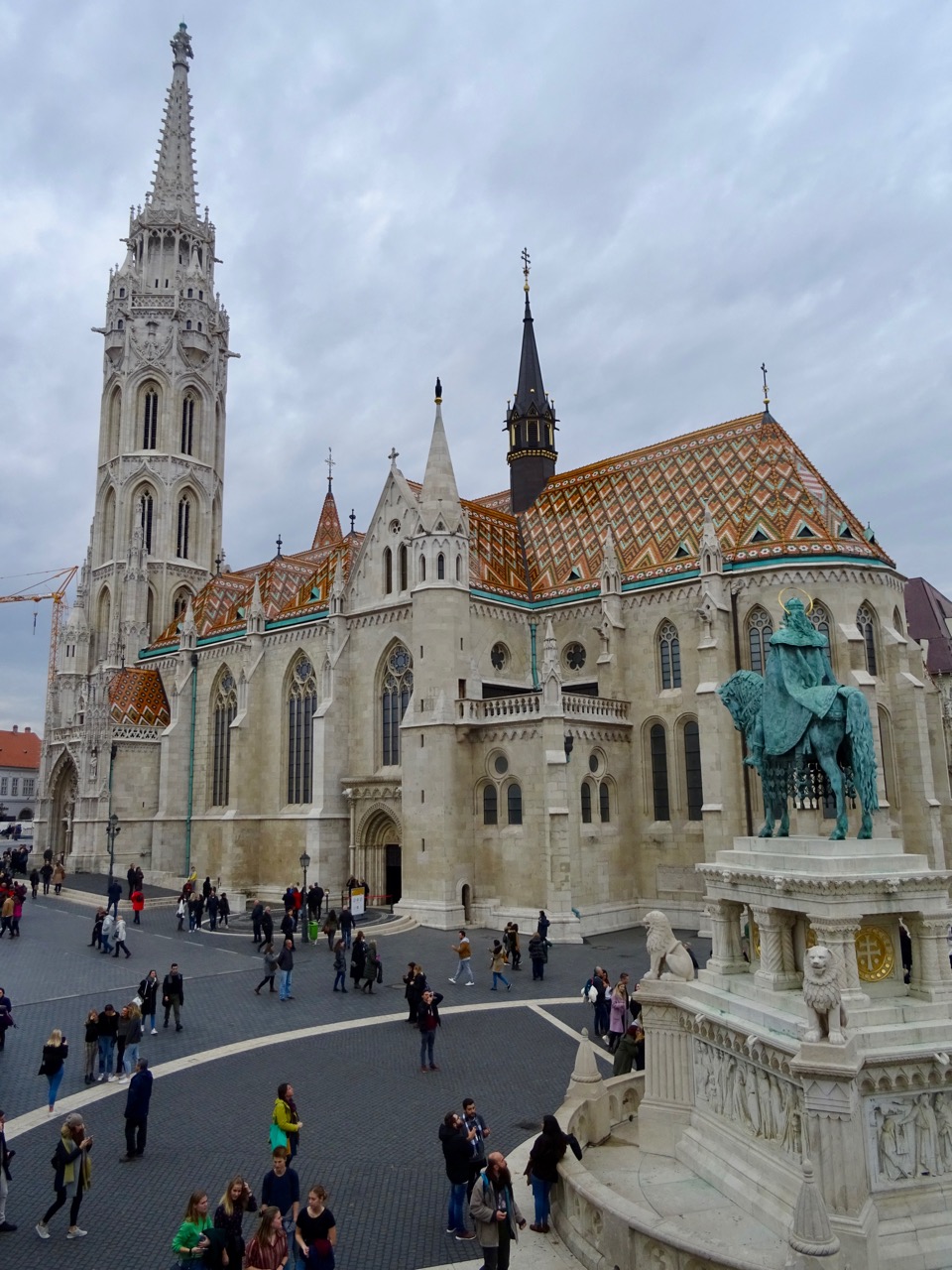 There are a lot of people here.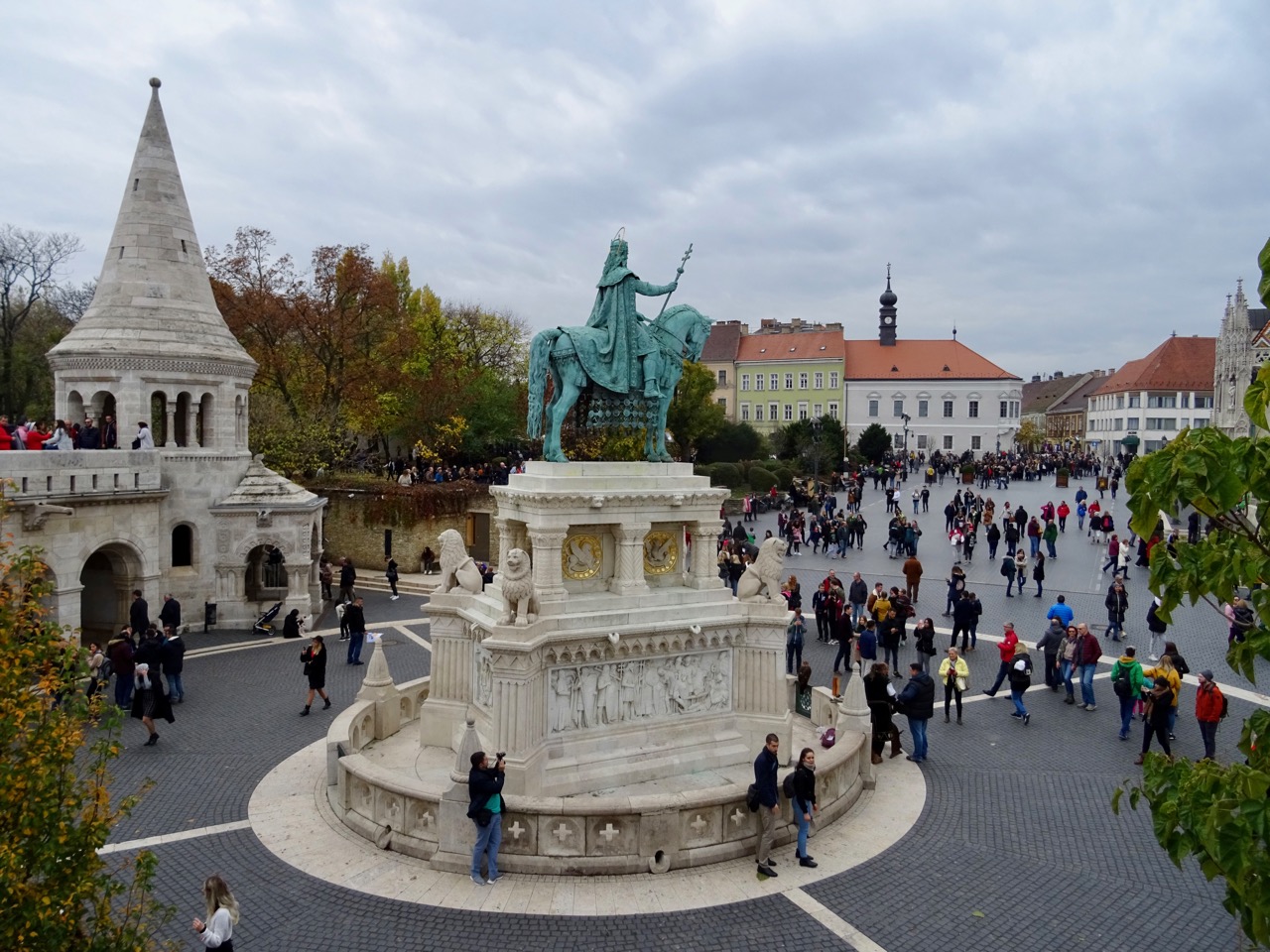
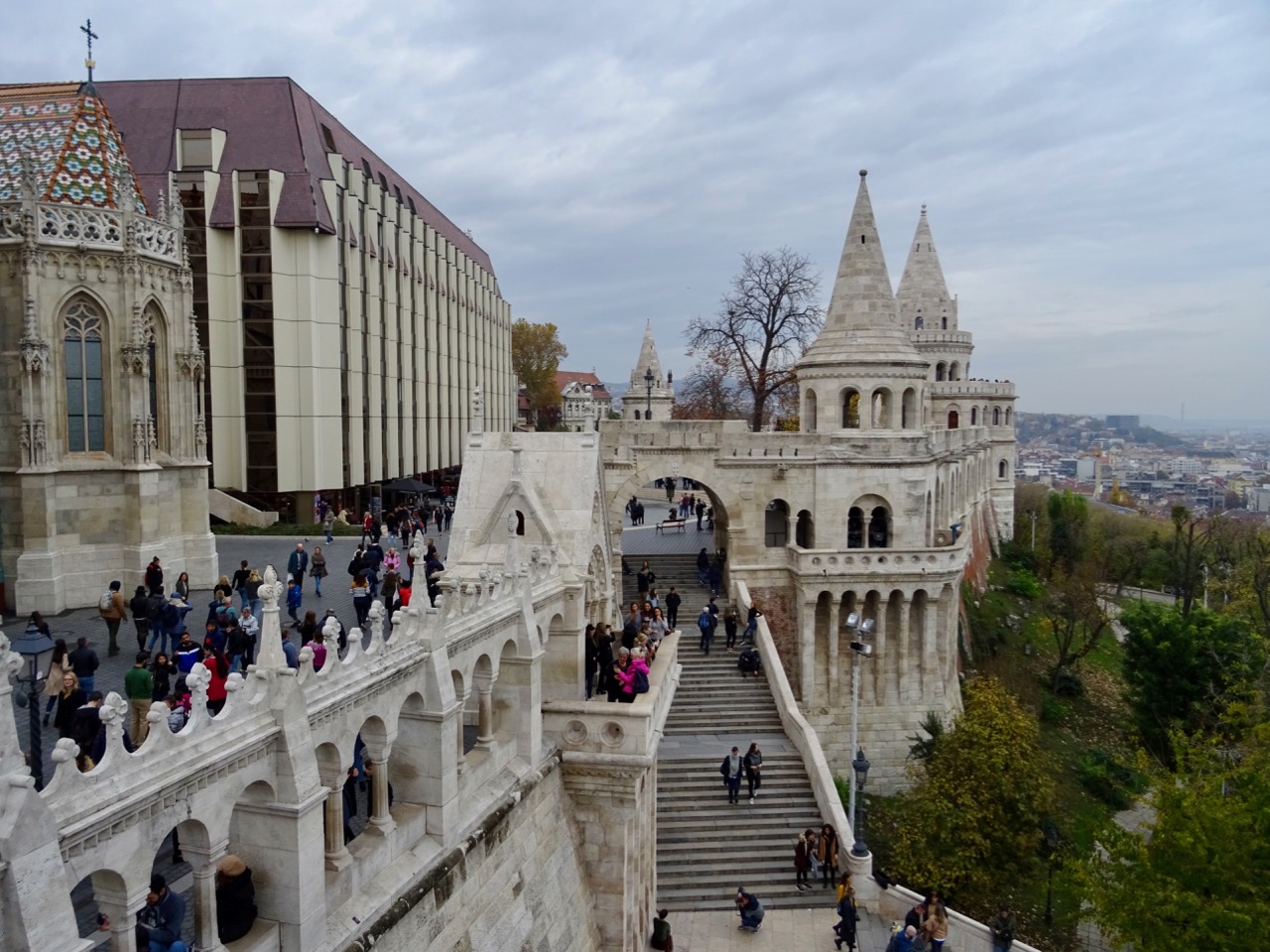 One of the many great views from the Bastion.
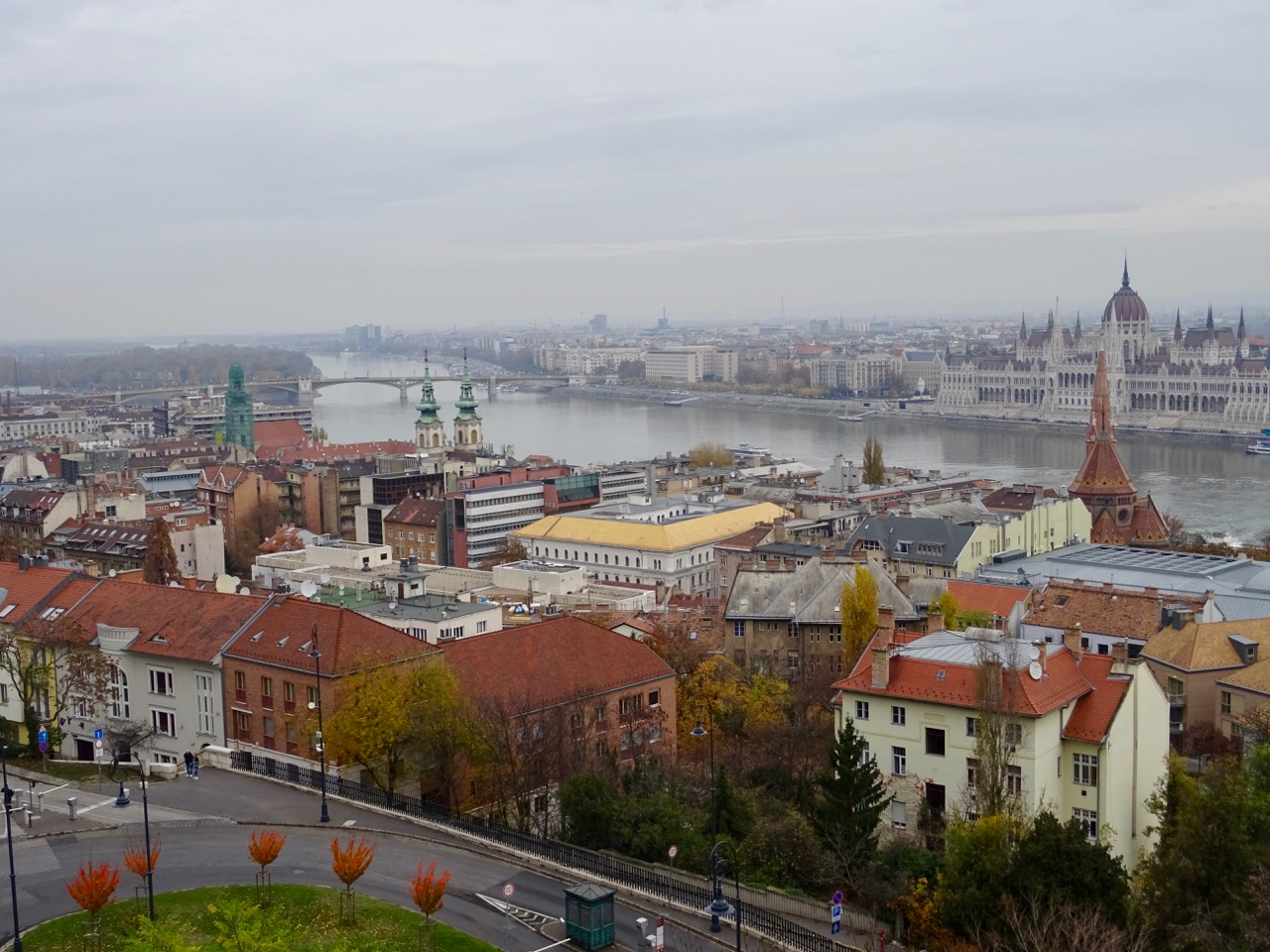 We had to wait a bit to find an arch not filled with other tourists. It often takes a while before I can get a decent photo, which involves deciding where I can get the best view and waiting until vehicles and other people are not in my picture frame. Bob is very patient, waiting for me to take photos. I probably take at least 5 or 6 photos for every one I use in this blog.
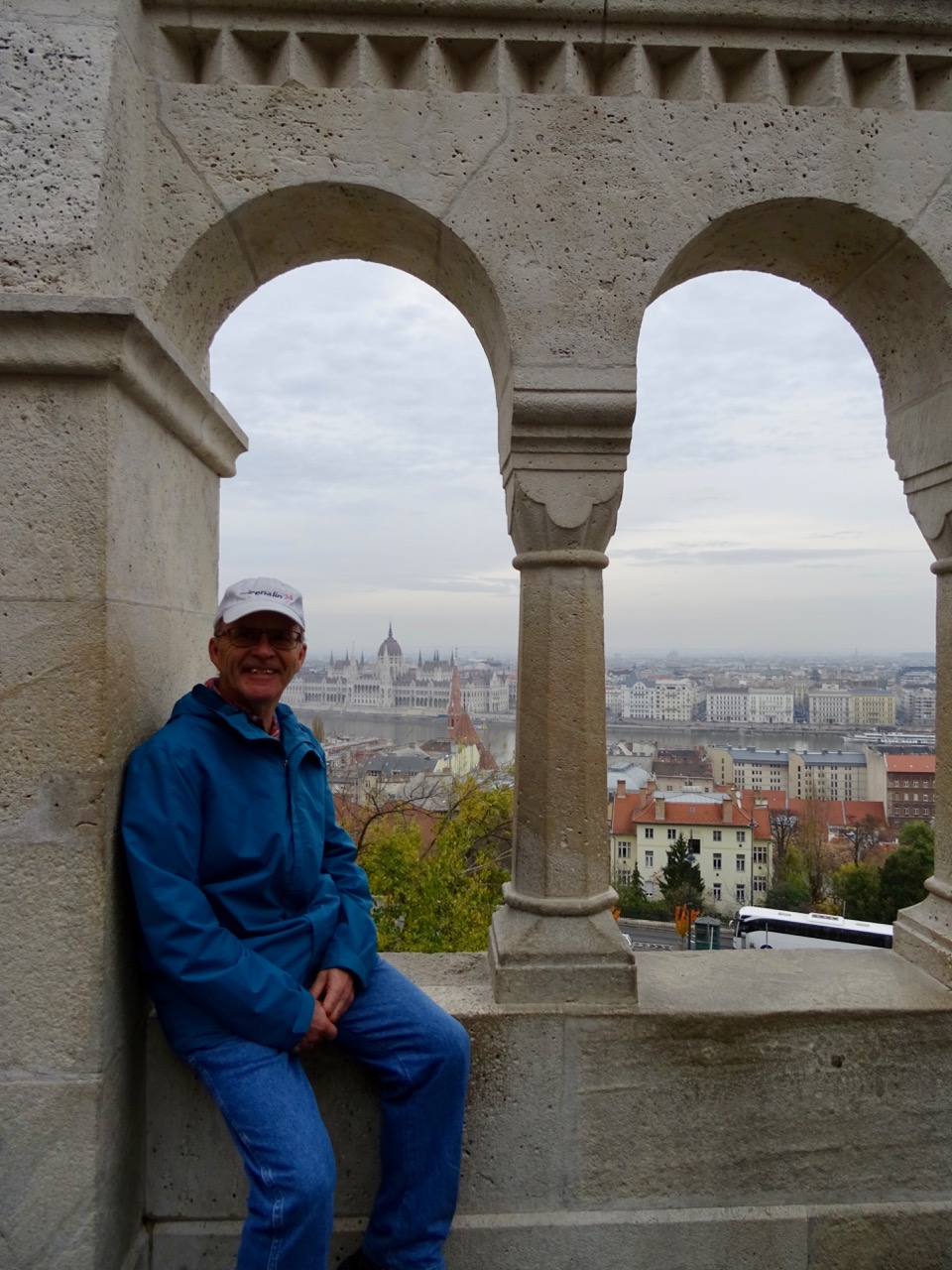 The Bastion was inspired by the architectural style of the early medieval times. It has many towers and was meant to feel like a fairy tale castle, as it wasn’t built for defence.
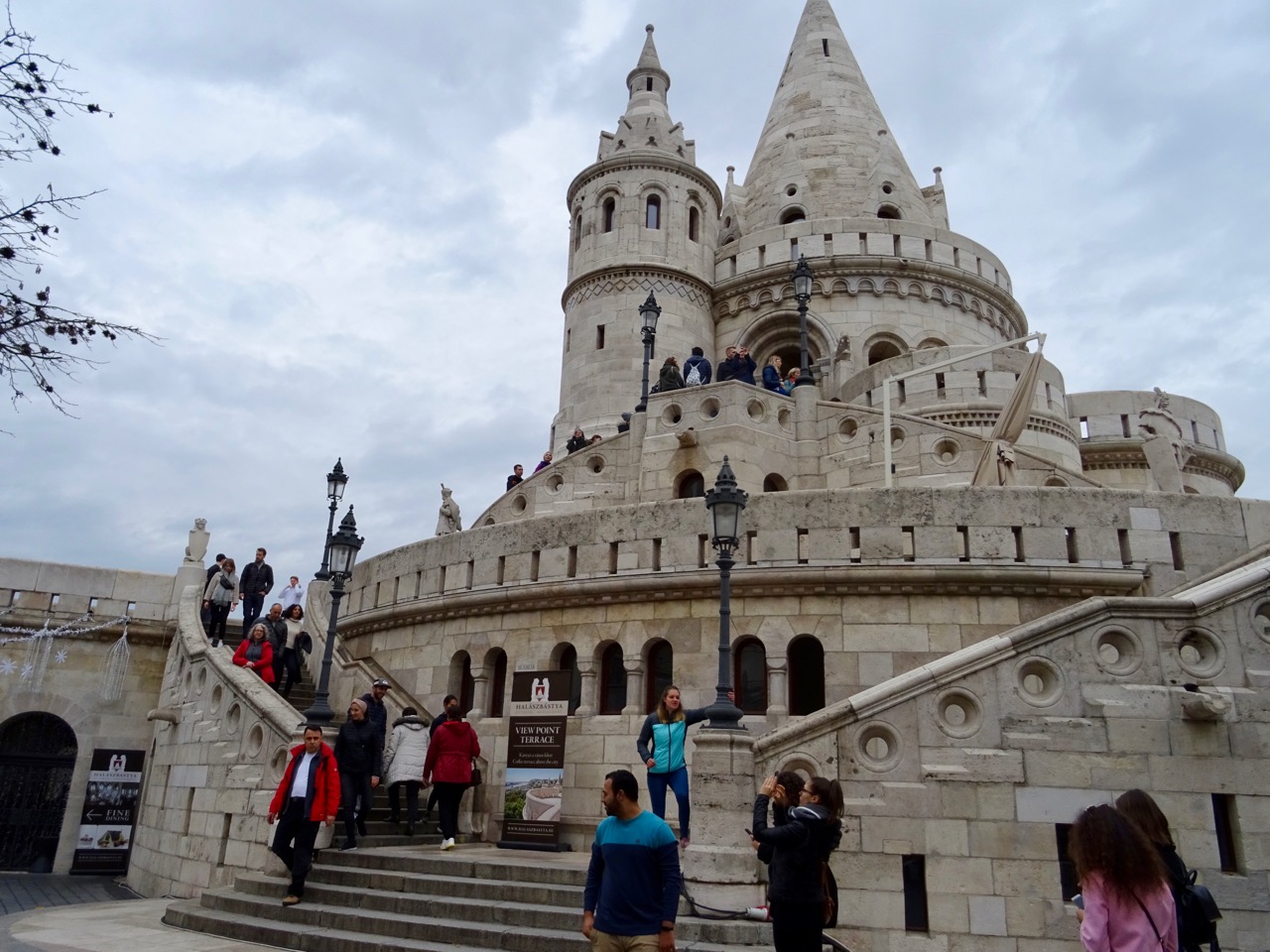 I am always happy when I find a dragon!
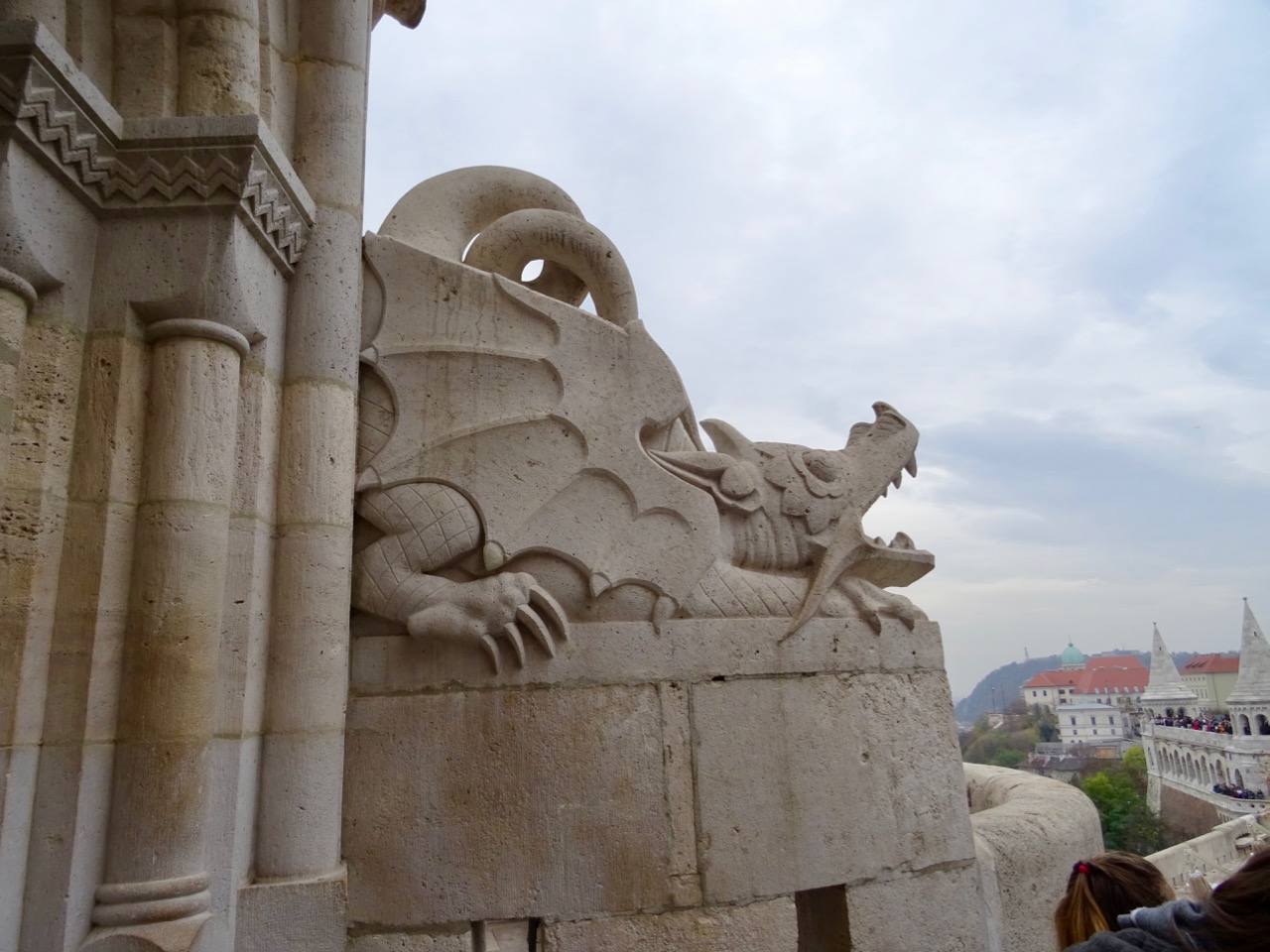 These medieval church ruins were built into the modern Hilton Budapest Hotel.
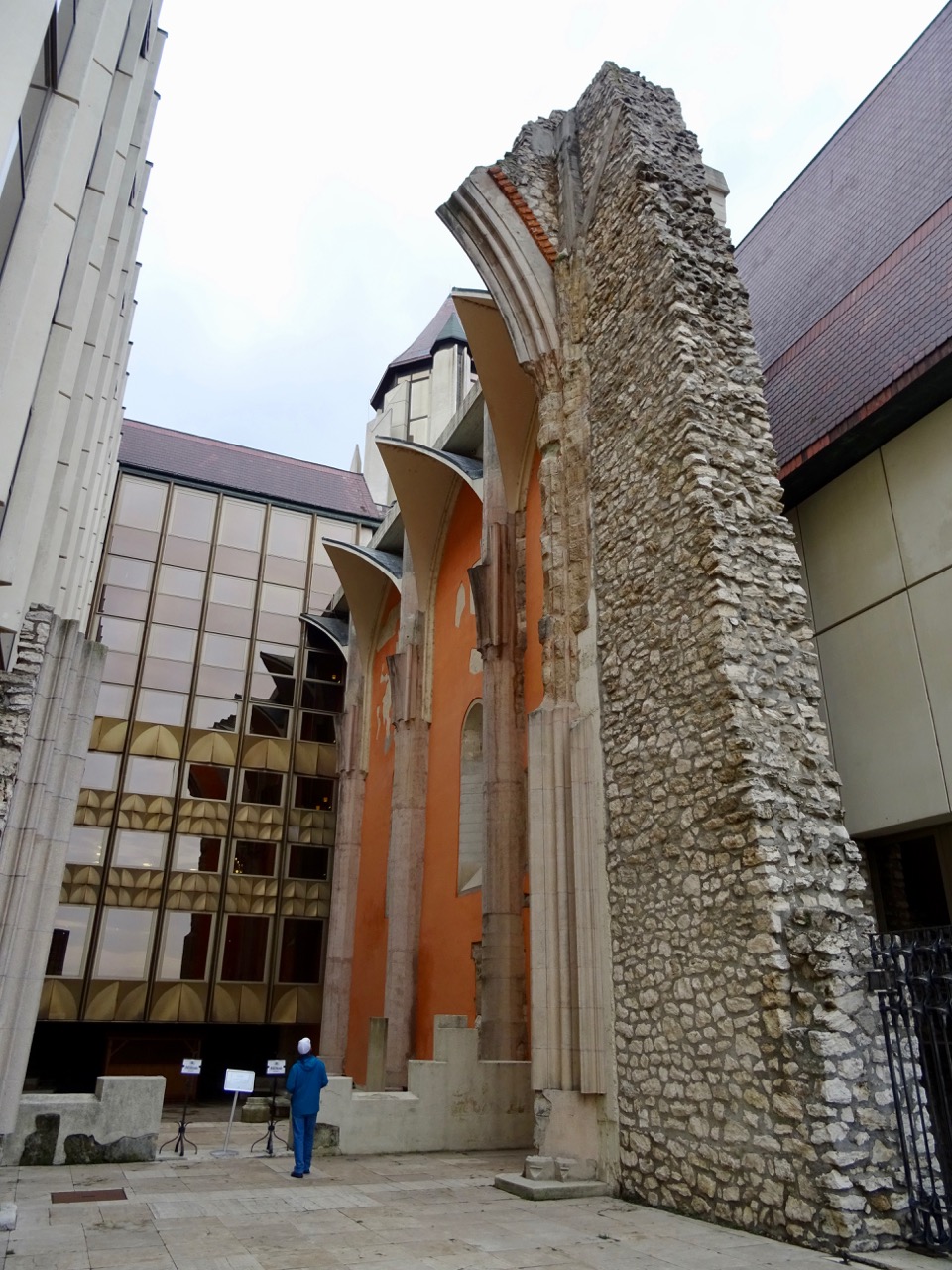 The Black Plague caused the death of 30-60% of Europe’s total population in 1691 and 1709. People believed that erecting a column would protect them from the plague. The carving on the top of the column represents the Holy Trinity. Below this the whole column is decorated with smaller statues depicting angels, and saints. The central sculpture shows King David praying to God to let his people avoid the outbreak of a plague. Residents believed the Holy Trinity Column did its job, as the plague never returned after 1709.
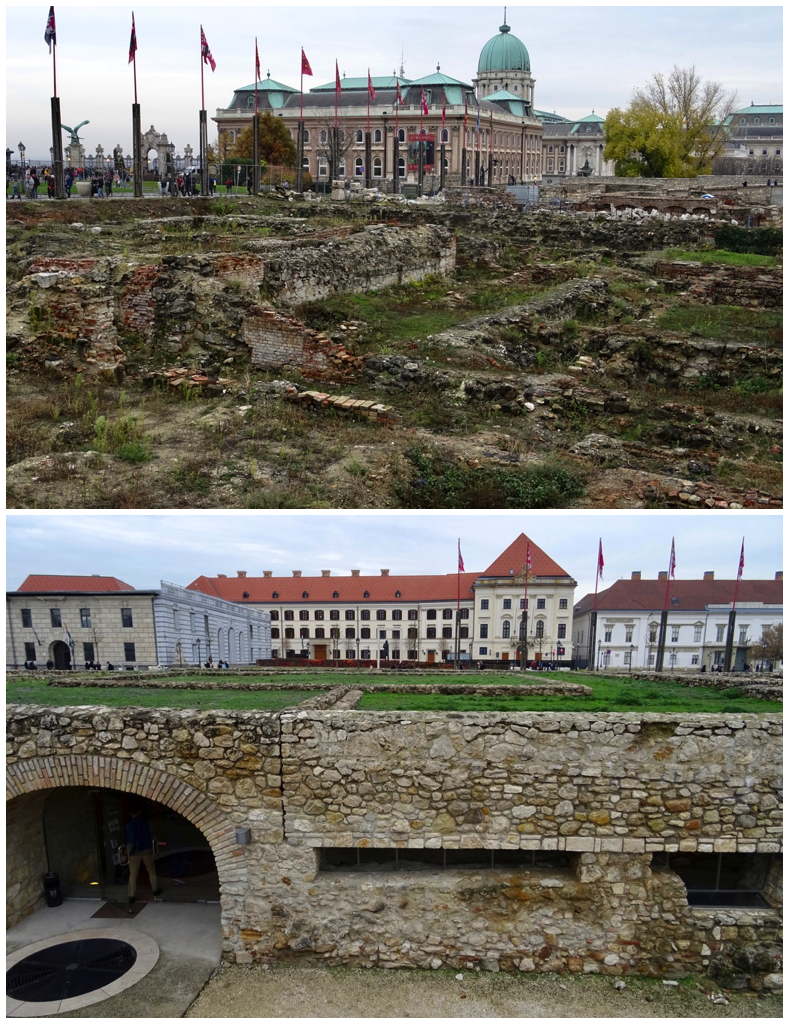
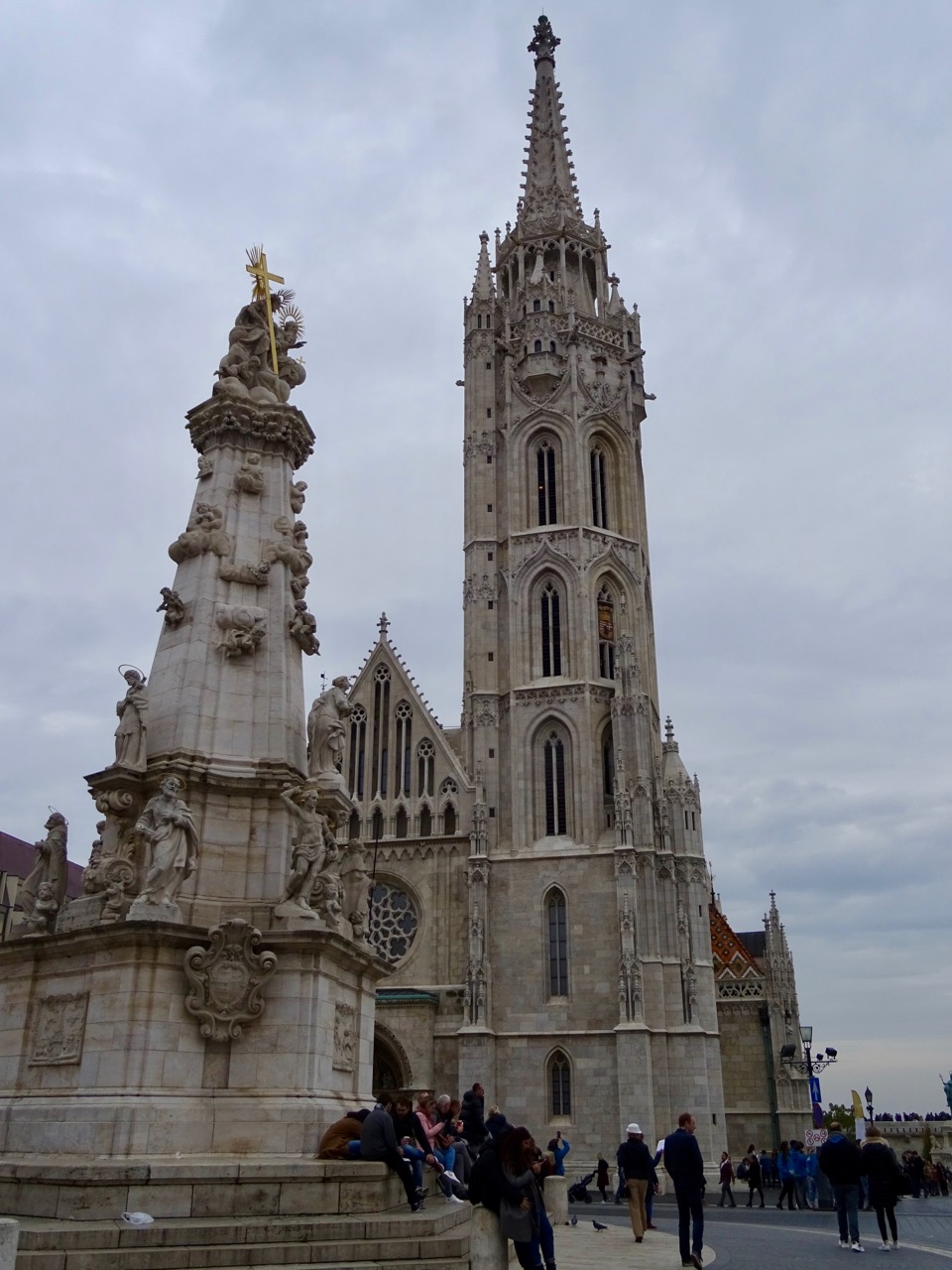 On our walk to the nearby Buda Castle we pass these Medieval ruins. Beneath some of the ruins there is a wine cellar which offers wine tastings. It is located below the remains of a 13th century Dominican Cloister, which is part of a huge labyrinth system underneath the Castle Hill.
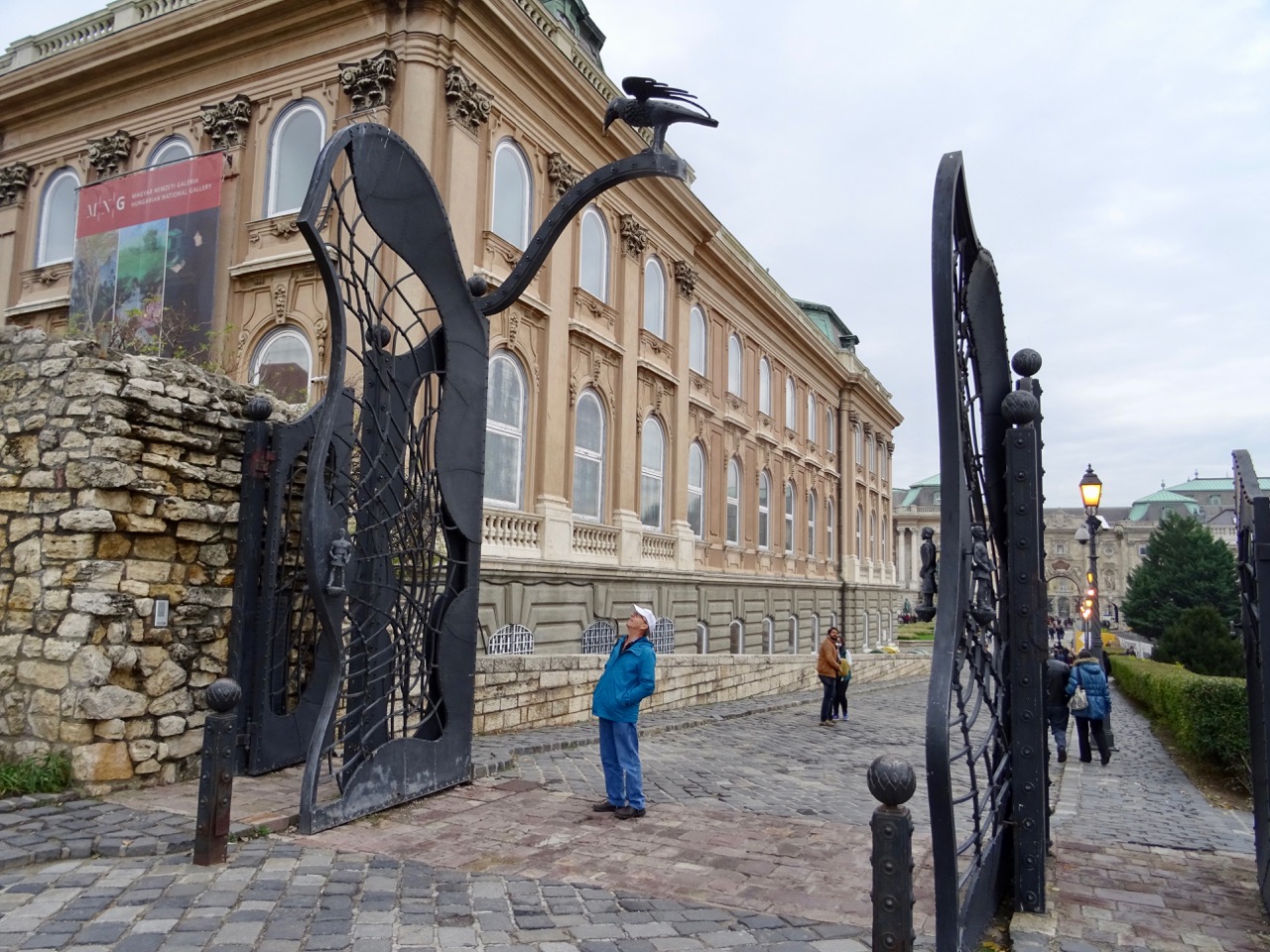
  King Matthias (1457-1458) adopted the crow as his heraldic emblem after catching one of them stealing a ring, and killing it to get his ring back. These gates are topped with a crow with a ring in its mouth. The gates are very bizarre, almost creepy looking.
 This is the back side of the Buda Castle…
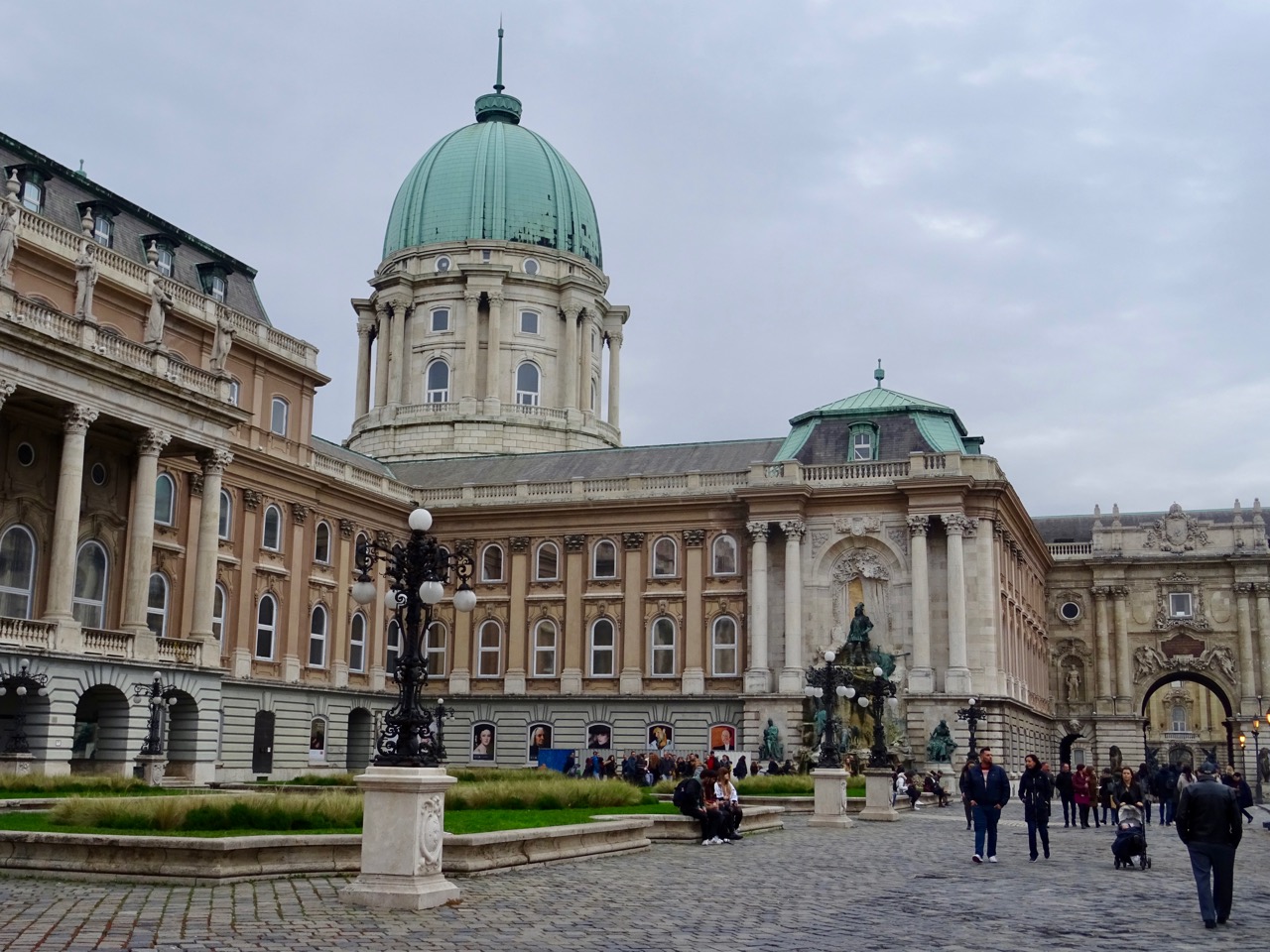 and here is a close up of its fountain. Too bad the water in all the fountains in Budapest has already been turned off for the winter.
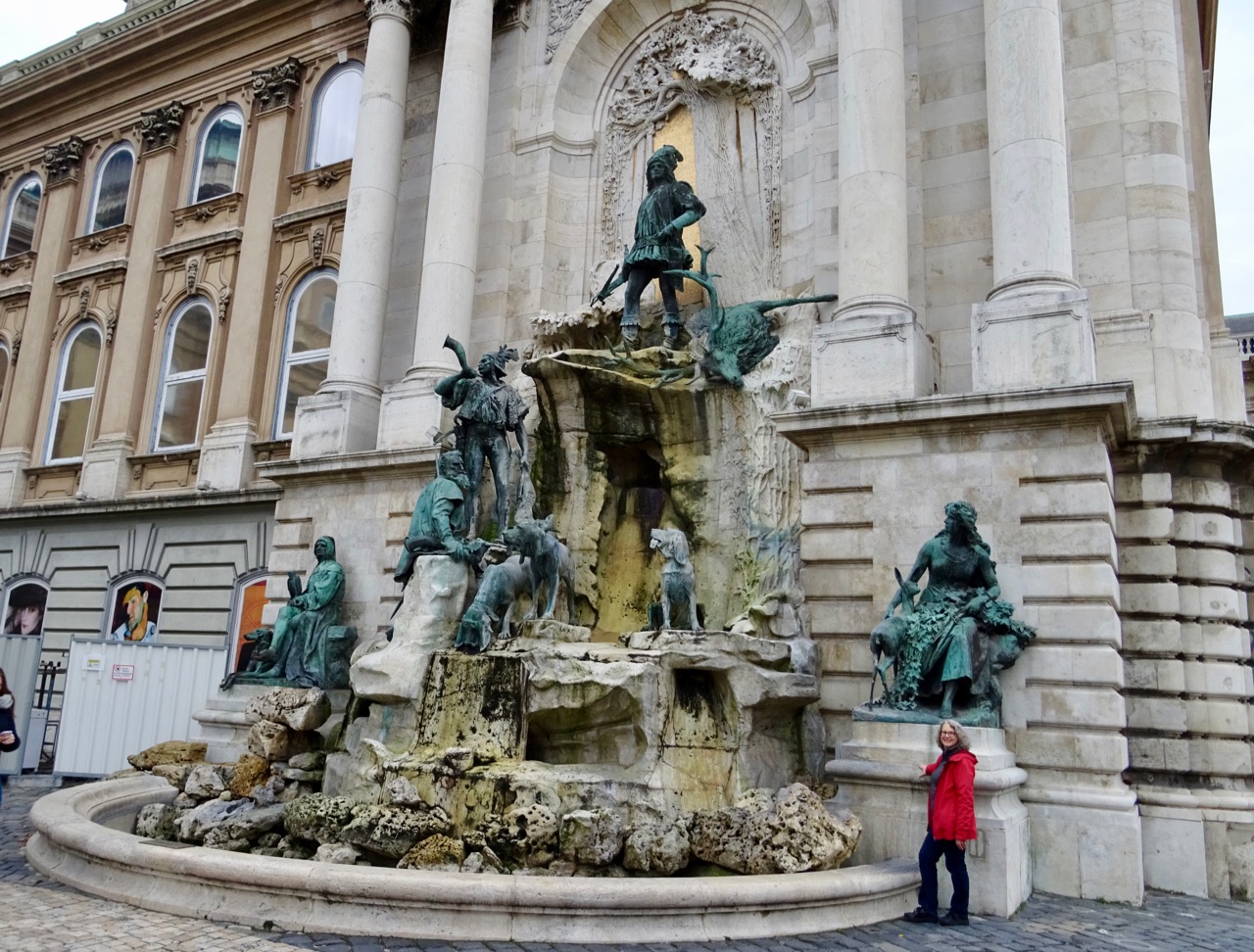 The front of the Buda Castle with lots of tourists…
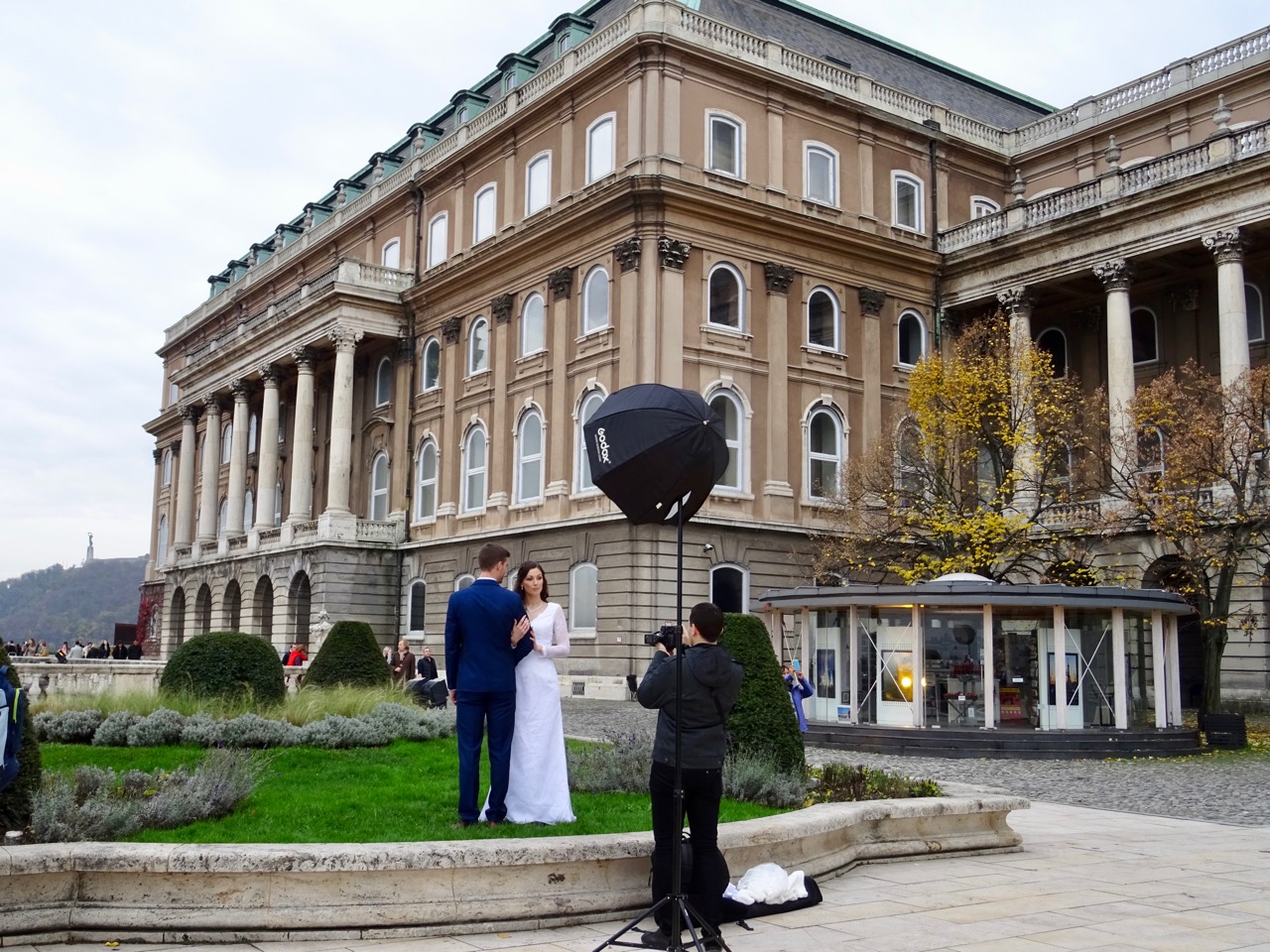
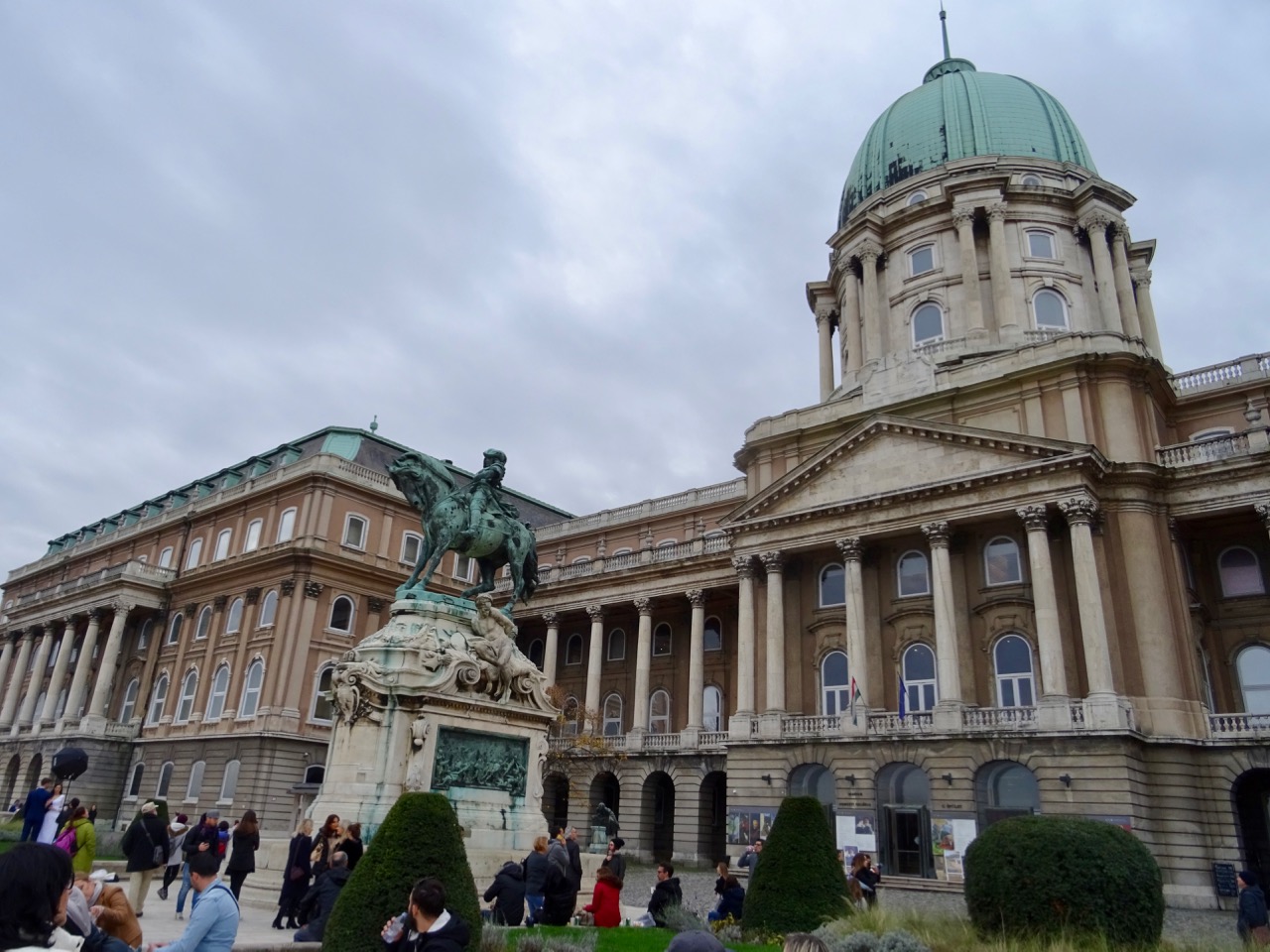 and a bride and groom taking their wedding photos. I wonder if the photographer has to photoshop out all the tourists?
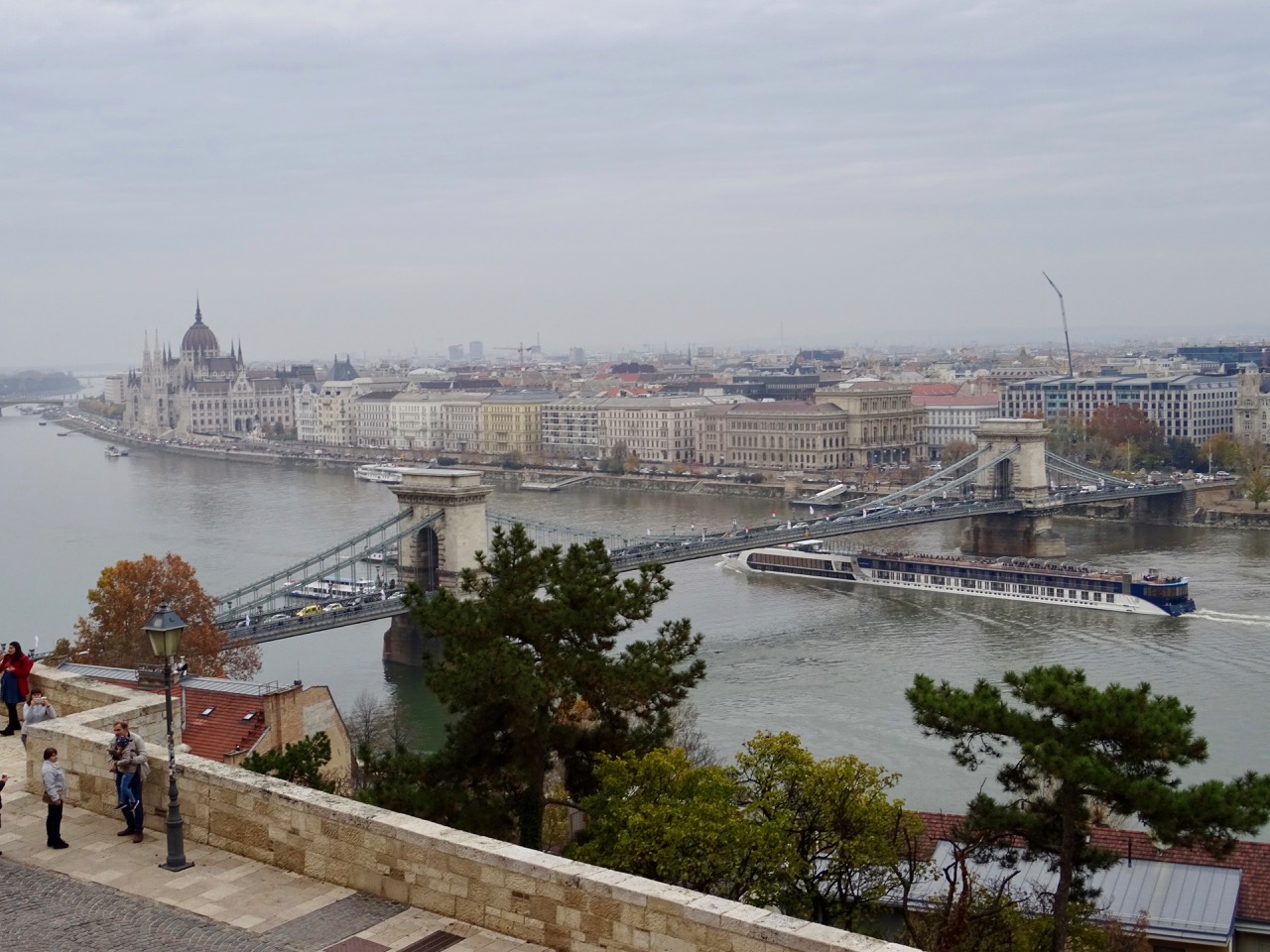
 We see a large river cruise ship o the Danube.
 There are walkways high above Medieval walls.
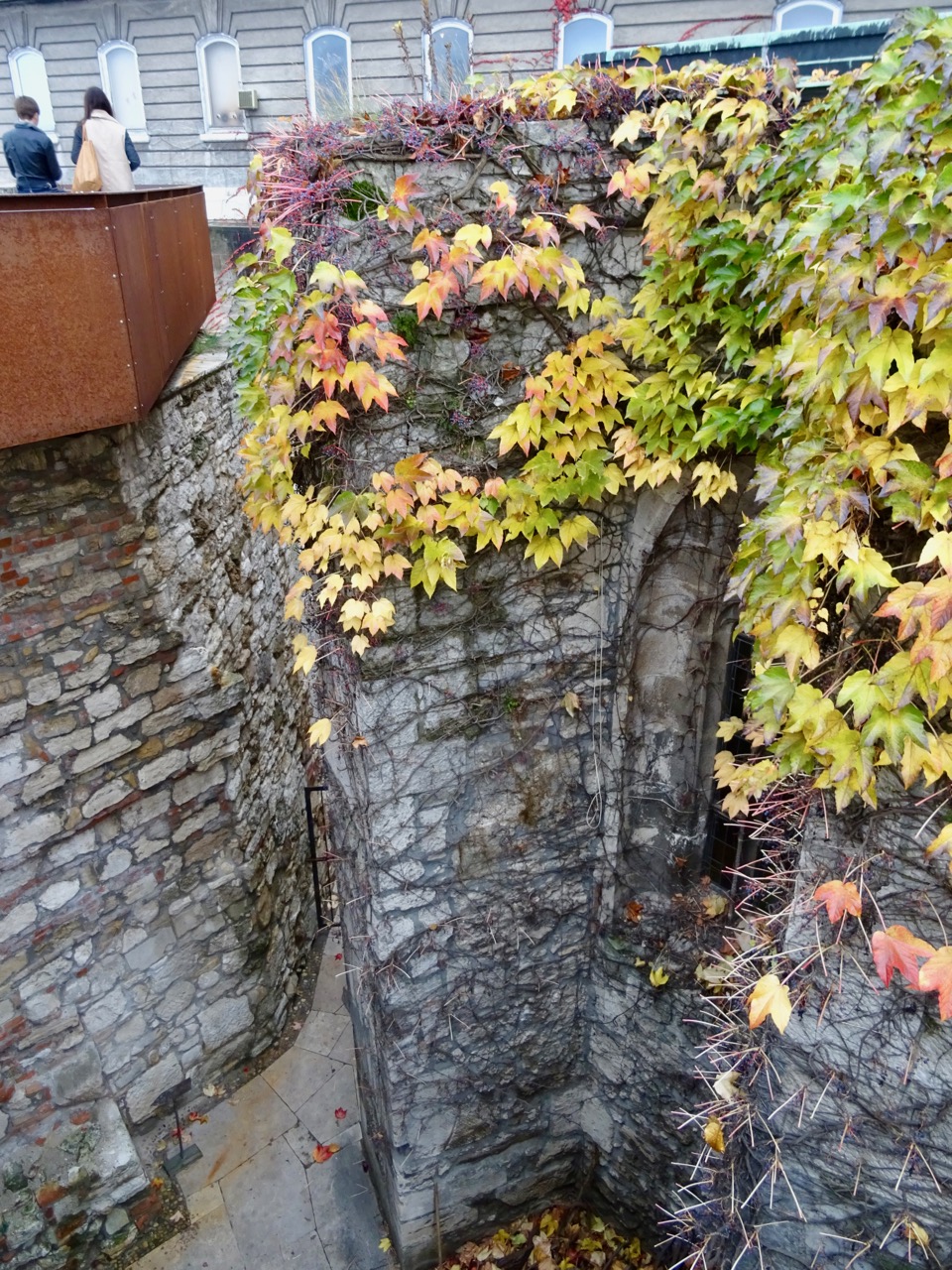 We walk down a flight of stairs below a statue of the Madonna and baby Jesus.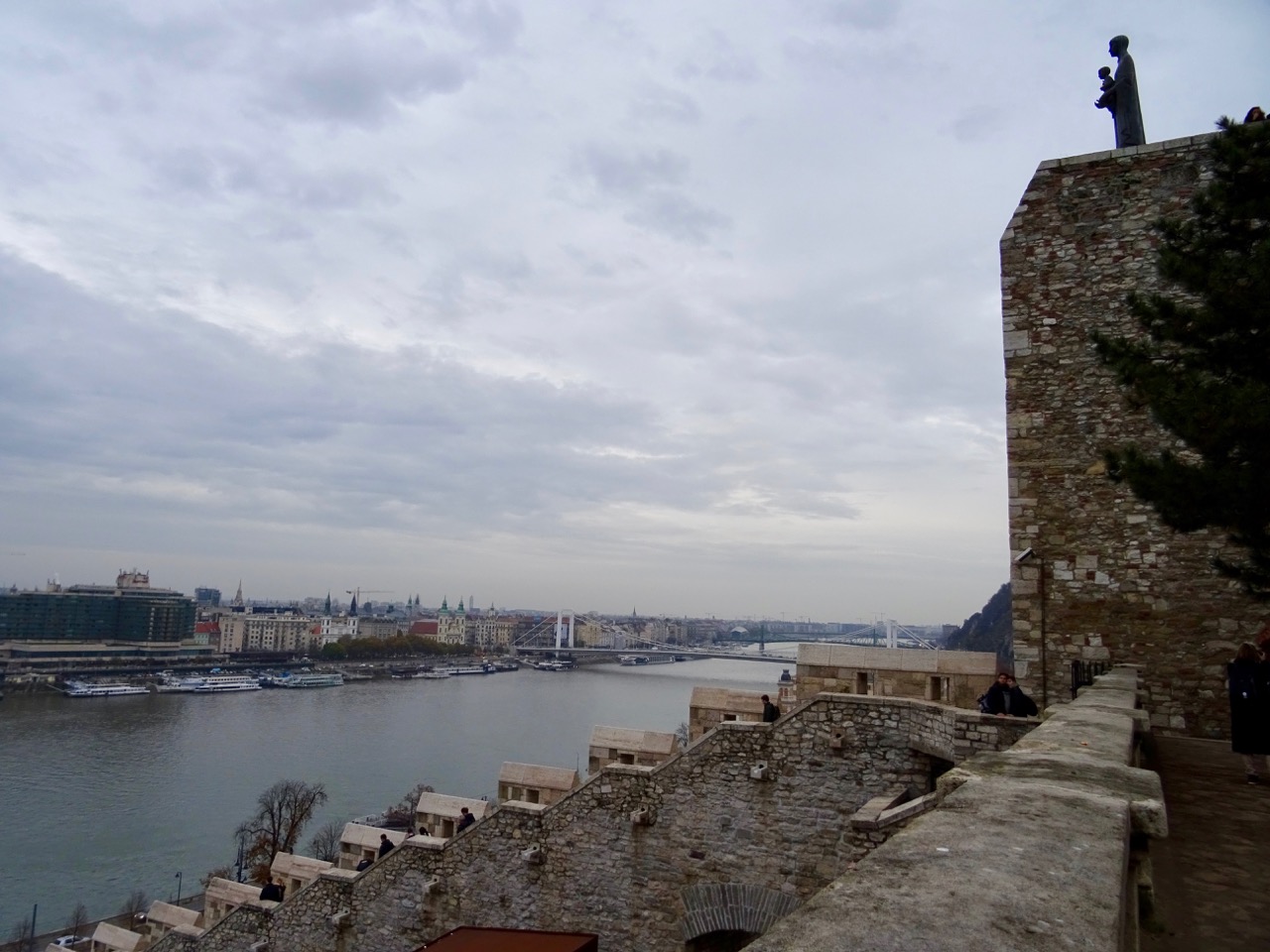
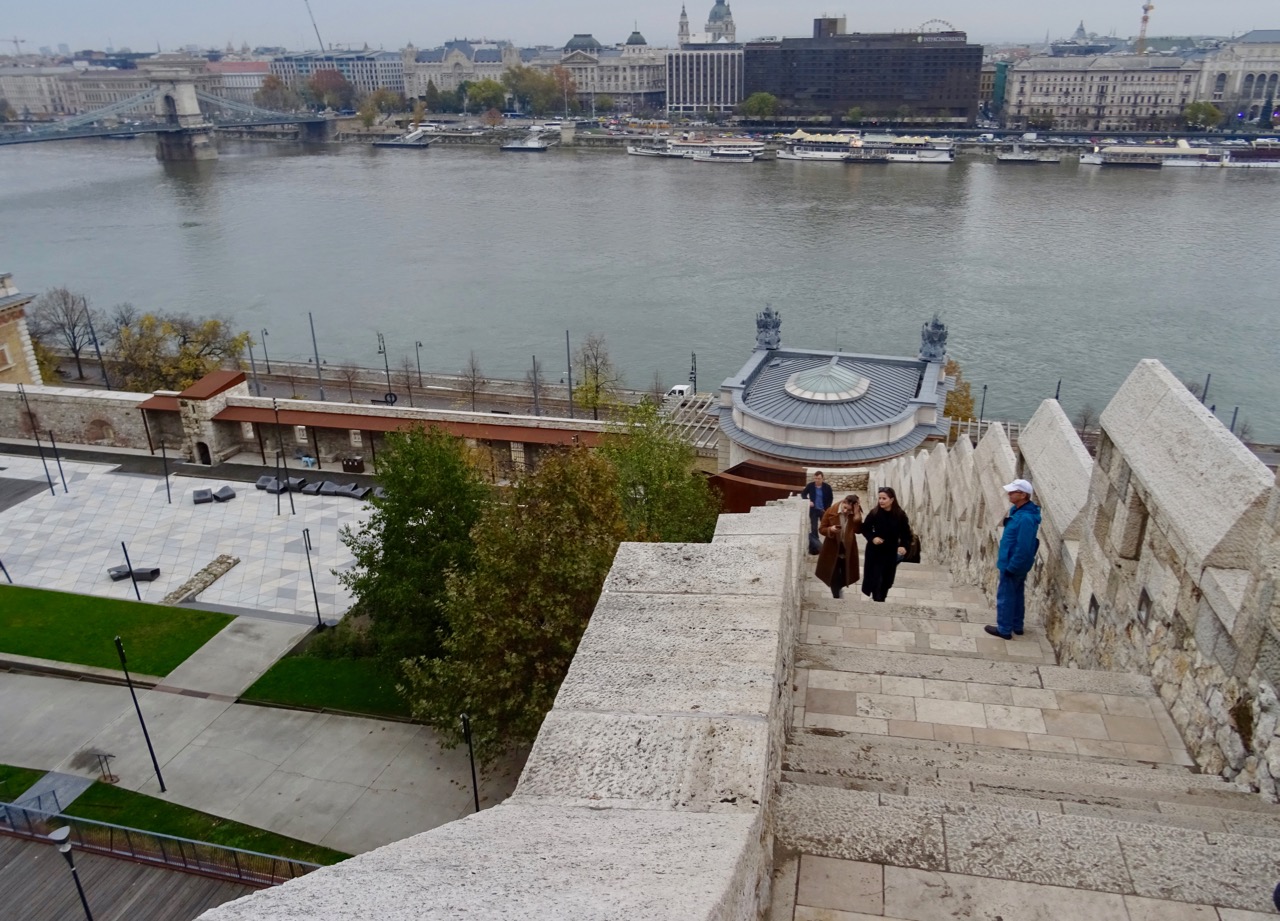 When we walk across this bridge we can see these same stairs on the far left side of this photo.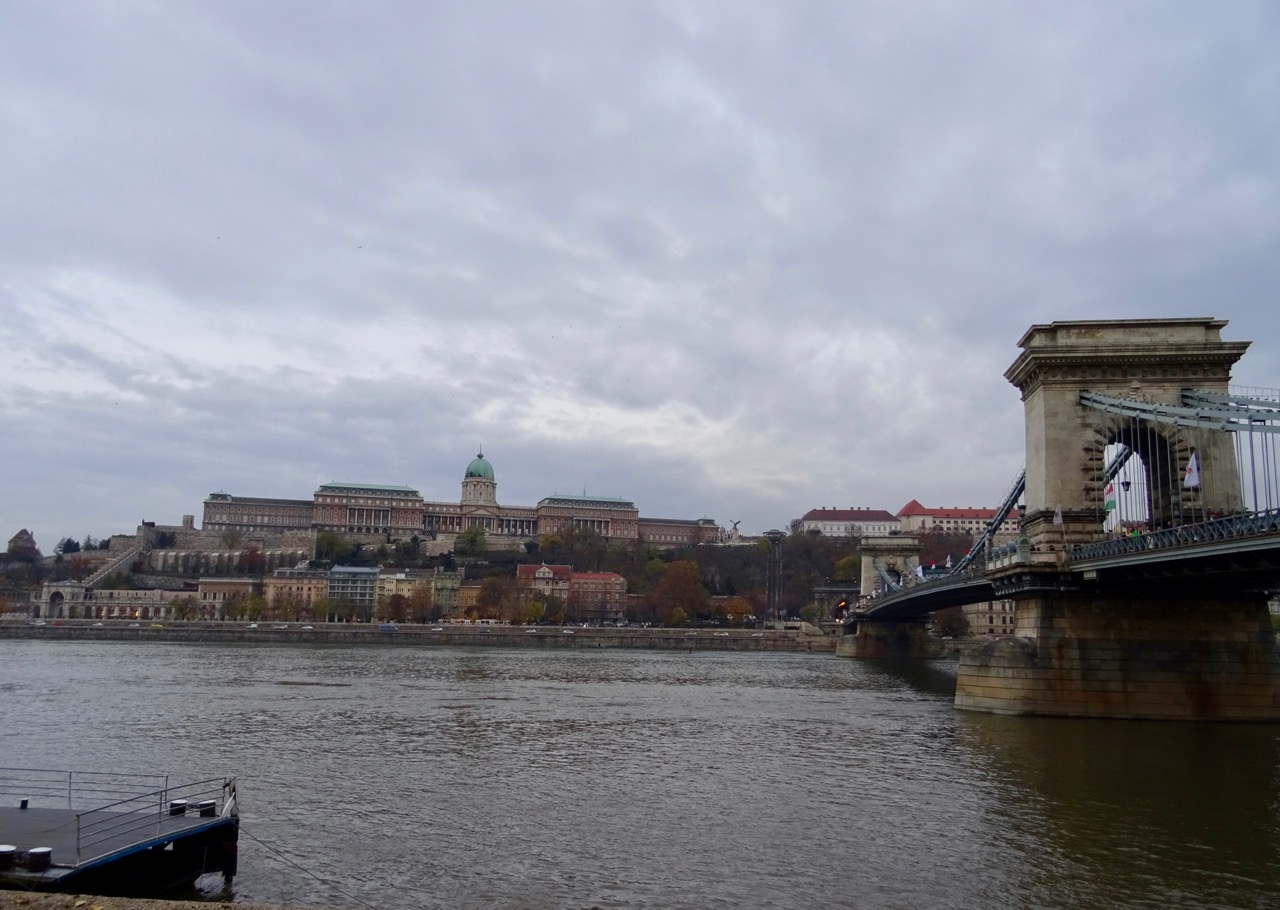
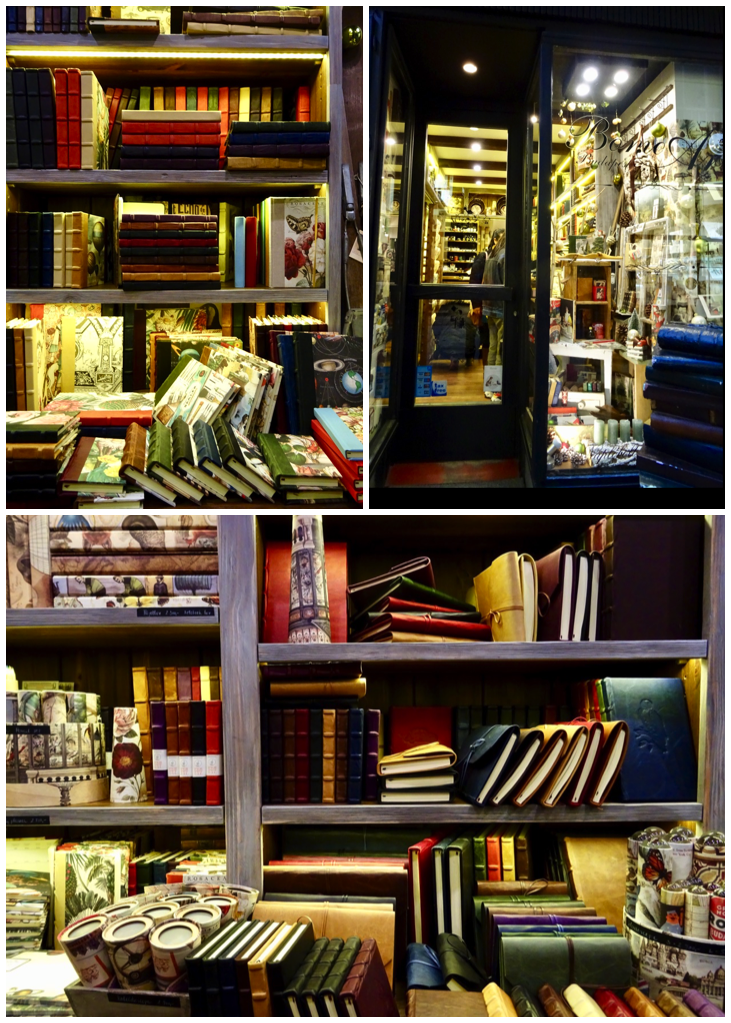
 We are walking to this little bookstore that sells handmade journals. Bomo Art is a tiny store, less than 2 metres wide! It didn’t have any larger sketchbooks with good paper for drawing. Too bad, or maybe it was good. My suitcase is already pretty heavy with the two sketchbooks I bought in Linz, and the huge Dürer book I got in Vienna.
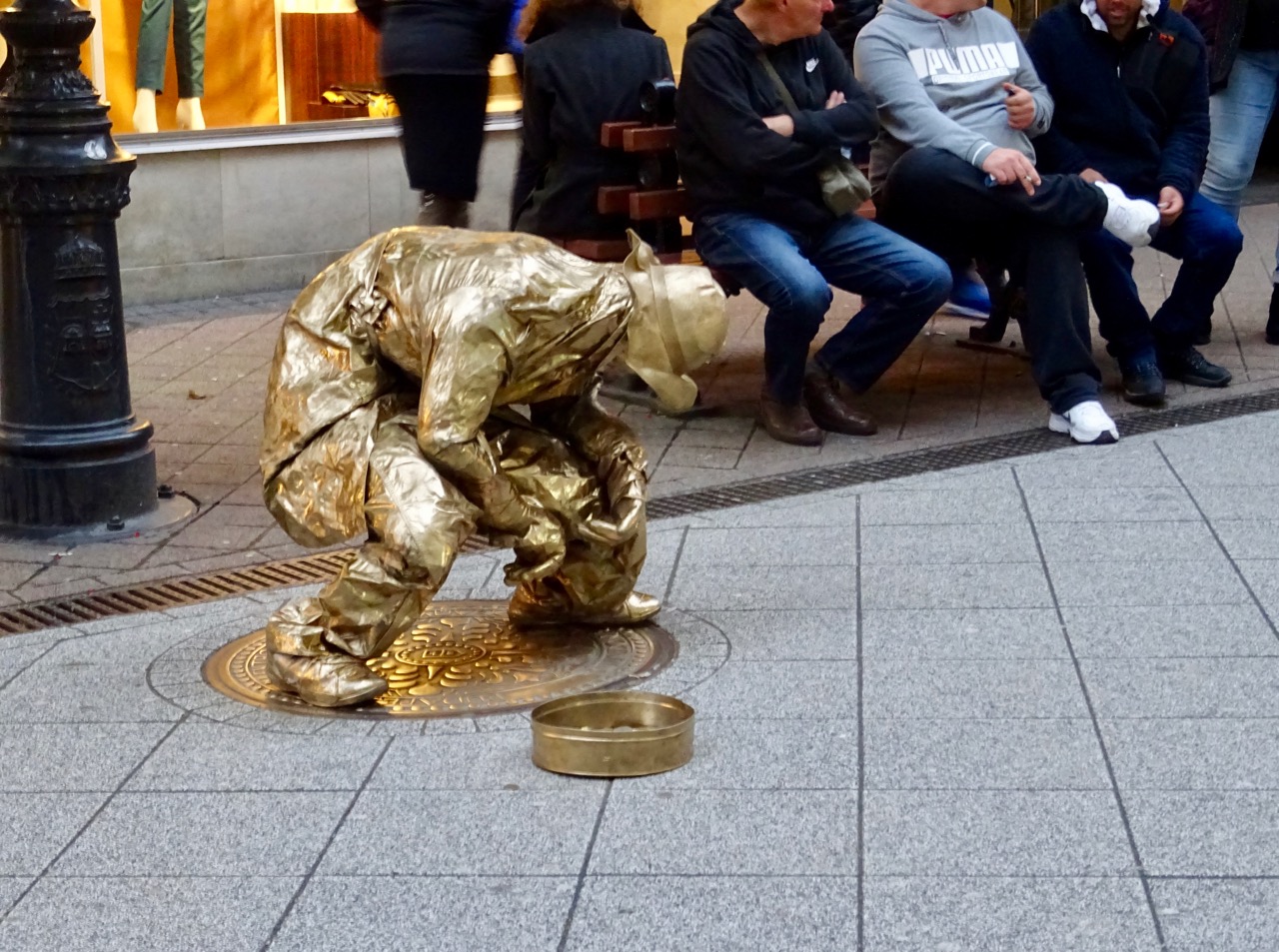
 We watched this street performer for a while and wondered how he was able to hold this difficult pose. We later saw him in a different position but when we walk by again we see a guy lean heavily on him and to our surprise he crumples! Turns out he is a mechanical man! People were putting lots of coins into his can, trying to get him to move. They had no idea they were being tricked into thinking this was a man in costume.
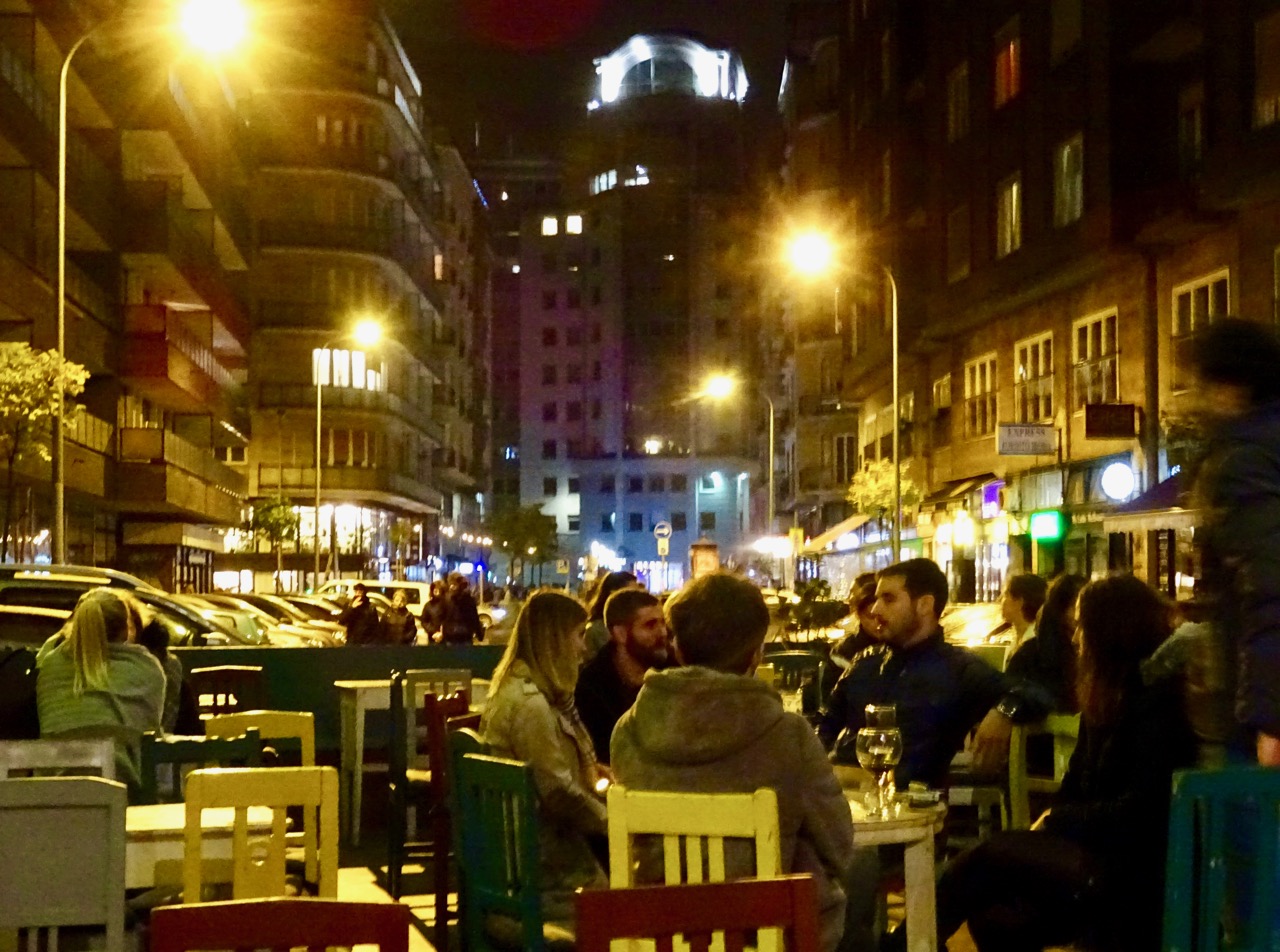
  It is quite cool at night but it doesn’t stop people from sitting outside drinking beer.
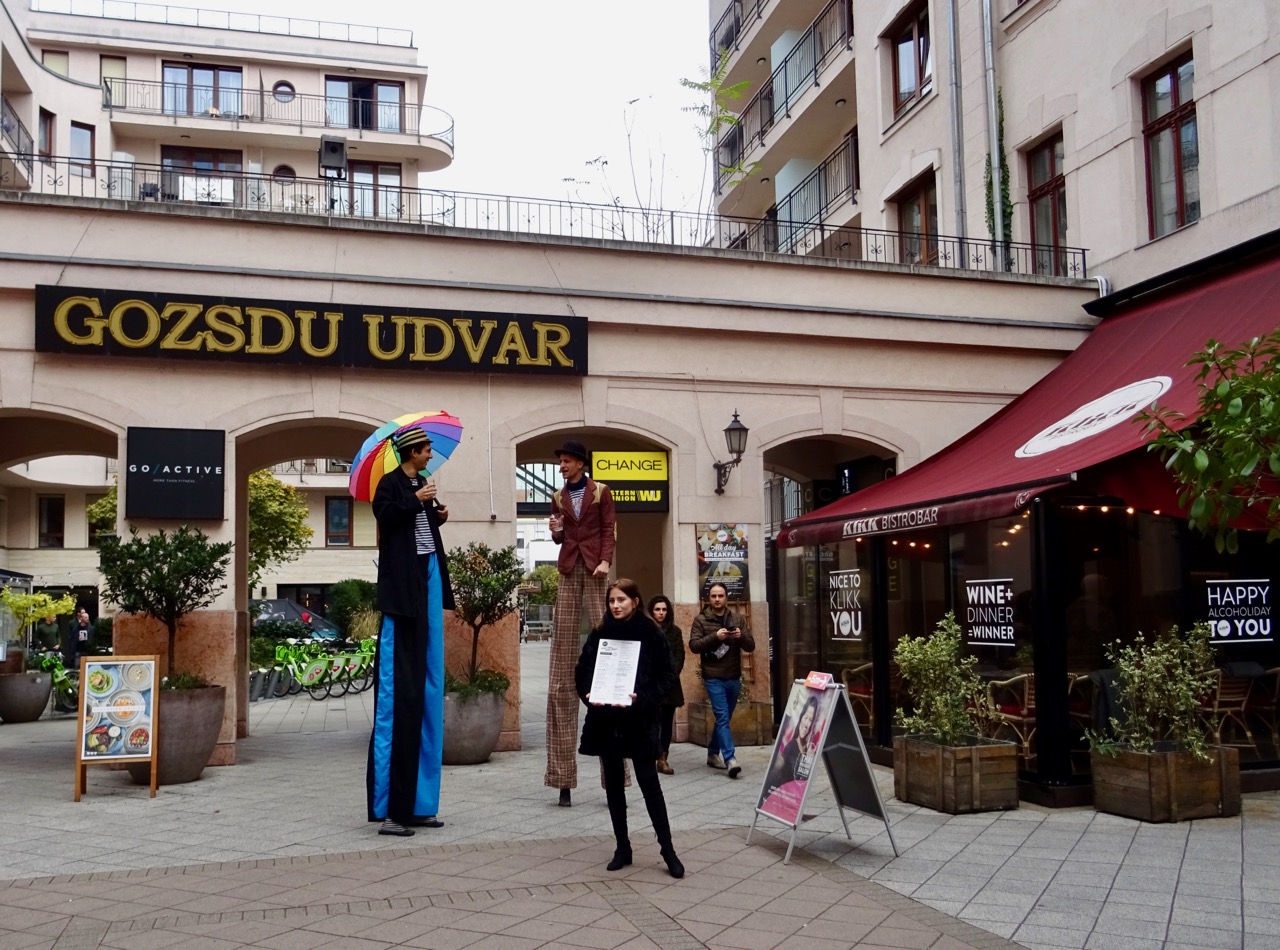
  One last walk down the decorated street towards the Christmas Market. There are so many more people out on the streets tonight.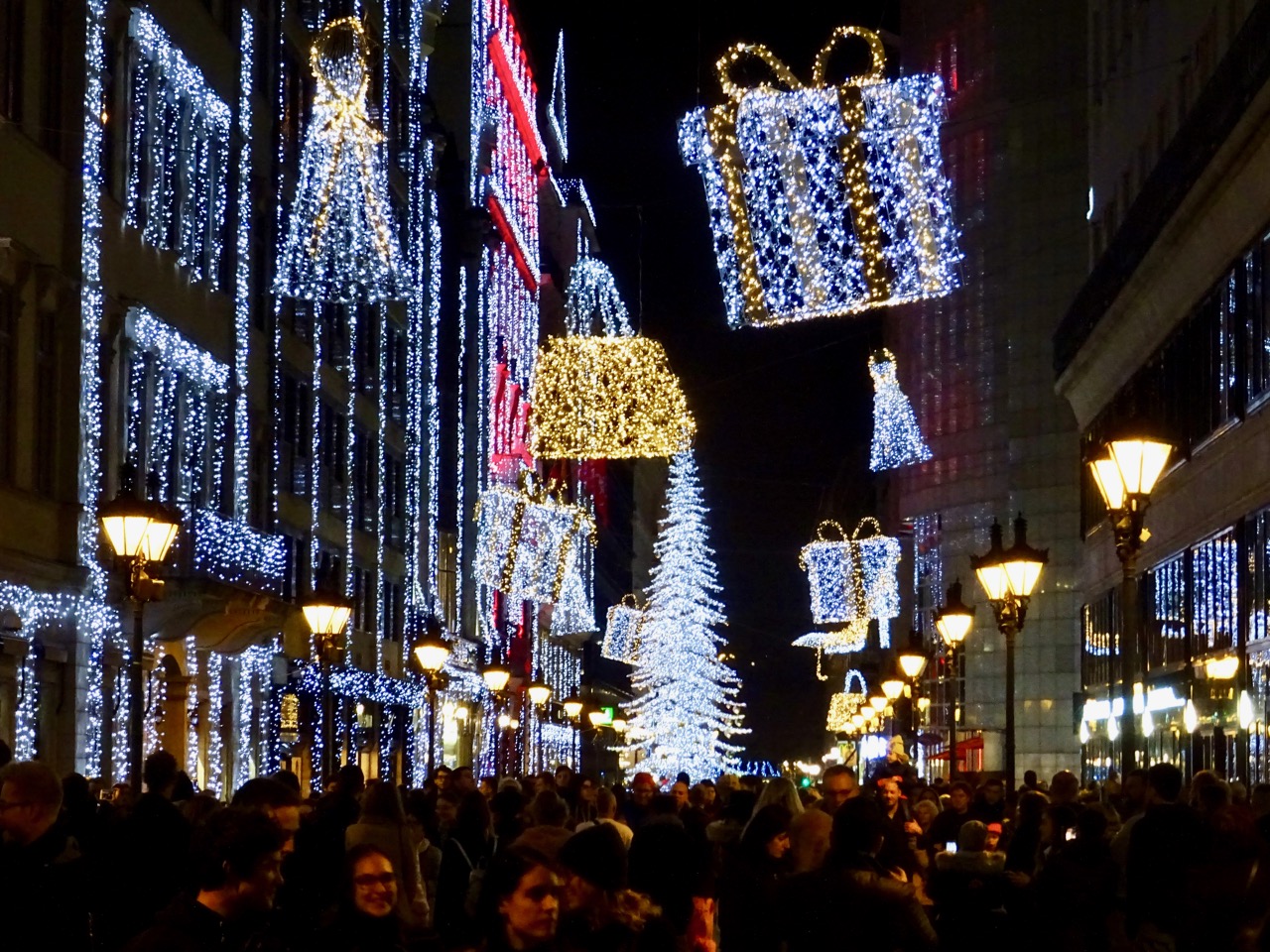
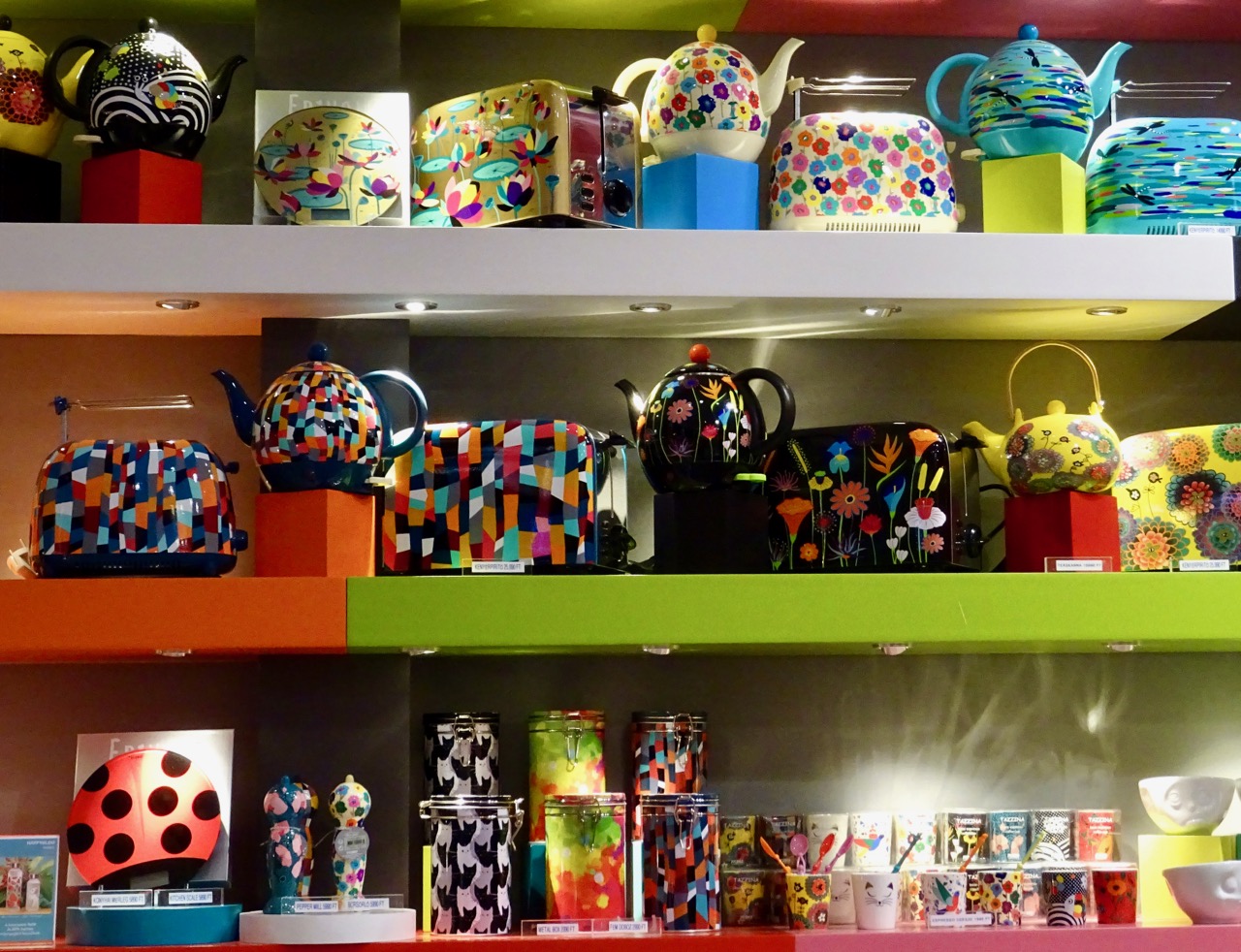 We stop at one of the stalls and I buy a couple small gifts I have been eyeing every time we walk by.
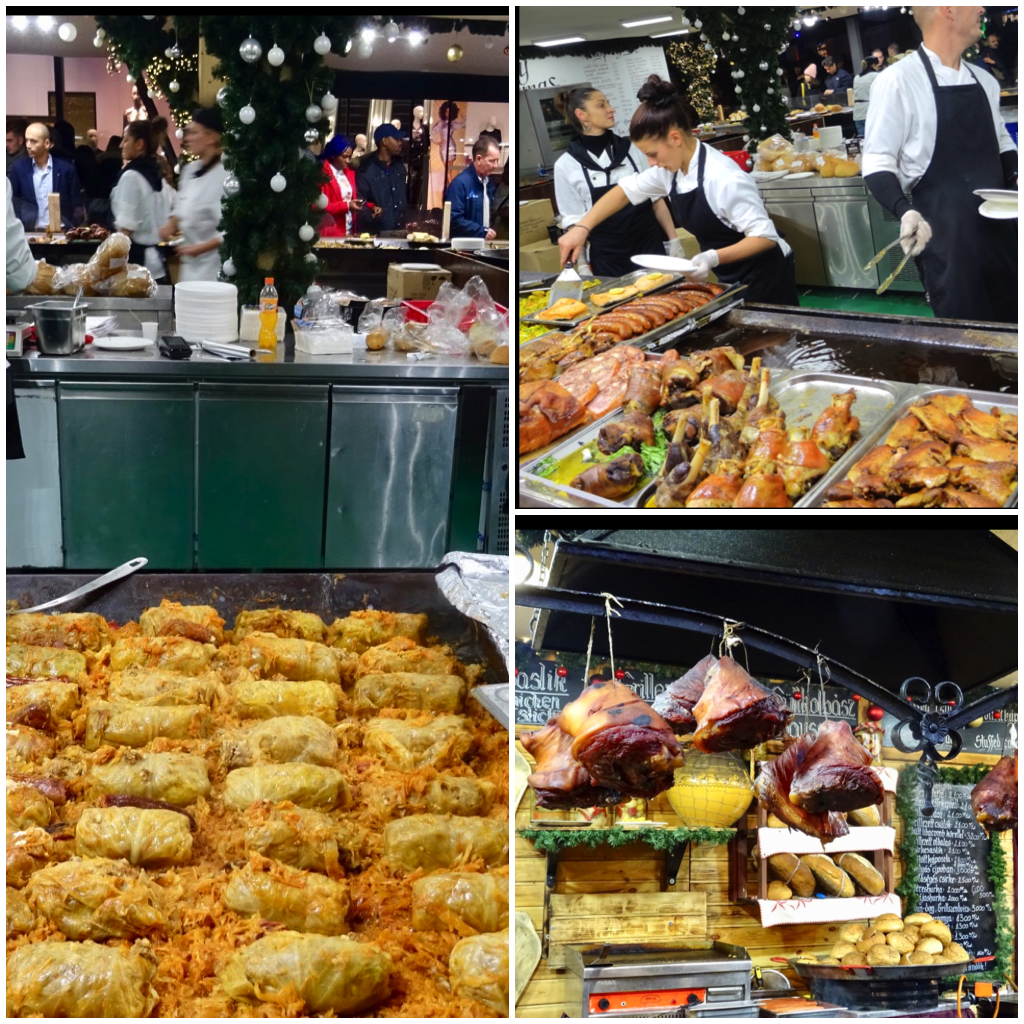
  I also took photos of the food stands. Pork hocks are a big item here! We were going to buy a meal here a few days ago but quickly changed our minds when we discovered that one cabbage roll, albeit a big one, would cost us 5,000 Forints, the equivalent of $25 Canadian! A small plate with a sausage and two small helpings of side dishes was $35.00! We were rather shocked at how expensive it was. We saw other tourists change their mind and refuse to purchase what they had ordered when they realized the price.
 I saw lots of these sparkling balloons and thought they were so pretty. They were even nicer in person than in the photo. We spend the rest of the evening tidying the apartment and packing for our drive to Croatia tomorrow. Oh, and the puppet show we saw ws ‘Coraline’.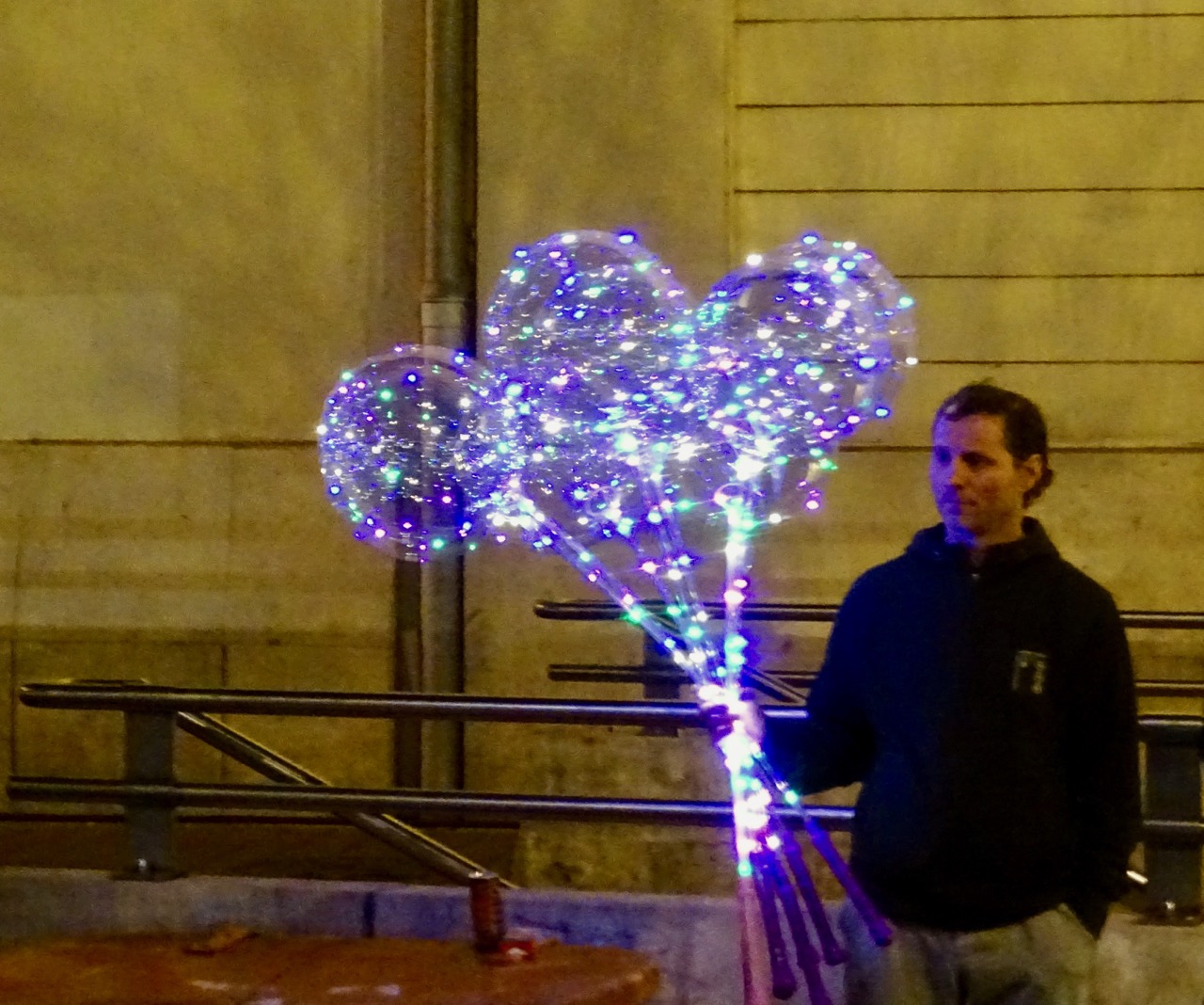
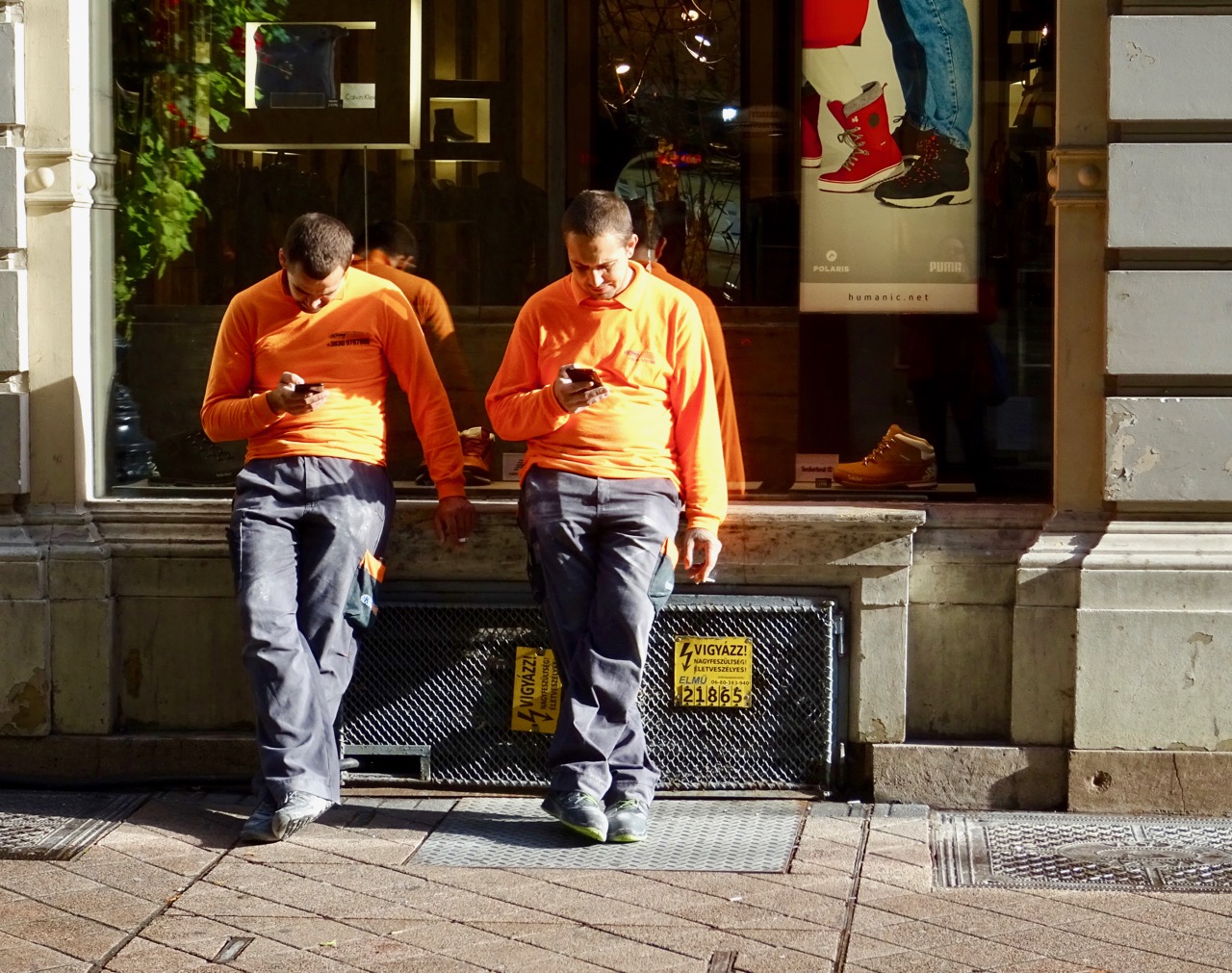
 I laugh watching these two guys. They are dressed the same, stand the same and both are smoking and looking at their cellphones. They even both take a drag on their cigarettes at the same time!
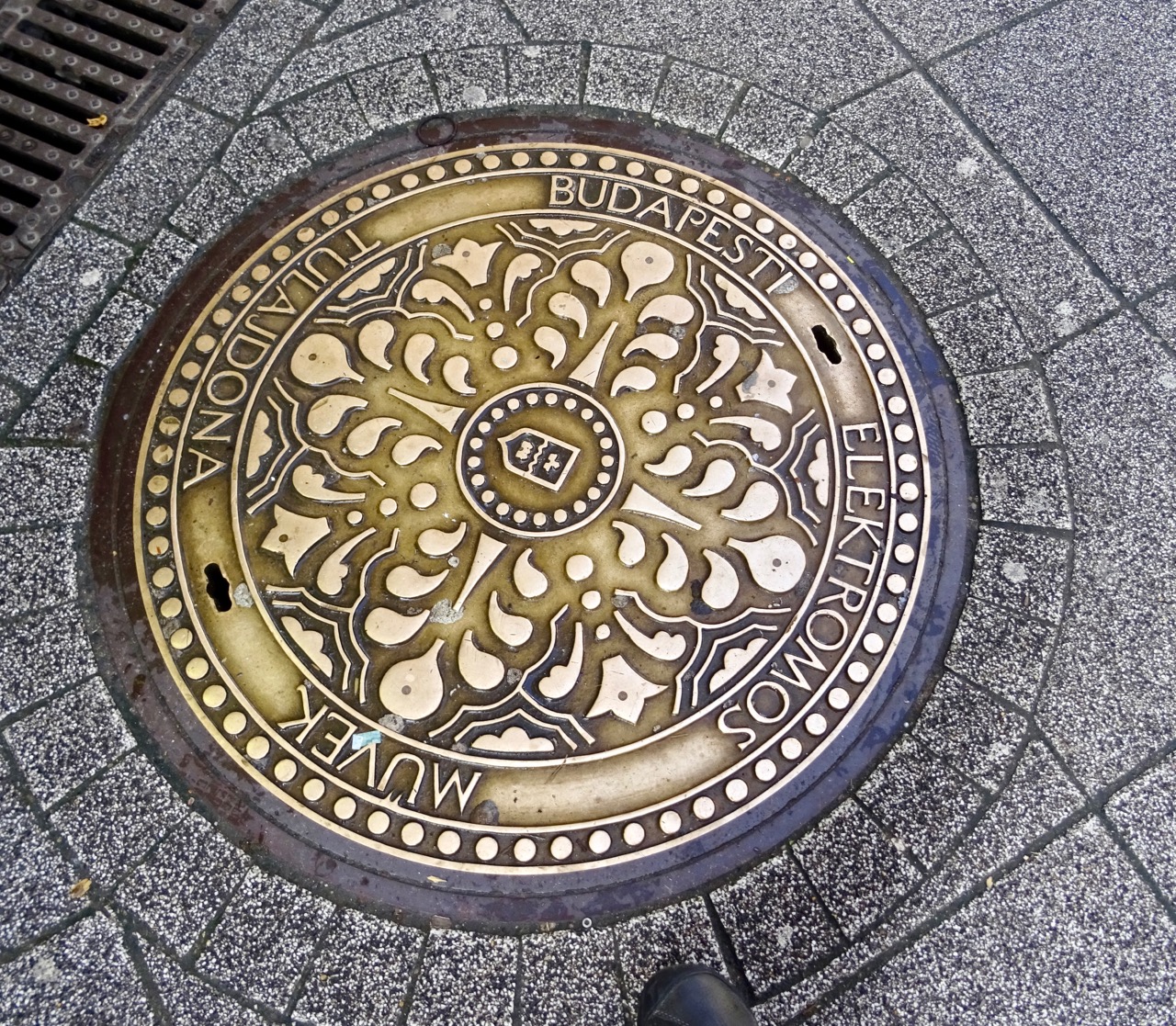
 Budapest has very pretty manhole covers.
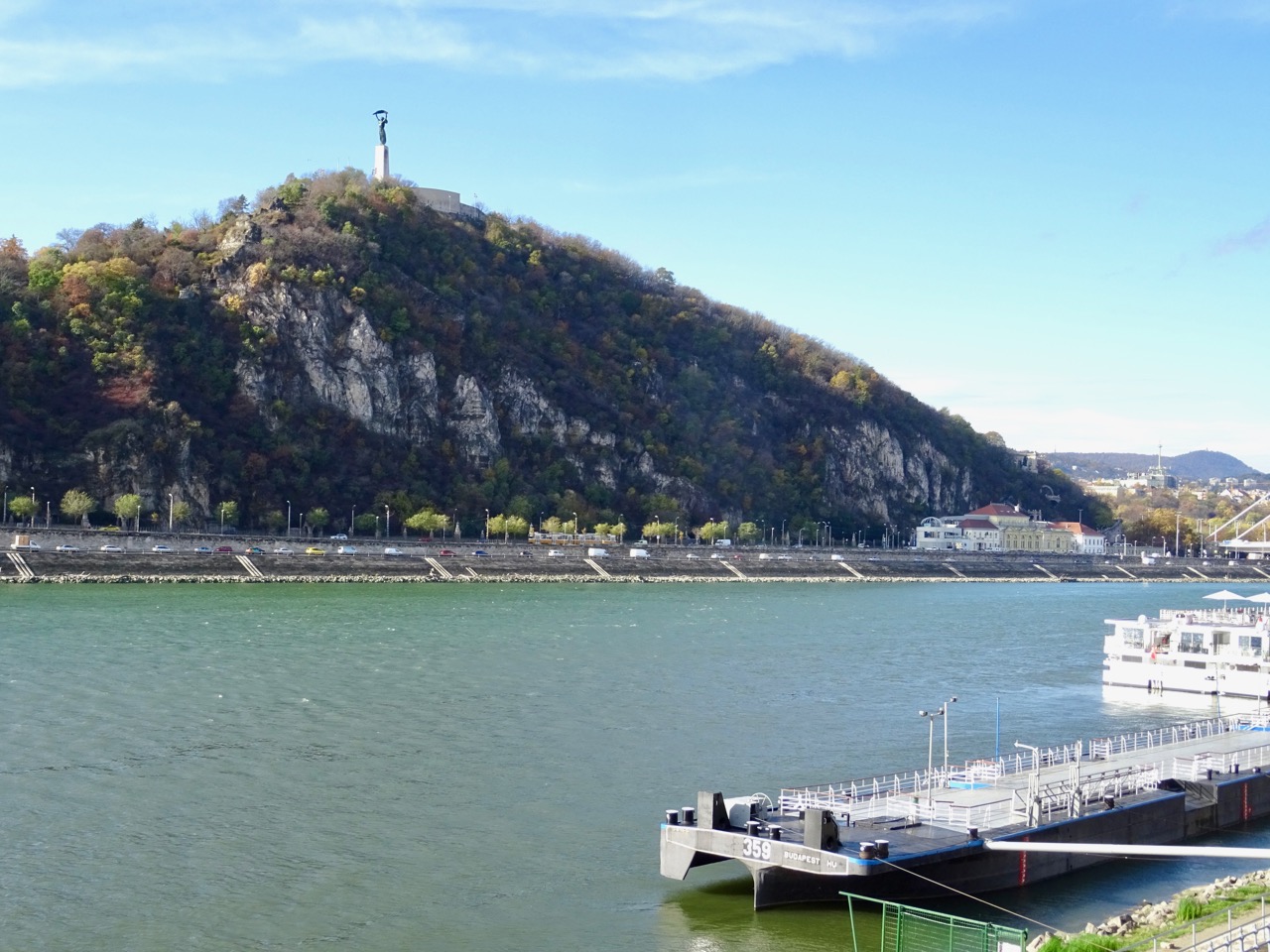
 Bob tells me we are going to the top of that hill across the Danube River on the Buda side of the city. I am quite happy to hear there is a bus that will take us most of the way.
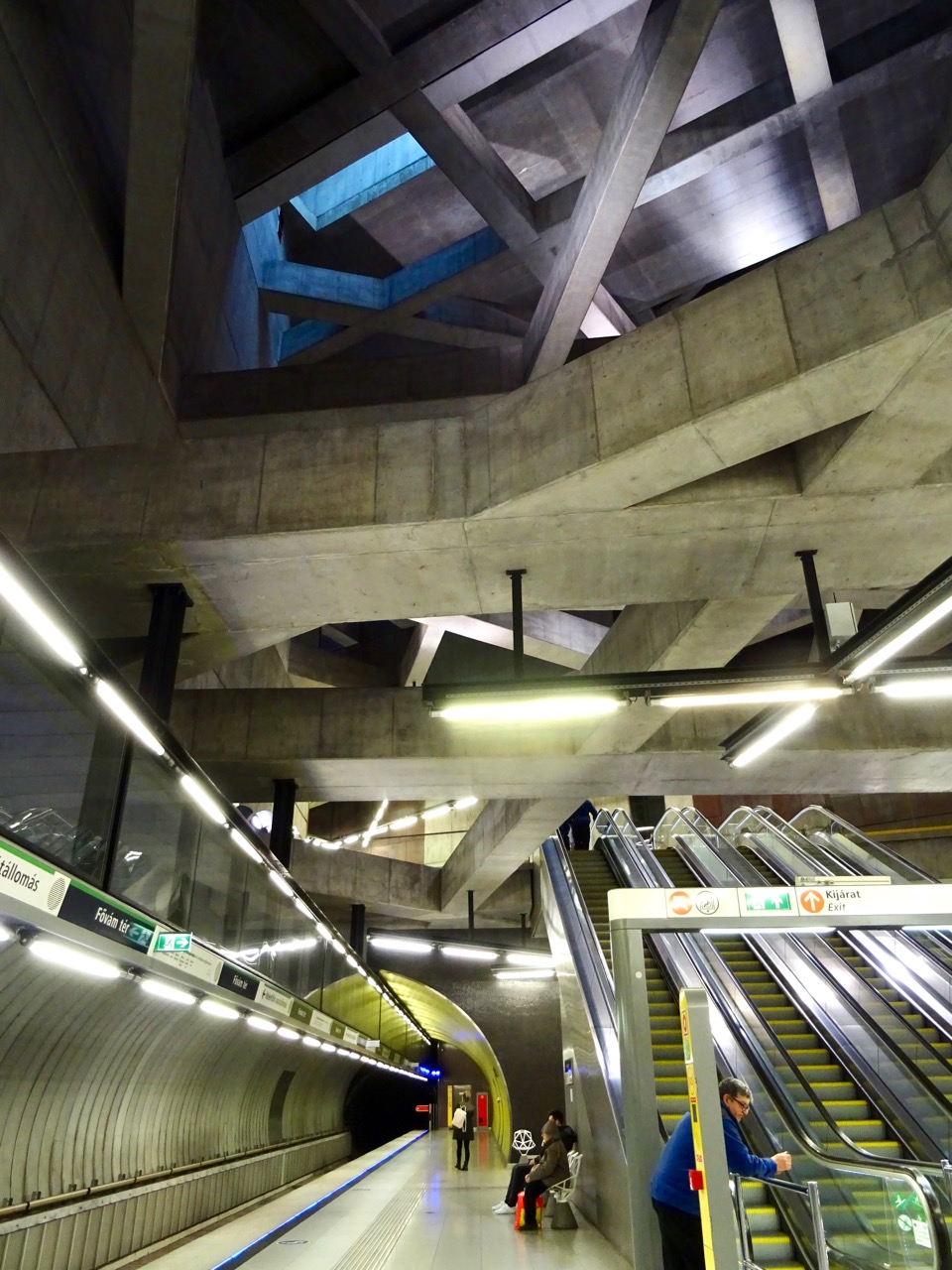
 The metro stations in Budapest are very deep underground. They were built so that they could be used as bomb shelters. I wonder what would happen if a bomb fell above a station full of people. How would they get out…would they be trapped by all the rubble? Then I decide that they could walk down the tracks and maybe get out at another spot. Bob says I think too much!
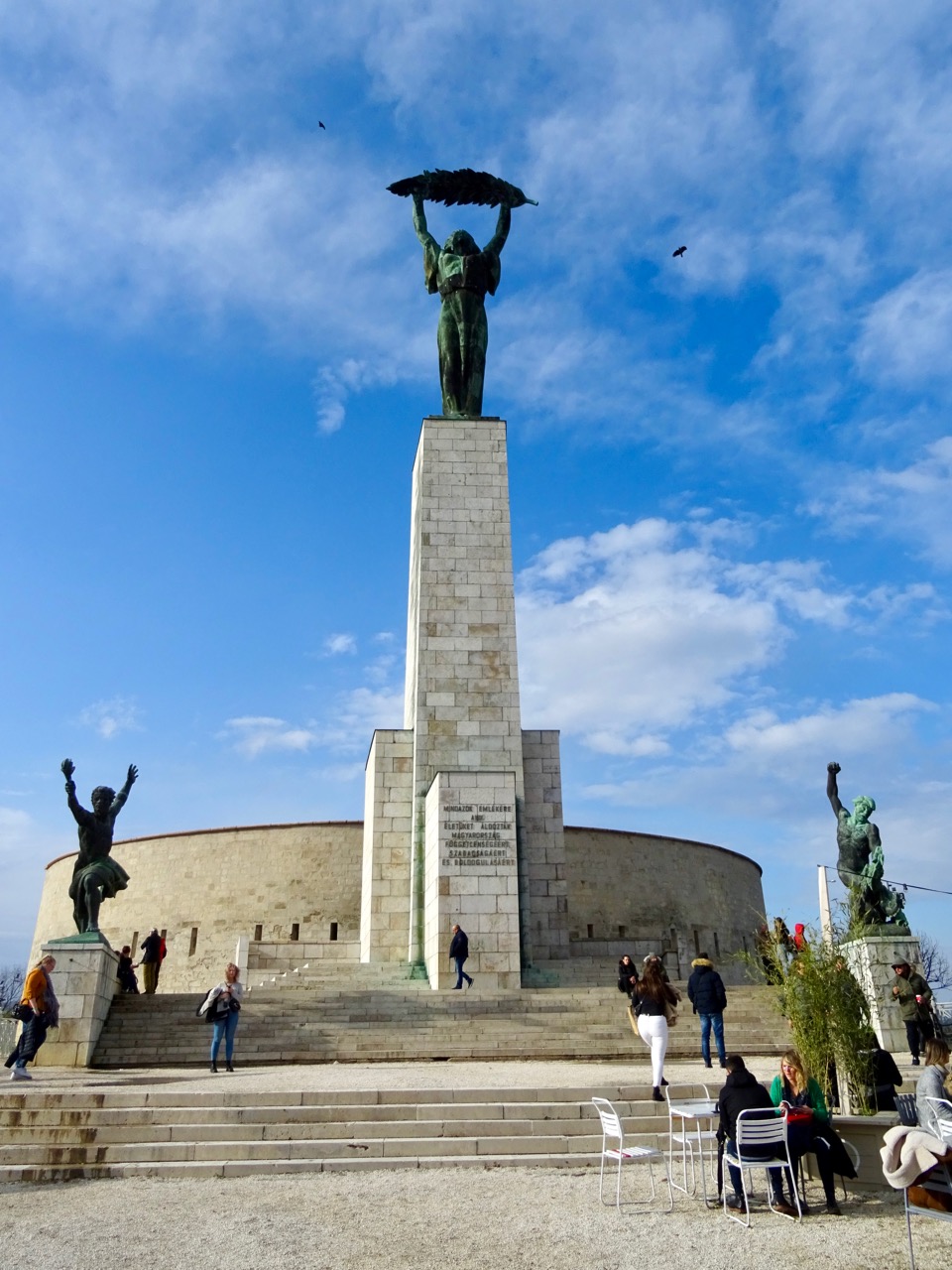
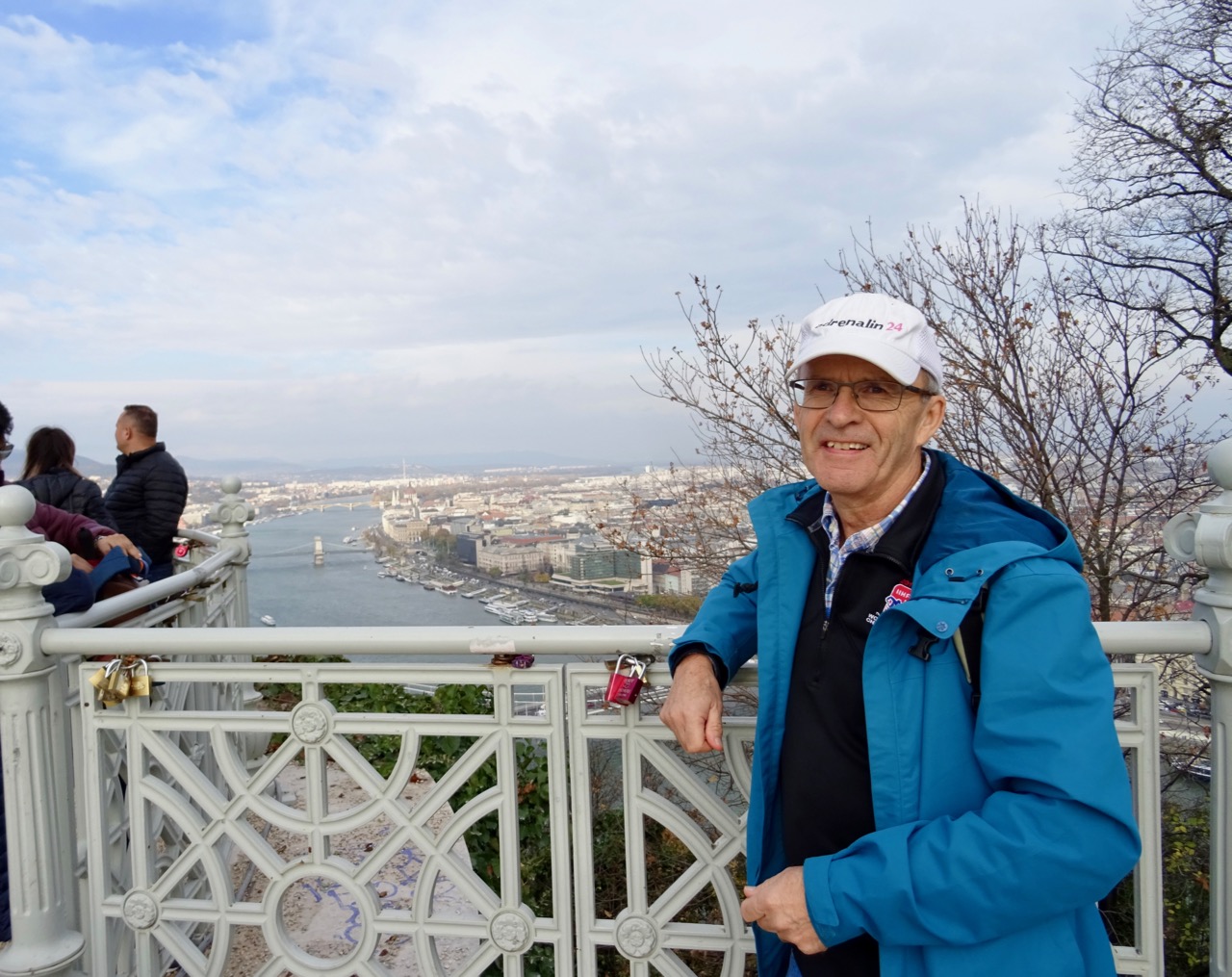
 We are on top of Gelléert Hill and it was only a short climb from the bus stop. There are great views of Budapest looking to the East…
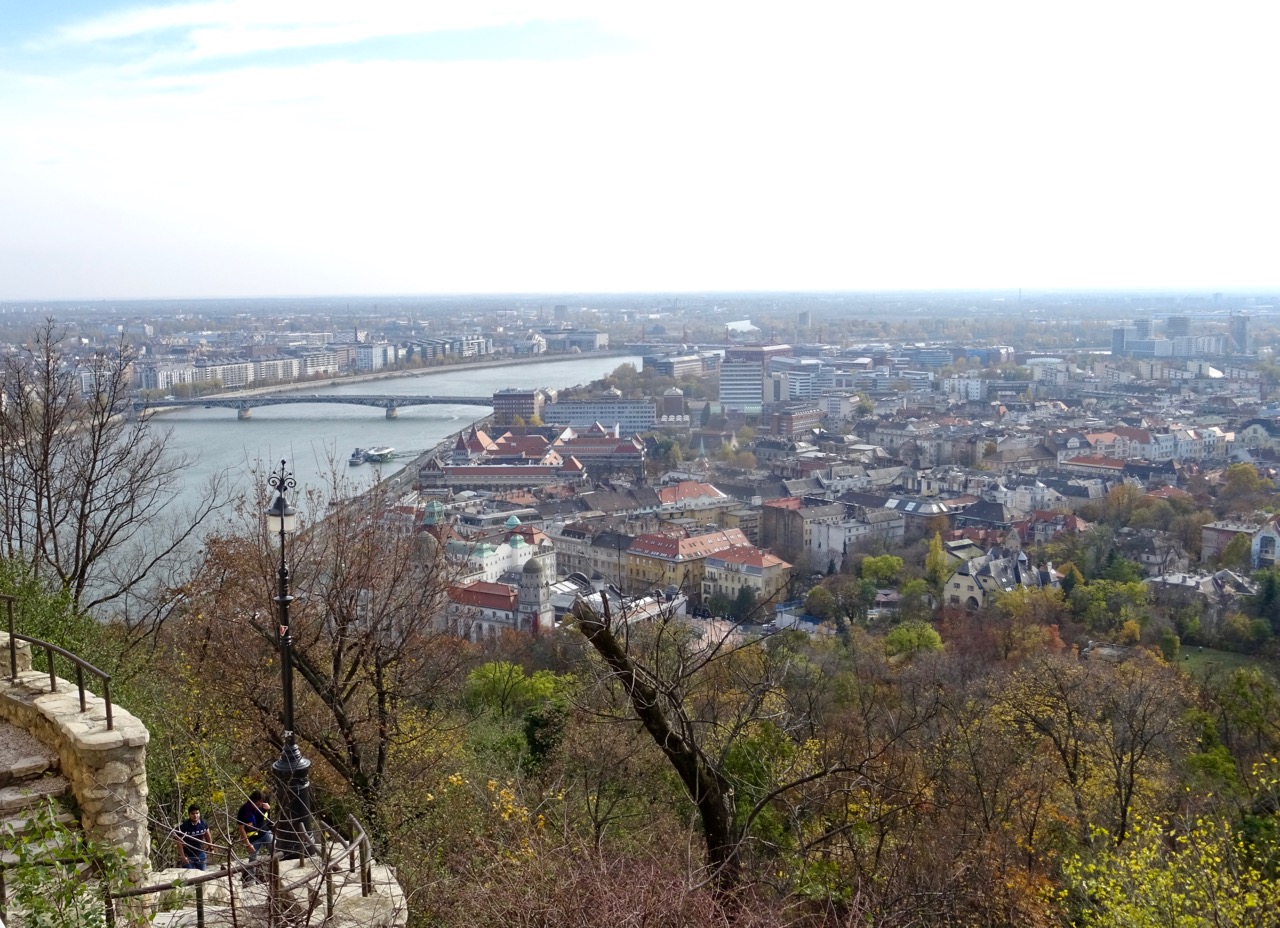 and the West.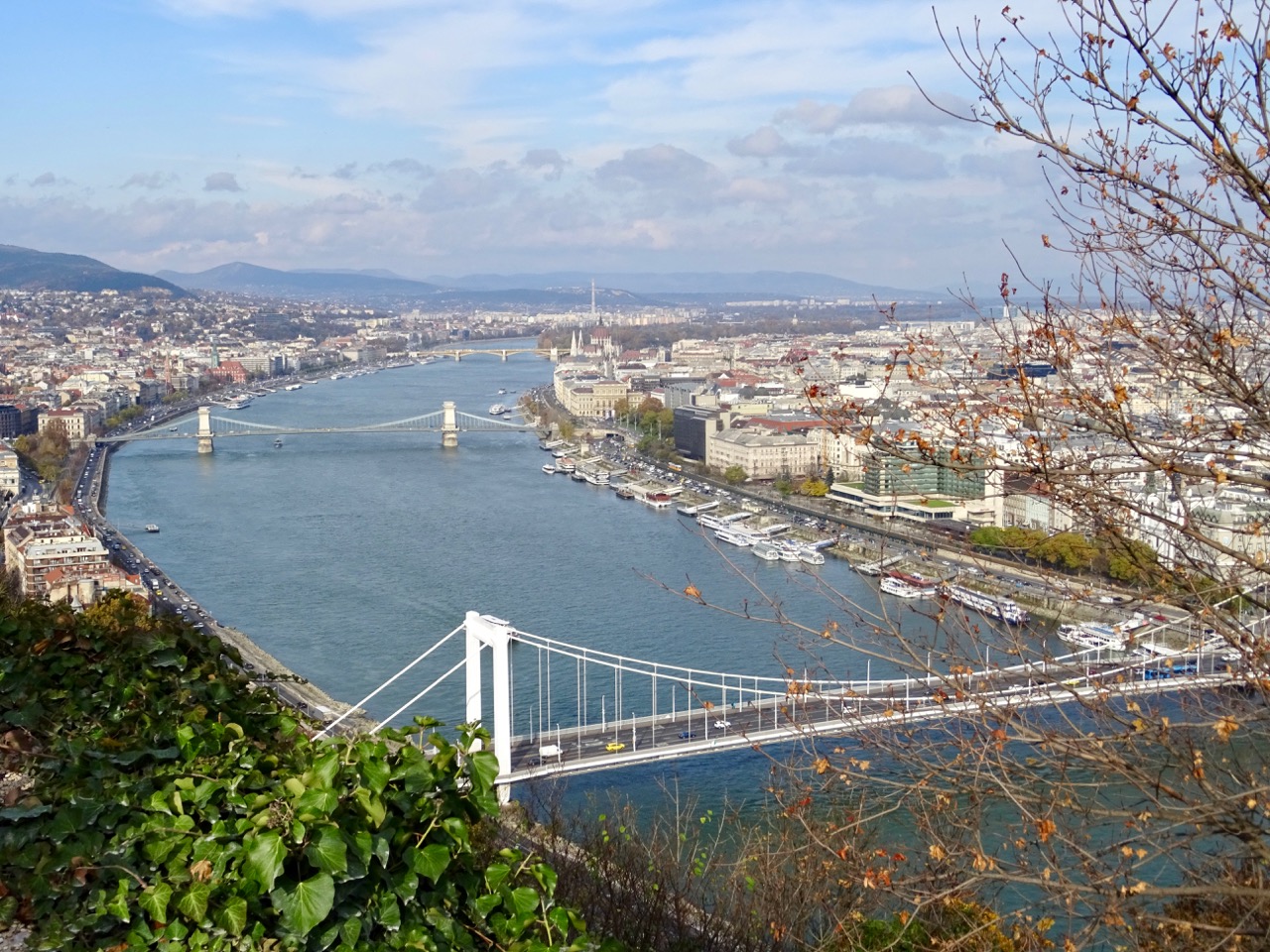
 Bob called me over to watch an older man operating a shell game near here. He had a cardboard box and three shells, and people bet on which shell a pea was under after they were shuffled. We were astounded that he was able to convince people to bet 400 or 500 euros.
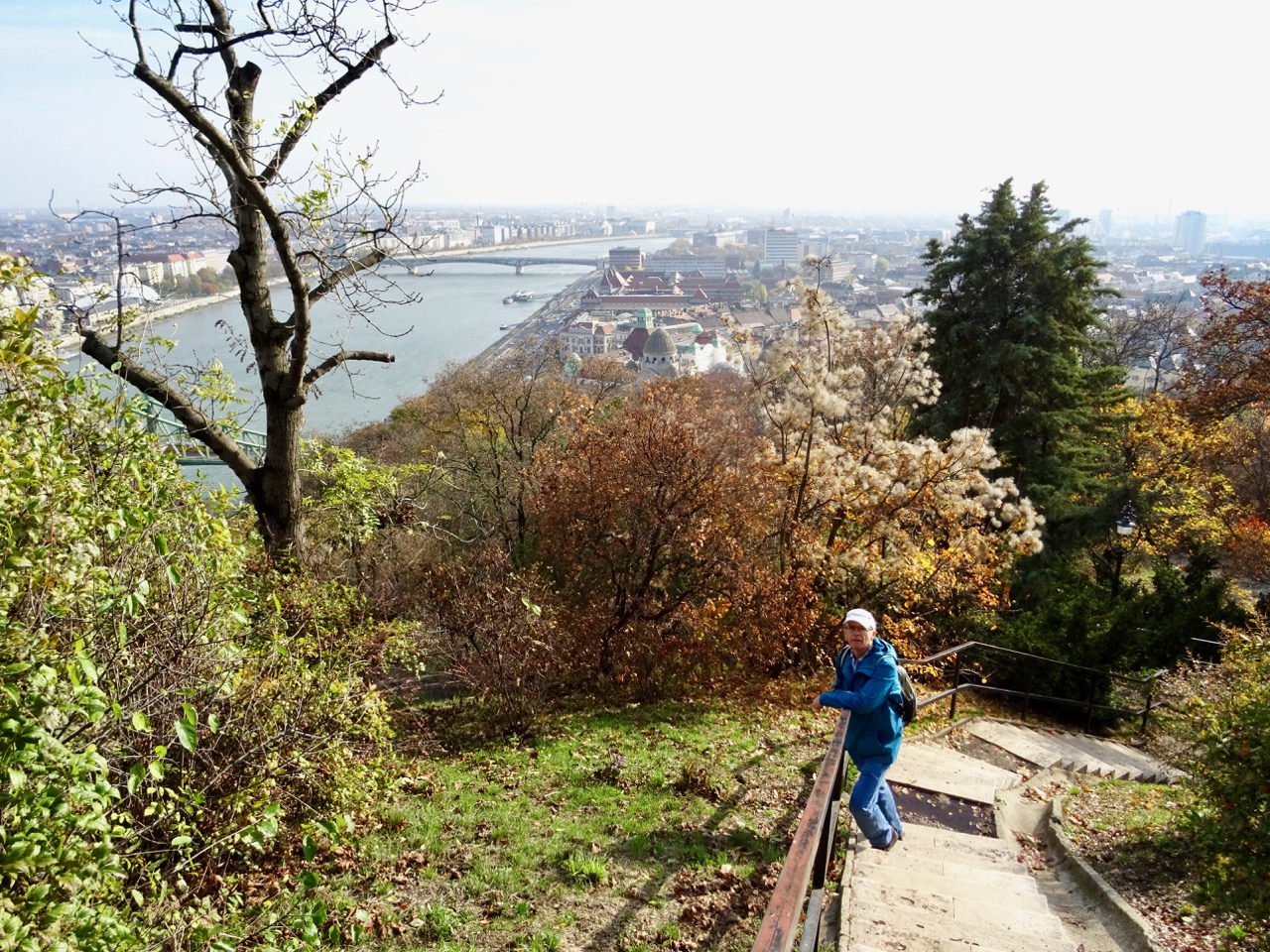
  It is getting windy so we start down the hill. We are walking down…
 through a park with lots of trees…
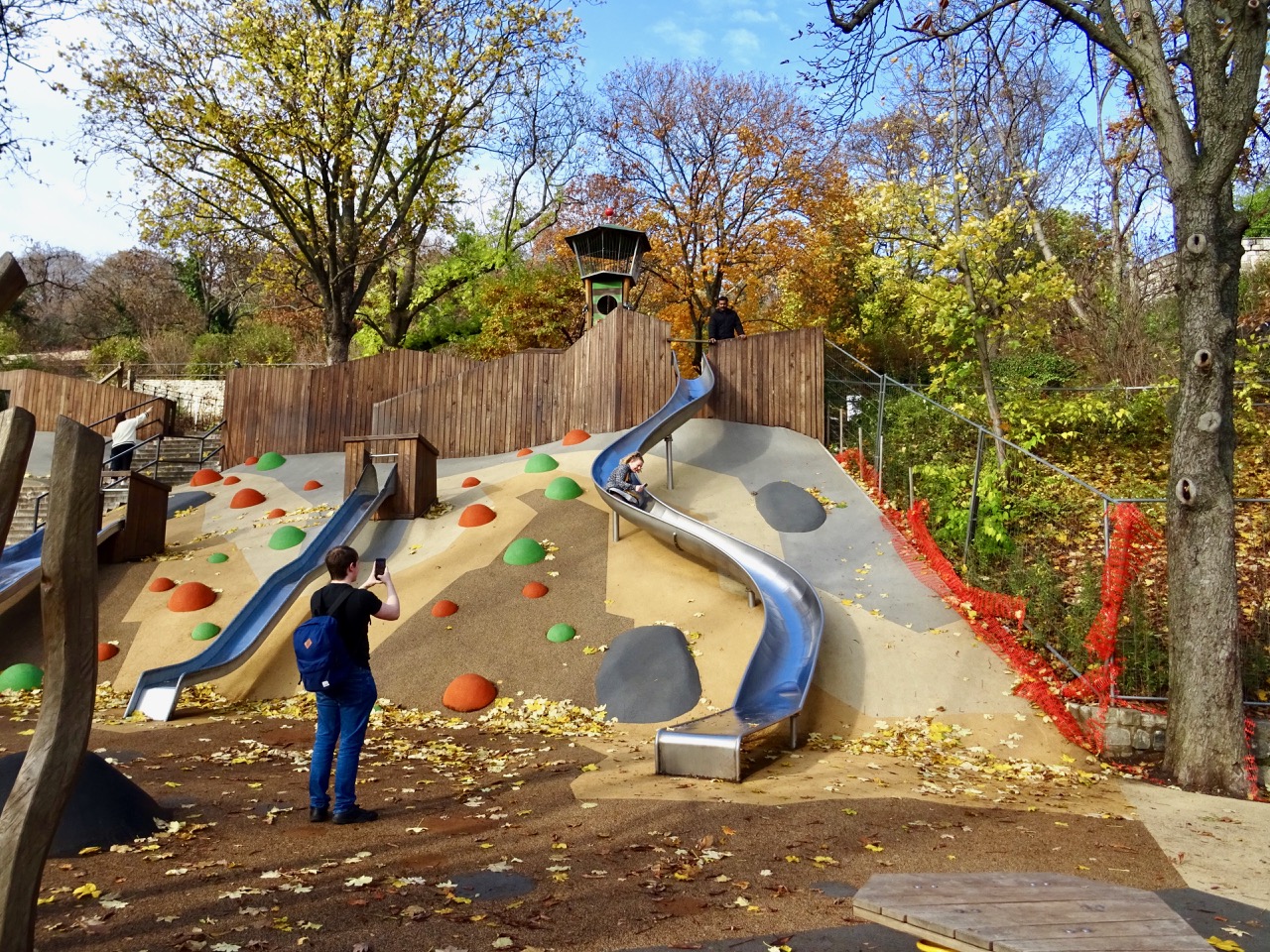
 and a couple playgrounds. This one takes advantage of the hillside. We tried this slide too.
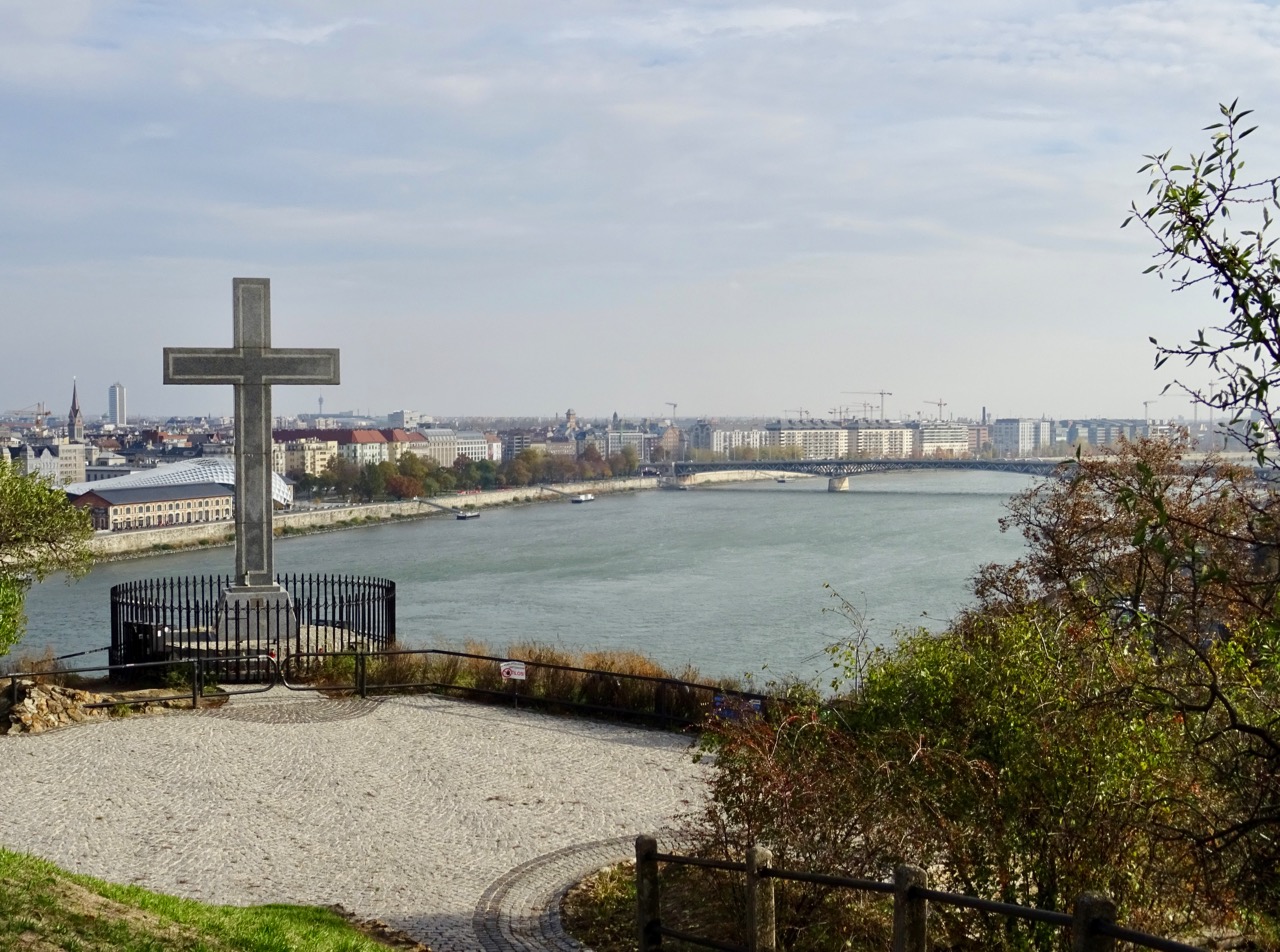
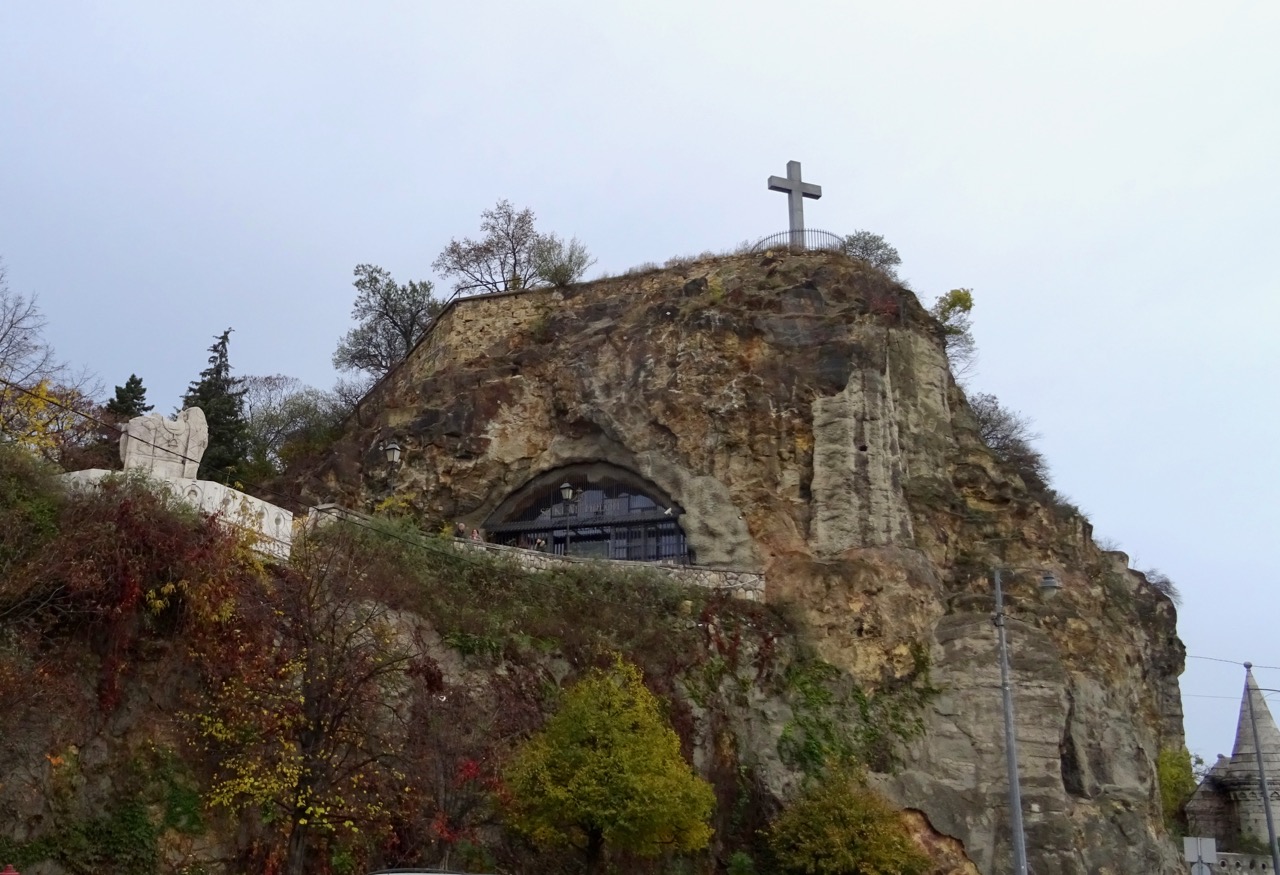
 This cross is about halfway down the hillside and marks the location of the Cave Church directly below it.
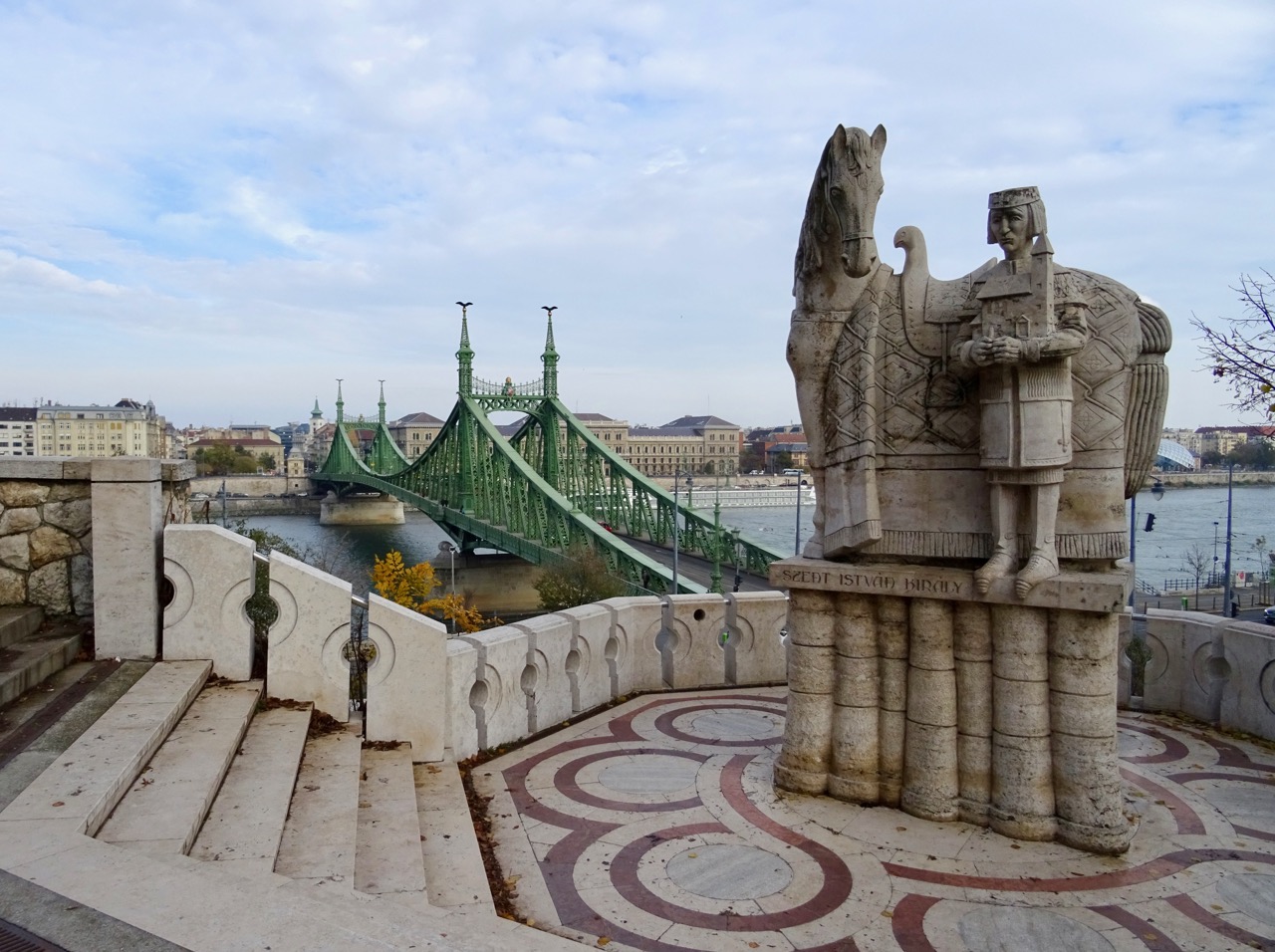
 This statue of St. Stephen is near the entrance to the Cave Church.
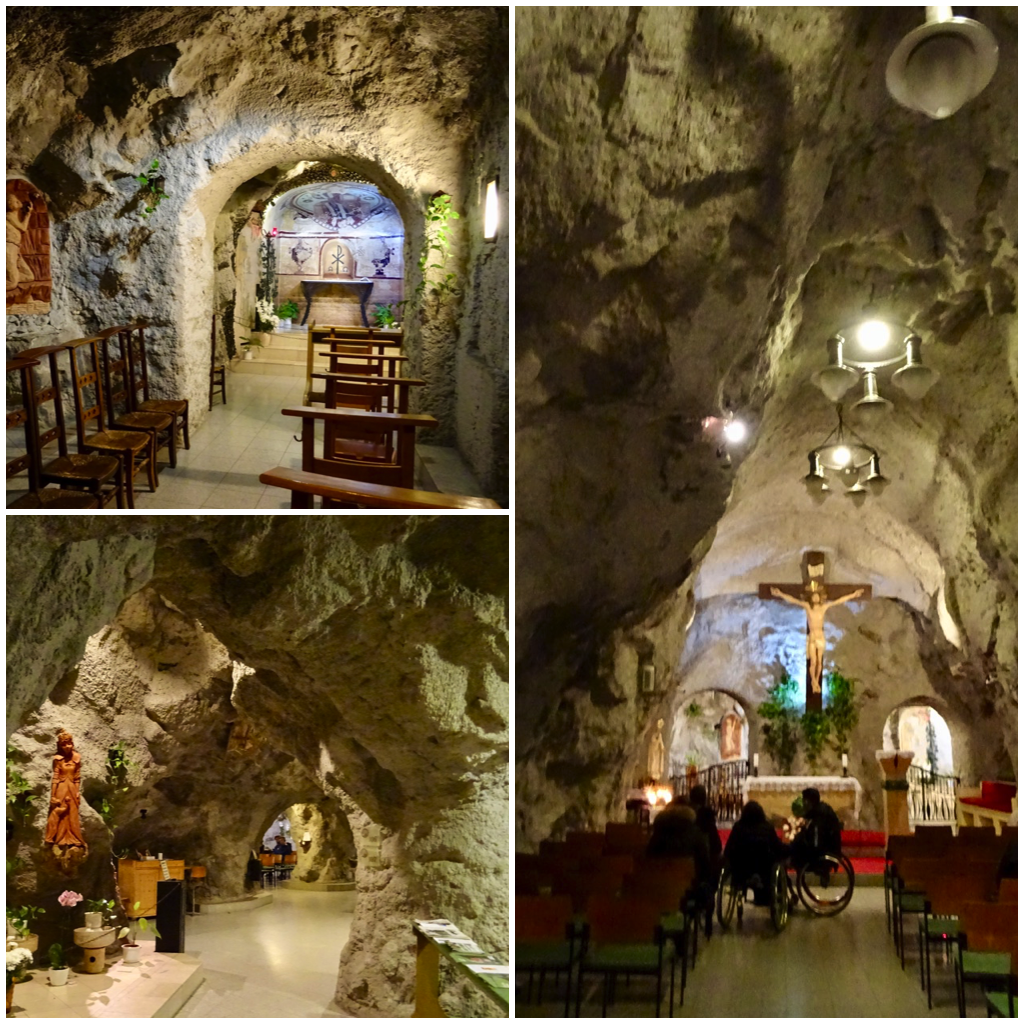
 For more information and photos about this curious church check
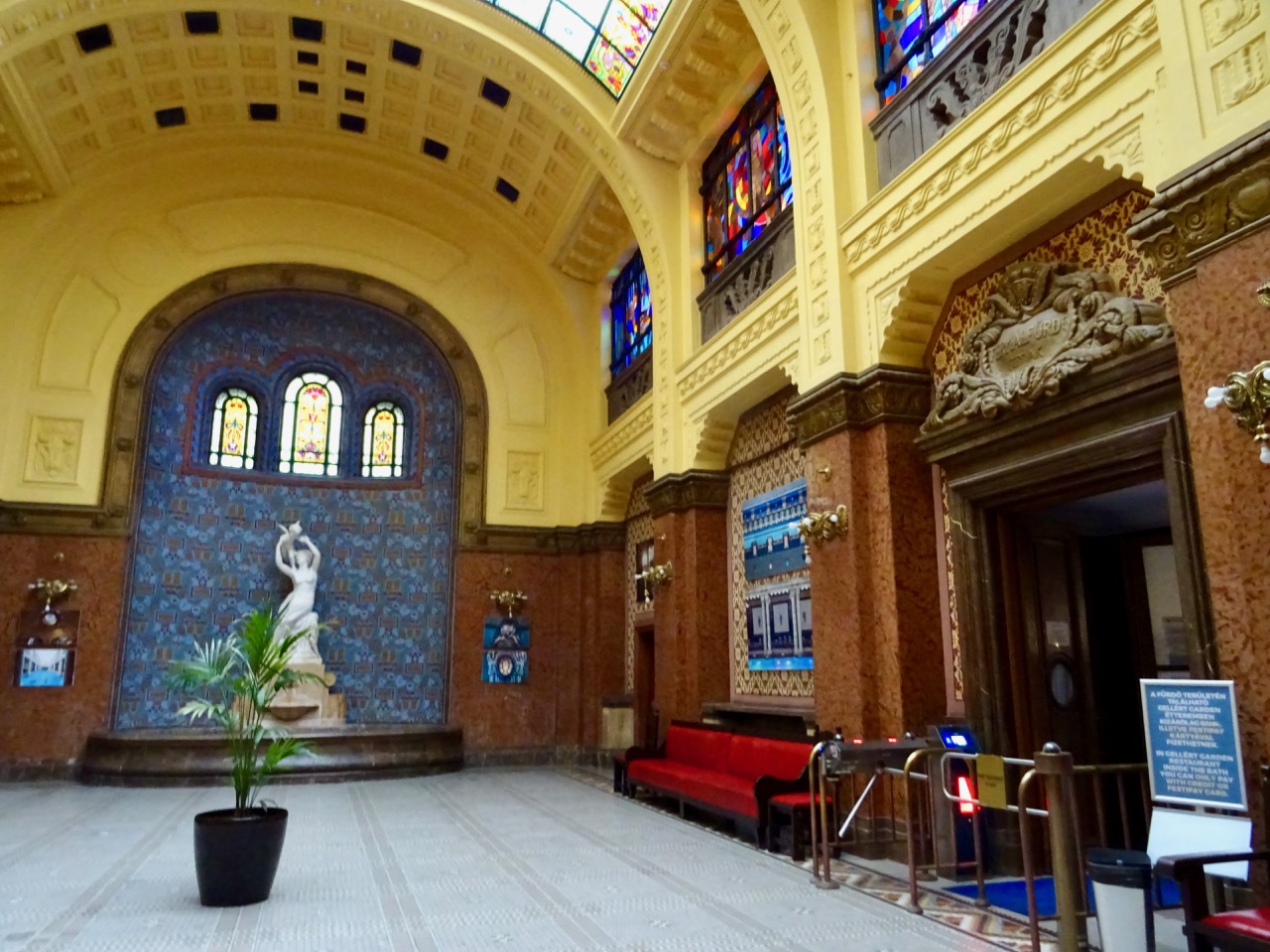
 A bit further down the hill we peek inside the Gellért Hotel…
 which houses one of Budapest’s thermal bath houses. It looks very fancy.
 Here is a view of the cave entrance from the street below…
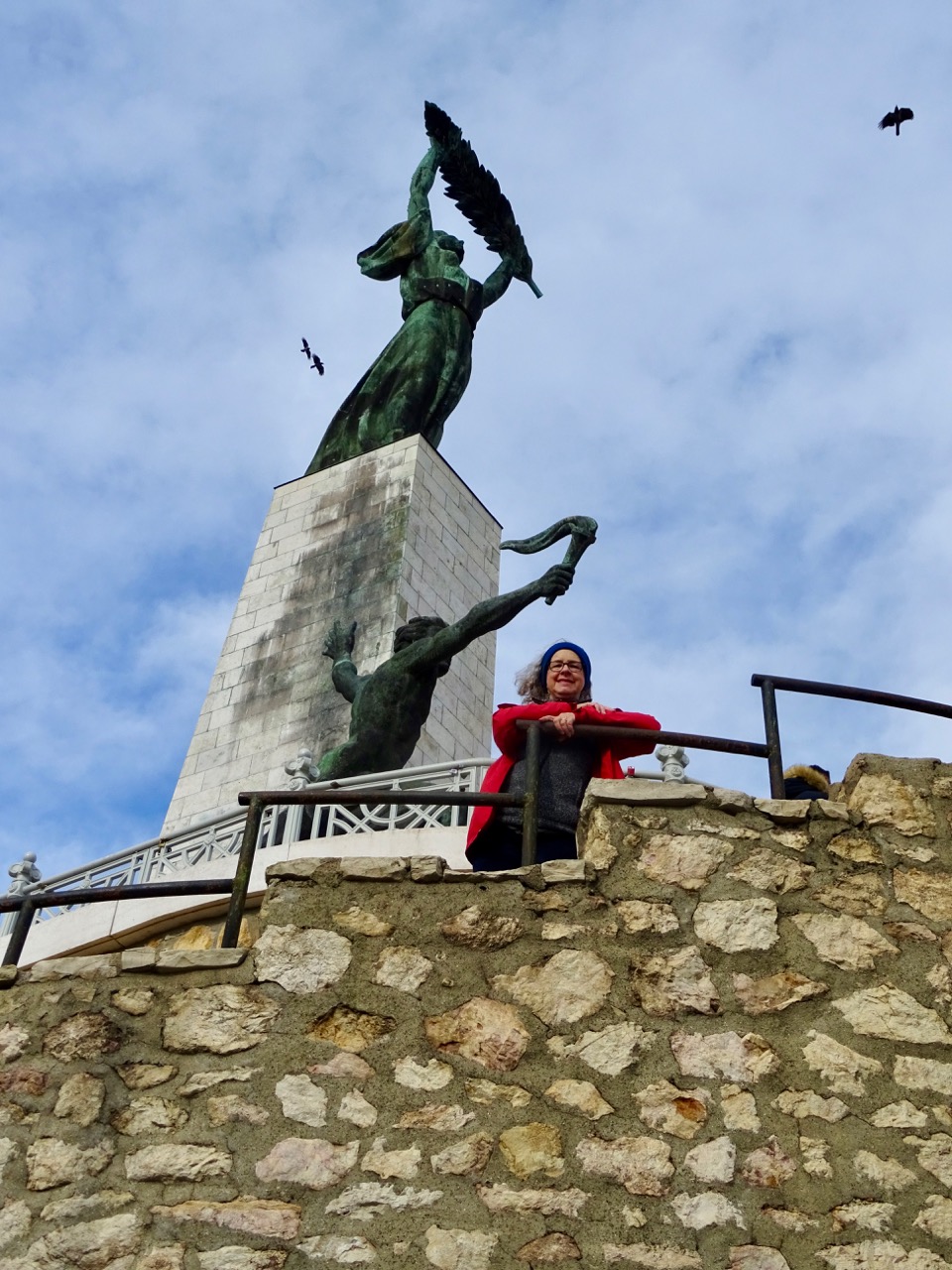
  and the Liberty Statue at the top of the hill.
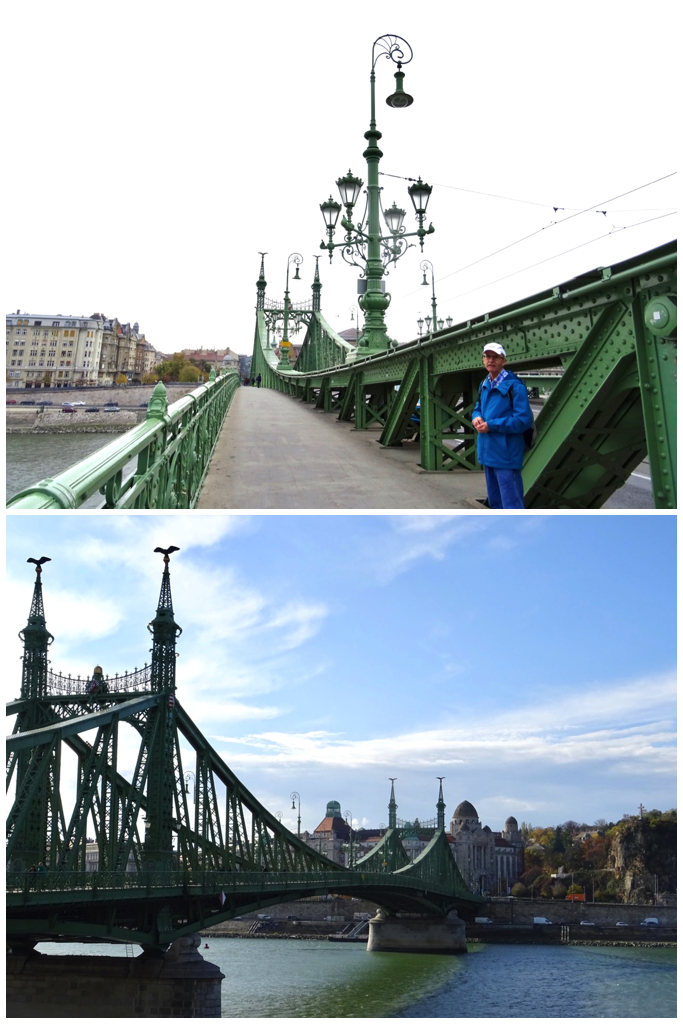
 We walked back across the bridge to the Pest side of the river…
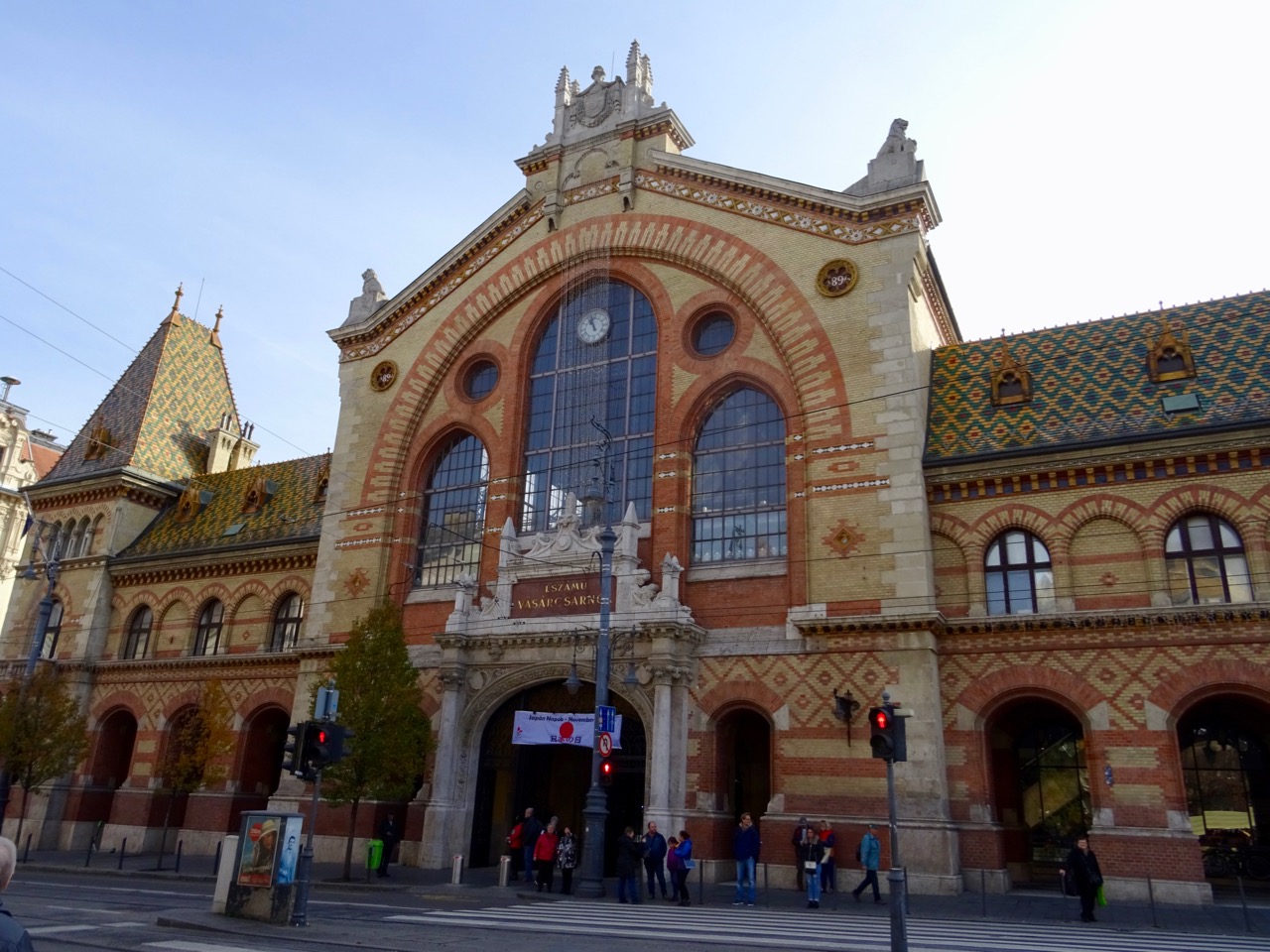
 and visit the Indoor market.
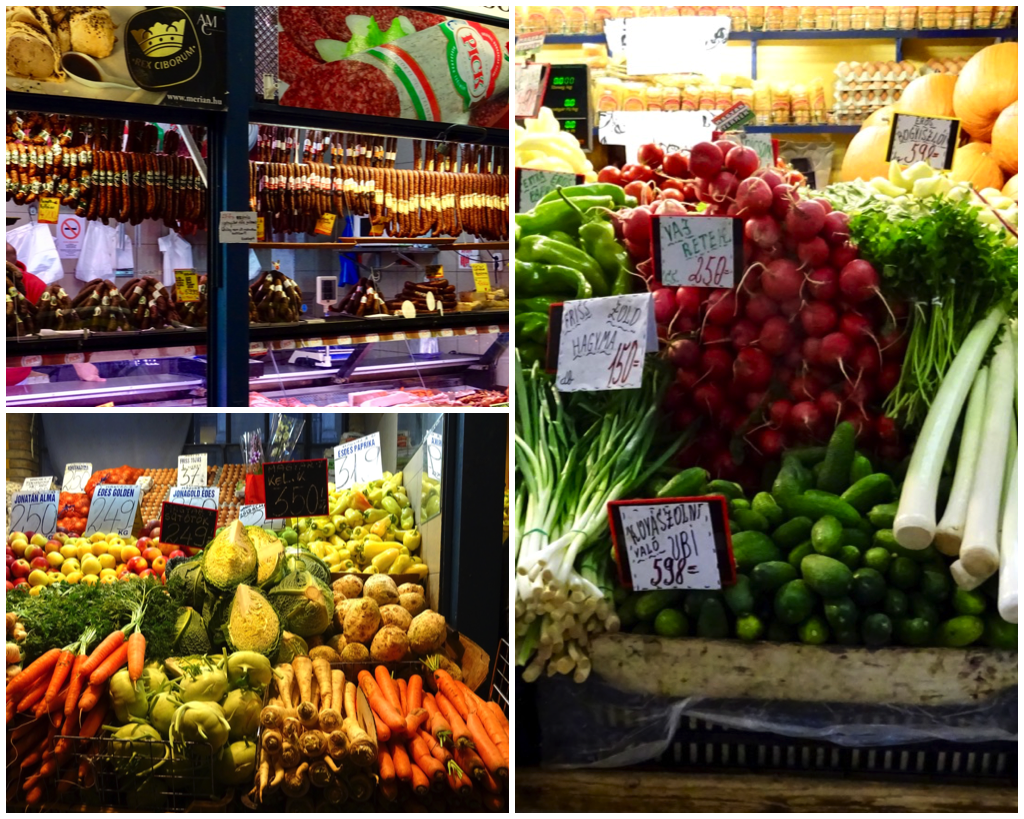
  I thought these kohlrabi were huge but the radishes were enormous, about the size of an egg! I’ve never seen radishes that big! We have supper here but unfortunately the food wasn’t really all that great.
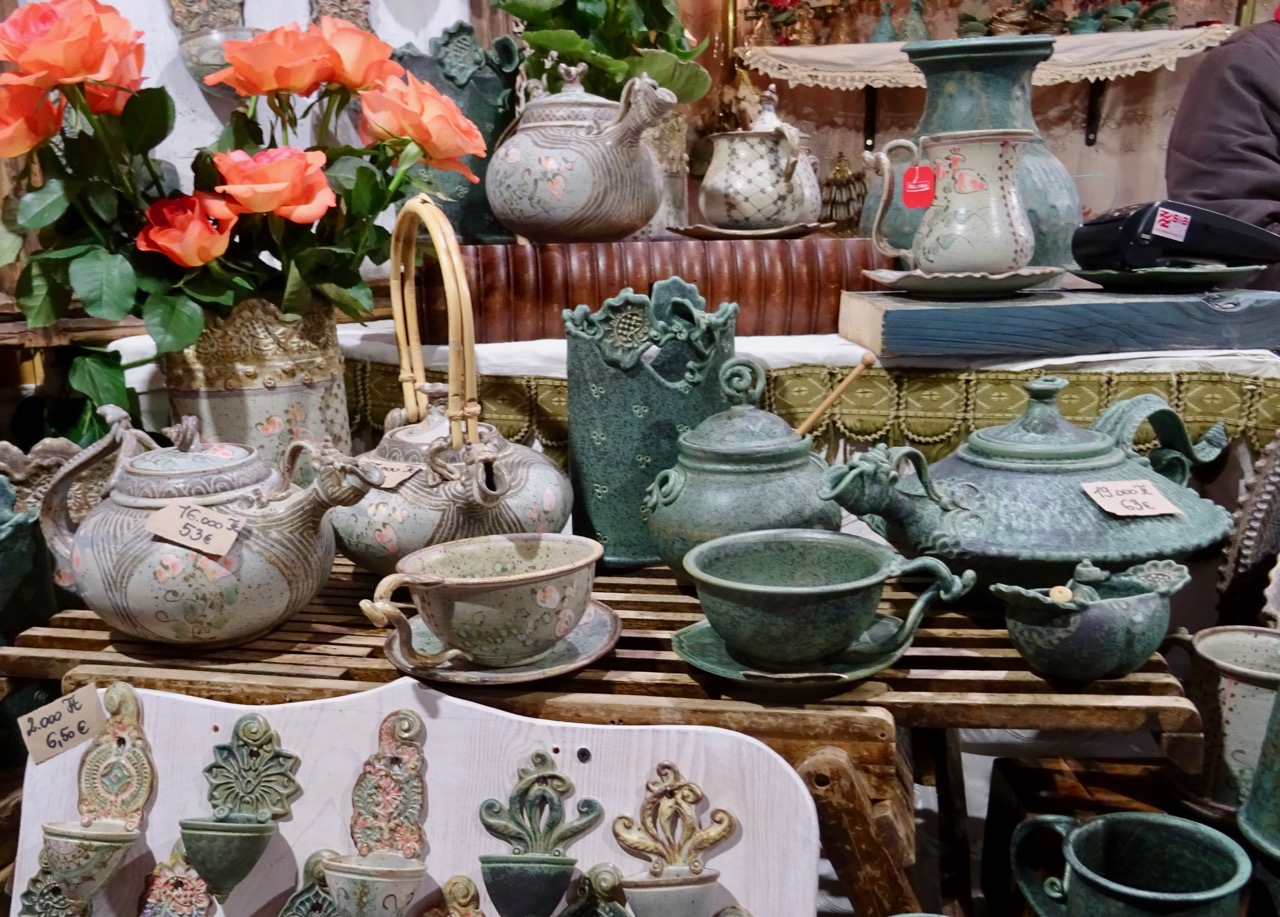
  On our walk back home we pass through the Christmas Market and I notice these teapots. I would have loved to have bought one but worried about getting it home in one piece.
 These necklaces are made with seed beads! Imagine how long it would take to make each one.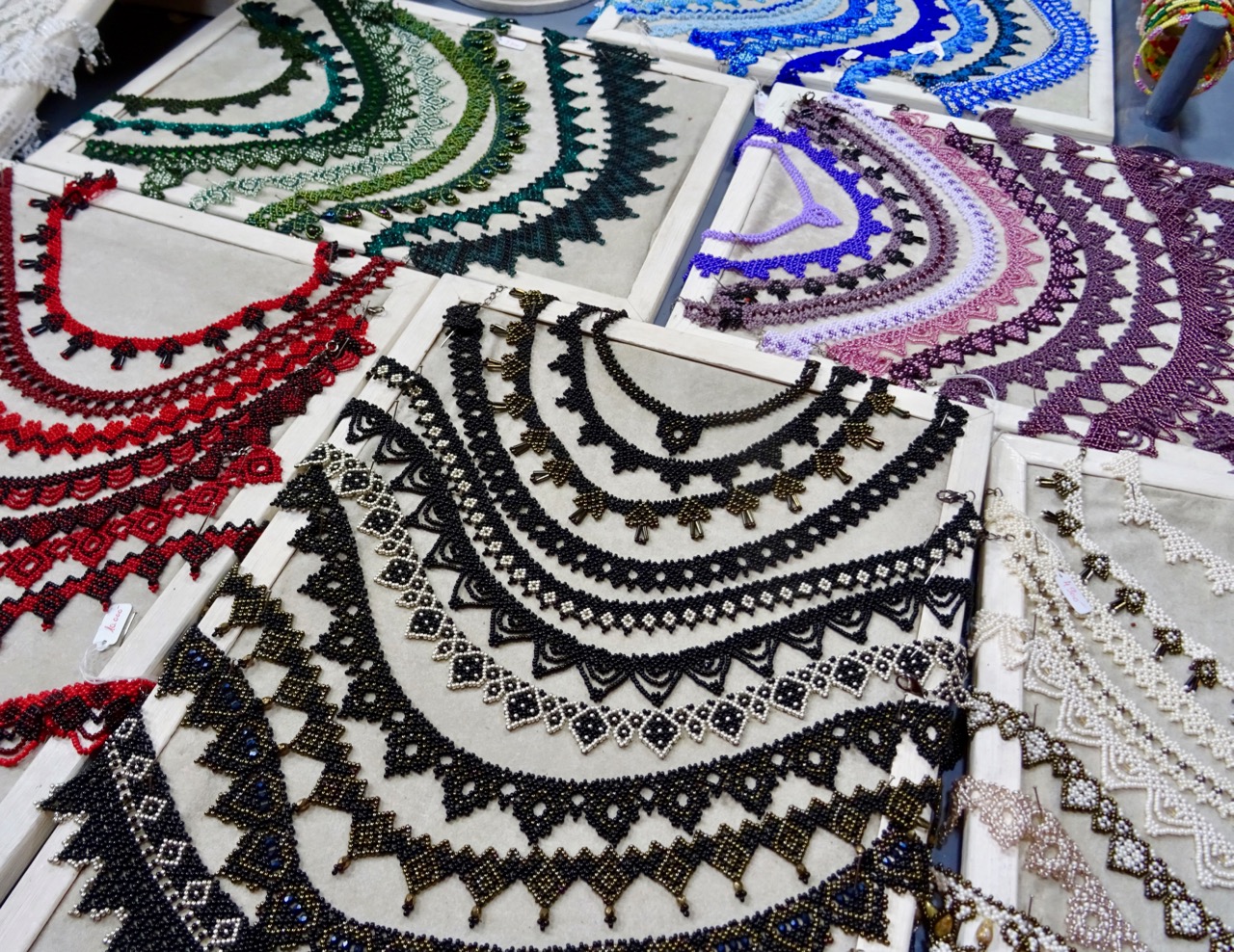
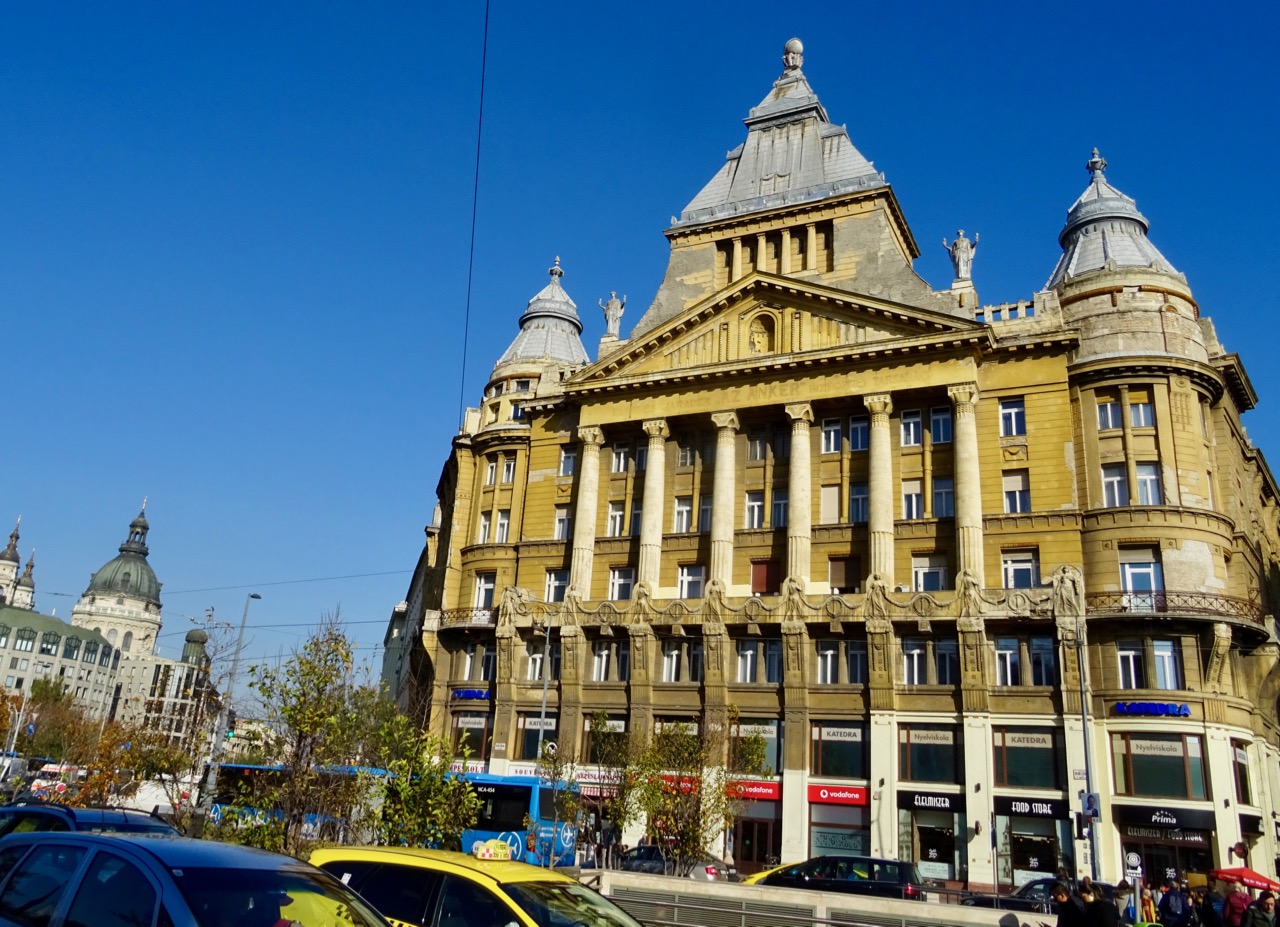
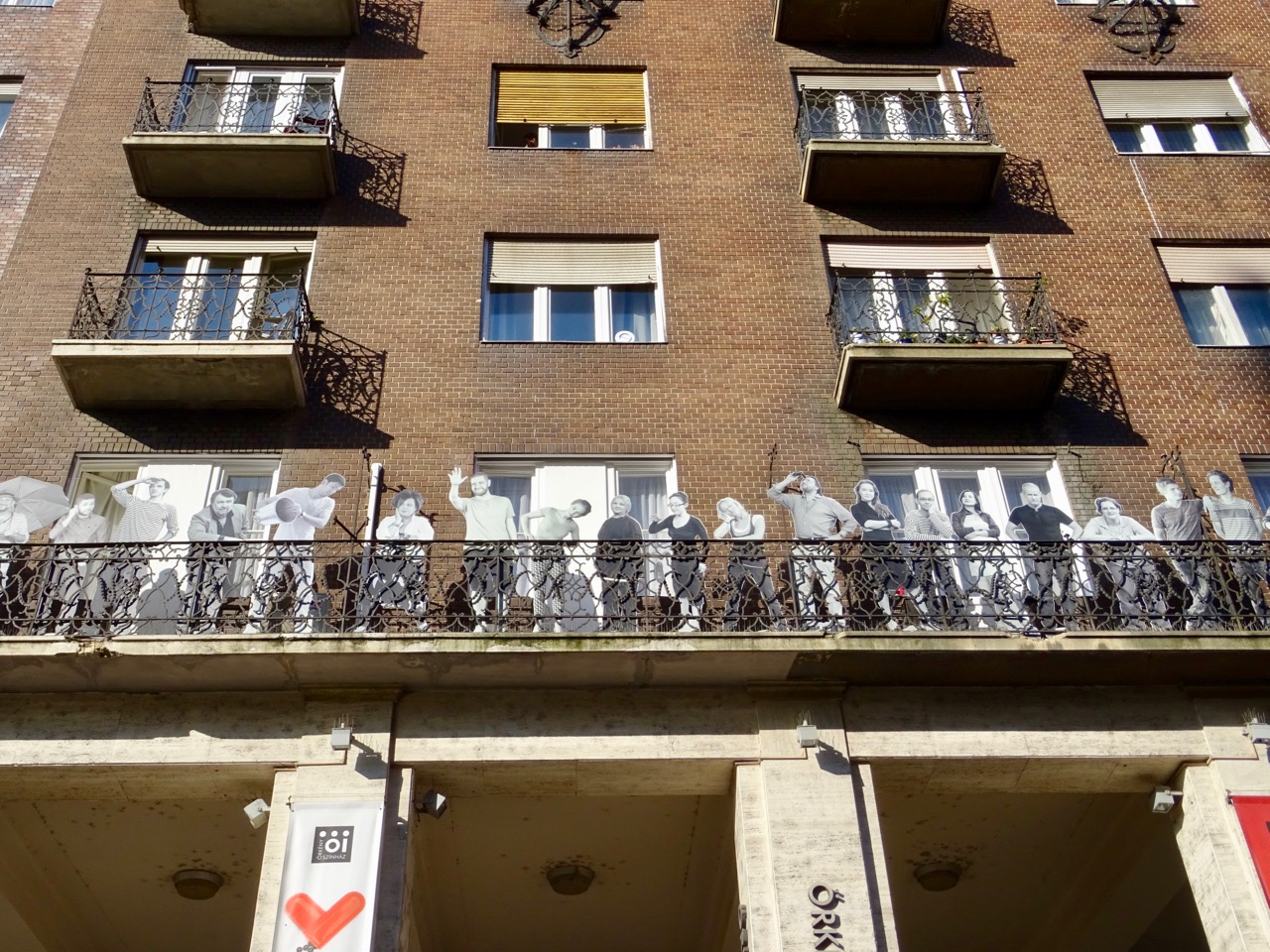 We are staying in the Old Jewish Quarter and the roads are very narrow and crowded. As we leave this area, the roads widen and there are many pedestrian-only roads and big plazas. This large ornate building is the first large building I see on the main Street near our apartment.
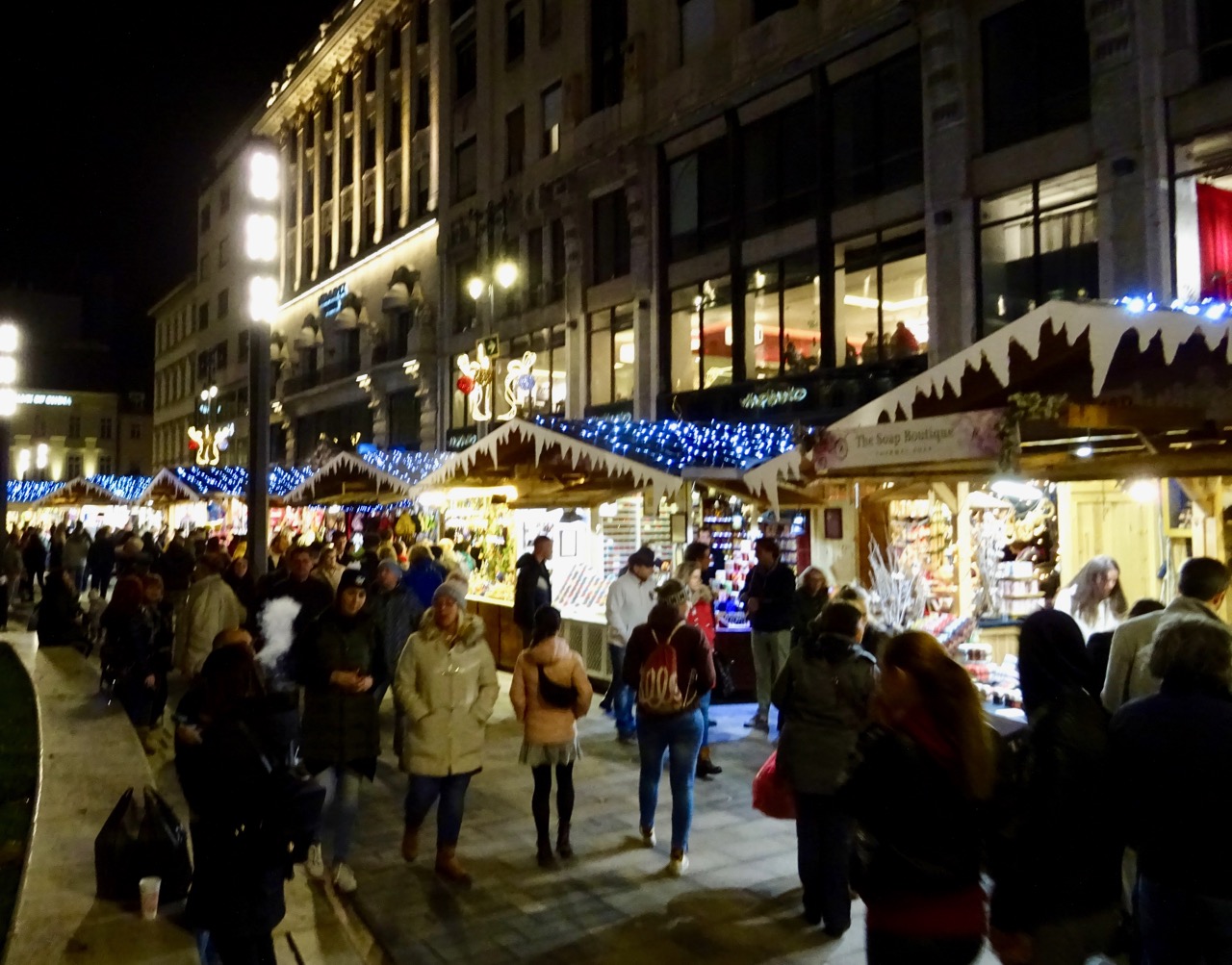
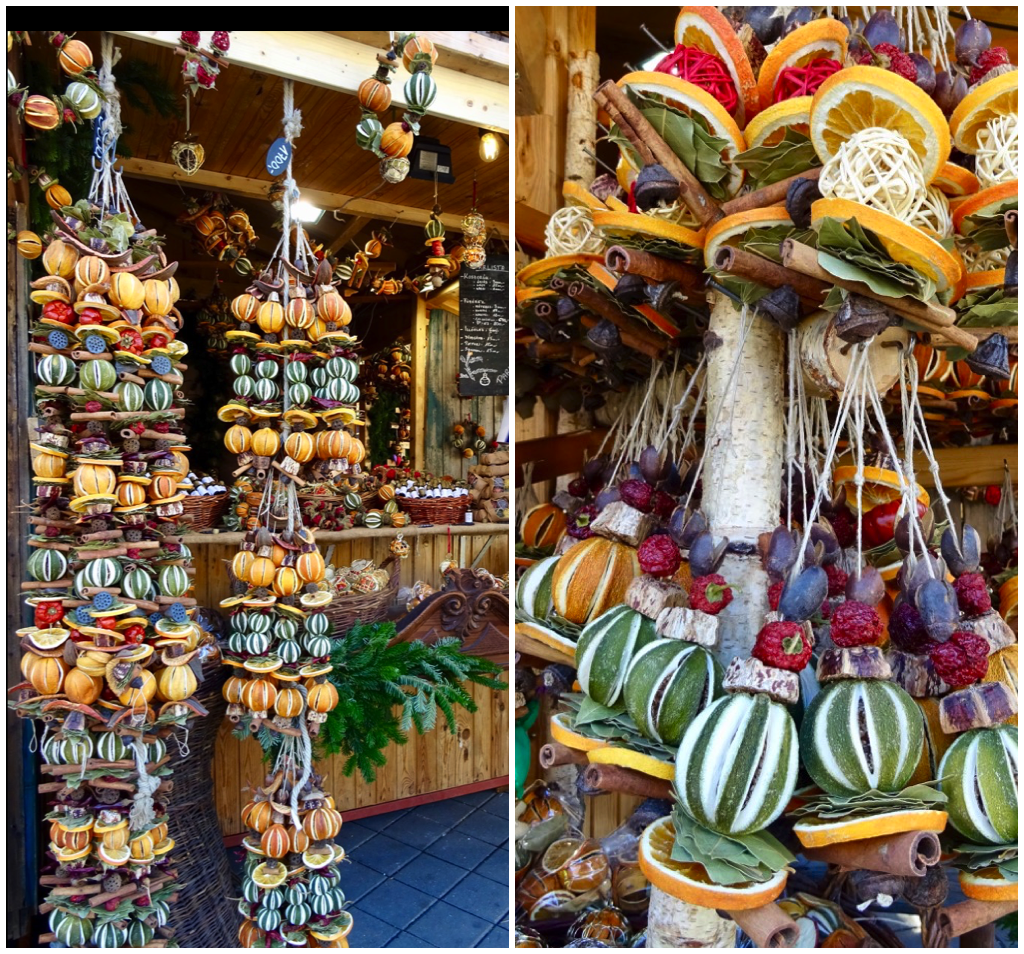
 We walk towards the nearby Christmas Markets. There are lots of small wooden ‘cabins’ filled with beautiful crafts. I loved these dried fruit ornaments, but I am sure that I wouldn’t be allowed to bring these through Canadian Customs. Too bad, they are lovely and smell wonderful.
 There are several stands with all sorts of candies…
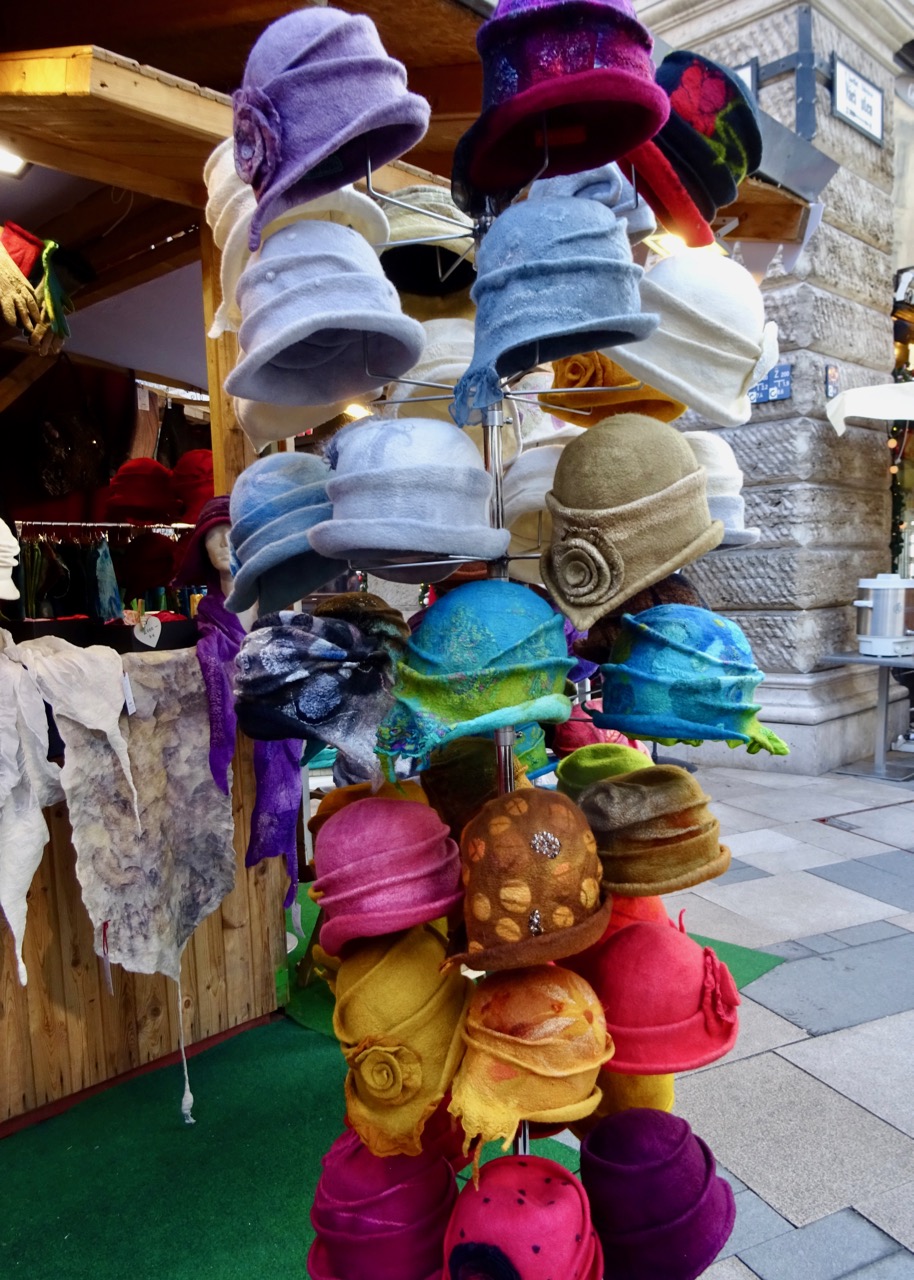
 beautiful felted hats, that are priced starting at $150.00 CAD.
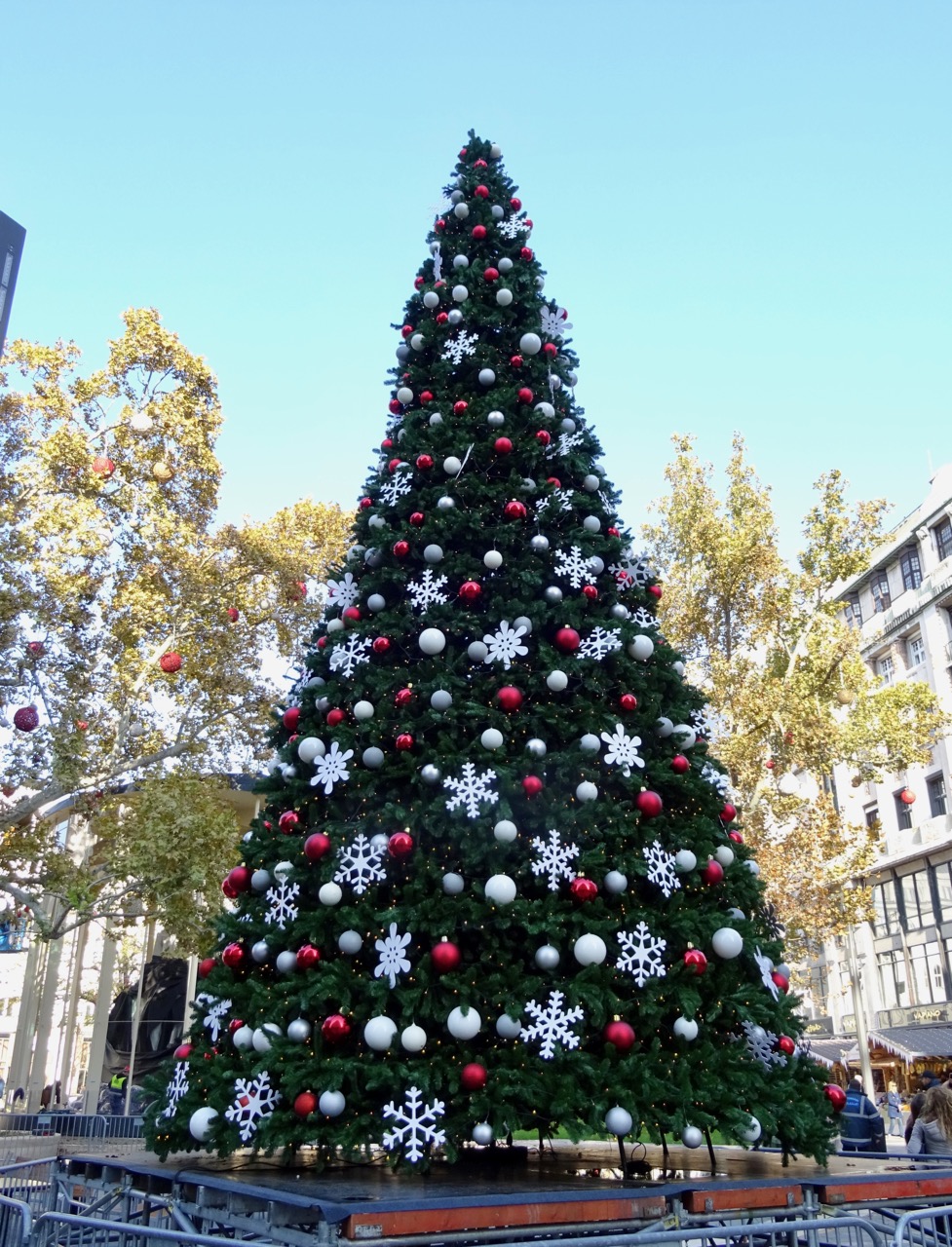
 This our first Christmas tree of the year.
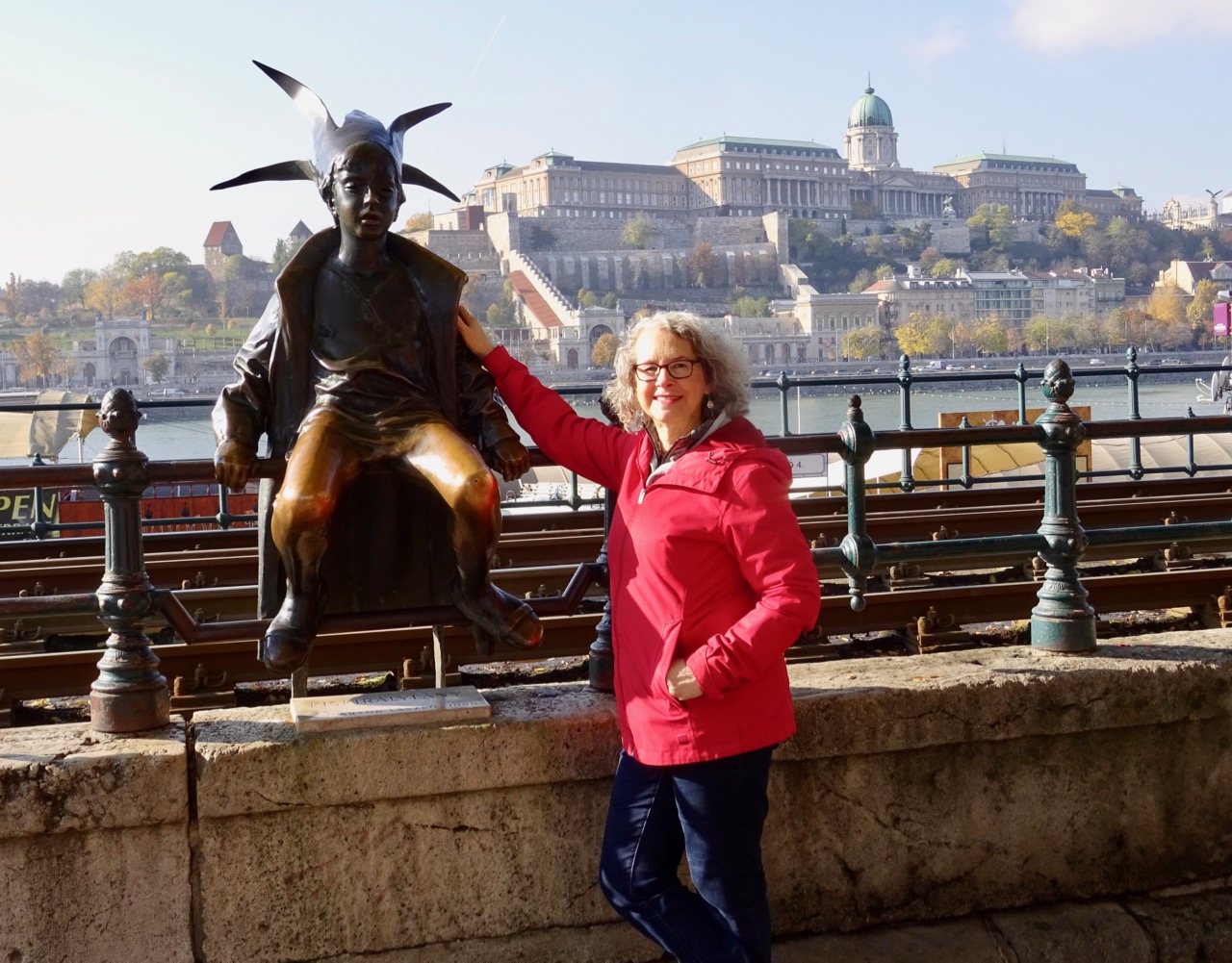
 This ‘Little Princess’ is the first of many statues we see on the streets of Budapest.
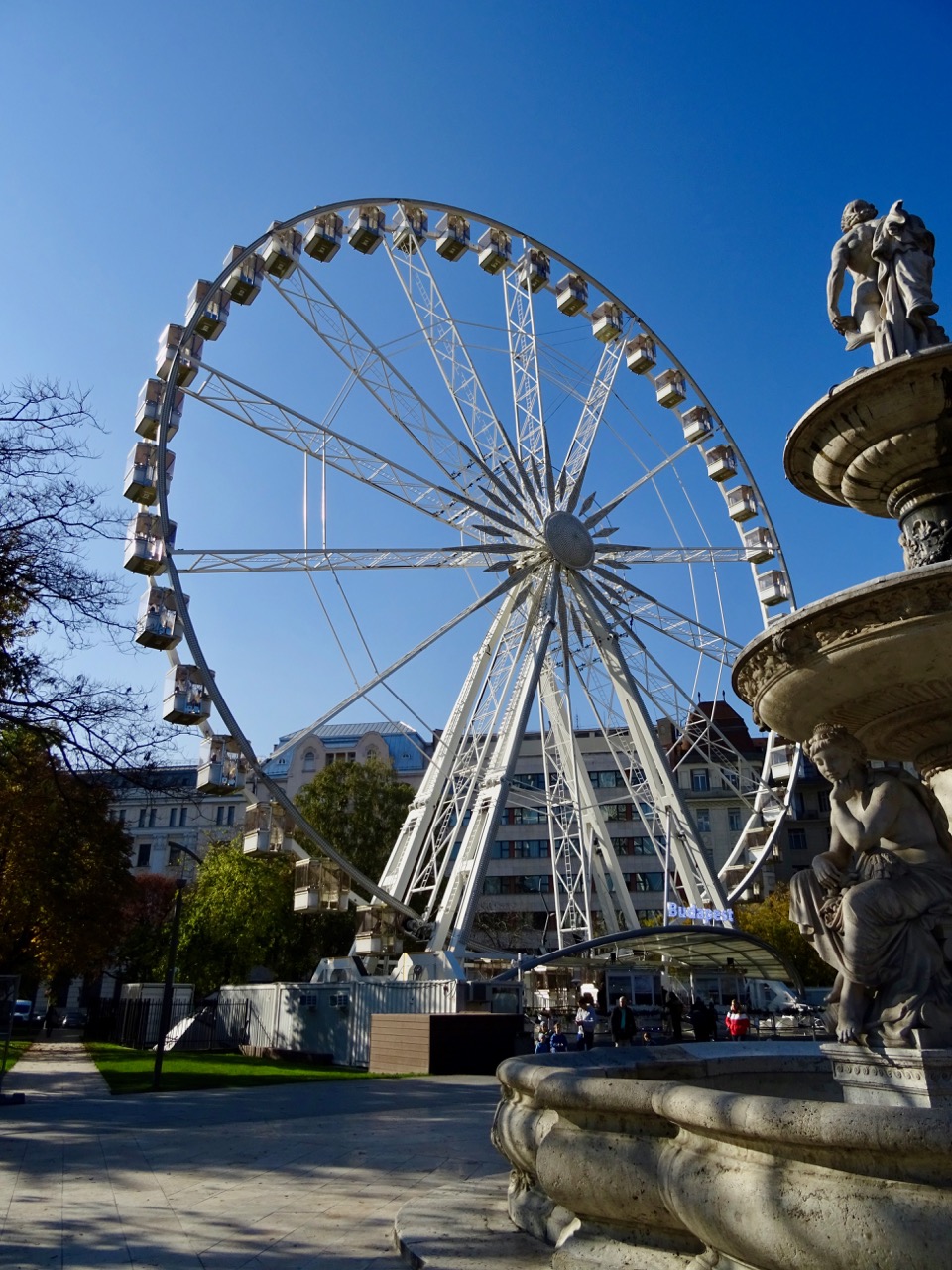
 Another ferris wheel, but we decide to pass on riding this one.
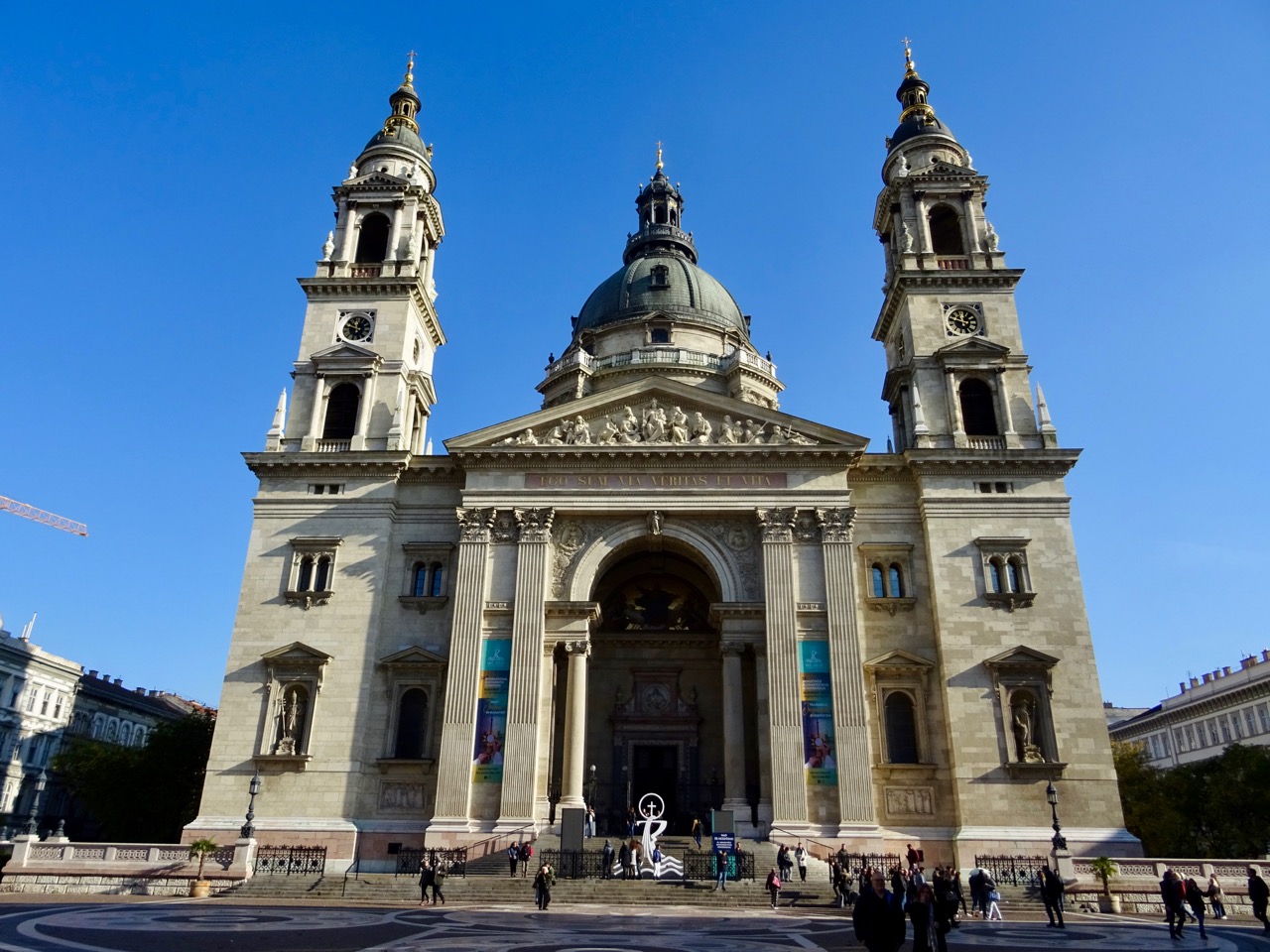
  St. Stephen’s Basilica is in the centre of Budapest.
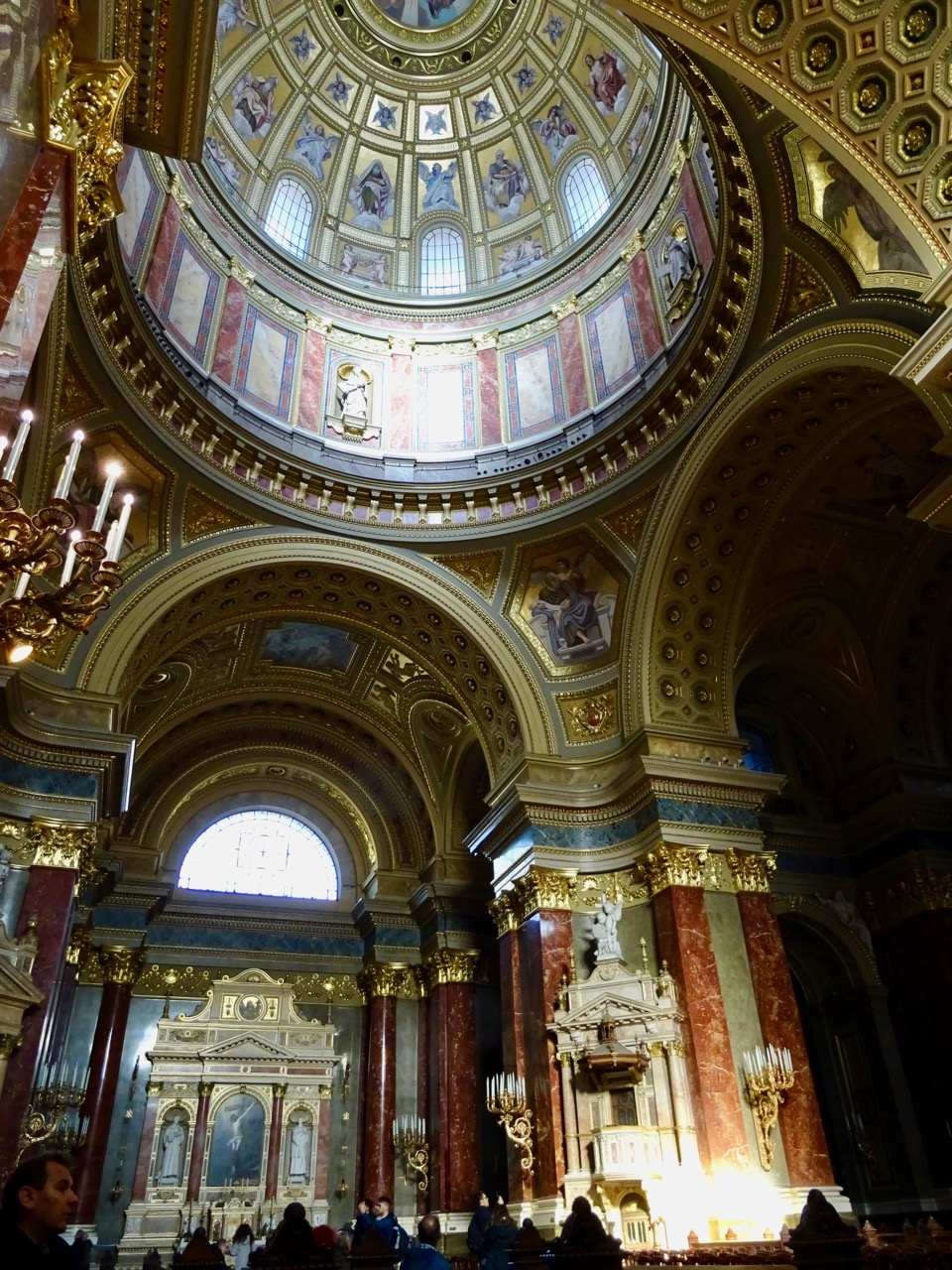
 The inside off the church has lots of gilded ornamentation and a beautiful dome.
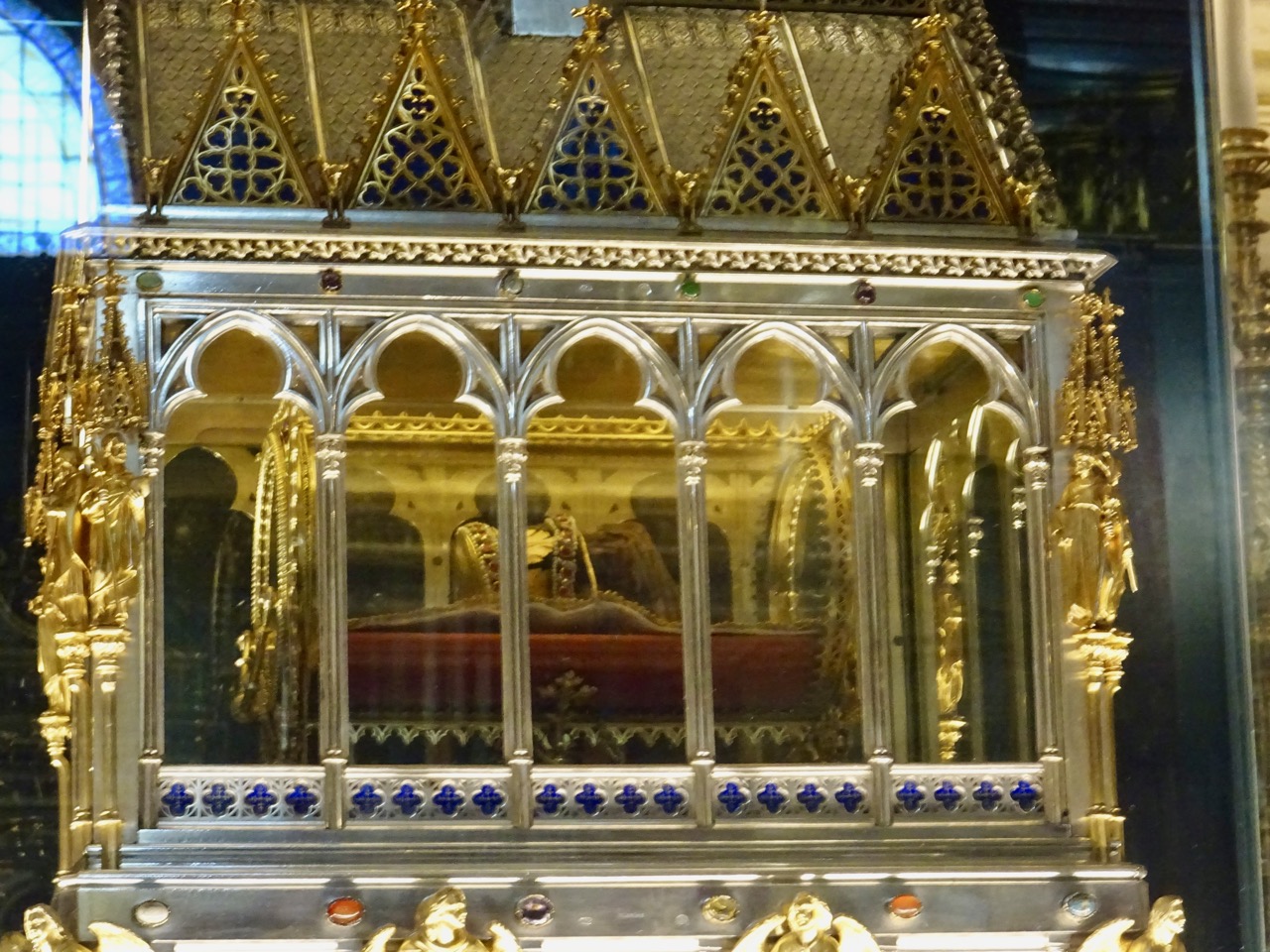
 The main attraction in this church is the thousand year old mummified right hand of King Stephen. If you want to see this relic, deposit a coin and a light comes on to view the hand.
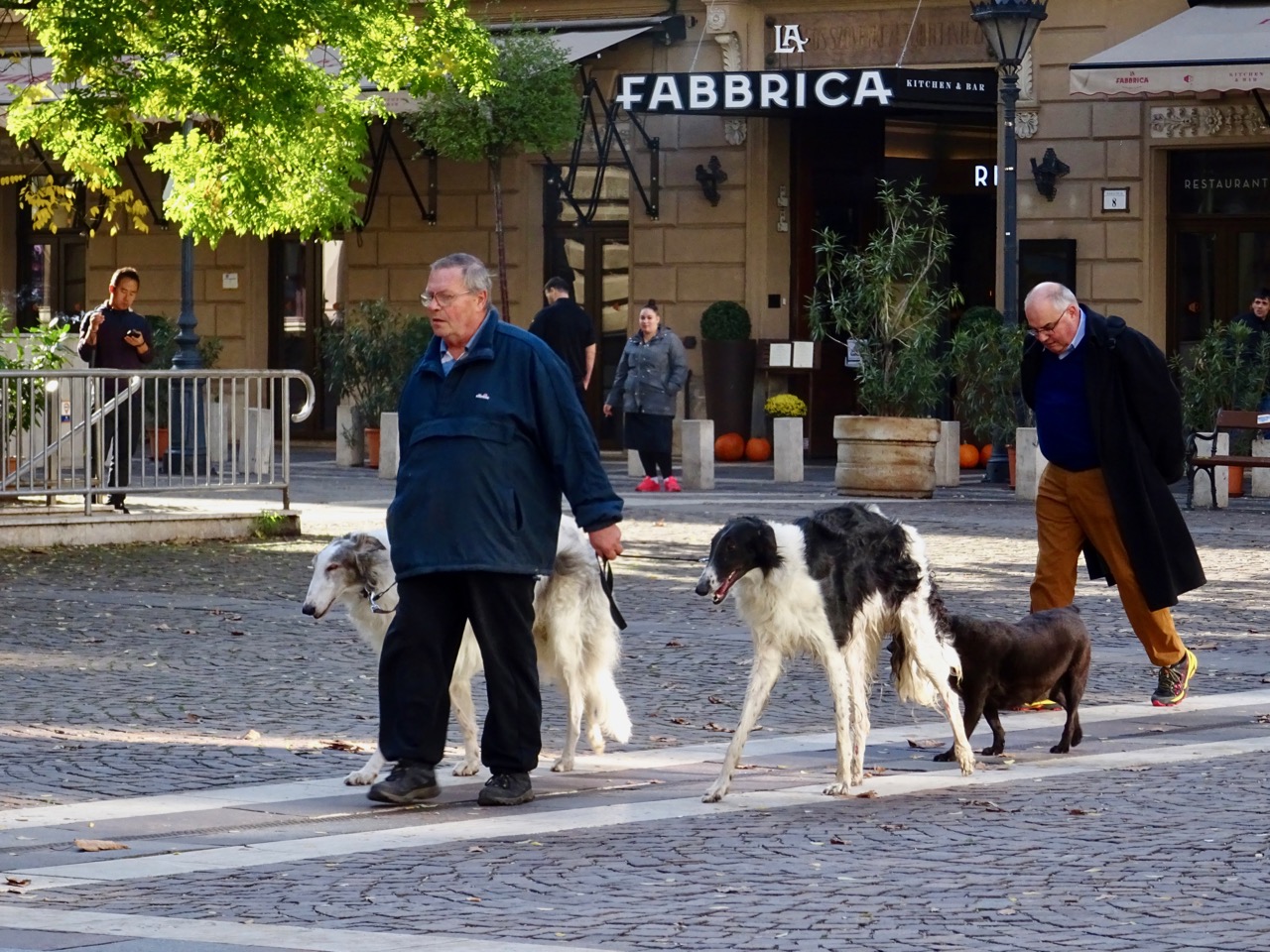
 These two borzoi dogs looked like they needed a bath and brushing. There are lots of dogs here and they live their lives on pavement. I kind of feel sorry for them.
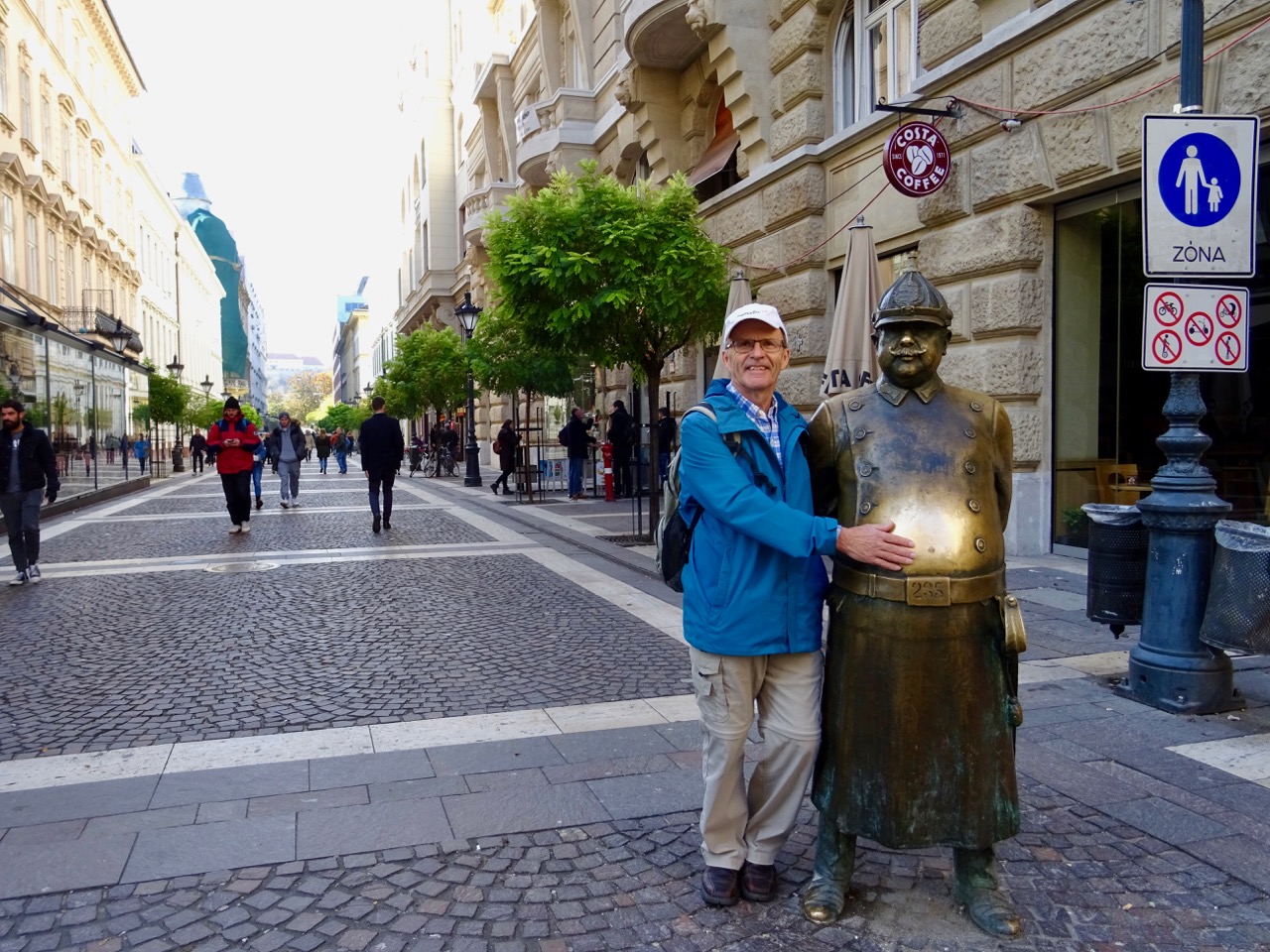
 The Fat Policeman Statue represents how hearty the Hungarian foods are, and rubbing his tummy is supposed to bring good luck. There are many ‘good luck’ statues on the streets of Budapest.
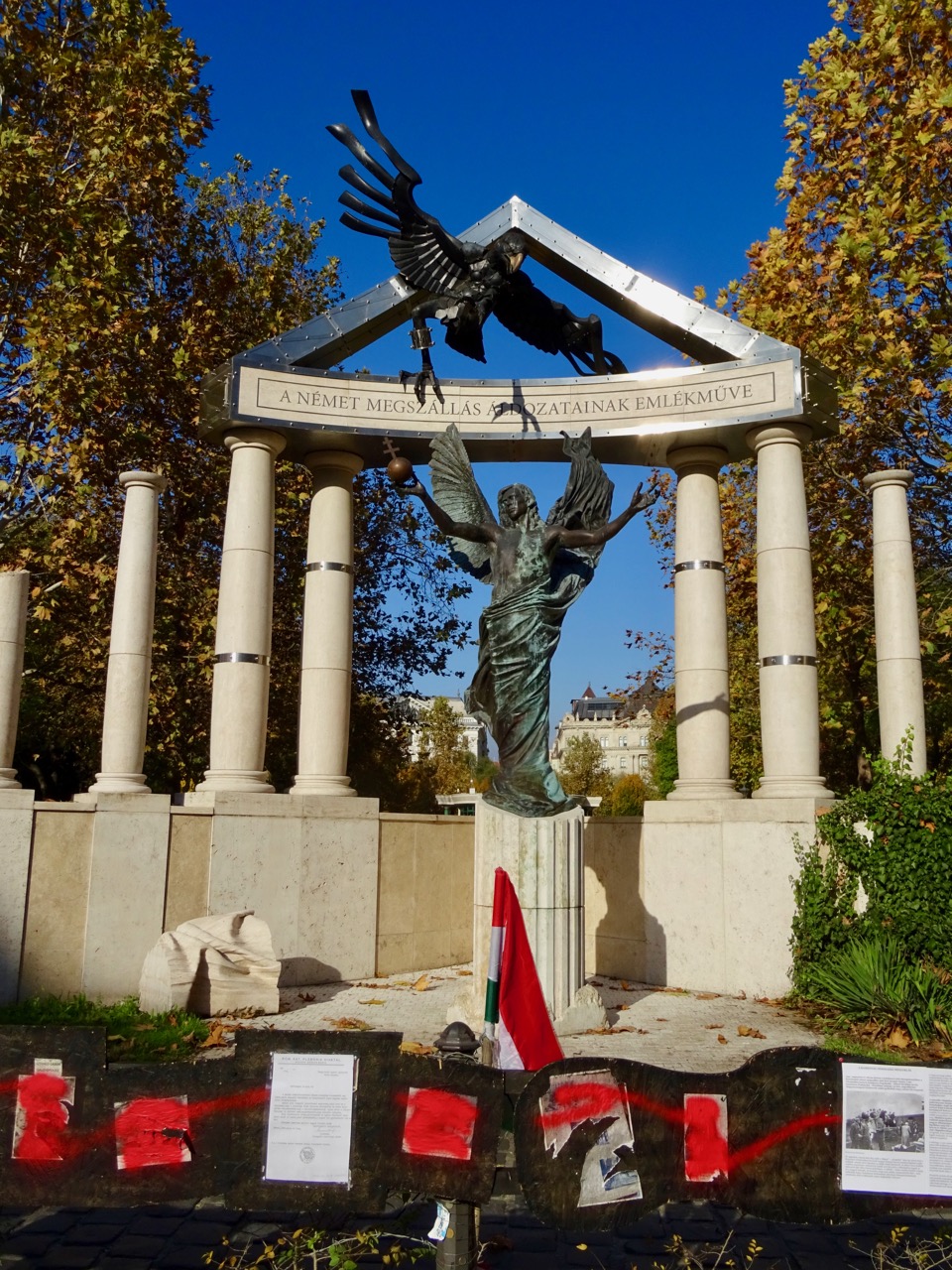
 The Hungarian government erected the ‘Memorial for Victims of the German Occupation’ statue in the middle of the night in July 2014.
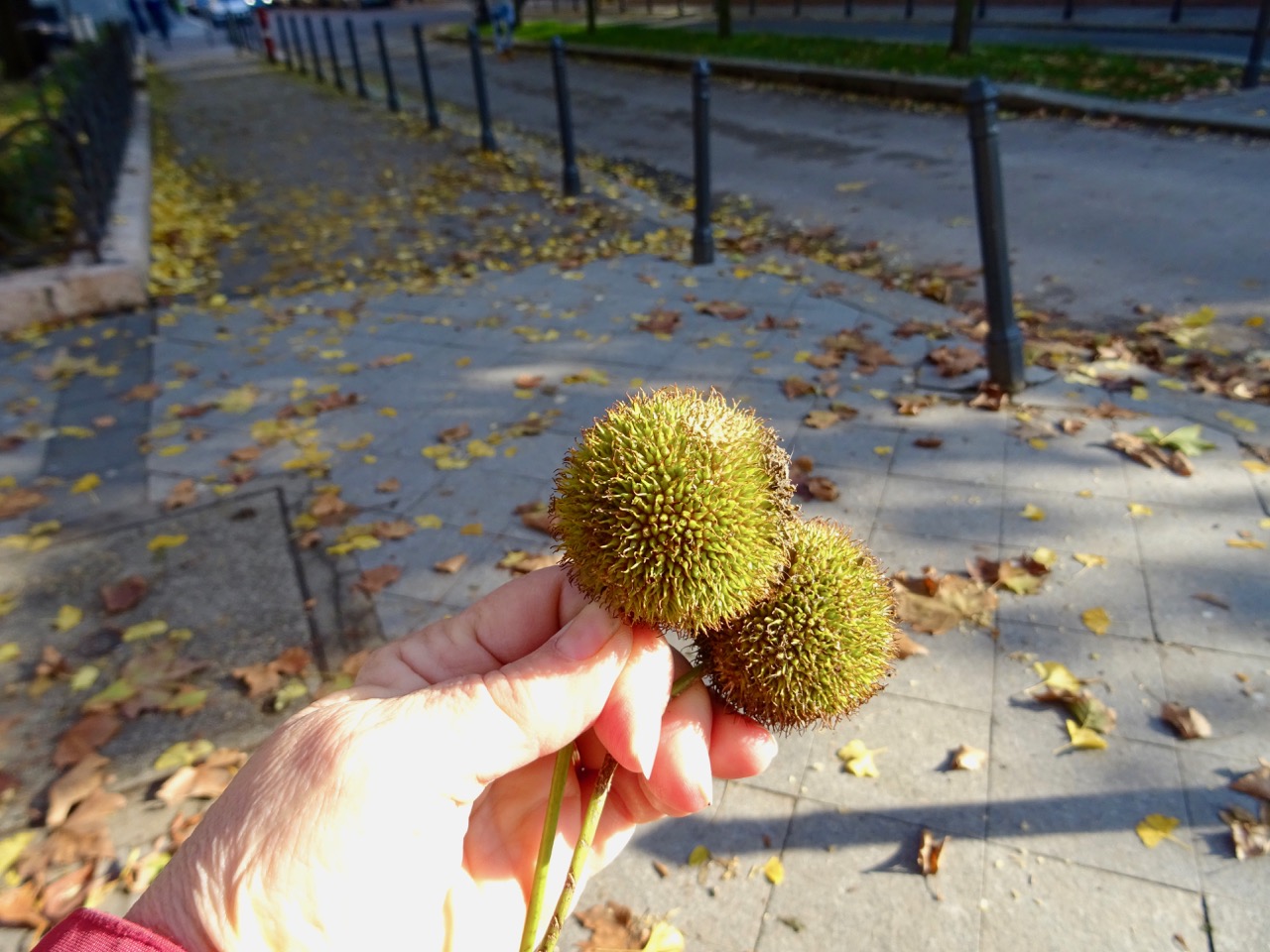
 Some seed pods from one of the trees near this statue are interesting.
 There is a statue of Ronald Reagan in this plaza as well because of his efforts to end the Cold War.
 There are so many ornate buildings here…
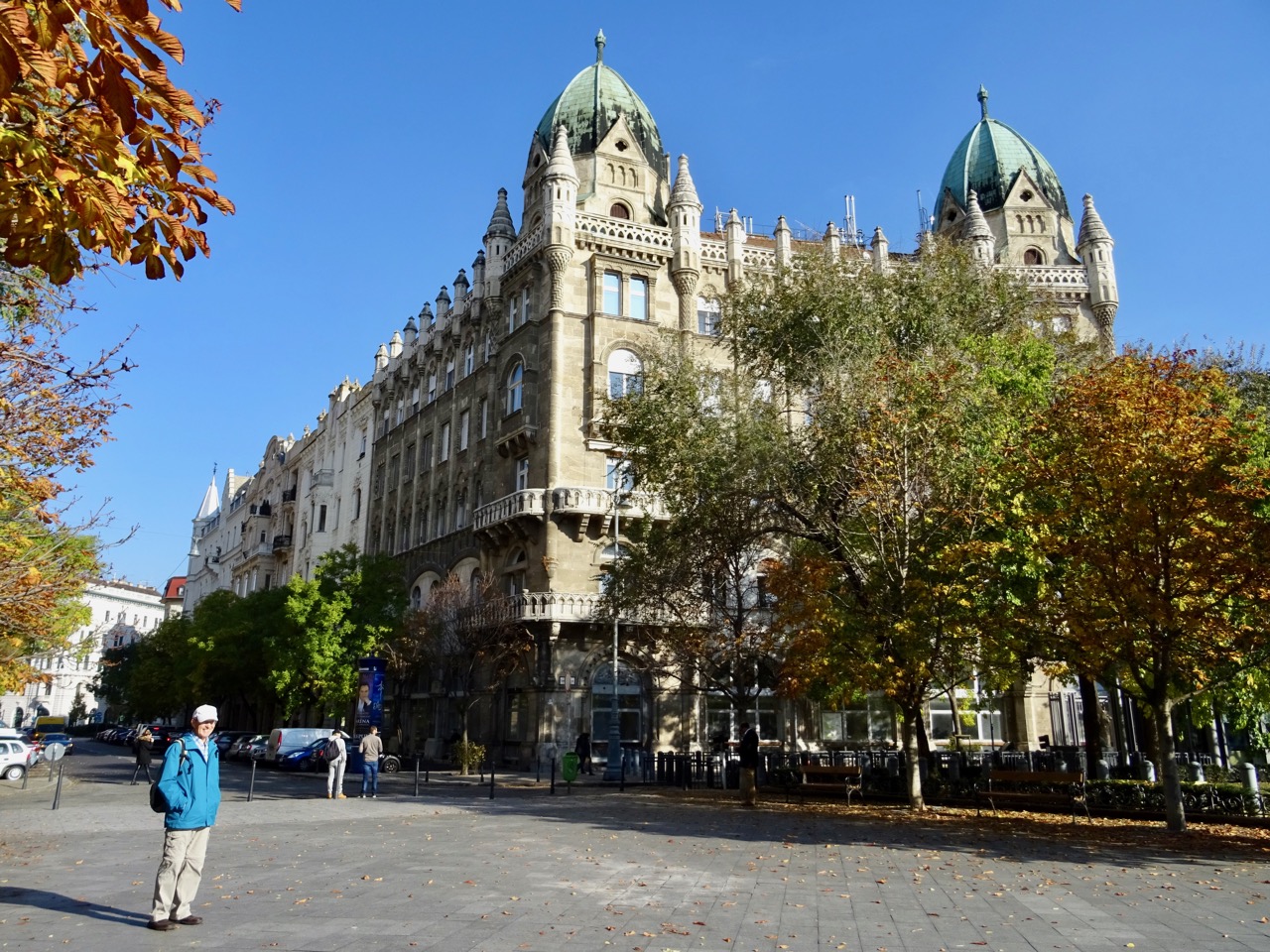 like the Parliament Building! It is so big I can’t get it all into one photo.
 Across the river we can see the Buda Castle.
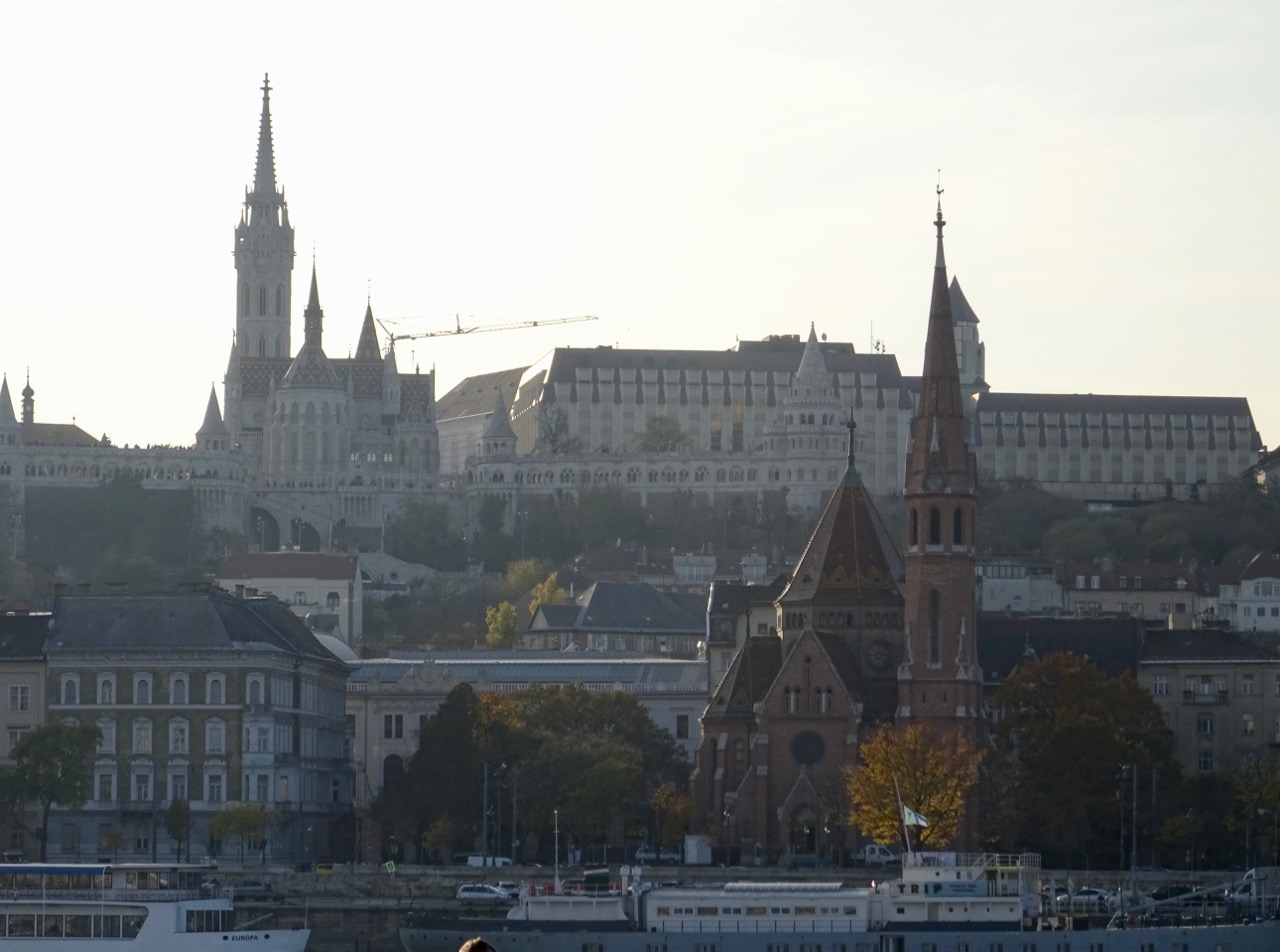 Bob takes a moment to sit with the Hungarian poet Attila József…
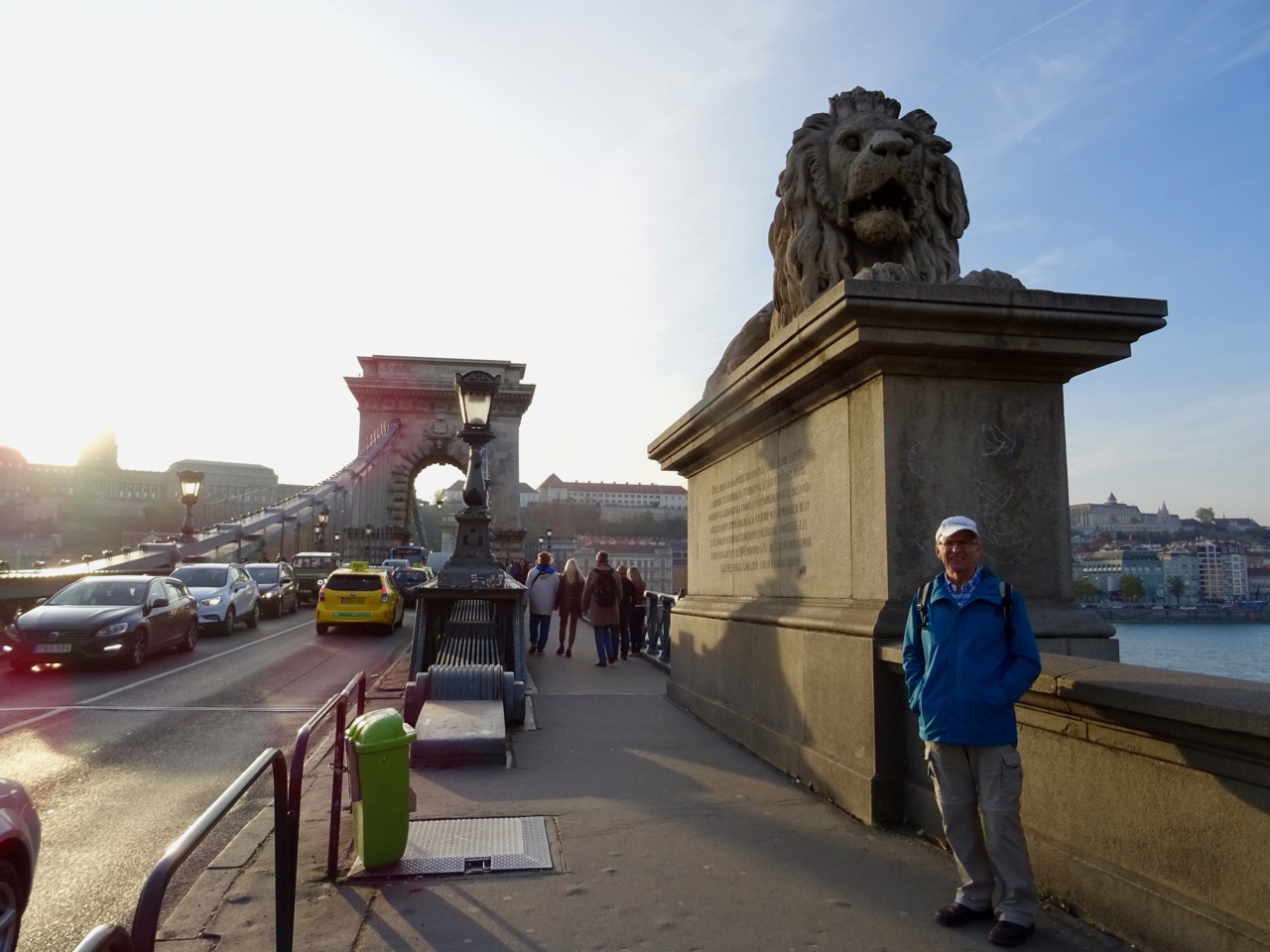
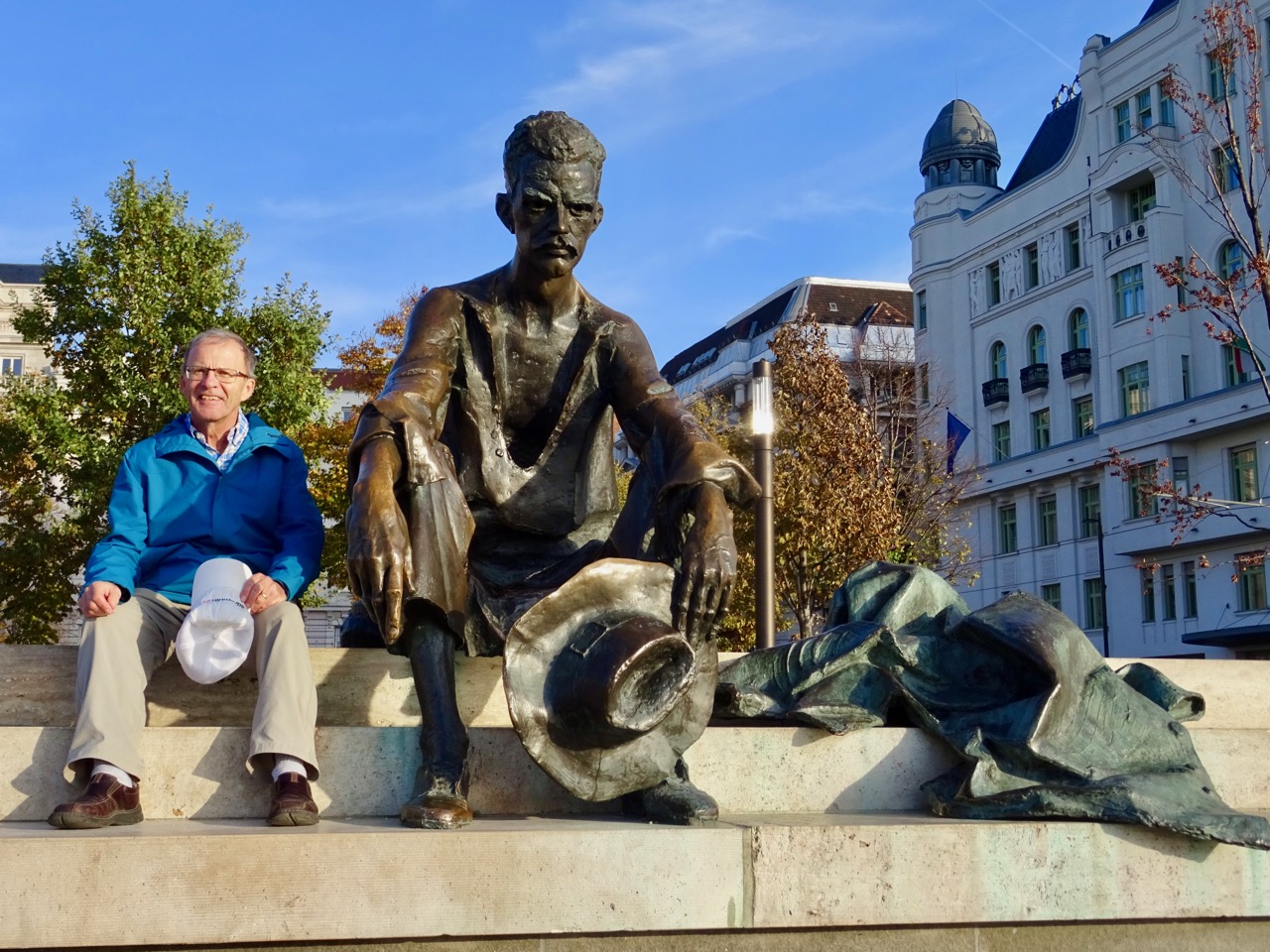 and then we walk onto the Chain Bridge with its guardian lions for a view of Budapest from the river.
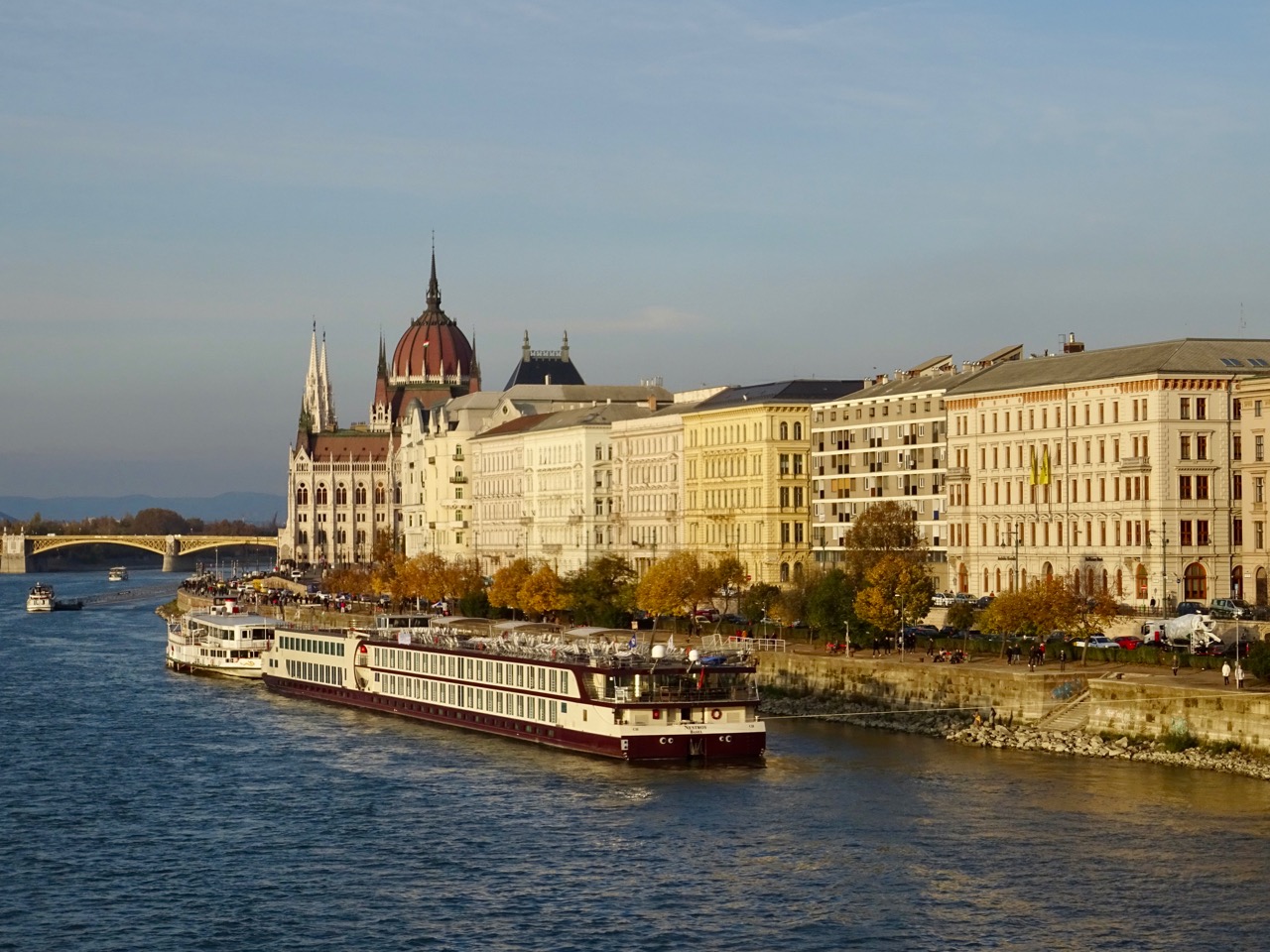
 This is the Pest side of the river, the side our apartment was on…
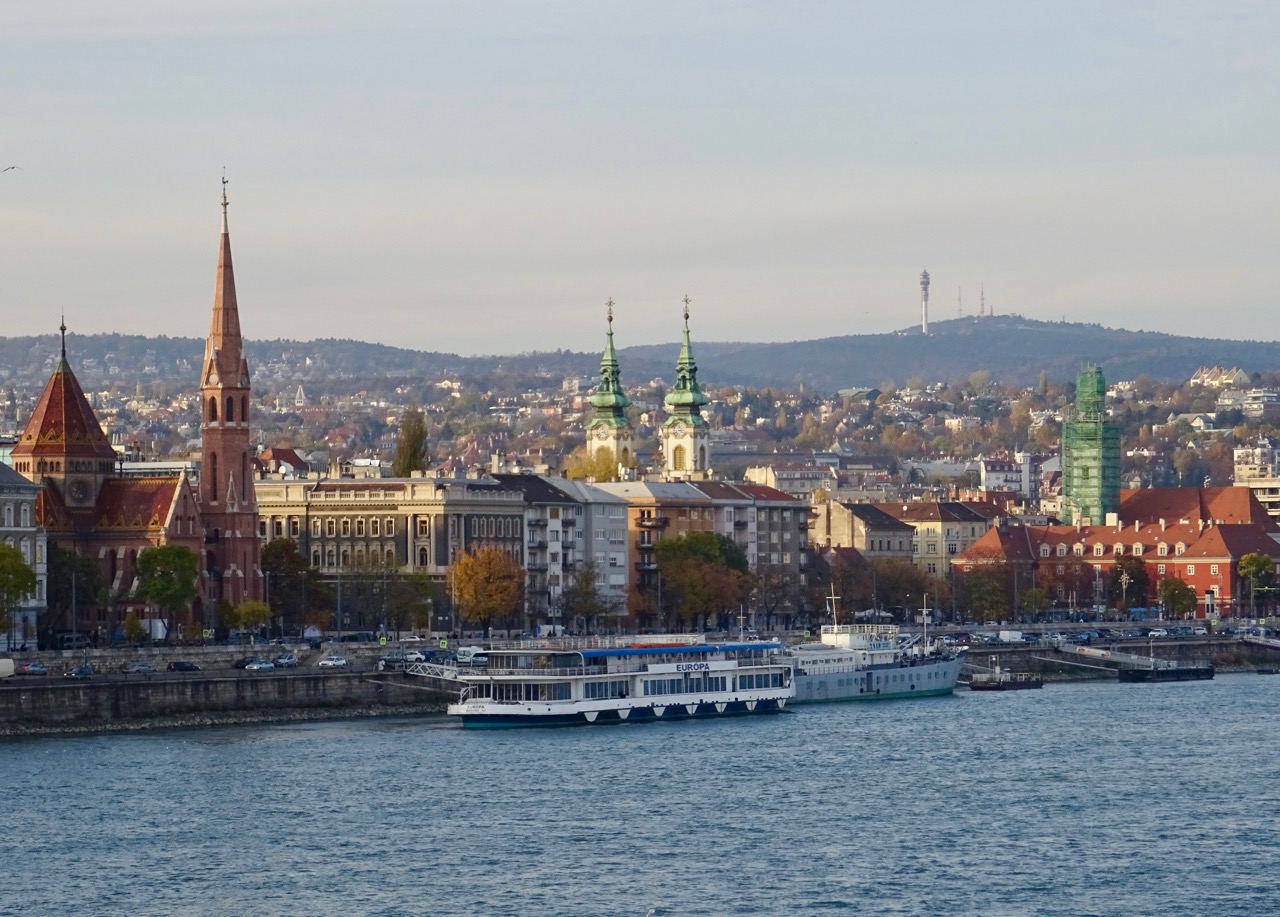
 and this is the Buda side. These two cities were united in November 1873, and the name ‘Budapest’ was given to the new capital.
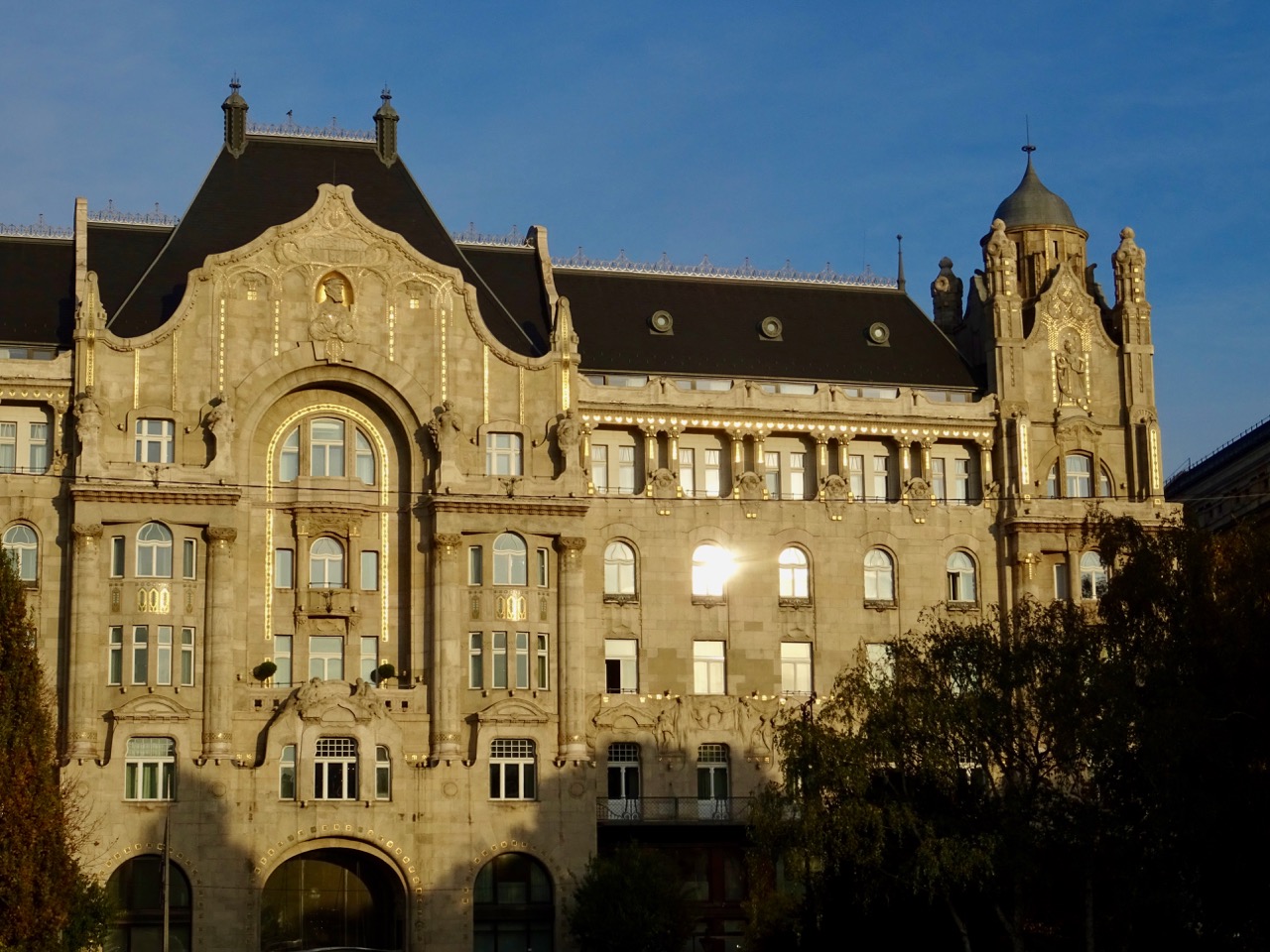
 I don’t know what this building is but it had delicate golden trim that sparkled in the late afternoon sun.
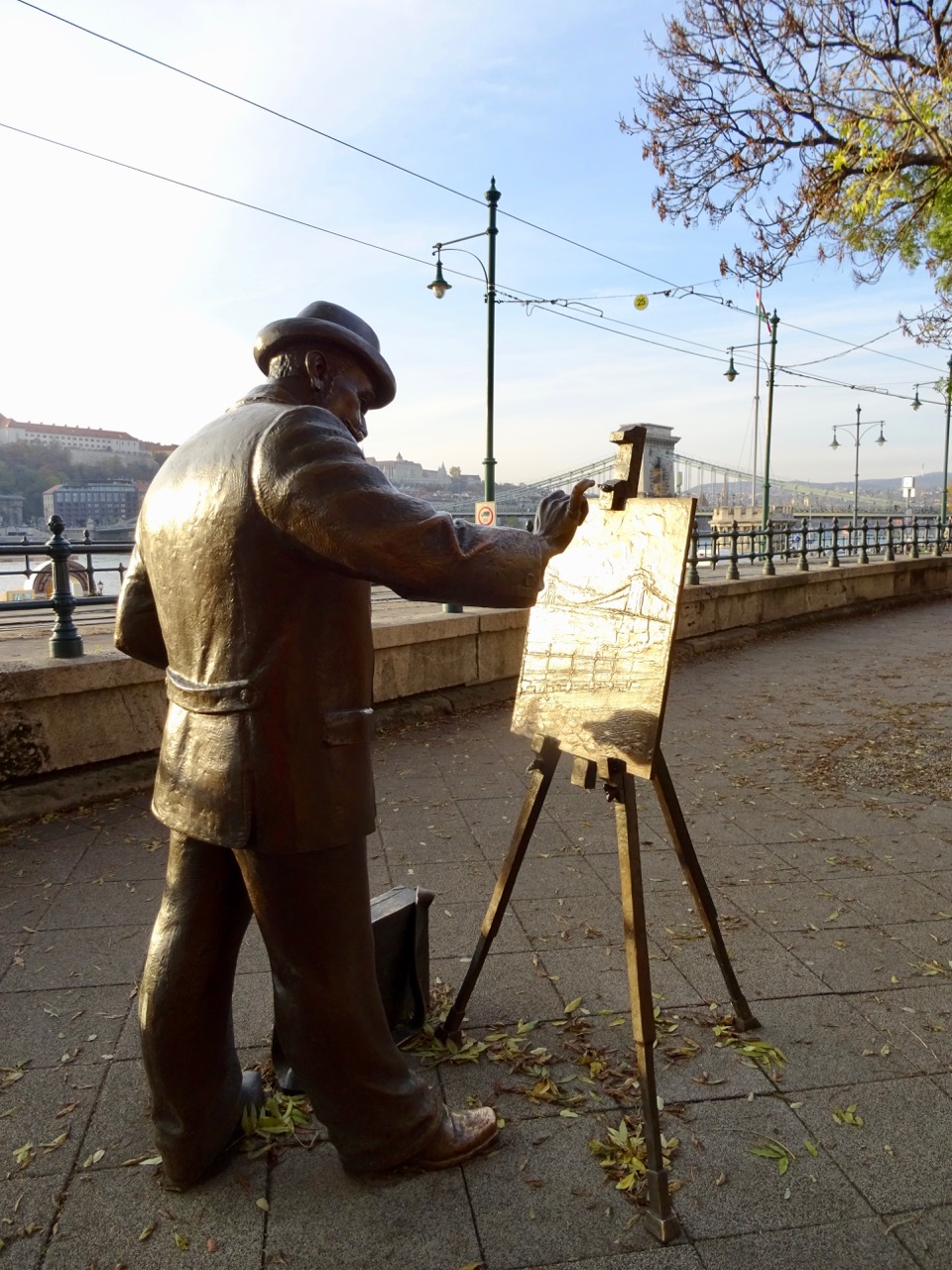
 We find a statue of Roskovics Ignác, a famous Hungarian painter, on our walk along the Danube River.
 Walking through the Christmas Market on our way home I notice this jar of pickled onions! They made me laugh!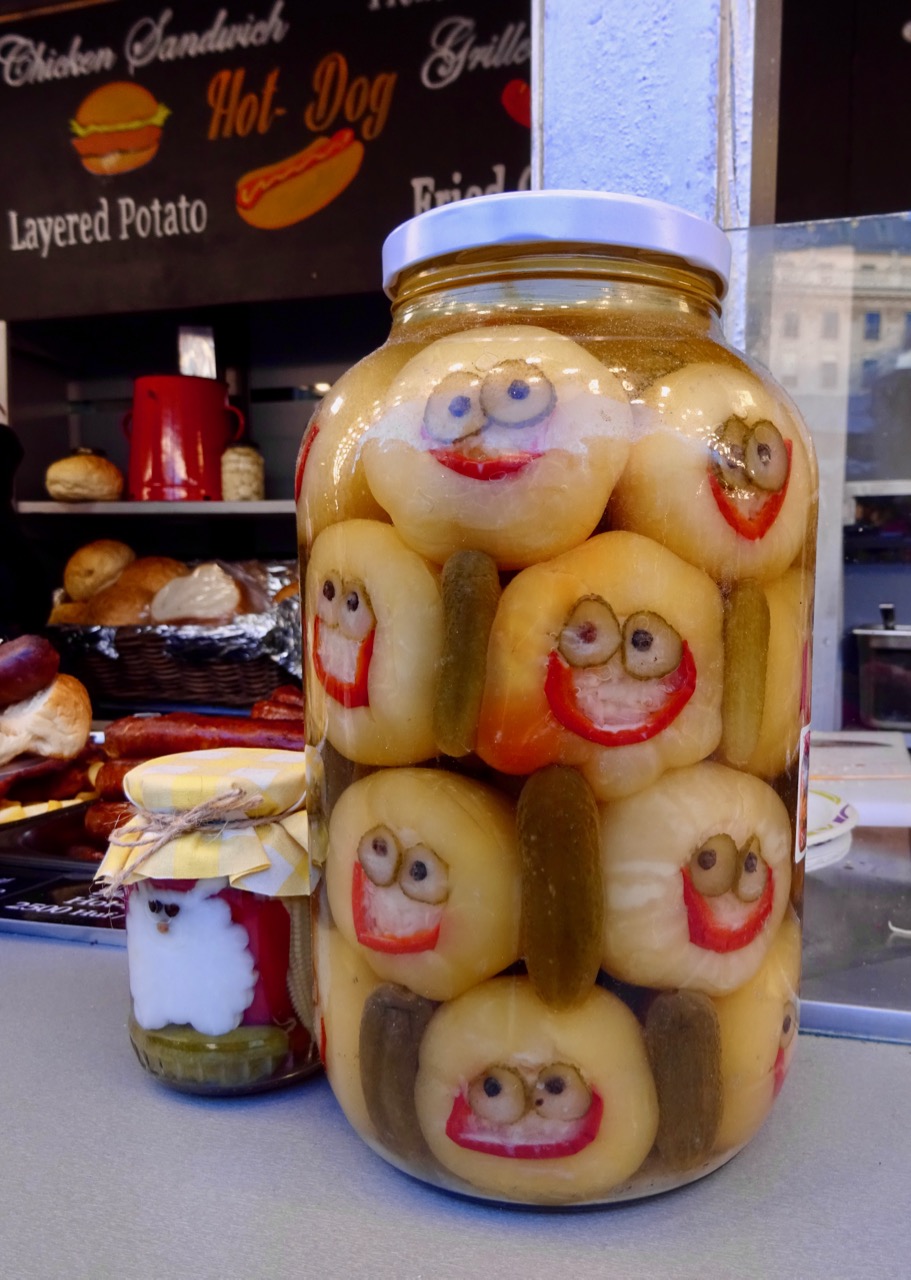
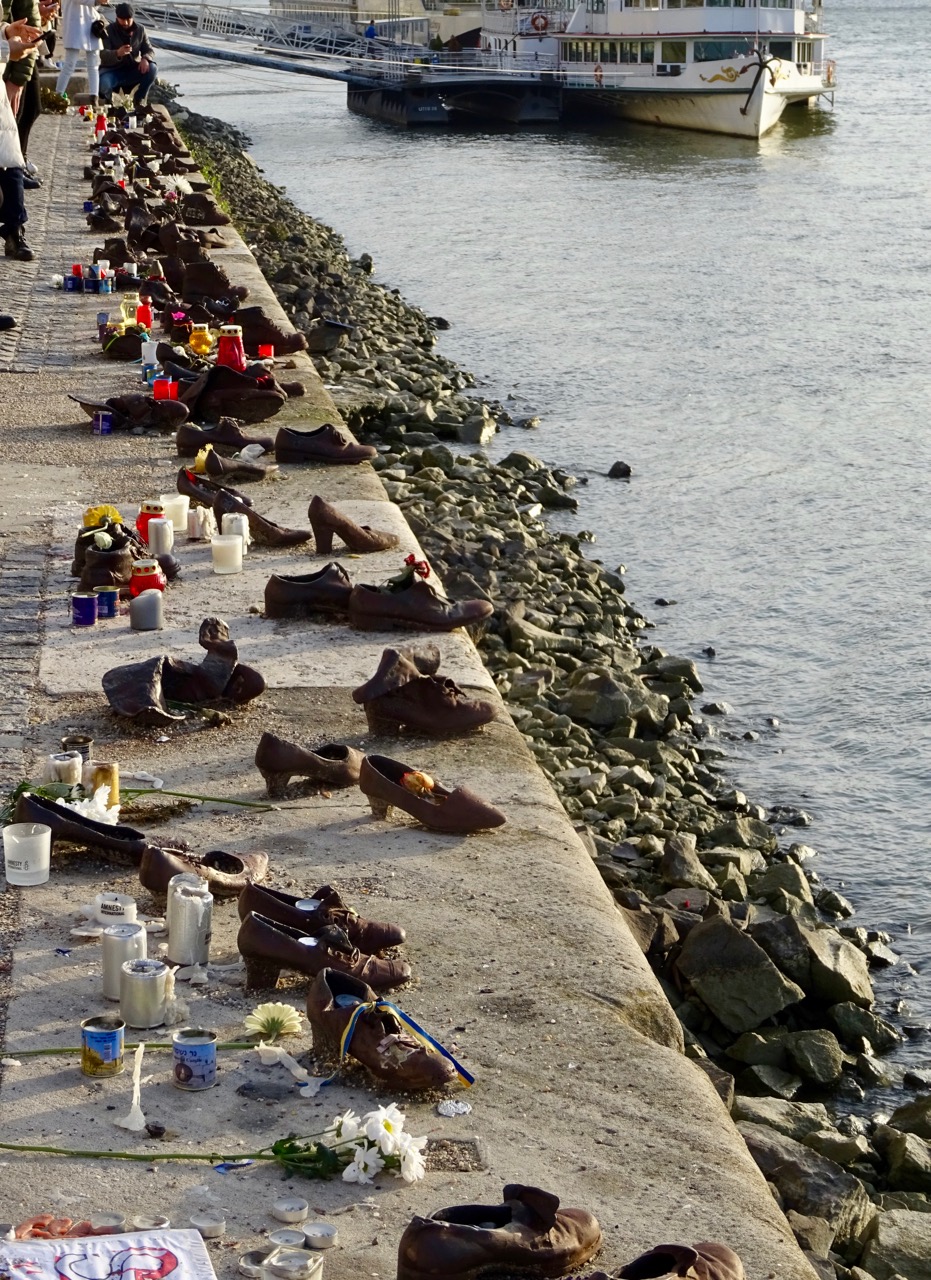 A quote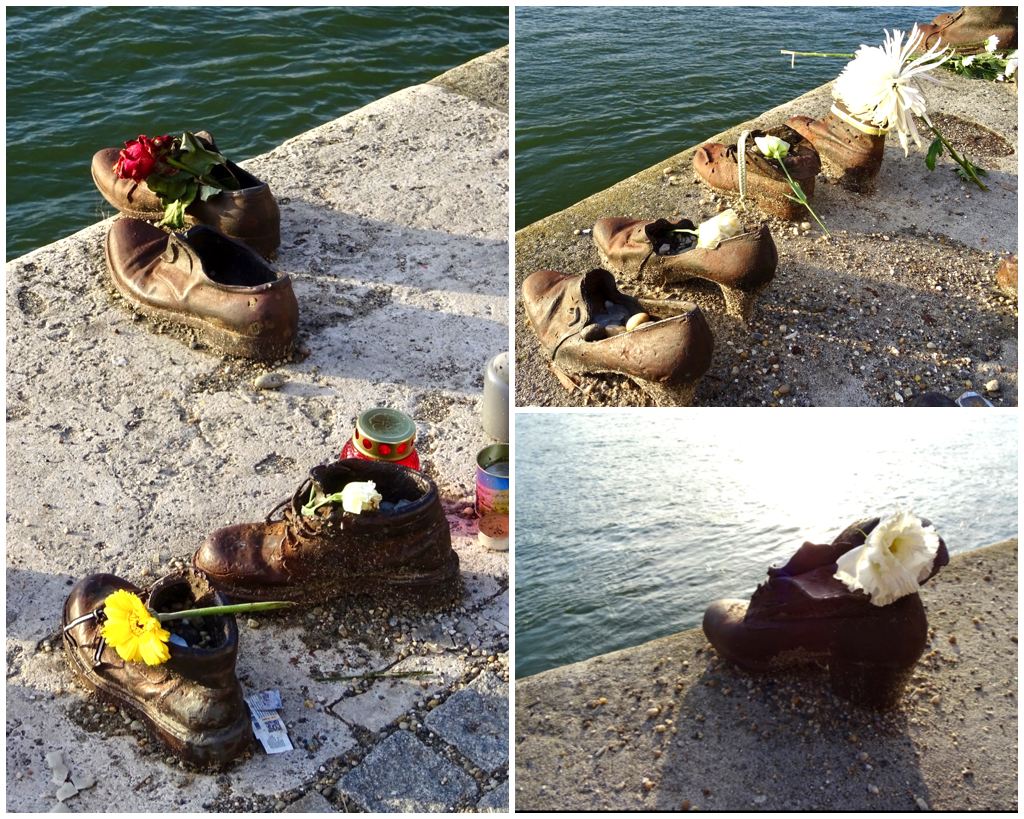
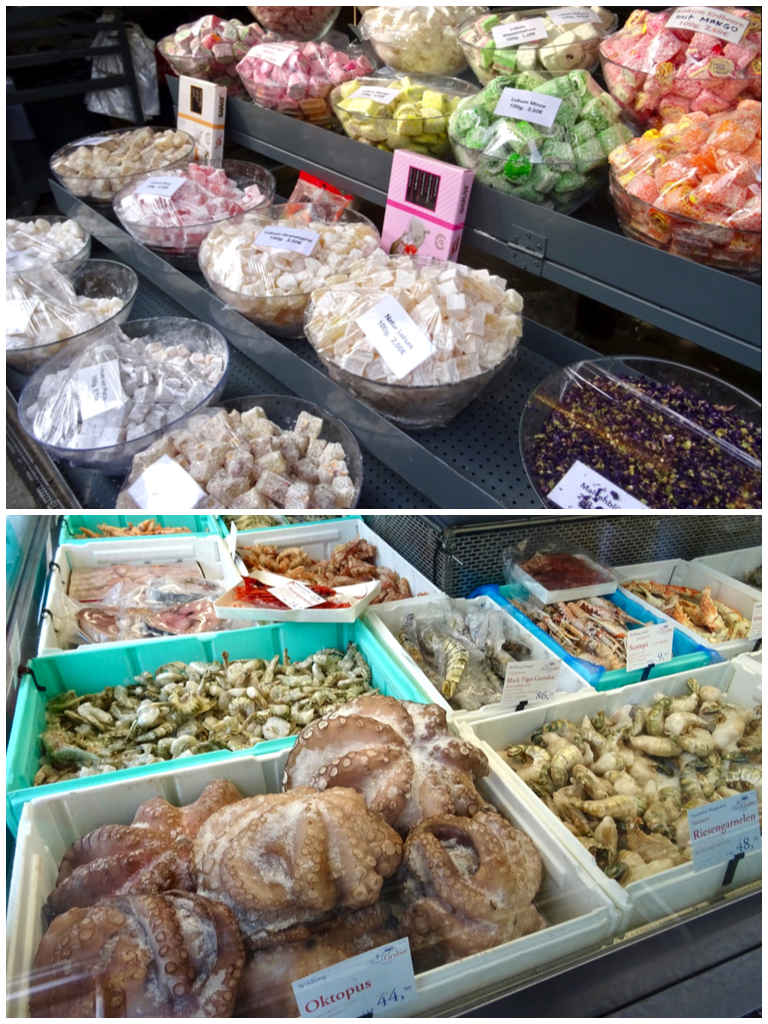
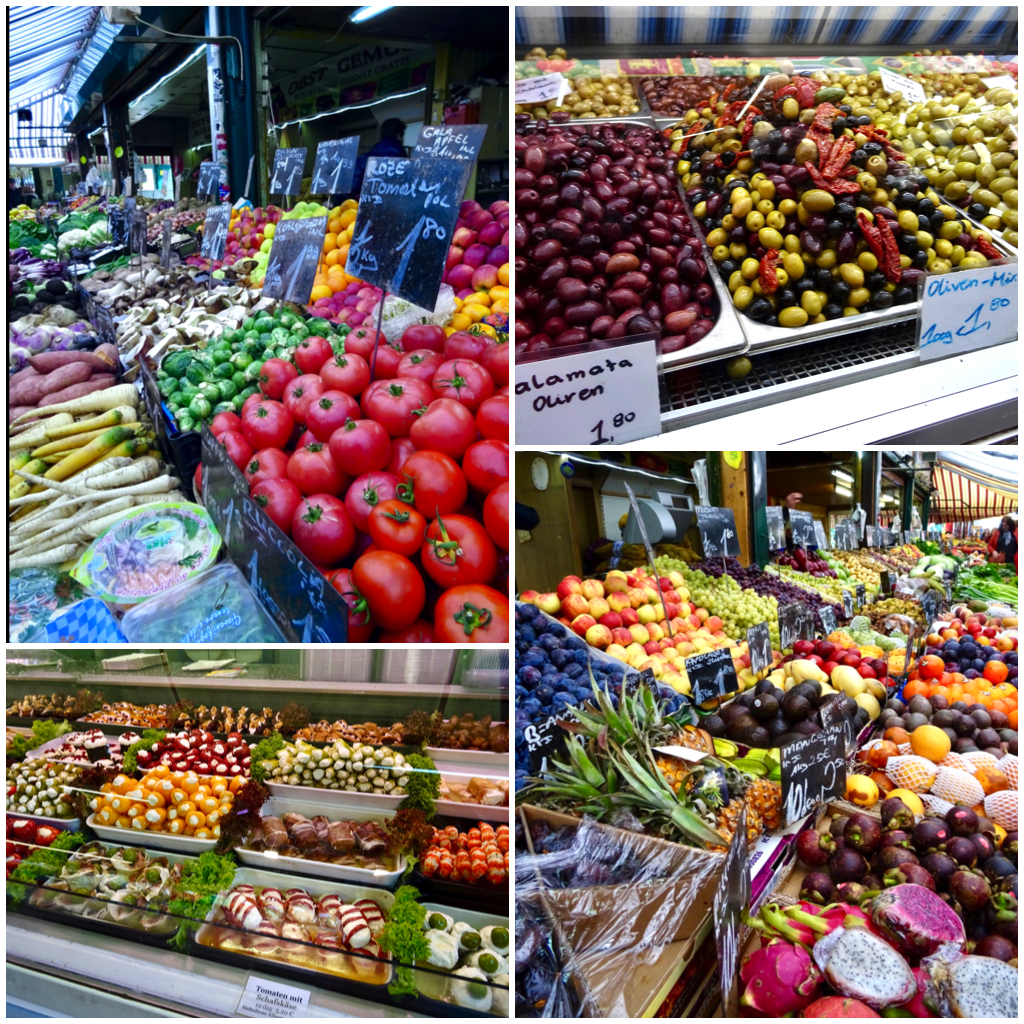 as well as all sorts of candies, dried fruits and some rather exotic looking products in the fish market section.
 Near the Naschmarkt we find this interesting tribute to the Orson Wells movie, The Third Man. It is possible to tour the sewers, right under our feet, where part of the movie was filmed, but we pass on that today.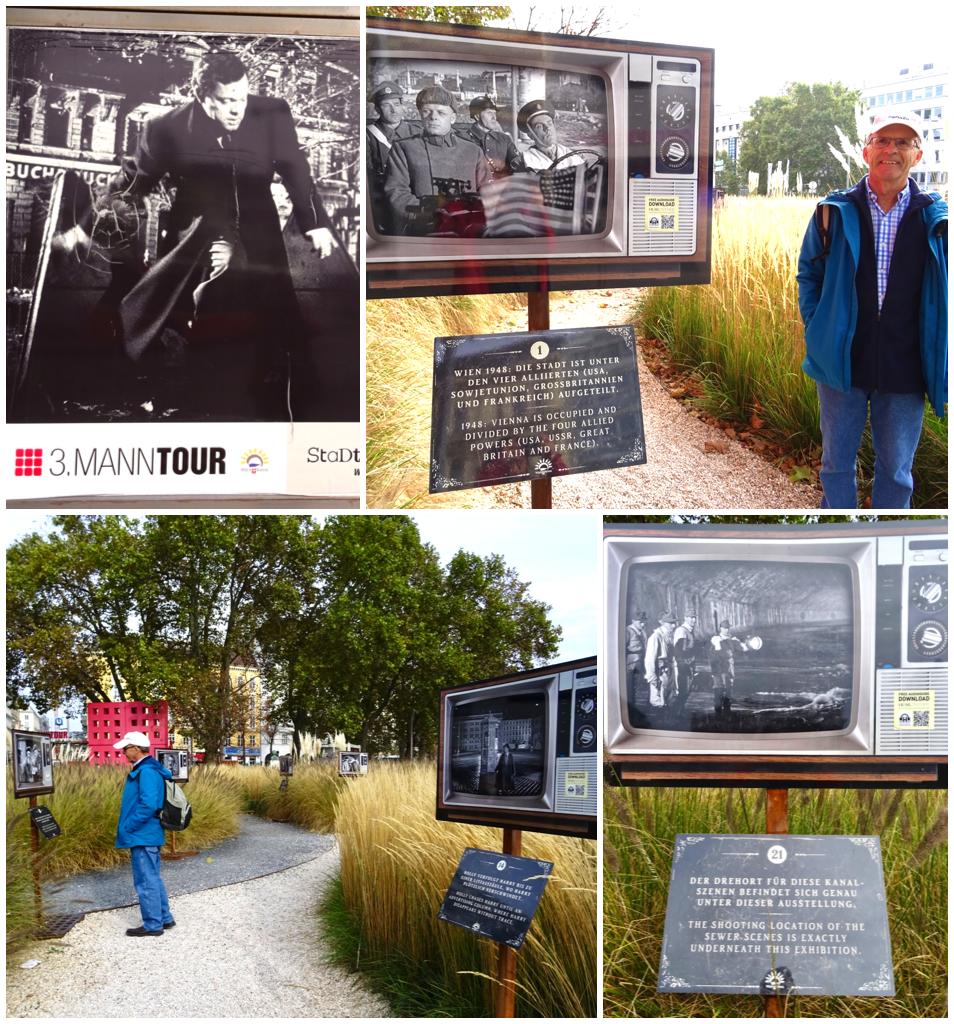
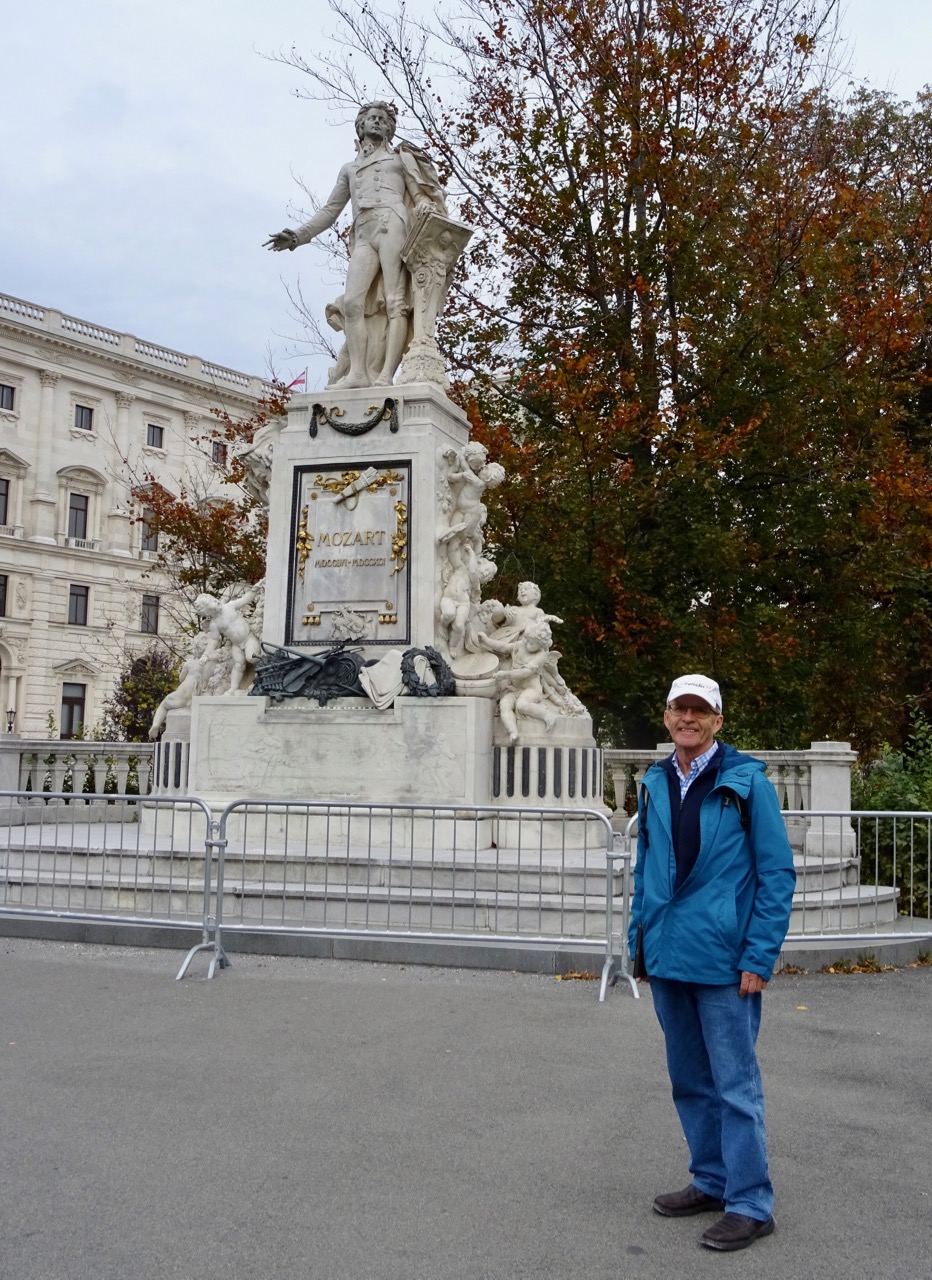
 There is a statue of Mozart, right beside a Hop On Hop Off bus station. We sit and have our picnic lunch and watch tourists jump off the bus, snap a photo from quite a distance, and then jump back on the bus to get to the next destination. This sure isn’t the way we do it! We sight-see very slowly and leisurely, stopping often to look at the sights, people watch and just enjoy where we are and what we are seeing. We are very slow tourists!
 This equestrian statue of Emperor Joseph II, erected in 1795 is the oldest equestrian statue in Vienna.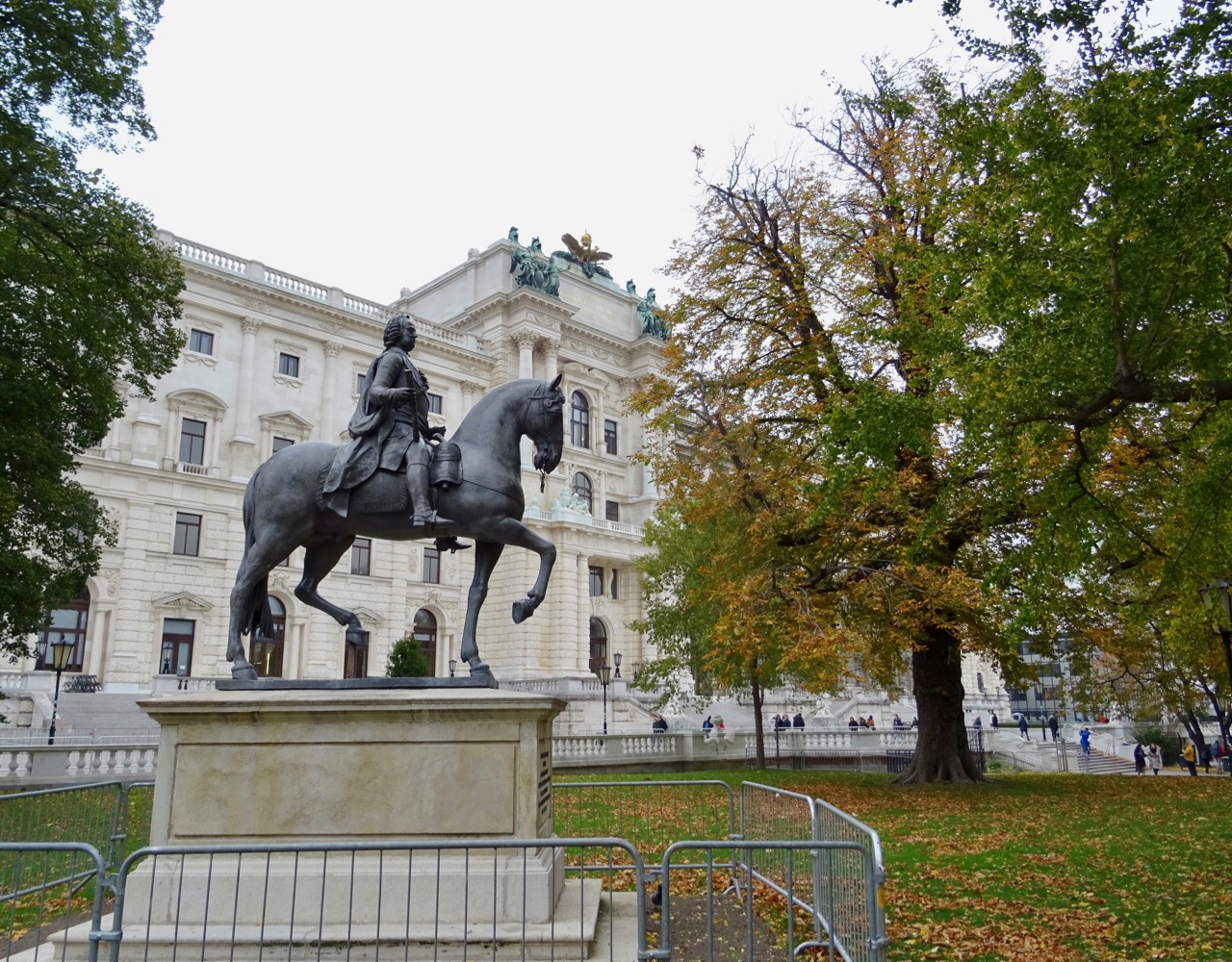
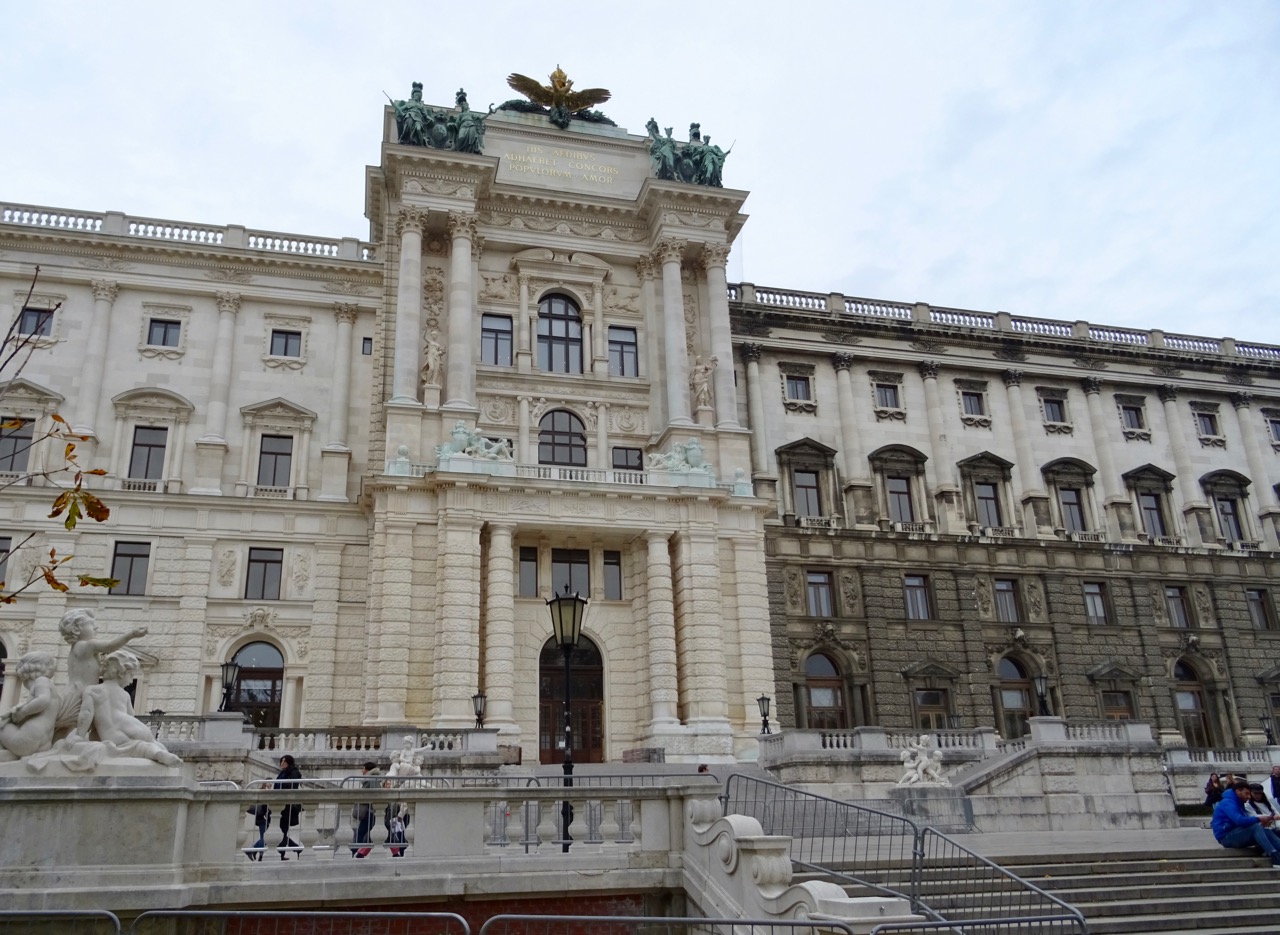 We make our way to the Albertina Museum, which we will visit another day. There is a Durer Exhibit I am looking forward to seeing. This is a street view from a corner of the Albertina.
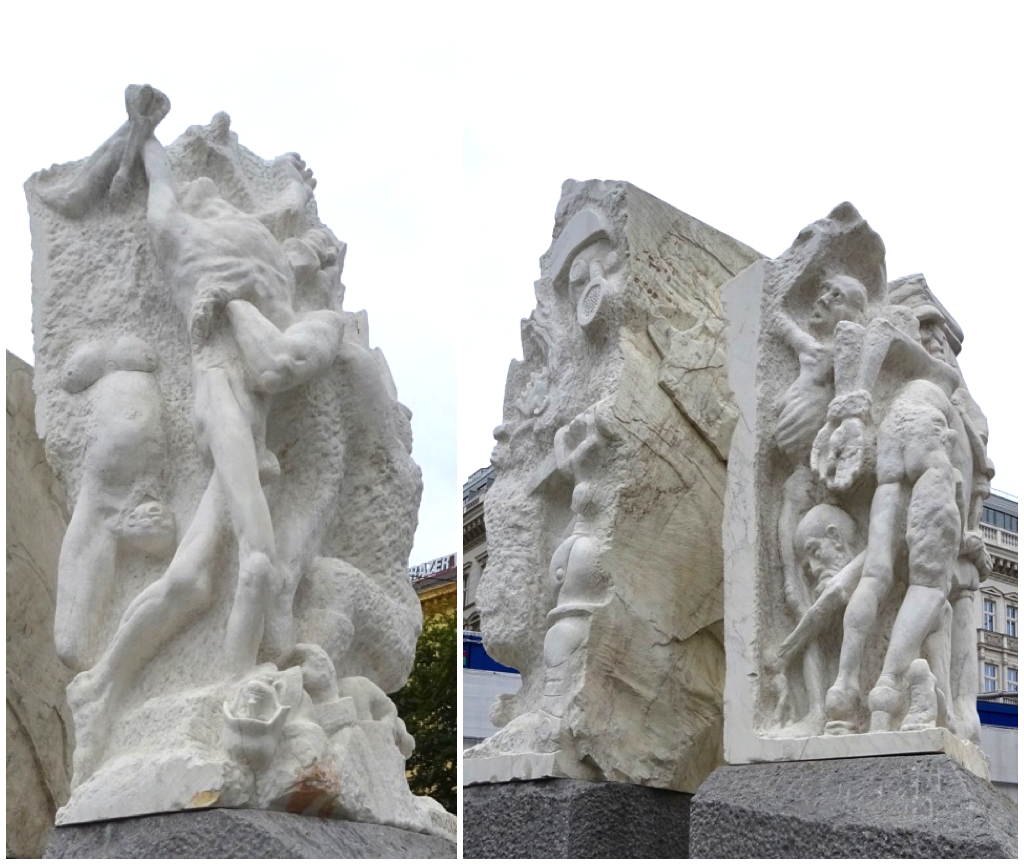 Of course there are several churches on our walk, and we visit all of them!
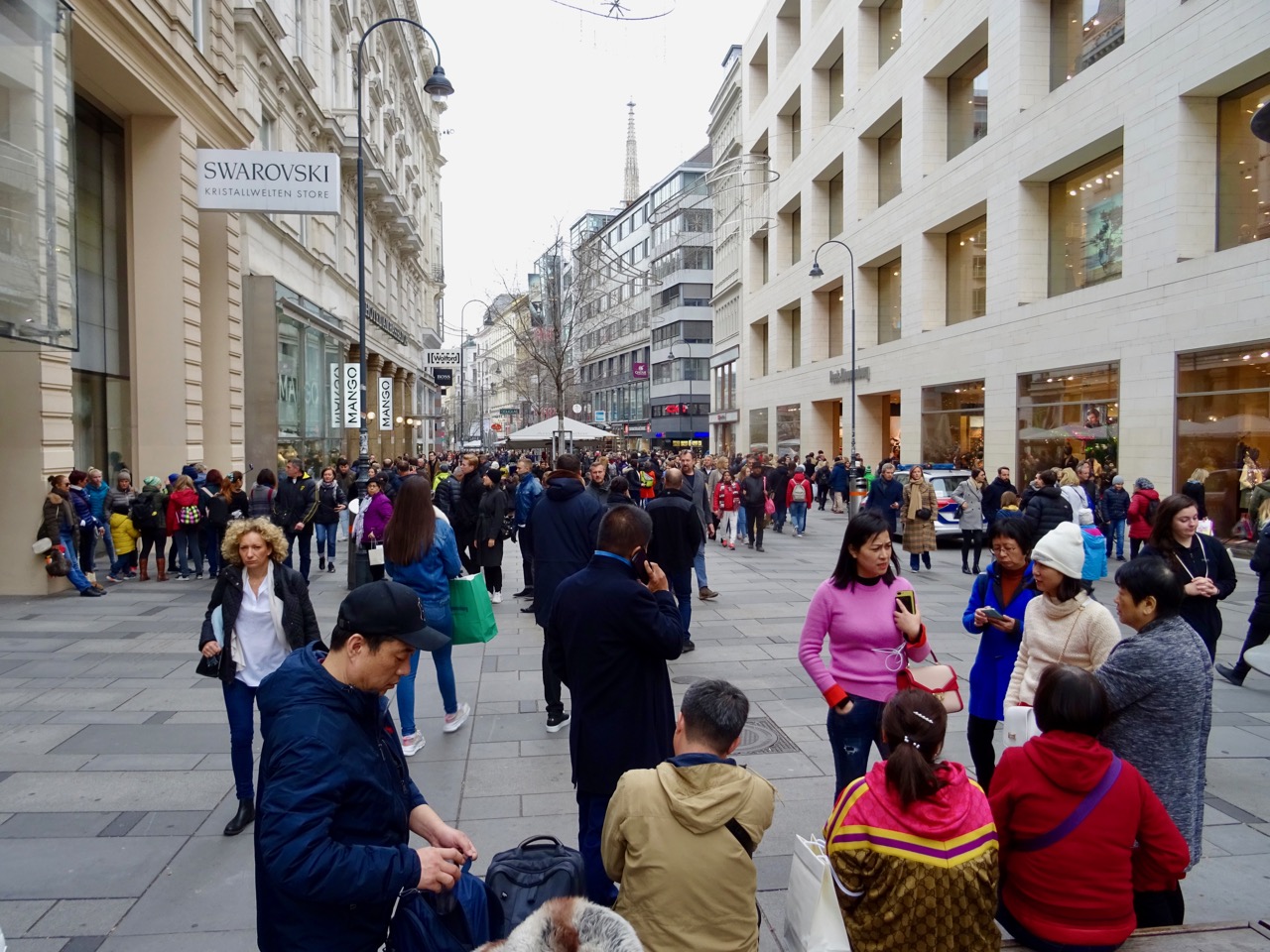
 This broad pedestrian Kärntner Strasse is packed with people and lined with shops and places to eat. This road dates to 97AD when it was a Roman road that went from Vienna to the border of Italy and Slovenia, and eventually all the way to St. Petersberg, Russia!
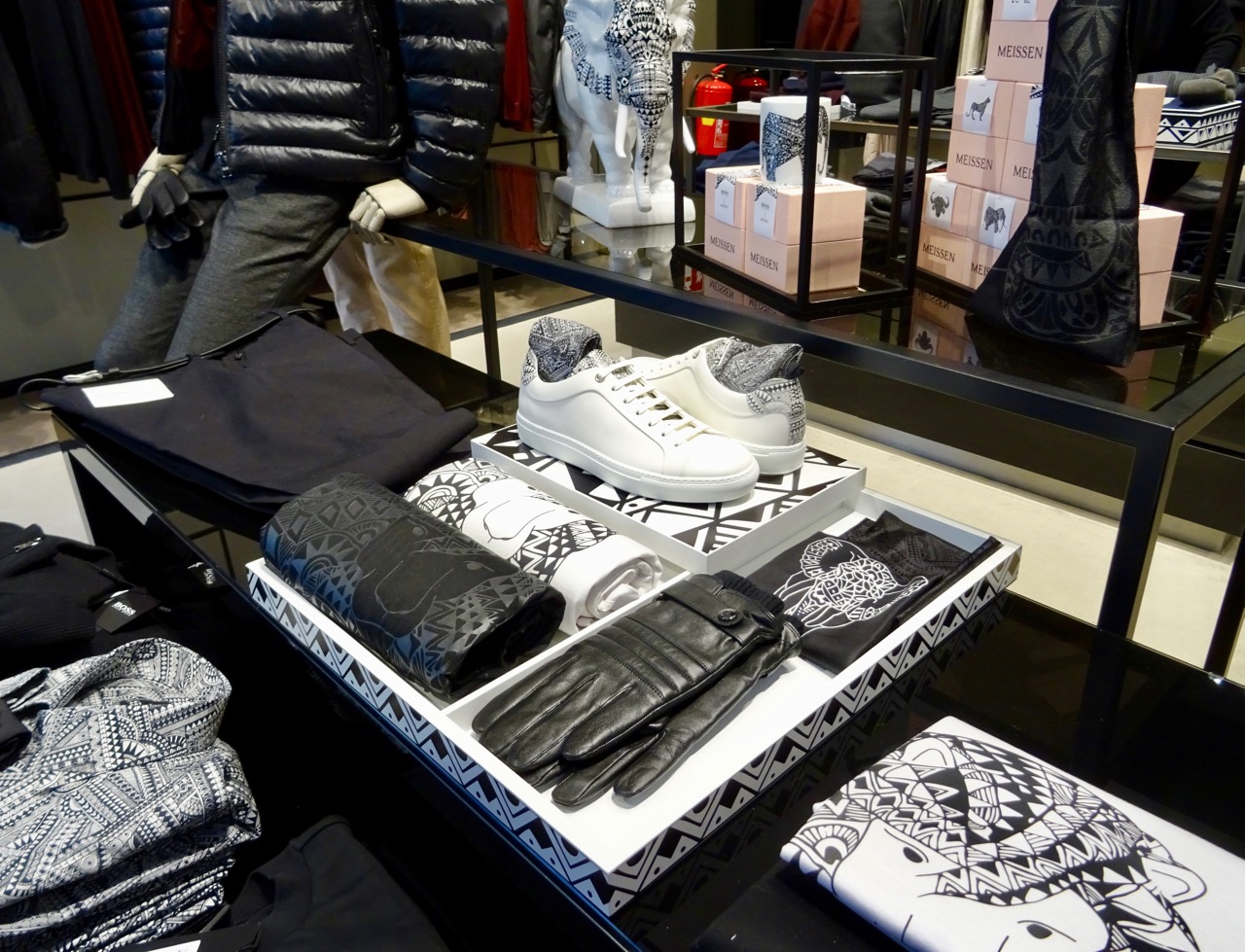
 I thought that the Zen-Doodle like designs on the clothing in this shop were interesting.
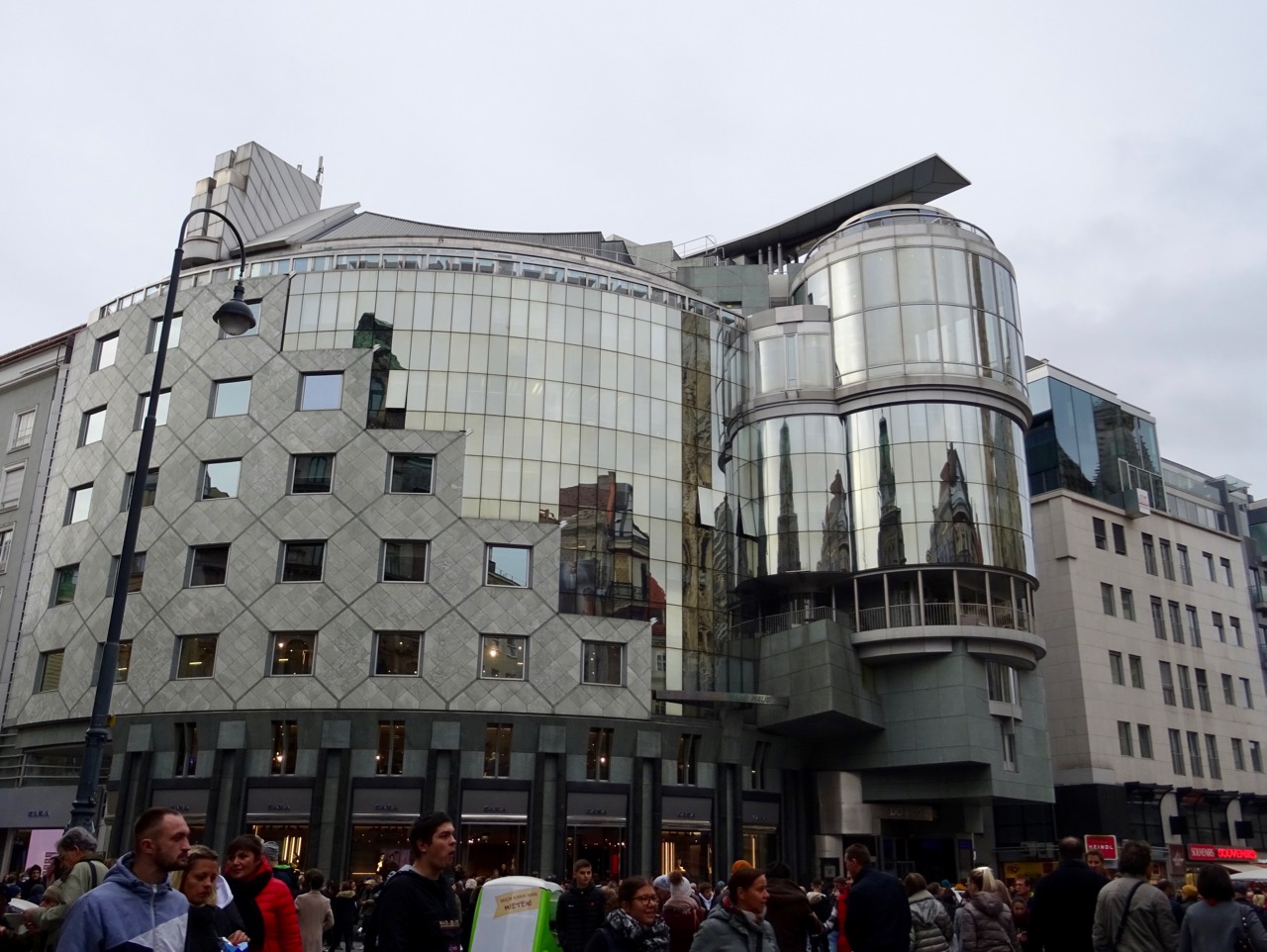
  The modern Haas House offers interesting reflections of St. Stephen’s church.
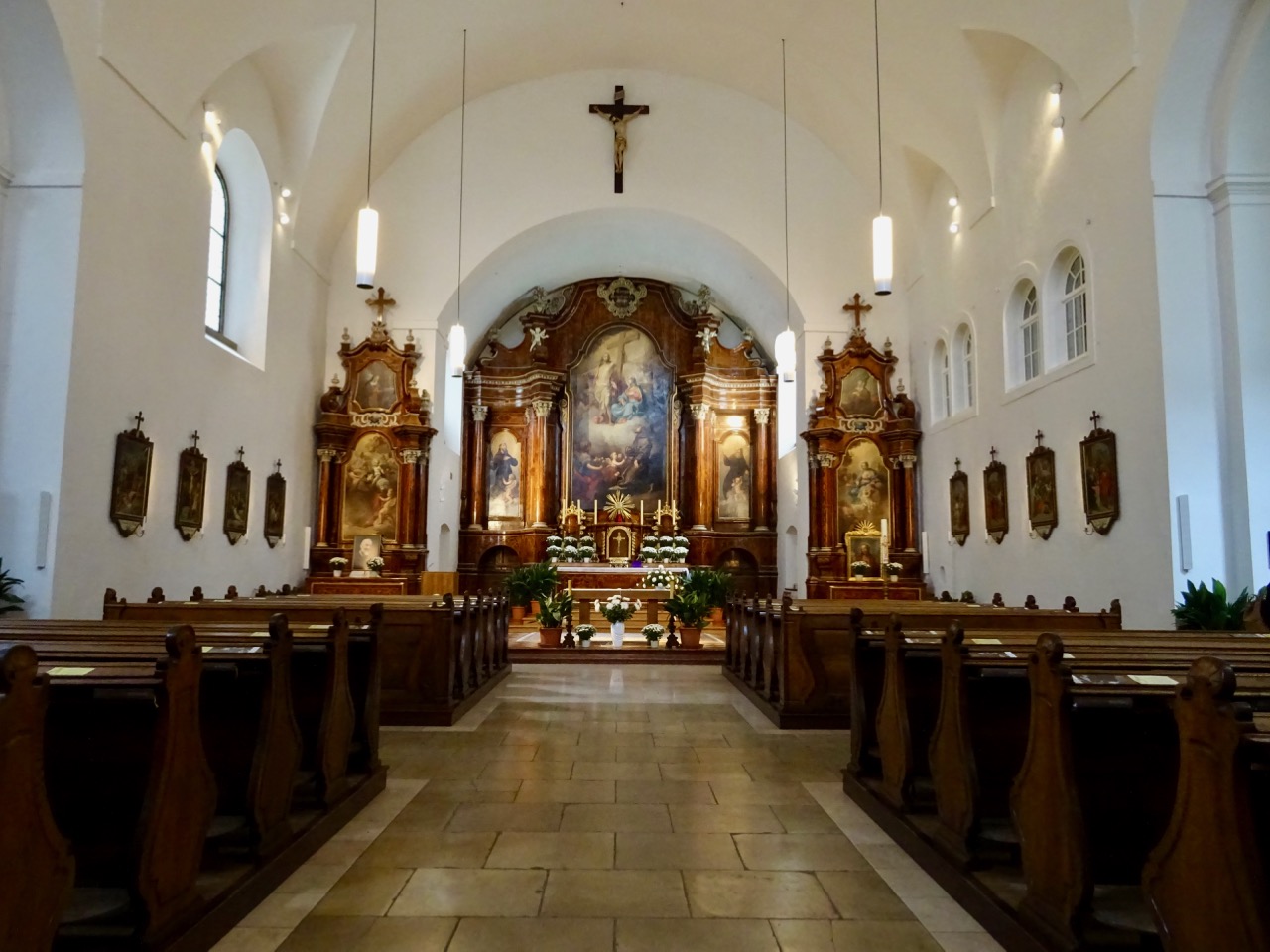
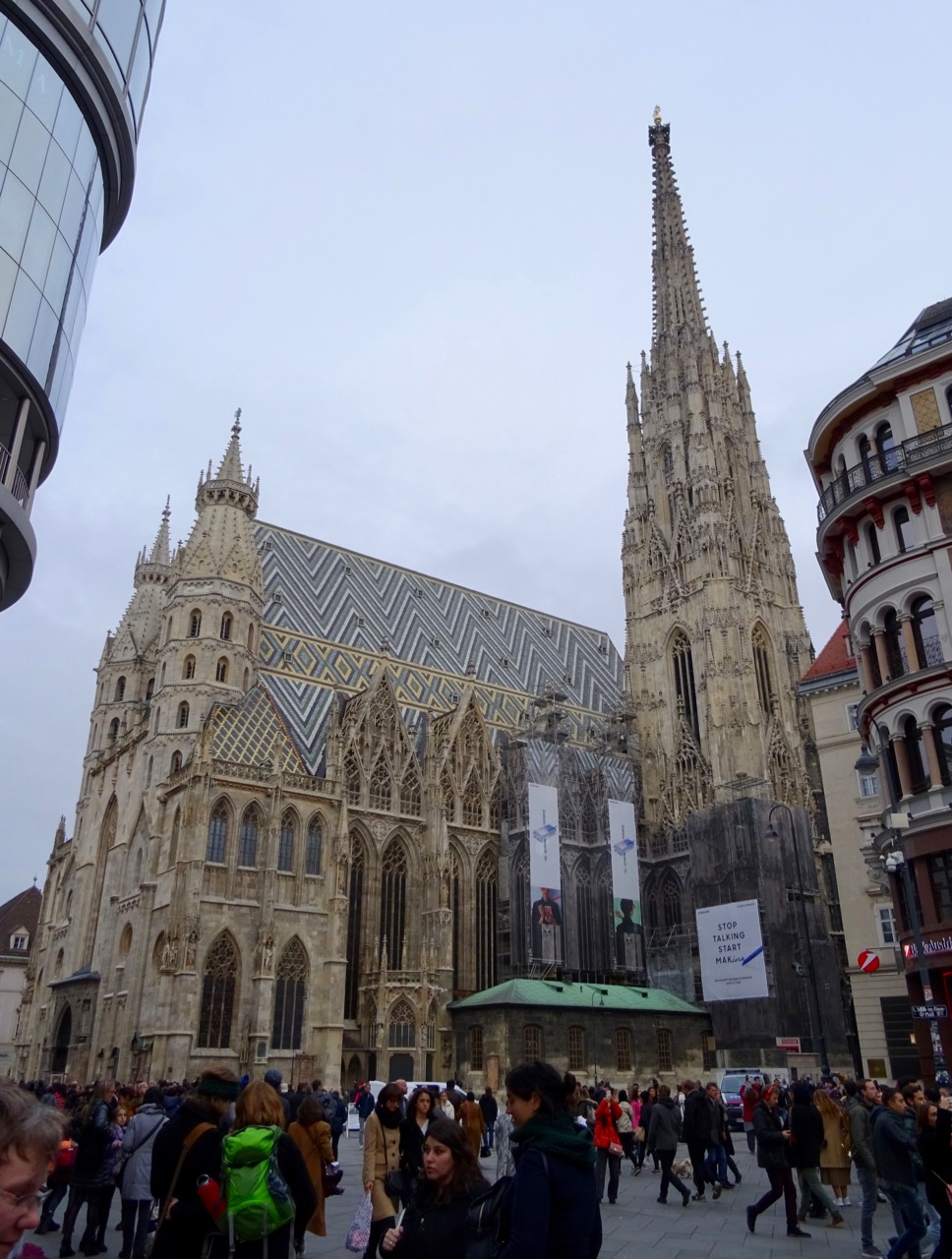
 The St. Stephen’s Cathedral is huge, and ornately decorated, outside…
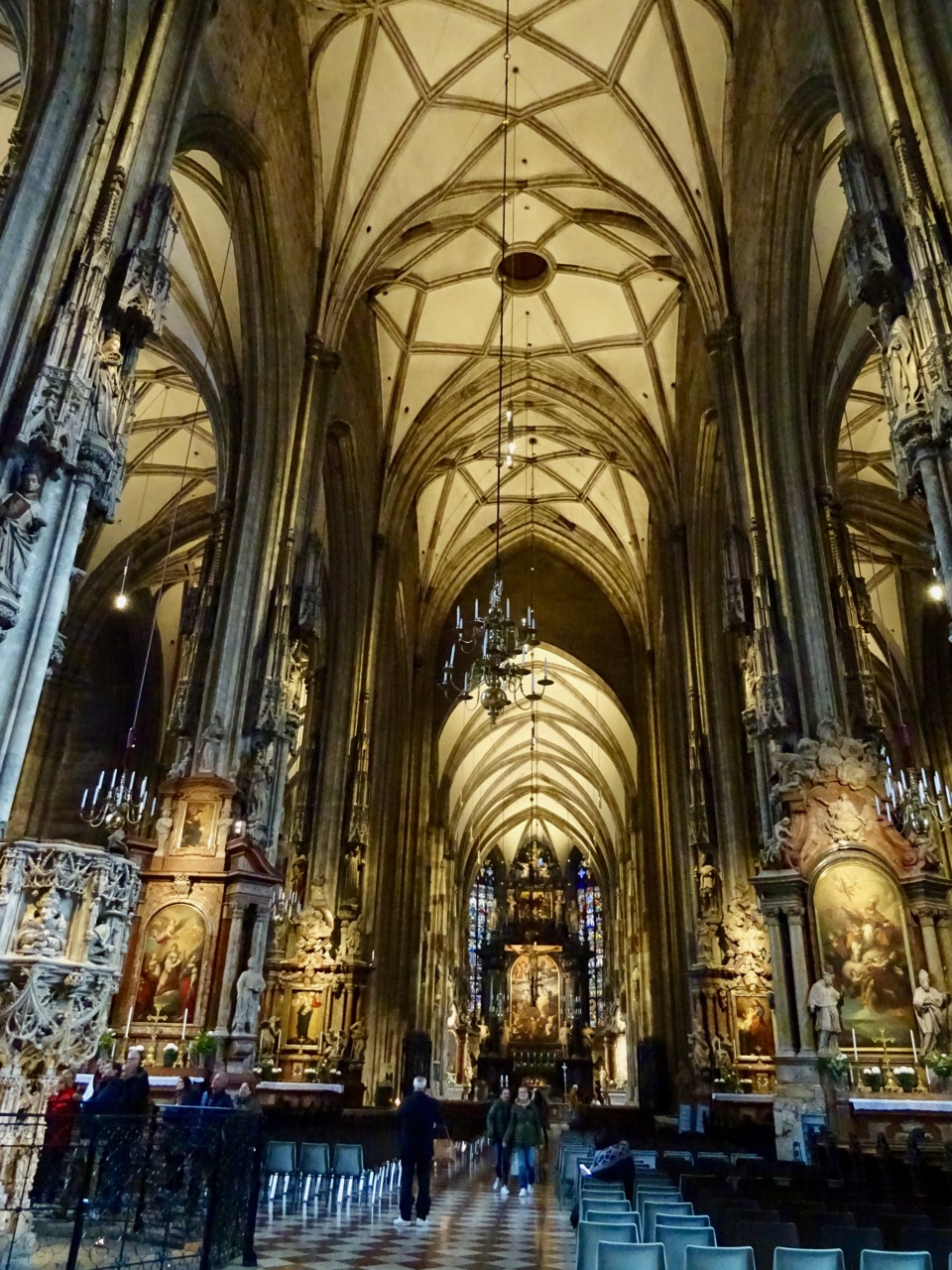
  and inside.
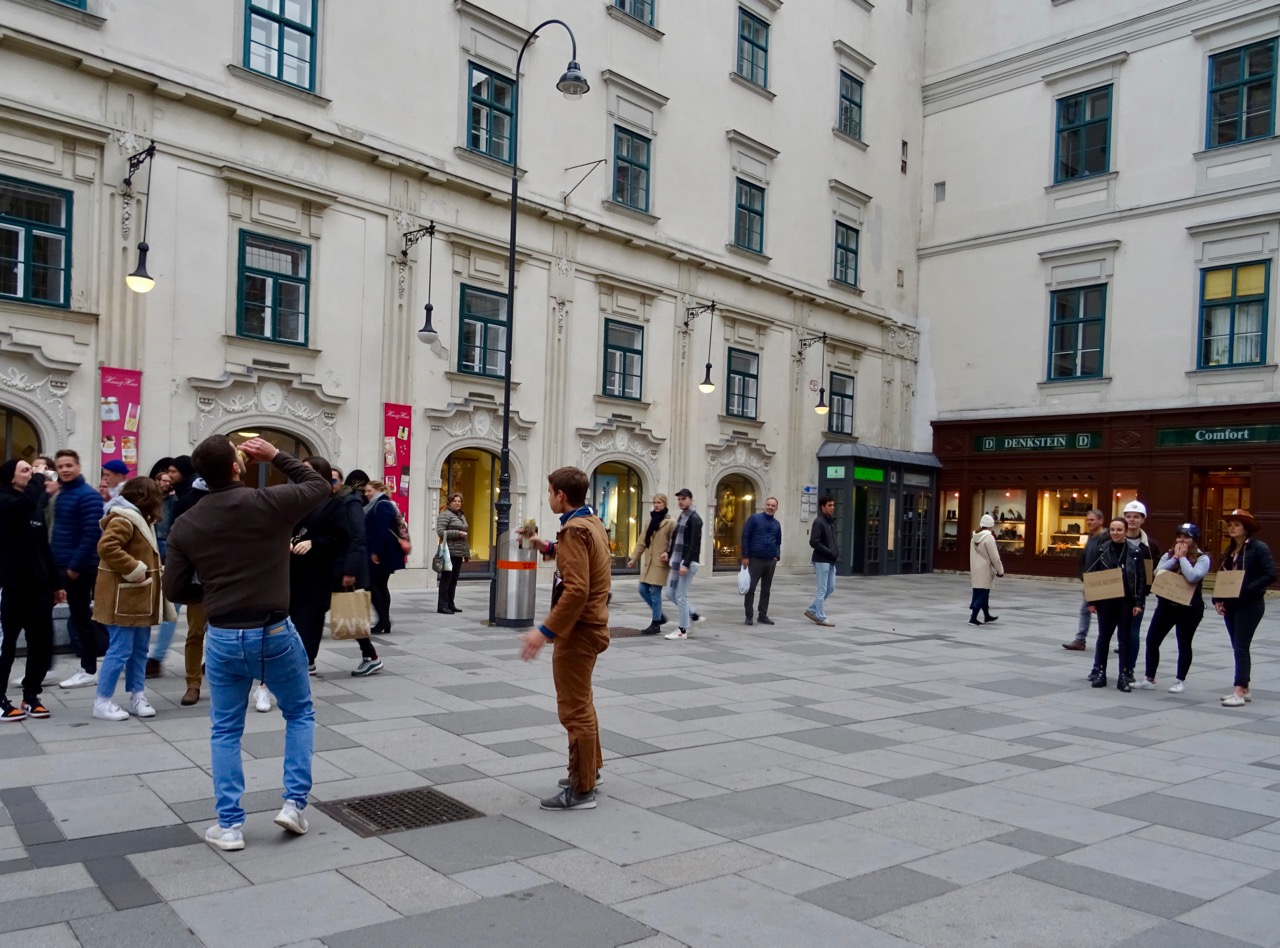
 Just behind the cathedral we see a group of people taking part in a drinking game. The guy in the blue jeans drank his big can of beer twice as quickly as the guy dressed in brown!
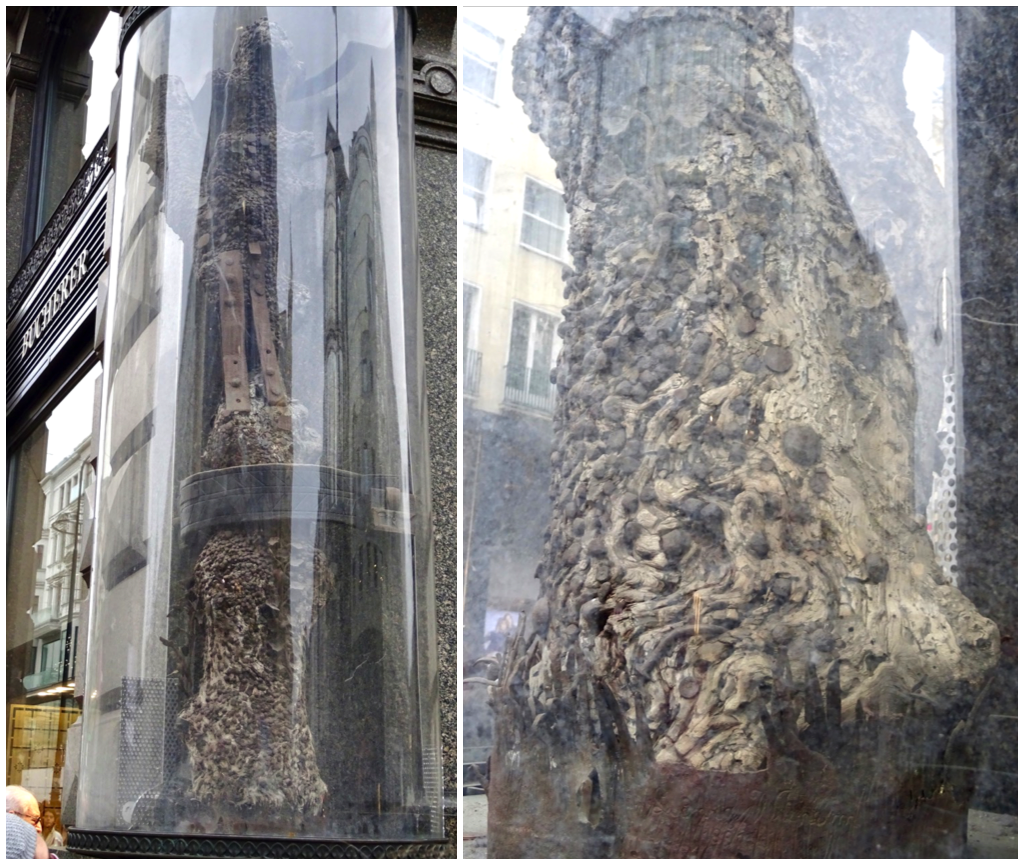
 The Stock im Eisen is part of a tree that has hundreds of iron nails pounded into it and dates from 1440. No one is sure why the nails were pounded in but it is thought that is was for good luck. It is located on the corner of a building and is protected behind plexiglass.
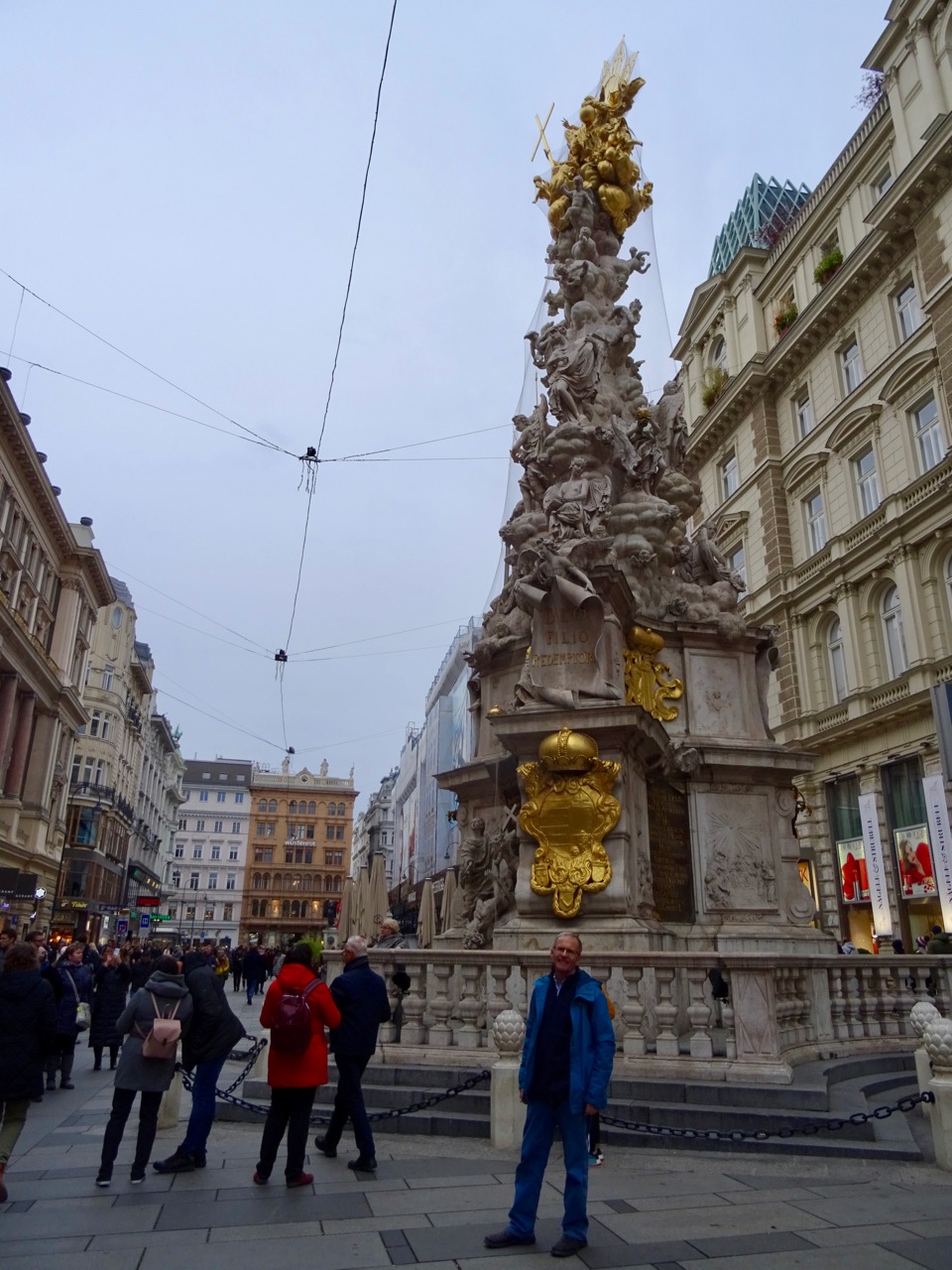
 The Holy Trinity Column, located on a street in the inner city of Vienna, was erected after the Great Plague epidemic in 1679. It is one of the most well-known sculptural pieces of art in the city.
 S
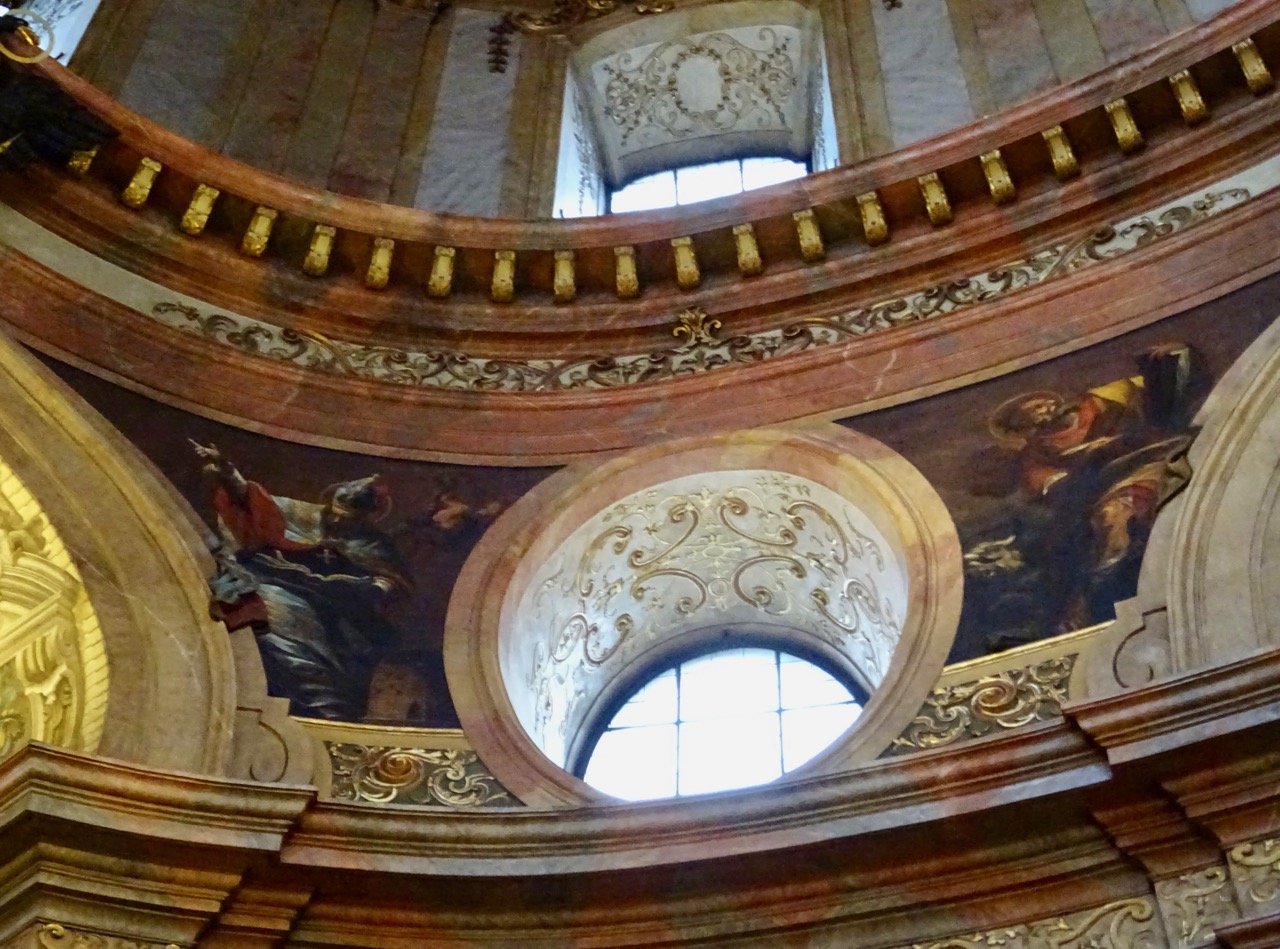
S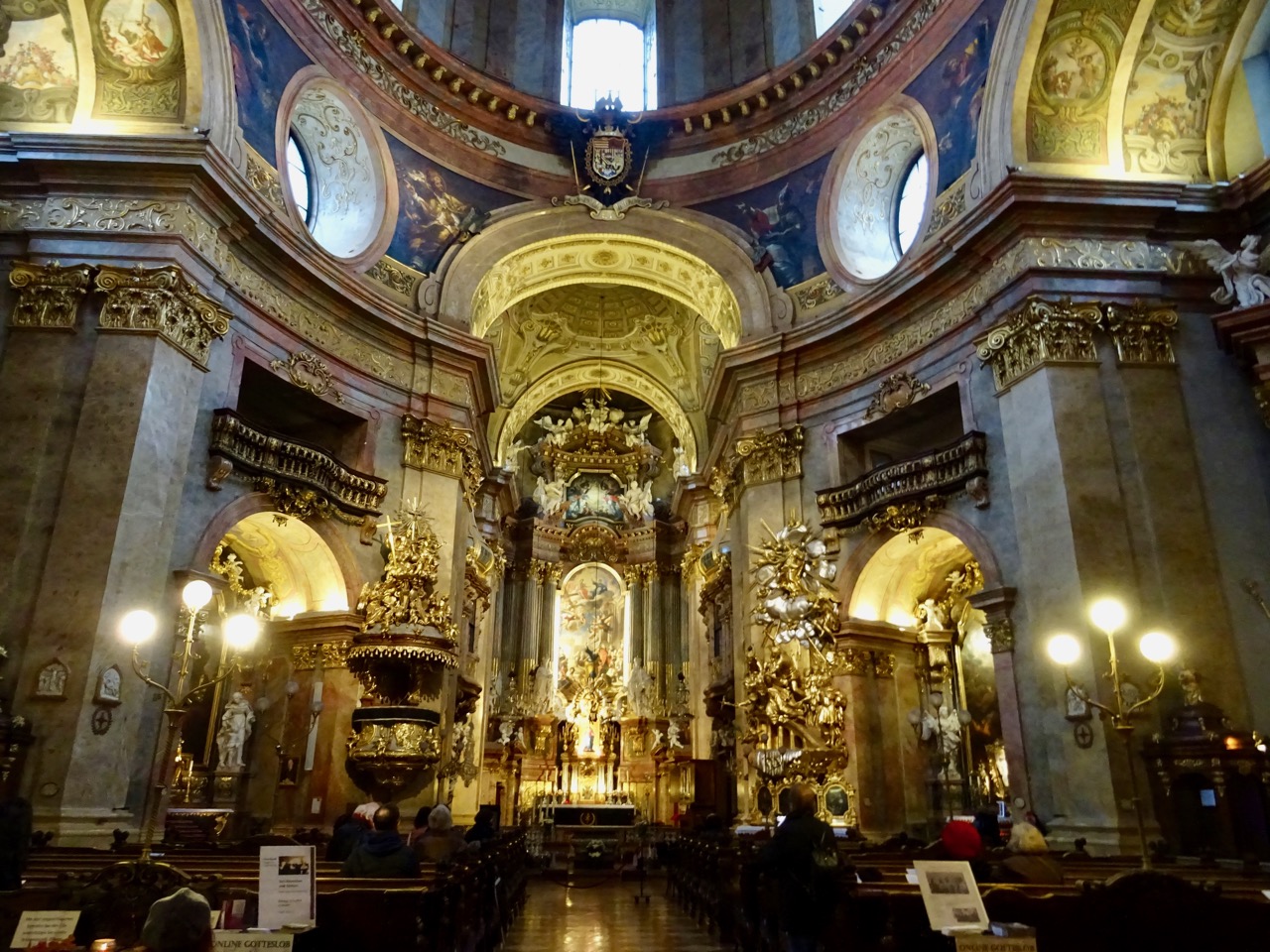 I thought it interesting the way the paintings on the dome extended over the sculptural trim around the round windows.
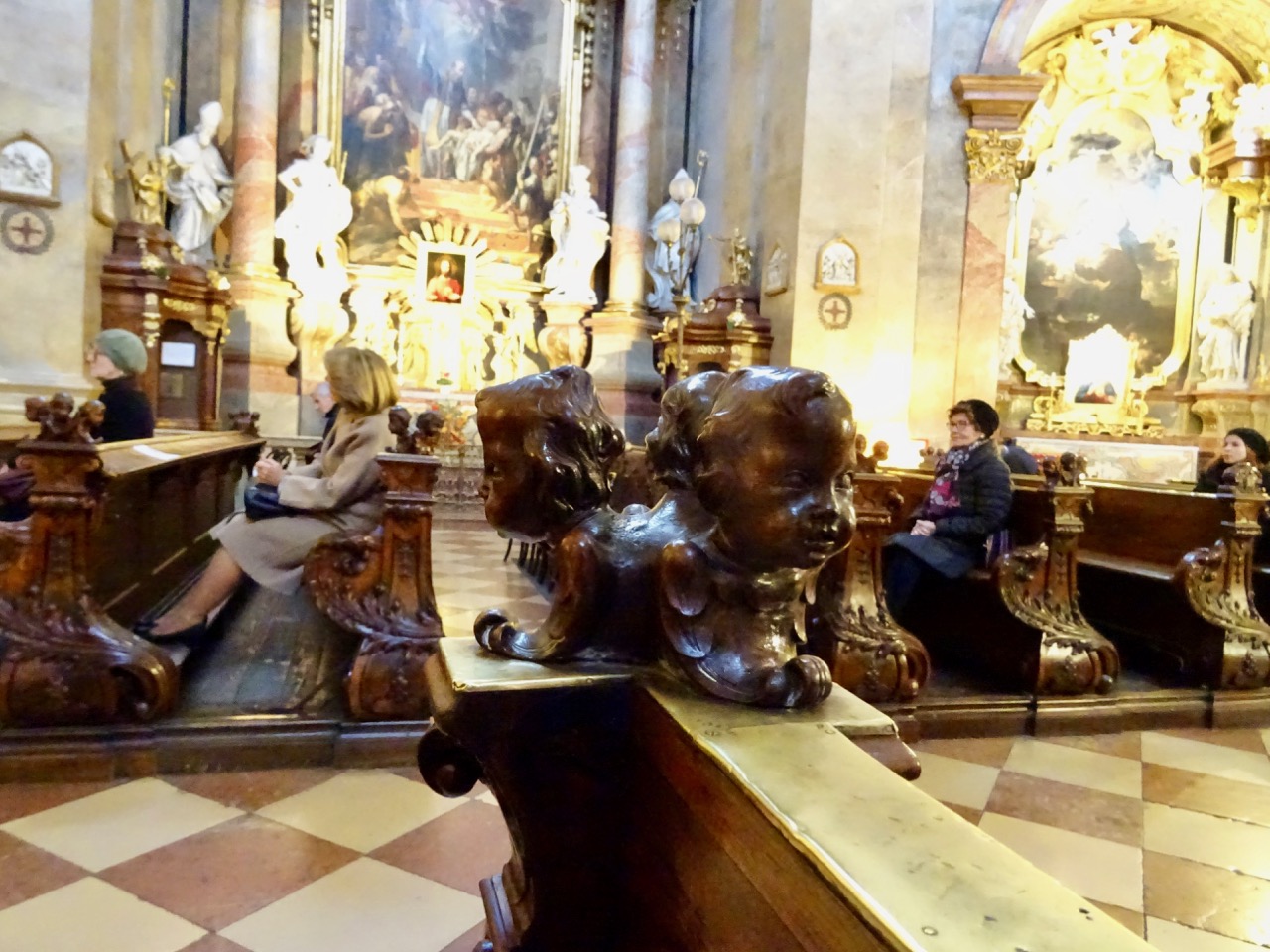
 The end of each pew is beautifully carved with different finials of three children’s heads. We sat for quite a while listening to the choir practicing.
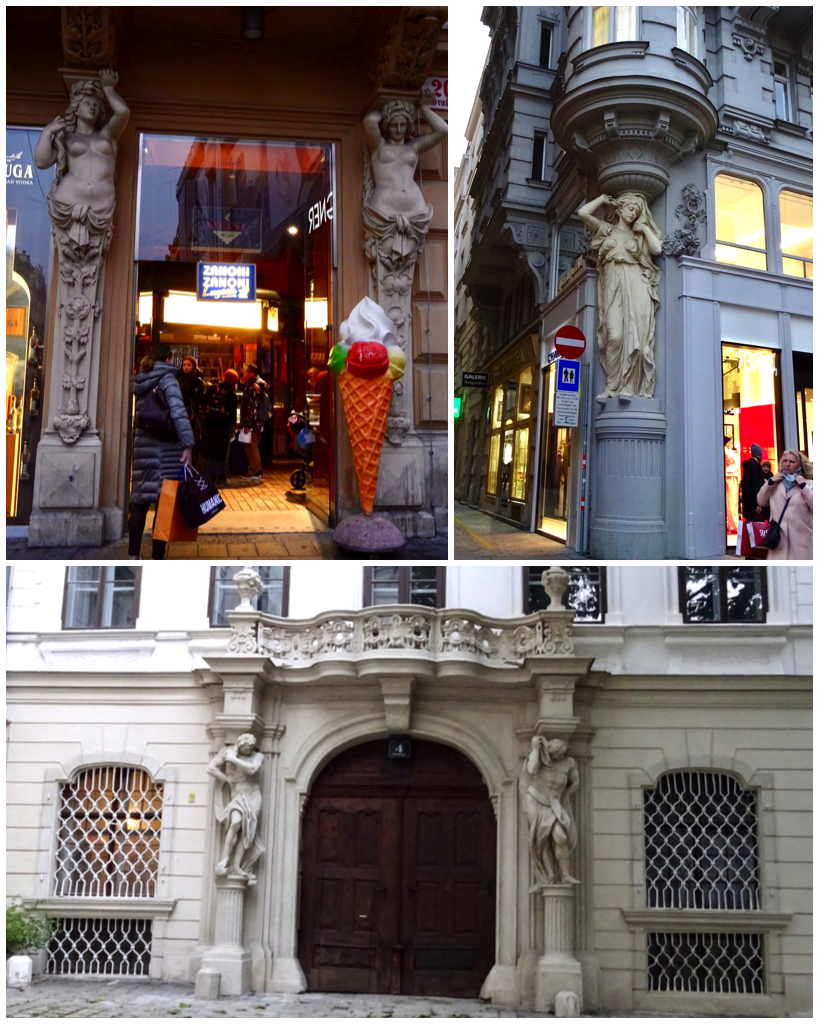
  Back outside, there are interesting details everywhere I look, like these sculptures holding up balconies.
 I loved this building. It looks like a castle. I wouldn’t mind living here!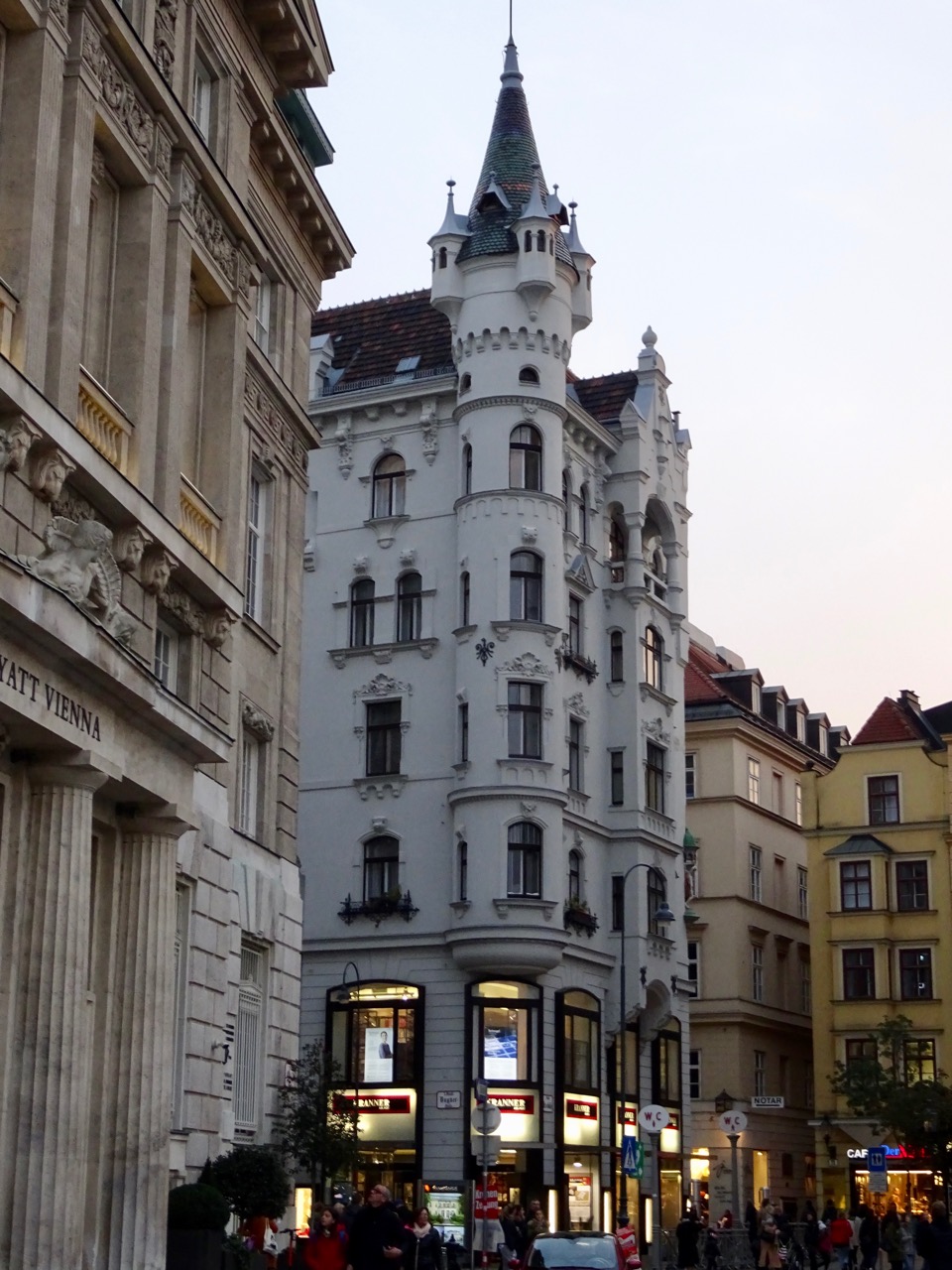
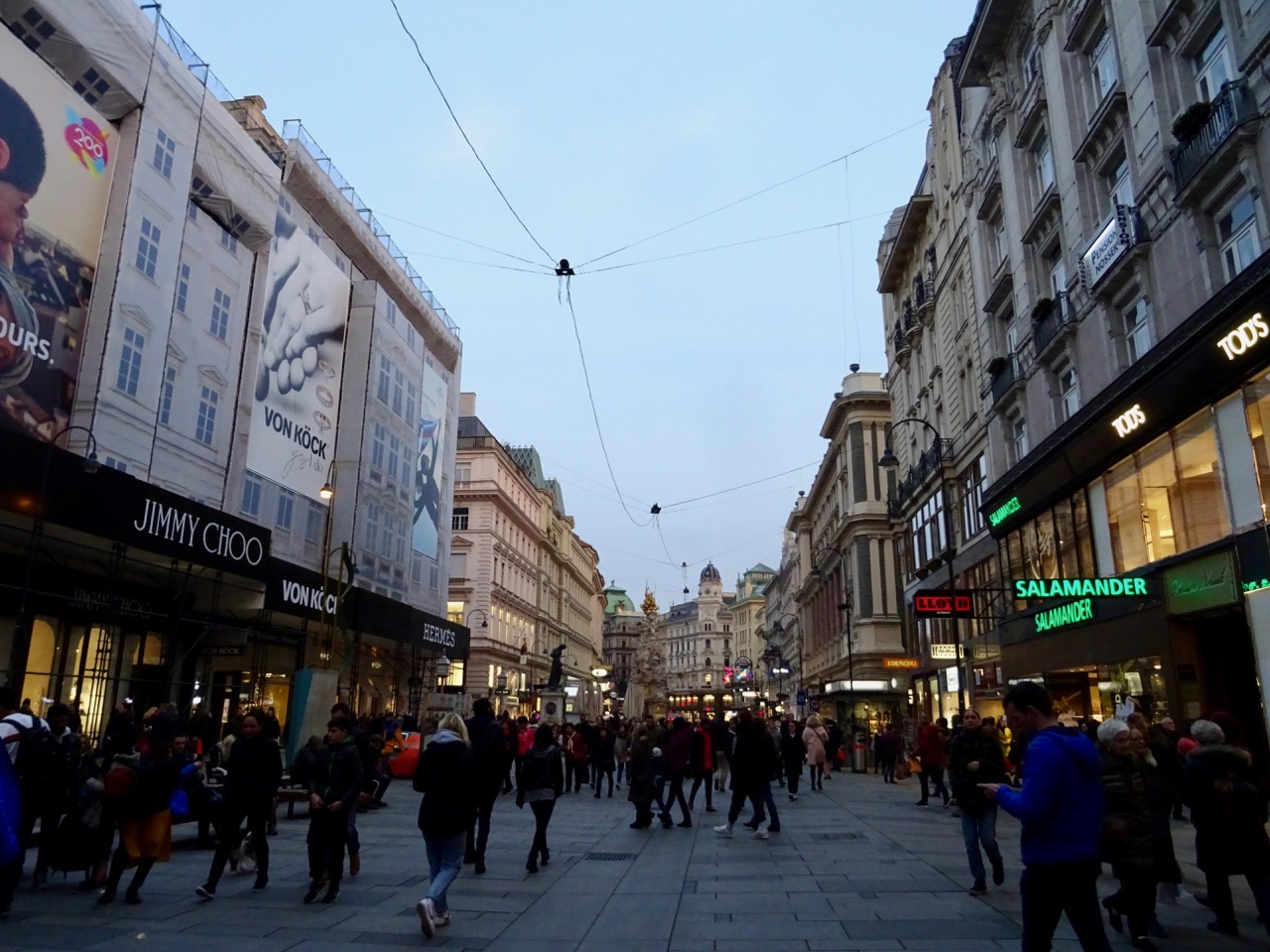 where the customers are served champagne as they shop! Sigh…an experience I am sure I will never have!
 There are Roman ruins…
 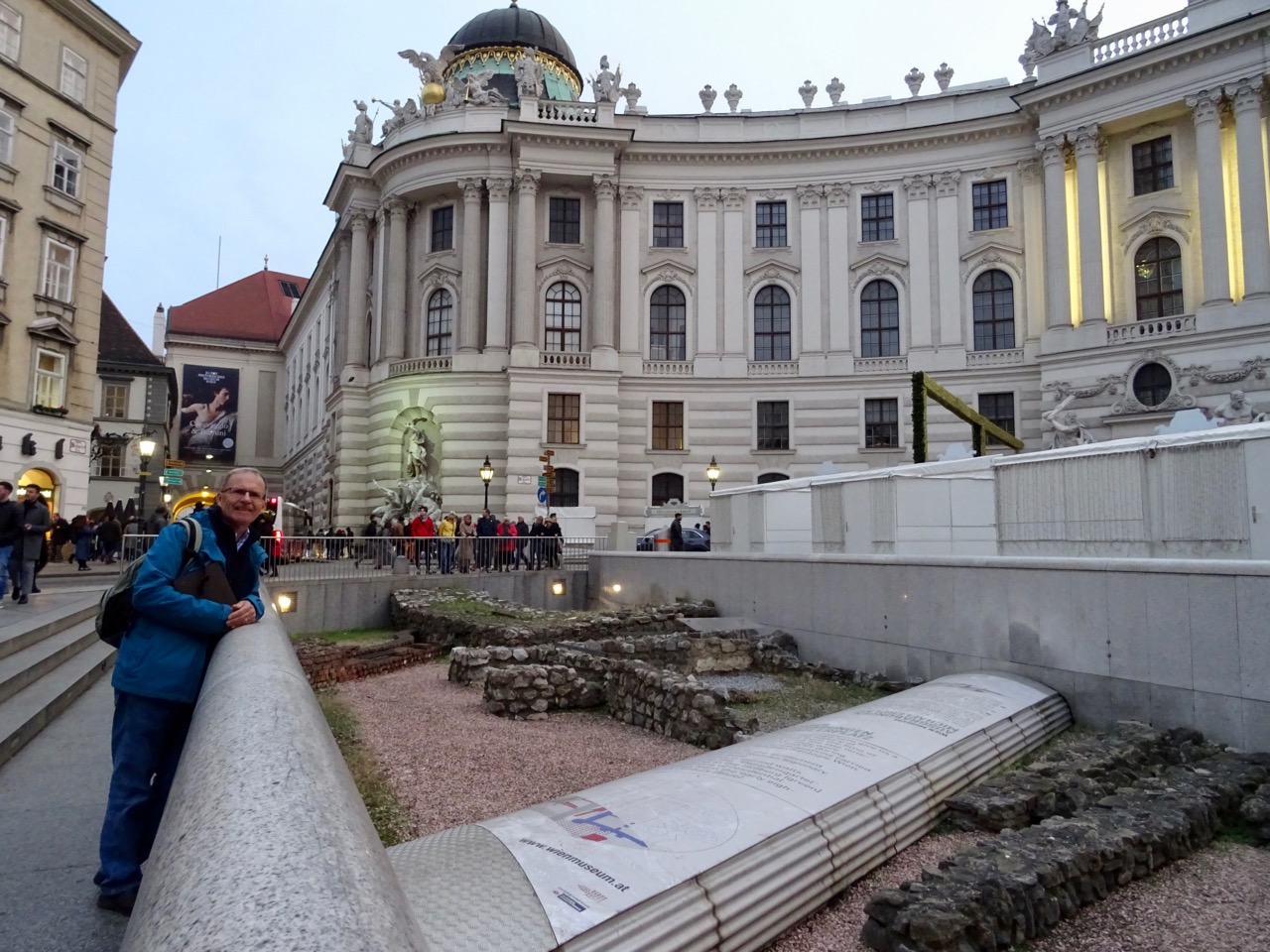 and beautiful statues on the corners of buildings.
 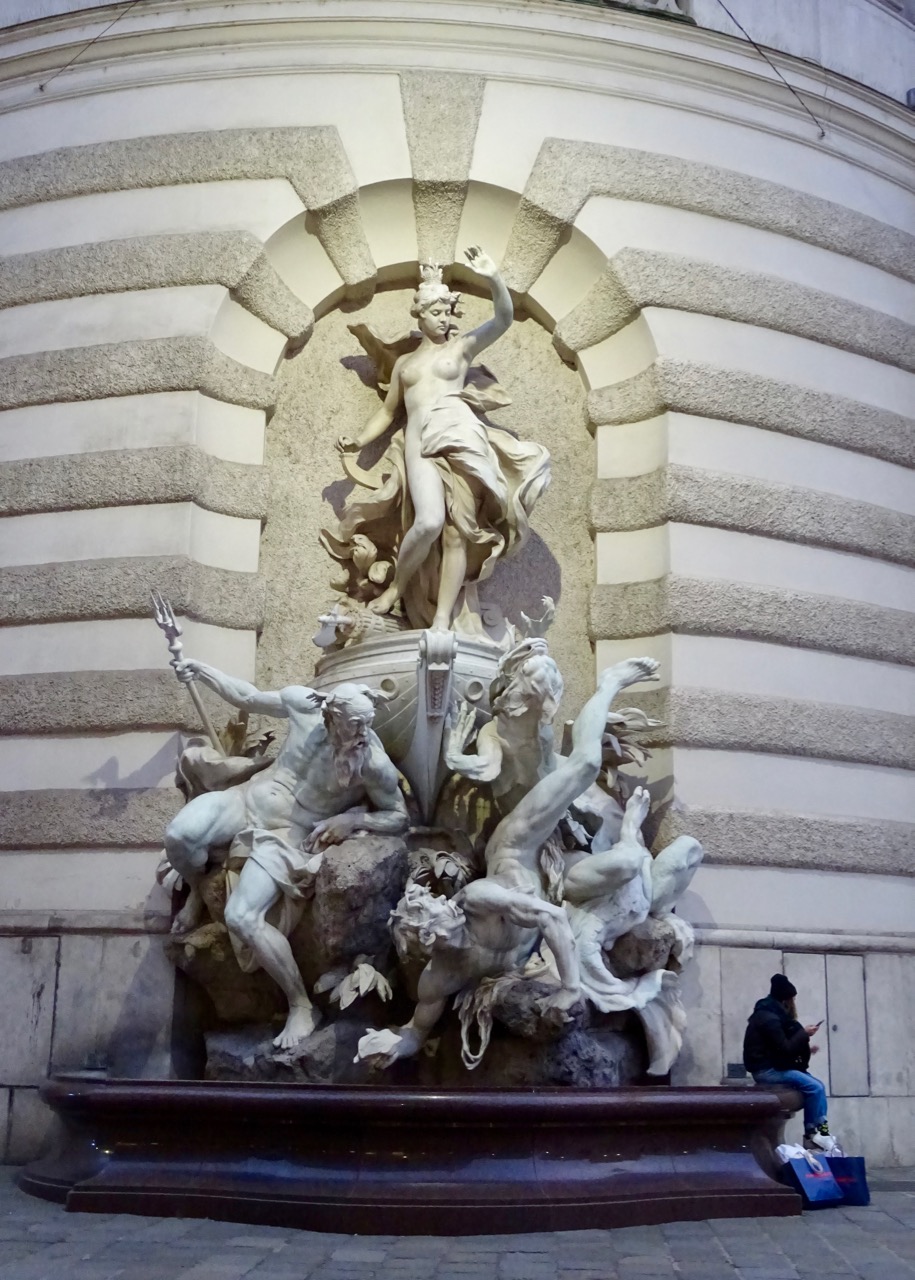 This is the building that houses the Austrian National Library, the Österreichische Nationalbibliothek, as well as the Spanish Riding School with the world famous Lipizzaner stallions. We will visit both of these on another day,
 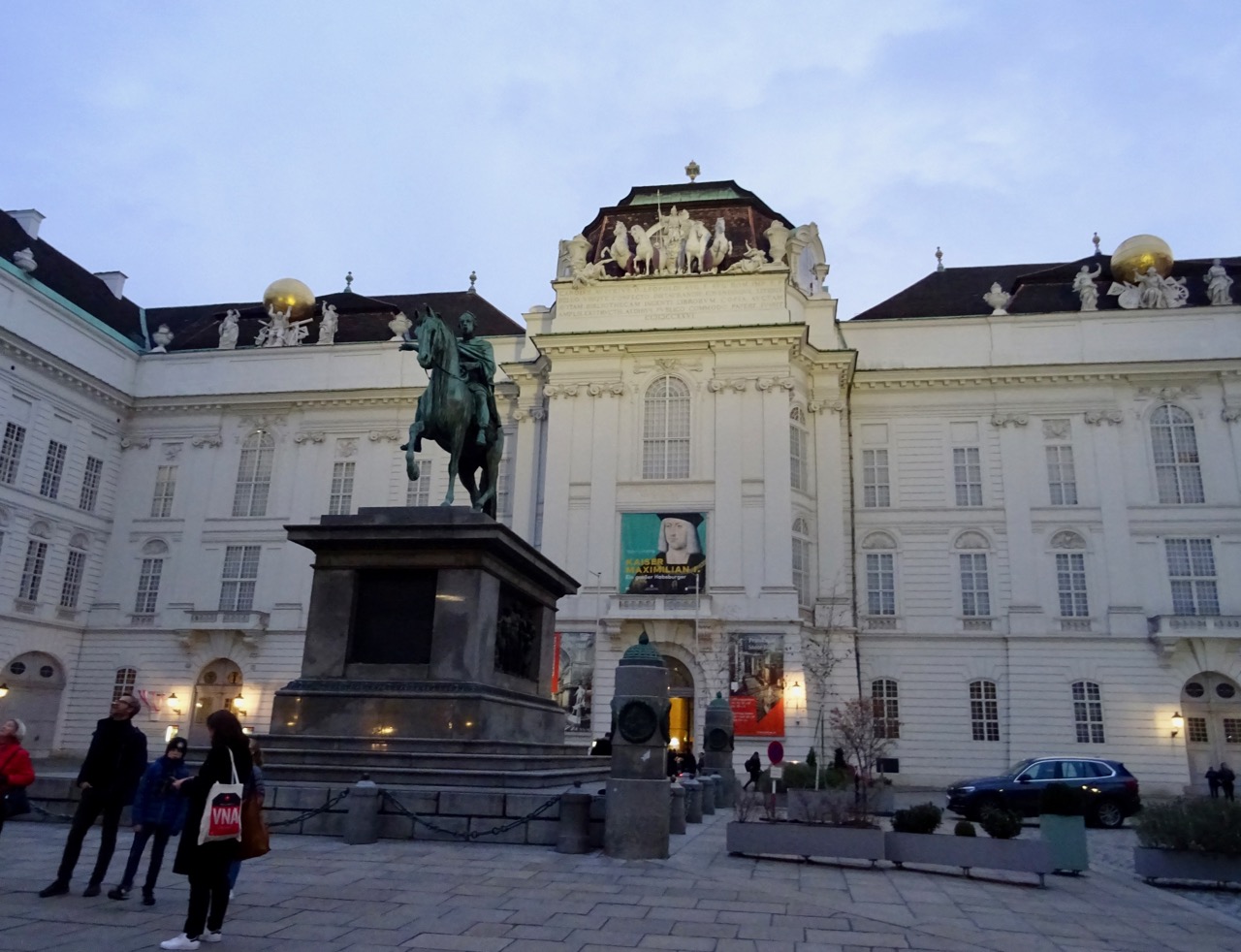 It gets dark earlier now, at about 5;30. The buildings look pretty all lit up. This is the other side of the Neue Burg Wing of the Hofburg Palace. We saw the backside earlier in the day.
 Time to head home. This subway station has colourful murals. Our apartment is very well located on the U6 subway line, so it takes less than a half hour to get home. Somehow even our ‘easy’ days end up being quite long. We left before noon and it will be after 7:00 by the time we get home.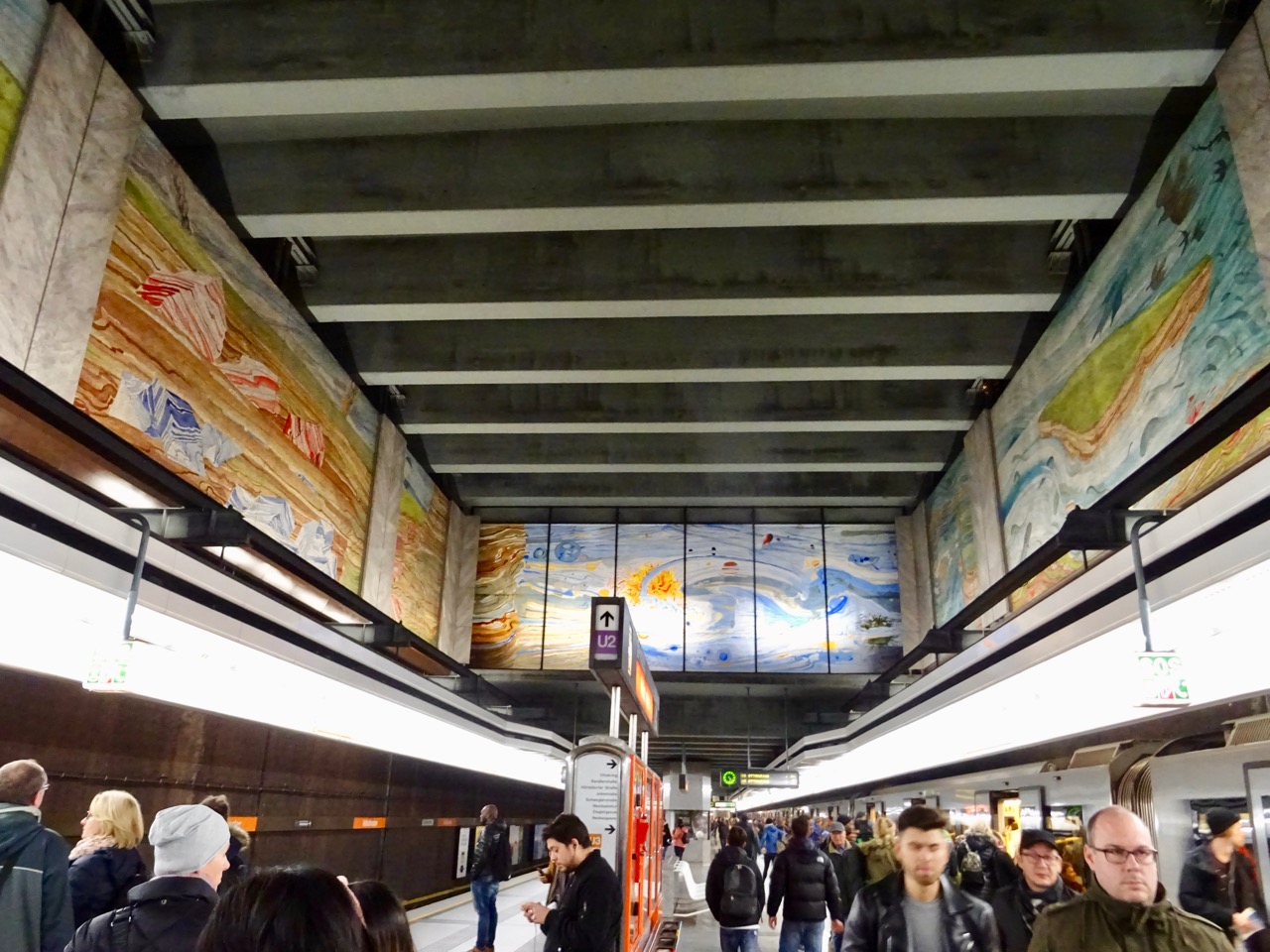
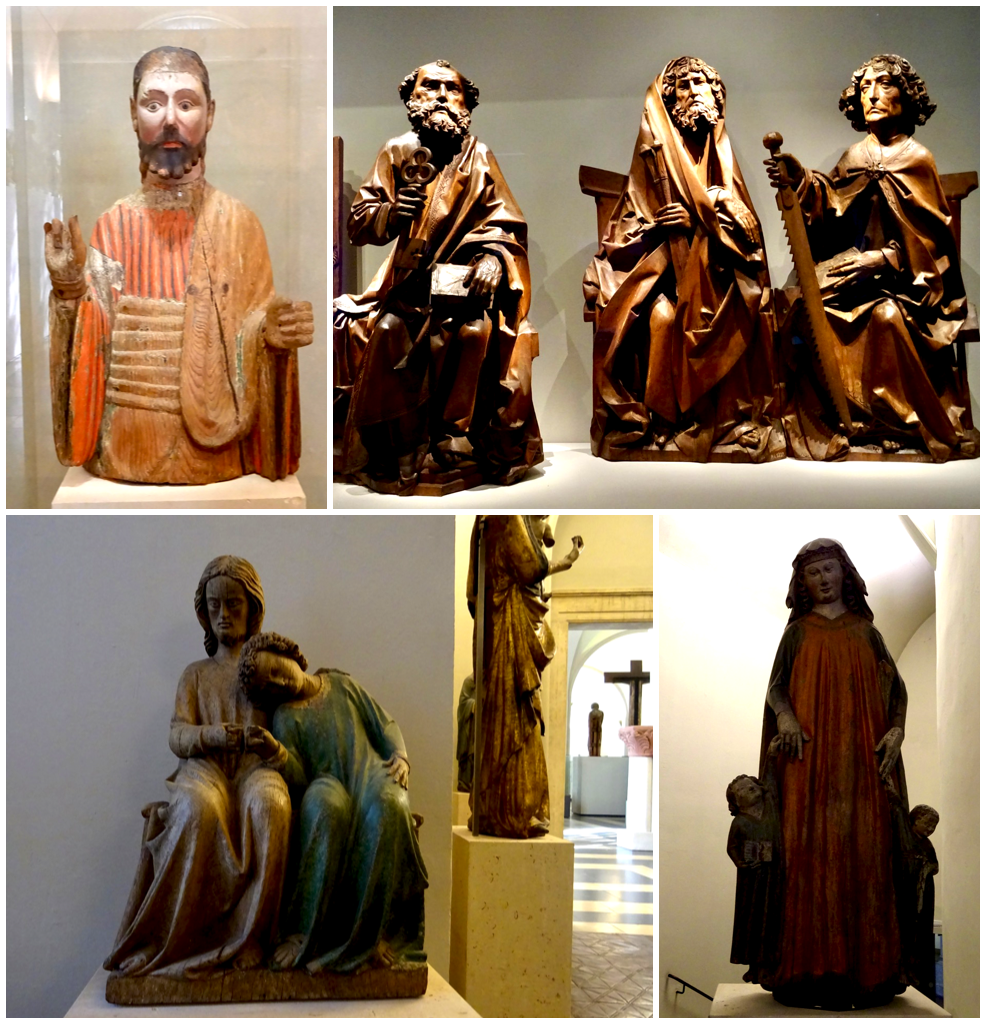
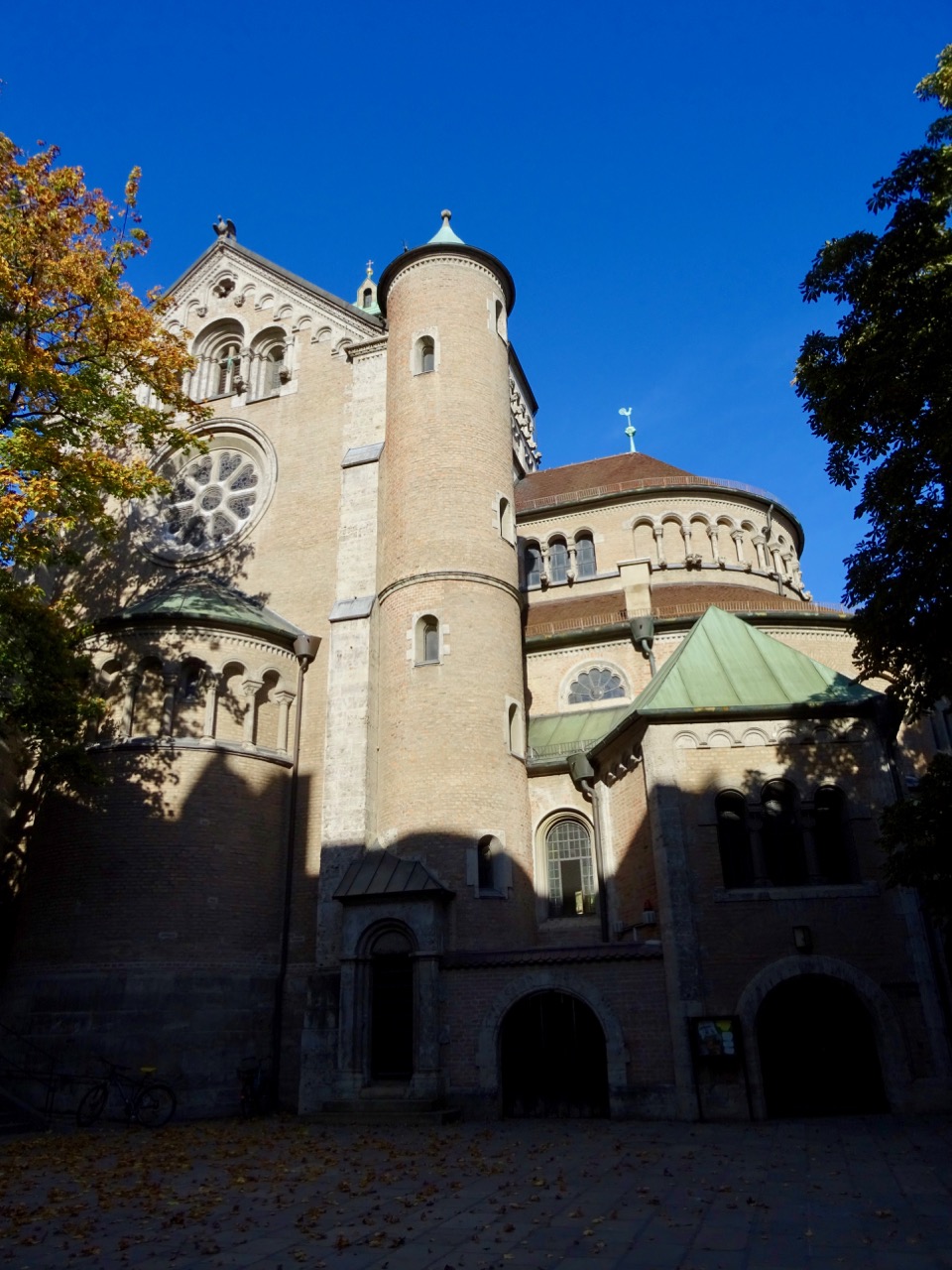 It is only one euro admission to the Bavarian National Museum on Sundays. The first rooms we enter have incredibly beautiful wooden sculptures, many of which still have their original painted colouring. The sculpture of Christ is from 1200, the Apostles are from 1505, and the woman with children is from1300. All the pieces are in amazing condition…it is hard to believe that they can be this old.
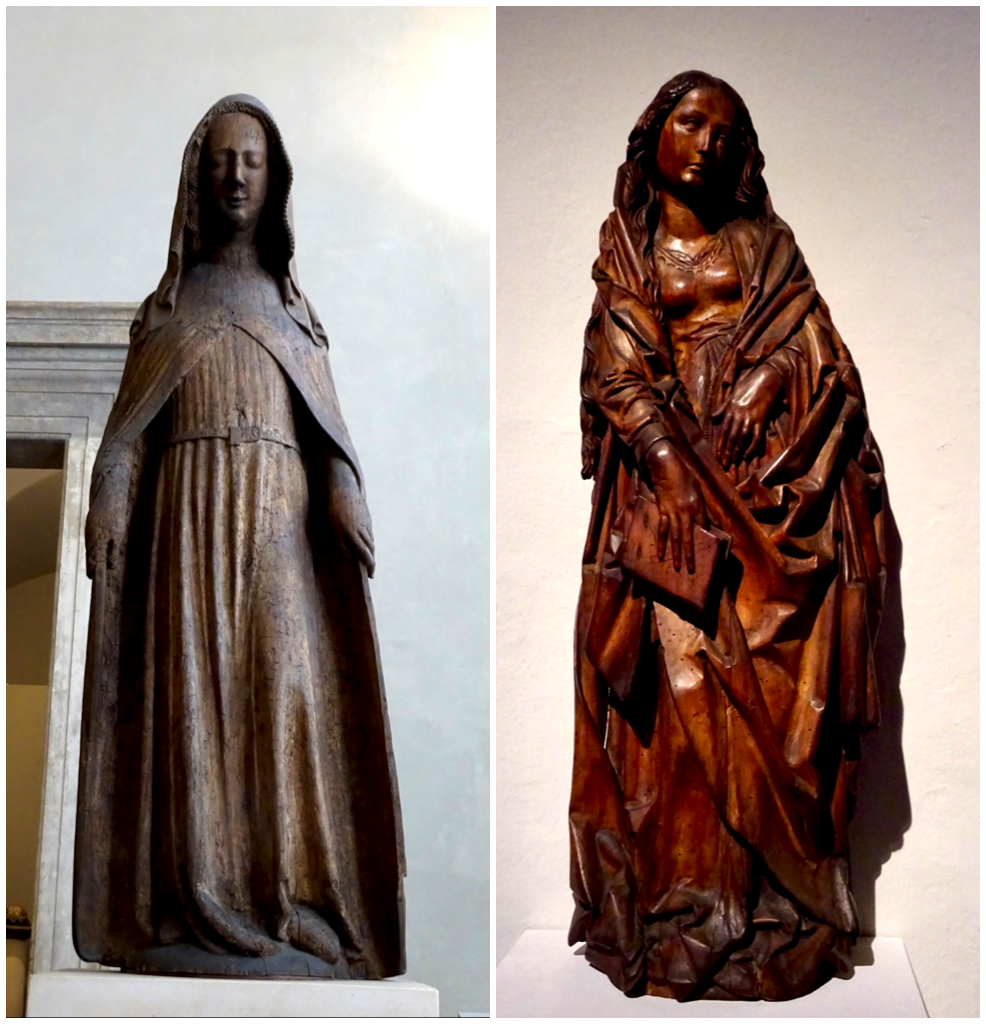
 These were two of my favourite pieces. The Mary on the left is from1300 and is larger than life size, while the second Virgin Mary is from 1500. Notice how her finger marks her place in the book she was reading when she is surprised by the angel. She is much smaller, probably about 30 ” tall. They were both exquisite.
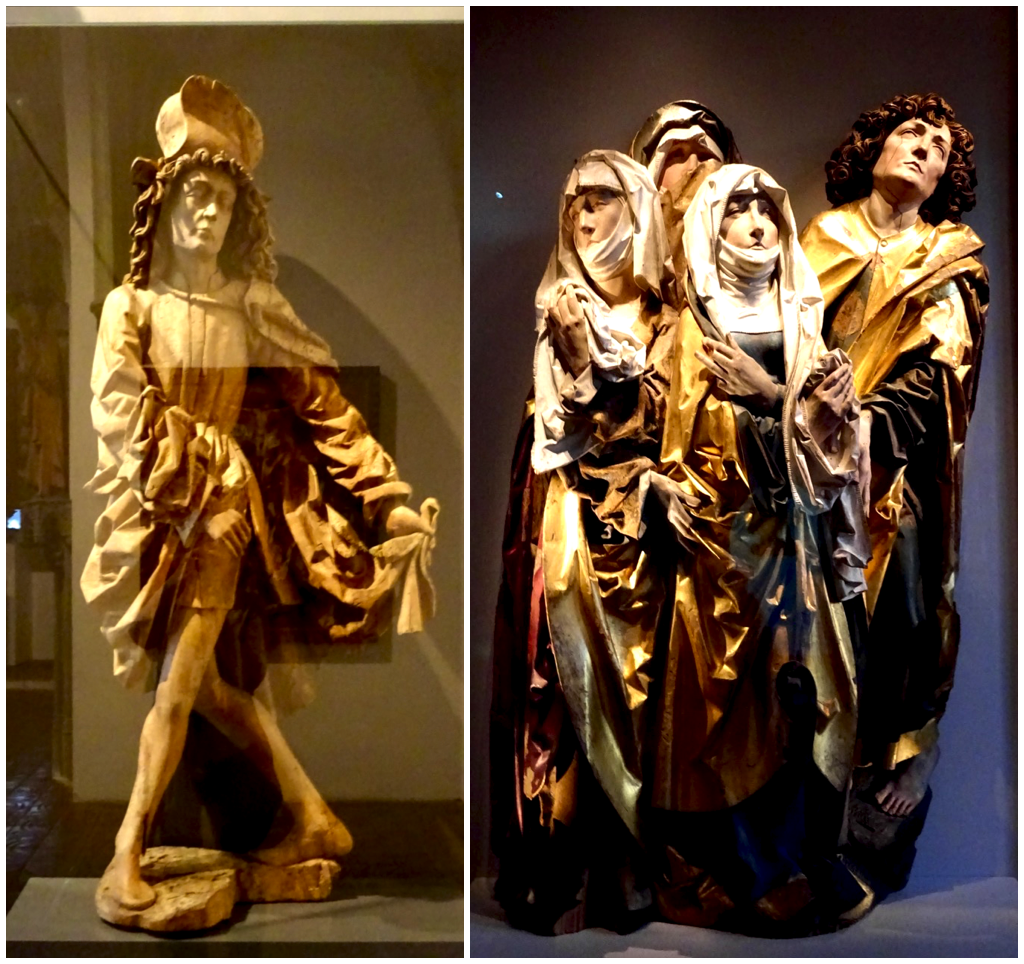
 This dancing fellow from 1490, is exceptionally animated for such an early carving. The detail of the hands and drapery in the group of figures was so beautifully done. I have a heck of a time drawing drapery, and I can’t imagine how anyone can carve it so well.
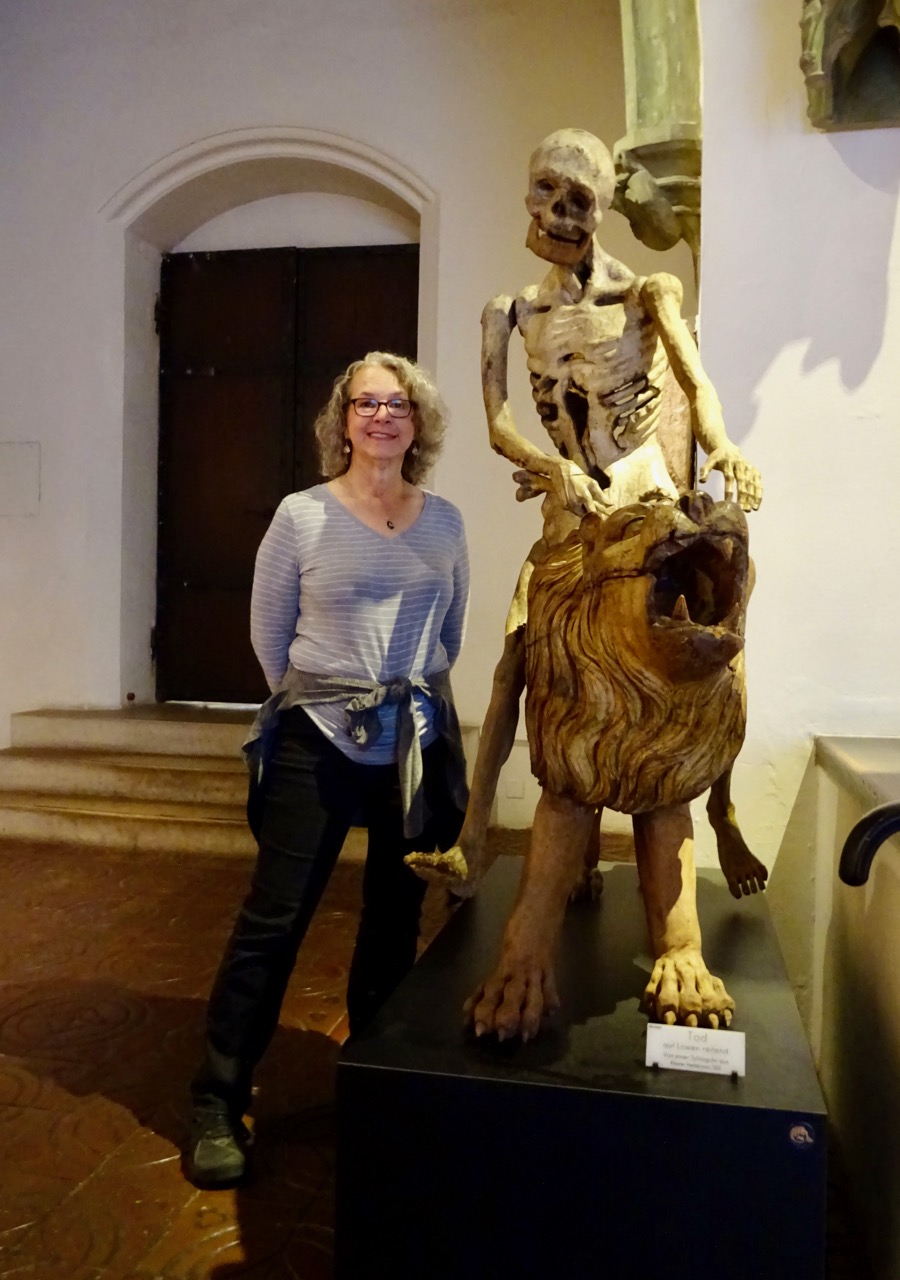
 We don’t know what this skeleton astride the lion is about but it was interesting. Unfortunately most of the signage is only in German,
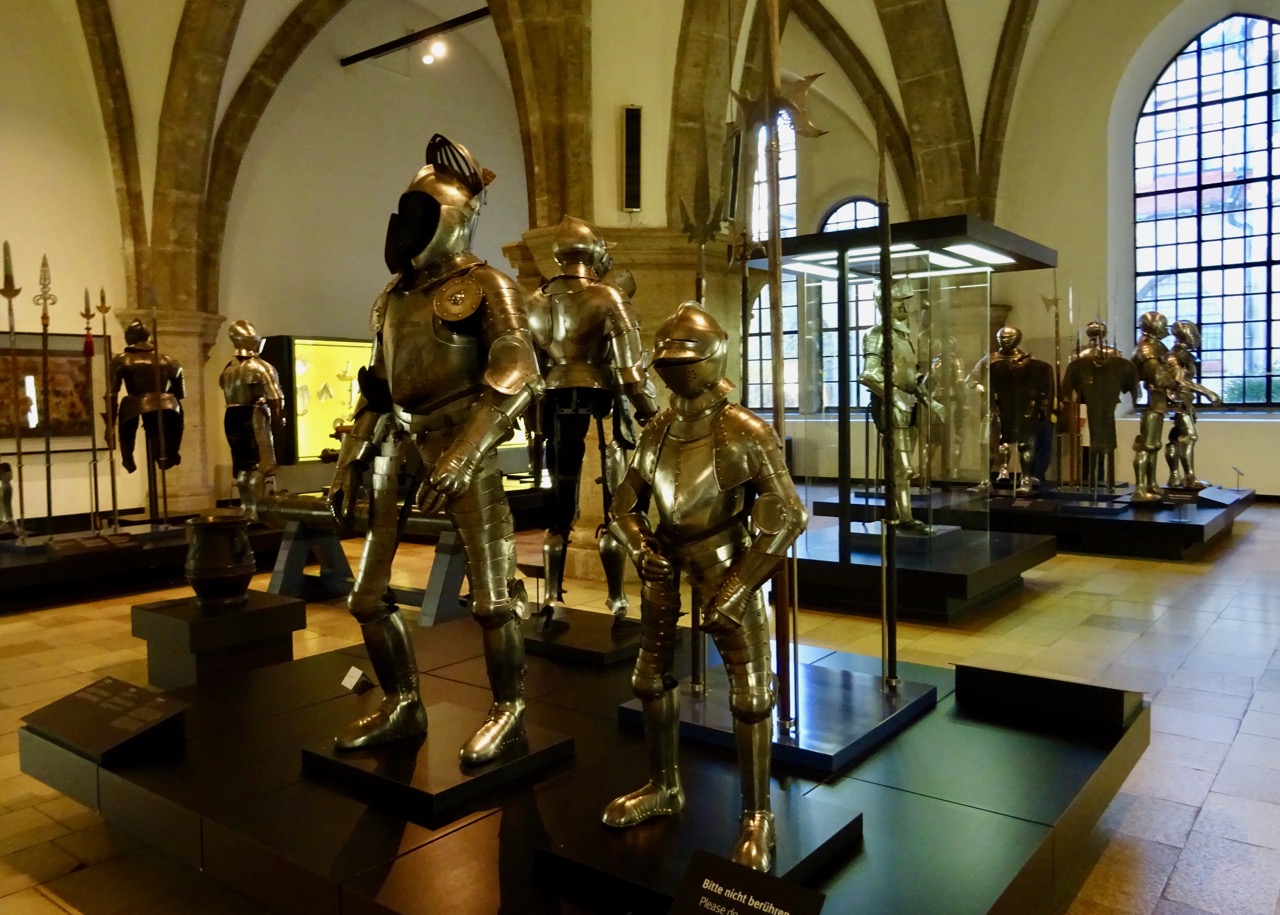
  There is a room full of armour…
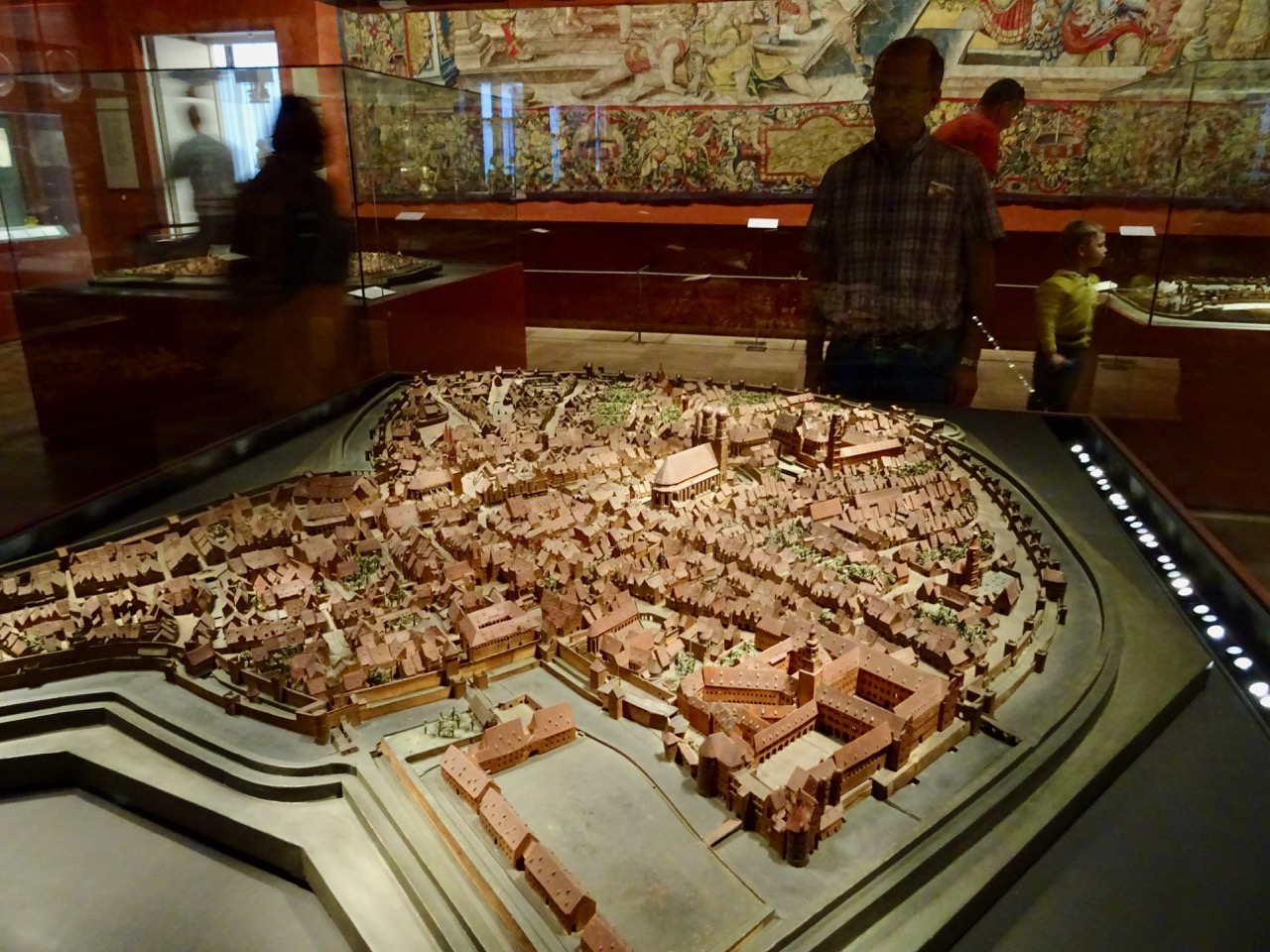
 and another room with models of many towns. This is Munich in 1580 and we are able to recognize some of the buildings that are still present in modern day Munich!
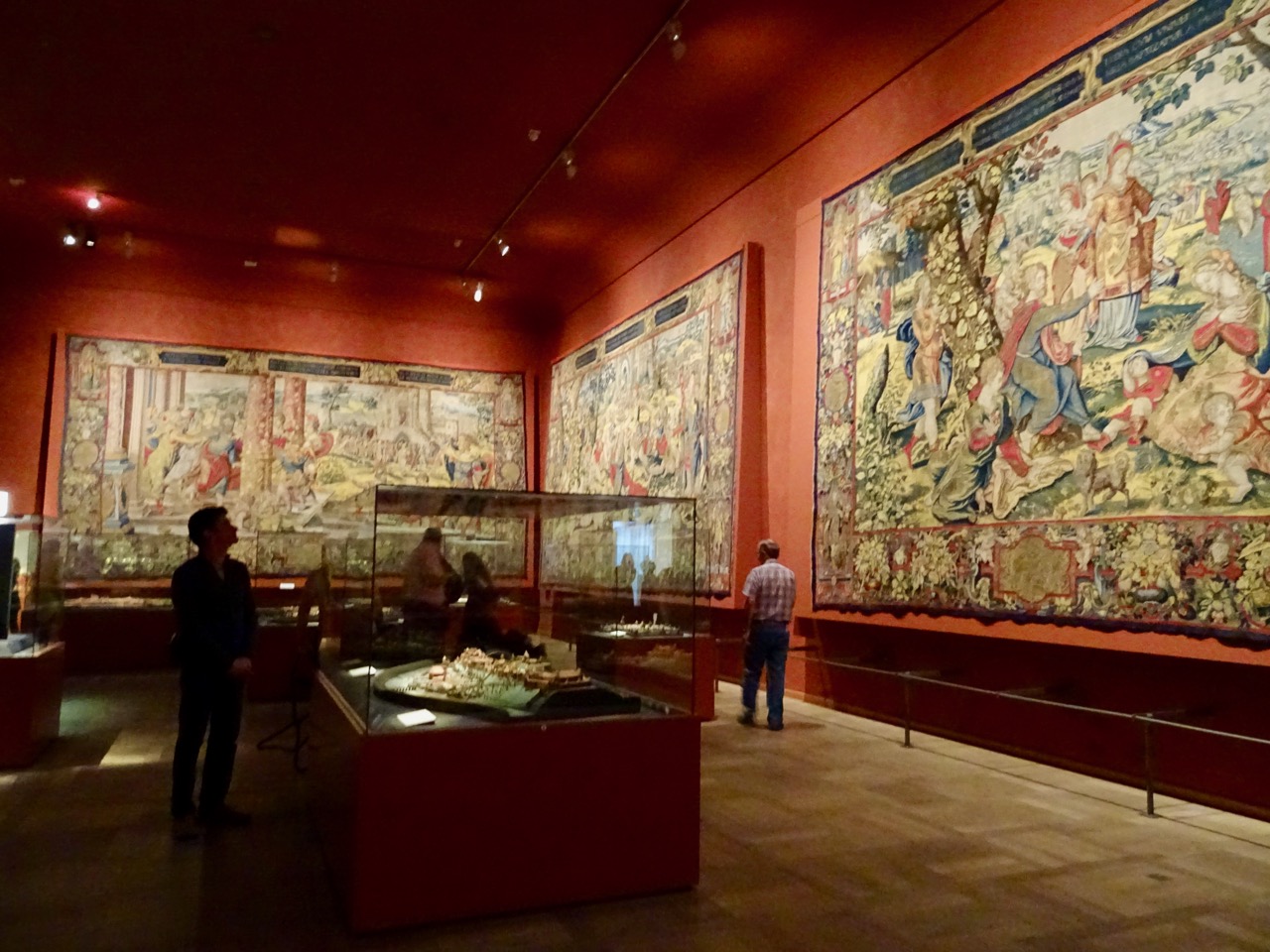
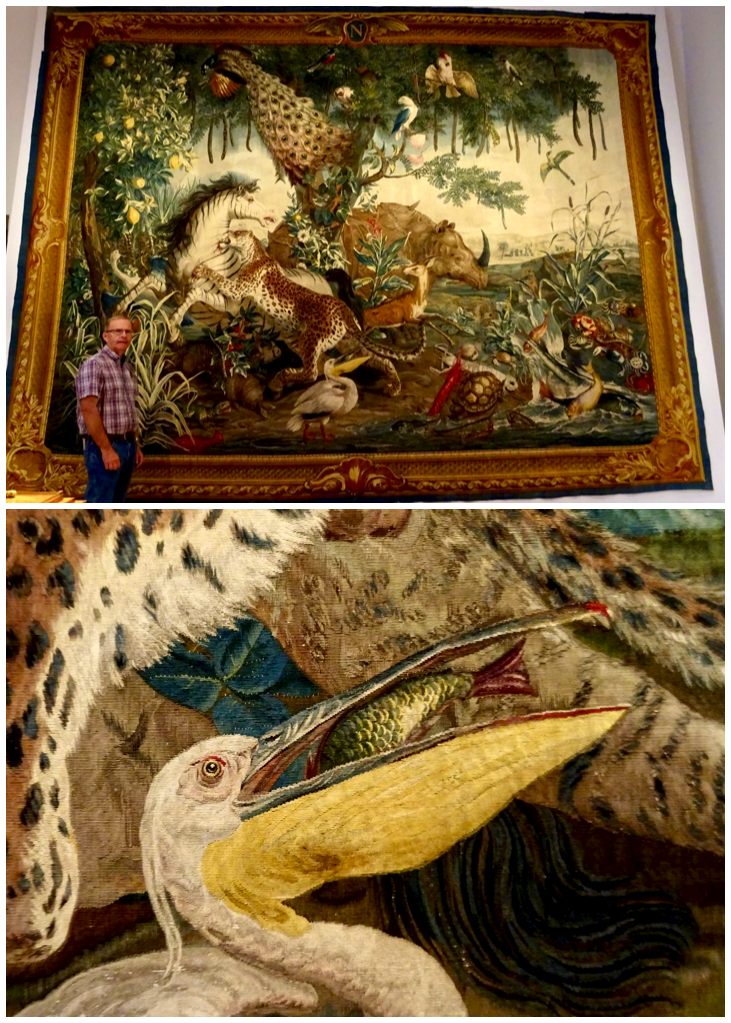
 There are enormous detailed tapestries on the wall. We are amazed at the excellent condition of these tapestries.
 This small panel from the mid 1500’s is only about 6″ tall and is made with intricately inlaid wood. It is incredibly detailed.
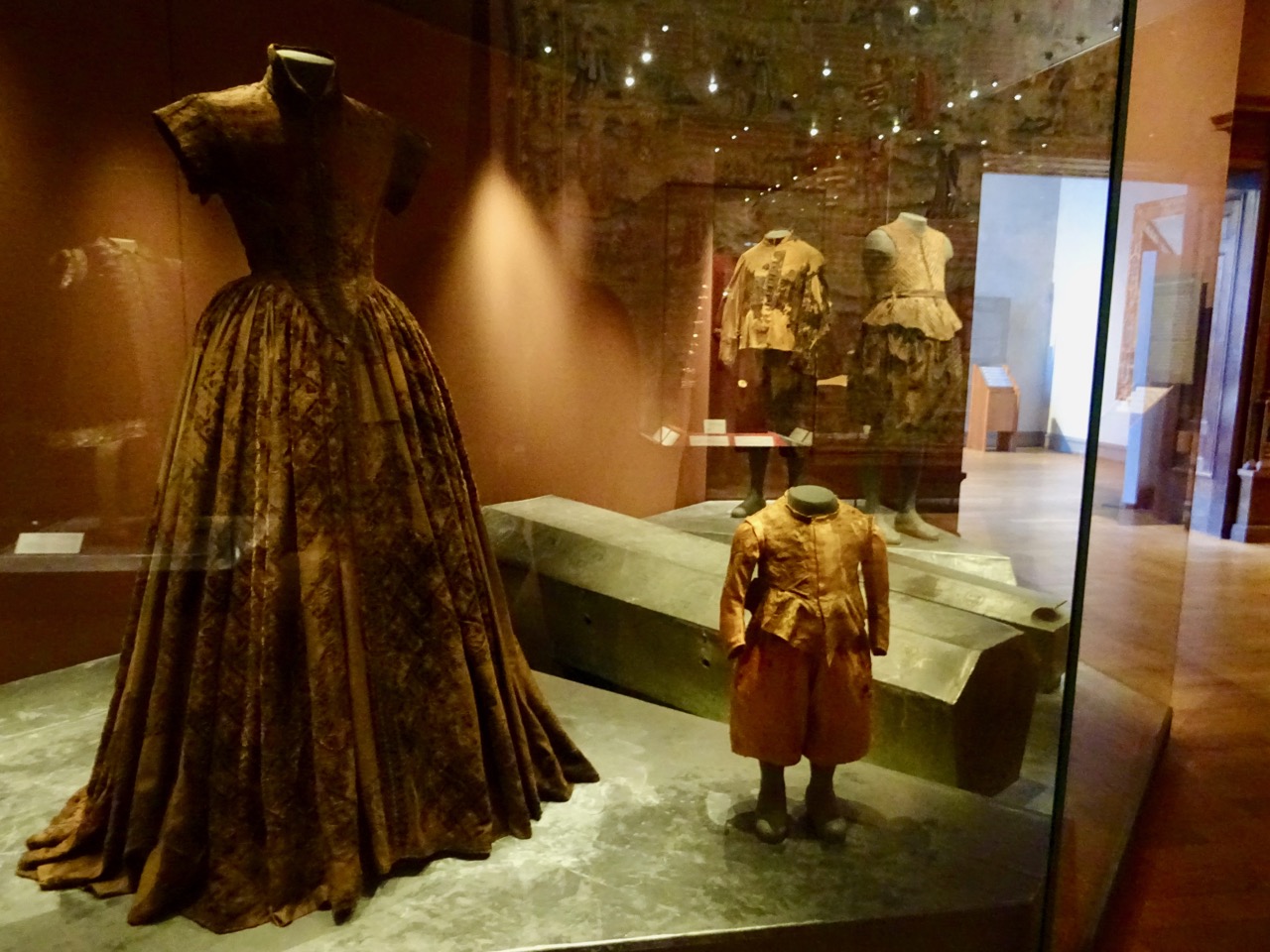
 The child’s outfit is from 1547 and the dress from 1630. I wonder how these have survived all these years. Their tiny hand sewn stitches are visible and there is some wear and tear but they are really very well preserved.
 The next room is filled with amazing cabinets. I love boxes and cabinets with lots of drawers, and I have never seen anything like these. The coin cabinet of Maximillian I was made for his collection of gold coins. Each of the rows is a shallow drawer with fitted spaces for the coins. It is made of ivory, lapis lazuli, silver and enamel, so of course it must have its own storage case! The case on the right hinges open in the middle so the cabinet can be inserted for safe keeping.
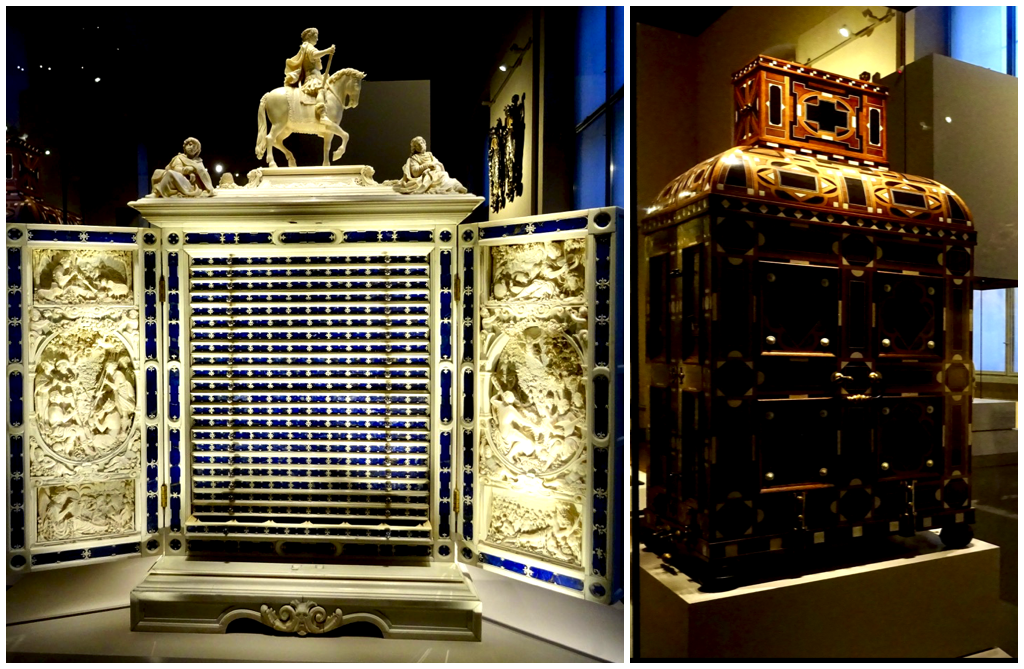 This cabinet was built for the Electress Maria Ana. The ivory cabinet is gorgeous with lapis lazuli panels, but then I walk around to the other side and it is even more beautiful, with silver and enamelling. This cabinet has 176 drawers and secret compartments for storing precious objects! Wow!
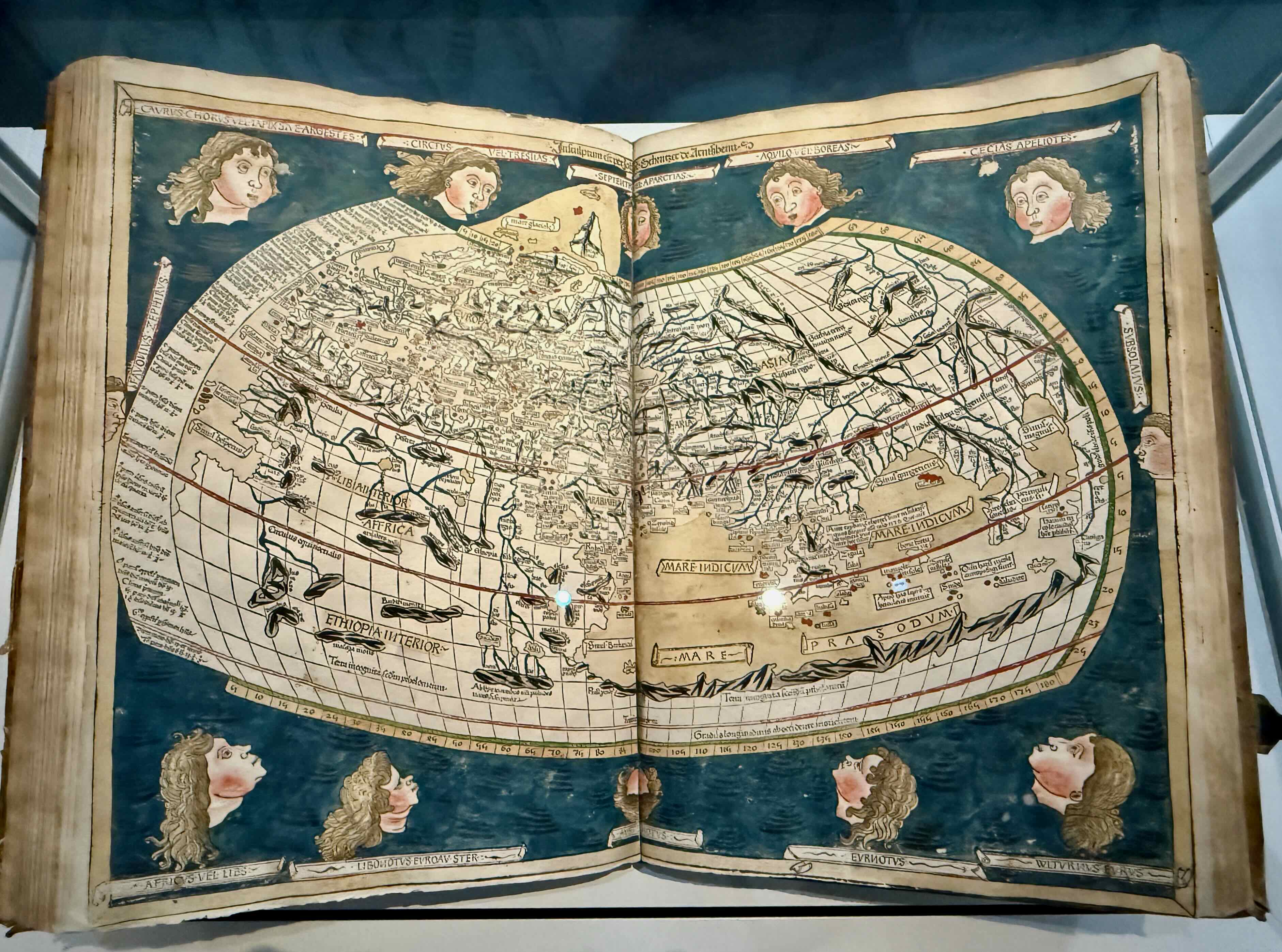
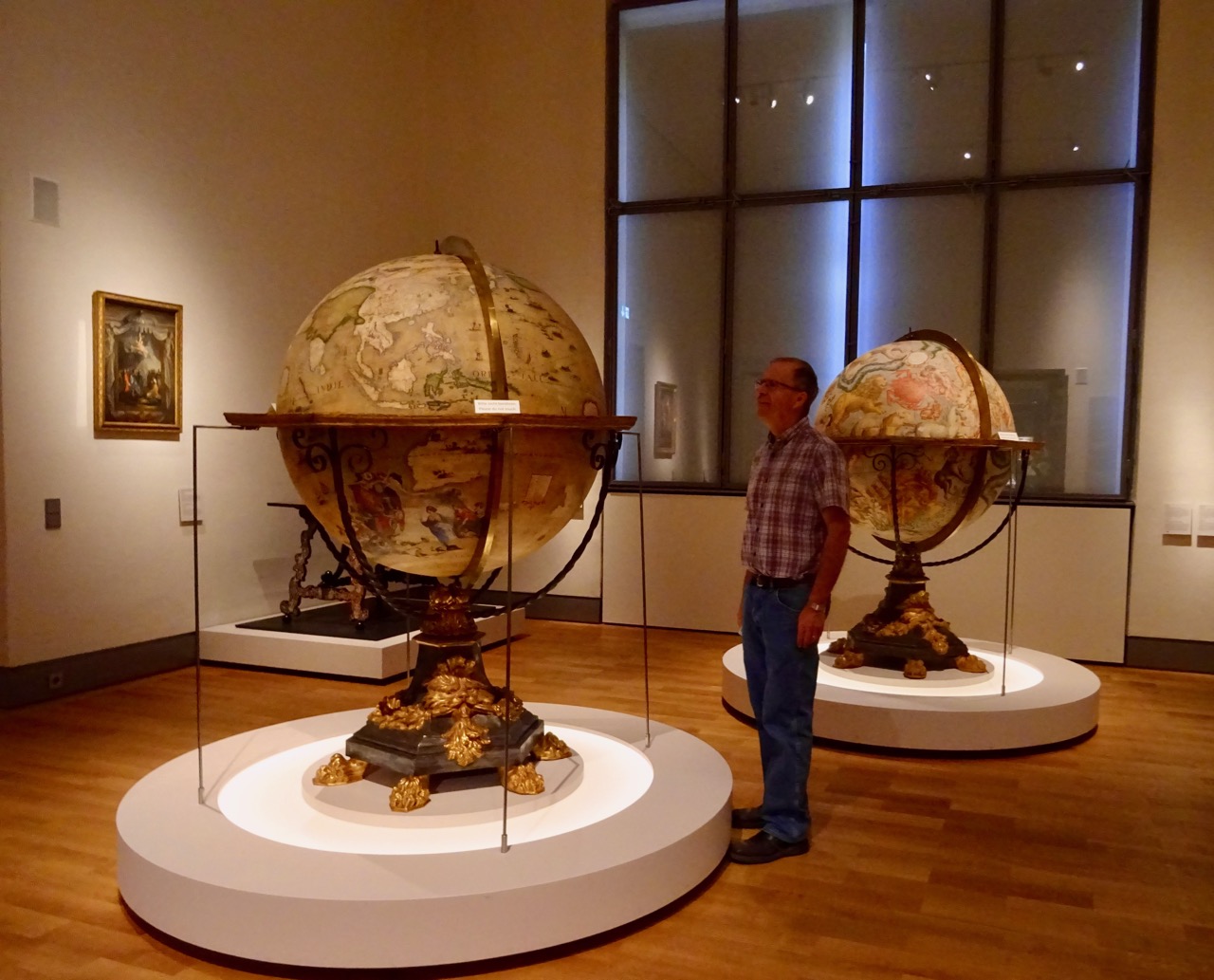
 These huge globes were interesting..
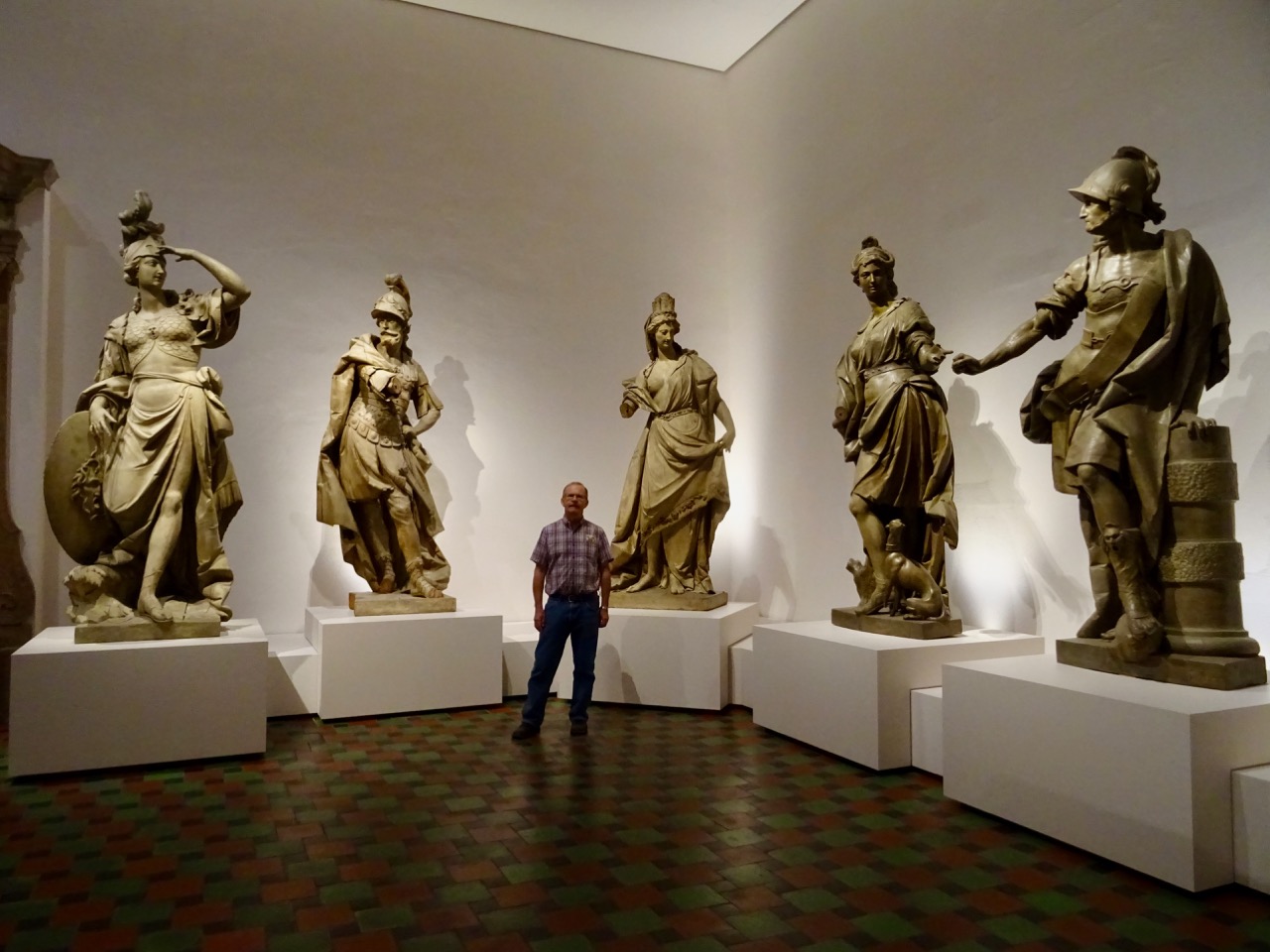
 and then we walked into the next room with these monumental wooden figures!
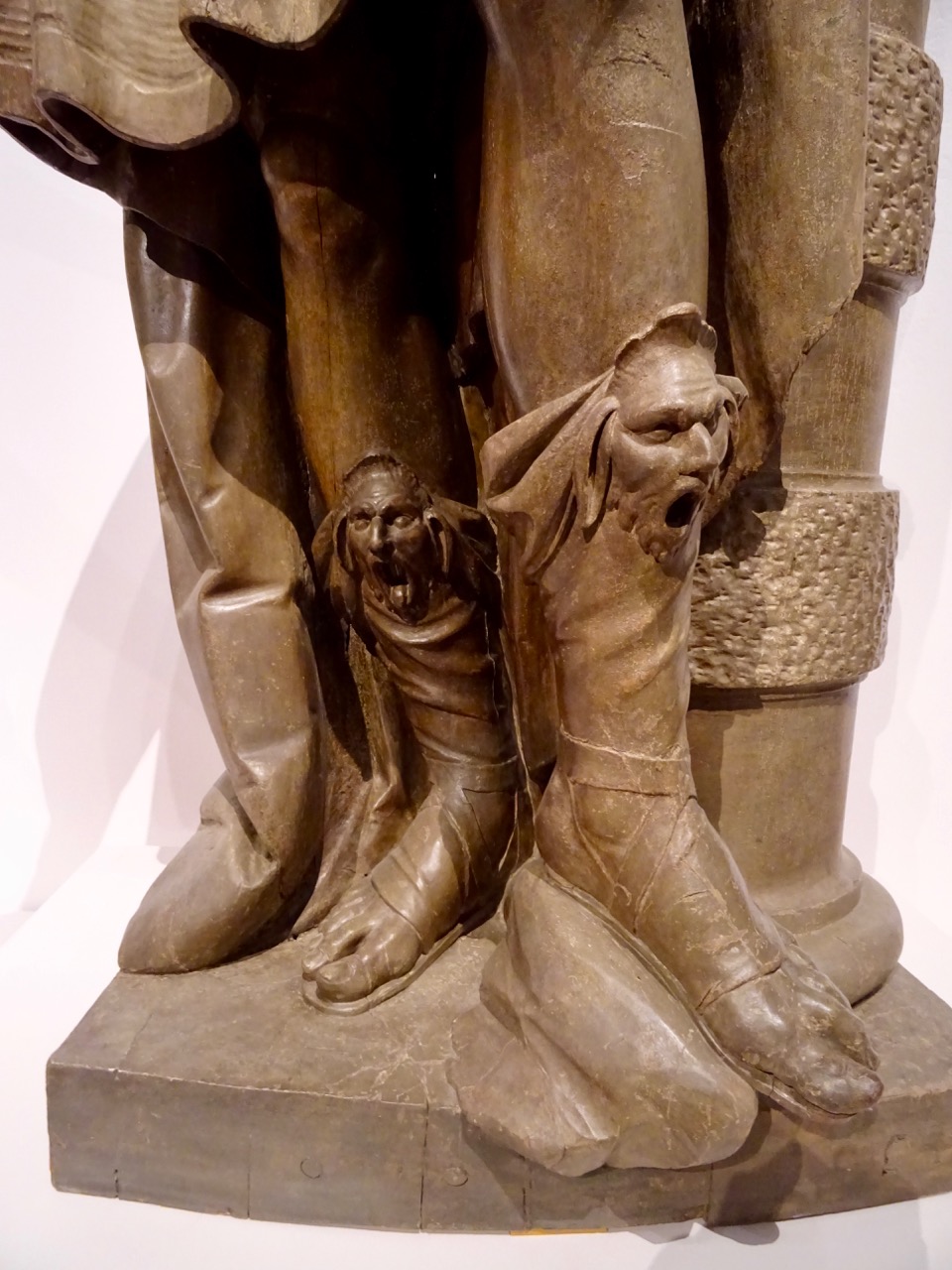
 Don’t you love the faces on these sandals?
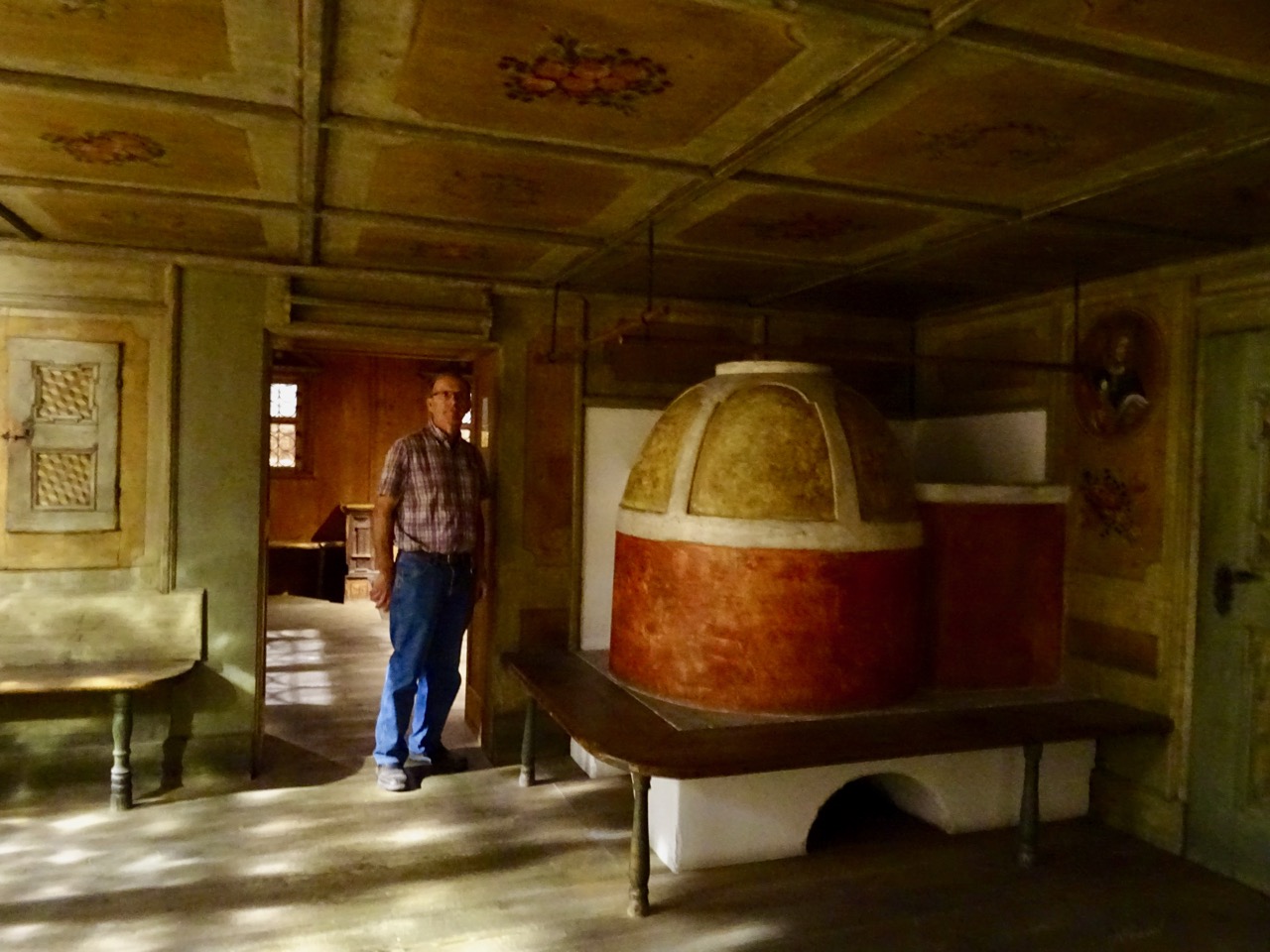
 Downstairs there are several rooms that appear to be taverns. We aren’t sure, because all the signage here is German. I think the domed object in the corner is a stove to heat the room.
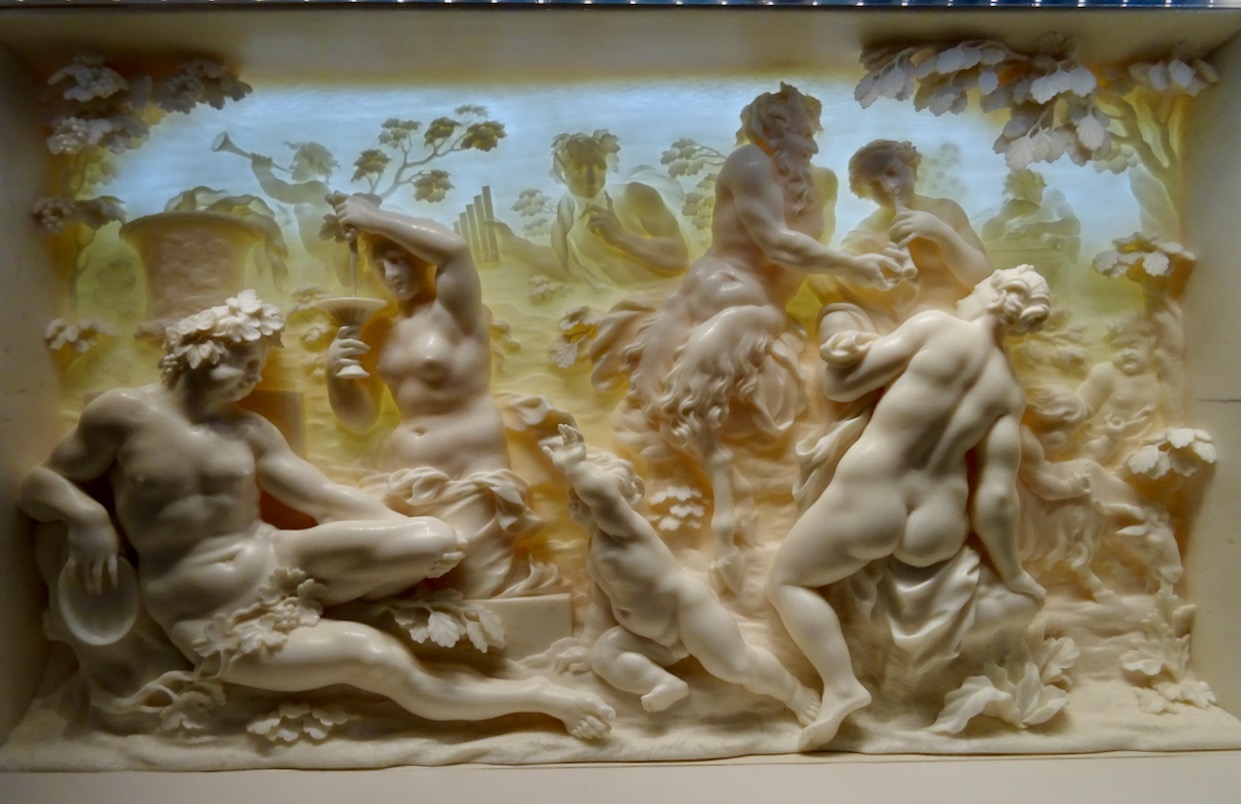
 Back upstairs, there is gallery of about 1,000 ivory objects and I wonder how many elephants died so these could be created? This ivory carving was one of fifty or so. The background sky is so thin that the light shines through it.
 The Rape of Proserpina on the left is carved in ivory, and the porcelain centrepiece on the right depicts Neptune being drawn by seahorse and tritons. They were both completed in the mid 1700’s.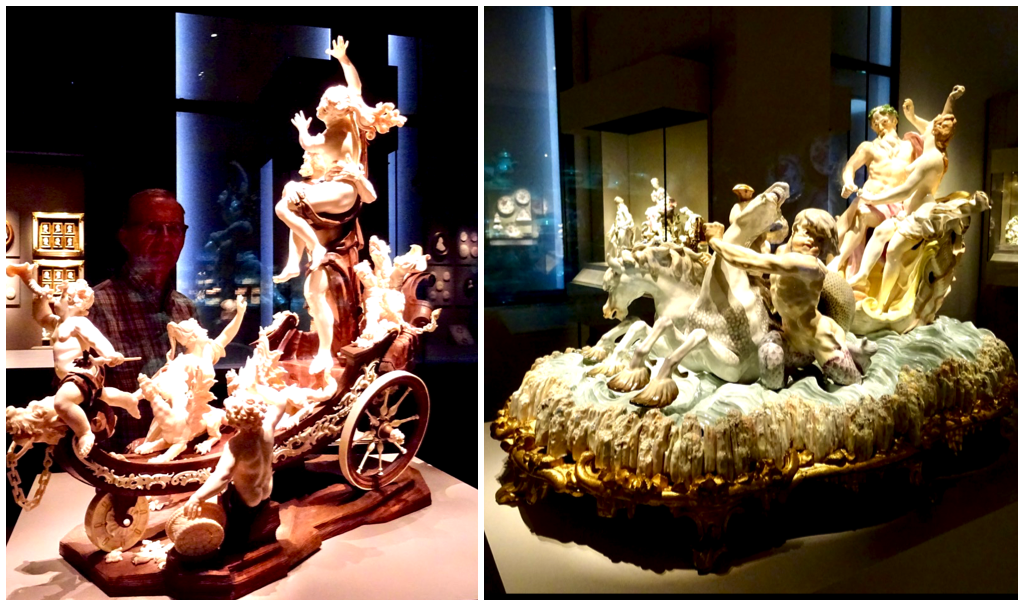
 I thought this tapestry was particularly colourful and beautiful. Notice the details in the close up of the pelican.
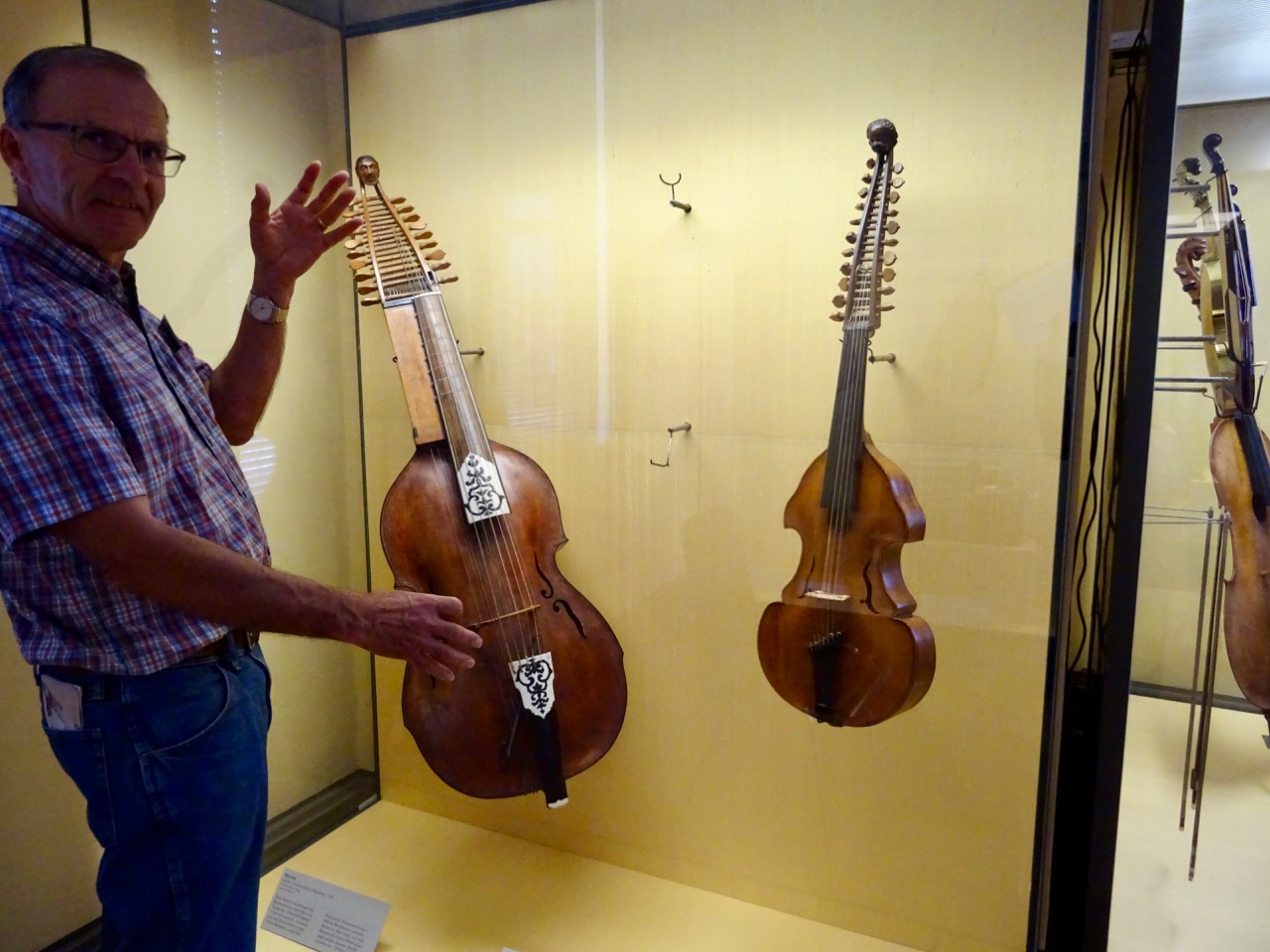
 Some of the musical instruments on display are rather strange. Bob is wondering how to play the double layer of 19 strings on this one…
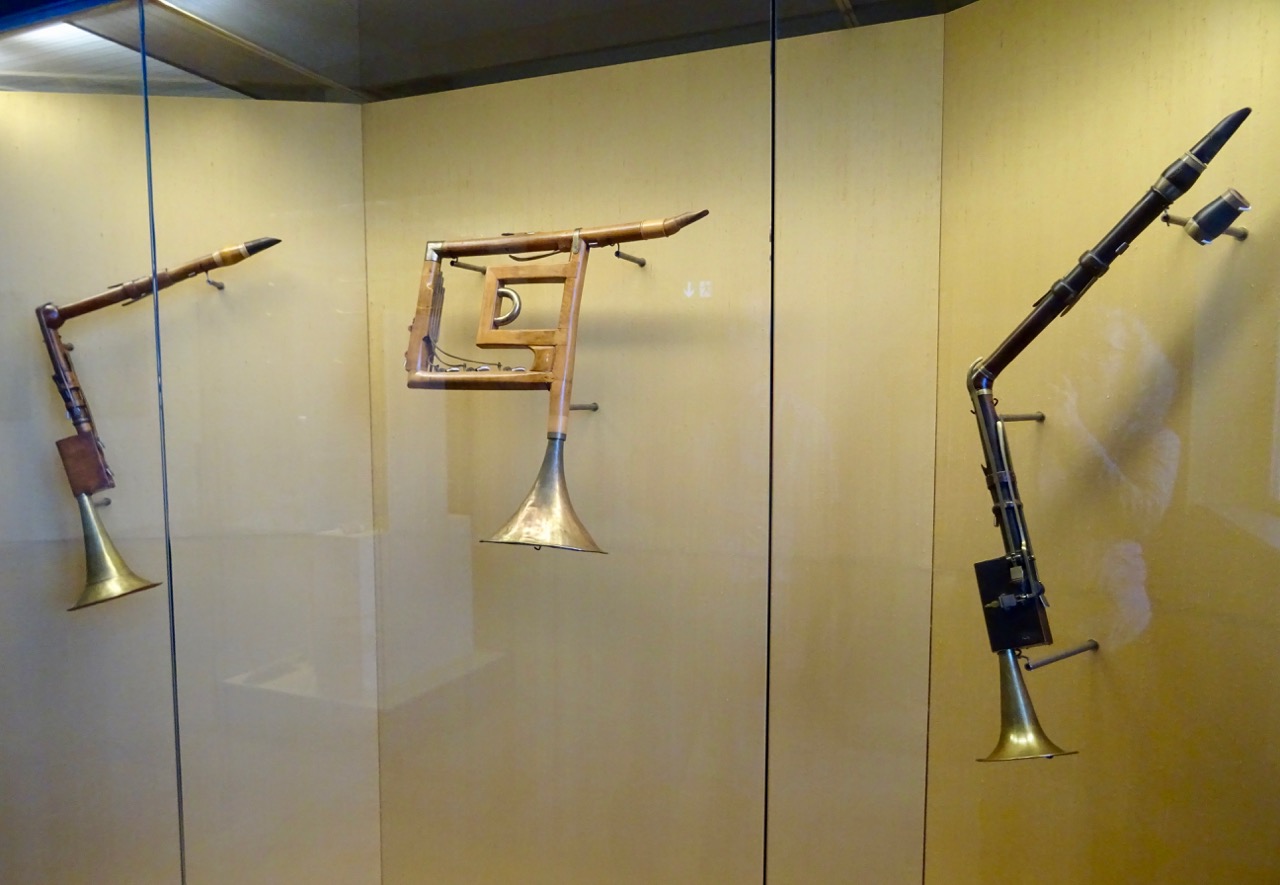
  and check out the crazy wind instruments.
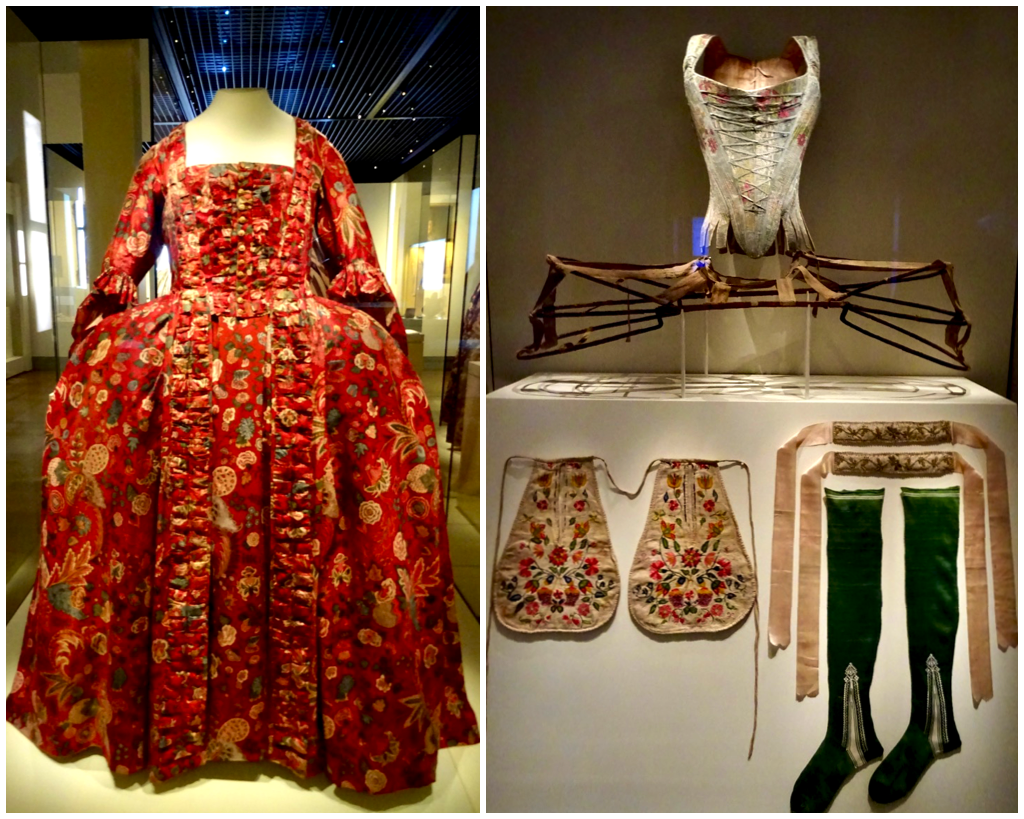
 There is a wonderful display of clothing from the mid 18th century. Even the pet monkey had stylish togs.
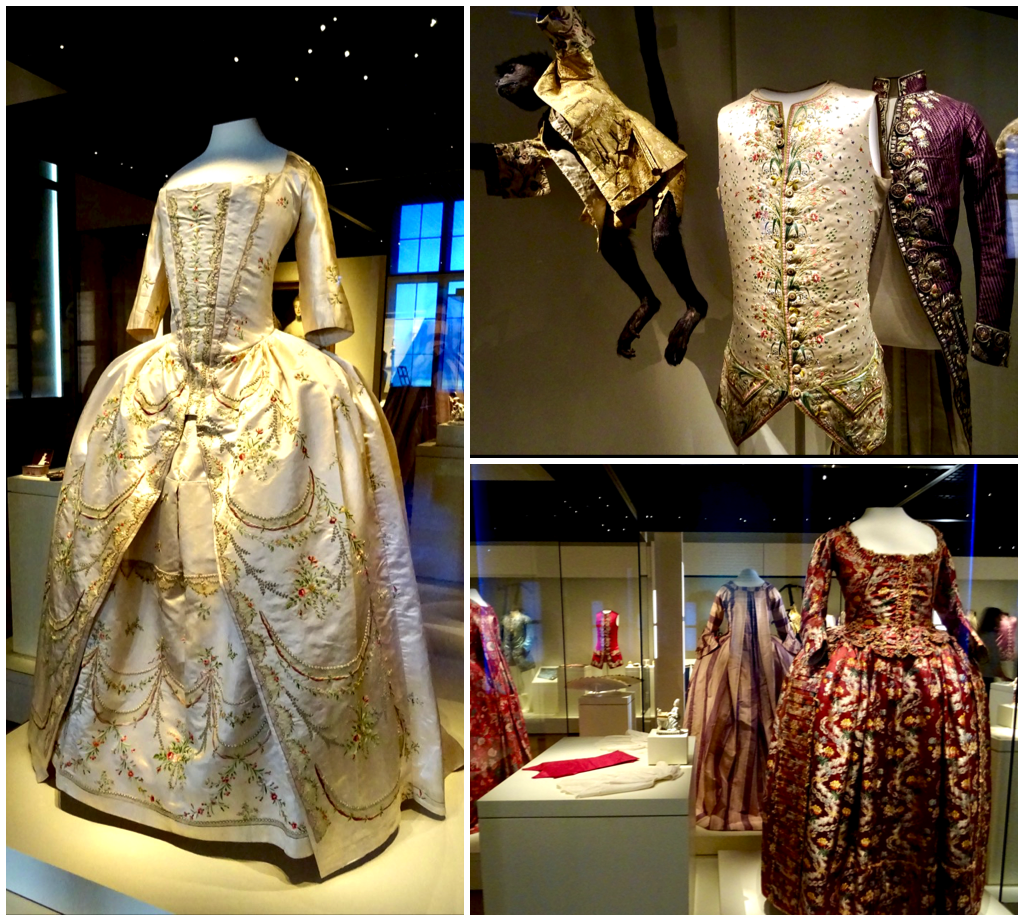 But take a look at the undergarments women wore!
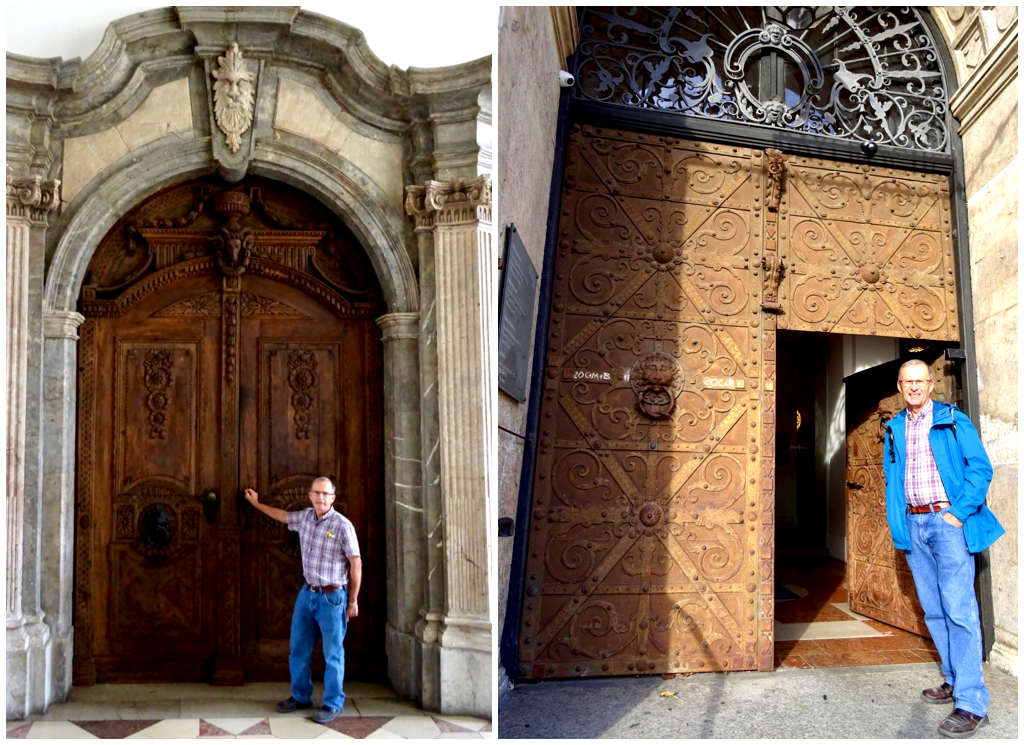
  I love doors and this museum has many. The front door opens automatically when we approach. Seems weird for such an ancient door.
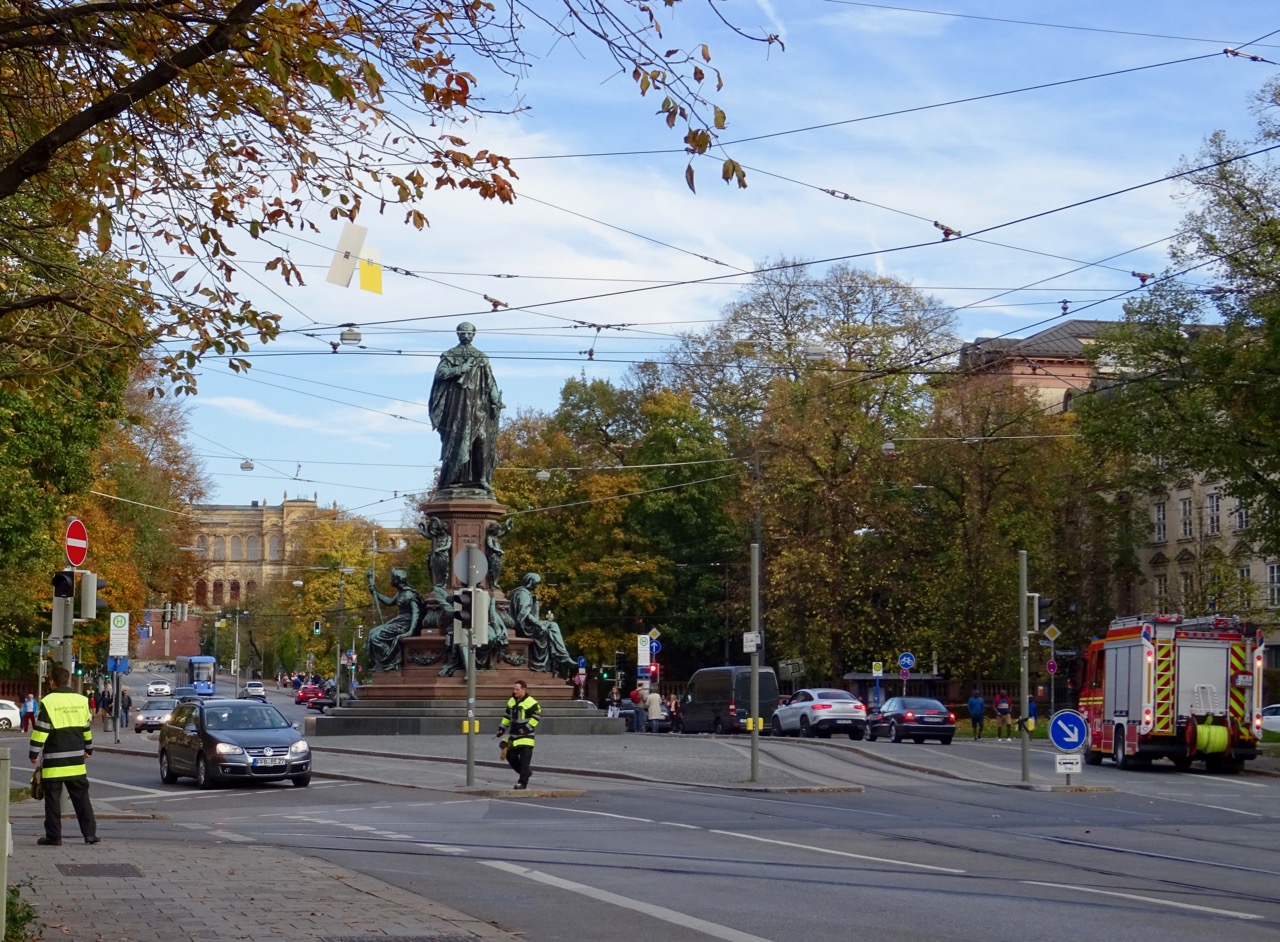
 We walk along the river on our way to Maximillianstrasse, where all the fancy expensive shops are located.
 On the way, a firetruck pulls up and the firemen check behind bushes and in garbage cans, then drive away. We wonder what they are looking for.
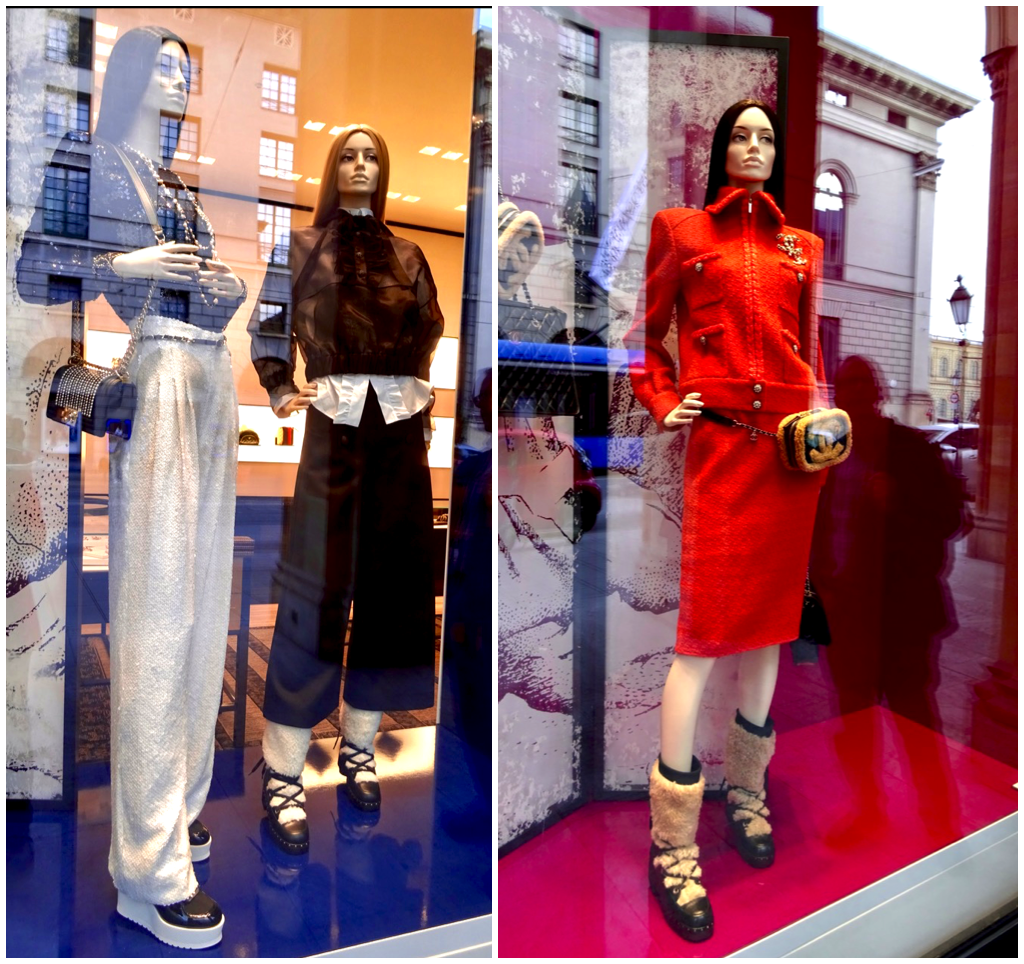
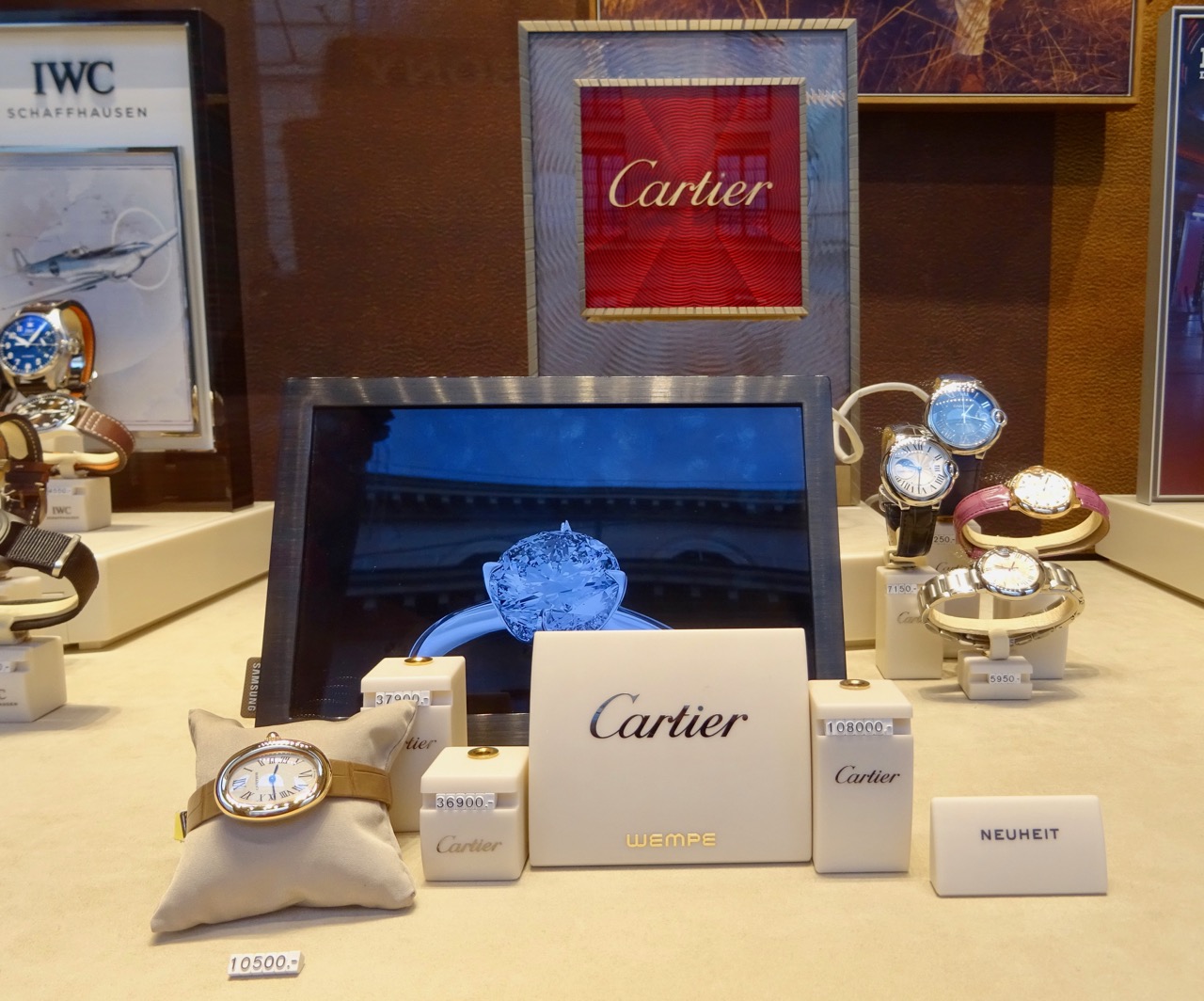
 We window shop where the wealthy people shop! The two outfits on the left are only 42,400.00 euros! The red outfit is only 26,300 euros! At today’s exchange rate that is over $100,
 The stores are closed so they only leave the ‘cheaper’ watches in the windows. Notice the empty stands for the more expensive ones.
 We pass more very loud, very energetic Chilean protesters on our way home.
 trudymason.com