Day 61, Saturday, October 28, 2023
Today we are going to visit another UNESCO World Heritage Site to see the oldest prehistoric cave paintings known to date in the world! The cave is an hour and a half drive from Nîmes, so we leave early. The drive to the caves is interesting as the countryside is constantly changing.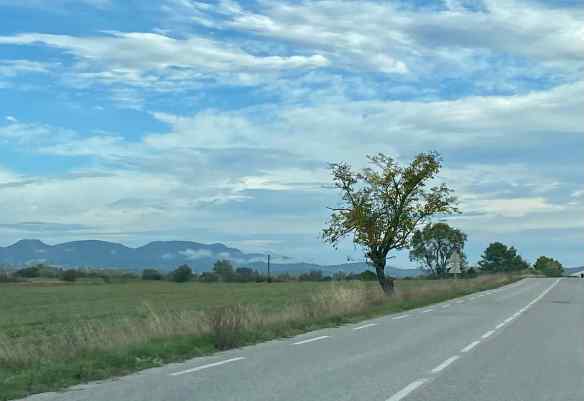 The Sycamore/ Plane trees are starting to show their fall colours.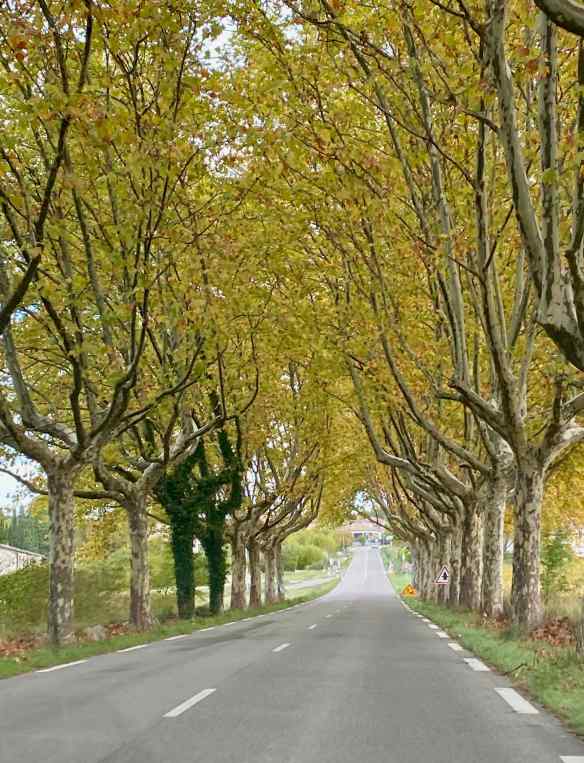
As we drove into the hills it got foggy…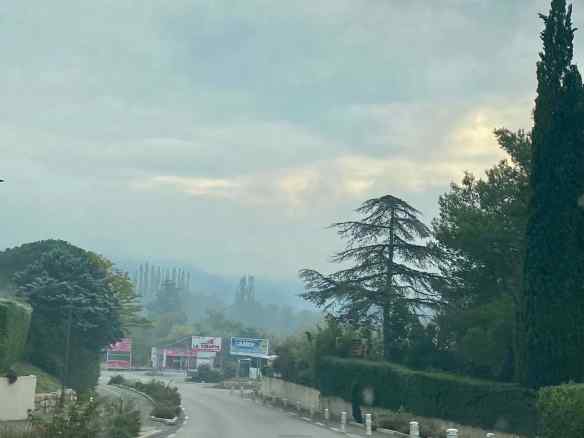
and we were soon below the clouds.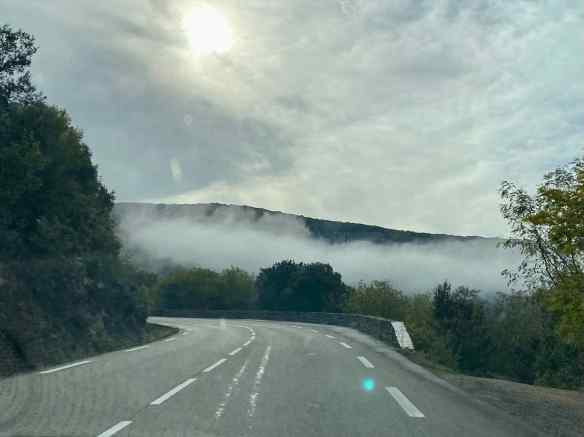
The Chauvet cave, or Caverne du Pont d’Arc contains exceptionally high-quality paintings dating back 36,000 years. It was discovered in 1994 and has never been open to the public. Only a very small number of scientists are allowed to visit each year to study the Chauvet cave. The lessons learned at the Lascaux caves helped prevent any damage being done to the amazing art discovered in the Chauvet Cave.
Construction on the replica cave began in October 2012 and it was opened to the public in 2015. Chauvet II is located 9.5 km from the original cave.
All the photos of the building and the inside of Chauvert II, Caverne du Pont d’Arc are by Patrick Aventurier and can be found on the Chauvet II website. https://en.grottechauvet2ardeche.com/history/
An arial view of Chauvet II.
The building that holds the replica cave. It has a viewing platform on the top of the building.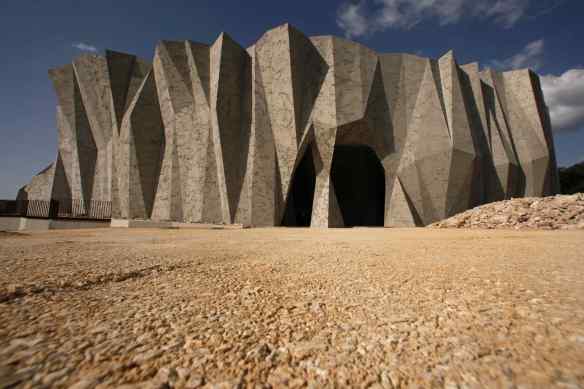 This is the view from the top of the building.
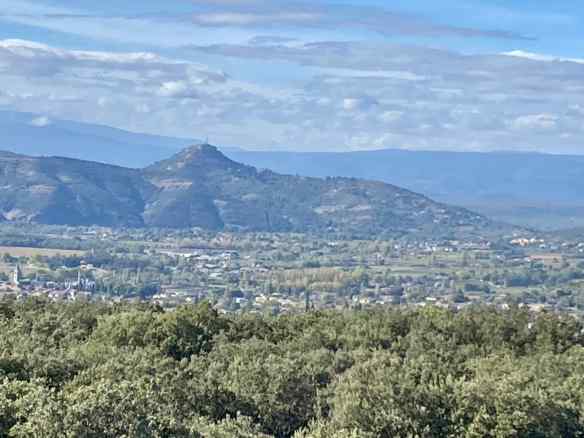 We have time to watch an immersive sound and light experience called ANIMAL before our cave tour begins.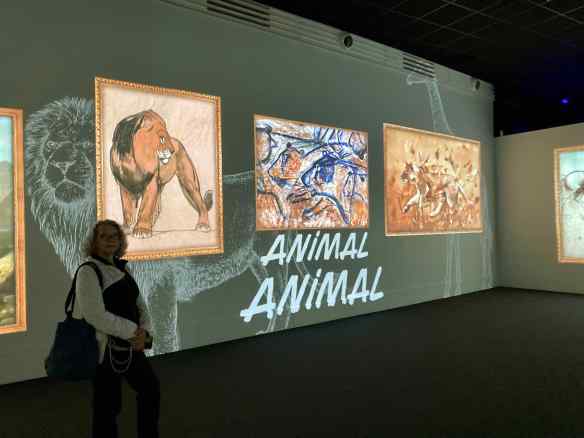
Here are two videos I took during the show. I don’t know how to edit videos, but they are not long, one is just over 2 1/2 minutes and the other is 3 minutes long. It really was a spectacular show.
Before we enter the cave our guide asks us not to ask questions about the construction of the replica cave until after our tour, to help us feel as though we are in the real cave.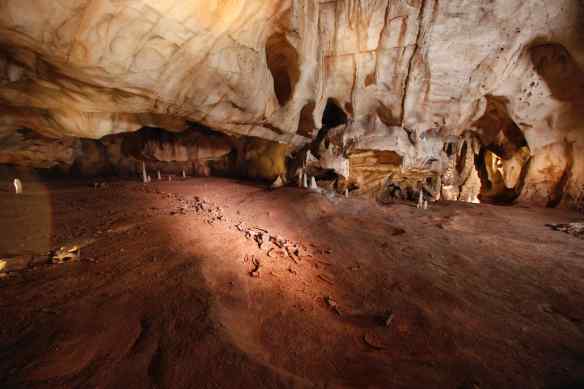
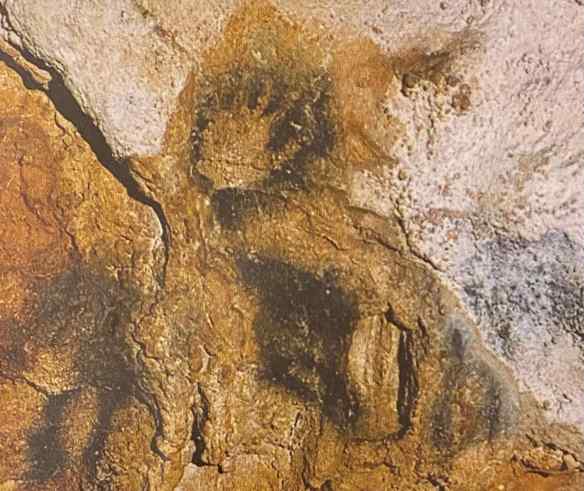
The Chauvet caves contain a masterpiece…the oldest known artwork in the world. They are over 36,000 years old…that is 18,000 years older than the Lascaux Cave we visited earlier. These handprints tell us that the right hand of the artist had a crooked little finger, perhaps it was broken at one time and didn’t heal properly?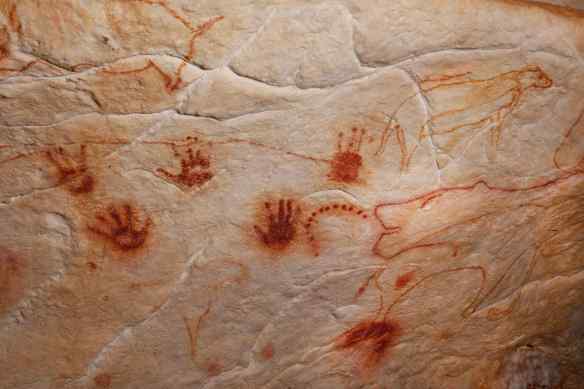
These red dots are palm prints. If you look closely you will see that there are a few prints that show the fingers and the little finger of the right hand is crooked. These palm prints were done by the same artist as the previous handprints!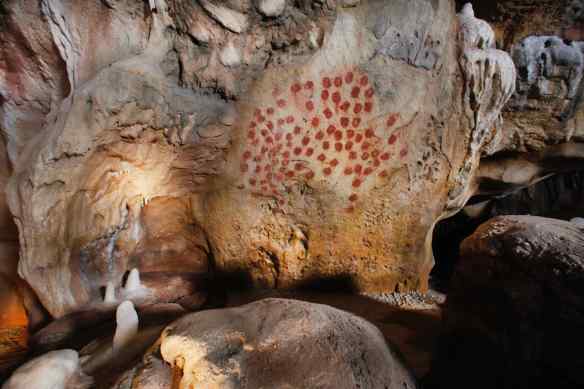
One of the first charcoal drawings that we see. Because charcoal was used the paintings were able to be carbon dated to determine their age.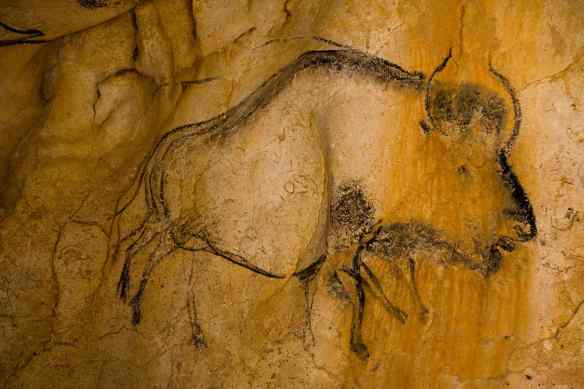
Some of the engravings were made by pressing into the soft mud walls of the cave with the artist’s fingers.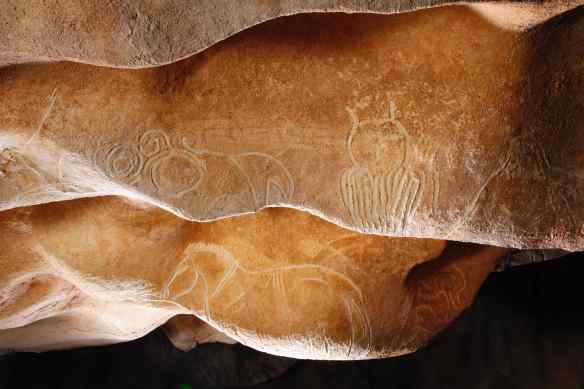 There are very few owl depictions in prehistoric cave art. We get to see one here.
As we walk further into the cave there are more animals on the walls. 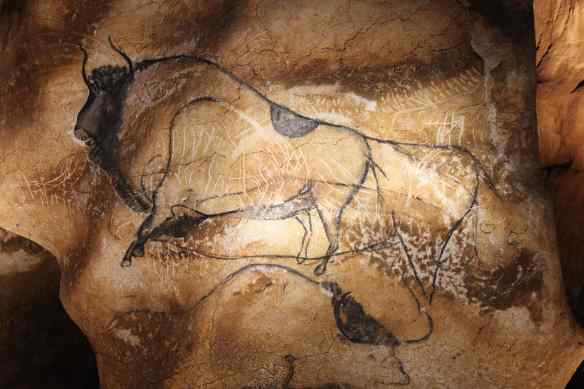
The next four photographs are all part of a panel showing the largest collection of animals in the cave and it was located in the very deepest part of the cave.
We are in front of the Lion Panel: a12 metre-long fresco of a lion hunt that takes my breath away! We stand in awe, as the flickering lights reveal these drawings.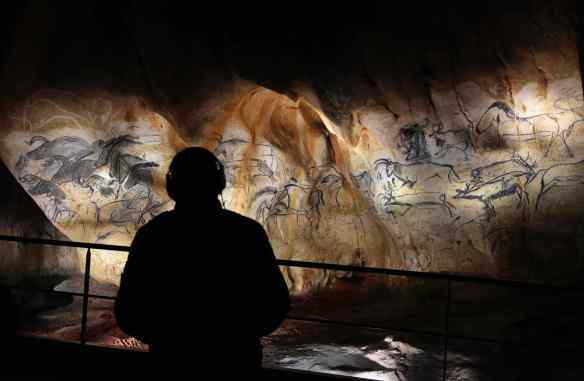
The lighting mimics flickering firelight and the animals almost appear to move.
Of course the lighting is set on a timer and all too soon it is finished. I tell our guide that our time here is too short and I don’t want to leave… she asks if we would like a bonus viewing and when I say yes, she turns the lights on again. We all got an extra 20 minutes in front of these magnificent paintings!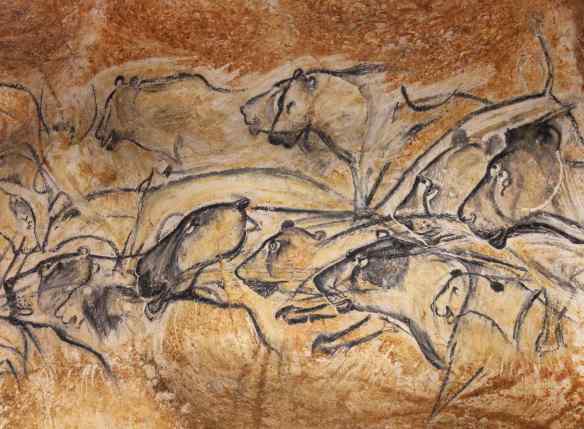
The Aurignacian Gallery is a complementary area to discover on our own after the cave visit. There are life size replicas of prehistoric animals. Wooly mammoths, Megaloceros , the huge deer in the background, …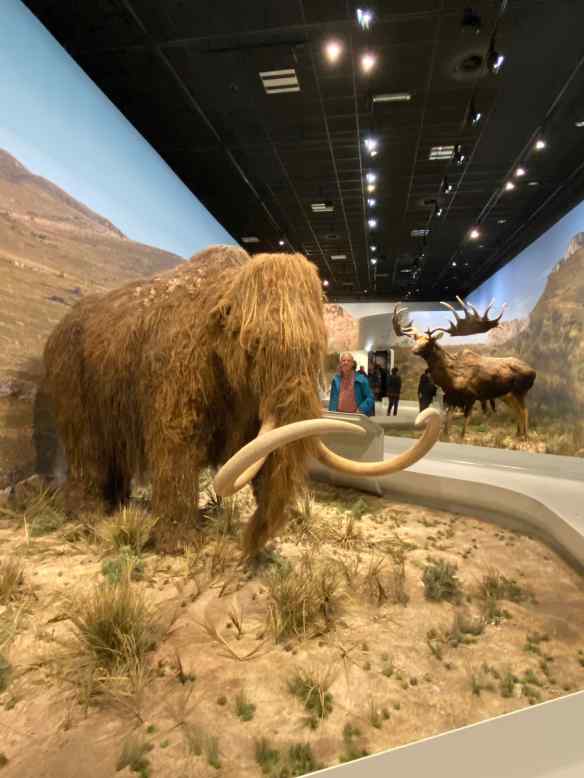
Aurochs…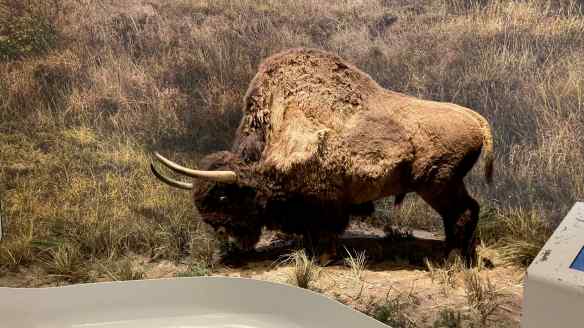
Cave Bears and Cave Lions…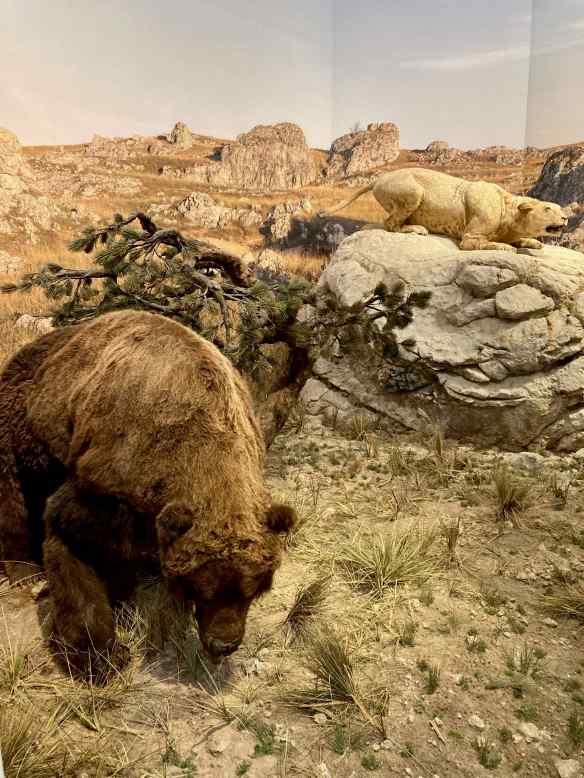 and Bob’s favourite, the Wooly Rhinoceros.
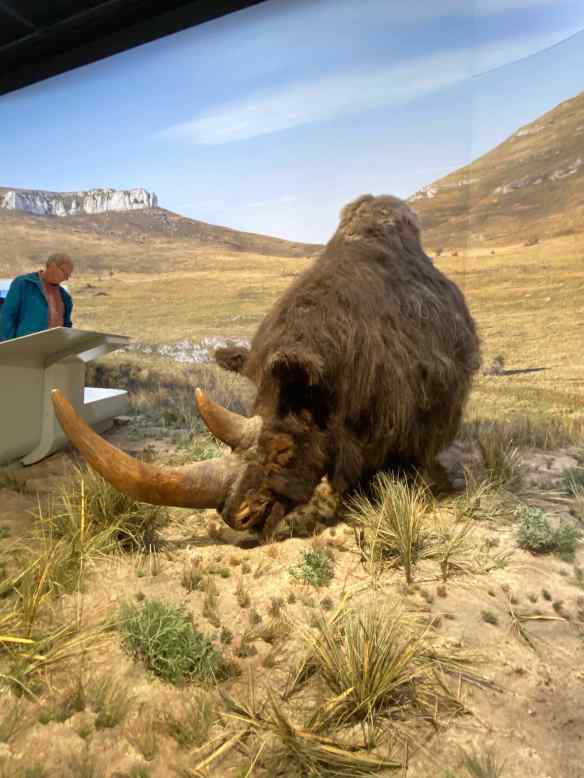
There are interesting interactive panels, including this photo of a baby wooly rhinoceros that was found in a mine in Russia in 2007…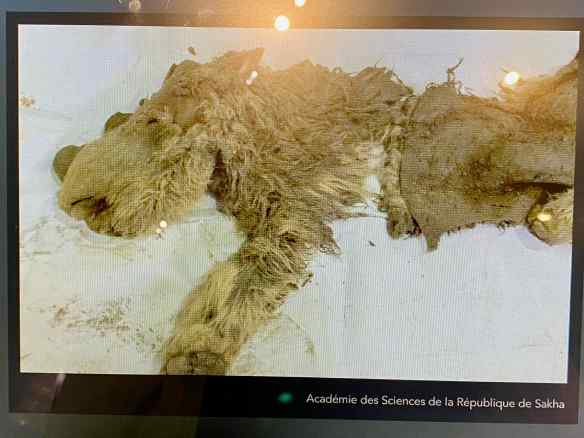
and one of this steppe bison found in Alaska in 1979.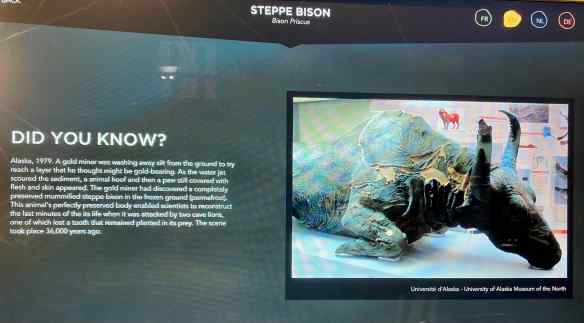
Something I didn’t know before this trip and all the caves we have visited is how like us Prehistoric Cro Magnons were. They were hunter gatherers and were anatomically very similar to modern man “but more robust, having larger brains, broader faces, more prominent brow ridges, and bigger teeth. They were well renowned for creating a diverse array of artistic works, including cave paintings, Venus figurines, perforated batons, animal figurines, and geometric patterns. They also wore decorative beads, and plant-fibre clothes dyed with various plant-based dyes. For music, they produced bone flutes and whistles, and possibly also bullroarers, rasps, drums, idiophones and other instruments. They buried their dead, though possibly only people who had achieved or were born into high status.” ~Wikipedia 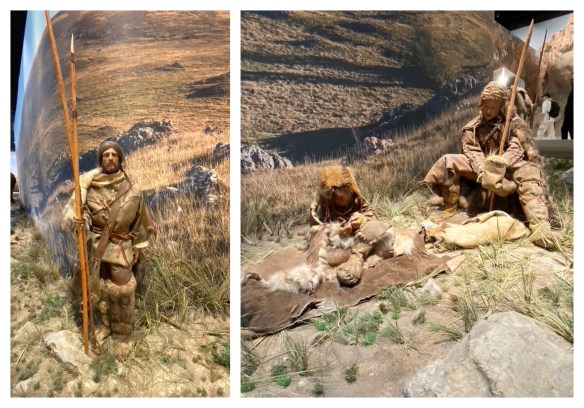
After our visit at Chauvet II we drive to the location of the original cave along this narrow road with lots of tunnels.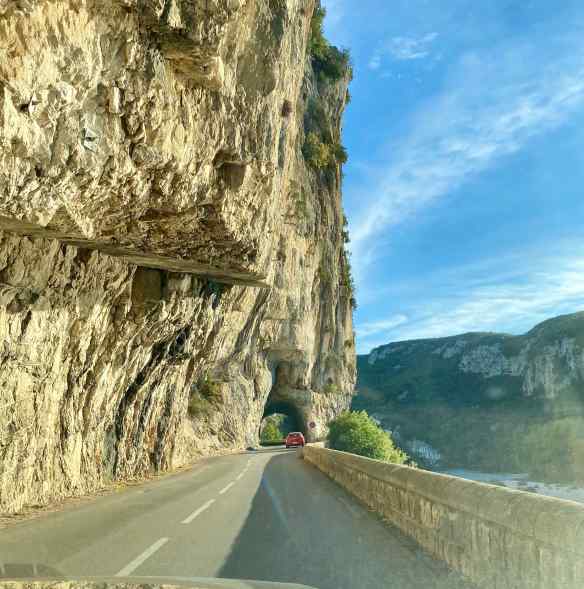
It was quite the experience.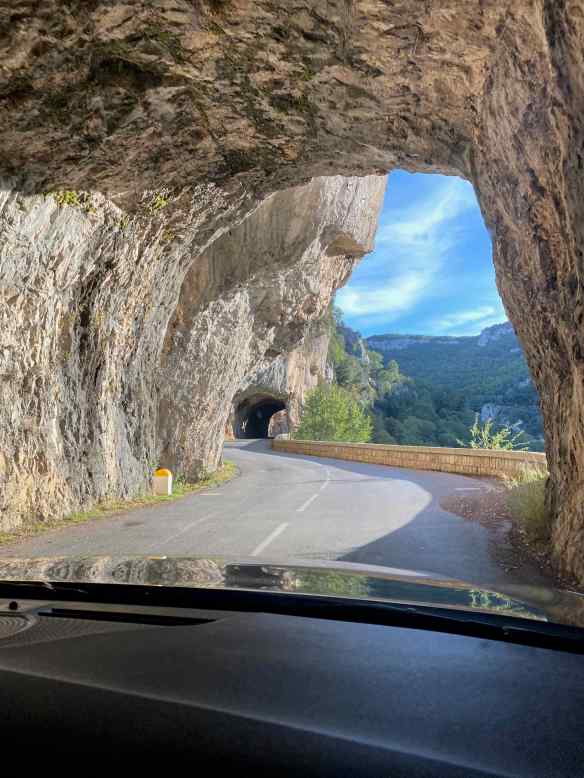
We park and this is our view.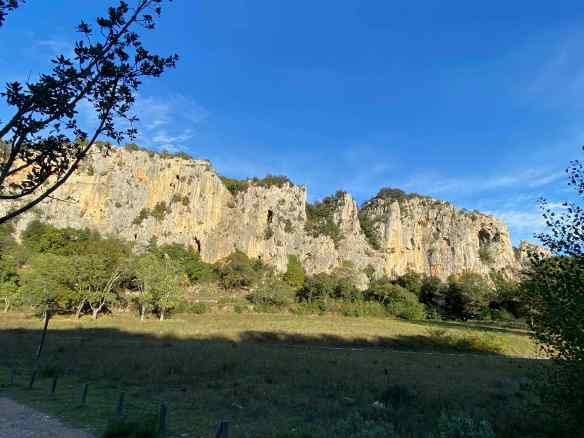
The cave was located near the Pont d’Arc, a natural stone bridge. We would have liked to walk up to the location of the original cave, but it is getting late and we still have an hour and a half drive before us. Too bad but we don’t want to be driving home in the dark.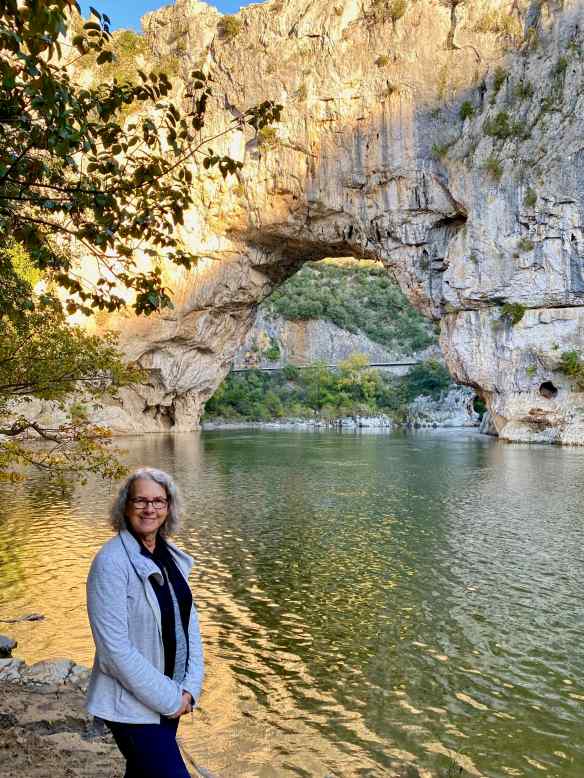
The cliffs here are full of what appear to be cave openings, and there is a sandy beach alongside the river that is a popular spot for families.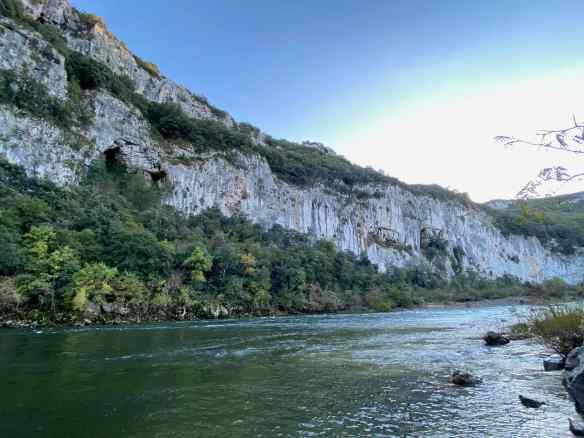
Bob spots this rock formation in the distance that looks like a horse’s head. He is good at finding rock formations that look like people or animals.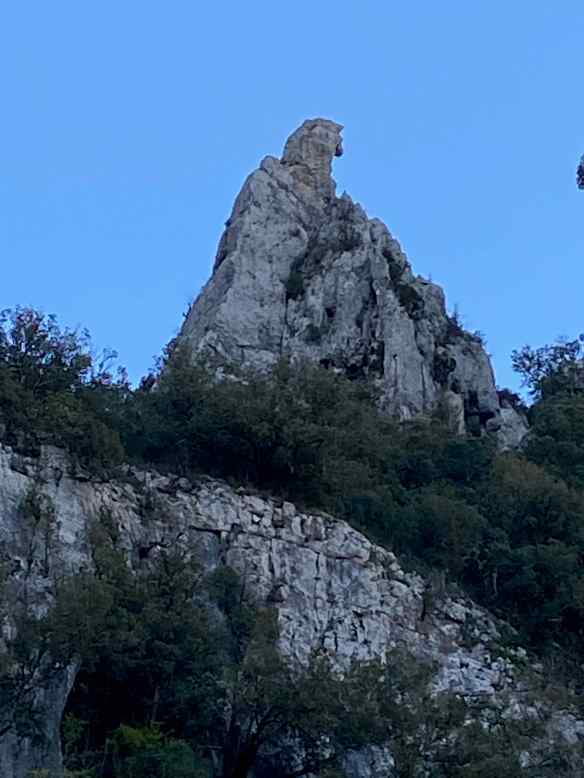 More tree lined roads on the way home…the leaves look golden in the setting sun.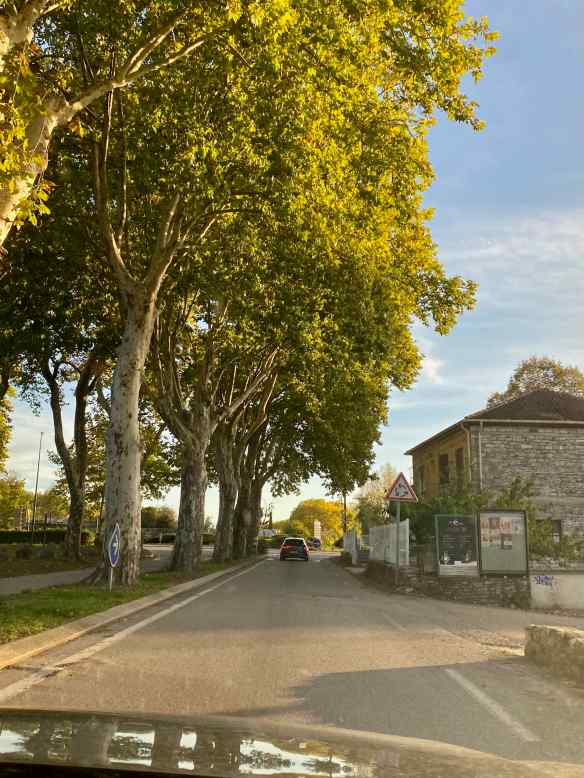
All too soon the sun sets…and we are driving in the dark, but only for the last half hour or so which isn’t too bad.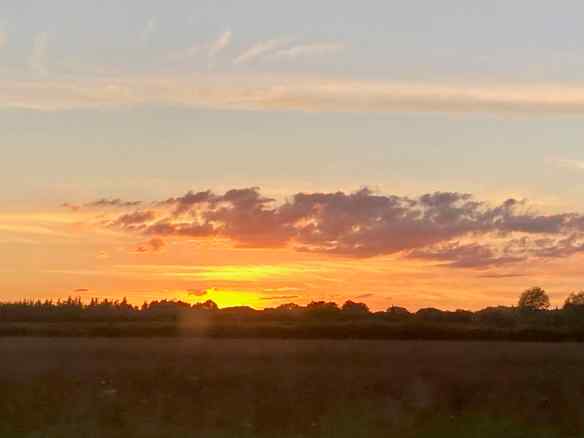
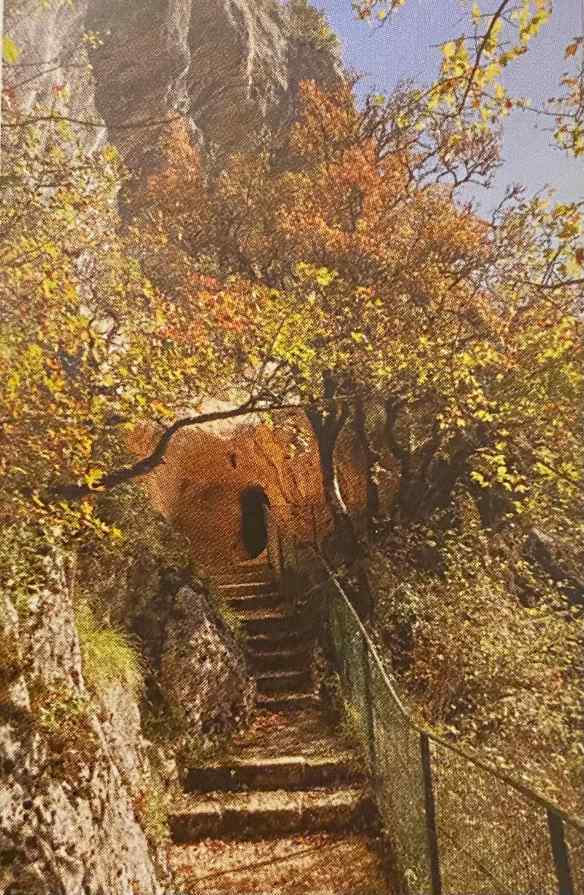 There are more than 200 painted and engraved figures in Fonte de Gaume organized into compositions in the four main sections of this 120 meter long cave. We visited all but the narrowest section in the Diverticule teminal and the short cave on the right of the entrance.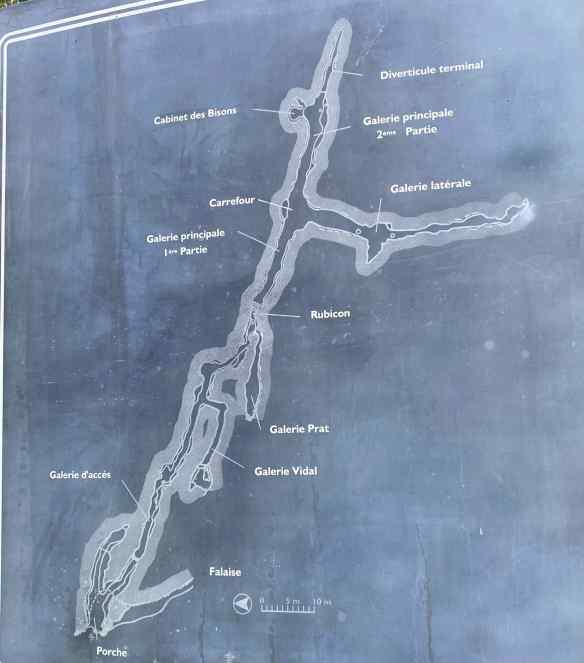
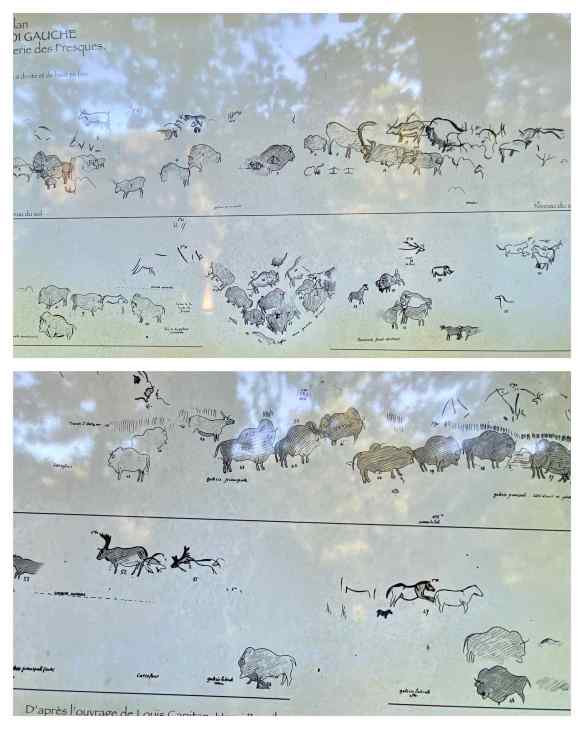
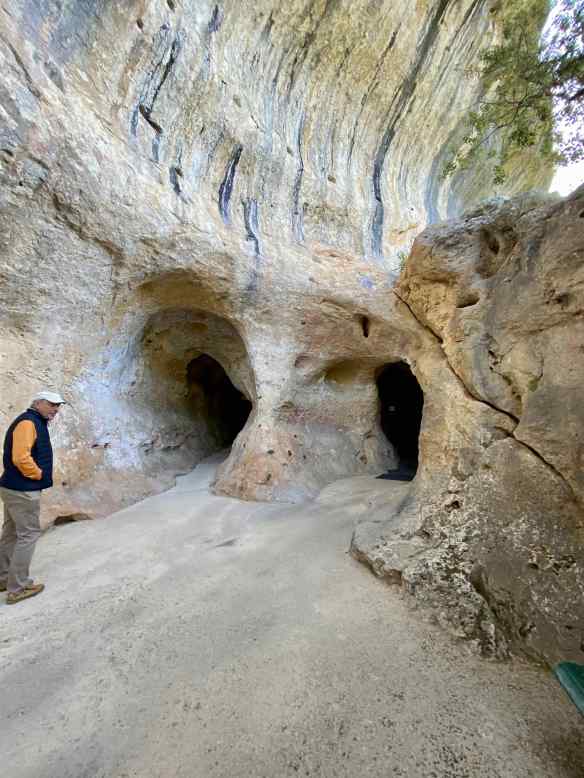
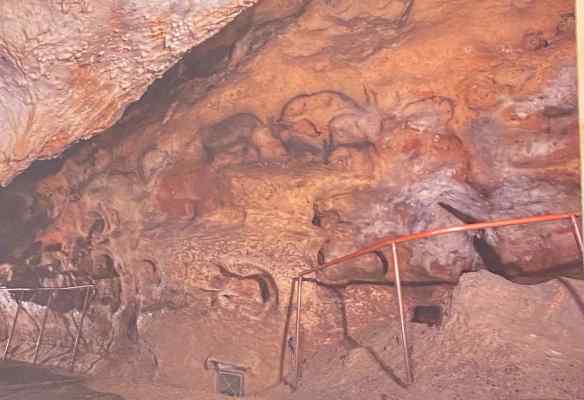
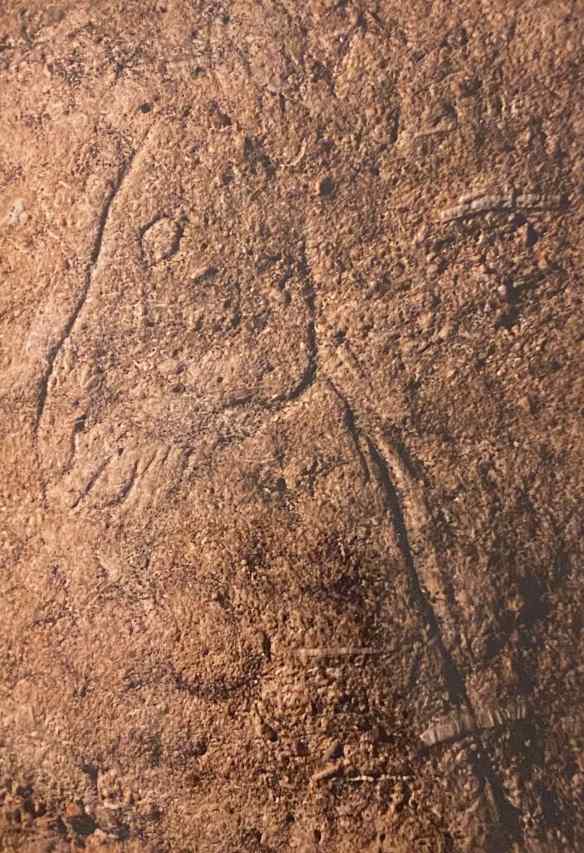
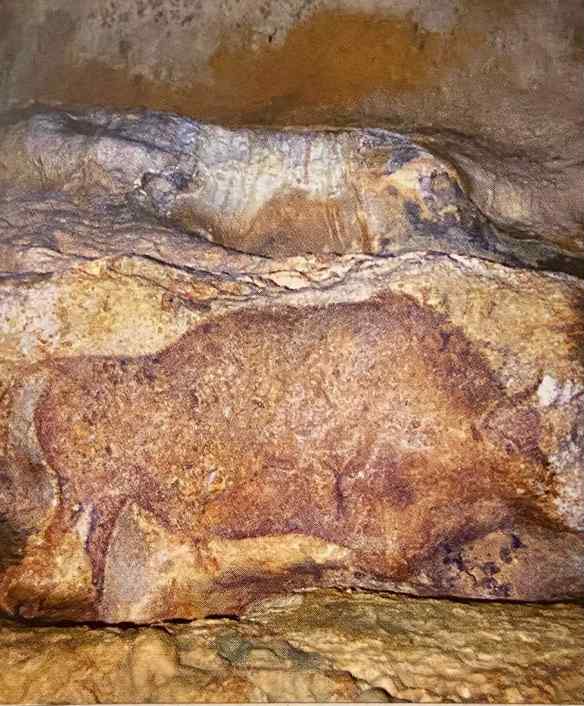
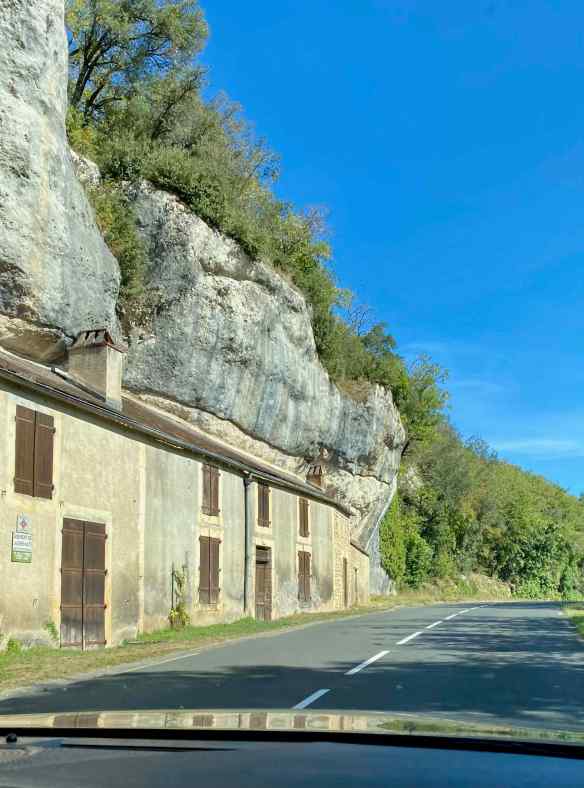

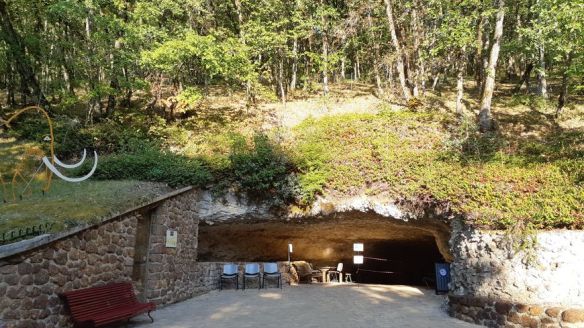
 The first artworks we see are engravings…some of them were made by the artist using his fingers to mark the soft stone. Rouffignac is famous for its Mammoths. 158 mammoths that have been found on the walls of this cave, this is 30% of all mammoth representations in prehistoric cave art. Yet, curiously, there have been few mammoth bones found in this area. We also see cave bear claw marks all over the walls. The parallel vertical lines below this mammoth are from a cave bear scratching his claws on the cave walls.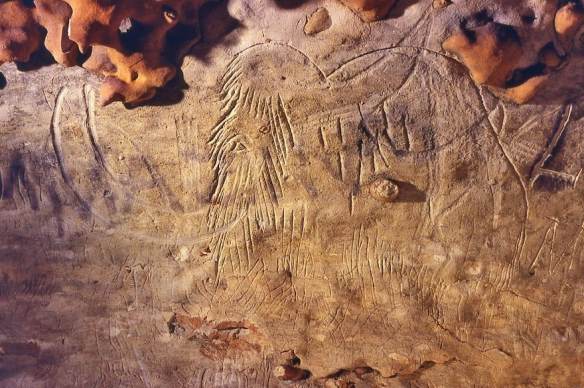
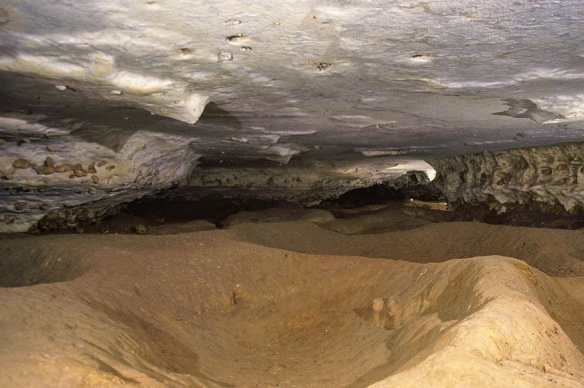
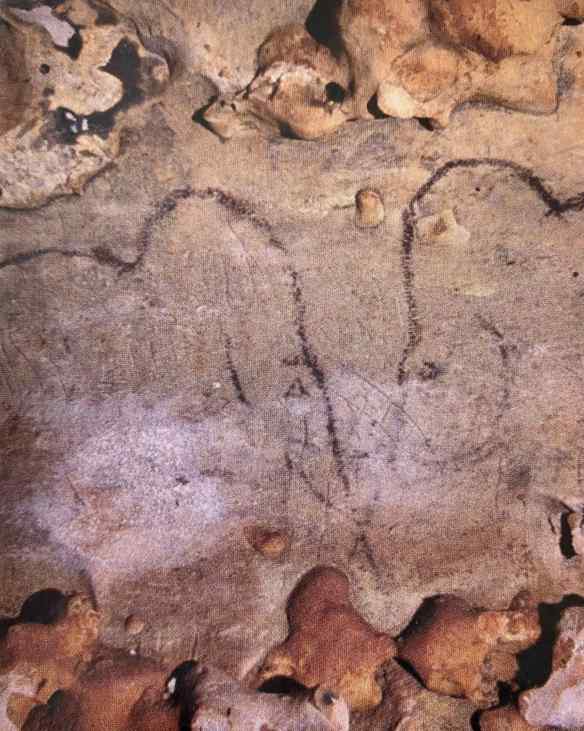
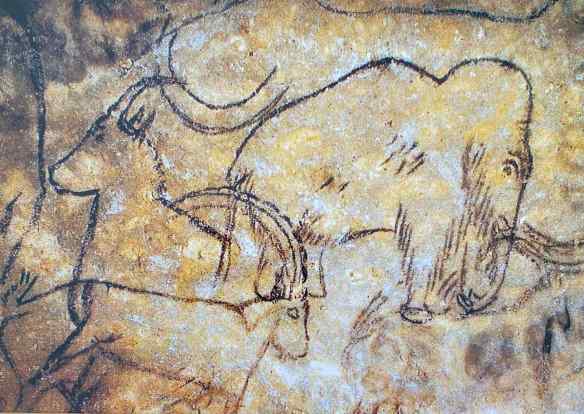 I was surprised to see that almost everyone in the group turned towards our guide when he started talking and they stopped looking at the drawings! Really? Couldn’t they have listened but keep looking a the artwork above our heads? It seemed such a waste to be standing here and ignoring these ancient drawings. One very interesting drawing of a mammoth showed its anal flap. Sorry, no photo of that one. Yes, this is a flap that covers the mammoth’s anus to keep it warm. Only someone who had very close contact with a mammoth would know about this detail. This fact was used to help authenticate these drawings, as they were thought to be modern fakes when they were first discovered..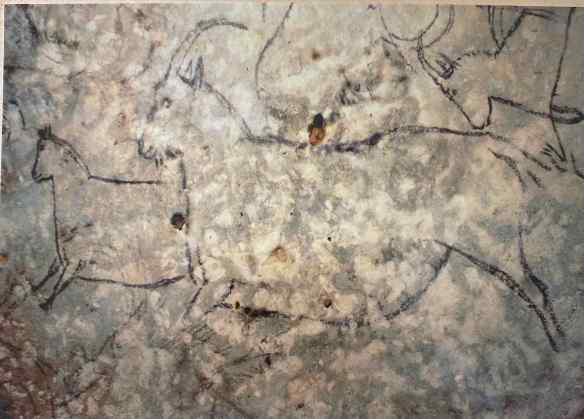
 trudymason.com