Day 25, Thursday, September 19, 2019
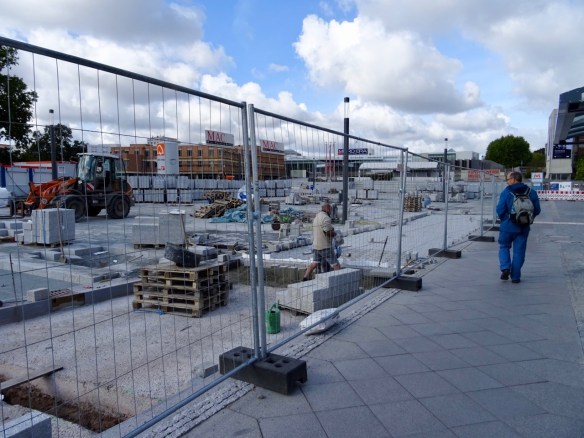
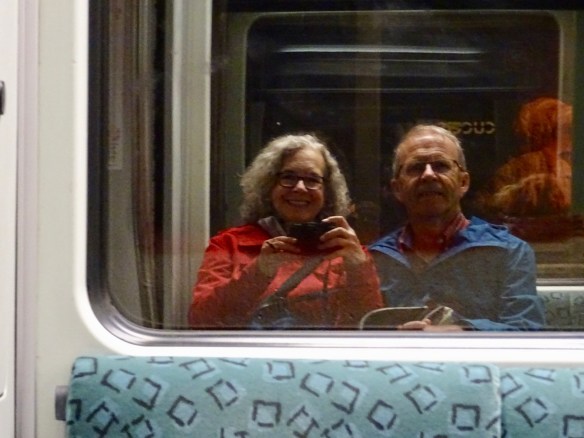
As we walked to the metro this morning, the interior of this car caught my eye!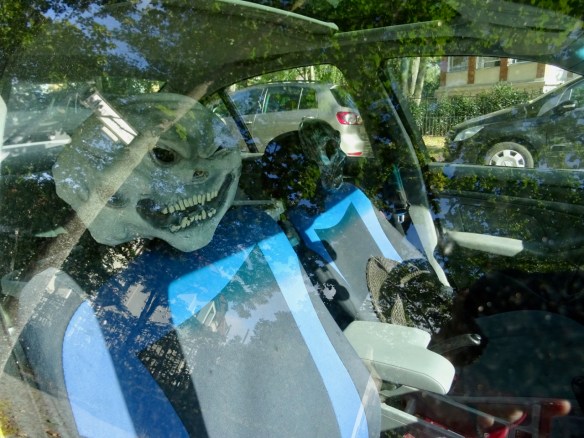 These workers are laying paving bricks for a huge plaza. We have not seen poured cement sidewalks or plazas here, they are all made with paving stones. It seems very labour intensive.
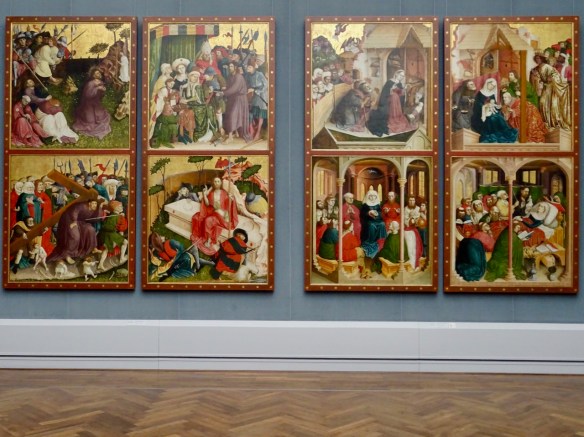
 The Gemäldegalerie is our first stop today. This museum is near the Berlin Zoo and has one of the world’s leading collections of European paintings from the 13th to the 18th century. The quality of the artwork here is amazing. This is the first painting we see, part of an altar from 1437 telling the story of Jesus on the left, and Mary on the right. The white ‘baseboard’ in the photo comes almost mid-thigh on me, to give you an idea of the scale of the works.
 The corner of one painting from 1444 shows two pregnant women, notice the babies depicted on their stomachs. I had never seen this symbolism before.
 We both liked the Fountain of Youth by Lucas Cranach, 1546. This is not the style of his work that I am familiar with…
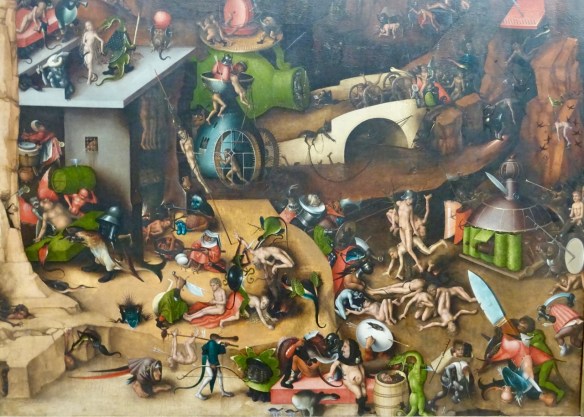
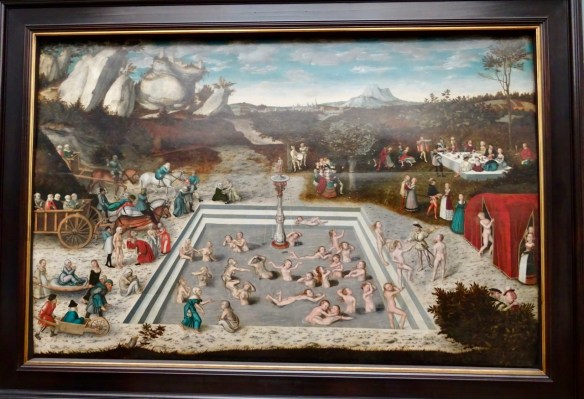 this is! I have always wondered at this artist’s creativity.
 Wow!! This painting by Rogier van Der Weyen from 1440 is my absolute favourite of everything we have seen so far this trip. I absolutely love it and wish that the photo was able to convey the impact it has in person. I would have bought a print but it was almost $100 and I worried about getting it home safely. This is a painting I could live with forever.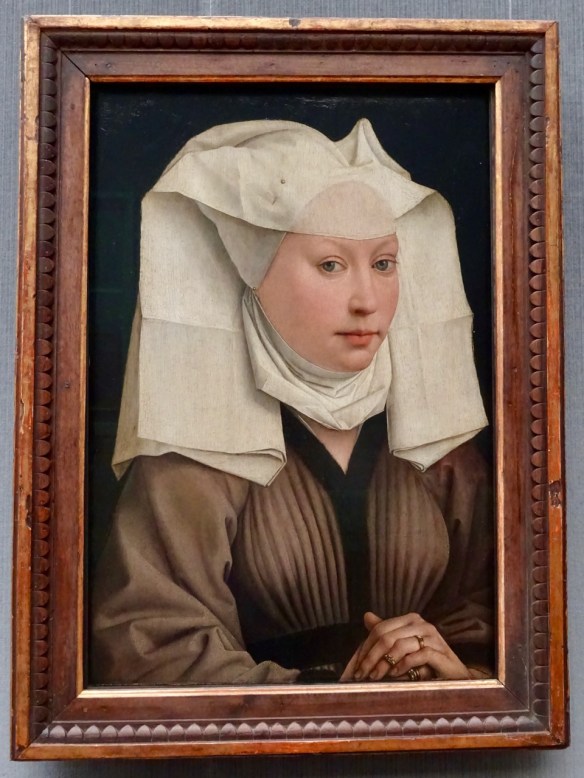
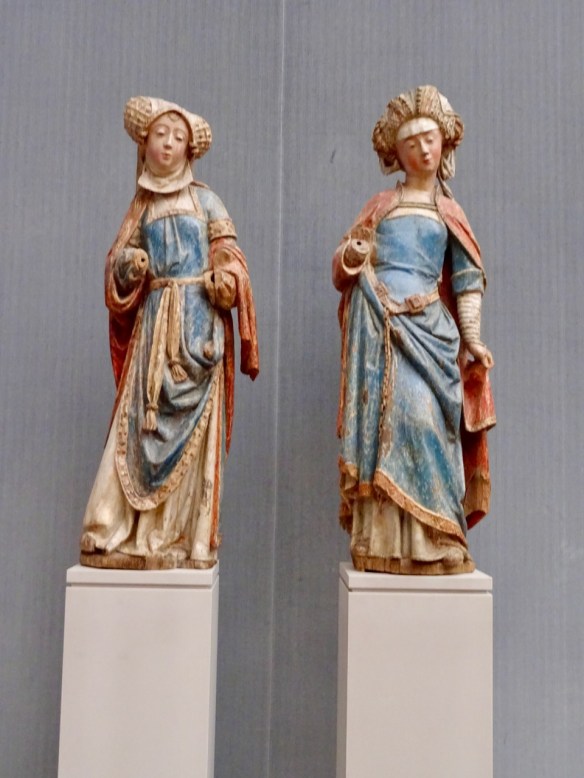
There are so many interesting portraits here that I have never seen before. Can you tell that I am drawn to portraiture? These two tomb figures, 510, were very endearing.
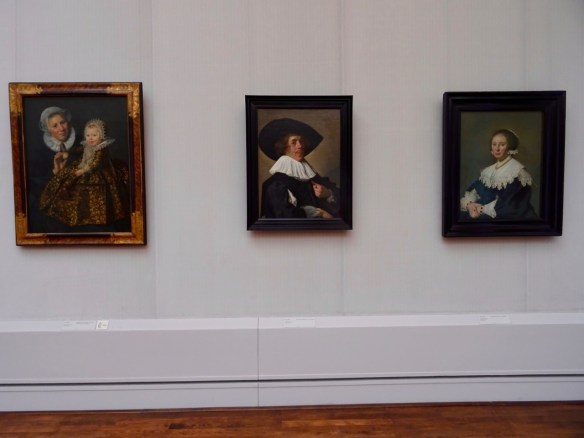
 I am fond of Frans Hals portraits and there was a whole room of them.
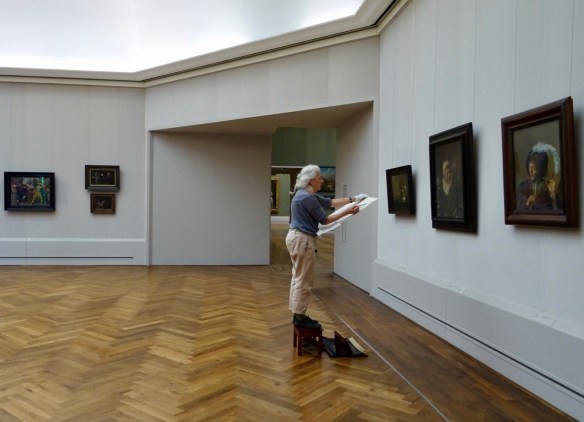
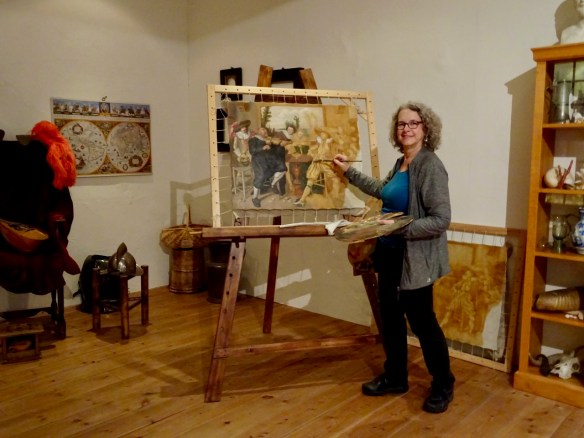
 This artist must like them too. What a tough way to work though, on a little stool, holding such a large drawing board. I assume the museum does not allow easels.
 I am excited to see this Vermeer from across the room, but then..
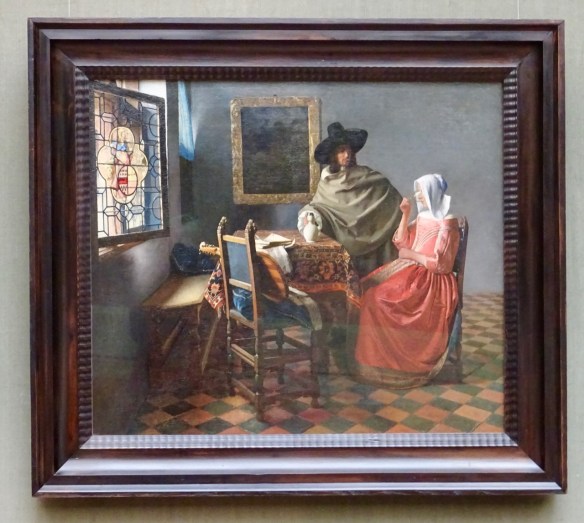 I notice The Girl with the Pearl Earring. I had no idea the this painting was in this museum. What a lovely surprise.
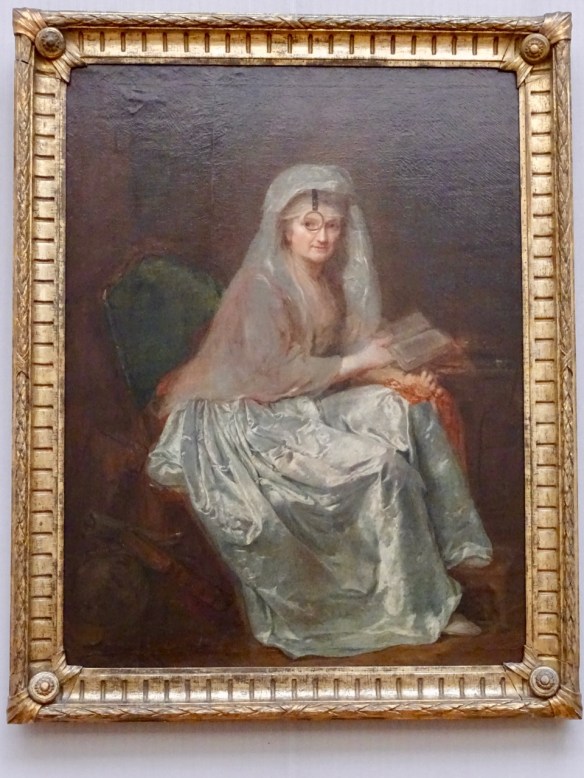
 Anna Dorothea Therbusch, 1721-1782, is one of the few women artists who actually made a living as an artist. This is a self portrait.
 There are Caravaggio’s here…
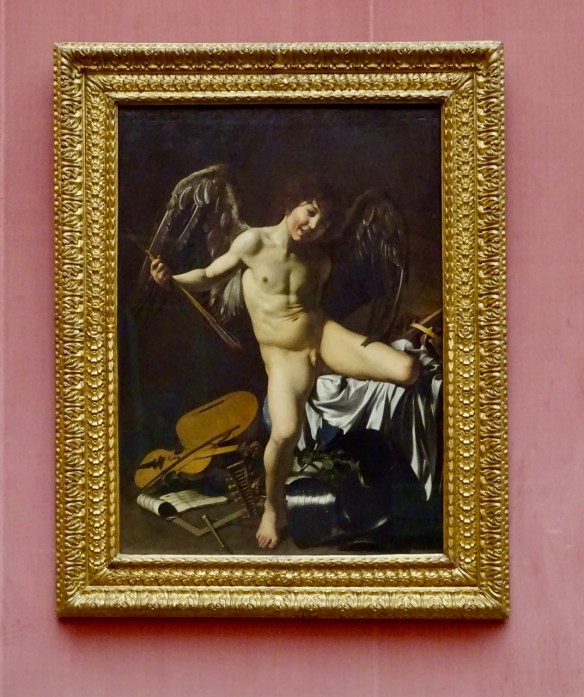 and Georges de la Tours…
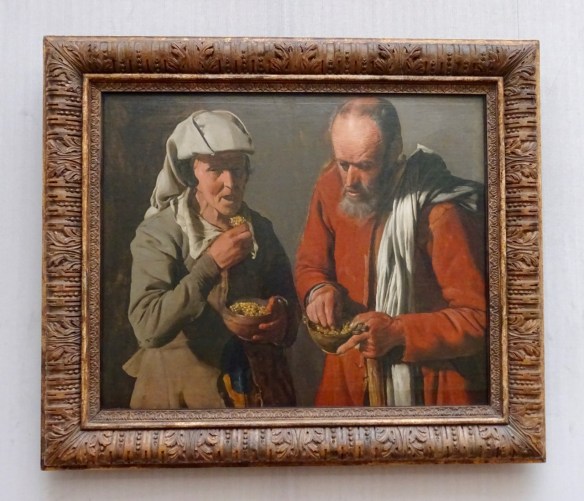 and Botticellis,
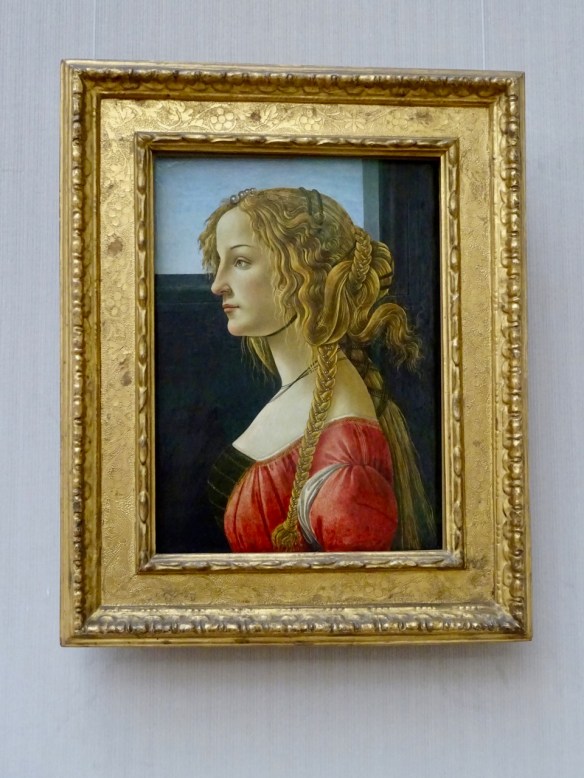 including this Botticellis Venus.
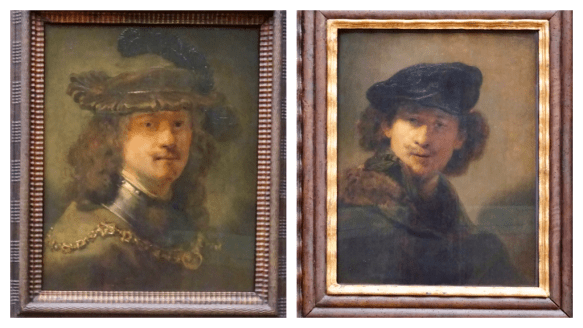
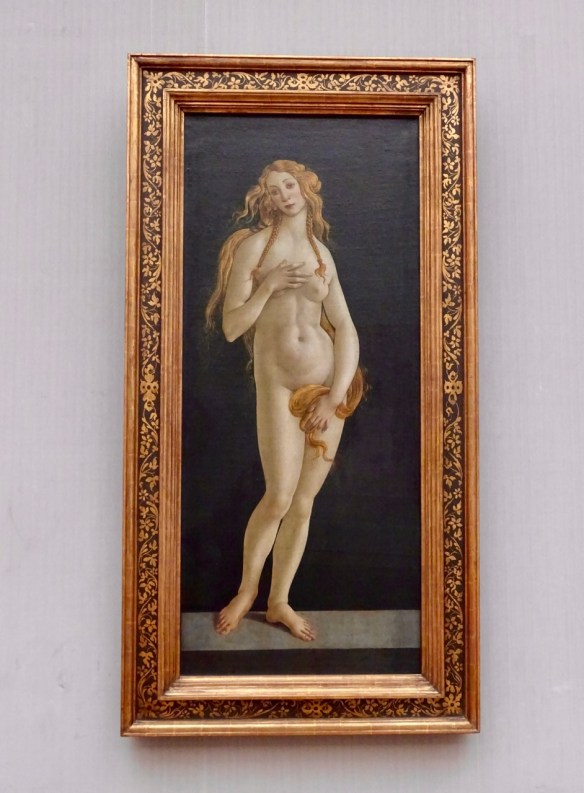 And there are Rembrandts, including these two famous self portraits.
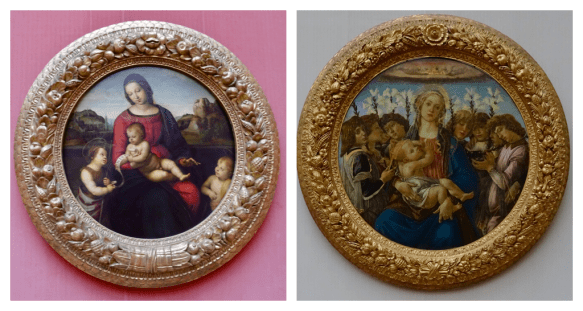
 I finally get to see these two tondos in person, the one on the left by Raffael (34″ diameter) and the one on the right by Botticelli (54″ diameter). I particularly like the Botticelli, his Madonnas are always so beautiful.
 This was fun! I am so glad we visited the Gemäldegalerie, it was quite amazing.
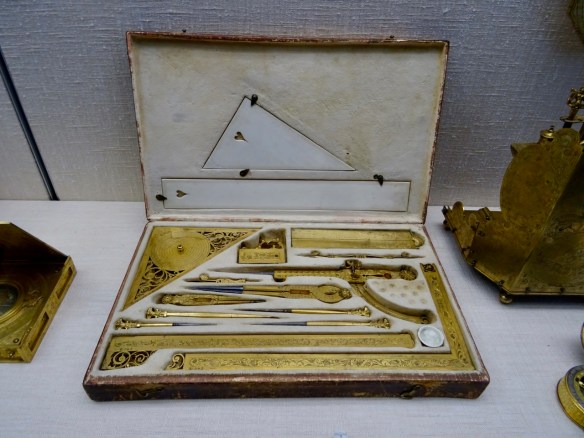
 After a picnic lunch we check out the Kunstgwerbe Museum nearby. I would love to have this beautiful geometry set from the 16th century.
 This museum has lots of porcelain, furniture and church treasures, but we walk by all these. It is just too much to absorb.
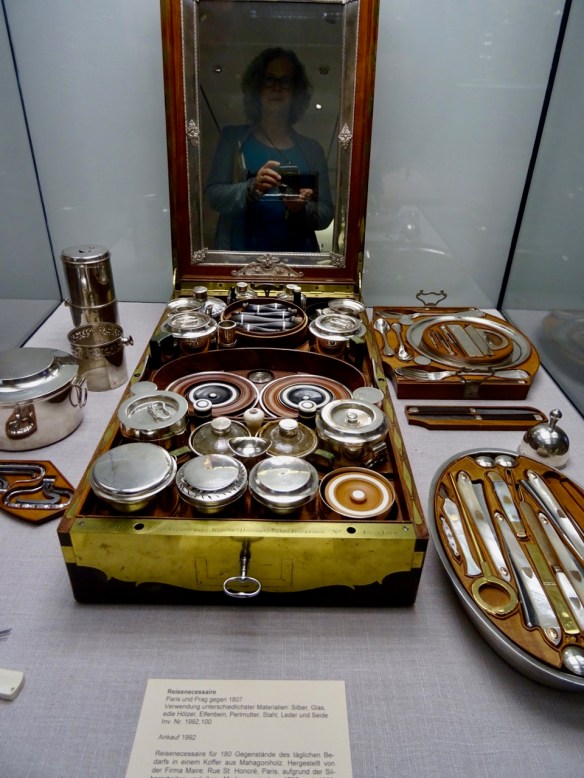
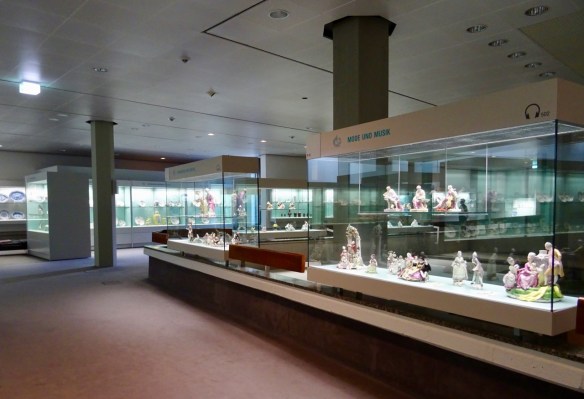 A few items did catch our eye though. This is an elaborate portable kitchen from 1807, maybe used for camping? All the info is in German, so not sure.
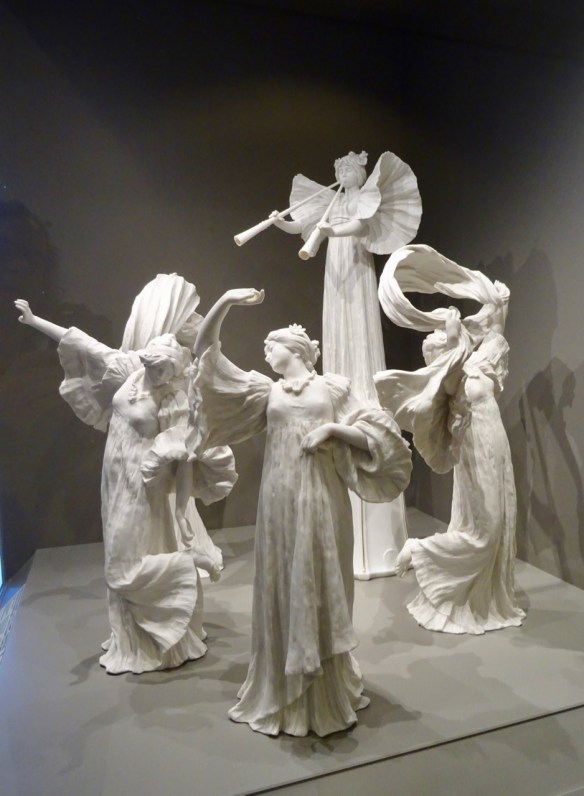
 These glazed porcelain figurines were part of a group of 15 that were awarded a gold medal at the 1900 International Exhibition in Paris.
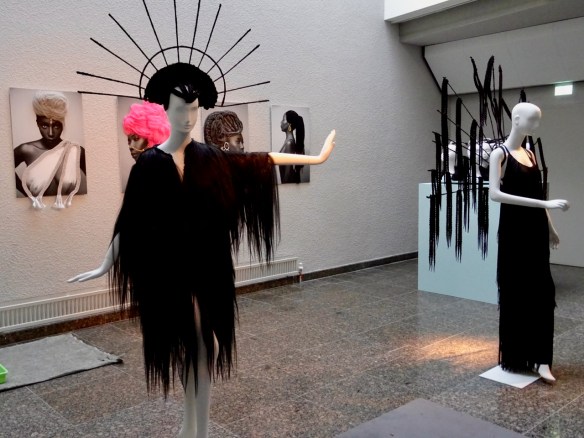
  There was also an exhibit on Afro Hair, with some very different displays.
 And finally, an interesting walk through women fashions through the ages.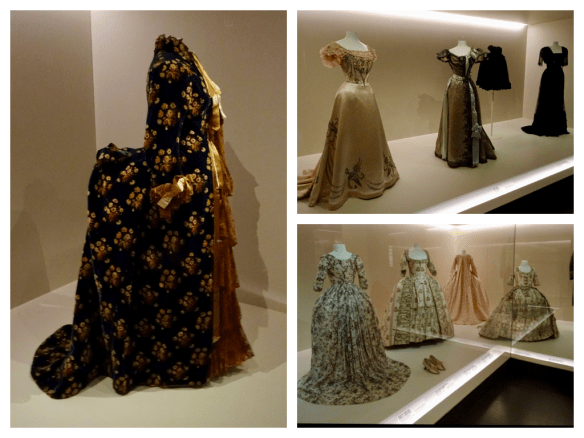
Across the street we stop to see the Berlin Library. It is enormous! Probably the biggest I have ever visited. It was tough to get in though. Without a library card I had to get a special pass, and no one is allowed to carry a purse or backpack or other bag. So everyone puts their stuff in clear plastic bags! I don’t see the point of that all. So different from home. Oh and do you notice the card catalogues in the bottom photo? I was surprised to see them.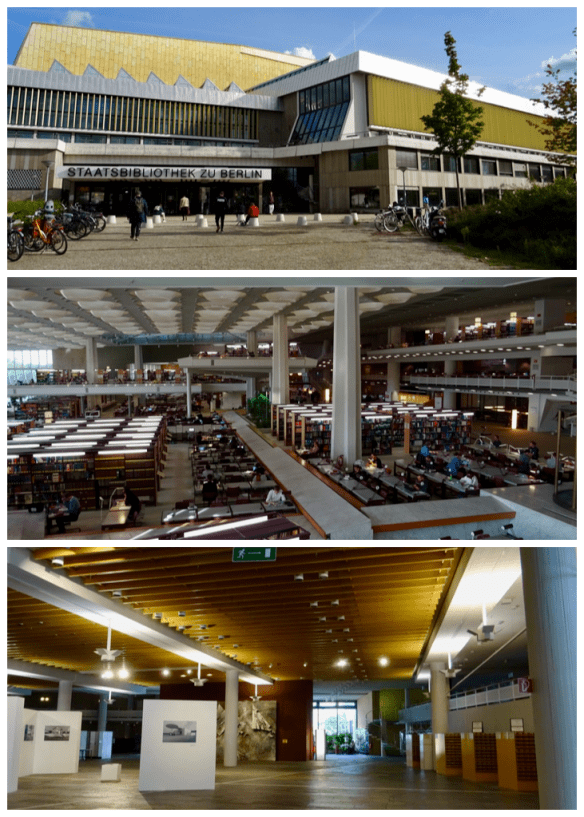 Whew! and we aren’t finished yet. We catch a bus back across town to visit the oldest church in Berlin but the interior has been updated so much. It wasn’t what we were expecting, but still interesting. For some reason there was a rooster crowing inside the church? No idea what that was about.
 We split up, Bob heads to the Bode Museum and I catch the metro to go life drawing. I pass this post with just a few posters wrapped around it on my way to drawing.
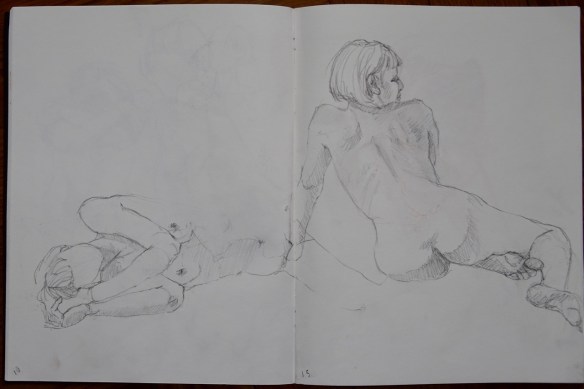
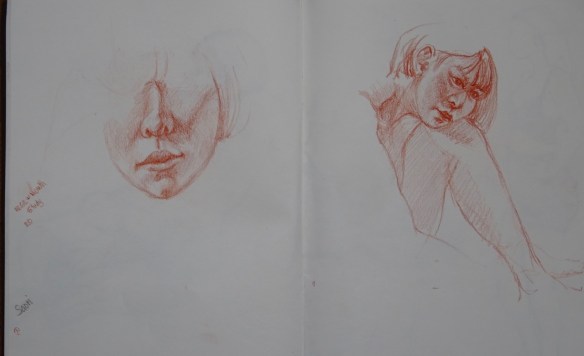
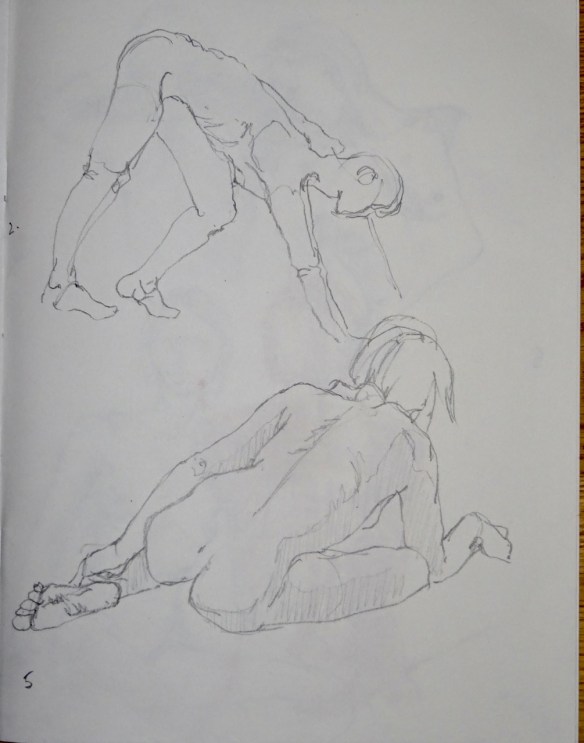
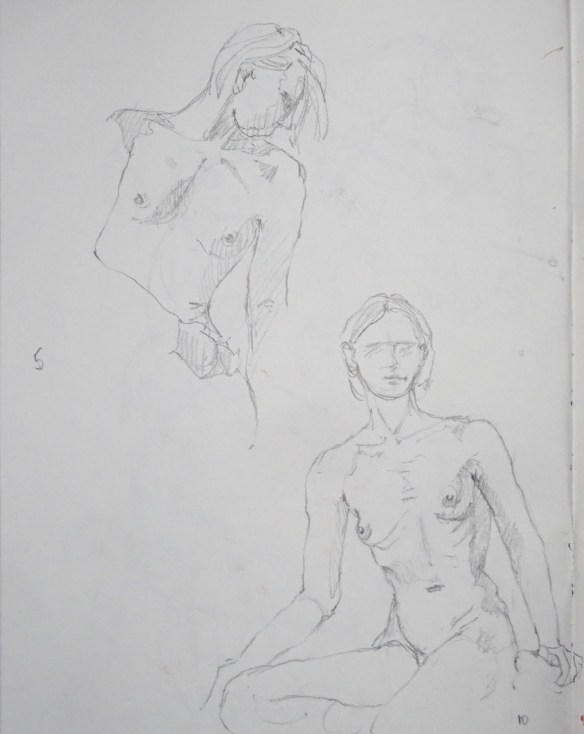
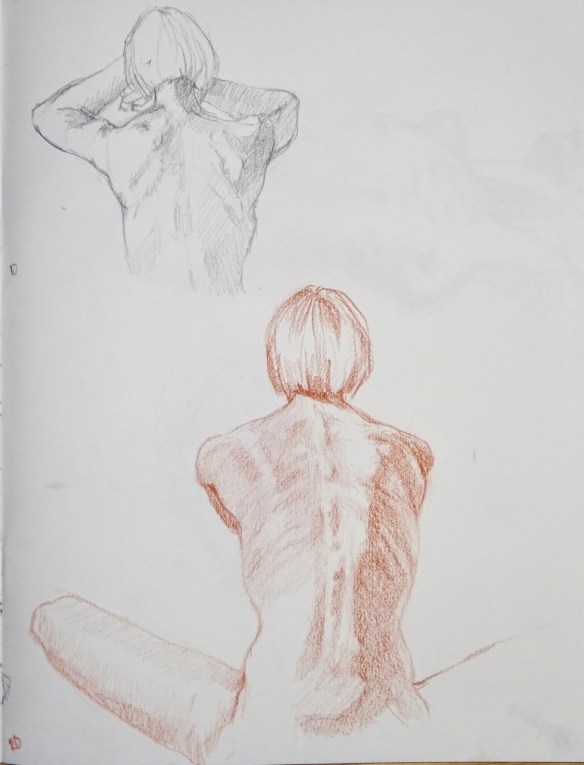
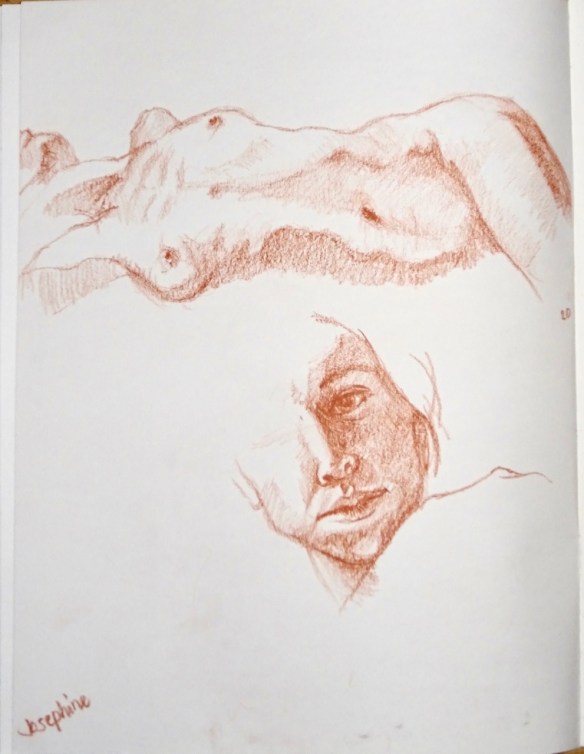
Here are my drawings from tonight. The first page is two minute poses and the times of the other poses are written on the pages. This was a pretty full day!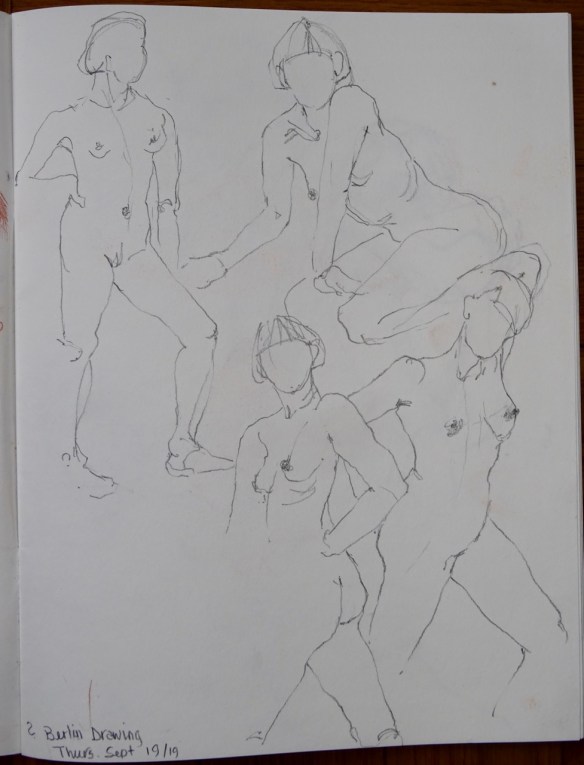
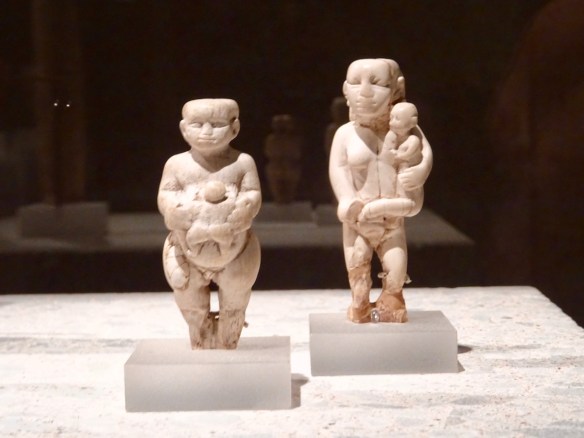
 I am often most drawn to small items in these exhibits, like these tiny ivory figures of mothers and their children, only about 3-4″ tall from 3000 BC. I think they are incredibly detailed and beautiful.
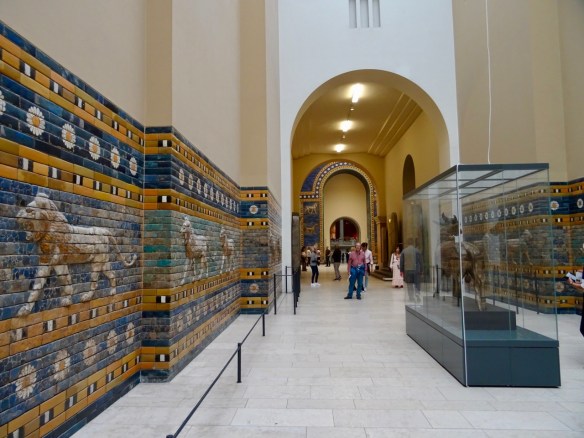
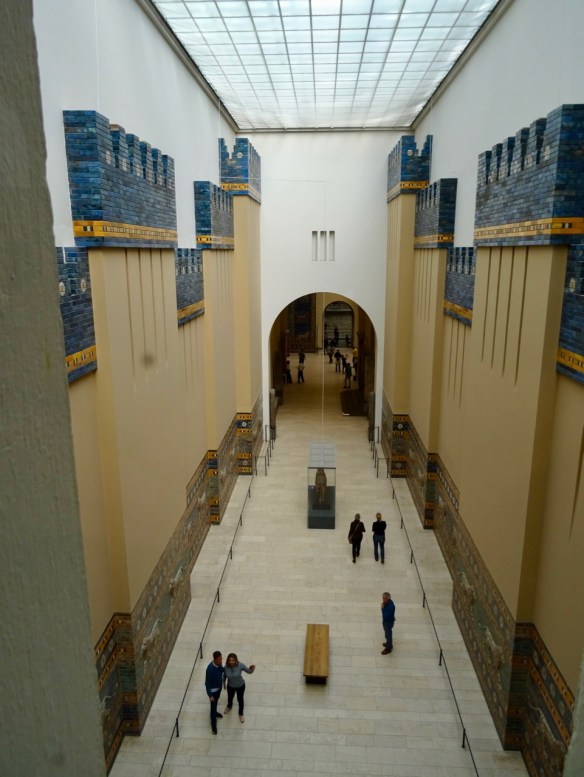
 This is the processional way which led towards the 6th Century BC Ishtar Gate of Babylon. It is very impressive.
 I loved this wooden sculpture.
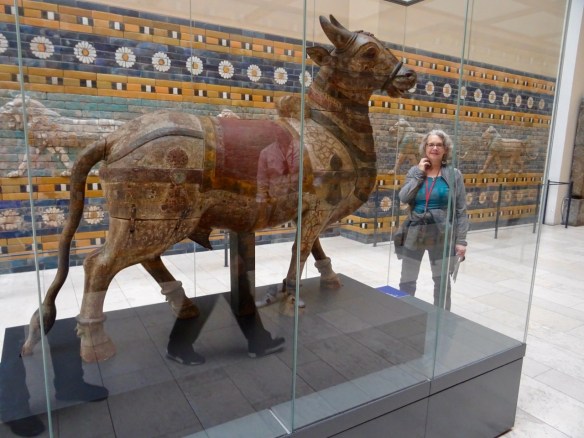 Here is another view of this approach that gives a better idea of the size..
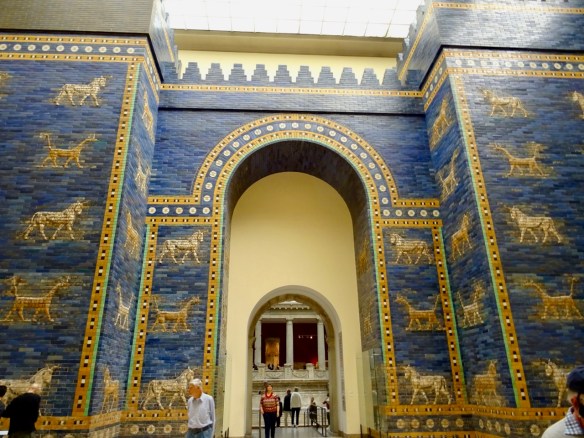
 The reconstruction of the gate has original tiles around the animals. This is only a part of the gate, as the museum ceiling would have to be more than twice as high for the whole gate to fit.
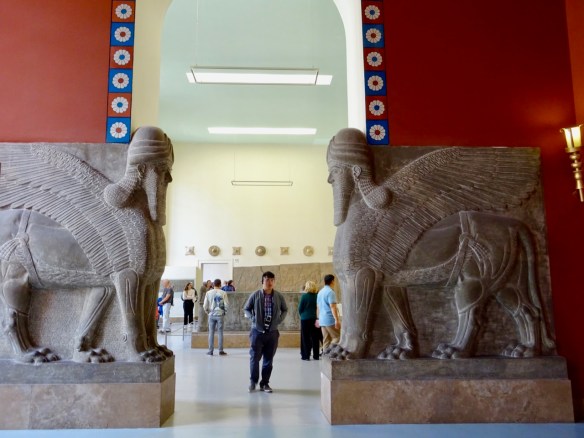
 These two creatures guarded the Assyrian King in 883 BC. These are casts from the originals in the British Museum, which were each carved from a single piece of alabaster. No idea who the guy is…it was impossible to get a photo without some stranger in the middle of it!
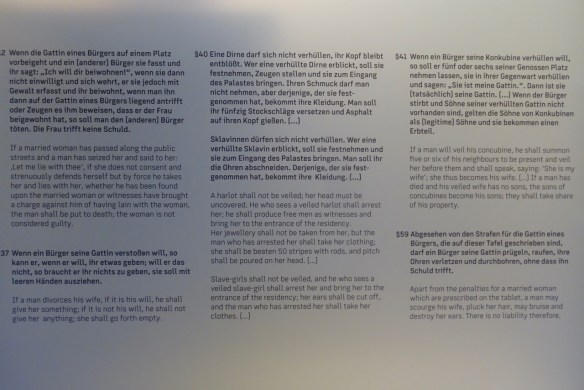
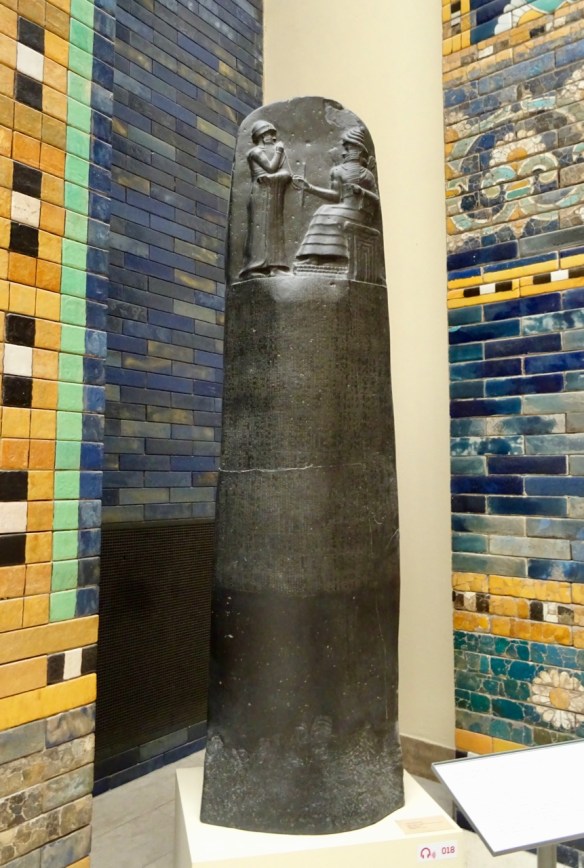
 Times were tough for women. Take a peek at these laws from 3000 years ago.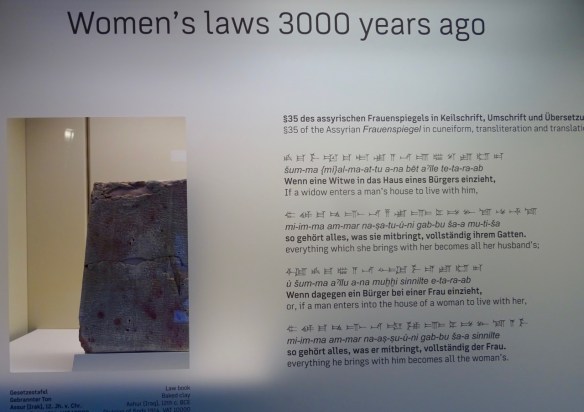
 This close up of one of the lions from the Ishtar Gate shows how the original pieces of tile were reassembled.
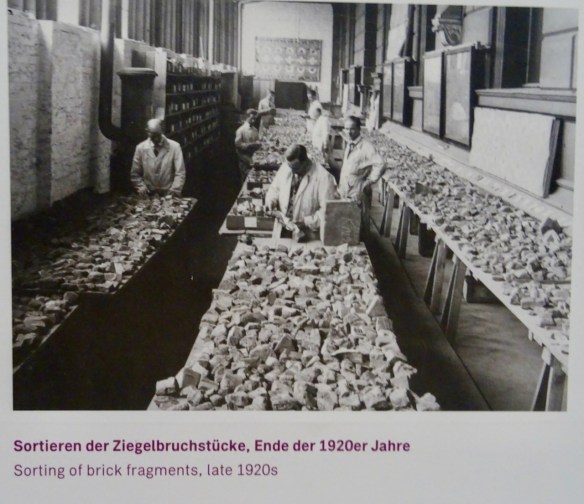
 This is the condition of the tiles when they were unearthed. Can you imagine trying to piece these thousands of bits together?
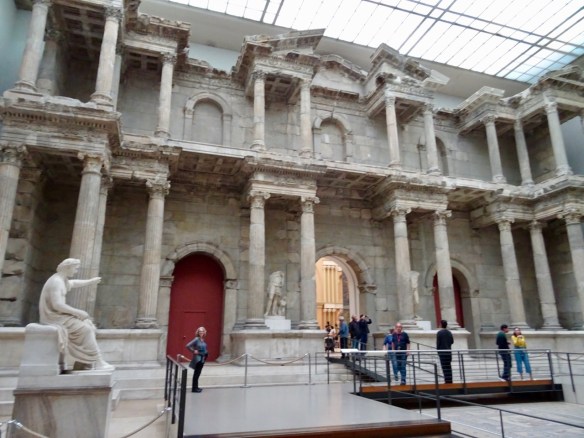
 Another huge structure in the museum is the 2nd Century AD Market Gate from Miletus. This is the largest historical monument that has been reconstructed indoors. It is about 30 meters wide and 16 meters tall. This grand structure was only the entrance to a marketplace, although it looks more like a palace.
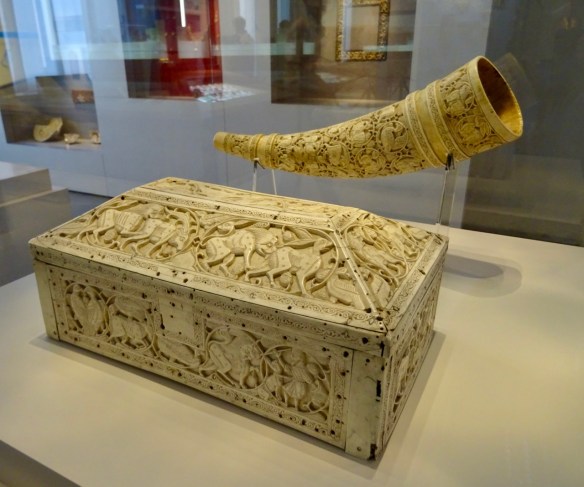
 This ivory box and horn were covered with intricate carvings. There were so many things to see and marvel over.
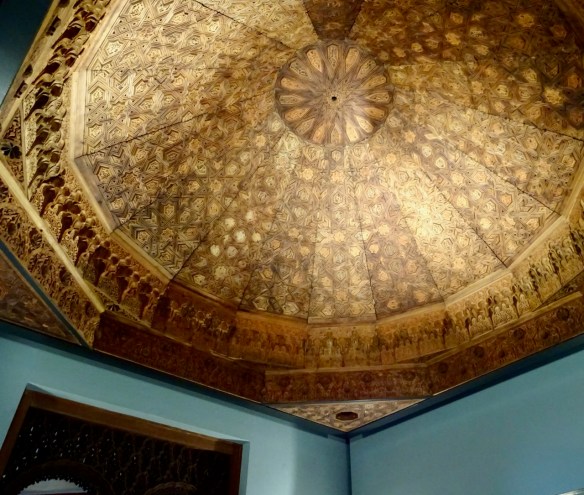
 This intricately carved ceiling is from the Alhambra in Spain. We saw other ceilings like this when we visited there a few years ago.
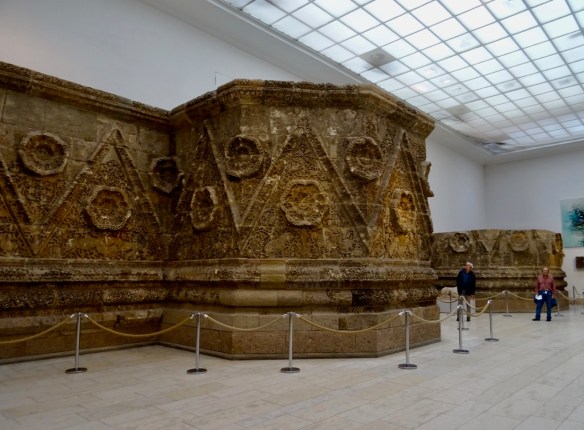
 The 8th Century Mshatta Facade is 33 metres long and 5 metres high with two towers and part of a central gateway. This
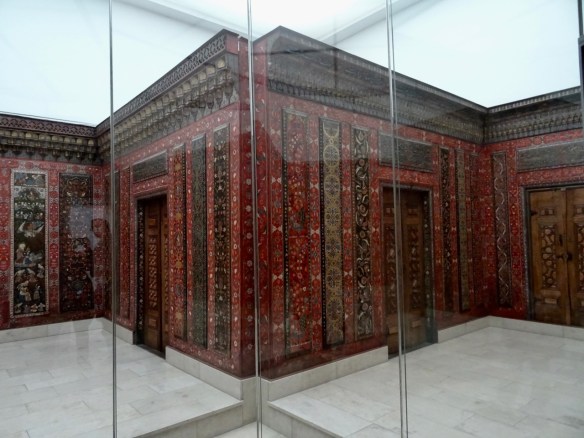
  The Aleppo room was built as a reception room by a wealthy Christian merchant in Aleppo. The paintings Illustrate Islamic floral and geometric designs, scenes from the Old and New Testament, and Persian book illustrations.
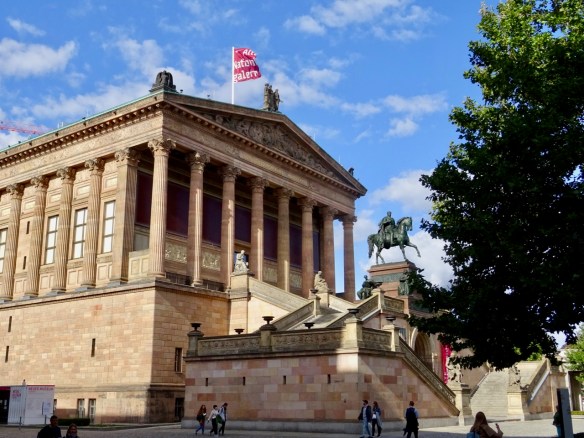
 A view of the Alte National Gallery we visited yesterday.
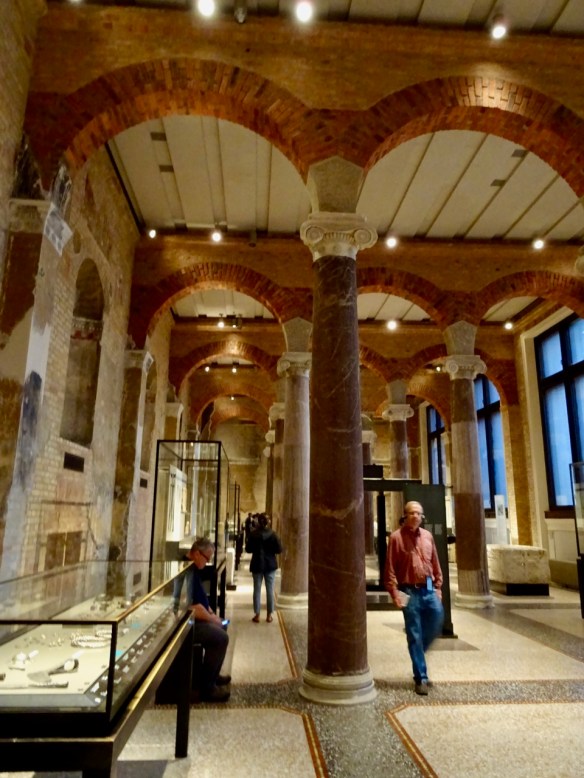
 Next we visit the Neues Museum. This building suffered severe damage during the Second World War. In 2003 work began to restore the building without erasing the traces of past damage. We see evidence of this damage throughout the museum. Note the bullet and shrapnel holes in the pillars…
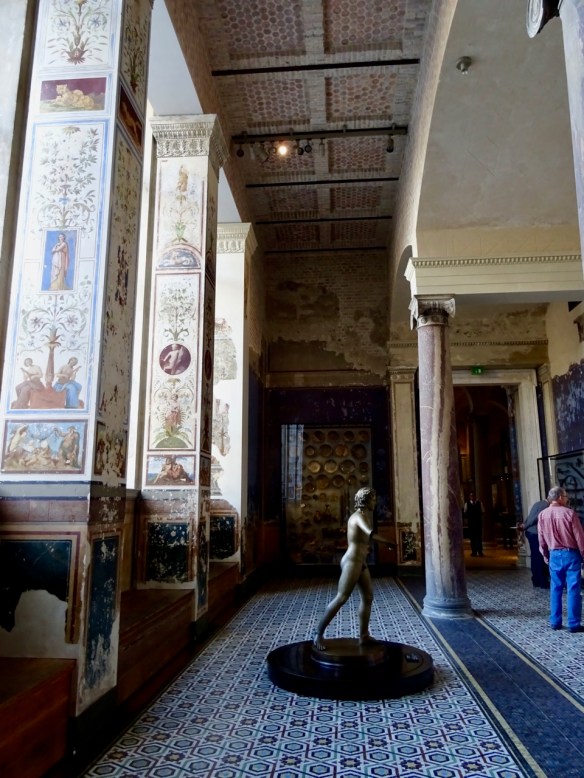
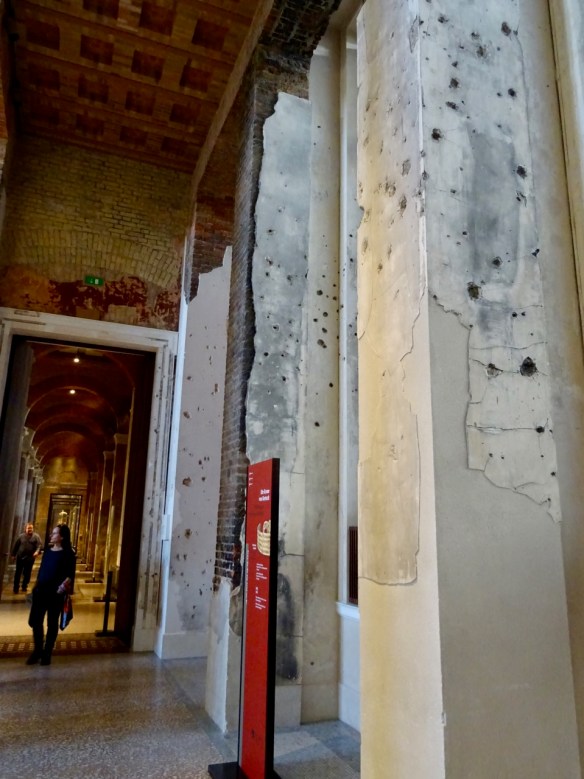 and damaged areas in this room.
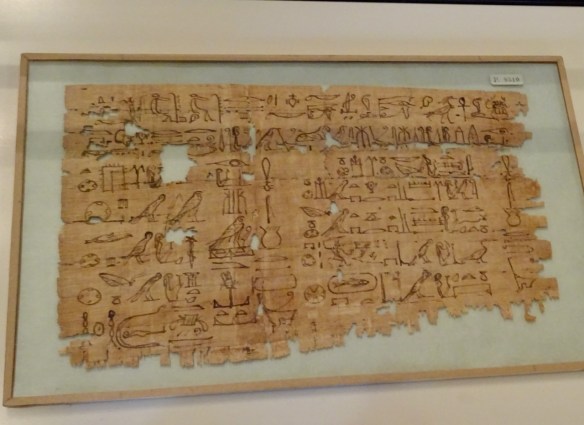
 There were many pieces of ancient papyrus from the 4th Century BC. I find it astounding that these fragile documents have survived.
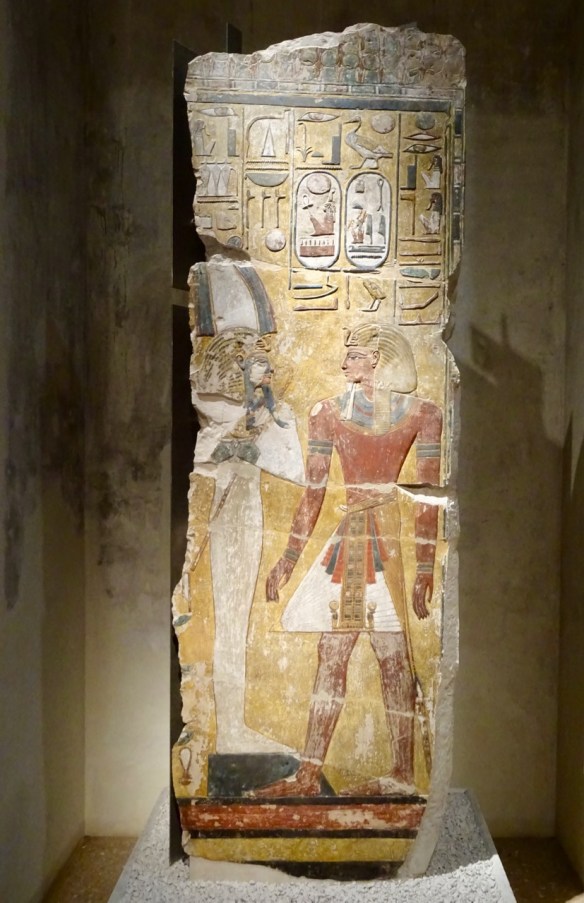
 Original paint remains on some of the Egyptian sculptures from 1290 BC!
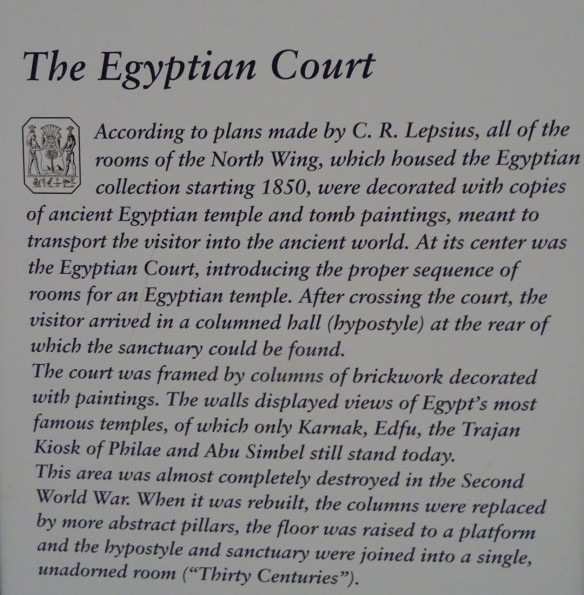
 This is a room that was heavily damaged during the war. These three panels are all that is left of twelve panels that were on the walls of this courtyard. We actually visited the three Egyptian temples depicted on these walls during our trip there in 2011.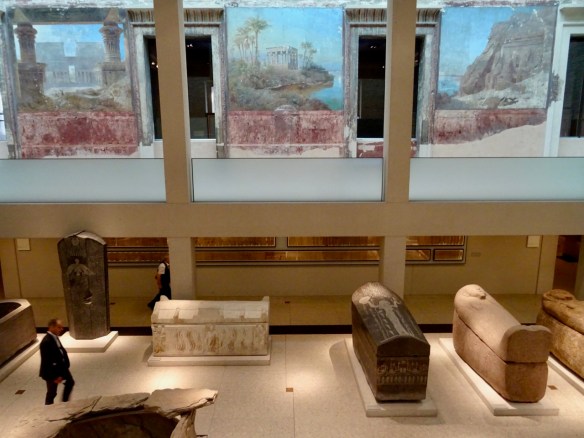
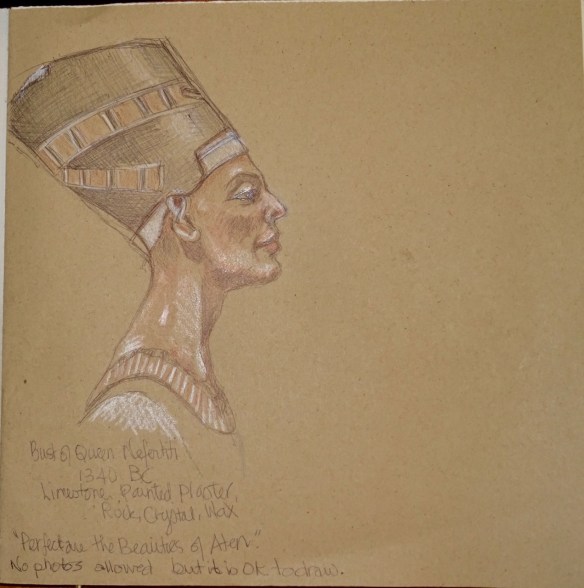 There are so many rooms filled with so many treasures. It can be a bit overwhelming.
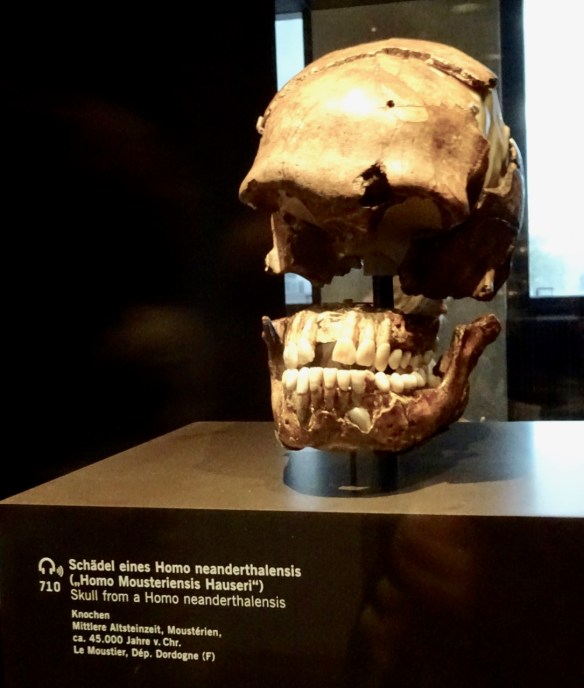
 I thought the teeth on this Homo Neanderthalensis were astonishingly white and cavity free!
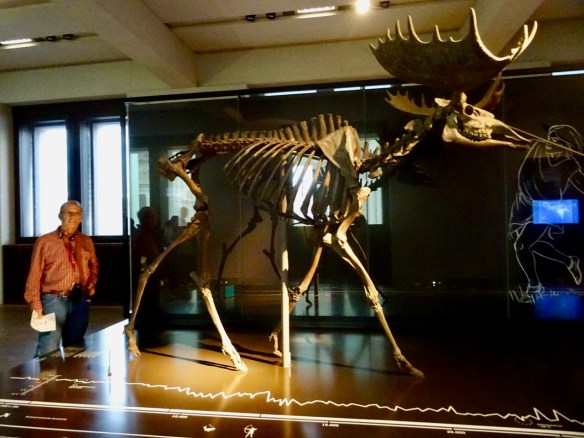
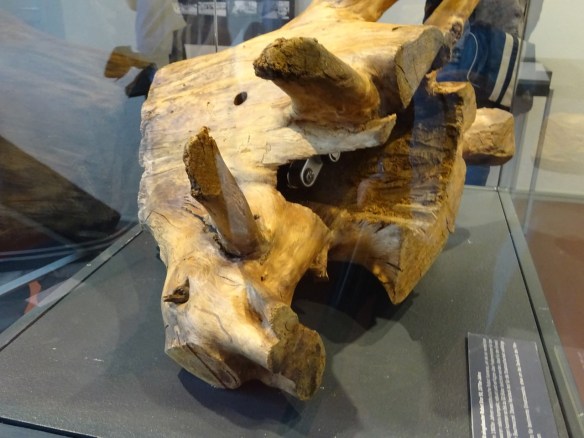
 This elk from 10,700 BC was discovered during construction of one of the Berlin underground subways in 1956.
 I forgot to post these sketches form the Altes Museum yesterday.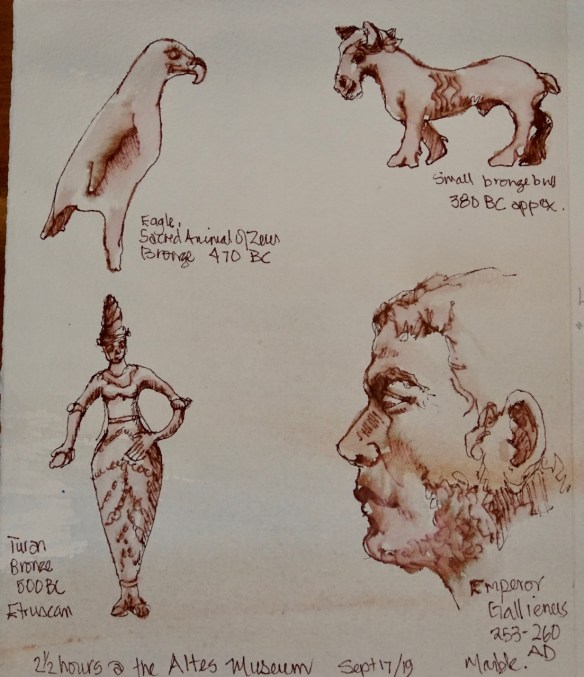

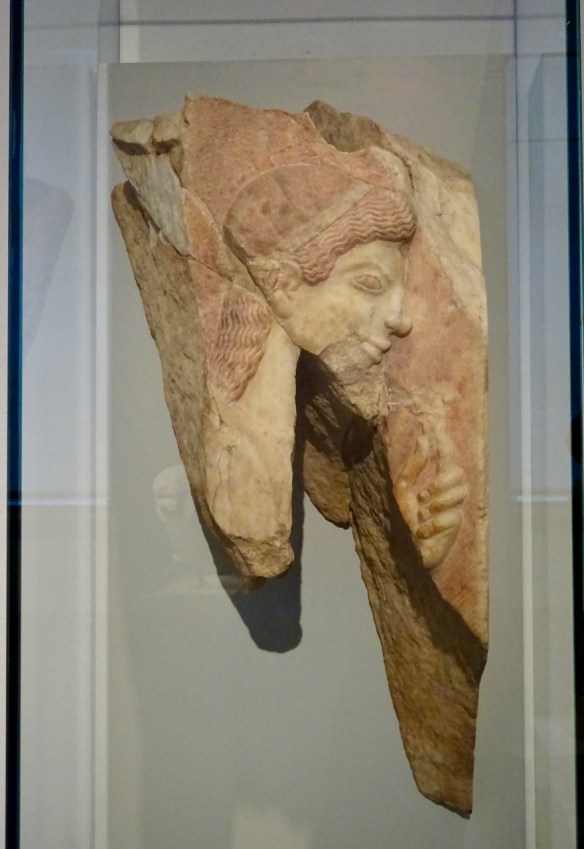 We were surprised at the detail of some of the1,300 ancient coins on display. The museum has more than 150,000 coins in its collection!
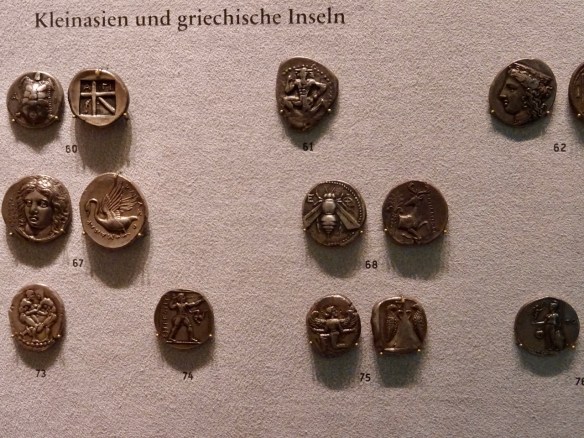 Bob snaps a photo of me sketching…
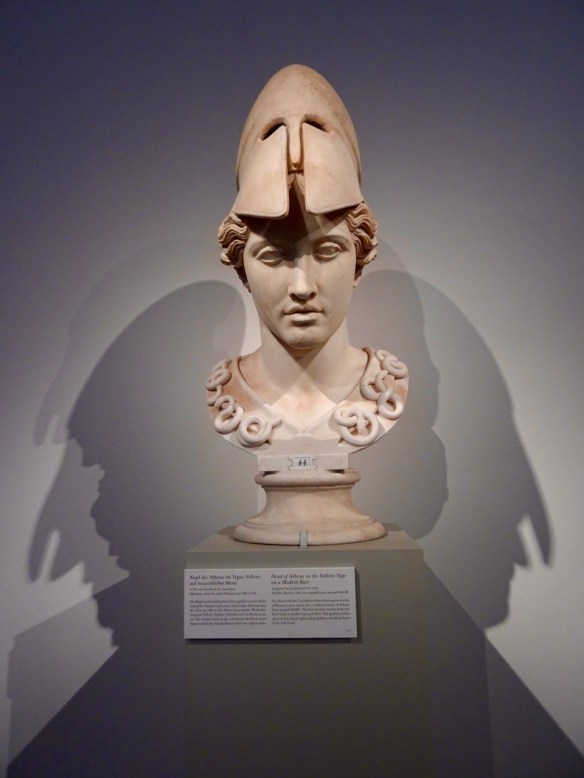
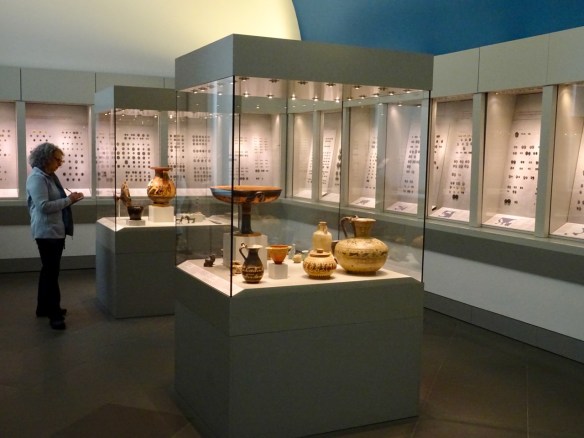 and then notices the shadows behind this bust. He is getting very ‘artsy’!
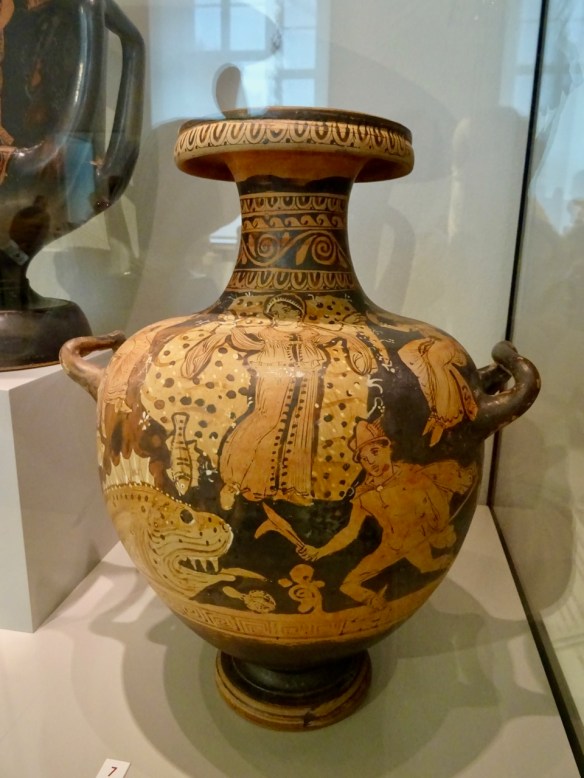
 This Greek vase from 350 BC showing Perseus slaying a sea monster with a sickle is quite different in design than most of the vases we have seen.
 The rotunda has a huge dome with a round skylight and has an incredible collection of sculptures on both levels.
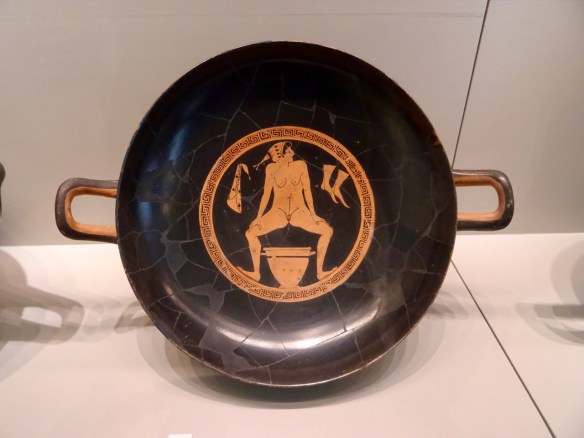
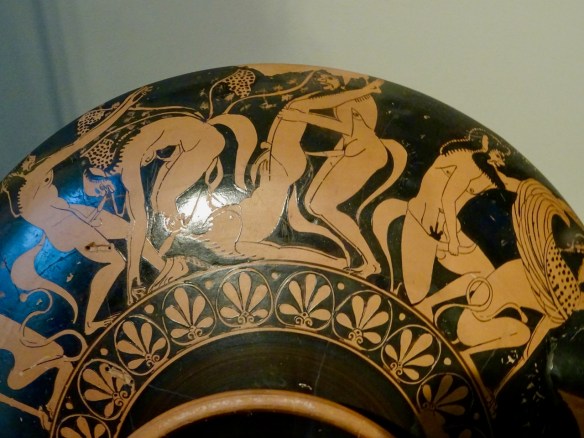
 In the next room this rather unusual drinking cup, is titled Hetaera Above the Chamber Pot!
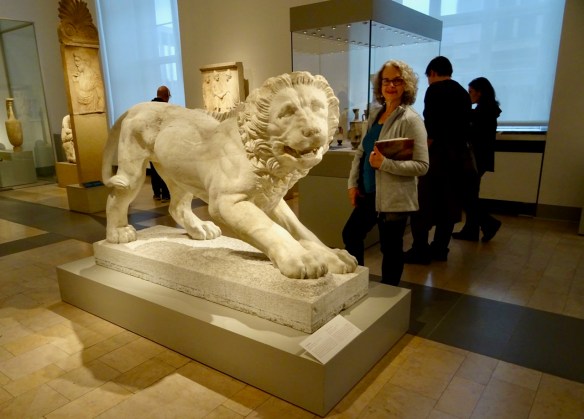
 This Funerary Lion just makes me smile…
 and I love this statue of a mourning female servant from 330 B.C.
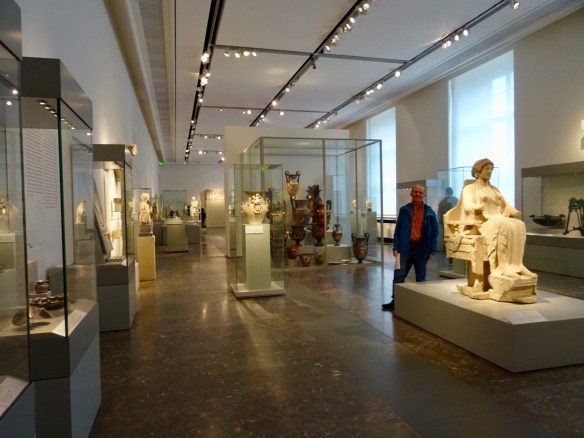
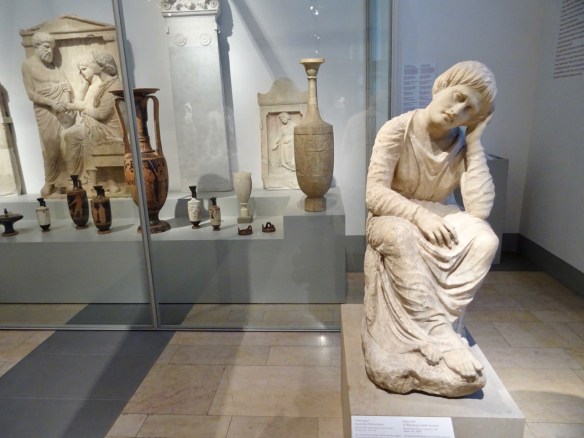 There is so much to see here, room after room filled with beautiful art.
 The Torso of an Old Fisherman, from 200 B.C. is an example of Hellenistic sculpture representing ordinary people.
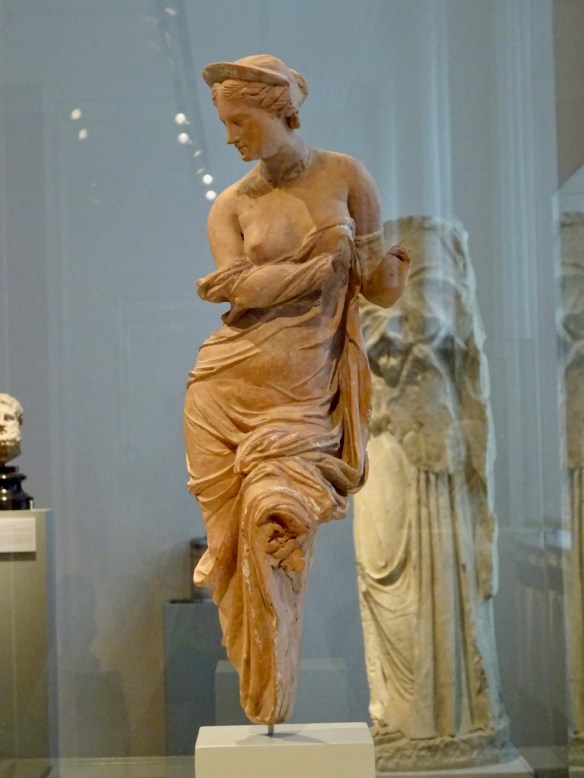
 This statue of Aphrodite, 2nd Century B.C., is thought to be one of the most beautiful ancient terracottas in existence.
 I think this collection of Middle Class Women from 325-150 B.C. is amazing. They were about 8 ” tall and are so detailed.
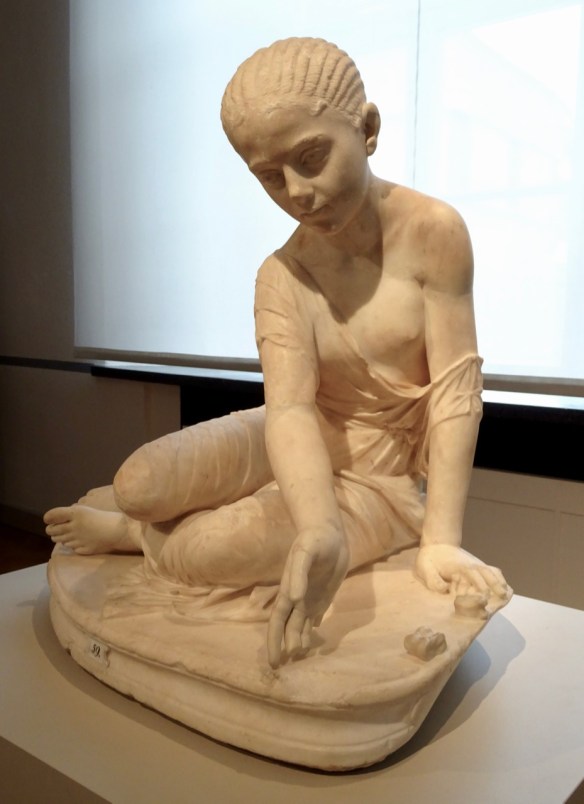
 The Girl Playing Astragal, or knucklebone, is likely a funerary sculpture.
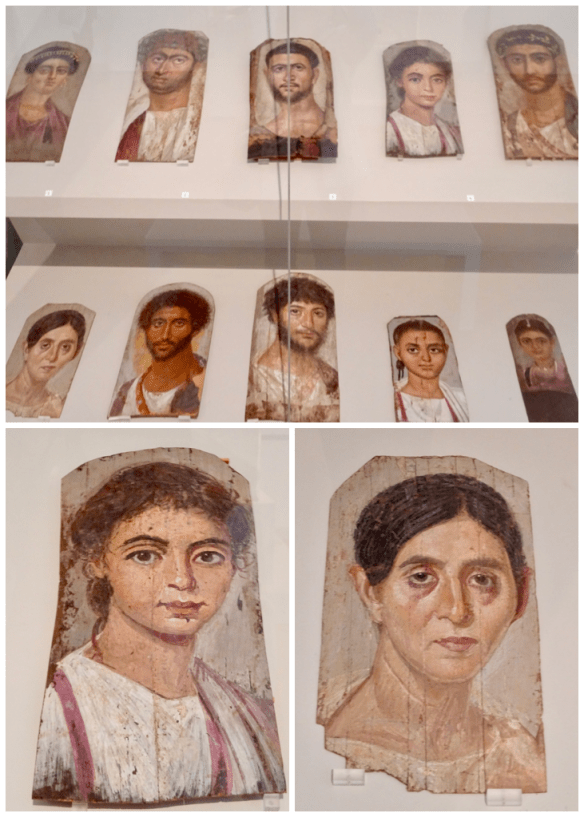
 These 3rd Century A.D.mummy portraits from Roman tombs in Egypt were a surprise. We had never seen anything like them. They were painted with wax and tempera.
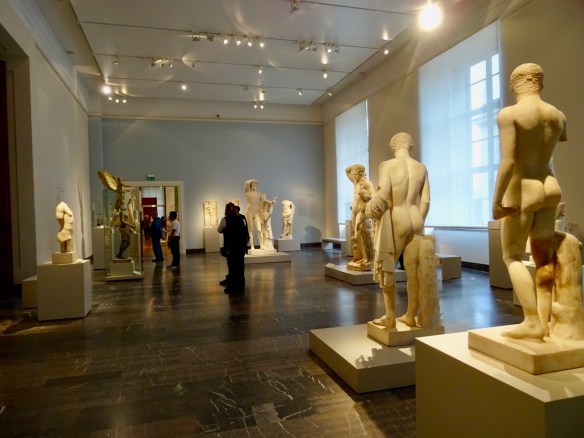
 Another sculpture filled room.
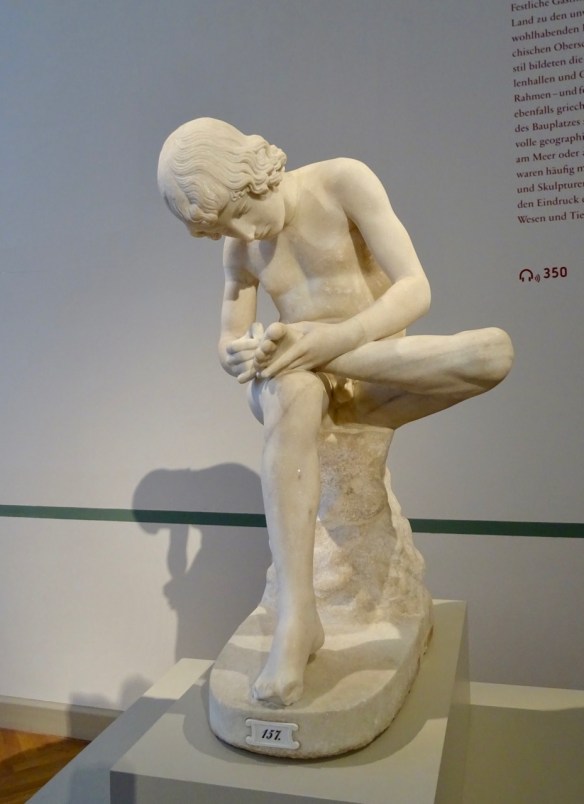
 We have seen Boy with a Thorn, or Spinario, several times in our travels…at the Uffizi Gallery in Florence, in Rome and in Paris. In Rome we saw the original bronze sculpture that inspired the marble copies, It is a favourite of mine.
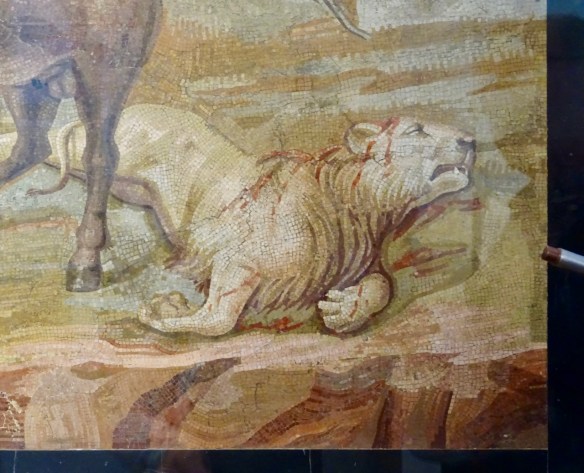
 This looks like a painting,
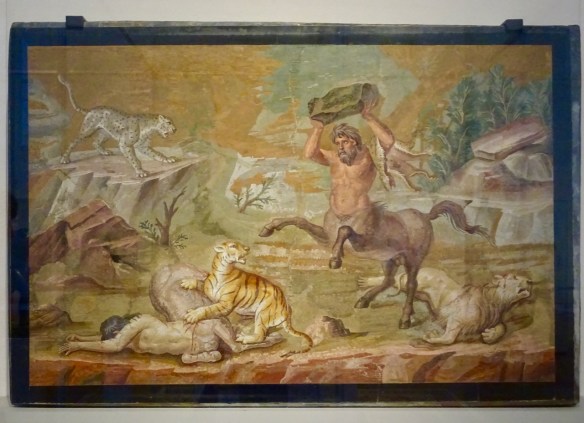 but it is actually a mosaic! I held up a pen in the corner for scale so you can see how tiny the mosaics pieces are.
 This sad little boy was likely on a tomb for a child.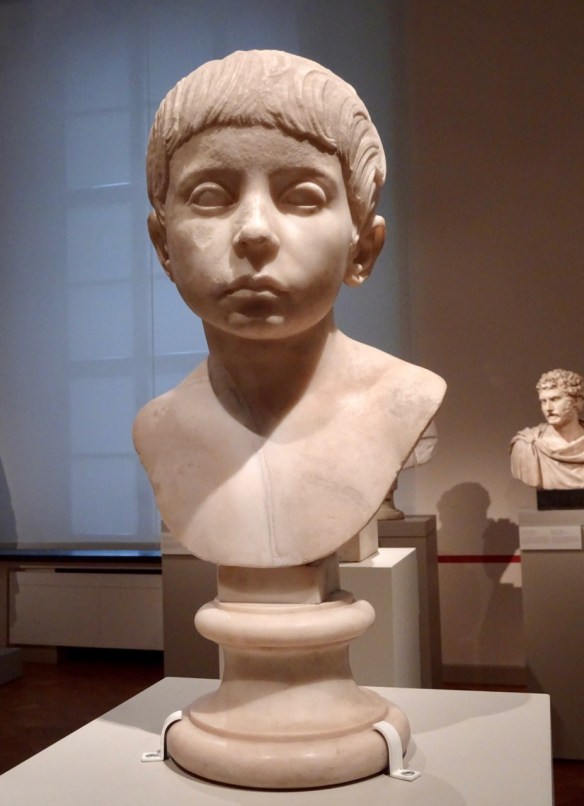
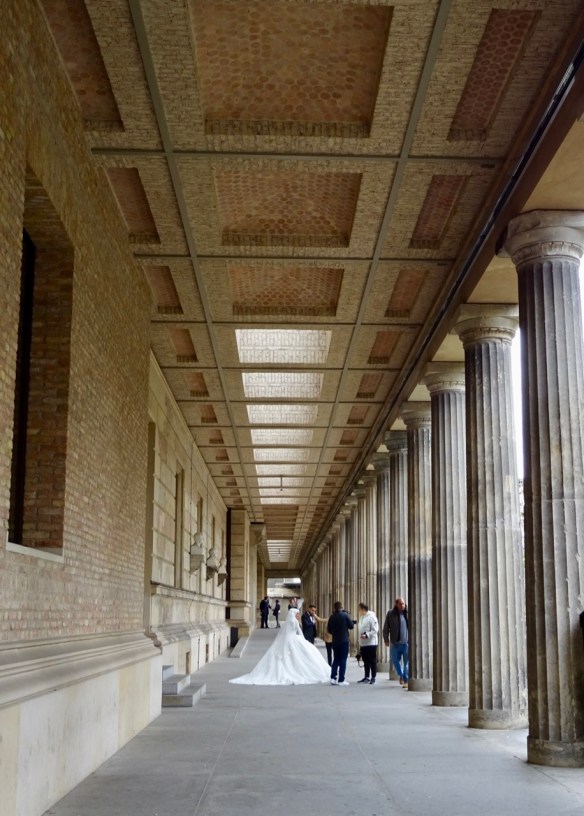
 On a long covered walkway to the next museum we see a wedding photo shoot.
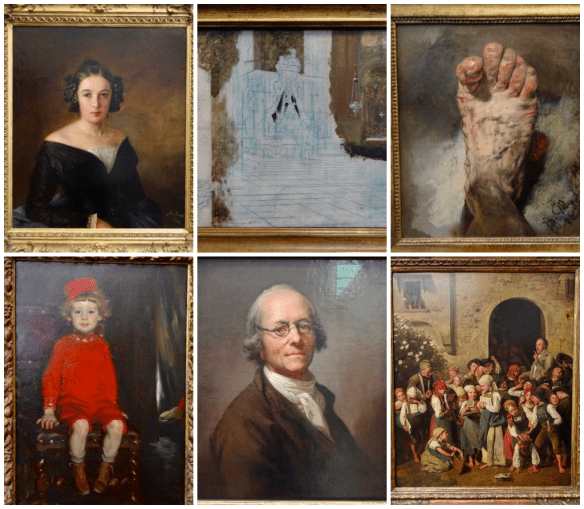
  The Alte National Museum in Berlin features Nineteenth Century art with works by famous painters and sculptors. These are a few paintings that caught my eye, all by German painters that I am not familiar with. There were several paintings that are only partly finished. I found these very interesting, as it is possible to see how the artists approach the painting process.
 There were some Renoirs, Pissaro’s and Carravagios, as well as Rodin’s The Thinker.
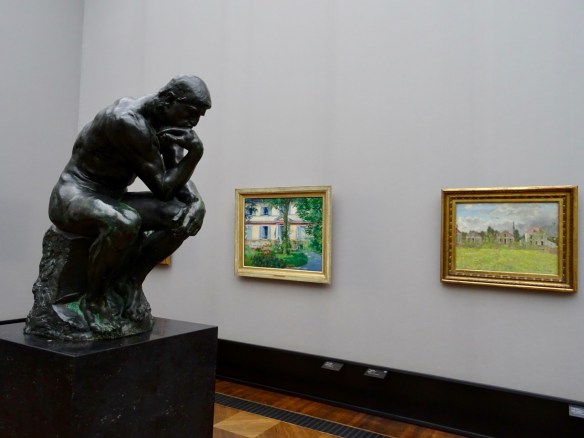 This sculpture was so lifelike and the pose was so natural. There is so much to see, and we have been at these two museums for over five hours!
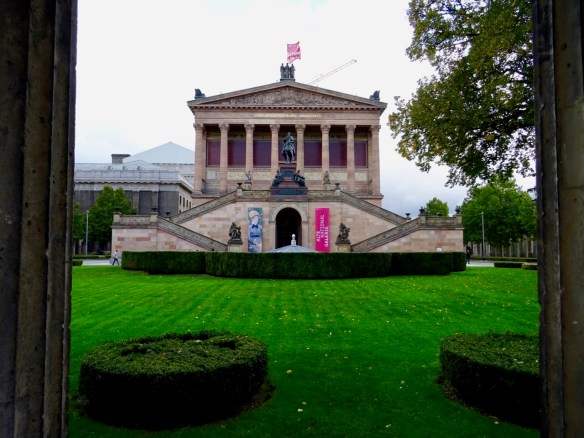
 This is the Alte National Museum, seen from the covered walkway.
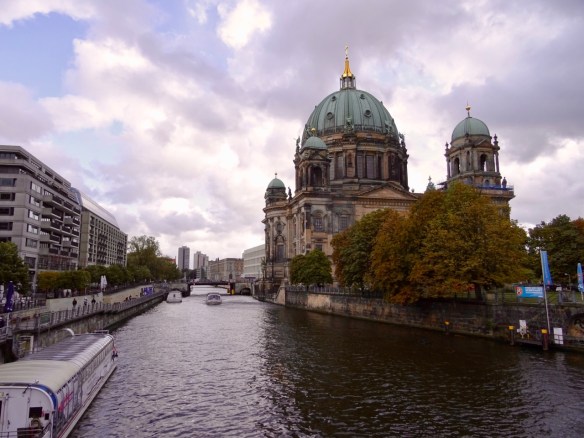
 As we walk to the bus we pass the Berliner Dom, the largest church in Berlin. This photo somehow makes me think of Notre Dame in Paris.
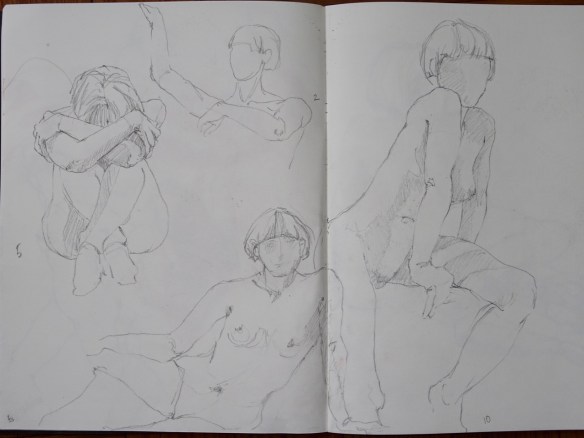
  I am went drawing tonight at a Meet Up Life Drawing session. Our model, Josephine, was very tall and thin which was challenging to draw. These are two minute poses.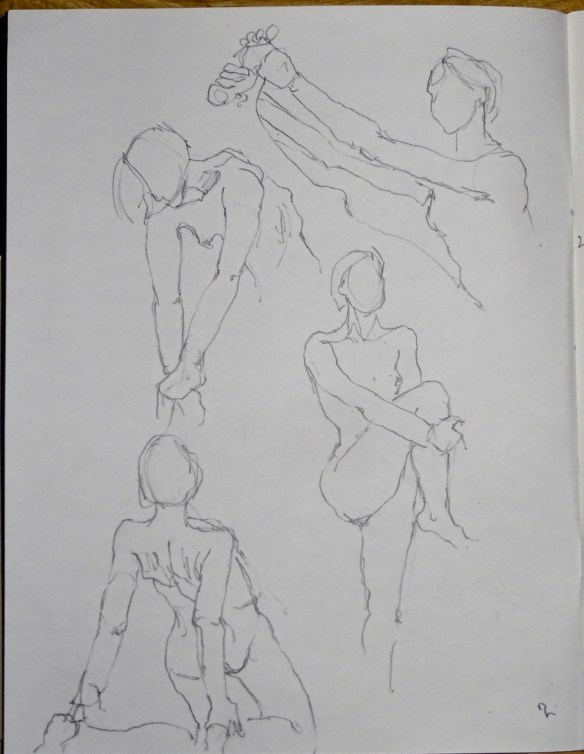
 This is something we don’t see at home…taking your IKEA purchase on public transportation! It has been a long busy day and we are both a bit tired.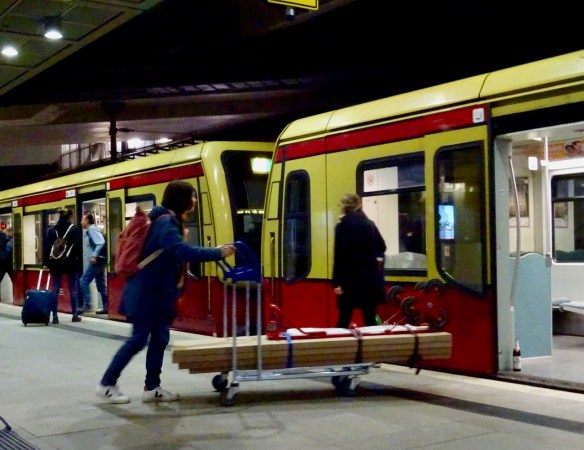
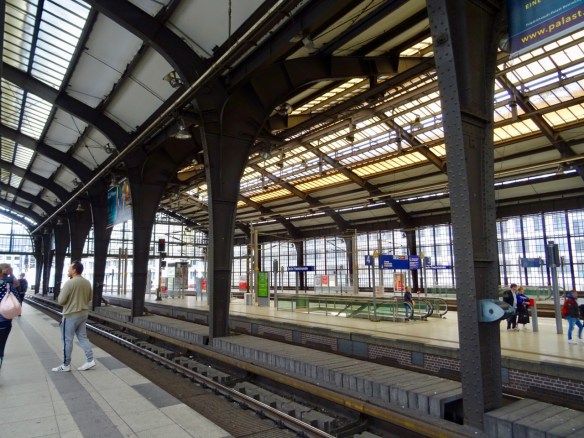
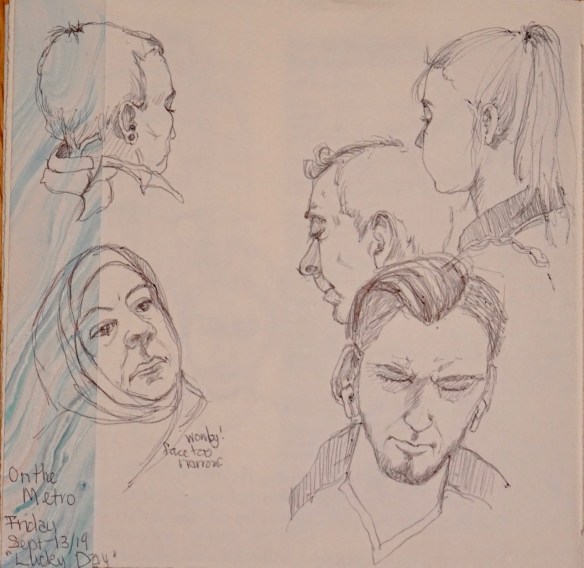 I like to use a Bic Fine Ballpoint pen for these subway drawings. A pen forces me to commit to what I put down, no erasing makes it challenging.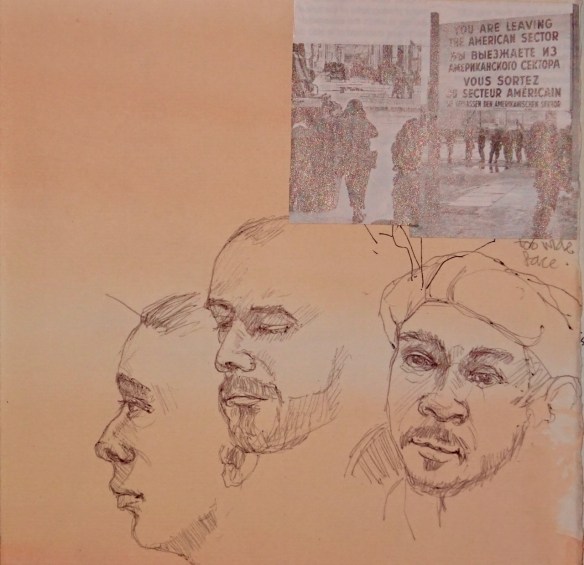
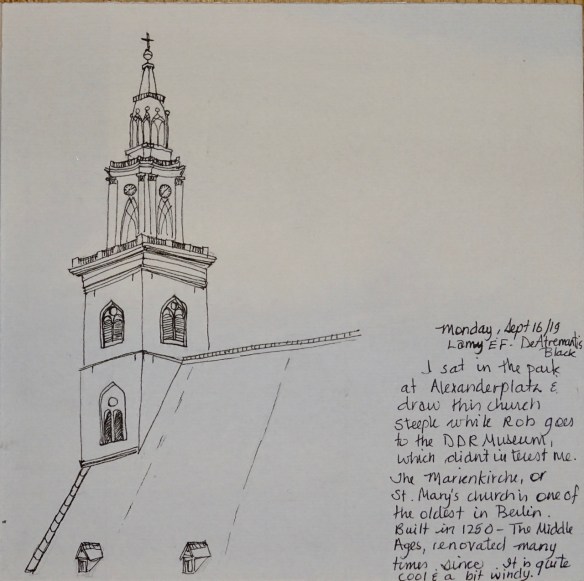
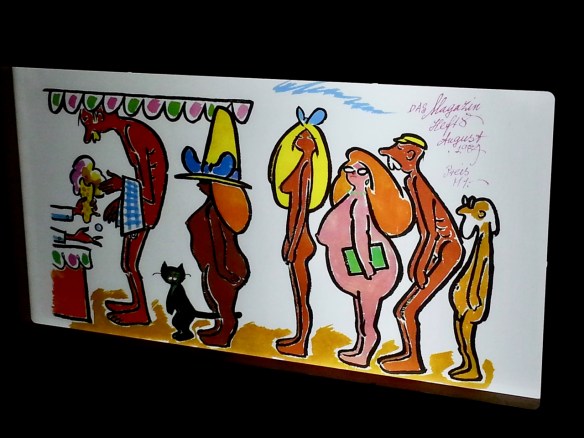
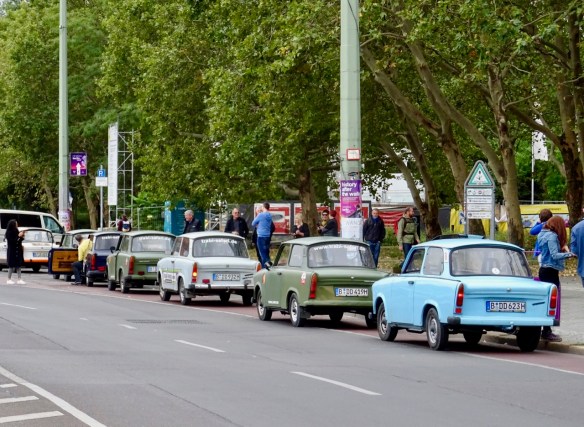
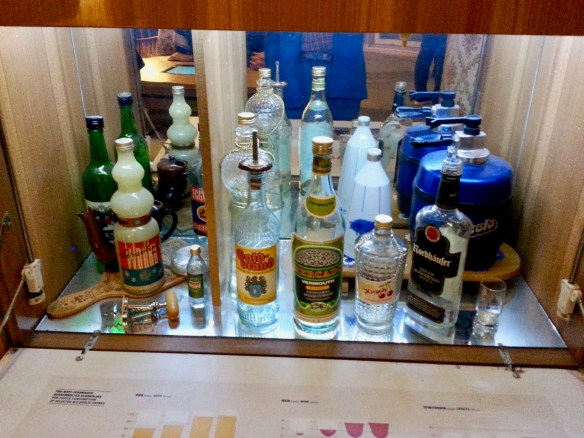 We saw these Trabants on the way to the DDR museum. While there Bob discovered that the cars’ bodies were made from a material called Duroplast. This was a composite material made from cotton fleece and granulated phenol, which was heated under pressure and formed into a rigid component for use on the exteriors of the cars.
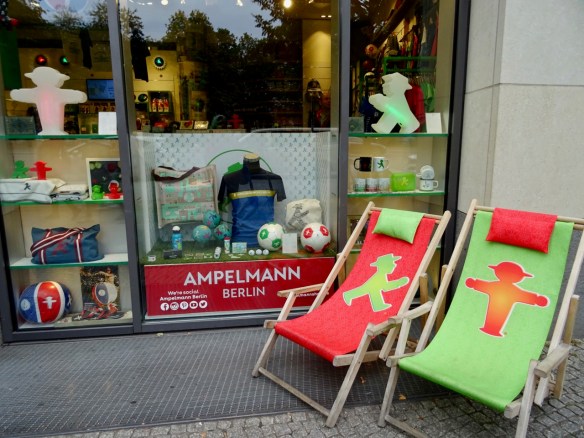
 While walking to a nearby park to draw I passed this store dedicated to the Ampelmann, the little character that lets pedestrians know when it is safe to walk.
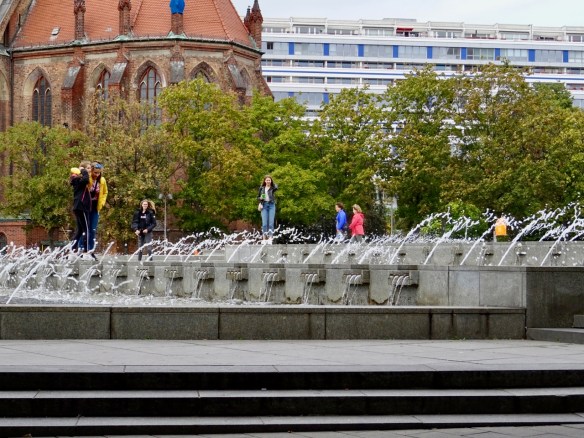
 While I sat drawing the church I watched these young ladies walk out onto the nearby fountain for some photos. I quickly got my camera out because I knew what was going to happen next.
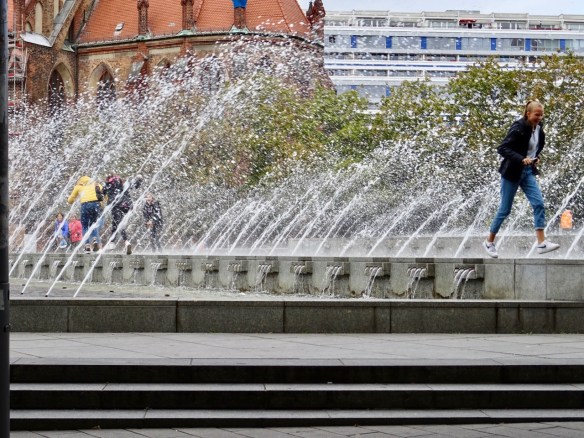
 Surprise!! I laughed so hard, as did all their friends!
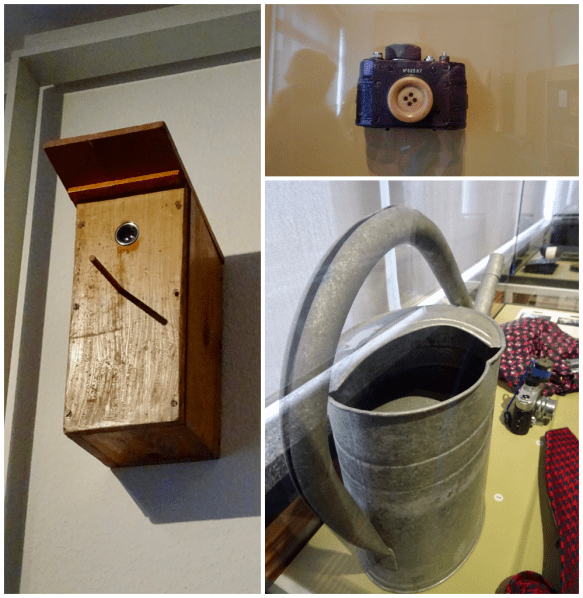
 We had a picnic lunch and then headed to the Stasi Museum. This museum is located on the former grounds of the headquarters of the GDR State Security. We had a two hour tour that talked about how the lives of the East Germans were controlled, manipulated and repressed by the political police system of the former East Germany. Seems like everyone was spying and informing on everyone else, and almost every aspect of people’s lives was controlled by the state. It must have been impossible to trust anyone. Most of the exhibits were like this office room below, not very interesting I thought, but our guide’s talk was very interesting. He told us anecdotes about his life as well as his parents and grandparents lives during this time.
 I hung out at the back of our tour group and did some sketching of people in the tour while I listened.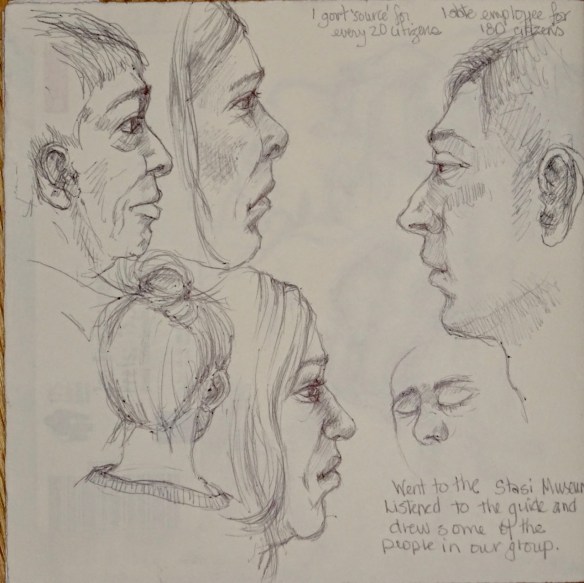
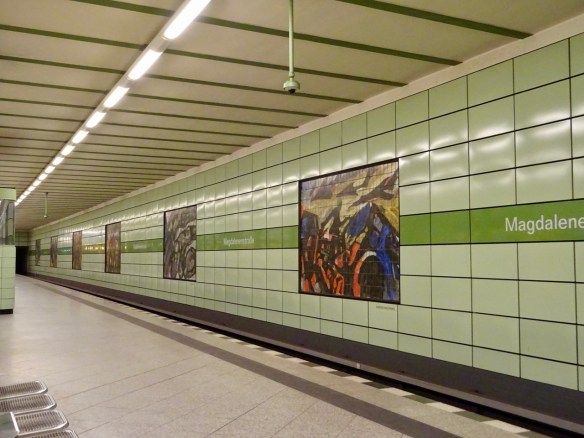
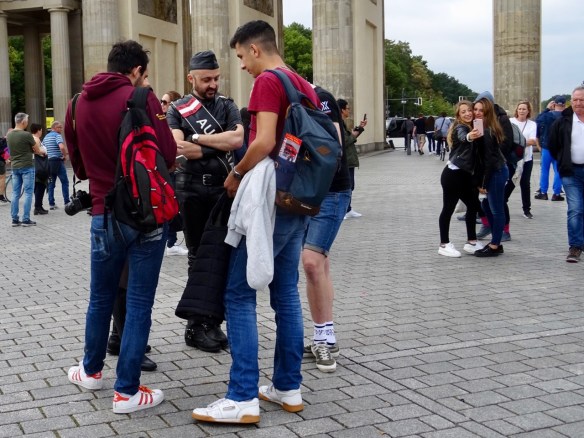
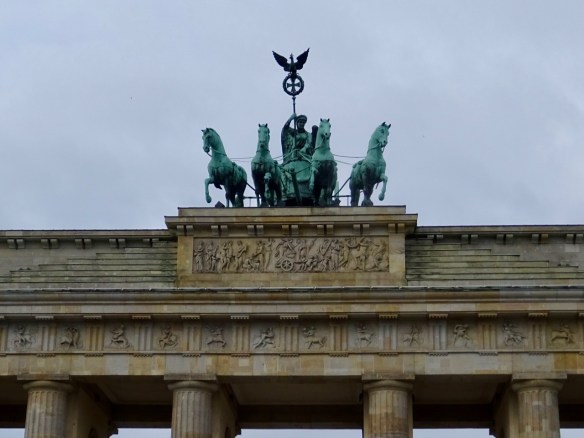 The gate is a popular gathering point for tourists. This fellow was dressed interestingly, turns out he is Austria’s Mr. Fetish 2019!
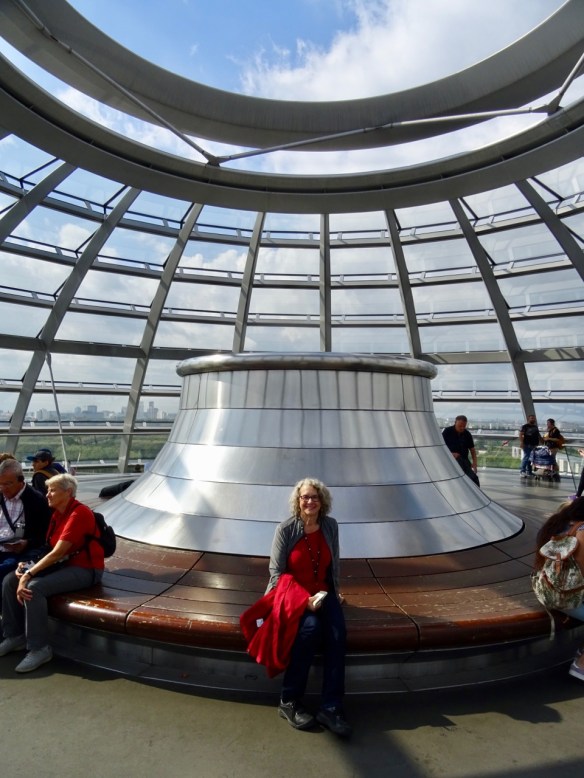
 We walk to the Reichstag Building which houses the German Parliament. We are required to show passports and go through security screening before we are allowed into the building. After riding an elevator with 30 other people we arrive at the dome. Can you find us in the reflections?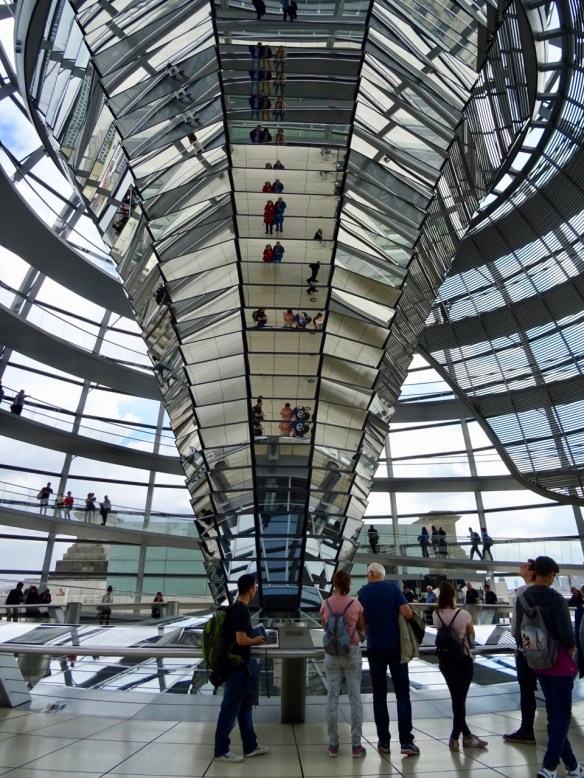
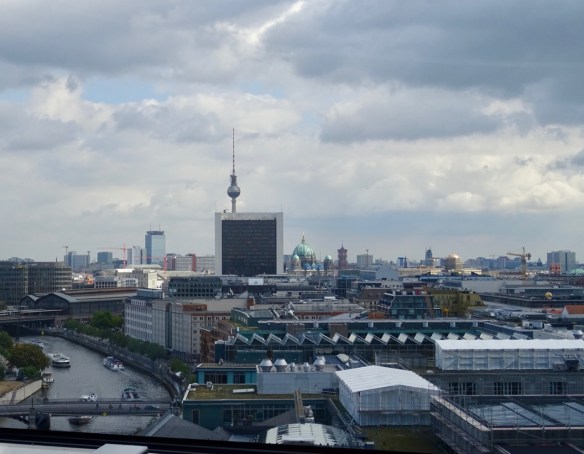
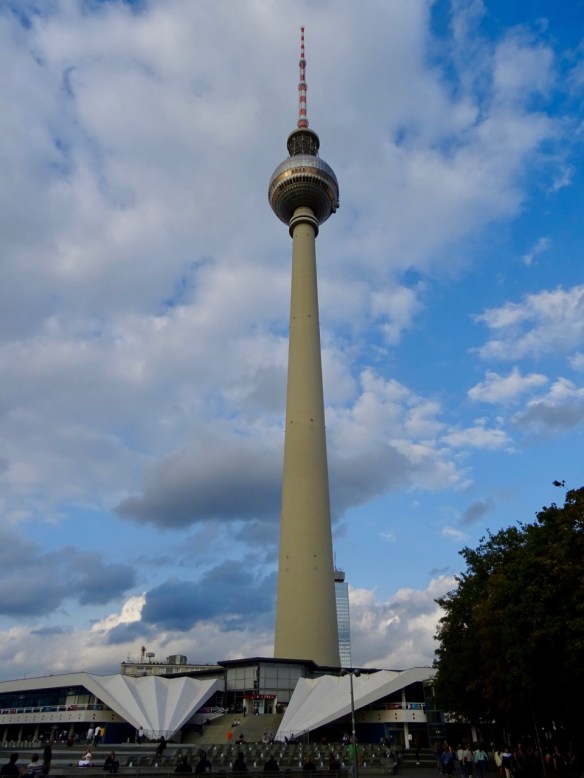
 A view of the 368 meter high TV tower we walked by yesterday. It is the tallest tower in the European Union.The greenish domes beside it belong to the Berlin Cathedral, which is Berlin’s largest church.
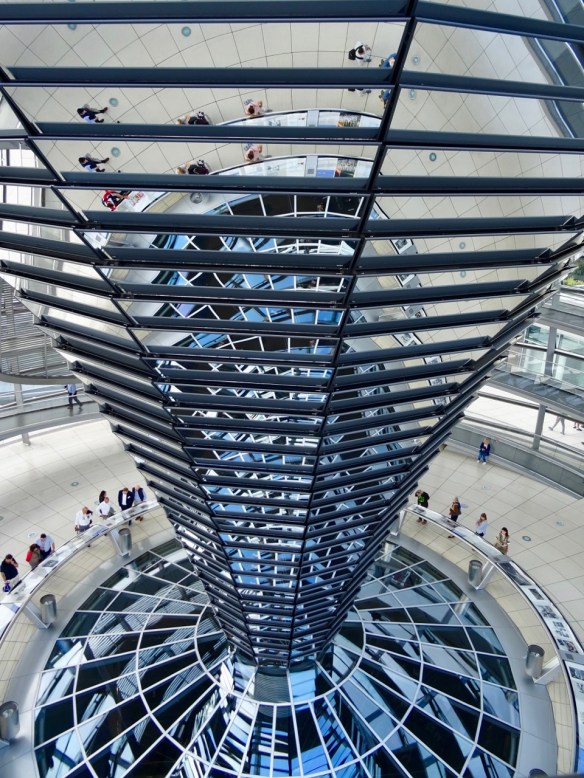
 Looking down from the ramp. The 360 mirrors on this column reflect light down into the parliamentary chambers below the dome.
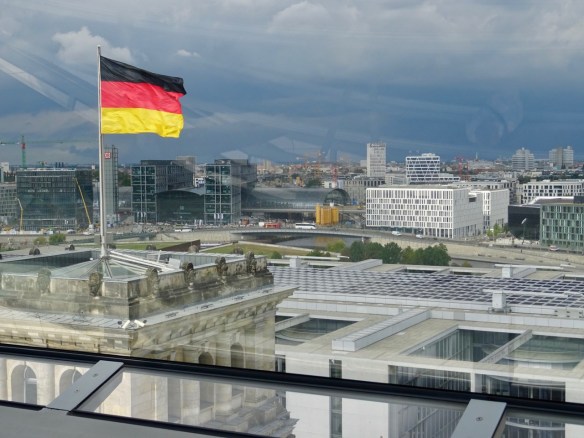
 A view of the Sony Building where the giant giraffe was located. The yellow building is the Berlin Philharmonic which is said to have one of the best orchestras in the world.
 At the top of the dome is a 10 meter diameter opening which provides fresh air. Rain falls through it into the cone and is recycled. The warmth of the stale air rising in the dome is recovered by this cone and used to heat the building, along with 300 square metres of solar panels. The dome is 40 metres wide and opening at the top is 54 metres off the ground. It is very impressive.
 The sky is getting very dark outside and the wind has picked up. I think we might get wet!
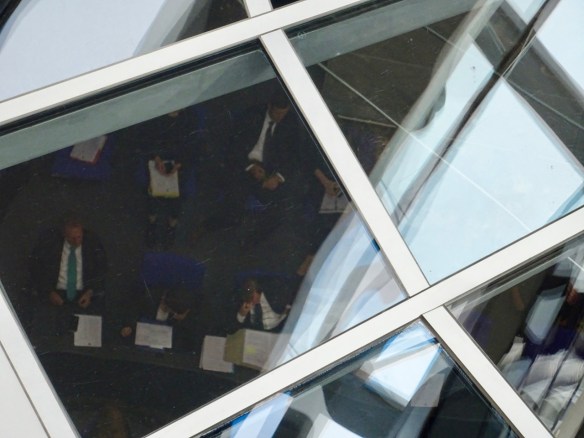
 If you look at the square in front of the lady in black pants in this picture you might be able to make out the members of Parliament sitting below the dome. They look like little whitish spots.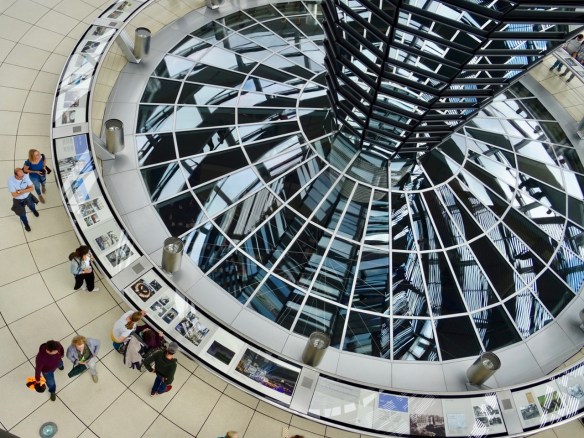
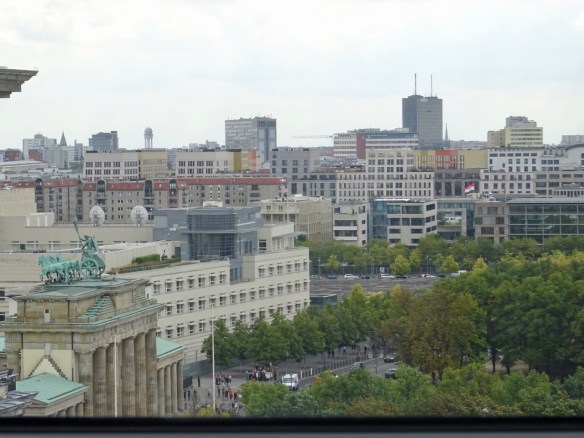
 A view towards the Brandenburg gate and the Jewish Memorial which is the grey area beside the white building.
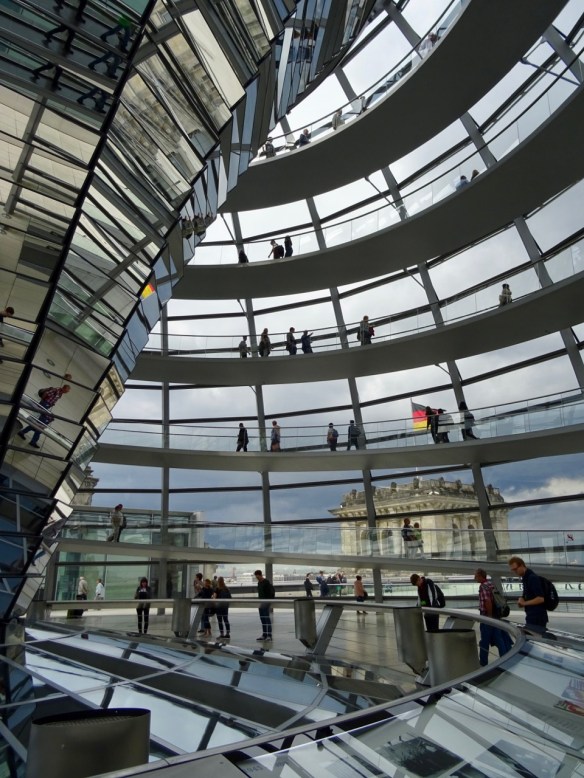
 Walking down from the top of the dome, we are on a ramp which is in-between the up ramp. You can see people walking in different directions, some going up, some going down.
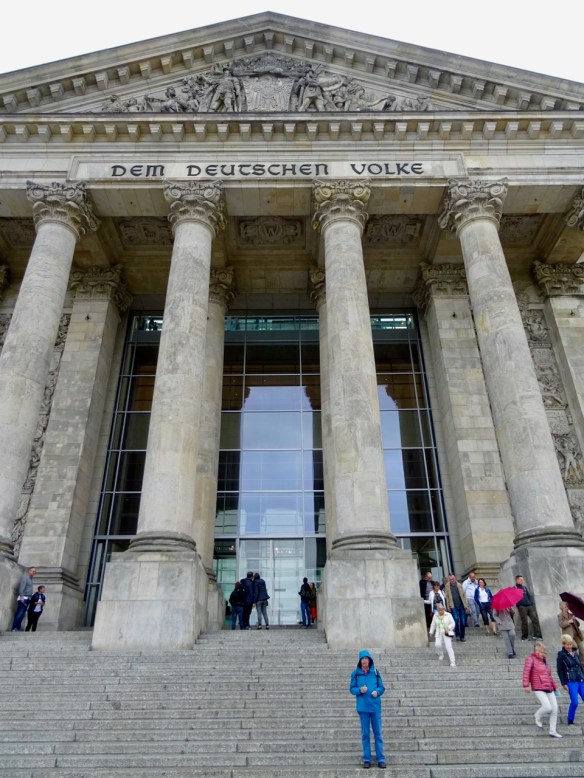
 It is cold and wet when we get outside. The inscription reads “The German People”
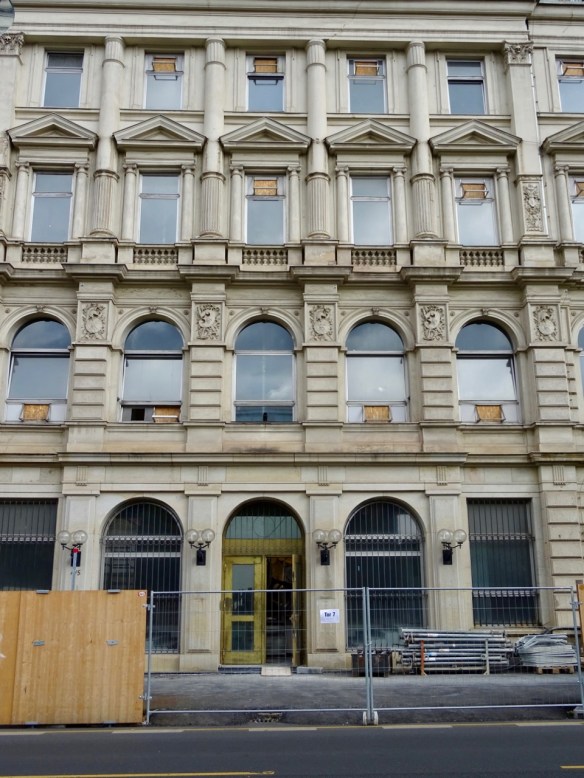
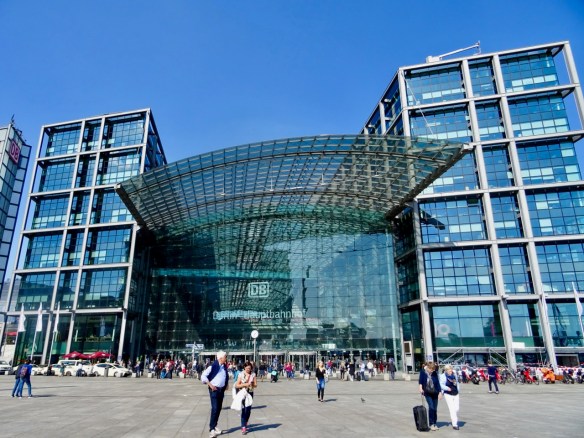
 We pass this building under construction. The inside is completely gutted. A new modern interior will be built but the exterior will be preserved. We see other buildings undergoing this process. We walk to one of the nearby train stations to find a place to eat a late lunch and we are pleasantly surprised to find the sun is shining when we come back outside.
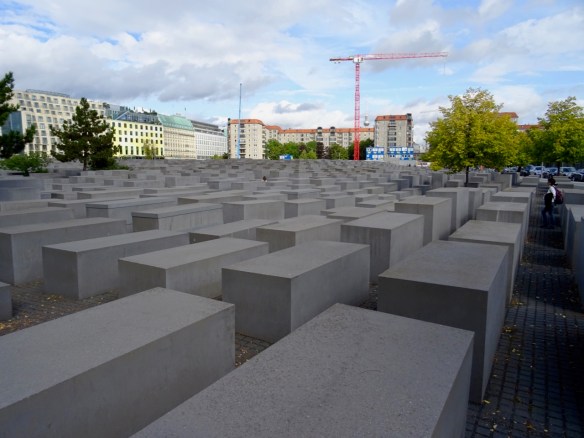
 The Memorial to the Murdered Jews of Europe is a 19,000 square metre site covered with 2,711 grey concrete slabs, or stelae ranging in height from 8″ to 15′. It is situated on part of the former Berlin Wall Death Strip.
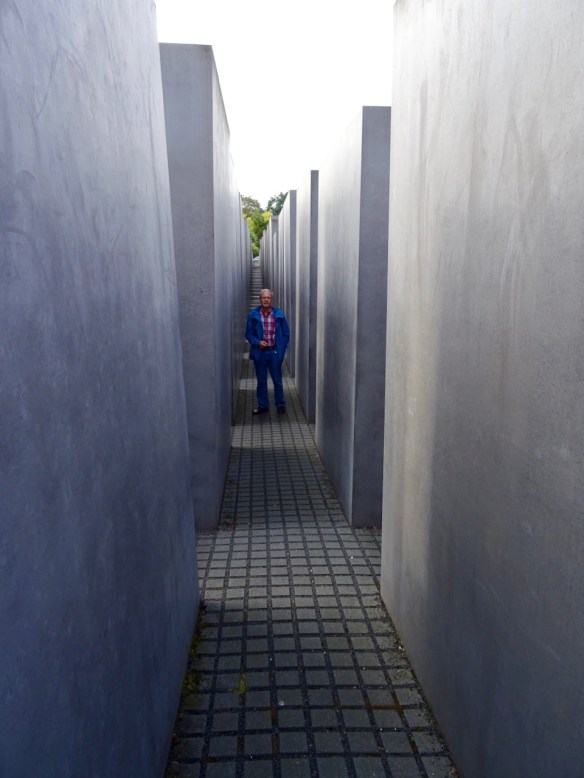 There are 54 x 87 rows of these 7′ x 3′ long stelae, and the ground between rows is uneven and undulating. There is an information centre with displays and a list of names of 3,000,000 of the Jews who were killed in the Holocaust but we did not go inside. This is a sombre place, but something seems missing. The walls of names of the Holocaust victims that we saw at Auschwitz had a stronger impact on me than this memorial site.
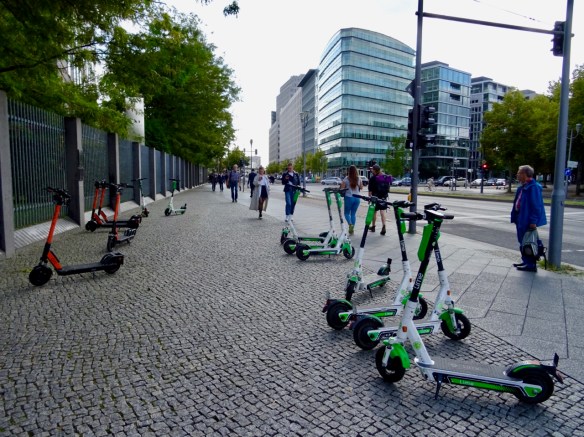
 Walking towards Checkpoint Charlie we pass some of the many electric scooters that are scattered around the city. People ride these in on sidewalks and in traffic, sometimes two people on a single scooter! Seems kind of dangerous to me and the busses honk their horns at them all the time!
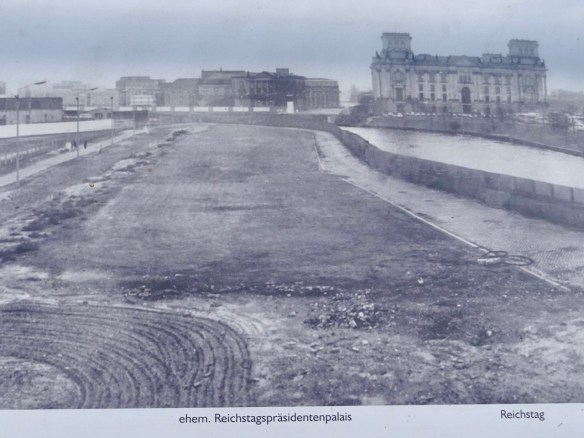
 A photo on a street display showing the Berlin Wall and the Death Strip near the Reichstag Building .
 We stop for a rest at Checkpoint Charlie Beach!
 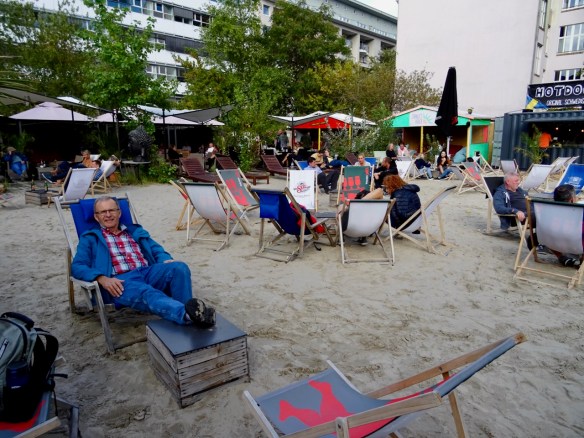 Where Bob tries a very strange hotdog, filled with mashed potato and lettuce. He said it wasn’t very good.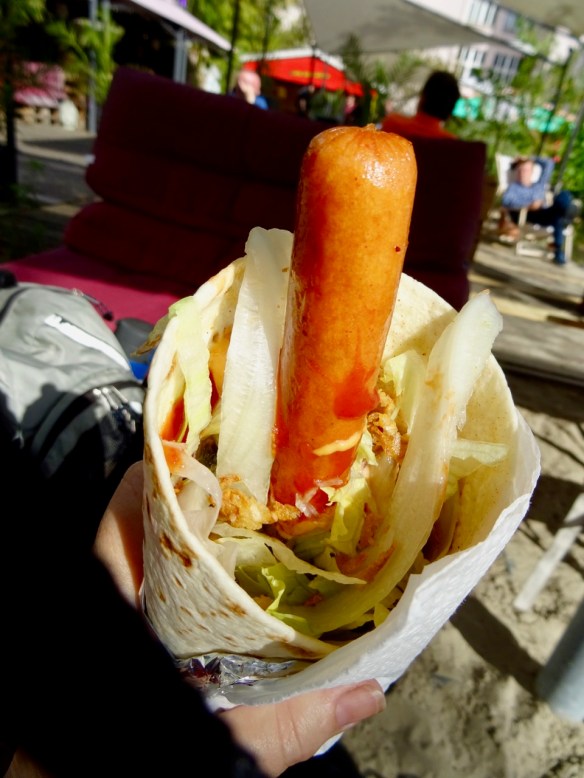
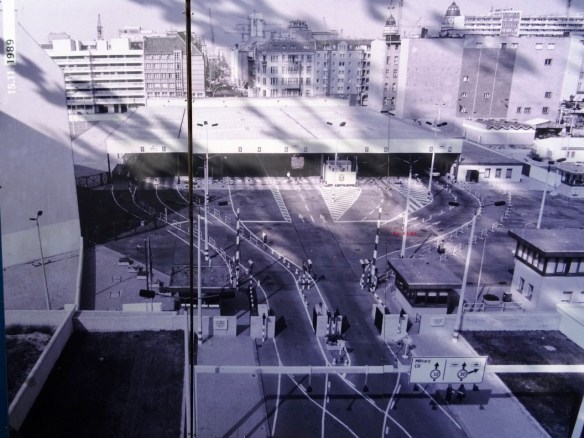
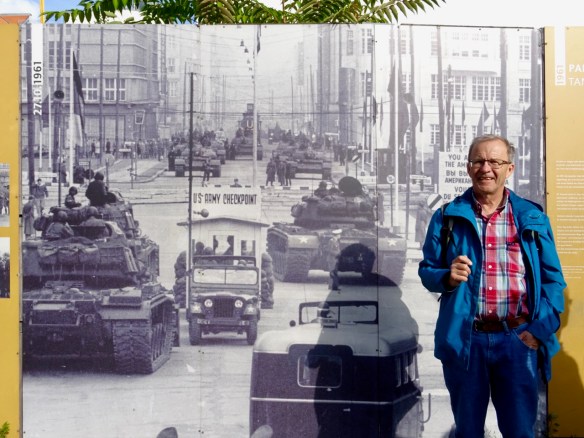 This checkpoint grew in stature over the years. This photo is from 1989.
 We come across pieces of the Berlin Wall in several locations along our route today.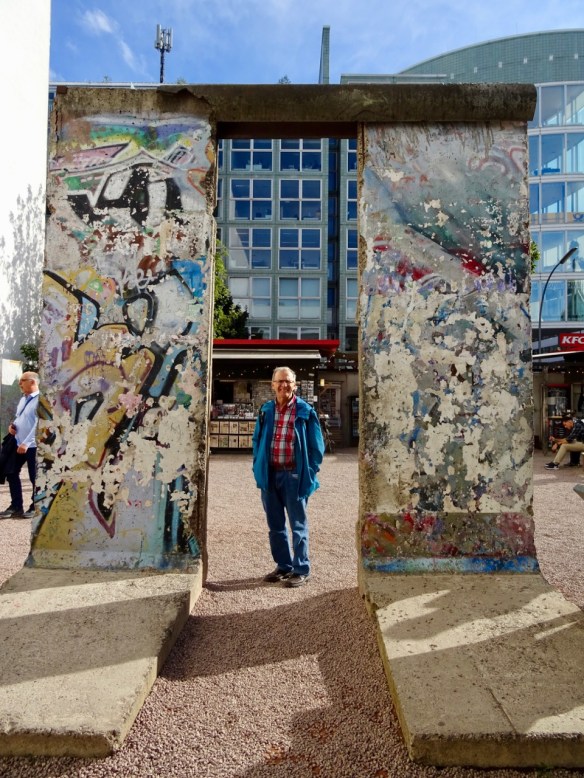
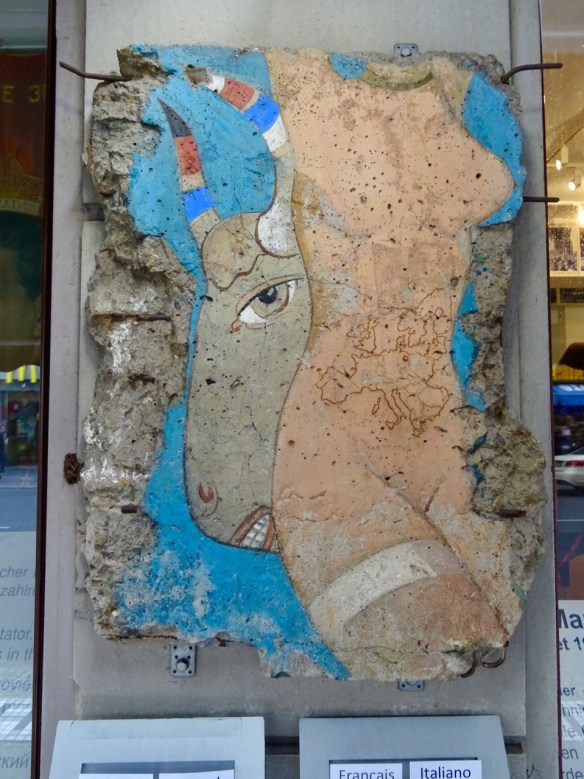
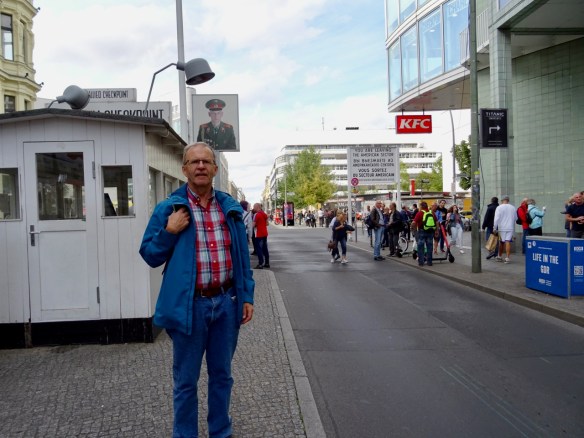
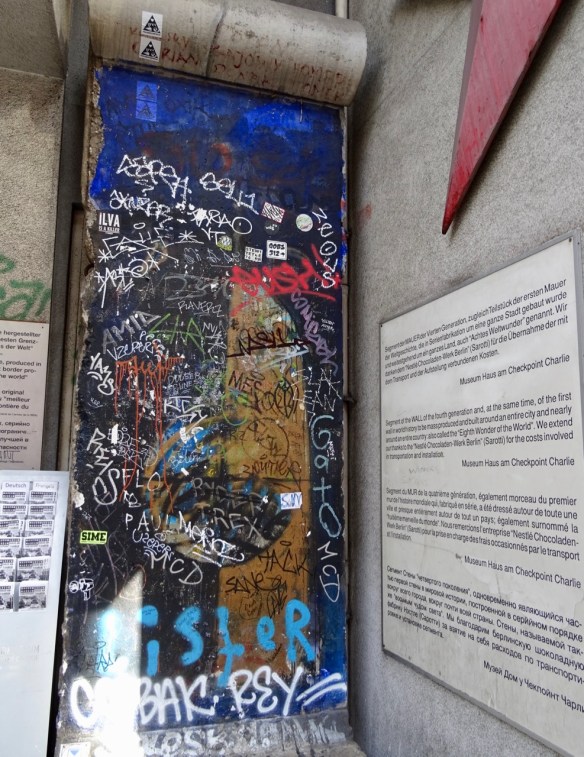 Checkpoint Charlie from the Soviet side, looking to the American side…
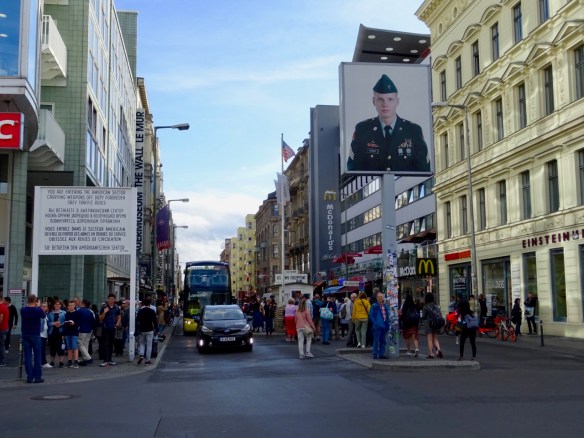 and from the American side looking toward the Soviet side.
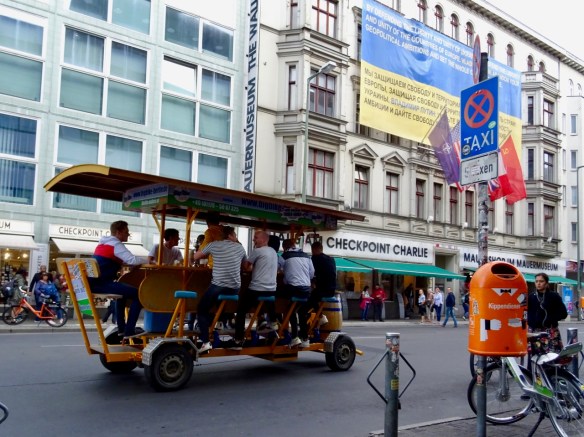
 After all the heavy stuff we saw today we have to laugh as this vehicle full of very loud beer drinking young men goes down the street! It is powered by the peddling of the drinkers onboard.
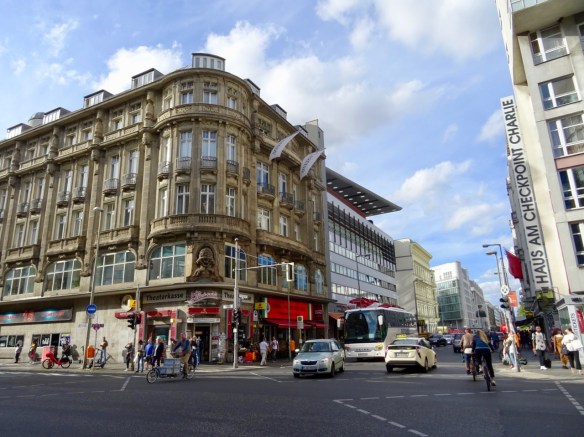
 A interesting building on our way to the metro station. This
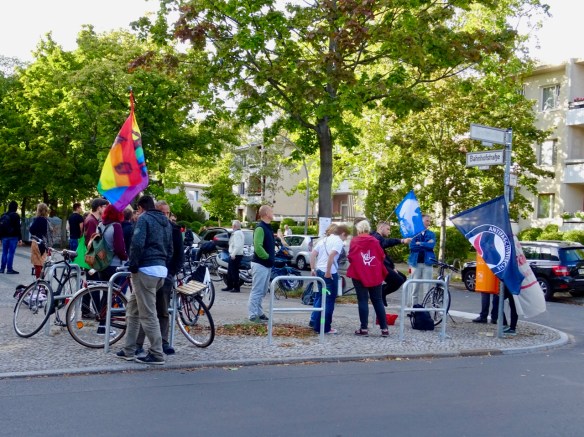
  Near home we come across this demonstration against far right extremists. We have seen several of these protests and they are always accompanied by a heavy police presence, no matter how small the rally. Actually, we found that there is a heavy police presence everywhere is Berlin.
 This is one of the tiniest cars I have ever seen. it only holds one passenger.
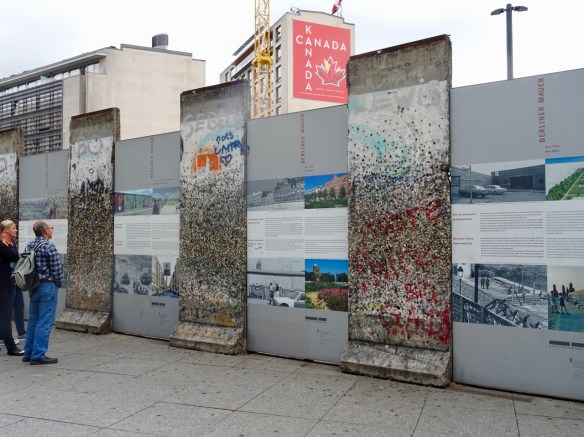
 There are some pieces of the Berlin Wall here and for some strange reason they are plastered with wads of chewing gum left by visitors. Notice behind the wall is the Canadian Embassy.
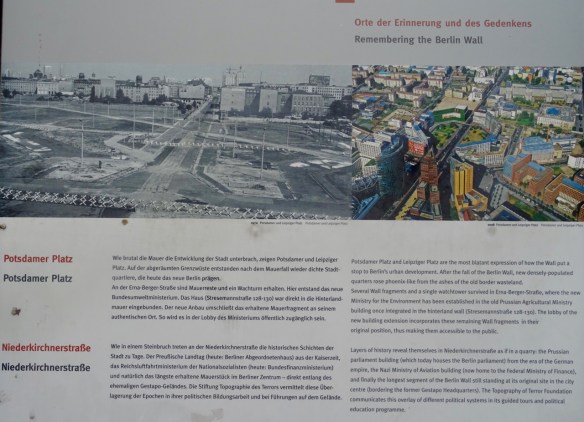
 The display was very informative. Bob knows a lot more about the history of Berlin than I do so I found these panels quite interesting. This one shows the Dead Zone, which was the unoccupied area around the Berlin Wall, and the developed area now.
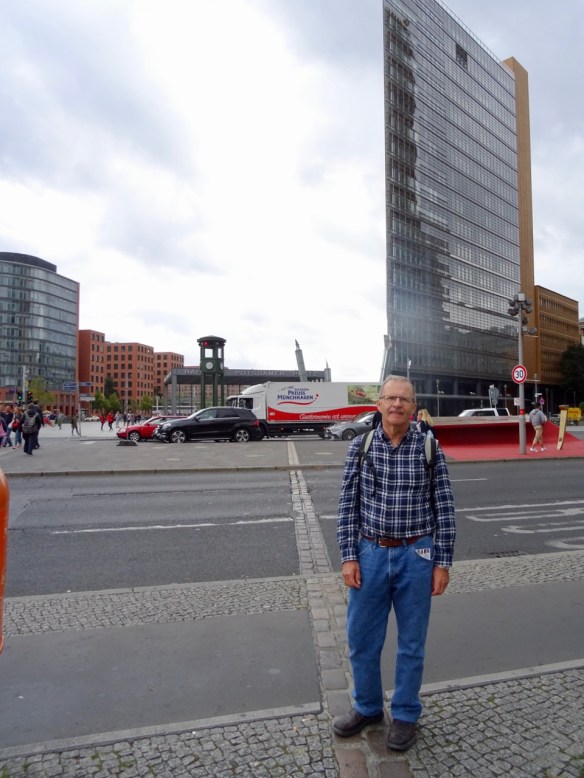
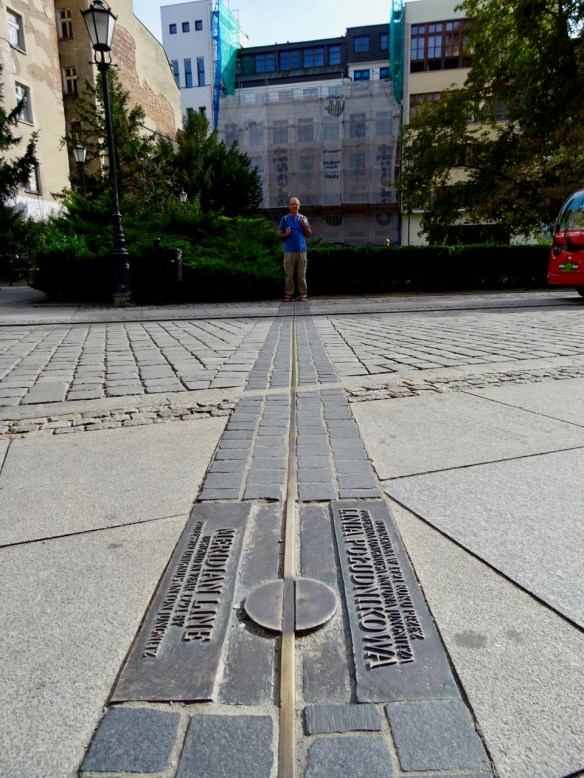
 The cobbled line Bob is standing on is where the Berlin Wall used to be located.
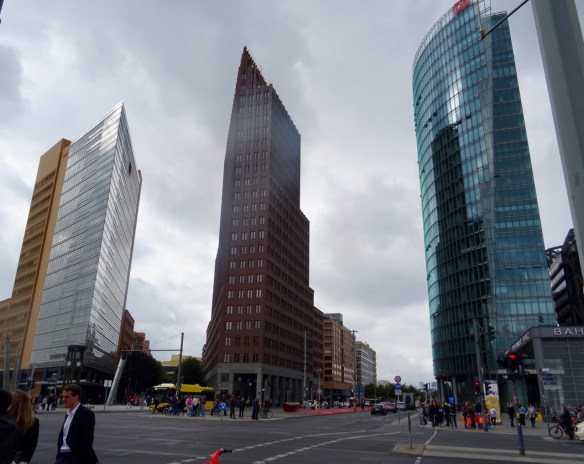
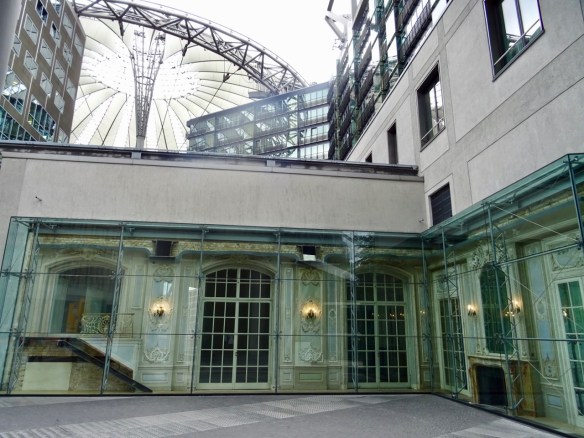
 We walk to the Sony centre and find this interesting building that has part of an old hotel interior enclosed in glass as part of its exterior wall.
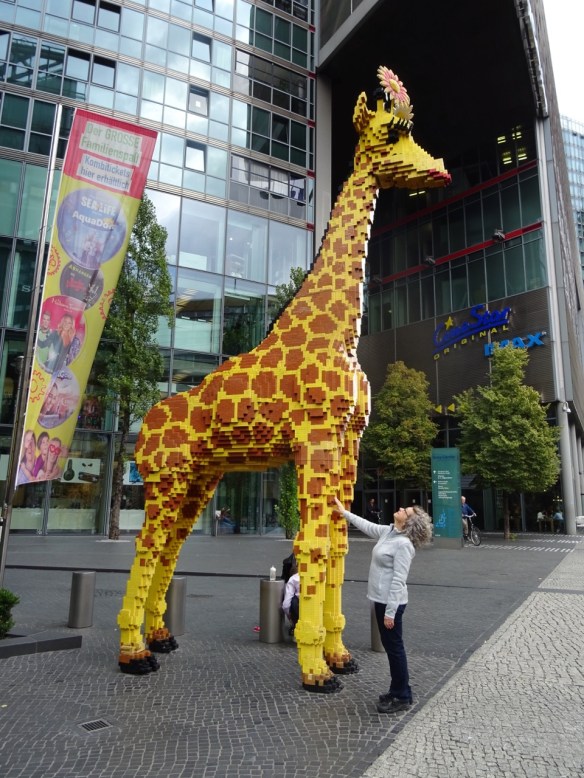
  Wow! This LEGO giraffe is the biggest giraffe I have ever seen…
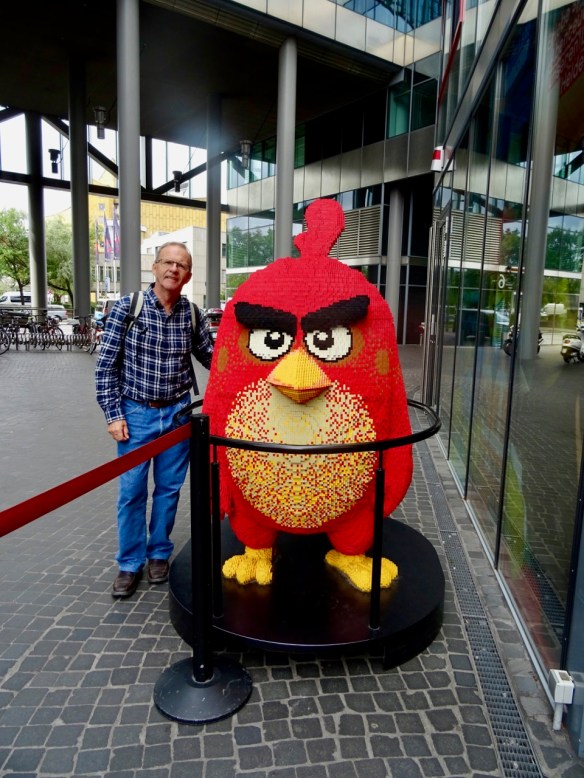
 and Bob found a pretty huge Angry Bird!
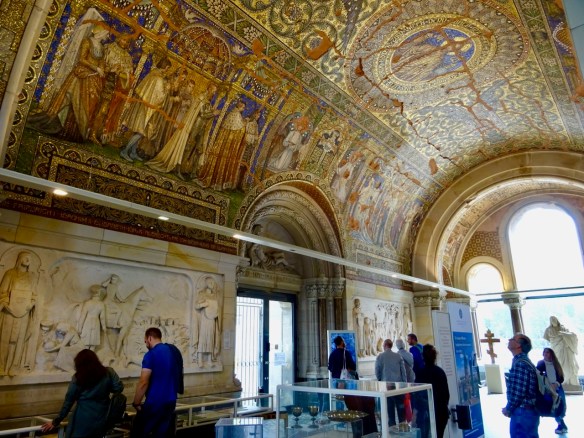
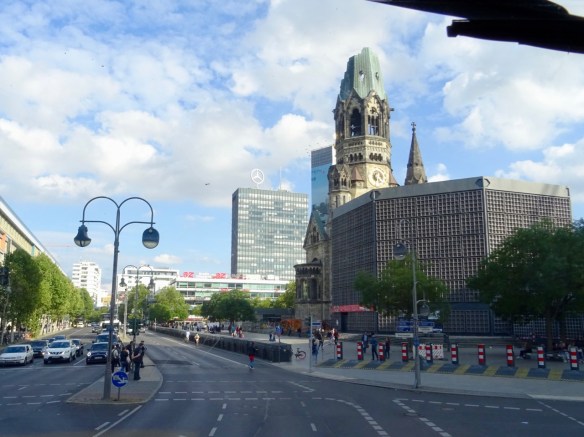
 We make our own Hop-On Hop-Off tour by catching the #100 bus. First stop is the Kaiser Wilhelm Memorial Church. It was destroyed by the bombing in WWII and is now an anti-war memorial to peace and reconciliation.
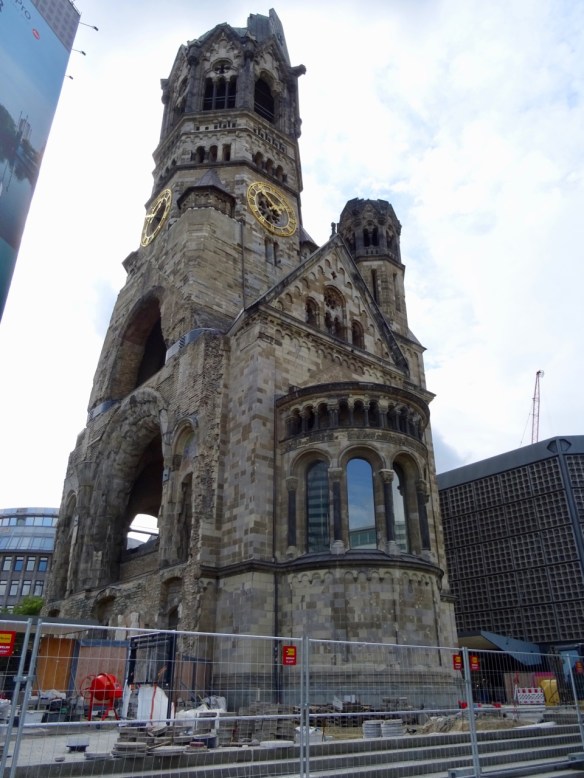 This is what the church used to look like.
 The little bit of the interior that remains is covered in beautiful mosaics…
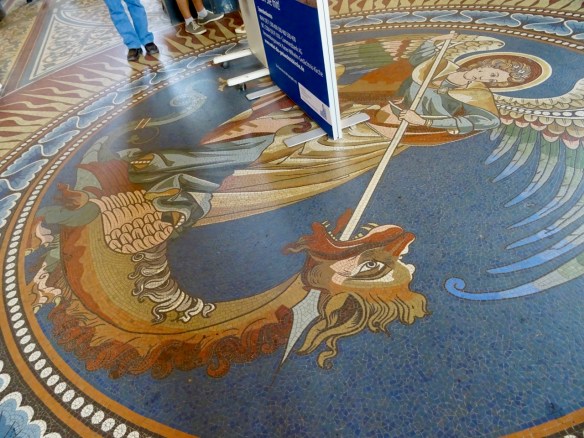
 even the floor is completely decorated with mosaic tiles. It must have been an incredibly beautiful church.
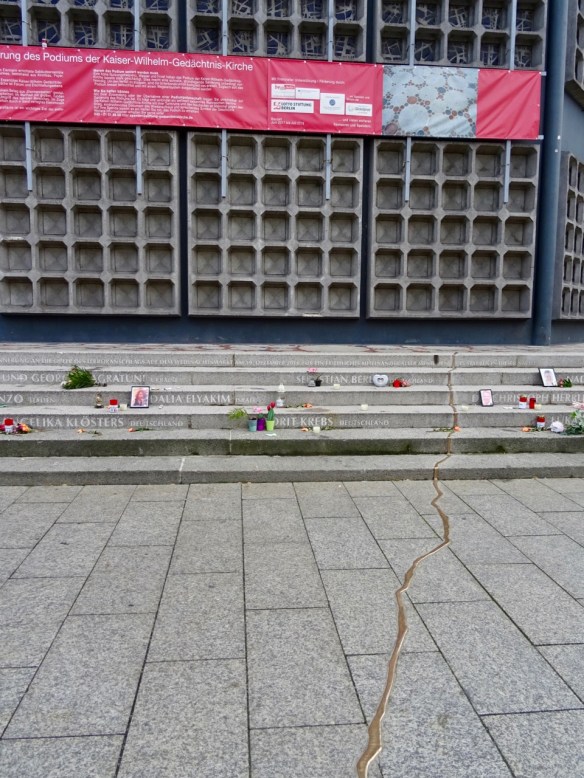
 Outside we see this memorial for the victims of a terrorist attack on December 19, 2016 on the steps of the Memorial Church, A stolen truck was driven into the crowd at the Christmas Market and twelve people were killed and seventy were seriously injured. The names of the deceased are engraved on the steps and the bronze crack represents the fracture the attack inflicted on society. It is like a scar and shows that healing and everyday life are possible, but we should not ignore or forget the scars we bear and what caused them.
  We walk inside the Memorial Church and I am quite overcome. Something about this space moved me to tears. It is unlike anything I have seen before.
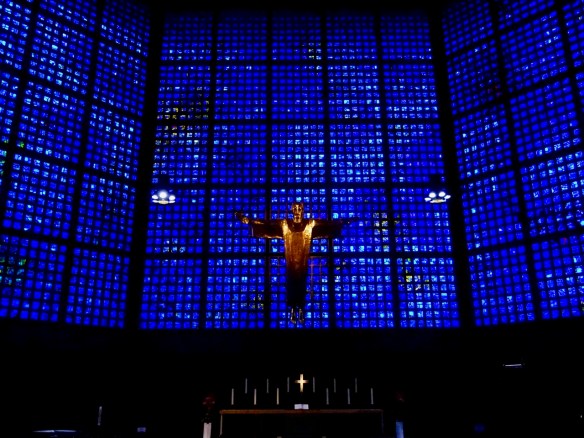 This Christ figure was beautiful.
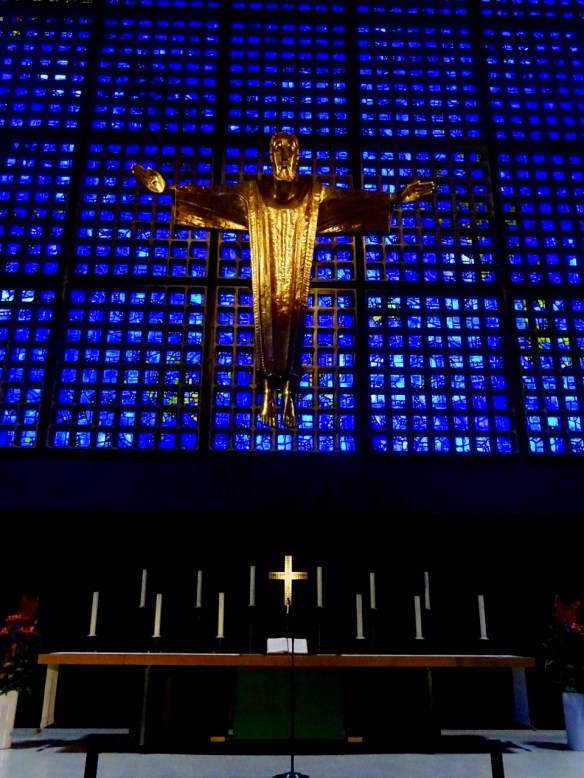 There is a concert here tonight and we sit for a while listening to the two organists practicing for tonight’s performance. You can see them in this photo. To listen to the organ music
 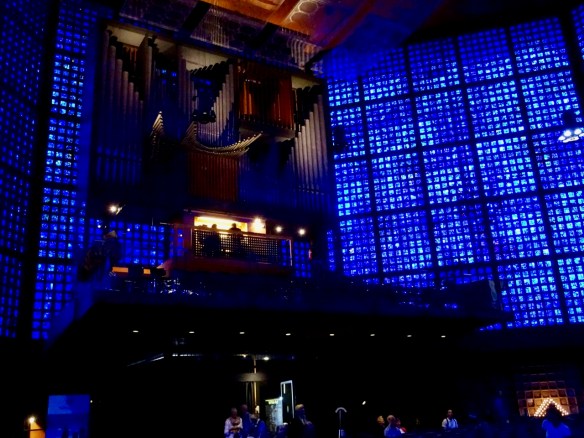 The walls are made of 22,200 panes of stained glass and each pane is made of many individual glass pieces.
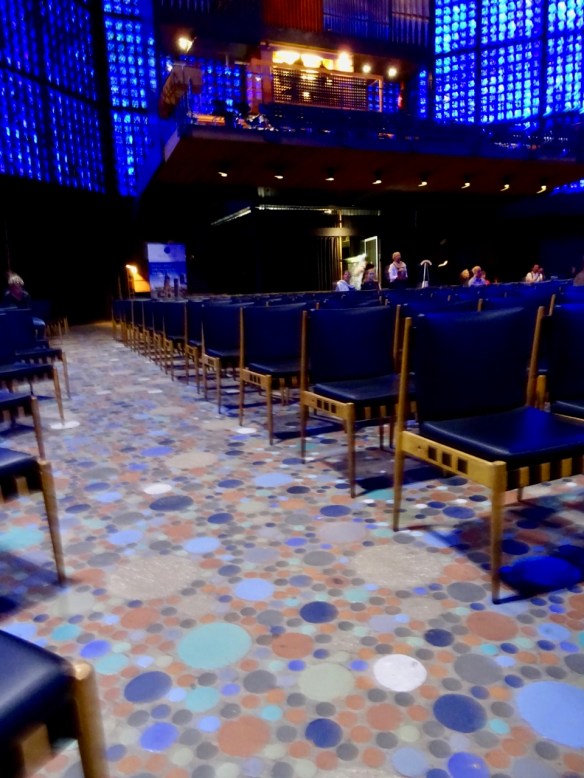
  The floor is covered in circles of many colours and sizes. It made me think that all those little pieces of glass and all the circles on the floor could represent people who have died and are memorialized in this church.
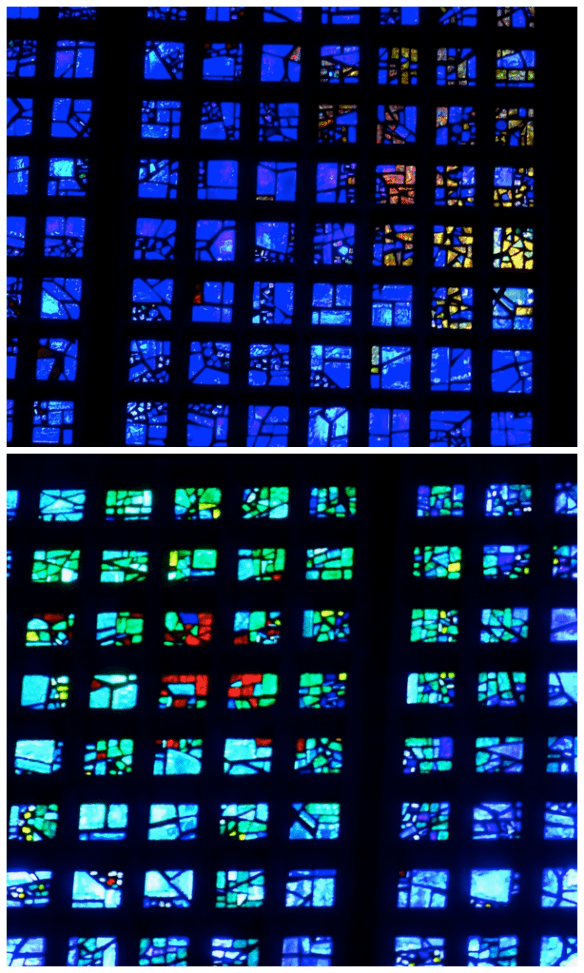
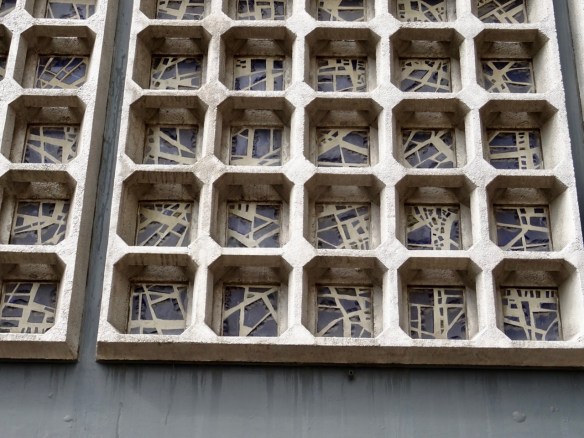
 The outside walls show how each piece of glass is embedded in mortar within each individual pane. The outside of this church gives no hint of the vibrant colours inside.
 We walk down the broad boulevard between the lanes of traffic. Here is a view looking back towards the bombed church.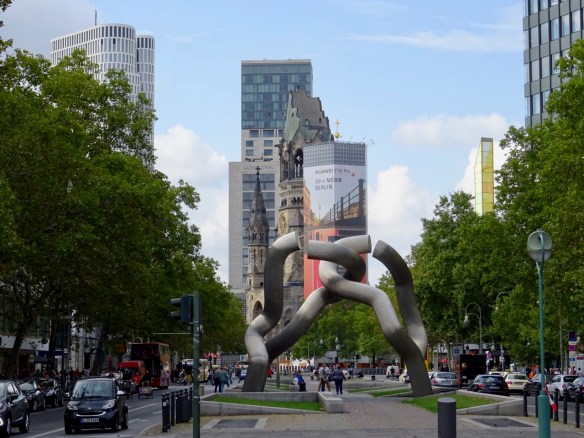
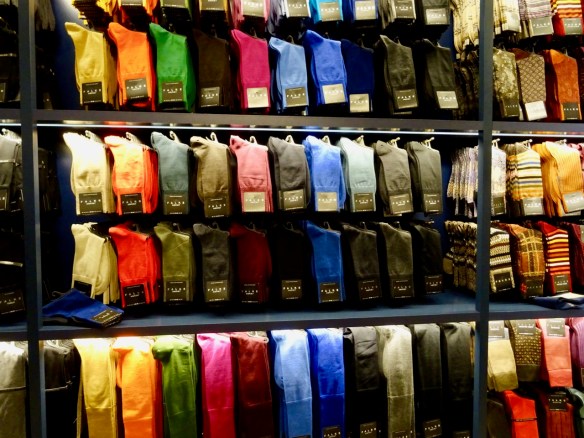
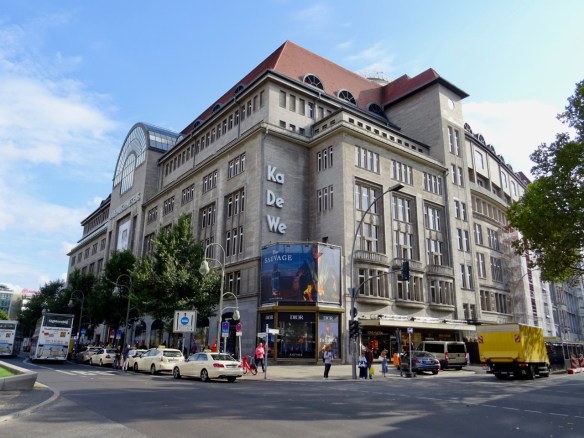 We make our way up to the sixth floor and find a whole floor of yummy things to eat. Too bad there are no gluten, dairy and egg free options for me.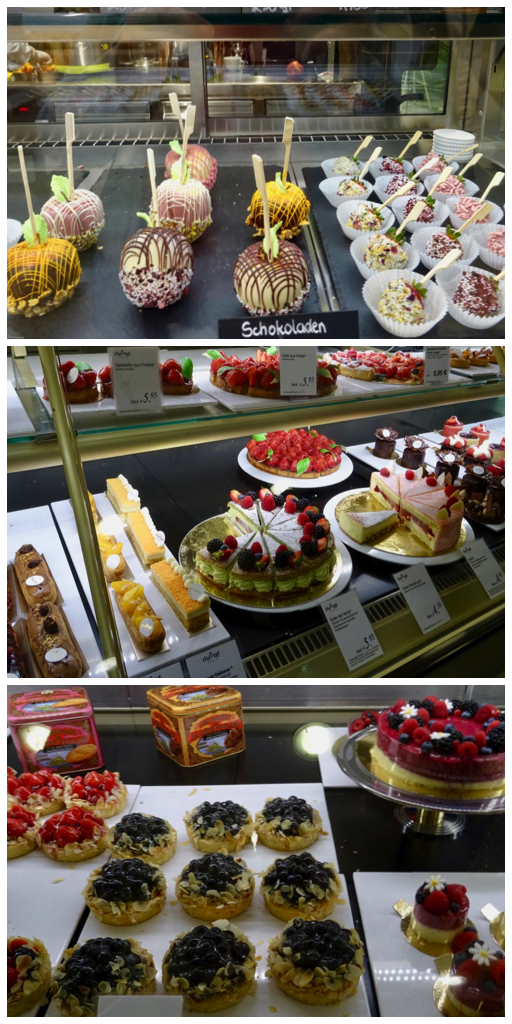
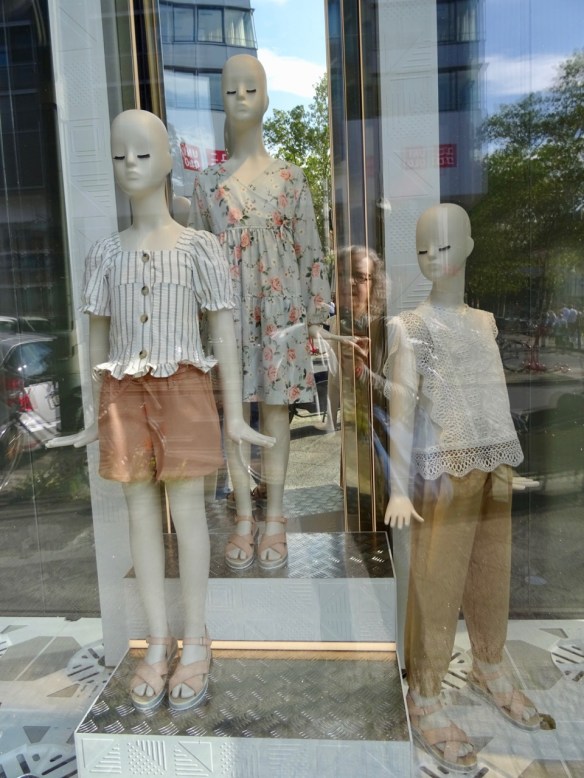
 Here is what fashionable girls are wearing in Berlin.
  We continue our tour on a double decker bus. This is the first time we have sat up front on the top of one of these busses. !t does give a different viewpoint.
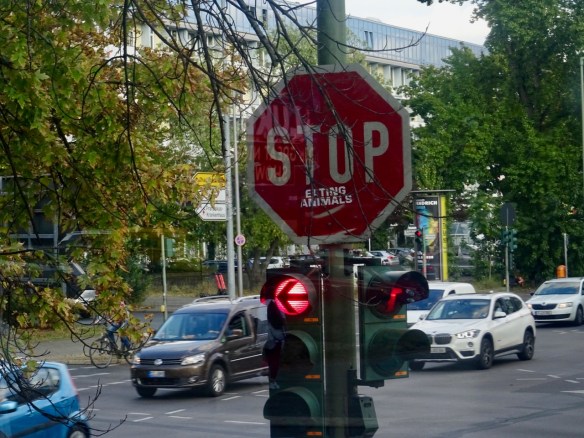
 Bob notices something strange about this stop sign.
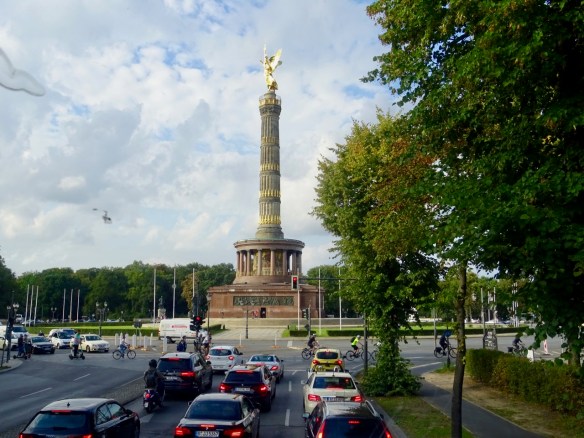
 We drive through the centre of a huge park and around this monument. The Victory Column with Victoria, the Goddess of Victory in the centre of the Tiergarten park is one of Berlin’s most famous landmarks.
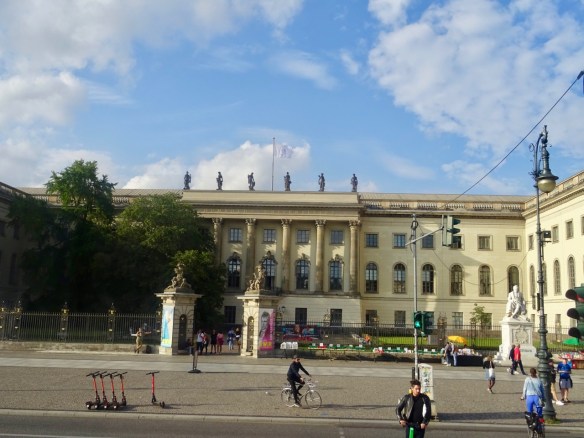
 We drive past the spot where the old book market was yesterday. Bob did a bit of research and discovered that this is the University where Eisnstein and the Brothers Grimm taught and where Karl Marx and Friedrich Engles studied . It was also the site of the burning of thousands of books by the Nazis in 1933.
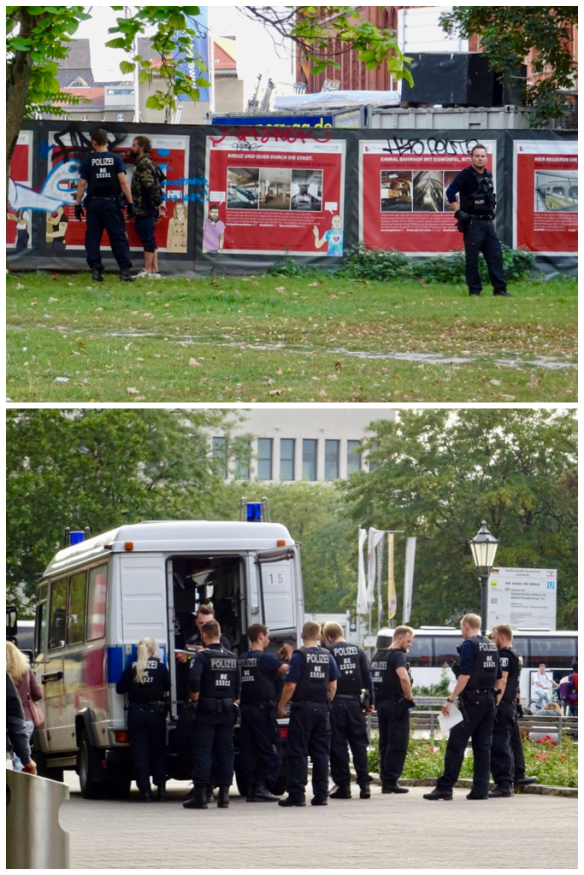
 Next stop is Alexanderplatz, a large public square and popular gathering place in Berlin. We find a bench for a tea break and witness a little drama unfolding behind us. It took eleven police officers over half an hour to move this fellow in handcuffs from beside the fence to the police wagon. There was lots of interviewing of bystanders and note taking but we don’t have a clue what it is all about.
 This is the view in front of us.
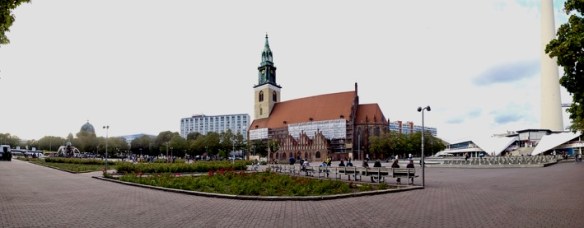 I wanted to go to the top of the Berlin TV Tower but it cost €16 which is almost $24 each. That seemed a bit too much.
 The Neptune Fountain is is very ornate.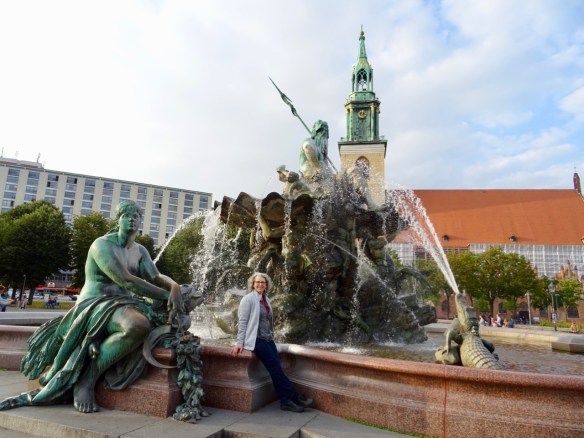
 Day 17, Wednesday, September 11, 2019
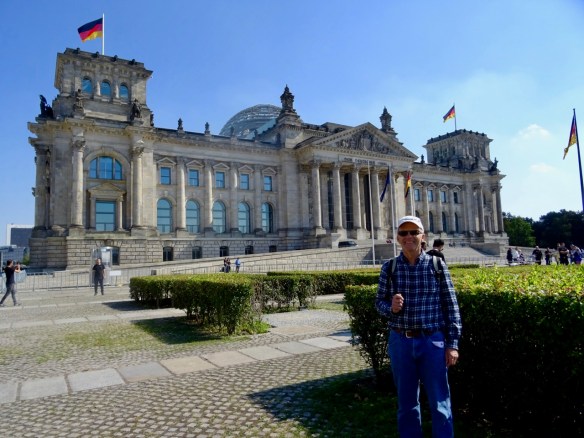
 The Parliament building has a huge dome on the top that requires a reservation to climb. We book a Friday tour and then find a nice park to sit and
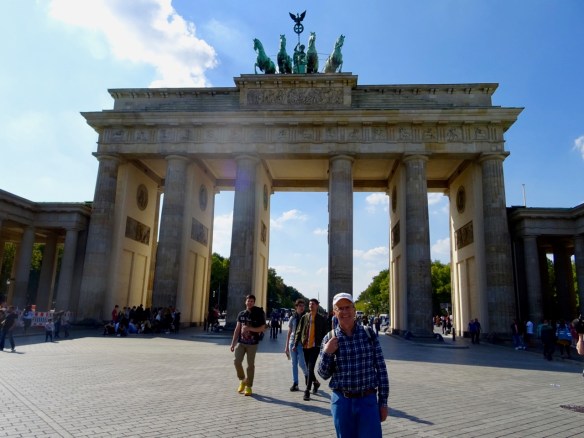
  This is the Brandenburg Gate. It was built in 1791, and was modelled after the Acropolis in Athens. Hundreds of thousands of people celebrated before the Brandenburg Gate as the Berlin Wall fell on November 9th, 1989. Since the end of the Cold War, the Gate has come to represent German unity and freedom.
  We think these protestors were in support of the Chinese government’s actions in Hong Kong.
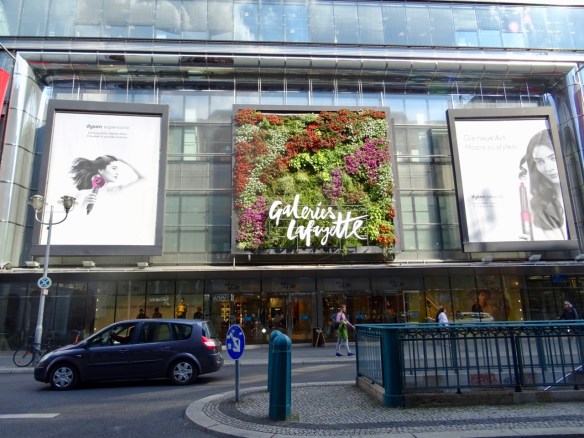
 This huge wall garden was a colourful surprise.
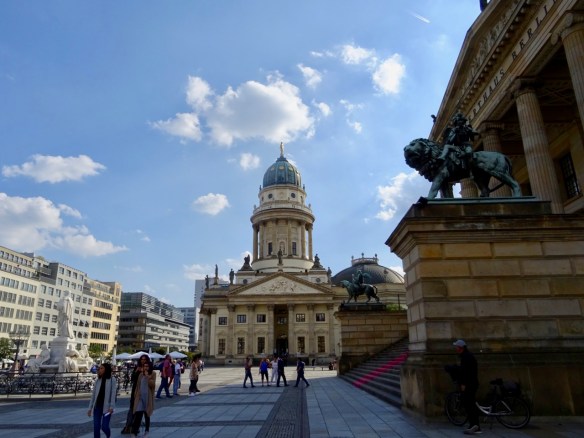
 We walk to the Gendarmenmarkt which is an 18th century square used for gatherings and events. On either side there are two identical churches. The one in the photo is the German Cathedral, the Deutscher Dom. It was heavily bombed in the second World War and has been restored as a museum with displays on the parliamentary democracy of Germany.
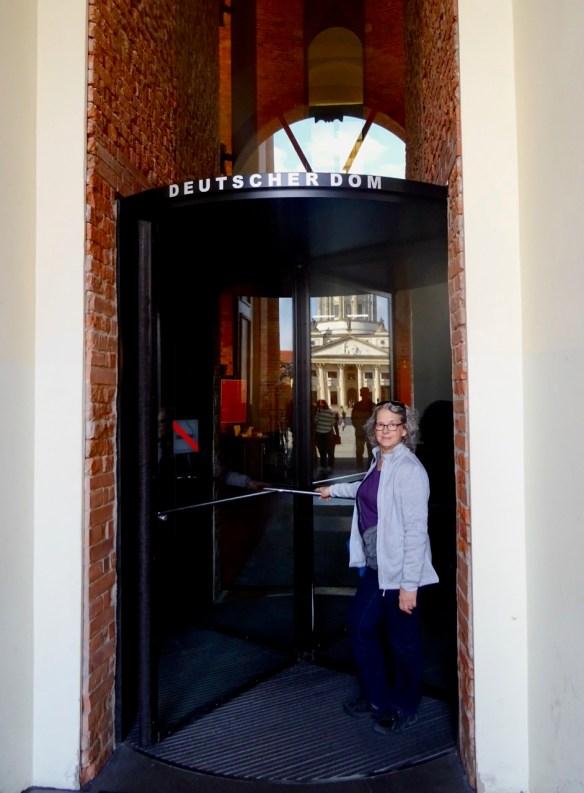
  Bob noticed this reflection in the door to the German Church of the identical French Church across the square. We went in for a look and somehow got separated. The place is a bit of a maze and I felt like I was never going to find Bob or my way out! That did it for me… I went and waited outside and Bob had a look around.
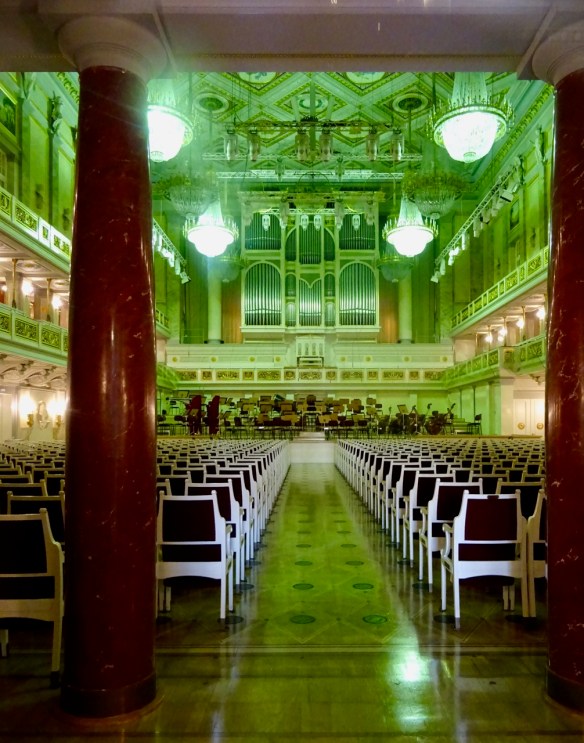
 This photo he took shows some of the old building and the reconstructed concrete parts, and one of the crazy stairways that I got lost on!
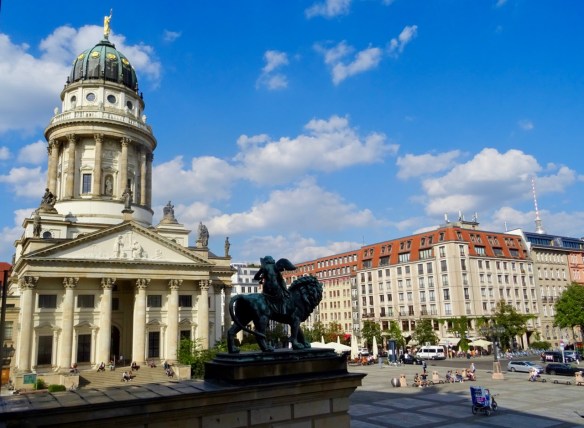
 This is the French Cathedral directly opposite the German one. It was closed for renovation so no idea what was in there.
 There was outdoor market of old books, postcards and papers in front of the building below. There were some rather interesting erotic postcards from the early 1900’s! We did better this time and found the right metro line to get home.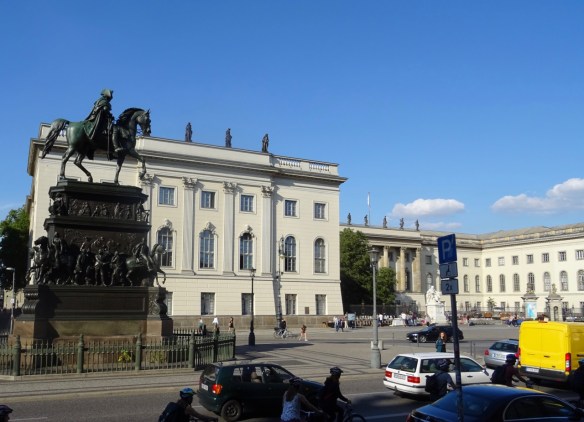
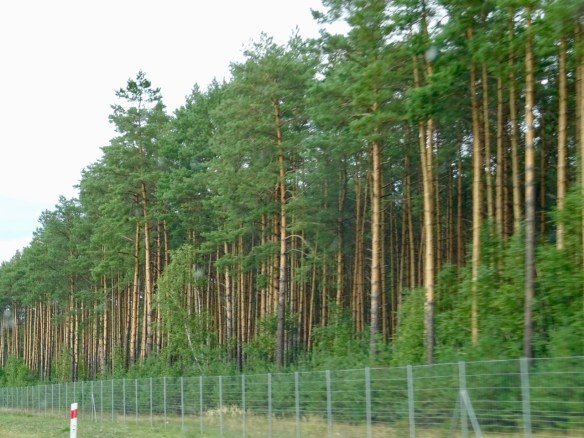
 We pass by lots of trees that appear to be grown for timber. Their lower branches have been trimmed so that the trunks grow straight.
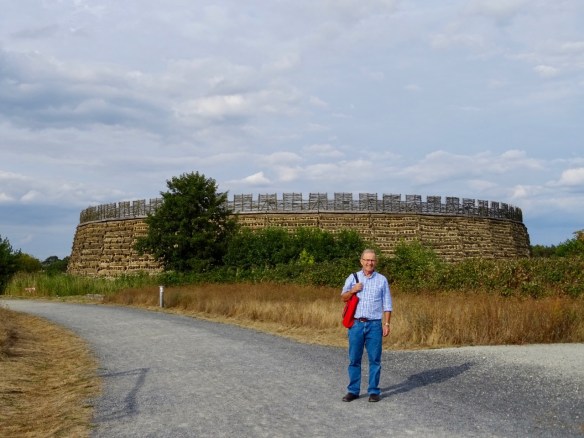
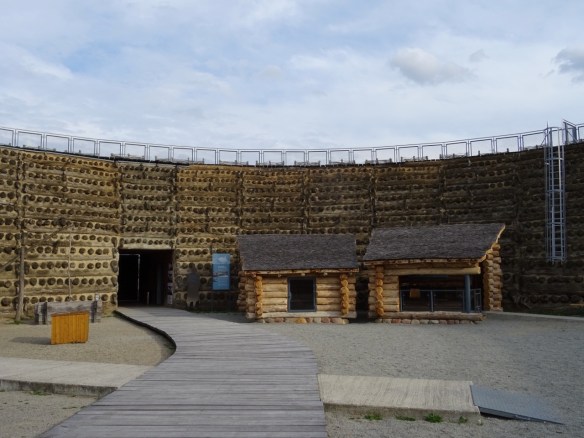
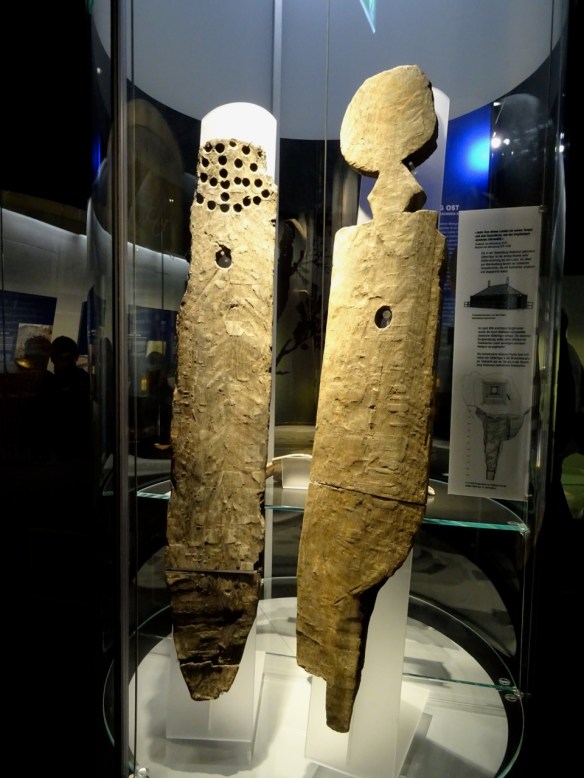
 Not far into Germany we stop at Slawenburg Raddusch, which is a reconstruction of a fort built by Slavic people in the 9th and 10th Centuries. It is surrounded by a moat for added protection.
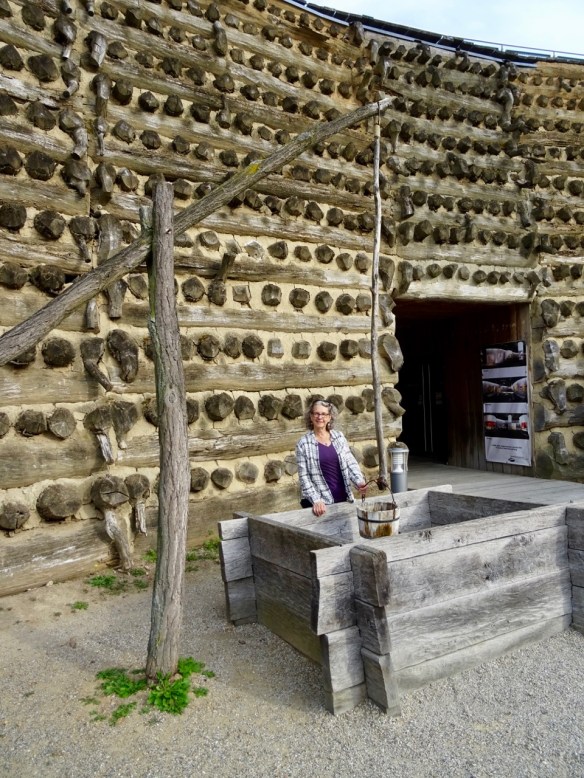
 This well is 40 feet deep.
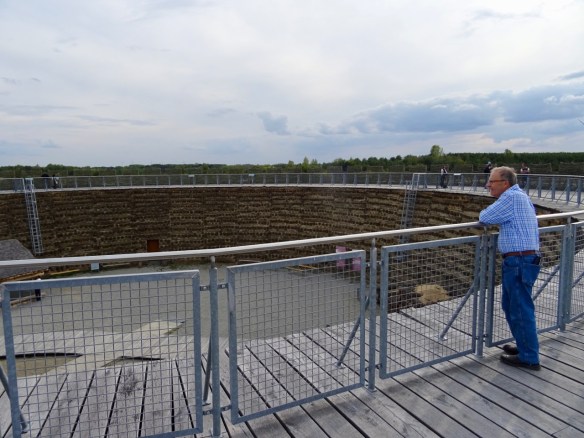
  We climb to the top of the wall which offers a great view of the surrounding landscape.
  This model shows what the original fort would have looked like…
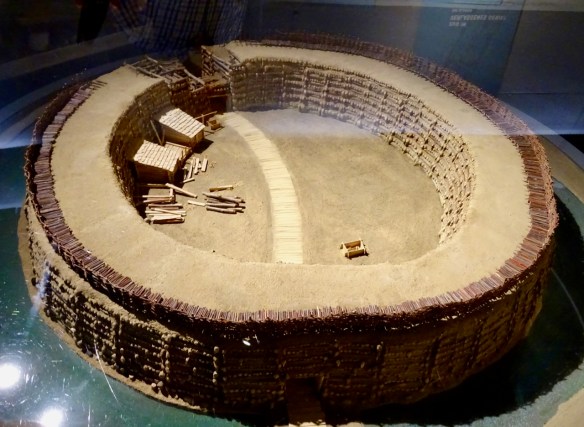 and how it was constructed. The dirt used to fill the walls came from around the base of the fort and created the moat.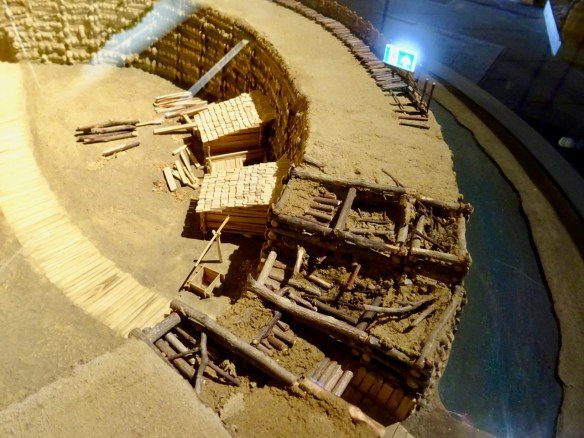
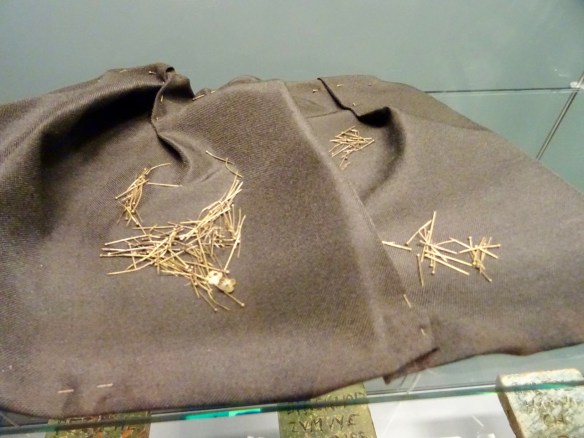
 I thought these straight pins for sewing were pretty amazing, considering they are so ancient.
 Here is a view of part of the museum with its large display of pottery,,,
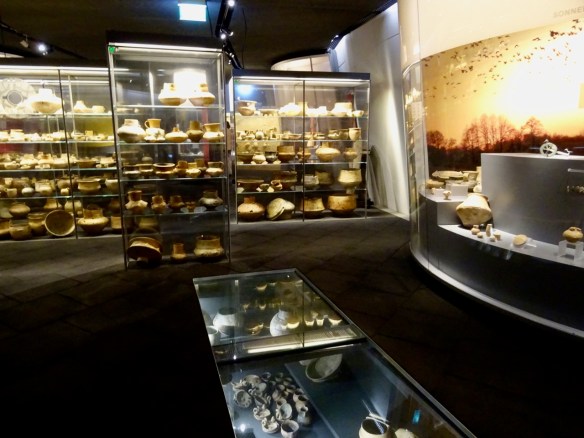 and burial pits, where cremated remains were placed along burial gifts for the deceased.
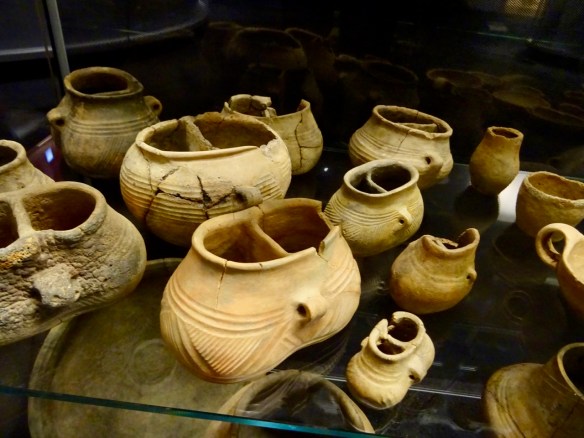
 I was intrigued by the shapes of some of the pottery. All the pottery was made by hand without the aid of a potter’s wheel.
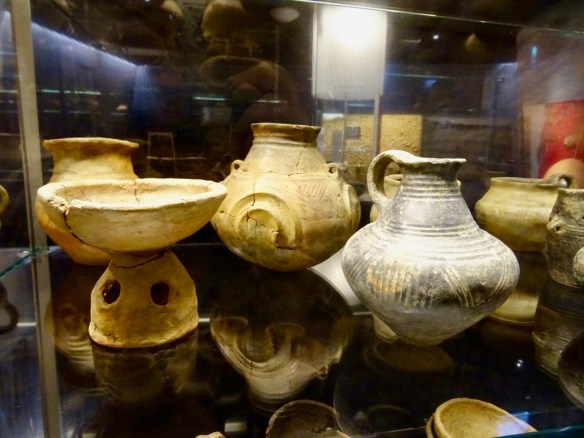 I wonder what these pots were used for?
 The tour was great. We rented an audio guide for €1.5 and it was very well done. We got so much more out of the display because it. We managed to finish our visit through the museum just as it was closing at 6:00 pm. We see lots of wind-farms on our way to Berlin. We arrive in Berlin as it is getting dark and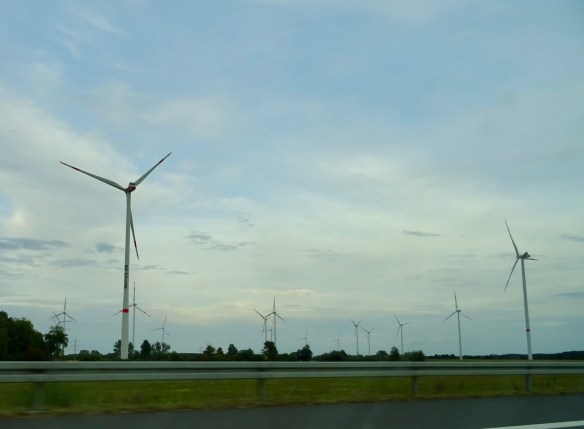
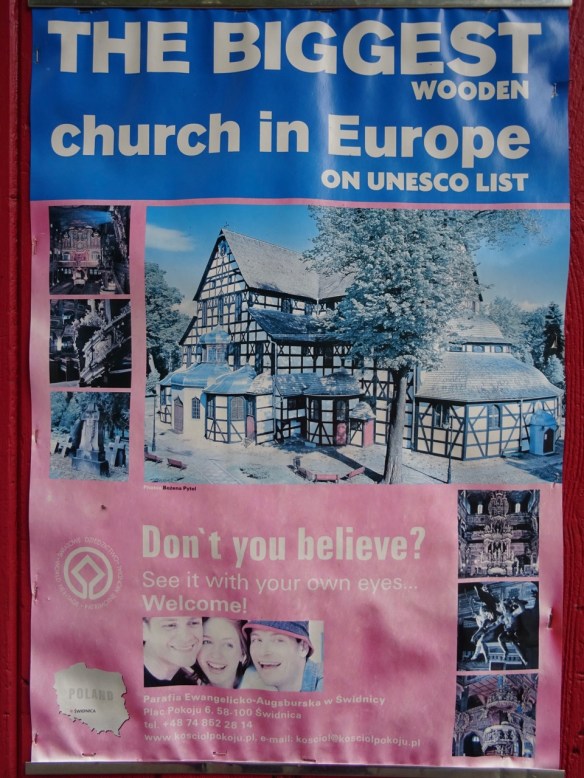
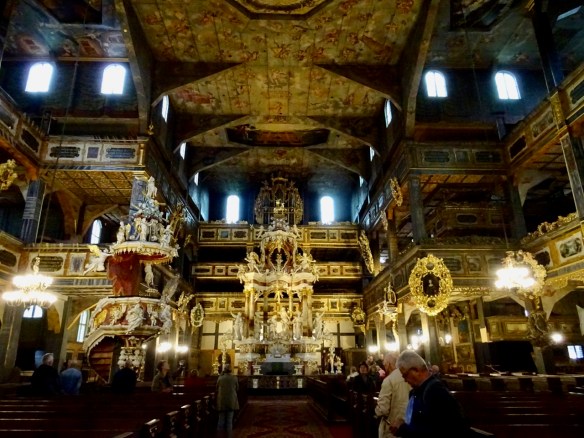
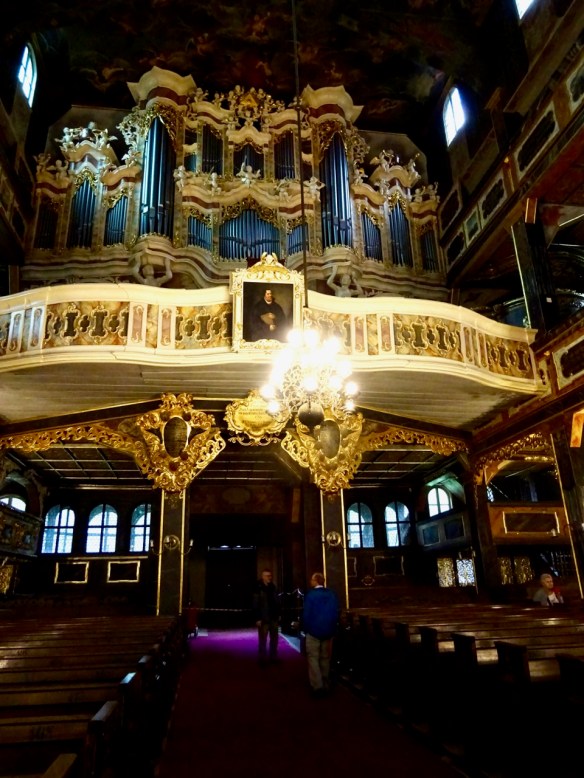
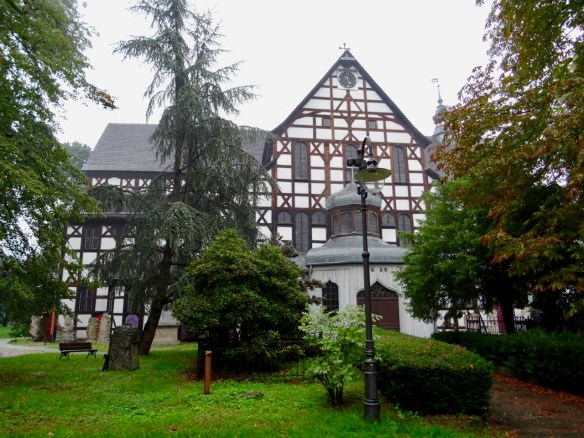 We walked into this church and we were amazed at the size and ornateness of the interior. This photo is looking towards the altar. The walls and ceilings are decorated with painted panels added after the construction of the church was completed in 1657.
 The back wall with the organ.
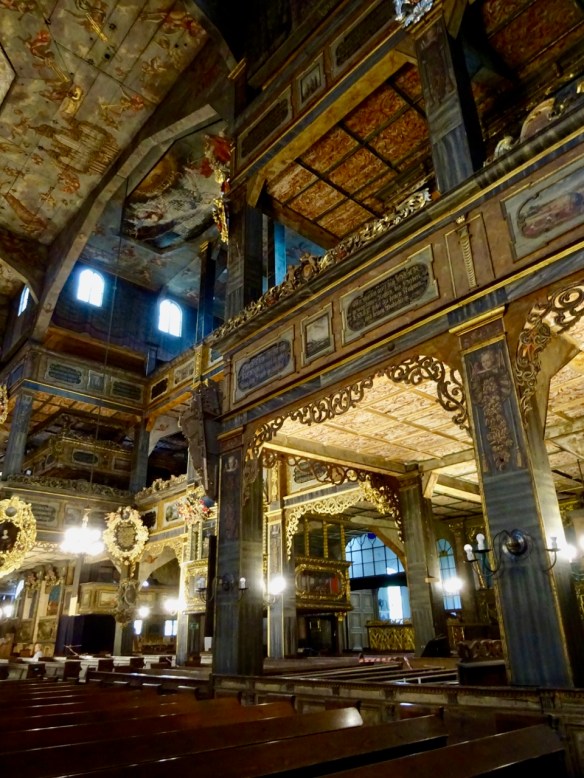
 A view of one of the sides of the church with it’s two tiers of balconies. The spaces between the wall timbers were filled with clay and wattle.
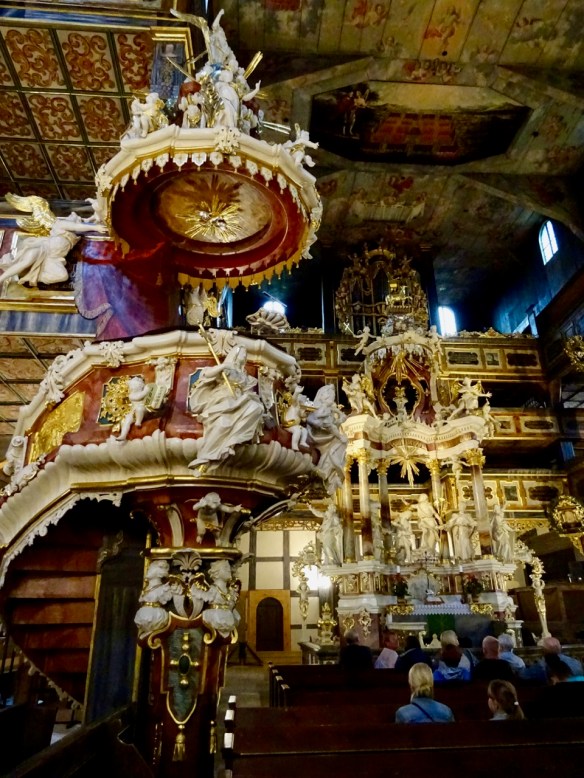
 The pulpit is extremely ornate.
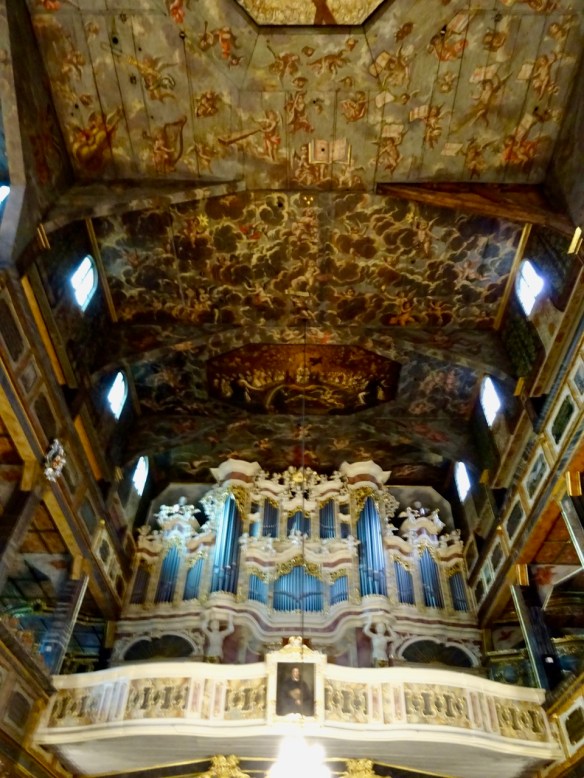
 A view of part of the painted ceiling.
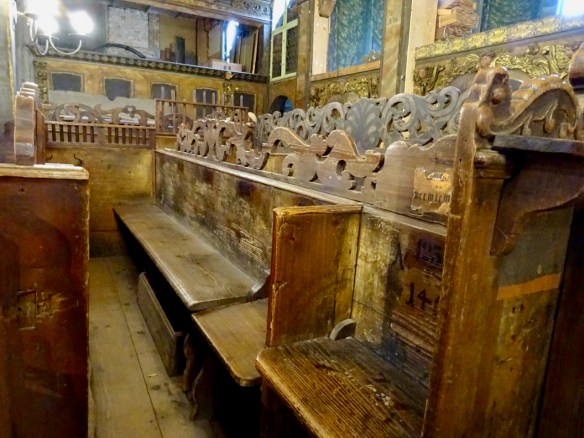
 I loved the old pews with their carved backs and worn seats.
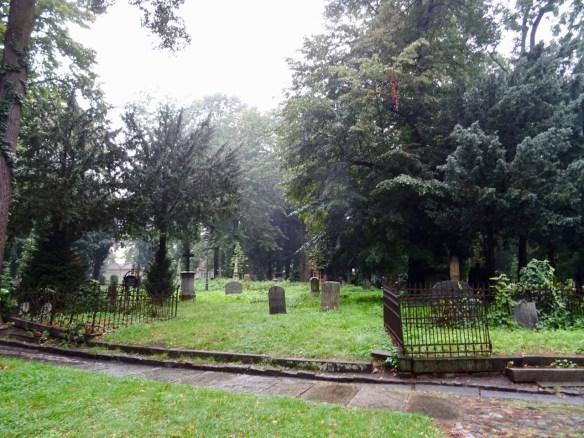
 There is a cemetery surrounding the church.
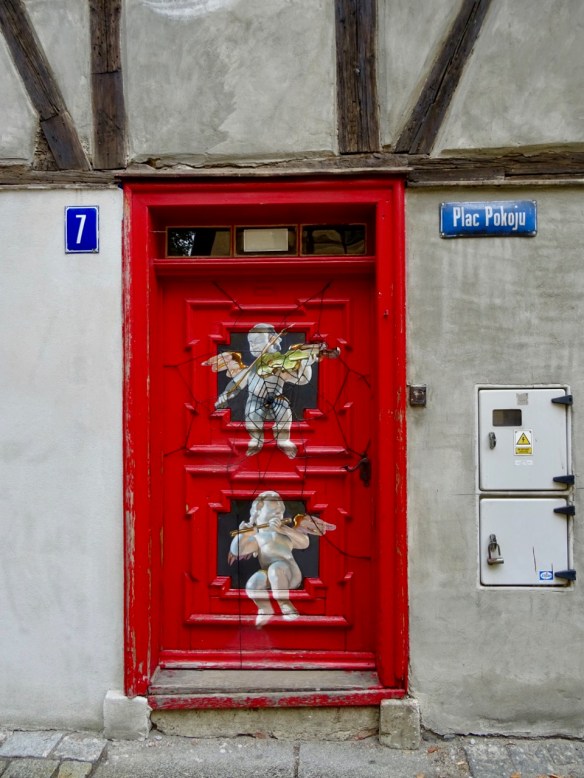
 As we walked back to our car we passed this interesting door. Makes me curious about who lives here.
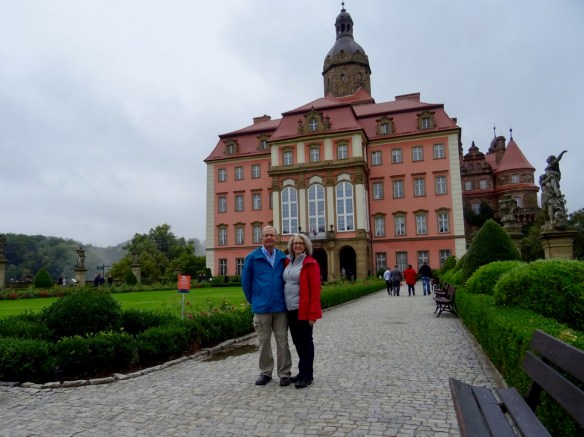
 Next stop on our day trip is the Książ Castle, the third largest castle in Poland which dates from the 13th century.
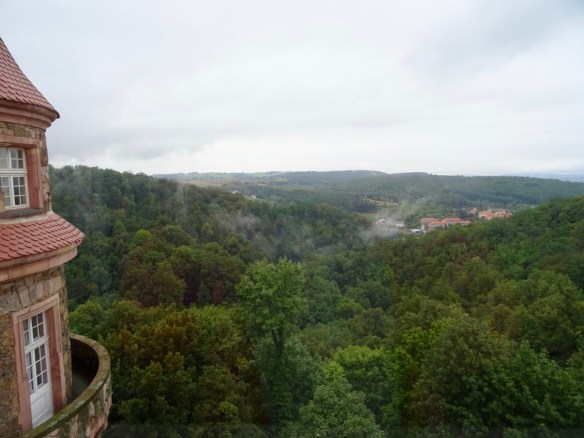
  One of the the views from inside the castle.
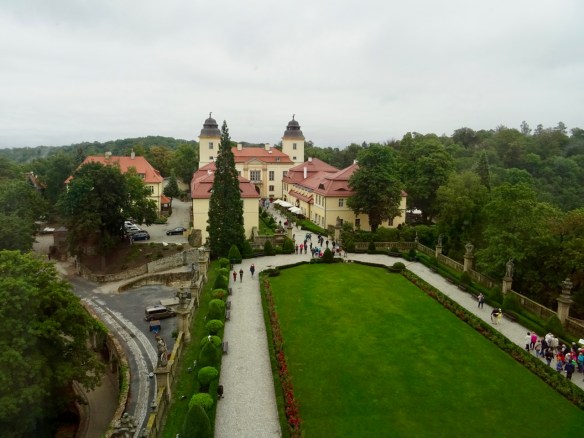
  The entrance buildings and front grounds of the castle.
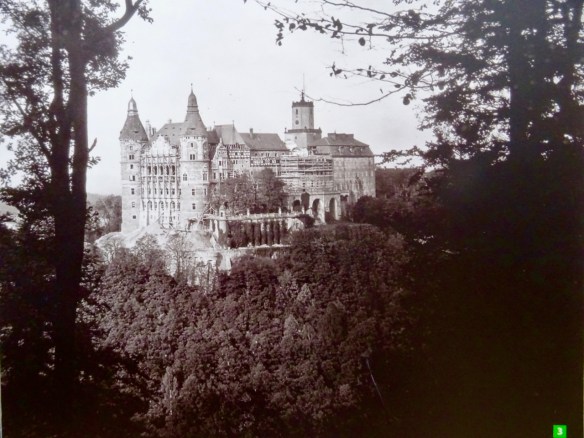
 An old photo showing the castle atop an impressive rock cliff. It has been destroyed and rebuilt and expanded various times and in different styles (from Gothic to Baroque and neo-Classical). The latest family to reside there, was the Hochberg family, one of the richest and most influential families in Prussia. In the 14th century they transformed the original defensive castle into one of the most beautiful residences in this part of Europe. The Hochbergs lived there for many generations, until 1941, when it was confiscated by the Nazis.
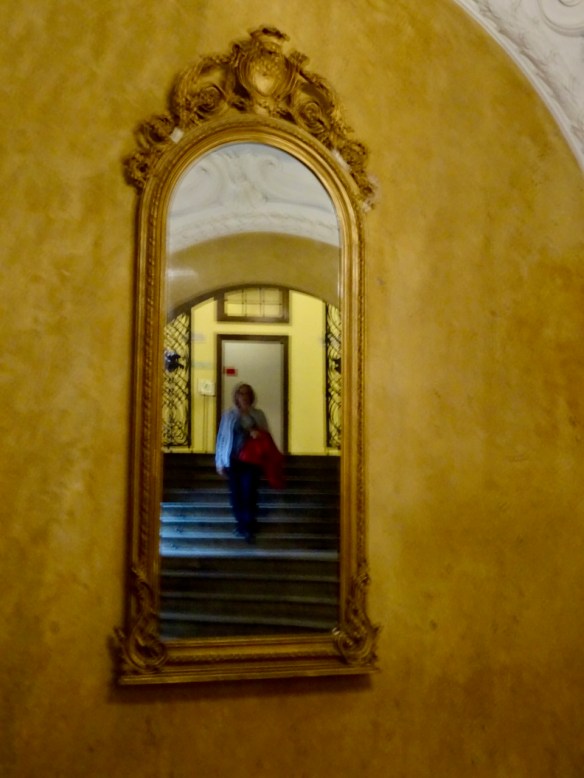
 Bob caught my reflection in this old mirror.
 The Black Courtyard is decorated with the coats of arms of the castles many owners.
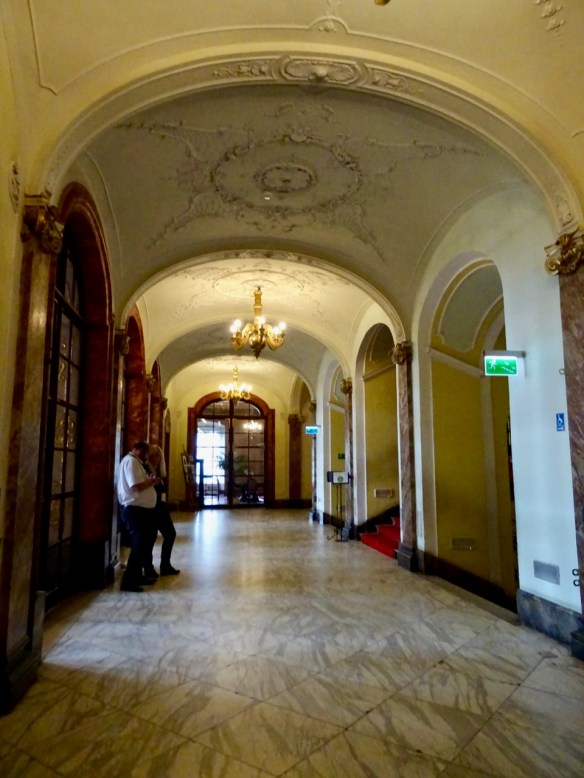
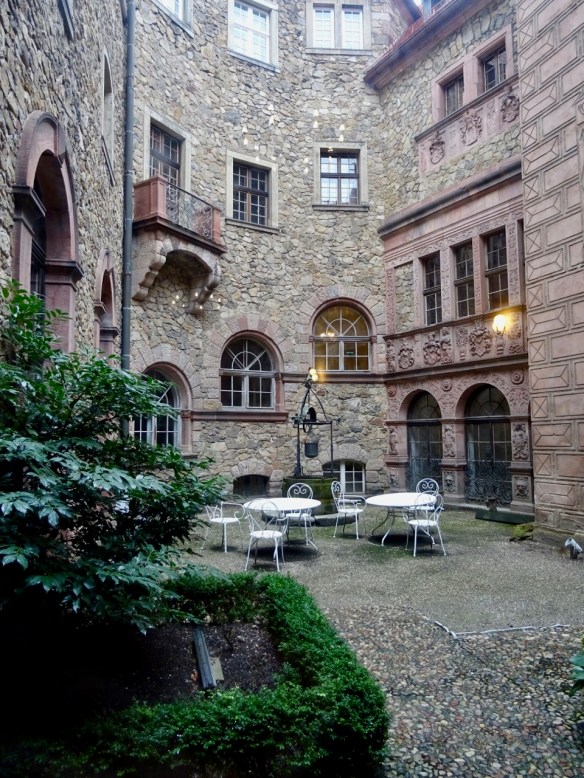 We walked through many halls, some simple…
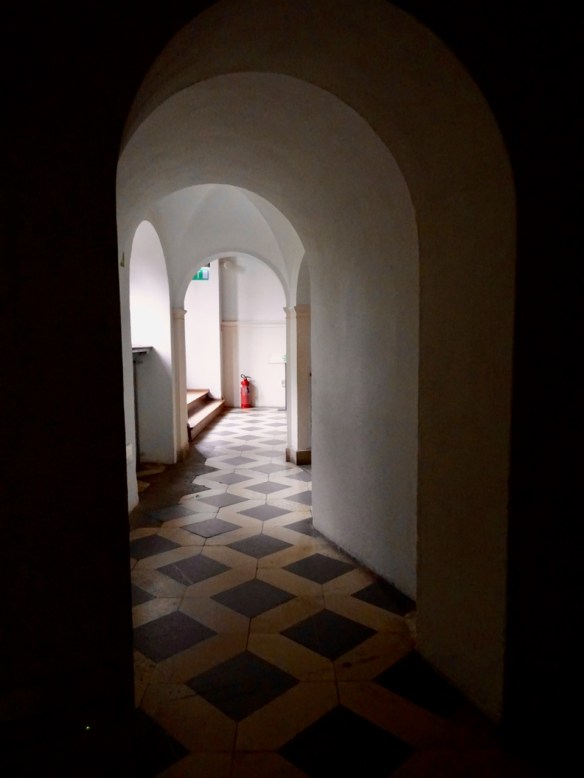 and some very ornate. I suppose a castle with over 400 rooms needs lots of hallways and stairs, and we did climb lots of stairs.
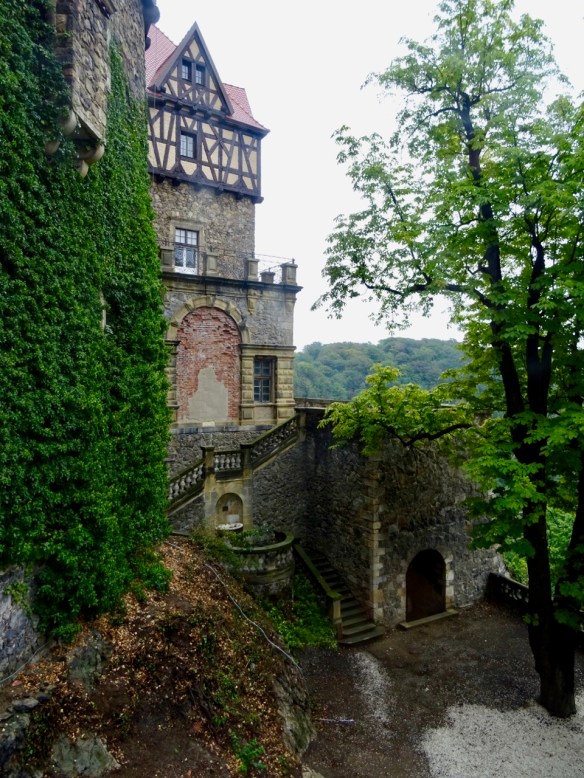
 Another view out one of the castle windows of the Chestnut Terrace with four large chestnut trees.
 As always, we must remember to look up. So many of the ceilings are ornately decorated.
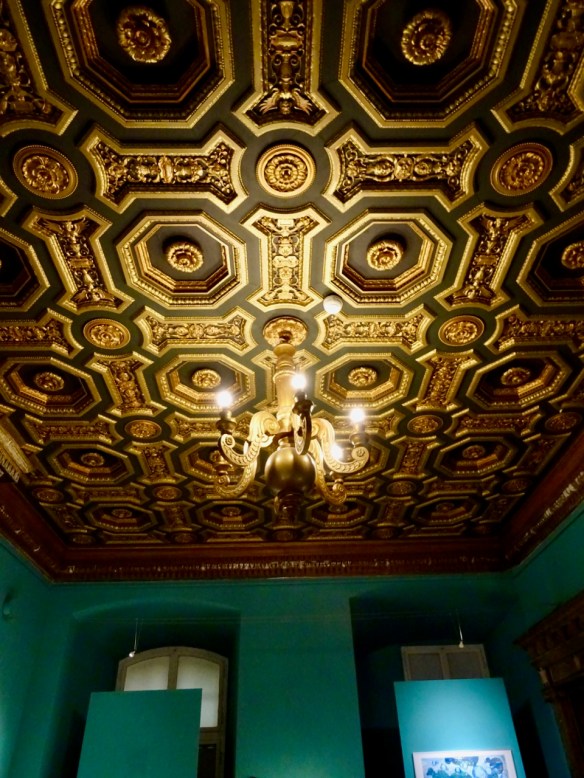 There was an exhibit of blown glass in some of the rooms and another view down one of the many hallways.
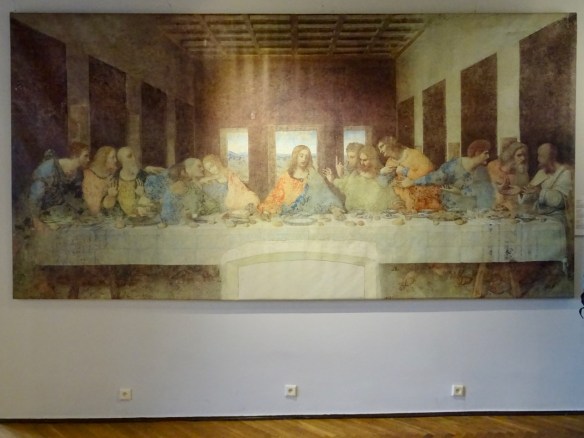
 We weren’t able to see the Last Supper when we were in Italy two years ago (we didn’t know you had to buy tickets far in advance) but there is a Da Vinci exhibit here in the castle with a replica. Not as good as the real thing but interesting none the less.
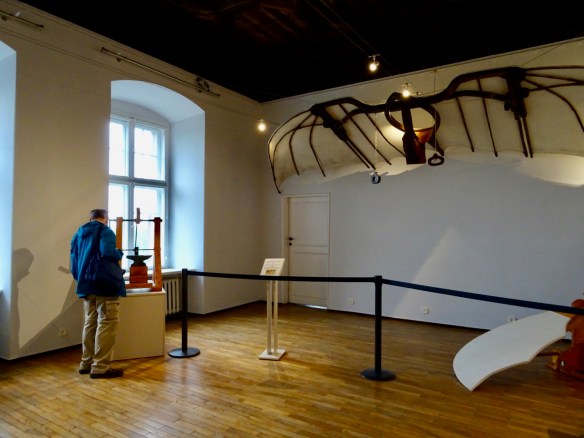
 There were replicas of many of Da Vinci’s paintings, including the Mona Lisa, and models of some of his inventions.
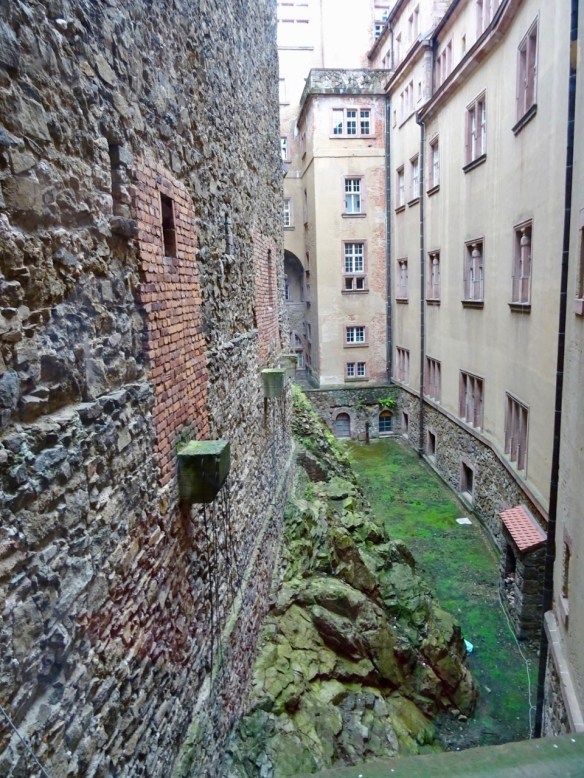
 Looking out one of the windows we get an idea of some of the renovations and reconstruction that has taken place over the centuries. It is quite a convoluted building.
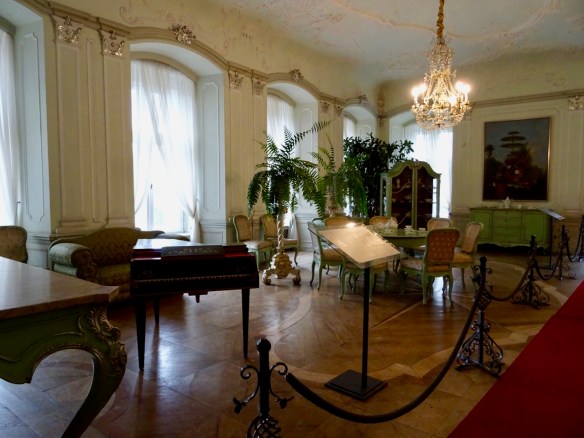
 One of the restored and decorated rooms. The Nazis stripped the castle of its furnishings and paintings and it is just now being restored.
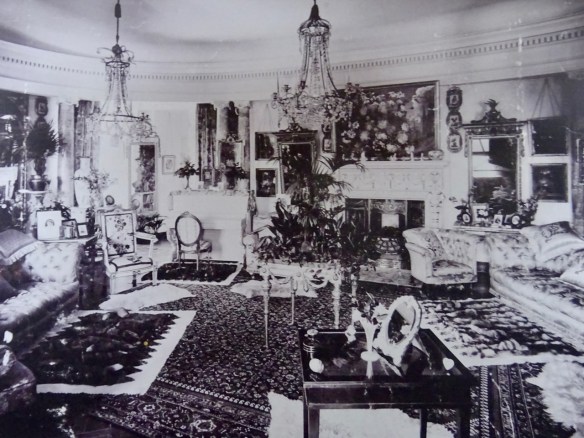
 A photo showing a much more elaborately decorated room than we see today.
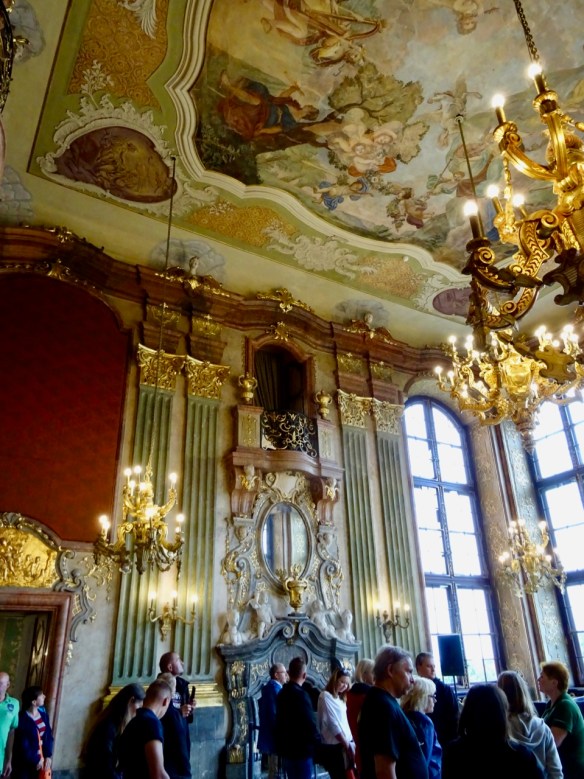
 The Maximilian Room has been restored to its former glory. There is a balcony on either side, one for the prince’s apartments and one for the princess’s apartments, that overlook this elegant room.
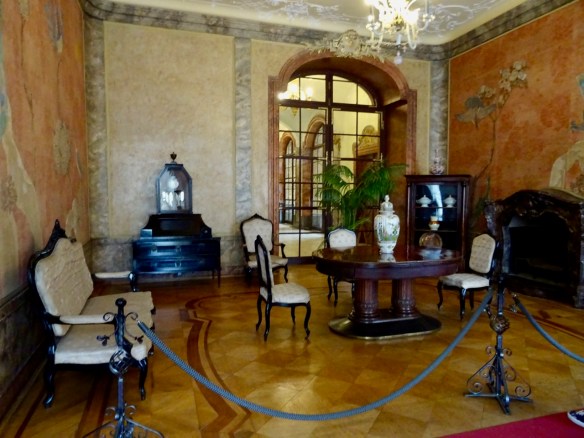
 And what castle would be complete without a Japanese influenced room. They were very popular.
 “The castle became an important part of the
 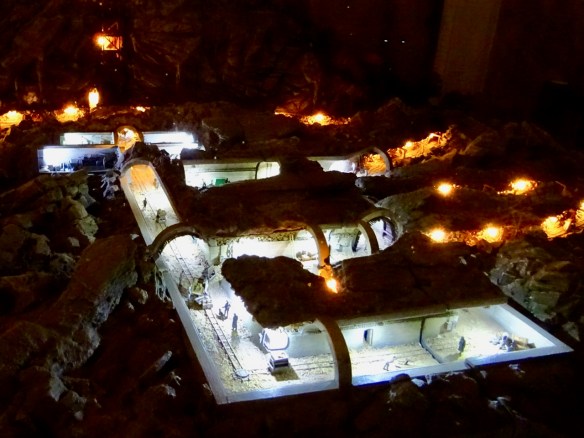 As we finish the tour of the castle, we are led out to the gardens and terraces surrounding the castle.
 The grounds are beautifully maintained.
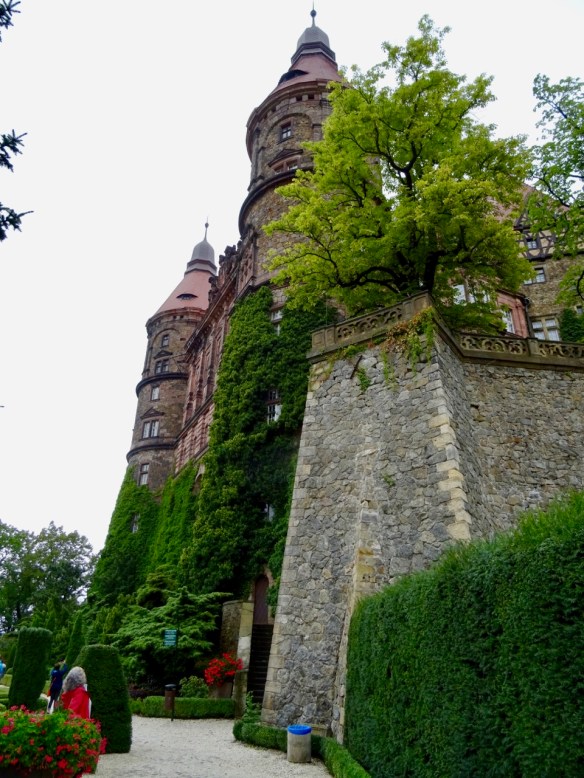
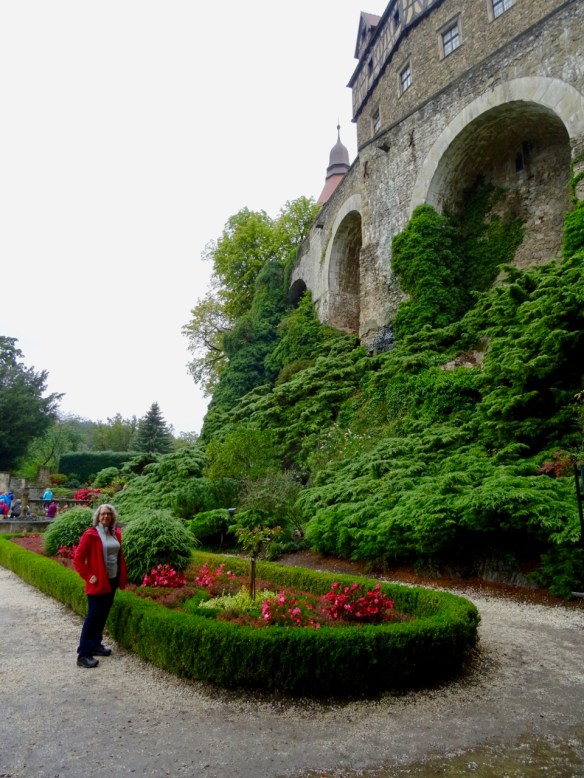 An interesting view of the castle.
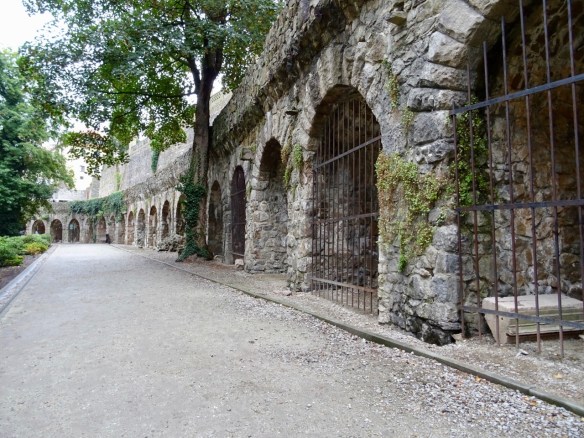
 We have no idea what all these small arched nooks with their iron grates are.
 As we walk back to our car we pass a pond with blooming water lilies.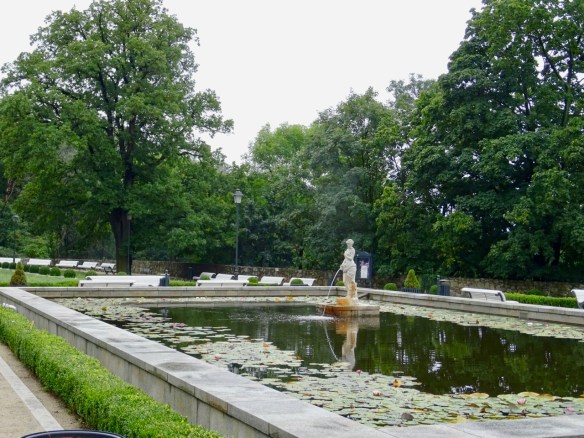
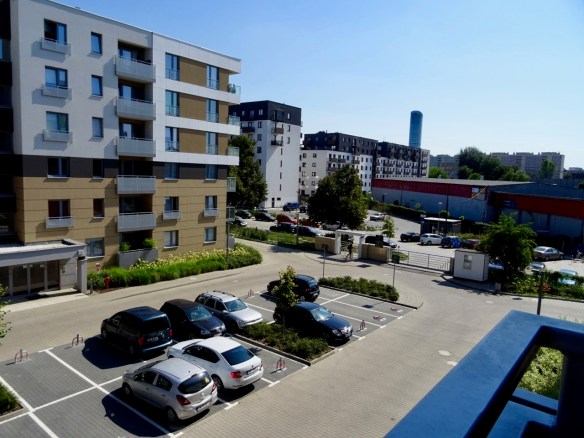
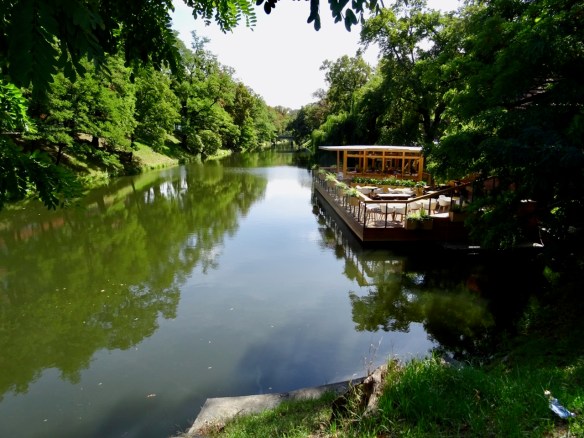
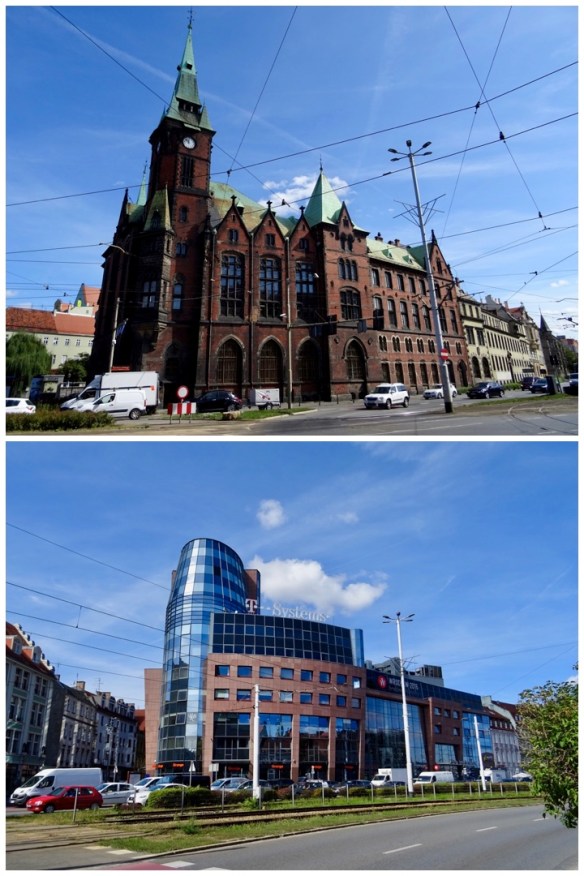 Here’s how big items get delivered!
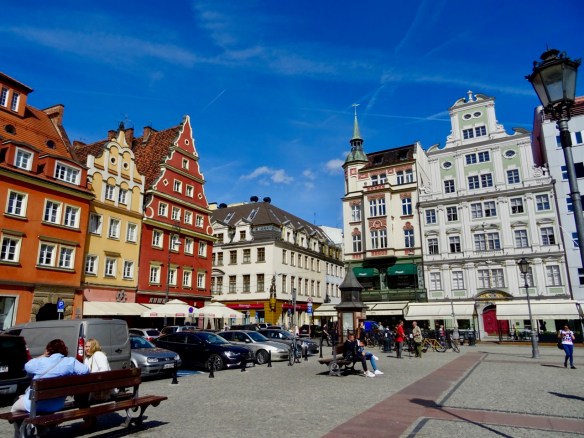
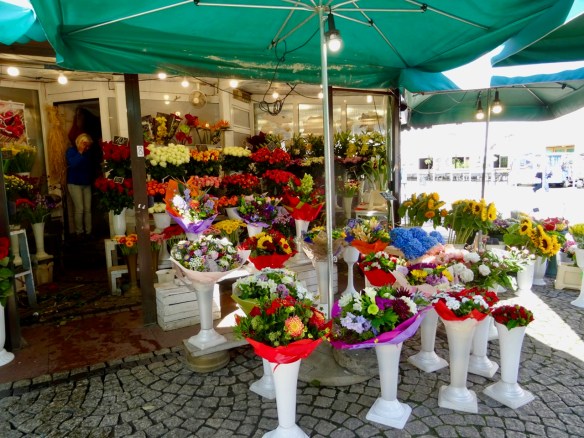 Wroclaw has an ever growing populations of gnomes. In fact, our guidebook states “the little buggers are currently rumoured to be running rampant to the score of over 300 making it literally impossible for us to try to keep track of them!” I think they are delightful and I am happy to make their acquaintance .
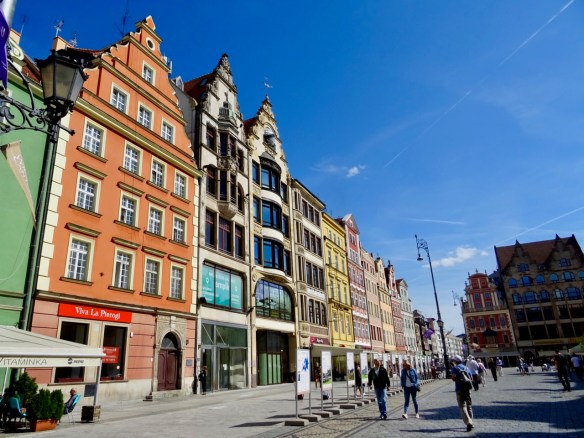
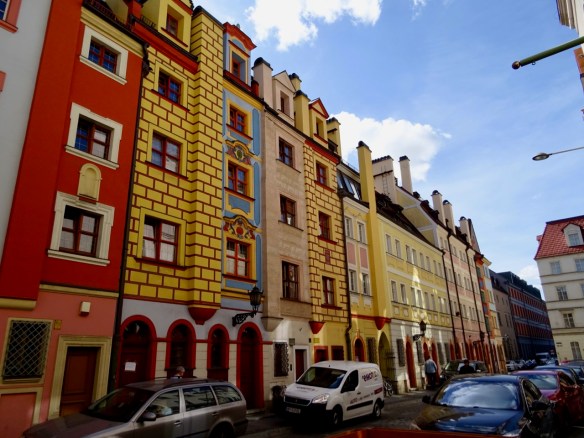
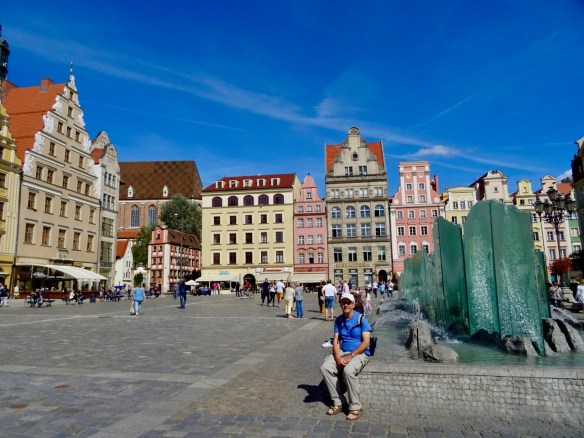 and more tenement houses in the town square.
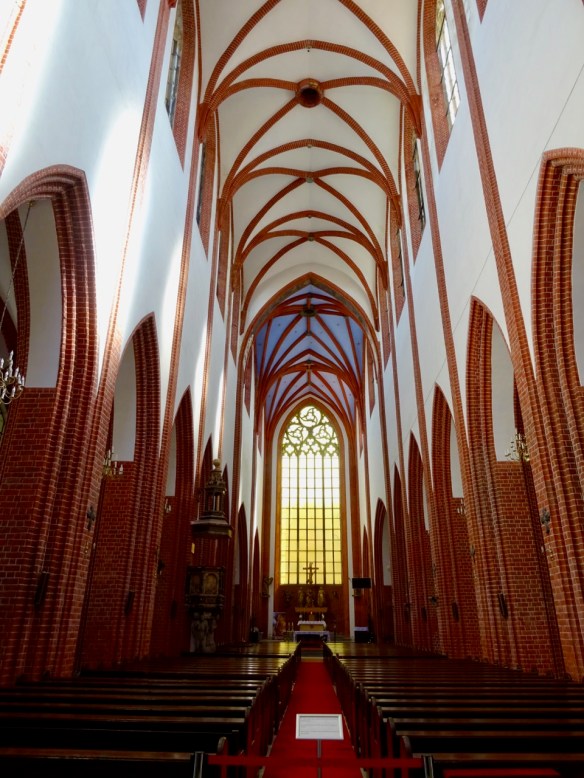
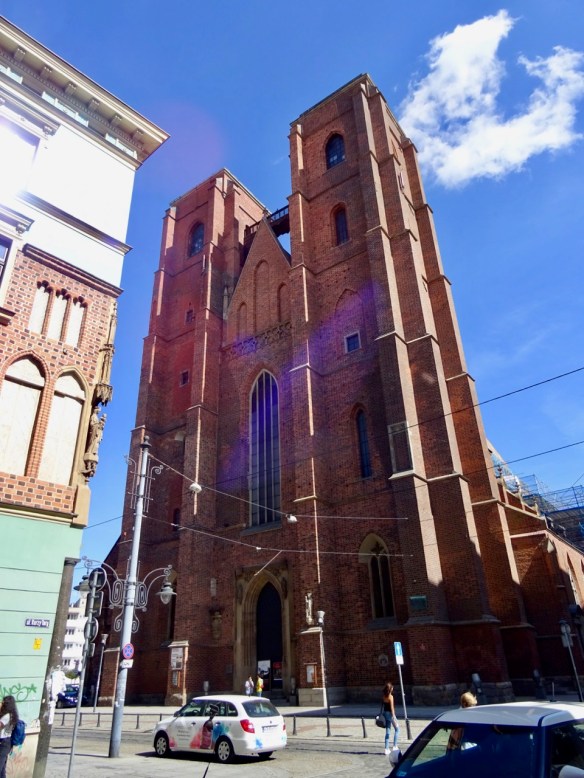
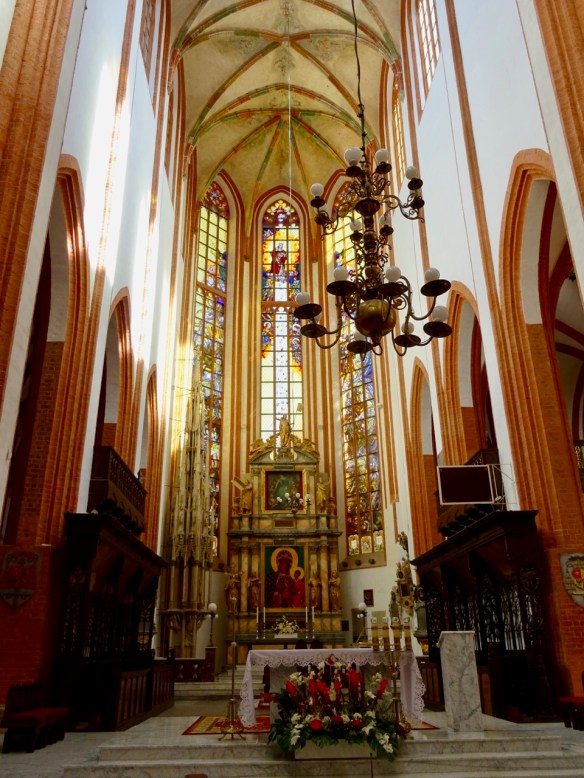
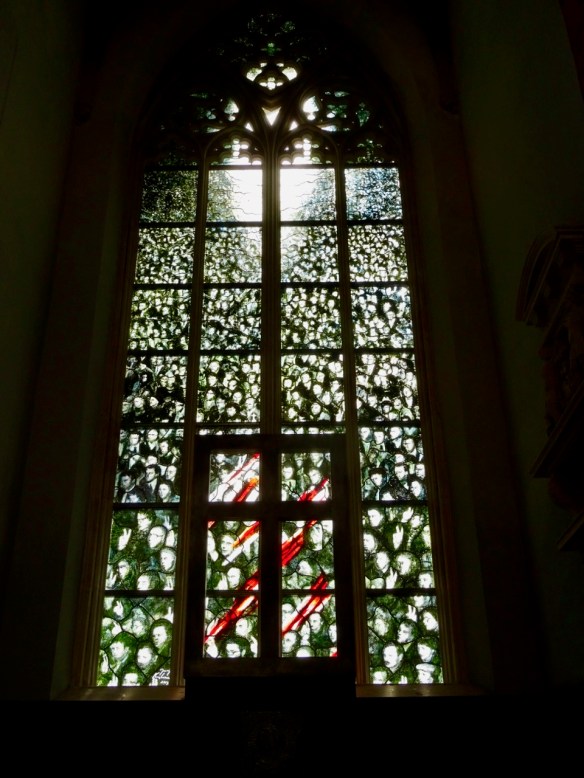
 The interior of St. Mary Magdalene’s Church which dates from 1330.
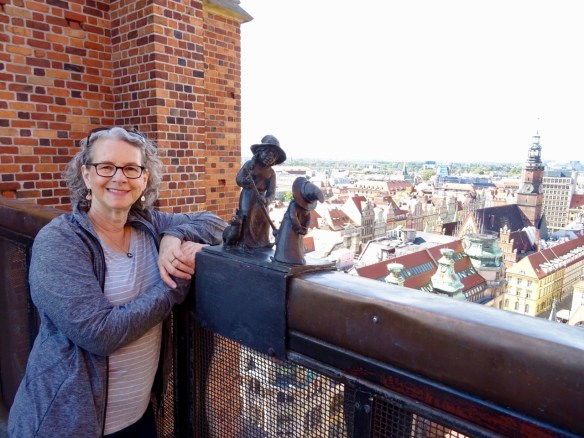
 We climb 147 steps up to the walkway between the two towers. In times past women suspected of being witches were forced to cross this walkway (there were no railings then) and if they made it across safely they were branded as a witch. If they fell to their death, then they were innocent of the crime of being a witch! You certainly didn’t want to be accused of witchcraft! I am very glad there are railings now and I meet another couple of gnomes.
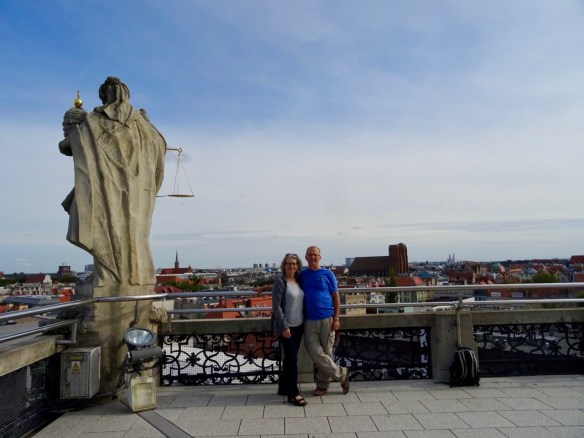
 We have great views of the city from up here.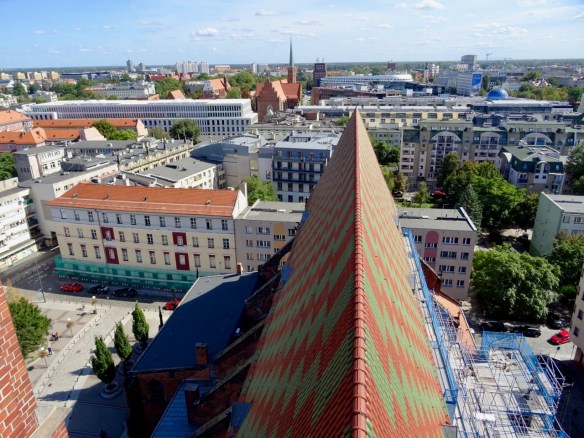
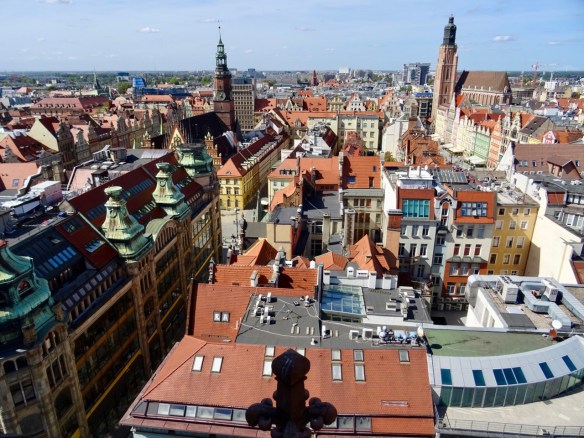 Here is a view of the walkway, way up there between the two towers.There were steeples on these at one time, not sure if they were destroyed during the war?
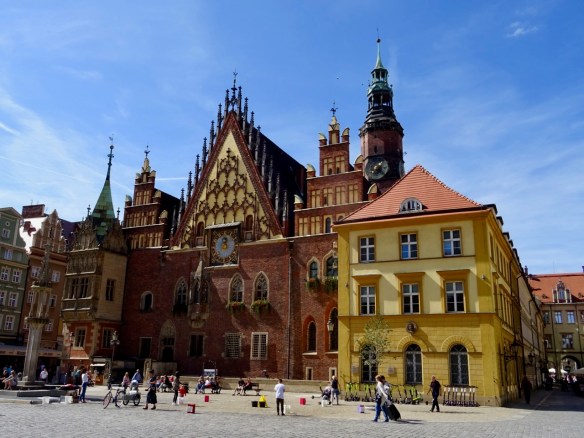
 More ornate colourful buildings.
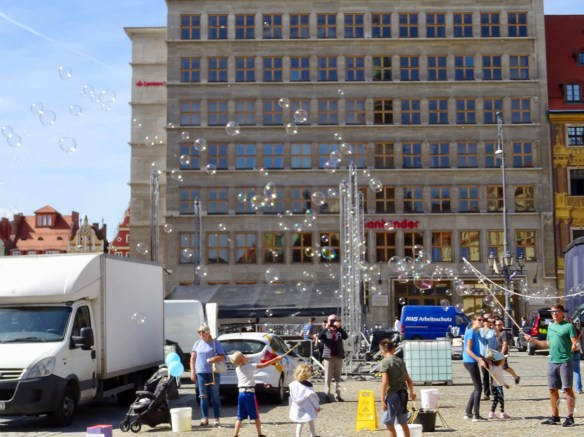
 I wish I knew the recipe for the bubble mixture this guy was using! He made hundreds of bubbles at a time with his string between two sticks. Kids had such fun chasing all the bubbles.
 We found quite a few more of these little fellows, on doorsteps, or tucked into corners.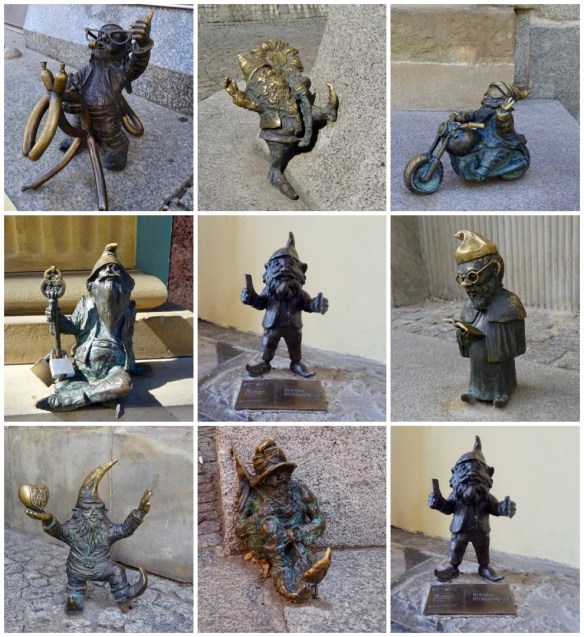
 The two little houses in the corner called Hansel and Gretel are the only two houses left of streets that used to surround a cemetery. The cemetery closed in 1773. I wonder where the graves went?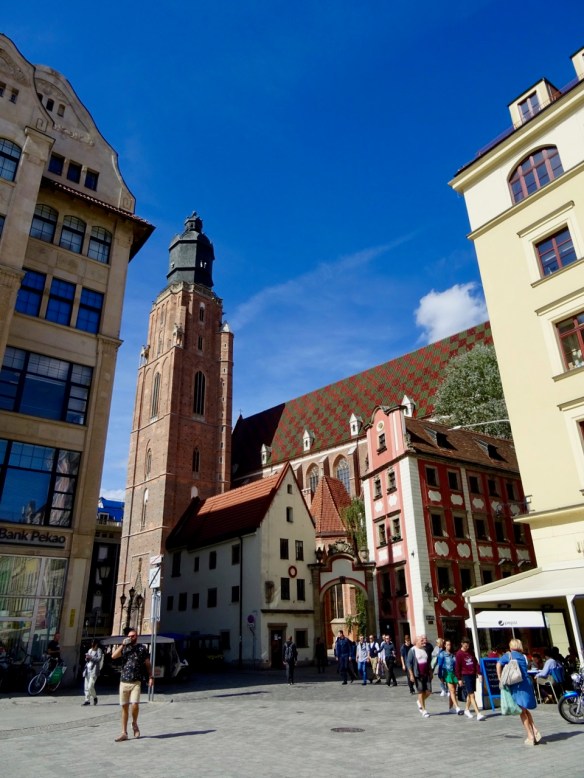
 and more busy gnomes.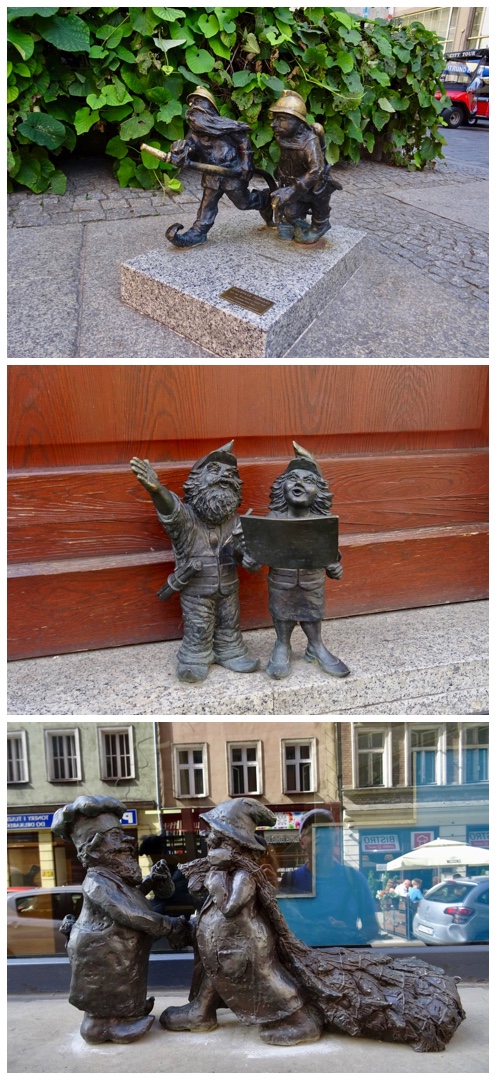
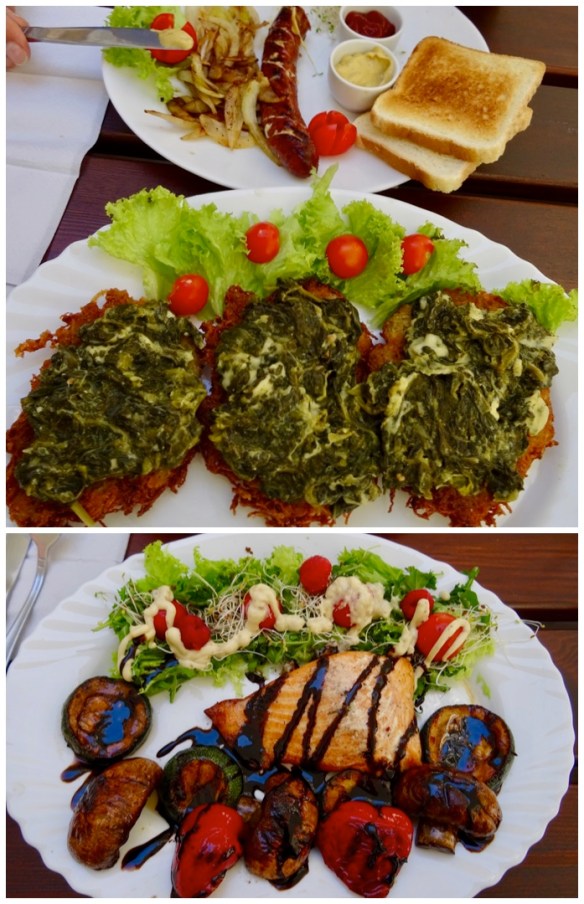
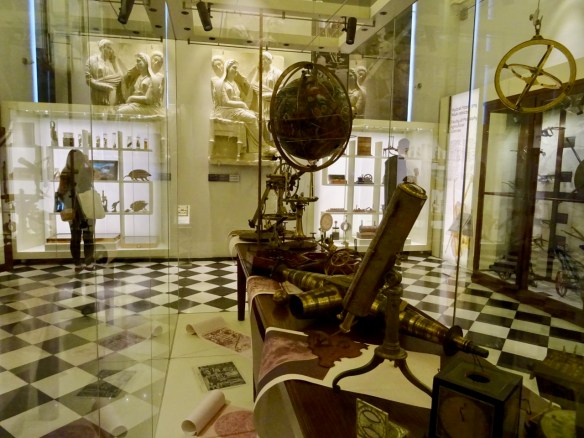
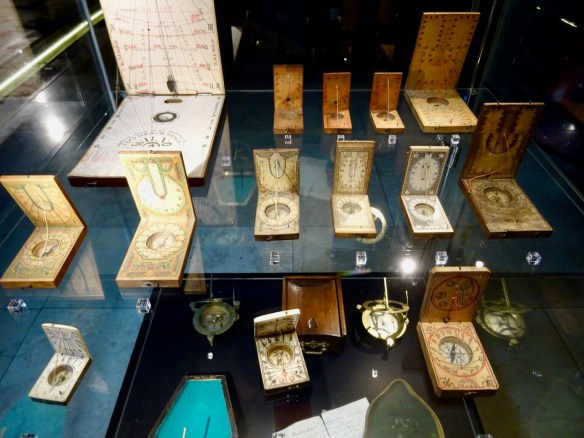
 and an interesting collection of artifacts. This is a chart for determining eye colour.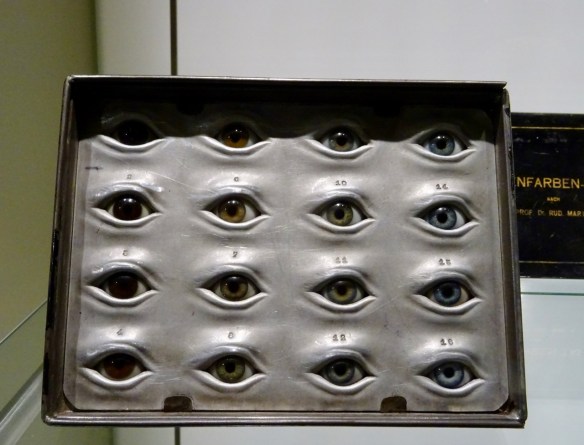
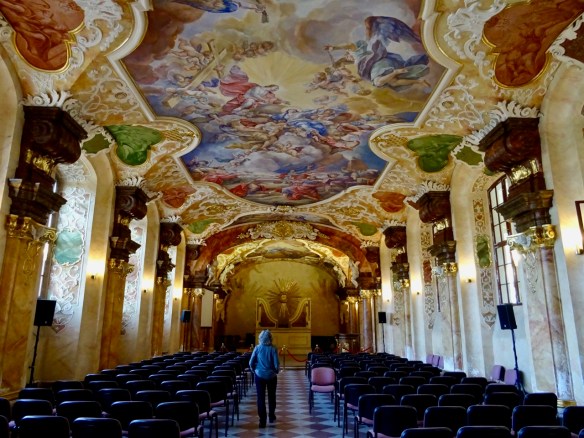
 The Music Hall is under restoration but we are allowed a peak inside.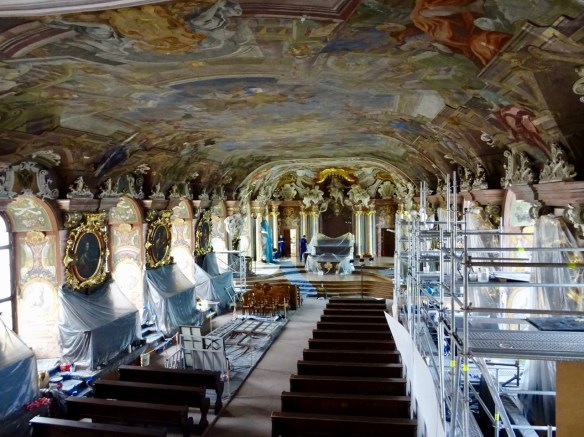
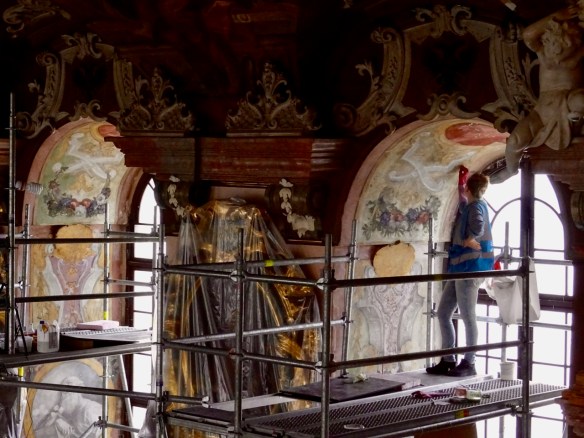 We. climb another 203 steps up the Math tower, which has displays along the way.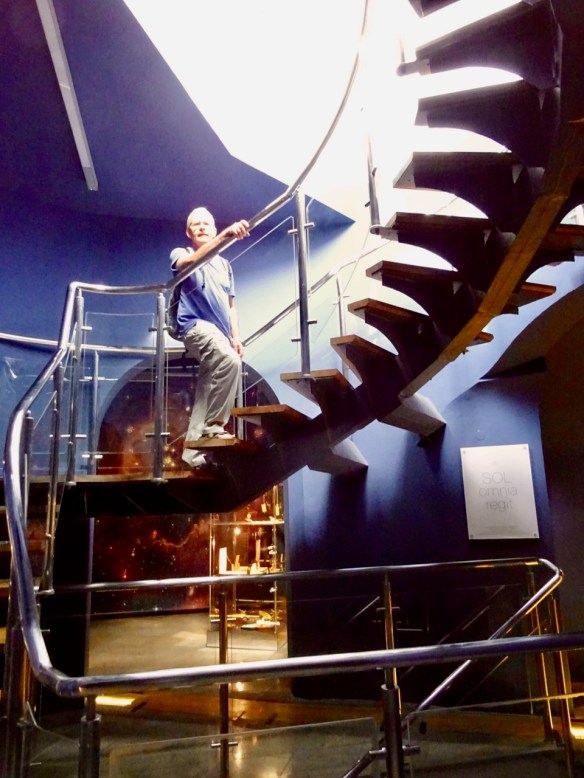
 and the views. Notice the very modern looking tower among the old.
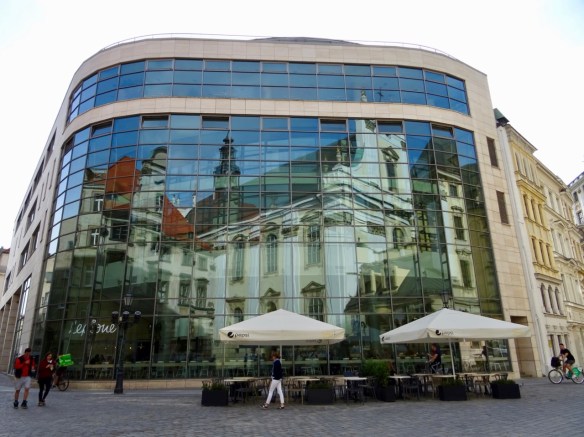
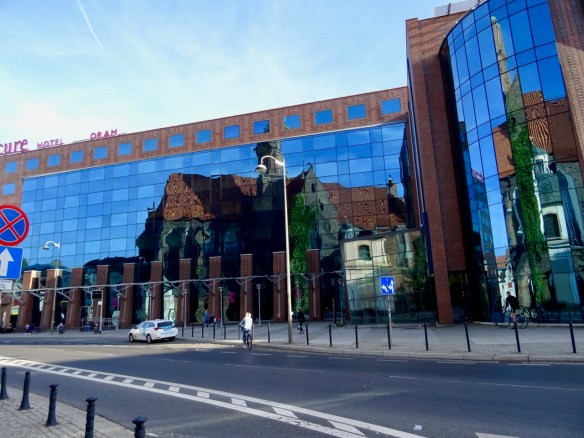
 I just love all the reflections of the old buildings in the glass walls of the modern new buildings!
 Churches here are either very ornate…
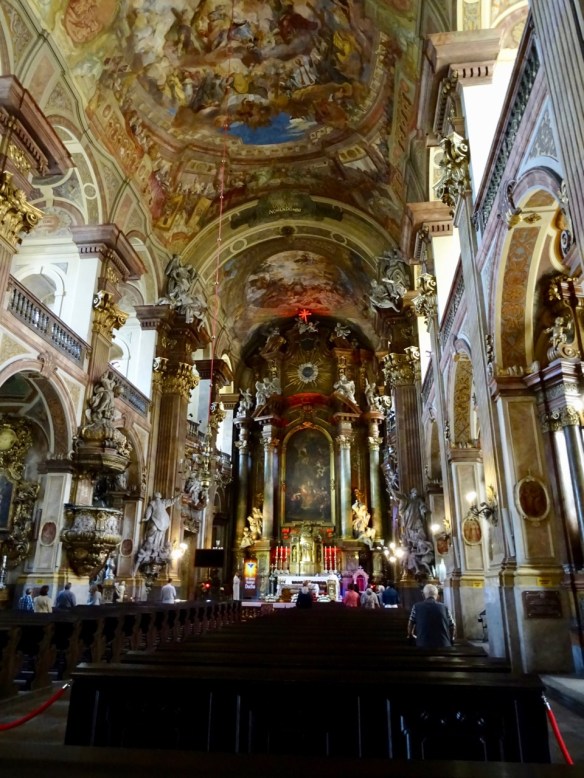 or look like this. The late afternoon sun was shining through the windows casting everything in a lovely olden glow.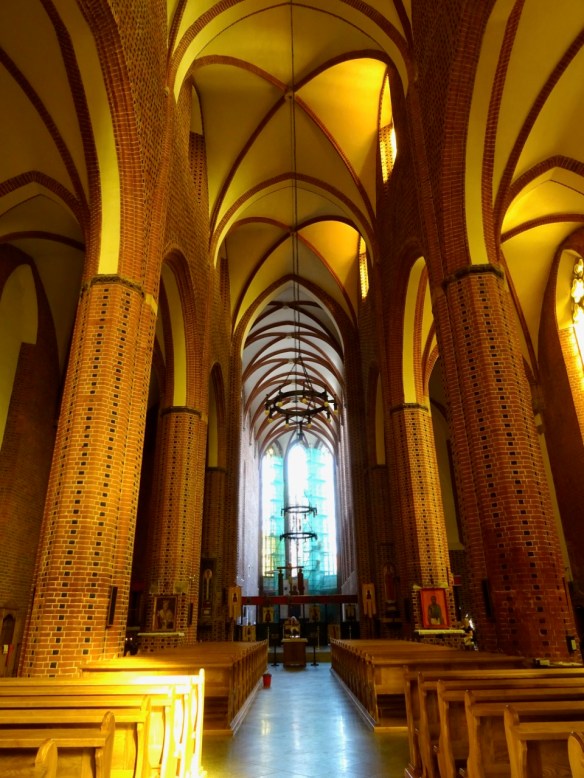
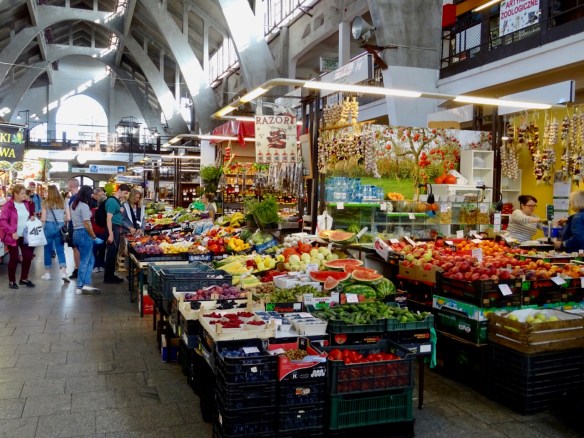
 Then we visit the market and buy some fruit. Food prices are very reasonable here.
 More reflections.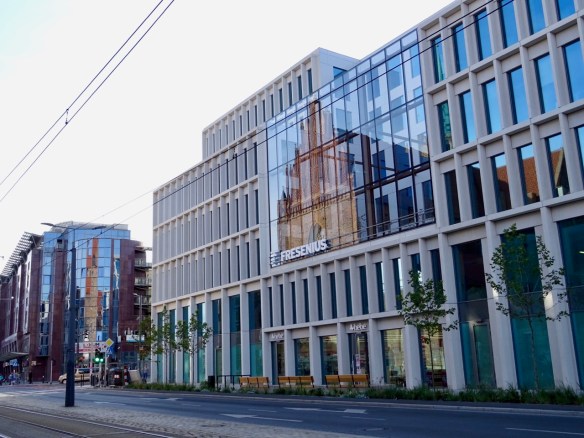
 We catch a trolley bus home. We haven’t seem many paved streets or sidewalks here. Most of the streets and sidewalks here are cobbled in one fashion or another. All the uneven footing is hard on the feet and ankles. We walked 16,700 steps today and climbed the equivalent of 31 floors!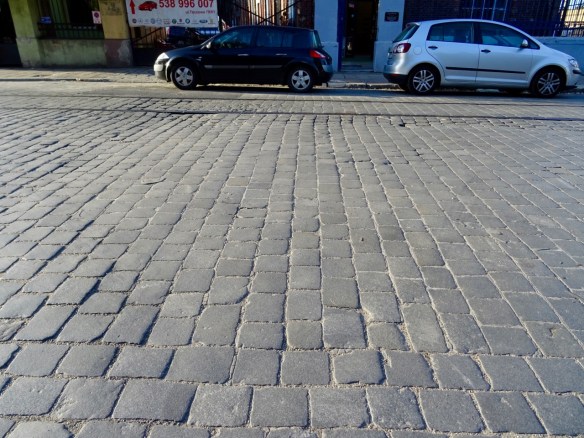
 trudymason.com